Whatever happened to the Halloween I once knew?

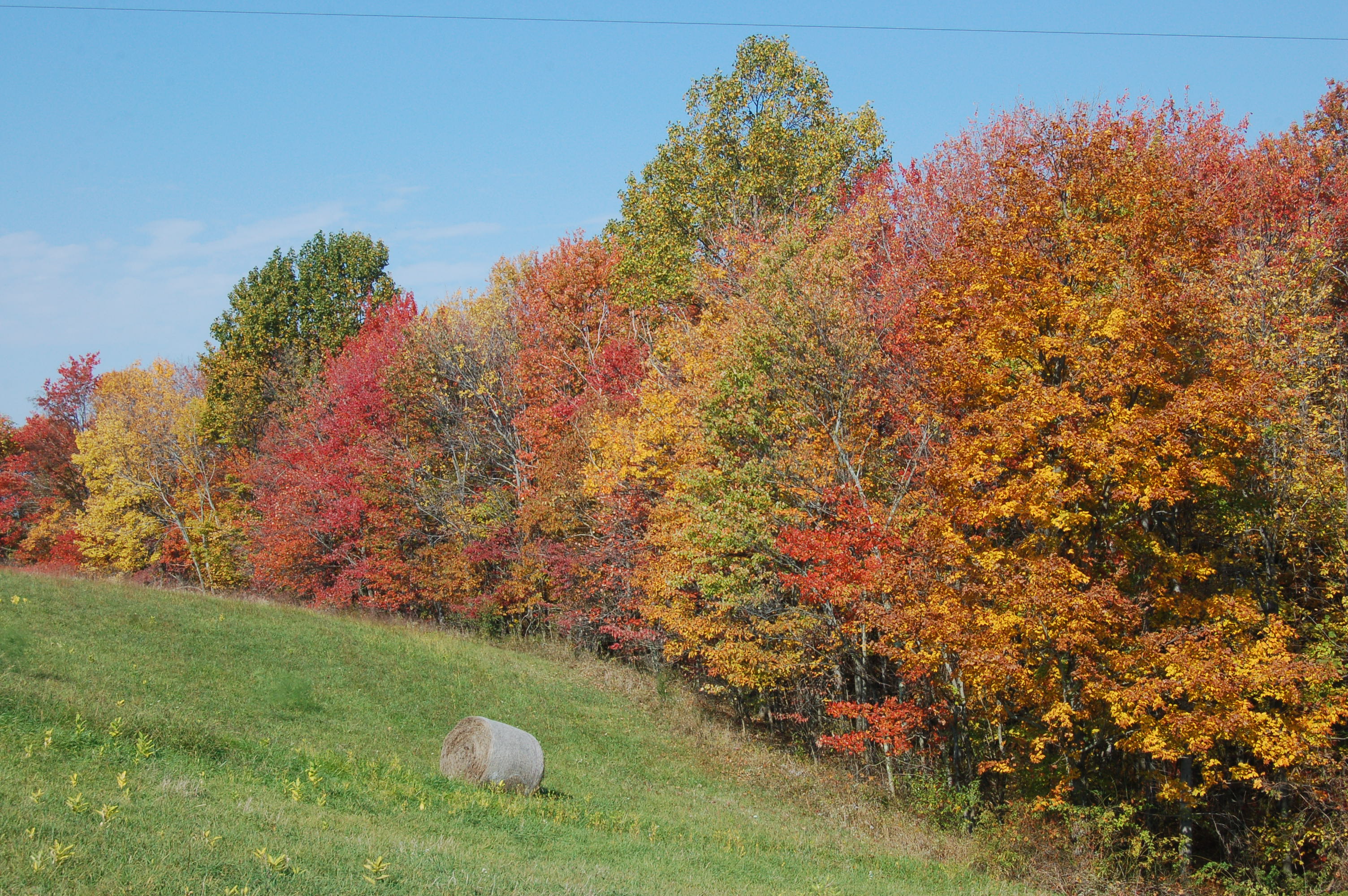
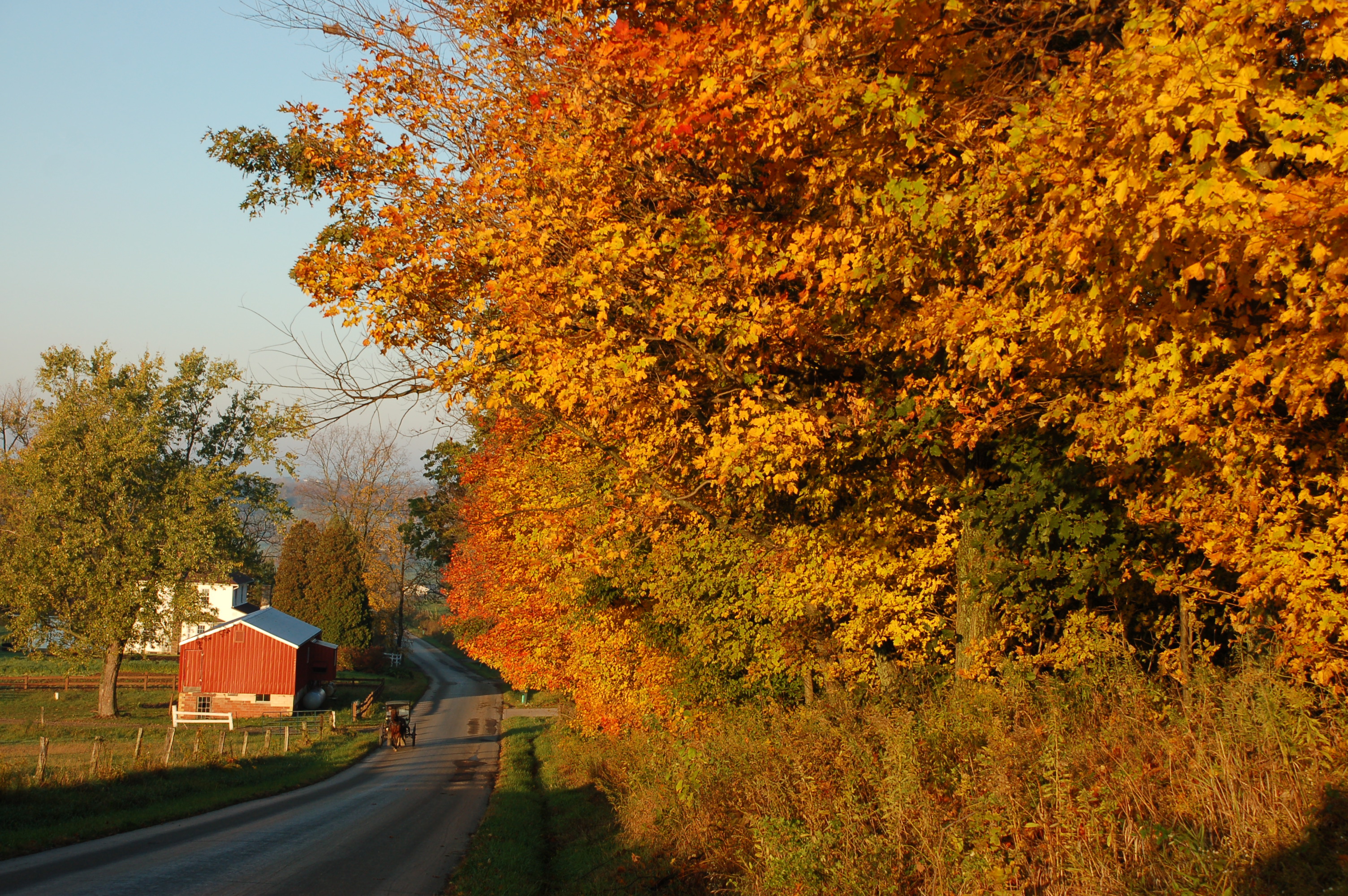
Amish country fall by Bruce Stambaugh
By Bruce Stambaugh

Halloween didn’t use to have such a bad reputation.

When I was growing up, us post-World War II youngsters looked forward to this benign, unofficial holiday. We just had fun.

Sure. There were mischief-makers, roughnecked teens that crossed the line. But they fortunately were in the minority. They certainly didn’t exhibit the violence and gore that we too often see associated with Halloween today.
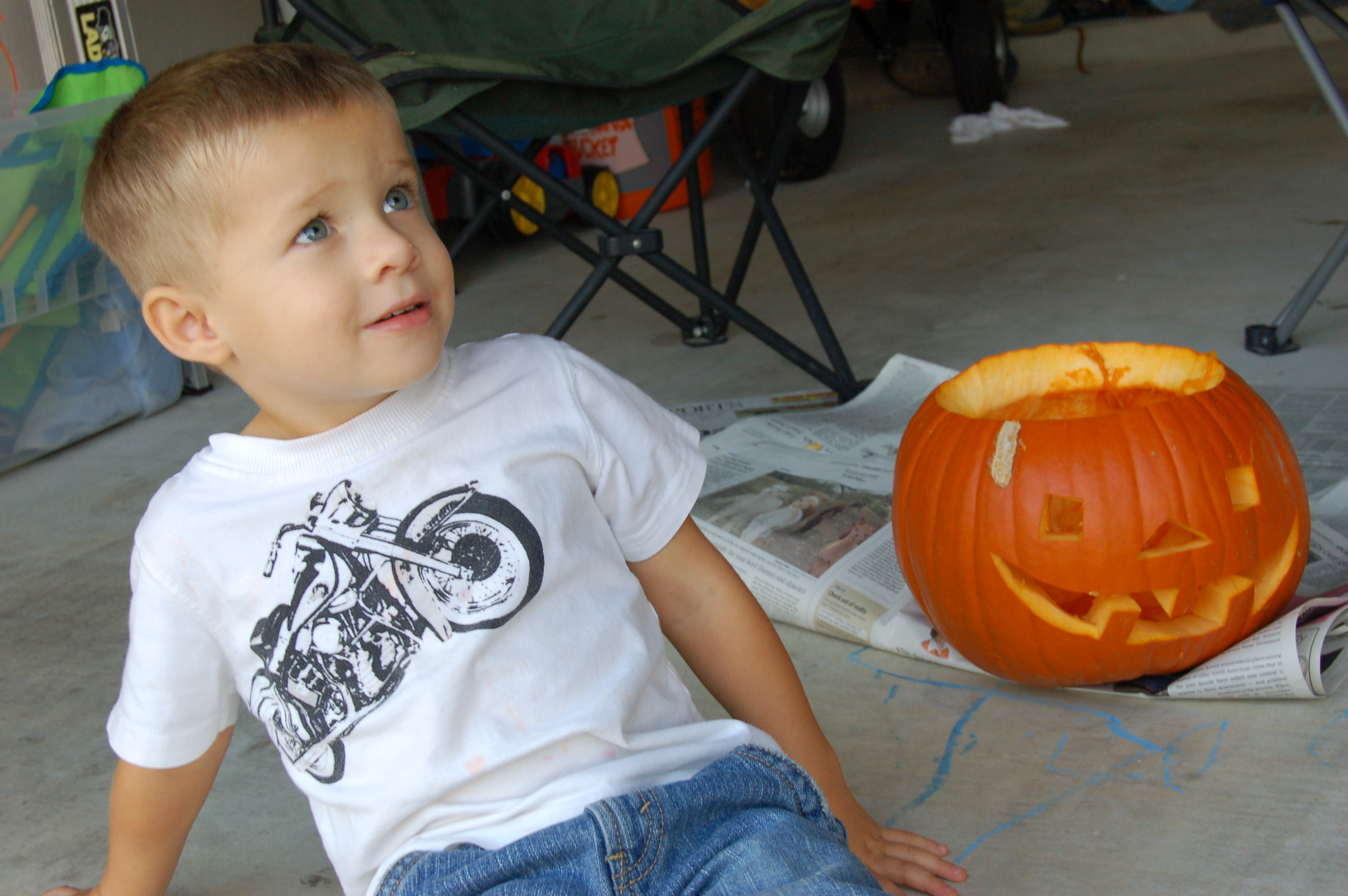
Jack 'O Lantern by Bruce Stambaugh
I remember some bully stealing our carefully carved jack-o’-lantern off our front porch. When I spotted the costumed thief running away with our pumpkin, I yelled at him. The much bigger boy responded posthaste by threatening me. Fearful, I said nothing more. I didn’t want to lose my bulging bag of candy that I had so carefully gleaned from our burgeoning neighborhood.

Other Halloween hooligans would soap windows. The really nasty ones would use paraffin, which was much harder to get off the glass. A silly prank was to throw a handful of shelled corn against someone’s windowpane. That trick was used if you got no treat at the front door, which seldom happened.

Of course there were the unfounded scares of razor blades in apples and tampered with candy. We just took precautions and had a good time.

At school, Halloween parties were held in each classroom. All the kids would dress up, many in mundane outfits like cowboys, ghosts, witches, pirates, and princesses. Homeroom mothers would prepare snacks that usually included punch and homemade cookies.

Even our parents got caught up in the fun. I distinctly remember Mom and Dad going to a Halloween party dressed as outhouses, hers and his of course. They won a prize, which I think was a bag of corncobs.
Trick or Treat by Bruce Stambaugh
My wife and I wanted those same experiences for our own children as they grew up. However, living in the country is much different than living in a suburb. There was and continues to be no Trick or Treat night in our sparsely populated neighborhood.

Local towns held Trick or Treat night, but we never felt comfortable having our children beg for candy at homes where they were not known. Fortunately, local civic groups, including the volunteer fire department, hosted a Halloween parade and a party with judging, games and treats for all area children at the elementary school.
Betsy Ross by Bruce Stambaugh
Our son and daughter went one year dressed as a tube of toothpaste and a toothbrush. Maybe they thought that would counter the cavities they would develop devouring all of that sugary candy.

To be sure, there were and still are other downsides to Halloween in rural America, including Amish Country. Pranks include corn shocks burned or moved into the roadway, and extensive toilet papering. Dozens of rolls of toilet paper are unfurled on trees, utility lines, in yards and on town squares, creating a TP style blizzard.
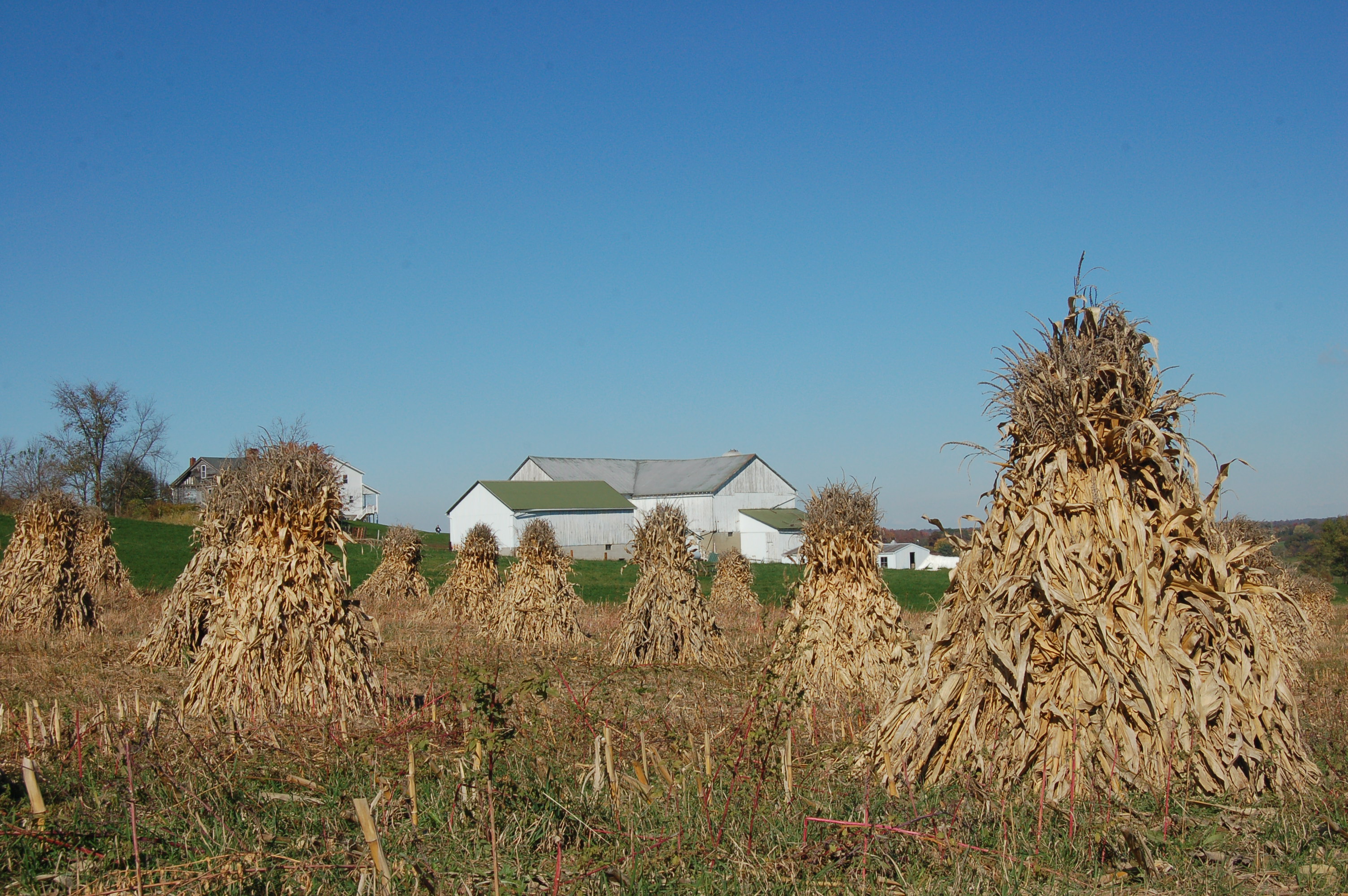
Cornshalks by Bruce Stambaugh
In our hectic world, with an unlimited stream of electronic information vying for our attention 24/7, my nostalgic description of Halloween seems pretty blasé. People today seem to have the desire to be scared out of their wits and often pay good money for the privilege.

In this age of skepticism and trepidation, some see Halloween as a demonic plague on society. They claim there is just too much evil and violence connected with the frightful celebration.

Since I tend to avoid malevolence, I’ll not quibble with that assessment. I do wonder, however, whatever happened to the Halloween that once focused on fun instead of fear.
Fog and trees by Bruce Stambaugh

Pumpkins are for more than pie

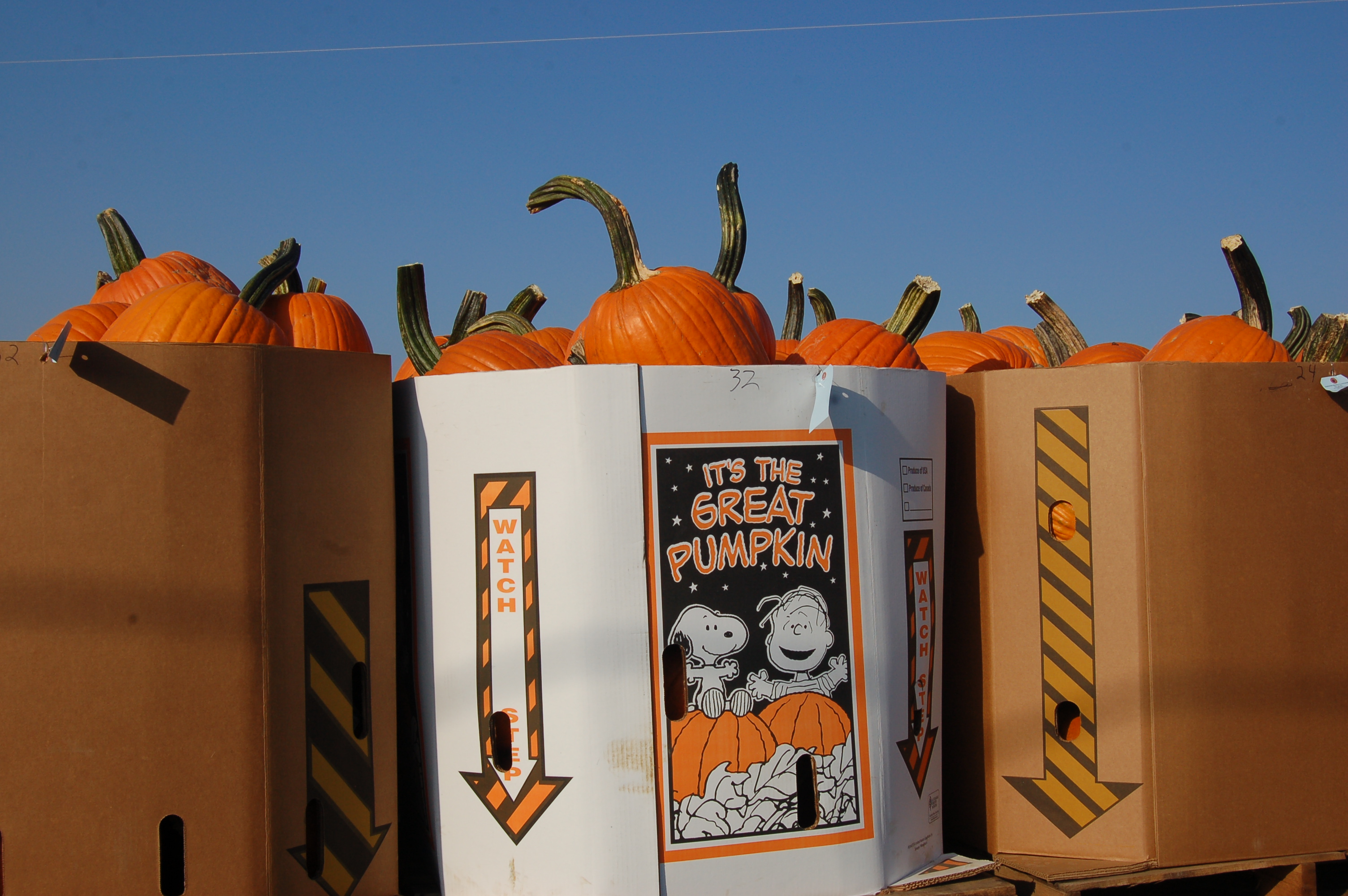
Great pumpkin by Bruce Stambaugh
Pumpkins, including the Great Pumpkin apparently, are sold in lots of large boxs at a produce auction near Mt. Hope, OH.

By Bruce Stambaugh

Besides the colorful leaves, pumpkins have to be right up there as one of the top icons of fall. The portly orange fruit seems to be everywhere this time of year.
By their sheer numbers, people appear to be in love with pumpkins. Maybe that’s because they don’t have to rake them like they do the pumpkin’s leafy fall compatriots.

Perhaps the pumpkin’s versatility is the primary reason for its popularity. Pumpkins are used for all sorts of things. My favorite, of course, is in pumpkin pie; hold the whipped cream please.

Pumpkin pie by Bruce Stambaugh
My wife's fabulous pumpkin pie.

I know I’m prejudiced. I’m partial to the pies my good wife makes. That doesn’t deter me, however, from enjoying the baking efforts of others just to prove my point.

Fall is the time of year when real, honest-to-goodness pumpkin pie begins to show up on the menus of local restaurants. There’s good reason for that. It’s pumpkin harvest time. Of course with canning and freezing, pumpkin pie can be made anytime. But given its delicate ingredients, it’s best made in cooler climes.

It’s also worth noting that the pumpkins we see for sale in the market, at roadside stands and in people’s front yards are not generally the kind of pumpkins of which pie is made. For that, you need pie pumpkins, which makes perfect sense to me.

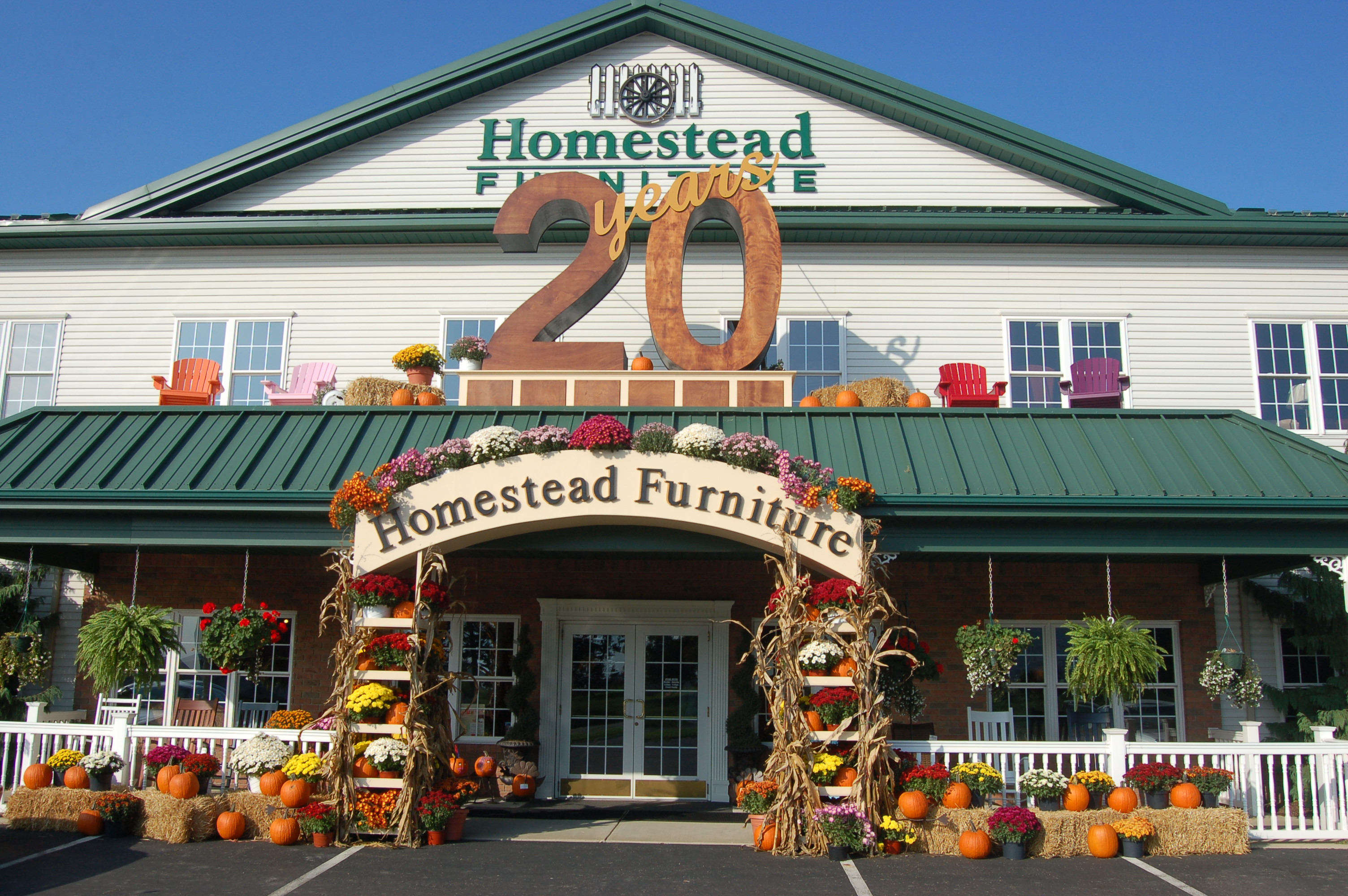
Pumpkin display by Bruce Stambaugh
Homestead Furniture, Mt. Hope, OH used pumpkins in it's 20th Anniversary Sale last October.

These pumpkins have a much higher calling. They are for show. Pumpkins decorate front porches, yard displays, commercial displays and accent fall flower gardens. Their bright orange color warms the coolest autumn morning.

Toward Halloween, people pick the perfect pumpkin for their Jack O’ Lantern. Carving a face into the anointed pumpkin can be a family affair that makes lasting memories for impressionable children. On October’s darkened nights, a single lighted candle sufficiently illuminates the caricature designed and desired.

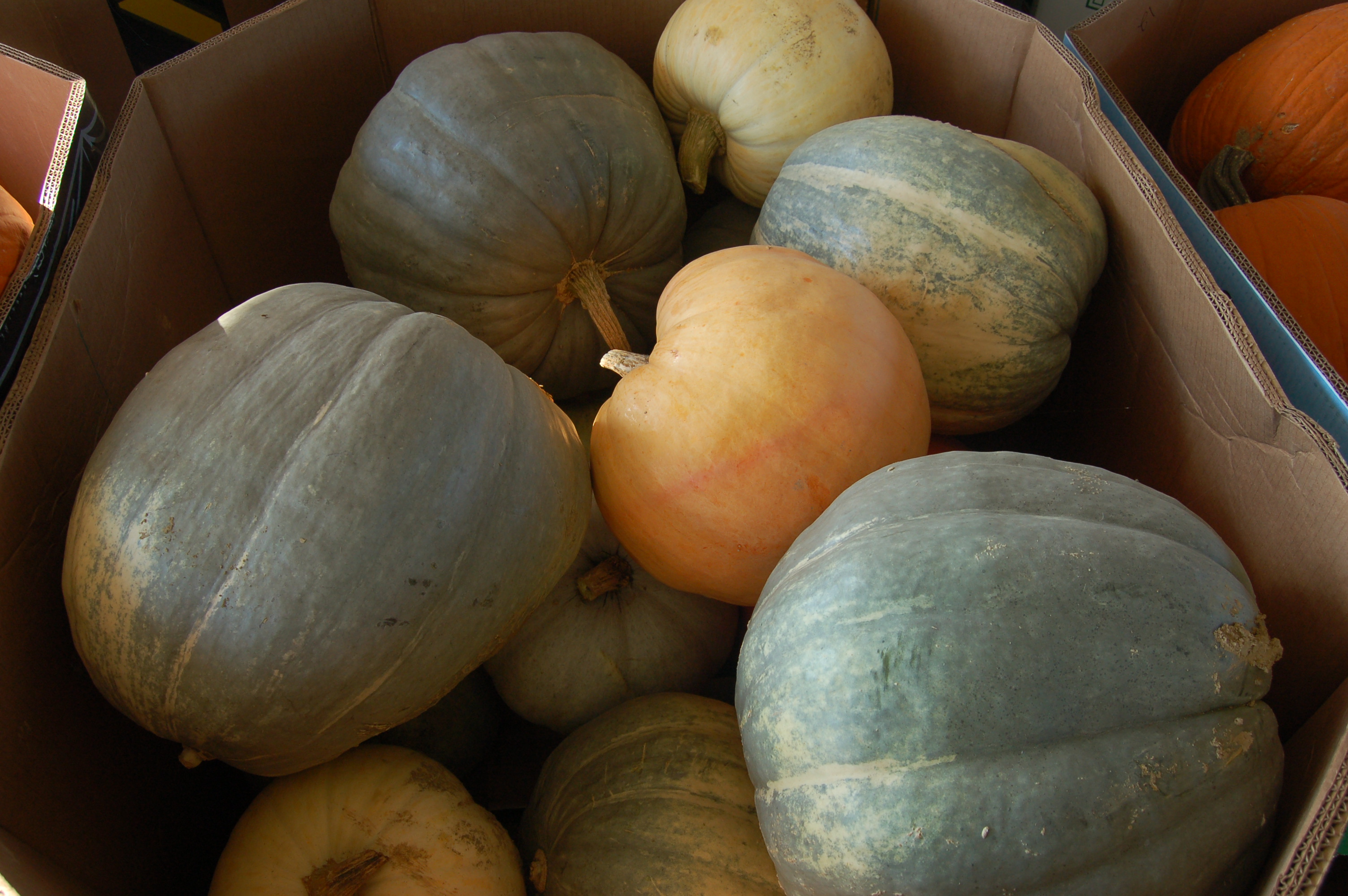
Colorful pumpkins by Bruce Stambaugh
Pumpkins of different colors.

To be chic, pumpkins now come in alternate colors. There are white ones, gray ones, brown ones and even blue ones. These, too, are prized for their ornamentation qualities, and exhibited indoors and out.

Pumpkins are so highly regarded in our North American societies that they even earn their very own festivals. Towns around the country, especially in the Midwest where most pumpkins are grown, celebrated with contests like the largest pie and the largest pumpkin grown. To date, the record belongs to a young man in Wisconsin with a pumpkin that weighed in at 1,810.5 pounds.

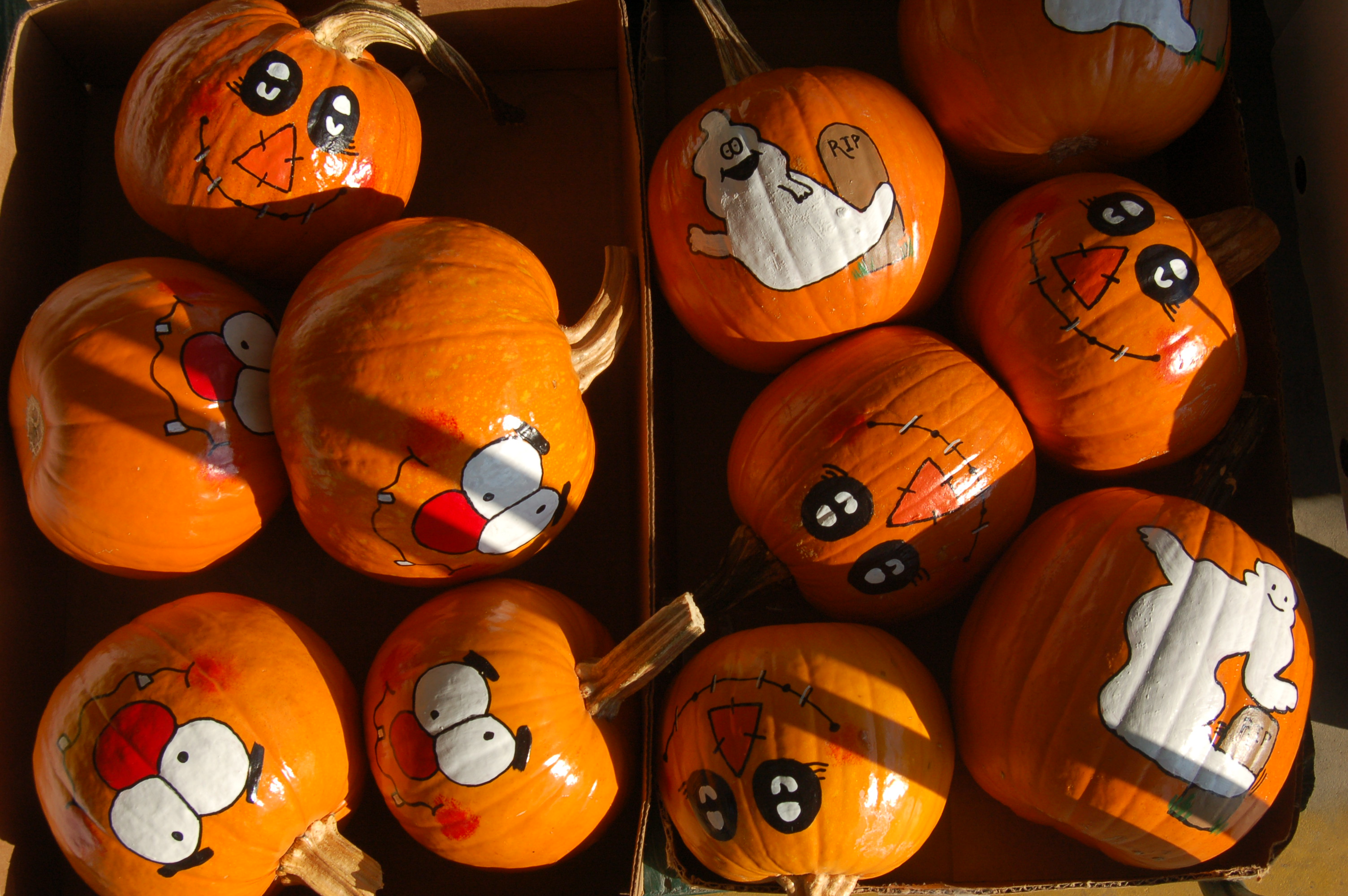
Painted pumpkins by Bruce Stambaugh
Pumpkins even get painted rather than carved so they last longer.

Pumpkins show up on our dinner tables in other forms besides pies and decorations. There are pumpkin cakes, rolls, ice cream, lattes, ravioli and soups. The seeds can even be roasted and eaten for snacks.

We shouldn’t be surprised at this. We are simply repeating history. Native Americans taught early explorers to North America to roast pumpkin slices skewered on long sticks over an open fire. Settlers learned to cut the top off a whole pumpkin, hollow it out, and fill it with milk and spices, and then bake it on hot coals. This entrée was the forerunner to our pumpkin pie.

The indigenous peoples also understood the pumpkin’s versatility. They would dry strips of pumpkin, and then weave them into mats to sit on.

Besides our early history, pumpkins have also played major roles in our folklore. Cinderella’s coach turned into a pumpkin at midnight. The headless horseman in The Legend of Sleepy Hollow threw a pumpkin at poor Ichabod Crane. Of course, Charlie Brown is full of hope, still looking for the elusive Great Pumpkin.

Whether reading, eating or decorating, enjoy the pumpkin variety show while it lasts. Now pass the pie please.

Large pumpkins by Bruce Stambaugh
Pumpkins of all shapes and sizes are sold every fall at the Mt. Hope Produce Auction, Mt. Hope, OH.

Fall, a time to die and a time to live

Fall in Amish country Ohio by Bruce Stambaugh
By Bruce Stambaugh

For those of us fortunate enough to live within proximity of giant stands of mixed hardwood trees, fall is a glorious time of year to observe life’s constant changes.

The annual autumn spectacular of the once lush leaves magically transforming the emerald landscape into magnificent warm rainbows carries us into nostalgic reflectivity. This year I couldn’t help but note a symbolic similarity in the recent death of the ingenious Steve Jobs, the guru who started Apple Computer.

Rainbow of colors by Bruce Stambaugh
Fall's rainbow of colors on display.

The very first computer I ever used was an Apple. Just the name of the computer endeared educators to these amazing, easy to use personal computers. School systems across the country bought them for student and teacher use. The fact that Apple was wise enough to give teachers and school districts educator discounts on their purchases made them all the more attractive.

One of the schools where I was principal acquired an Apple computer for the library in 1989. Now obsolete floppy discs were inserted to boot programs or software for students to use. I have primarily used Apple computers ever since.
Apples by Bruce Stambaugh
Shortly after hearing of Jobs’ death, the Internet was full of information about his life. I found many of the touching quotes and reflections via posts on Facebook.

One particular poignant clip greatly moved me. It was a 15-minute video of Jobs’ address at the 2005 Stanford University commencement. No one would have mistaken the pure genius that produced innovative personal electronic devises like the iPod, iPhone and iPad for Shakespeare. But his message was prophetic nevertheless.

His words were neither flowery nor convoluted. Like his multitude of popular electronic inventions, his exhortation was straightforward and concise. He had three simple points for the graduating class that day. Each was illustrated by personal stories from his humble yet incredible, creative life.

His final point was perhaps the most powerful and applicable. Just a year removed from having survived pancreatic cancer, Jobs told the sun-drenched audience “death is very likely the single best invention of life.” He told those gathered that if you live each day as if it were your last, someday you’ll be right. Jobs was as pragmatic as he was innovative.

Though he had hoped to live decades longer, Jobs emphasized that remembering that he would be dead soon was the most important motivator for him. He related that view even though he of course had no idea how long he would live. Jobs said no one wants to die, but death is the destination that we all share. Death clears out the old to make way for the new.
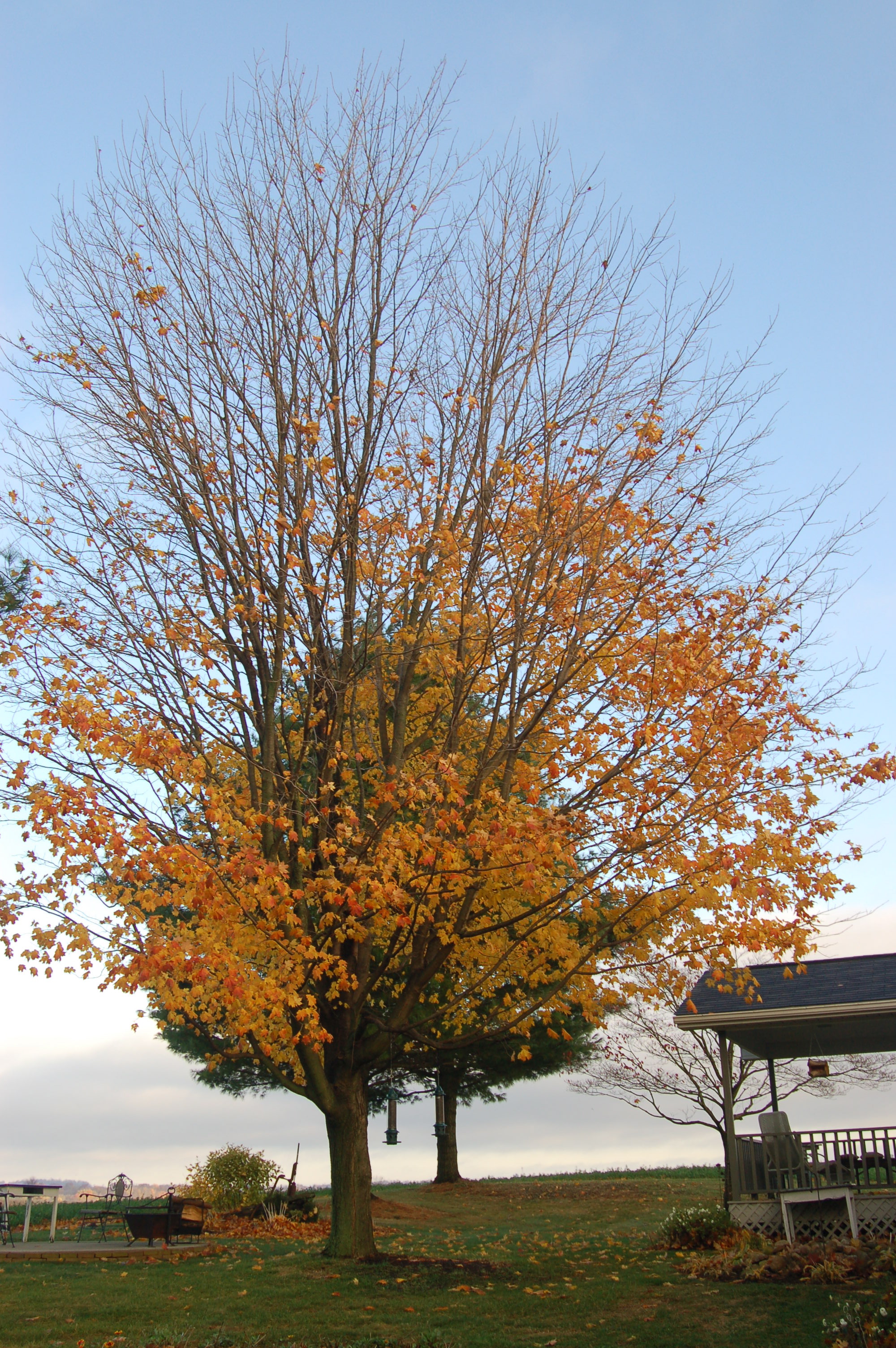
Maple tree by Bruce Stambaugh
That’s the way it is with the leaves. They bud in spring, unfold overnight to lush, lovely green or crimson until their predictable fate in the fall. Having done their job of helping the tree thrive and grow another year, the leaves succumb to the inevitable.

The leaves unveil their natural, vibrant colors, keep us captivated for a few precious days, and then drop and wither. Left behind is a tiny bud that will become next year’s new foliage. The old give way to the new, returning to the earth from whence they came.

Our lives follow the same cycle, though most span more than a year. The colors of some leaves are more remarkable than others. In the same way, some lives shine brighter than others for humankind.
Sugar maple leaf by Bruce Stambaugh
Steve Jobs was one of those brilliant leaves.

Admiring children’s creativity, especially the grandchildren’s

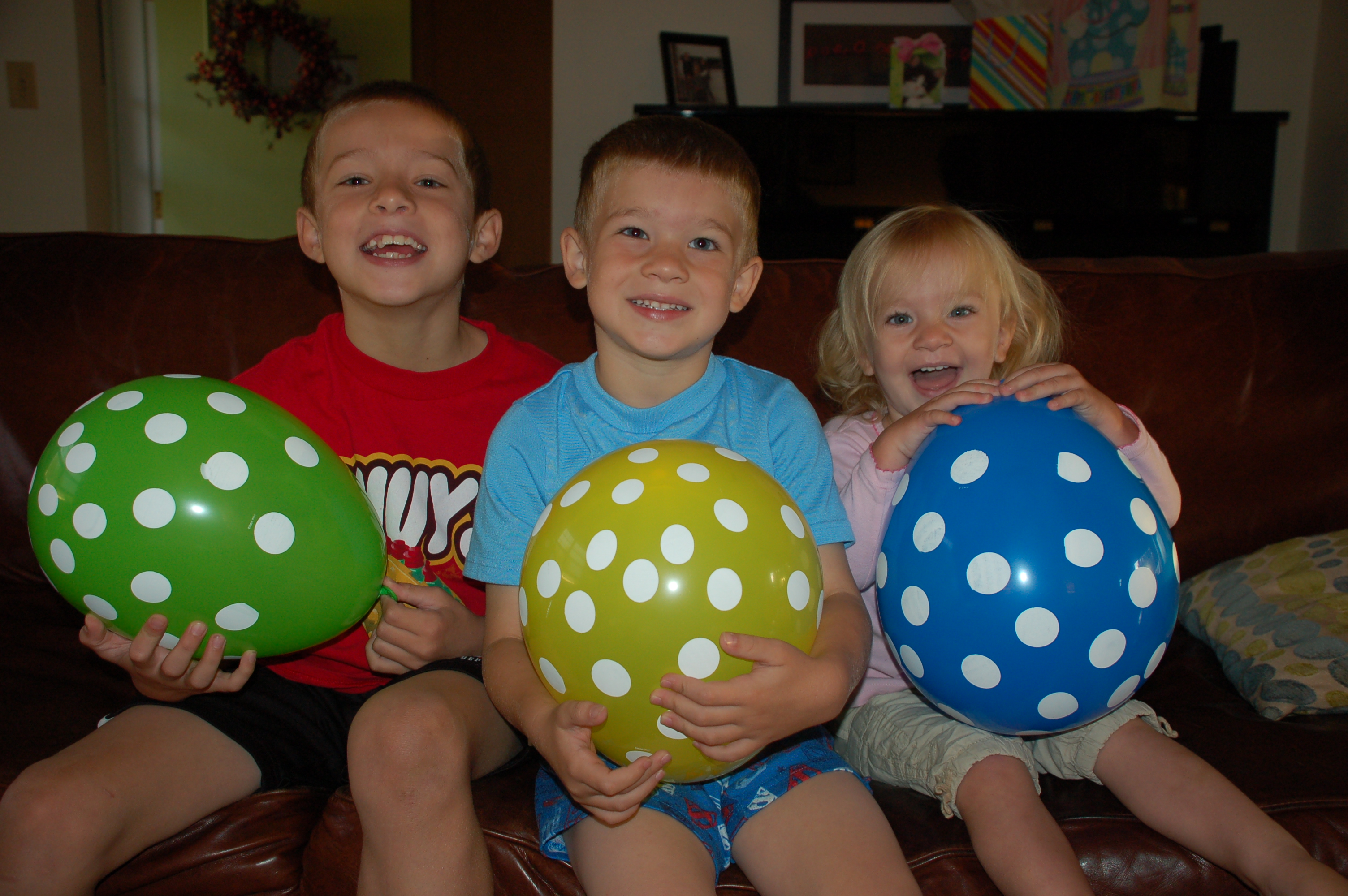
Grandkids by Bruce Stambaugh
Our grandchildren, Evan, Davis and Maren.

By Bruce Stambaugh

A painting hangs on a wall in my home office where I spend much of my workday. The artistry isn’t one of my mother’s rich landscape watercolors.

The painting is simple in content, perhaps even a bit juvenile in style. That’s why I like it so much. I purchased the watercolor from a former student.

The sixth-grade artist took a common setting and made it exquisite. She had captured perfectly the daily scene in her classroom. A row of colorful books lined the soldier brick windowsill. The black tattered blinds, cords hanging limp, covered the upper third of the old steel framed windows.

I wanted the painting as a memento. I also wanted to encourage her to keep painting. That was a long time ago, and I don’t know if the girl, now a young woman, still paints or not. I hope she does. She had a creative eye.

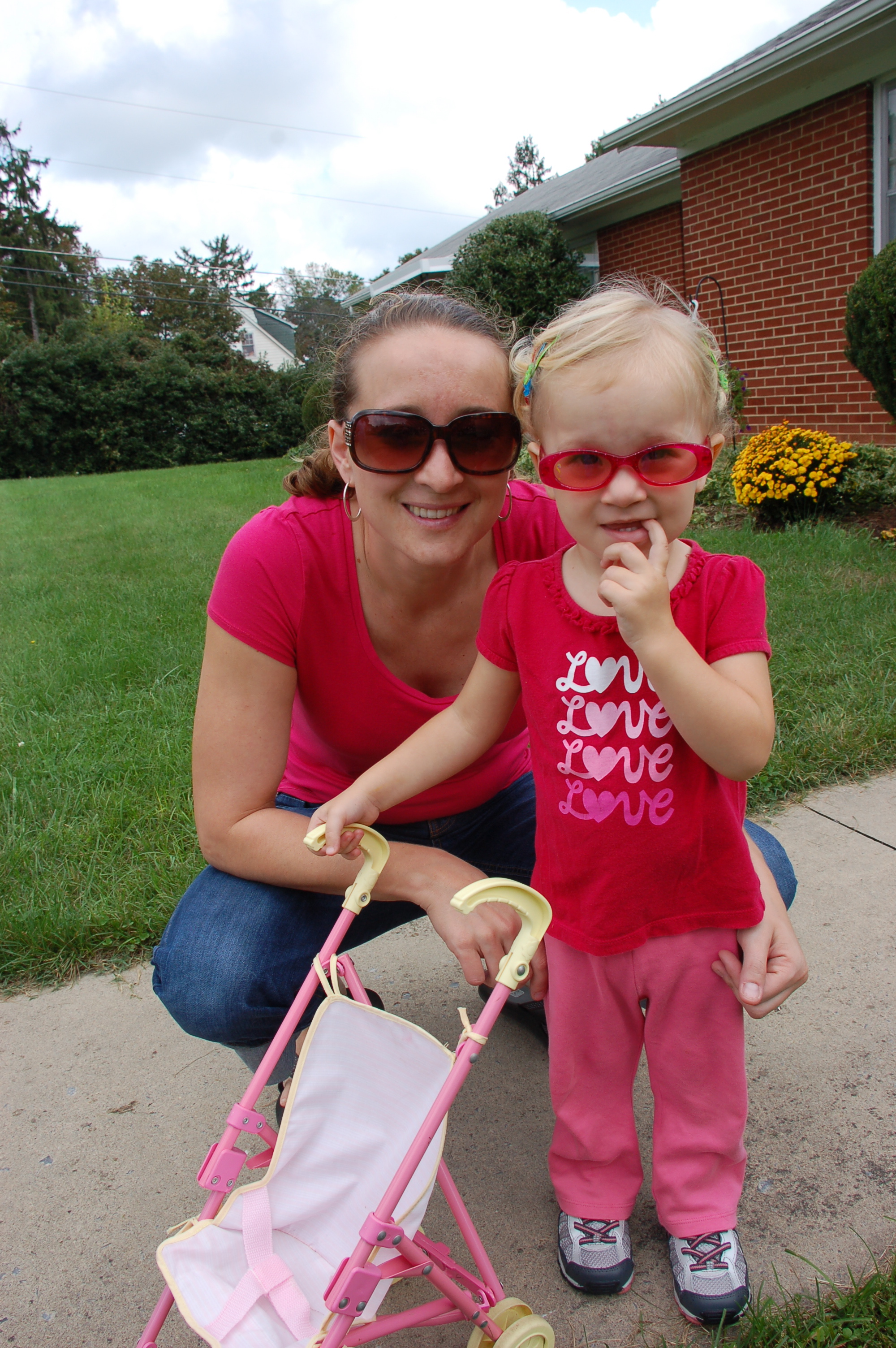
Mother and daughter by Bruce Stambaugh
Maren insisted that I take a picture of her with her mommy and their sunglasses.

My middle grandchild does, too. His older brother by two years, and his 2-year old sister also have their own individual flashes of creativity. But Davis is different for sure. He is left-handed after all.

For a 5-year old, he seems to see patterns that others, myself included, look right through or ignore altogether. Davis may have inherited some of his great-grandmother’s artistic ability.
My wife and I visited recently with our daughter and her family in Virginia’s beautiful Shenandoah Valley. During our stay, Davis’ creativeness burst forth on more than one occasion.

He showed me his rock collection, which is housed on the porch of an unused entrance to their home. Davis uses several characteristics to choose his rocks. Size, color, texture, shape, and weight are all his geologic requisites.

I was honored when he asked me to identify a rock he chose to take to preschool to share with the other students. I told him it was granite, and Nana chimed in that countertops are made of granite. This took us to the Internet for pictures of the coarse-grained igneous rock. Davis was fascinated with all the different types and colors.

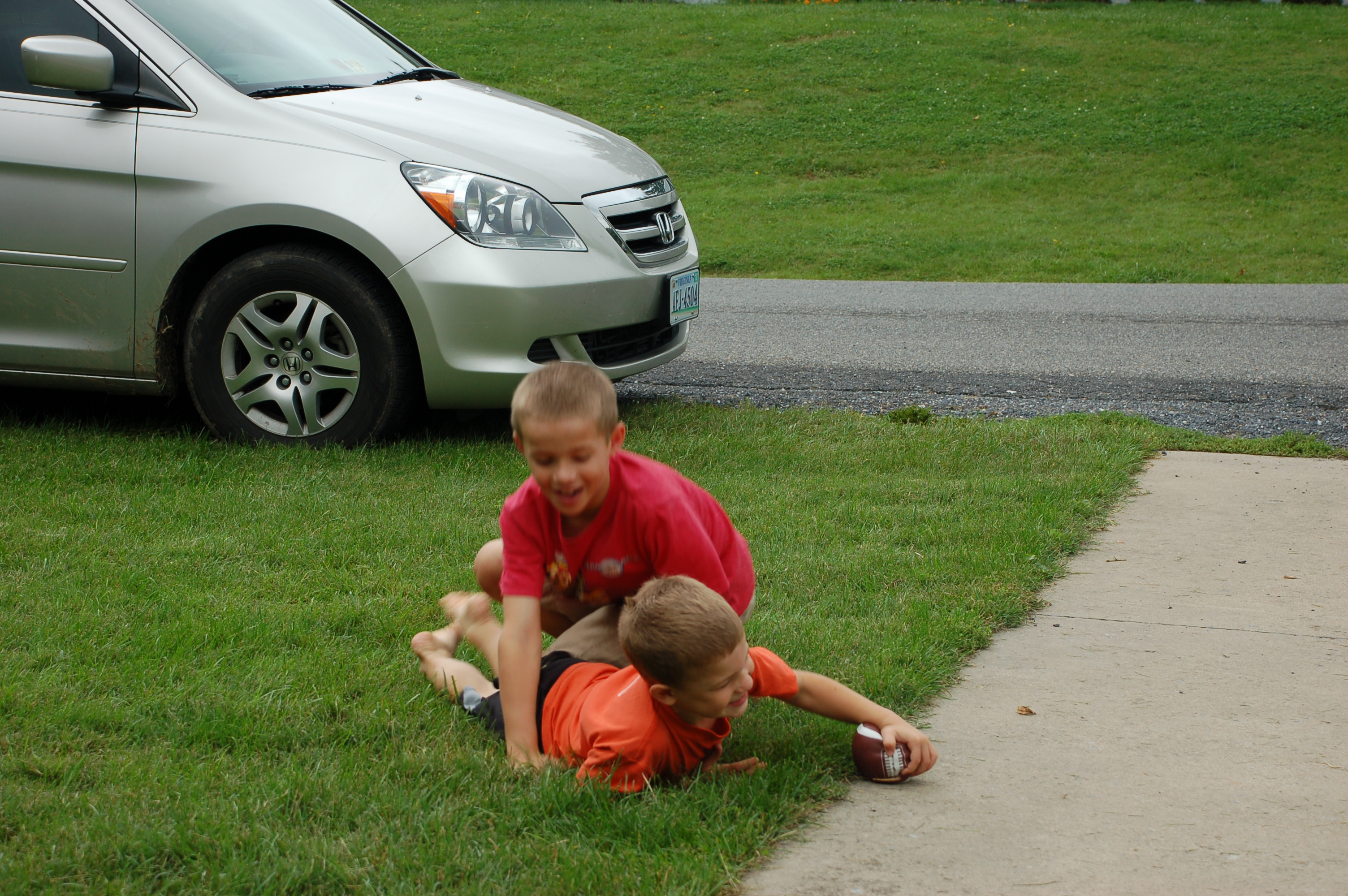
Touchdown by Bruce Stambaugh
The grandsons enjoy their football.

While playing football with him outside, I pointed out a big puffy cloud floating overhead. Davis informed me that it was a dragon. On second glance, I don’t know how I missed that obvious observation.

The sure sign that we may have a budding Picasso in the family was Davis’ intensity while drawing. He stared at the Wii characters on the television screen as his big brother played a game. Davis turned to his drawing paper over and over again, dedicated to replicate what he saw. He didn’t quit until he was satisfied with what he had sketched.

His siblings, Evan and Maren, draw, too. Evan is a meticulous stay-between-the-lines kind of guy, while little Maren is just honing her abstract expressionism. She sent a sample of her early work back to Ohio with us.

Sketching by Bruce Stambaugh
Davis sketching in the pea gravel at the playground.

At the park, Davis discovered a shark designed cleverly onto a section of a gigantic wooden play set. Like the dragon, I didn’t see it until Davis pointed it out. The sharp teeth, the menacing eye, the dorsal fins and the fanned tail were all right there. Creative kid that he is, Davis sat down in the pea gravel and began to outline a replica with his index finger.

I marvel at children who can see the extraordinary in the ordinary. I admire it all the more when the children happen to be youngsters I know well, like my grandchildren.

Shark by Bruce Stambaugh
Davis and his playground shark.

Ornithology is for the birds

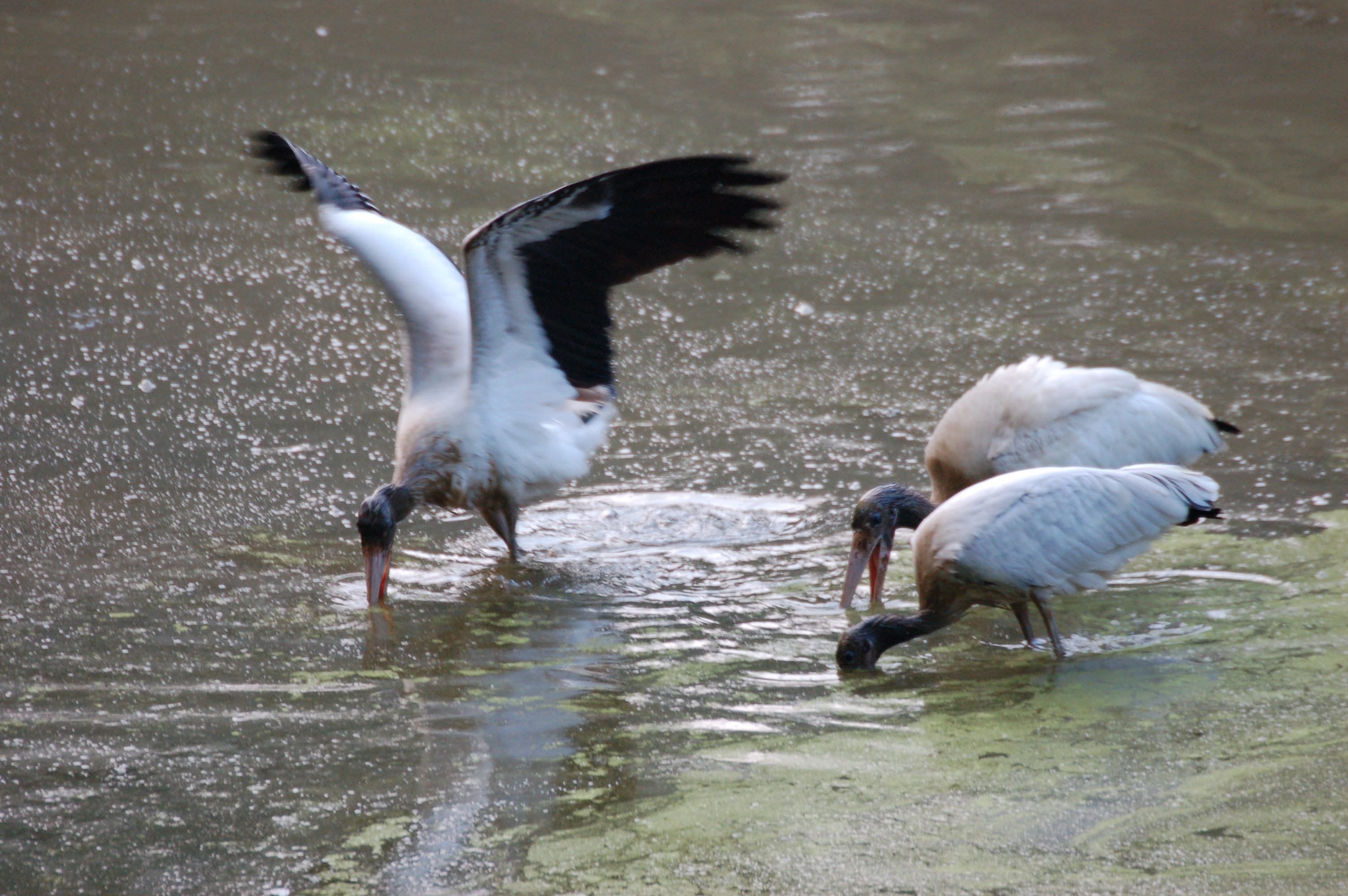
Wood Storks by Bruce Stambaugh
These Wood Storks appeared in a marshy area in Coshocton Co., Ohio in August 2008. They normally are coastal birds in the southern U.S.

By Bruce Stambaugh

More often than not, birders take it on the chin just for being birders. Compared to football, American or Australian, it’s not exactly a contact sport, at least in the physical sense.

Birding is, however, very popular worldwide. That might be because of the many amenities that bird watching affords, and those that it avoids, like unnecessary roughness.

Why is birding so universal? Let me count the ways.

Birding is fun. Birding can be enjoyed by all ages. Birding doesn’t require a lot of expensive equipment, though you can spend big bucks if you so choose. Birding can be free. The birds come to you.

Black Vultures by Bruce Stambaugh
The owners of this camper probably didn't expect to get this friendly with these Black Vultures.

Birding can be enjoyed year round. Birding is an inclusive activity. Birding can be enjoyed by persons of any age. In fact, it is not uncommon to find entire families enjoying the sport together.

Birding is addictive, turning that usually negative word on its head. Once you learn a little about birds, you intuitively want to know more.

Birding is interactive. Birds get to know you. You get to know the birds.

Green Herons by Bruce Stambaugh
I had the luxuary of observing this pair of young Green Herons from my back porch.

Birding can be done anytime anyplace, hiking, biking, sitting, traveling, on the beach, in the woods, on vacation, or while at work. All are good times to “bird.”

Birding not only introduces you to new species. You make new friends while enjoying an outing, too.

Birding is both personal and interpersonal. You make your own sightings, but immediately share the information with other birders to verify the identification. Others do the same for you. Birding it is both a sociable and a social sport. It is a whole lot more fun done with others than alone.

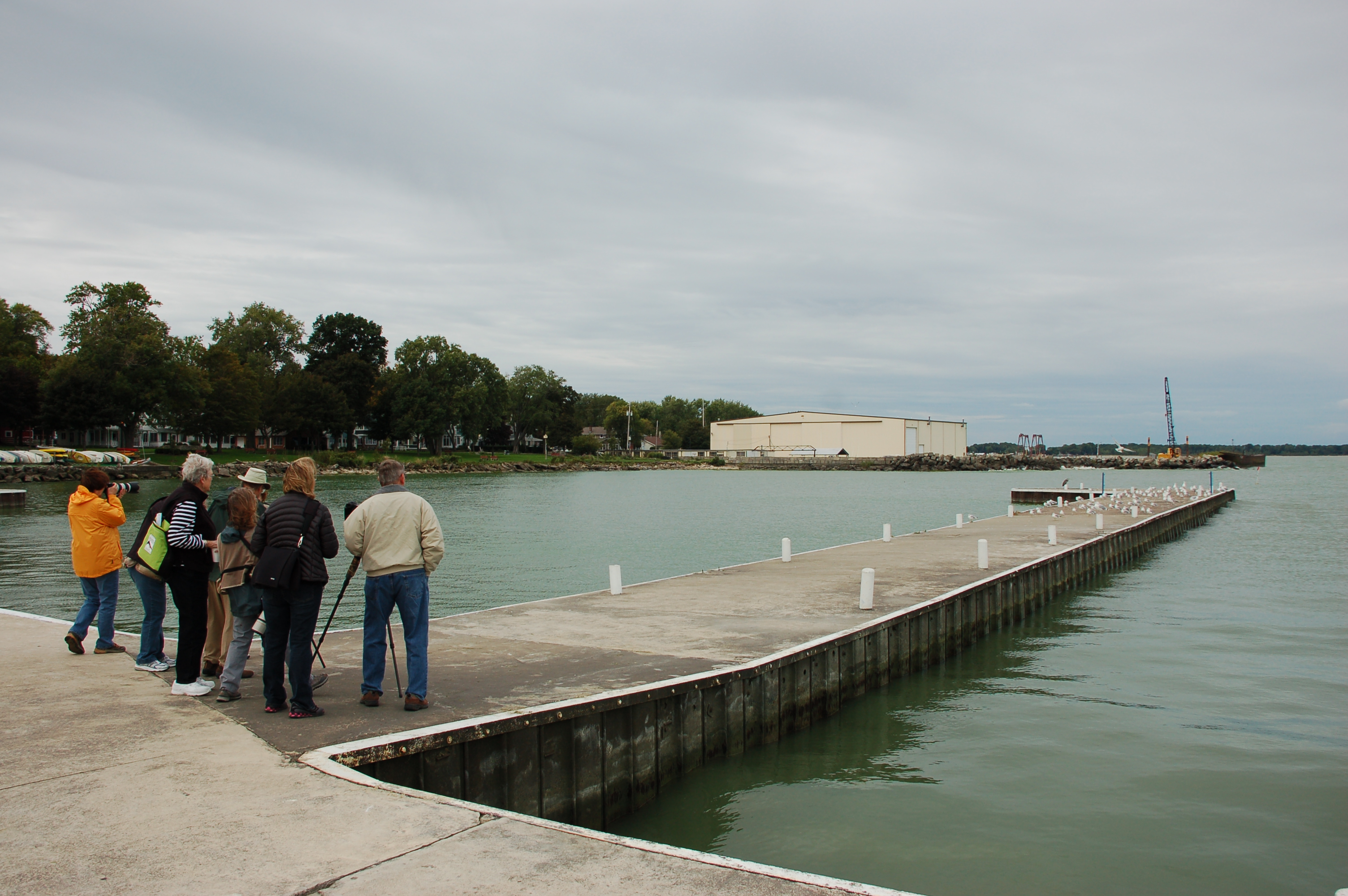
Birders by Bruce Stambaugh
Birding is a social sport, best enjoyed in the company of other birders, whether novice or experts.

Believe it or not, birding can and does get competitive, but in a good way. Many birders compile a life list, an accounting of all the bird species they have ever seen, which includes when and where.

When a rare bird is spotted, birders shun selfishness. They call other birders or have it posted on a bird alert website. Soon scores of birders show up hoping to see the rarity for themselves.

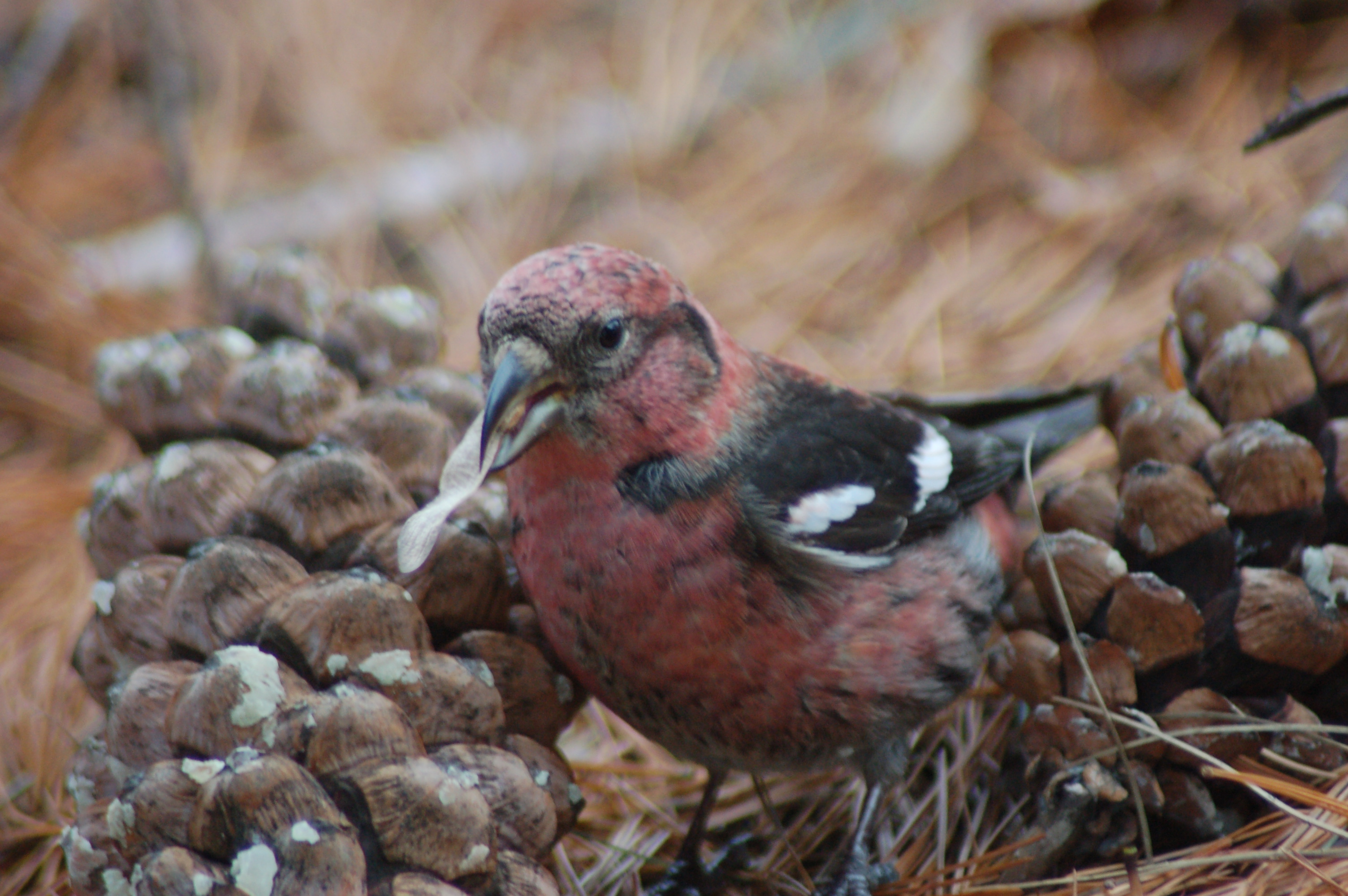
White-winged Crossbill by Bruce Stambaugh
A flock of White-winged Crossbills spent a few days in the Holmes Co., Ohio area in March 2009. They migrated from pine grove to pine grove, including the one in my own backyard.

When a quartet of Wood Storks, birds usually found in Florida, appeared in Coshocton Co., Ohio awhile back, someone asked me if I had seen them. I hadn’t. They gladly gave me directions and I was ready to go. But I didn’t go alone. I filled my van with other birders, three generations who wanted to see the storks, too.

Birding leads to hospitality. You welcome birds by feeding them. You greet and meet other birders if you have a rare bird arrive, even having them sign their names and where they are from. That’s just common etiquette among birders.

Tree Sparrow by Bruce Stambaugh
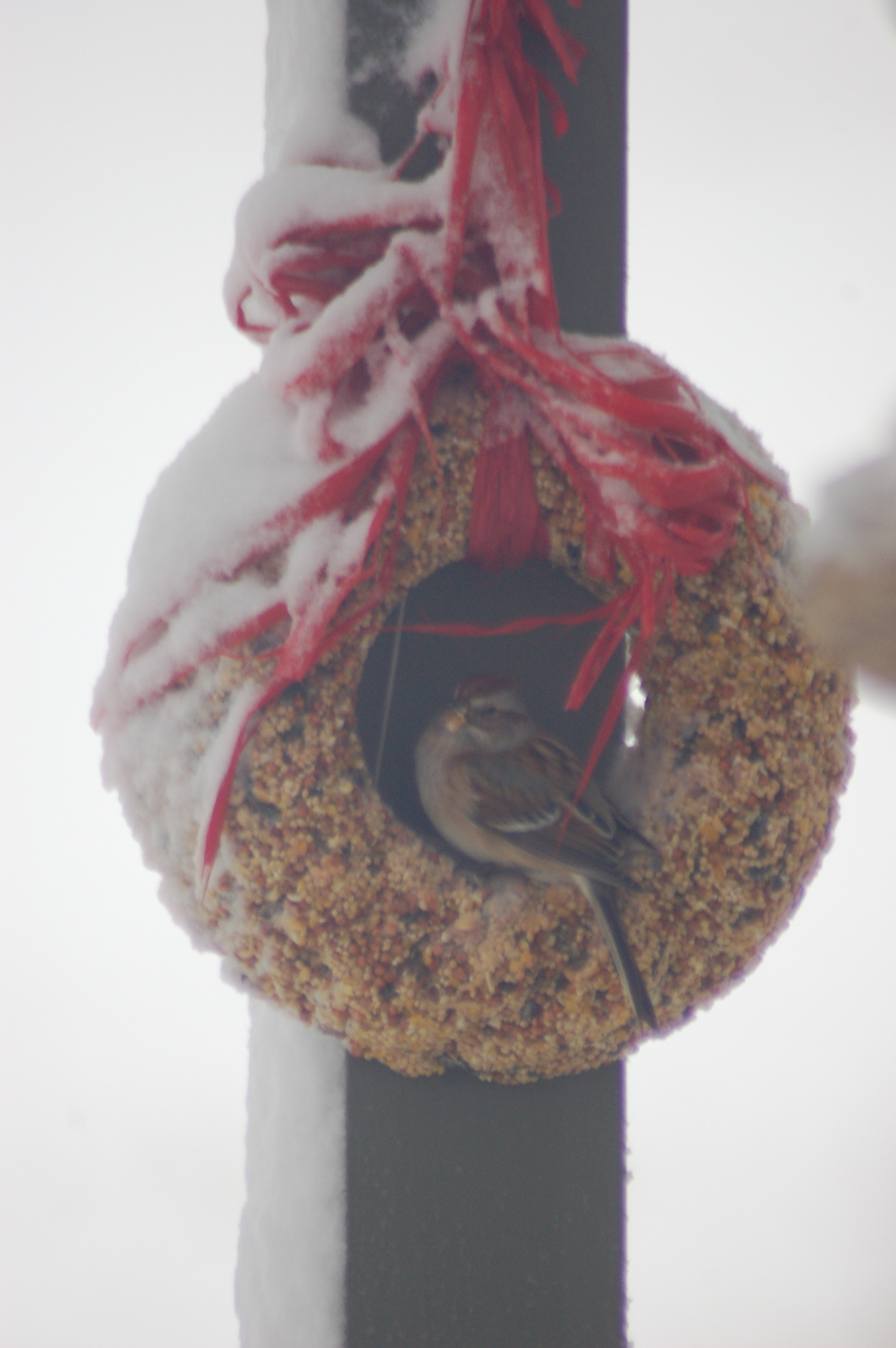
This Tree Sparrow found the perfect refuge from a harsh winter's storm.

Birding invigorates your senses. The range of songs and calls of birds are often heard before the birds are seen. The amazing array of bird plumage dazzles the imagination.

Birders are polite and follow directions. Hundreds of birders from 37 states and 10 countries attended the Midwest Birding Symposium recently in Lakeside, Ohio. A Lakeside resident was impressed that the birders actually stopped for stop signs.

Birders are clean and emphasize being green, preferring reusable water bottles to disposable plastic ones. Birders are nice to others and the environment.

Birders are teachers. They are happy to share what they know and see.

For the birds by Bruce Stambaugh
This vanity plate leaves no doubt about the hobby of this driver.

Ornithology is the scientific study of birds. Given all their positive characteristics, the study of birders could be labeled “civility.” Birders clearly are their own special flock.

It’s the plum time of year

Fall sunset by Bruce Stambaugh
The sunsets in the fall are truly amazing.

By Bruce Stambaugh

For those of us fortunate to live in North America’s temperate zone, this is the plum time of year. I mean that literally and figuratively.

The literal part is that locally grown plums are at the peak of their ripeness. I’m just plum crazy for plums.

I remember traveling with my grandfather, who knew as many people in the world as my gregarious father did. Grandpa Merle loved to stop at roadside produce stands, especially where he knew the proprietors. If they had ripe plums, he always bought a peck or two.

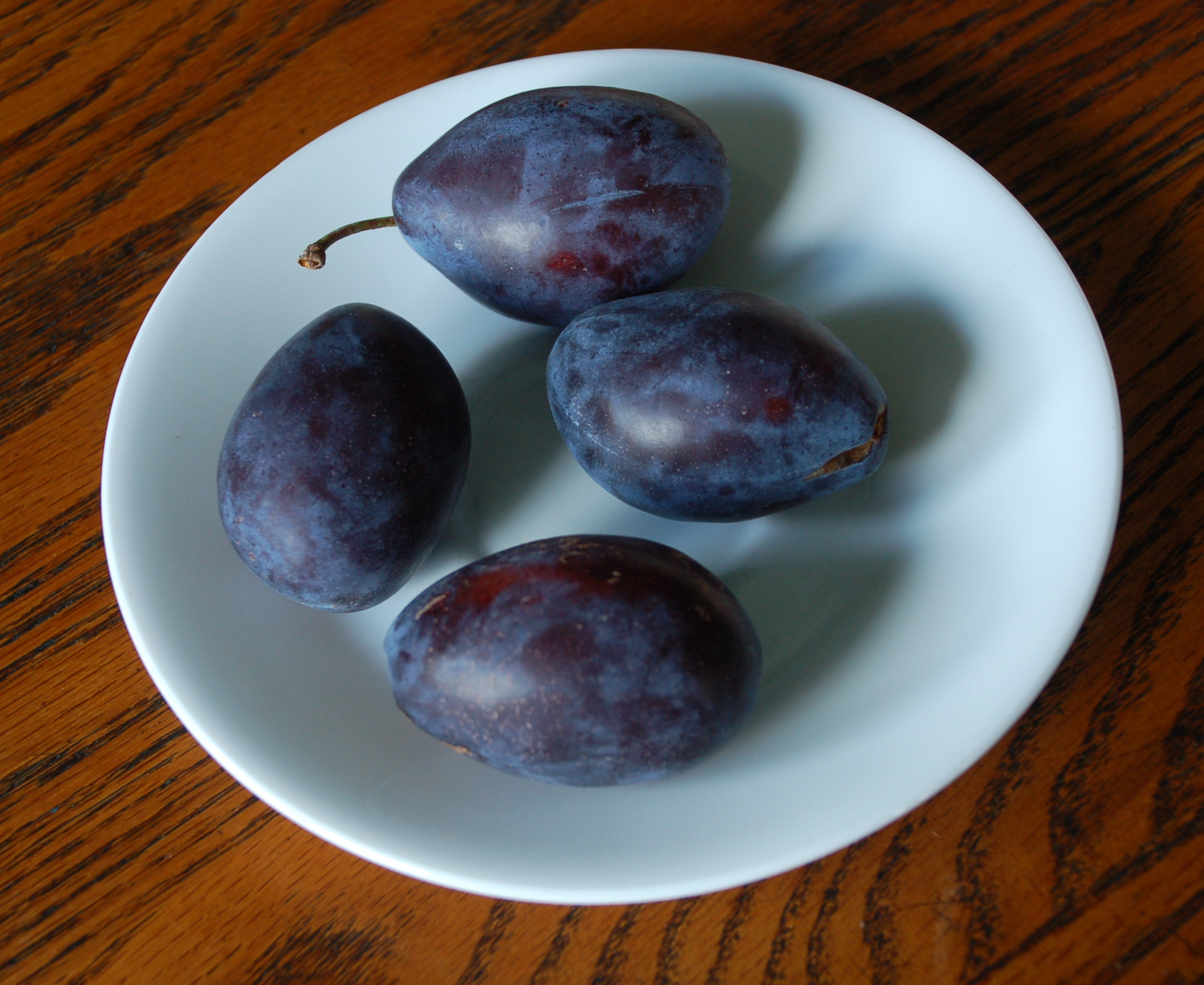
I loved everything about them, their simple size, their football shape, their blue violet sheen, their light greenish-yellow flesh, their sweet tart taste, and even the pit.

Sugar plums by Bruce Stambaugh
The variety of plums locally referred to as sugar plums.

I liked the size because, especially for a kid, they weren’t too big, which meant we could usually eat more than one. I liked their oblong shape because it was easy to bite in to.

I found the plum’s color inviting. The moist sweetness with the tart aftertaste was both delicious and curious. I liked the texture of their meat and the fact that, unlike other fresh fruit, you could bite into them without having juice run down your arm and drip off your elbow.

Much to my mother’s chagrin, I often plopped a whole one in my mouth. My mother highly discouraged my poor manners to no avail. I often eat the lovely plums the same way today.

Once devoured, that left the seed. I didn’t eat it of course. For whatever reason, I tucked the pit, which mirrored the shape of its fruit, into my left cheek and sucked on it for hours. I could play an entire baseball game with a plum seed nestled between my cheek and gum. It seemed to help keep my mouth moist. Besides, it was better than the usual baseball alternative, snuff.

All those memories resurfaced for me when my wife brought home some plums from the local produce stand. They were accompanied by Bartlett pears, squash, zucchini and preserved sugar beets, too. The fall harvest was on, one of the primary symbols of the season.

Holly berries by Bruce Stambaugh
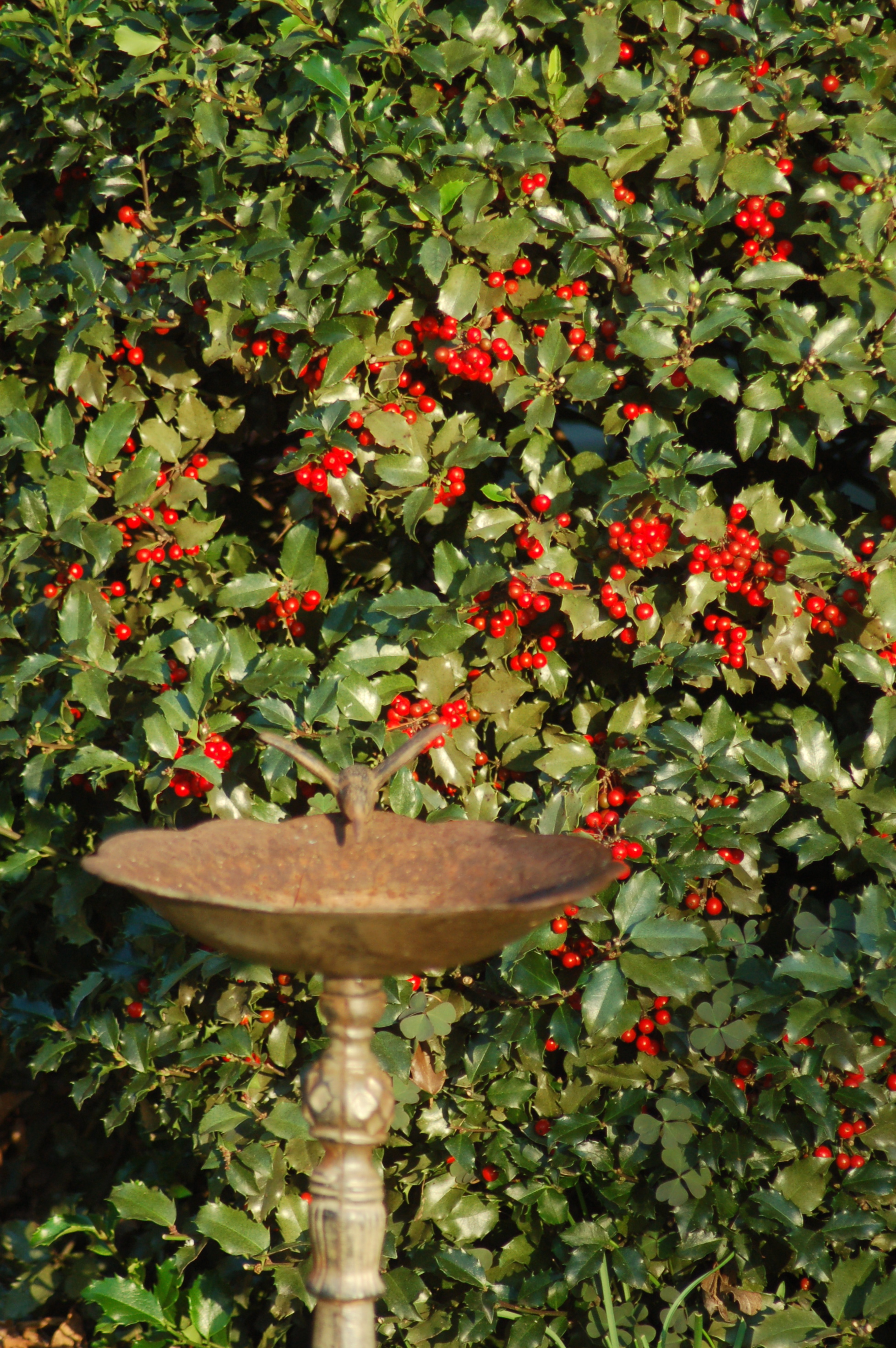
The holly berries have turned bright red, a nice contrast against the bush's prickly green leaves.

We are enjoying an abundance of tomatoes that have seemed to ripen in our modest patch all at once. There isn’t one heirloom I don’t enjoy, and they can be eaten in so many different ways, right off the vine, fresh salsa, in sandwiches, sauces, and with pasta.

Our neighbors added to the feast by insisting we help them out by accepting and consuming a sampling of the last of their bumper crop of sweet corn. It was amazingly sweet for this late in the growing season.

The days have grown shorter and cooler, both daytime and night. The leaves on the deciduous trees have begun to turn. They started falling shortly after Labor Day.

The webs of black and yellow garden spiders catch the frequent morning mist and then sparkle diamonds in the sun’s rays. The sunrises and sunsets are breathtaking, each one picture perfect.

Golden rod by Bruce Stambaugh
Though weed that it is, golden rod brightens even the haziest of mornings.

The dogwood and holly berries are bright red. Yellow jackets are everywhere. Unkempt fields, once purple with ironweed blooms, have morphed to mustard with thousands of goldenrod heads bending from their fullness. Wild tickseed sunflowers brighten the dustiest roadside.

Autumn has arrived. Either metaphorically or realistically, transitioning from summer to fall in northern Ohio is a plum time of year.

An empty nest is a good thing

By Bruce Stambaugh

We humans can learn a lot from bird behavior.

A pair of Rose Breasted Grosbeaks had frequented a backyard hanging feeder filled with sunflower seeds for much of the summer. Time and again they ferried nourishment to their young somewhere deep in the woods. When they were ready, the young fledged and flew the coop. The nest was empty.

Rose Brested Grosbeak by Bruce Stambaugh
A male Rose Breasted Grosbeak at the oil sunflower feeder.

My wife and I knew early on in our child rearing that the day would come when our daughter and our son would both be gone. They would grow up and begin lives of their own. That’s as it should be.

The main role of parents is to raise your children the best you know how, imperfectly to be sure, and then let them go. They are adults. They can use their own wings to fly through this crazy world of ours.

Still, I have encountered parents who long for the days when their children were younger. They just can’t give them up, even though they are adults. The comments have not only come from newbie nesters, also known as helicopter parents, who hover over their college freshmen. Veteran parents whose “children” left long before our own also seem melancholy.

Empty nest by Bruce Stambaugh
No post about the empty nest would be complete without a picture of an empty nest, in this case a House Wren's nest in an Eastern Bluebird box.

Ideally, the child/parent relationship should go something like this. As infants, the children are totally dependent on the parents. As they grow and mature, they change from children to young adults, responsible for their own actions.

By their late teens, the kids may go off to college, like our children did, or simply leave home to begin life on their own. It is at this critical point in the family relationship cycle that parents need to freely release their offspring.

Unfortunately, given the current extended downturn in the global economy, jobs are harder to come by. The reality for some is that out of financial necessity adult children and sometimes grandchildren have had to move back in with parents and grandparents.

In the 16 years since our nest has been empty, my wife and I have had opportunities to travel without the constraints of busy teenagers’ schedules. More often, we have simply enjoyed our quiet times together. Of course we continue to interact with our grown children and the grandchildren as frequently as we can. But we have also learned to give them their own space.

Flower garden by Bruce Stambaugh
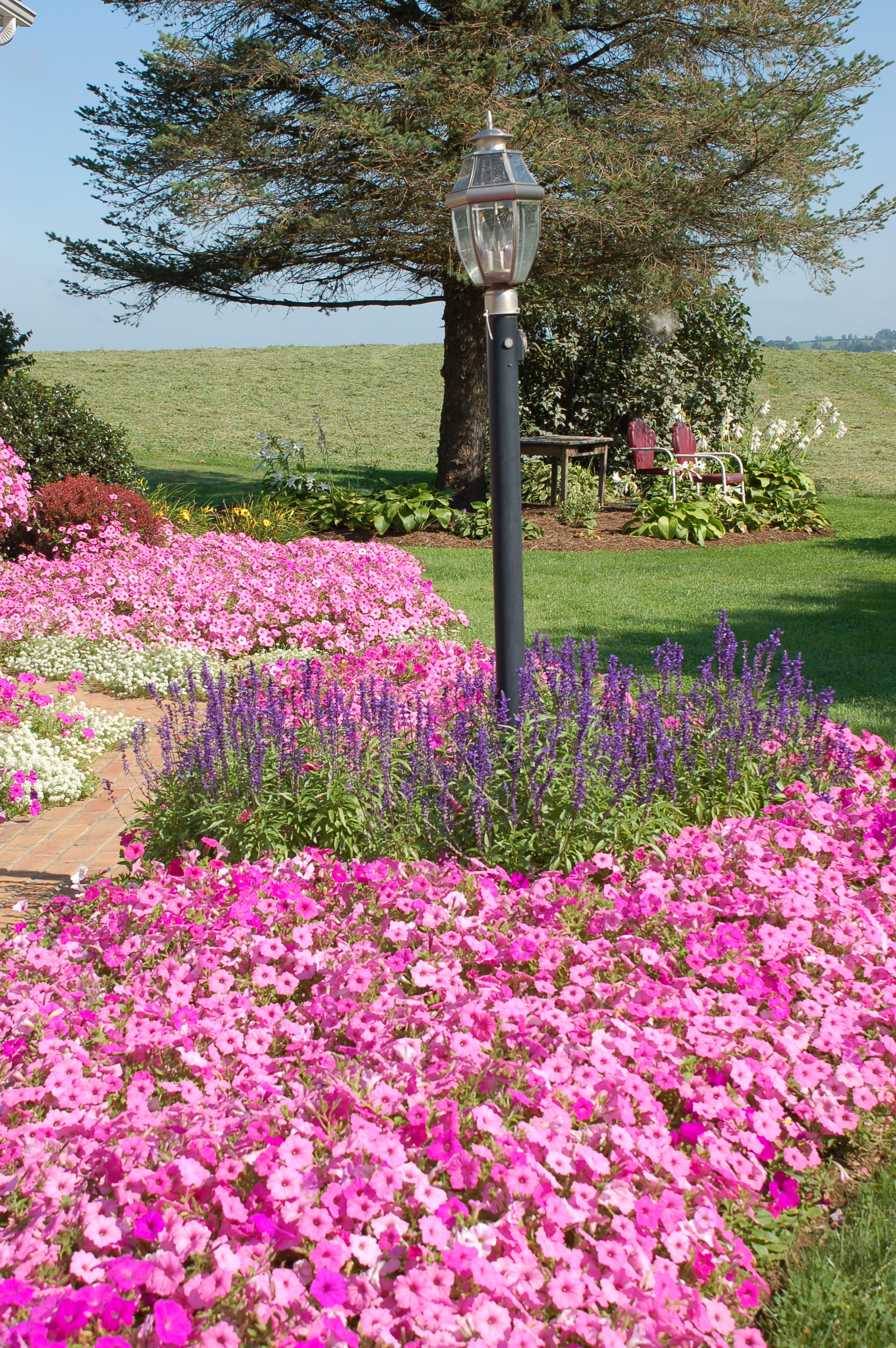
My wife gets many compliments on her beautiful flower gardens.

The empty nest has had another unexpected benefit. My wife and I have also rediscovered one another, and learned to enjoy our own hobbies and interests. Some we do as a couple. Others, like gardening for Neva and birding for me, we enjoy separately. We have gained individually and as partners.

I know humans have a higher calling than birds. Birds at least instinctively know that their role as parents is to sit on those eggs until they hatch, feed the chicks until they fly, teach them how to forage for food and to fear predators. After that, they are generally on their own.

For me, that’s where the comparison tilts to our advantage. We should strive for interdependence with our adult children, keeping in contact with them, always loving and communicating with them, without controlling or smothering them. Achieving that optimum goal can help combat the emptiness of the empty nest.

A healthy, nurtured interdependence between parents and adult children can result in the empty nest being a good thing for all involved, birds included.
Family by Bruce Stambaugh

The lights of September 11, 2001

By Bruce Stambaugh

My memories from September 11, 2001 are bathed in an emotional kaleidoscope of lights that seemed to guide me through that infamous day.
Sun rays by Bruce Stambaugh
The first light broke with the sunrise as I readied for work. I stood awestruck at the beauty that played out before me. The light from the morning sun glinted in bright shafts of beams through and around the leafy branches of the giant black oak tree directly across from our home. A misty ground fog was rising, reflecting and refracting light beams every which way.

The haze had dissipated and the sky turned pure sapphire by the time I reached my workplace. The sun had no competition now. The brightness of the crystal clear day buoyed me.

A lengthy phone call interrupted my regular startup office routine, which included turning on the radio. The caller went on and on, unnecessarily repeating point after point.

The second line on my phone rang. By the time I could rid myself of the windy caller, the other call had already gone into my voice mail.

Soon the little red light on the phone began to blink, the signal that I had a message. It was from our son, who lived and worked in New York City. Despite the passage of time, I can still distinctly hear his words.

“Dad,” Nathan’s message said, “Something has happened at the World Trade Center. We don’t have Internet or TV. Can you tell me what’s going on?”

I hung up and quickly turned on the radio. The first thing I heard was that a plane had crashed into the Pentagon in Washington, D.C. I bolted to the receptionist’s desk to find out what was happening. I was told that a plane had flown into one of the Twin Towers in New York City.

I tried to reach my son at his workplace, which was just south of Times Square. Neither his office phone nor cell phone would ring through. Fear gripped me.

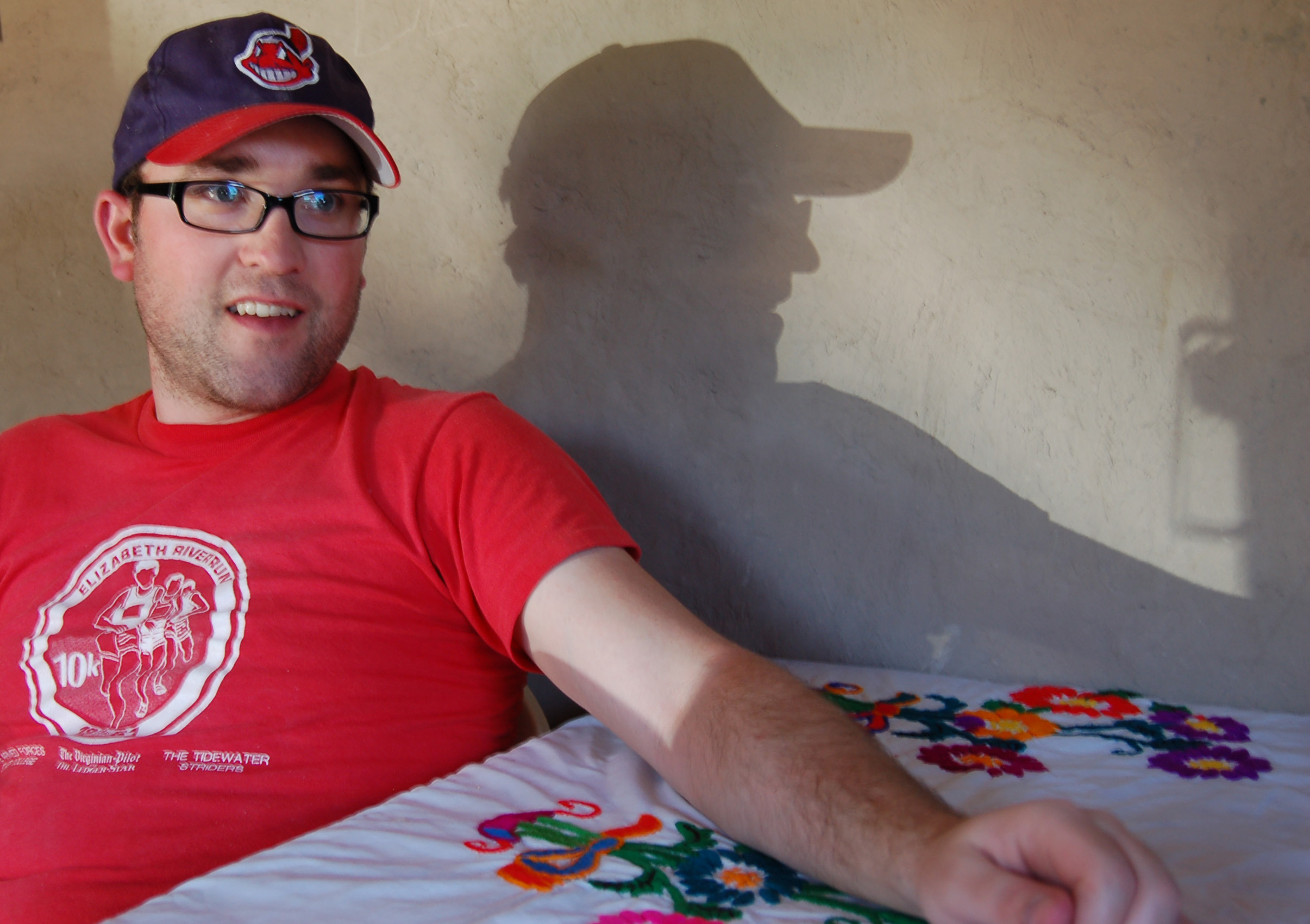
Nathan's shadow by Bruce Stambaugh
Our son, Nathan, during a break while on a work project near San Marcos, Ocotopeque, Honduras

I went to a TV to watch what was happening. By then, the second tower had been hit, and reports were coming in of another plane down in southwestern Pennsylvania.

At 10:45 a.m., I was paged for a phone call. I picked up the line and it was my son.

“Dad,” he said trying to cover his anxiety, “I don’t know how I got a line out to you. I just wanted you to know that I’m OK but that Manhattan is locked down. No one is going in or out.”

Despite our mutual fears, an indescribable light of love connected my son and I through those phone wires. We spoke for about 10 minutes until Nathan said that others wanted to use his phone. By late afternoon we were calmed with the news that our son had safely returned to his apartment.
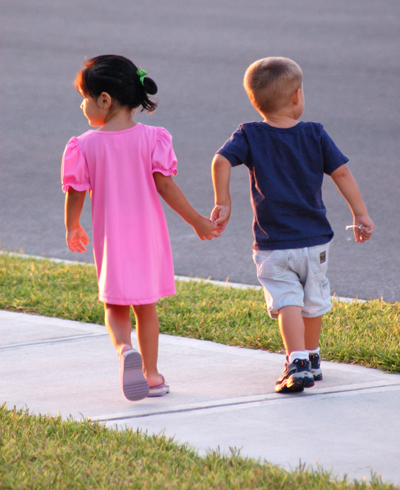
Holding hands by Bruce Stambaugh
At the end of that incredibly long, exhausting day another light shown. The live TV coverage broadcast a surreal scene. The evening’s sun filtered through the gray, smoldering debris at Ground Zero. A ghostly spire, all that structurally remained of the Twin Towers, reflected and refracted light beams eerily similar to those at the oak that morning. I hoped that some good could come of this horrific international catastrophe.

Now a decade removed, I still cling to that desire, though too many lives have had their own individual lights snuffed out. I long for the light of peace among all peoples, even if it means the need to share that light one person at a time.

Two lifetime experiences in one day

From the press box by Bruce Stambaugh
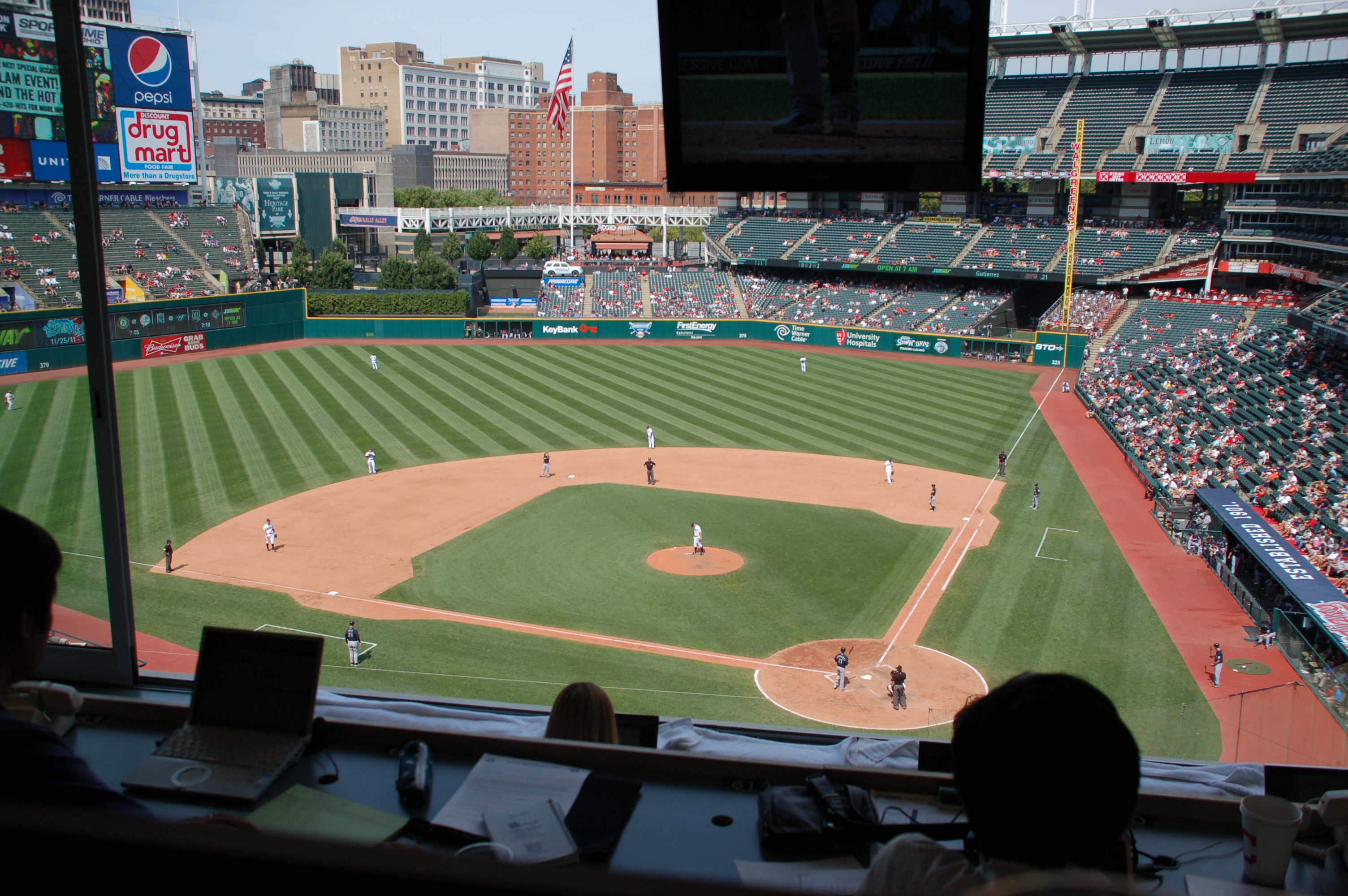
The view I had from the press box at Progressive Field in Cleveland, Ohio.

By Bruce Stambaugh

I had looked forward to this day for a long, long time.

A reporter friend of mine asked me if I wanted to accompany him to a Cleveland Indians game with seats in the press box. Big kid that I am, it was a lifetime dream of mine to do so.

For years I had wondered what it would be like to sit in the press box to watch a baseball game. Last week, my dream came true with an unexpected bonus.

To get me through the press gate, my reporter friend, who will remain nameless for professional reasons, listed me as his photographer. Good thing I had taken my camera along.

My excitement settled soon after attaching the yellow press tag to my belt loop. Our planned first stop on my behind-the-scenes tour of Progressive Field was the playing field to watch batting practice and mingle with the players and coaches. But this game was the day game of a day-night double-header. There was no batting practice.

Progressive Field by Bruce Stambaugh
My regular seat at Progressive Field is just above my left shoulder, seven rows back.

Since I was actually standing on the playing field I wasn’t all that disappointed. My friend took my picture in front of the Indians dugout and by the Indians on deck circle, which is directly in front of where I usually sit as a fan.

We headed into the Indians dugout. I sat in the shade on the bench a few feet from some player who had completely shaved his head. It was Justin Masterson, the starting pitcher for the Indians.

Soon we made our way down the tunnel and up the ramp to the players’ clubhouse. We rubbed shoulders with several players, but passed them without speaking according to media-player etiquette. All in all, I found the locker room to be much less luxurious than I had envisioned.

I had a similar reaction when we entered the media dining room. It was spacious, but reminded me of a college cafeteria, only with a nice view. We signed in and paid for the buffet. Thoughts of the media being coddled began evaporating. Once I tasted the food, the memories of college continued.

Across the hall was the press box, curving left and right high above and behind home plate. Here, too, I was surprised. Instead of plush, I saw plain. The press box was more functional than cushy. There was plenty of room to work, but it really wasn’t the best view from the third row where we were assigned to sit.

Reporters at work by Bruce Stambaugh
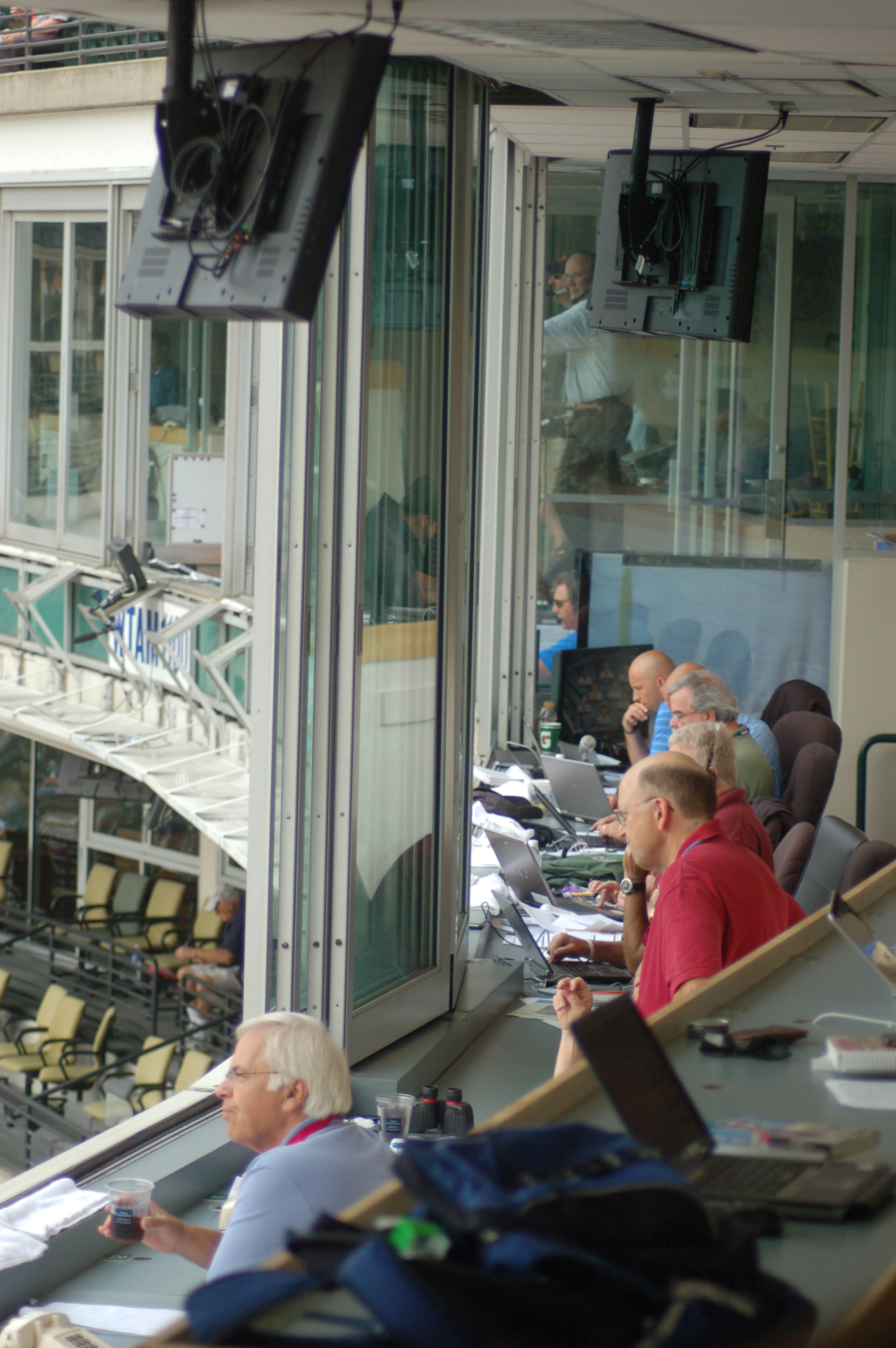
Reporters hard at it in the Progressive Field press box.

It was unexpectedly quiet, too. With deadlines to meet, the reporters simply minded their own business and watched the game.

The game moved right along until 1:51 p.m. when the press box itself began to move. I felt an obvious swaying east to west. I asked my friend if he felt it. Indeed he did.

Other reporters swiveled their heads with astonished looks on their faces. The press box rocked and rolled for 30 seconds, stopped briefly, then began again, only not as severely nor as long.

Someone checked on the Internet and said that the Pentagon was being evacuated because of an earthquake centered in Virginia. Here I was in my first and probably only major league press box and I had also experienced my first earthquake.

I had always wondered what a quake felt like. Now I knew. I felt both nauseated and exhilarated.

With those lifetime experiences realized together, I happily took my usual seat at the next Indians game I attended.

Batter up by Bruce Stambaugh
The view from my regular seat at Progressive Field is much improved over the press box.

August is the quiet month

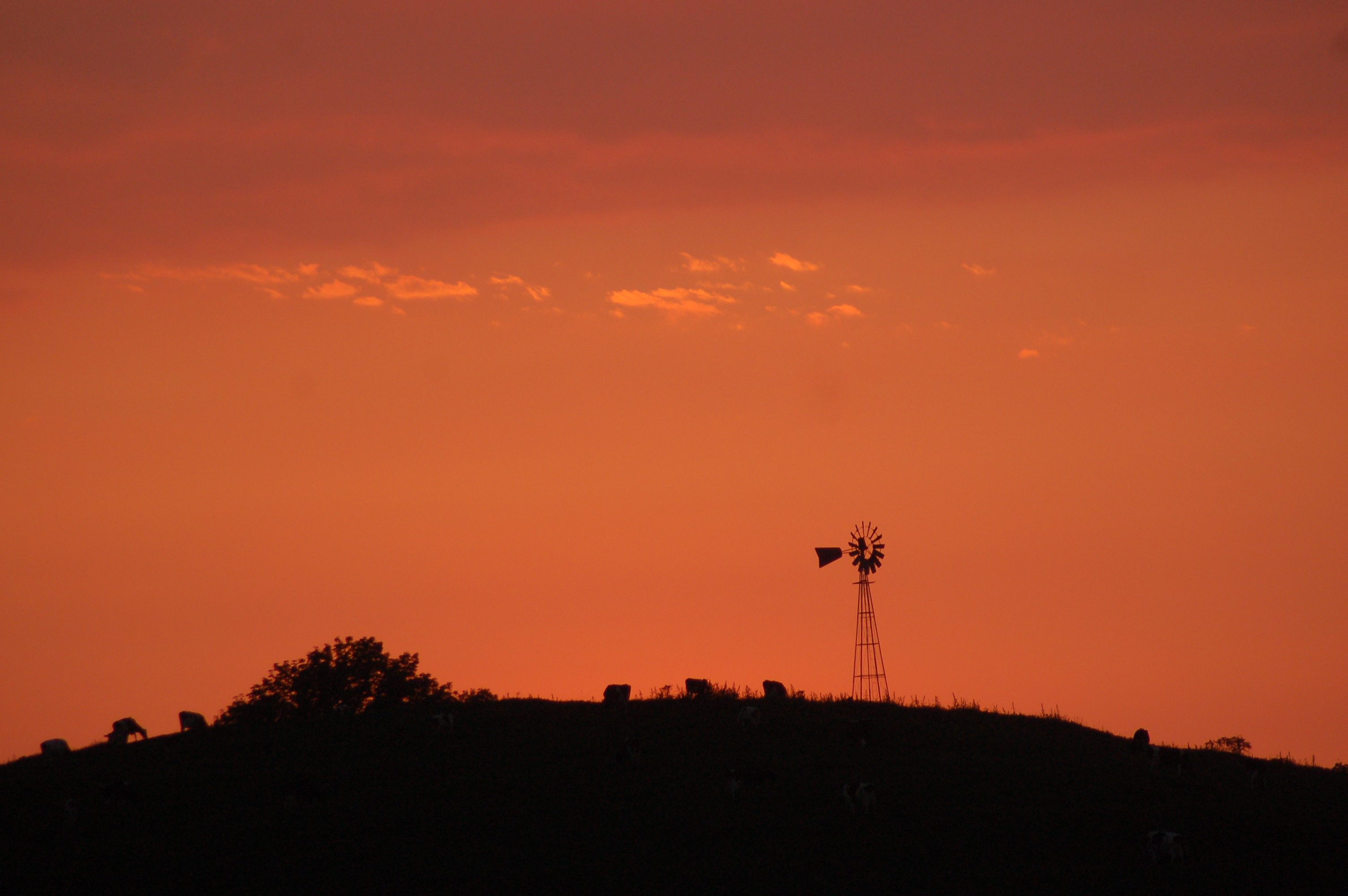
August sunset by Bruce Stambaugh
A typical August susnet in Ohio's Amish country.

By Bruce Stambaugh

I have always thought of August as a transitional month, the days between busy, boisterous July and the revitalizing September.

August is the stepping-stone from summer’s onslaught of activities into a pre-fall mentality. Vacations wind down for most people. It’s back to school and back to work.

If we take time to halt our busyness, our clamor to re-ready ourselves for the new school year at hand, we can take note of this calendar bridge from tilling to harvest, from clamor to order. In its intermediary mode, August seems to quietly take it in stride.

The songbirds no longer need to announce their territory or impress their mate. The young have flown the coop, or more properly stated, the nest, and bird life has returned to seeking daily subsistence. The American Robin precisely models the point.

From April to July, the Robins paired off, warbled their luxurious choruses almost continuously sunup to sundown. They pecked on windows, noisily flitted off their nests when disturbed and faithfully fed their young.

The Robins were ubiquitous in both presence and song. People often comment when they see their first Robin of the spring.

First Robin by Bruce Stambaugh
People often remark when they spot their first Robin of the spring.

Now, in late August, the Robins have all slyly retreated to their preferred nomenclature. They are more than content to while away the day searching for food deep in the recesses of the shade and forest.

Think about it. When was the last time you either heard or saw a robin? They simply and silently slipped away unnoticed.

If they haven’t already, other bird species will soon be disappearing from the area altogether. The Purple Martins, Barn Swallows and Common Nighthawks all heed their interior instinctive urgings and vanish unseen much like the Robin. We under-appreciate their massive consumption of insect protein until it’s too late to thank them.

Just as quietly, the multiple greens of fields and pastures have grown taller, richer. Chameleon-like, they have morphed into emeralds, tans and russets with hardly a rustle.

August harvest colors by Bruce Stambaugh
The colors of August change from day to day.

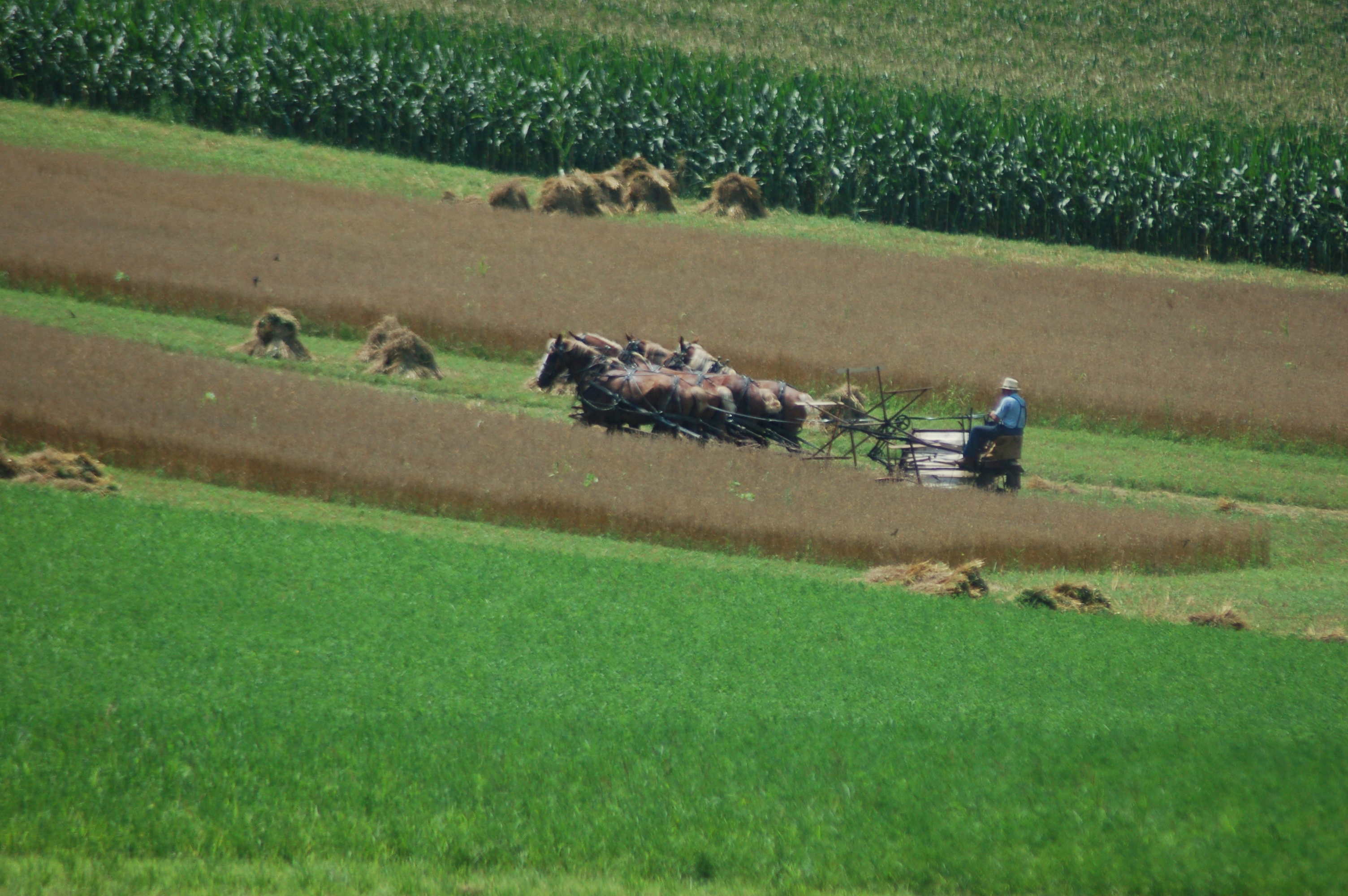
Farmers have taken in their wheat and most of their oats matter-of-factly, and now tolerantly wait the drying of the later cash crops, corn and soybeans. There is no mechanized clanking in patience.

Song Sparrow by Bruce Stambaugh
A Song Sparrow sings away.
The Song Sparrow still belts out an occasional composition, but nothing as regular as it had been earlier in the season. The House Wrens, once so noisy they approached annoyance, have taken to the underbrush, giving their last brood endurance lessons.

August’s atmosphere also has been quieter than the previous months, save for a couple of late night thunderstorms. The brilliant flashes and deep, rolling booms shattered my sleep like Civil War cannon fire might have. Midnight imaginations run wild when deafeningly jolted.

The few sounds of August we can count on are more monotonous and so commonplace we may not even notice their calls. Cicadas and crickets signal day and night. With windows thrown open to catch the unusual August twilight coolness, the insect symphony has helped humans settle in for sound sleeping.

Every now and then a ranging coyote howls from atop the neighbor’s pastured hill, if for no other reason than to drive the tethered neighborhood canines crazy. The feral call is one thing. The domesticated is another.

Now that school years in most locales begin well ahead of September, the playful echoes of children rollicking at recess again fill the air. It’s a timbre I love to hear over and over again, even if it does break August’s amazing silent spell.
Amish school by Bruce Stambaugh

Bay Photos by Donna

Wildlife photos from the Chesapeake Bay region

ROAD TO NARA

Culture and Communities at the Heart Of India

K Hertzler Art

Artist and nature journalist in the Shenandoah Valley of Virginia.

Maria Vincent Robinson

Photographer Of Life and moments

Gabriele Romano

Personal Blog

Jennifer Murch

Art is the only way to run away without leaving home. -Twyla Tharp

Roadkill Crossing

Writing generated from the rural life

ANJOLI ROY

writer. teacher. podcast cohost.

Casa Alterna

El amor cruza fronteras / Love crosses borders