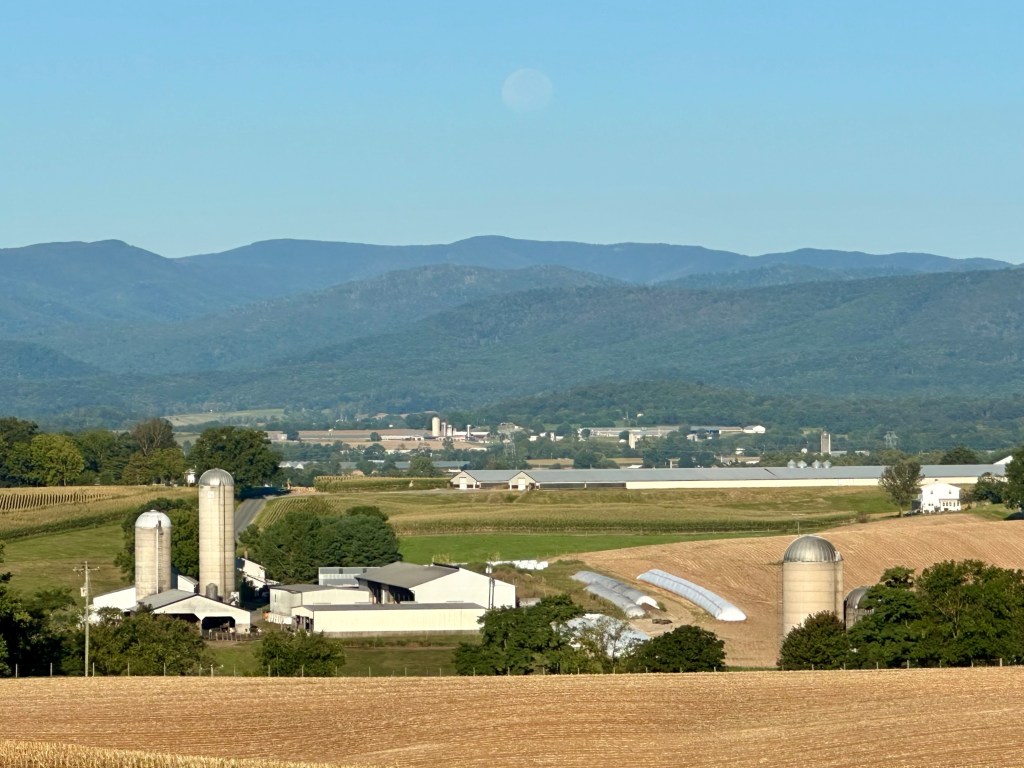
The Full Corn Moon over the Allegheny Mountains. Photo by Bruce Stambaugh
I had hoped to capture the Full Corn Moon setting over the Allegheny Mountains on the morning of September 7. However, the early morning’s sunrays blanched out the moon before it reached the western horizon.
Consequently, this is the best I could do. I hope you can find faint moon in the photo’s top center.
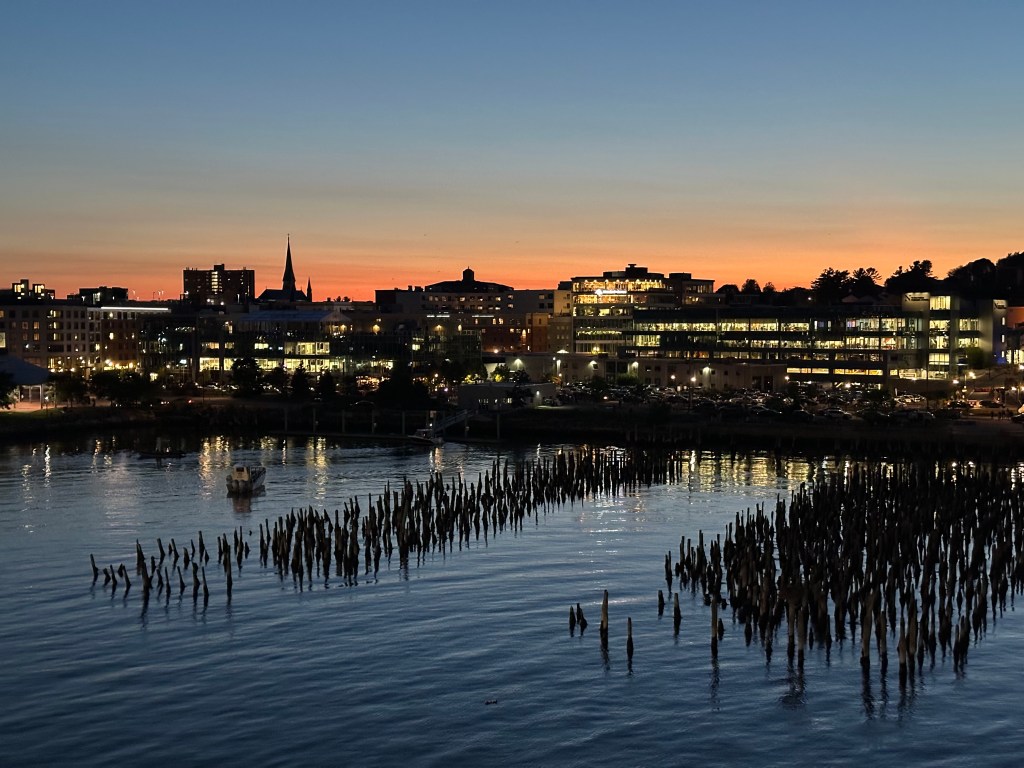
Portland, Maine, harbor at twilight. Photo by Bruce Stambaugh
We neared Portland, Maine, our last stop on the cruise itinerary, at mid-morning. Our landing in Boston the next day was simply to disembark.
I was able to take several shots of the shoreline and the many inlets as we approached docking in Portland. I spotted the Ram Island Ledge Light Station, and was able to capture some acceptable shots of it. However, I forgot that it was directly across the water from the Portland Head Lighthouse. I could easily have photographed both, but my head was a bit fuzzy from the strong pain medication I was given. I rationalized that I already had some decent shots of that iconic lighthouse from a previous visit years ago.
The day began just like yesterday, in the ship’s medical center for another pain shot. The good doctor wanted me to go ashore to a hospital for CT scans of my ribs and head, since I had hit my skull in the fall. If we did that, it would be the end of our trip.
Cracked ribs weren’t a life-threatening condition, and Neva had checked my eye responses every two hours during the night, and I showed no signs of a head injury. Besides, we had already paid for transportation from the dock to the airport to catch our flight home. So we kindly declined.
Upon docking, we had to disembark for customs in Portland anyway. For some reason, we docked on the starboard side, so we had a perfect view of the harbor and downtown Portland. I took several photos while we waited for our group to be called to pass through customs. I heard and then saw an Osprey sitting on its nest that was built on the tallest one of the old wooden dock pilings.
The weather was perfect, and I felt well enough to walk through security and head to Commercial Street along the waterfront. We found a cafe, bought our decaf mocha lattes, and enjoyed the sights and sounds of a busy port.
From our sidewalk seats, we watched people board a narrow-gauge railroad and enjoyed the sounds of the whistle and the little steam engine chugging the train along the shoreline. A few minutes later, it backed its way into its parking location and waited for the next group of passengers.
We returned to the ship and, after dinner, enjoyed the evening activity of this special day. It was the Fourth of July, and a flotilla of boats big and small had anchored in the preferred spots offshore to watch the fireworks show.
We had the perfect view as the fireworks exploded just after dark. The booming sound echoed, and sparkling colors reflected off the harbor’s quiet waters. It was the most fitting conclusion to our land and sea cruise.
The next day was a hurry-up-and-wait kind of day as we rode the bus to the airport, made our way through TSA, walked to our gate, and sat for six hours. Fortunately, one of Boston’s best seafood restaurants was near our gate, and we had a yummy seafood lunch for our flight back to Virginia.
Thanks for traveling along with us, bumps and all.
I was really looking forward to visiting the Halifax, Nova Scotia area. We had booked an excursion to the famous Peggy’s Cove. We never made it.
After another good night’s sleep on the Zuiderdam, I rose early to meet the bus for our tour. When I stepped with my left foot into the shower mat, the ship suddenly made a quick pitch in the opposite direction. Instantly, for a split second, I was Superman, until I wasn’t. I hit the sink, and then smacked the floor with a shocking thud.
At first, I lay there stunned, no pain, my only thoughts reserved for my chronic back issues. But the back felt fine. I tried unsuccessfully to get up, and that’s when the pain shot through the right side of my body.
My wife helped me to my feet, checked me over, and assured me I wasn’t bleeding anywhere. Now thinking about the lovely day ahead, I dismissed the pain and got ready for the day.
We headed to breakfast on the Lido deck. To be safe, I had an old man’s breakfast, hot oatmeal and four prunes on the side. As I stood up to leave, I could hardly walk. The rest of the boring details are in a separate, previous post here.
Our plans for the day were cancelled, and I received excellent treatment in the ship’s medical center. The staff was terrific. So, were the pain meds.
Fortunately, our comfortable cabin served as an excellent resting place. The only problem was that I couldn’t lie down. A month later, I still can’t. The ship’s X-ray machine showed one cracked rib. The CT scans at our local hospital, when we returned home three days later, revealed three.
I felt better standing, so I spent an inordinate amount of time on our veranda, which faced the harbor side. I watched the morning marine fog layer evaporate into a warm, sunny day.
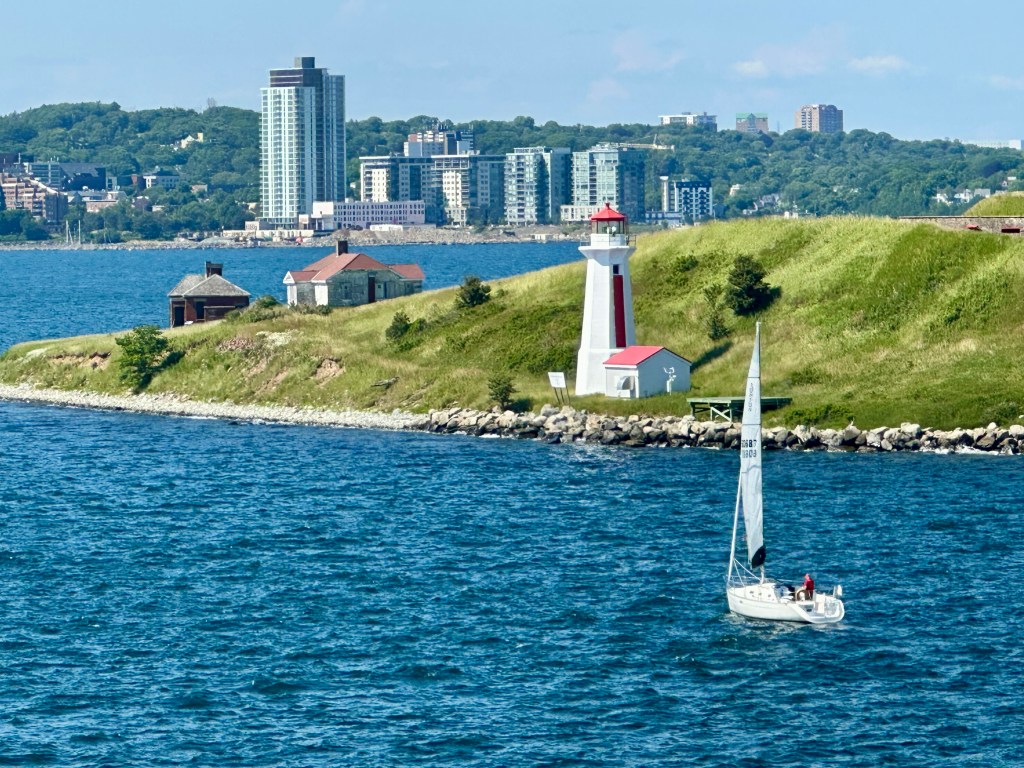
Rest assured, I snapped too many photos of the same scene, only with different ships. A harbor lighthouse stood directly opposite us, and its bright while paint glowed in the afternoon sun. It made a perfect background. But how many times can you photograph ships with the same setting?
All categories of boats passed by. Fishing, ferries, sailboats, a Canadian Coast Guard cutter, trollers, a stately tall ship, and even tugboats escorting a huge freighter made time pass and filled my phone with hundreds of unnecessary photos.
The doctor told me to move around as much as I could without causing excessive pain. So, we went to lunch and dinner, sitting on padded chairs.
It wasn’t the way we had planned to see Halifax. But it was the best we could do.
Our intrepid guide, John Bourgeois. Photo by Bruce Stambaugh
We arrived at 7 a.m. at the Port of Sydney, Nova Scotia, located on the eastern end of Cape Breton Island. From our veranda, the old town still seemed to be asleep.
Before we left the ship, we couldn’t help but notice a giant fiddle on the dock, welcoming visitors to this intriguing town. At 60 feet tall, the largest fiddle in the world stands as a tribute to the island’s Celtic heritage and in reverence to its decades of fiddling.
We opted for a walking tour around the town over another long bus ride into the country. We were glad we did. We hardly lost sight of the Zuiderdam, which was fine with us.
Our morning stroll around Sydney was just that, very leisurely. Our guide was a character, dressed in period clothes, and unafraid to express his opinion. He was a hoot. With a name like John Bourgeois, did he have any other option? His surname gave away his personality.
John clearly loved his native town. His folklore stories of mysterious intrigue easily kept our attention. John knew the town’s history like the back of his hand. He should have. His family name went back generations, enabling him to interject personal ancestral history into his tantalizing tales. Perhaps some of them were true.
As we walked up hill from the dock, John took his time with his steps and his words. He knew himself and his town well.
John pointed out the Royal Bank Lion Monument, a symbol of power at the start of the prosperous steel mill days, now long defunct. He drew our attention to the now-abandoned church with an upside-down ship’s hull for a roof, the house where the ladies summoned the beleaguered sailors returning from a long voyage, and the community’s old firehouse, now a mustard-yellow painted two-story home with a bright blue door.
We enjoyed the flower gardens of lovely old two-story homes still occupied by long-term residents, and toured an old building that served as a residence and general store. It’s an impressive museum in its third life. We spied a Paul Bunyan-style mural of a hockey player that honored the beloved Canadian sport.
After giving John a generous tip for his honesty and folksy stories, I asked him for directions to a restaurant he recommended. He said it was just a little way straight ahead. A half-mile later, I found it, and the restaurant was closed. Apparently, I was as magnanimous as I thought.
We walked back to the Joan Harriss Cruise Pavilion, where we found a restaurant with lobster rolls. It was a relaxing way to end our walk around Sydney.
As our ship left the dock and headed out of the inlet, I realized that Sydney was much more than what we saw on our walking tour. The roofs of houses and church spires stretched far inland.
We passed the old coal tipple where ships loaded the once major export. Like the steel mills, the mines are now shuttered. Farther out along the peninsula, a forested backdrop highlighted impressive homes, rural stone churches, and a lighthouse where the harbor pilot boarded his boat for the ride home.
We enjoyed another musical performance after a nice dinner and called it a day. Halifax was our next highly anticipated destination.
The House of Green Gables. Photo by Bruce Stambaugh
I wasn’t sure what to expect from Prince Edward Island. Consequently, what the island offered surprised me.
We rose as the sun peeked over the eastern horizon into a cloudless sky. That correctly portended a fair weather day for our afternoon excursion to the Green Gables House and Museum.
Based on the comments of others who had been to PEI, I expected Charlottetown to be dotted with quaint, lovely houses. If they were there, we didn’t see them.
Our bus trip to the Green Gables Heritage Place included a sightseeing tour of the island. However, because the house is located on the other side of the island from the port, it was basically an hour’s drive out and another one back on the same roads.
We saw the fertile red soil that produces a variety of crops grown in many other locations. Prince Edward Island is the potato capital of Canada. I thought that, impressive as big as Canada is, and given that PEI is Canada’s smallest province, with 2,185 square miles.
On the way to our destination, we passed Lucy Maud Montgomery’s gravesite, located not far from the beloved homestead that inspired her writing. Here, too, I wished the bus would have stopped for photo opportunities. But we were on a three-hour tour, and I wanted to make sure we arrived back at the ship before the 4:30 p.m. departure.
We enjoyed the self-guided trek through the old house, all decked out with appropriate period furniture. However, the only piece of furniture that was original to the home was the halltree.
Those familiar with “Anne of Green Gables” likely could imagine reading about Anne’s escapades as we ventured from room to room, upstairs and down. I was particularly impressed with the meticulously manicured grounds.
Lovely flowers were in full bloom. Not a weed could be found in the modest vegetable garden. A variety of songbirds sang among the trees and flower gardens around the sloping property.
I spied a path that led to the woods where Anne frolicked, and I took it more for birding purposes than curiosity. I crossed the footbridge over the creek and up into the woods, only to stop short.
The woods soon gave way to a different kind of green. The Green Gables Gold Course surrounded the historic homestead. I sucked the breath right out of me. I pondered what L. M. Montgery might think about that.
Returning to the museum to meet my wife, I asked our step-on guide about the irony of a golf course encapsulating this historic site. The kindly lady merely informed me that PEI was the golf capital of Canada.
I was taken aback by that, since we had only seen rolling agricultural fields with occasional crossroad towns since we left Charlottetown. My wife and I found a shady spot and enjoyed our snack lunch before boarding the bus for our next stop.
A short drive brought us to Prince Edward Island National Park. The park was a narrow but expansive area that included long stretches of red rock cliffs with white sand beaches below. The Gulf of St. Lawrence stretched out deep and wide before us.
Too soon, we were back on the bus retracing our tracks to Port Charlottetown. We made it back to the Zuiderdam with little time to spare.
The aft of the ship was moored to a cement platform in the harbor. A local longshoreman and his female crew piloted out to untie the giant rope that steadied the docked cruiseliner. On the way, two young females entertained us by pretending to be those human-like wind socks that many car dealerships use to get your attention. Their imitation was a fun send-off for us.
As our ship pulled out into the Hillsborough River, we could see more of Charlottetown. With its church spires, busy harbor, shoreline parks, and colorful cottages and homes, it was indeed a charming town.
Sailboats, pleasure boats, and fishing boats escorted us back to the Gulf of St. Lawrence. A pair of red-roofed, white lighthouses accented by lush evergreens and patches of PEI’s famous red soil bid us farewell.
The seas turned a deep, stunning blue as nighttime approached. That meant dinnertime and more cruise ship entertainment. The day of surprises had tired me out, and sleep came easily.
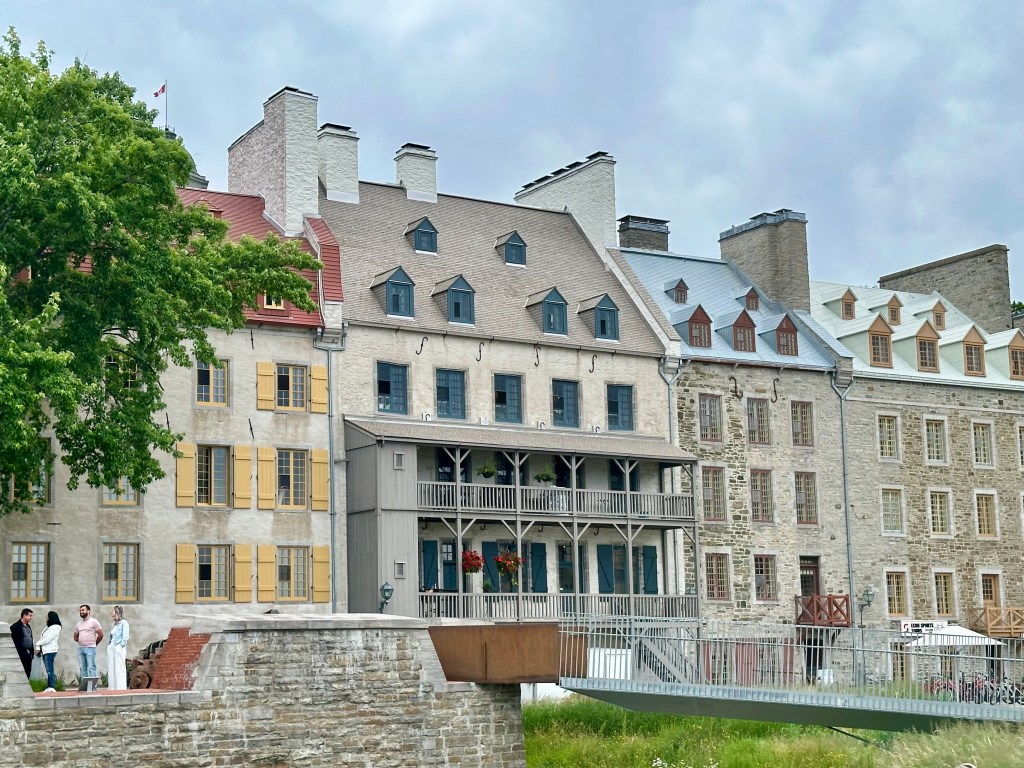
Part of the Royal Battery and rowhouses along the St. Lawrence River. Photo by Bruce Stambaugh
Our stay in Quebec City was much too short. Shortly after we checked into our hotel just outside the wall around Old Quebec, it began to rain. Still, our guide gave us a brief walk around a few blocks before guiding us back to the hotel.
We opted to have dinner at the hotel due to the combination of the rain and our long bus trip. We were tired.
Fortunately, we arrived via a narrow road that took us by the Citadel of Quebec, and an old neighborhood of lovely houses and quaint restaurants. To our right was the St. Lawrence River, where we would cruise for two days before reaching the Canadian Maritime provinces.
The most impressive building we saw was the famous Chateau Frontenac, now a Fairmont Hotel, which looms over the old city and must look rather impressive from the river. We weren’t fortunate enough to stay there.
So, we enjoyed a dinner with fellow travelers and got to know some of them better. We were all ready to board our cruise ship in the morning.
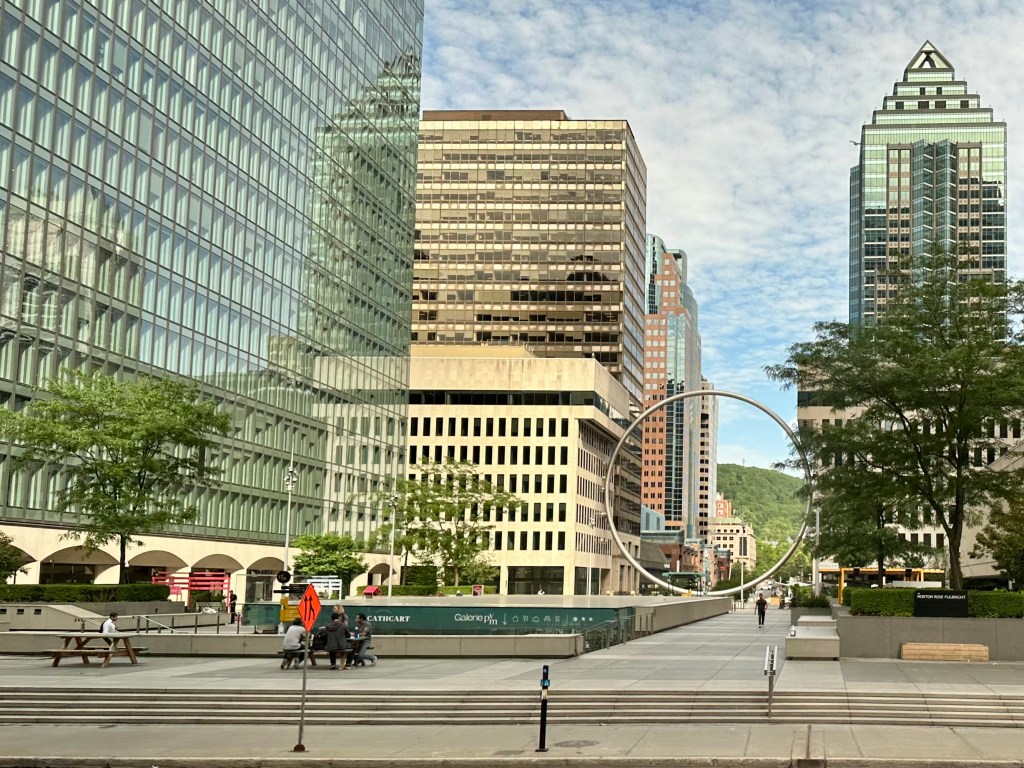
Victoria Square, Montreal, Quebec, Canada. Photo by Bruce Stambaugh
I had never been to Montreal, Canada, before. I was pleasantly surprised.
Montreal is a beautiful, clean, vibrant, progressive city. Montreal is proud of its heritage, which it works hard to preserve. It also embraces the arts, with brightly colored murals, statues, sculptures, and well-preserved historic buildings.
The photo above represents all of those qualities and more. The artistic ring set in Victoria Square has a significant purpose for the people of Montreal. Amid the gleaming buildings, the ring points to the distant hill in the background.
To residents of Montreal, it’s not a hill. The island city worships its Mount Royal as a mountain, though it is only 764 feet high. It provides excellent views of the city, including the sports venue for Expo 67. Mount Royal is part park, part cemetery. It’s a green paradise surrounded by a bustling city.
To get there, we passed city parks with modern art and sculptures adorning towering, modern buildings, a respected university, bohemian rowhouses, and an impressive, giant portrait of native Leonard Cohen covering the entire side of a building.
We also saw Montreal’s apartment icon, Habitat 67, built for Expo 67. The complex looks like cardboard boxes stacked on top of one another. We visited Old Montreal, where we saw the Notre Dame Basilica and the Bank of Montreal’s legal headquarters opposite the church. It’s an architectural beauty, built to disguise it from looking like a bank.
Anchoring the Place d’Armes square is the Maisonneuve Monument erected for the founder of Montreal, Paul de Chomedey. The base of the impressive monument honors other significant contributors to Montreal’s history, including the Iroquois Native Americans.
We had lunch in the Old Montreal section, which could have been a setting in any European city. People filled the streets, restaurants, and cafes.
We said goodbye to Montreal and headed to Quebec City.
The Vermont State House, Montpelier, Vermont. Photo by Bruce Stambaugh
The third day, we traveled from our ski lodge in New Hampshire to the Vermont state capital in Montpelier. We passed Mt. Washington on the west side and then into the Green Mountain State. In French, “les monts vert” means Green Mountains.
Our first stop was at a sugar maple syrup farm, where we viewed the process of making syrup. We also got to sample “sugar snow.” Crushed ice was used in place of snow since we were there in late June.
We poured hot maple syrup over crushed ice in a hot dog container, then twirled a fork around the cooling syrup so we could taste this treat. It was absolutely amazing. To me, it tasted better than candy.
The proprietors provided a glass of water, a dinner roll, and a dill pickle to help with digestion after eating all that sweetness. I had a sip of water and then ate the pickle just to see the resulting consequences. I liked it. The pickle indeed neutralized the intense sweetness of the cooled syrup. I couldn’t eat the roll since I am gluten-free.
From there, it was on to the Vermont state capital in Montpelier. We had time to tour the unique capital building and find lunch. Since it was drizzling, we decided to eat in the building’s small cafe.
I was impressed with the building’s modesty, compared to other, more gaudy state capitals. We entered through a side door that a police guard had opened, and we were also free to roam around. There were no metal detectors.
A giant painting of a Civil War scene caught my attention. Benjamin Franklin Mason painted the Battle of Cedar Creek, which happened only 40 miles north of where we live in Virginia’s Shenandoah Valley. A Vermont military leader led a Union charge against a formidable Confederate defense. Col. Newton Stone was later killed in the Civil War Battle of the Wilderness.
We found a small office that had photos of all 50 U.S. state capital buildings. It covered an entire end wall.
High school students from around Vermont were holding a mock session of the state legislature. So, we had to be quiet as we peeked into the modestly appointed meeting room with a dangling chandelier in the center.
Too soon, we boarded the bus and headed to Montreal, Quebec, Canada. Crossing the border in a remote rural area like northeast Vermont went so smoothly that I don’t even remember it.
The Tea Party Museum, Boston, Massachusetts. Photo by Bruce Stambaugh
My wife and I recently did a land/sea tour of part of New England and eastern Canada. Our small group covered a lot of ground in two weeks.
Instead of inundating you with multiple photographs and detailed descriptions of the places we visited, I challenged myself to choose one photo from each day. That’s not an easy task when you see so many historical spots and scenic landscapes.
Nevertheless, I hope you enjoy this attempt at super-summarizing our two-week trip.
Boston, Massachusetts, was our first stop. Neither my wife nor I had ever been to this historic city that played such an essential part in the development of the United States of America. So, we flew in a day early to get settled.
Like much of the rest of the country, Boston was unusually hot for the end of June. Consequently, we opted for a trolley tour of the bustling, unfamiliar city to avoid excessive walking. That limited my usual way of photographing our trip’s highlights. Still, I was able to capture the combination of the deep history and fast pace of this 21st-century city.
I chose the photo of the replica sailing ships moored at the docks of the Boston Tea Party Ships and Museum because it best represented both the history and the current vibe of Boston.
The Sons of Liberty set in motion the American Revolution by dumping 342 chests of East India Company tea into the harbor. The War of Independence began two years later near Boston.
But look beyond the vessels to the green space along the waterfront to the modern office buildings. See the bridges that connect the many commercial and business areas on and near the waterfront. This scene is but a microcosm of the thriving port city of Boston as it was in the early colonial days and is today.
In our all too brief stay in Boston, we saw historic spots and locations, city parks, monuments, lovely rowhouses, government buildings like the state capitol, and modern skyscrapers. We also found the good people of Boston to be friendly, helpful, and hospitable.
Boston proved the perfect place to begin our trip into New England and on to eastern Canada.
Departing Halifax, Nova Scotia, Canada. Photo by Bruce Stambaugh
I love giving and receiving hugs, especially as I age. The fact that my four siblings and I received little physical affection growing up might play a significant role in my desire to be a hugger in my senior years.
There’s nothing better than giving my grandchildren a hearty hug after an athletic event or concert in which they have participated. And too, I melt when they hug me for simply being their grandfather. That momentary embrace says more than any card or note of appreciation.
The same is true for close friends, especially as we endure the aging process with all its expected and unexpected ailments. When we gather in small groups, whether at church or in our homes, the first question often asked is, “How are you?”
My wife and I are in two different small groups of peers, most of whom have Ohio roots like us. We now live in Virginia’s Shenandoah Valley, close to three of our four grandchildren.
When with other seniors, we chat around a meal or a table of snacks and drinks about our health. Sharing and listening become equivalent hugs, emotional squeezes, if you will. As septuagenarians and octogenarians, we all need those affirmations as we deal with our latest ailments.
Our ship, the Zuiderdam, docked at Portland, Maine. Photo by Bruce Stambaugh
However, since we returned from a recent cruise, I’ve had to learn to be happy accepting verbal greetings instead. I cracked three ribs in a freak fall near the end of our trip.
All was going well until our ship approached Halifax, Nova Scotia. Before we left, friends cautioned us not to fall. I had every intention of complying.
As I stepped into the shower, and please don’t try to imagine that, my left foot hit the shower mat just as the ship pitched in the opposite direction. I flew through the air like Superman, only not as gracefully.
My arm stopped my flight by hitting the sink, and I crashed to the floor with a loud thud. Excruciating pain shot through my right side. My wife said I made noises she had never heard before from any creature.
After the initial shock, I composed myself and finished getting ready for the day. However, after breakfast, my ribs pained me greatly. We headed to guest services, and I was immediately wheeled to the ship’s medical center.
The friendly and competent medical staff quizzed me, took my vitals, and gave me medication to ease the pain. X-rays showed a cracked rib, but the doctor wanted me to go ashore to the hospital. Doing so would effectively end our vacation, and I didn’t want that to happen.
Painful as it was, a cracked rib wasn’t a life-or-death situation. We enjoyed Halifax as best we could from our veranda. I checked in the next two mornings for additional shots of pain medication, and we were able to fly home on schedule.
But because I had also hit my head in the crazy fall, we went to our local hospital’s emergency room after we arrived home. CT scans showed not issues with my head, though my wife questioned those results. I did, however, have three cracked ribs, not one.
We took it easy the next few days before I felt like venturing out. Friends who didn’t know about my accident greeted us with the usual hugs, but I politely waved them off and explained.
I have developed a new appreciation for the importance of the rib cage to the rest of the body. I measure my moves and watch my steps. I also recognize that three cracked ribs are insignificant when compared to more consequential diagnosis of cancer and other diseases of friends and family.
I’m still healing and greatly looking forward to when I can once again hug and be hugged without pain. Until then, a fist bump will do.
The Portland, Maine waterfront at dusk. Photo by Bruce Stambaugh






 Roadkill Crossing
You must be logged in to post a comment.