
I didn’t believe in ghosts until I saw one.
It was July 3, 2010. My wife and I were enjoying our annual laidback week at Lakeside, Ohio, a Chautaqua community on the shores of Lake Erie.
Lakeside provided a respite away from the daily grind of life for thousands of families during its Memorial Day to Labor Day season. Founded in 1873 as a Methodist summer camp, the village has grown into a thriving community that promotes education, recreation, religion, and arts and entertainment.
My wife and I participated in selected activities from all four pillars of opportunity during our week-long stay. But we mostly relaxed with friends on the wrap-around front porch of the hospitality house where we stayed a week each year. We played dominoes for hours.
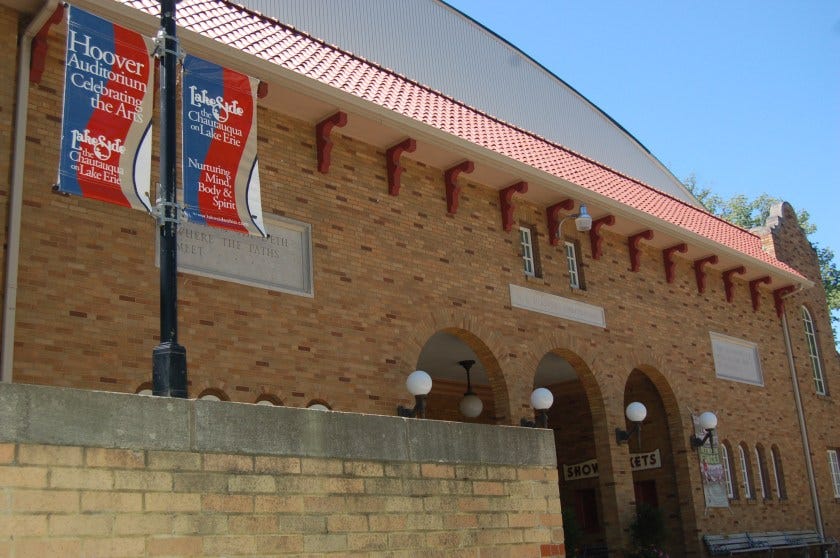
Across the street in the 100-year-old Hoover Auditorium, Lakeside offered a variety of entertainment and lectures each evening, Monday through Saturday. That’s where I saw the ghost.
A lively and loud Celtic group of singers and dancers nearly filled the 2,000-seat venue. We arrived early to secure seats where the breeze would provide relief from the hot and humid Ohio summer days. The old auditorium remained essentially unchanged from its construction in the late 1920s, including the absence of air conditioning.
The band busted out lively tune after tune. The music wasn’t my cup of tea, but experiencing new cultures was part of the Lakeside design. I was glad we had chosen front row seats in the second section of Hoover, where I could stretch my feet into the east-west aisleway.
About halfway through the program, the excessive noise emanating from the stage made me restless. Apparently, it bothered the ghost, too. For some reason, I looked up at the suspended triangular metal beam that held the speakers and the spotlights that illuminated the stage.
From stage left, a glowing, blueish-white figure appeared. A man walked casually across the beam, not built to hold any significant weight, to stage right.
As the music boomed out, I sat transfixed on this man from another era. He had the appearance of a maintenance man. The man looked to be in his 50s, clean-shaven, and I can never forget his ruddy face with that square jaw. His hair was slicked back, a style of the time, and parted on the left side.
He wore a work shirt with no label, thick denim work pants cinched with a thick leather belt, and heavy leather boots that laced up in the front. The apparition was dressed in the attire of an early 20th-century construction worker, the same era as when the storied auditorium was erected.
I followed the man as he casually stepped across the beam until its end. He knelt and appeared to be adjusting something. I wondered if he was attempting to turn down the sound.
Had the clanging and drumming of the uproarious music awakened this ghost? Was he annoyed at all the ruckus?
At that point, I briefly looked around at the audience. All eyes were fixed on the musicians and dancers on the stage. I glanced back up to the man, and he wasn’t there. In his place was a softball-sized glowing orb, the same blueish-white color as the man. The orb quickly arched back to where the man first appeared and then disappeared.
I looked at my wife beside me, but like the rest, she was focused on the performers. I had always wondered what I would do if I ever saw a ghost. I had my answer. I just sat there in disbelief.
Questions ran through my brain like a runaway train. What had I just seen? Had anyone else seen the same thing? Why did I see it? What did it mean? Was I crazy?
At the show’s end, we retreated to the porch across the street. I sat quietly as other guests discussed the show, waiting for someone to mention the ghostly maintenance man. No one did.
The next day, my curiosity got the best of me. I visited the village’s archive center housed in an old, white-clabbered church building. Besides the archivist, I was the only one there, which allowed me to speak candidly with the young woman about my existential experience.
She listened attentively to my story, nodding her head, seemingly believing every word I said. The young woman merely replied that she had never heard of a ghost in Hoover Auditorium.
“But,” she continued, “I’ve heard strange sounds while working alone here. And I have caught glimpses of what I thought were visitors, but no one had come in.” I felt heard and accepted.
The woman went on to tell of several sightings of ghosts in the old Lakeside Hotel. Guests had even reported them sitting on their bedsides. She sent me next door to where all of Lakeside’s records were kept.
I asked the village historian, an older woman, to review the architect’s plans for Hoover Auditorium. The employee led me to an architect’s metal cabinet, where the narrow, flat drawers pull straight out. I soon was reviewing the blueprints for the interior of the auditorium.
I found no structural beam that would have run across and above the stage where I saw the ghost. However, I did discover that the scaffolding used to build the inside of the auditorium reached approximately the same height as the metal frame where I saw the ghost. The woman, who also kindly listened to my story, said she had no record of anyone being injured or killed during the construction of Hoover.
So, I was back to where I started. Full of unanswered questions, and wondering why, out of an audience of 2,000 people, I was the only one to see this phantom. After fifteen years, the entire scene is still etched in my mind so keenly that I could still pick this guy out of a lineup.
I’m still baffled as to why I saw this ghost. But what it did do is open my eyes and my own spirit to a fuller understanding of life. Much to the contrary of today’s thinking and behaving, life isn’t simple black or white, or right or wrong.
This experience showed me that life is full of gray areas, questions without answers. Most of my life is now behind me. I strive to stay in each moment and embrace whatever comes my way, even if it is a ghost.
At the very least, I now know how I would respond if I saw a ghost. I just watched, wondered, and marveled at what I saw.


 Roadkill Crossing
You must be logged in to post a comment.