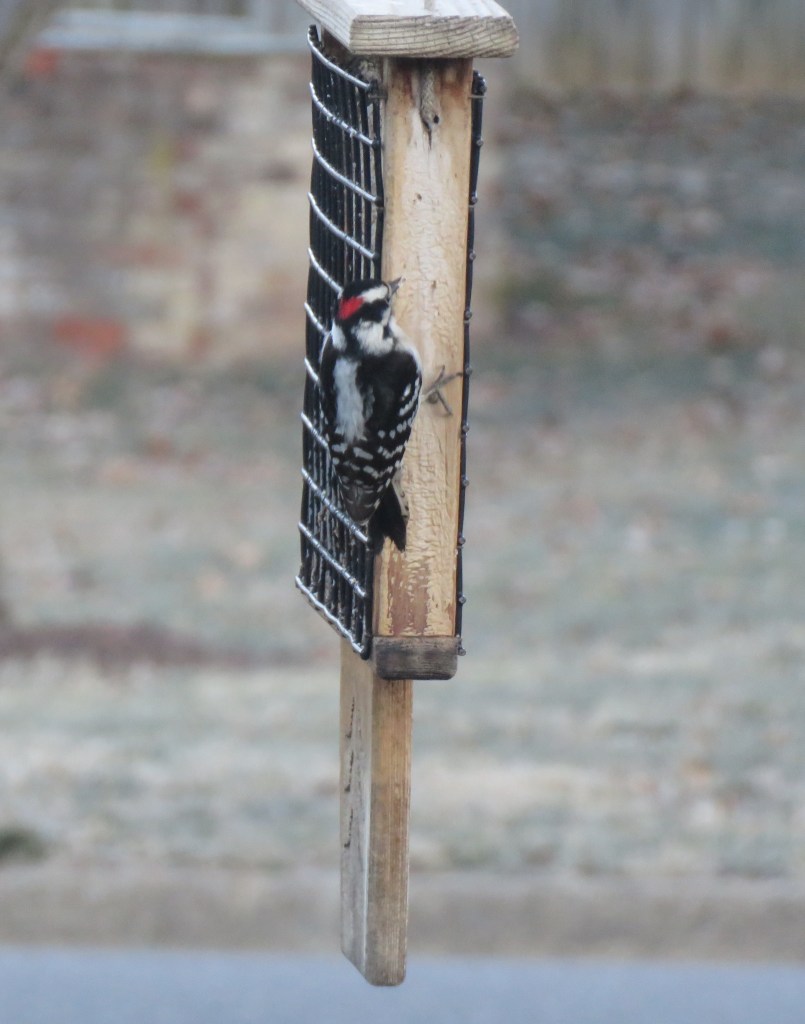
A male Red-bellied Woodpecker at the suet feeder. Photo by Bruce Stambaugh
It’s been a slow winter for feeding birds. Both the number of birds and the kind of species coming to my birdfeeders are down.
I have my suspicions, but I’m not exactly sure why. It could be the two roaming black cats that wait stealthily for lunch. Or, it could be the loss of cover. My neighbor cut down two mature trees on our property line. Or, it could be the inconsistent weather of cold and warming here in the Shenandoah Valley. Or, more likely, there are simply fewer birds. In a recent report, Cornell University estimated three billion birds have been lost in North America since 1970.
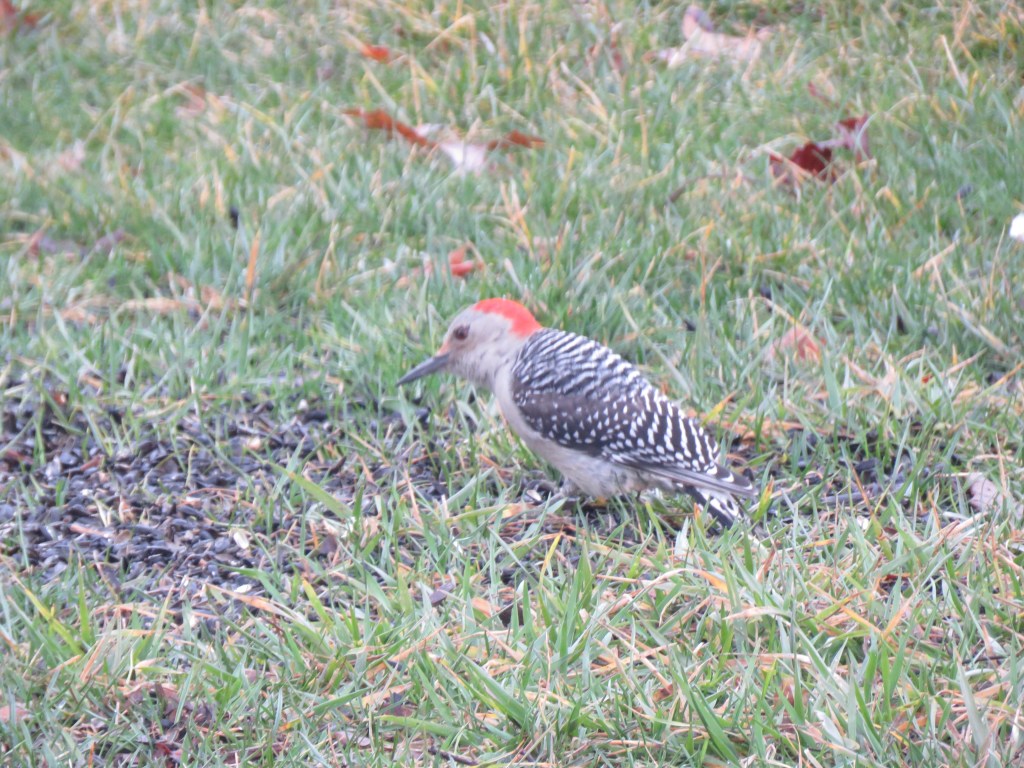
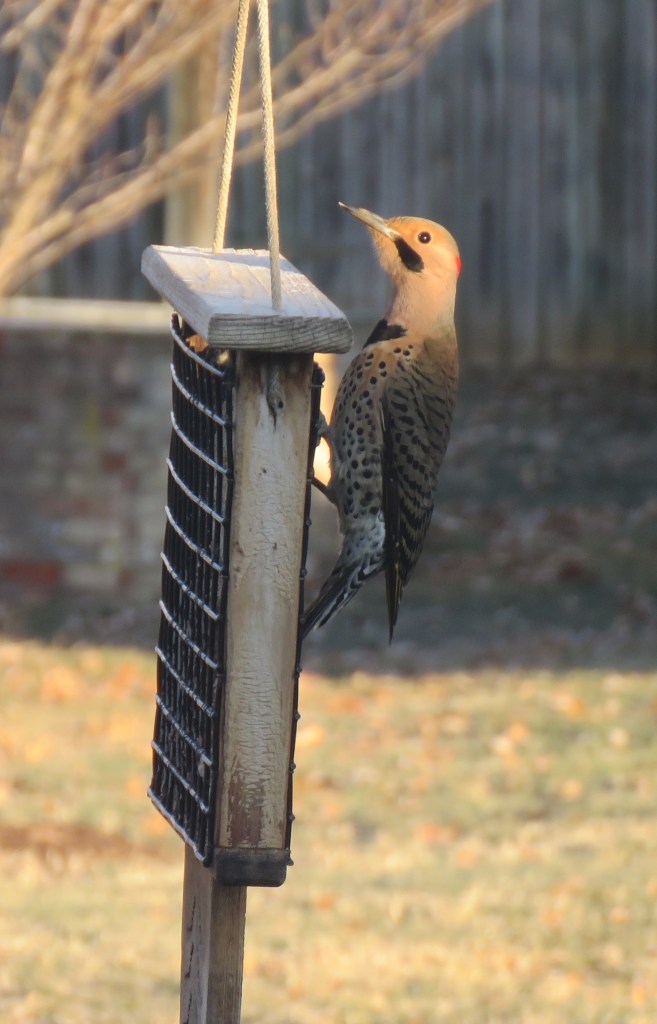
However, I am happy with the variety of woodpeckers that have made a regular appearance at our feeders. They have especially frequented the peanut butter suet feeder in the front yard. The feeder hangs from the large red maple, only 30 feet from the street. Others prefer the black oil sunflower seeds, while some peck at the cracked corn I spread on the ground.
All the woodpeckers announce their arrival in one manner or another. The Red-bellies and the Flickers want the bird world to know that they are arriving, so their harsh, loud screeches warn other birds to get out of their way. I have not seen the two species at the feeders together.
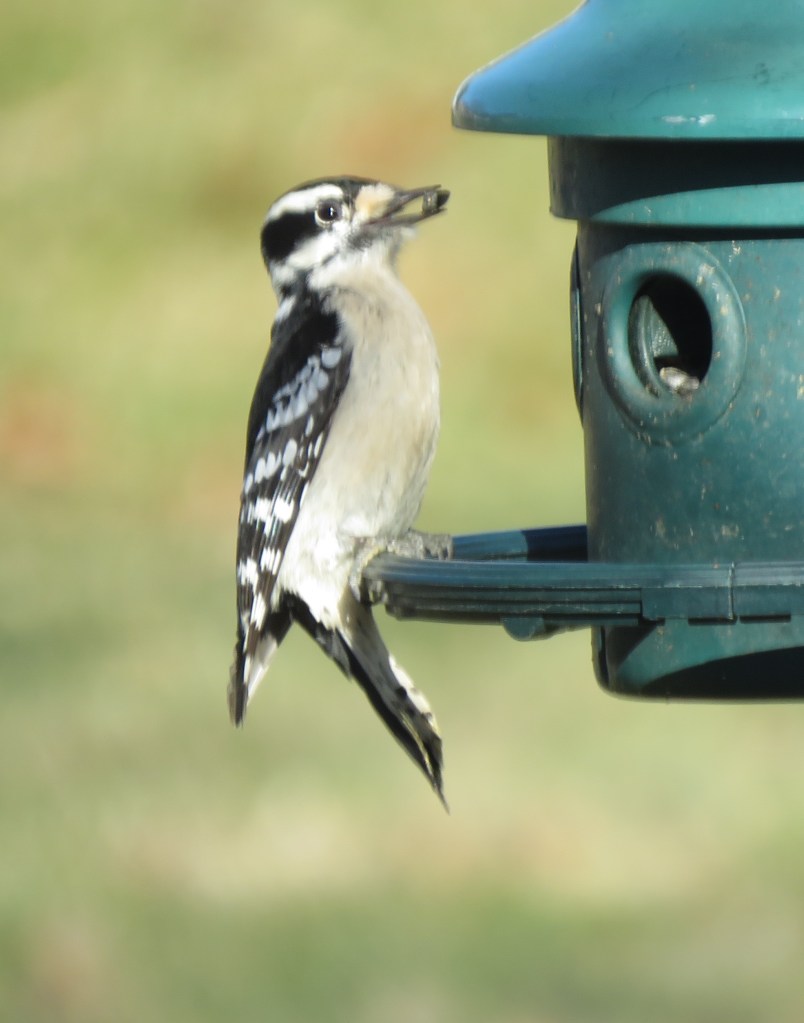
The Downy Woodpeckers are the most discrete. Their soft squeak or rapid-fire drumming on a tree limb gets my attention. Other times they just show up.
Here are a few of my favorite shots of the various woodpeckers at my feeders.
A female Red-bellied Woodpecker searches for black oil sunflower seeds on the ground. Photo by Bruce StambaughA female Downy Woodpecker snatches a sunflower seed. Photo by Bruce StambaughThe morning sunshine highlighted a male Northern Flicker at the suet feeder. Photo by Bruce StambaughA male Downy Woodpecker at the suet feeder. Photo by Bruce Stambaugh
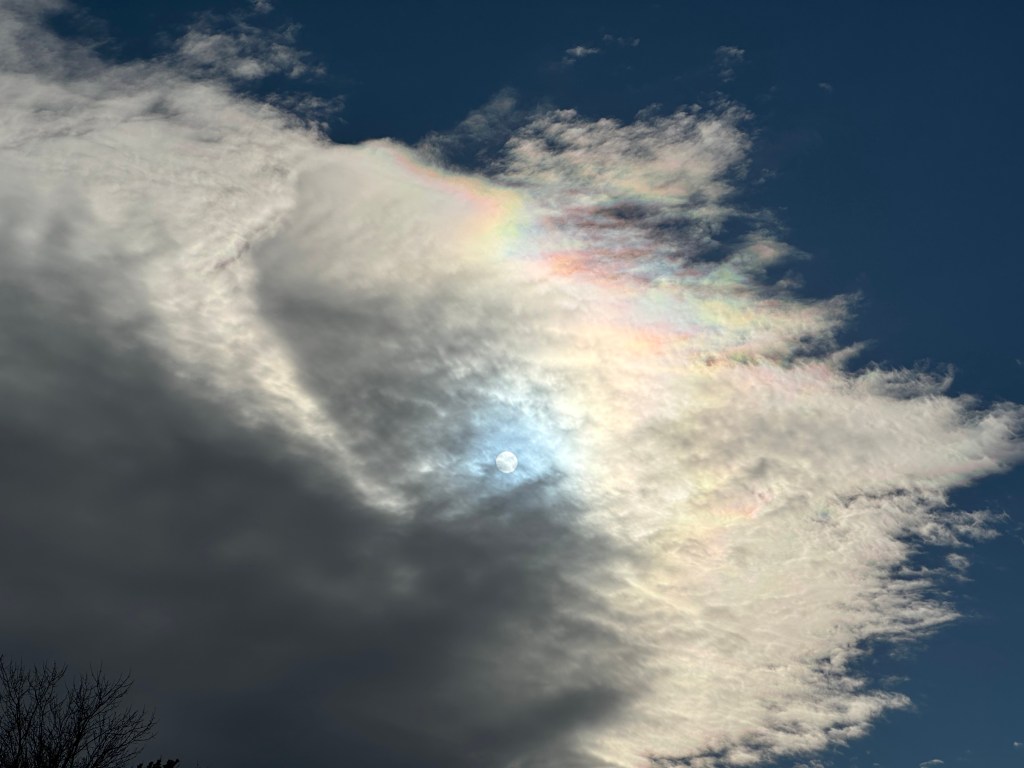
While walking with my wife in our suburban neighborhood, we spied this cloud iridescence or irisation.
Though not uncommon, this irisation occurred in a cirrocumulas cloud. Irisations usually occur close to the sun, which you can see in the photo. It was at the leading edge of the atmospheric river system that pummeled southern California.
I checked the radar when we returned home and found that the rain clouds ran from Virginia’s Shenandoah Valley to Dallas, Texas.
But where does the word “irisation” originate? You can thank Iris, the Greek goddess of rainbows and the messenger of Zeus and Hera to us earthlings. Since I obviously received this colorful communication, I wanted to pass it on to you.
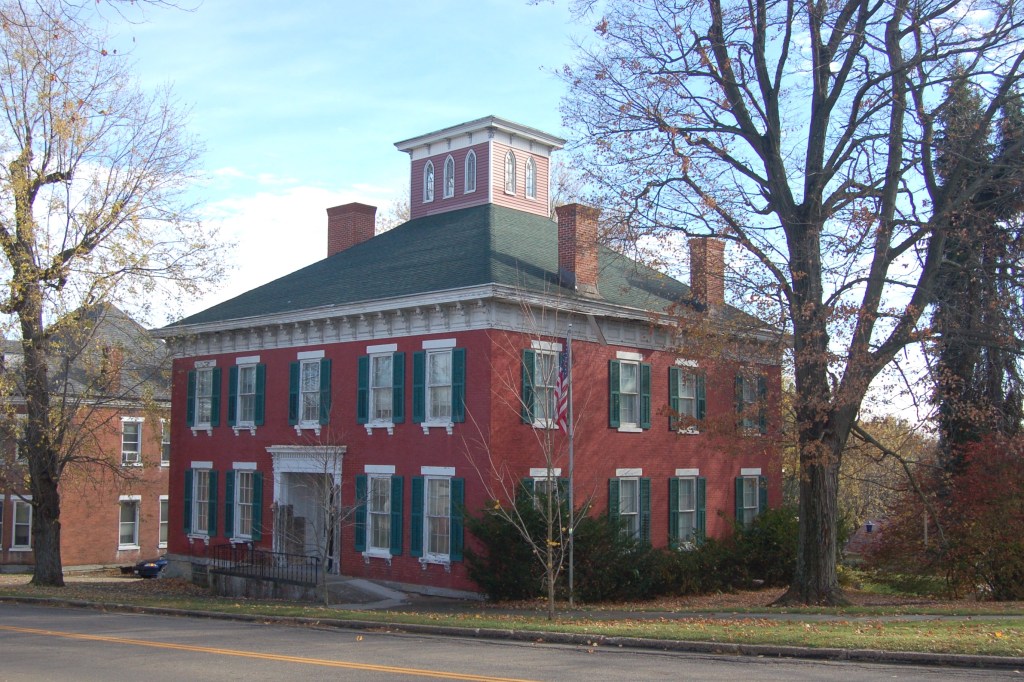
Lanterns lit in the cupula of this home led people on the underground railway to safety. Photo by Bruce Stambaugh
Would you be surprised if I told you that the great Jackie Robinson wasn’t the first African American person to play in Major League Baseball? Would you be even more surprised if I said he wasn’t even the second black player?
Hard to believe as it is, both comments are fact. Moses Fleetwood Walker, better known as Fleet, was the first Black player in the major leagues. He played catcher for the Toledo Blue Stockings in 1884. He signed with the team in 1883 after playing on the baseball teams of Oberlin College and the University of Michigan. Fleet’s brother Welday played a few games that same year, becoming the second Black player. That was 63 years before Jackie Robinson debuted with the Brooklyn Dodgers.
In the post-Civil War era, signing and playing Fleet and his brother was a bold move for the Toledo club, a member of the American Association, now the American League. In the Jim Crow era, it met with great hostility from Whites and, in an odd way, led to Fleet’s short career.
The plaque honoring Fleet Walker in the baseball Hall of Fame. Photo by Bruce Stambaugh
Hall of Famer Cap Anson, the star player and emboldened racist for the Chicago White Stockings, now the Chicago Cubs, refused to play with a Negro on the field. Toledo’s manager called his bluff, however. Knowing he wouldn’t get paid unless his team played, Anson relented. However, Fleet was injured and wasn’t scheduled to play that game. But because of the tense situation, his manager had Fleet play anyhow.
So, why isn’t Fleet recognized as the first Black Major League Baseball player? John Husman, a leading baseball historian, cites two reasons. Records in that era of baseball were not well kept. But more importantly, Jackie Robinson was a star player who played 10 seasons for the Dodgers, plus years in the Negro Leagues before that. The Negro Leagues didn’t exist when Walker and his brother played. Consequently, history forgot them.
Of course, Hall of Famer Jackie Robinson is rightly credited with being the first Black player in baseball. He broke the color barrier with his amazing baseball skills and longevity as a major league player. He earned his Hall of Fame enshrinement in Cooperstown, New York, and the annual recognition of Jackie Robinson Day every April 15th. It was the day he joined the Dodgers in 1947.
Moses Fleetwood Walker has a plaque in the Hall of Fame with a photo of him and his wife, recognizing his pioneer playing days. The plague also includes part of a threatening letter from the Richmond, Virginia, team. It is only one example of what he, his brother, and the teams he played for endured.
Part of one of the threatening letters Fleet Walker’s team received. Photo by Bruce Stambaugh
Despite the progress made by Robinson’s historic breakthrough, injustices to people and athletes of color continue. Only recently, a bronze statue of Jackie Robinson was stolen from a park in Wichita, Kansas. The perpetrators cut off the life-sized statue at the ankles, leaving only his shoes. The statue, valued at $75,000, was later found mutilated and burned at another area park. Clearly, the racist hatred expressed in the Richmond letter toward Fleet Walker so long ago still flares its ugly head too often today.
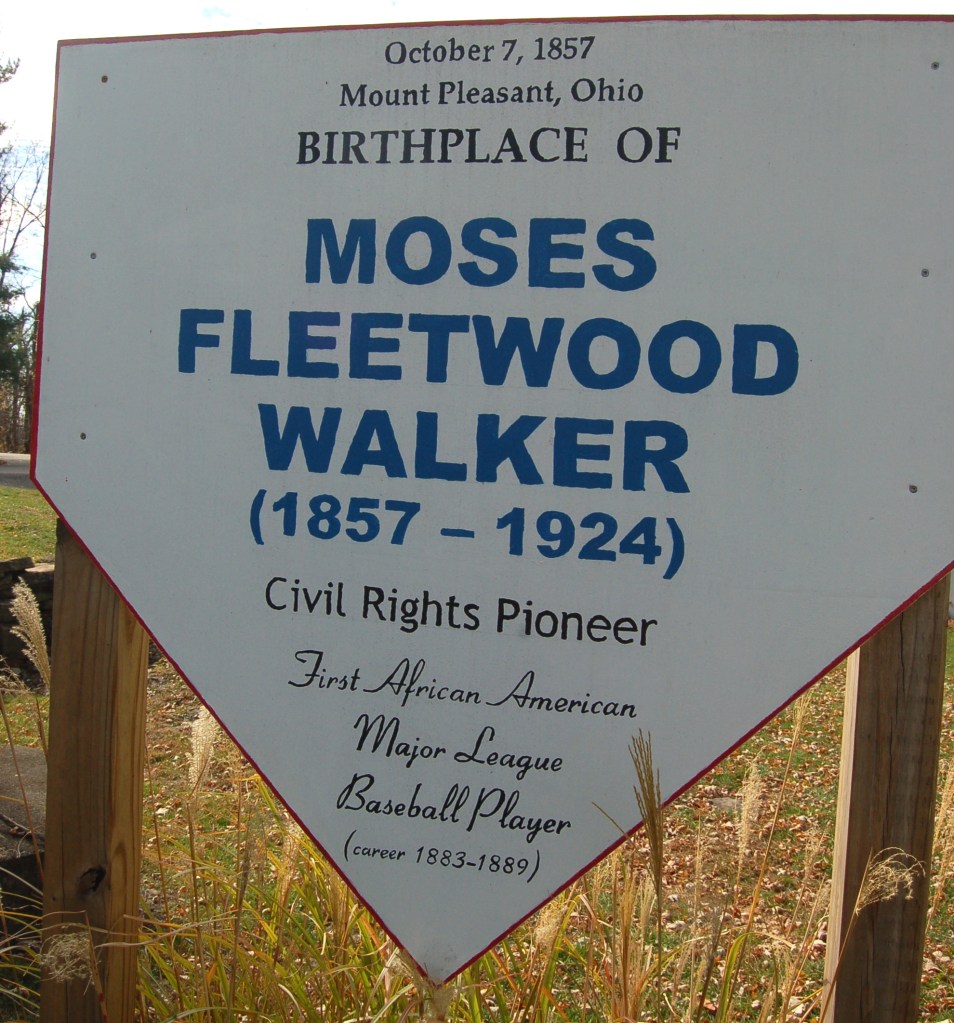
Ironically, Moses Fleetwood Walker was born in 1856 in the then-Quaker town of Mt. Pleasant, Ohio, a noted station on the underground railroad. Lantern-lite signals from the glass windows of a cupula atop a large brick home on the main street of the small village led travelers on the underground railroad to safety from the nearby Ohio River. Could his parents have been among them? It’s a query likely never to be answered.
At least their oldest son has a touch of recognition with a plague in the National Baseball Hall of Fame. It’s a footnote of baseball history, but at least he isn’t forgotten.
I went birding the other day to a couple of small lakes. I was hoping to find a flotilla of waterfowl. But it was not to be. At Silver Lake, I did see a lone male Canvasback swimming with two female Buffleheads.
A male Canvasback and two female Buffleheads. Photo by Bruce Stambaugh
The offerings at the larger Lake Shenandoah, southeast of Harrisonburg, Virginia, were even less. I scanned the lake with my binoculars and saw nary a bird. I walked the mile-and-a-half path around the lake, hoping to find a few ducks tucked among the cattails out of the wind.
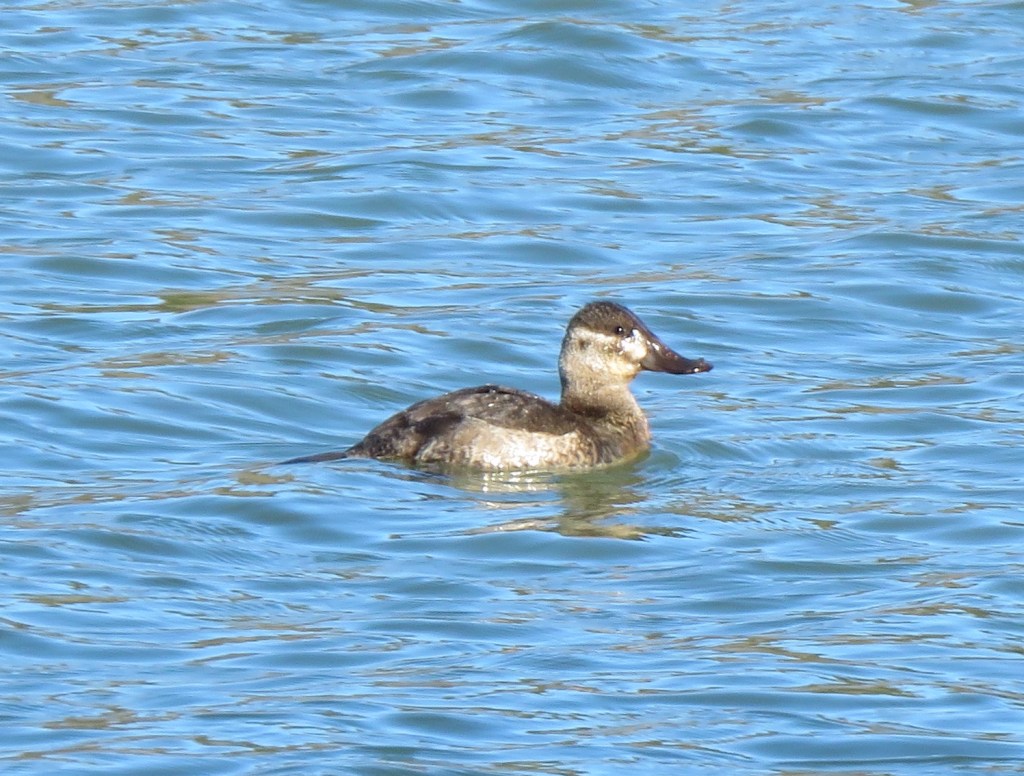
As I reached the midway point, I spotted a diving duck. The little brownish duck didn’t stay long on the surface. After several tries, I finally got a photo of a female Ruddy Duck.
A female Ruddy Duck.
Even though there were few ducks on the ponds, I considered it a successful day of birding.
Of course, baseball buffs know the expression “ducks on the pond” as a euphemism for runners in scoring positions. I like it when my multiple interests overlap.
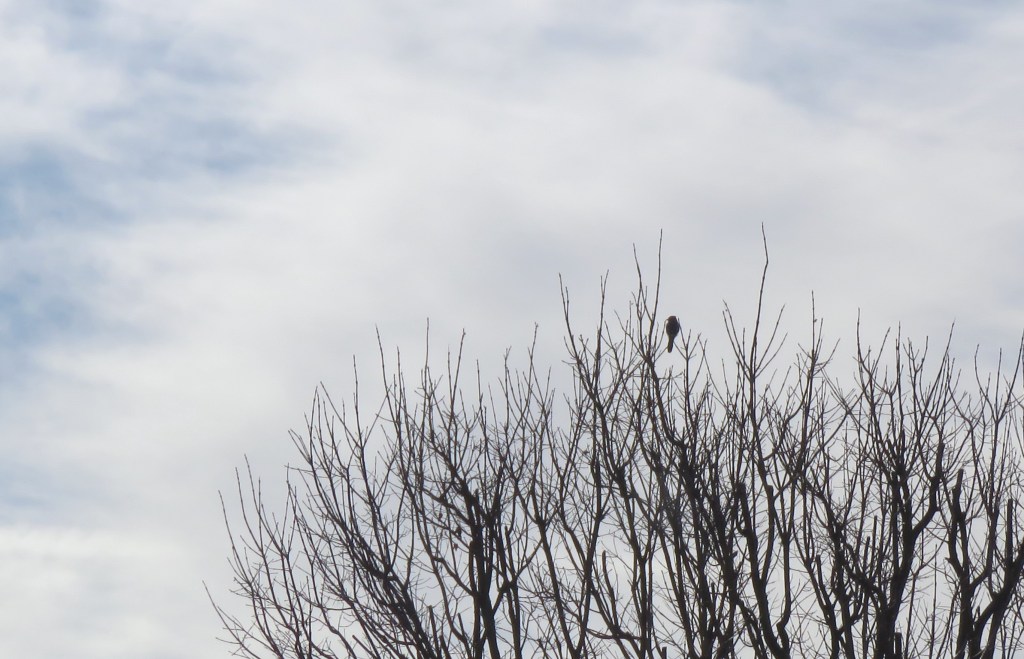
A Blue Jay scout atop a neighbor’s maple tree. Photo by Bruce Stambaugh
We’ve had several chilly, gray-sky mornings lately in Virginia’s Shenandoah Valley. Consequently, our backyard birdfeeders have been active. The usual suspects frequent the hanging and tray feeders to crack open the tiny black-oil sunflower seeds.
A small flock of American Goldfinches are the most faithful. A small flock of European Starlings are the least wanted. The latter devour nearly any bird food I provide.
Occcasional visitors are Northern Cardinals, Dark-eyed Juncos, a resident Song Sparrow, a pair of Carolina Wrens, and a few White-crowned and White-throated Sparrows. I’m glued to the windows when they all arrive, often simultaneously.
But the bird that usually announces its arrival is the Blue Jay. Of course, they seldom come alone. A group of four to eight brighten my feeders irregularly. They hog down the sunflower seeds, peck at the cracked corn, and sometimes the peanut butter suet.
When I’m out filling the feeders and heated birdbaths, I hear them mimicking other birds in the neighborhood. My favorite imitation is of the Red-shouldered Hawk, which makes occasional low flights over the house in search of a songbird meal.
The intelligent Blue Jays keep a sharp eye out for the Red-shouldered Hawk. They want to keep their feathers intact. Sometimes, I hear the Red-shoulder’s loud, repetitive screeching, meant to scare out hiding songbirds. The call is too close for me not to see the hawk. More often than not, it’s a Blue Jay in an evergreen pretending to be a hawk.
The Blue Jays apparently have observed this mode of attack and use it to their benefit, not to attack other birds, but to frighten them away from the feeders so they have free dibs at the goodies as they dive in like blue and white jet fighters.
Smart as they are, the Blue Jays may keep a sentinel perched high in a neighbor’s tree, listening and watching for any potential predator like a cat, hawk, or human. They take no chances.
I was fortunate to spy a Blue Jay lookout the other morning. It perched quietly for several minutes, turning its head every which way to ensure the coast was clear for breakfast. I turned away and then back again, but the tree was bare.
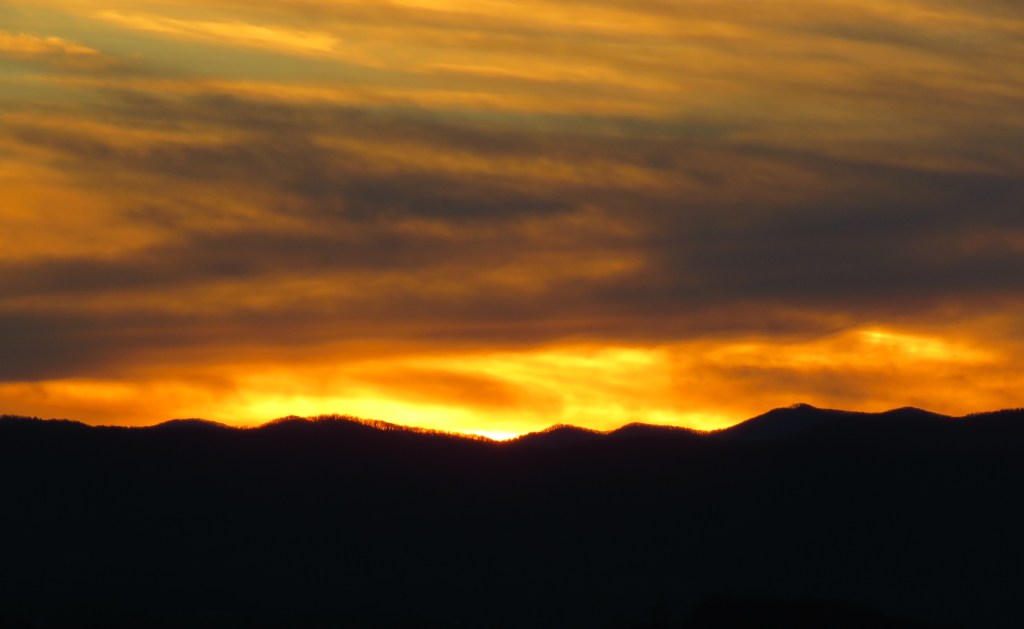
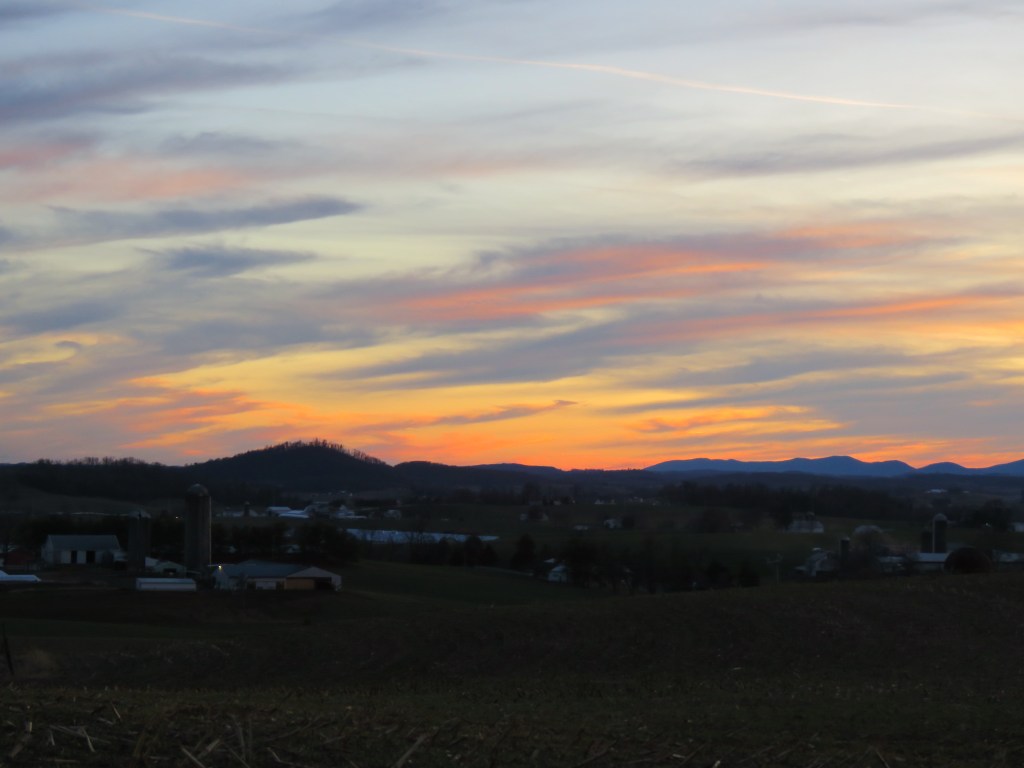
Sunset over the Allegheny Mountains. Photo by Bruce Stambaugh
I watch the sky for any hint of a colorful sunset. I have to go outside to do so since our house faces north. The view southwest, where the winter sun disappears, is obstructed by neighboring evergreens and houses.
When I think the potential for a colorful evening sky is favorable, I grab my cameras and head west. Mole Hill, an extinct volcanic core, is one of my favorite spots.
From Mole Hill, I have panoramic views in every direction but east. Recently high, wispy clouds stretched across the sky like fingers from the Allegheny Mountains 30 miles to the west. It looked good for a blazing sunset.
However, by the time I reached Mole Hill, upper-level winds had scattered the clouds, except right over the mountains where the sun would disappear. I waited, nevertheless.
My patience paid dividends. While the sky over the old-age mountains blazed orange behind the stubborn clouds, pinks and mauves blossomed south, southeast, and north. I happily snapped away.
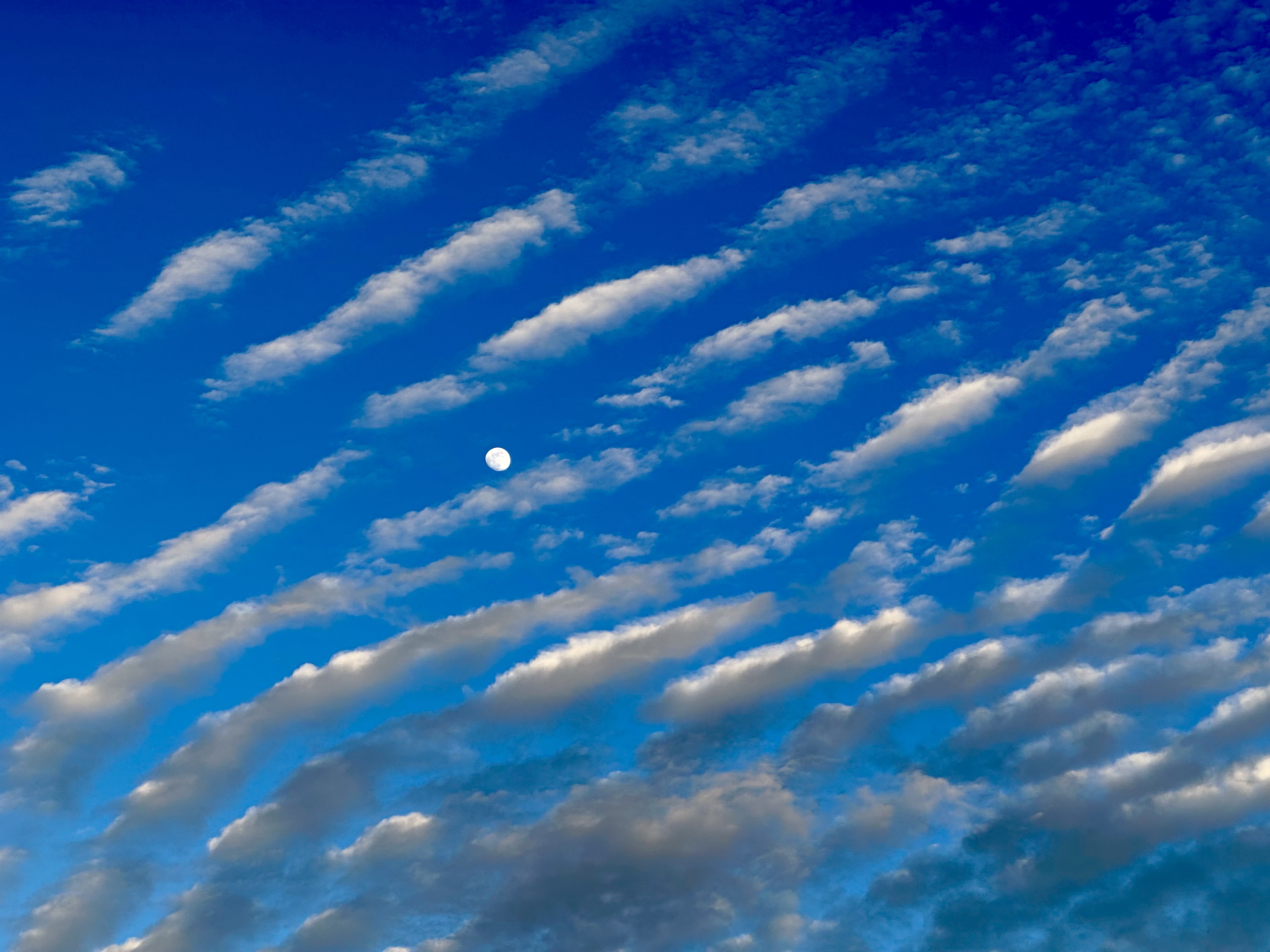
The Moon in a mackerel sky. Photo by Bruce Stambaugh.
I like to walk. Our neighborhood is the perfect place. We have little traffic in our little subdivision west of Harrisonburg, Virginia. Even though there are no sidewalks, the roads are wide and paved.
I walk as often as I can. But I enjoy the many things I see and sense as much as the exercise. The clouds caught my attention as I rounded the corner to our home in the crisp, cold air.
I recognized them right away. Meteorologists classify the high, scalloped clouds as Altocumulus clouds. Oftentimes, these clouds appear with other types of clouds. But on this winter’s day, they sailed the cerulean sky beneath a nearly full moon all alone.
Blue sky and dark blue shadows on snow. Photo by Bruce Stambaugh
You don’t need me to tell you that the winter weather has been brutal in the first few weeks of 2024. And yet, it has its serenity, too.
I always loved how the long shadows of winter played across snowy landscapes. Even in suburban settings, the sky, trees, and shadows mark stark but lovely contrasts against the snow.
Such beauty helps us through blizzards, snow drifts, wind chills, and freezing temperatures. Altogether, they help chase away the winter blues.
The temperatures in Virginia’s snowy Shenandoah Valley were in the single digits again this morning. There’s nothing like a cup of coffee of your choice to help take the chill off the coldest morning.
My wife and I enjoy mocha lattes. We have to drink decaf at our age. What’s your favorite hot drink?
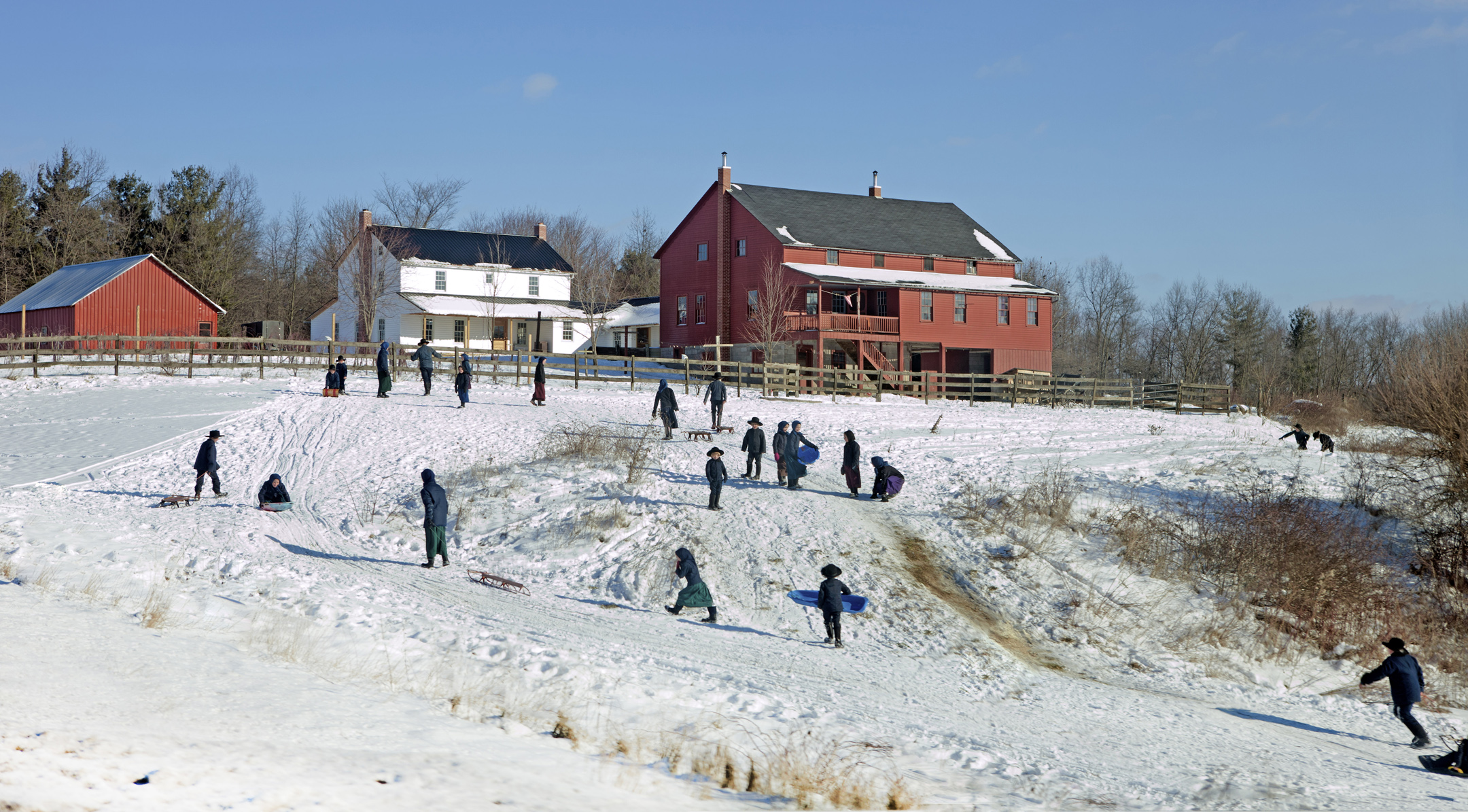
Swartzentruber Amish sled riding at recess in Wayne Co., Ohio.
There is “snow” better way to enjoy the January cold than sledriding. These Swartzentruber Amish students certainly enjoyed their afternoon recess gliding down a slippery hillside near their one-room schoolhouse.
After attending a meeting in Kidron, Ohio, 11 years ago, I decided to take some back roads home. It had snowed a few inches overnight, but the clouds had moved out by afternoon. The clear sky’s bright sun warmed the cold January day.
This scene came into view as I rounded a bend on a narrow township road. I knew I had to get a photo of these Amish schoolchildren sledding at recess. I also knew that I had to be discreet since I always tried to honor the Amish position of no photography.
I secured one photo undetected before moving on. The joyous laughter of the happy scholars made the satisfaction of this photo all the more enjoyable.









 Roadkill Crossing
You must be logged in to post a comment.