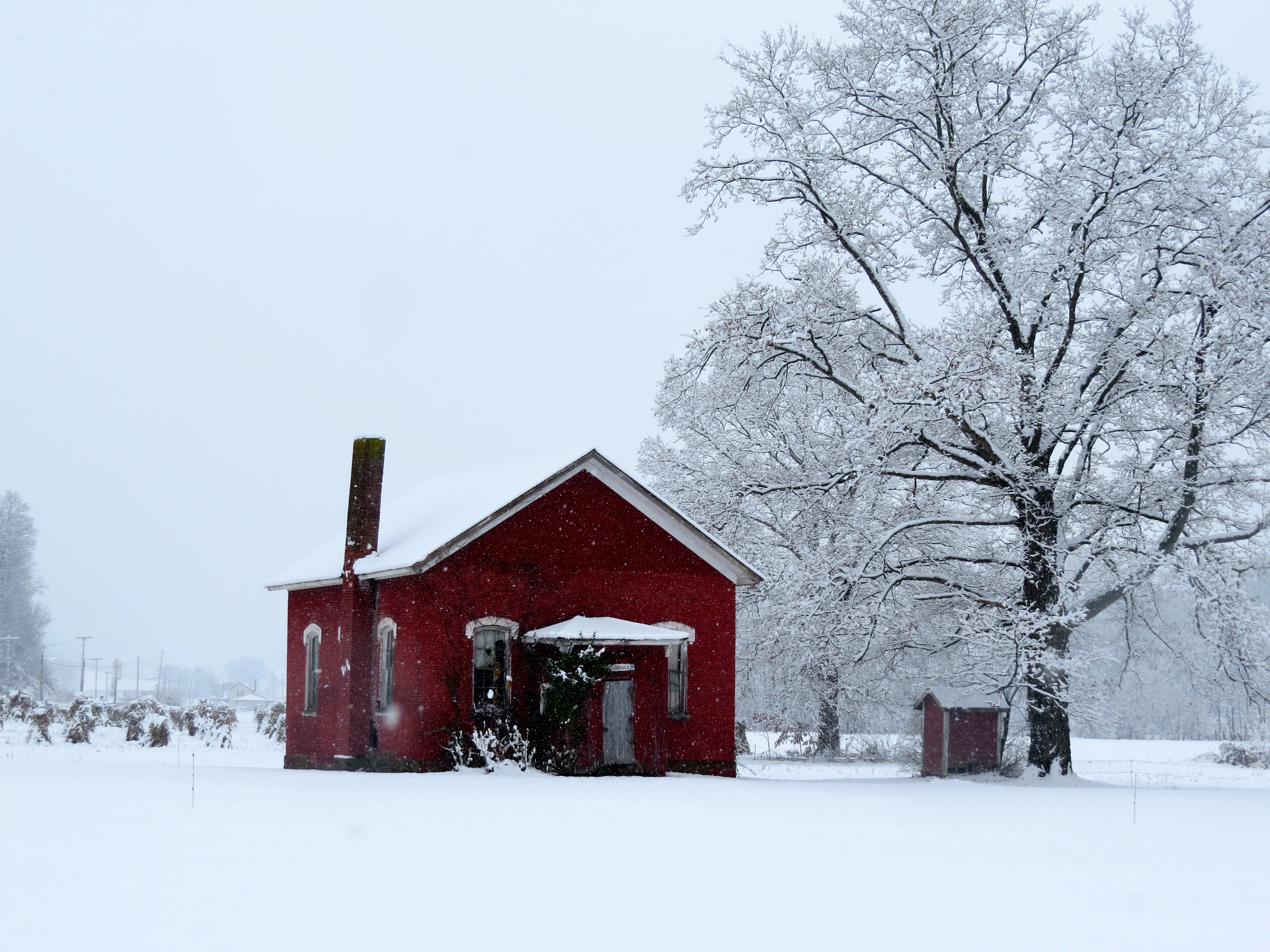
The red bricks of this abandoned one room school a few miles from my home stood in sharp contrast to the season’s first snowfall. Long since closed, this little red brick school once served as the incubator for future lawyers, farmers, housewives, teachers and business owners.
The outhouse on the right also played an important part in the school’s history. Right after World War II, the students gathered in the morning for class, but their usually prompt teacher wasn’t in the building. After several minutes, the oldest student, an eighth grader, went looking for the teacher, and found him sitting in the privy dead.
I always think of that story when I pass by the old Beechvale School. “Little red schoolhouse” is my Photo of the Week.
This was to be benefit Saturday for my wife and I. I simply couldn’t have projected just how beneficial it would end up being.
Before dawn a delightful aroma wafted across the landscape from the Amish farmstead behind our rural Millersburg, Ohio home. A congregation of people was barbequing chicken on portable grill wagons. A generator cast a harsh, artificial light upon the busy group, creating predawn silhouettes.
The benefit barbeque was for a couple that needed financial assistance due to extreme medical bills. She had cancer, twice. He had had surgery that kept him off of work for six months. To help out, we ordered six quarters of chicken to be picked up after 11 a.m.
A Mongolian hut is called a ger. (Photo by Kim Kellogg)That was but one of three different fundraisers in which we participated that day. The first began at 7 a.m. with sausage, ham and pancakes. My wife ate the meat. I ate the pancakes. The breakfast was held to raise money for a mission project in Mongolia. An authentic, completely furnished Mongolian ger, a felt lined hut, had been erected in the church fellowship hall for all to inspect.
As tasty as the food was, the fellowship that buzzed around our table was even better. We reminisced with old friends about how our lives had intersected during the ups and downs of life. Breakfast doesn’t usually come with dessert, but that’s what this conversation ended up being.
Though the chicken cooking was literally in our back yard, we had to pick up our order at a residence a mile up the road. For lunch, Neva and I each downed a quarter of the flavorful hinkel, as the Amish refer to it. We enjoyed the chicken so much I returned to buy more, only to be told that they only had enough to fill the presale orders.
Our Amish neighbors hosted the grilling of the barbequed chicken.
I drove back my neighbors’ long graveled lane to where the chicken was being grilled. I got the same answer there, but discovered the full measure of devotion of this gracious act of charity.
More than 80 friends, family and extended family members gathered to do the chicken. A total of four tons or nearly 8,500 quarters of chicken had been barbequed to sell on behalf of this family in need. The charcoal was lit at 5 a.m. The grilling began at 6 a.m. and finished up at 2 p.m. It was an all day deal.
From the looks on the workers faces, they were both elated at the success of their selfless efforts and fatigued from their long hours of hanging around the smoky grill pits. A total of 36 Amish churches helped sell the chicken, and they indeed sold it all. They may have barbequed lots of chicken, but in the process they also cooked up a liberal batch of compassion.
The band, Honeytown, performed at a local coffee shop to help raise money for our church youth group.
In the evening, Neva and I headed into town for a concert by a renowned, local quartet. Honeytown sang and played as a fundraiser for our church youth group. The kids were raising funds to attend a church wide conference in Arizona this summer. Only Mennonites would hold a gathering in the desert in July.
Each of these three benefits had a specific purpose, and each achieved success. Love comes in many shapes, sizes, and means, pancakes, barbequed chicken, and inspirational song among them. Though independent of one another, a common purpose and generous acts of human kindness bound the benefits as one.
We had been thrice blessed. Beneath an umbrella of golden sun and cloudless coral sky, this benefit Saturday had truly been extraordinary.
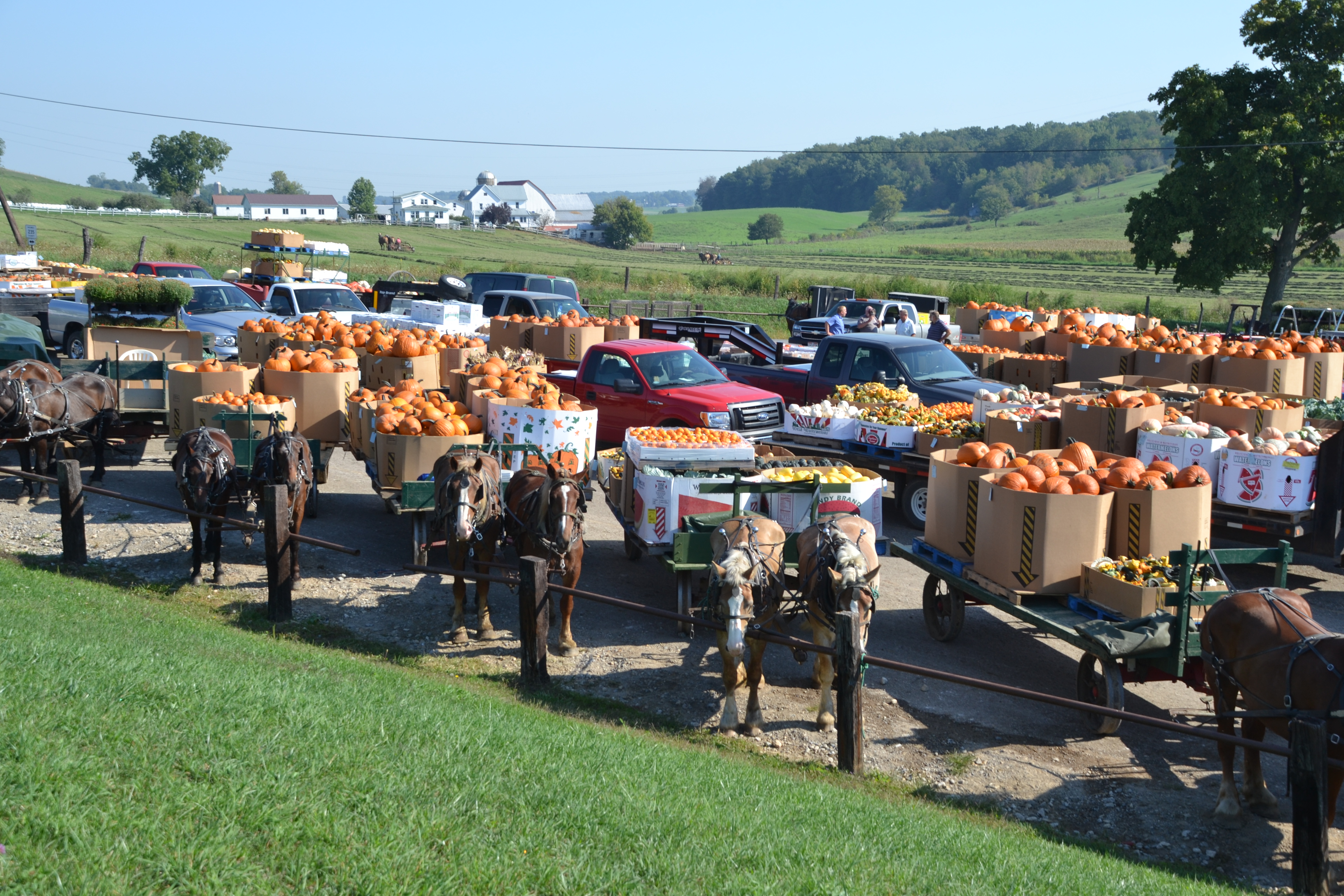
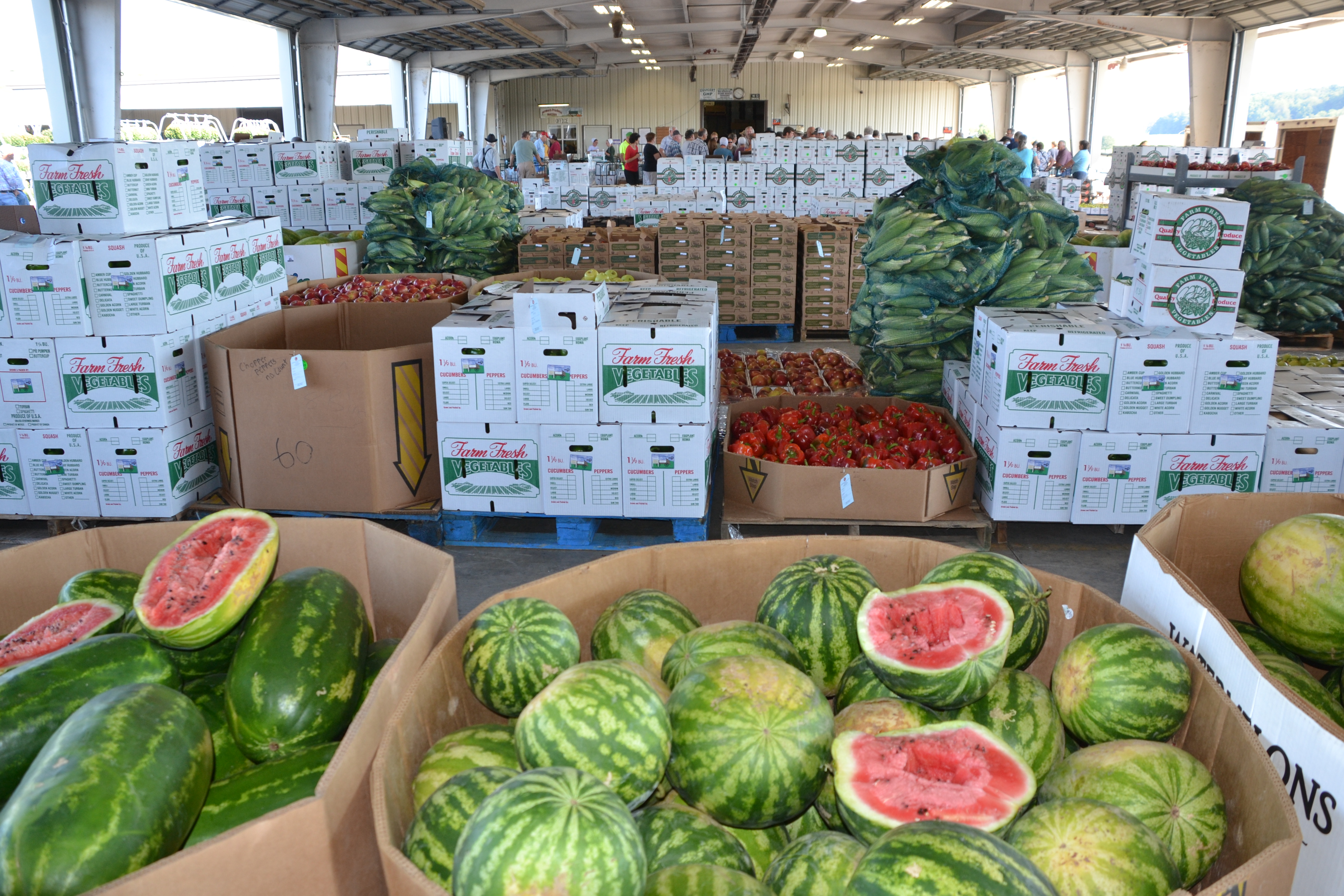
The lineup of produce waiting to be auctioned was colorful in more than one way.
By Bruce Stambaugh
For inspiration this time of year, I love to frequent the local produce auction located just two miles north of my home. It’s a carnival, traffic jam, town hall meeting, commerce hub and art museum all rolled into one.
I like to arrive midmorning just as the auction is about to begin. When it’s peak harvest time, the place is abuzz. Men, women and children seem to have caught the same exciting spirit. Trucks of all sizes back up to the loading docks to both deliver for the auction and to load produce purchased.
Vehicles of all sorts line up to empty and to load the produce and associated items. Box trucks, pickup trucks, and pickups with flatbed trailers, tractor-trailer trucks, tractors with loaded wagons, horse drawn wagons, vans, cars, carts and bicycles all congregate at the Farmers Produce Auction west of Mt. Hope, Ohio.
Their drivers are there for one of two reasons. They arrive to sell their fruits, vegetables and flowers or to buy them. A few of us, of course, show up to simply admire the proceeding. The exuberant energy and shining beauty are both contagious. The drive through auction creates an unusual traffic jam.
Amish men and teenagers steady their team of horses, standing patiently in line under the strengthening sun. Most have traveled miles with their cargos of colorful produce, neatly packaged and ready for the sale.
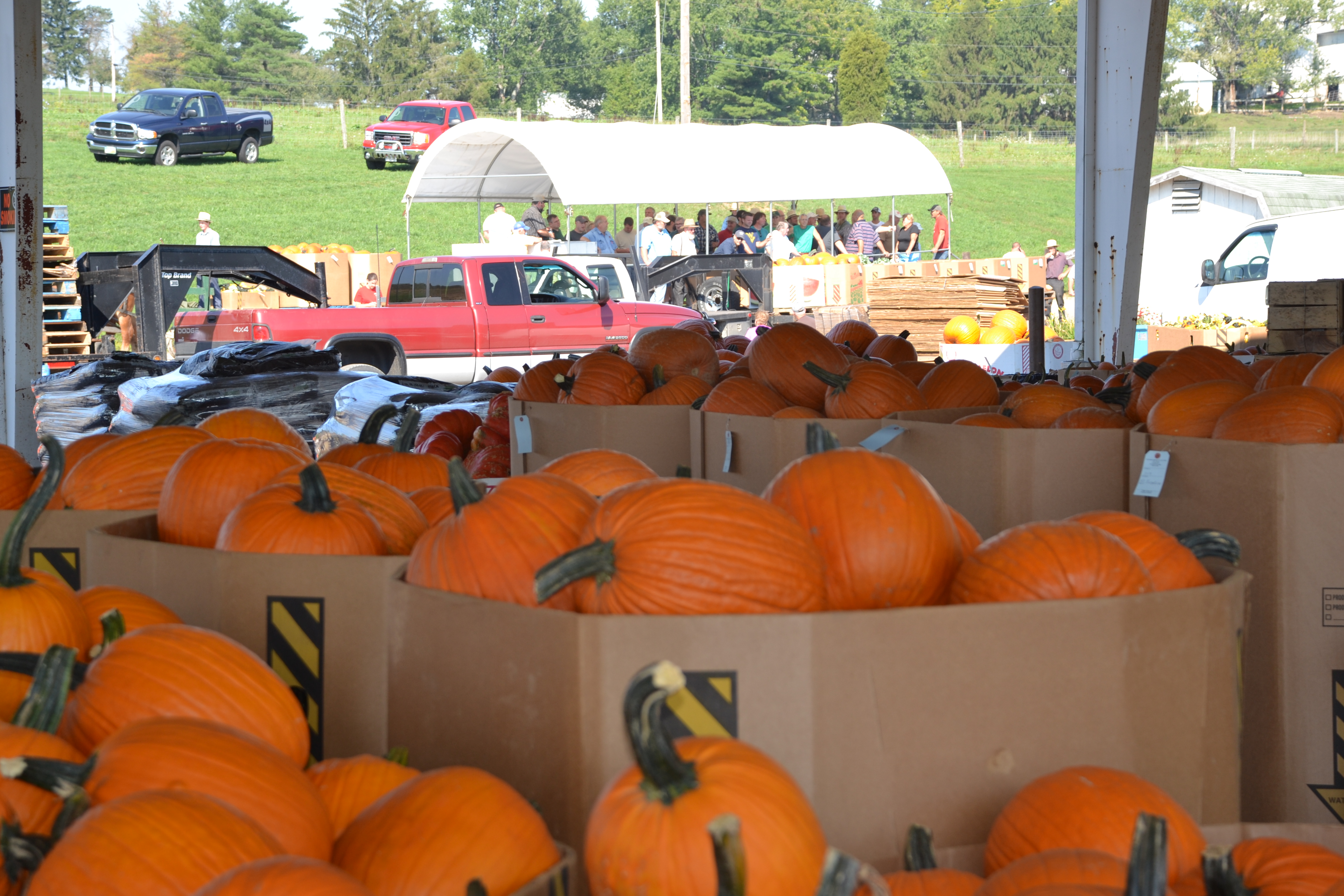
The assortment of trucks carries interesting payloads, too. The season’s last sweet corn and melon, huge boxes of the season’s first pumpkins, bright red and yellow peppers, and flat after flat of budding burgundy, gold and crimson mums are just some of the offerings. Buyers and sellers alike gathered around the auctioneer as bids were taken.
The syncopated rhythm of the auctioneer echoes from the open-sided building, announcing the sale’s start. Buyers quickly abandon the food stand and squeeze in to catch any bargain they can. The pace is quick, and if you snooze you lose. People pay attention.
The buyers themselves are a joy to watch. Young and old, male and female, they represent their own produce stand, local restaurants or a supermarket chain. This is their livelihood. They are daily regulars, and the astute auctioneer knows them well. A wink, a nod, a twitch and particular hand gestures signal bids and it’s on to the next lot. So much produce arrives each day that two auctions, one inside, one outside, are held at the same time.
Soon the drive through auction simultaneously begins outside. Double rows of boxed and packaged produce or flats of hundreds of flowers are sold straight from the wagon or truck on which they arrived. They pass by the canvas-covered auctioneer’s stand two-by-two until the last one is through.
Sellers know they have to be on time. Despite the disjointed configuration of vehicles, the sale runs efficiently, making buyers and producers both happy. To be first in line, one driver arrived at 6:15 a.m. for the 10:15 a.m. sale. That’s the dedication of effective and productive commerce in action.
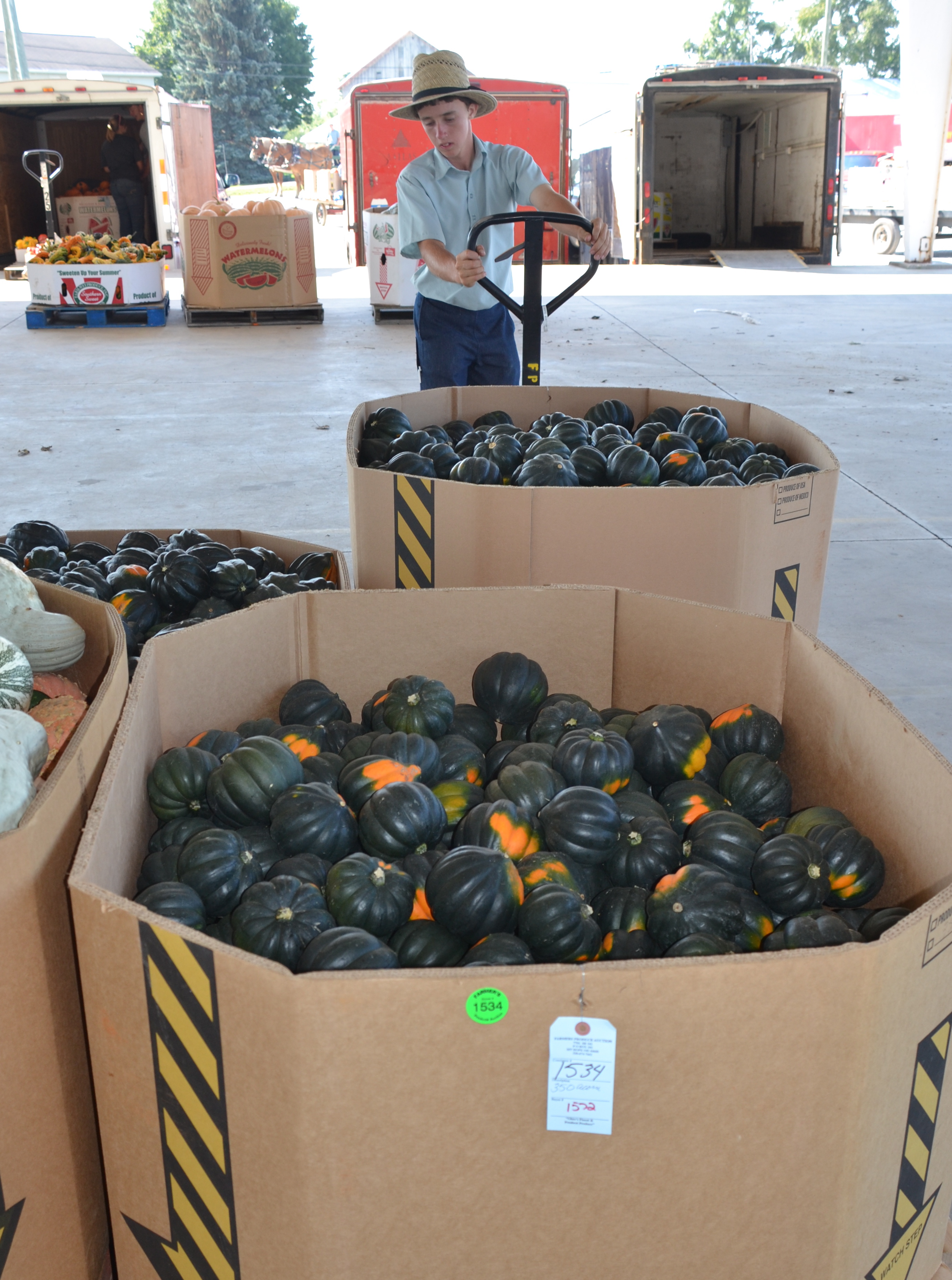
Amish teens help move the sold produce to staging areas until the buyers claim their purchases.Hand-printed tags on the purchased commodities tell the tale. The number in black indicates the producer. The red number is the buyer. As soon as the lot is sold, young men and boys transport the goods with tow motors to designated stations where the merchandise is parked until claimed. Once the buyer is all in, the purchased containers are loaded into his or her vehicle.
By lunchtime, teamsters mull their successes on the slow, rattling ride home. Truck drivers secure their load, and head to their predetermined destinations where the fresh goodies will be sorted, washed and prepared for consumption.
The fascinating organization, the polished production, the gregarious people and the artsy produce combine to create one rousing show. What an inspiring performance to start the fall.
Growers are taught how to package their produce to ensure both quality and higher prices.The produce is neatly lined up in rows as it arrives to be sold at the auction.The outside auction is done by selling the produce in double rows that slowly pass by the auctioneer’s stand.Seasonal decorative produce like these gourds and pumpkins add to the auction’s peak season success.Besides the Amish farmers, the auction employs several Amish men and women to help with the sale.
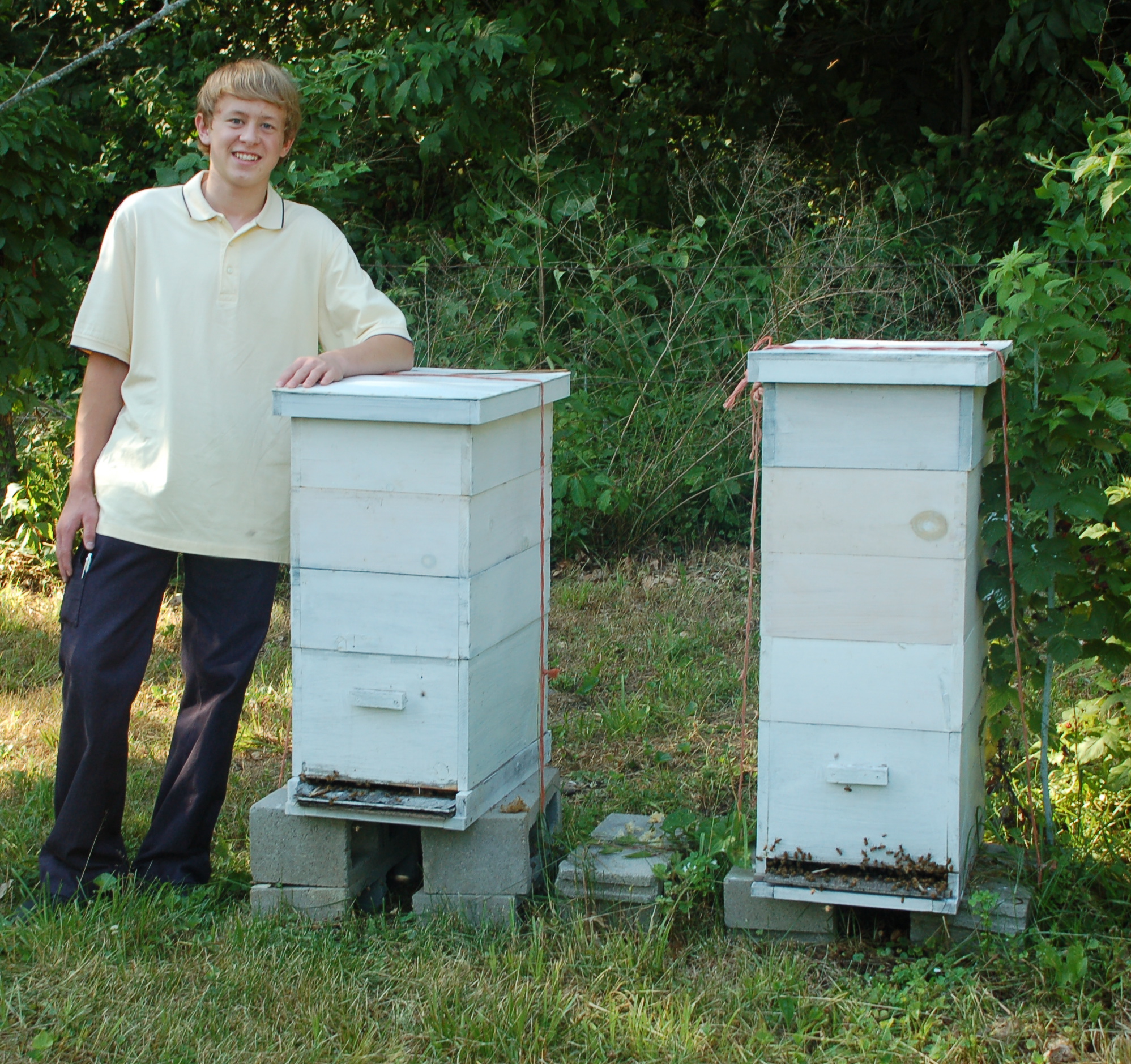
Brian Miller, 17, of Apple Creek, OH checked out some bee hives before a recent meeting on beekeeping held near Mt. Hope, OH.
By Bruce Stambaugh
Beekeeping is on the rise, according to Dr. Jim Tew, recently retired bee specialist at The Ohio State University Extension Services in Wooster, Ohio. He just doesn’t know why.
A meeting held recently at the residence of Mark Miller near Mt. Hope, Ohio seemed to be proof of that. Men, women and children, many of them Amish, nearly filled the several rows of church benches set up in Miller’s spacious outbuilding where the beekeeping meeting was held.
Miller said beekeepers’ meetings like this one are held three times per year. He said there are two such groups in Holmes County, Ohio. They are geographically split into northern and southern groups, with U.S. 62 being the dividing line.
The meetings are held to keep area beekeepers informed about the latest information on beehive maintenance and keeping the bees healthy. They also lean on the informal approach to allow for extensive question and answer times. Dr. Jim Tew shared his expertise on beekeeping to a group of beekeepers in Holmes County, Ohio. Many of those in attendance were Amish.
Tew was asked to share his expertise on beekeeping. The gregarious and modest Tew kept the group relaxed with personal stories of his more than 40 years of beekeeping. He retired from the OSU Extension after 35 years.
The Alabama native told the group that beekeeping is extremely popular right now.
“But I don’t know why,” he said. He suggested one explanation could be that honeybee husbandry fits into the popular universal interest in providing a dependable, wholesome food supply. Honeybees scurried in and out of a hive across from Mark Miller’s residence near Mt. Hope, OH.
Related to that sustainability idea, Miller told the group, “I like the concept of producing our own bees here in Ohio.” Normally, purchasing commercial kits and commercially raised queen bees, which are essential for hives to thrive, starts bee colonies.
“Having meetings like this,” Miller said, “will help us toward that goal.”
Indeed, Tew indicated that when the Varroa destructor mites began to invade honey beehives in 1987, the industry took a huge hit. The killer bee scare followed that, and bee husbandry began to wane. Dr. Jim Tew showed the group a mite zapper that could help control destructive Varroa mites.
“It’s unnerving,” Tew said of the disease, officially called colony collapse syndrome. “Happily those initial dark days have gone away, and I no longer have any fear of all of my hives dying.”
He shared various ways beekeepers could help deter the mites and how to properly inspect hives for any possible problems. He said the most recent die off of bees made headlines because information spread rapidly on the Internet.
“This die off was not new,” Tew said, “though it may have a different cause.” He explained that there could be many causes for hives not thriving.
“Too many of us want to find one reason for a die off,” he said. “Each of you who keeps bees will have to talk amongst yourselves to determine what system to stop the mites works best.”
Miller said the meeting was not limited to those who live north of U.S. 62. In fact, 17-year-old Brian Miller came from Apple Creek to learn about bees. He just began keeping bees last year, and said his hives are thriving.
The Tri-County Beekeepers Association in Wooster awarded Brian Miller a $500 scholarship for an essay he wrote on “Why I love beekeeping.” He said the money enabled him to purchase needed beekeeping supplies and equipment to maintain and expand his hives.
Mark Miller, who began beekeeping in 2009, said he also received an award to help him get started.
“I was honored to receive the Don Meyers East Ohio Apiculture Project prize of $75,” he said. That amount helped him buy two hives and equipment to operate them.
Though he retired from his OSU Extension position, Tew continues in the bee business both personally and professionally. Besides keeping bees himself, he also serves as a state beekeeping specialist for his home state of Alabama.
He kidded the crowd by saying that he now has a 900-mile commute to work. In actuality, he travels to Alabama five times a year to complete his beekeeping responsibilities.
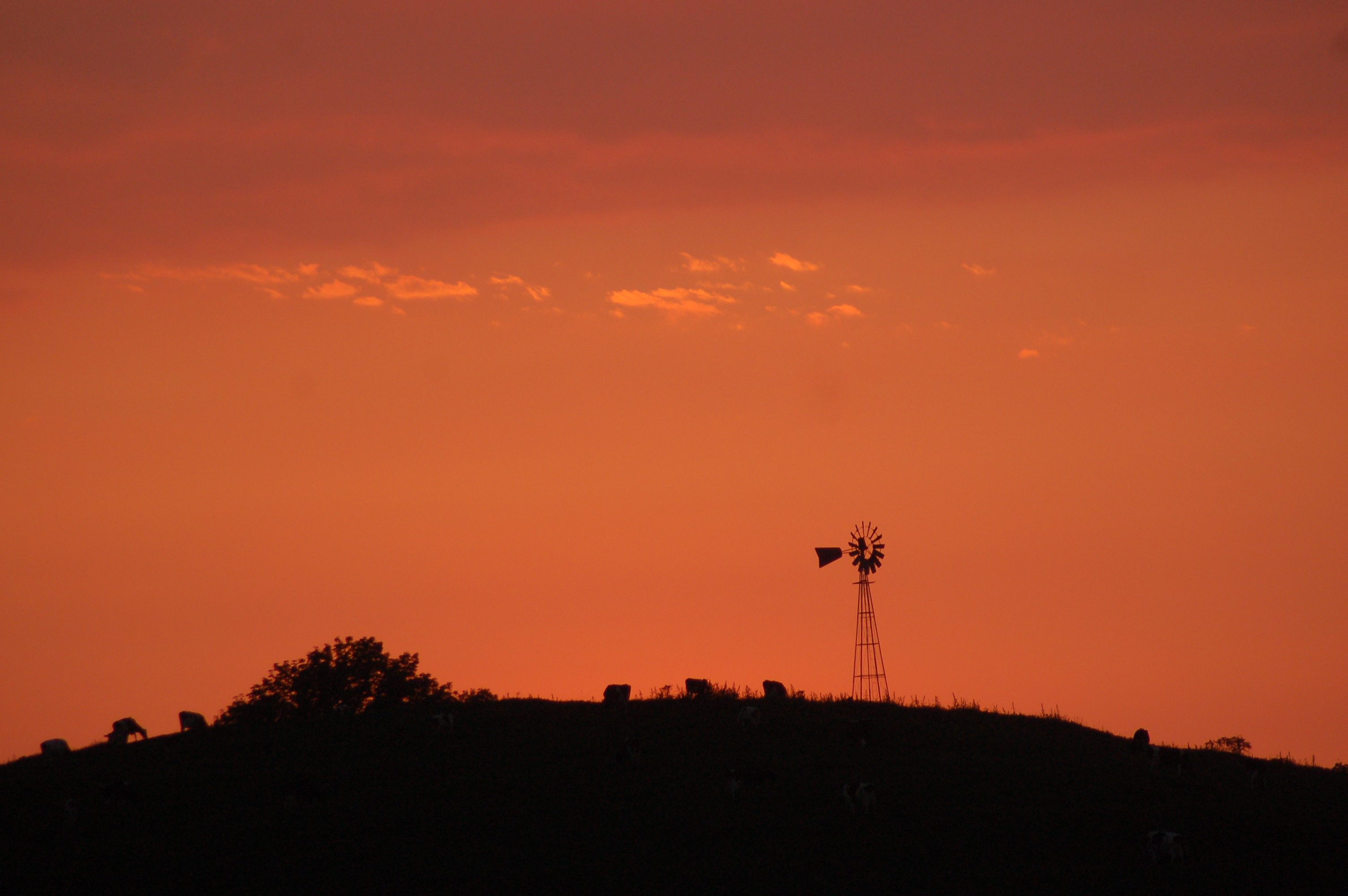
A typical August susnet in Ohio's Amish country. By Bruce Stambaugh
I have always thought of August as a transitional month, the days between busy, boisterous July and the revitalizing September.
August is the stepping-stone from summer’s onslaught of activities into a pre-fall mentality. Vacations wind down for most people. It’s back to school and back to work.
If we take time to halt our busyness, our clamor to re-ready ourselves for the new school year at hand, we can take note of this calendar bridge from tilling to harvest, from clamor to order. In its intermediary mode, August seems to quietly take it in stride.
The songbirds no longer need to announce their territory or impress their mate. The young have flown the coop, or more properly stated, the nest, and bird life has returned to seeking daily subsistence. The American Robin precisely models the point.
From April to July, the Robins paired off, warbled their luxurious choruses almost continuously sunup to sundown. They pecked on windows, noisily flitted off their nests when disturbed and faithfully fed their young.
The Robins were ubiquitous in both presence and song. People often comment when they see their first Robin of the spring.People often remark when they spot their first Robin of the spring.
Now, in late August, the Robins have all slyly retreated to their preferred nomenclature. They are more than content to while away the day searching for food deep in the recesses of the shade and forest.
Think about it. When was the last time you either heard or saw a robin? They simply and silently slipped away unnoticed.
If they haven’t already, other bird species will soon be disappearing from the area altogether. The Purple Martins, Barn Swallows and Common Nighthawks all heed their interior instinctive urgings and vanish unseen much like the Robin. We under-appreciate their massive consumption of insect protein until it’s too late to thank them.
Just as quietly, the multiple greens of fields and pastures have grown taller, richer. Chameleon-like, they have morphed into emeralds, tans and russets with hardly a rustle. The colors of August change from day to day.
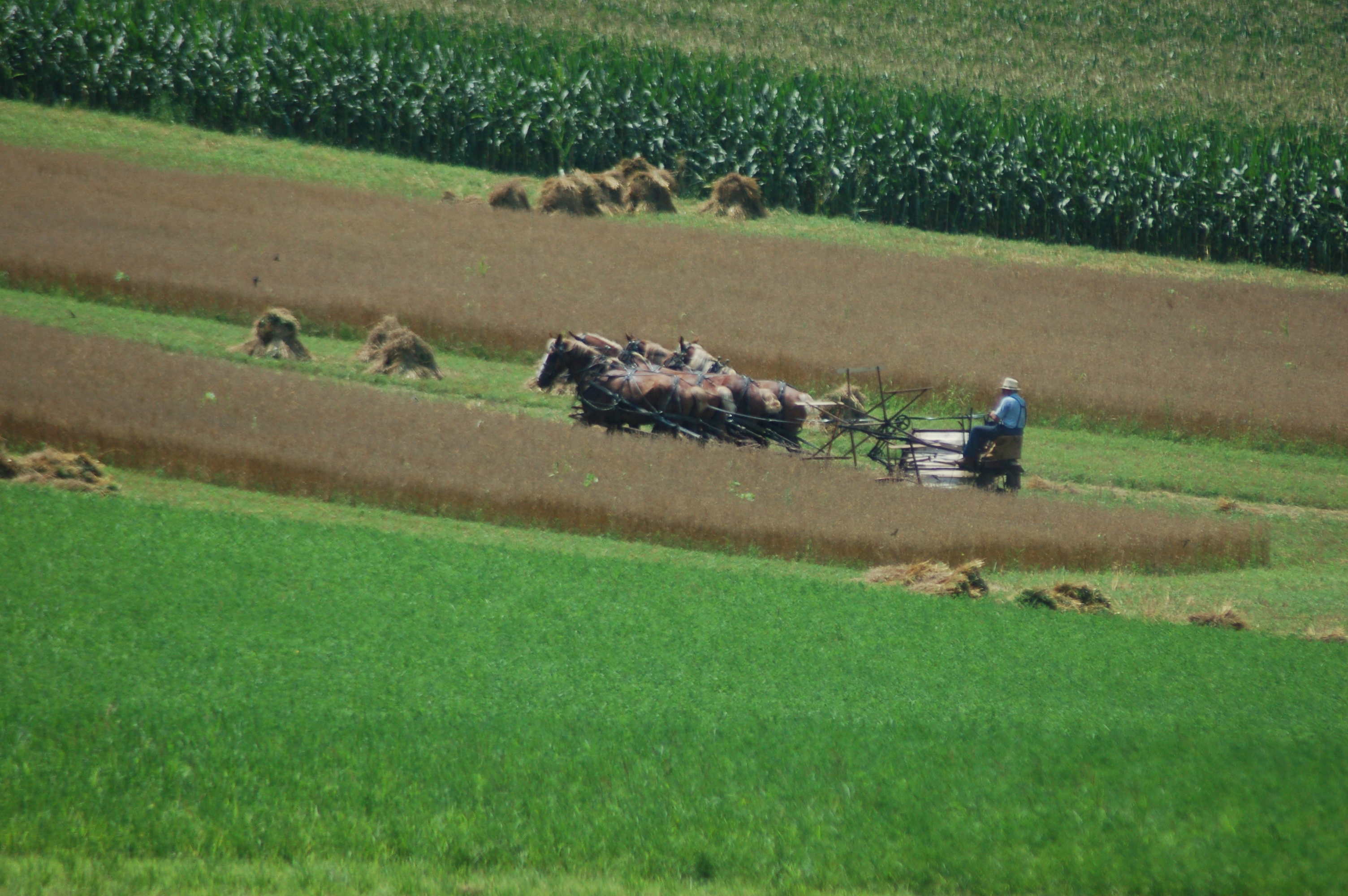
Farmers have taken in their wheat and most of their oats matter-of-factly, and now tolerantly wait the drying of the later cash crops, corn and soybeans. There is no mechanized clanking in patience.
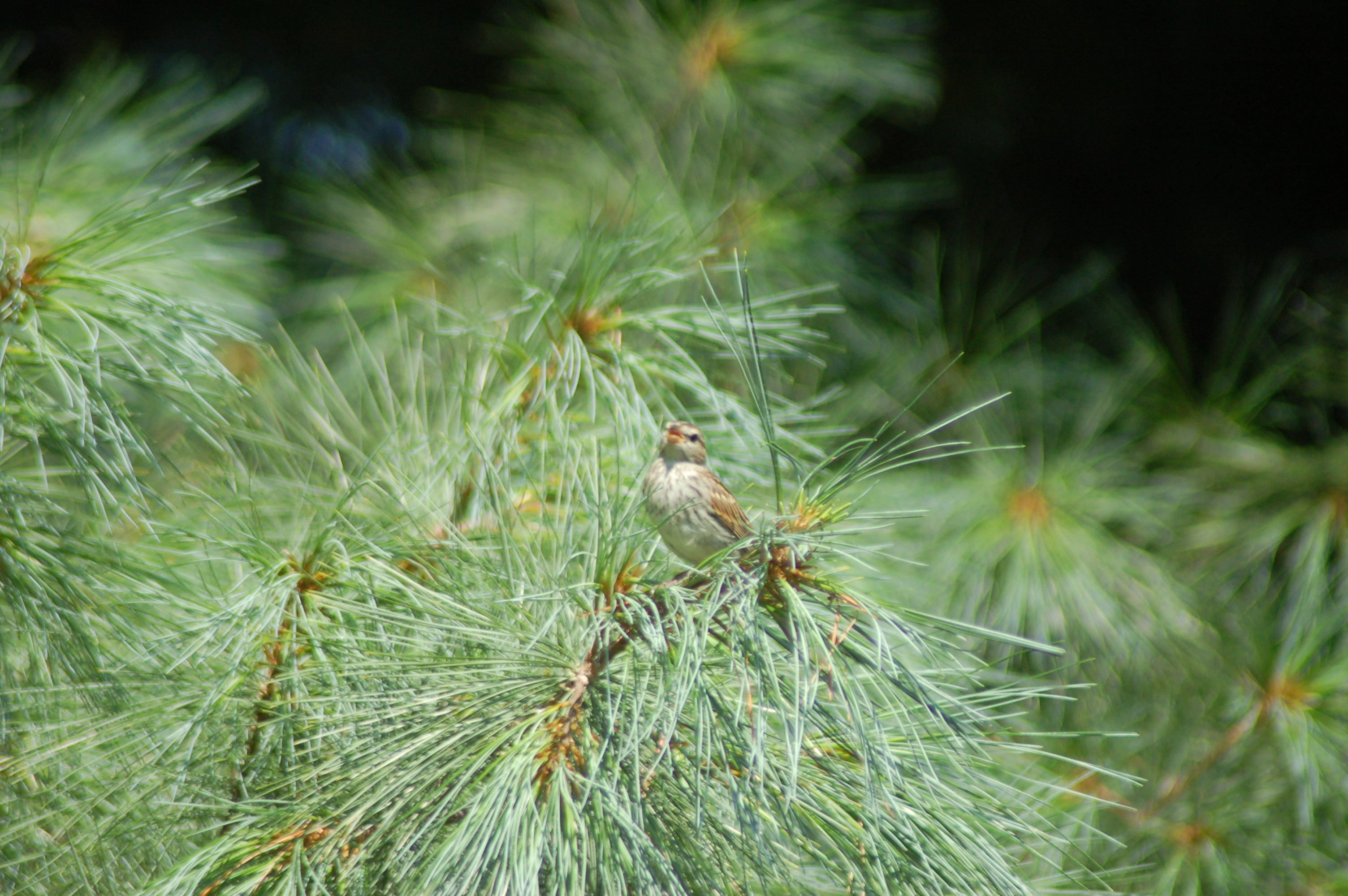
A Song Sparrow sings away.The Song Sparrow still belts out an occasional composition, but nothing as regular as it had been earlier in the season. The House Wrens, once so noisy they approached annoyance, have taken to the underbrush, giving their last brood endurance lessons.
August’s atmosphere also has been quieter than the previous months, save for a couple of late night thunderstorms. The brilliant flashes and deep, rolling booms shattered my sleep like Civil War cannon fire might have. Midnight imaginations run wild when deafeningly jolted.
The few sounds of August we can count on are more monotonous and so commonplace we may not even notice their calls. Cicadas and crickets signal day and night. With windows thrown open to catch the unusual August twilight coolness, the insect symphony has helped humans settle in for sound sleeping.
Every now and then a ranging coyote howls from atop the neighbor’s pastured hill, if for no other reason than to drive the tethered neighborhood canines crazy. The feral call is one thing. The domesticated is another.
Now that school years in most locales begin well ahead of September, the playful echoes of children rollicking at recess again fill the air. It’s a timbre I love to hear over and over again, even if it does break August’s amazing silent spell.
Erik Wesner, 33, went from selling books to the Amish to writing one about them. It was an unexpected but enjoyable trek for the Raleigh, North Carolina native.
“I kind of stumbled into it beginning in Arthur, Illinois,” Wesner said.
Erik WesnerWesner went door-to-door selling books for nine years. His job took him to many communities around the country where Amish had settled.
“The kind of books I was selling were appropriate for them,” Wesner said. He explained that they included sets of family Bible study books.
Whether he spent five minutes or 20 minutes with each household, he liked what he saw and heard. He was impressed with the inquisitiveness of the Amish, their resourcefulness and friendliness.
Wesner graduated from the University of North Carolina with a double major of English and economics. It was that knowledge that caused him to take notice of something else that he found common among the Amish.
“Everywhere I went in the Amish communities,” Wesner explained, “I saw successful businesses.” He said he was intrigued with that pattern, especially since most of the entrepreneurs were self-taught and didn’t have either high school or college degrees.
“While visiting in Amish-owned businesses, I saw customers who had driven three hours from Indianapolis and Chicago to make purchases,” he said. “I figured that was a sign of quality and honesty.”
Wesner couldn’t help but notice the continued success of these businesses in each Amish community he visited, even given the down economy.
“From Iowa to Illinois to Lancaster, Pennsylvania to Holmes County, Ohio, I found many success stories to share,” he said. That instilled in him a desire to learn about how they were able to not just survive but thrive when other businesses were not.
That intrigue lead to his book, Success Made Simple, an extensive review of Amish-owned businesses and what makes them consistently tick and click. His book is based on many interviews with Amish business folks across the country.
Wesner said though the book didn’t make the best-seller list, he gained something even more rewarding.
“Through all of this, I have made many friends among the Amish,” he said. That is what brought him back to Holmes County recently. He was visiting some New Order Amish in the Shreve, Ohio area.
In addition to his book, Wesner started a blog called “Amish America” right after the Nickel Mines incident in Lancaster County, Pensylvania in 2006. A gunman shot several Amish schoolgirls. The story made headlines worldwide.
“I didn’t like some of the things I saw and heard following that tragic situation,” Wesner said. Since he enjoys writing, he began the blog at http://amishamerica.com/.
The blog features stories and photographs of various Amish communities. He said he writes about and shows examples of everyday Amish life without trying to glorify it.
“I really enjoy the immediacy of the blog,” Wesner said, referring to the immediate posting of comments by some of his many followers. “I find that very rewarding.”
Wesner said there have been unexpected benefits to his blog.
“I mentioned an Amish business on my blog,” he said, “and the owner thanked me. She had customers who said they heard about her business by reading the blog.”
Wesner said he is working on a second book about the Amish. He said it would focus on the lesser-known things about the Amish lifestyle.
When he is not visiting Amish communities during the summer months, Wesner spends eight months out of the year teaching English in his parents’ home country of Poland. He said his students are mostly adult professionals who need to learn English for their jobs.
“I guess I feel a sense of obligation,” Wesner said about living in Poland. “My grandmother still lives there, and I didn’t want her to feel alone.”
That kind of dedication to family would resonate well with the Amish culture, too.
Driving in Amish Country is usually pleasurable and relaxing until the unexpected happens. A couple of recent experiences served as reminders of both the dangers and the benefits of traversing the winding, hilly highways in Holmes County.
A friend of mine, Glenda, and I recently each experienced amazingly similar situations only days apart. We each came away from our separate but comparable incidents feeling bathed in the beauty of humanity’s best behavior.
Glenda was on her way to her office when she came upon a buggy accident only seconds after it had happened. The buggy was crumpled, the horse lay injured in the roadway, and a young Amish woman was seriously hurt.
Glenda said everything happened in a whirl. Someone called 911 while she tended to Katie, the injured buggy passenger. Others came to settle the horse, releasing it from the tangled wreckage, getting it to a safe place and calling a vet.
The ambulance arrived, and transported Katie to the hospital. Glenda continued on the way to her office, wondering how the young girl would be.
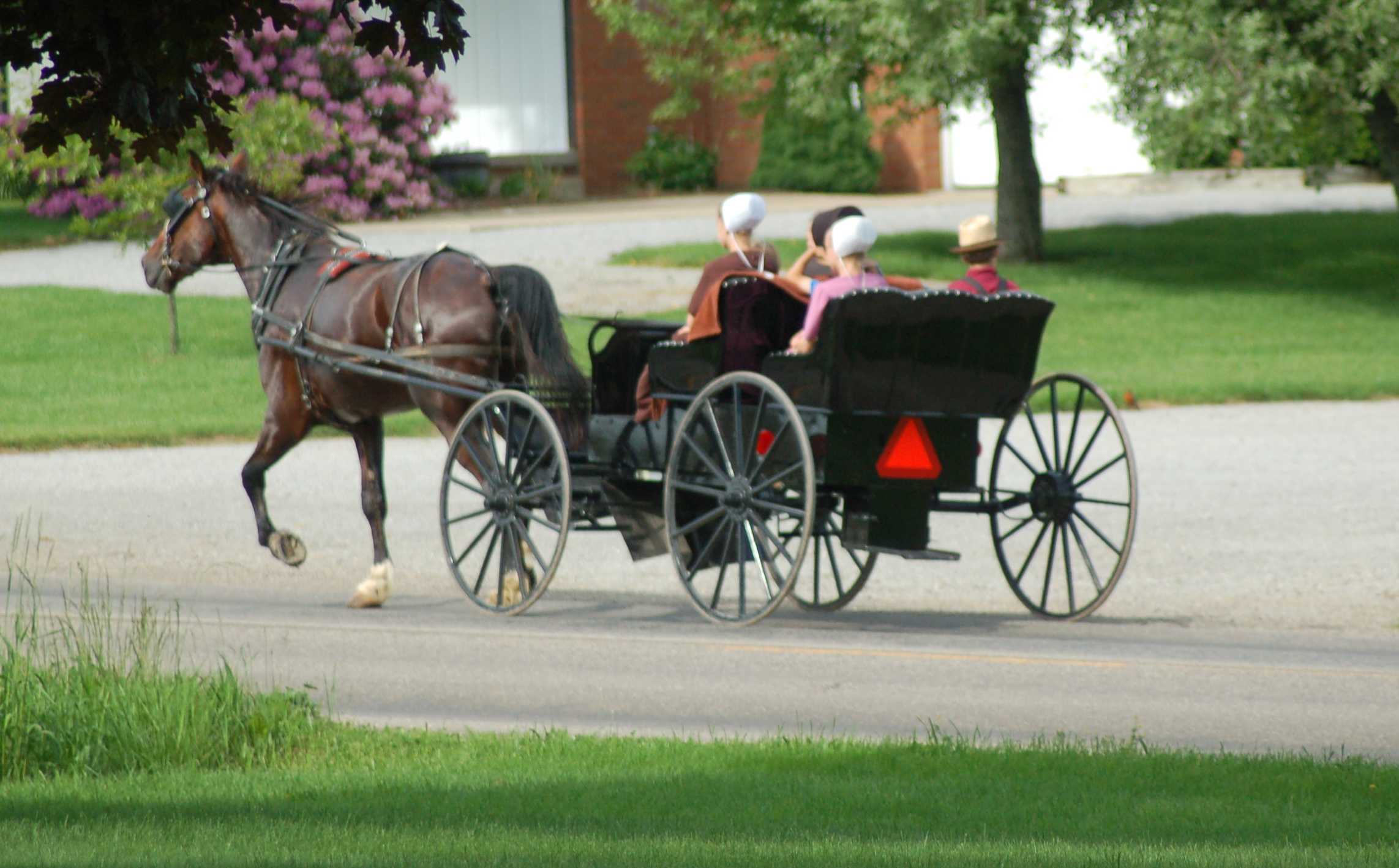
The Amish enjoy riding in their open buggies on pleasant days.
The following Sunday evening it was my turn. A friend had just arrived at our home for a visit when we heard a muffled crunch, followed by curdling screams of despair. We rushed to the front of our home to watch a horse bolt away, harnesses wildly whipping along the pavement.
A young Amish woman was slumped on the ground in front of a damaged buggy. Blood gushed from her forehead. John, our visitor, was a registered nurse and rushed to the girl’s aid. My wife retrieved towels from the house to help control the girl’s bleeding, and I called 911 on my cell phone.
Neighbors who had also heard the girl’s cries came running from every direction to help. Some brought blankets. Others lit flares to warn approaching traffic of danger on the other side of the hill. John continued to control the bleeding, and reassured the girl, whose name was Ellen.
A wave of bicycles all ridden by young Amish girls glided over the hillcrest. They had been with Ellen at a gathering, and retraced their path when they recognized her runaway horse. They came to see what had happened to their friend.
A few minutes later a pickup rolled up and out jumped Ellen’s parents and siblings. Someone had told them about the accident and they arrived to console their daughter. In addition, a passerby had corralled the horse and taken it to a neighboring farm. All this and the ambulance had yet to arrive.
Fortunately, Ellen was alert and with the bleeding stopped, she became more coherent and said the horse simply spooked. Unlike the accident Glenda happened upon, no other vehicle was involved.
Once the rescue squad arrived, treated and transported Ellen, the scene quieted dramatically. Our neighbors offered a flat trailer to haul away the damaged buggy. It was loaded and transported home. In a few minutes, the pickup returned the borrowed trailer.
The scene soon cleared after that, and we returned to visiting with John as if nothing had happened. Yet much had.
In both trauma situations, good citizens arrived to do what they could. What could have been very tragic instead turned humanitarian spontaneously.
As these two examples reveal, the beauty of driving in Amish Country isn’t always found in the scenery. The compassion of its citizens can outshine any pastoral vista.
2 eggs 1/4 teaspoon of salt
1 cup vegetable oil 8 tablespoons of cocoa
2 cups brown sugar 1 cup milk
3 cups flour 1 1/4 teaspoons of vanilla
1 teaspoon of baking soda
Mix eggs with vegetable oil and sugar until creamy, then add flour, baking soda, salt, cocoa.
Add vanilla and milk.
Drop on greased baking sheet with teaspoon.
Bake at 375 degrees F. about 7 minutes.
Let cool.
Add filling between two cookies.
Filling recipe
5 tablespoons of flour 1 cup of milk
1 cup of sugar 1 cup of shortening
1/2 teaspoon of salt 1 teaspoon of vanilla
Mix flour and milk, and cook until thick, then cool.
Mix other ingredients.
Add the two mixtures together and beat until fluffy.
Whoopie pies are actually two cookies stuck together with some kind of filling or icing. These have marshmellow cream, and were not purchased in Maine.
By Bruce Stambaugh
For two consecutive nights, I sat with hundreds of others in a College of Wooster, Wooster, Ohio performance hall and listened to real experts share about urgent current events in the world.
The first evening, the speaker was an Iranian journalist who told his story of being arrested and tortured in Iran for reporting newsworthy events. The country’s autocratic leadership didn’t take kindly to him telling the world what was happening.
The next evening, two career diplomats from Egypt took the same stage and mesmerized an even larger crowd with Egyptian political history and their observations on the unfolding events in their home country. They were ecstatic that the mostly peaceful revolution had succeeded, and were nearly giddy about the country’s potential to finally embrace democracy.
All the while in our democratic nation’s capital, Congress raucously debated the necessity and wisdom of spending federal dollars on programs to feed and educate children. This version of democracy in action numbed me.
Amid all this critical confusion, a ludicrous verbal war had broken out between two states. Maine and Pennsylvania were at loggerheads over the origin of the Whoopie pie, of all things.
If you are not familiar with this delectable snack, Whoopie pies look like two cookies held together on their bottom sides with white frosting. They look that way because that’s what they are.
Things got serious between Maine and Pennsylvania.
When a Maine legislator introduced legislation to make the delicious treat the state dessert, the keystone state took it personally. Pennsylvania’s tourism bureau set up an online petition for people to sign. It was titled “Save Our Whoopie” as if Maine was going to round them all up for themselves.
The original Whoopie pies were chocolate, and most still are. But other flavors and colors have found their way into recipes, like pumpkin, red velvet, and carrot. I even saw some pink ones in honor of Valentine’s Day. The filling is generally sugary vanilla icing, although alternatives could be whipped cream, ice cream and marshmallow cream, which is Maine’s claim to fame. In some areas, they are known as Chocolate Gobs.
Most Whoopie pies are the size of hamburger buns. Others are more bite sized.
Things got so testy about where and how the first Whoopie pie was made that major metropolitan newspapers picked up on the story. It probably was a nice diversion from all the nasty news they had to report.
The tone of the rhetoric between Maine and Pennsylvania nearly matched that of the sound bite D. C. politicians. This was more than just a publicity stunt. Why couldn’t both states have the same dessert as their state’s favorite? After all, seven states claim the Cardinal as their state bird, and I have not seen any feathers fly over those duplicate designations.
In all the Whoopie pie war reporting, never once did I either hear or see anything about how popular Whoopie pies were here in the world’s largest Amish population. Here, the delectable treats show up regularly at family gatherings, reunions, at picnics and in school lunch boxes.
I thought it admirable that our own plain people paid little heed to this confectionery war. They had better, more productive things to do.
As for Egypt, Iran, Congress and all the others, we’ll have to hope for the best. While Maine and Pennsylvania make whoopee over their Whoopie pies, I think I’ll just enjoy mine.













 Roadkill Crossing
You must be logged in to post a comment.