Never a dull moment at Lakeside, Ohio

throughthehollyhocksbybrucestambaugh
The waterfront at Lakeside.

By Bruce Stambaugh

There’s never a dull moment at Lakeside, Ohio. That’s quite a statement for a sleepy, little village on the shores of Lake Erie.

Don’t misunderstand. That doesn’t mean the residents are rowdy. Just the opposite is true for this Chautauqua town.

In the summertime, Lakeside bursts with energy and activities, planned and spontaneous. There’s never a dull moment because there’s just so much to do for any and every age level. I’ll let the activities speak for themselves.

The Lakeside programming offers vacationers and residents a multitude of sponsored options that enrich the body, mind, and soul. Founded in 1873 as a Methodist Church camp, Lakeside has evolved into a summer destination for thousands of folks across the country.

shuffleboard, Lakeside OH
Shuffleboard, a favorite Lakeside pasttime.
Lakeside is a place that welcomes all who come to relax, learn, meet new folks, enjoy entertainment, and commune with others and nature. It’s why we keep going back year after year. Now that we’ve moved to Virginia, my wife and I make Lakeside our guaranteed summer vacation.

Since Lakeside is a gated community during the summer season, it’s a safe place to be for one and all. Kids are free to roam its crisscrossed streets that run the mile length of the cottage-filled community.

They won’t be alone. The community swells to 6,000 or more residents at summer’s peak. Making new friends is easy. Besides, the 300 year-round residents are glad to have the company.

Planned programs and classes for toddlers to teens to senior citizens fill each day. Choosing which activities and events to participate in creates an estimable problem. You won’t hear “I’m bored” at Lakeside.

Children can attend arts and crafts classes, build model boats, or enjoy a game of shuffleboard with family and friends. Lectures, bible studies, morning worship, and walking tours enlighten the adults.

For those who love the water, Lakeside offers swimming in its new pool that includes lap lanes, a kid’s area, and water slide. There’s even a children’s splash park down by the dock.

The waterfront is really where the action is at Lakeside. The dock is the go-to place for sunbathers and fisherpersons alike. Lifeguards standby for those who choose to swim in the lake. Sailors young and old navigate their own boats.

sunset, Lakeside OH
Sunset on the dock.

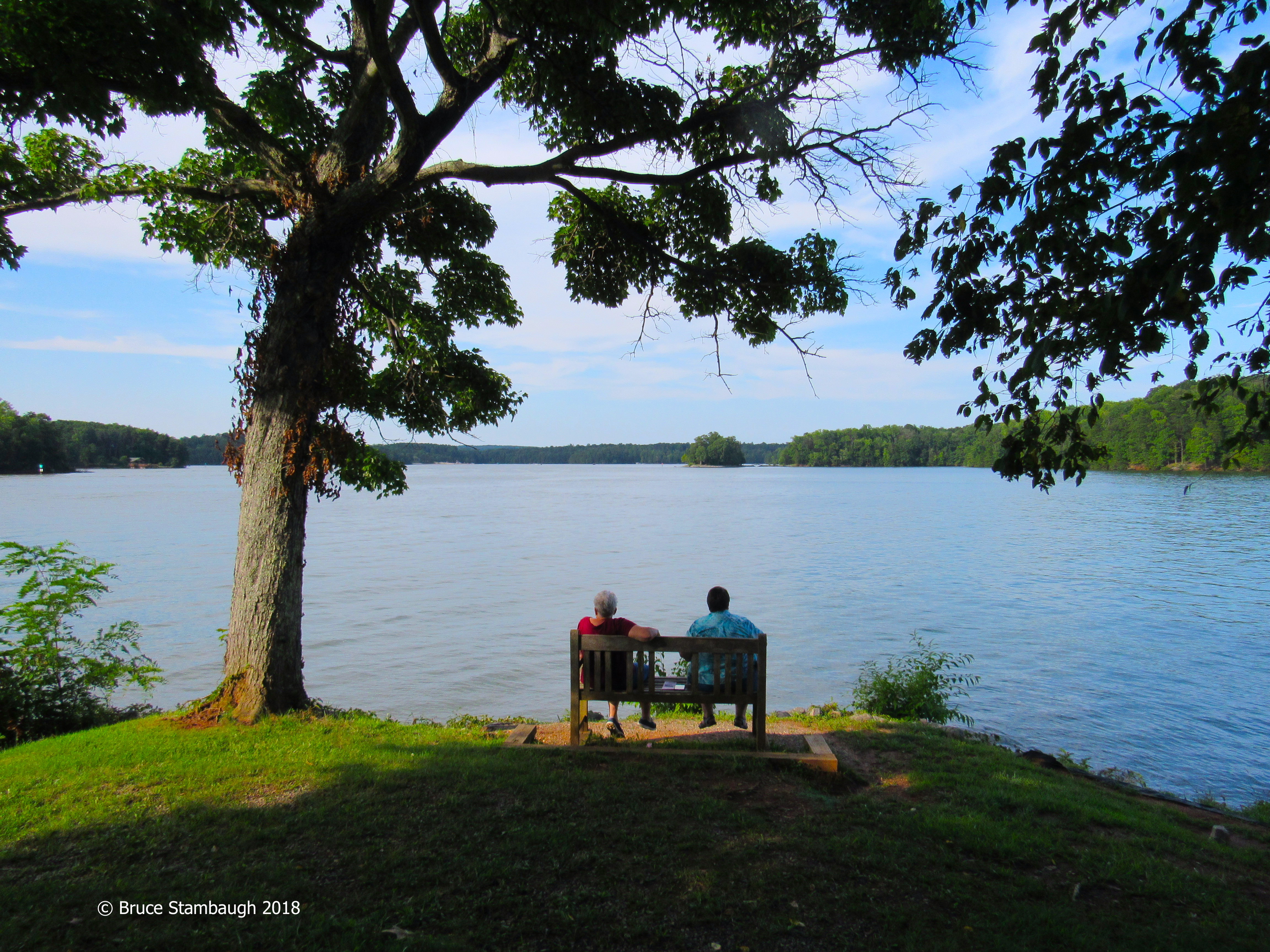
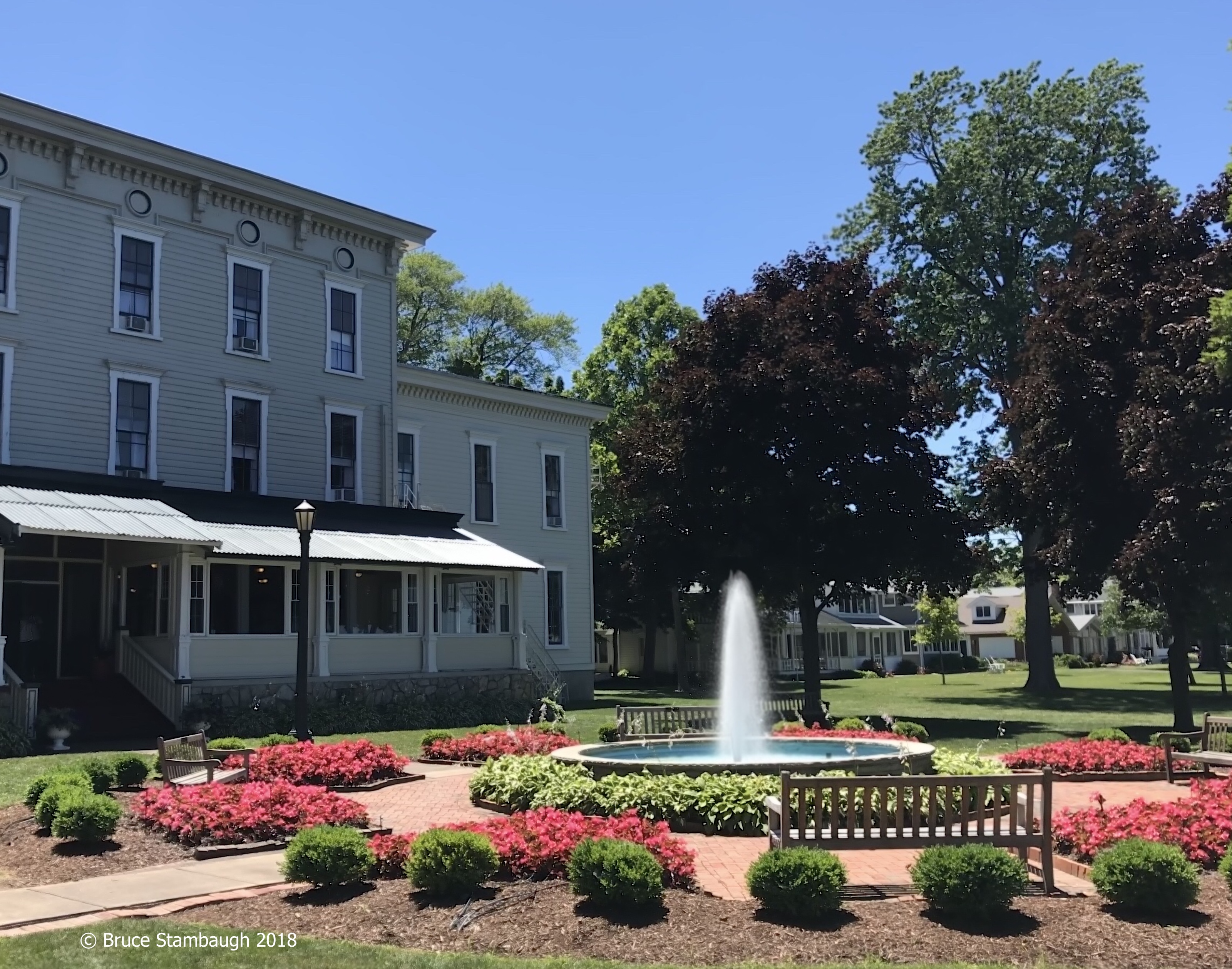
You can fill your day with more casual options, too. Take a leisurely walk along the shore while enjoying beautiful flower gardens, lovely cottages, and gorgeous views of Kelley’s Island, and Perry’s Monument at Put-in-Bay. Or sit on a park bench beneath giant shade trees and dream the day away.

In the evening, Hoover Auditorium takes center stage with a variety of programs that captivate the entire family. Admission costs are included in the gate fees.

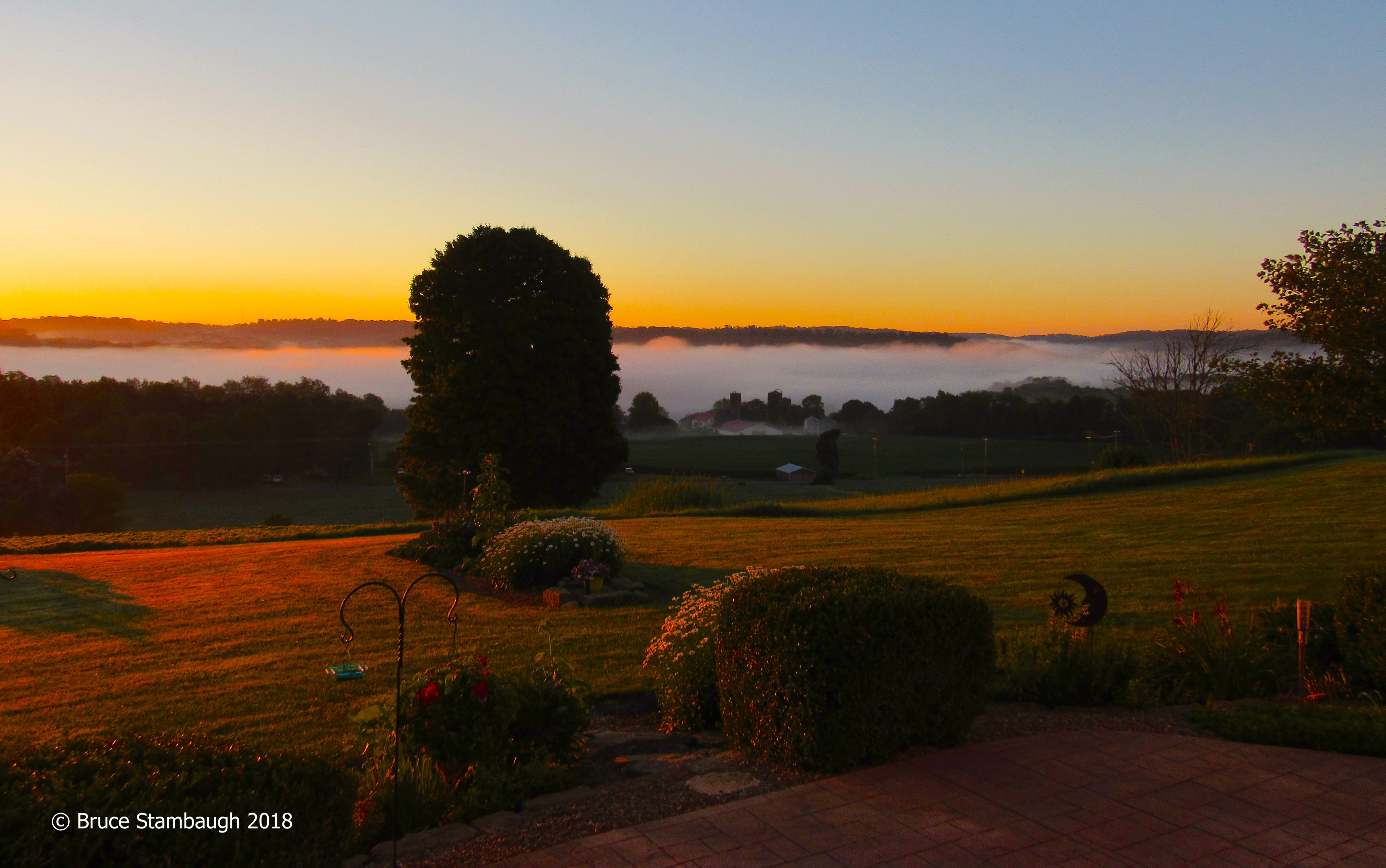
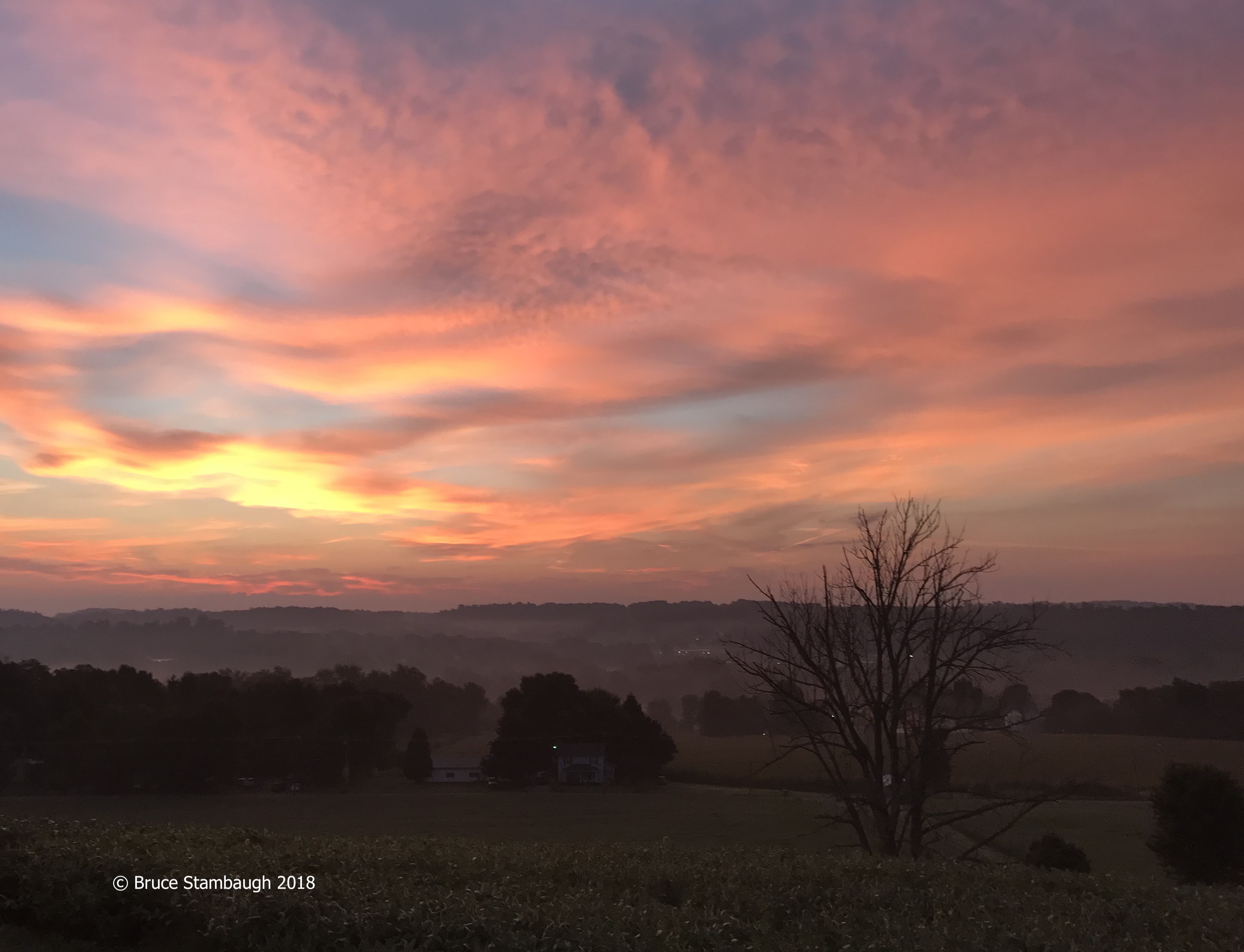
If the weather cooperates, sunsets draw people to the dock for picturesque photo ops. Sunrises are just as spectacular rising over the lake with their pinks and blues.

A farmers market offers up local produce and delicious homemade goodies two mornings a week. For those less worried about their diet, freshly made donuts and hand-dipped ice cream bring many smiles.

As for my wife and me, we’re more than content to sit on our favorite sweeping front porch that dominates the front side of the guesthouse where we stay. At the corner of Third and Walnut, we have a first-class view of all that Lakeside has to offer.

I’m always happy but never surprised to spot long-lost friends walk by. That reconnecting alone nurtures my body, mind, and spirit to the full.

sunrise, Lakeside OH
Silhouettes at sunrise.

© Bruce Stambaugh 2018
Celebrating the freedom to be kind

Fort McHenry, Baltimore MD
Fort McHenry.

By Bruce Stambaugh

Long ago, someone once tried to trick me with a skewed question. “Do the English celebrate the Fourth of July?” was the query.

My answer went something like this: “Well, the English have a July 4th like the rest of the world, but I doubt that they celebrate it.”

The Fourth of July is Independence Day in the United States. It’s a day of traditions: family gatherings, picnics with hot dogs and hamburgers, baseball games, and fireworks, although the latter is often spread out over a period of days depending on planned community events.

American flags are flown, and many decorate their houses with red, white, and blue buntings. Some communities hold parades with high school bands, fire trucks, decorated floats, and troupes of children riding patriotic adorned bicycles.

In typical American fashion, fireworks on the Fourth of July began in 1777 during the Revolutionary War with England. They weren’t the only flashes and booms in the sky then. Muskets and canons were also fired as ways to increase the commotion and hopefully boost the morale of the rebelling colonists.

A few years later during the War of 1812, Baltimore, Maryland had a life or death situation louder and fiercer than any fireworks. On September 13, 1814, the British Navy opened fire on Fort McHenry, the primary protective garrison of the city’s harbor. Much like today, Baltimore was an essential Atlantic coast port. Its defense was vital against the British, who had just burned the nation’s capital, Washington, D.C.

The fort withstood a horrific 27-hour bombardment by the British fleet. Francis Scott Key, a noted attorney, witnessed the attack from a ship in the harbor. When the smoke and mist cleared in the morning, Key saw the stars and stripes still flying from the fort, and was moved to write a poem about the battle. That poem became the lyrics for the “Star Spangled Banner,” our national anthem.

My wife and I recently visited the fort with a friend. As I watched a replica of the original flag flap in the morning breeze, I thought about the importance of celebrating the Fourth of July. It’s much more vital than food, fun, and colorful pyrotechnic displays.

In these current, trying times, when everyone seems to be talking and fewer people listening, I recoiled at the unnecessary squabbles going on in families, private and public meetings, in the media and on social media. Much of it is not pretty, and too much of it is hurtful, divisive, and driven by fear, not fact.

A person I recently met gave this suggestion: Treat people kindly in the moment. It might be the only time you have with them. She was right.

This Fourth of July, wouldn’t it be wonderful if we began listening to one another without bias, without interruption, without labeling, without being dismissive or rude or worse? After all, we are one nation, made up of many peoples from many different origins, languages, races, religions, beliefs, and backgrounds. That is as the Founding Fathers envisioned in the words of the U.S. Constitution.

So let’s carry on with the usual Independence Day activities. As we join together with family, friends, neighbors, and even strangers, let’s begin again to converse with one another with civility, kindness, respect, and appreciation, whether we agree or disagree with what is said.

That’s how a community as small as a family and as large as a nation should behave in order to thrive. In accomplishing that, we really will have something to celebrate on the Fourth of July besides Independence Day.

grocery store sign
A sign for many cultures.

© Bruce Stambaugh 2018

Beauty all around

Longwood Gardens
Beauty all around.

This young woman posed at different locations in Longwood Gardens in Kennet Square, Pennsylvania. As I walked around the lovely gardens of the sprawling estate with my wife and dear friends, we kept running into this couple. Given the setting of the flowers, greenery, and the curving walk leading right to the impromptu photo shoot, I had to take this shot.

“Beauty all around” is my Photo of the Week.

© Bruce Stambaugh 2018

Inspired by water from a rock

Rock Spring Cabin, Shenandoah NP
The view from the cabin.

By Bruce Stambaugh

Life is a mystery.

I hiked the short trail with one thing in mind. I wanted to find the old cabin and take a photo of its chimney if it indeed had one. As so often happens in life, discovering what I was looking became secondary in this trek.

I took my time on the trail, soaking in all the glorious sights and sounds that I encountered along the way. There was a lot to absorb.

Rock Spring Cabin was a short distance away from a crude hut built for hikers along the Appalachian Trail in Virginia’s Shenandoah National Park. From the cabin’s covered front porch, the Page Valley played out in the patchwork patterns of fields far below.

The cabin at Rock Spring.
The primitive log cabin did indeed have a stone chimney. I snapped my picture and headed for the spring of Rock Spring Cabin nearby.

When I arrived, I was stunned at what I saw. I stood there in both amazement and disbelief. There, high in the Blue Ridge Mountains, cold, clean, crystal clear water gurgled from beneath giant boulders as old as time. Human interaction, of course, had to plumb it with a PVC pipe.

Instantly, my mind flashed back to my childhood. I thought of the Old Testament Bible story of Moses striking a rock and water gushing forth for the assembly of disgruntled, thirsty Jews wandering in the desert. That ancient story always struck me as a blend of awe, mystery, and miracle.

I contemplated the moment. I couldn’t help but wonder why here at this spot, more than 3,000 feet above sea level did water run from rocks? The earth does fantastic, mysterious things. Explanations are not always required.

Still, I reckoned the answer to my rhetorical question. Clearly, the rock strata folded long before human history began and forged a channel for the water table below.

Yet, there was something mystical about the rock spring, its waters trickling down the steep slope far into the valley below. I mentally traced its path from small stream to a creek that formed a tributary to the Shenandoah River. Farther north, it met the broad Potomac River at Harper’s Ferry, West Virginia, and then flowed east through rapids and placid waters alike, passing the nation’s hectic capital into the Chesapeake Bay and on into the Atlantic Ocean.

Noisy ravens awakened me from my lively daydreaming. Apparently, they viewed me as an intruder. Not wanting that title, I returned to the main trail, warblers, and thrushes flitting and singing in the leafy canopy high overhead.

I walked a short distance down the trail, and the raven followed me, swooped low, and continued its nasal banter. It was only then that I realized that I was not the target of its raucous concern.

A motion drew my eyes downward. Not 30 feet away a young black bear grazed along the forest floor. My head instinctively swiveled in search of the mother bear. I saw only trees, plants, and rocks.

black bear cub, Shenandoah NP
Young black bear.

I gingerly stepped a few feet down the trail where I could get a better view of the cub, likely in its second season given its size. One click of the camera shutter and the bear spied me and bounded down the hill towards the spring. Overflowing with wonder and joy, I headed in the opposite direction for the parking lot.

I went searching for a cabin and found so much more. An emerald forest. Water from a rock. Agitated ravens. A frightened bear cub.

Life is a mystery waiting to be solved.

Appalachian Trail, Rock Spring Trail
The emerald way to Rock Spring Cabin.

© Bruce Stambaugh 2018

Mountain Laurel with a view

mountain laurel, Grayson Highlands SP VA, Whitetop VA, SW VA
Mountain Laurel with a view.

Traveling with friends, we wanted to reach the overlook at Grayson Highlands State Park near Whitetop, VA, before a front moved through bringing heavy rains. We just made it.

We were pleasantly surprised to see not only a marvelous view but that the Mountain Laurel bushes were blooming. No other clumps of them were in blossom as we drove up the mountain. These beauties just made the view all the more impressive.

The mountain range far in the distance is the Blue Ridge.

“Mountain Laurel with a view” is my Photo of the Week.

© Bruce Stambaugh 2018

Putting lifelong learning into practice

Old Order Mennonites, Shenandoah Valley
Sunday morning at Pleasant View Old Order Mennonite Church.

By Bruce Stambaugh

Exploring has always been in my blood. Curiosity has coursed through my veins all of my life.

The move from Ohio to Virginia’s Shenandoah Valley merely whetted my appetite to become familiar with my new surroundings. A myriad of opportunities abound, either spontaneously or scheduled, to explore this beautiful, historic setting.

The view from Pleasant View Old Order Mennonite Church.
Many of my junkets have been self-started. A lazy afternoon’s drive around the rolling, scenic countryside brings new people and places into my life. The Shenandoah Valley region is rich in history, a personal favorite subject. I needed more.

I joined scores of other retirees who were also eager to still learn a few things in life. James Madison University, located in Harrisonburg, offers a Lifelong Learning Institute to that end.

I just completed my second class, an overview of Mennonites in the valley.
Phil Kniss, the pastor of Park View Mennonite Church in Harrisonburg, taught the class. He is an astute student of Mennonite history, so I knew I’d learn a lot.

The first session served as a historical survey of Mennonites, tracing their beginnings to the 16th century Reformation. Because of their steadfast beliefs, many Mennonites endured persecution to the point of martyrdom.

Consequently, many moved from their European homelands to the New World, where they hoped for a new chance to live peaceably. Unfortunately, conflicts followed them right into the 18th century as they settled in Virginia’s Shenandoah Valley. They tried to live in peace farming the fertile soil, but war found them again.

Armed with that information, class field trips sent us into the lives and history of the many sects of Mennonites in the valley. A small choir enthralled us with their magnificent singing at the local Mennonite high school that is celebrating its 100th year.

This slideshow requires JavaScript.

At the Old Order Mennonite elementary school, I flashed back to former Ohio days of living among the Amish with their own private schools. The horse and buggy Old Order Mennonites are spiritual cousins to the Amish.

At the unassuming Old Order Mennonite church, a devoted preacher succinctly explained the scriptural basis for their simple way of living. Like all other Old Order men, he was clean-shaven but spoke Pennsylvania Dutch, an anomaly among his people.

This slideshow requires JavaScript.

At the buggy shop, we laughed and learned through the wisdom of the father-son combo that so efficiently ran the business so necessary to the Old Order way of life. The elder’s humor kept us on our toes.

In an Old Order Mennonite home, we gave thanks and feasted on a scrumptious home-cooked meal. The sparkle in our host’s eyes twinkled her delight in our contentment.

This slideshow requires JavaScript.

At Bank Mennonite Church, we learned of an orchestrated church split with genuine intent to agreeably disagree on specific theological applications while continuing a parallel spiritual path. Congregates dressed and lived like Conservative Mennonites in Holmes County, Ohio with a notable exception. Again, the men had no beards.

At the final class at Crossroads Heritage Center, we explored a type of living museum. Guides explained pioneer life as we wound through original, relocated old houses and various other buildings.

It was a fitting location for the last class. From high on a hill, the valley played out below us. The city bustled beneath the hot morning sunshine. Yet, the farmland’s still earthy springtime fragrances enveloped us.

From that vantage point, I imagined the struggles, the heartache, the determination and the desire to live their lives in community together through productivity, and finding peace and satisfaction in weaving their daily lives together.

Strangely and marvelously, I felt right at home.

View of the valley from the garden at Crossroads.

© Bruce Stambaugh

Cootes Store

old general store, Rockingham Co. VA
Cootes Store.

It’s been nearly a year now that my wife and I moved from Holmes Co., Ohio to Virginia’s Rockingham Co. One way I’m learning about the area, its people, its topography, its history, its culture, is just by driving around. Of course, I usually have my camera with me to document what I see and find.

Before we moved from Ohio, we would pass through a small burg named Cootes Store on our way to visit our daughter and her family in Harrisonburg. It was hardly more than a crossroads in the northwestern part of the county. I found the name intriguing and just assumed that once upon a time a real “Cootes Store” must have existed there.

On one of my discovery runs, I found Cootes Store. Its personality jumped out at me through all of the old, eclectic merchandise visible inside and out. This likely isn’t the original building, but it is all that remains of what once must have been a thriving business to have a town named for it.

You can read more about the history of Cootes Store here. “Cootes Store” is my Photo of the Week.

© Bruce Stambaugh 2018

Blue Moon Eclipse

blue moon, eclipse, Amelia Island FL
Blue Moon Eclipse.

Sometimes the stars do line up for you. In this case, it was the moon and the sun. On the morning of January 31 precisely at sunrise, the first blue moon of 2018 began a total lunar eclipse. You can see the beginning of the eclipse at about 11 on the moon’s face. The moon sank below the horizon before the eclipse was total.

I was fortunate to be able to capture the extended but broken reflection of the moon in the Amelia River at Fernandina Beach, FL. Dawn’s first light illuminated the sailboat moored in the river.

“Blue Moon Eclipse” is my Photo of the Week.

© Bruce Stambaugh 2018

Fogbow

fogbow, Little Talbot Island SP FL
Fogbow.

I’m a weather nut, geek, groupie, whatever you want to call me. The weather has fascinated me since I was a child. My wife will verify that I get antsy in severe weather. I’ve tried to channel that excitement and energy into practical action. I’ve been a severe weather spotter for the National Weather Service since 1975.

Imagine my surprise when the fog rolled in off of the Atlantic Ocean while walking a beach near Mayport, FL one afternoon. I was surprised and thrilled to see this rare fogbow appear. I was extremely fortunate to be at the right place at the right time because fogbows don’t last long and are seldom photographed.

Fogbows are cousins to rainbows. Fogbows form from the sun reflecting in millions of tiny water droplets that make up the fog. Since it takes one million cloud droplets to make a single rain droplet, the fog droplets are too small to adequately refract the colors that create rainbows. Consequently, the fogbows shine bright white but only for a brief time. Because of their color, fogbows are also called ghost rainbows, white rainbows, or cloud bows.

You can get a feel for the size of the fogbow by comparing the people below the far left end of the weather phenomenon. “Fogbow” is my Photo of the Week.”

© Bruce Stambaugh 2018

Enjoying traveling in silence

St. Augustine FL
St. Augustine, FL is a favorite destination for us.

By Bruce Stambaugh

My wife and I like to travel. We’re not world travelers by any stretch of the imagination. Mostly we embark on both long and short ventures to visit friends, explore new places, and revisit old haunts.

Given today’s complexity and expense of flying, road trips are our favorite. That means Neva and I spend lots of time together in our vehicle.

Our peers, other retired couples, do the same of course. Most report that they use the road time to chat with one another, plan future activities, and discuss ongoing world events. Not us.

When we travel by motor vehicle, Neva and I have a solemn, implicit pact. We seldom talk. It’s been that way almost from day one of our marriage. I suppose it’s just a habit that we quickly fell into. But we have made it work for us.

From my experience, most folks seem uncomfortable with silence. Neva and I take it in stride, each using the quiet time in different ways. Neva reads, stitches, does word puzzles, or plays games on her iPad. Me? As I drive, I observe, think, and plan. I know that sounds a bit boring, but I find the quiet time refreshing.

We can be spontaneous, though. We don’t necessarily travel from point A to point B. We like to stop if we see something that catches our eye. That’s especially true for me. I’ve even been known to turn around just to photograph a lovely landscape scene or an attractive old building or an eagle snacking in an open field.

WV farm, cornshed
This farmstead in West Virginia is typical of the scenes I stop to photograph.

When we can, we drive the old surface routes, avoiding expressways and interstate highways, especially if we don’t have to be somewhere at a given time. Doing so makes life so much more interesting for us.

We also traveled with our son and daughter when they were young. That was before cell phones, iPads, iPods, and in-vehicle entertainment centers. We would have the typical family verbal interactions. But on long trips, Neva always had individual activities for the kids to fill the road time.

Those trips weren’t as peaceful as the ones we take now by ourselves. No one would have expected them to be, but our son and daughter weren’t rowdy either.

As we’re driving, every now and then I’ll think of something I meant to ask Neva but forgot. I seem to do that more and more these days. So I’ll ask on the go. She does the same with me. That question may lead to further discussion and a resolution to a dangling participle in our lives. Without long stretches of silence, that unresolved issue might not have even been discussed.

I also find sustained silence helpful in flushing out touchy topics I have avoided for fear of disagreement. After all these years together, we know that it’s better to lay all the cards on the table than secretly hold them to fester. Perhaps a moving vehicle keeps conversations progressing, too.

The happy couple
In my younger years, I was a bit uncomfortable with silence when others were around. I tended to fill the space with words like I loved to hear myself talk. I didn’t. Experience has taught me that listening can be more valuable than speaking.

For Neva and me, sustained silence has strengthened our relationship. It’s a nonverbal equalizer where neither dominates, and we both can participate as we choose. In our specific case, it’s been an essential part of our wedding covenant for 47 years and counting.

© Bruce Stambaugh 2018

Bay Photos by Donna

Wildlife photos from the Chesapeake Bay region

ROAD TO NARA

Culture and Communities at the Heart Of India

K Hertzler Art

Artist and nature journalist in the Shenandoah Valley of Virginia.

Maria Vincent Robinson

Photographer Of Life and moments

Gabriele Romano

Personal Blog

Jennifer Murch

Art is the only way to run away without leaving home. -Twyla Tharp

Roadkill Crossing

Writing generated from the rural life

ANJOLI ROY

writer. teacher. podcast cohost.

Casa Alterna

El amor cruza fronteras / Love crosses borders