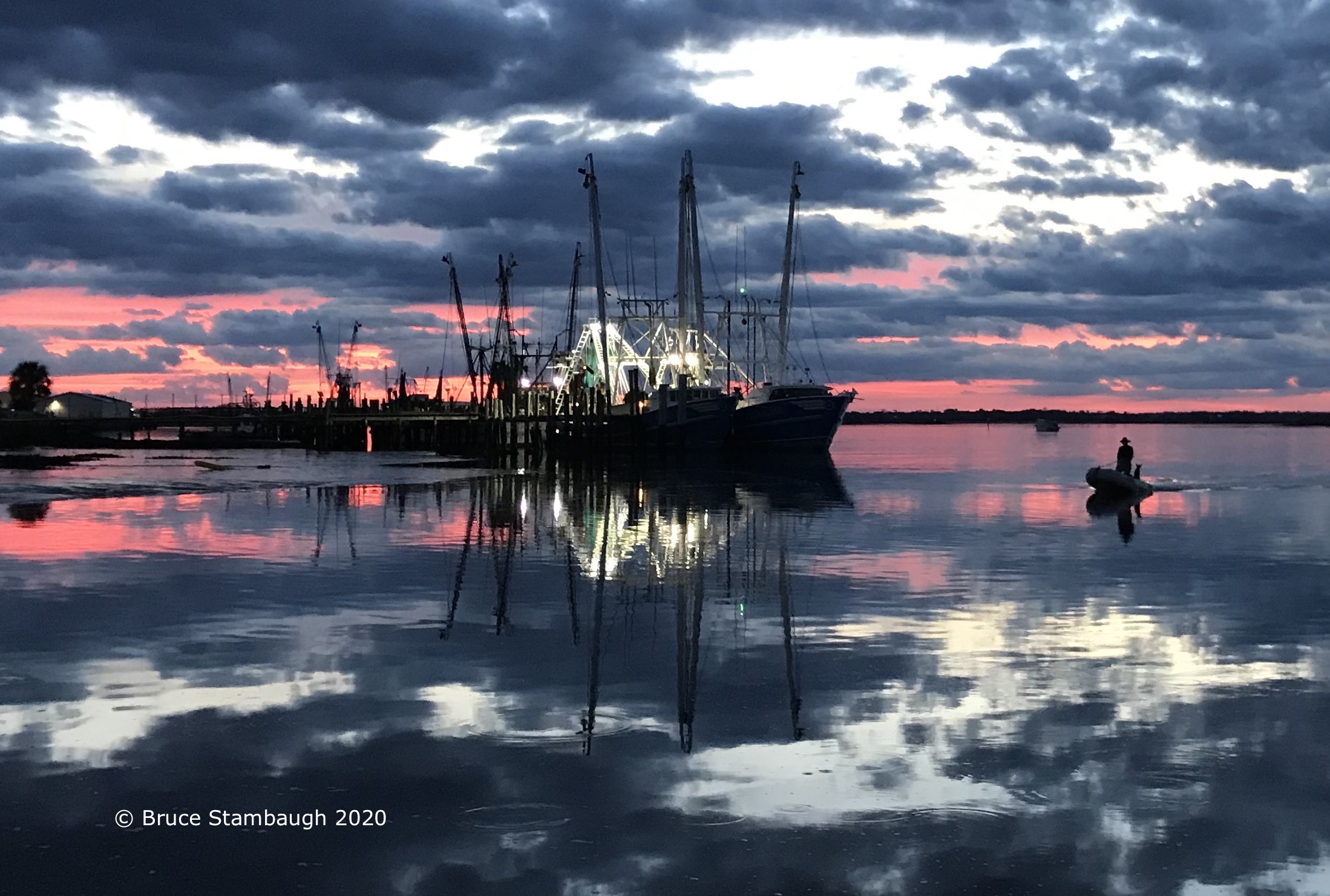
I had given up on this sunset. In fact, I was already heading back to my car from the dock when the sky suddenly changed. I hustled back onto the dock to get a few shots before the sky called it a night. I couldn’t believe my good fortune when an older man with a barking dog cruised into view in a dingy. Their presence added a human element to this painting-like scene.
Rather than wax poetic about all of the aspects and details of the photo, I’ll simply let you enjoy it from your own perspective.
Raining over the ocean.
I stood on the shoreline alone in joyous disbelief. This wasn’t supposed to be happening, and yet, it was, it did.
“This” was no ordinary sunrise. Our snowbird rental on the Atlantic Ocean northeast of Jacksonville, Florida, affords us striking views, especially at dawn.
The sea mirrored the sky as the celestial kaleidoscope slowly revolved from violets to pinks to oranges to gold to grays. I willingly allowed those siblings of earth and atmosphere to kidnap me.
My initial urge was to shout for joy, but that seemed irreverent, uncouth, and even sacrilegious. For once in my life, I stayed silent, sedated by the aura that engulfed me.
A renegade cumulonimbus cloud hovered miles offshore. Sheets of rain cascaded into the sea.
My eyes drew heavenward. The risen sun, hidden by clouds over the Gulf Stream, illuminated the universe, at least the part that I could see. It was heavenly, indeed.
With each degree that the sun rose into the clouds, the refracted rays altered the colors. As if someone had flipped a light switch, the violet hue transformed into orange, bathing everything it touched.
The scene was surreal. I felt like I had been pulled above the beach, the foamy waves no longer lapping at my feet.
It was then that I more fully appreciated the ocean’s contribution to this original, living painting. The gently swelling sea reflected both the water’s depth and the sky’s variable palate.
This slideshow requires JavaScript.
Dabs of puffy clouds scalloped the sky. The ocean’s choppy undulating created a more linear composition. It was cottony above, corduroy below.
Though the consistencies remained the same, the colors continued to change. The wind scurried the dazzling clouds east while the ocean rolled west.
An instantaneous golden glow ensued when the sun finally peeked through the distant clouds hanging above the horizon. Overhead, the rain clouds just as suddenly converted the gold to gray unapologetically.
With the sky now spritzing droplets, I turned to retreat to the condo. And then I stopped to behold another divine marvel.
A brilliant double rainbow arched above our suntanned building complex. Once again, I was awestruck. I motioned for my wife to go look at the rainbow. She only waved back from the balcony. Desperate, I pointed to the sky, mimed a bow with my right hand, and pointed up.
This time Neva understood and rushed to the back of the condo. She returned before I could even begin to clean the sand from my shoes. Her radiance from seeing the double promise equaled that of the sky, which made me even happier.
By the time I made it back to the condo, the sky had darkened, and the rain pelted down. The morning’s free art exhibit was now washed out.
Other than the rain, none of this was expected. The official forecast had called for precipitation to overrun the northern Florida east coast overnight. But with the rain’s delayed arrival, we were treated to this transformative experience.
This ecclesiastical event seemed to last an eternity. However, the timestamp on the scores of photographs that I took showed only 10 minutes had elapsed.
The magical scene had changed so rapidly that I couldn’t take in all of the finite details as they occurred. A review of my photos revealed the dramatic, atmospheric sequence of changes in that short window of opportunity.
Birding and photography go hand-in-hand. Binoculars and a camera are essential tools for me to hone my dual hobbies. I heard the Red-winged Blackbird singing before I spotted it in this dead tree with its tangle of branches. I have always considered the blackbird’s song a harbinger of springtime. To hear its melodious song in January was music to my ears. Of course, it was a warm afternoon in Florida, not Virginia or Ohio. A look through the bins confirmed the pair of Eastern Bluebirds that sat silently behind the blackbird.
I knew full well that the photo would produce only silhouettes since I was shooting into the southern sky with the sun an hour from setting. The crisscross of dead limbs immediately brought to mind the Walter Scott quote of “Oh what tangled web we weave when we first practice to deceive.”
Well, there is no deceit on my part with this photograph. “A Tangled Web” is my Photo of the Week.
An important characteristic for any photographer is to be observant. By that, I mean to be aware of what is going on around you while you are actually focused on a different task. Doing so allows a photographer to capture that certain event when it occurs.
That was the case for me recently. I was reading on the balcony of our rented condo on the Atlantic Ocean when something caught my eye. An unusual collection of high clouds drifted across the late morning sun’s path. Because this was the day the sun was closest to the earth, the sun’s glare was extra harsh. However, I could see defused color in the mixture of clouds streaming in front of the blazing sun. It certainly wasn’t a rainbow, but the colors were similar only distributed randomly. They also occurred close to the sun.
The weather geek in me said that this was an iridescent cloud. I researched cloud types to confirm my conclusion. Sure enough, it indeed was an iridescent cloud, something not often seen because their appearance is usually short-lived.
Of course, the next duty of a photographer is to share what was captured. So I have. “Iridescent Cloud” is my Photo of the Week.
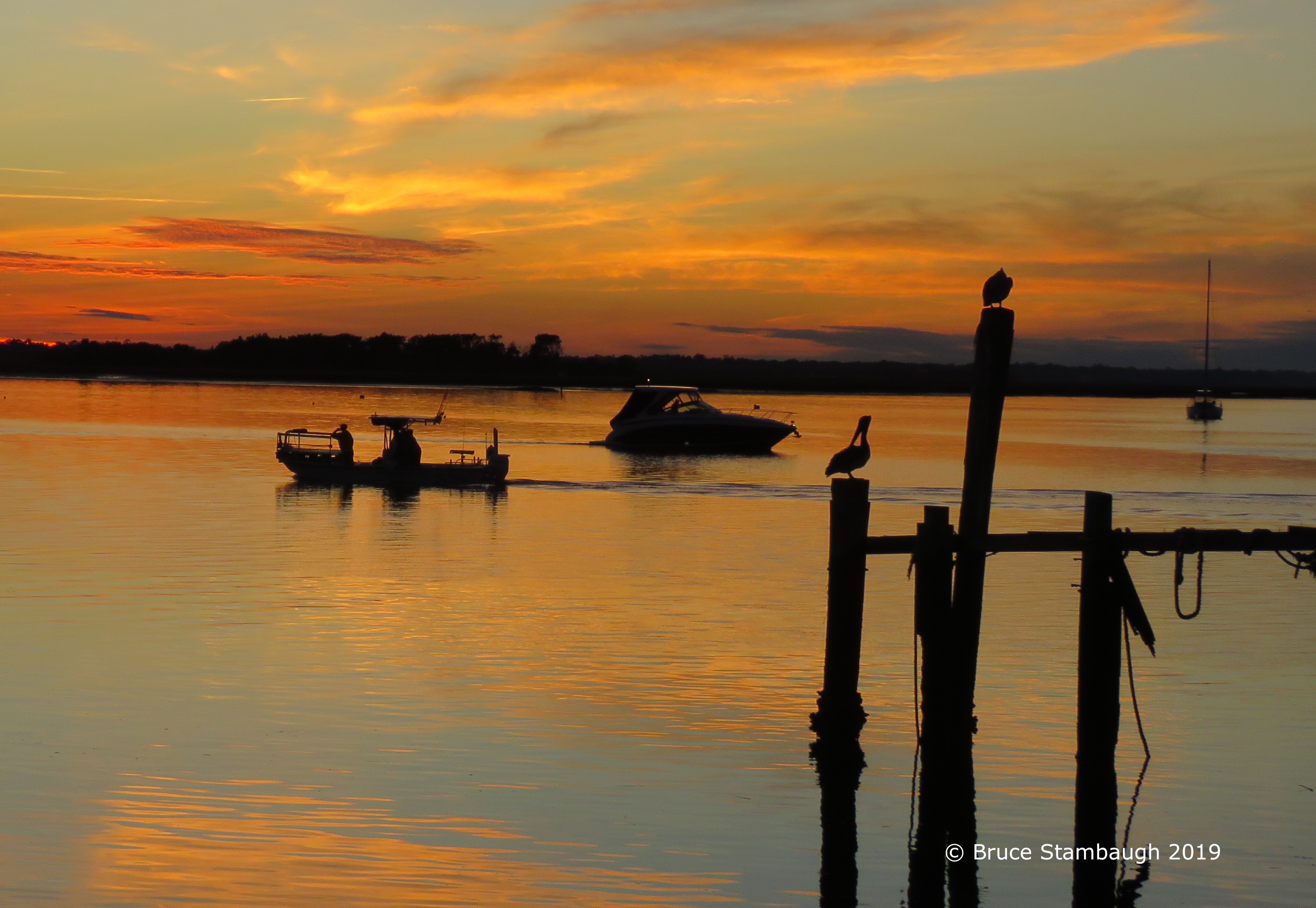
I was fortunate to catch an amazing sunset the first evening of the New Year. Having a couple of boats motor by at its peak nicely improved the composition. The roosting brown pelicans provided character to the natural beauty.
The photo was taken at an old marina on the Amelia River, Fernandina Beach, Florida.
“Capturing 2020’s first sunset” is my Photo of the Week.
Well, we made it. You and I have traveled yet one more year around the sun. True to form, 2019 was full of wonder, mistakes, successes, and a smorgasbord of conundrums and craziness.
As usual, I kept track of a few of the lesser but still extraordinary events and findings during the year.
January 20 – A meteorite was recorded striking the surface of the moon during the Super Full Blood Wolf Moon total lunar eclipse. January 22 – According to a report from nonprofit Oxfam, the world’s 26 wealthiest people are worth the same amount of money as the world’s poorest 3.8 billion. January 30 – The temperature dropped to -48 degrees with a wind chill of -65 in Norris Camp, Minnesota, making it the coldest place in the lower 48 states. Early morning sky, January 31. February 1 – The BBC reported that January was the hottest month on record in Australia and that five days were among the top 10 on record for the warmest. February 7 – NASA reported that the last five years have been the hottest since records began being kept in 1880, with 2018 the fourth warmest year. February 13 – NASA announced that it had declared the Mars rover dead after being unable to communicate with it following a massive dust storm on the red planet. March 25 – A British Airways flight bound for Dusseldorf, Germany, instead accidentally landed in Edinburgh, Scotland, because the company filed the wrong flight papers. March 26 – UPS began an experimental delivery system using drones in North Carolina. March 27 – Airbnb, the online home-sharing site, surpassed Hilton Hotels in annual sales. April 11 – A standup comedian in England died halfway through his comedy routine, only the audience thought it was part of his act. April 19 – A 10-year-old Fredrick, Maryland girl born without hands won a national handwriting contest. April 22 – The BBC reported that 23 million people use 123456 as their password for private online accounts, with 123456789 as the second most popular password. May 22 – The last known ship to bring slaves to the U.S., the schooner Clotilda, was discovered in a remote branch of Alabama’s Mobile River. May 23 – Longtime Marietta, Georgia, mail carrier Floyd Martin retired, and on his last route, residents decorated their mailboxes and held a block party after he finished his deliveries. May 31 – After 20 rounds and running out of hard words, the National Spelling Bee in Washington, D.C., crowned an unprecedented eight co-champions. June 5 – Tom Rice, 97, of Coronado, California, reenacted his pre-D-Day 1944 jump into Carentan, France, as part of the 75th anniversary of the Allied invasion at Normandy. June 11 – Kraft announced that it was selling salad frosting, which was French dressing disguised in a colorful bottle to get kids to like it. June 19 – A survey by YouGov reported that 39 percent of Americans between the ages of 18 and 24 hadn’t used deodorant in the last 30 days. July 3 – The American Automobile Association estimated that a record 49 million people would be traveling the U.S. highways on the Fourth of July holiday. July 12 – A report on British roadkill showed that badgers were the mammals most likely to meet their end on the highway, although pheasants led the animal roadway mortality rate. July 22 – Officials near Sandpoint, Idaho removed turtle crossing signs because thieves kept stealing them as soon as the unique warning signs were replaced. August 14 – A 12-year-old boy attending a family reunion found a rare Ice Age wooly mammoth tooth by a creek near the Inn at Honey Run near Millersburg, Ohio. August 15 – A new study released by the U.S. Geological Survey showed that 90 percent of rainwater samples in Colorado included microplastic shards, beads, and fibers. September 6 – A new international study showed that 90 percent of the time eyewitnesses would assist someone assaulted in public. September 7 – Miami Marlins pitcher Brian Moran struck out his young brother, Colin, pinch-hitting for the Pittsburgh Pirates. September 21 – When a car fell on his neighbor pinning him, Zac Clark, a 16-year-old high school football player from Butler, Ohio, rushed over and lifted the 3,000-pound auto, saving the neighbor’s life. One of my proudest moments. October 7 – After falling at his home in Plains, Georgia the previous day, former President Jimmy Carter, 95, with a bandage above his left eye and a visible welt below, still helped build a Habitat for Humanity home in Nashville, Tennessee. October 18 – NASA astronauts Christina Koch and Jessica Meir performed the first all-female spacewalk when they ventured outside the International Space Station for five and a half hours to replace a faulty battery charger. October 30 – Firefighters in Simi Valley, California successfully saved the Ronald Reagan Presidential Library from a wildfire with assistance from a herd of goats brought in earlier in the year to eat away the brush surrounding the library. November 3 – When midnight shift workers didn’t show up at a Birmingham Waffle House restaurant, several customers jumped behind the counter to help the lone employee serve 30 other customers. November 8 – The last survivor of the Hindenburg Disaster, Werner Gustav Doehner, died in Laconia, New Hampshire, at age 90. November 18 – Police in Goddard, Kansas, discovered a camel, cow, and donkey wandering along a rural road. December 9 – A New York City man removed and ate a banana from a Miami, Florida art exhibit that had sold for $120,000. December 10 – A 43-year-old Monroe County, Louisiana man, was arrested for fixing the bingo game he was calling so his relatives could win. December 20 – Emily Williams, a wildlife ecologist in Alaska, was late for work because a moose was licking the salt off of her car.
Here’s hoping 2020 will give us both a better year and better eyesight in all that is happening around us.
This is one of my favorite Christmas morning shots. It’s also very personal and sentimental. After 37 years in the same house, December 25, 2016 was our last Christmas here before we moved to Virginia’s Shenandoah Valley to be near the grandkids.
This photo shows our granddog, a Sproodle (English Springer Spaniel/Poodle mix), watching a horse-drawn Amish buggy trotting by the house. It was a familiar scene for us all those years. The clop, clop, clop of the horses’ hooves on the payment of the busy road on which we lived soothed our souls. We miss that a lot.
I suppose, in part, that is why I chose this peaceful Christmas morning photo to share. I took it in the calm of the blessed morning before the grandkids awoke one last time at our Holmes Co., Ohio, home.
“Christmas Morning in Amish Country” is my Photo of the Week.
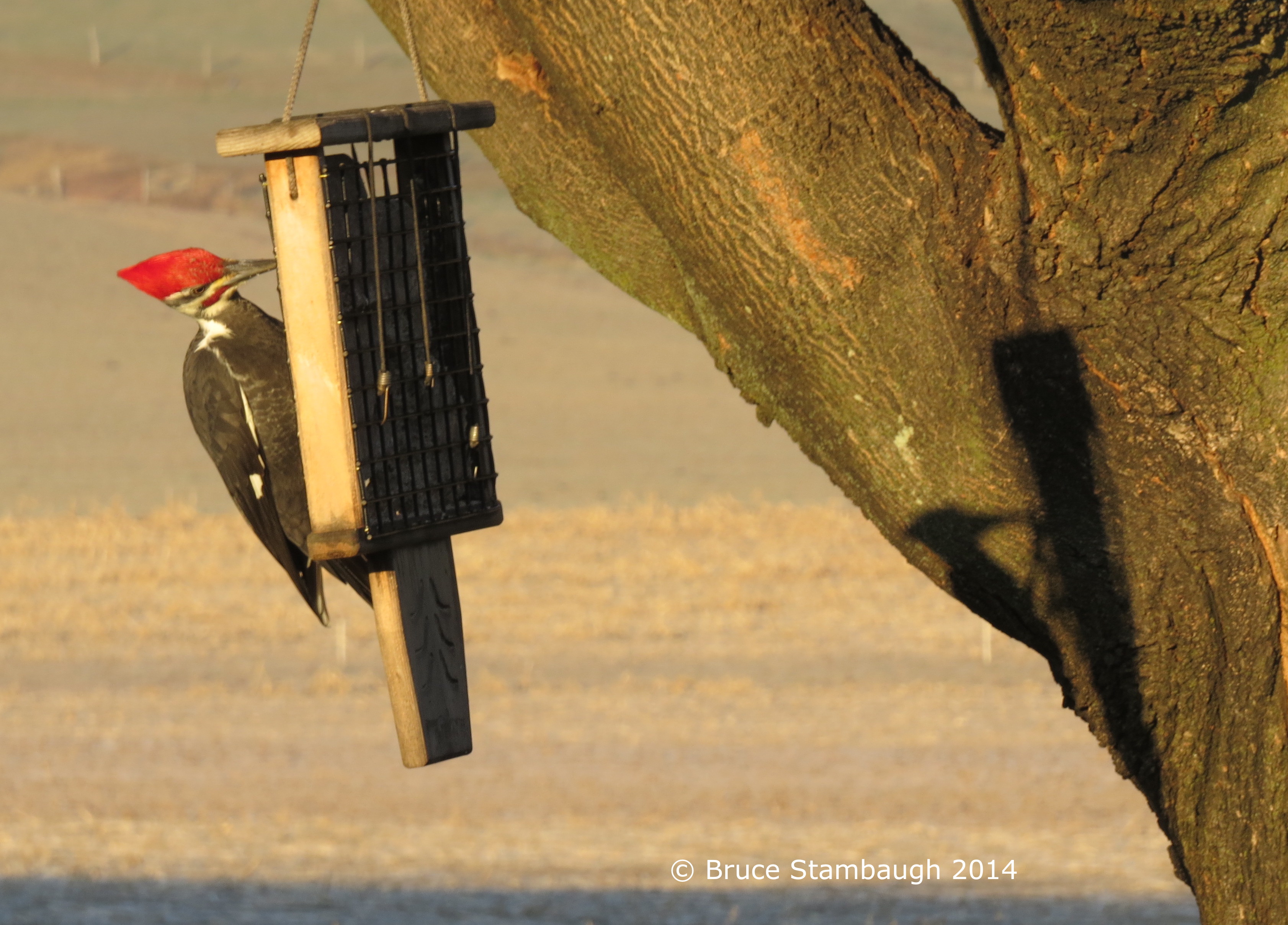
This beautiful male pileated woodpecker was only concerned about one thing: breakfast. The early morning sun, low in the southeastern horizon, brightly highlighted North America’s biggest woodpecker just before the winter solstice of 2014. The angle allowed the bird’s shadow and that of the peanut butter suet feeder to be cast on the trunk of the old sugar maple in our backyard near Mt. Hope, Ohio. The pileated woodpeckers came to our feeders year-round, even bringing their young to our home in Ohio’s Amish country. Those birds would be in the top 10 things that I miss since we moved to Virginia’s Shenandoah Valley two and a half years ago.
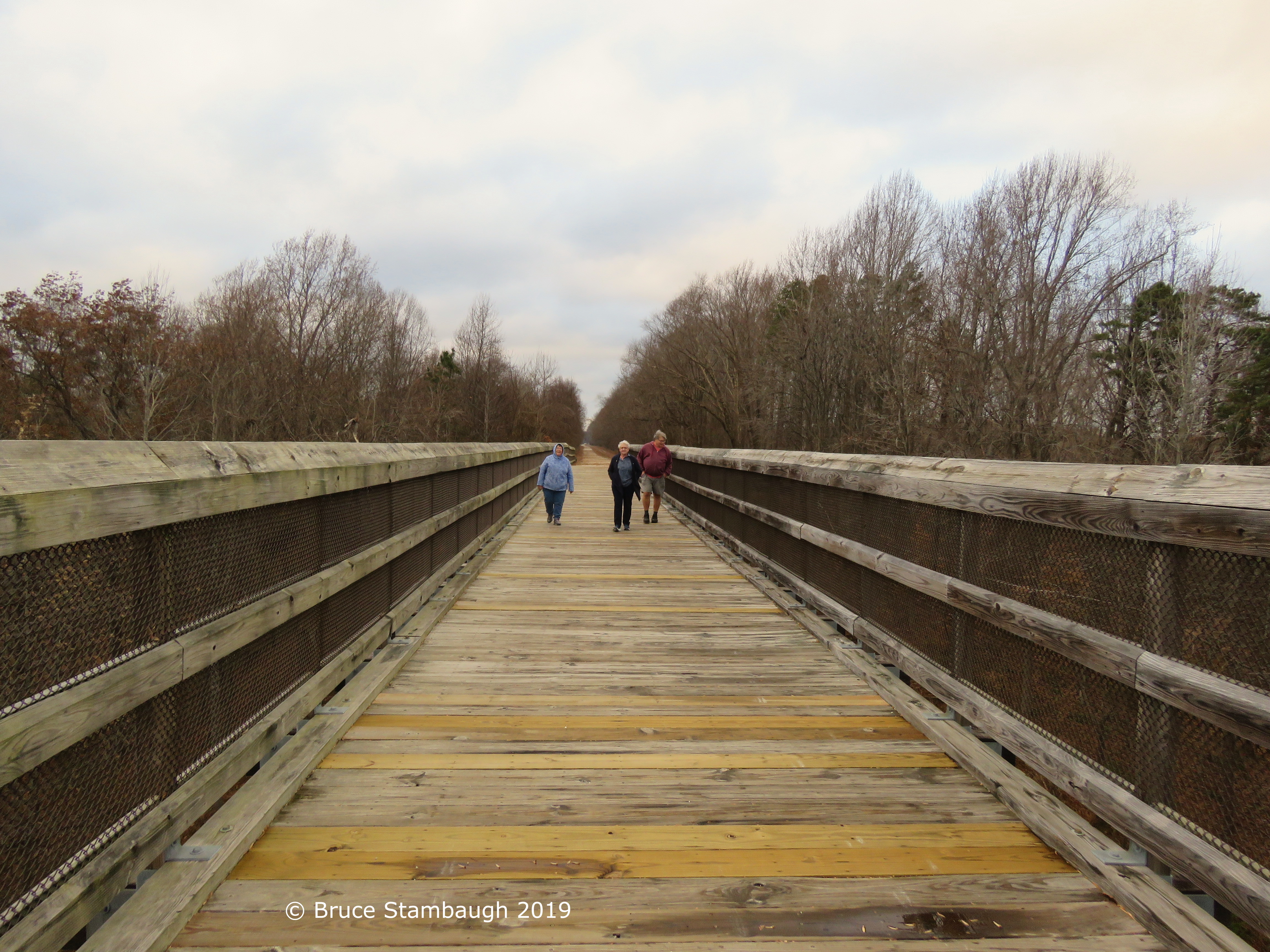
Perspective is an important element in photography. When I turned around to check on my fellow walkers, I snapped this shot. The side rails on the former railroad bridge provided an excellent example of perspective. Having my wife and friends in the shot also added the perspective of size. The perspective of depth is also demonstrated. The eye goes beyond the walkers far down the bicycle and walking trail.
The photo was taken on High Bridge, the centerpiece of High Bridge State Park, Farmville, Virginia.







 Roadkill Crossing
You must be logged in to post a comment.