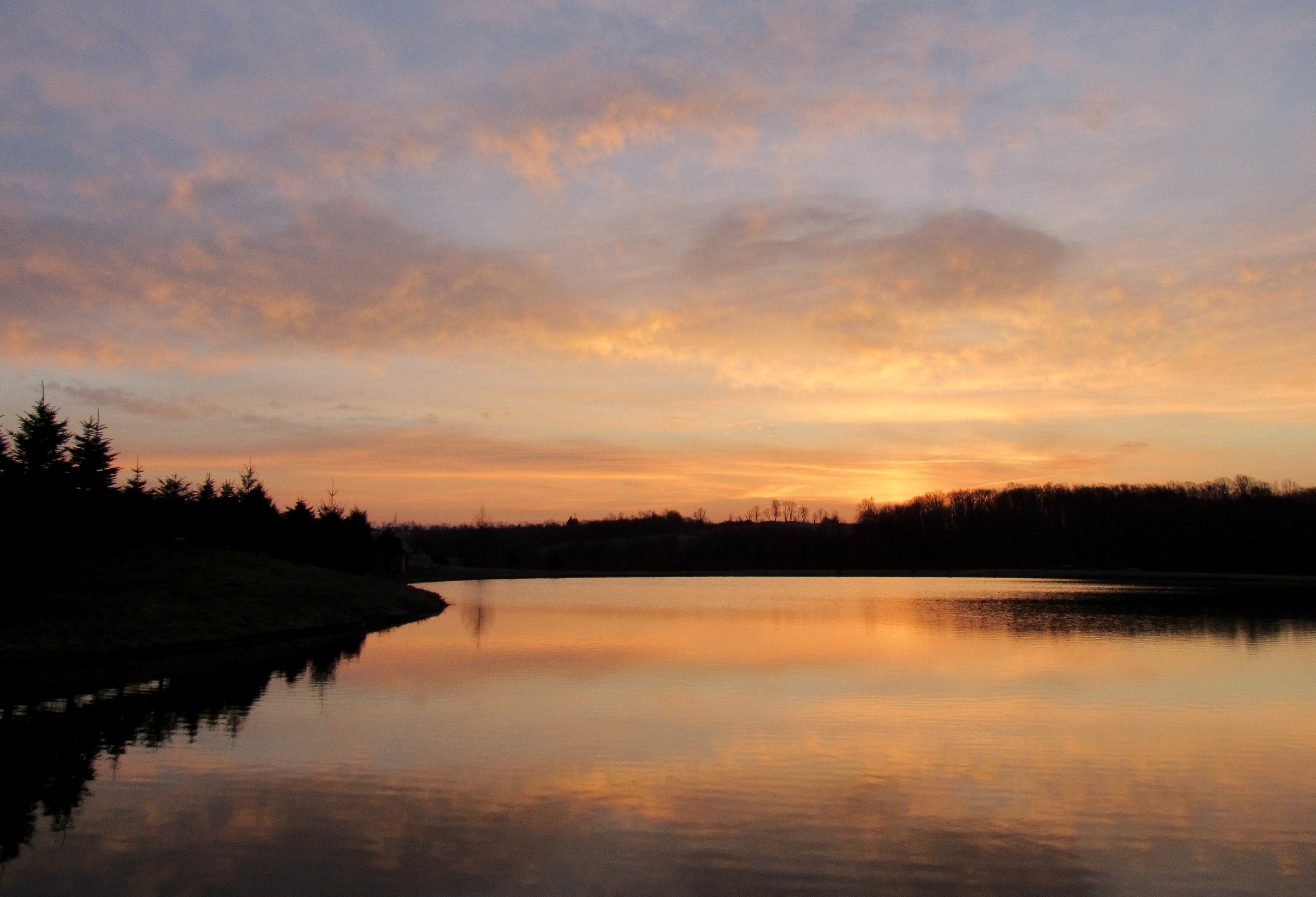
As the sun rises on a new year, I wish only the best for you in 2023.
Happy New Year!
© Bruce Stambaugh 2023

As the sun rises on a new year, I wish only the best for you in 2023.
Happy New Year!
© Bruce Stambaugh 2023
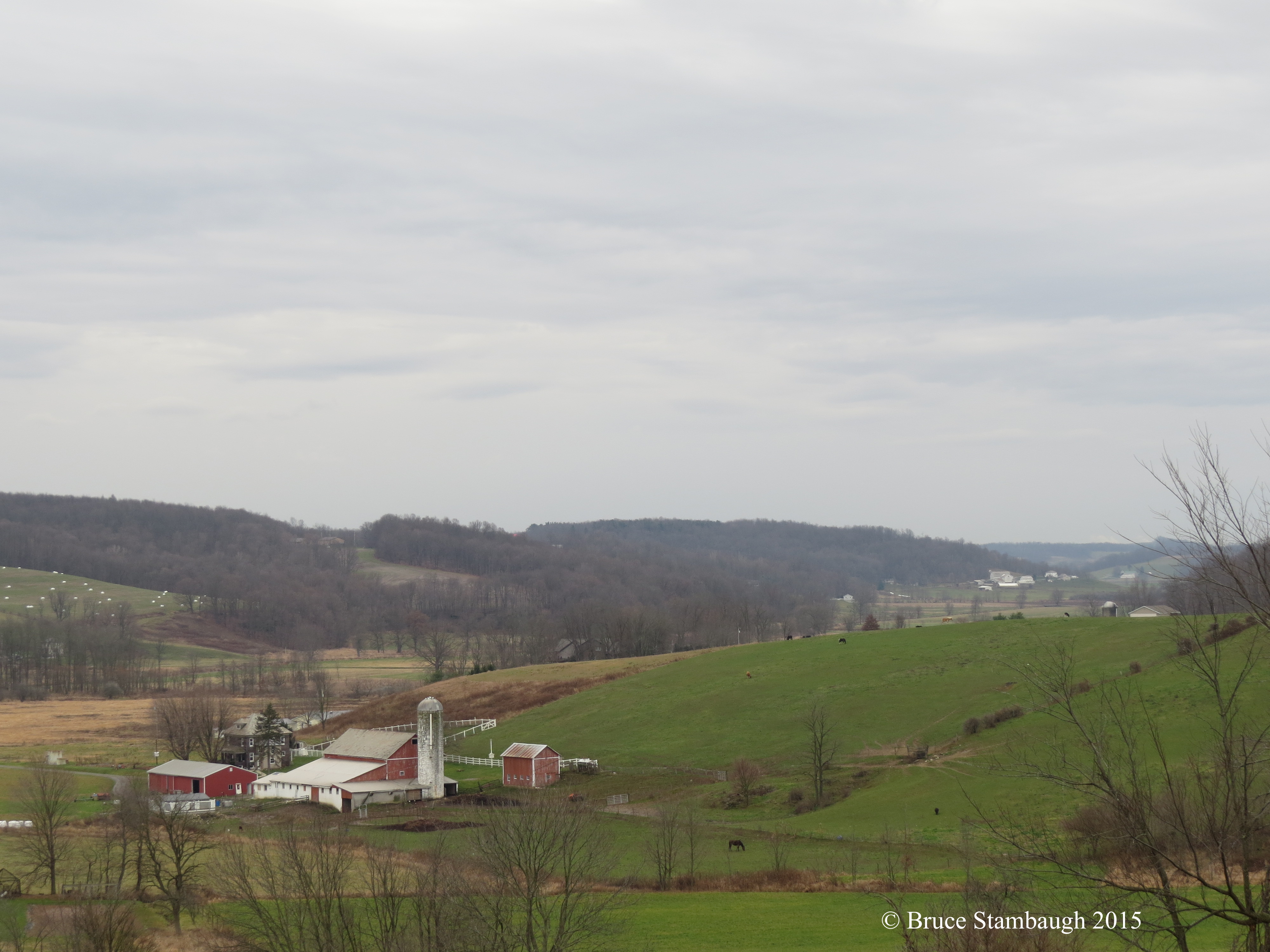
The Amish enjoy celebrating the holidays just as much as anyone else. However, they go about it a bit differently.
Defining how the Amish celebrate America’s most time-honored holidays deserves an introductory explanation. The Amish are divided into church groups, usually about 100 persons per church. And by “church,” they mean fellowship since they hold church in their homes, shops, or barns.
There are many different orders of Amish. The Swartzentruber Amish are considered the lowest order, with the New Order Amish the highest, since they hold Sunday school on alternate worship Sundays.
The terms “lowest” and “highest” are not intended to be derogatory or hierarchical. It simply is the way it is with the Amish. Those in between are the Old Order, the most numerous among the Amish population. The rules of the church leaders determine the orders.
Defining the Amish is a lot harder than their simple lifestyles might let on. Nevertheless, they all celebrate the holidays in one way or another.
The key to understanding how the Amish do so lies in this understanding. You can’t generalize about the Amish. Their holiday traditions and rituals vary from family to family, church to church, and sect to sect, not much different from any other culture or ethnic group.
Modesty is an essential principle in the values of the Amish. That fact can be seen in exactly how the Amish keep the holidays. In living out their faith beliefs, they do so joyously surrounded by food, family, and friends. Christmas decorations are insignificant.
Here is an overview of how any given Amish family might celebrate the holidays, save those in the Swartzentruber order.
Christmas
From the Amish perspective, anyone not Amish is considered “English.” The Amish recognize and respect Christmas’s universal demarcation on December 25. For them, Christmas is a sacred day in honor of the birth of God’s only son, Jesus Christ. Many, though not all, will fast before their family gathering.
Amish celebrate Christmas twice, once on the expected date of December 25 and again on January 6, commonly referred to as Old Christmas. In higher religions, that day is known as Epiphany.

Unlike the rest of society that celebrates Christmas, the Amish do not have Christmas trees or decorations. They will, however, burn Christmas candles in honor of the day.
After the usual Christmas meal of turkey or ham and all the trimmings, the Amish will spend the afternoon and evening playing table games, board games, and cards. None of the card games would involve using face cards, however.
Of course, it wouldn’t be Christmas without gifts, and the Amish also carry out this gift-giving tradition. The gifts will be wrapped, but usually nothing elaborate. Children will receive toys. There is, however, no mention of Santa.
Perhaps the closest to celebrating Christmas in contemporary fashion is done at the private or parochial Amish schools for grades 1 – 8. There are nearly 200 such schools in the Holmes County area. All are either one or two-room schools, where students walk to school. Before taking a couple of days off for Christmas, a program is held for parents, grandparents, and friends on the evening of the last day of school. The program usually consists of Christmas songs, poetic recitations, short plays, and possibly group singing.

Old Christmas
Old Christmas harkens back to the change from the Julian calendar to the Gregorian calendar during the latter stages of the Reformation when Pope Gregory XIII switched Christmas to December 25. Out of tradition and reverence for their forefathers, the Amish have continued to honor Christ’s birth on January 6.
Unlike the more jovial December 25 celebrations, Old Christmas is more solemn. It begins with fasting, followed by another typical Christmas meal and more gift-giving. However, the emphasis is on reflecting and visiting as opposed to reveling.
No matter which holiday is celebrated, family is always essential in any get-together for the Amish. And that is true for any Amish order.

© Bruce Stambaugh 2022
Scanning through some photo files, I found several photos of Amish farms in December. These photos were all taken in or near Holmes County, Ohio.


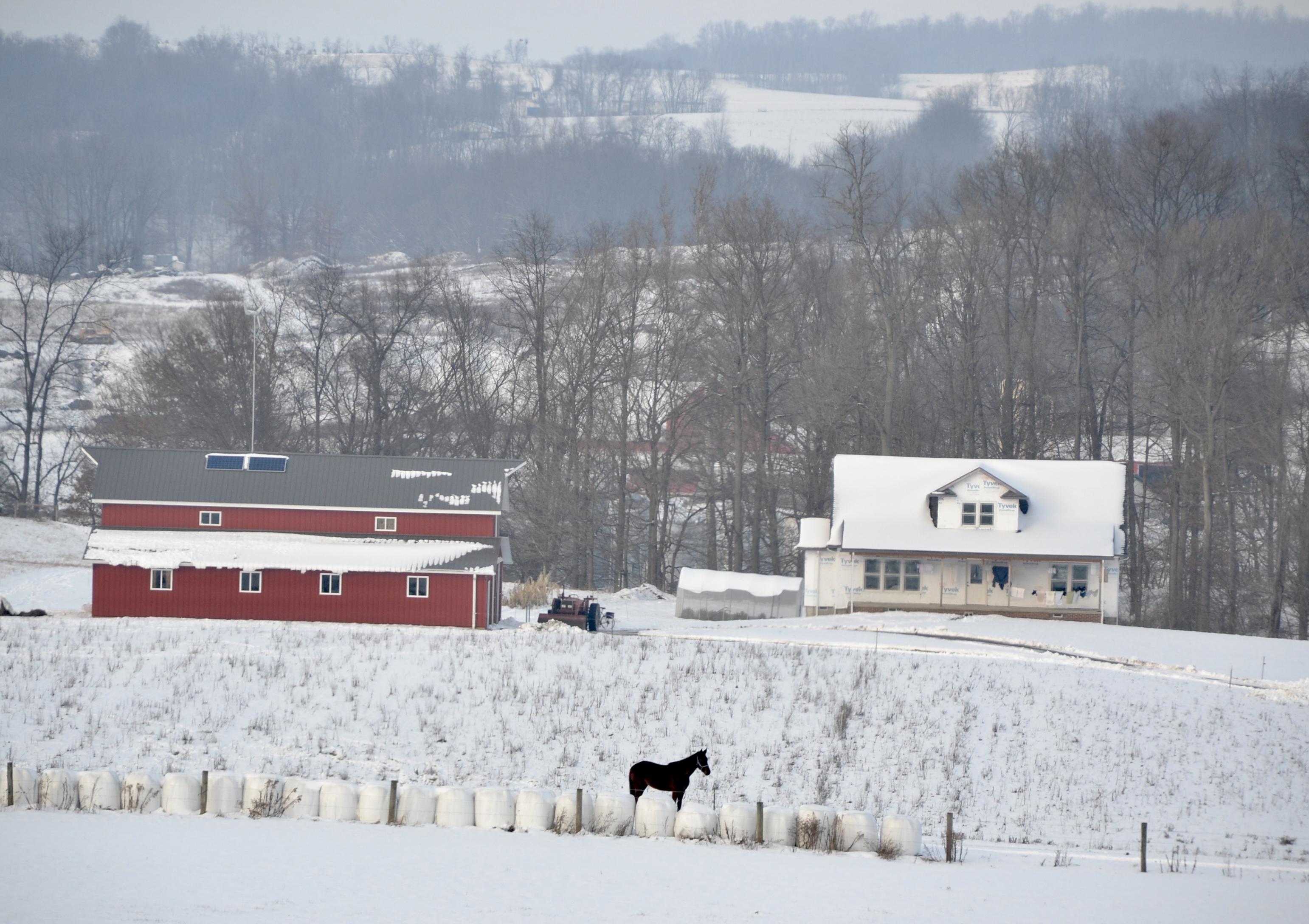
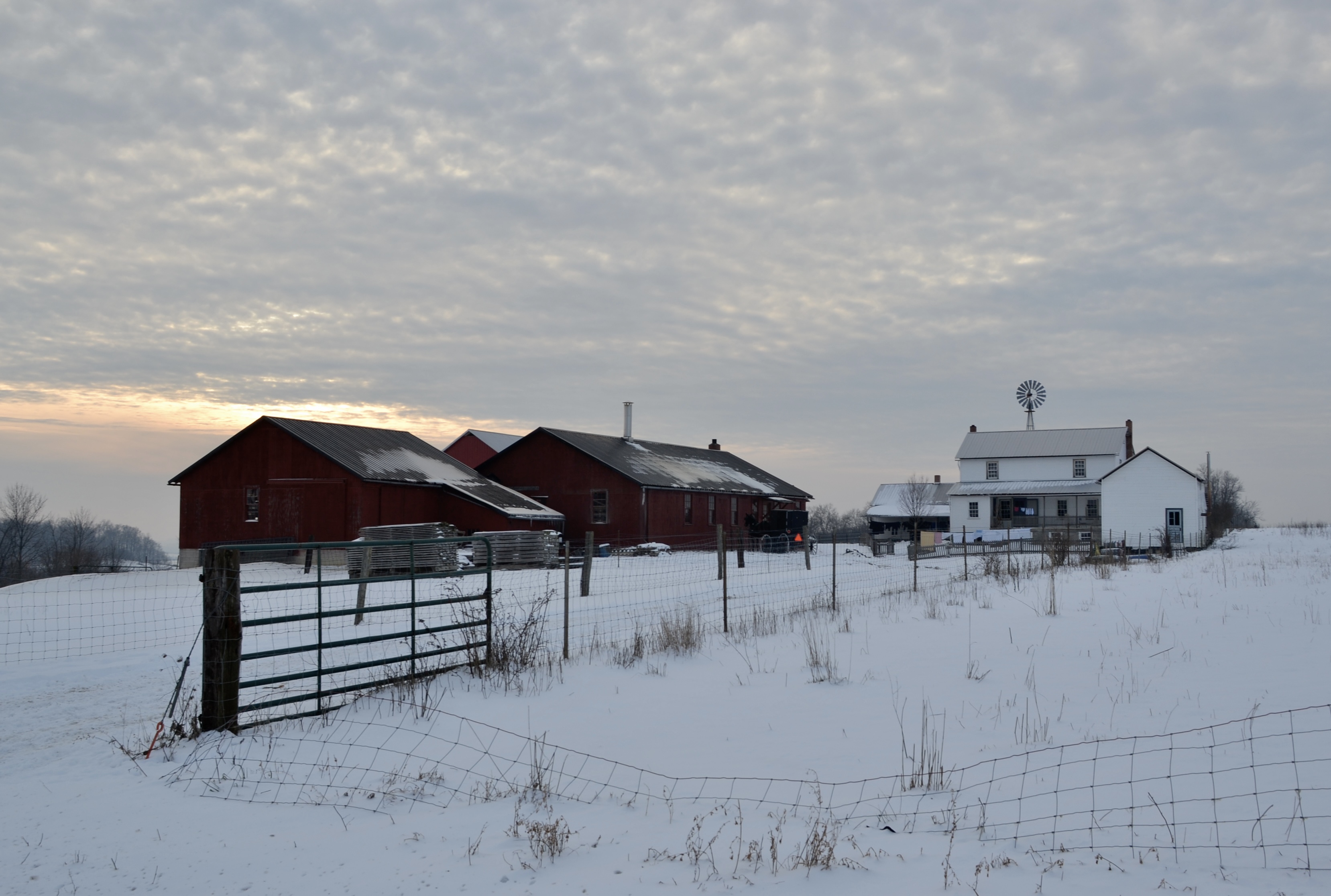
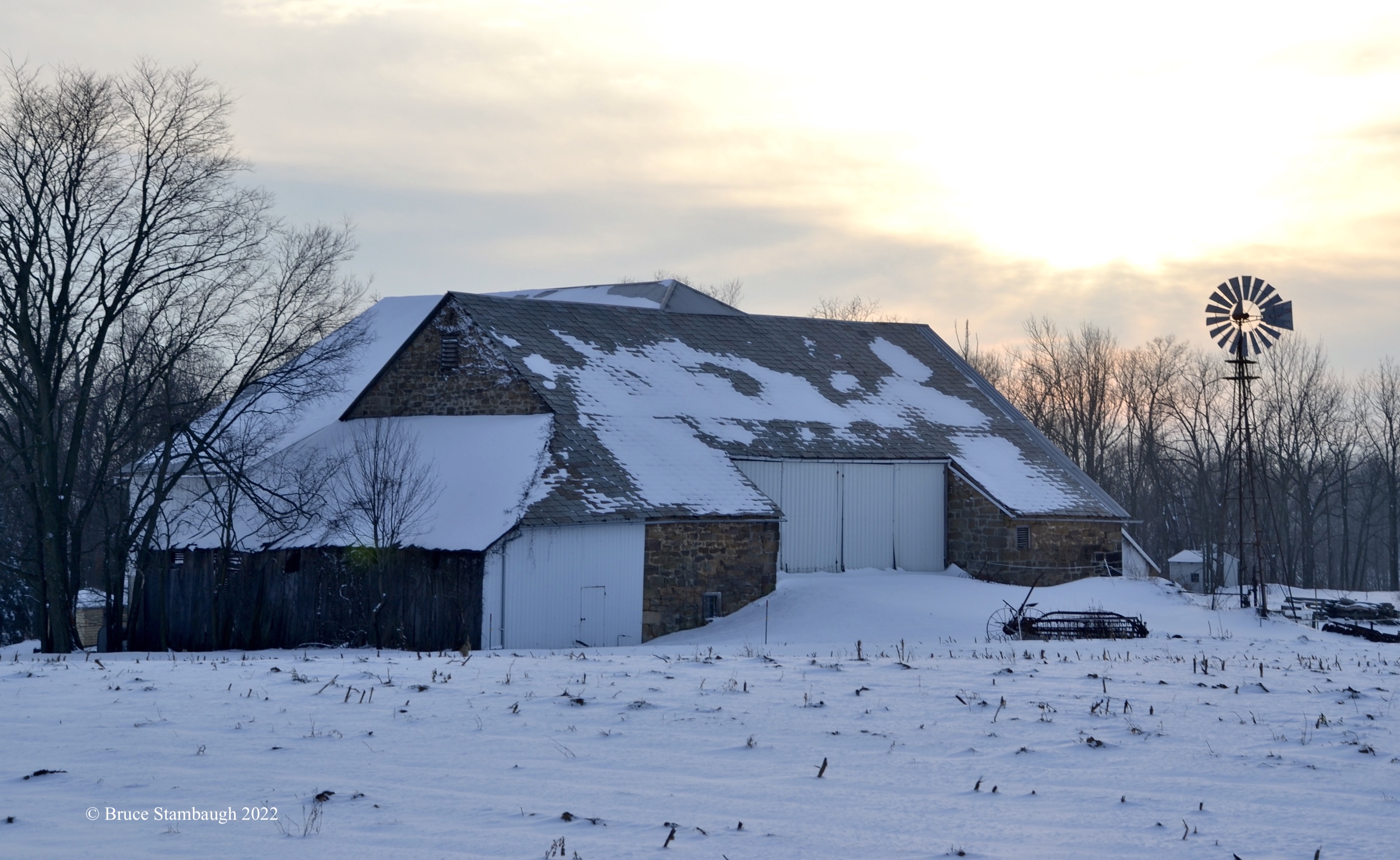

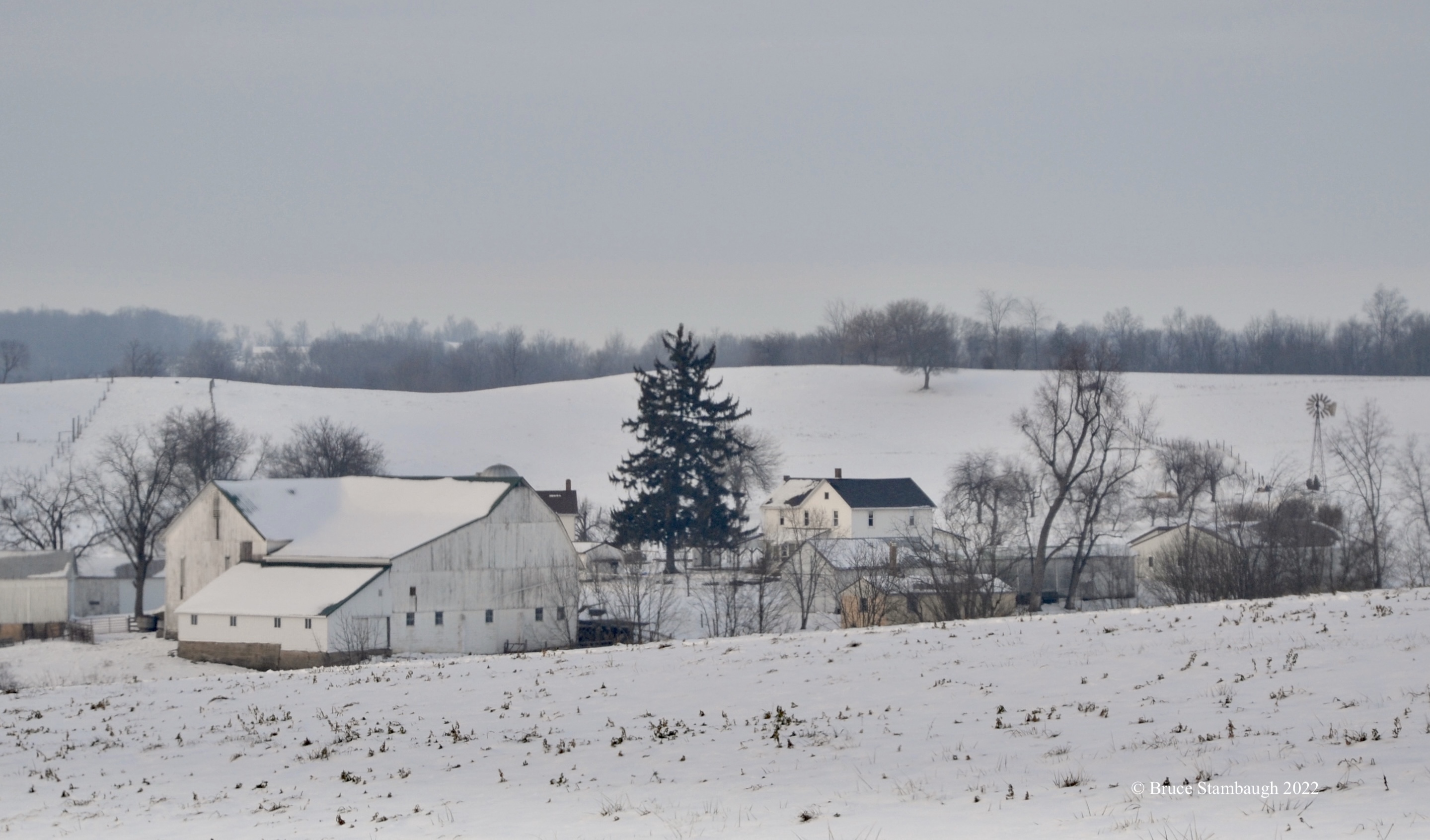

Please click on the photos to enlarge them.
© Bruce Stambaugh 2022

Yesterday, we had an ice storm in Virginia’s Shenandoah Valley. Schools and many businesses were closed, but for the most part, little harm was done. The power surged just once in our neighborhood.
The ice coated everything from the ground up with at least a quarter inch of ice. There was more ice in some places, while others received much less. The ice accumulation depended on elevation, air temperature, and the amount and types of precipitation in any given area.
One thing was sure at our location. The layer of ice created a crystal palace appearance to all it embraced. It was joyous to look out and see nature’s beauty enhanced all the more.
I was surprised to see so few birds at our many feeders placed strategically around our front and back yards. But by mid-day, they apparently got hungry enough or felt safe enough to venture out from the security of their perches to come to the feeders.
I was ready for them with my cameras. I captured a brilliant red male Northern Cardinal sitting on a branch of a frosted evergreen. But it was his female companion that stole the show.
The female Northern Cardinal perched on an ice-incrusted limb of a young tulip poplar tree we had planted earlier this year. The photograph embodied the whole of the day.
The encasement of the ice is clearly visible, while the thin ice pellets pepper the background. With its burnished tulip-like blossoms frozen in time, the dormant tree beautifully accented the Cardinal’s lovely muted red and olive coloration.
This female Northern Cardinal earned the title “The Ice Queen.”
© Bruce Stambaugh 2022

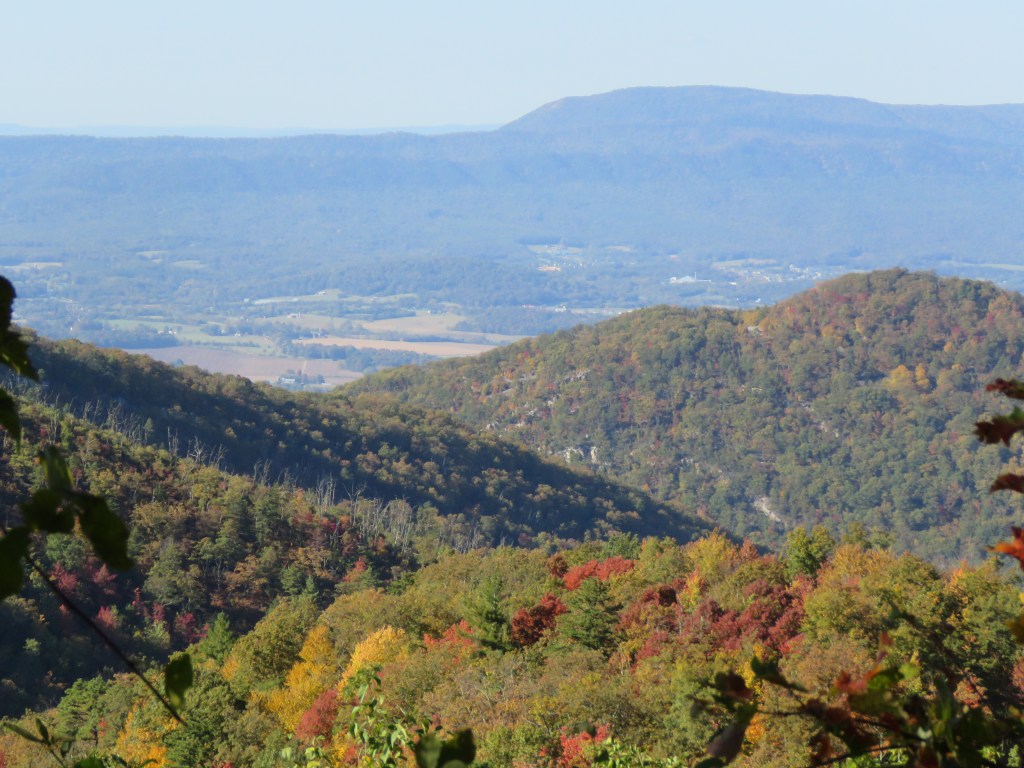
What a difference just a few days make. A friend told me that the colors on Shenandoah Mountain were exceptional. A man I could trust, I took his comments to heart.
Viewing the colorful leaves of autumn is a long-standing tradition for me. Of course, living most of my life in Ohio’s Amish country spoiled me. I was surrounded by brilliant colors nearly every fall without having to leave home.

I needed to satisfy that desire to participate in autumn’s color fest. The Saturday morning after my excursion on Skyline Drive, I headed west on US 33. It’s not just the main route west out of Harrisonburg, Virginia. It is the only roadway west that traverses the Allegheny Mountains into West Virginia.
The drive to the summit of Shenandoah Mountain takes about half an hour from my home. I headed out mid-morning, and as I reached where the road runs parallel to Dry River, the main waterway of Shenandoah Mountain, I changed my course. It was evident that the afternoon light would better illuminate the beauty of the leaves.
Not wanting to waste my attempt, I turned into a locally popular park, Riven Rock. In the summer, families go there to cool down from the heat and humidity by playing in the clear, placid waters of the braided stream. Here the morning sun proved me correct. Only the southernmost leaves were highlighted while I stood in the shade on the eastern bank. I decided to try again in the afternoon.
Before venturing out again, however, my wife and I attended a high school marching band concert at nearby Bridgewater College in the town from which it derives its name. We watched our second grandson and his bandmates perform a great show. So did some of the sugar maples on campus.



Our grandson after the performance, the marching band, and sugar maples.
I headed out again just after 3 p.m. I planned to drive to the top of Shenandoah Mountain, where there is a parking lot for a trailhead. On the way up the twisting road, I noted places where I could pull off to photograph nature’s glory. And I could see that the higher I went, the richer the colors. I was pumped.
Vehicles nearly filled the small parking lot. I wasn’t surprised. It was a great day for hiking and enjoying nature’s beauty in the George Washington National Forest. The trailhead leads from the parking area to the only remaining fire tower on Shenandoah Ridge. The hike up to High Knob Fire Tower is popular. The crowded parking lot said plenty of hikers were on the trail.
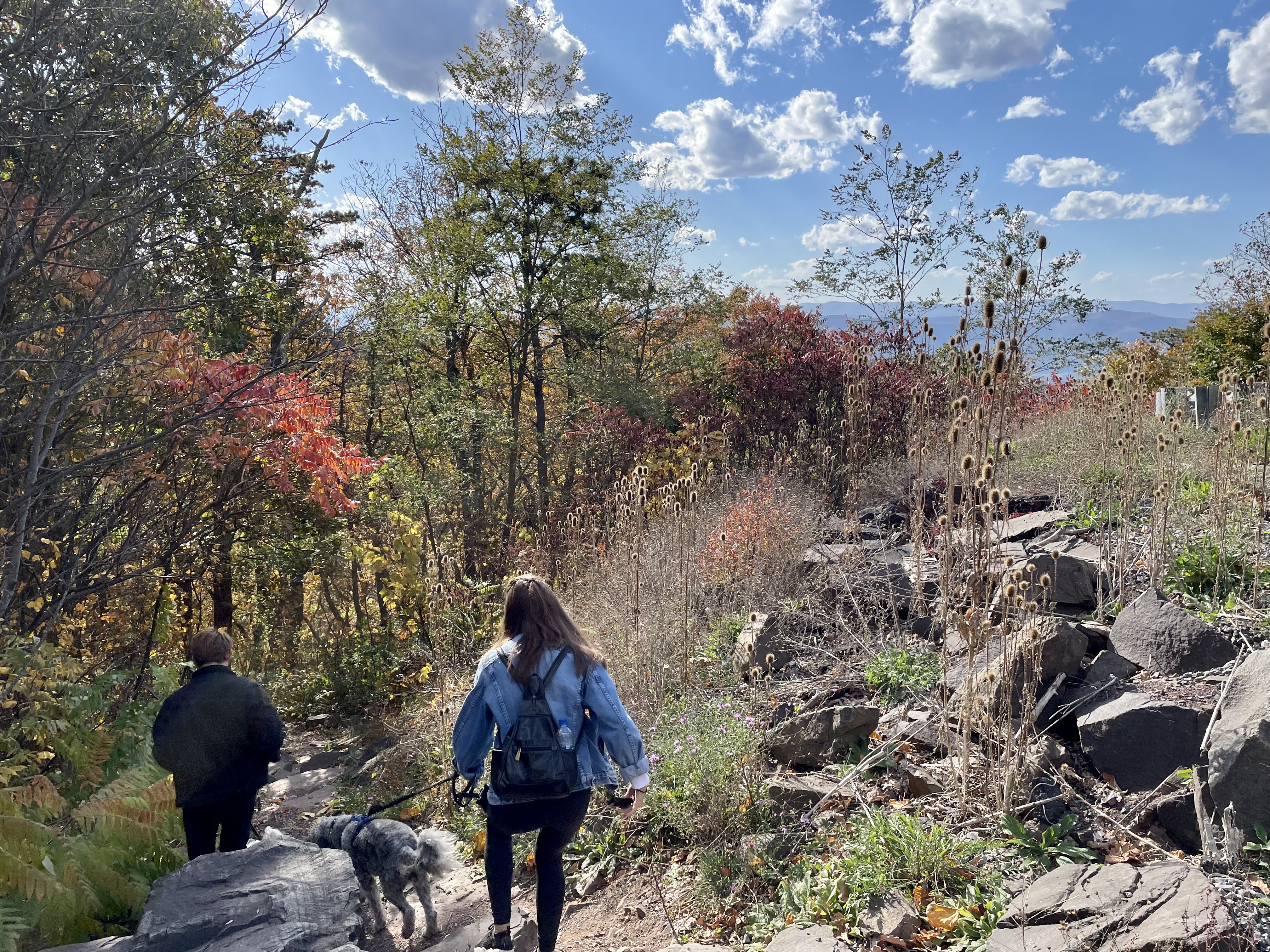
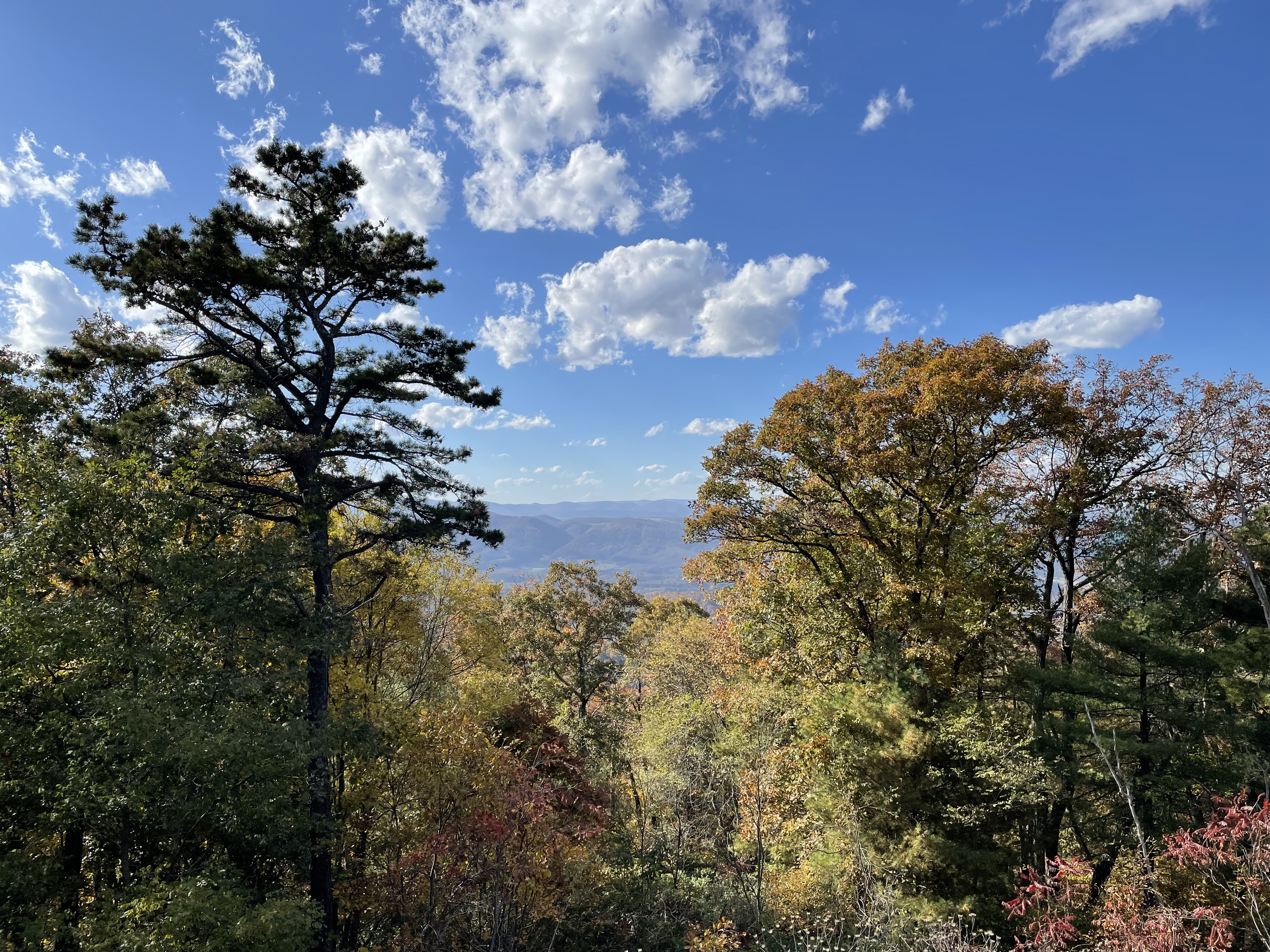

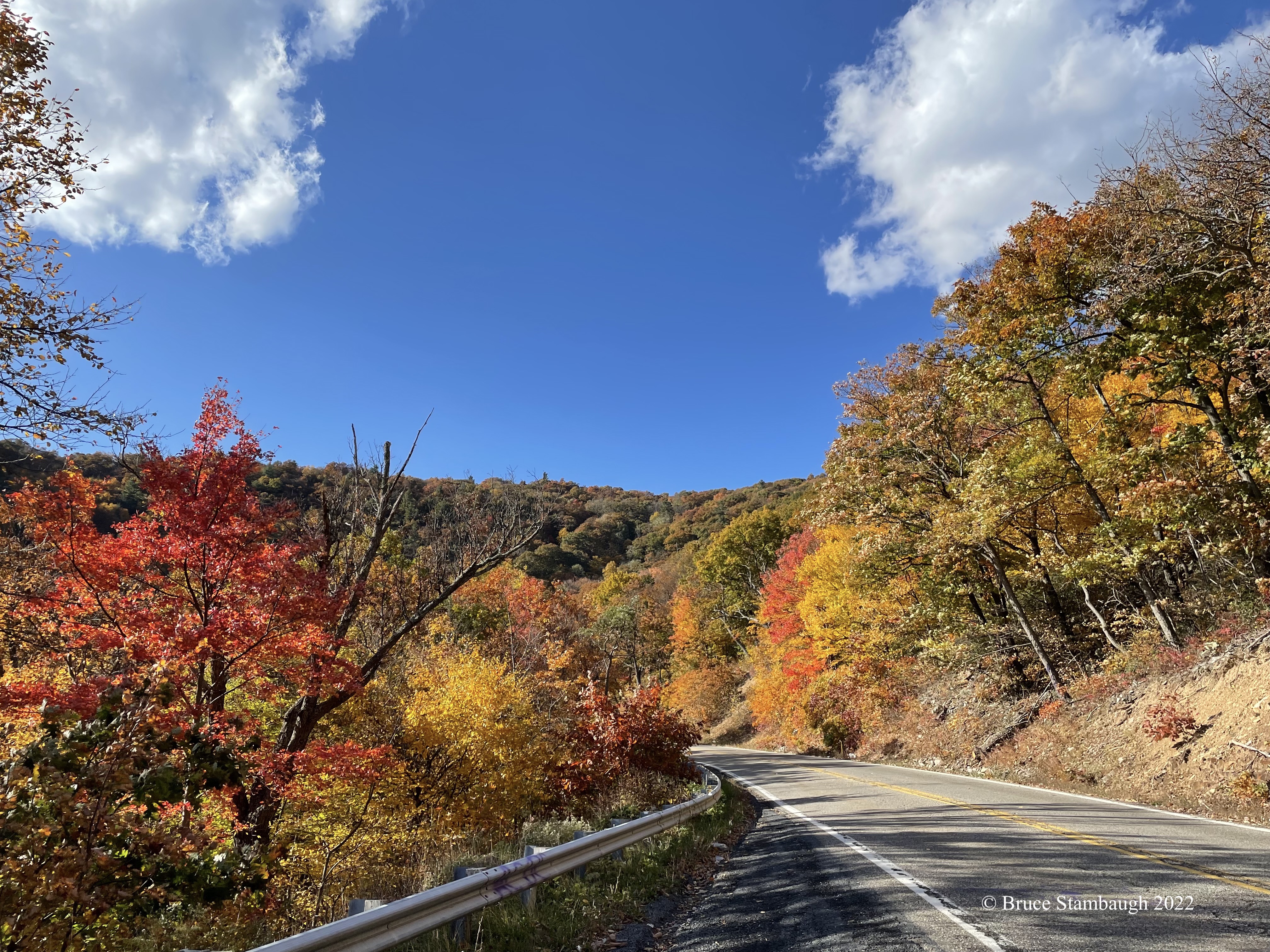
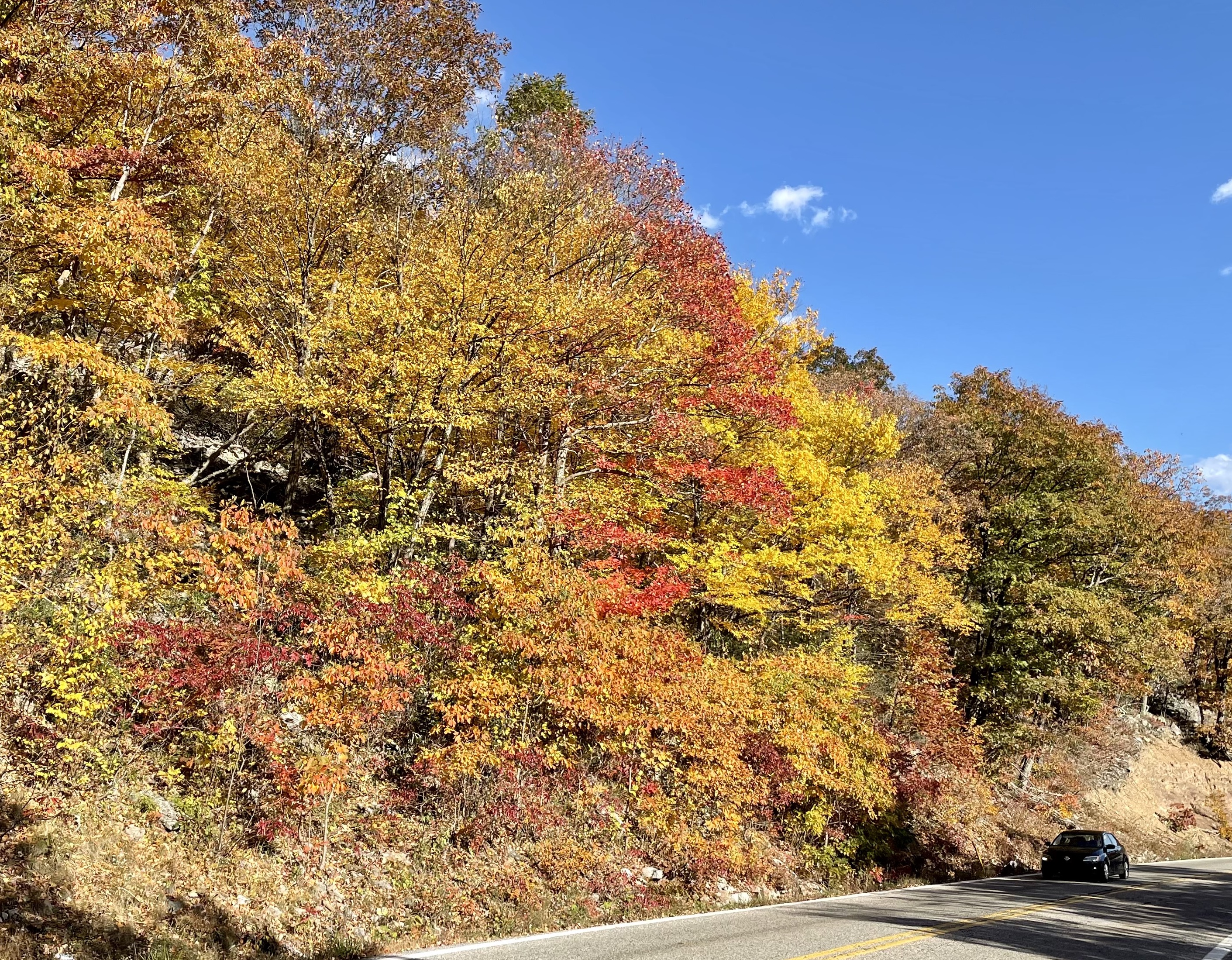

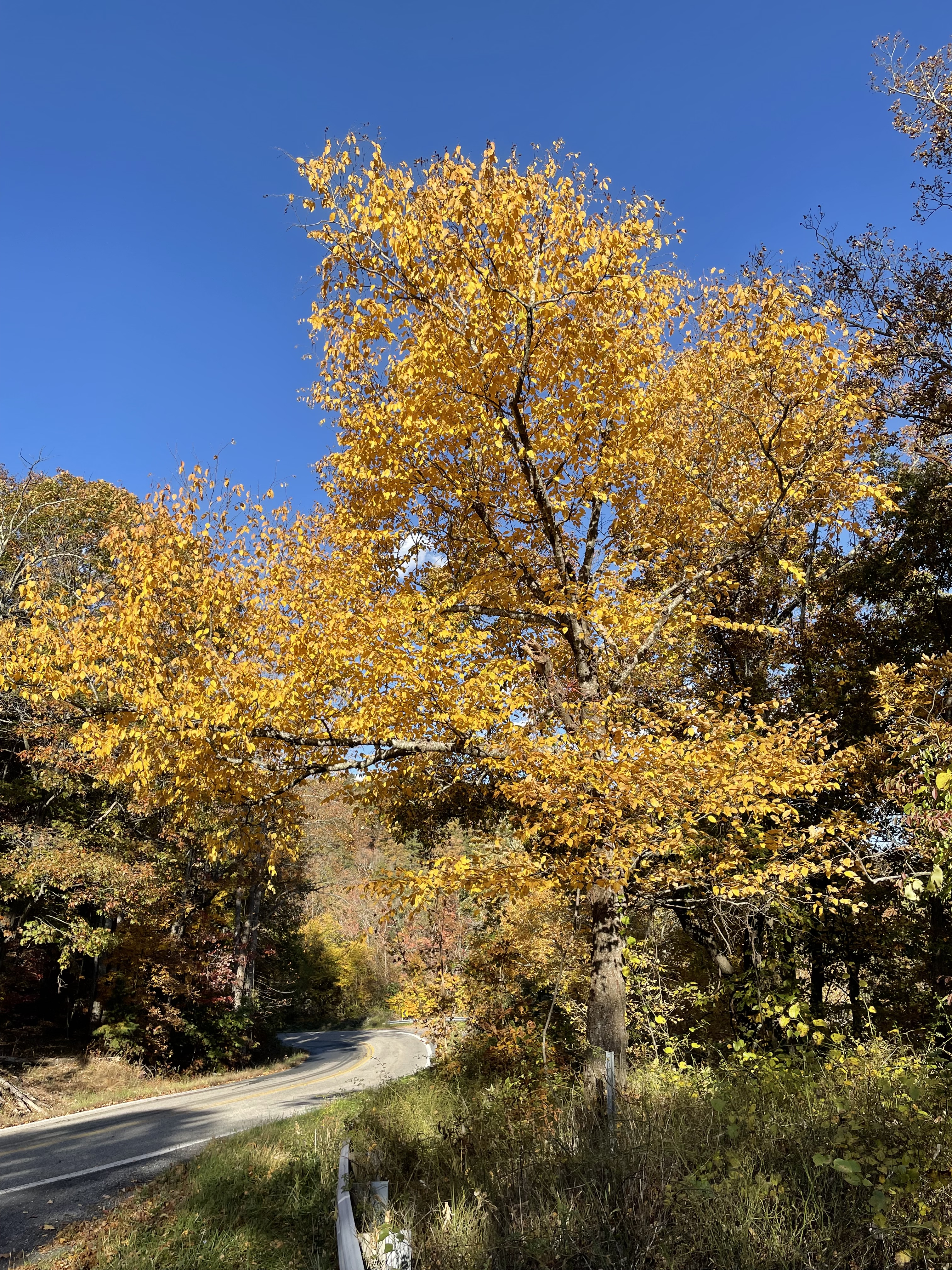
Please click on the photos to enlarge them.
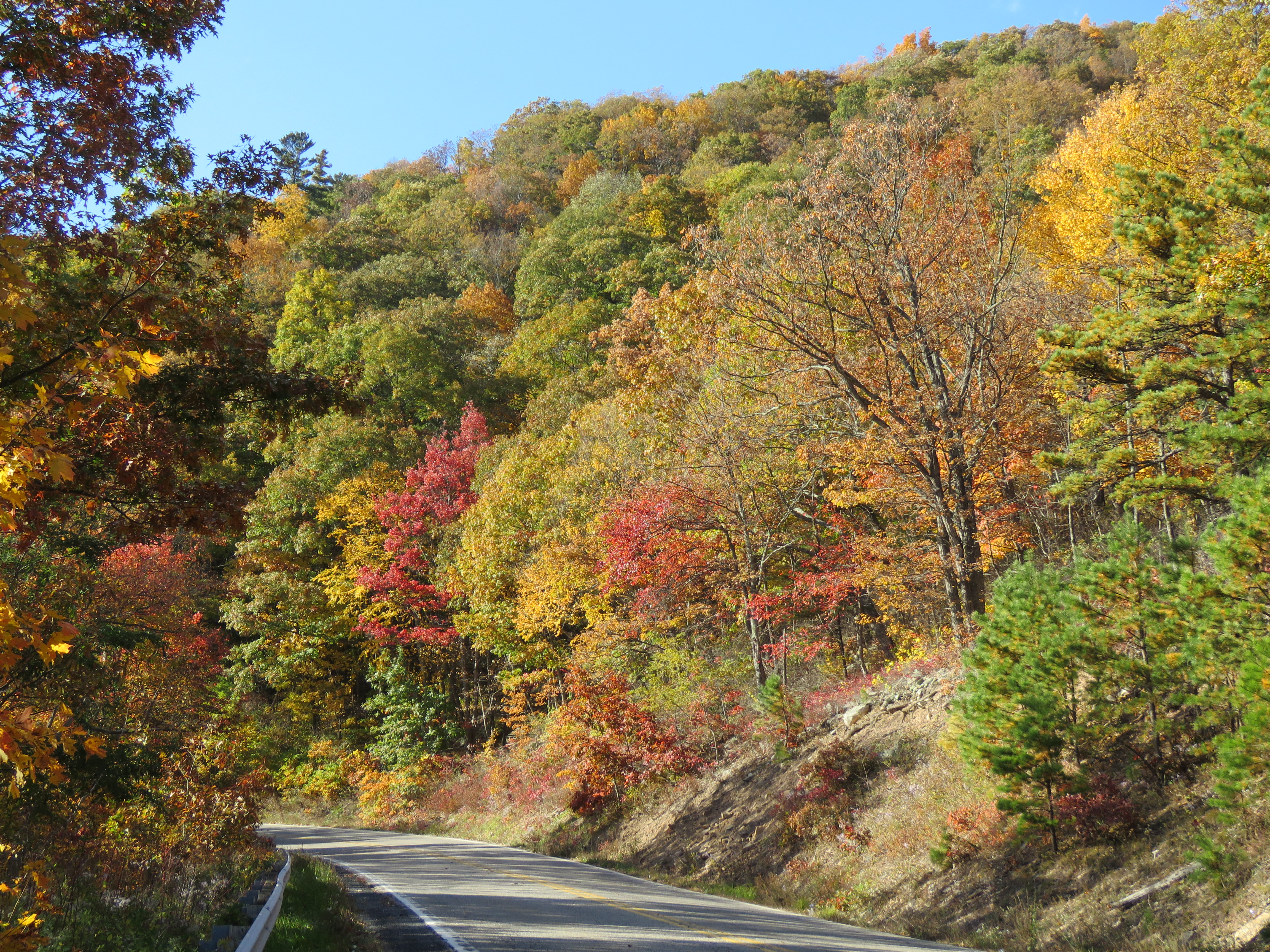
I took a few photos at the top of the mountain and returned to my car to capture the beauty. Going down showed me just how right my friend had been. The trees along the two-lane winding road were gorgeous.
Nature was in her glory, and so was I. I stopped in the few safe places I had spotted. The afternoon sun bathed the crimsons, golds, yellows, and reds. I tread carefully along the narrow, curvy roadway as cars and trucks whizzed by.
I rejoiced in my good fortune. The colors were incredible. The leaves that the afternoon sun backlit also caught my attention. I happily snapped away.
After only a few stops going a fourth of the way down the mountain, the colors drastically faded. Just as meeting people on Skyline Drive energized me, knowing that I had reached my goal of capturing the turning of the leaves filled my spirits.
Fall is my favorite time of year, and these experiences are why.
© Bruce Stambaugh 2022
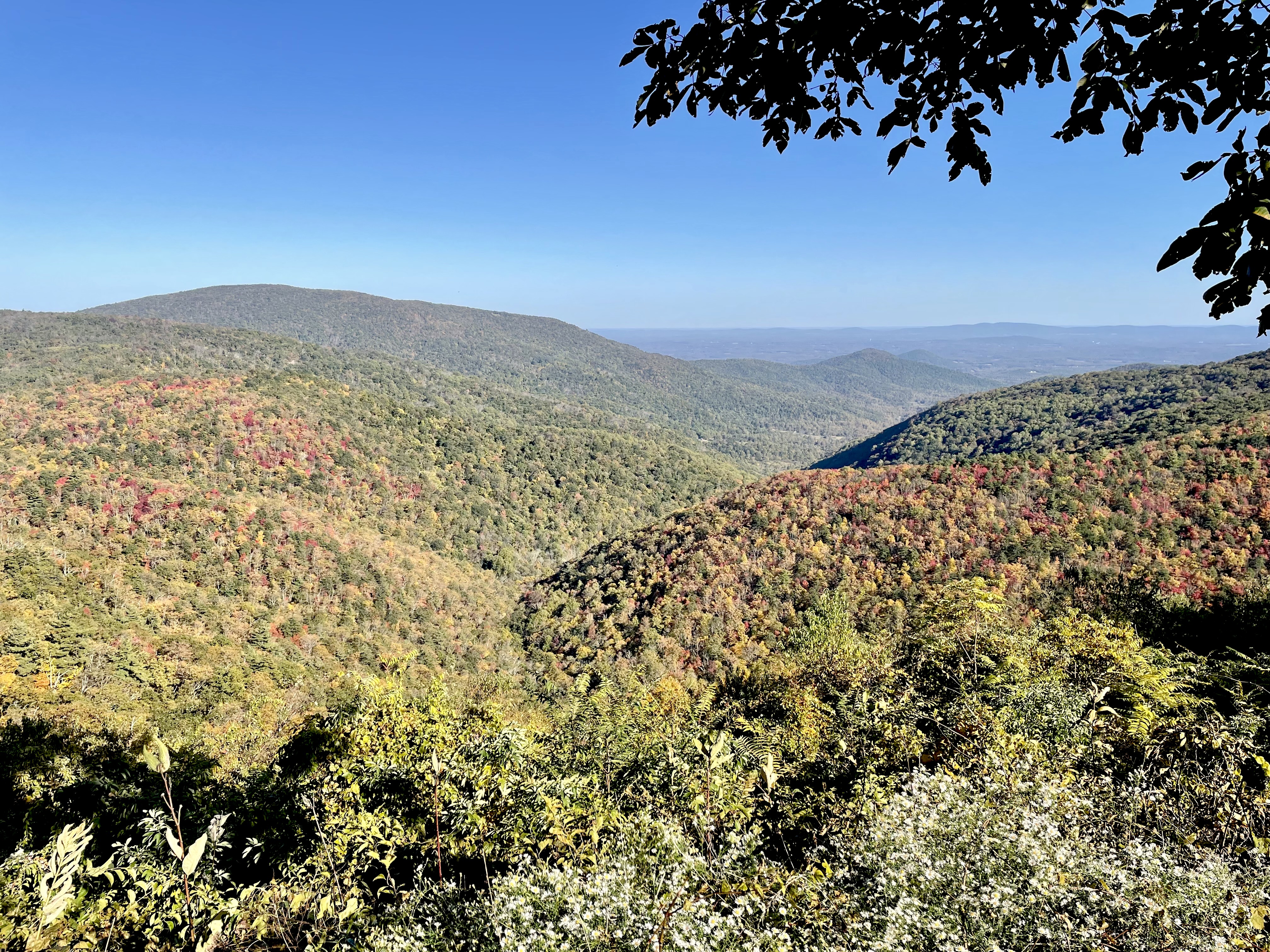
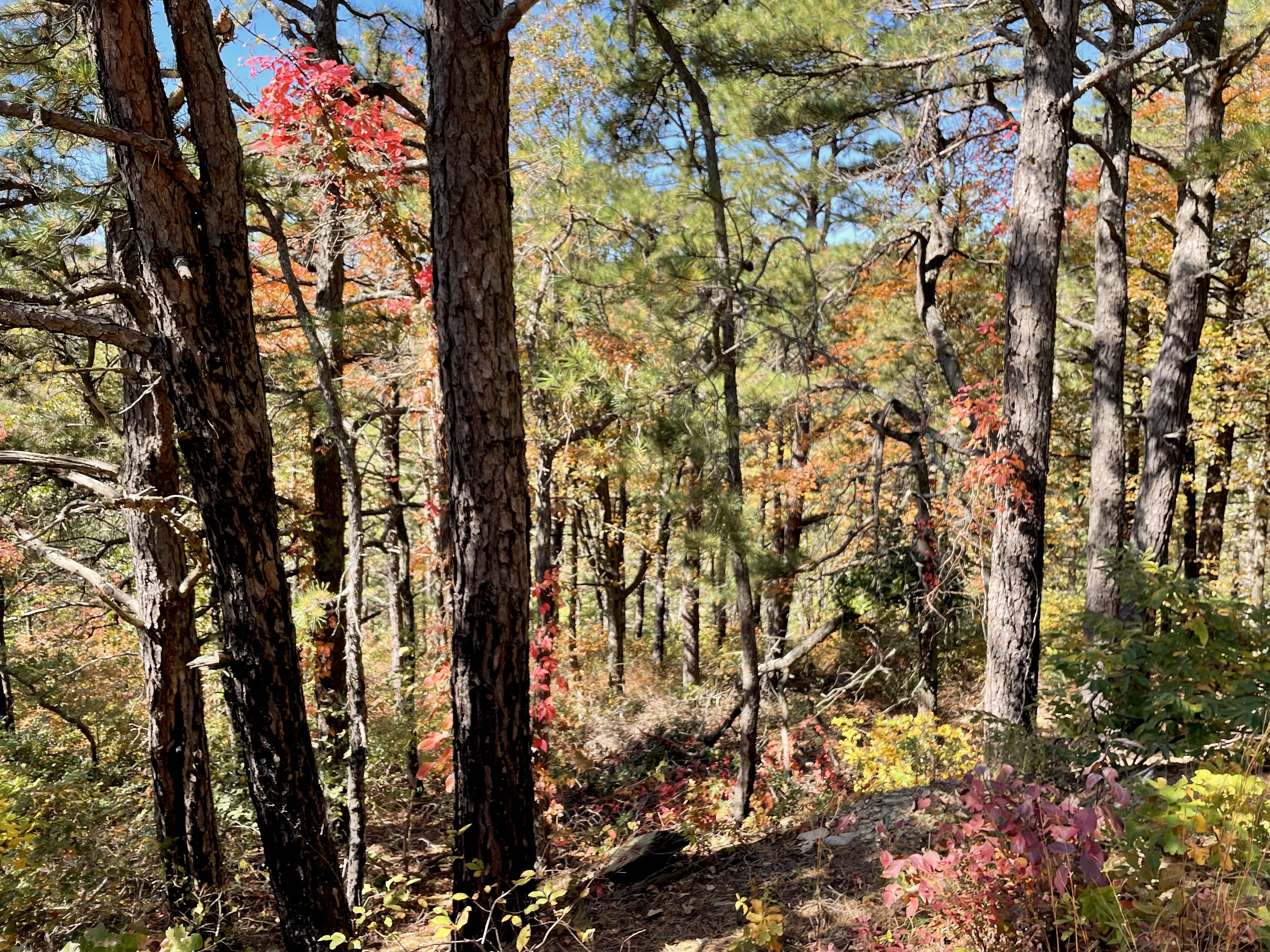
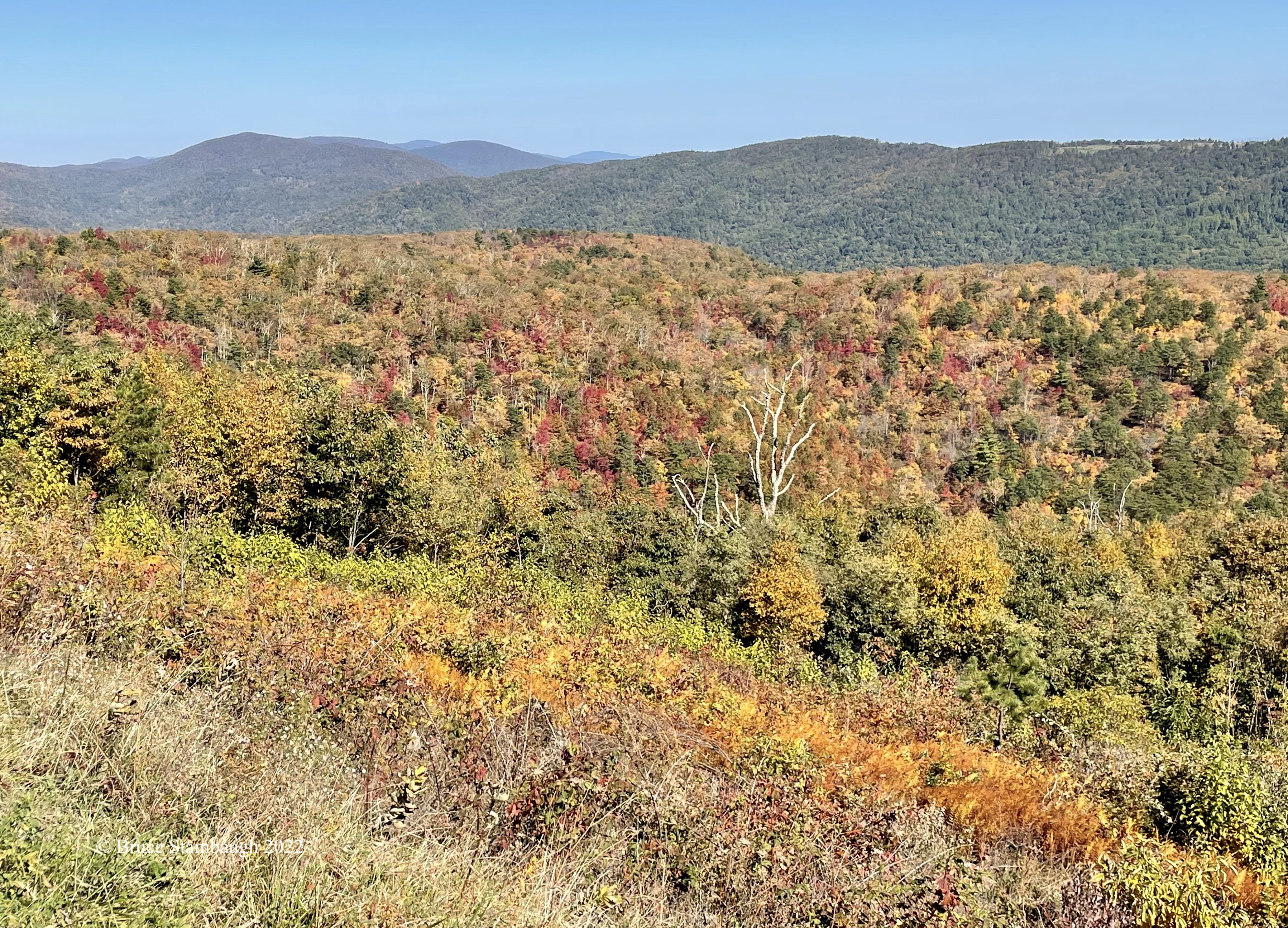
I was hoping to see the Blue Ridge Mountains painted in shades of red, yellow, and orange in Virginia’s Shenandoah National Park. What I discovered were only splashes of brilliance here and there.
Most of the mountain forests were dull in color. I was a bit early.
Of course, I wasn’t alone in my quest. Others were out and about, cruising the roadway for the same reason. I spotted vehicles from several states and even a Canadian province at the various overlooks where I stopped.
The day was bright and beautiful. The park’s early afternoon temperatures were in the 60s and high 50s. The bright sunshine warmed lower elevations in the Shenandoah Valley 10 degrees higher.
The excellent weather and a good report from a morning doctor’s appointment put me in an exceedingly good mood. The people I met wherever I stopped only increased my joy. Everyone seemed to be in a jovial mood.
Folks were snapping selfies with the coloring trees as their background. I took time out from my photography with offers to take portraits of couples, families, and a woman with her dog. Of course, engaging conversations ensued as they thanked me.
It didn’t matter what state of origin or type of vehicle they drove—Massachusetts, Pennsylvania, Georgia, or Ontario; camper van, motorcycle, Mercedes, or clunker. Everyone seemed to be on the same emotional page. That connectivity made the day and the scenery even prettier than they already were.
The first family I came across was from the deep south. They were on their way to Williamsburg and wanted their two boys, 17 and eight, to experience at least a little of the storied national park.
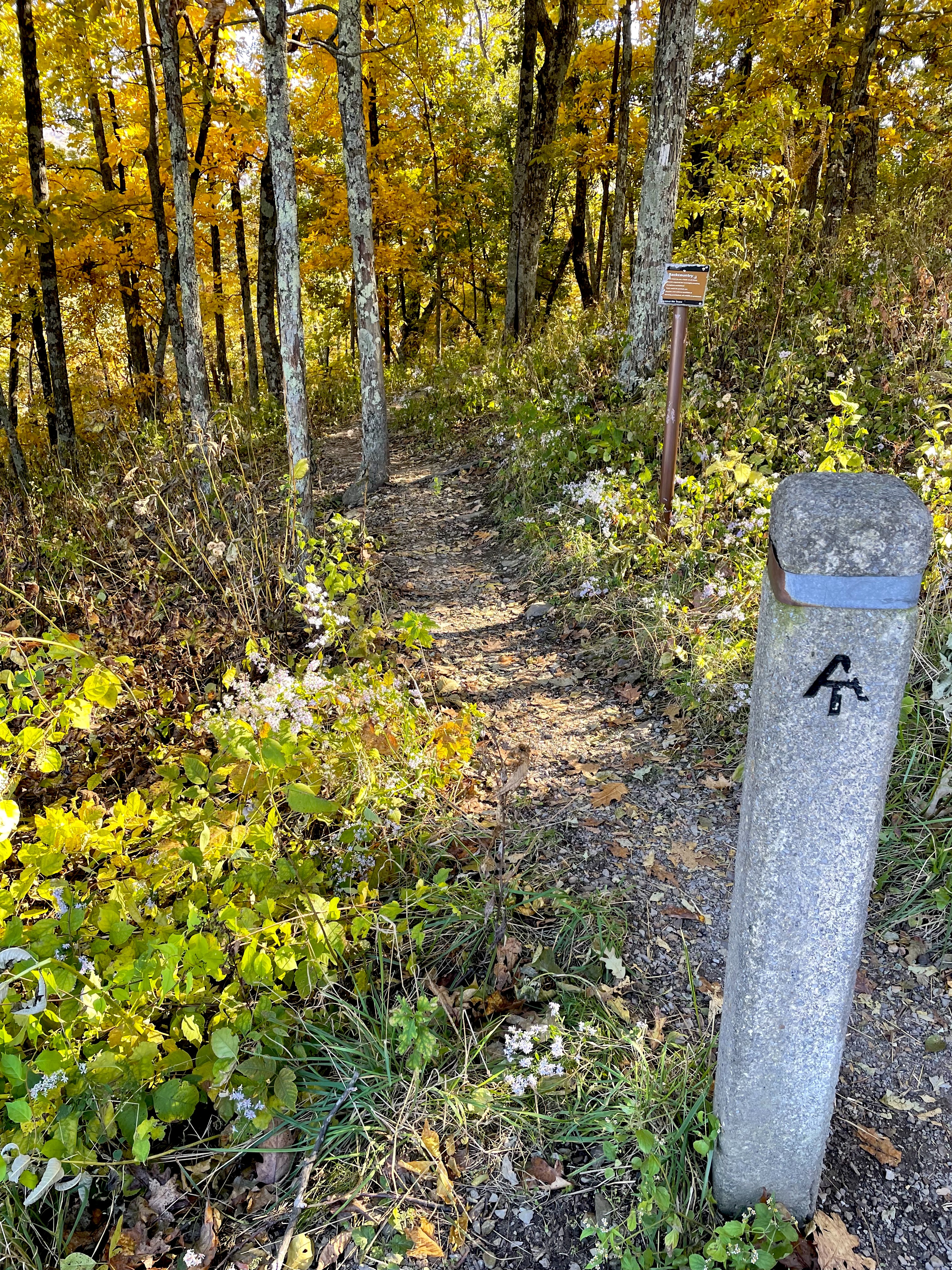
I asked the younger one if he knew he was walking on the Appalachian Trail. Indeed, he did. I told him he could go back to his second-grade class and report that he had hiked the AT and see if they knew what that was. He just giggled.
I started at the southern entrance to the park at Rock Fish Gap. Go north, and you will be in the park. Go south, and you travel the Blue Ridge Parkway. Either direction, it’s a beautiful, leisurely drive that soothes the soul and eases the mind. The 35 miles per hour speed limit contributes to that cause.
That’s what the woman with the dog was attempting to do. She drove southeast from Philadelphia towards Charlottesville for the parkway. When she realized Shenandoah National Park was so close, she changed gears and spent a night camping in Big Meadows, nearly in the center of the park.
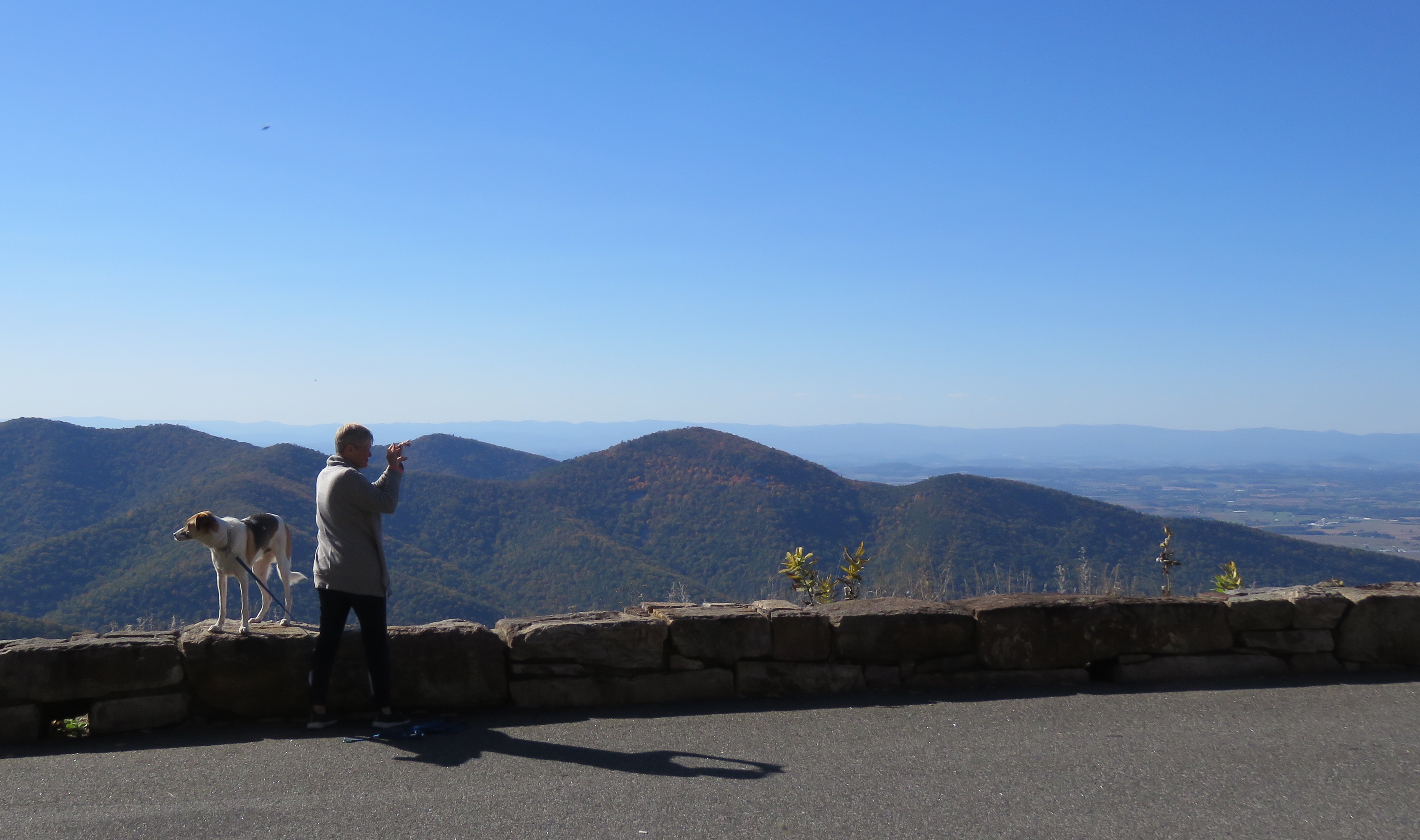





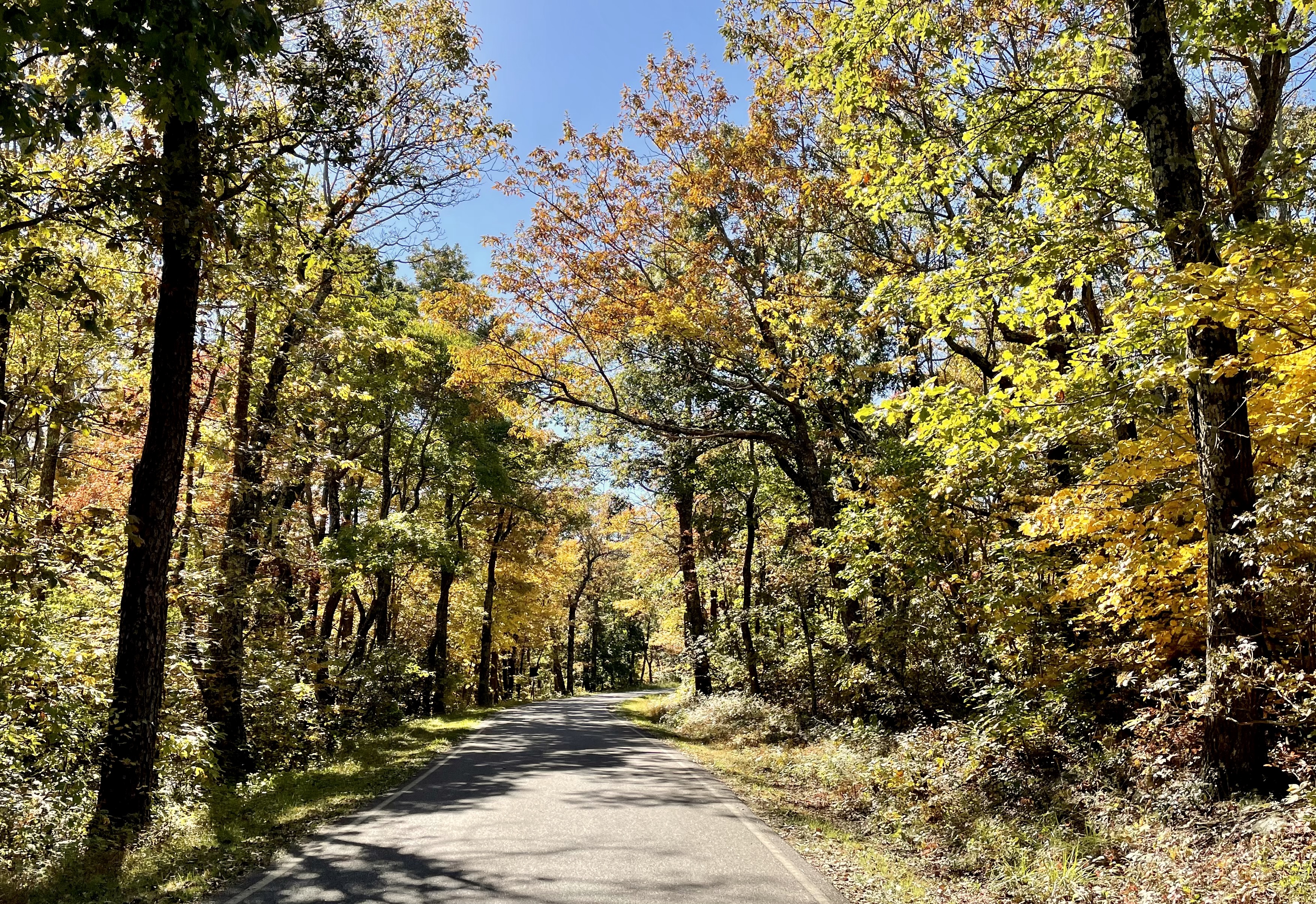
As we chatted, she voluntarily confessed that she had turned left out of Big Meadows without realizing she was going in the wrong direction. Reality caught up to her when she arrived at the park’s northern entrance south of Front Royal, Virginia.
Undaunted, she merely turned around and headed south. She laughed at herself for trying to rely on GPS when there was little to no cell phone service in the park. She was happy to know she could get internet at Waynesboro, her destination for the night. The next day, she could begin her journey on the Blue Ridge Parkway.
A retired couple on a motorcycle was thrilled with the photo I took of them with crimson leaves of oaks, maples, and dogwood as the backdrop. They seemed most pleased, however, that I had included their bike in the photo.
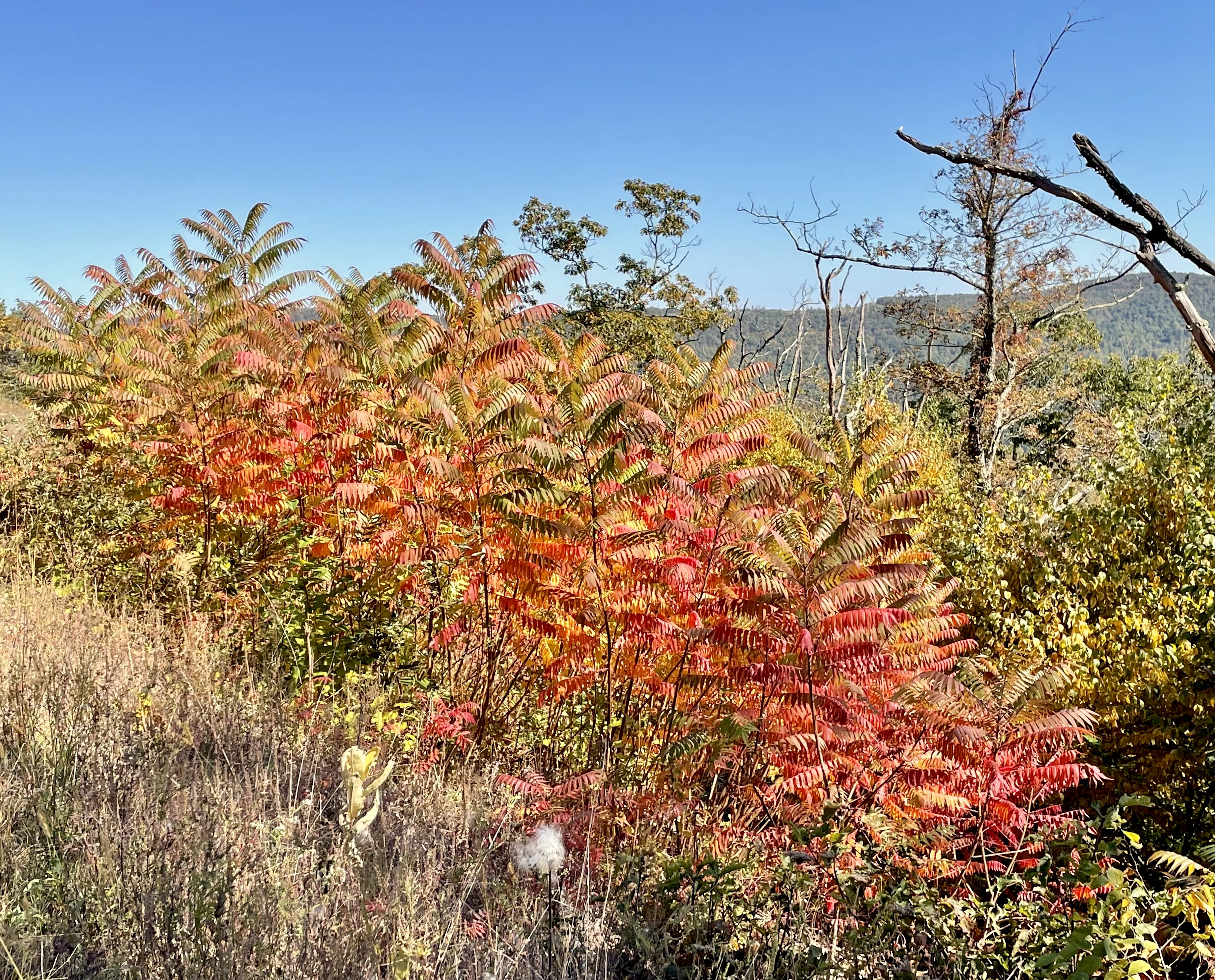
Ironically, the colors dulled as I cruised north and to higher elevations. Only patches of sunlit staghorn sumac brightened the roadside.
I had stopped at most overlooks, snapped many photos, and talked so much that it took me three hours to drive the 40 miles to Swift Run Gap. No matter. It was an afternoon well spent and one I’ll remember for a long time.
© Bruce Stambaugh 2022

While visiting the Marbry Mill on the Blue Ridge Parkway near Meadows of Dan, Virginia, I spotted this creature staring back at me. The knotty apparition in the weathered barn wood sure resembled the face of a real Barn Owl.

For comparison, here’s a photo of a real barn owl.
What do you think? Does it look like a Barn Owl to you or perhaps some other creature?
© Bruce Stambaugh 2022

It had been too long. I missed hiking regularly.
I had several excuses as to why I hadn’t hiked: I was traveling; the weather was too hot and humid; it was too rainy; I had family obligations. I could list more, but you likely don’t want to hear them.
So, I gladly agreed to lead a group when an opportunity to hike came along. A friend and several of her female friends hike local trails weekly. The Mill Prong Trail in Shenandoah National Park was on their radar, but they were unfamiliar with it. My friend knew I had hiked it.
I chauvinistically asked if men were allowed in their hiking entourage, and I was quickly admonished. They wanted to hike and wanted me to lead the way.
The Mill Prong is a side trail that juts off the Appalachian Trail (AT) at mile marker 53 on Skyline Drive in the park. The trail leads to the Rapidan Camp, the summer home of President Herbert Hoover and First Lady Lou Henry Hoover.

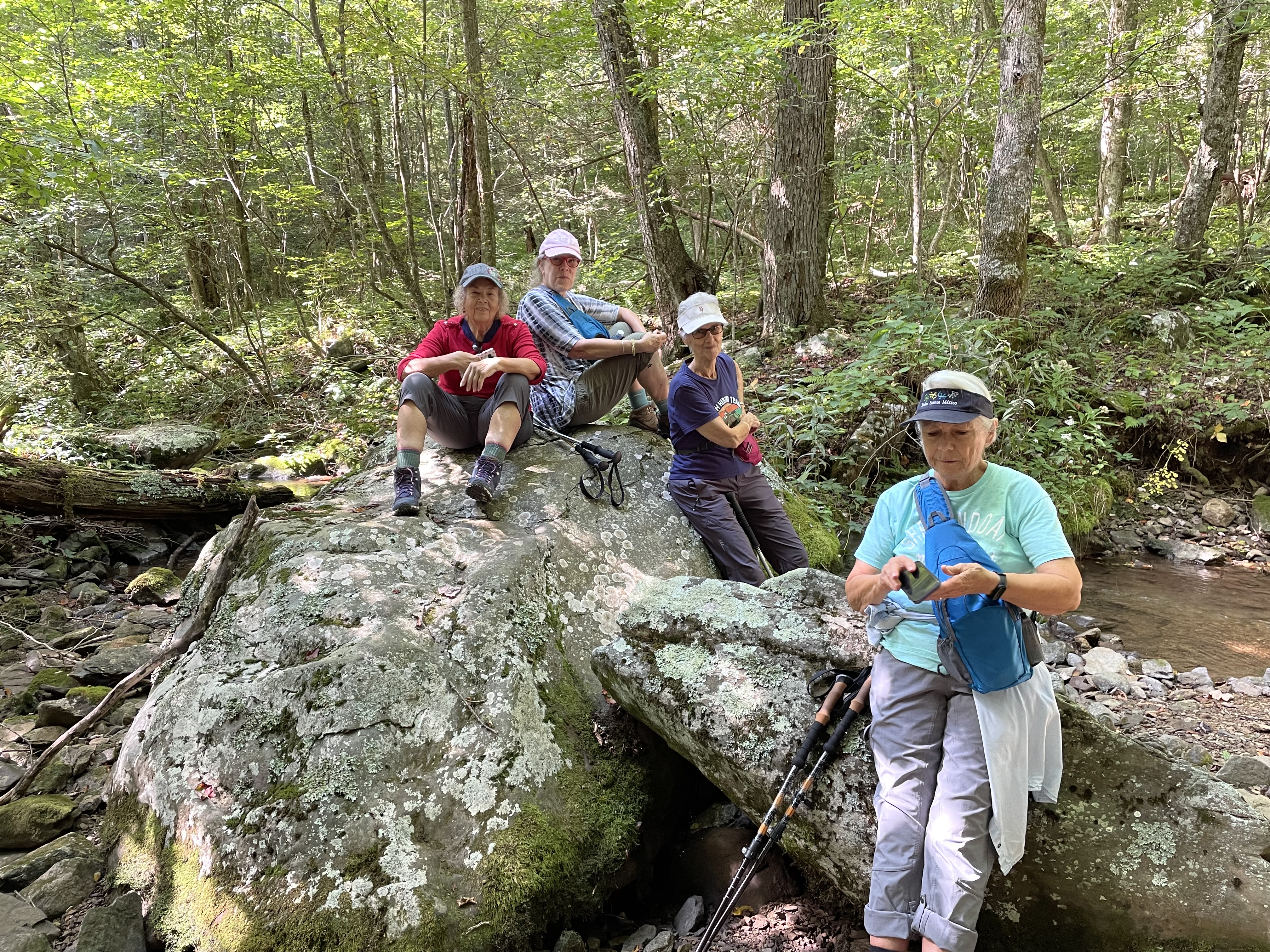
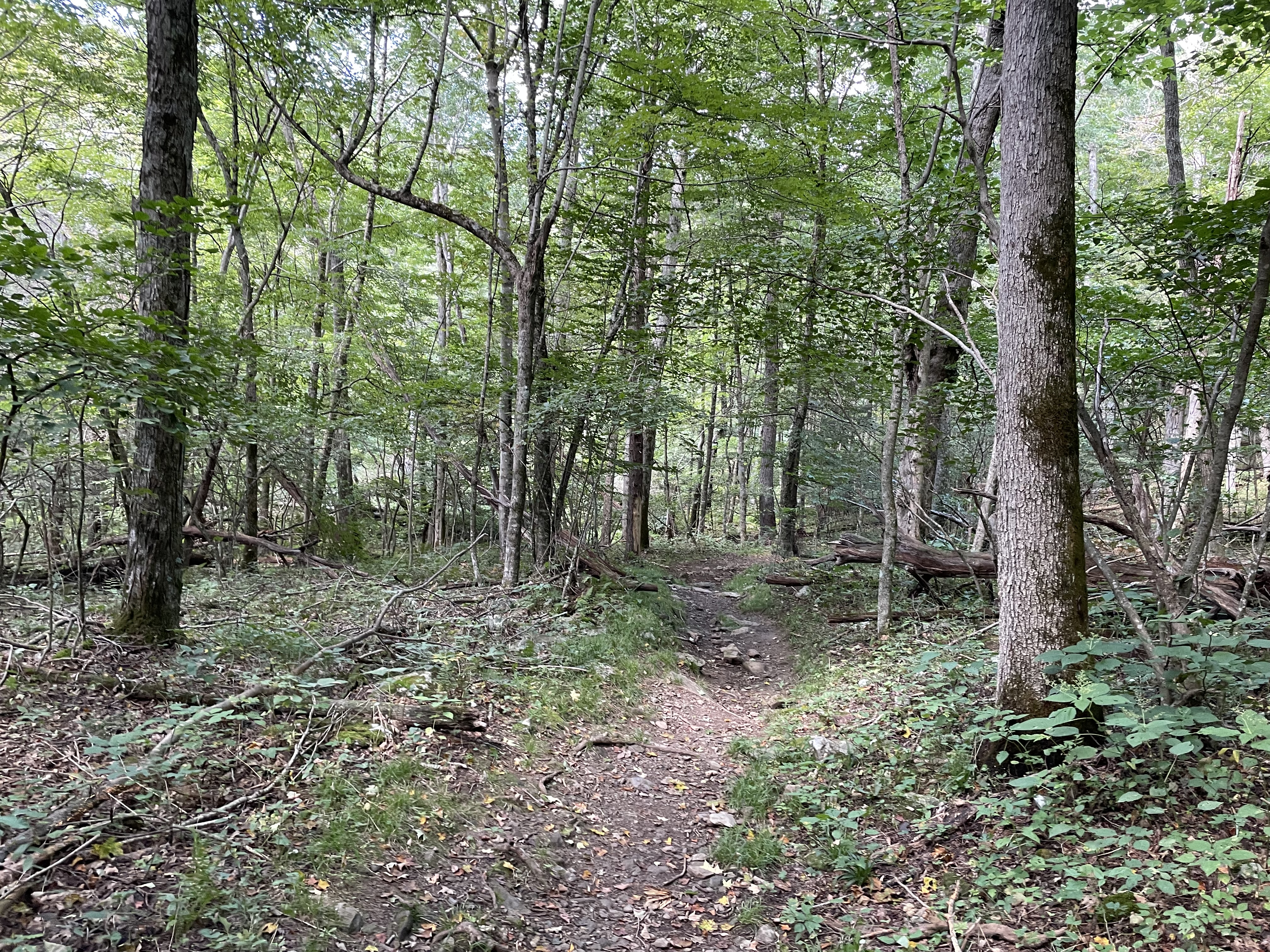


My trail app on my iPhone listed it as a moderately strenuous 3.7-mile hike round trip. We wouldn’t be going that far. Since all in our group were in their 70s, our goal was to hike to the intersection with the Mill Prong Horse Trail. That is exactly one mile.
This day was much cooler than the previous weeks of hot, sticky, and sometimes wet days in Virginia’s Shenandoah Valley. When we arrived at the parking lot where the AT crosses Skyline Drive, my van’s thermometer read 60 degrees. It was perfect hiking weather.
To access Mill Prong Trail, you must walk across the roadway and then a short distance on the AT. Soon you’re at the Mill Prong Trailhead.
I had told the ladies that this wasn’t the most scenic hike. They were more concerned with the trail’s difficulty and elevation gains. Having hiked it previously, I knew that the Mill Prong was a comparatively gradual decline to the horse trail. We had no intention of going to Rapidan Camp. A two-mile roundtrip hike down and back would suffice.
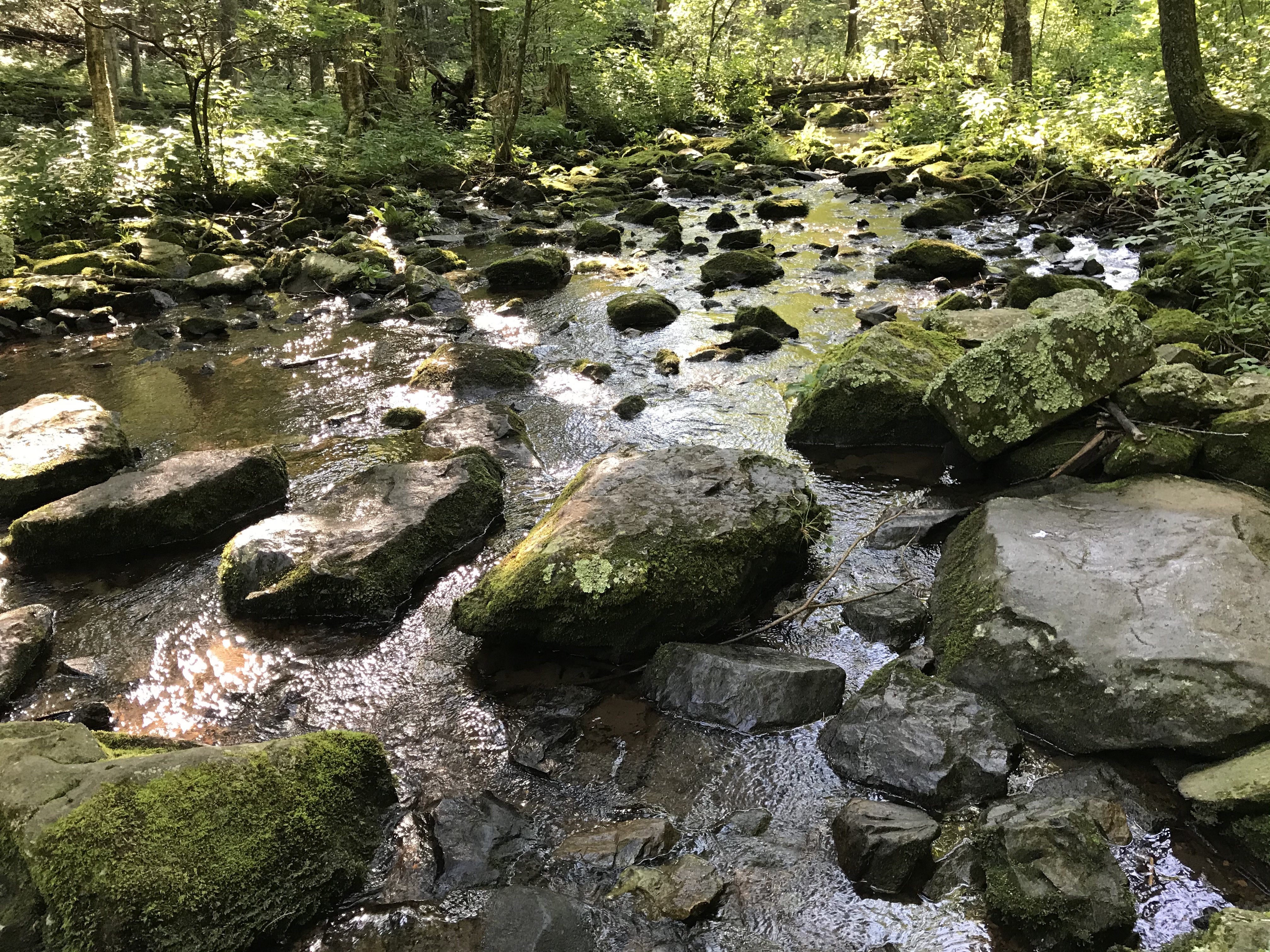
The Mill Prong Trail has two stream crossings. Trail-keepers conveniently placed large rocks for hikers to successfully cross both without getting wet. That is, as long as you don’t slip and fall. I was the only one who did.
The trek down the Mill Prong trail was similar to my earlier experience. The walk was eerily quiet. I only heard a lone Downy Woodpecker along the mostly dirt path down and back. We saw no other hikers until a young woman passed us as we were nearly finished, and she was just starting.
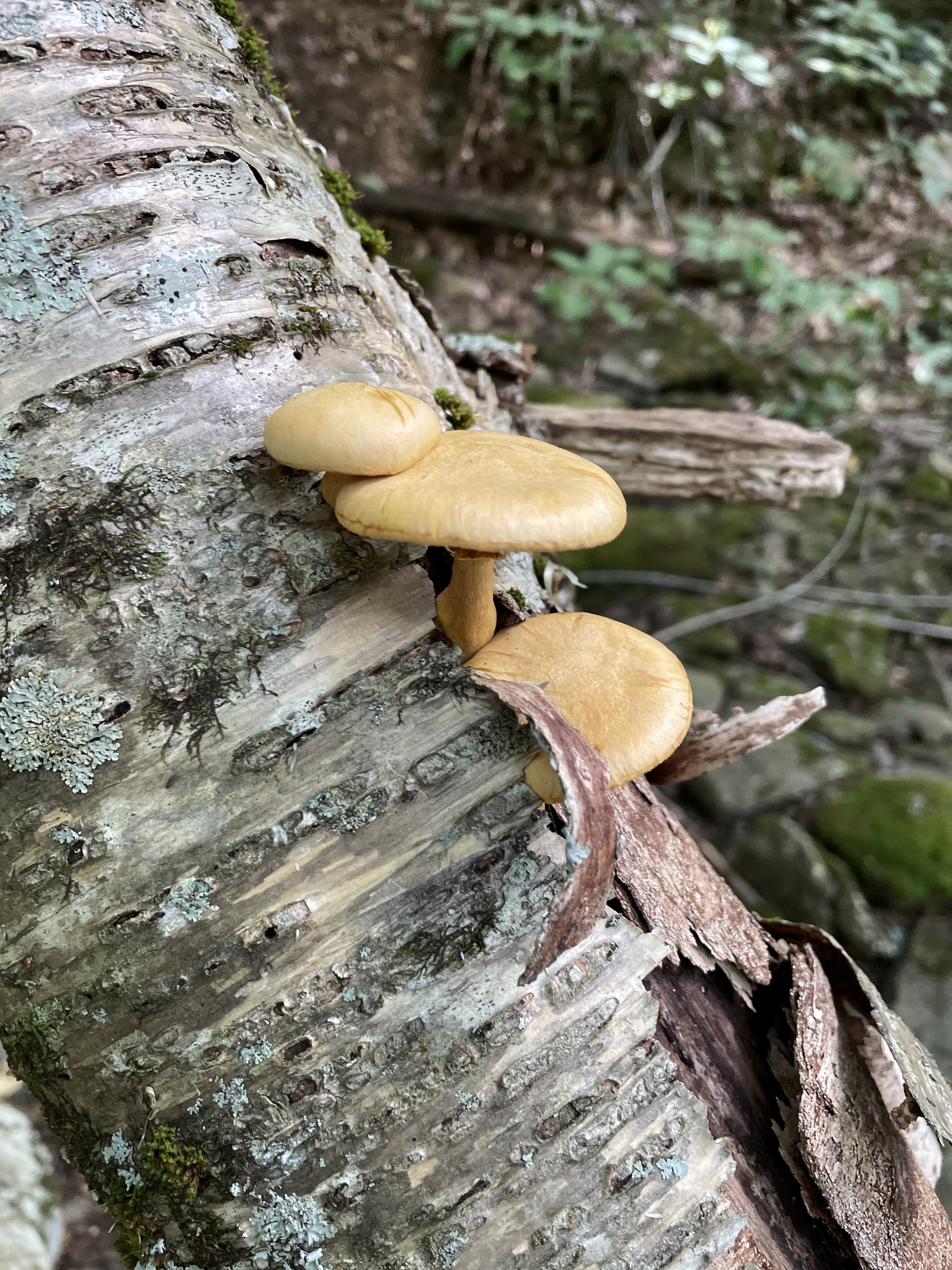
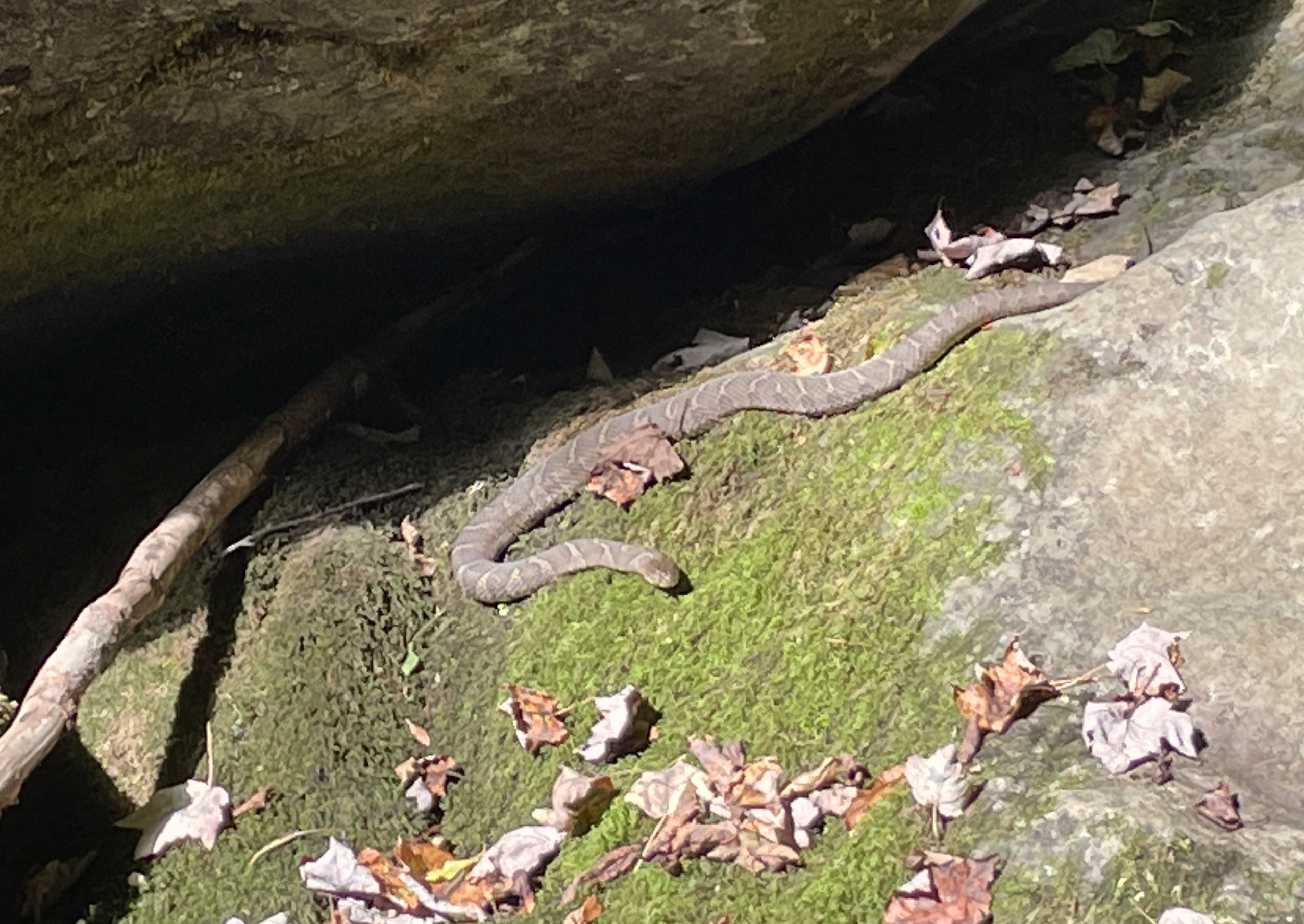
We took our time, enjoying nature’s stillness, the verdant forest floor carpeted with ferns, grasses, and wildflowers. We respectfully observed the colorful fungus and the four-foot northern water snake soaking in the morning sun on a large moss-covered rock in the middle of the trickling stream.
We took a break just after passing the horse trail, precisely one mile from the trailhead. We ate our snacks, inspected the snake, kept our distance, and hydrated.
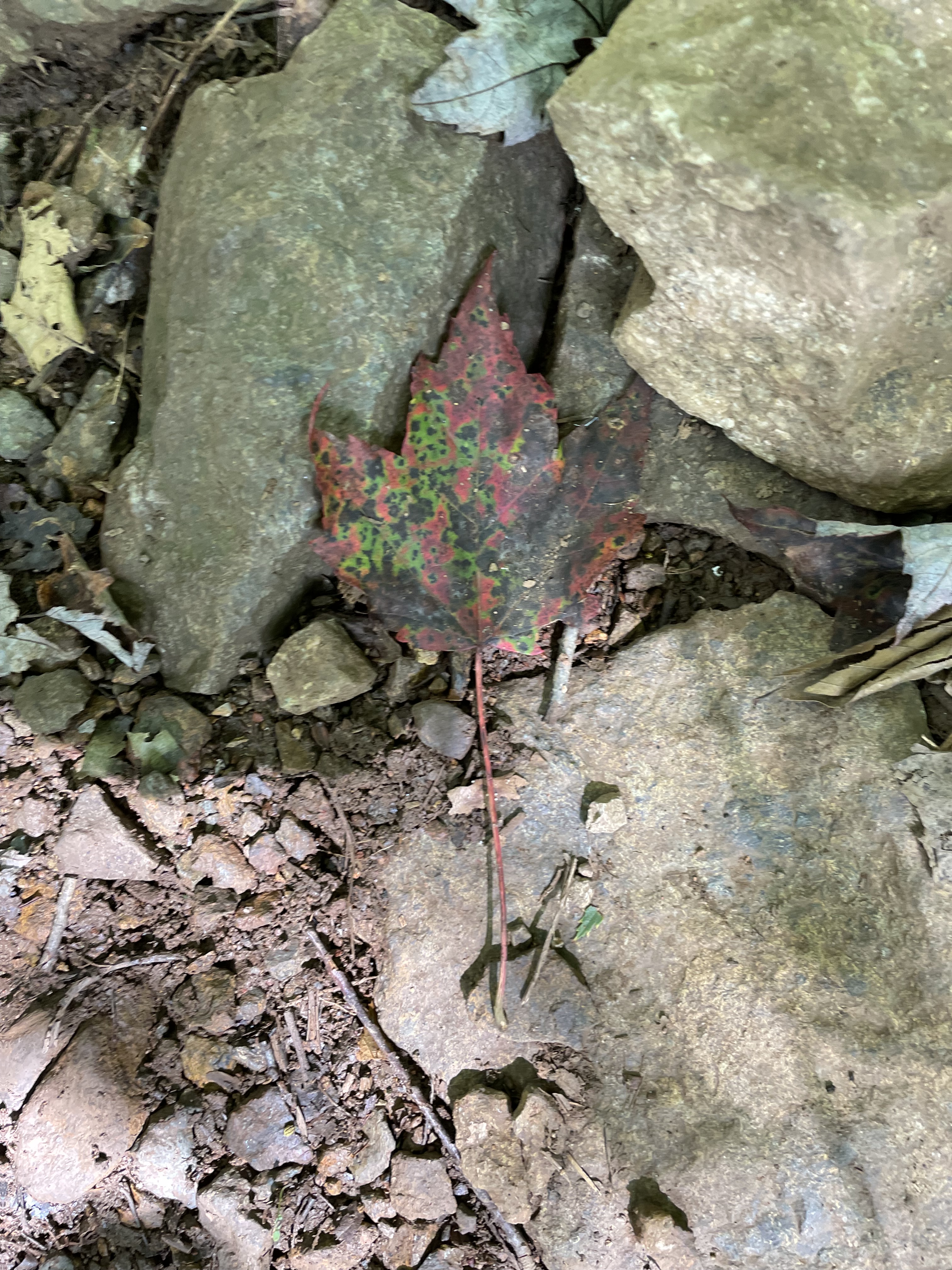
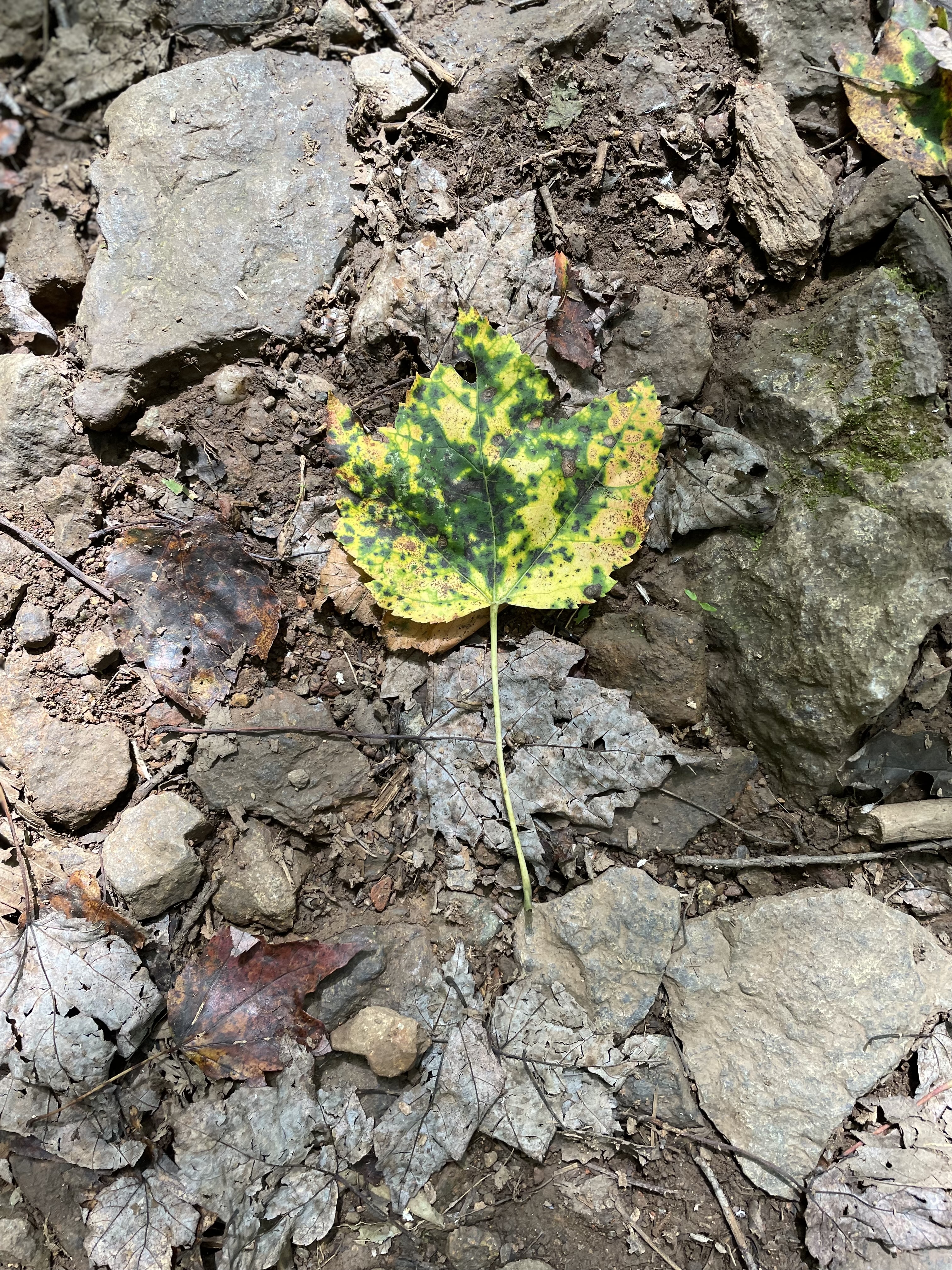
Then it was time to head back up the gradual incline. The trail effortlessly wound its way past outcroppings, back across the two forks of the Mill Prong, shaded all the way by a mixed hardwood forest. It was already shedding some of its leaves.
Just before we reached the intersection with the AT, birds and pollinators began to appear. Jewelweed bloomed everywhere, especially in a triangle between the AT and Skyline Drive. Hummingbirds zipped left and right, and a few Monarchs and Tiger Swallowtails flitted here and there.
Despite our tired old bones, smiles dominated. It was a perfect ending to just the kind of hike the ladies like to take. Me, too.
© Bruce Stambaugh 2022

I was out watering plants and trees last evening since we haven’t had any rain for several days. Suddenly, the western sky turned bright golden.
I quickly wrapped up my watering, grabbed my camera and iPhone, and headed to a close location with an open view to the west. The golden glow had faded. The sun disappeared behind the Allegheny Mountains, but dramatic color remained.
The farmer had already cut the enormous cornfield and had turned loose steers to forage for spilled corn cobs. With Mole Hill to the left and the sunset’s remnants still lingering above the mountains, it looked like a scene out of the old west, not the Shenandoah Valley.
The vista was a beautiful way to close out the first day of September.
© Bruce Stambaugh 2022

I searched for a decent location to photograph the latest lovely sunset in the Shenandoah Valley. I stopped when I came upon this scene of young steers grazing.
The Black Angus scattered in the rolling pasture filled the foreground, while the local landmark of Mole Hill, an extinct volcanic core, dominated the background. The sunset orange-tinted cloud hovered over the Allegheny Mountains in the distance. I imagined old Mole Hill had exploded out of eons of dormancy.
© Bruce Stambaugh 2022
Wildlife Photos From The Chesapeake Bay Region
Culture and Communities at the Heart Of India
Artist and nature journalist in the Shenandoah Valley of Virginia.
Photographer Of Life and moments
Personal Blog
Art is the only way to run away without leaving home. -Twyla Tharp
Writing generated from the rural life
writer. teacher. podcast cohost.
El amor cruza fronteras / Love crosses borders



 Roadkill Crossing
You must be logged in to post a comment.