I hadn’t been to Secrest Arboretum in Wooster, Ohio since a tornado literally blew it apart September 16, 2010. In the midst of our recent summer-like weather, I decided it was time to reconnect.
Like so many others, I always had found the arboretum to be a place of blissful escape and rejuvenation. Its lovely woodlots, pristine gardens and peaceful settings have long served as a place of inspiration and retreat for many.
I knew why it had taken me so long to return to this little paradise. I didn’t want to relive those ugly memories, so opposite of what Secrest was meant to be.
Just an hour after the tornado hit late that summer evening, I had maneuvered in and around the devastation of the Ohio Agriculture and Research Development Center campus, where the arboretum is located. As a volunteer severe weather spotter, the Cleveland office of the National Weather Service had sent me there to photograph the damage as best I could.
I only had about a half an hour before sunset. Rescue crews were still combing buildings for possible victims who may have stayed late for work or study. Sporadic jerky flashes from searchlights sent eerie light beams through holes of broken buildings.
Focusing on my duty, I snapped as many pictures in the dim light as I could. That purposeful concentration was the only thing that stilled my emotions. Tornado damage near the Barnhardt Rice House on the Ohio Agricultural and Research Development Center in Wooster, Ohio on the evening of Sept. 16, 2010.
Historic buildings were ripped apart. Vehicles had been smashed and tossed like toys. Giant, beloved trees were snapped, toppled and twisted. It was overwhelming to see this peaceful place resemble a war zone.
It was nearly dark by the time I had circled back to the famous and popular gardens. Trees that had stood as sentinels over the flora and fauna had been sheared off or completely twisted out of the ground.
I thought of the many good times past when we toured the gardens with family and friends, admiring the marvelous variety of plants, flowers and trees. Those memories made it all so heart wrenching.
Like thousands of others, researchers and visitors alike, I loved the place. The EF2 tornado stole that, too. I knew that restoration had begun almost immediately. But I wondered if Secrest would ever be the same.
Buoyed by the unusually warm weather, I laid aside my fears and drove in. As soon as I exited my vehicle, familiar sights and sounds were instantaneous. Young trees had been planted, some adjacent to the sawed-off stumps, testimonial tombstones to those once towering trees.
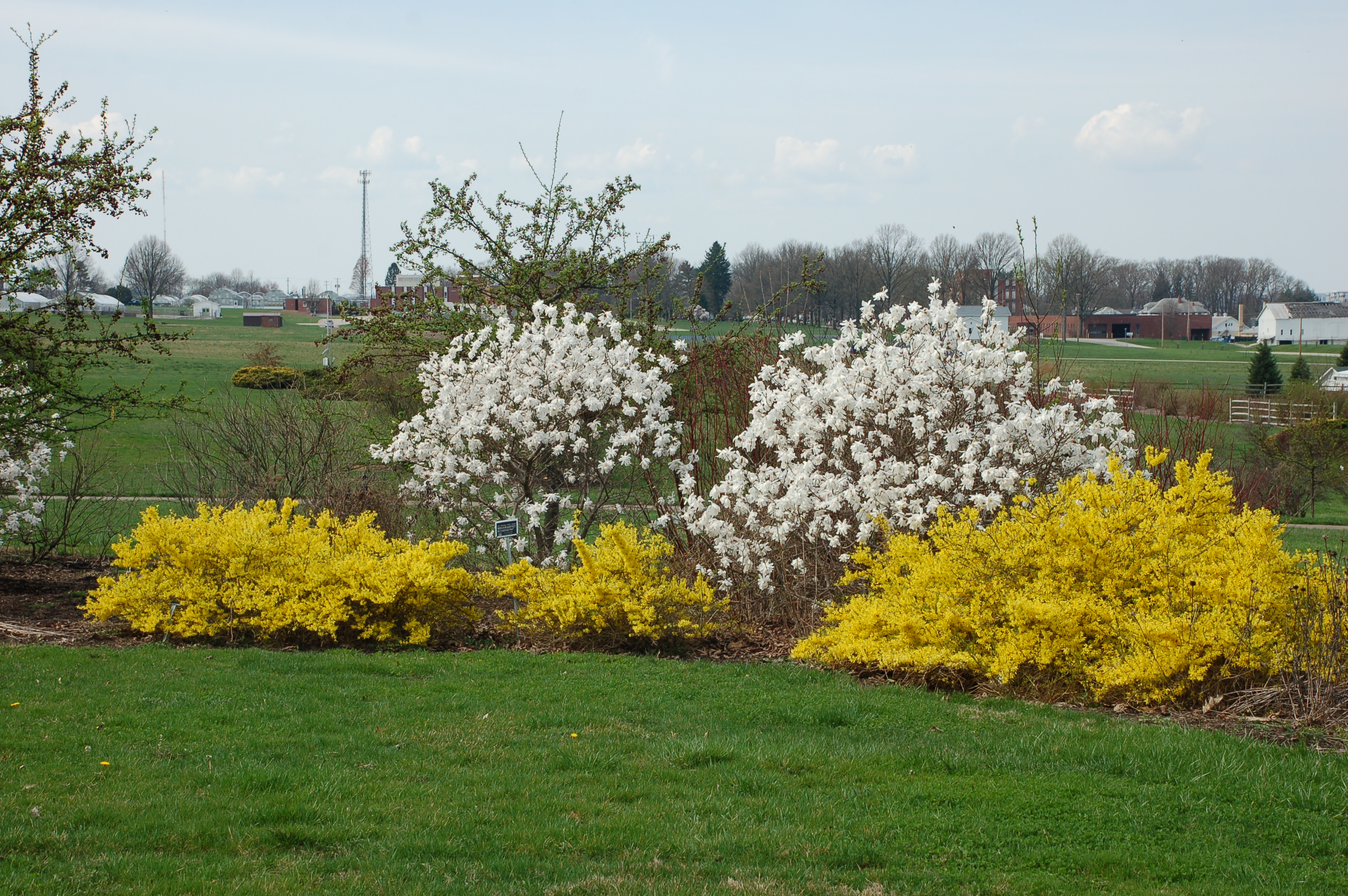
The early onslaught of warm weather had coaxed the blossoming of many flowers and flowering trees. Crocuses, daffodils, hydrangea, forsythia, magnolia and even an exotic tulip were all blooming, some well ahead of schedule. Workers were busy trimming out last year’s dead growth while construction crews continued to repair, replace and expand the lovely gardens.
The Barnhardt Rice House is repaired and back in use.It was a pleasure to walk the paved pathways to explore the remake. I wasn’t the only one to notice the fragrant flowers. Huge bumblebees and honeybees gorged on the nectar of the new blossoms. Mocking birds flushed from one bush to the next, staking out nesting preferences.
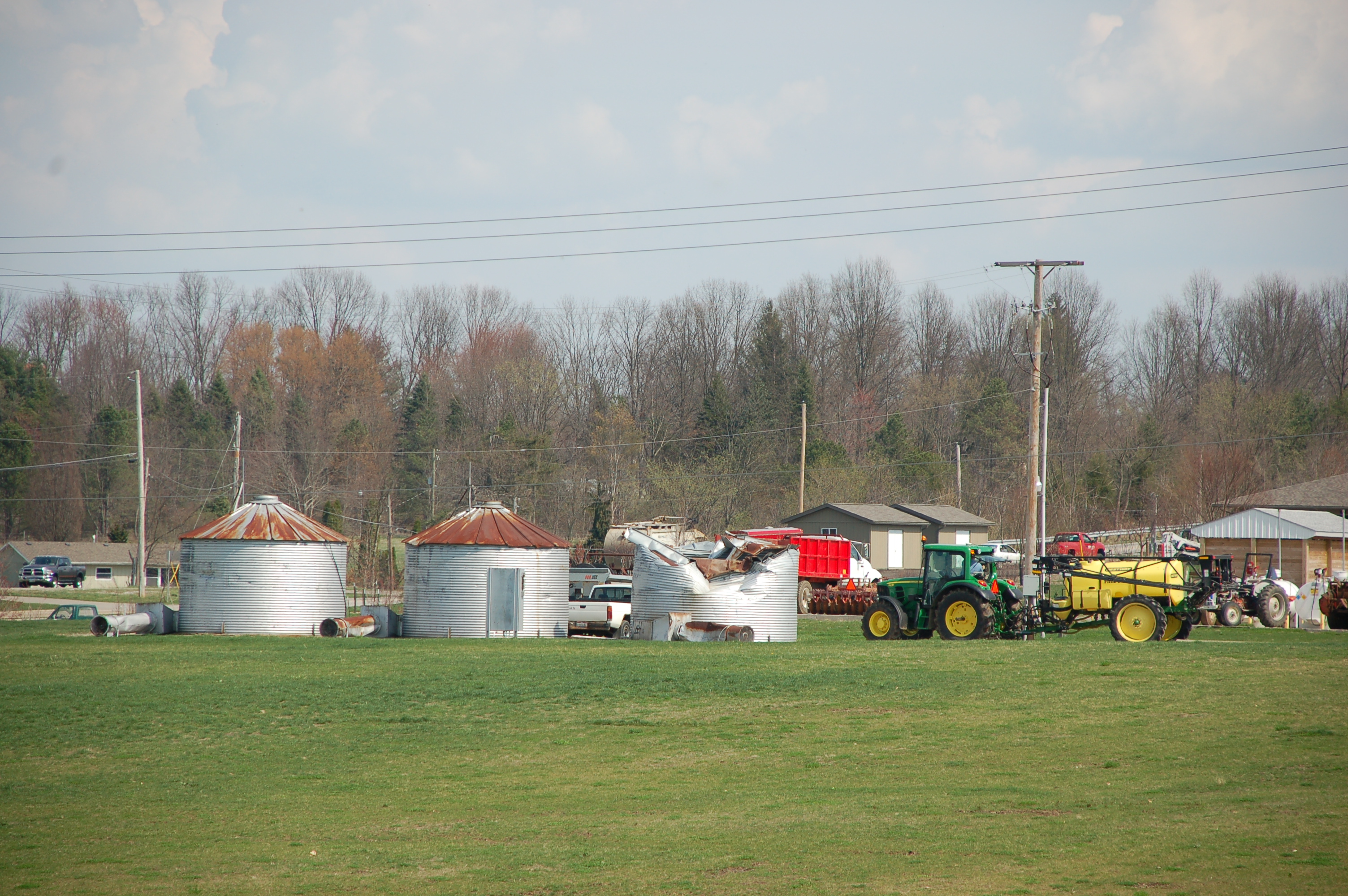
It was also nice to see some of the campus building restored, refurbished and back in use. Others, however, remained much as the tornado had left them. Silos on the OARDC campus stand as they were after being hit by a tornado Sept. 16, 2010.
The restoration of Secrest Arboretum is a work in progress to be sure. In some sections, tornado twisted and toppled trees remain within eyeshot of the ongoing transformations.
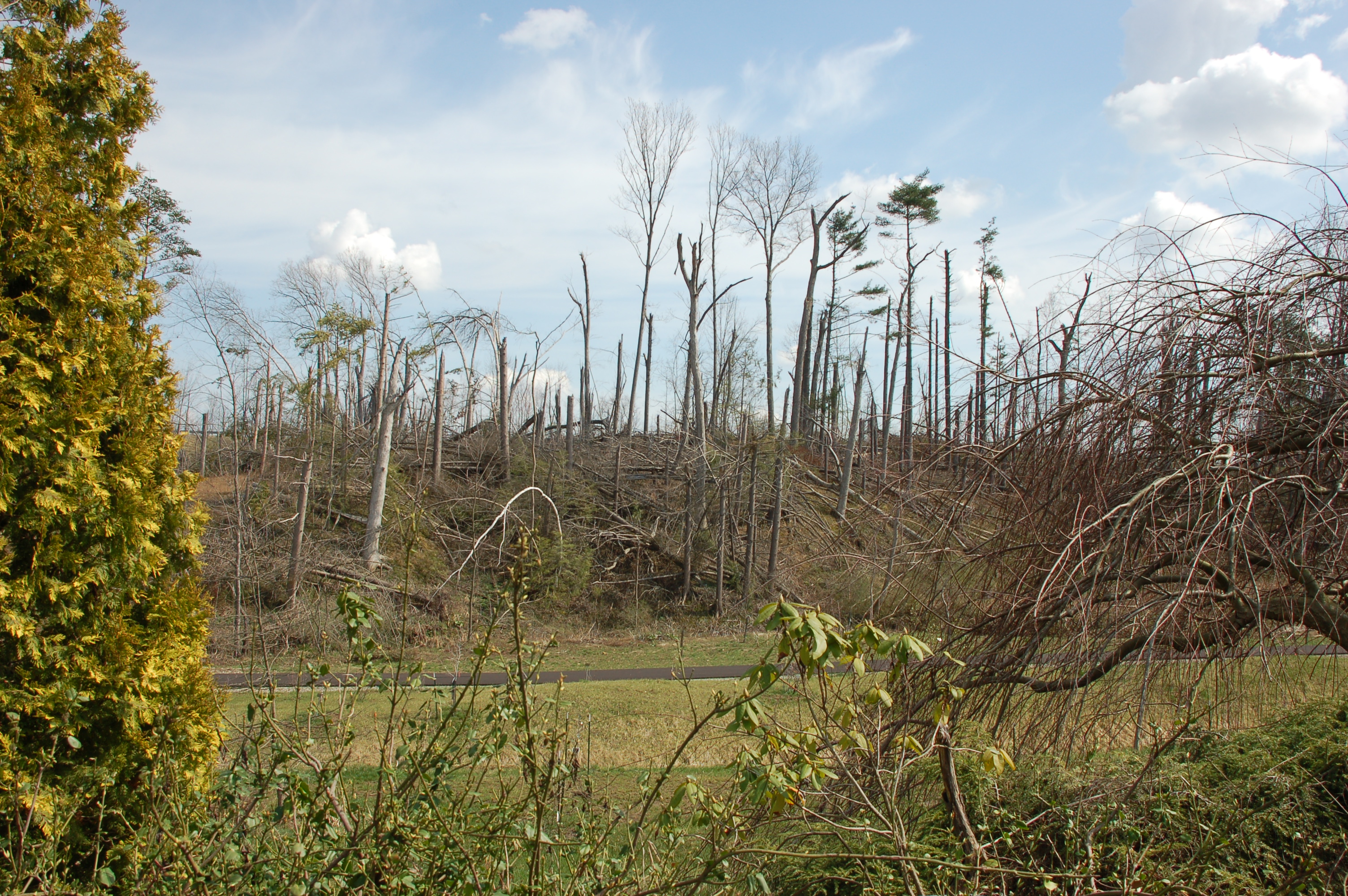
The contrasts of nature’s stark fury and inspiring revival filled my soul. In the midst of this resurrection season, Secrest and I were both healing. While many areas of the arboretum have been restored, sections of large trees downed by the tornado remain.
The beauty around us helps create a lasting, loving relationship. By Bruce Stambaugh
Soon my wife and I will have been married for 41 years. How have we made it this far? Well, this may sound funny, but the answer to that question in part is because we manage to avoid each other.
I think I better explain. My wife and I both believe in being community activists. That is a fancy way of saying we get involved in local activities, many of them on a volunteer basis.
Over those 41 years of marriage, Neva and I have recognized a familiar pattern. She goes out the drive just as I am coming in or vice versa. When we first noticed this routine, we laughed about the happenstance. The phenomenon has continued with amazing regularity.
When Neva comes in the drive as I am leaving, we just roll our eyes in common acceptance and acknowledgment of the many paths our busy lives have taken us. We recognize the importance of accepting and encouraging our individual interests and areas of service as important ingredients of any successful marriage. Where our driveway moments occur.
With us, this is pretty much how it goes. Neva has a 10 a.m. meeting scheduled in Millersburg with the thrift store where she volunteers. I have the morning free to tinker around the house or write. After lunch, Neva arrives home, and I need to leave for a rendezvous with a local resident regarding a township issue. I’m a township trustee.
We haven’t necessarily planned these driveway moments. It’s just the way it has panned out time and again over our 41-year marriage. I come in the drive, Neva goes out. It’s like clockwork.
If anything, it’s more about trusting each other and commitment to community than intentional evasion. Perhaps that’s one of the reasons our marriage has not only grown in years, it’s thrived.
We respect each other and each other’s interests. We also give each other the freedom and space to exercise those interests. The fact that those activities often coincide with a community event is possibly the glue that has helped hold our loving relationship together.
Neither of us would begin to pretend to be perfect or that ours is a model marriage. That innate trust, however, allows us to do our own thing while actually reinforcing our husband and wife relationship.
I’m not bragging when I say that we feel blessed to have lasted this long as a couple. Marital bliss for our generation has turned out to be a 50/50 proposition. I feel for those who have tried to hold their marriage together, giving their all to no avail. I am ever so thankful that we have hung in there, even during difficult times.
With the varying schedules and comings and goings, having a supporting community around us has certainly enhanced our chances for success. We fully and humbly recognize that we have not been on this long journey alone. We have many people to thank for being there for us through thick and thin.
Friends, neighbors, church members, and especially family have all played important roles in the success and longevity of our marriage. Our son once asked me what the secret to our longevity of marriage was. I didn’t hesitate in answering, “There are no secrets between us.”
That includes where Neva is going again when I pull into the driveway.
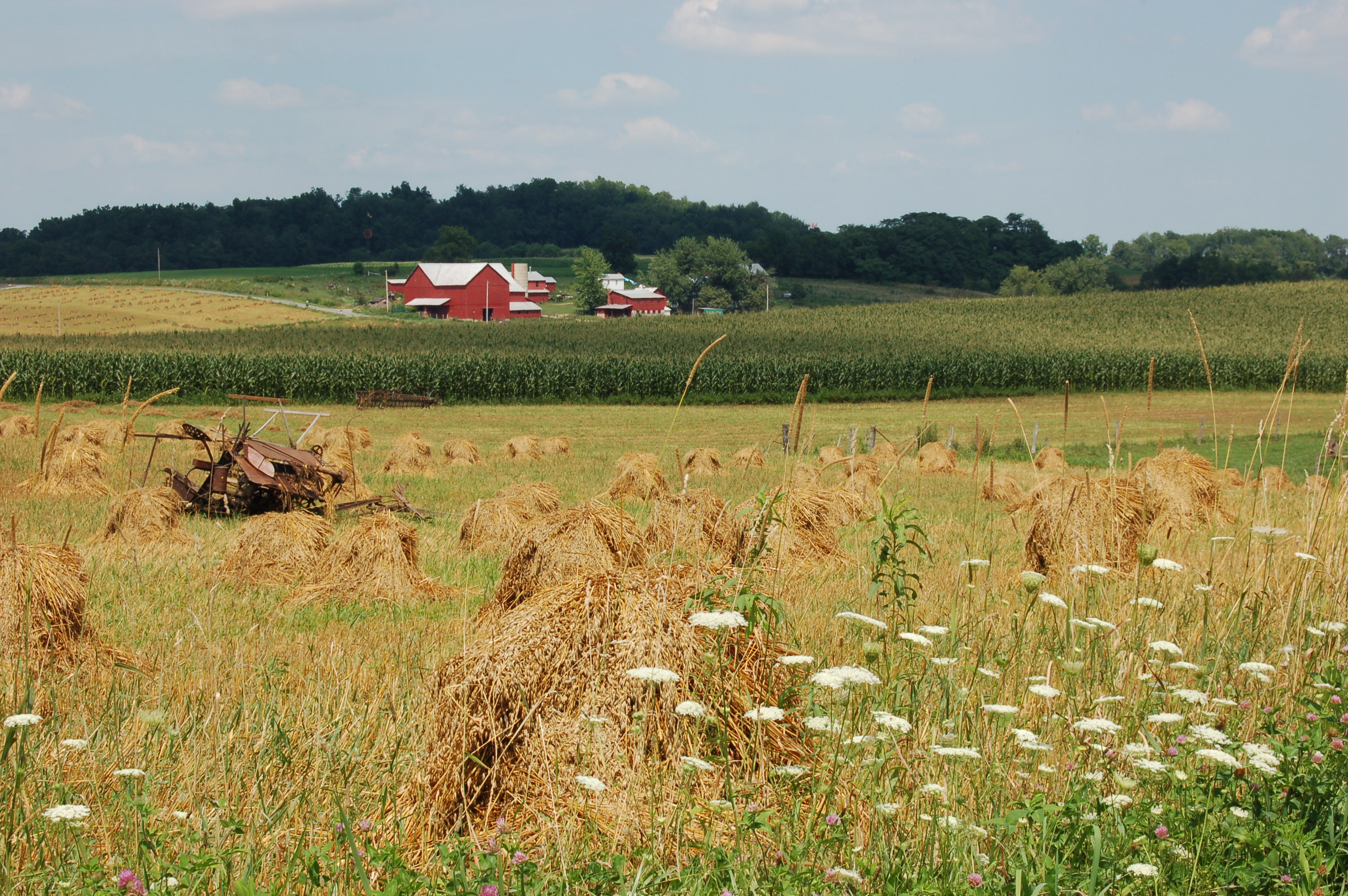
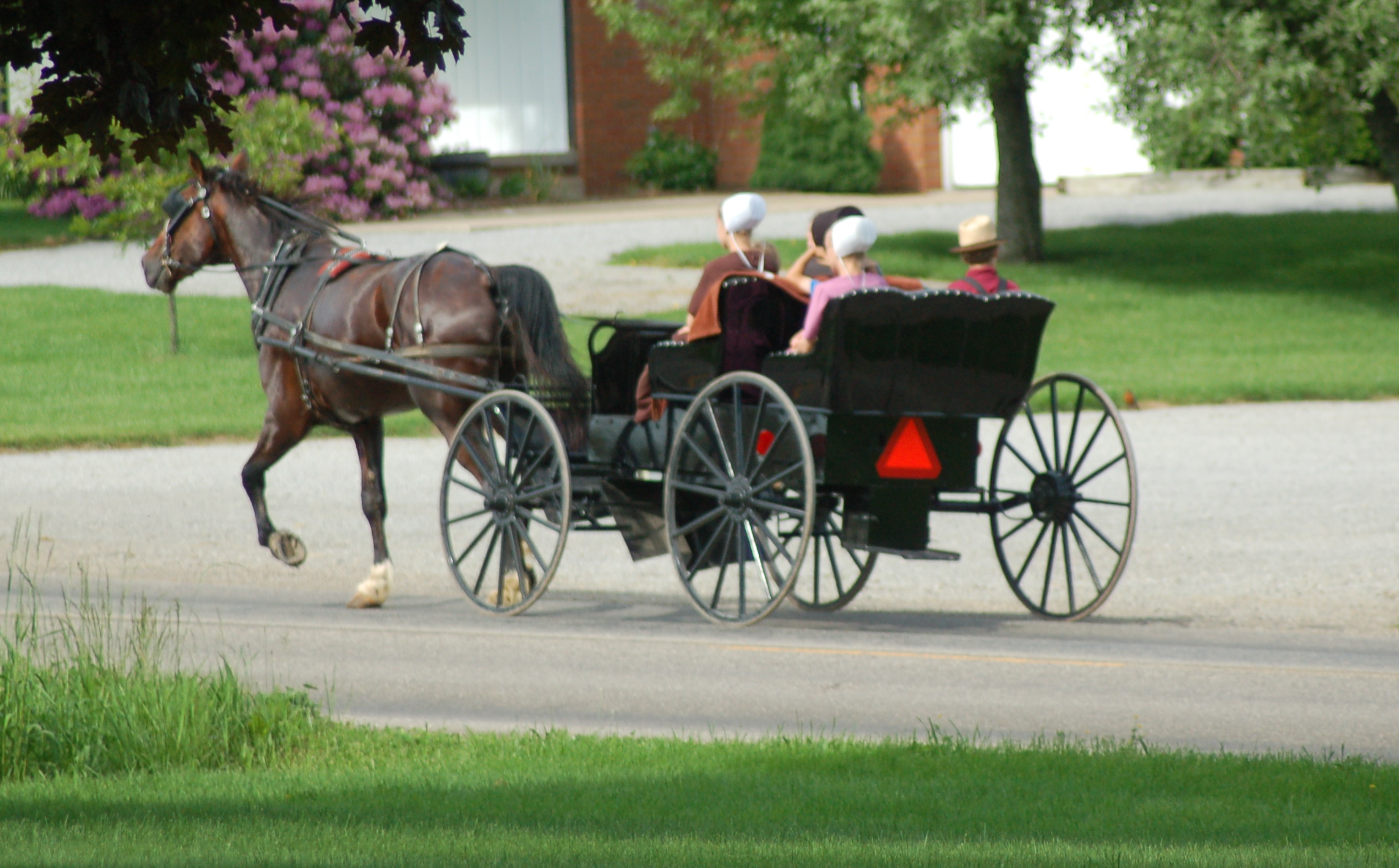
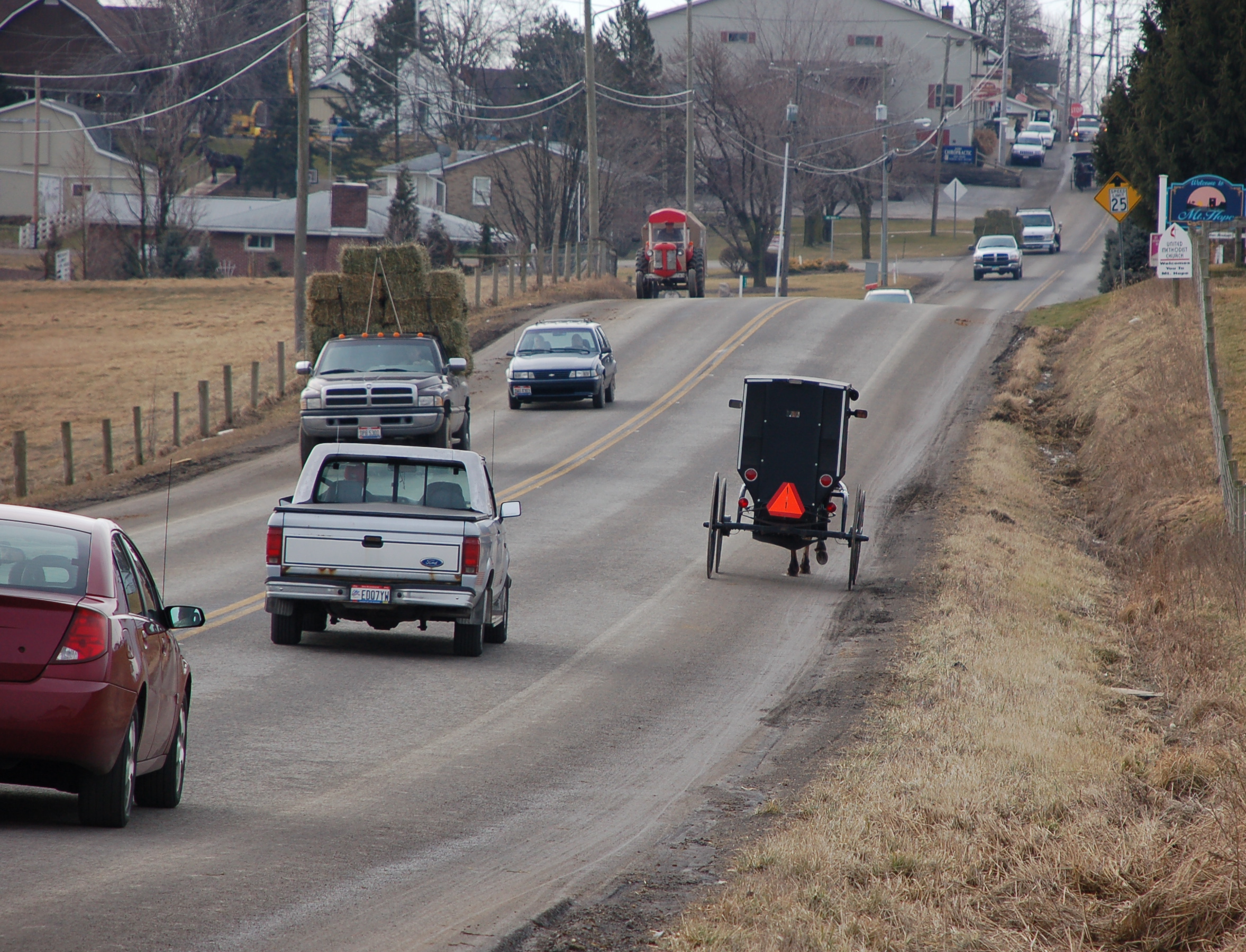
Picturesque rural scenes like this one attract millions of people every year to Ohio's Amish country.
By Bruce Stambaugh
The Amish in the Holmes County, Ohio area have been in the news in recent months, and the news hasn’t always been good. The bizarre hair-cutting incidents, murders, financial fraud and accidental shootings all had the bright lights of media coverage shining on the normally peaceful and private Amish folks.
By faith and by lifestyle, the Amish wanted none of the attention. Yet, Amish are humans, and subject the same extremes and circumstances as any other individual, family or group of people. When something disturbing and uncanny happens among the world’s largest Amish population, the media swoop in to tell the world about it.
Certainly, the media has its right and responsibility to report stories it deems important. When it comes to radical events concerning the Amish, like the renegade group led by Sam Mullet of Bergholz, Ohio, it seems the world can’t get enough information.
Indeed, that desire to know is understandable, especially when it involves the normally reserved Amish. Violence in a usually peaceful and peace-loving community is an anomaly, and definitely incongruous with the Amish lifestyle.
The problem is, of course, that the Amish really want nothing to do with publicity, whether positive or negative. Humility is a main premise to their way of life. They believe that no member should be the center of attention, whether for doing good or doing ill. The Amish culture is centered on community, not individuality.
It is when the extraordinary in the community occurs, like the recent hostile beard cutting incidences, that that norm is broken. The unusual acts are extensively reported, and the world responds with questions and fascination. Again, the Amish prefer not to be featured as a general rule. But they also want the world to know that these extreme human behaviors are exceptions, not the rule, in the regular work-a-day-world.
Just their choice of slower living lifestyles alone actually brings about media attention to Amish country. Many film and TV documentaries have been recorded and broadcast depicting the Amish and their less hectic lifestyle. Unfortunately, many of these productions often misinterpret or misrepresent the Amish and their values. When that unusual lifestyle is interrupted by extreme circumstances, the reporters from around the world flock in to get the scoop.
The Amish deplore any violence, whether it is done to them or others. In the case of the accidental killing of a 15-year old girl riding in a buggy, the shooter himself was Amish. Within days, the two families reconciled privately, saddened by the unfortunate and unexplainable one in a million chance that took a young life. The families forgave, and worked at getting on with life as best they could. That precious act of communing drew no media attention, which was just fine with all involved.
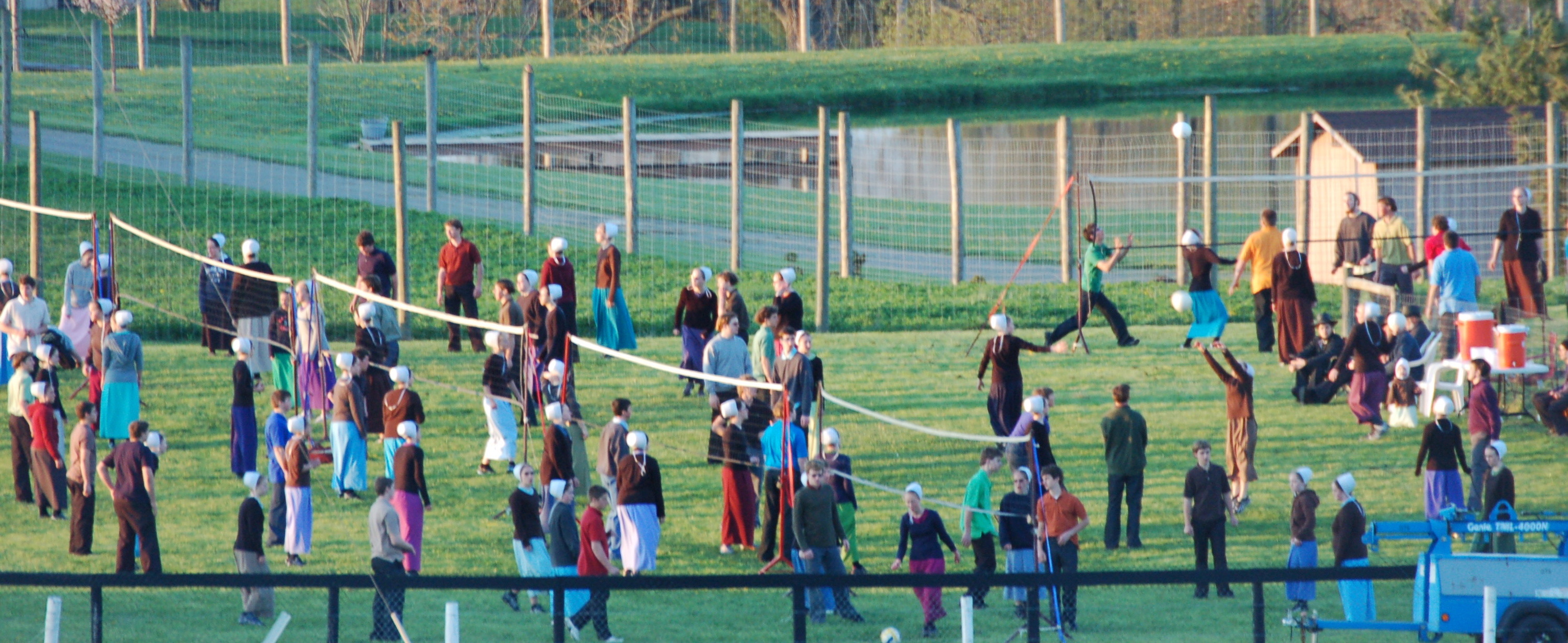
The Amish understand society’s need to know. They just don’t want to have their beliefs violated in gathering the sordid facts. If they do agree to a rare journalistic interview, Amish do not want their faces shown on television or in the newspaper. Amish youth meet regularly for hymn sings, bible study and good old-fashioned fun, like a volleyball tournament. No trophies are awarded, and there are no losers.
That bit of advice certainly should be followed by anyone visiting Amish country. Knowing that Amish prefer not to be photographed, it is best to take pictures of them from the back and from afar. In other words, take a picture of a field being plowed with the horses and farmer going away from the camera. Out of respect for their beliefs, facial pictures of Amish adults should be avoided.
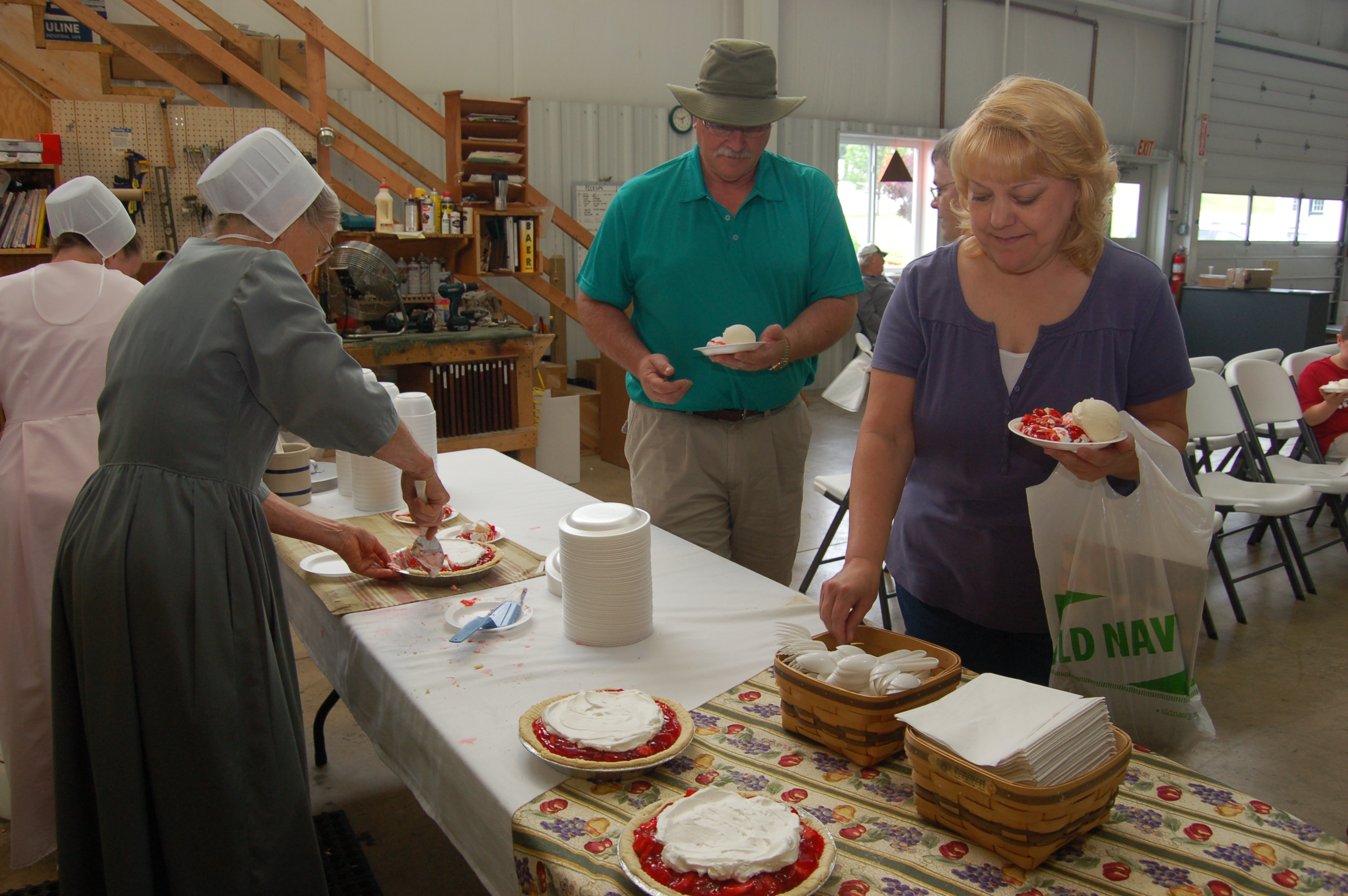
When in a large crowd with mostly Amish folks like at one of the area’s numerous benefit auctions, be sensitive to the setting. Photographs of individuals would be discouraged.
The global media infrequently descends upon Amish country to report unusual stories. When they do, the Amish prefer to steer clear of any of the attention. They understand that the story needs to be told. They just don’t want to be a part of it.
This article appears in the current edition of Ohio’s Amish Country.
Here we are at winter’s end. Spring officially arrives March 20.
In reality, winter here in our area has hardly been winter at all, especially when compared to the past two. In case this mild winter has dulled your memory, the winters of 2009-2010 and 2010-2011 were bears, both fit more for polar bears than humans.
All of Ohio, and much of the Midwest for that matter, got dumped on. We measured snow by the foot instead of inches. Schools were closed, factories shut, roads declared impassable.
Several snowfall records were set all across the Great Lakes region. They were winters of which children can only dream, and adults refer to, accurately or imaginatively, as snows like “when I was growing up.”
The snows were relentless. Once the snow from one big storm was cleaned up, another and sometimes bigger snow buried us again. Those winters never seemed to end. They began in November with below normal temperatures and above average precipitation and lasted into April.
Even the springs that followed were damp and cold. It really wasn’t until we had reached June in northeastern Ohio that spring’s fair weather had begun in earnest.
This winter, on the other hand, was indeed a different story. Old man winter never really showed his face. Yes, we had snow, but only a few times did it deposit enough to measure in inches, and even then, it was often a half an inch here and a quarter of an inch there.
Records were broken for precipitation this winter. The moisture was mostly rain, driven along by strong winds.
Those who cherish the winters of the previous two years had to hate this one. Snow skiing, ice skating, sled riding were all shelved for the most part. In Wisconsin, the vehicles of desperate ice fishermen sunk into a lake because the ice was so thin.
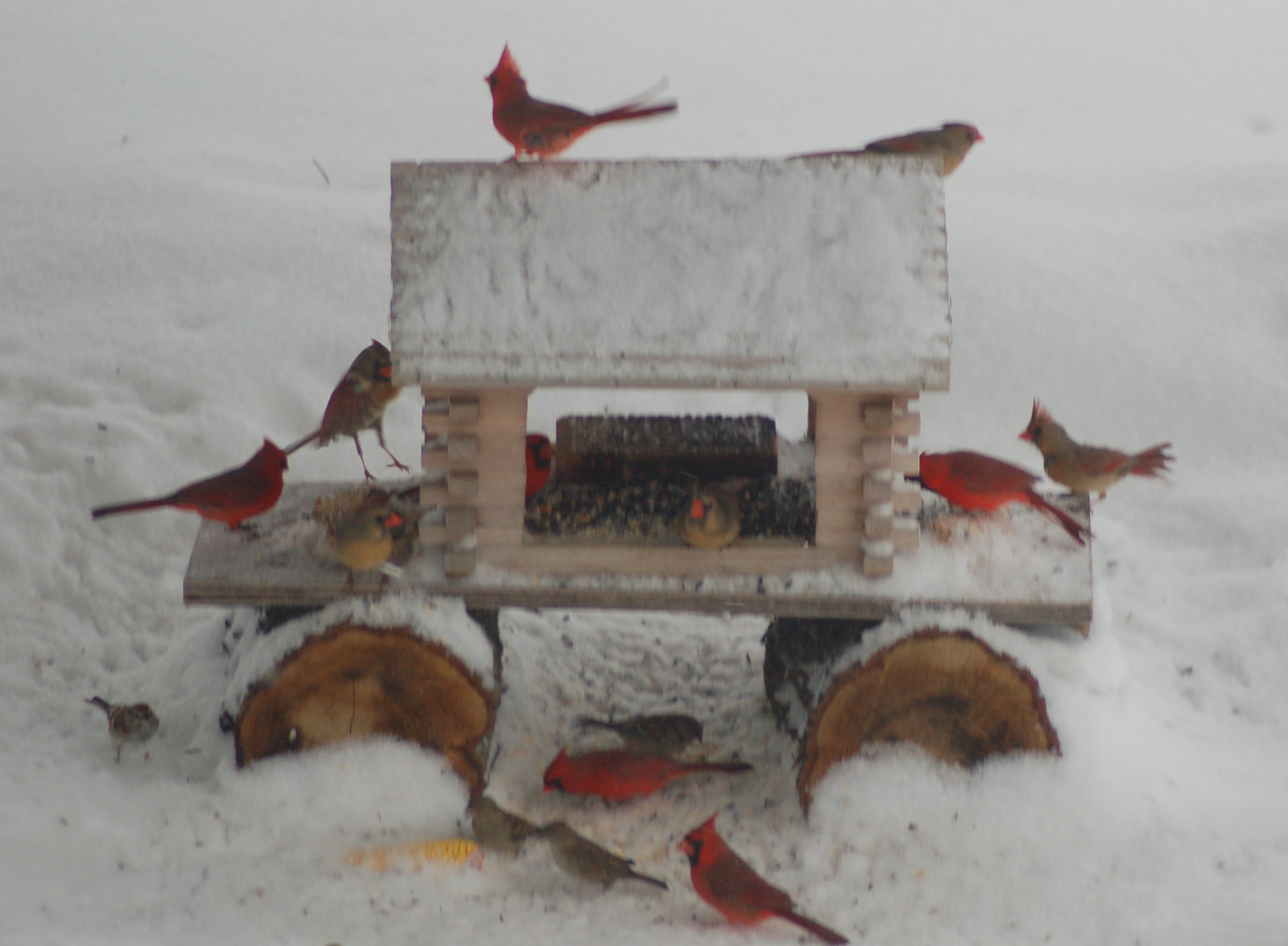
The previous two winters brought birds galore to backyard feeders. This year, the birds were far and few between, preferring their natural foraging to human offerings. Sure the usual faithfuls appeared, but not in the numbers or frequency of harsher winters.
This winter was so mild that the first crocuses bloomed in February instead of March. The long slender stems of the weeping willow trees showed their pencil yellow early too. I even heard of one woman who planted sweet potatoes in February.
All the rain kept the dull, ugly brown of dormant yards at bay. Instead, lawns stayed some shade of vibrancy all winter long. From the looks of things, moles may have enjoyed the winter most of all. Their unsightly mounds dotted the prettiest of landscapes indiscriminately throughout the area.
At my age, I was ready for an easygoing winter, although a weeklong cold snap would have been nice to help keep the insects in check. I’m fearful of the buggy consequences of not having a sustained cold spell. Perhaps the flycatchers, swifts and swallows will thrive if such an outbreak does occur.
I hear people saying that we may pay for the mild winter with a cold and snowy spring. That could happen, although the National Weather Service has forecast a warmer and wetter than normal March through May.
We’ll have to wait and see. In the meantime, we can rejoice that winter’s end is near, and that spring, whatever she may bring, is at hand.
It’s no accident that buggies, pedestrians and bicyclists are easier to see when traveling the hilly and curvy roads of the area.
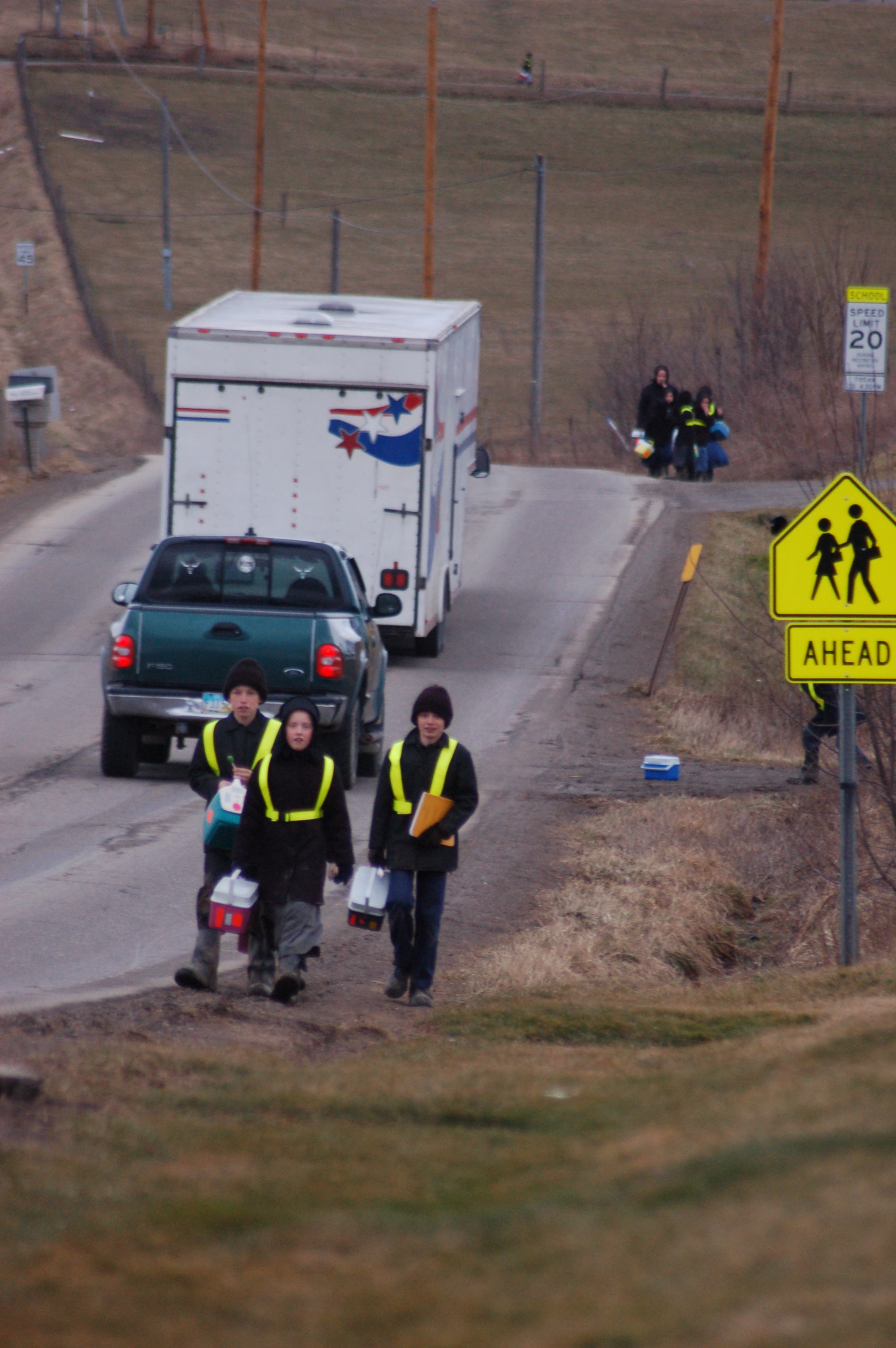
Pedestrians, like these Amish school children, are much more visible since they started wearing day glow vests.The Amish Safety Committee, made up of three Amish men, has been working for 18 years to educate their constituency on road safety. The most recent focus has been on improving visibility.
Drivers who frequent the Amish areas of Holmes, Wayne and Tuscarawas counties can literally see the impact the committee has made. Recognizing the importance of being seen, lighting has been the biggest improvement. In addition to the required slow moving vehicle orange triangle on the rear of the buggy or cart, most horse-drawn vehicles are now well lighted.
“The biggest factor in most car/buggy accidents is speed,” said Wayne Hochstetler, of rural Millersburg, and a member of the safety committee. “Drivers just can’t judge how fast they come upon a dark colored buggy.” Church rules stipulate that buggies be black in Ohio.
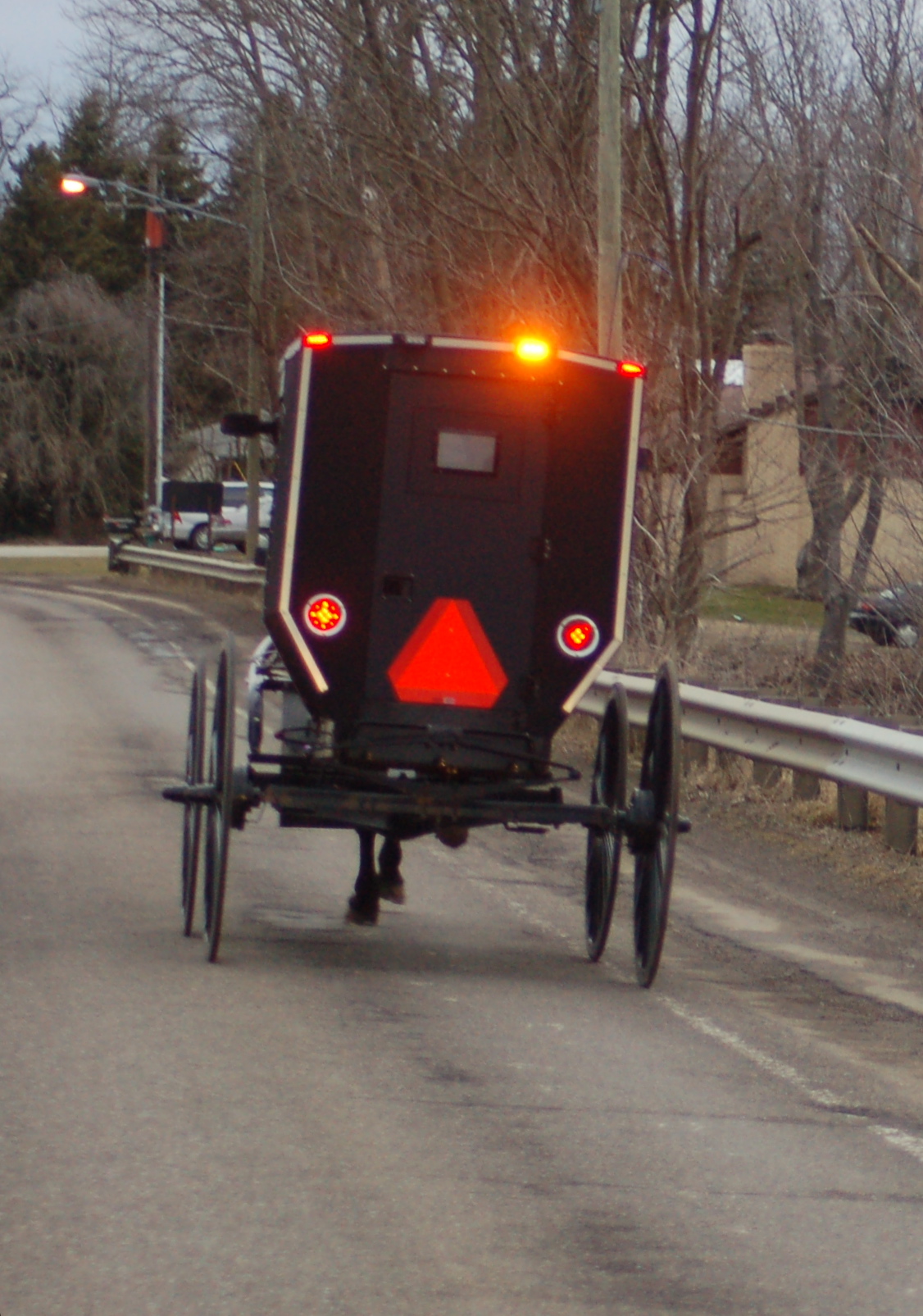
Amish buggies, like this one in Holmes Co., OH, are much easier to see thanks to improved marking and lighting.“The biggest help has been the blinking amber light,” Hochstetler said. The light is usually centered at the top of the back of the buggy. It operates on batteries, and some models even provide varying blinking patterns.
“The blinking light tells the driver that a buggy is ahead sooner than the triangle does,” Hochstetler said. The committee has suggested other lighting for buggies as well.
“We encourage people to use taillights and running lights for both the front and back,” Hochstetler said. Rear lights are imbedded in the body of the buggy, while running lights are on both sides of the buggy.
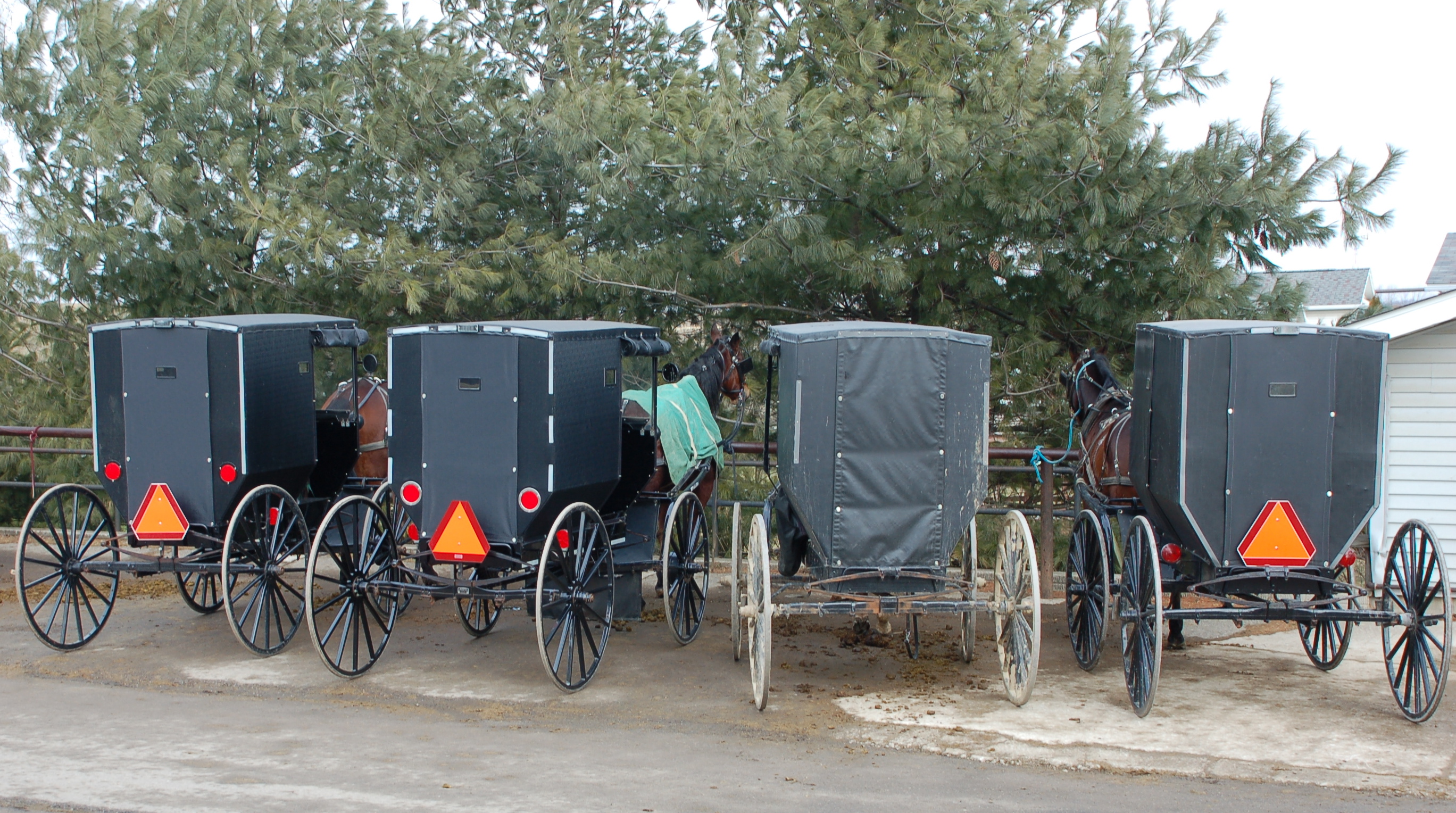
The rear lights are red, just as they would be on a motorized vehicle. The running lights serve as a form of headlight, although, according to Hochstetler, they are used more to be seen than afford light for the buggy operator to see. Amish buggies are marked with Slow Moving Vehicle orange triangles, reflective tape, and lights. How they are marked is determined by the church district to which they belong, or which sect of Amish, like the Swartzentruber buggy with no SMV.
In addition, smaller lights are often used on the top front of the buggies, too. These are white, amber or sometimes blue, though law enforcement discourages the latter. Most of the new lighting is LED lamps, which create a brighter, easier to see light. Most buggies also have white reflective tape that outlines the back of the buggy.
The illumination improvements haven’t been confined to horse-drawn vehicles either. Many pedestrians and bicyclists now wear reflective and lighted vests for easier visibility. Like the buggy lights, the lighted vests blink at night. Some walkers use LED lamps attached to their hats in order to be seen by oncoming traffic.
Bicycles also use red blinking taillights and bright white headlights. Reflective straps are also used around horses’ ankles and on the shafts of the buggies to which they are hitched. This permits reflectivity from traffic approaching from the side. Drivers of all kinds are reminded to drive safely in Amish country.
Besides Hochstetler, other committee members are Gid Yoder and Rueben Schlabach. Detective Joe Mullet, of the Holmes County Sheriff’s Office, and Lt. Chad Enderby, of the Wooster Post of the Ohio State Highway Patrol, serve as ad hoc advisory members.
Hochstetler said that the grassroots efforts of the committee have been so well embraced by the Amish in Holmes, Tuscarawas and Wayne counties that they have been invited to help form other safety committees in other Ohio Amish communities.
“We have even been asked to share in other states like Indiana, Michigan and New York,” Hochstetler said.
Mullet said that even the Swartzentruber Amish, the lowest order of the sect, are now using two lighted lanterns with front and rear lens. They formerly used only one.
Mullet said that he spends several days a year visiting Amish parochial schools to teach the students practical safety measures. They include the proper way to walk and ride bikes to and from school, and encouraging wearing the day glow vests.
Mullet said he often tells personal stories to make it more meaningful for the students. Mullet also has an advantage in keeping the students’ attention since he can speak Pennsylvania Dutch with the students.
In addition to being proactive on safety, the Amish for several years have paid a self-imposed donation to the Ohio Department of Transportation to help improve area roadways. Hochstetler said each church district has a person designated to annually collect donations for each horse-drawn road vehicle owned by the household.
ODOT shares the money with county and township officials for local road improvement in areas where Amish live. The money is intended to be a monetary substitution for road improvements in lieu of paying gasoline taxes, which owners of motorized vehicles pay each time they buy fuel. Donations by Amish families to the Ohio Dept. of Transportation help construct and maintain buggy lanes for safer traffic flow. This buggy was traveling near Mt. Hope, OH.
Youth basketball in Harrisonburg, VA. By Bruce Stambaugh
It’s time for March Madness again. As much as my wife and I enjoy watching the college games on television, we had other basketball priorities. That’s the way it is with grandparents.
Our seven-year-old grandson’s basketball season was winding down, and we hadn’t seen him play yet. We used that as an excuse, as if we needed one, to drive the 350 miles south and east to Virginia’s lovely Shenandoah Valley to see him play. Across the Ohio River and through forested West Virginia mountain passes we went to cheer him on. One of the mountain passess in West Virginia we cross each time we travel from Ohio to Harrisonburg, VA.
Unfortunately, Evan was ill when we arrived. His 103-plus fever kept him home from school for a couple of days. But sports nut that he is, Evan’s fever subsided and he was ready to roll by game time Saturday morning.
We all piled into our daughter’s van and headed a few miles down the road to an elementary school where the basketball games are held. Other parents and grandparents filled the meager bleachers, too, as you might expect. The coach gives instructions to the young players.
I was impressed with how the operation was run. After all, seven is a young age to be playing a contact sport. After the usual warm-ups were completed, the coaches gathered the players for instructions.
The main referee, a lanky teenager, also helped the players. He talked to them before each jump ball and as the game progressed. In fact, once the whistle had blown, he often demonstratively showed the players the correct way to guard or shoot.
The young referee took time to instruct the young players, too.Of course, as soon as play resumed, it was like nothing had been said. The kids were pretty young to grasp the full aspects of the game. They were mostly out to have fun, and win, even though no score was kept.
Another plus was that the baskets had been lowered to make it easier for the boys to shoot. In addition, they used a smaller sized ball, one that was much easier for their small hands to handle.
This game was a lot of fun to watch. A few parents and grandparents, who shall all remain nameless, hollered out instructions to their favorite player. But just like they did the coaches, the kids seemed to ignore the advice and played on, dismissed rules and guidance in favor of trying to make a bucket anyway they could.
The youngsters emulated NBA players with their style of play.In fact, the play of the youngsters, combined with the loose officiating, reminded me of an NBA game. Dribbling seemed to be an option, and shooting was far more common than passing the ball.
Back home, Evan practiced his skills with his younger brother, Davis, by playing an electronic game on the TV with the Wii. Davis tried his best to teach me, but I guess I was just too old to jump properly to make a basket. I seemed to be showing my age in both the virtual and real world.
Our granddaughter, Maren.Their baby sister, Maren, had tolerated Evan’s game just fine. She took along her baby doll for real entertainment. She didn’t have much interest in the Wii game either.
Maren was much too preoccupied with more important things, like playing quietly by herself until her brothers interrupted her privacy. Then another game began, which their lovely mother refereed, no whistle required.
Admittedly it was a long way to go to watch a basketball game, but well worth the time and effort. This grandfather can’t wait for youth baseball to begin.
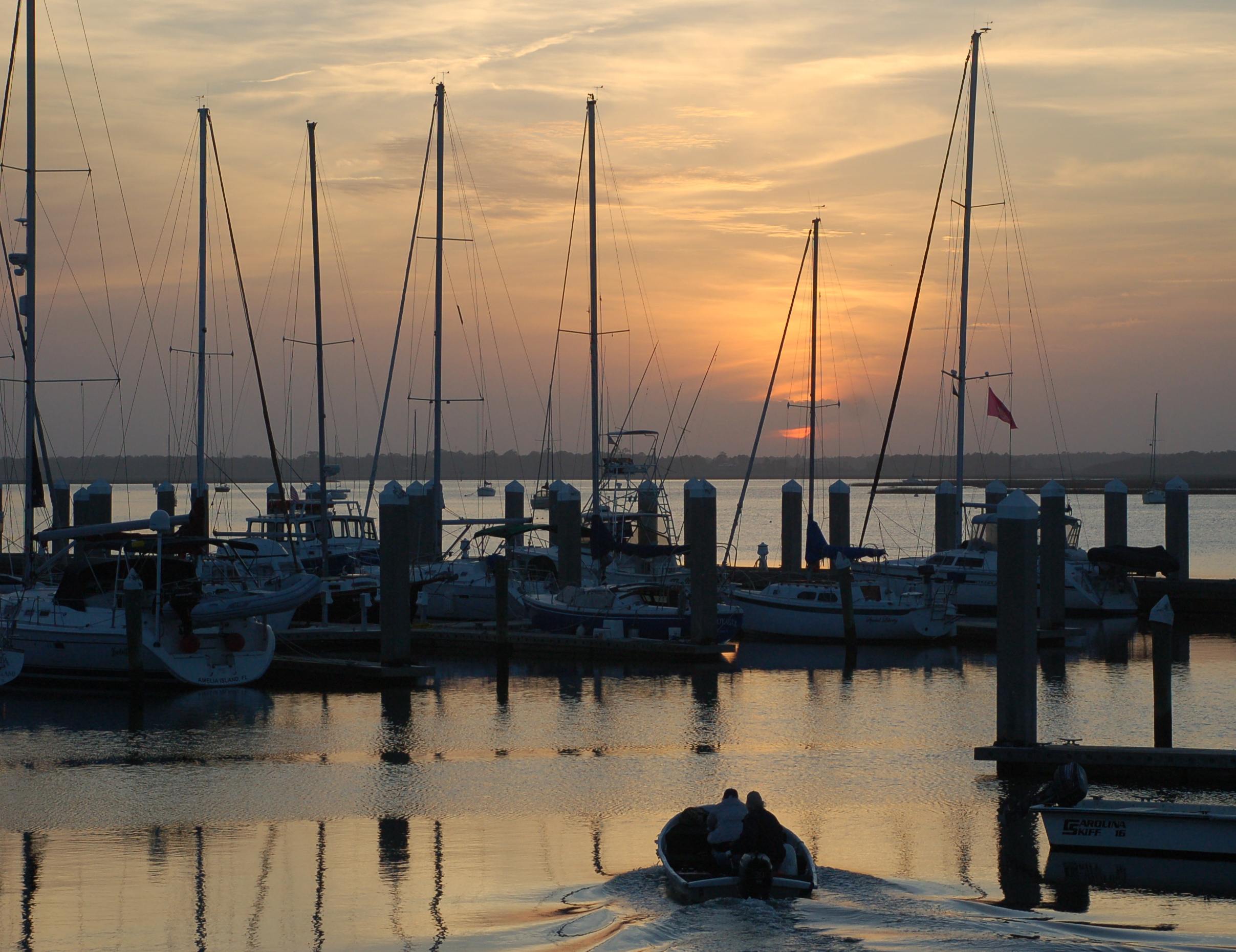
Sunset at the harbor, Fernandina Beach, FL. By Bruce Stambaugh
It seems no matter how much planning my wife and I do for each trip we take, we find at least one unexpected gem along the way. Amelia Island, Florida was just such a place on a recent trip to the Sunshine state.
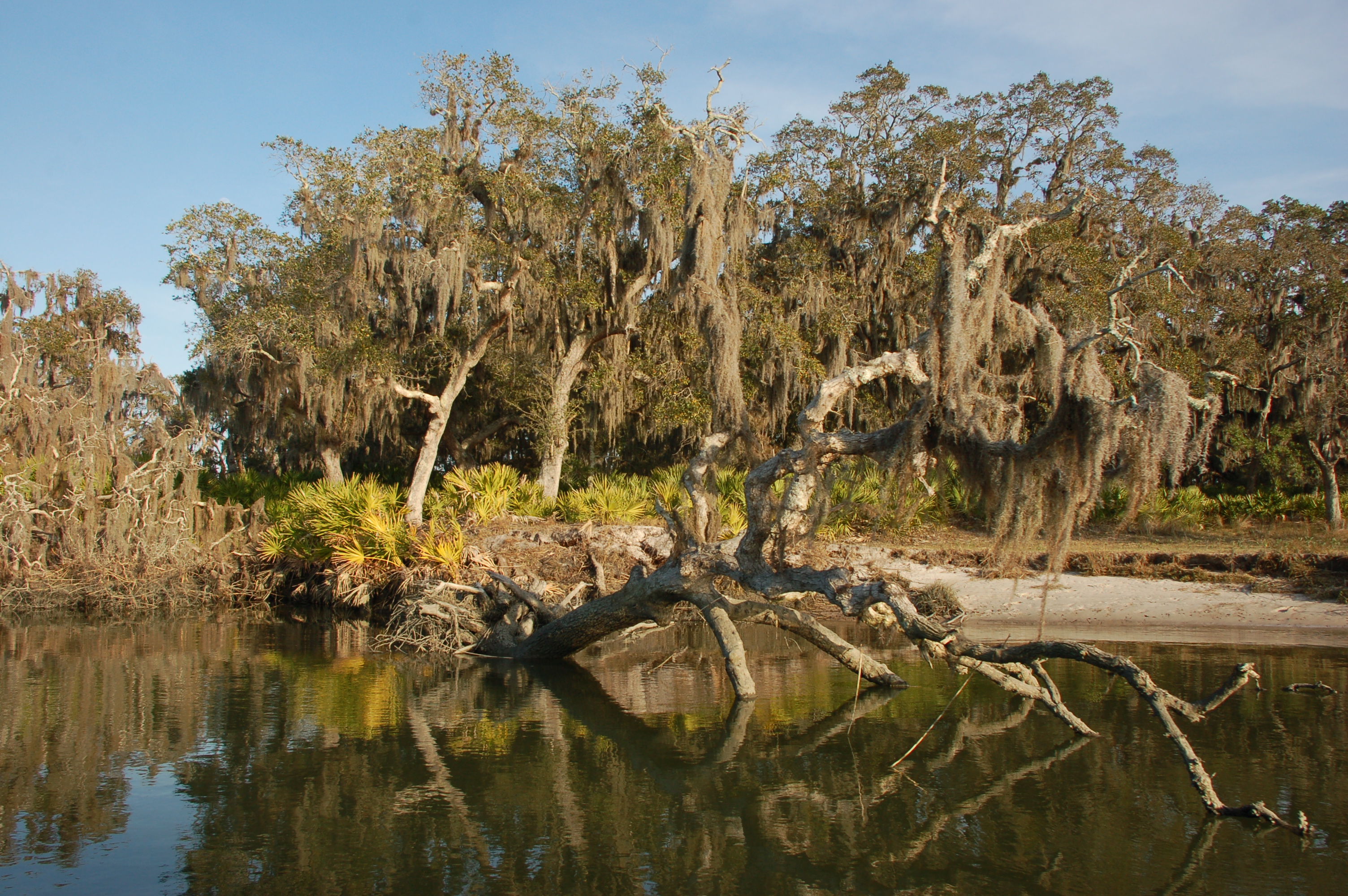
The unpretentious island initially was to be no more than a one-night layover to our final destination, Sarasota. It didn’t take long to realize what a diamond in the rough we had found. The island’s natural amenities alone deserved a closer look. A typical scene of live oaks and palmetto palms along the Amelia River.
On the way home, we stopped at Amelia Island for a two-day self-guided tour. Once we started to uncover the island’s riches, we could have spent two weeks there.
Steeped in history and oozing with natural beauty, Amelia Island’s chief charm seemed to be its modesty. Just inside the Florida line from Georgia, I sensed the island and its people knew what they had, but just didn’t want to flaunt it. Main Beach on the Atlantic Ocean, Amelia Island, FL.
On the Atlantic Ocean side, Main Beach runs the entire length of the 13.5 mile long island. In the off-season, resident and migrating birds far outnumbered the exploring humans combing the beach or local teens windsurfing. The Pippi Longstocking House, Old Towne, Fernandina Beach, FL.
On the inland side, historic Fernandina Beach graces the island’s picturesque waterfront. Here’s where the island’s modesty reigned. The beautiful little town was actually settled three years before St. Augustine, which bills itself as the oldest in the country.
Fernandina Beach lost its historic distinction when the Spanish conquistadores massacred the French settlers and all the island’s indigenous people, too. An open grassy square in the old town section still marks the spot.
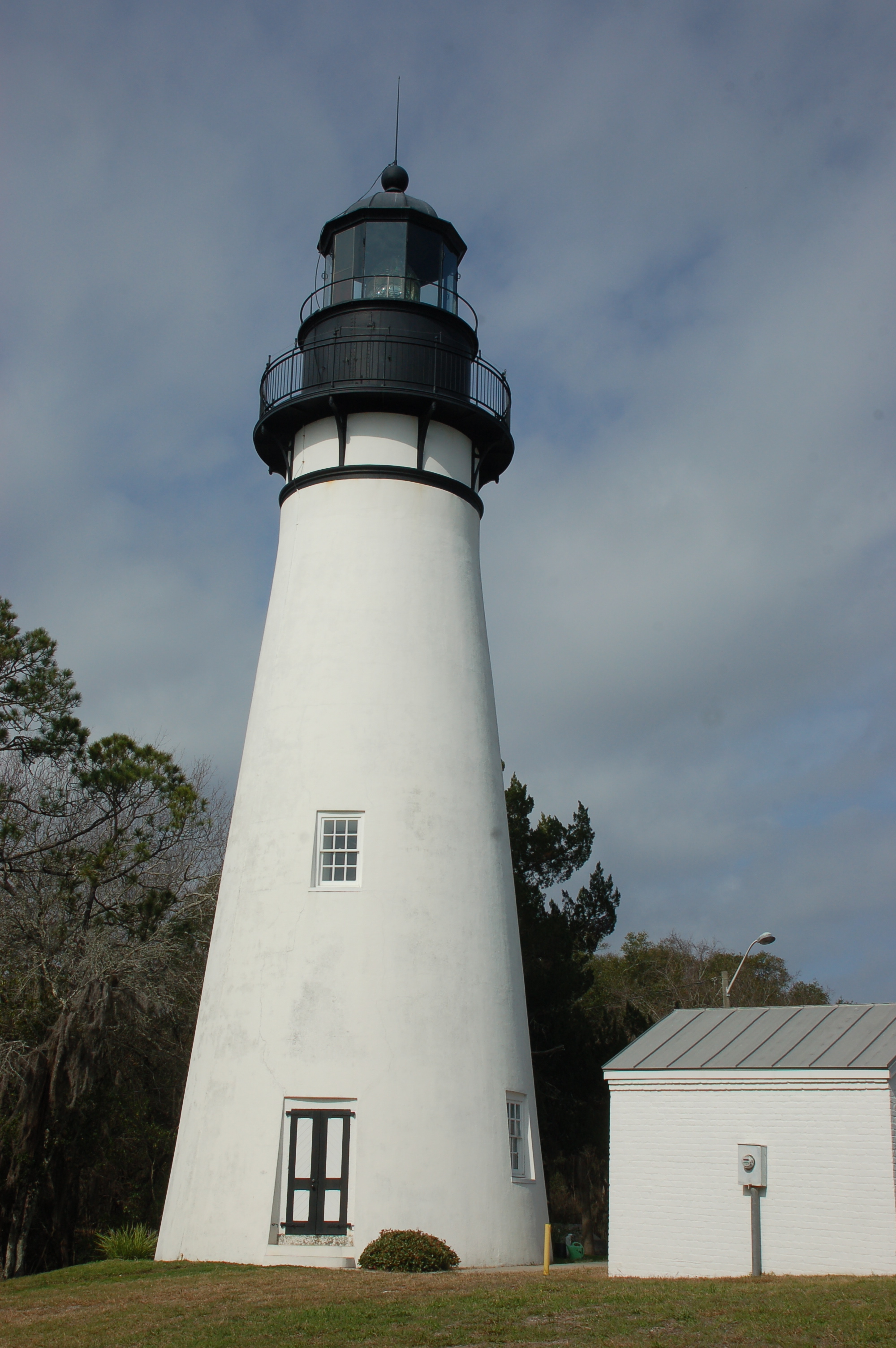
Ironically, one of the many distinctive houses in the town stands adjacent to the infamous slaughter. The old place was used as the setting for the 1988 Pippi Longstocking movie. The Amelia Island lighthouse.
Back in town, the oldest bar in Florida was temporarily converted into an ice cream parlor for a scene in the movie. The island’s elementary children were recruited for an ice cream fight until the reality of the hot Florida weather melted the main prop. Colored mashed potatoes were instant replacements to complete the filming.
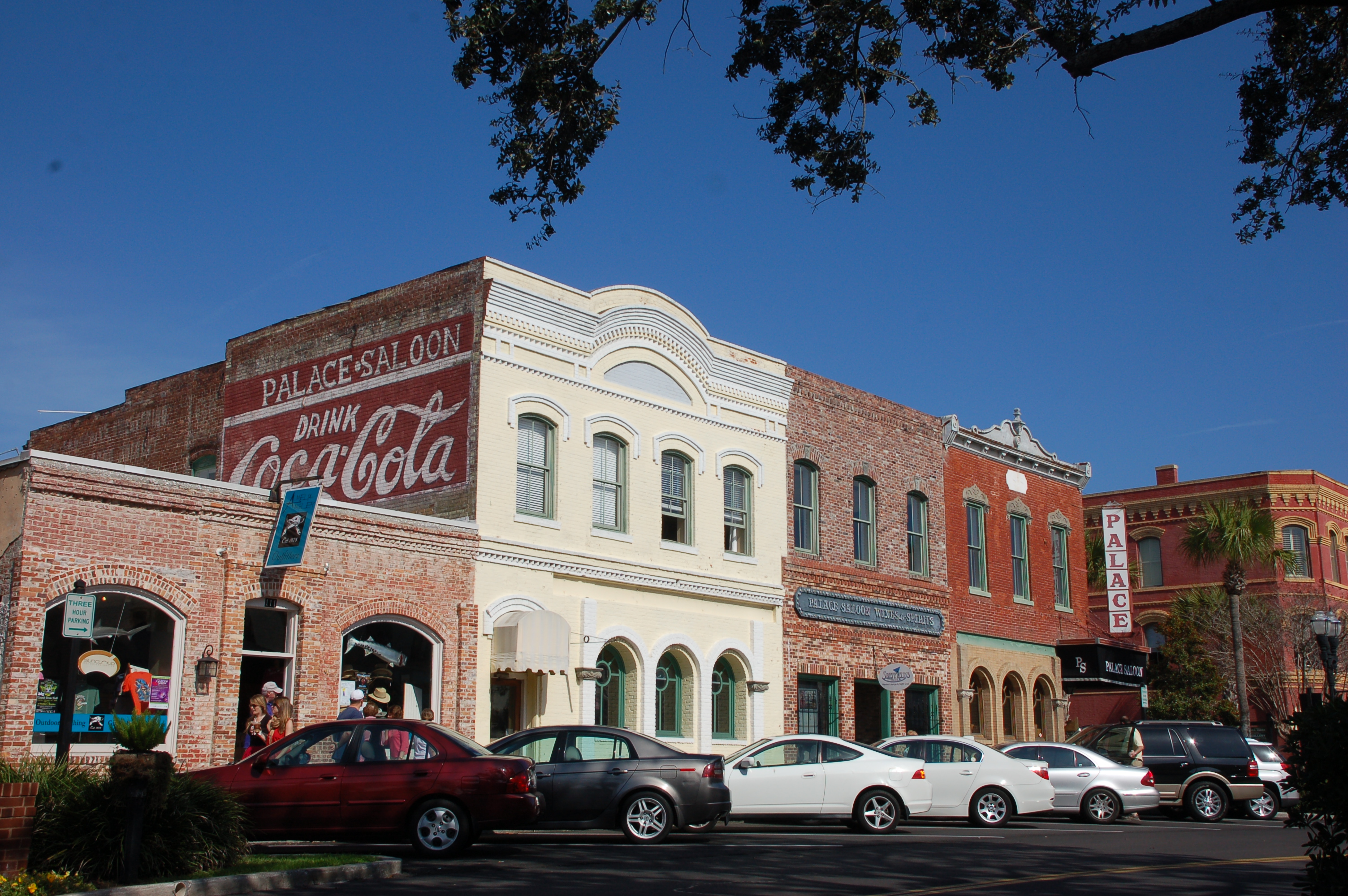
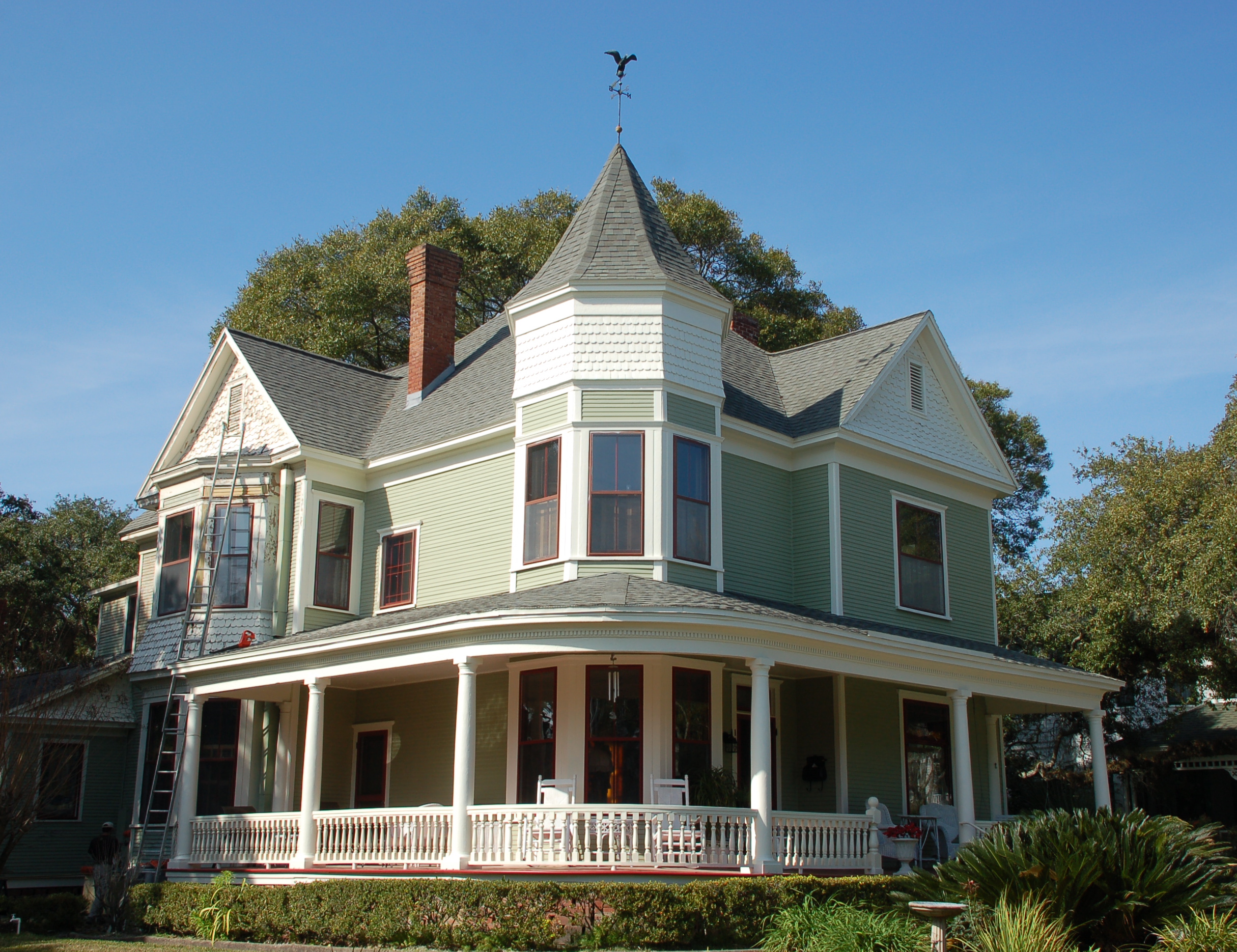
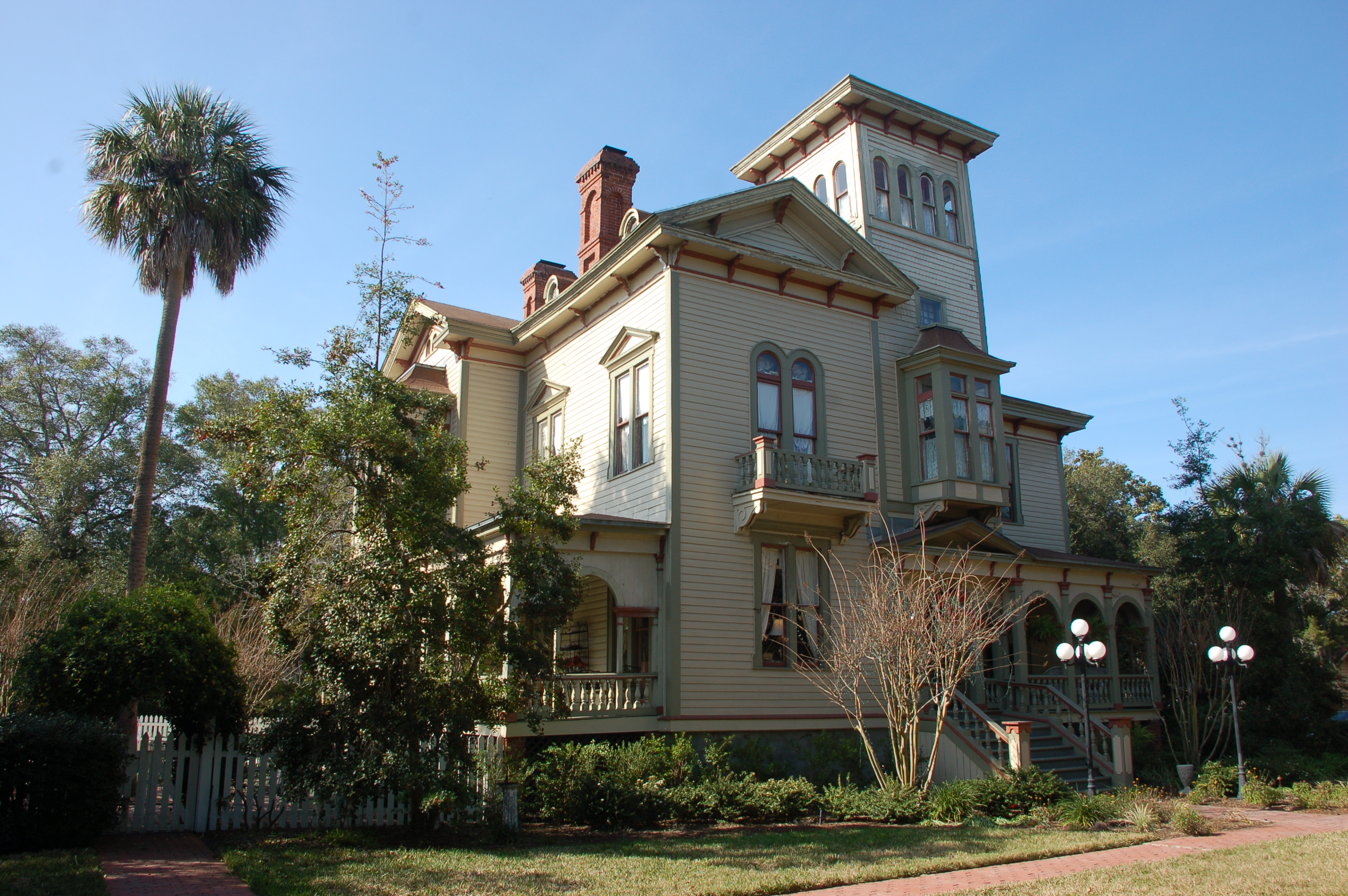
Well-preserved historic buildings make up the impressive downtown. Locally owned restaurants serve locally caught seafood, while upscale boutiques attract shoppers from near and far. Stately, well-maintained homes from bygone years line the north-south streets off of the main drag.
To say Amelia Island’s attitude is small town would be an understatement. A fender bender outside our hotel brought four cruisers. Wild Spanish stallions still graze on the many isolated islands near Amelia Island.
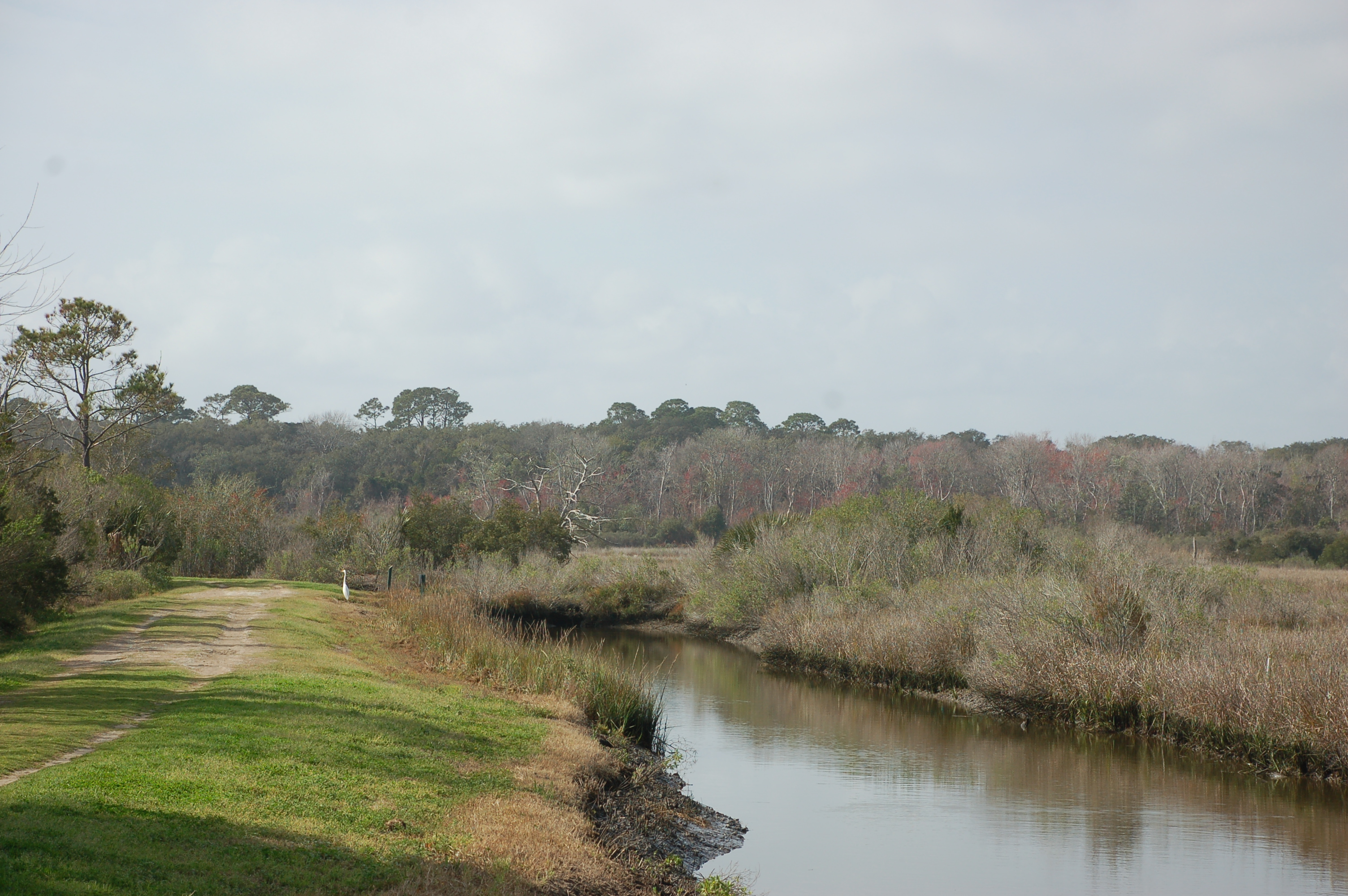
The desire to keep things as they are reaches far beyond the town itself. An outstanding state park features a Civil War fort. Egan Creek Greenway runs down the middle of the island for birders, joggers and bikers to enjoy. A charming lighthouse, still in operation, keeps watch over it all.
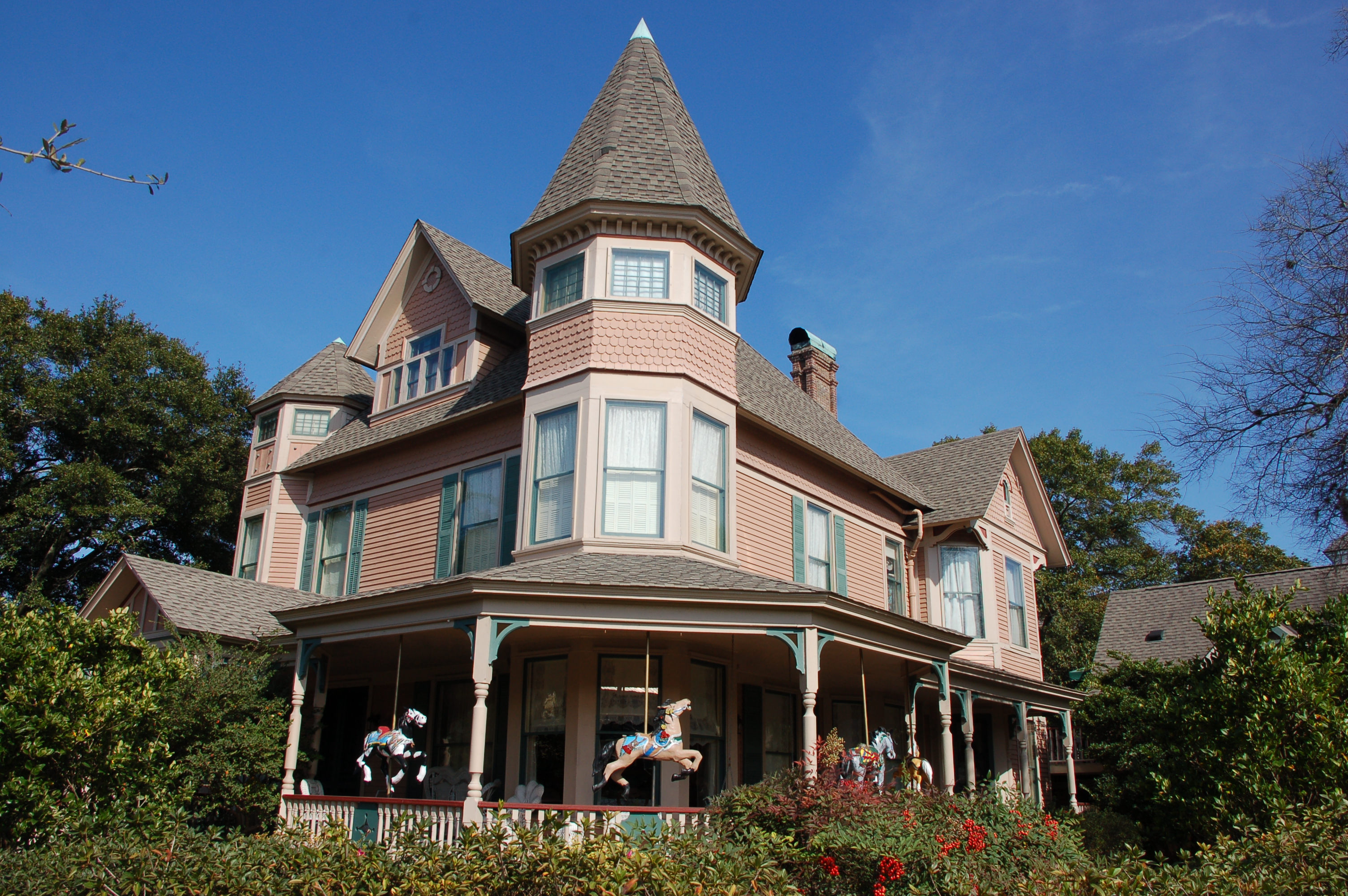
Take a boat cruise and you discover even more gems about this unheralded island. Rare birds, bottle nosed porpoises, wild Spanish stallions, and salt truncated live oaks are all part of the treasure chest of Amelia Island. The Bailey House, one of many well-maintained historic homes in Fernandina Beach, FL.
Even in the two additional days of exploration, we couldn’t uncover all of the island’s hidden nuggets. That will make our next visit all the more exciting.
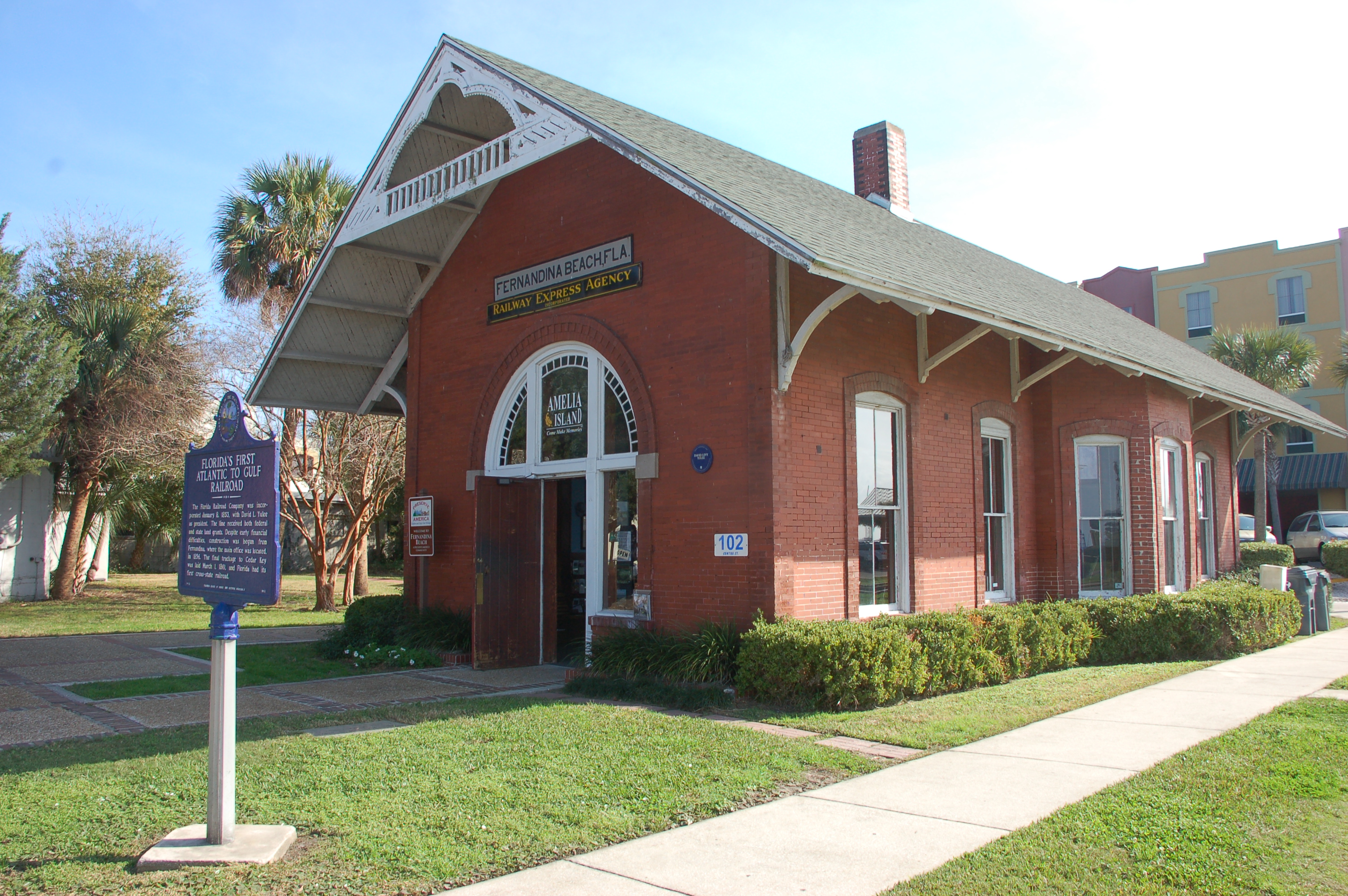
Just some of the old buildings is historic downtown Fernandina Beach, FL.The Egan Creek Greenway in the center of Amelia Island provides opportunities for birding, biking, jogging and walking.Humphreys House, getting a new coat of paint.Baker House, Fernandina Beach, FL.Prescott House, Fernandina Beach, FL.Meddaugh House, Fernandina Beach, FL.The Tabby House is appropriately named.Fairbanks House, Fernandina Beach, FL.The old railroad depot now serves as a welcome center near the waterfront in Fernandina Beach, FL.
I feel sorry for anyone born on Feb. 29. They only get to celebrate their birthday every four years. If it is a century year like 1900, they have to wait eight years.
I haven’t known very many people in my life who were born on leap day. So it’s not like I was influenced to complain about the dubious day on their behalf.
My good wife’s grandmother, Maggie, was a leap day baby. Neva remembers turning 16 the same year her dear grandmother was 16. Indeed, Maggie had to wait eight years before she could celebrate her first birthday. She was born in 1896.
People born on Feb. 29 get cheated. Sure they have a birthday every year. But it has to be celebrated on Feb. 28 or March 1 or perhaps a day of their choosing. How would you like to consistently celebrate your birthday on a day other than the actual day?
I understand the reason for leap day. An extra day has to be added, generally every four years, to keep pace with the earth’s real speed of rotation. That fact alone reemphasizes my main point. The current calendar system is inaccurate, messed up, verhuddelt, as the Amish would say.
To make matters worse, leap days usually occur during presidential election years, except on most century years. Do we really need an additional day of negative national campaign hyperbole? The year 2000 was an exception because it was divisible by 400, which is why 1900 wasn’t a leap year.
Now that I think about it, having a leap day would be an excellent question for the candidates to debate. If you compare that suggestion to some of the idiotic comments and ideas that they have been espousing on their own, I think it fits right into the political verbal fray.
In fact, given some of the witticisms by the candidates so far, I wouldn’t be surprised if at least one of them thought leap day was a reference to a frog-jumping contest. Who could argue with that?
Officially a leap day occurs in most years that are divisible by four, like 2012. Years that are evenly divided by 100 do not contain leap day, unless they are divisible by 400, like 2000 was. See what I mean? Unless you’re a math wizard, leap day is simply confusing.
This is reason enough to eliminate leap day. If we have to follow all of these crazy exceptions to even have a Feb. 29, why bother? Why not just wait until an entire year needs to be added, and do it all at one time. It would be like an entire year of jubilee, only in reverse. I’ll be dead by then anyhow, so I wouldn’t have to deal with the ensuing consequences.
I am surprised about one thing with leap day. It hasn’t been made a national holiday. What a great way to stimulate the economy? Establish yet another card buying, gift giving holiday, especially right after the sales for Valentine’s Day and Presidents’ Day. That would put three holidays in the shortest month of the year, a marketer’s dream come true. Sorry. Ground Hog Day doesn’t count.
In all seriousness, if you were born on Feb. 29, I wish you a happy birthday. If my birthday fell on Feb. 29, which it doesn’t, I would only be 17 this year. On second thought, let’s just keep the calendar the way it is.
The sugar shack sits adjacent to the woods on Gary Miller’s farm west of Millersburg, Ohio. By Bruce Stambaugh
I had often heard about the sugar shack. A group of guys I knew, mostly from our church, had formed an informal co-op. The goal was to make and offer maple syrup, with the donated proceeds going to a scholarship program for students in rural Honduras.
My journalistic nosiness finally got the best of me, and I ventured out one chilly day when the sap was running strong. My intent was to write a story for a local weekly newspaper. What I discovered went far beyond what any feature story could represent. Here were a few good men who through sheer determination made this sweet enterprise work. They worked cooperatively out of a common desire to succeed, not out of individual or corporate profit. Indeed, there were no profits. The money collected through donations went to the scholarship program.
Tim Roth, left, and Paul Conrad stoke the fire of the sugaring evaporator system.This endeavor was borne of commitment, desire, effort, camaraderie, purpose, joy, ingenuity, and sacrifice, all with rewarding results. And to think that it all started with the landowner, Gary Miller, standing in the rain dreaming of making maple syrup. Miller never envisioned how far his idea would go.
“Three years ago,” Miller said, “I was standing in the rain under an umbrella boiling sap in an assortment of old used pans on my grill.” Miller lives on a small farm west of Millersburg, Ohio.
Miller shared his idea with his friends, and the sugar shack quickly became a reality. The structure itself was donated to Miller. A friend, Paul Conrad, had an old shed he told Miller he could have, and Miller’s sons moved it in seven different sections for him. Once on site, the building was reassembled, reusing the old lumber. Since then, its design and size has been tweaked and expanded.
That process set the tone for what was to come. Much of the equipment used by Miller and his friends has been refurbished as some part and purpose of the maple syrup operation. Paul Conrad, left, and Bobby Miller check one of the 400 taps in Gary Miller’s woods.
Indeed, when the sap is moving like it is now, so does this voluntary collection of Miller’s friends and family who assist with the project. They placed 400 taps in sugar, red and black maple trees.
“We are careful about how many taps we place in a tree,” Miller said. “We don’t want to stress them.”
Like most farming efforts, preparing for the sap harvest takes a lot of preparation, and can be an ongoing project. Recently a shed was built to store the chords of firewood needed to heat the boiling process. Of course the friends also helped split and stack the wood that fuels the fire that boils the sap on a homemade evaporator. True to form, the gregarious crew also put that together. Much of that ingenious system consists of recycled metal and other repurposed materials.
The wood stove that holds the fire that boils the sap belonged to Scott Sponsler, another friend. The stove was extended with metal from old toolboxes from a pick up truck that Miller owned. Miller had a fan rebuilt and some ductwork manufactured locally. Together they help distribute the heat generated by the wood stove. The heat evaporates the sap into syrup.
The sap enters the sugar shack from another recycled item, an old bulk tank rescued from an unused milking parlor. It is held up by a repurposed metal stand so the sap flows by gravity into a smaller holding tank inside the old wooden shed. Gary Miller explained how the sap is heated by running through a maze of troughs in order for it to become maple syrup.
From there, the sap runs into a customized sheet metal maze that allows the sap to be evaporated as it circulates up and down the four parallel troughs. After entering a second connected metal maze, the sap begins to change color. It is closer to the firebox and the pre-heated sap really begins to boil. Its darker color indicates that the moisture is being bubbled away.
Miller said that the sap isn’t officially maple syrup until its consistency is at least 66.9 degrees brix, as measured by a hydrometer. Miller said with this set up, it takes 51 gallons of sap to produce a gallon of syrup.
Miller and his friends make the syrup when the sap is running. He said warmer days and cooler nights are the best conditions to make the sap run. When the sap runs, so does this gang of close friends and family members. When the sap is running, his shack and the surrounding woods are very busy places indeed.
Scott Sponsler poured sap from the collection bucket into a 15-gallon container, which was hauled back with several others to the sugar shack via tractor.Before it is pumped into the elevated holding tank, the sap is gathered into 15-gallon containers from each tap bucket. The containers are carried on the back of a small tractor. In keeping with the pattern, the tractor was loaned, too.
All the free equipment and labor is only appropriate. Miller said the maple syrup that is produced is not for sale, although it does have a name, Smoke Pit Maple Syrup.
“This is not a commercial operation,” Miller emphasized.
Instead customers get to donate whatever they feel the syrup is worth. The money is used for an educational scholarship program in Honduras. Miller’s Sunday school class at Millersburg Mennonite Church is financially sponsoring the schooling of several children there.
Roy Miller, a retired Holmes County family physician, serves as the unofficial coordinator of activities. He even travels to Honduras several times a year and meets with the students, their parents and the local church leaders who oversee the scholarship program there.
With all that said, Gary Miller revealed the secret ingredient in the maple syrup production as far as he is concerned.
“It’s not about the syrup,” Miller said. “It’s about the fellowship.”
Indeed, laughter and kibitzing among the friends intermingle with the steam from the cooking sap in the cold, small shack. The steam and merriment waft together out into the cold air through the open doorways. The good-natured ribbing helps make the labor-intensive sugaring efforts all the sweeter.
In that initial visit, I was impressed with the care given to producing a quality product, and with the interpersonal interaction that makes this particular micro business the all around success that it is.
It was clear to me that two pure products are produced at the sugar shack. High quality maple syrup created for a great cause is the tasty finished product. Genuine, committed friendship that knows no bounds and has no earthly measure is the dividend.
Persons interested in obtaining some of the Smoke Pit Maple Syrup should contact Gary Miller at 330-763-0364. Gary Miller demonstrated how he checks the sugar content of the maple syrup using a hydrometer. This story appears in the current edition of Farming Magazine.
Fishermen leave the harbor at Fernandina Beach, FL. By Bruce Stambaugh
Vacation is one of my favorite words. Perhaps it’s because it’s one of those duplicitous words in the English language that can be used as either a noun or a verb.
I love to go on vacation. We will vacation at the beach. Either way, the end result is still the same. Vacation is vacation.
My wife and I are fortunate to be at a point in our lives where we can get away, if only for a few days, without much hassle. When friends invited us to share a house with them in sunny Florida for a week, we cleared our schedules and confirmed our reservations.
When you live in northern Ohio and it’s wintertime, there’s only one direction to go on vacation, and that is south. Clearly, I’m not a snow skier. At my age, I prefer the warmth to cold, and so do my old bones.Sunset at Siesta Key Beach, Sarasota, FL.
It’s more than climate that draws us away from our familiar digs, Holmes Co., Ohio, where up to four million visit annually. Most visitors to our area, however, choose spring, summer and especially fall to roam the bucolic Holmes County hills.
Our curiosity and desire for adventure draw us away from our own congenial vistas as much as anything. We love to explore new places as well as revisit familiar ones.
Our gracious Florida hosts planned plenty of interesting activities for us during our weeklong stay. Fortunately, we enjoy many similar activities as our friends. Like us, they prefer to pace themselves. It was vacation after all. No reason to rush.
I could bore you with a verbal slideshow of our trip. I’ll just say we had a great time, whether we were on the most beautiful beach in the country, which we were, or enjoying an enlightening and informative historical tour, which we did. The Florida House, Fernandina Beach, FL, is the oldest operating hotel in Florida.
Instead, I want to tell you about some of the people we encountered along the way. It happens wherever we go. I am fascinated and appreciate the kindness of pure strangers we encounter on our travels. Meeting new people is one of the vacation perks.
Sure, there are a few goofballs almost everywhere. But for the most part, we have found people to be absolutely engaging, matching the gorgeous scenery that surrounds them.
It is hard to single out any one person in Mt. Airy, North Carolina. Everyone we met seemed like a familiar character from Mayberry.
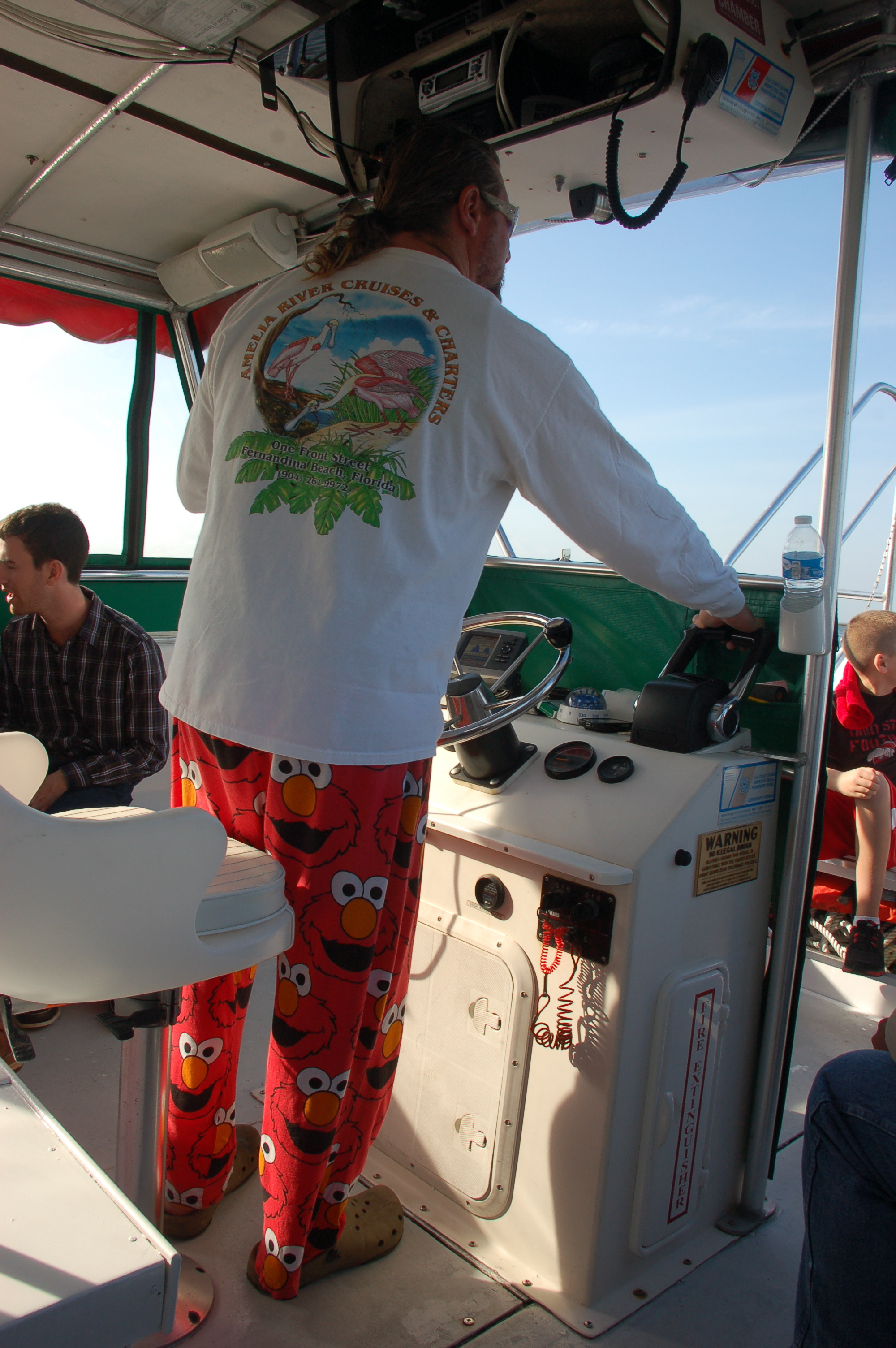
Captain Pajama Dave piloted our Beach Creek tour at Fernandina Beach, FL.The young and enthusiastic park ranger near Mt. Mitchell on the Blue Ridge Parkway was most helpful. He directed us to Asheville when we found the road unexpectedly closed.
The kind lady at the Venice Rookery who encouraged us to return at dusk to watch the hundreds of nesting egrets, herons and ibises settle in for the night was a pure gem. Even a non-birder would marvel at that experience.
Another amazing individual was our tour boat captain at Fernandina Beach, Florida. Captain Dave was as cordial and passionate about his lovely habitat as the history of the area was interesting. His trademark bright red Elmo pajama pants fit his personality and his passion for nature’s handiwork that he so eloquently pointed out.
The precocious Juniper.
Finally, there was 2-year-old Juniper, the petite and perky daughter of some friends in Charlotte. We had never met her. Yet by evening’s end, she wanted “Pruce” to read her one more book.
To paraphrase Dr. Seuss, Oh the places we’ve been and the people we’ve met. Together they make vacation a charmed word in our household.

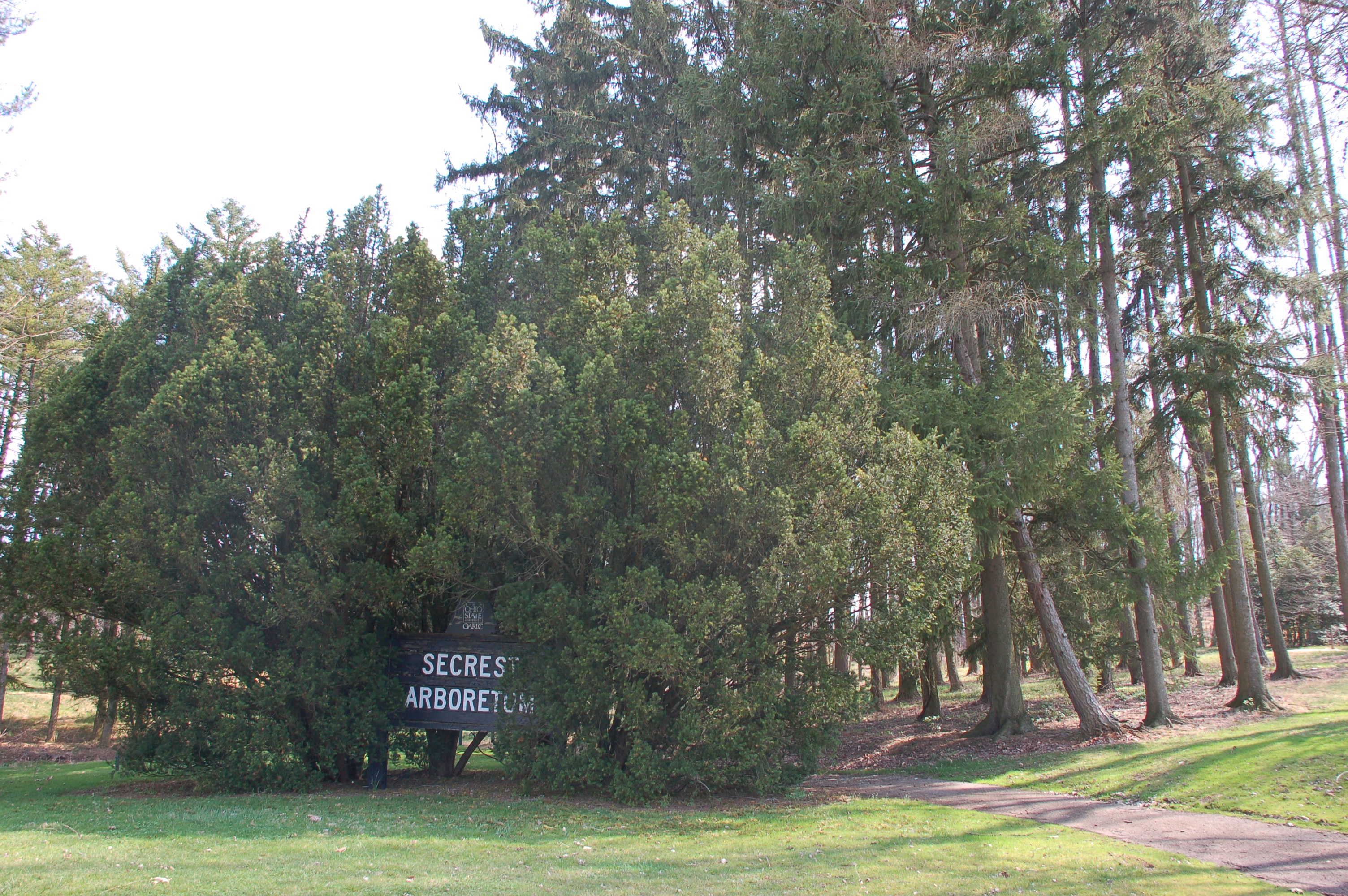 Like so many others, I always had found the arboretum to be a place of blissful escape and rejuvenation. Its lovely woodlots, pristine gardens and peaceful settings have long served as a place of inspiration and retreat for many.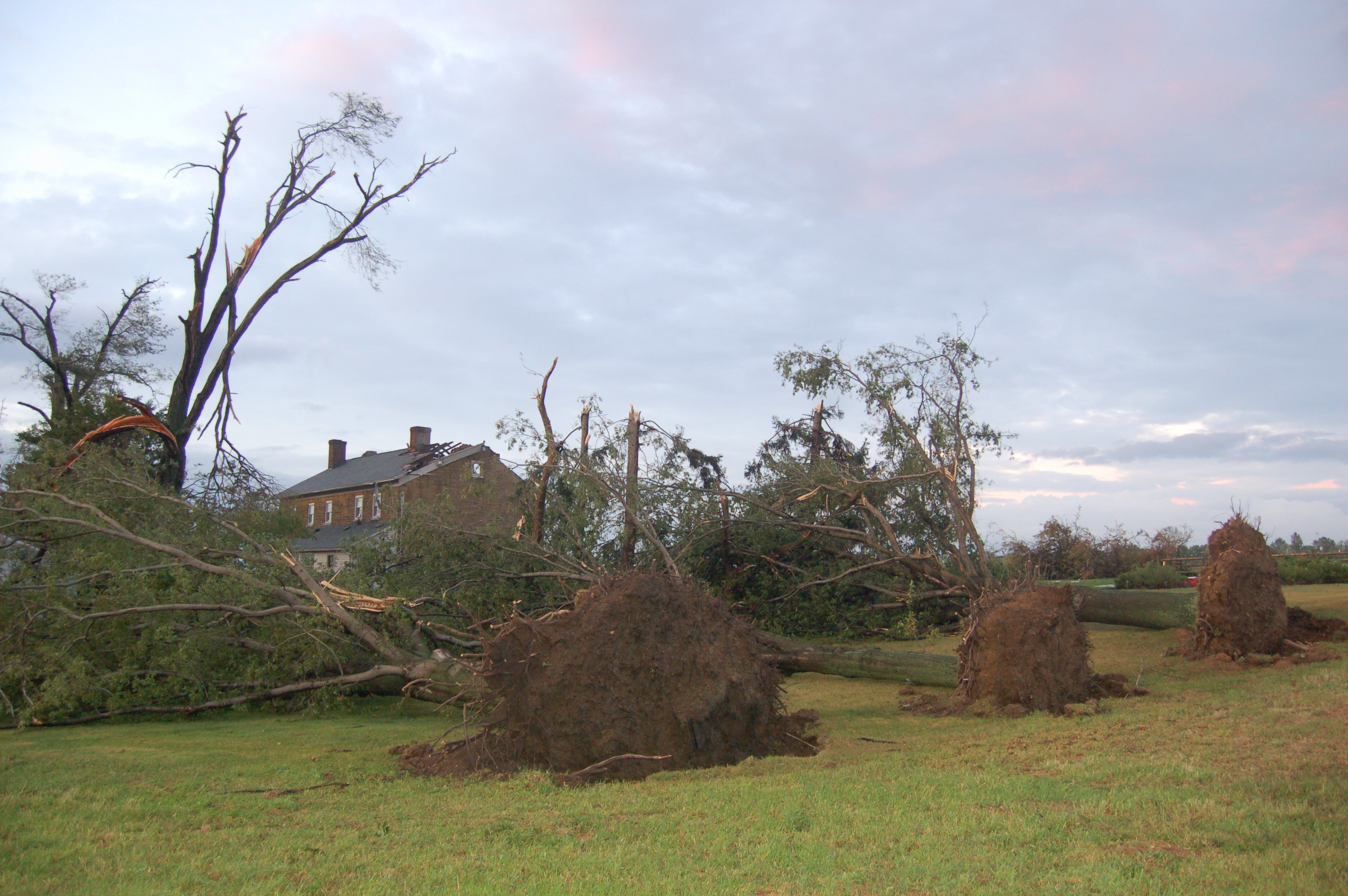
 Buoyed by the unusually warm weather, I laid aside my fears and drove in. As soon as I exited my vehicle, familiar sights and sounds were instantaneous. Young trees had been planted, some adjacent to the sawed-off stumps, testimonial tombstones to those once towering trees.
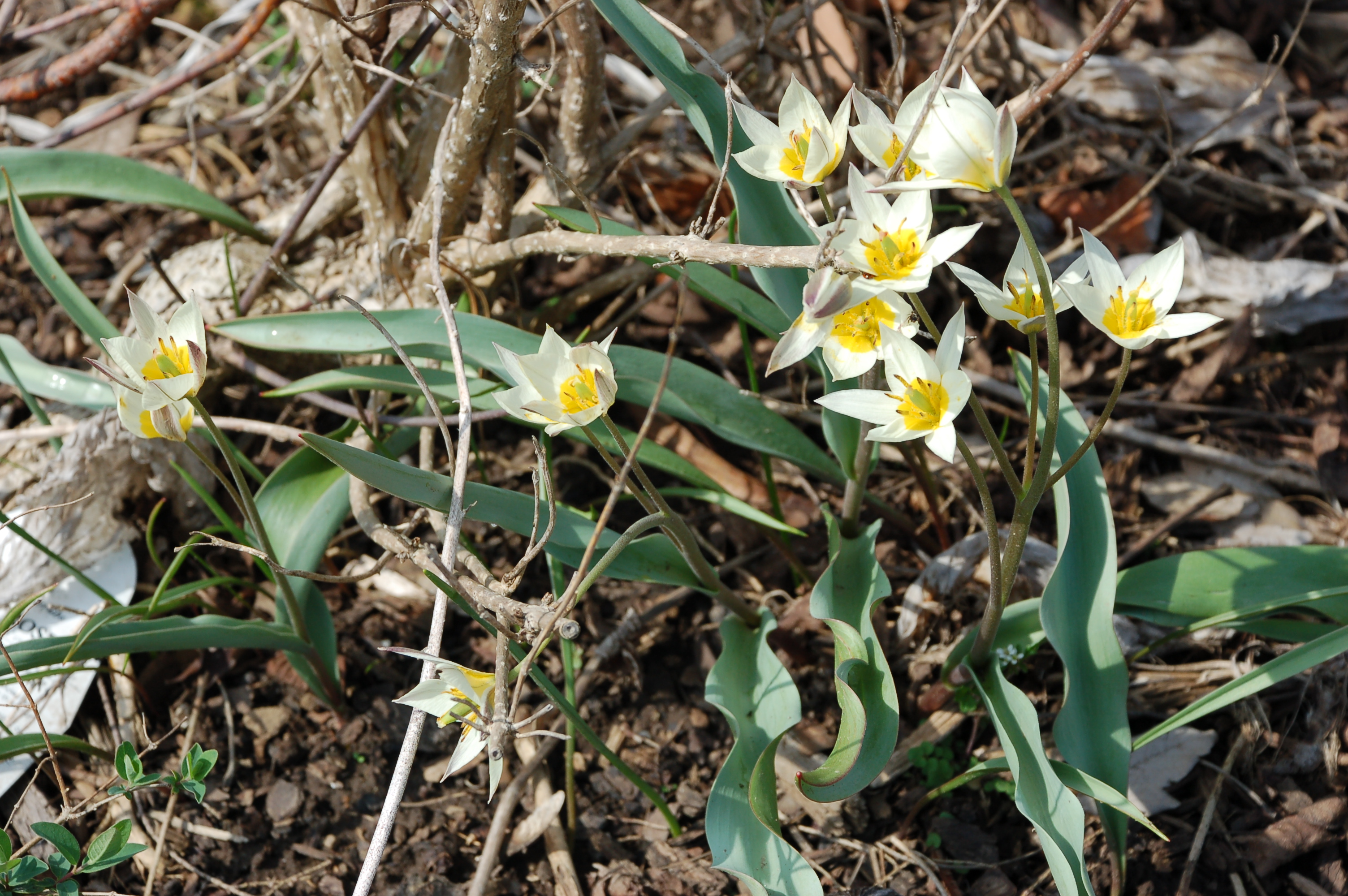 The early onslaught of warm weather had coaxed the blossoming of many flowers and flowering trees. Crocuses, daffodils, hydrangea, forsythia, magnolia and even an exotic tulip were all blooming, some well ahead of schedule. Workers were busy trimming out last year’s dead growth while construction crews continued to repair, replace and expand the lovely gardens.

























 Roadkill Crossing
You must be logged in to post a comment.