These recent Shenandoah Valley sunrises and sunsets were too beautiful not to share with you, especially on gray, chilly December days.
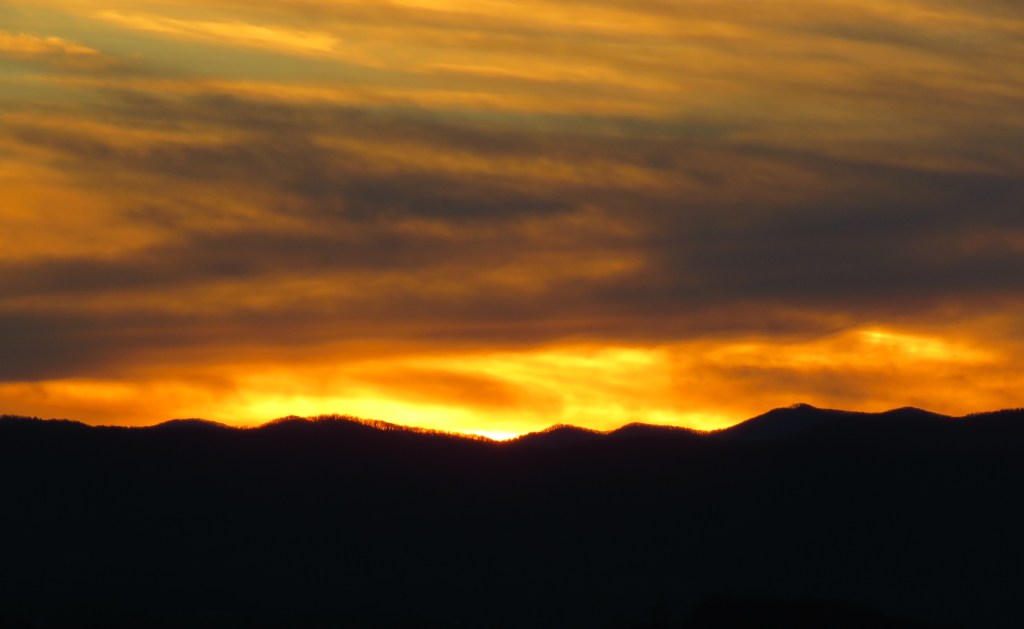
This glowing sunset on December 2 included a sun pillar. The setting sun’s rays backlit the virga that appeared around the sun pillar.
I rose early enough on my birthday to capture the tale end of a lovely sunrise from the backyard. Red in the morning, sailors take warning proved true. Low rain clouds moved in and blessed us with some much-needed precipitation.
We didn’t get much, but every little bit helps.
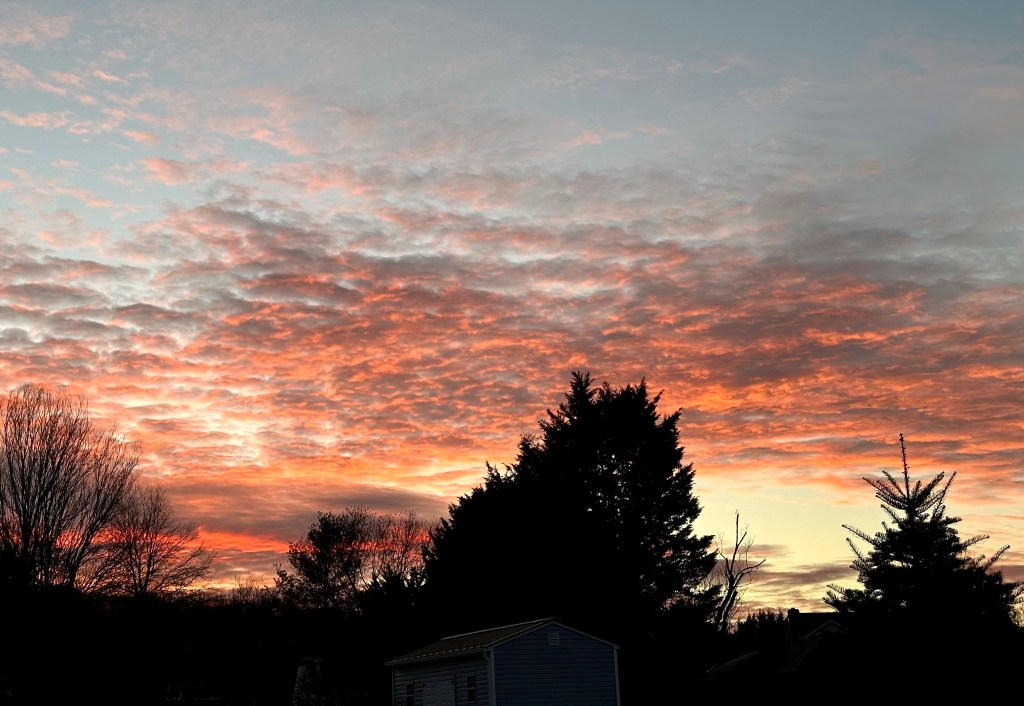
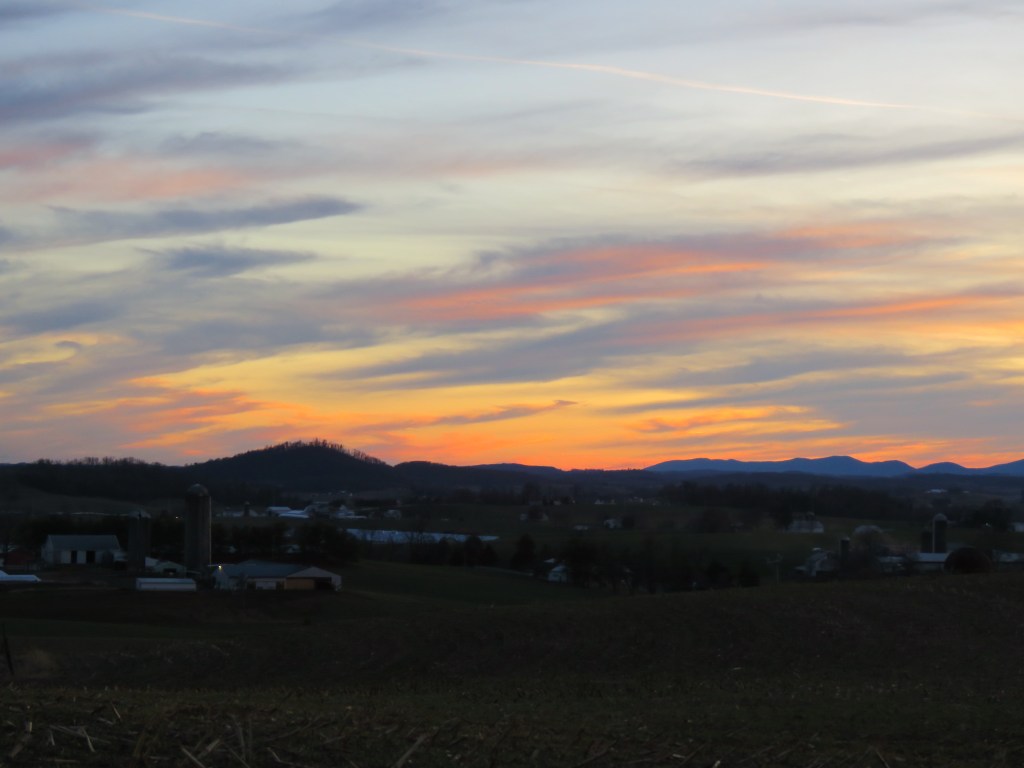
The soft pastel sunset on December 4 added to my happy birthday.
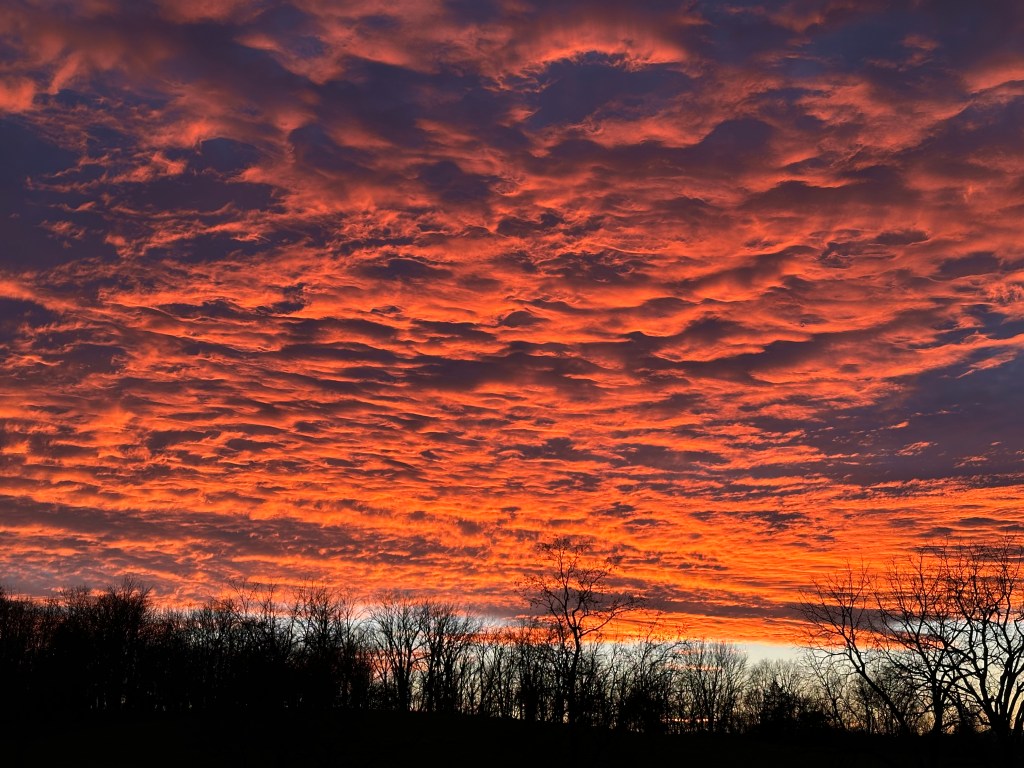
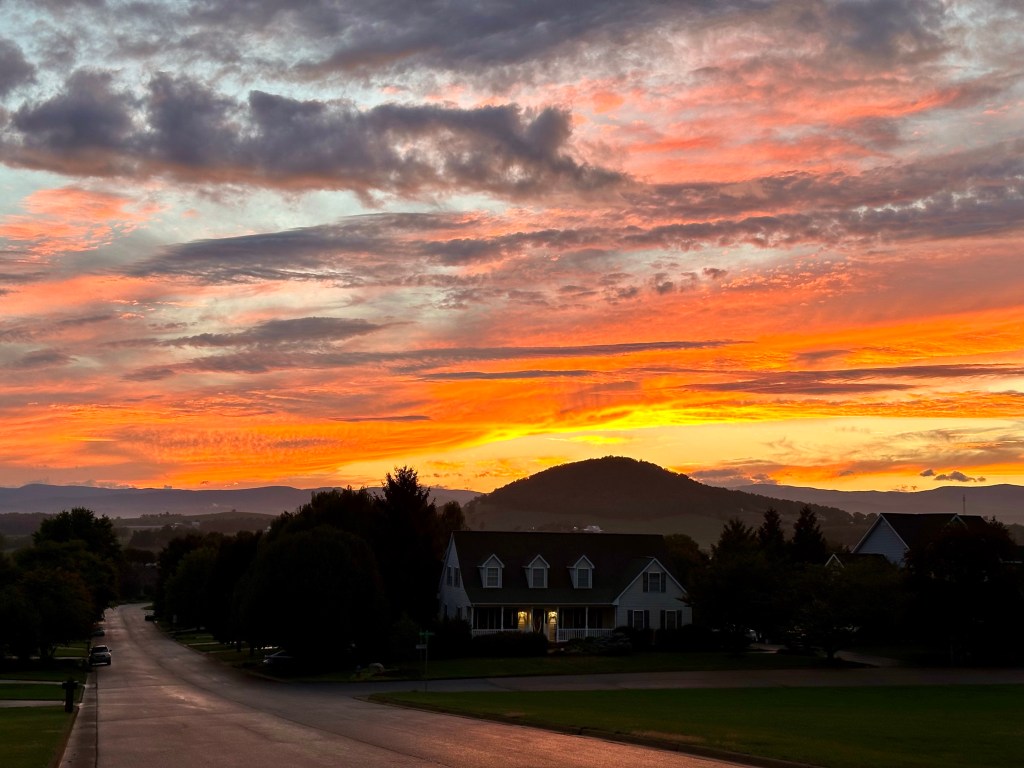
In contrast, the December 7 sunset was explosive. As sunsets want to do, the colors transformed minute-by-minute as I changed locations to photograph the gorgeous scenes. This photo was taken from a roadside near my home.
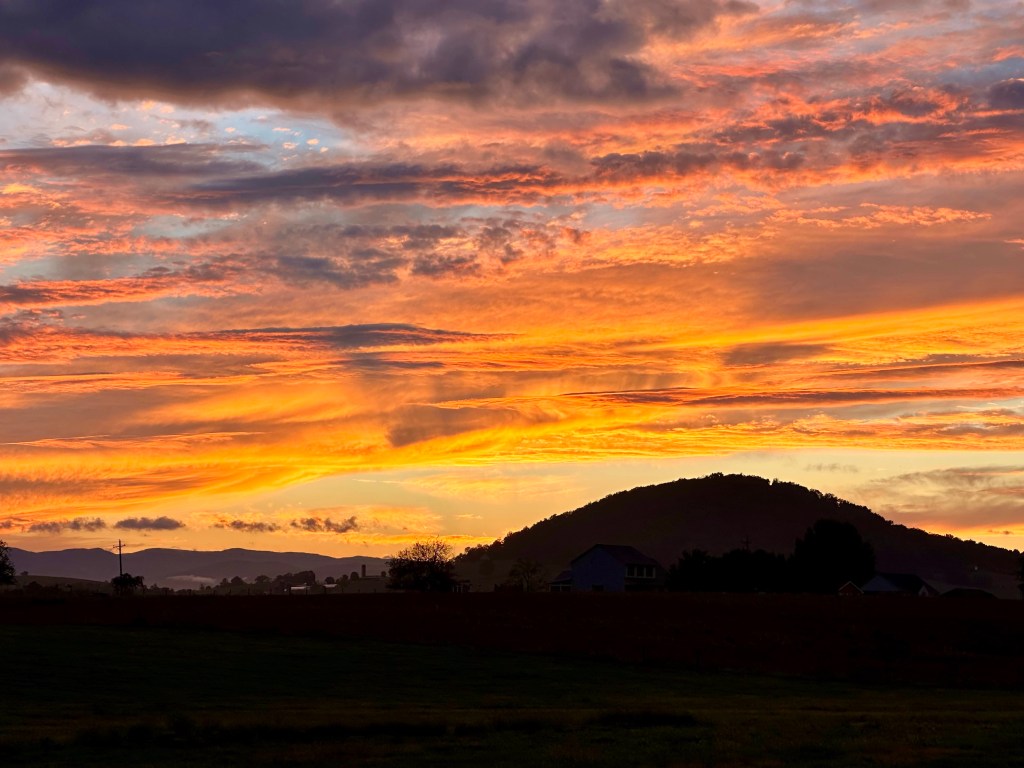
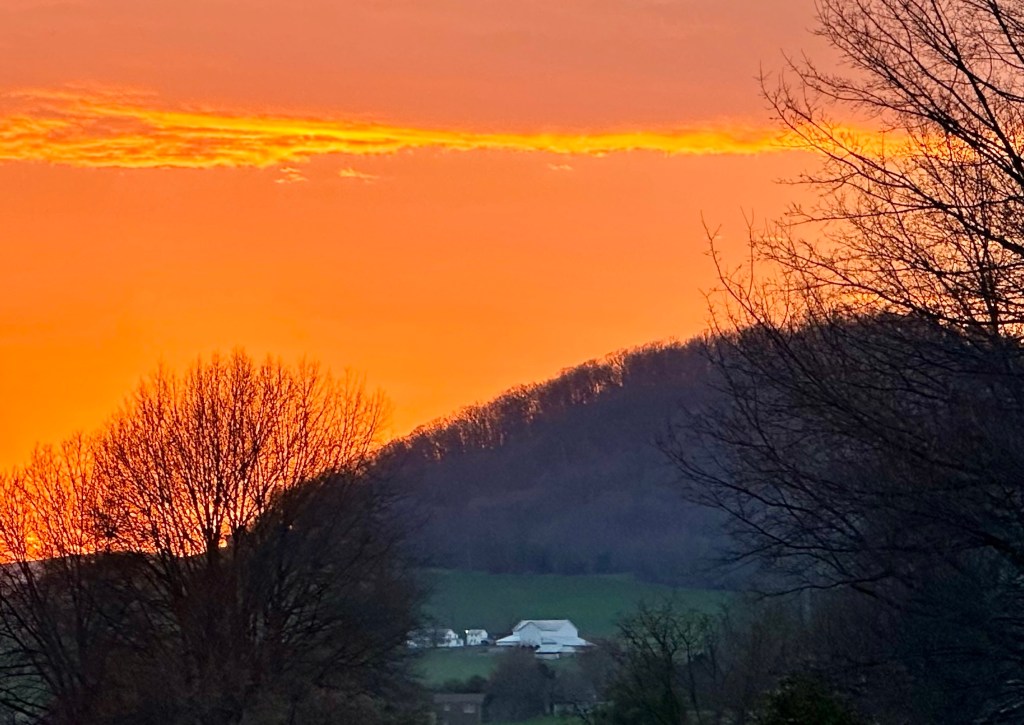
Only six minutes later, the sky had transitioned to bright orange and scalloped grays over a local landmark: Mole Hill, a long-dormant volcanic core.
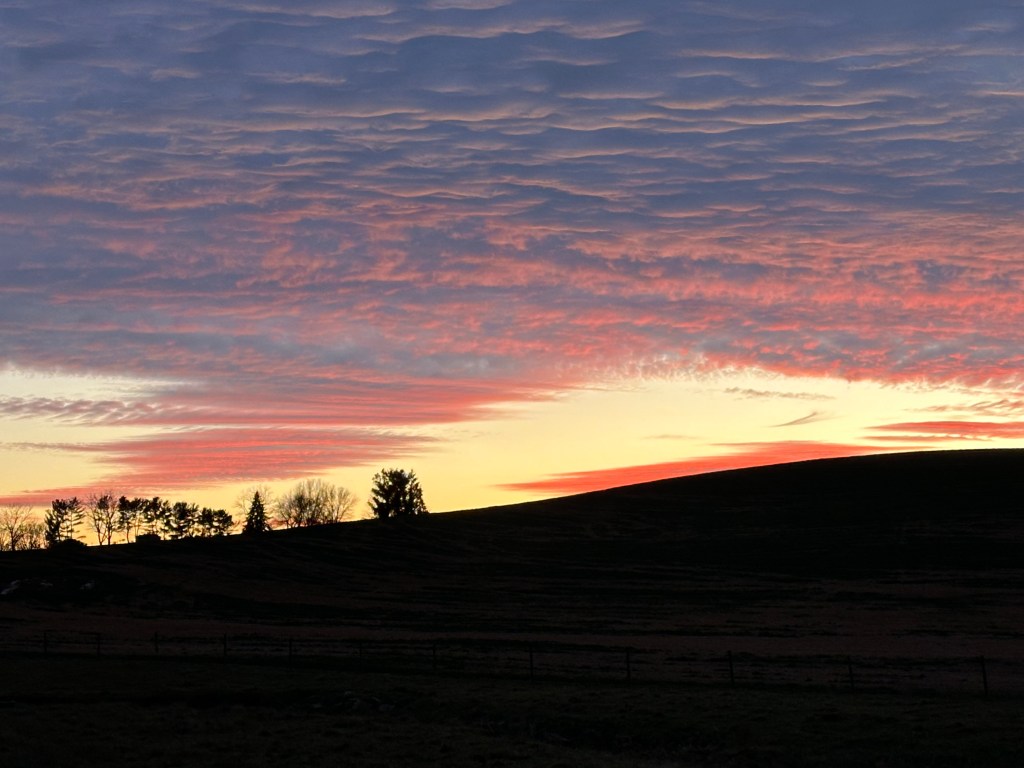
As I drove farther west, the sun sank behind the old, folded Appalachian Mountains. Still, earth and sky combined to provide photographic offerings.
Finally, it was time to head home, basking in the satisfaction of a marvelous sunset.
The following day, I woke in time to catch the last of a glorious dawn. A high hill blocked our view to the east, so I had to rely on peeking out a window to see what the sky had to offer. A friend who lives on a hill facing east posted the full sunrise on social media, replicating the previous night’s sunset beauty. So, I had to be happy with my backyard shot.
That’s how we live each day. We embrace whatever we discover, capture its essence, and share the blessing with all we meet.
The first week of September brought a variety of photographic opportunities and emotions. I’ll let the week’s activities play out in the photos and captions.
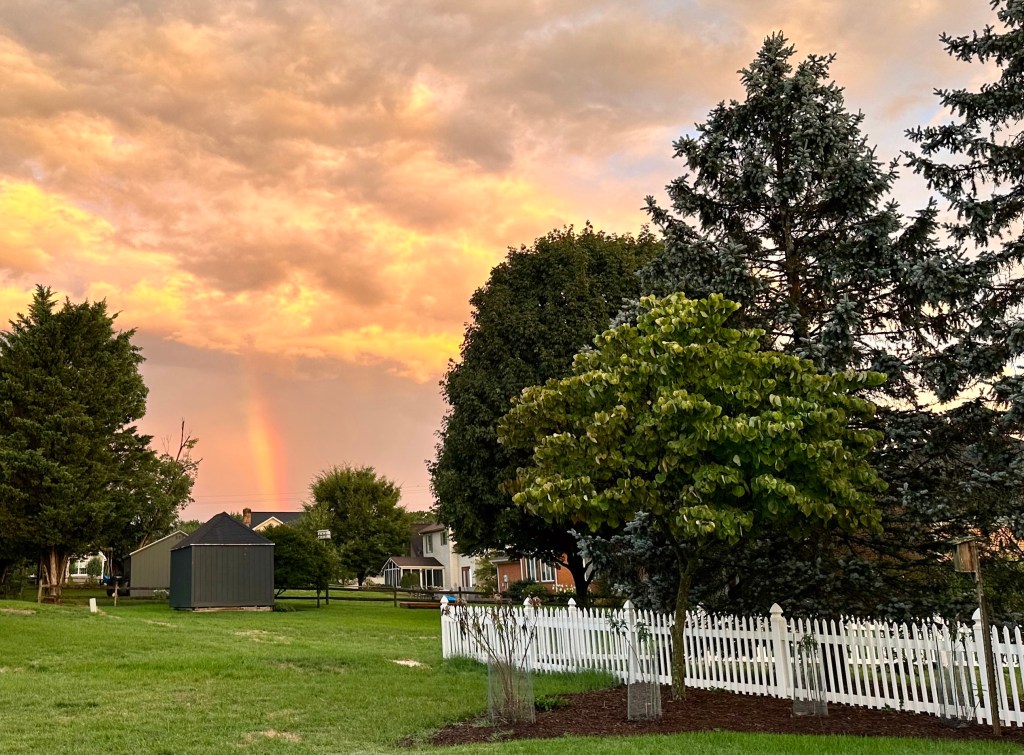
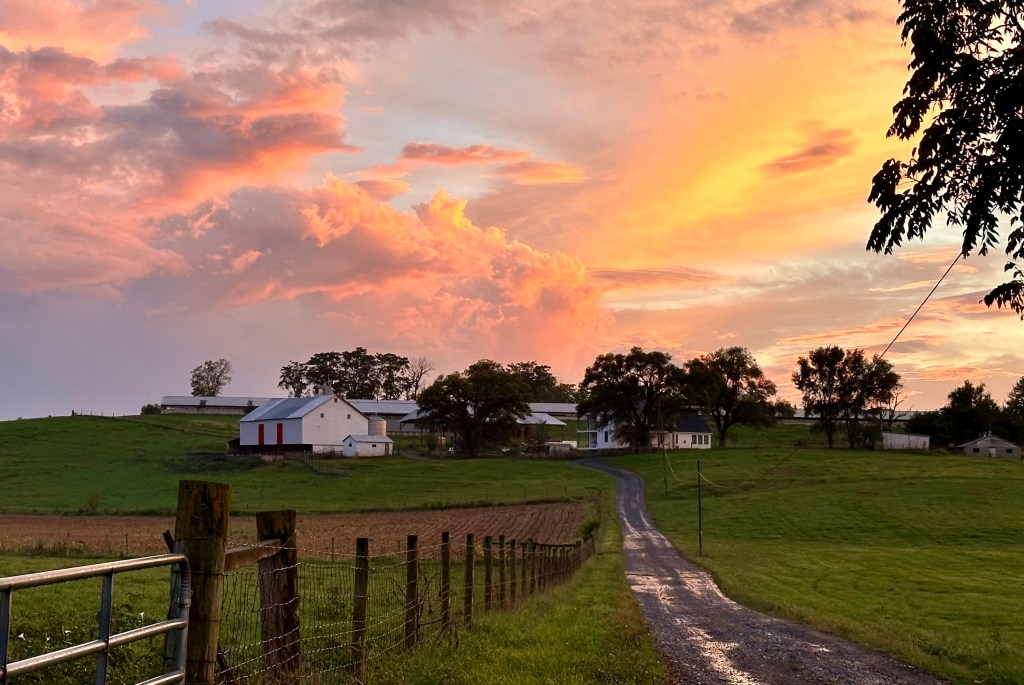
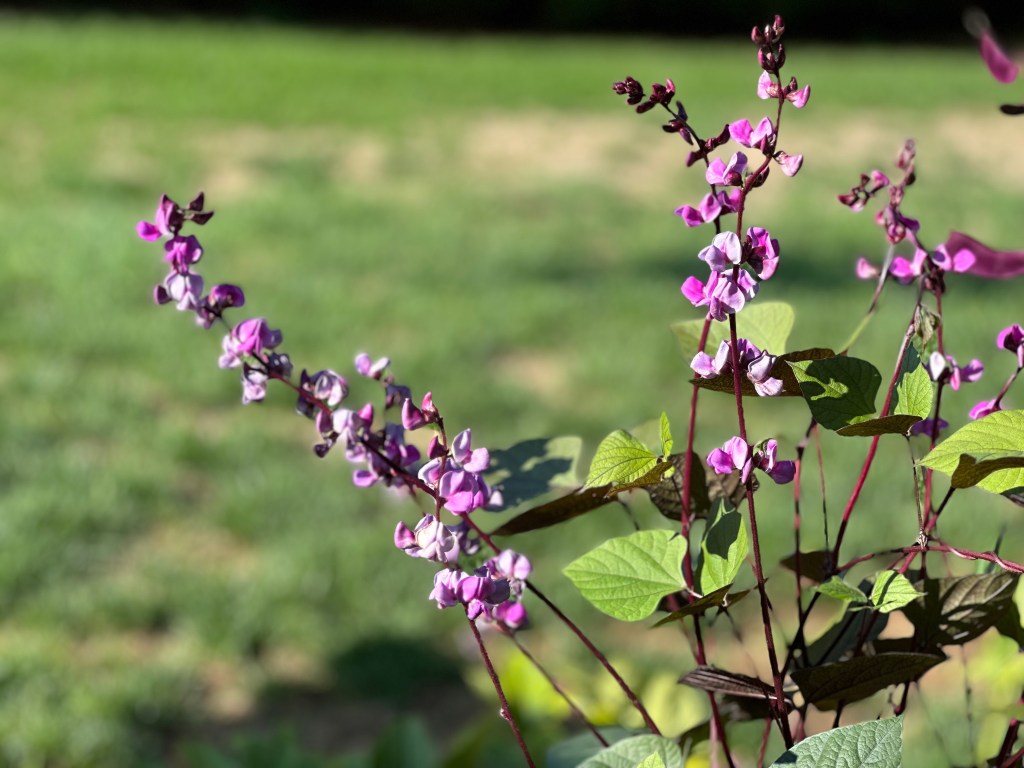
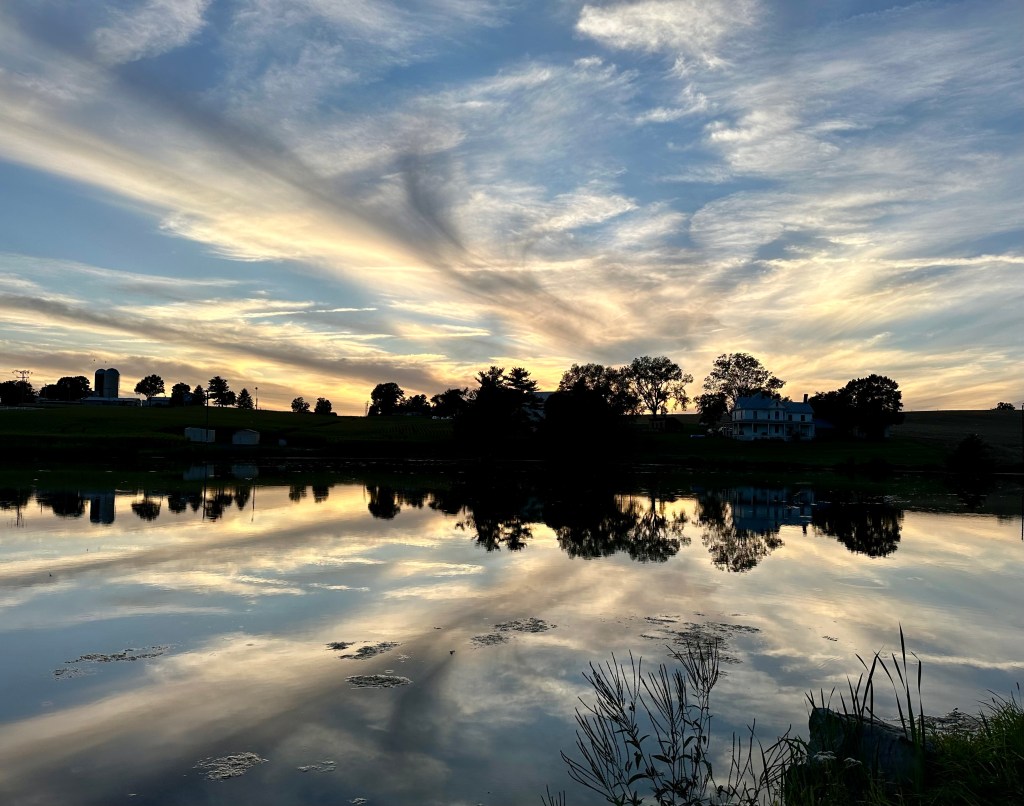
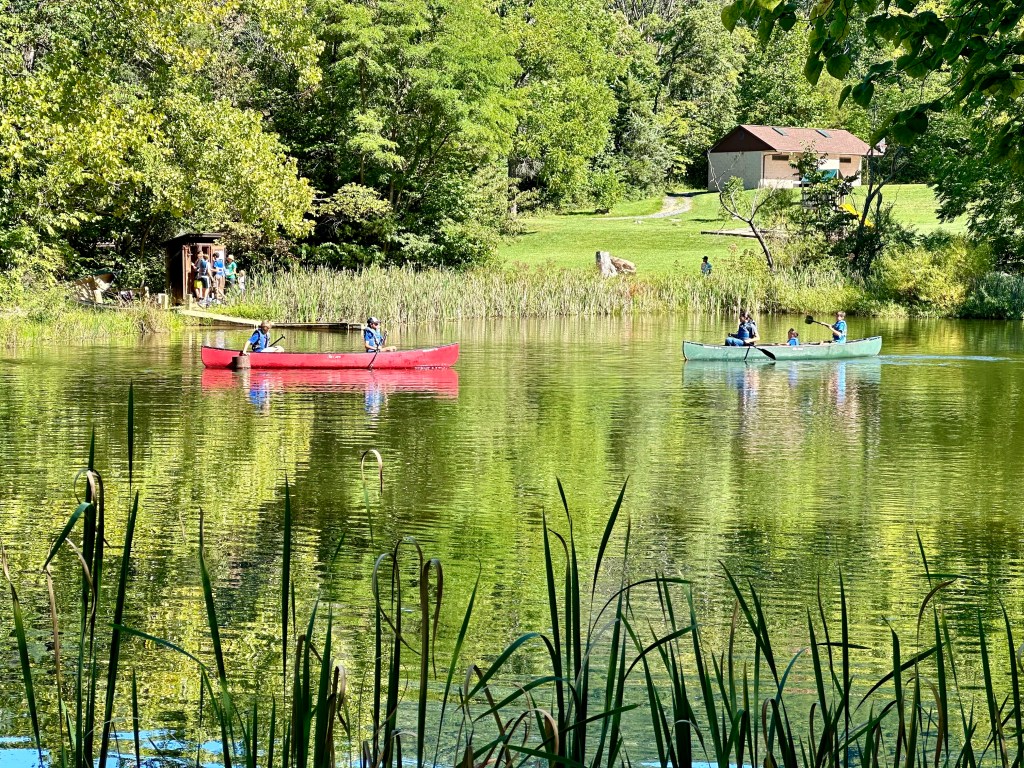
My wife and I spotted this hot air balloon sailing over our neighborhood on our regular morning walk. Photo by Bruce StambaughWe celebrated communion at church. Photo by Bruce StambaughA storm front brought much-needed rain Sunday evening, leaving a rainbow spawned by the setting sun’s rays. Photo by Bruce StambaughSunday’s sunset exploded with a multitude of texts and colors. This photo was taken on Sunny Slope Farm. Photo by Bruce StambaughMole Hill, an extinct volcanic core, always makes an excellent foreground for the sunset over the Allegheny Mountains. Photo by Bruce StambaughFog rose from the Dry River in western Rockingham County that Sunday evening while grays and mauves dominated the southwestern sky. Photo by Bruce StambaughThe sky’s drama continued as I drove home on September 1. Photo by Bruce StambaughThe backyard Hyacinth bean plant was in full bloom in the morning sunshine on September 3. Photo by Bruce StambaughEvening clouds splayed over Silver Lake near Dayton, Virginia, on September 3. Photo by Bruce StambaughThe evening’s thin cirrus clouds made it seem like old Mole Hill was erupting. Photo by Bruce StambaughOn the west side of Mole Hill, the soft sunset seemed to emmite striated clouds. Photo by Bruce StambaughAs I watered our thirsty flowers, shrubs, and trees the following evening, I spotted a Black Swallowtail caterpillar. Photo by Bruce StambaughI attended an excellent lecture and gallery preview by photojournalist and filmmaker Morgan Heim at Eastern Mennonite University on Friday morning. Photo by Bruce StambaughWe ended the week by attending our church’s annual retreat at a camp at the base of Massanutten Mountain northeast of Harrisonburg. Photo by Bruce Stambaugh
Our suburban home near Harrisonburg, Virginia, faces north. That requires me to constantly check east and west around dawn and dusk for any hint of a colorful sunrise or sunset.
My chances of catching a lovely sunrise have to be more intentional. The older I get, the easier it is for me to sleep past the sun’s morning appearance. Seniors seem to have a sleep cycle similar to that of newborns. I fall asleep fine, but staying asleep is another matter. Consequently, my awakenings in the middle of the night contribute to my sleeping pattern. I toss and turn and then sleep soundly until sun up.
So, I have many more Virginia sunset photos than sunrises. I walk in the neighborhood as often as I can, and I especially like doing so in the morning.
The morning sun highlighted a farmstead on Mole Hill. Photo by Bruce Stambaugh
The other day, my wife and I were about to begin our morning stroll when I noticed the sun shining on a farmstead on the eastern slope of Mole Hill, a local landmark. Mole Hill is the remnant of a volcanic core from millions of years ago. Over millennia, nature’s elements have weathered and withered the basalt down into a gently sloping geographic feature resembling a molehill, thus its name.
With my camera at the ready, I captured the sun highlighting this old homestead. I didn’t think much of it then, but that changed the following evening.
I wasn’t too hopeful for a glowing sunset, yet when I looked out, the sky radiated orange across the western sky. I knew my only chance for a photo was from the middle of the street in front of our home. So, I did that, standing at nearly the same spot as the morning photo of Mole Hill.
The farmstead stood out even with the setting sun behind it. Photo by Bruce Stambaugh
In one of the photos, the same farmstead stood out, even on the shaded side of the historic hill. I don’t tinker with my photos, so this eerie highlight simultaneously puzzled and intrigued me.
Call it what you will. I’m glad the sun shines on Mole Hill morning and evening.
Sunset over the Allegheny Mountains. Photo by Bruce Stambaugh
I watch the sky for any hint of a colorful sunset. I have to go outside to do so since our house faces north. The view southwest, where the winter sun disappears, is obstructed by neighboring evergreens and houses.
When I think the potential for a colorful evening sky is favorable, I grab my cameras and head west. Mole Hill, an extinct volcanic core, is one of my favorite spots.
From Mole Hill, I have panoramic views in every direction but east. Recently high, wispy clouds stretched across the sky like fingers from the Allegheny Mountains 30 miles to the west. It looked good for a blazing sunset.
However, by the time I reached Mole Hill, upper-level winds had scattered the clouds, except right over the mountains where the sun would disappear. I waited, nevertheless.
My patience paid dividends. While the sky over the old-age mountains blazed orange behind the stubborn clouds, pinks and mauves blossomed south, southeast, and north. I happily snapped away.
I was out watering plants and trees last evening since we haven’t had any rain for several days. Suddenly, the western sky turned bright golden.
I quickly wrapped up my watering, grabbed my camera and iPhone, and headed to a close location with an open view to the west. The golden glow had faded. The sun disappeared behind the Allegheny Mountains, but dramatic color remained.
The farmer had already cut the enormous cornfield and had turned loose steers to forage for spilled corn cobs. With Mole Hill to the left and the sunset’s remnants still lingering above the mountains, it looked like a scene out of the old west, not the Shenandoah Valley.
The vista was a beautiful way to close out the first day of September.
I searched for a decent location to photograph the latest lovely sunset in the Shenandoah Valley. I stopped when I came upon this scene of young steers grazing.
The Black Angus scattered in the rolling pasture filled the foreground, while the local landmark of Mole Hill, an extinct volcanic core, dominated the background. The sunset orange-tinted cloud hovered over the Allegheny Mountains in the distance. I imagined old Mole Hill had exploded out of eons of dormancy.
Mole Hill is a landmark in Shenandoah Valley’s Rockingham County. The forested nob is actually the remnants of a volcano’s core. That hasn’t deterred locals from farming and living around its base.
Mole Hill is properly named. The Allegheny Mountains in the western background dwarf it in comparison. Still, Mole Hill attracts birders, bikers, and sunset gazers alike.
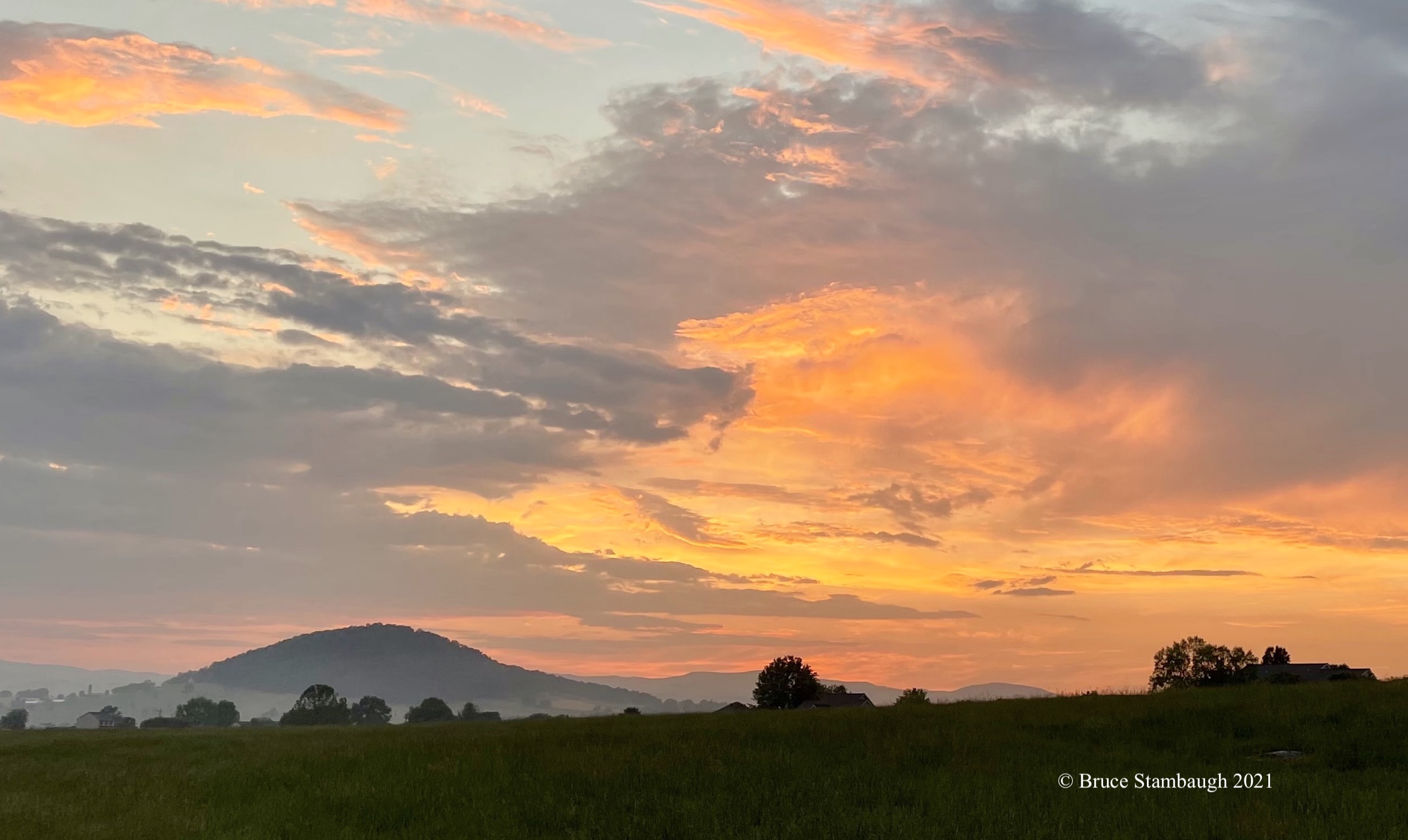
This photo was taken about two miles east of Mole Hill near Harrisonburg, Virginia. With evening fog setting in, the fiery sky looked as if it had recently erupted from this local favorite hotspot.
I never met Ron Garitone, the late mayor of Wallace, Idaho. I’m sure I would have liked him if only based on one creative decision he made for his small mining and timber town located in Idaho’s panhandle.
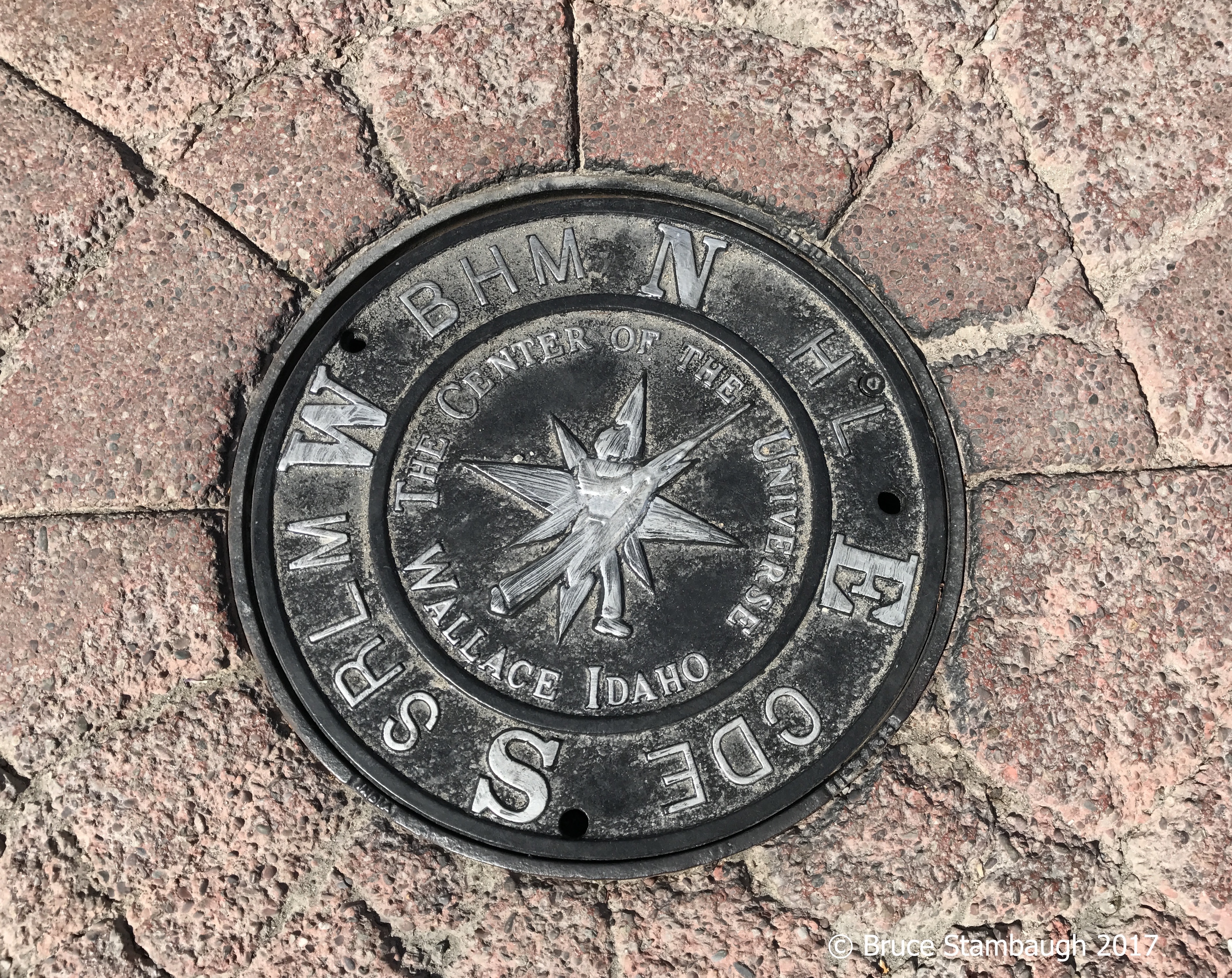
Pushed on an environmental issue by the EPA in 2004, the mayor was told, “If a thing cannot be disproven, it is thereby proven.” The incredulous but affable mayor called the government’s bluff. He proclaimed his beloved Wallace the Center of the Universe because his claim could not be disproven, he said. His proclamation gained international attention. Wise town leaders seized on the idea and installed a fancy manhole cover that doubles as a marker in the middle of the main intersection declaring Wallace as the center of the universe. Blue and white tourist signs mark the spot.
The proof is in the manhole cover.
As I stood there admiring the designation with no fear of the typically light traffic, I flashed back to my early Holmes County, Ohio days. Impressed with its rural location and horse and buggy prominence, people who visited us, including several of my family members, asked me why we lived there. I had a ready answer for them.
“We live here because Holmes County is the center of the universe.” That usually brought puzzling, blank looks. So I’d clarify. “If I want to see anything else in the world, I have to leave here.”
I was joking of course, much like the good-humored mayor. However, there was a grain of truth to the statement. Rural counties universally can’t offer all that their citizens need. Folks travel to more urban areas for entertainment, sporting events, doctors, shopping, and fine dining to name just a few.
Sometimes everyday items can’t even be bought in the heart of Ohio’s Amish country. Specifically, it’s a fact that neither gasoline or alcohol can be purchased in either Saltcreek, Holmes County or Salt Creek, Wayne County. That point carries far beyond those two commodities.
Autumn in Ohio’s Amish Country.
Nevertheless, the faithful residences of the greater Holmes County area still love where they live. In my nearly seven decades of living, I’ve found that most folks feel the same way about where they reside no matter where they call home. Home is home. It’s all they need, sometimes all they know. As far as they are concerned, it is indeed the center of their universe.
If we all feel that way, we can’t all be right. The truth is we all have bragging rights to that claim. Each of us is entitled to make that statement. But that does not diminish the other towns or peoples.
I know that is true from having lived all of my adult life in Holmes County, Ohio, where I spent my most precious and productive years. To me, it was the center of the universe. It must have been. It attracted three to four million visitors a year.
Now my view has changed, right along with my life’s purpose and priorities. I have a new center of the universe from which to operate. I can see it every time I walk to the mailbox, every time I travel down Pin Oak Dr. Mole Hill greets me, calls me, as it does so many others.
Mole Hill is an ancient volcano now covered with dense woodlots, lovely homes, and fertile farm fields. Mole Hill is simply unmistakable and is the landmark by which all folks within its eyeshot navigate. In western Rockingham County, Virginia, Mole Hill is the center of the universe. I dare you to prove otherwise.
















 Roadkill Crossing
You must be logged in to post a comment.