A lone young man sits contemplatively among spring’s glorious colors. Photo by Bruce Stambaugh
The Edith J. Carrier Arboretum in Harrisonburg, Virginia, is a marvelous place to contemplate life’s challenges, changes, and celebrations. That’s especially true in spring when the trees, flowers, and shrubbery come alive with their soothing colors.
I went there to pick up a tree I had purchased in the arboretum’s annual fundraising plant and tree sale. What should have taken me only a few minutes turned into two and a half hours. The arboretum’s beauty drew me in like a bee to pollen.
I strolled, not wanting to miss any opportunity to photograph flowers, leaves, or birds. Near the end of my walk on an elevated trail, I spotted a young man, possibly a college student, sitting alone on a bench near the pond. The arboretum is part of James Madison University’s campus.
I captured this scene from afar, hoping this individual used the inspiring setting to enhance his meditation.
We live in a noisy world. It’s hard to find pure silence to simply listen, ignore the busyness of your mind, and relax without interruption.
When I saw an invitation to participate in a Contemplative Sit at the end of the daily devotion I received via email from Richard Rohr, I clicked on it. I instinctively knew I needed the 12-minute exercise to calm my mind, body, and soul. I didn’t realize how hard it would be.
The Reverand Dr. Barbara Holmes led the video presentation. The screen was a lifeless gray, with the title “Contemplative Sit” half grayed out. Once the single chime of a small bell rang to begin the exercise, I closed my eyes, thinking I could better concentrate on breathing in and out. It wasn’t to be.
I thought about last night’s sunset, the high gray clouds reflecting the sun’s warm glow. Our mother star had long since sunk below the Allegheny Mountains. I waited then for the warm beauty of the sky and now for a fulfilling silence.
I heard a crash from the video I knew wasn’t part of the meditation. I opened my eyes and saw the countdown to skipping another YouTube ad. I immediately clicked it away. Then I noticed the words, “We focus on the breath going in and out of the body.” I realized I needed to keep my eyes open to be fully engaged.
At that moment, however, I became acutely aware of all the noise around me. My neighbors across the street were mowing their yard in their usual father-and-son tandem. The sound of the two mowers competed with the tinnitus in my ears. I had buzzing external and internal competition to distract me.
Ironically, only then did I hear the video’s faint ebbing and flowing of wind rustling over a prairie, a desert, through tree limbs. I couldn’t tell, and it didn’t matter. I concentrated on my breathing. I unconsciously rubbed my hands on my thigh bones down to the knees and back to the hem of my kaiki shorts.
A single-engine plane flew a few hundred feet over the house, probably from the local private airport eight miles away. Its sturdy engine soon carried it out of earshot.
Was I failing this intentional time of contemplation? I let go of that judgment and refocused on my breathing. I spied a mother robin bobbing in the grass beneath the red maple tree in our front yard. She had speared an insect, likely to help feed her second brood of the summer.
My cell phone dinged. Another person in the group text commented on my friend Mike’s release from the hospital. I breathed a breath-prayer of thanks and gratitude.
A morning breeze rustled the leaves and bounced the smaller limbs of the maple outside my window. Still, I heard the wind’s faint rhythm coming and going from the video. Two Goldendoodles from the neighbors down the street barked, a regular occurrence. I continued breathing, letting go, and focusing on silence without self-criticism.
A pair of Northern Cardinals flew into the maple tree, and the video bell sounded the meditation’s end. I felt free, rooted, and ready to face the rest of the day.
I hadn’t planned on doing this meditation. But I have always enjoyed spontaneous activities that arouse my senses of the world around me. This morning’s experience was an unexpected but necessary infusion into another day of joyful living.
(I have included the link to the meditation if you are interested.)
A balmy day in the Shenandoah Valley.
When I drive alone, I often meditate.
It’s not what you might think. I don’t close my eyes, of course. I just enjoy the peace and the time alone to think. I don’t forget about driving. It would be both foolish and dangerous to do so.
I try to allow extra time for a more leisurely drive. I avoid superhighways. Backroads are my preference because I never know when I might need to stop to take a few photos of the fantastic scenery that Virginia’s Shenandoah Valley affords.
Unlike my younger years, I drive silently. No radio, no CDs playing. I enjoy the quiet unless the road surface is too rough. Then I take in the music that my tires sing to the tune over the various macadam surface textures. The octaves change by the mile.
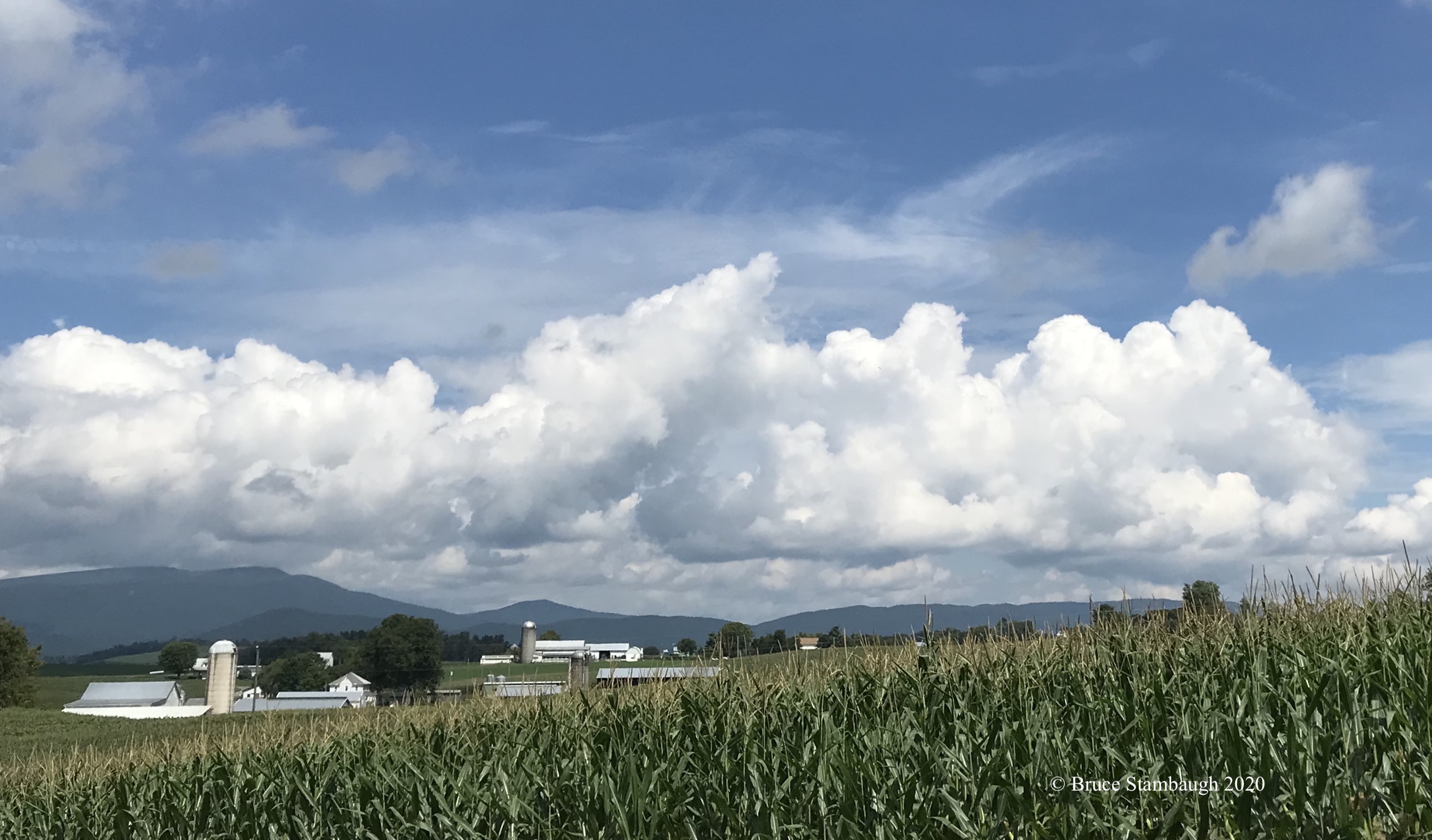
I’ll use the GPS when I have to. Once I know the way, however, I am on my own, like the other day when I had a doctor’s appointment 35 miles away. A typical farm in the Shenandoah Valley.
I left nearly two hours before my 2 p.m. appointment. Besides a couple of brief planned stops, I knew there would be photo opportunities along the way. I had been that route before.
Driving in that contemplative state helps to clear my mind from all of life’s noisiness. Plus, I get to enjoy the mountains to my left and mountains to my right. In between, there is nothing but gently rolling countryside dotted by farms, fields, forests, and more gigantic chicken houses than I care to count.
Weather permitting, I ride with the windows down and the sunroof open. I sometimes pay the price if I pass a freshly manured field.
This trip turned extra-special. Once I passed Sulphur Pump Road, I turned south on the narrowest windy way with no ditches and farmers’ fences hard against the blacktop.
The paved path twisted and turned, rolled up, down, and around until I made a slight right onto Battlefield Road. In less than a half a mile, I crossed a short narrow bridge in the curve of the road. Ahead, an old plantation sat high on a ridge behind a grove of mature pines. The spot where young men died in the Civil War Battle of Bonnie Doon.
At this exact spot at the bottom of the hill, Americans fought Americans in a Civil War skirmish. Hand-to-hand combat ensued, with heavy casualties on both sides. Today, fruit trees and fence line trees waved in the wind.
No historical marker identified the bloody spot. I knew it from a Civil War class that I am taking remotely. It was this week’s lesson.
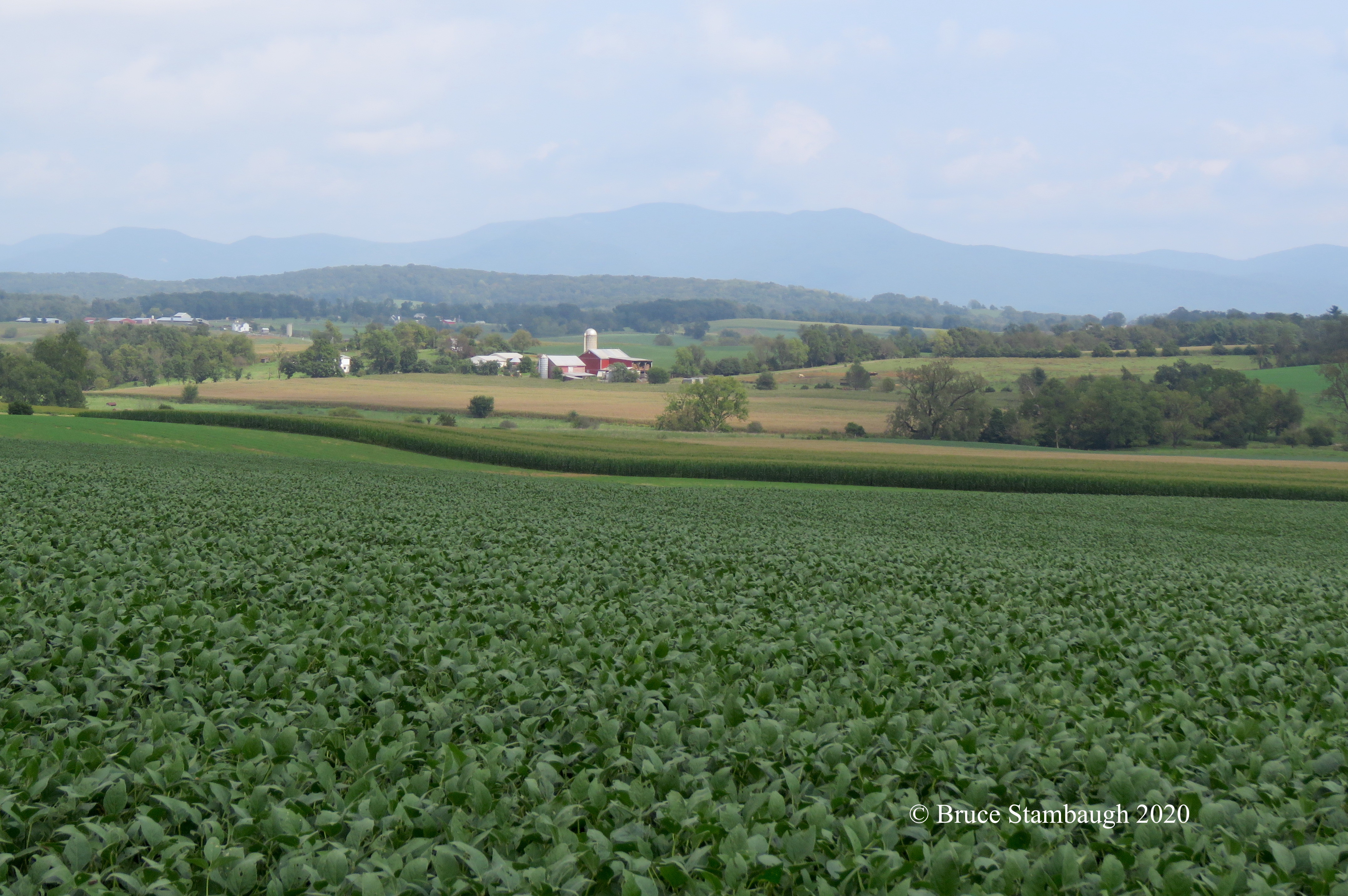
Farther south, a couple of miles, two different historical markers on opposite sides of the road defined the facts and sight of a deadlier clash, the Battle of Piedmont. Field corn and an impressive planting of soybeans nearly hid both plaques, while the Blue Ridge Mountains and Shenandoah National Park created an enchanting backdrop.
I wondered if people knew what had taken place here, the massive loss of life, the many casualties, and prisoners of war, the consequence of the Union victory. If they knew, did they still hold a grudge or even care?
Did they appear only as fields of corn and beans to them? Were people merely on their way from point A to point B in their daily lives as they passed?
I pondered all of this as I arrived at the impressive multi-storied medical office building. I donned my mask, had my temperature taken, responded in the negative to all of the required COVID-19 questions, and waited my turn for my 21st-century exam.
During my morning devotions, I try to include a brief time of meditation. A recent theme focused on observing rather than reacting with anger, fear, or judgment to human interactions.
Little did I know then that before the day would end, I would personally apply that lesson.
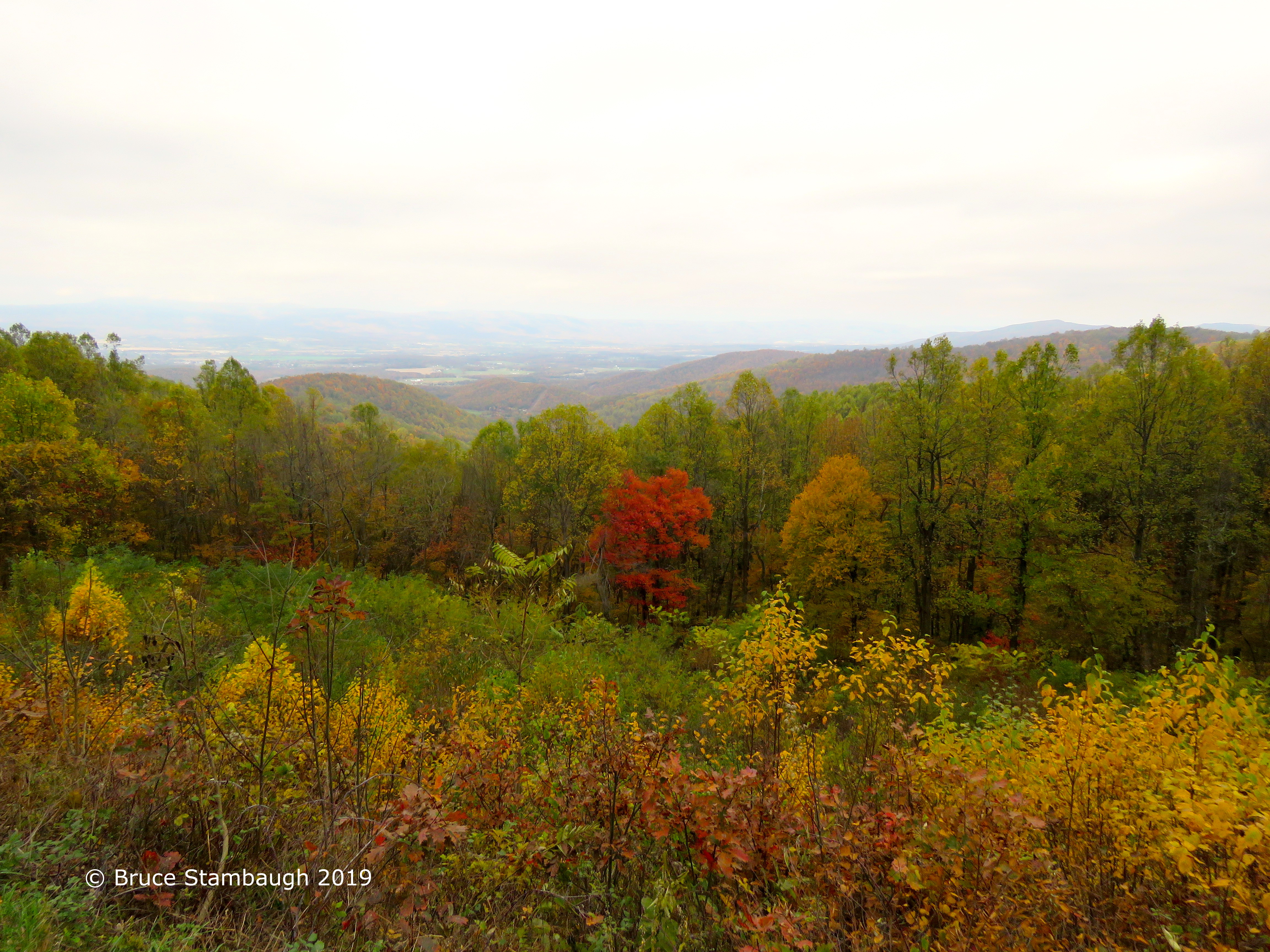
The day was foggy in the Shenandoah Valley. Random openings in the haze allowed the morning sunshine to poke through. The Blue Ridge Mountains, however, were socked in. I wanted to go there for one last chance to capture the beauty of a Shenandoah fall.
With the hope that the sun would eventually burn off the overcast, I headed to Shenandoah National Park. By the time I arrived shortly after noontime, that is precisely what happened.
Driving along the park’s extolled Skyline Drive is a joy at any time of the year. It is an absolute privilege to experience the fantastic colors of the fall foliage.
The park burst with scarlet, red, yellow, orange, amber, russet, brown, and crimson. Each hue complemented the others. I drove in the fresh, moist mountain air with the moon roof open and the windows partially down, taking in the autumn’s sights, sounds, and pungent fragrances.
I made several stops to photograph the scenery and finally recognized my fatigue at Big Meadows, where I stopped for lunch. The combination of my emotional exhilaration and the numerous times of exiting and reentering my vehicle had tired me. It was a reminder that my leg still had healing to do.
I retraced my route. Fog still rolled up out of the hollows and dissipated before my eyes. I continued to pull into nearly every overlook to capture the gorgeous splendor.
At my last stop, I reached for my camera, but it wasn’t there. I quickly searched in the vehicle, but the camera was gone. I must have left it on a stone wall at the last overlook where I had paused for an afternoon snack.
This slideshow requires JavaScript.
In the five-mile backtrack, my thoughts ticked off the options. It could still be there. Someone may have turned the camera in, or it was gone.
For most of my life, I have been my own worst critic. I berate myself when I err or let my emotions control my mood because of a negative situation. Not this time.
Remembering the morning’s meditation, I mentally weighed the consequences of my lapse of concentration by leaving the camera. I also accepted the situation without self-judgment.
Where I lost my camera.
I had captured dozens of photos of the incredible scenery. Now, they could be lost. I still had the day’s experience, however. That would be serenity enough, camera or no camera.
When I arrived at the overlook, the camera was nowhere to be found. I used my best option. I returned to the Big Meadows visitors’ center and reported my camera missing.
I headed south again, making a couple of more stops before I arrived at the Swift Run entrance station, where I access the park. I asked the ranger if anyone had turned in a camera. To my amazement, she said a young woman had given her a camera only 30 minutes ago. It was mine!
Of course, I was ecstatic to have the camera back, but not as delighted as I was with my self-control. No anger, no negative thoughts, no self-blame had arisen.






 Roadkill Crossing
You must be logged in to post a comment.