Have hat, will travel

hatsbybrucestambaugh
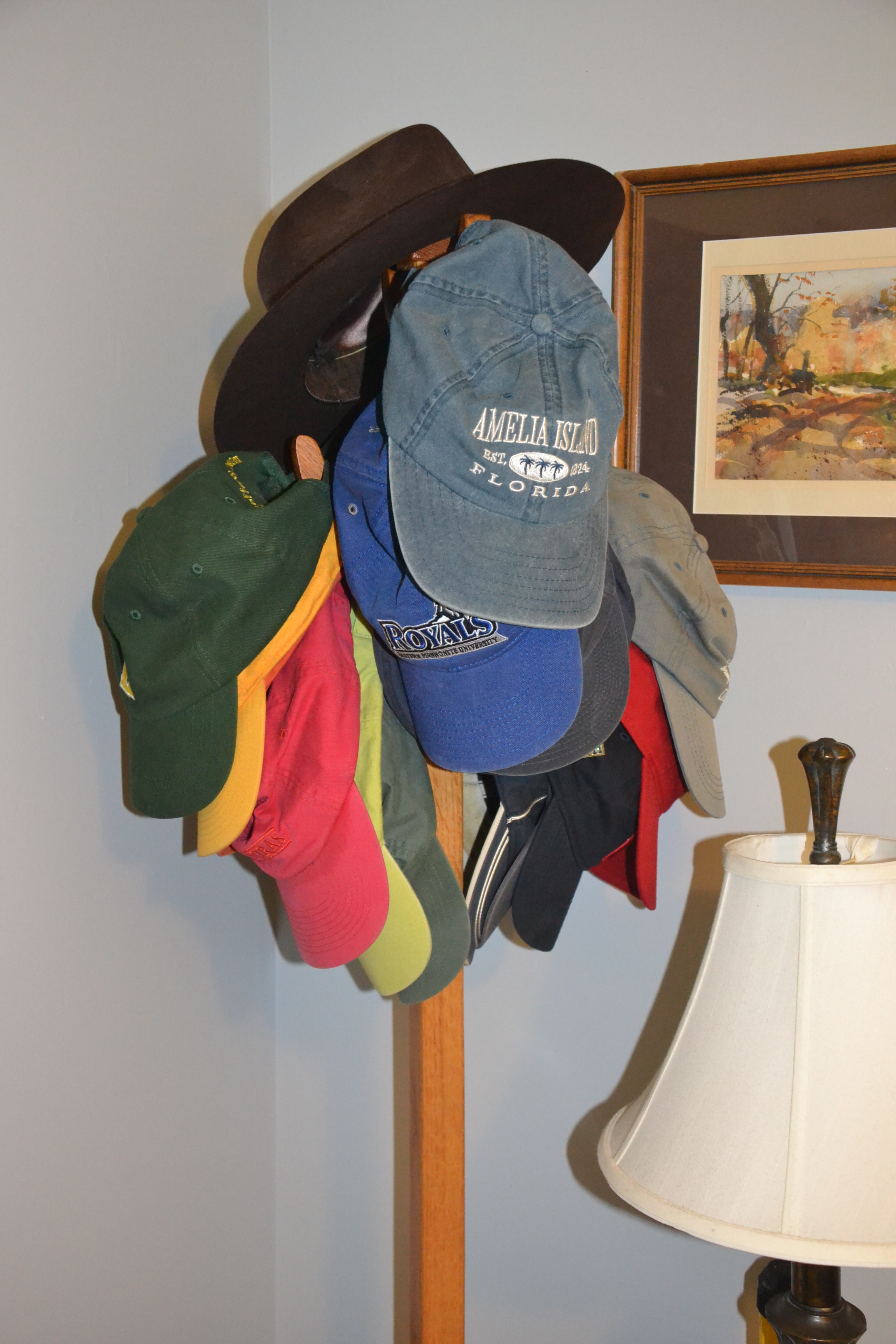
Some of the hats in my utilitarian collection.

By Bruce Stambaugh

People collect all kinds of things when they travel. Post cards, plates, jewelry, T-shirts and mugs are popular items. Souvenir shops in any touristy locale confirm that.

Me? I collect hats, more out of necessity than sentimentality. Given my lack of hair, I call it BPS (Bald Protection Syndrome). At least I have a practical use for my hat hobby.

BPS is the only way I can explain my obsession with hats. Baseball caps, golf caps, air-cooled hats, even a cowboy hat, define my collection.

It dawned on me that my assortment of hats really represents a segment of my personal history. I look at a hat, and I can usually recall where I bought it or in some cases, like the cowboy hat, who gave it to me.
hatrackbybrucestambaugh
Not a spot to spare on my hat rack.
The hats hang on an oak hall tree that a dear friend made for me. The hall tree stands in a corner beside my bed. The hats are the first things I see in the morning and the last at night, keeping the memories fresh in my mind.

The brown, broad-brimmed, pressed velvet Stetson cowboy hat occupies the pinnacle of the hat holder. That’s no coincidence. My daughter and her family gave it to me as a present several years ago when they lived in Texas. I wear it only on rare occasions.

I collect hats the way Imelda Marcos saved shoes. Each peg of the faithful hat rack is full of hats and memories. The hats come in different shapes and colors, but most are ball caps. All generate vivid recollections.

I have too many from a favorite vacation spot, Lakeside, Ohio. I don the bright yellow hat with a big blue block letter “L” on the front most often.

Perhaps some of my favorite hats are the ones I acquired while participating in some special activity. I have a handsome brown cap with the sun rising over the profile of a mountain, all stitched in white. I got that one at the state park where I once hiked and birded in Arizona.

Another hat I wear a lot is the one I received for attending a birding symposium. It should come as no surprise that the hat features a bird on the front.

Still another hat I obtained in Arizona and bought especially for birding is a lightweight, broad-brimmed, air-cooled canvas hat. I only wear it when it’s hot or when we go to the beach with the grandkids.

Two hats in my collection have extra-special meaning to me. I purchased both in Honduras. One is bright red with orange lettering that spells out the name of the poor Central American country.

meandmyhatsbybrucestambaugh
I’m happiest in hats.
The other Honduras hat is black with a red rooster on it, which is very apropos. As unstable as the Honduran government is, I think the roosters actually run the country. They are everywhere and don’t bother to wait for the sun to rise to announce their presence.

The pride and joy sports hat in my collection is bright red with a raised deep blue block “C” on the front. I wear it when I attend Cleveland Indians games to show my support for the often-hapless team. Wearing it may also reveal other blemishes in my character.

Some people collect stamps, others coins or antiques or teacups. I collect hats. Each one has a story and a special meaning.

Vacation season is here. More travel, more memories, and more hats ahead.

© Bruce Stambaugh 2013
No matter where they live, people are people

enjoyingthegamebybrucestambaugh
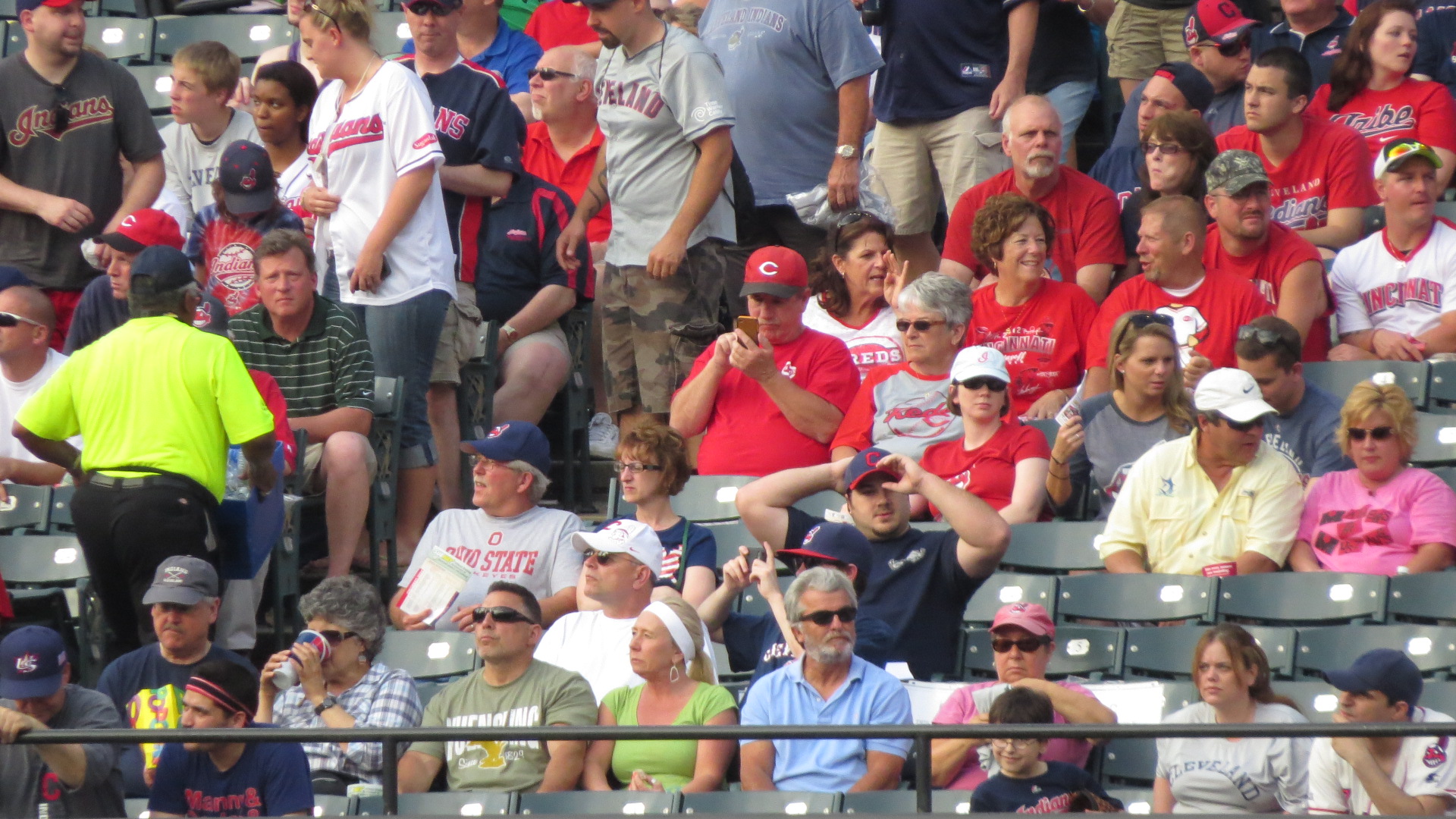
Baseball fans enjoying a game.

By Bruce Stambaugh

I find people fascinating, a joy to watch. I can easily pass the time observing crowds at airports, sporting events, meetings or shopping.

Humans come in a kaleidoscope of shapes, sizes, races and ages. They adorn themselves with a variety of intriguing duds and accessories. I marvel at and learn from their diversifications.

mariebybrucestambaugh
Marie was tickled pink that I wanted to take her picture on the dock at Lakeside, OH.
I remember a specific time many years ago when the shoe was on the other foot. My wife and I were visiting her cousin in southern California. Barb had two daughters, ages two and three months. Our daughter was two months old.

I was informed that we were going shopping one afternoon at the local mall. We were quite the sight and unintentionally created an intriguing distraction as we sauntered around the sprawling mall with a toddler and two infants in strollers and two lovely mothers and one man.

When I volunteered to care for the girls while the women ducked into a few stores, the fun began. We became the mall’s main attraction. The kids drew passing shoppers in like they were magnets.

I found myself engaged in conversations with people curious about the children. Were the babies twins? When I said they were born three weeks apart, I could see the mental wheels turning in the questioners’ heads.

When my wife and her cousin, who are close in age, returned to check on us, the eyebrows really arched. People’s non-verbal communication revealed their conceptual inferences about one man, two wives, and three little girls.

learningaboutconflictbybrucestambaugh
Dr. Catherine Barnes (center) taught the Conflict Analysis course during the Summer Peacebuilding Institute at Eastern Mennonite University, Harrisonburg, VA.

In reality, that’s how we operate as social beings. We reach conclusions based on what we see, and interpret observations based on our own life’s experiences and values. Many times, like my mall experience, those assumptions frame and tilt what reality is if the truth is not properly explored.

Recently I was asked what the single most important point I had learned at the Summer Peacebuilding Institute that I had attended in Harrisonburg, Virginia. The answer flowed easily.

“The most significant concept I learned was that people are people,” I said. Not exactly profound, but true nonetheless.

Not wanting to come across as cryptic, I further explained my seemingly glib answer. Based on what I had gained first hand from my global classmates, we all strive and often struggle for the exact same things. We desire basic human needs and rights regardless of our culture, race, religion, wealth, ethnicity, or gender.

groupprocessingbybrucestambaugh
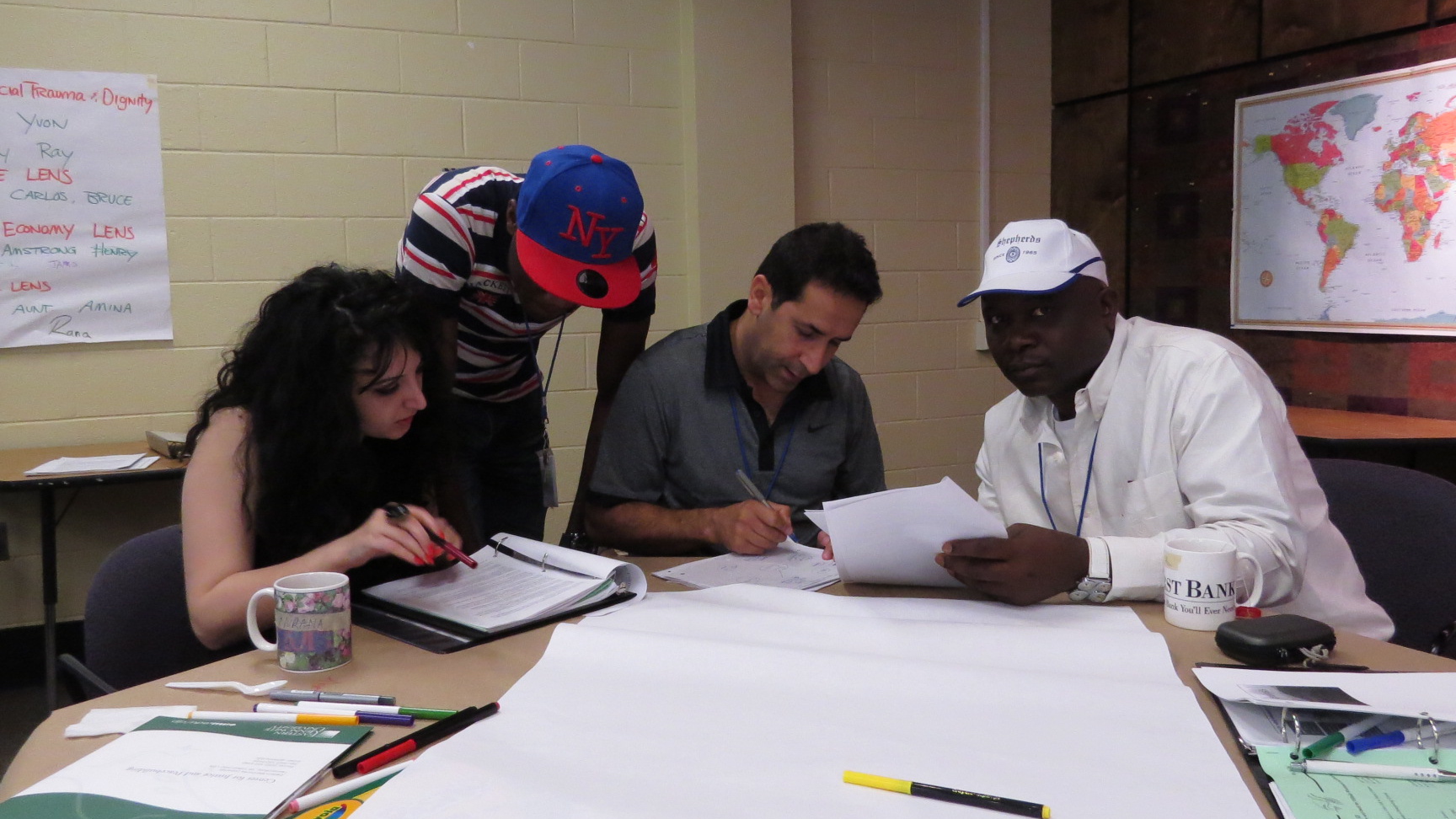
Much of the SPI class involved small group interaction among class members.

Our modest class consisted of female and male inhabitants from four continents, 13 countries, and multiple races and religions. Yet, we were all there for one common purpose. We wanted to gain practical and applicable methods for understanding and resolving conflict.

To that end, the cultures, traditions, and primary languages of each class member became secondary to the overall goal. No barrier would deter our learning, thanks to an outstanding professor guiding dedicated students.

We all had too much to lose by allowing prejudice to cloud our thinking. After all, most of the astute class members would return home to implement and teach the knowledge they had acquired. In too many situations, that would be done in hostile, dangerous, unstable conditions.

Our class discussions easily revealed that people universally desire the same life goals. We all need food, shelter, security, identity, dignity and the freedom to grow and explore in an ever-changing, challenging world.

No political bend could deny the obvious. Regardless of roots of origin, people are indeed people, and they ache to be treated accordingly.

classmatesbybrucestambaugh
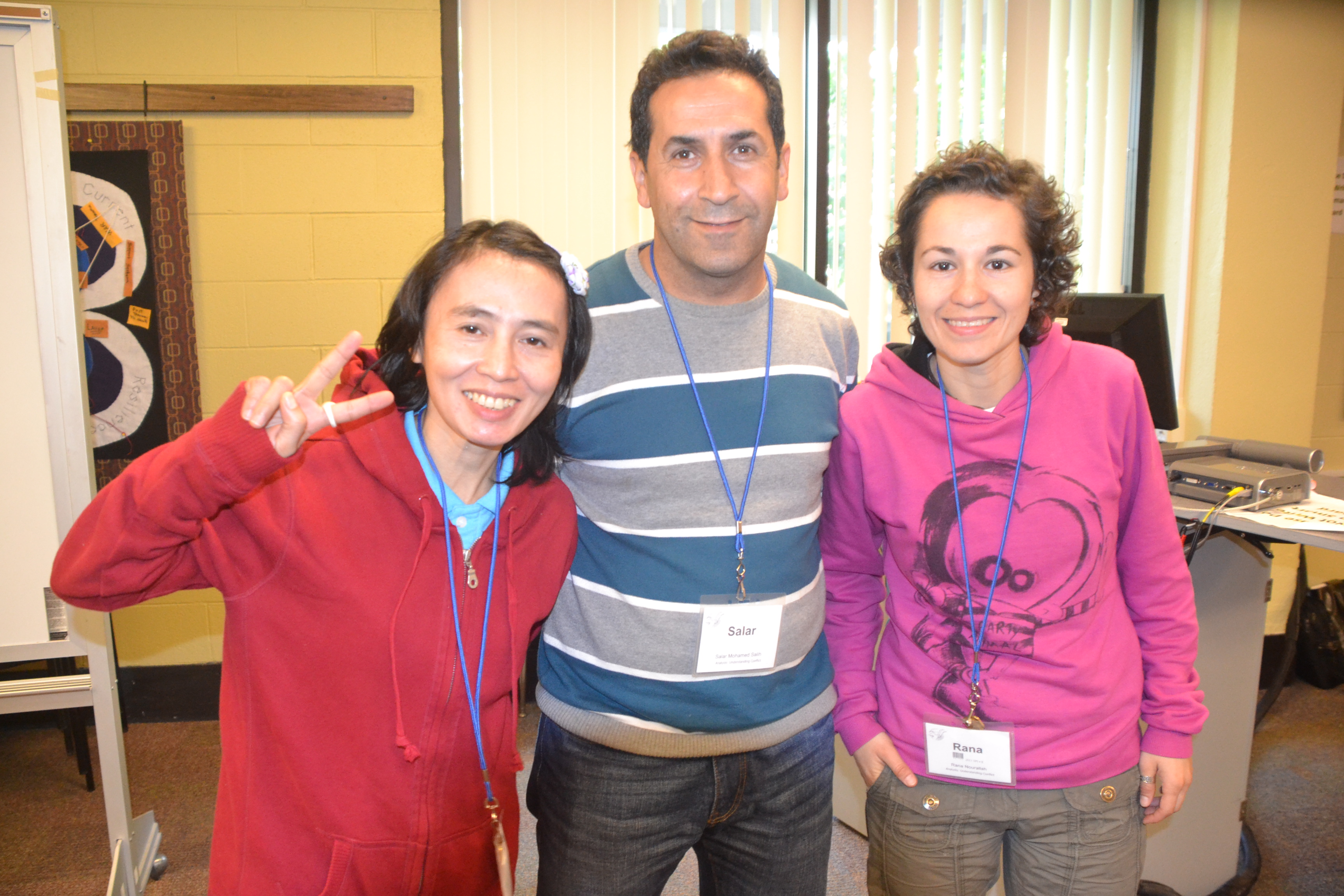
Friendships formed from the classroom interactions.

© Bruce Stambaugh 2013

In memory of an impulsive father

thecottagebybrucestambaugh

By Bruce Stambaugh

My late father was a loving, loveable guy. His impulsive actions, however, often masked those admirable traits.

Combined with his affability and innate friendliness, his good intentions sometimes wrote a recipe for embarrassment if not potential disaster. Even when in the wrong, Dad would turn a negative into a positive.

Dad was definitely gung-ho about everything he did in life. With his many interests, he did a lot in his 89 years of living. He went full force, no holds barred. Dad was simply passionate about life.

If he knew this about himself, Dad certainly never acknowledged this reckless abandon approach to life as a fault. The way he lived, he had to have seen this passion as an attribute.

parentsbybrucestambaugh
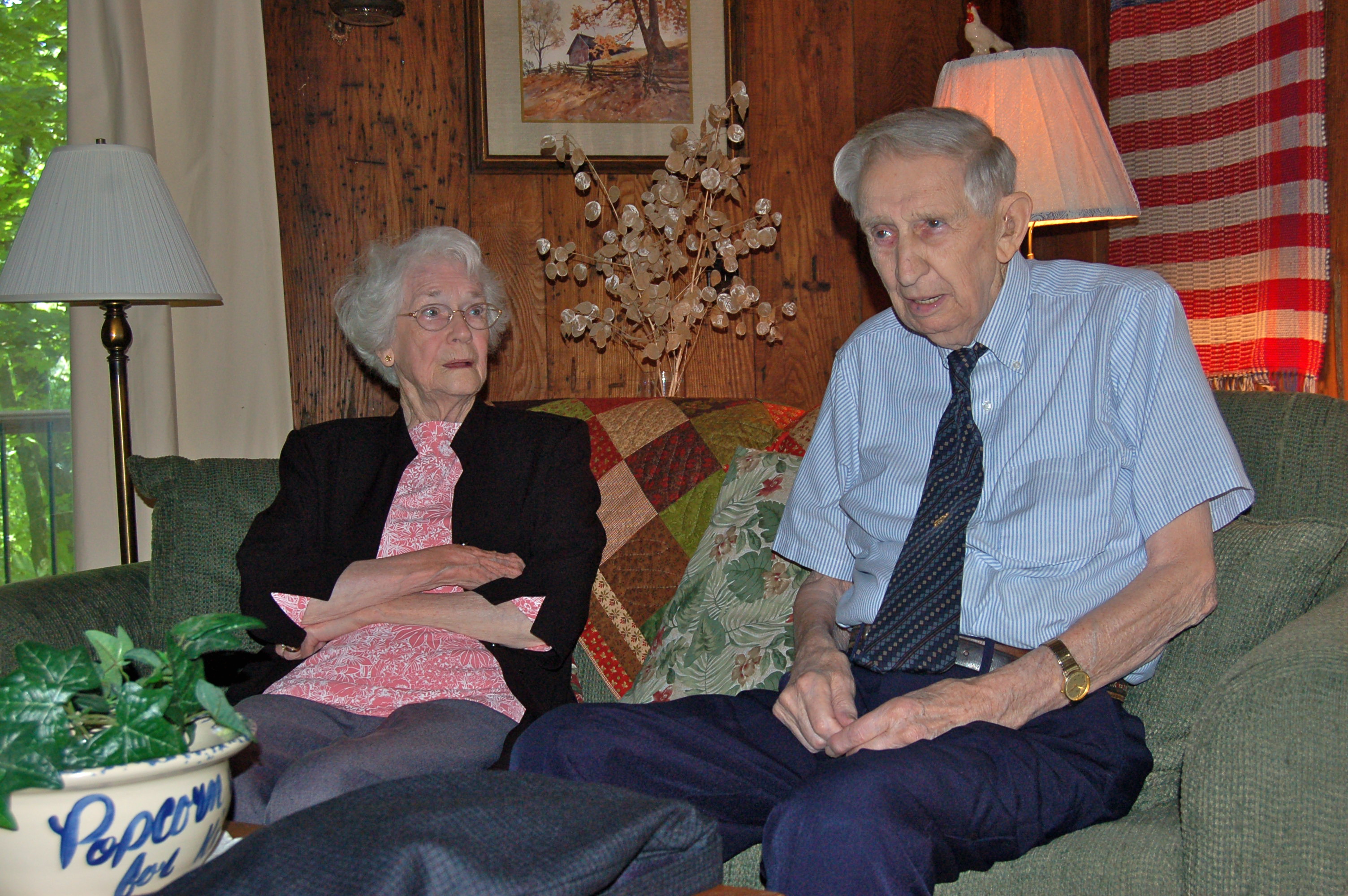
My wife and I surprised my parents on Father’s Day in 2009 with a visit to the cottage they had built. We had purchased it from them, and remodeled the cottage. Dad died on Dec. 21 that year.

Dad loved sports, especially outdoor activities like hunting and fishing. He also amassed an extensive Indian artifact collection. Dad was involved in many community activities, almost always in leadership positions. The end result was that he made many friends in his lifetime.

Dad’s enthusiasm sometimes got the best of him, and others, too. The story my nephew shared at Dad’s memorial service three and half years ago pretty well summed up my father’s impulsiveness. The story is true with no hyperbole interjected.

Mom and Dad had a cabin on Clendening Lake in southeast Ohio. They loved to host friends and family as frequently as possible. My younger brother and his family attended one such outing.

pontooncolorsbybrucestambaugh

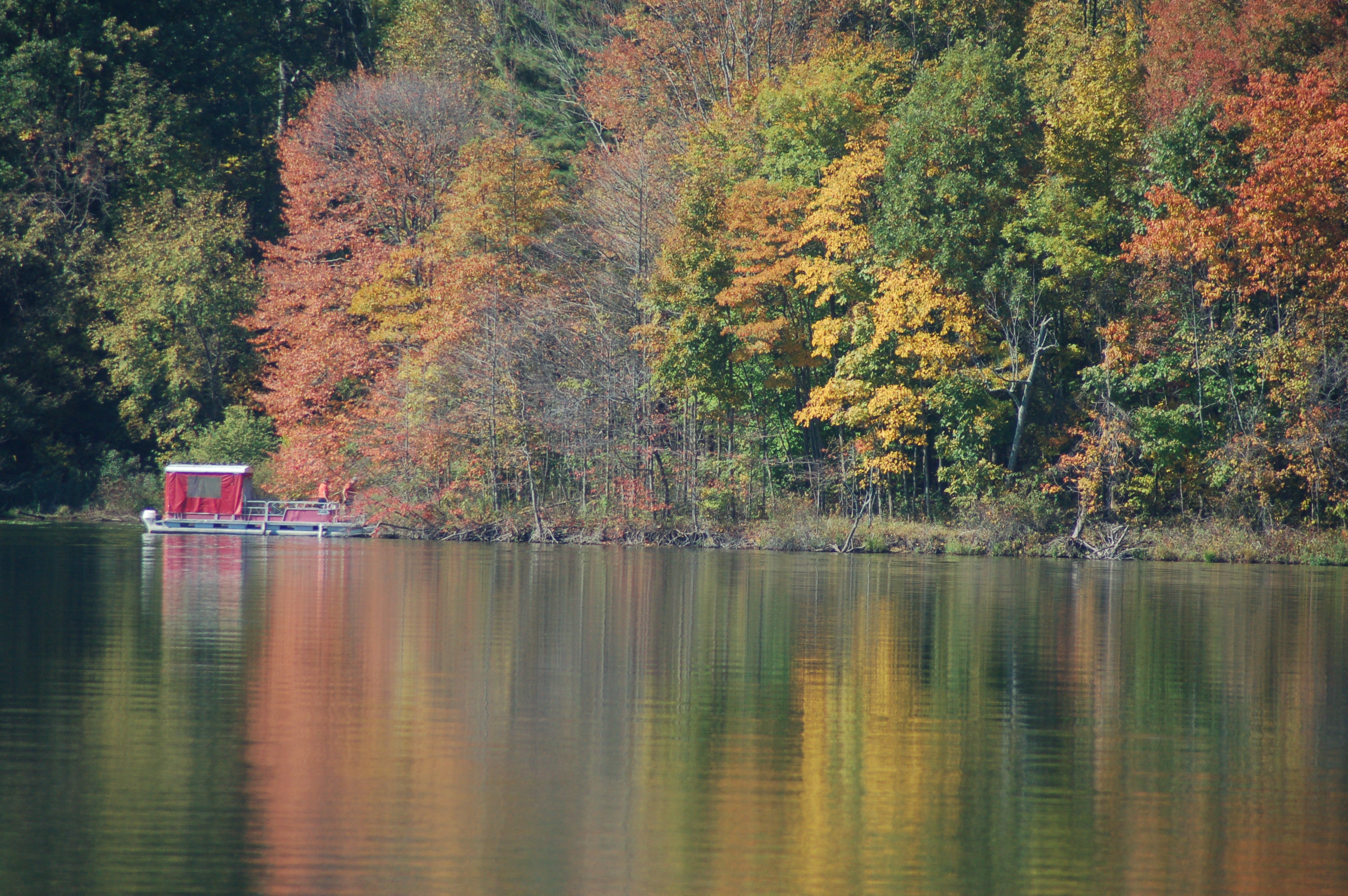
A favorite activity of Dad’s was to pile everyone onto his pontoon boat for a combination cruise and fishing trip around the 14-mile long lake. The scenery was always enjoyable. The fishing on the other hand often was more bait than catch.

On this particular voyage, Dad had found a spot right across the lake from the cabin. My nephew reported that the fishing was good until my father’s impetuosity intervened.

Dad cherished interacting with people, often to the point of being late for supper or forgetting an appointment altogether. I think he invented the word “relational.”

While my brother and his family were concentrating on catching croppies, Dad noticed another boat on the opposite shore. He thought it looked like the owner of the cabin next to his.

fallfishermanbybrucestambaughDad suddenly announced to his surprised passengers, “Hey, that looks like Bennett over there,” and up came the boat anchors. Lines were reeled in, and across the lake they went at full throttle.

Since Clendening isn’t a very wide lake, it didn’t take too long to reach the spot where Mr. Bennett was fishing. My nephew recalled wondering why his grandfather wasn’t decreasing the pontoon’s speed as they got closer and closer to the south shore.

Seeing the inevitable, my brother motioned for Dad to slow the boat or change coarse. He did neither.

Dad instead responded by yelling a series of “Hellos” to Mr. Bennett, who at first waved back, then tried frantically to wave Dad off.

Dad greeted his neighbor by ramming the pontoon boat into the much smaller bass boat, tipping it and its owner into the murky lake. Fortunately the water was shallow there. But all of Mr. Bennett’s rods, reels, tackle boxes and stringer sank straight to the lake’s bottom.

Dad had finally stopped the pontoon by the time Mr. Bennett had popped up soaking wet. What was my father’s first comment to Mr. Bennett after the crash? An apology? Not exactly.

Dad matter-of-factly hollered, “Hey, Bennett, are you catching anything?”

fatherandsonsbybrucestambaugh
My older brother, Craig, and I accompanied our father, Dick Stambaugh, on an Honor Flight trip to Washington. D.C. on Sept. 12, 2009. We posed in front of the Ohio pillar at the World War II Memorial.

© Bruce Stambaugh 2013

Enamored by names

I am honored to report that today I received the University of Akron’s Wayne College Regional Writers Award for non-fiction. Since I’m naturally too modest to say much about myself, friends and colleagues encouraged me to share this winning essay with you.

By Bruce Stambaugh

I have always been enamored by names.

By names, I mean the title affixed to something, someone or someplace that transcends the given moniker of the object, the person or the place.

When I moved to Holmes County, Ohio many moons ago, I immediately picked up on the custom of speaking in this sort of colloquial code that was neither an accent nor a dialect.

People spoke of names for places as if the entire world knew to what and where they were referring. Often times, most of those names could not be found on any official document, including a county map.

Still, people used the names as reference points, meeting places and settings for stories, imaginary and true. With apologies to Stephen Colbert, the “truthiness” of the tale didn’t really matter.

In my teaching days, my elementary students matter-of-factly offered up perfect examples of what I mean. When I asked the students where they lived, I got answers like “on French Ridge” or “next to Dingle Brown” or “ beside Blackbird Croskey.”

Once I caught on to this provincial name-dropping, I tried turning the tables on the kids through the lessons. They found it down right sacrilegious to learn that Glenmont had once been Napoleon and Killbuck was first Oxford.

Nor did they believe me when I told them that Fort Fizzle had really been a fort, and the cause of its rebellious caretakers actually did fizzle. It was an insignificant skirmish in the American Civil War. But it was our own.

The cute terminology wasn’t confined to the schoolhouse either. Once, when I reported to the fire station after the alarm had sounded, I found the first two trucks gone and the station empty. I checked the chalkboard where the type of run and its location were hastily scribbled. “Grassfire, Baddow Pass” was all it said.

I was stumped. I had no idea where that was, and had to wait until another volunteer showed up to find out which way we should go.

The name game even spilled over to church. When the youth group wanted to go on a hayride to Panther Hollow, I again had to ask about the exact location. When we got there, it was so spooky I thought it should be named Ghost Hollow. But I soon learned that was actually on the north side of the nudist camp. And no, I am not making up any of this.

When I moved to the eastern part of the county, I discovered the local names just as prolific, if not more so. Amid the Amish and Mennonite culture, several people have the same name. But there was only one Bicycle Dan and one Toothpick Andy.

We had our church picnic in Troyer’s Hollow. The Stink Plant sits on Weaver Ridge. Good friends live on Joe T. hill.

In the western, more Appalachian area of the county, the hills are steeper and the valleys are wider. In the east, with its more gently rolling hills, the tranquil valleys are referred to as bottoms.

A young woman was once talking with a small group of people about what each valley was called. She said she lived in Bulla (or Bull) Bottom, and that the valley on the north side of Walnut Creek was called Genza (or Goose) Bottom.

She promptly turned to a young man who lived over the next ridge, and innocently asked him, “And what is your bottom called?”

Like I said, I love these earthy, rural names rich in traditions and full of life, goodness and virtue.

© Bruce Stamabaugh 2013

So many questions, so few answers

By Bruce Stambaugh

Some time ago I listed several questions over a wide range of topics that I had accumulated. Most of my musings were unanswerable.

Well, since I’m an inquisitive fellow by nature, I’ve done it again. My inquiring mind wants to know, and I thought April Fools Day might be a good time to ask. Should we let the questions begin?

northcoastbybrucestambaugh
The North Coast of Ohio is really the south shore of Lake Erie.

Why is the south shore of Lake Erie called the North Coast in Ohio?

Why do people feel compelled to yell “In the hole!” after a pro golfer hits a shot?

Are there East of Chicago pizza places west of Chicago?

Why do fans in line with the TV camera at baseball games wave and wave and wave once they realize they are on TV?

easterfullmoonbybrucestambaughBeside the letter “r,” what’s the difference between the word “wiggle” and “wriggle?”

If lights attract moths, why don’t these nocturnal winged insects come out in the daytime?

Do they serve Cuban sandwiches in Cuba?

What kind of wine goes with honey barbequed potato chips?

Why are the natives of the Philippine Islands called Filipinos and not Philipinos?

Why is it that when a teacher says the test will be simple, it will always be hard?

someassemblyrequiredbybrucestambaugh
Some assembly required.
Why is it that when directions say, “Some assembly required,” it usually is a lot?

Did you know there is a right way and a wrong way to hang a roll of toilet paper?

Do you know which is the right way to hang a roll of toilet paper?

Did you know that Easter always falls on the Sunday after the first full moon after the vernal equinox?

Did you know the emergency number in Australia, the country down under, is 119?

If tornadoes in the northern hemisphere spin counter-clockwise, and tornadoes in the southern hemisphere spin clockwise, which direction would a tornado on the Equator spin?

Did you know that in Ohio it’s a law that motorized vehicles have to have their headlights on if their windshield wipers are operating?

How do bullfrogs know when the air is warm enough for insects to fly in early spring?

Did you know that the only direction you can travel from the North Pole is south?

When you sneeze, why do people say, “God bless you?”

hotdogsbybrucestambaugh
You won’t find these hot dogs at McDonald’s or any other fast food restaurant for that matter.

Have you ever tried to order a hotdog at McDonalds?

Where did the idea of the Easter Bunny originate?

Is Allstate Insurance really available in all states?

Have you ever wondered who your doctor’s doctor is?

Why is baseball the only professional sport where the manager and coaches have to wear uniforms like the players?

Why is it when you are following a slow moving vehicle in a no passing zone, you don’t pass any oncoming cars, but as soon as it is all right to pass you can’t because there is oncoming traffic?

What is the difference between a day being “partly sunny” or “party cloudy?”

partlysunnybybrucestambaugh
Partly sunny or partly cloudy?

Why do emergency vehicles proclaim “Dial 911” when we no longer have rotary phones?

Why do we still say we’ll carbon copy an email, for example, when we no longer use carbon paper?

Do they serve French toast in France?

americanrobinbybrucestambaugh
In good weather or foul, American Robins still have orange breasts.
Why do people refer to the red, red Robin when the American Robin’s breast is orange?

Why do donuts have holes in the first place?

Why does it seem colder at 27 degrees in April than it does when it’s 27 degrees in January?

Why do we celebrate April Fools Day anyhow?

© Bruce Stambaugh 2013

My best friend for 42 years

thestambaughsbybrucestambaughBy Bruce Stambaugh

March 27, 1971 was a beautiful Saturday. It was warm, the sun was shining, and spring was definitely in the air. The field next to the church had just been sprayed with liquid manure.

I remember it well, the wedding, not the smell. It was the day I married my best friend. Of course, I didn’t know she would become my best friend. My best friend was my best man. I married Neva to be my wife, or so I thought. It has turned out so much more than that naïve 23 year-old groom could have imagined.

We soon discovered that we had a lot in common besides amorous affection. We both liked travel, adventure, antiques, nature and Milky Way candy bars.

The summer after our wedding we lived on a mountain with no communications, no electricity or running water. As part of a church sponsored summer service project, we hosted hikers at a camp about halfway up Pikes Peak in Colorado. I chopped the firewood and Neva prepared our meals over either a woodstove or an open fire.

homewithaviewbybrucestambaugh
We never tire of the view behind our rural home in Ohio’s Amish country.

That experience helped set the stage for all that was to transpire in the next 42 years. Through thick and thin, in sickness and in health, we strived and thrived as individuals and as a couple. It hasn’t all been pretty or perfect, but we have endured, much the way we did on the mountain.

We each spent a career in public education, something we both dearly believe in for the good of our own children, our community and our country. It was an honor to serve in that capacity.

We built one new home and completed another. Both had excellent views and wonderful neighbors.

snugglingwithnanabybrucestambaugh
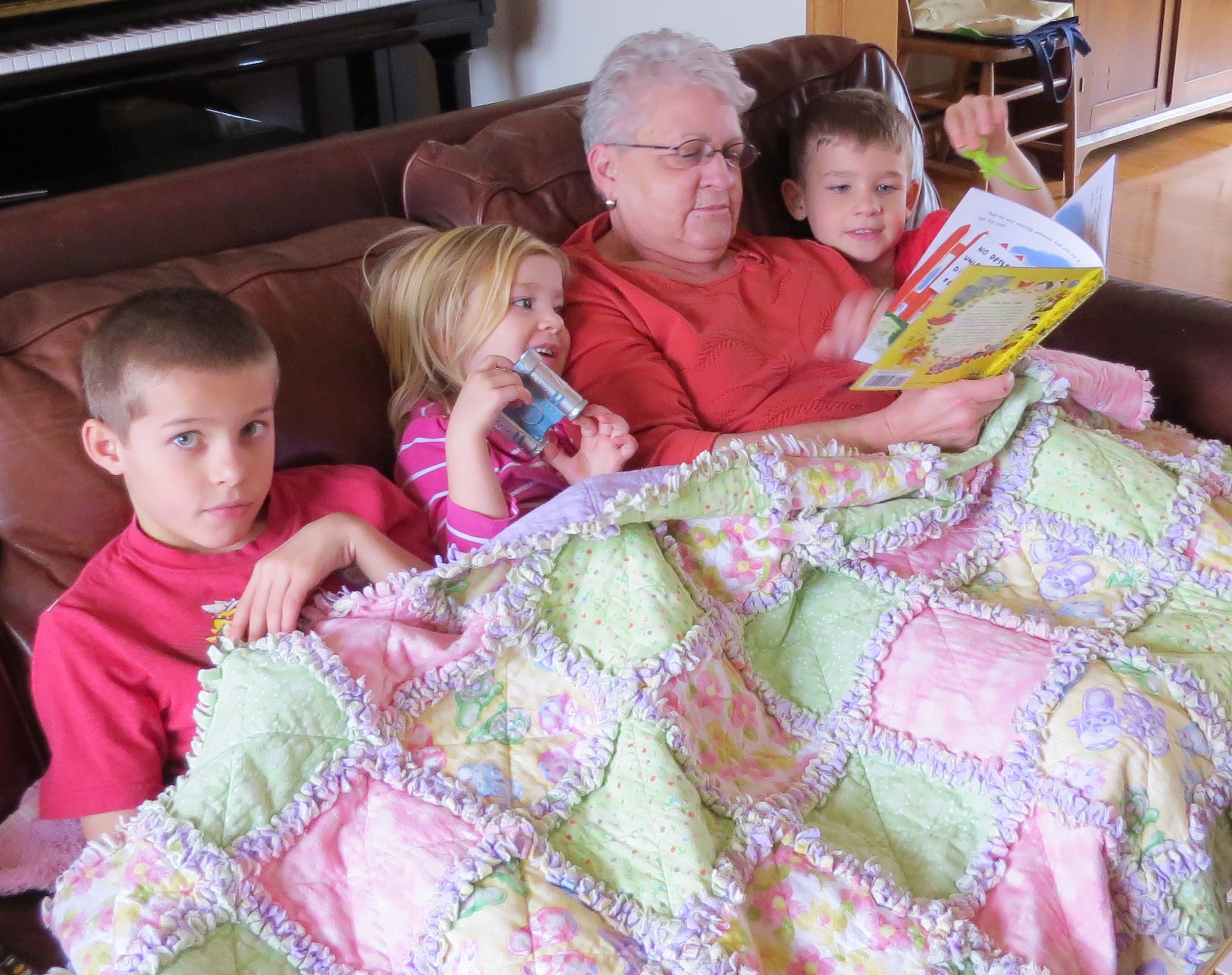
Our grandchildren snuggle under a blanket as Nana read a book to them on a cold winter’s night.
We raised two beautiful children, who each have an amazing spouse of their own. It’s a joy to watch them all blaze their trails through life, positively affecting others. Of course, we adore our three grandchildren as precious gifts, too.

Our similarities and differences have balanced, renewed and enriched our lives, and have helped cement our marital friendship. Neva loves helping at the local thrift shop. I enjoy photographing sunsets. She quietly quilts or sews while I write.

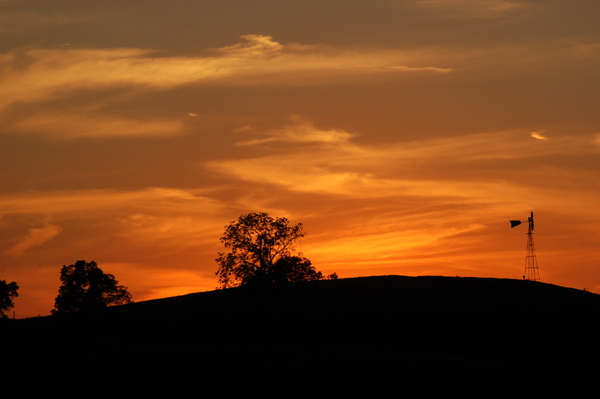
augustsunsetbybrucestambaugh

The length and strength of our marriage can be attributed to our many common interests, and the recognition that we try to allow space for our own wants, wishes, talents and abilities. We complement one another, and we compliment one another.

babyquiltbybrucestambaugh
Neva made this baby quilt for our granddaughter.
After 42 years of marriage, Neva and I have reached a new phase in our relationship. We love being grandparents, and seize each opportunity to host, visit or vacation with the grandkids. Being mostly retired allows us to do that.

It also gives us pause to ponder how we have made it through the good and bad that life has thrown at us. All I can determine is that we have survived for two main reasons. We have many faithful friends and family members who have unwaveringly stood by us, and we have each other.

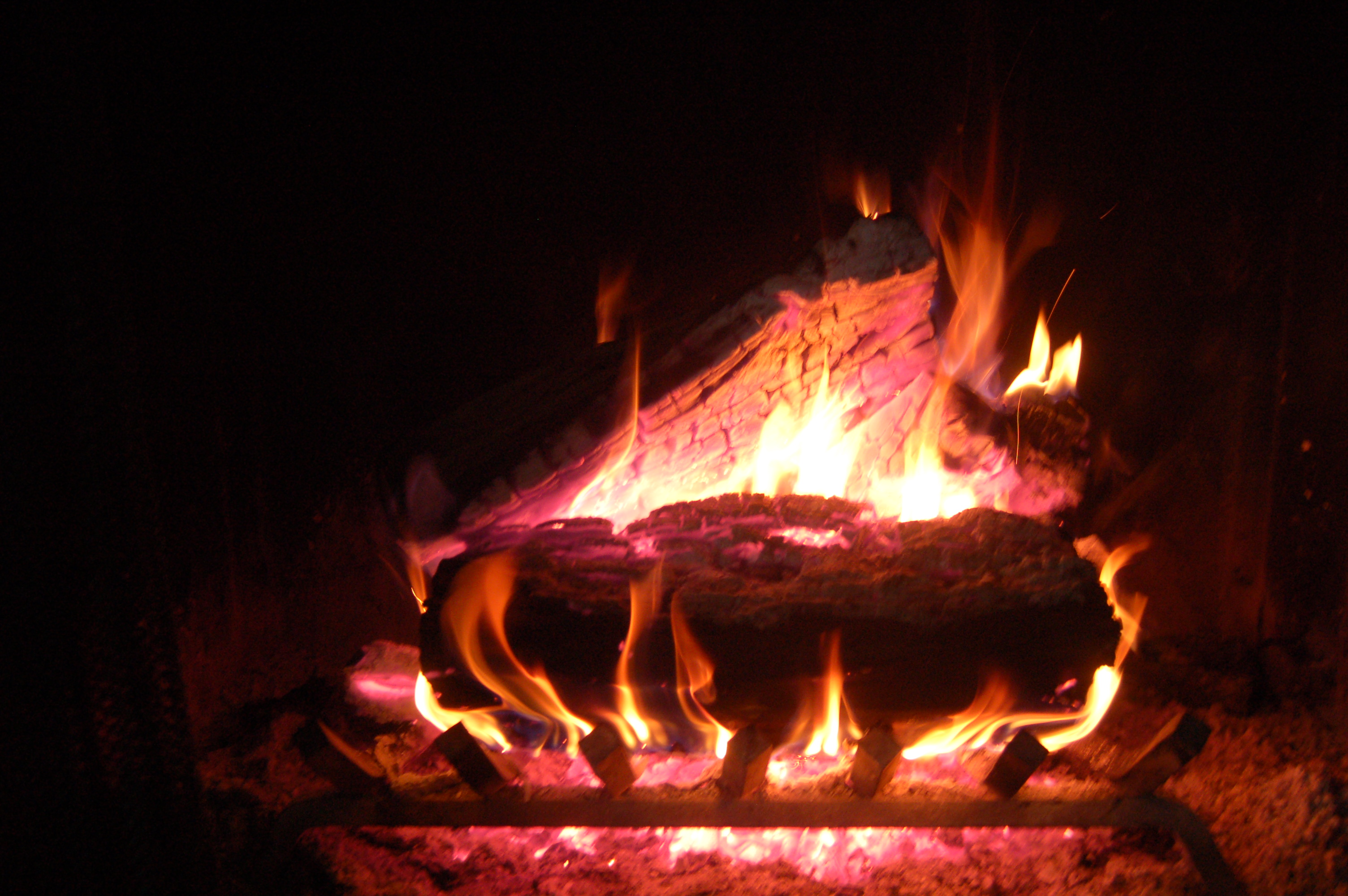
With a mesmerizing fire in the fireplace, a cup of coffee and some of Neva’s delicious homemade cookies, we spend many winter evenings together enjoying college basketball games on TV. It doesn’t take much to make us happy.

We are still close friends with our best man and his gregarious wife. But as I look back on our life together, it is obvious that Neva and I are more than wife and husband. We indeed are each other’s best friends.

roaringfirebybrucestambaugh
The fire still burns.

© Bruce Stambaugh 2013
This writer can’t write or spell so well

By Bruce Stambaugh

I love to write, but writing doesn’t like me. Let me explain.

I have always enjoyed finding out the details of situations, then telling other people about what I learned. I guess I was born with a nose for news.

Growing up in post-World War II suburbia, a neighbor lady affectionately called me “The Beacon Journal,” in honor of the Akron, Ohio newspaper. Her point was that I not only knew the latest neighborhood news, but my facts usually checked out, too. At least that’s what I always thought she meant.

brucestambaughbybrucestambaugh
Me.
Unfortunately, I had a problem when it came to actually writing down the information. I could remember details all right. It was just that my handwriting was so bad it was nigh impossible for people to decipher. This was especially true for school projects.

On top of that, I wasn’t the best speller either. The problem there was that I spelled phonetically, which in the English language won’t carry your written communications very far.

So here I was a young storyteller with atrocious handwriting and horrible spelling skills. I can’t tell you how many times I would seek out a teacher to ask how to spell a certain word. The answer was always the same, as if it were an educators’ conspiracy. “Go look it up,” was the universal response.

In junior high study hall, we had one huge dictionary that students queued to use. I wore a path in the checkered tile from my assigned seat to the lexicon lectern. With impatient peers waiting in line while I fumbled through trying to find a word that I had no idea how to spell, I would break out in a cold sweat.

Whenever I heard that hated phrase “go look it up,” I cringed. What was the logic in trying to find a word in a dictionary when I had no idea what letter the word even started with?

scribblednotesbybrucestambaugh
Notes I scribbled during a recent phone call.
Let’s just say that the answer to that was that I did a lot of erasing in my schooldays. I knew I was in trouble already in the first grade. Those big fat cigar-like red pencils they gave us to use to practice our letters were not only hard to hold they didn’t have any eraser on the top. I had to always borrow one from the teacher until she finally asked my parents to buy my own.

That led to another problem. The pencil lead was dark and gritty on that pale green writing paper with the two-toned blue lines that I never seemed to be able to follow. Out came the eraser, and pretty soon the paper was not only smudged, it often had at least one hole in it. Those lettering lessons would have made really neat abstract art.

That’s what happens when you start first grade at age five with no preschool or kindergarten experience. My fine motor skills have never caught up.

My handwriting is still horrible. So is my spelling. But thank goodness for computers and word processing software. I sit in awe sometimes when I run the spellchecker and the program can actually figure out the word I meant.

Typing has saved me from trying to decode my scraggly penmanship, unless of course I’ve done an interview with someone. I usually have to hustle home and quickly transcribe my scribbling so I can remember exactly what I wrote.

That’s how bad my handwriting was and still is. Steve Jobs, Bill Gates and Michael Dell saved my life, purely in a literary sense of course.

© Bruce Stambaugh 2013
Repeat vacations aren’t so bad after all

beachwalkingbybrucestambaugh
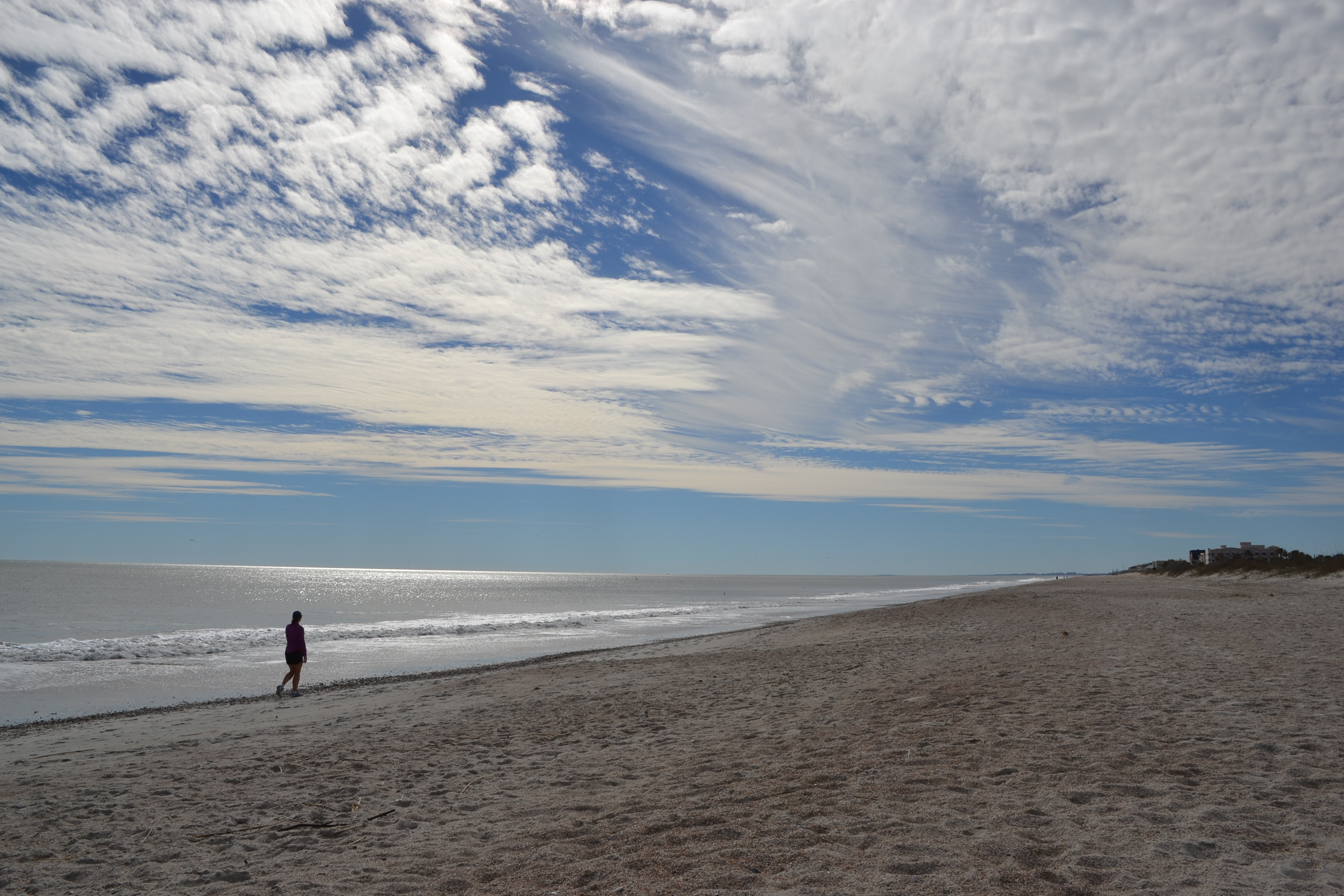
Finding just the right spot to relax on Main Beach, Amelia Island, Florida in January is not a problem.

By Bruce Stambaugh

I used to question the wisdom and practicality of vacationing twice in the same location.

Perhaps my personal wanderlust interfered with my empathy for the travel preferences of others. With so many places to visit locally, regionally, nationally and globally, I reasoned why would anyone want to return to the same place year after year?
Surely the urge to explore and discover had to be greater than the certainty of returning to the same destination at about the same time each year. I’m rethinking that opinion.

I am in a transitional period of my life, intentionally between full time employment and true retirement. I’m enjoying the freedom that comes with a flexible schedule.

harborsunsetbybrucestambaugh
The harbor at Fernandina Beach, Florida offers many a scenic sunset.

I still like visiting new locales, seeing new topography, meeting new folks. I am also beginning to more fully appreciate the contentment of familiarity. I realized that fact recently while my wife and I bathed in the glow of another incredible sunset over the harbor at Fernandina Beach, Florida.

For someone who practically calls Lakeside, Ohio his summer home, it should have been obvious to me. I guess I considered our Lakeside stints more tradition than vacation. Silly me.

We had found Amelia Island almost by accident last year. It was an overnight stop on the way to our true vacation destination, Sarasota, Florida. We liked the island so well we spent two more days there on the way home. We were hooked.

ameliaislandcharmbybrucestambaugh
Charming homes line the streets of Fernandina Beach, Florida.
We loved the island’s charm, its beautiful beaches, its commitment to wildlife habitat preservation, its rich history, and the diversity of activities it offered. We had only skimmed the surface last year. We needed to return to further explore this intriguing community.

Last year the weather, like most places in the country, was exceptionally warm for northern Florida in January. We walked the nearly vacant beaches in t-shirts and shorts. I birded the island’s preserve. We dined on locally caught seafood. We were in paradise instead of Ohio in January. It felt marvelous.

This year we returned to this magical destination for two weeks in order to dig deeper into the island’s many treasures. The weather couldn’t match that of 2012, but we had fun nevertheless. Cooler mornings warmed into pleasant days. Shorts and sandals were only appropriate a couple of days this time around.

eganscreekgreenwaybybrucestambaugh
Egans Creek Greenway offers biking, hiking, fishing and birding on the north end of Amelia Island.

We toured the local history museum, lunched outside at most restaurants, and collected perfect seashells of all sizes and colors. I hiked the paths through Fort Clinch State Park and Egans Creek Greenway enjoying the flora, fauna and breath-taking vistas and spring’s emerging pastels.

My epiphany came while I hustled around the boardwalks at Fernandina Beach’s harbor photographing yet another sunset. A patron sitting at a table of a dockside restaurant hailed me, wanting to know if this was my first time on the island.

ameliaislandstateparkbybrucestambaugh
Amelia Island State Park, at the southern tip of the island, is a great place to relax, walk or fish.

When I innocently replied that it was not and then read the man’s surprised facial expression, it hit me. To him I must have looked like a child on Christmas morning as I dashed around trying to get different angles of the ever-changing colorful sky.
I had taken many, many sunset shots last year. Yet here I was plying for more. Lightning struck. I recognized why people did repeat vacations.

I was relaxed, happy, appreciative, satisfied, if not downright blissful. Amelia Island, Florida in January 2014? Why not? It could become our traditional winter vacation.

beachchairsbybrucestambaugh

© Bruce Stambaugh 2013

Groundhog Day is February’s April Fools’ Day

By Bruce Stambaugh

I’ve never been a fan of Ground Hog Day. It’s like February’s equivalent to April Fools’ Day.

I see Feb. 2 as an artificial holiday. It is more marketing ploy than weather prognostication, designed to pump up a small Pennsylvania town to help distract those living in the country’s colder climes from cabin fever.

That was a long sentence.

I am pretty sure no one, other than the mayor of Punxsutawney, Pa. perhaps, takes the event seriously. Winter after all is driven more by calendar and climate than it is one day’s sunny or gloomy weather. Whether the groundhog sees its shadow or not, winter will continue until it really is over.

I hope I don’t sound too bitter.

smartgroundhogbybrucestambaugh
This groundhog was a little to cagy for me. No matter what I baited this live trap with, the groundhog resisted and returned to its burrow under our back porch.
Besides, Punxsutawney Phil has developed some competition over the years. Not to be outdone by the silliness, Ohio has Buckeye Chuck, who is more or less the Avis of rodent forecasting. He tries hard, but doesn’t draw the crowds or paparazzi of his Keystone counterpart.

Where am I going with this? For one, back in time.

Many years ago when I was a young man in college who thought he knew everything, one of my roommates and I got into a mildly heated discussion about groundhogs of all things. And yes, we were both sober. We might have been bored or stubborn perhaps, but definitely not delirious.

Nevertheless, we did indeed disagree about this four-legged furry creature. My roommate, Joe, claimed that groundhogs and woodchucks were two entirely different animals. I said they were one in the same.

We didn’t come to fisticuffs, but Joe was pretty sure that he was correct. I was just as certain that I was right.

Finally, after too much verbiage for too long a time, we decided on a neutral determinant. We would look up the two words in my heavy-duty Random House dictionary. The thick reference book was my one major college personal investment. I was, and still am, a notoriously bad speller. Being a journalism major, I knew I needed to have my assignments completed with proper spelling. This was long before personal computers and word processors with built in dictionaries existed.

Since my parents had taught me to share, the dictionary held a prominent place in our little off-campus abode. It sat atop a desk in the dining room for anyone to use. It wasn’t uncommon for us to invite fellow students over to study together. At least we were supposed to be studying.

Since “groundhog” came before “woodchuck” alphabetically, I turned to my word first. I placed my index finger beneath “groundhog” and read, “Groundhog. A woodchuck.”

My roommate was in denial. I stepped away while he turned to “woodchuck.” “A groundhog” the dictionary declared, Joe’s voice cracking in disbelief.

If I recall correctly, the dictionary was closed rather suddenly. Joe surrendered, a bit grudgingly.

I learned much later in life that in Maine groundhogs are colloquially called whistle pigs because of the whistling sound that they make. In other locales in North America, groundhogs are labeled land beavers.

That brings us back to the present.

Just remember that Feb. 2 when you see a man dressed in a top hat and tuxedo holding up a groundhog, woodchuck, whistle pig or land beaver for the cameras, it really doesn’t mean a thing. Spring will officially arrive March 20 shadow or no shadow.

daffodilsbybrucestambaugh

© Bruce Stambaugh 2013
Birding through the bathroom window

fallsunsetbybrucestambaugh
Sunsets through the bathroom window are pretty anytime of the year. This was taken in early Nov. Photo by Bruce Stambaugh

By Bruce Stambaugh

This time of year, especially when inches of snow cover the ground, birds flock to my backyard feeders. Please excuse the pun.

I hope you won’t mind me telling you that I get the best view of the various and sundry species of birds through the bathroom window of our modest country home. The kitchen window is good for observing birds, too, but it can’t match the wider view from the bathroom.

cardinalbybrucestambaugh
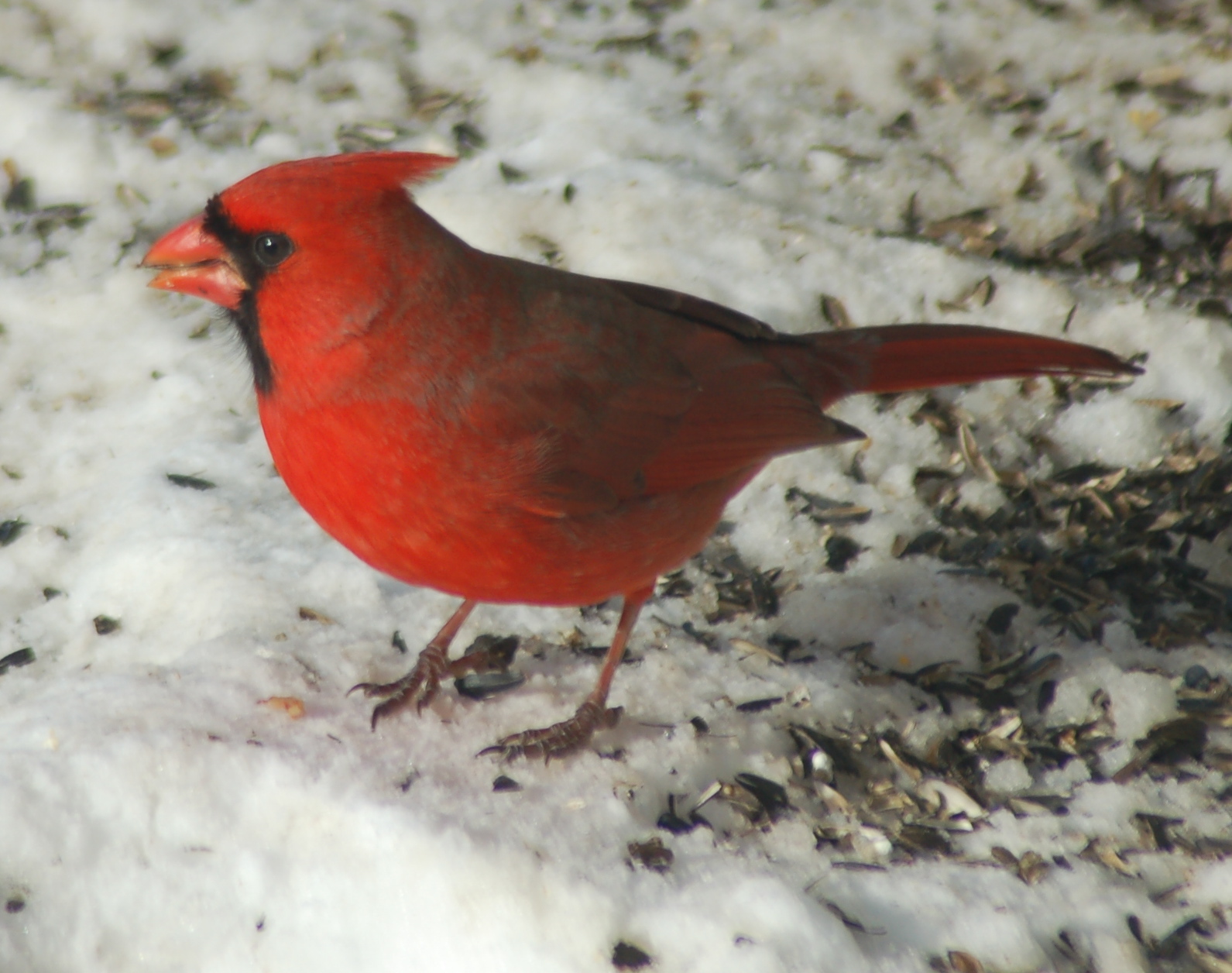
A male Cardinal ate oil sunflower seeds on a recent snowy day. Photo by Bruce Stambaugh
I wouldn’t blame you if you thought this a bit odd. It’s not really. From the bathroom window, I get the best look at the several feeders stationed around the backyard.

The bathroom is on the main floor of the house and faces to the west, which is particularly advantageous on rare sunny winter days. The afternoon sun shines brightly on the birds, adding enhanced brilliance to their winter plumage.

From the restroom vantage point I can see most of the backyard, from the perennial wildflower patch at the south to the back porch at the north. In between and straight out from the window are the little garden pond and the mature sugar maple tree. Birds are attracted to both for different reasons, water and cover, respectively.

takingadrinkbybrucestambaugh
A pair of Eastern Bluebirds sip water at the garden pond. Photo by Bruce Stambaugh
An electric heater keeps the pond from freezing. The pump that creates the miniature waterfall runs year-round, serving as both an avian drinking and bathing station.

The maple tree, with its impressive crown, is king of the backyard. I can see all but the very top of the tree through the window. Songbirds and birds of prey perch on its welcoming outstretched branches. Its crinkled, exfoliating bark serves as a helpful tool for woodpeckers and nuthatches. They wedge sunflower seeds into the cracks and use their pointy beaks to hammer open the shiny black shells to reach the prized protein hearts.

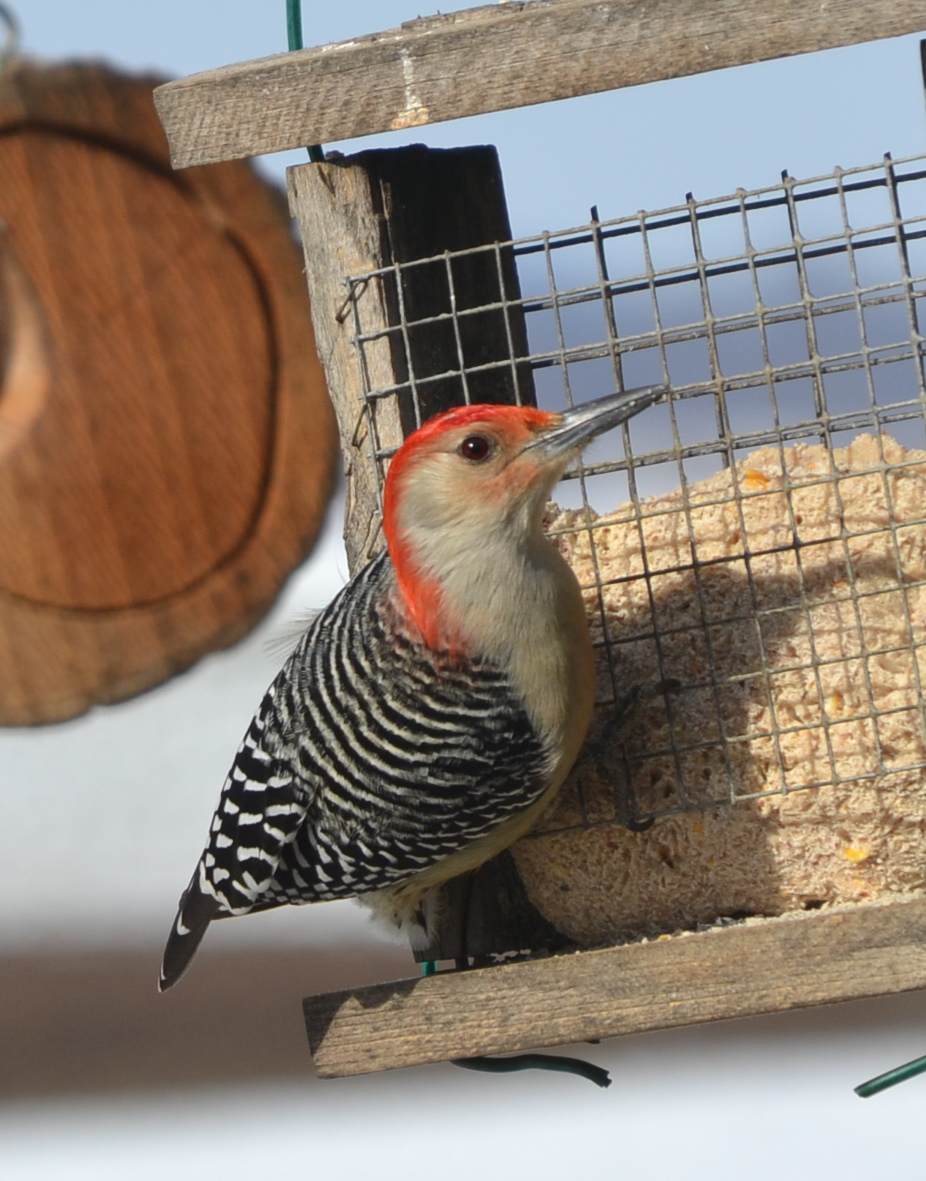
A male Red-bellied Woodpecker frequents the suet feeder. Photo by Bruce Stambaugh
The platform feeder and hanging feeders are also visible from my unusual viewing spot. Like most birders, I keep a camera handy to record the antics of the many aviary visitors. I capture other critters, fox squirrels, opossums and groundhogs, at the pond and feeders, too. Please know that the ironic humor of keeping a camera in the bathroom doesn’t escape me.

The digital photos help me record the comings and goings of these valued visitors all year long. Wintertime is my favorite, however, especially when a good snowfall blankets the ground. I fill the feeders, and await the action, camera in hand. The birds seldom disappoint.

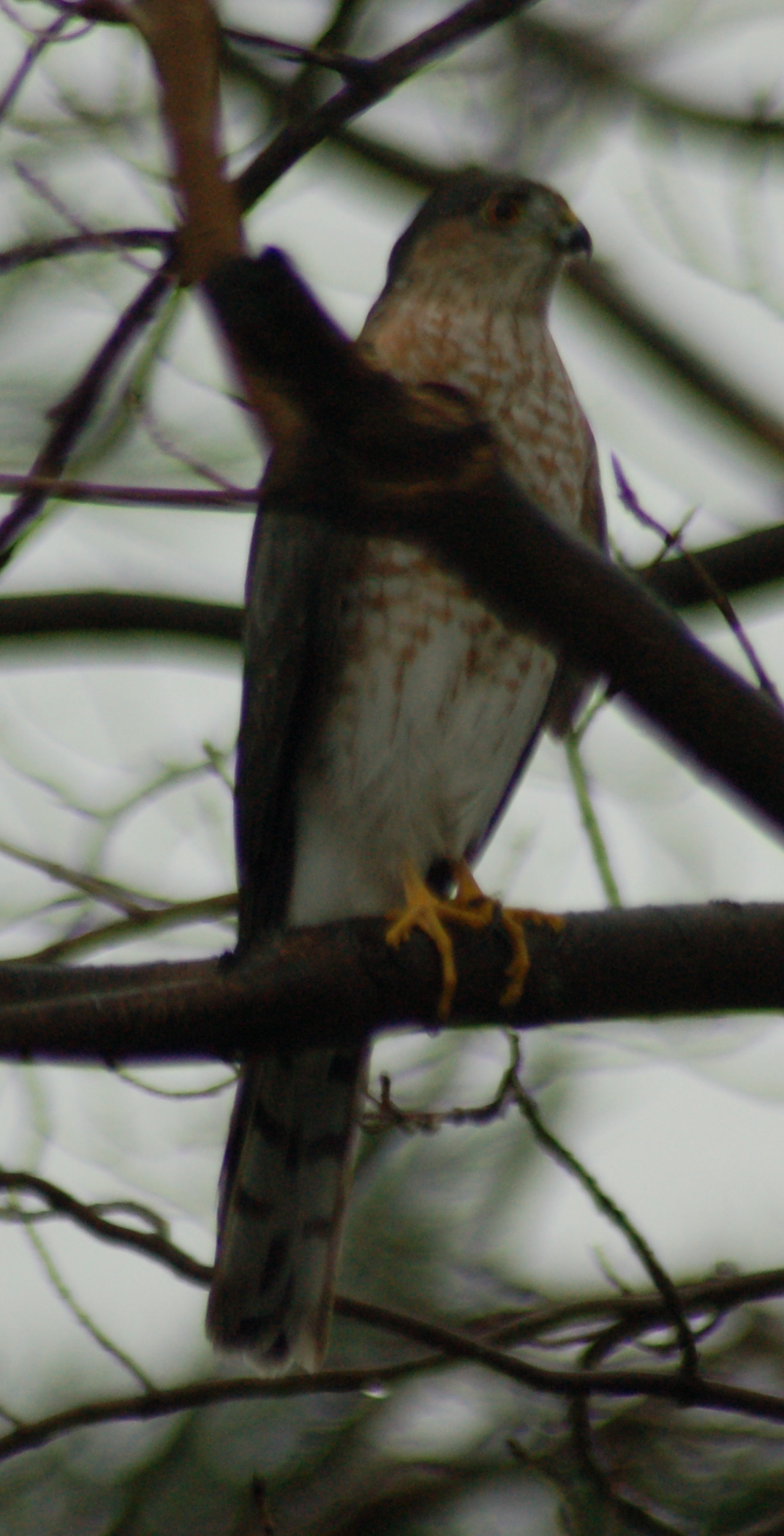
Occasionally I witness a special happening. A Sharp-shinned Hawk makes a sneak attack hoping for an afternoon snack. It zips by

sharpshinnedhawkbybrucestambaugh
A Sharp-shinned Hawk landed in the sugar maple in search of an afternoon snack.
Photo by Bruce Stambaugh
the kitchen window and lands in the maple. I rush to the bathroom window in time to click away at the red-eyed accipiter.

Timing is often everything in bird watching. I have been able to photograph Red-headed Woodpeckers and Baltimore Orioles feeding simultaneously from the same suet feeder. From the bathroom window, I have had the perfect angle to catch brilliant Eastern Bluebirds chowing down on chipped sunflower hearts.

I have also seen a dozen or more deer munching in the shaded meadow far beyond our yard. I’ve been fortunate to see the neighbor’s horses romp on hillside pastures beneath the old windmill. I have snapped inspiring sunsets in every season. The list could go on and on.

Birding is a sport that can be enjoyed anytime, anyplace, even from the bathroom. For those who know me really, really well, that shouldn’t come as a real surprise.

honeywagonbybrucestambaugh
The honey wagon cometh. Photo by Bruce Stambaugh

© Bruce Stambaugh 2013

Bay Photos by Donna

Wildlife photos from the Chesapeake Bay region

ROAD TO NARA

Culture and Communities at the Heart Of India

K Hertzler Art

Artist and nature journalist in the Shenandoah Valley of Virginia.

Maria Vincent Robinson

Photographer Of Life and moments

Gabriele Romano

Personal Blog

Jennifer Murch

Art is the only way to run away without leaving home. -Twyla Tharp

Roadkill Crossing

Writing generated from the rural life

ANJOLI ROY

writer. teacher. podcast cohost.

Casa Alterna

El amor cruza fronteras / Love crosses borders