The day after the wedding, only the lonely church bench wagon marked the spot where the bittersweet wedding had taken place. Out of respect for the Amish, no pictures were taken prior to or during the wedding.
By Bruce Stambaugh
The cool morning’s haze hung in the low, sweeping valley, kissing everything animate and inanimate with thousands of moist droplets. The sun, just now slipping above the distant hillsides, began to undo the dew.
An Amish church bench wagon stood alone, a silvery silent phantom in the dampened alfalfa field. A week earlier the wagon likely went unnoticed. It had been brought there to supply some of the seating for the hundreds of guests who attended a very special wedding.
The bride, a good friend and neighbor, was the happiest, most excited young woman about to be married that I had ever met. Only a year earlier this same 34 year-old had adamantly proclaimed to my wife that she would never get married.
Life events change things above and beyond our poor power to anticipate or comprehend them. We can only accept them.
Months earlier, the groom was suddenly a young widower with six children, teenager to toddlers. When the life of a wife and mother is taken at 34, a huge, horrible hole is created. Now, through a series of miraculous happenings, the modest, stalwart man was about to take a new bride.
It clearly was a bittersweet wedding. In fact, the bride used that as the theme in the invitations, throughout the preparations and the wedding itself. She went out of her way to include the children and their grandparents in this transition.
The home of the new bride and groom and their family.
If ever there was a model for the positive blending of families, this wedding was it. There were tears of joy for the new couple, for the young children who would once again have a mother, and for the new groom, who would no longer have to worry about how to care for his family while holding down a fulltime job.
Step by step, it all came together. Even the minister had to wipe away a tear or two as he preached his sermon in his native Pennsylvania Dutch. During his animated sermon, he spoke reverently to the children, all dressed in matching gold shirts and dresses. He shared personally and passionately with the bride and groom on the incomparable commitment they were making.
In the Amish community, weddings and the meal that follows are a crowning celebration. They are a commitment for a lifetime to each other and the community. Surrounded by hundreds of family and friends, my friend followed her heart, and filled that family’s aching emptiness.
The reception was held across the narrow township road from the bride’s parent’s home. A large white tent had been erected to accommodate the reception goers. Usually the wedding party sits in the eck, or corner, while the guests enjoy their meal at long decorated tables.
This was no ordinary Amish wedding. The guests were afforded a glimpse of how life would be in this newly established household. Centered at the back of the tent was a huge, antique dining room table. Around it sat the bride, the groom and his six children. The bride fed one toddler while the groom fed another.
This marvelous couple had only been married a few minutes, and already they were modeling the family way. I had to wipe away a few tears of my own.
Just as the joy of this marriage warmed the spirits of the wedding guests, the strengthening sun quickly melted away the dewdrops around the church wagon. It was an honor and a blessing to have witnessed both.
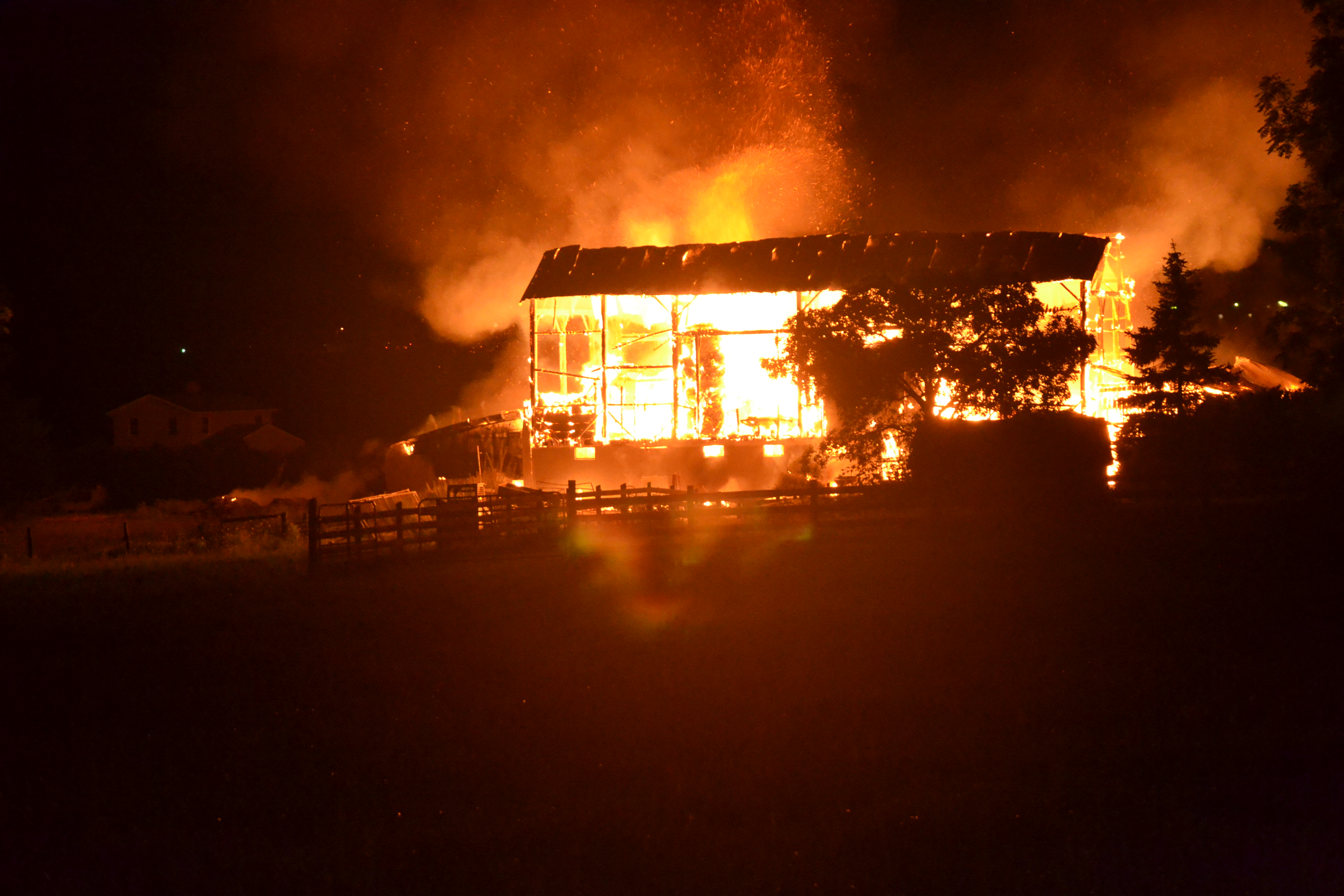
The middle-aged man sat in the van watching what he really wanted to do. His physically weak condition didn’t allow him to help rebuild the barn that had burned a month earlier.
I knew this man, and knew his heart was with these good people, people from across the community who came together to help resurrect the barn. My friend’s presence moved me as much as the corporate act of mutual aid that we witnessed.
Though he couldn’t help, my friend wanted to be there for support, for community, to keep the connection with his people. His presence was his help. Everyone knew about the fire that had destroyed the old bank barn. There was nothing firefighters could do that night other than to protect the adjacent buildings, which they did successfully.
Only three days before the barn raising, the clarion call went out, one phone message to another, for help. The result was a swarm of activity that began at sunrise and lasted until the job was nearly completed. This was not only how the community worked. It was the community.
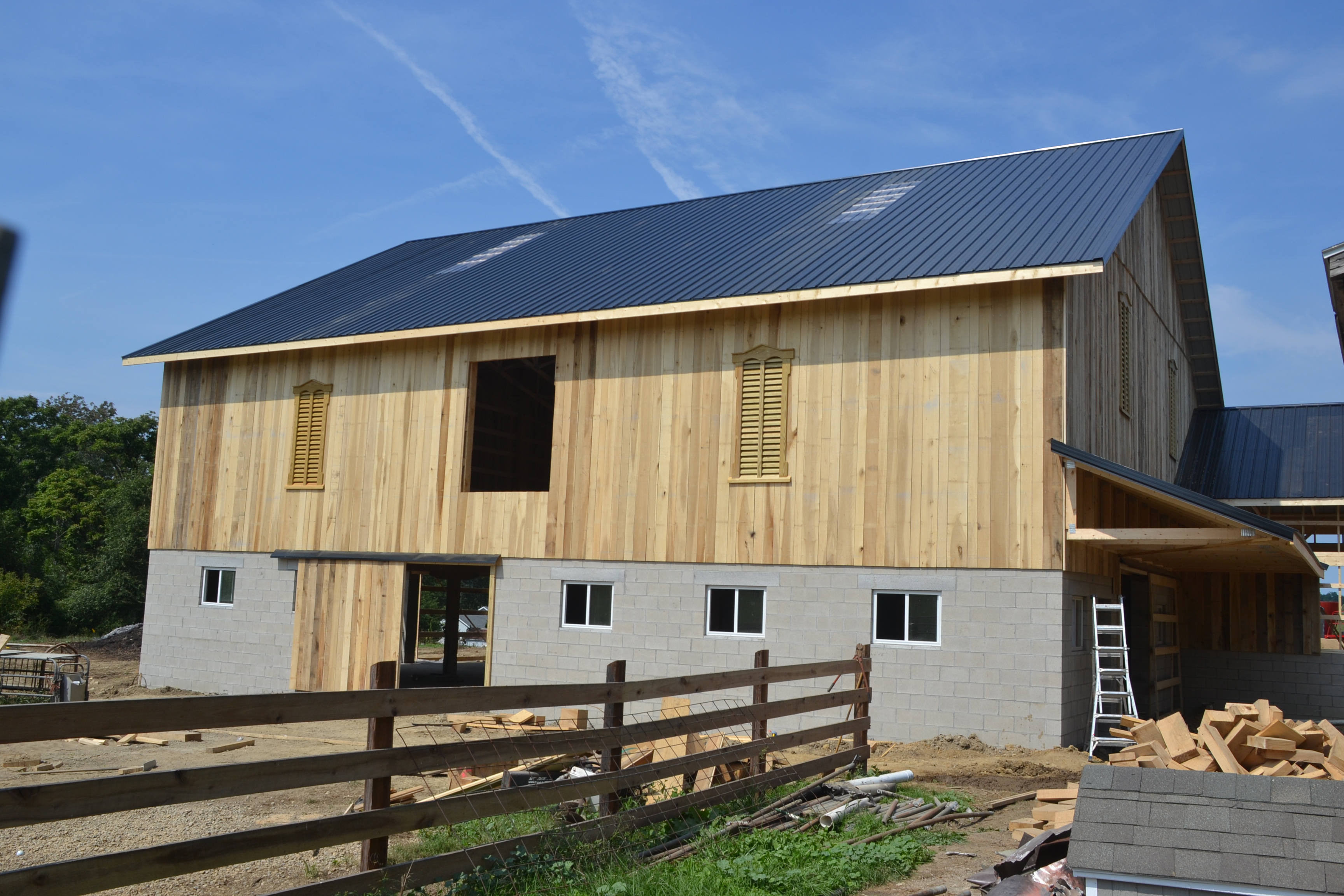
Three hours after the work had begun the barn was fully framed.
My friend knew this. He viewed his vicarious participation as imperative.
He didn’t need to tell me this of course. In our decades of living here in this place, we knew the unwritten, modest code of conduct. When your neighbors need help, help them.
It is the way this community operates, has operated, will operate. It is who we are and how we survive. Without one another, we are nothing. No man is an island indeed.
Old Order and New Order Amish worked side-by-side, hammer by hammer, board by board, with one another. Conservative Mennonites, Mennonites, and probably a few Baptists and Presbyterians were in the mix, too. All hands were on deck, no membership cards needed.
One man served as the coordinator for constructing the structure back into a barn. One body, estimated at about 300 men, women and children, made it happen. The process was beautiful to behold, a community in action.
With the foundation and floor previously completed, the framing of the barn began before sunup. By 8 a.m., the trusses were already being set. No orders needed to be barked. Spontaneous crews simply flowed in precision without cue, and the building arose. It was mind-boggling, astounding and inspiring.
Completing the crown.
High work.
North side crew.
Lunch tent and barn.
Grazing away.
On goes the siding.
On goes the roof.
Skylight.
Halfway.
Finished.
Bearded men, clean-shaven men and teenage boys, proving themselves worthy, massed over the 50 by 60 foot frame. Seated on church benches, youngsters and women, their bonnets bleached whiter by the day’s brightness, watched and waited their turn.
By noon, the siding and roof were nearly completed. Hearty meals of homemade meatloaf, mashed potatoes and gravy, and plenty of side dishes and luscious desserts refueled the crews for the afternoon.
Even the weather cooperated for stepping casually across the peek of the roof. Clear blue sky, no wind to sway the balance, no humidity to dehydrate efficient work all made for perfect construction conditions.
In practicality, such a coordinated effort helped cut the cost of rebuilding for the owner. In a broader sense, such a coordinated effort reaffirmed that in a cooperative community no tragedy is too great to overcome.
Though he couldn’t help lift a board, my friend participated in this most sacred and iconic act. To the passersby who stopped to take photographs, it was a special treat to behold.
For those who knew what really transpired, like my friend, it was much more than a delight. It was communion.
By evening work on the main barn had been completed.
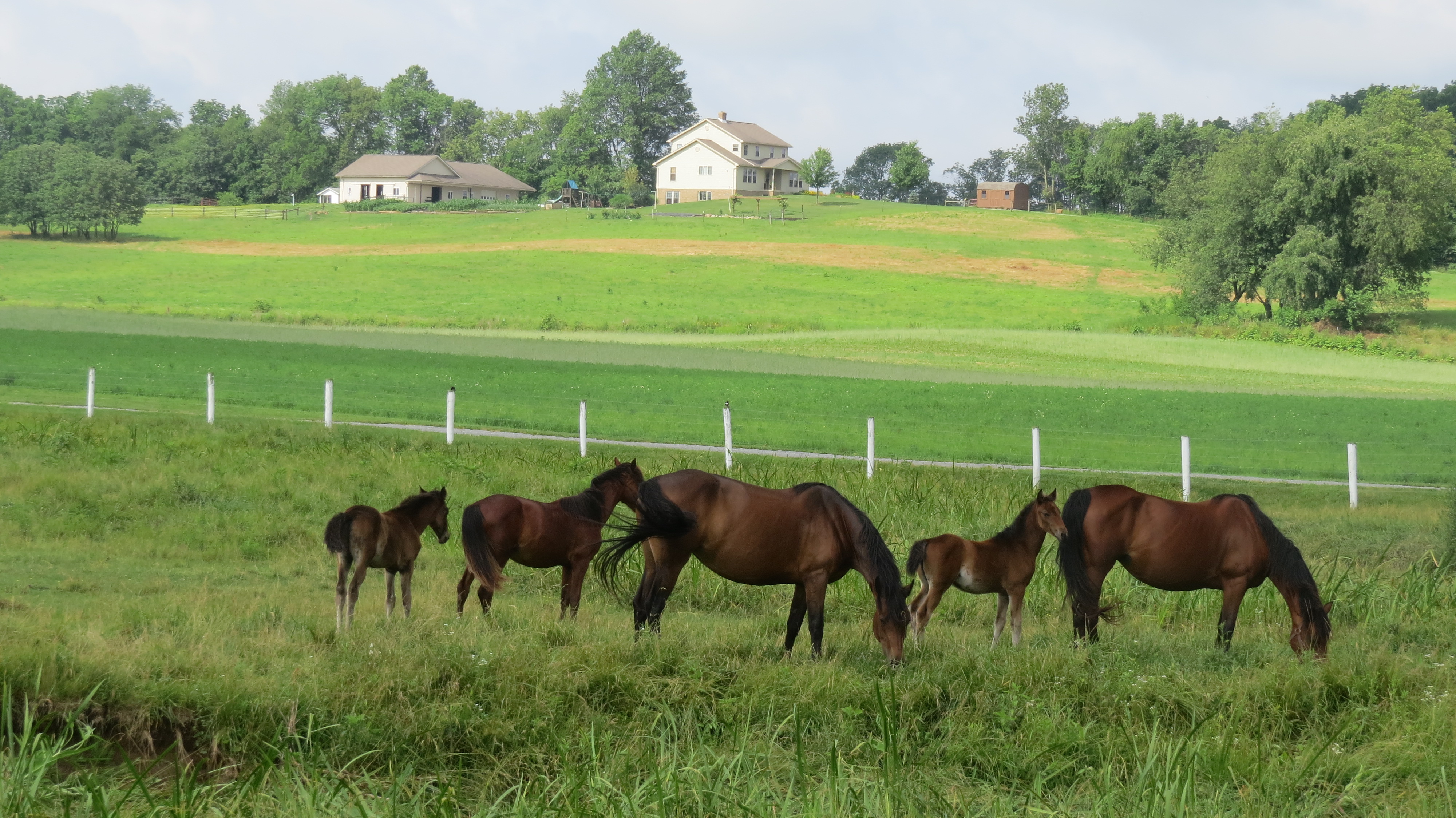
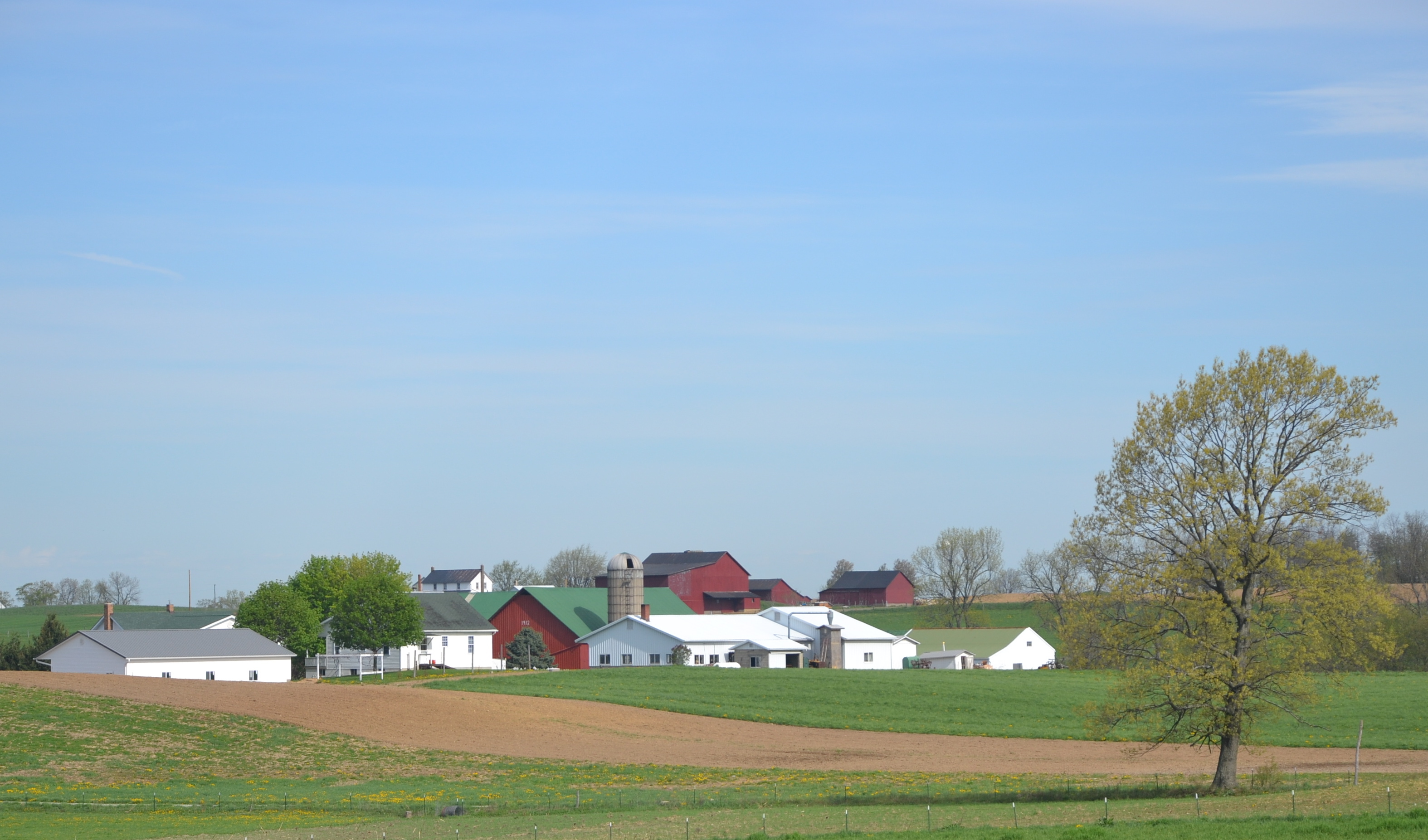
I drove by this Amish produce farm on the way to and from the pharmacy.
By Bruce Stambaugh
I happened into the local pharmacy mid-morning to purchase a few items I needed. It turned out to be much more than a routine shopping trip into town.
The clerk at the checkout counter was a former student in one of the buildings where I had been principal. Normally, upbeat and cheery, I mentioned that she seemed a bit down about something. The young woman replied that the store had been robbed of drugs the previous evening, and that she was still a little jittery from the experience.
I expressed my regrets and sadness to her. I told her that my own parents and my wife’s parents had each had been robbed. In the aftermath, they felt violated, insecure and wary. The young woman said she felt the same.
Just then another employee arrived and joined the conversation. She, too, had a school connection. She was an employee, and I had her son as a student.
The scene reflects the lifestyle in Amish country. Though crimes do occur from time to time, the perpetrators are usually caught and convicted.
The women told me that law enforcement officials had arrived quickly, and through the help of witnesses and their police dog, the alleged perpetrator had been caught.
Still, I could see the fear in their eyes and hear the quiver in their voices. At that point, another customer arrived at the checkout counter. Yes, she, too, was another former student.
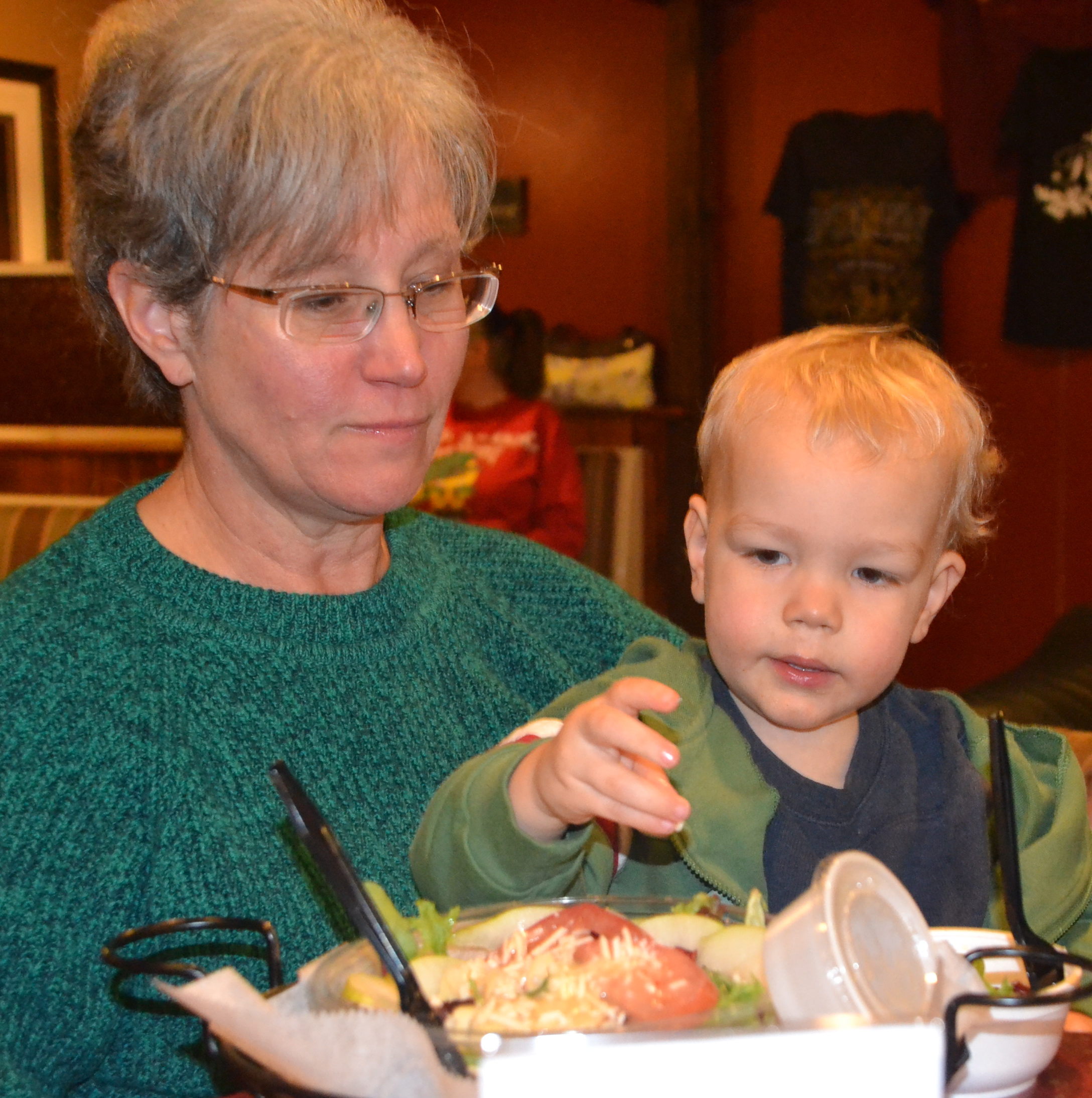
Grandma and grandson.I recognized her and her freckles, but had to ask her name. I told Heidi she hadn’t changed, and she said I hadn’t either. I told her to get her glasses checked, and we all laughed.
Given the circumstances and the setting, it was fun just to share a bit of laughter. The kibitzing we did back and forth helped them forget the robbery.
We are fortunate to live in a community where criminal acts are the exception and not the rule. Like my friends at the drug store, we are all connected one way or another.
I think this familiarity with one another develops a certain resiliency with folks. My neighbor’s business was broken into. Another neighbor had a valuable deer stolen. Local banks have been robbed, and on and on it goes. Fortunately, these various incidences happened over a long period of time.
There are times when the thoughtless desperation of others interrupts our normal life. And yet, a new day dawns and we go on with our everyday business, trusting, hoping, and praying that all will go well.
Smiles are generally the rule in any Holmes Co. business.
When you live in a community where many people know one another through friendship, work, church, school, neighbors or are related, you tend to feel safe. You also feel connected.
A friend of mine, long since gone, once hosted her grandchildren who lived in a metropolitan area in another state. When it got dark, one of the grandchildren asked if she was going to close the drapes since people passing along the busy highway could see in.
GrandsonHer reply to the simple question was a life lesson for her grandchild.
“We leave the curtains open,” the grandmother said, “so that people can see us. That way they will know we are all right.”
There are times when others will take advantage of us for such thinking. But if that happens, friends, neighbors, coworkers, relatives and former students will help us in our time of need.
Sometimes that help simply comes in the form of a little spontaneous laughter that helps keep us connected to one another. In the case of my friends at the pharmacy, the smiles and the laughs in the face of fear were treasures no robber could steal.
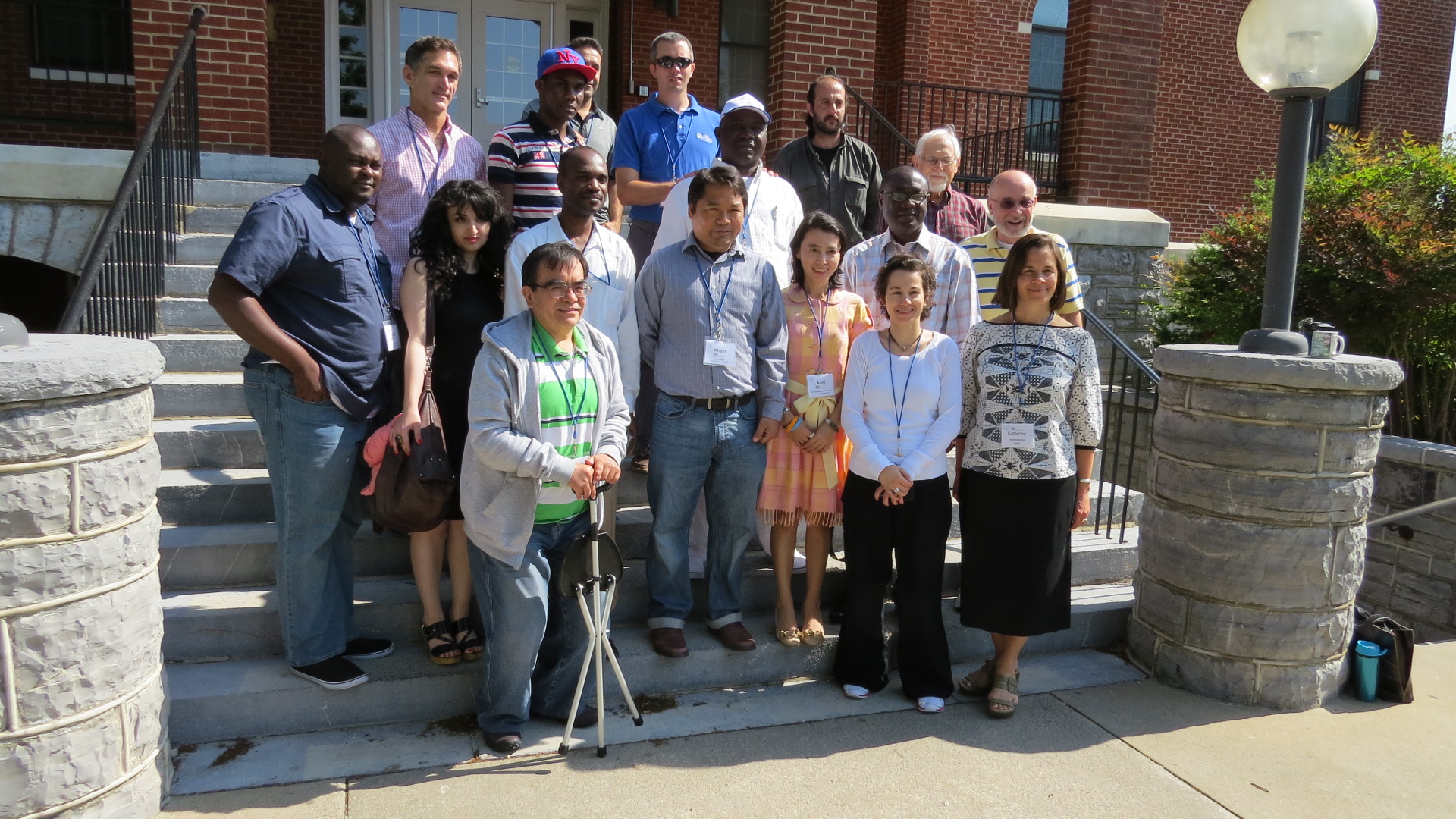
The Conflict Analysis class of the Summer Peacebuilding Institute at Eastern Mennonite University, Harrisonburg, VA.
By Bruce Stambaugh
We have it pretty nice here in the Greater Holmes County, Ohio area. I have known that ever since I moved to the area just after the historic July 1969 flood.
Ask locals, and they’ll tell you that it’s the best place in the world to live. I wouldn’t begin to argue otherwise.
That doesn’t mean, however, that this is the only place to call home. Clearly, if it were, the countryside wouldn’t be the same. Pastoral settings would give way to a jagged urban scape and all the trappings that accompany it.
For those who never venture afar from our comparatively protected environs, there is a danger with our self-satisfaction. Seeing the world with only our particular glasses can give us a distorted viewpoint on other cultures, socially, politically, economically and any other way you want to look at life.
At times it can be good to change lenses. That means we sometimes have to get well out of our comfort zone to do so. We have to let go of what we know, and learn anew.
Virginia’s Shenandoah Valley offers incredible views, like the morning mist rising out of the valleys.
Recently I took an intensive graduate school course at the Summer Peacebuilding Institute at Eastern Mennonite University in Virginia’s lovely Shenandoah Valley. It’s a place as pretty as home, only old age mountains backdrop rolling, fertile foothills.
Of the 16 participants in the class, I was one of only three North American students. The others came from places like Azerbaijan, Thailand, Iraq, Kurdistan, Belgium, Ghana, Nigeria, Syria and Haiti. I would have struggled to find some of these countries on a globe.
The students ranged from young adults to grandparents like me. Their given names were Amstrong, Yvon, Nurana, Carlos, Rana, Aunt, Ray, James, Oscar, Henry, Nameer, Ernest, Amina, Khant and Salar. They were pastors, government leaders, workers for non-governmental aid agencies, interpreters and teachers.
Though our cultures, races and geographic origins varied greatly, we were there to learn about the various ways to analyze and understand conflict. Given the current situations in the countries represented, much useful information was certain to be shared back home.
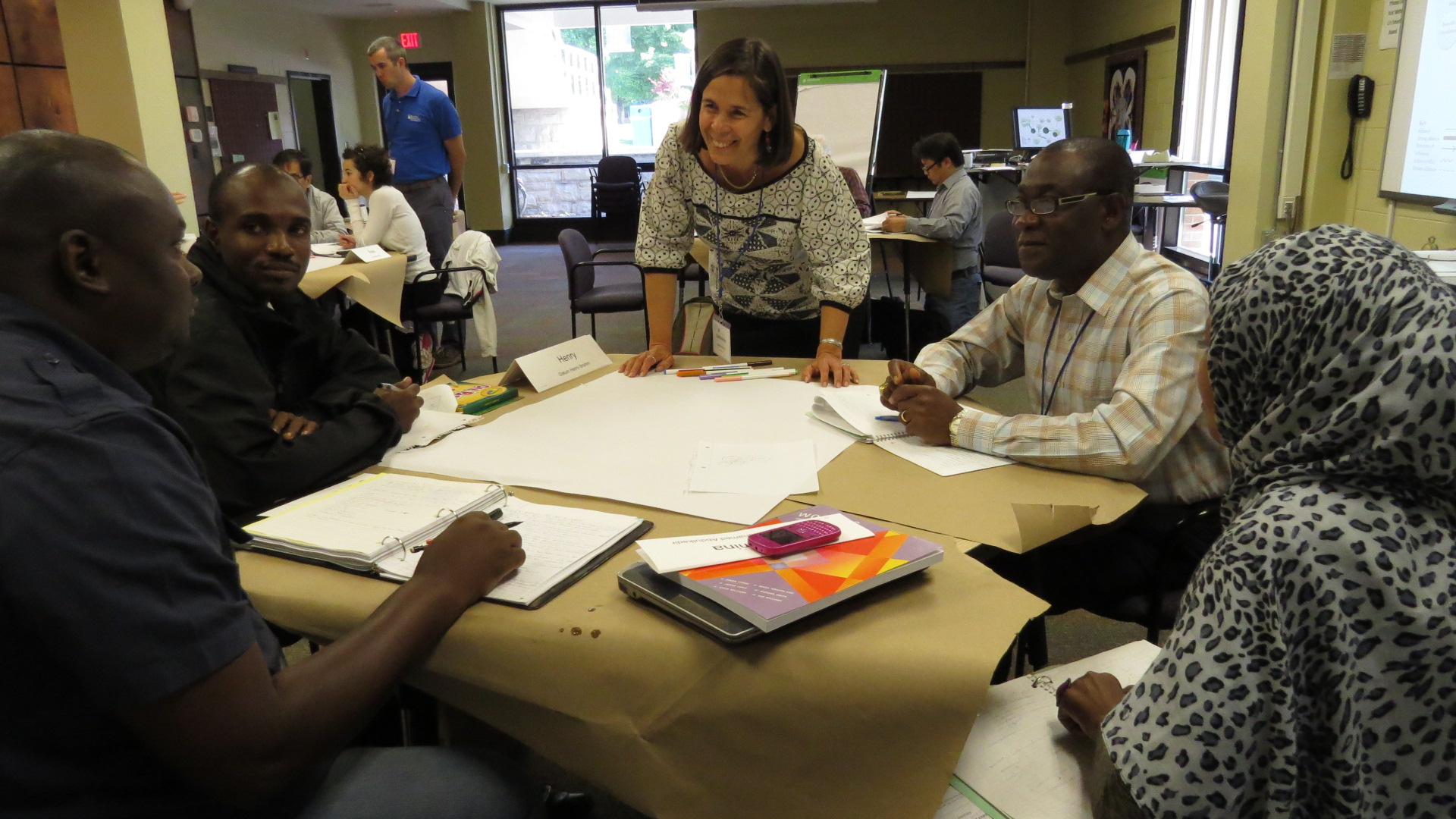
Much of the class time was spent in small group discussions and activities.
In the classroom, we sat in groups of three or four, each day a different configuration, each day new and fascinating stories intertwined with the professor’s lessons. Their personal stories, shared privately, were compelling, if not fearsome.
A pastor from Haiti called his wife every night and spoke to her from midnight until nearly dawn just to ensure his family’s safety. The consequences of war had destroyed the home of a young woman from Syria. Yet reconciliation, not retribution, was the aim of these devoted, considerate, inquisitive community leaders striving to promote peace.
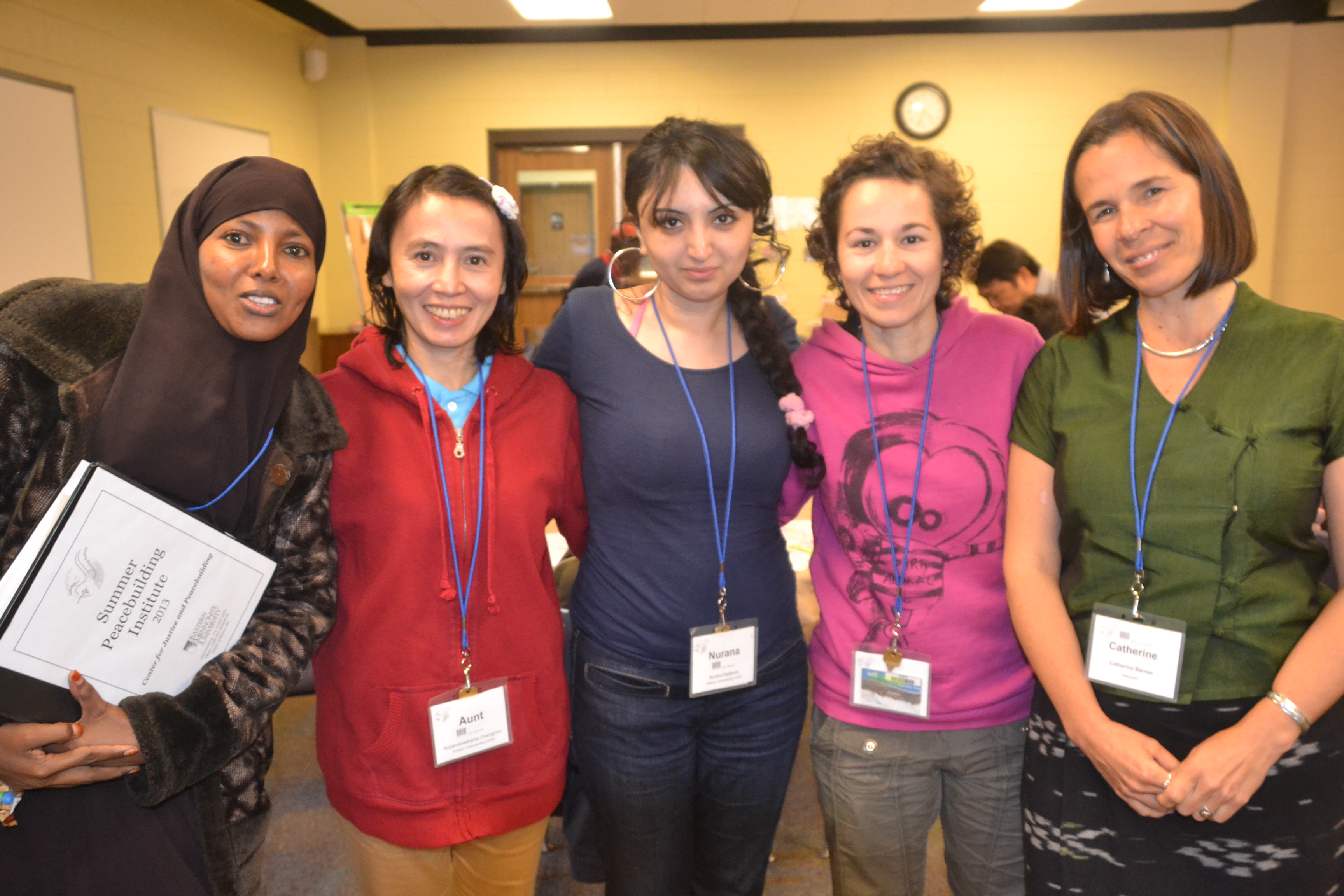
The dynamic women of the Conflict Analysis class of the Summer Peacebuilding Institute.
Instead of focusing on how bad it was in their country or blaming other governments, these men and women were glad for the opportunity to learn how to dissect and resolve conflict. They would take what they had learned and apply it as best they could. Their goal was to improve the world around them, even if it was one person at a time. Where there was despair, they saw hope.
When the Haitian pastor asked me if my home was safe, I hesitated before answering. I looked deep into his dark, wondering eyes, and simply said, “Yes, I live in a very safe place.”
“You are very fortunate,” he replied softly. I was humbled.
All of us who live in our lush, agrarian area are fortunate. Occasionally it takes looking through other life lenses to fully appreciate our own home view.
I am honored to report that today I received the University of Akron’s Wayne College Regional Writers Award for non-fiction. Since I’m naturally too modest to say much about myself, friends and colleagues encouraged me to share this winning essay with you.
By Bruce Stambaugh
I have always been enamored by names.
By names, I mean the title affixed to something, someone or someplace that transcends the given moniker of the object, the person or the place.
When I moved to Holmes County, Ohio many moons ago, I immediately picked up on the custom of speaking in this sort of colloquial code that was neither an accent nor a dialect.
People spoke of names for places as if the entire world knew to what and where they were referring. Often times, most of those names could not be found on any official document, including a county map.
Still, people used the names as reference points, meeting places and settings for stories, imaginary and true. With apologies to Stephen Colbert, the “truthiness” of the tale didn’t really matter.
In my teaching days, my elementary students matter-of-factly offered up perfect examples of what I mean. When I asked the students where they lived, I got answers like “on French Ridge” or “next to Dingle Brown” or “ beside Blackbird Croskey.”
Once I caught on to this provincial name-dropping, I tried turning the tables on the kids through the lessons. They found it down right sacrilegious to learn that Glenmont had once been Napoleon and Killbuck was first Oxford.
Nor did they believe me when I told them that Fort Fizzle had really been a fort, and the cause of its rebellious caretakers actually did fizzle. It was an insignificant skirmish in the American Civil War. But it was our own.
The cute terminology wasn’t confined to the schoolhouse either. Once, when I reported to the fire station after the alarm had sounded, I found the first two trucks gone and the station empty. I checked the chalkboard where the type of run and its location were hastily scribbled. “Grassfire, Baddow Pass” was all it said.
I was stumped. I had no idea where that was, and had to wait until another volunteer showed up to find out which way we should go.
The name game even spilled over to church. When the youth group wanted to go on a hayride to Panther Hollow, I again had to ask about the exact location. When we got there, it was so spooky I thought it should be named Ghost Hollow. But I soon learned that was actually on the north side of the nudist camp. And no, I am not making up any of this.
When I moved to the eastern part of the county, I discovered the local names just as prolific, if not more so. Amid the Amish and Mennonite culture, several people have the same name. But there was only one Bicycle Dan and one Toothpick Andy.
We had our church picnic in Troyer’s Hollow. The Stink Plant sits on Weaver Ridge. Good friends live on Joe T. hill.
In the western, more Appalachian area of the county, the hills are steeper and the valleys are wider. In the east, with its more gently rolling hills, the tranquil valleys are referred to as bottoms.
A young woman was once talking with a small group of people about what each valley was called. She said she lived in Bulla (or Bull) Bottom, and that the valley on the north side of Walnut Creek was called Genza (or Goose) Bottom.
She promptly turned to a young man who lived over the next ridge, and innocently asked him, “And what is your bottom called?”
Like I said, I love these earthy, rural names rich in traditions and full of life, goodness and virtue.
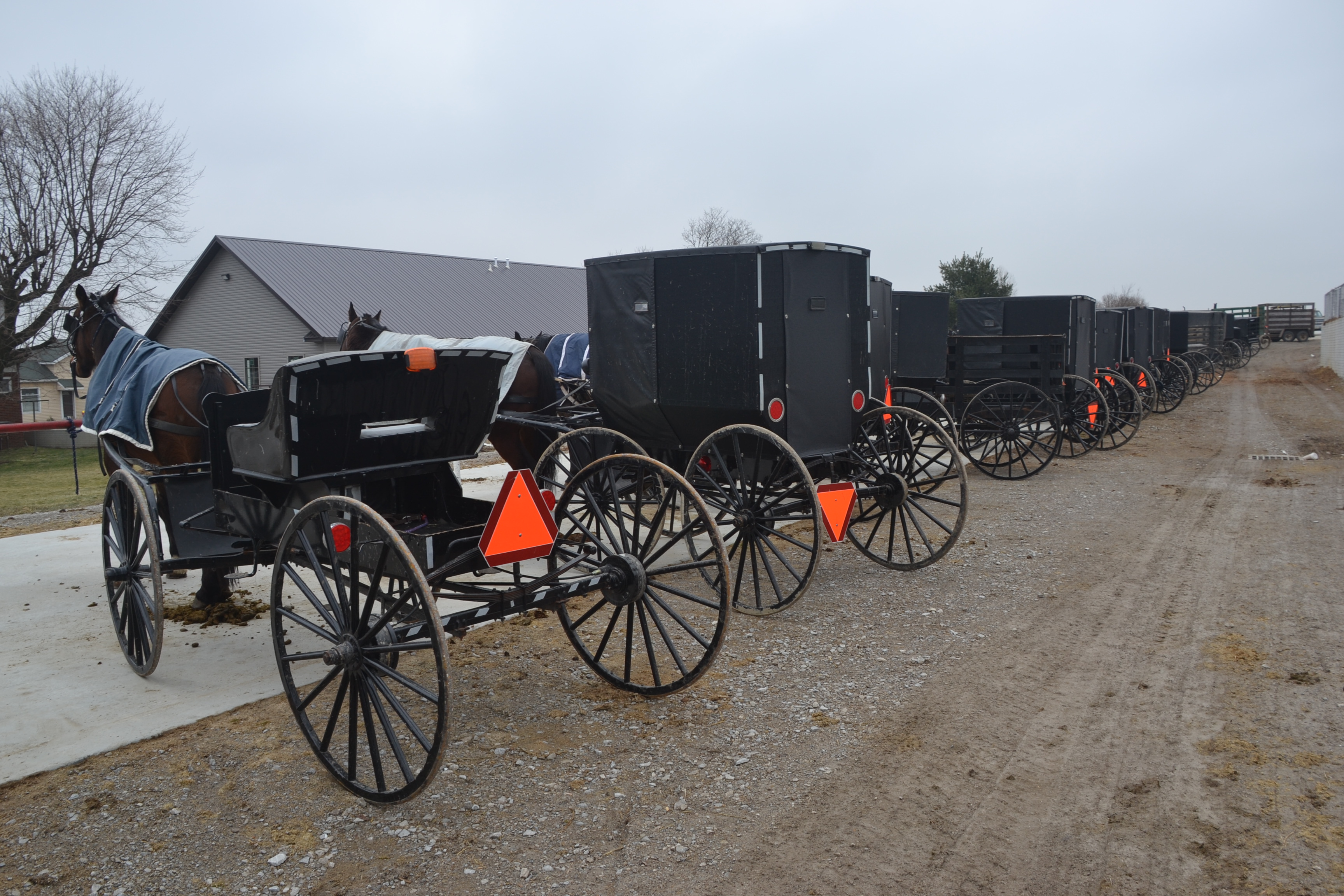
An assortment of buggy styles were tied up at a local auction barn.
By Bruce Stambaugh
Amish buggies in Ohio’s Amish Country may be all black, but they definitely aren’t all the same. The nondescript, unobtrusive color merely keeps them uniform and modest.
Even if they all are black, a closer look reveals that there are many differences in buggies. These variances are especially true for buggies owned by younger Amish men. Particular attention is paid to the kind of accessories included on their buggies. After all, a buggy can last for 30 years if it is well maintained.
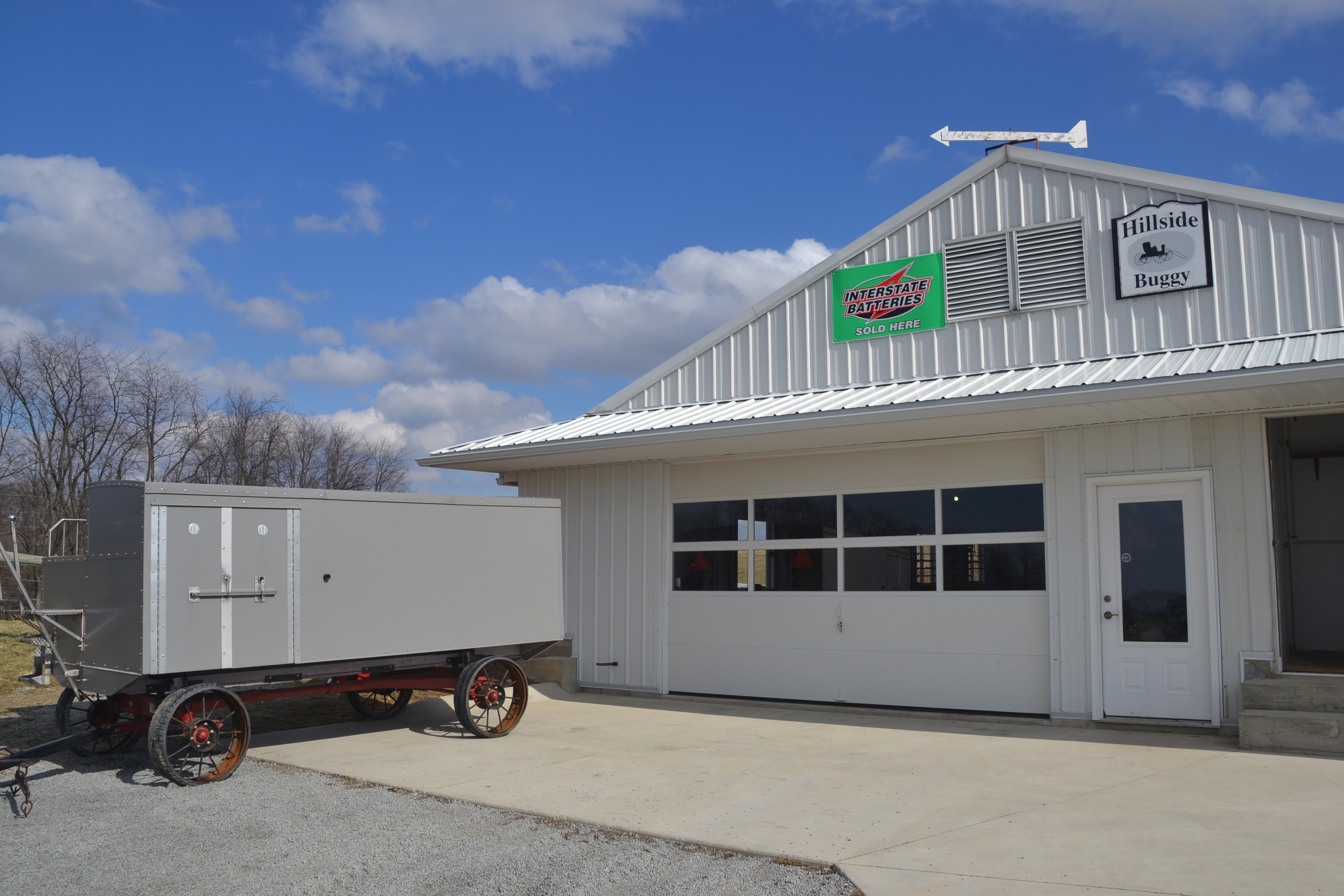
An Amish bench wagon stood outside an Amish buggy shop near Berlin, OH. The wagon is used to carry the church benches from one location to another. Since the Amish do not have church buildings, they take turns hosting church for the 100 or more members and their children. Shops like this one are cleared out and cleaned in preparation for church service.At least two-dozen buggy shops are sprinkled around the Greater Holmes County area. That way the Amish do not have to travel far to order a buggy or have one repaired. That concept is maintained in all aspects of the Amish lifestyle.
Demand for new buggies is high. Most buggy shops reported a year’s wait for a new buggy. Depending on the size of the shop and the kind of buggies being built, buggies are produced at the rate of no greater than one per week. Buggy repairs are worked in accordingly. Should a buggy be damaged in an accident or lose a wheel, for example, it would receive priority status.
Most buggy shops are family operations. A father and his son or sons may run the shop, assisted by an apprentice or even wives and daughters. This way the trade can be passed from generation to generation.
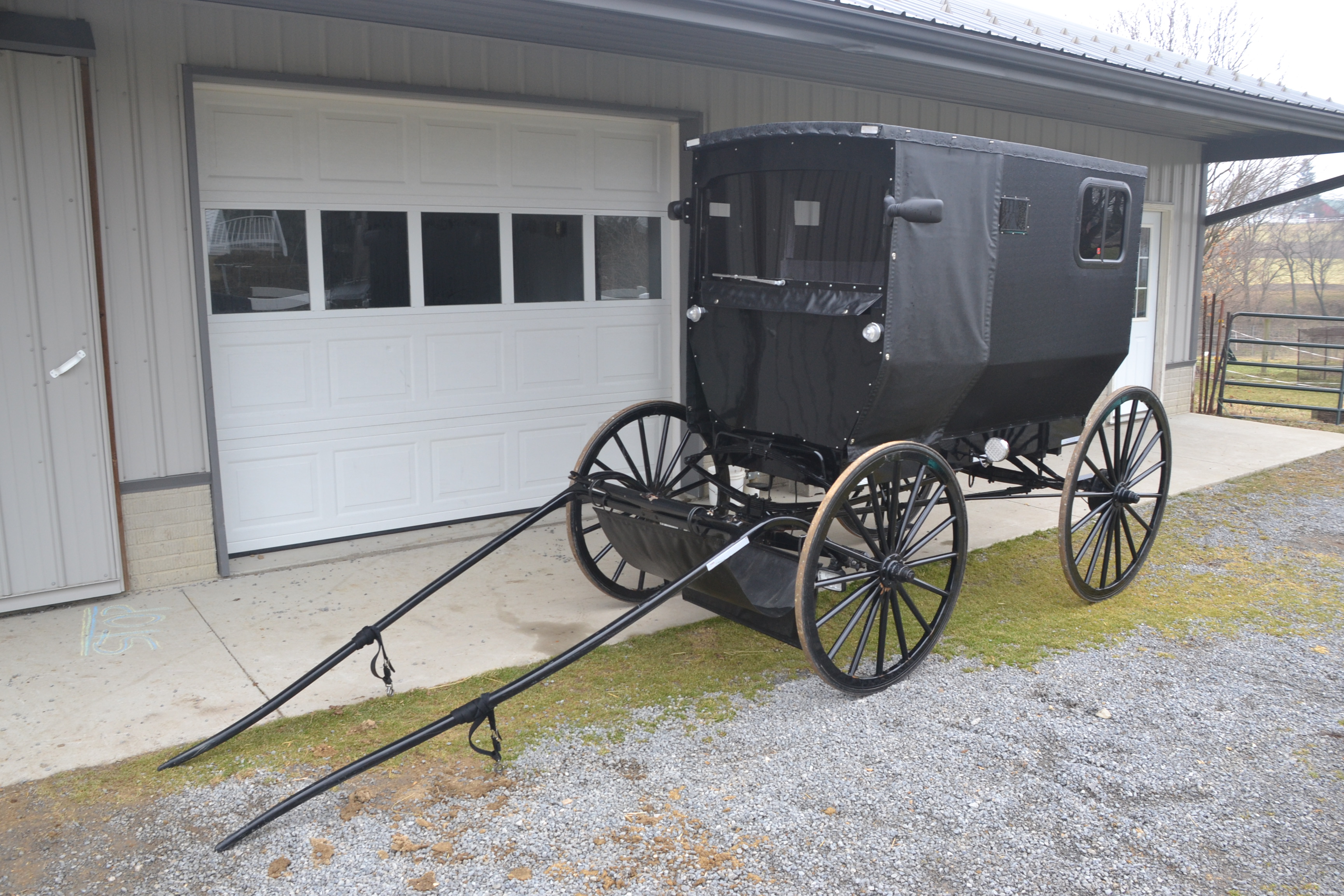
Amish buggies are built one at a time. The buggy in the foreground still needs to have its black vinyl coated cloth skin attached, and painting completed.
Because each buggy is custom-built one at a time, assembling a buggy is a prolonged process, taking as long as a year to complete. To build a sturdy, useful buggy, shop owners and workers need a variety of skills. They must be a carpenter, welder, upholsterer, painter and mechanic all in one.
According to Menno Schlabach, owner and operator of M & S Coach near Berlin, buggies start with a wooden base. Reinforced with metal braces, a wood framed structure is attached. The sides and tops are covered with a grained, vinyl coated black cloth.
“With 150 church districts in the area, customization of each buggy varies a great deal,” Schlabach said.
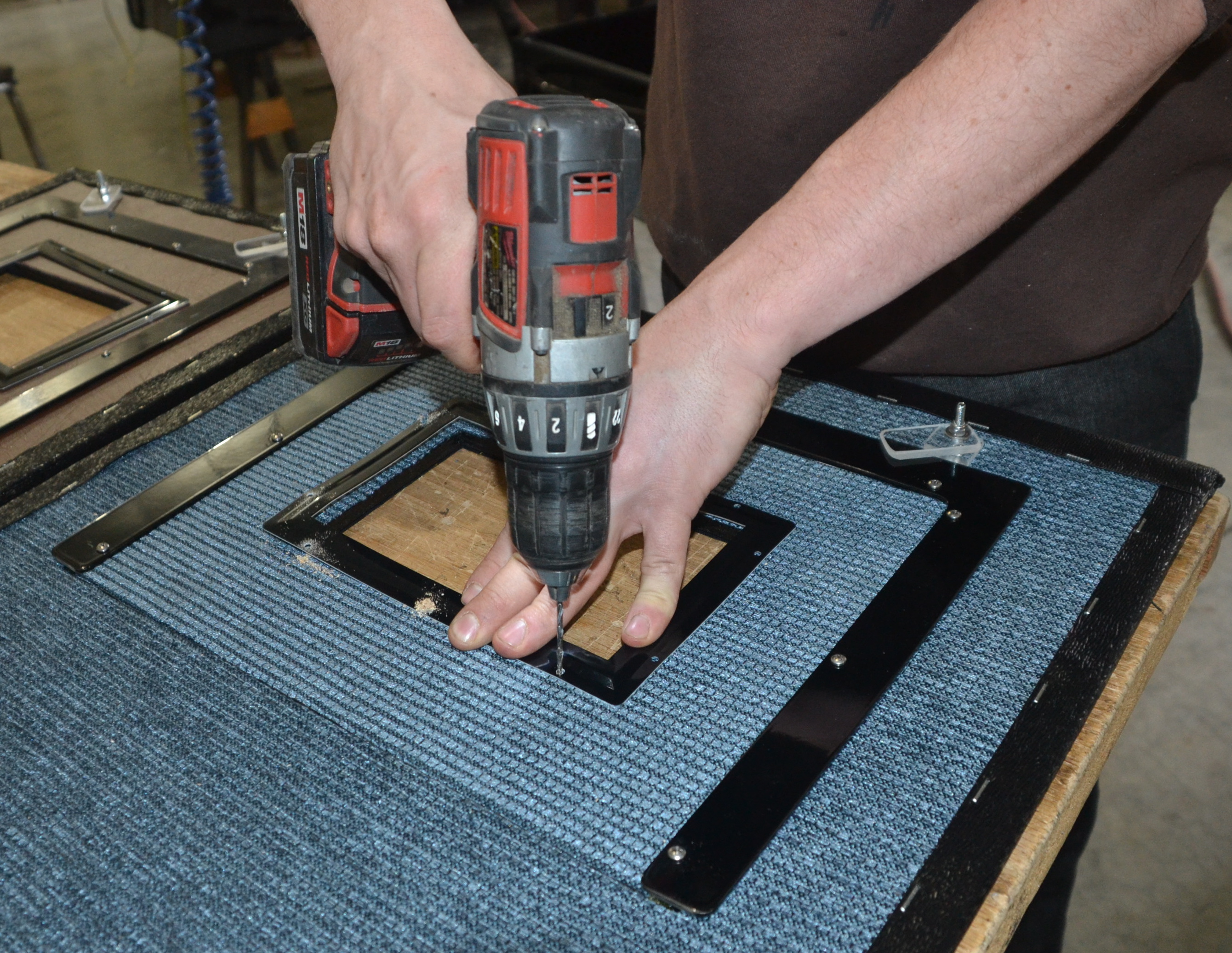
This wood inlaid dashboard is typical for young Amish men to have installed in their first buggy. The levers that operate lights and even a hand-powered windshield wiper fit through the cutout holes.
Indeed, it is the customization that allows the customer to put personal preferences into the new buggy to give it character. That process also slows the construction. With all the various options, Schlabach said it takes an average of 150 hours to build a new buggy.
A worker installed a window in the door of a new buggy.Some buggies have curtain doors that roll up, while others have sliding doors on the side and a hinged door in the back for easier access. Other buggy accessories include shelves for storage, switches, battery compartments, mirrors, window sizes and shapes including the choice of glass or Plexiglas or no glass at all, shapes and cushioning of seats, manually operated windshield wipers, brakes, upholstery and a variety of lighting options. Even the materials of the wheels and shafts vary.
Dashboards seem to be the telling tale of the owners’ preferences. Some are intricately made using inlaid or exotic wood. The dashboards are mounted on the inside of the front piece of the buggy. They generally house switches for exterior and interior lights and turn signals.
Buggies in the Greater Holmes County, Ohio area are usually well-lighted and marked with a slow moving vehicle reflector, reflective tape, and rear amber blinking light.Even the exterior lighting is customized. Just like cars, buggies have headlights and taillights. Most also have amber warning lights on the top rear of the buggy. Running lights along the sides of the buggies help drivers see at night. Marker lights positioned on the front and sides of buggies are other accessories that give the buggy its individual distinction. Only buggies owned by Swartzentruber Amish, the lowest Amish order, still use kerosene lanterns for visibility.
The style of buggy is determined by its purpose. A two-wheeled cart is the simplest of all buggy types and is used for quick, local trips. The hack is the Amish equivalent to a pick up truck. Sometimes called buckboards, a hack is a four-wheel buggy that is designed for hauling livestock and other bulk items. Some driver compartments of hacks are covered, while others are open.
The most common buggy type is the surrey. They are built with a bench seat and a storage area in the back that also has an option for two small flat seats along the insides. The side seats can be removed to increase storage. Usually children use those rear seats.
Most parts of buggies are made locally, including these shafts that connect the horse to the buggy. The shafts are made and bent at a specialty shop near Mt. Hope, OH.
Surreys come covered or open. Covered buggies are called top buggies. The family version of a surrey has two bench seats and four openings for access, plus some storage space in the rear with a door or curtain that rolls up.
The Amish like to keep things as local as possible. The wheel, spokes, axel and brakes were all made within 15 miles of this buggy’s owner’s home.The newest buggy version is the mini-surrey, which can actually hold more passengers than a regular top buggy. Affectionately called a minivan by some Amish, the mini-surrey serves the same purpose. The side seats behind the front bench comfortably hold two adults or several children on each side.
The cost of new buggies varies depending on the type and size of the buggy and the kind and amount of accessories included. A new cart could cost $1,500 while a new, well-equipped mini-surrey could run up to $7,000.
With a horse for an engine, the buggy’s driver steers with a set of reins instead of a steering wheel. Still, the purpose of a buggy is the same as a motorized vehicle. It transports its passengers from one place to the other, just at a much slower speed.
Buggies may be black. But they are an important element that helps keep the Amish culture moving in every way.
The newest style buggy seen is the Holmes County area is the Amish mini-buggy, affectionately called the Amish minivan.
During the course of a year, I take a lot of photographs, thousands to be exact. My son says I take too many, especially of the same thing. But I snap away for several reasons. My mother gave me her artsy eye to see the beauty in the world around me. She painted landscapes. I take pictures. Shooting pictures is also a way to document the year. In addition, I enjoy sharing the pictures I take, either through this blog, in magazines, on websites, or simply printing them out for people to enjoy.
With that introduction, this is my 2012 in review. With so many pictures, I didn’t want to bore you. Instead, I chose a picture a month, kind of like a calendar in reverse. I hope you enjoy my selections.
Happy New Year!
Bruce
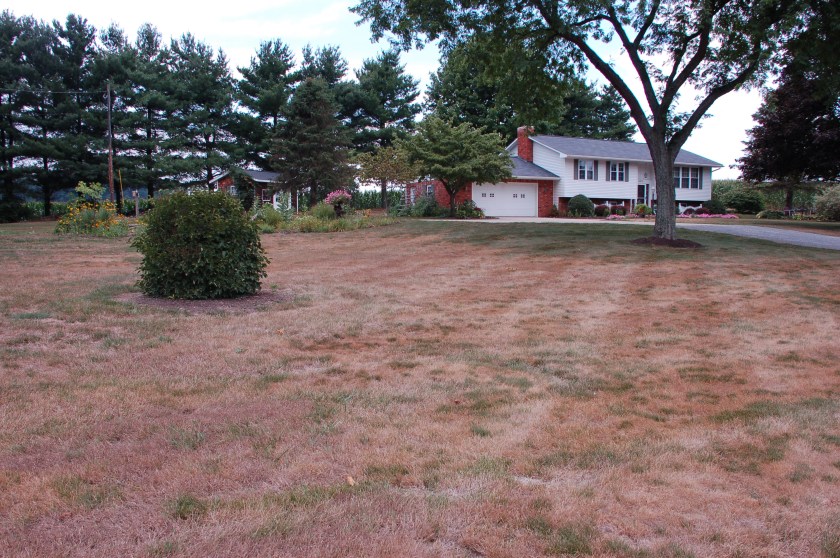
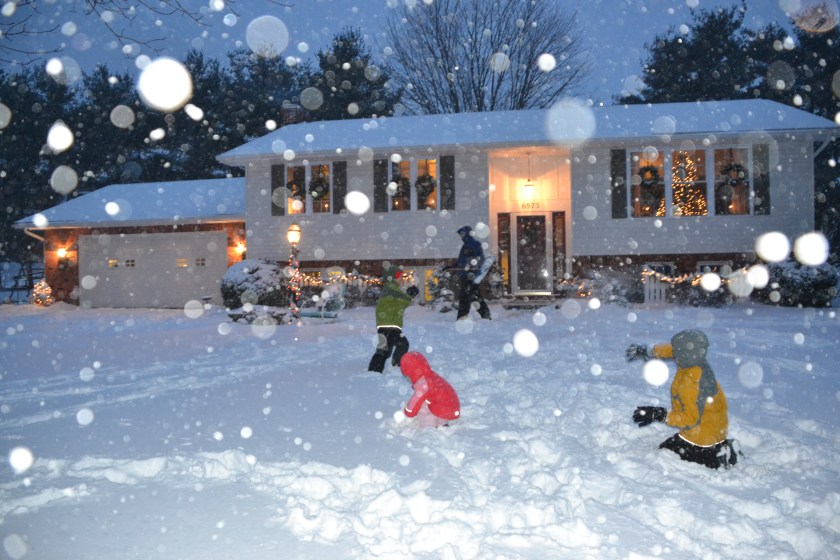
Enjoying a beautiful sunset on America’s number 1 rated beach, Siesta Key, Sarasota, FL, was a great way to begin the year.I love birding. This Northern Flicker posed perfectly for this shot in Feb.My wife and I celebrated our 41st anniversary in March by visiting Williamsburg, VA. These hats caught my eye.Lakeside, OH is one of my favorite vacation spots. When the Lakeside Daisies are blooming, which they did two weeks early this year, the town is even prettier. These daisies only bloom on the Marblehead Peninsula, and this bee enjoyed the small patch of these special flowers on April 29.I feel very fortunate to have Rose-breasted Grosbeaks frequent my backyard feeders. This male seemed fearless as he gorged on oil sunflower seeds in early May.I enjoyed capturing our grandchildren’s initial reaction to the surf at Sunset Beach, NC in early June.The end of July was the peak of the summer’s drought in Ohio’s Amish country, where my wife and I live.Summer fog is not unusual in Ohio’s Amish country. I often take my camera along on my morning walk, and I was glad I had this late August morning.A young Amish girl checked out the colorful balloons at the neighbor’s produce stand during their Customer Appreciation Day at the end of Sept.Laundry drying against the colorful leaves in mid-Oct. in Holmes Co., OH created a contrasting shot.The silhouettes of the corncrib and tree against the Thanksgiving Day sunset made a stunning image.Watching our grandchildren and their parents play in the snow the day after Christmas was as magical as the snow itself, and a wonderful way to end 2012.
Brooke Hershberger entertained participants of last year’s church walk at Millersburg Mennonite Church.
By Bruce Stambaugh
The event has such a straightforward name. Yet, participating in the annual Millersburg Candlelight Church Walk is so much more than that.
Yes, it is a walk, unless you choose to drive from church to church. This year six churches within walking distance in and close to Historical Downtown Millersburg, Ohio are set to host visitors on Friday, December 14 from 6 to 8 p.m. Millersburg is located 35 miles southwest of Canton, 75 miles south of Cleveland or 80 miles northeast of Columbus.
The churches are chosen for the proximity as well as their historical significance, according to Kate Findley, who is the volunteer coordinator for the event, now in its third year.
Kate Findley (left), coordinator for the church walk, shared about the Presbyterian Church at last year’s church walk.“We want those who can do so to be able to walk from church to church,” Findley said. “Those who cannot walk are welcome to drive to each church.”
Besides the physical exercise, people who participate in the tour will also learn about the history of each church. Findley said representatives from each congregation would be available to share about their church and answer any questions. For example, some of the church buildings have housed different denominations over the years.
In addition, the various churches in the walk have unique architectural features that people should find interesting. From ornate bell towers to stained glass windows to intricate pulpits, each church has its own structural story.
“This is an opportunity for people who might drive by these churches frequently without ever being inside them to see what they look like,” Findley said.
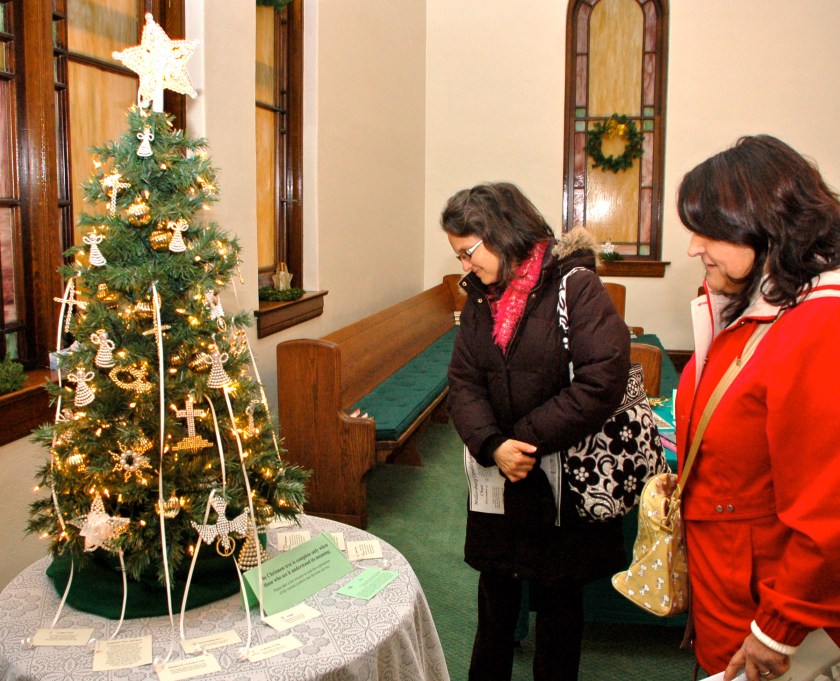
Participants in the church walk can view special Christmas decorations and traditions at each of the participating churches.
The six churches included in the candlelight walk include Faith Lutheran Church, 187 S. Clay St.; First Presbyterian Church, 90 S. Clay St.; Grace Pointe Community Church, 164 N. Washington St.; Millersburg Christian Church, 125 N. Clay St.; Millersburg Mennonite Church, 288 E. Jackson St., and St. Peter’s Catholic Church, 379 S. Crawford St.
“The walk committee is really excited to have Grace Pointe Community Church join the walk this year,” Findley said. The building formerly housed the United Methodist Church. Findley emphasized that participants can visit the churches in any order they choose. Maps of church locations will be available at each church.
“There is no starting or ending place,” Findley said. “We are encouraging people to participate in the special music and Christmas carol singing after the walk.”
A special music presentation and singing of carols at Millersburg Mennonite Church will begin at 8:15 p.m. Members of Millersburg Mennonite will perform vocal and instrumental pieces as well.
Each church will be decorated for the holidays according to the particular traditions of each congregation, Findley said. Luminaries will decorate the path to each church. Participants are also invited to relax at each church and enjoy the music presented. Participants will also have a chance to taste the culinary skills of the various church parishioners. Refreshments, including homemade Christmas cookies, will be available at each church building.
“The Millersburg Candlelight Church Walk is an excellent time for families to get in the holiday spirit,” Findley said. “It’s fun for everyone.” During the first two years of the church tour, participants represented several generations. Findley said that the church walk gained such notoriety in its first two years that people from other counties contacted her about starting one in their communities.
“I think that says a lot about the quality of the Millersburg Church Walk,” she said.
Findley noted that participants should be aware that the Grace Pointe Church is not handicapped accessible, and that parking is across the street from the church.
The walk is free and open to the public. Besides county residents, several persons from outside the Holmes County area attended the previous two walks.
Smack in the center of our bucolic county is a gift that can be enjoyed by all. The Holmes County Trail is a golden thread that symbolically intertwines the east and the west as one.
Now December may seem like a strange time to be writing about hiking and biking. When we have a gem of a trail in our midst it isn’t. Despite living in northeast Ohio where the weather is as fickle as its politicians, township trustees excluded, the trail is a year-round treasure for hikers, bikers and birders alike.
The trail ties Holmes County’s two cultural and geographic regions together through more than its central location. This multipurpose ribbon of assimilation serves as outdoor gym, nature center, photographic paradise and transportation route all in one. Many people, local residents and visitors alike, utilize those undeniable attributes.
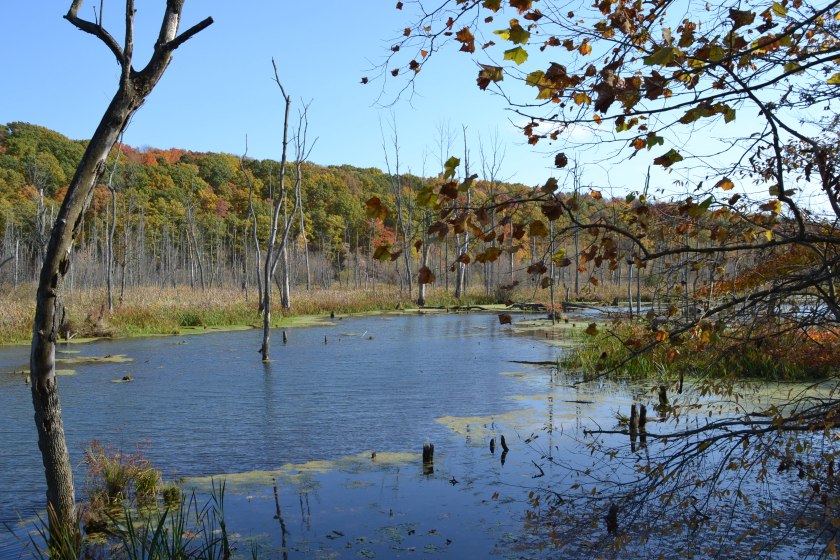
Though the trail has been open for awhile, it has only been in the last couple of years that I have begun to fully appreciate its value. I bike and hike the trail for the obvious reasons. I need and enjoy the exercise. The trail, however, provides so much more than physical workouts. For 15 miles from Fredericksburg to Killbuck, enigmatic landscapes of steep wooded hills and low marshlands with grasses, reeds, wildflowers, wildlife, ponds and estuaries abound.
The Holmes Co. Trail runs through the Killbuck Marsh, an important wildlife area and fly way for migrating birds
Whether cycling or walking, memories flood my old brain much like the murky waters of the streams overwhelm the old-age valley after a summer deluge. Traversing where locomotives once chugged and whistled through the heart of the county invigorates the body, mind and soul. Truly its worth spans far beyond any personal physical or mental gains.
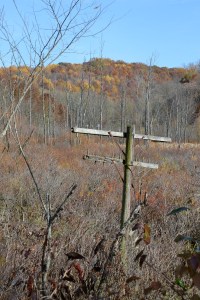
Historic and aesthetic reminders of railroad days appear occasionally along the way. The weathered, wooden arms of long-abandoned telegraph poles still stand. Girders of old iron bridges that once ferried locomotives pulling passenger and freight cars continue as supports for the trail to cross the many tributaries that feed the mother stream.
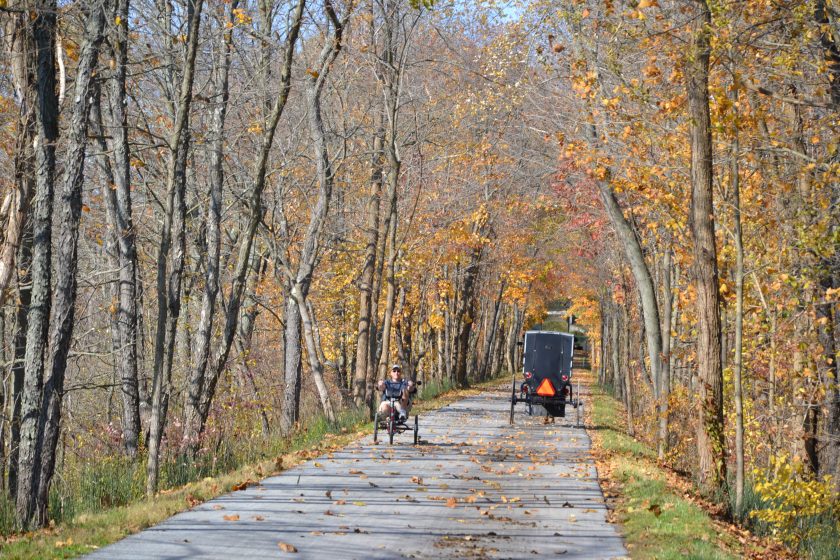
The old railroad bed that once conveyed products between Ohio cities has a renewed and appreciated purpose. Families leisurely stroll the paved path on a sunny Sunday afternoon. Casual and serious bikers alike zoom along the trail’s smooth, gentle gradient at preferred paces. Horses and buggies pass safely from home to store with no motorized hindrance.
Horses keep to one lane and bikers and hikers the other on the Holmes Co. Trail.
I am never surprised but always pleased by what I discover on my encounters along the trail. In the spring, pleasing pastels of plants, flowers and trees unfurl, and lyrical sounds of migrating songbirds, shorebirds, waterfowl and birds of prey fill the precious marshy flyway. In the shaded tree tunnels along the route, summer’s highlights include meeting fellow bikers from near and far who have come to enjoy the beauty of this special pearl.
A young Red-tailed Hawk took flight along the Holmes Co. Trail near Fredericksburg.Besides its rich, changing colors, the fall brings the joy of discovering a clamorous gang of crows spooking a bald eagle from its comfortable roost. Just down the way, gnawing beaver have encircled a cottonwood to the point of marveling that the tree still stands.
I have yet to experience winter on the trail. With the first fluffy snowfall, that will likely change.
As seasons come and seasons go, old friends meet and new friendships form along the blissful trail. Of all its intrinsic qualities, perhaps this virtue is the trail’s greatest gift to those who choose to unwrap it.
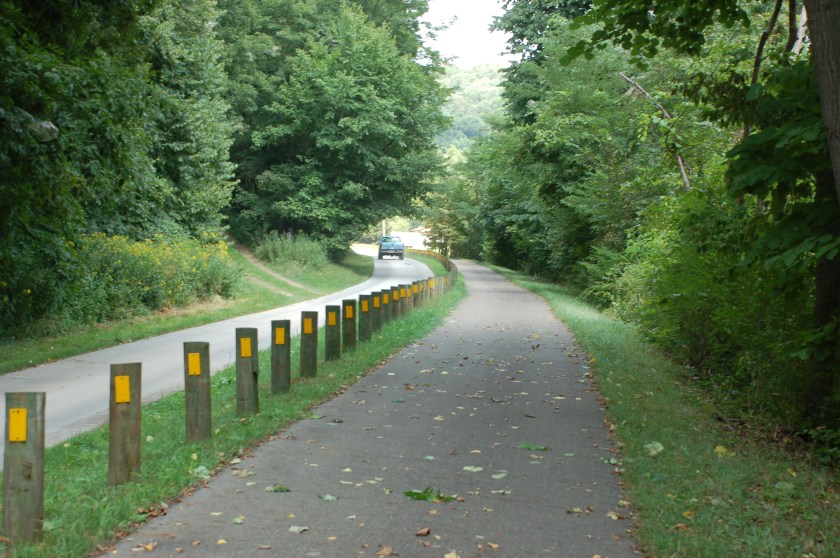
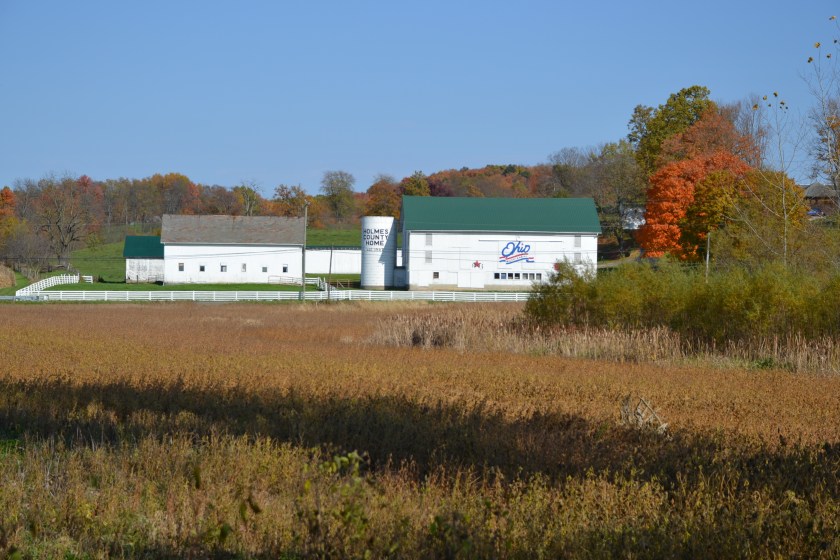
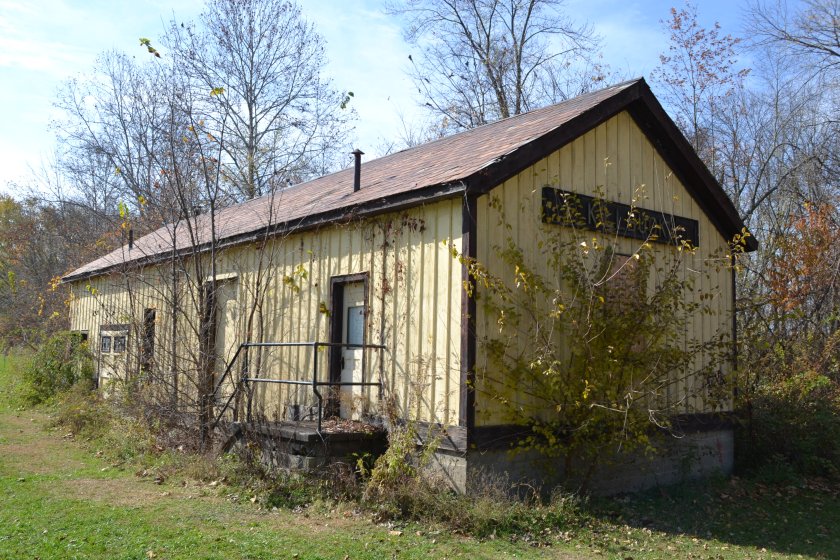
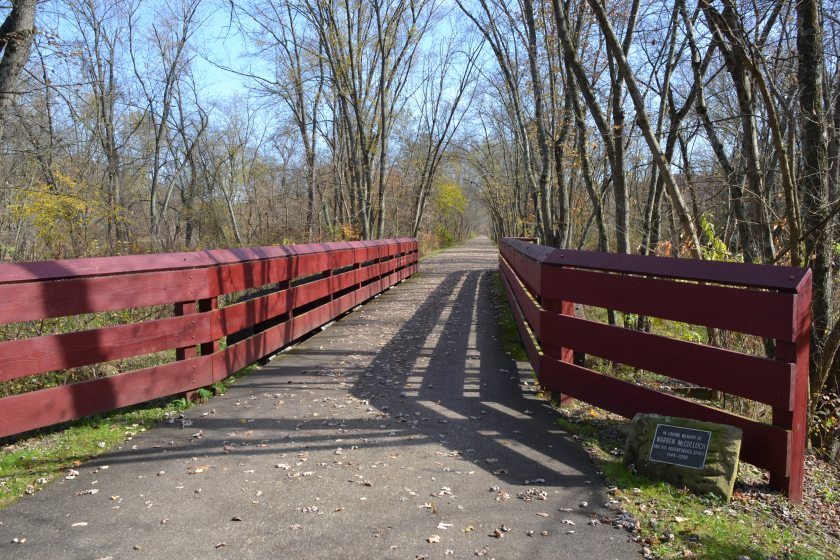
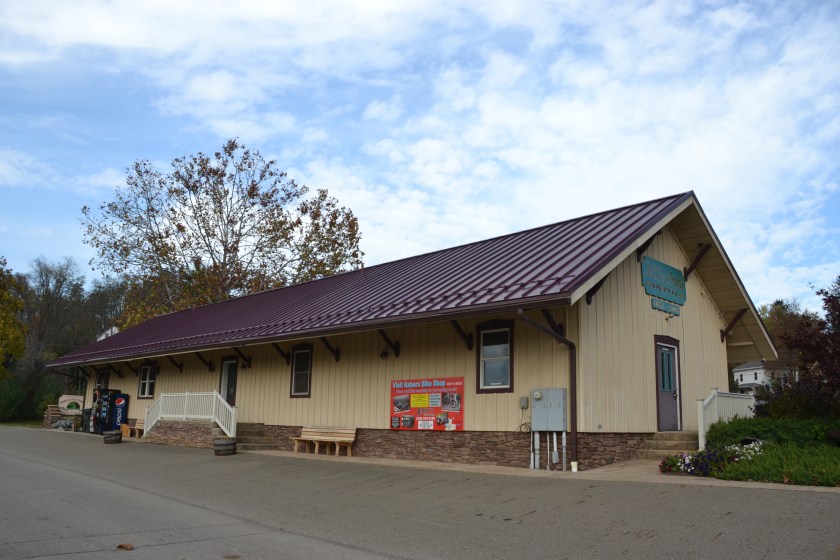
A Canada Goose gosling follows its mother through the marshy water along the Holmes Co. Trail.Families enjoy all the Holmes Co. Trail has to offer.North of Holmesville, a road parallels the trail.The views from the Holmes Co. Trail are beautiful and ever-changing.Fall is especially nice along the Holmes Co. Trail.In the fall, the Holmes Co. Trial really is a golden thread.The Holmes Co. Home is visible from the trail.Crops like field corn and soybeans also add to the variety along the trail.The trail follows the Killbuck Creek most of the way from Holmesville to Killbuck.The old depot in Killbuck marks the southern-most part of the Holmes Co. Trail.Horses are required to stay on one side of the trail for obvious reasons.The old railroad bridges still serve their purposes along the trail.The trail cuts through a variety of topography while maintaining a level ride.Though not in its original location, the Millersburg depot serves as the hub for the trail.The Killbuck Marsh is both a valuable wildlife habitat and a photographer’s haven.
The Holmes Co. Trail has several access points. They include from north to south Fredericksburg, Holmesville, Millersburg and Killbuck.
The last clouds of the remnants of Super Storm Sandy left Holmes County, Ohio late afternoon on Nov. 1.
By Bruce Stambaugh
I’m both a news and weather junky. When the weather is the news, I’m fixated. So it was with Hurricane Sandy.
From the time the hurricane entered the Caribbean until it finally dissipated in Canada many days later, I focused on news of what came to be known as Super Storm Sandy. Between her alpha and omega, Sandy stormed up the east coast. Once she turned inland, the destruction intensified.
Initially the media focused on a breaking story of a severely damaged construction crane in New York City. I watched in awe as video showed hurricane force winds bending the towering, monster crane like it were a twig. The damaged section dangled precariously several stories above a busy street while police and firefighters evacuated the area. News cameras zoomed in on the scene for the entire world to see. Much more serious incidents were occurring unknowingly far out of the cameras’ lens.
Sandy was one massive storm, just as predicted by the professional severe storm forecasters. Perhaps that is one positive to take away from this major weather event. Knowing that weather scientists were able to project accurately the intensity and path of the storm may convince people to take better precautions when future storm warnings are issued.
A huge geographic swath impacting millions of people got hammered. Sandy merged with an interior cold front, creating a hybrid storm with fierce winds, torrential rains, flooding, storm surges and even heavy snow in the Appalachian Mountains.
Sandy’s aftermath told an ugly, unfortunate story. Major metropolitan areas, including New York City, were particularly hit hard. As Sandy moved inland, the consequential events unfolded, and the media coverage began to expand.
Sandy’s winds, rains and high tide storm surges had obliterated once pristine places and popular vacation spots. Those who failed to heed the warnings either were stranded or rescued. Unfortunately others paid with their lives. Beaches where sun worshippers once lounged and children romped were simply gone. Beachfront homes and businesses disappeared.
Millions of people were without electricity, potable water, food, transportation and heat. Schools were closed. Businesses shut. Ruptured gas lines burst into flames, destroying entire blocks of homes. It was a mess to say the least.
The high winds and heavy rains we experienced here were minor compared to most affected communities. In fact, we were happy for the quenching rains.
Emotions and responses to the super storm became paradoxical. While snow resorts in West Virginia opened earlier than ever, several storm-related deaths occurred from auto crashes on slippery roads.
Birds seldom seen in Ohio were blown into the Buckeye State ahead of the intense storm. Birders here were ecstatic. All the while thousands upon thousands of people in northern Ohio were without power.
As the reality of the breadth and depth of the storm became known, the media ranged far and wide to cover the catastrophe. Both heart-warming and heart-wrenching stories of people helping people developed. The damaged crane seemed inconsequential compared to other ongoing calamities and heroic acts of goodwill.
Jessica StambaughAs massive and destructive as Sandy was, it seemed to affect each of us personally. That was certainly true for my family and me. A niece, Jessica, lives in Manhattan, and was among the throngs without power and heat for days.
I never did hear what happened to that dangling crane. I just know that Jessica was safe. Unfortunately, scores of others couldn’t say that about their loved ones.
This column appeared in The Bargain Hunter, Millersburg, OH.




































 Roadkill Crossing
You must be logged in to post a comment.