How We Celebrated Our Anniversary

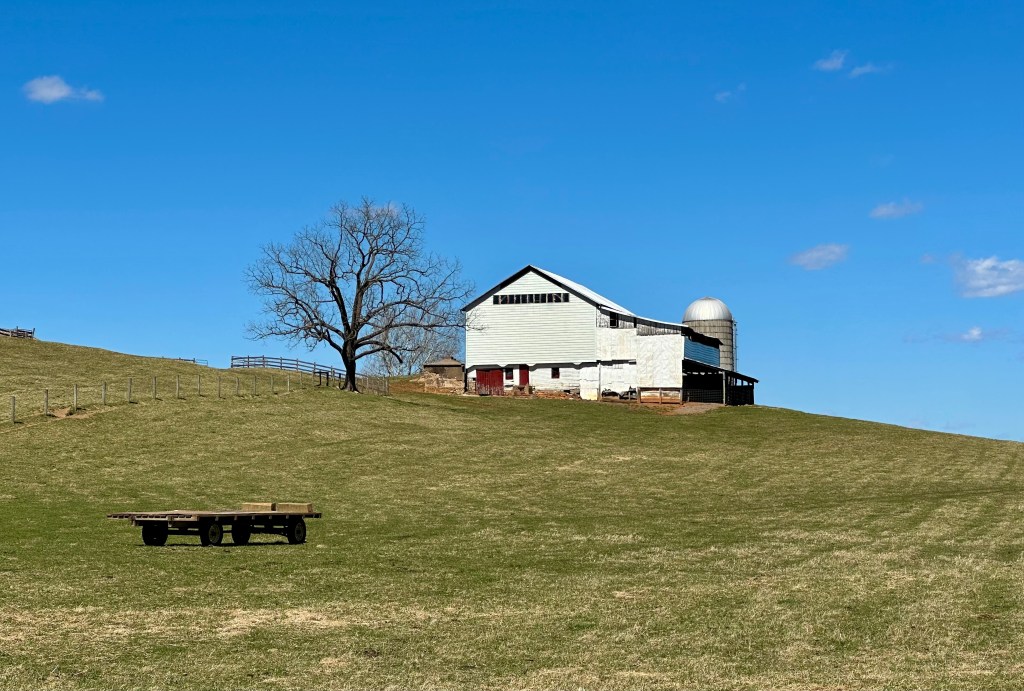
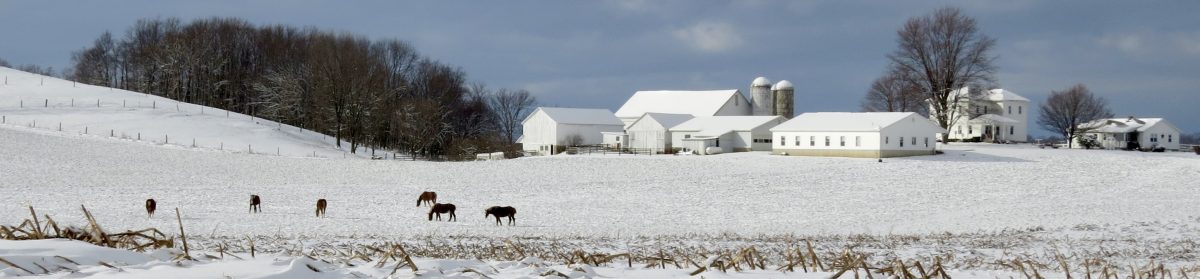
The pastoral landscape we enjoyed. Photo by Bruce Stambaugh

The weather was similar to the day we married 54 years ago, mostly sunny and warm. So, we decided to celebrate our anniversary by enjoying the scenic outdoors in Virginia’s Shenandoah Valley.

We drove the country roads in two Virginia counties, where Old Order Mennonite farms dominate rolling landscapes at the foot of the Allegheny Mountains. Those families have kept the farms intact for the most part. Generations have raised crops and livestock, including poultry, without selling off their prized road frontage for homes or small businesses. They must enjoy the scenery and quiet, too.

Despite the lack of rainfall, succulent green grasses for beef cattle, dairy cows, and plump sheep brimmed beneath tree-dotted pastures. Cottony clouds sailed overhead in the cerulean sky.

We visited a local birding hotspot across from a plain but pristine Old Order Mennonite church, where the men and women sit in benches on opposite sides after filing through separate doorways. Killdeer, Pectoral Sandpipers, and Canada Geese called and preened in the morning’s warmth, while pairs of Tree Swallows divebombed me for being too close to their birdbox.

Pectoral Sandpipers. Photo by Bruce Stambaugh

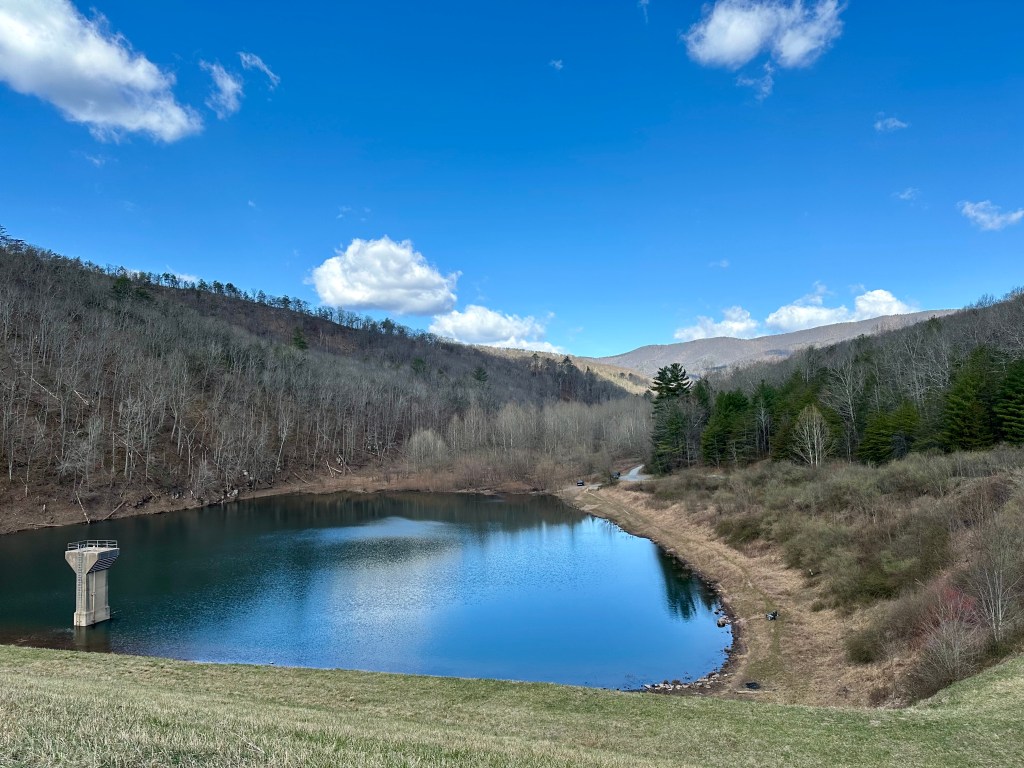
We turned onto a narrow, notoriously bumpy road that led to a mountain reservoir. A stream rushed between the mountains’ steep, forested foothills, marking the boundary between Virginia and West Virginia. Mint-colored leaves had only sprouted, allowing views of rock-filled talus slopes.

At the reservoir, the azure sky commanded the scene. Far below on its shores, fishermen plied the still water that mirrored the blue canopy overhead.

Though in no hurry, we kept driving south to our lunchtime destination. We wound up, down, and around onto primary roads and entered a historic, small southern city where artists and restaurants have replaced millineries, general stores, and saloons. We spied the old railroad station two city blocks away, where Amtrak and excursion trains still stop.

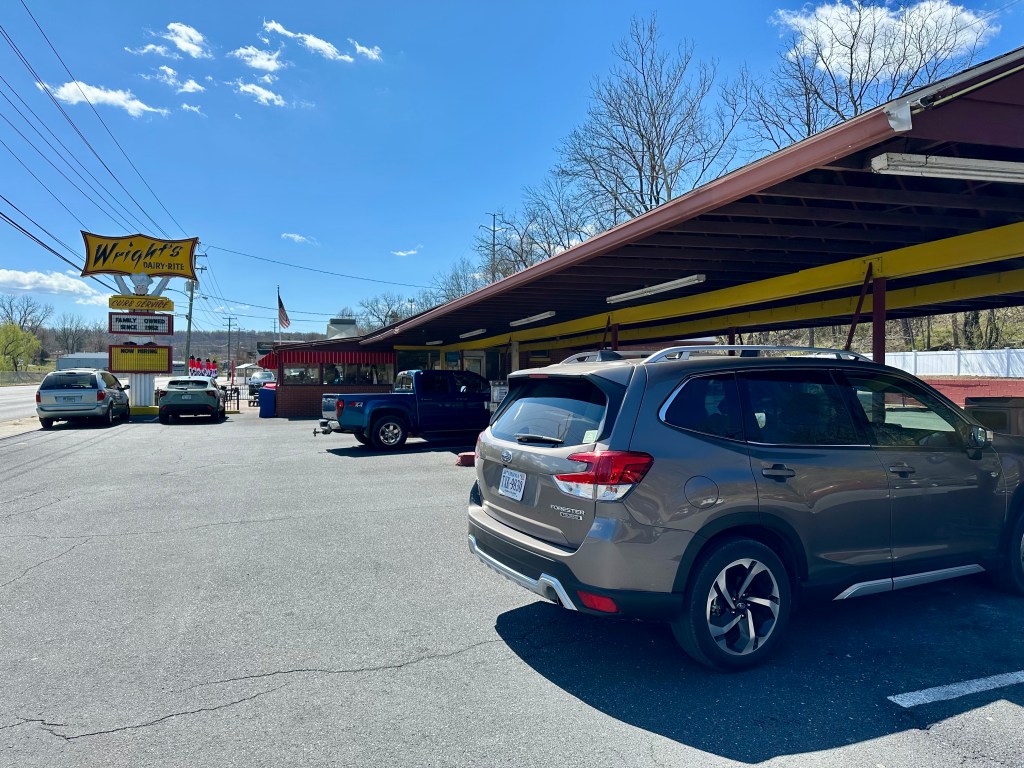
We were delighted to find a restaurant serving fresh seafood and luscious desserts. However, my wife diligently discovered an old-fashioned drive-in a mile away serving the best hot fudge sundaes.

It had been decades since I had to push a button to order food. The speakers looked like those we had at drive-in movie theaters in the 1960s. Our sundaes arrived just as we ordered, with chocolate ice cream.

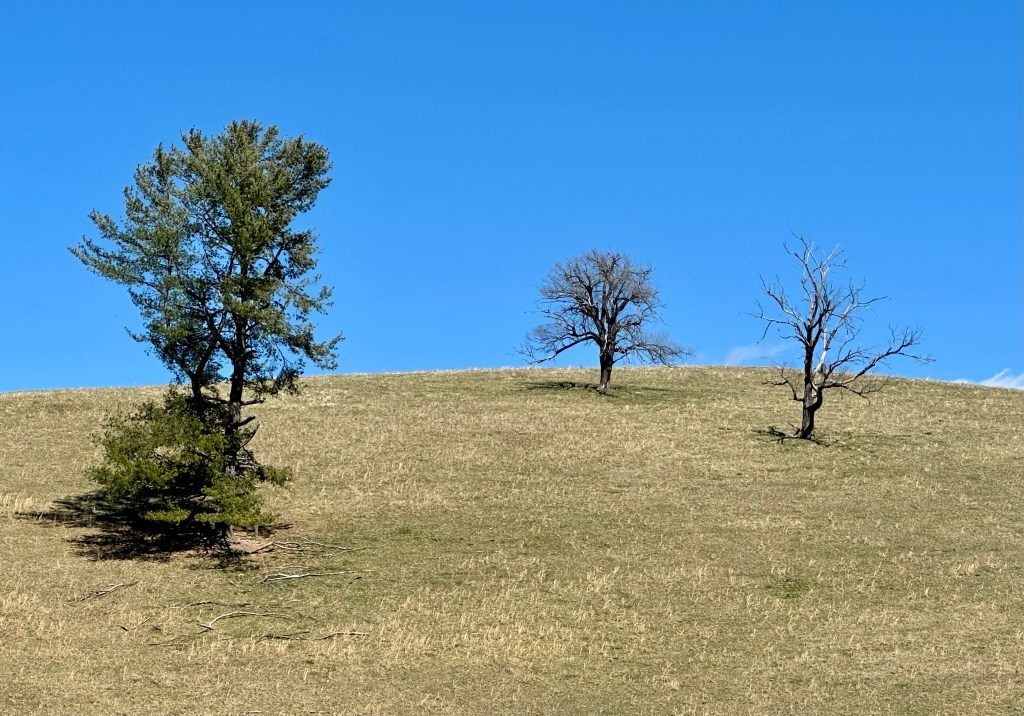
After the nostalgic pleasures, we headed west again toward the mountains before turning north. We passed ranches with lazy brooks snaking through green pastures occasionally speckled with grazing Black Angus cattle. Experienced farmers kept hilltop trees for cattle to gather on hot, humid Virginia days.

Drivers of the few vehicles that passed us waved the familiar index finger hello. If they know you, they point at you as a sign of recognition. We were fine with being admiring strangers.

Abandoned farmsteads stood on steep hillsides surrounded by trees planted ages ago. The houses were weathered and had broken windows, while many old outbuildings and barns had collapsed.

The long farm lanes that ended at white two-story houses and red bank barns reminded me of the happy, innocent Ohio days I drove down to pick up my fiancée. Like her lane, a small ridge of stubble grass divided the tire tracks.

The weather nearly matched the day we married all those years ago. Sunny skies and unseasonably warm temperatures dominated that precious day, too. However, the pungent smell of manure that the farmer had sprayed on the fields across from the country church was missing.

We made our way home happy, contented, and glad we had chosen to renew our vows so quietly, personally, amid welcome familiarity.

Steers graze on greening grass. Photo by Bruce Stambaugh

© Bruce Stambaugh 2025

Full Moon Setting


May’s Flower Full Moon was the last of the three supermoons of 2020. I wanted to photograph the full moon rising over the Massanutten Mountain Range that runs through the heart of Virginia’s Shenandoah Valley. However, my plans changed due to the weather. Spring has been unusually cloudy here this year. With a predicted clear sky on May 7, I was determined to capture shots of the full moon setting over the Allegheny Mountains that serve as the border between Virginia and West Virginia in Rockingham Co.

I had a clear view of the moon from Mole Hill, an ancient volcano, and noted area landmark west of Harrisonburg. Dawn’s early light highlighted Old Order Mennonite farms that dot the landscape all the way to the Allegheny foothills. The rusty silo, the brick farmhouse, the rolling, fertile fields, and the sweeping mountain slopes all take your eye right to the setting moon.

“Full Moon Setting” is my Photo of the Week.

© Bruce Stambaugh 2020

Look who’s talking now

Amish phone booth by Bruce Stambaugh
A phone booth on an Amish property is often placed away from the home to avoid the temptation of overusing the phone.

By Bruce Stambaugh

On a dark, chilly November night several years ago, an emergency medical technician arrived on the scene of a car verses buggy accident at a rural intersection. Unlike the car’s passengers, the older Amish man driving the lantern-lit buggy was uninjured.

As the scene cleared, the first responder asked the Amish man how far he had to go to call for help. With a toothless grin, the Amish man reached into his denim jacket and flopped opened a cell phone.

In the early days of cell phones, when even the EMT didn’t have one, that scenario might have been rare in Amish country. It isn’t any longer. As contradictory as is it may sound, Amish have and use telephones. They use them to converse, to fax, for GPS, to text, and on rare occasions, to access the Internet.

Of course, like many of other Amish lifestyle “rules,” there are many variables in the Amish – phone connection. Church leadership metes out phone use guidelines for Amish. Those rules and their application vary greatly. It all depends on which church and which order of Amish as to what the rules may allow. The rules about phone use, like other lifestyle guidelines, even differ from church to church within the same order of Amish.

Amish place by Bruce Stambaugh
The home of a young Amish family in Holmes County, Ohio.

The orders of Amish, if placed on a continuum, would range from New Order on the left to the Swartzentruber’s on the right. In other words, from the most progressive to the most conservative, with those terms being used in the religious sense, not politically. In between are the most numerous, the Old Order Amish that people describe when they refer to the sect.

The extremes of phone use by Amish would range from members of one church group permitted to have landline phones in their residence to others that are permitted no phones at all. Again, their individual church leaders determine how and where Amish use phones. This may seem strange or even unfair to those unfamiliar with the Amish, and sometimes to those who even live among them. But simply put, that’s just the way it is.

Driving down any highway in Amish country will reveal which families and businesses are not permitted to have landline phones in their buildings. Near the edge of the road, travelers will see small buildings about the size and shape of the old-fashioned phone booths with a door and usually a window for light.

They look like phone booths because that is exactly what they are. Enclosing the phone in a small structure protects the person using the phone from any inclement weather and provides privacy. The homemade phone booths are usually locked to prevent any vandalism or misuse.

Amish farmstead with phone booth by Bruce Stambaugh
Find the phone booth among all the other buildings on this farmstead near Walnut Creek, Ohio.

Such phone booths could be used by a single family or business, or by multiple families. Each family or business would have its own voicemail extension. The phones are not answered live.

Some churches require that phone booths be so many feet from the home or business. Some even require the phone to be across the road, so as not to be too convenient, thus reducing the possibility of casual use. Some Amish, especially the New Order sect, would allow a landline in their home.

In many churches, phones for calling out and faxing are permitted in the business, but not in the home. Incoming calls go directly to voice mail. This rule is economically weighted. The successes of cottage industries, which have boomed among the Amish in the last two decades, are critical to the welfare of the Amish community. Only about 10 percent of the Amish population farms today. The rest either have their own businesses or work at other local businesses.

Of course, any discussion about Amish and the use of phones would be incomplete without mentioning the ubiquitous cell phones. Cell phones are actually more widely accepted among the Amish leaders than landlines, simply because they are not literally tied to the public utility grid.

Cell phones have proven to be an efficient tool when it comes to doing business, regardless of the trade or product produce. Generally speaking, a common rule for cell phones is that they are turned off in the residence. Another rule stipulates that the phones cannot access the Internet or e-mail.

Because they are not yet church members, none of the rules apply to Amish youth, unless of course their parents say they cannot use them. Just like their non-Amish peers everywhere, texting and using cell phones to take pictures are typical for today’s Amish teenagers regardless of which church order their parents may belong.

In the 21st century, phones are one technology the Amish have embraced. Clearly though, the difference between them using the phone compared to the rest of society is in the details. For those instructions, the Amish look to their respective church leadership.

Bay Photos by Donna

Wildlife photos from the Chesapeake Bay region

ROAD TO NARA

Culture and Communities at the Heart Of India

K Hertzler Art

Artist and nature journalist in the Shenandoah Valley of Virginia.

Maria Vincent Robinson

Photographer Of Life and moments

Gabriele Romano

Personal Blog

Jennifer Murch

Art is the only way to run away without leaving home. -Twyla Tharp

Roadkill Crossing

Writing generated from the rural life

ANJOLI ROY

writer. teacher. podcast cohost.

Casa Alterna

El amor cruza fronteras / Love crosses borders