The Male Rose-breasted Grosbeak usually gets all of the attention for its stunning coloration. I think the female is attractive in her own right. The blended browns and creamy whites form an incredible pattern to help her hide from predators.
I captured this photo of a Female Rose-breasted Grosbeak as she appeared to contemplate when and how to approach the black oil sunflower feeder in the backyard of our new home in Virginia’s Shenandoah Valley. I was pleasantly surprised to have this species arrive at the feeder not long after I had hung it in the Mountain Maple tree.
The Pileated Woodpecker, 17 inches top to tail tip, is Ohio’s largest woodpecker. Conversely, the Downy Woodpecker is Ohio’s smallest at a mere 6.5 inches long.* The two are seldom seen together. If they happen to arrive in the same area, the Downy quickly knows its place. It is no physical match for the impressive Piliated.
I recently was watching and photographing a male Pileated Woodpecker feed on the peanut butter suet feeder that hangs in my backyard. Imagine my surprise when a male Downy Woodpecker suddenly dropped onto the feeder and seemingly challenged its mega-sized cousin. It was both a once-in-a-lifetime moment and a David vs. Goliath situation. I was extremely fortunate to capture this brief confrontation before the Downy decided to wait its turn.
“David and Goliath” is my Photo of the Week.
*Kaufman Field Guide to Birds of North America, 2000, Kenn Kaufman, p. 214 & p. 218.
The frantic knock on the front door got my attention. In my dash down the hall and to the front entrance, I wondered if someone was in need of help. Had there been another crash on our busy county highway?
When I flung open the door, there stood my neighbor smiling. My negative concerns immediately vanished. I shook Doug’s hand as he excitedly exclaimed that an eagle was sitting in a tree across the road from his house. I quickly retreated to my office and grabbed my camera with the long lens. As we rushed over to his front yard, Doug told me how he came to see our nation’s icon.
As he drove over the hill south of our homes, Doug saw the eagle circling overhead and then dive to the grass on the east side of the road where a roadkill raccoon laid. As his car passed the big bird, it flew to a branch low in a thicket of trees only a few yards away.
I concealed myself as best I could behind a large tree trunk at the corner of Doug’s yard. The camera’s shutter clicked away as other drivers zipped along the road unaware of the sight they were missing. The many branches in front of the eagle made it rather difficult for me to focus the lens. When I looked down at the camera to check the quality of the shots, the eagle flew east, leaving his intended meal behind.
This energetic young male Pileated Woodpecker posed just long enough for me to capture a shot of it before it flew off to another tree, possibly in search of a suitable nesting site. Before this photo was taken, the incredible bird was in and out of the holes on this snag.
I especially liked the way everything in the photo is leaning left. I felt fortunate to catch this shot when the woodpecker looked that way, too.
It happens every year. The American Robins come out of seclusion in dense Ohio woodlots or return from a regional migration only to be greeted by a snowstorm. This year was no exception.
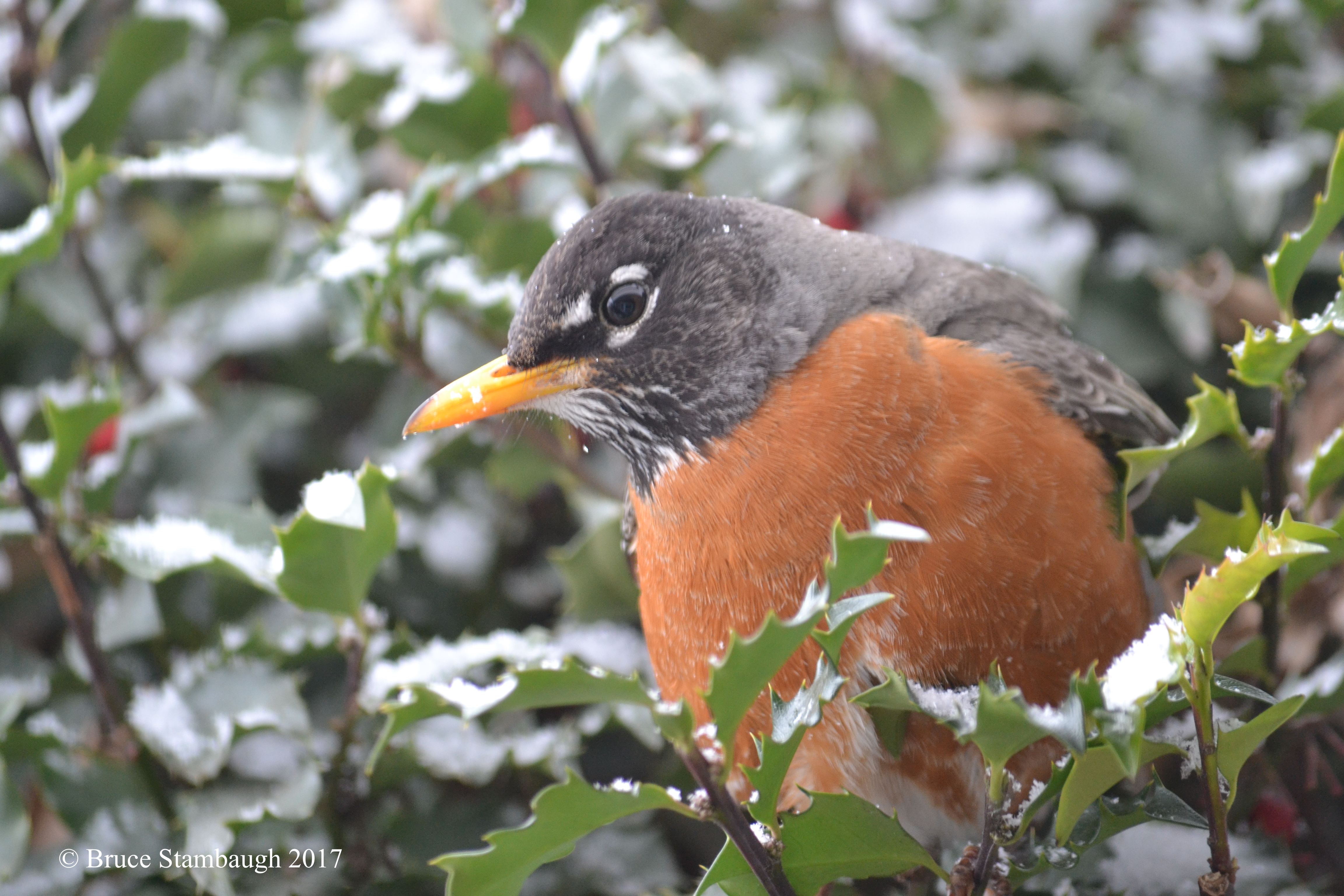
With no worms available due to the snow cover and cold temperatures, the Robins looked for other forms of food. The bright red holly berries fit the bill for a few of them. This male robin especially enjoyed flitting in and out of the bush next to our house. I was fortunate to be able to capture a few shots of him on the hunt for the round red delights. He would sit on a small branch in the snow, look around for a berry, then pounce on it as if it were going to make a getaway.
Sunshine in northeast Ohio in November and December tends to be a rare treat. When the sun does shine, all of God’s Creation soaks it in, including this lovely female Red-bellied Woodpecker. She took a break from enjoying lunch at the peanut feeder to warm herself on a chilly late fall day.
When it comes to photographing birds, timing is everything. This photo is proof.
Birds found a half-dozen Dickcissels, always desired birds if found nesting in northeast Ohio, near a rural intersection a few miles from my home. The birds flitted from one grassy field to another, carrying nesting material, and defending territory.
The birds did occasionally light on fence posts, barbed wires, and weeds. Though I was several yards away from this male, I was fortunate the bird turned to look in my direction just as I snapped the photo. The yellow surrounding the Dickcissel’s eyes seemed to highlight all of the other beauty of this gregarious species.
I found the shot impressive enough to make “Here’s looking at you” my Photo of the Week.
This pair of Canada Geese was none too happy about my early morning intrusion on their quiet solitude. Their harsh honking wasn’t the only thing that caught my attention. I couldn’t believe the color of the predawn sky’s reflection on the farm pond. The lavender and mauve beautifully accented these noisy birds.
For years, my wife had to endure me jumping up from the table morning, noon and night to respond to emergency calls. I served as a volunteer firefighter and emergency medical technician in Holmes County, Ohio for 27 years.
I can’t tell you how many times I must have interrupted a meal to respond to an emergency. Neva always understood that someone else needed my assistance more than our family, at least for that critical moment.
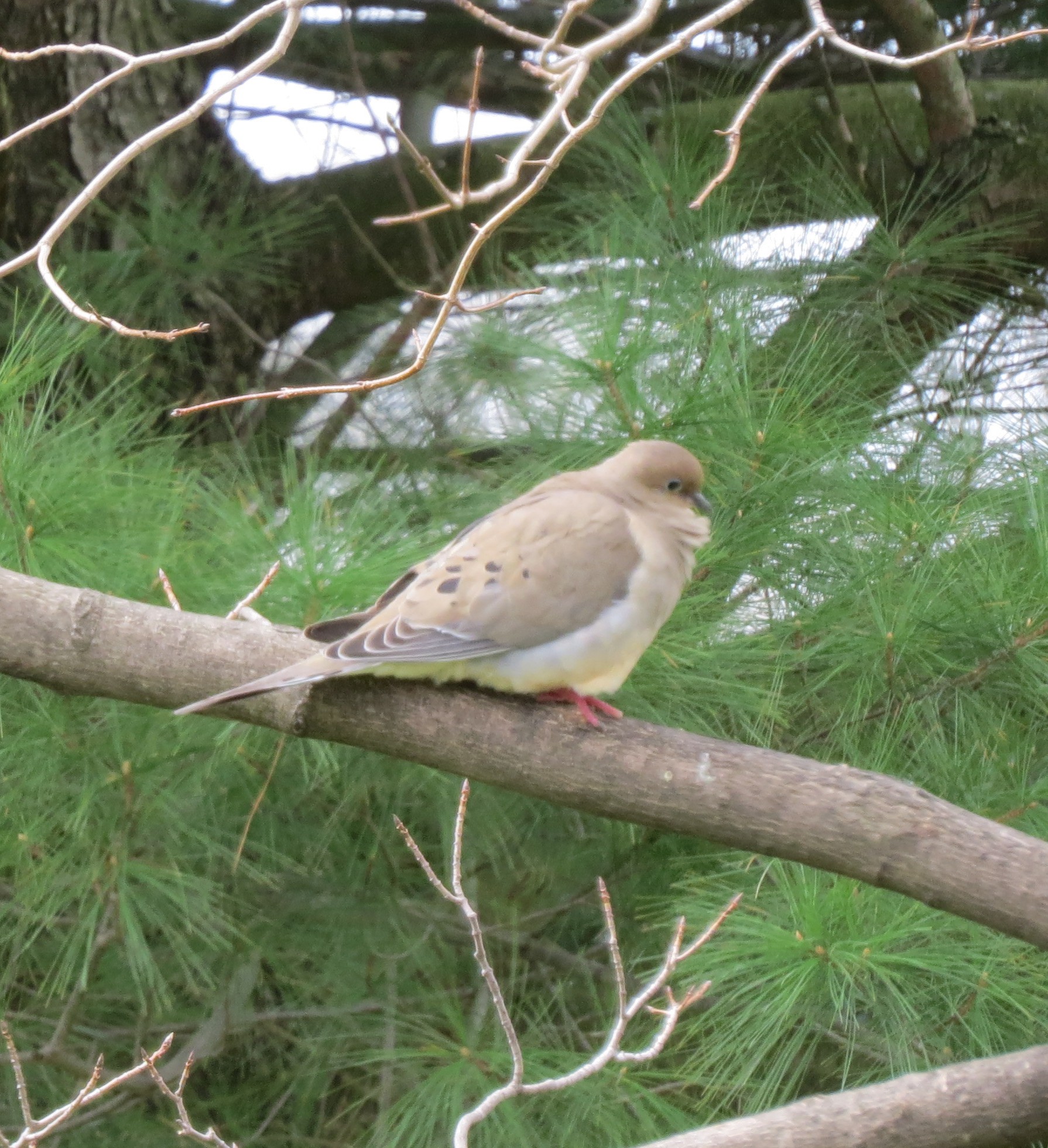
Mourning Dove.Now we’re both mostly retired, and I no longer respond to fire and EMS calls. I look forward to her delicious cooking, salad to dessert. However, pleasant surprises still occasionally interrupt our meals. Birds are usually the cause.
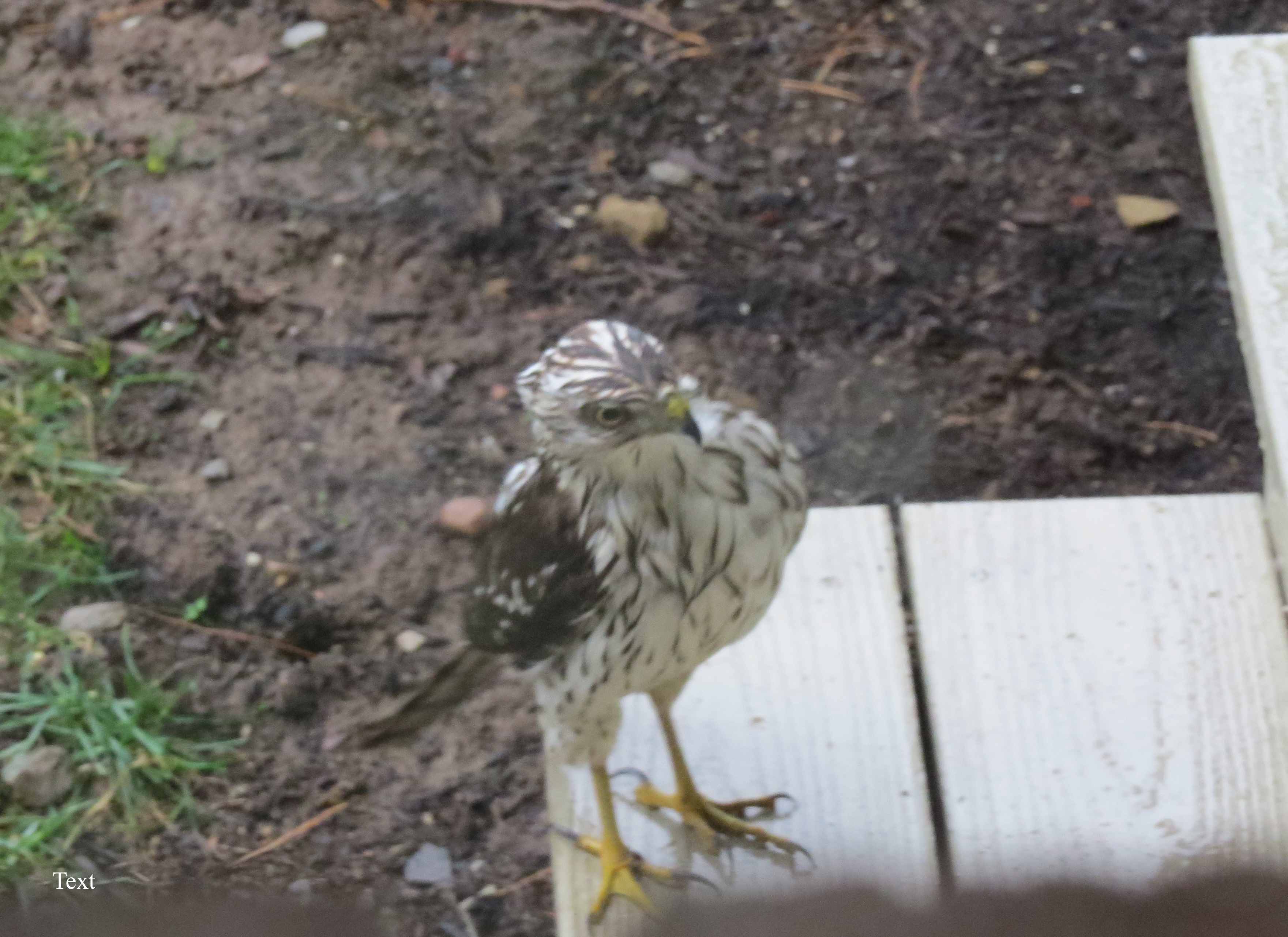
Recently Neva announced from the kitchen that lunch was ready. I knew to be prompt. I hadn’t even taken the first bite when I spied through a window some commotion. A hawk had perched on a thick pine tree branch in our backyard.
I raced for my binoculars as if I were answering a fire alarm. Even without the optical aid, I could see the feathers flying as the hawk plucked its prey. The hawk was having lunch, too. I watched the small accipiter briefly and then grabbed my cameras. I clicked and filmed away.
By its size and features, this beautiful bird was either a Sharp-shinned Hawk or a Cooper’s Hawk. Both are notorious for stealth flights in search of unsuspecting songbirds at backyard birdfeeders.
Clearly, I had just missed the capture. The hawk focused its full attention on plucking the feathers from its victim. Other birds gradually returned to the feeder buffet, oblivious to the hawk’s presence.
I consulted my favorite bird guide and compared my photos with the renderings in the book. All the while I continued observing the bird of prey. The bird’s physical characteristics best fit a Sharp-shinned Hawk.
Sharp-shinned Hawks and Cooper’s Hawks are tough to identify in the field. I had the advantage of perspective, comparing the bird in the pine with the branches around it. Its size appeared too small for a Cooper’s Hawk.
I checked other identifying markers, too. The bird’s rather flat head made its eye look large. The bright yellow legs were pencil thin. The brown streaks on its breast also said juvenile Sharp-shinned Hawk.
I posted one of the photos I had taken of the bird on the social media’s Facebook’s Ohio birding page. Others, including the author of my guidebook, confirmed the ID. It’s always nice to get affirmation from an expert like Kenn Kaufman.
Not surprisingly, my wife’s delicious homemade butternut squash soup had cooled. Neither of us complained. We were mesmerized by the aviary activities outside.
Satisfied with the photos that I had taken, I returned to my meal. From where I sat eating, I could still see the young hawk pulling at the meat of its capture. Though seemingly gruesome, it was an everyday act of nature, and we got to see it.
The Sharpie returned.I took another slurp of soup, looked up, and the hawk was gone. After I had finished eating, I went out to verify my suspicion of what the hawk had had for lunch. The feathers I found were indeed from a Mourning Dove.
Timing is everything. Had I not responded to the call for lunch when I did, I might have missed the unfolding action outside.
I didn’t mind this lunchtime interruption at all. I imagine the poor Mourning Dove would strongly disagree.






You must be logged in to post a comment.