The end of 2018 is in sight. Given the state of the world today, perhaps we all need a fresh start in life, no matter our age, our situation, our status. A new year brings new hope.
I reflected on all of that during a recent snowstorm that blanketed much of Virginia’s Shenandoah Valley. Shadows of the tree, its limbs, and the bird feeder they held played upon the newly fallen snow in our front yard. The contemplative scene gave pause to my birdwatching, to my reading, to my writing, to all that was happening near and far.
The long shadows cast by the late afternoon sun that had finally broken through gave hope that neither the winter’s frostiness nor the world’s cold calamities could keep us down long. For in the abrupt transition between the snowy brightness and shadowy darkness, light prevails.
Here’s hoping that light will shine warmly for the approaching New Year. “Year-end Shadows” is my Photo of the Week.
“We live in fearsome times.” My father told me that when we uselessly practiced nuclear bomb drills by hiding under our school desks, when with trepidation I sat cross-legged on the floor in front of our black and white when JFK called the Russians’ bluff on Cuba, then when Dallas happened, and assassins shot Martin and Bobby, and cities burned, and a president resigned, and revolts occurred, and we always seemed to side with the bad guy, when we chided dictators for gassing people only to bomb the survivors in their mourning.
“We live in fearsome times.” My grandfather told me that when he silently remembered his own gassing in the war to end all wars and died at the age that I am now coughing and coughing and coughing because there were no records that he was poisoned 100 years ago on the western front.
“We live in fearsome times,” I tell my grandchildren in failed efforts to shield them from the constant volleys of lies and accusations and nonsense spewing forth into their innocent world by powerful people who lost their decency, compassion, and empathy long, long ago.
“Have no fear,” I reassure them to ears deafened by headsets and screen time. Still, I think they get it all, the nonsense, the truth-telling, and the untruth-telling. That is my hope in this season of hope. On this darkest day of the year, the winter solstice, there is enough oil now to keep the candles burning. But we have to keep pressing on like those Hanukkah days of old. We must pour new wine into new wineskins, not old. We don’t want to waste the wine by bursting.
We live in fearsome times. We must be patient in the season of waiting. We must choose clarity over certainty, though certainty it is that we too often choose, only to be disappointed, and blame circumstances and others for our wrong choices. Those in the Old and those in the New reported the same. Therefore, in this season of light, hope, peace, patience is the rule as “we live by faith, not by sight.”
We live in fearsome times. This is the season of anticipation, joy, love, forgiveness, wonder, when blended, a recipe not to fear. We look for the brightest star to lead us forth, but stars are in heaven, not on earth. Behold the heavenly host is near. Do not fear.
We live in fearsome times. Thy kingdom come, thy will be done, not on our terms, but Yours and Yours alone. Our fragility and our insecurity overcome our logic, excite our emotions precisely opposite of what the good tidings proclaim, why the angels yet rejoice. They know the true Ruler is the Lamb, not the lion.
We live in fearsome times. Humans always have, always will simply because we are human, unable or unwilling to listen, to hear, to comprehend the goodness, the freedom, the surety bestowed on us to bestow on others, especially during these dark days.
We live in fearsome times. What will we do? How can we go on? Awareness is enough.
“In the beginning was the word… The serpent was more crafty than any other… Everyone who thirsts… Sing aloud, O daughter Zion… Now the birth of Jesus the Messiah… In the sixth month… In those days a decree went out… In that region there were shepherds… And the Word became flesh… Fear not…” Hallelujah.
Our modest Christmas display under a waxing crescent moon.
By Bruce Stambaugh
I always found it ironic that we celebrate the season of light and hope at the very darkest time of year in the Northern Hemisphere. Over the years, however, I’ve come to understand why.
We are in the midst of the season of hope and light. The eight-day Jewish celebration of Hanukkah has just concluded. Advent, the Christian pronouncement of the coming Messiah, ends on Christmas Day.
Menorah candles (Getty Image).It is no coincidence that holiday lights shine the brightest during the season’s darkest hours. Isn’t that the purpose of Hanukkah and Christmas? The Menorah has nine candles while the Advent arrangement has five.
Aligned by tradition and calendar, the two holidays usher in the season of hope and peace through miracles and light. They are intricately and purposefully interwoven.
The darkness challenges us to survive and thrive. To that aim, we ponder, wonder, and imagine all that is both good and wrong with our immediate world as well as the world beyond our personal life space.
During the darkest time of year, the seasonal contrasts are stark. Too many earthly citizens are in despair. They search for the basics of life: food, shelter, water, and safety. Many face loneliness, financial hardships, family disputes, or significant health issues. These are indeed dark times for them.
Dissimilarly, flashy TV and online commercials urge us to delight others via elaborate gift giving. They tout that the holidays aren’t complete without a new car or pickup sitting in the driveway or a glittery diamond necklace dangling around your sweetheart’s neck.
Wouldn’t it be more fitting in this season of hope to bestow blessings on those in need of life’s essentials? Such generous acts would undoubtedly help brighten the dark season of life if only for a few.
Advent candles on Christmas Day.The festive seasonal lights shine far beyond the reach of the Menorah and Advent candles. Hope means more than the sparkling, flashing, flickering lights of Christmas, more than the glittery cards and lavishly wrapped gifts beneath a festive tree.
The music of the season should spark a spirit within us to reach far beyond our circle of family and friends with whom we gather to celebrate. Perhaps like me, multiple year-end appeals for funds from bona fide charities that help the poor, the orphaned, the hungry, and the homeless have besieged you.
It is easy to be numbed by the sheer volume of needs. It doesn’t have to be. It would be both prudent and appropriate for those of us who share the Judeo/Christian experience and heritage to shine that warming light to others in whatever way we can. That would both help brighten their potentially dim holidays and create a real sense of personal satisfaction.
Christmas tree.As people of faith, shouldn’t we be the light that those in need seek? In the spirit of the season, that is something to ponder and do.
The luminaries of Hanukkah and Christmas remind and challenge those of each faith to reflect on the past and the foundations of their shared customs. The lights also illuminate those in our midst who are hurting and downtrodden.
If each one of us would reach out to help at least one person, one family, or donate to one charity, the holidays would be a little brighter for them and us. Doing so would be reason enough to light yet one more holiday candle.
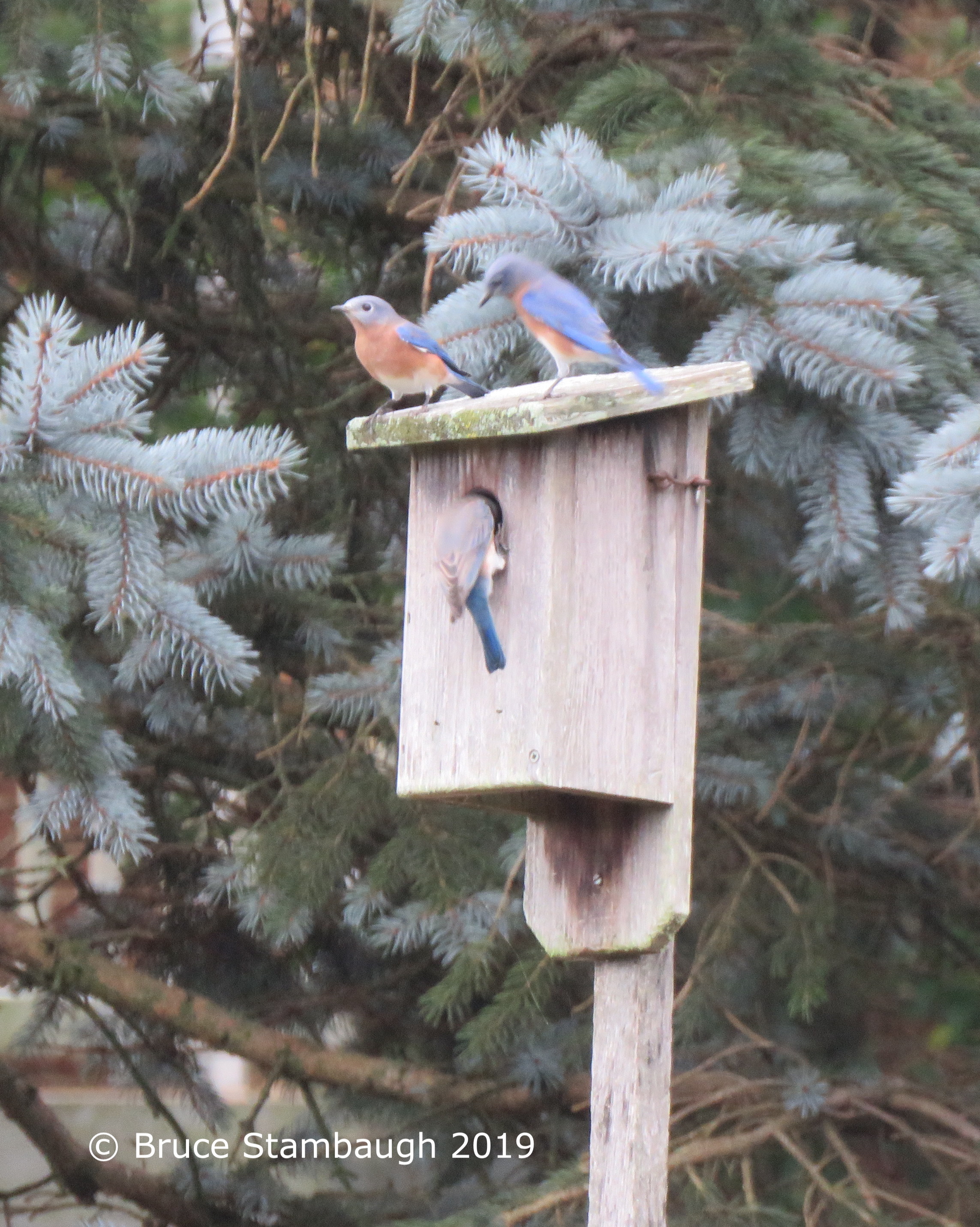
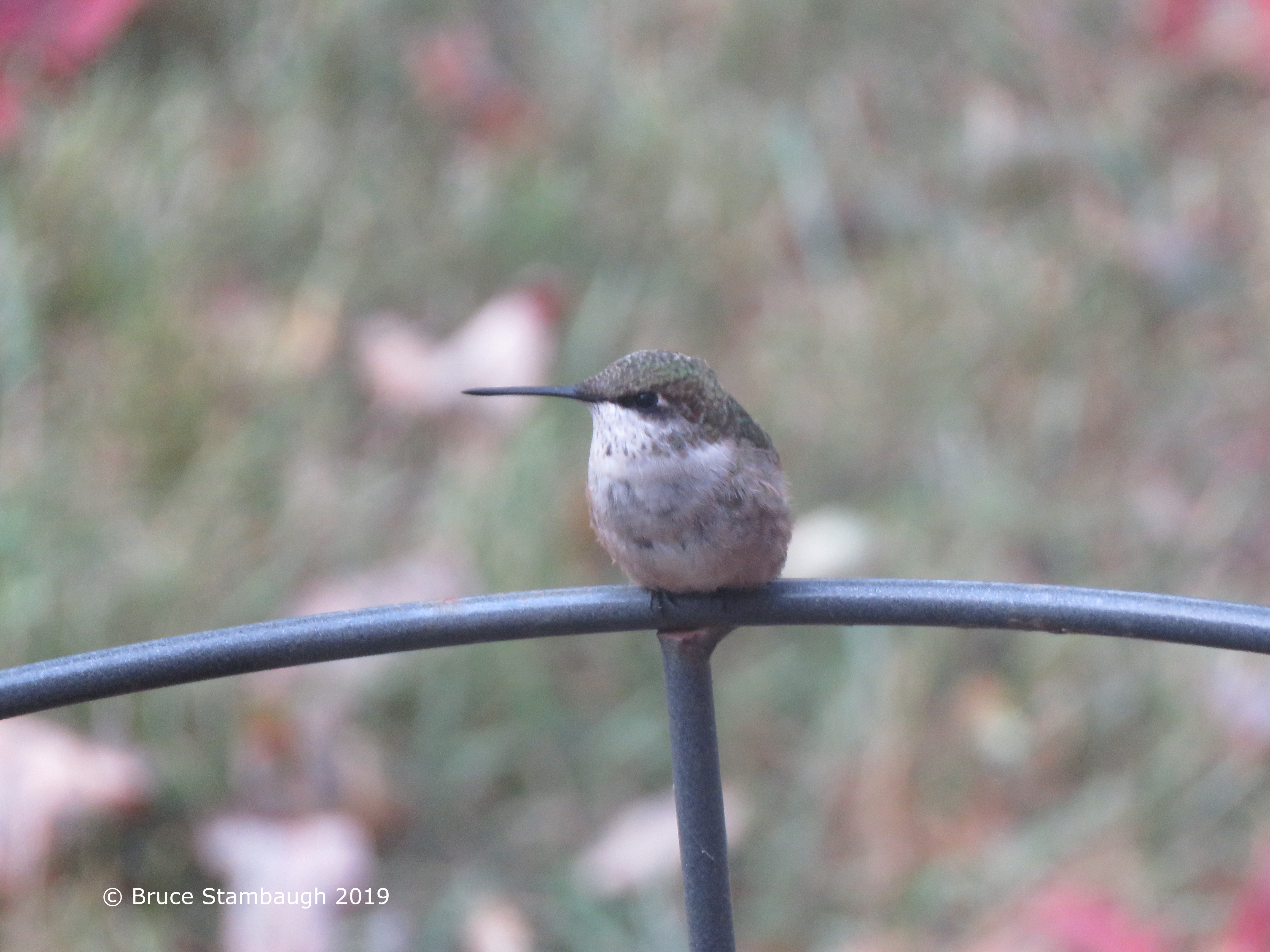
The annual migration of birds has been going on for some time now. Fall in the birding vernacular doesn’t equal calendar fall.
There is a logical reason for that. Different species of birds begin their migration at different times. Shorebirds and songbirds often lead the winged entourage to warmer climes. Others trail along alone or in giant flocks to the delight of avid birders. To account for these time travel variances in the birding world, fall is the most extended season, running from August through November.
At the suet feeder.
The same concept is valid for trees and deciduous plants. Some species begin their winter hibernation sooner than others. Their various changing colors can foretell this annual transition. Poison ivy leaves often turn bright red before September arrives, while the glossy leaves of shingle oaks fade from emerald to russet and hang on until early spring.
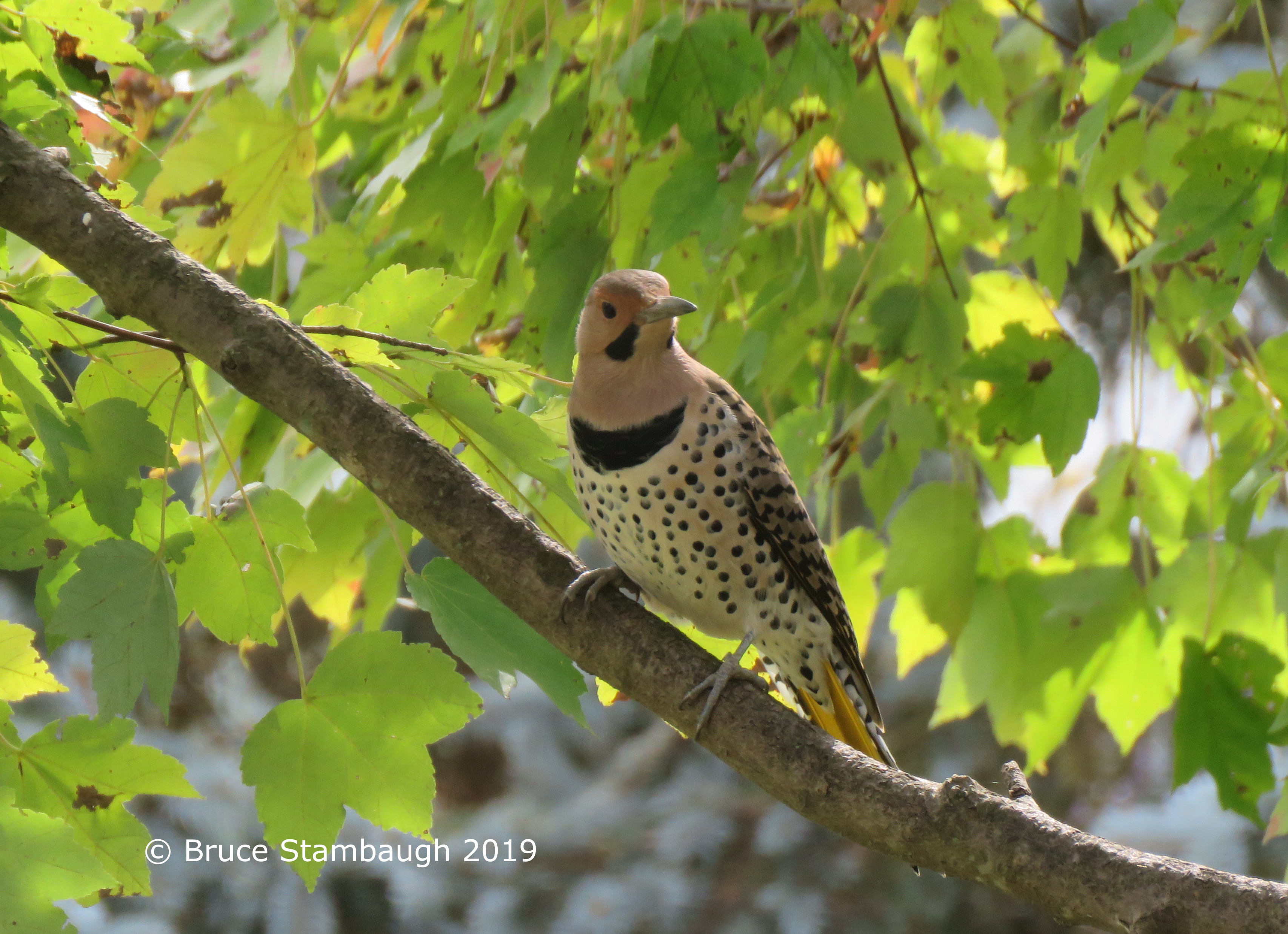
For me, I welcome these transitions, especially the birding varieties. As the leaves of the red maples in our yard began to fall, birds I had not seen before began to arrive.
Storms brought down many of the remaining leaves. They also blew in flocks of birds, some temporarily. Others seem here to stay.
Last fall, our first in the Shenandoah Valley, birds were scarce at the feeders. The numbers and variety of birds were well below my expectations. I longed for the many beautiful birds we had had in Ohio.
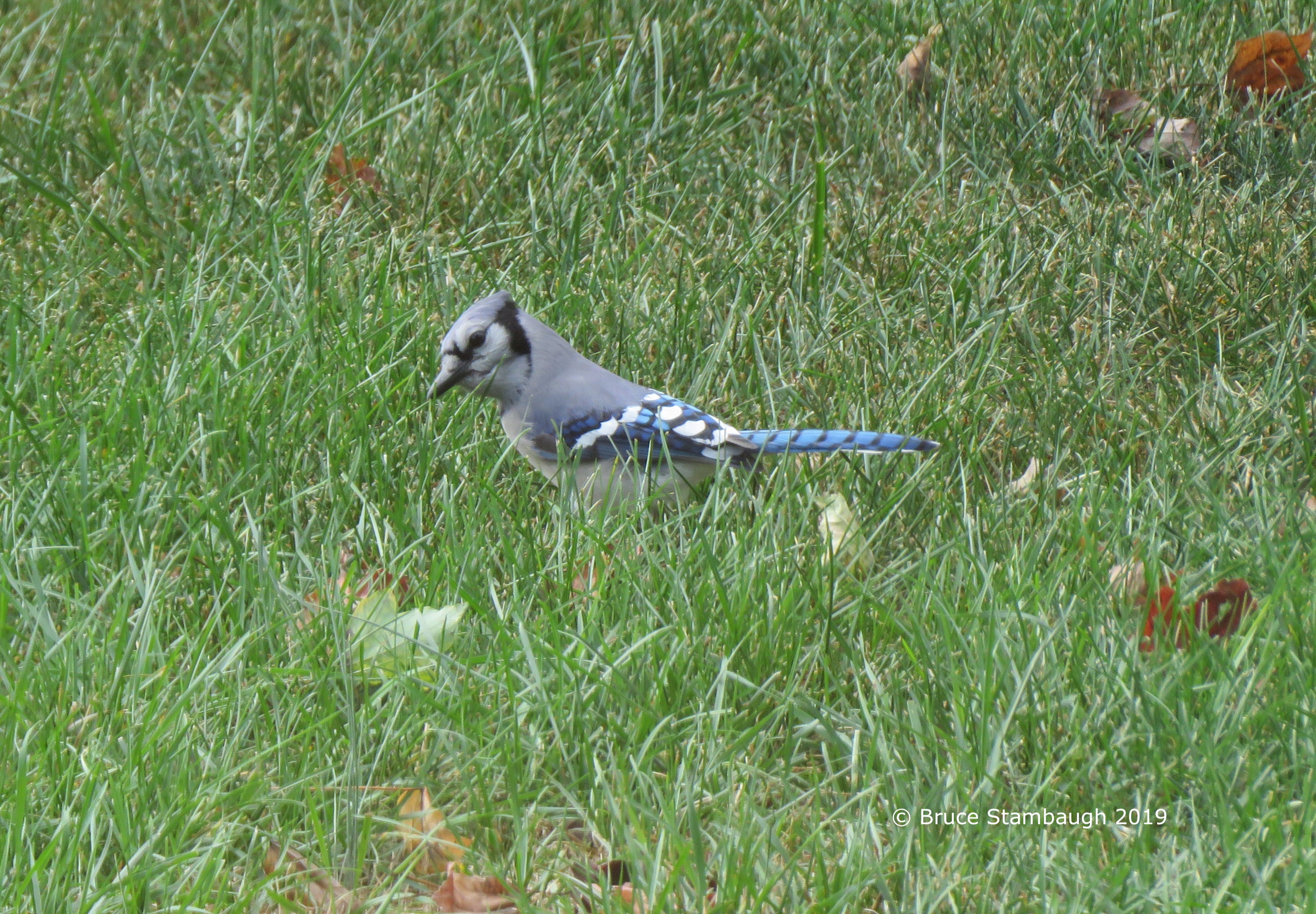
Optimist that I am, I hung the feeders again right after Labor Day and attracted a few regulars. I can always count on chatty house finches and boisterous blue jays. Once the weather cooled, the suet feeder went up in the backyard.
An inquisitive Carolina Wren.
I was contented with the usual suspects, happy that even the Carolina Wrens made regular appearances. But I could not have anticipated what happened next. About six weeks ago, I noticed some birds that resembled the numerous house finches that frequented our feeders. A closer inspection with the binoculars told me that we had a small flock of purple finches with a few pine siskins thrown in for good measure. I was ecstatic.
I had never had purple finches at the feeders and only had had passing pine siskins that took a break to refuel during migration. I hoped beyond hope that the birds would stay. So far they have.
These are gorgeous birds, each in their particular plumage. The reddish hues of the male purple finches appear iridescent, especially if the sun reflects off of their foreheads where the winter colors are the brightest. Though much duller and muted, the rich browns and creams of the females’ feathers are equally stunning.
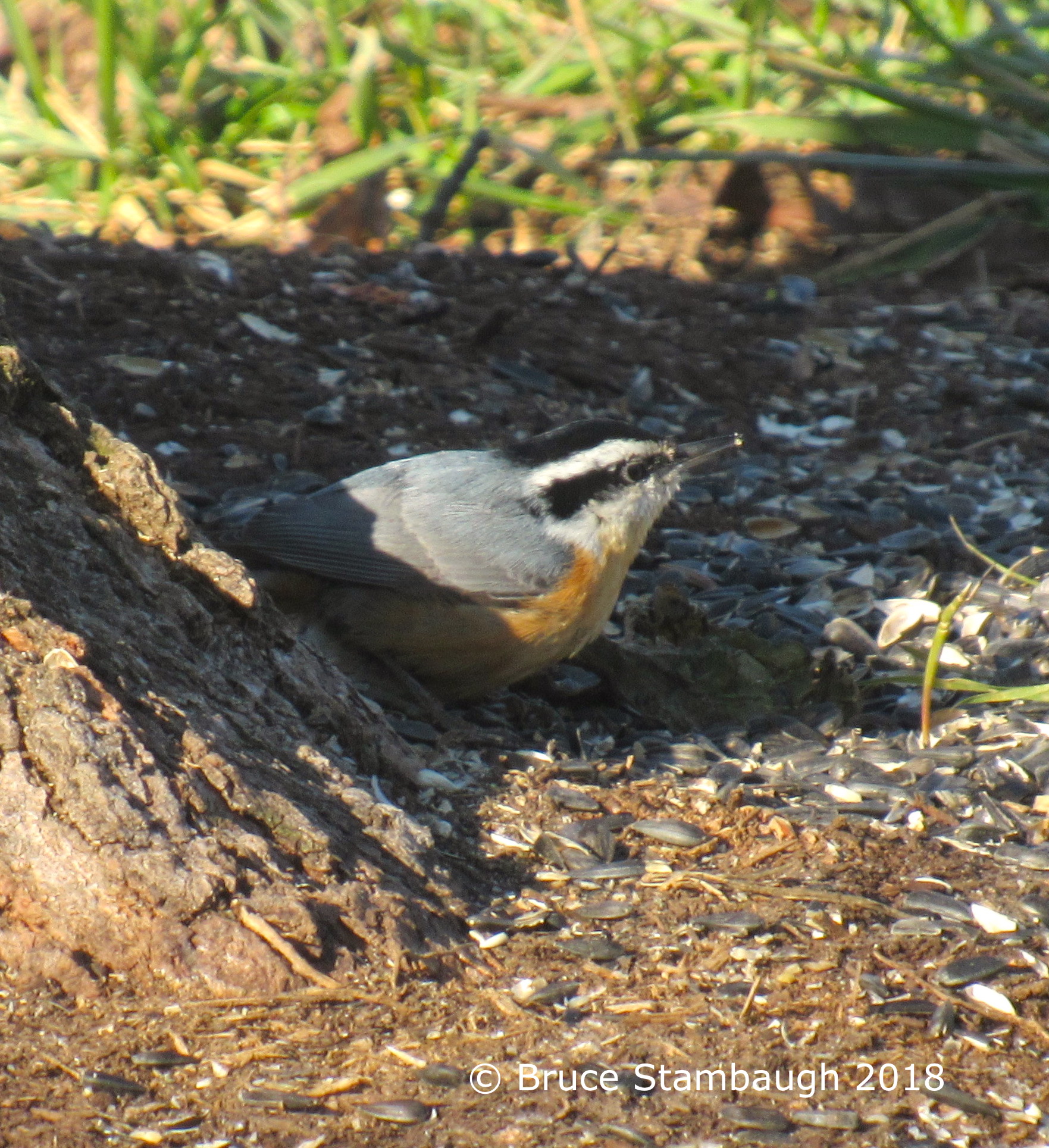
A rare visitor, a Red-breasted Nuthatch.
The more demur pine siskins tend to feed with the purple finches and the American goldfinches. Their brown stripes and flash of yellow at the wing tips make them striking birds as well.
The departure of the leaves and arrival of the birds mimic life. We can’t do anything about the past and try as we might, we can’t predict the future. Dull leaves and the arrival of purple finches are proof positive.
To be most productive, I strive to be present in each moment regardless of what change occurs. The mystery of it all sparks a spirit of gratitude.
I’m thankful the birds and trees keep reminding me that change is inevitable. If we pay attention, we can enrich our lives by embracing each subtle transformation, seasonal or otherwise.
For good or for ill, change happens. It is the way life is.
The holiday season is here. Thanksgiving Day has come and gone. Christmas, Hanukah, and New Years will be here in the twinkling of an eye.
It’s easy to get caught up in all the excitement, hoopla, and glitz of the extended festivities. After all, the big box stores, TV, radio, online ads, and printed fliers have been pushing their holiday wares for weeks now.
I try not to pay too much attention to all that holiday hype. In my retirement, I have, instead, come to enjoy each moment, anticipate the day at hand, and celebrate the unfolding daily events.
I have also learned that that is much easier said than done, given the state of the world, the conniving of greedy people and corporations, the unsettling of Earthly events, natural and otherwise. Still, we must carry on. So I did, and I do.
This particular day I joined a senior citizens’ hiking group led by a retired banker, a most trustworthy man. Our destination was Lewis Falls in Shenandoah National Park.
Our group of nine wound its way down the trail through the shedding deciduous trees, brushing against mountain laurel whose berries the forest birds and bears had not yet devoured. We crisscrossed several small streams, all of them rushing to plummet the 83 feet of Lewis Falls.
These cascading ribbons join just as they tumble into the Shenandoah Valley. We stepped gingerly across the last of the wetted stones and finally made it to the shaded overlook of the falls themselves. We refueled at that lovely sight on the snacks we each had brought along.
This slideshow requires JavaScript.
I climbed over the protective stonewall to get a slightly better view of the falls. It nearly cost me my life. I pitched the last handful of peanut butter cracker crumbs into my mouth and tried to swallow. I couldn’t.
I tried to breathe in. No air made it to my lungs. I didn’t want to die this way.
My EMT training kicked into gear. I got the attention of the nearest person and pointed to my throat. She asked me if I was choking and I nodded my head frantically. She hollered for the others and started to jump the wall to help me.
In these 20 seconds or so, I continued to try to swallow. I couldn’t speak. I thumped my chest with my fist twice, made a growling sound, and attempted to swallow again. Just as this courageous woman was about to apply the Heimlich maneuver, I felt the mountain air tickle my lungs. I took a swig of water, waved off my would-be rescuer, and spoke a few raspy words of thanks.
The woman was heartily relieved, but not nearly as much as me. As we backtracked up the zigzag trail, everything looked brighter, the colors more vibrant, the air sweeter. The trek back to the cars seemed much shorter, easier even until someone noticed that Herb was missing.
Heading back.
Cascades along the trail.
Fall colors.
Always look up.
Enjoying the serenity.
Rich, vivid colors.
The tallest member of our pack, Herb had headed back ahead of the rest of the group. But he wasn’t at the parking lot. The retired banker quickly formed a plan, and once again my firefighter/EMT training instinctively activated, only this time for a search and rescue effort.
Though frustrated for nearly two and a half hours, the search ended happily. Herb was found safe and sound. We all headed for home in thanksgiving and wonderment of creation and life itself.
In the midst of all the mundane marketing and holiday cheer, I have a suggestion. Let’s remember to be thankful for life itself.
The view of the Shenandoah Valley seemed even more pristine than usual despite the muted colors.
Thanksgiving is upon us. This year in the United States, the annual day of thankfulness arrives as early as possible, November 22. Our Canadian friends to the north celebrated their Thanksgiving on October 6.
It is only right and proper to pause as a people to reflect and give thanks. We can be grateful for so many things in our abundant living.
A friend on social media posted a list of items for which he was thankful. Given his life of service to others, I wasn’t surprised at how simple and ordinary the conveniences were that he listed.
Sometimes it’s the familiar, everyday activities and routines that are most meaningful to us. With my friend’s permission, here is his top 10 list of thankfulness:
1. Drinkable tap water
2. Flush toilets
3. Working septic system
4. Washer and dryer
5. Electricity in the home
6. Clothes to wear
7. A house to live in
8. Shoes
9. Floors that aren’t dirt
10. Ample food
Keeping things simple helps us think beyond ourselves, consider the plight of others who don’t have even those most basic necessities. The Center for Disease Control estimates that 780 million people globally do not have access to clean water, and 2.5 billion lack improved sanitation. That’s billion with a B. Think about those numbers for a second.
Food, water, and shelter are the basic essentials for living. My friend set a good example. He recognized just how fortunate we are to be able to go most anywhere in our country and turn the tap and be able to drink the water without worry of contamination. I realize that folks in Flint, MI would differ with this comment. As dangerous as their situation is, I’m glad it is an exception.
And when it comes to waste products, I’ve always respected folks who make their living dealing with the muck of life. Farmers, public utility workers, garbage and waste haulers all have tough jobs. I am thankful for them.
Before we moved from Ohio to Virginia, Neva and I significantly reduced our individual wardrobes. I had too many shoes and too many shirts and pants I seldom wore. Off they went to the thrift store. I’ve been to locales where decent clothing was hard to come by, if only for economic reasons. I, too, am thankful for affordable clothing and footwear.
Housing is indeed another luxury we too often take for granted. Many moons ago I encountered students I had in my classroom who lived in a house with dirt floors. I had a hard time getting over that when we were more than halfway through the 20th century.
Now here we are well into the 21st century, and poverty and inadequate housing are still rampant in our society and globally. Neva and I do what we can to help the homeless through trusted charitable agencies. I am also thankful for the home we share together, and for my gracious wife’s willingness to use her gift of hospitality.
Before the guests arrived.Finally on the thankfulness list is food. Food is a universal need and reason for jubilation. Food takes center stage at Thanksgiving. Roast turkey, dressing, potatoes and gravy, salad and pies all bedeck Thanksgiving Day tables in Canada and the U.S. alike.
When we say grace over this Thanksgiving Day meal, I’ll also be mindful of those who would love to be gathered there with us. Perhaps we should ensure that happens by inviting others not generally in our family circles.
When you think about it, doesn’t my friend’s list about cover what Thanksgiving is all about? What are you thankful for this Thanksgiving?
Where some of the local food is grown and where some of the food pantry clients live.
By Bruce Stambaugh
Life never ceases to amaze me. In my long years of living, I’ve learned that gratitude often emerges in the least likely of places.
My wife and I were asked to volunteer one evening a month at a local food pantry near downtown Harrisonburg, Virginia. The Friendly City is home to 55,000 people in the center of the Shenandoah Valley. The pantry operates once a week, providing foodstuffs for those who don’t have enough income even to buy basic grocery necessities.
Participants are only permitted to visit the food pantry once per month. Individual records are kept to ensure the rules are followed. That has never been a problem, however.
Locally grown produce like these tomatoes is often donated to the food pantry.The pantry receives its supplies from two sources. A regional food bank provides federal government USDA commodities, while local supermarkets, restaurants, and farmers donate their surplus food to the pantry. A few farmers even grow extra produce to help supply in-season fresh foods.
Those who depend on the food pantry for their sustenance must qualify by income for the USDA items. Pantry participants receive the locally provided food without qualification. The pantry offers a few healthcare products, too.
Neva and I have settled into our roles of interviewers. Our job has multiple responsibilities. We have to ask many invasive, personal questions before we can check off the USDA food preference list with the clients. I can’t tell you how many times I’ve had to write down $0 for a monthly income. It’s a humbling experience both for the clients and us.
With all the “workers wanted” signs around, a logical question might be, “Why don’t these people get a job?” The answer to this question is two-fold. Many of the clients do have jobs. Their meager incomes and family sizes qualify them for the federal subsidies.
William Penn quotation.From my observations and interactions, those who receive aid and don’t work are not employable for a host of obvious reasons. Some stay at home with small children. Some are senior citizens whose productive working days are long past. Some are disabled with no financial support of any kind. You get the picture.
Amid the discomfiting officiousness, one quality consistently shines from month to month, person to person. Everyone we encounter expresses gratitude for any help provided. Some are effusive while others say a quiet thank you.
As humbling and perhaps even embarrassing as the experience is for the clients, they are all thankful. Without being prompted, a few share heartbreak stories with us. They seem glad to have someone with whom to converse. We listen intently and thank them for sharing. A hardy handshake sometimes ensues.
I have yet to meet anyone who feels entitled to this food. Just the opposite is true. The clients’ glow of exuberant gratitude outshines any hint of disparity.
The joyous expressions and cheery thankfulness for whatever assistance they receive more than reward us for our collective efforts. Every client is especially appreciative if the list indeed includes healthcare items like diapers, shampoo, or toothpaste.
It takes courage to admit you need help. But if your child is hungry and the cupboard is bare, courtesy, gratitude, and thankfulness vanquish pride.
A disconcerting trend has developed, however. Each time we serve at the food pantry the number of clients tends to increase. Nevertheless, humility, smiles, and expressions of relief also grow exponentially.
Who would have thought that we would find and receive abundant gratitude from those who can’t afford daily food? Who would have imagined that serving in such a manner would reward us with humankind’s most heartfelt thanks?
I believe that to be effective, to be relevant, to be dynamic, to be healthy, a democracy depends on its citizens interacting. There are many ways to be involved in the lifeblood of the country.
Some citizens choose to serve the country directly by participating in its infrastructure. They join the military. They work in public institutions like schools, hospitals, police and fire services, and work in government agencies. Some even run for public offices.
Of course, not everyone feels called or led to do any of those actions. They prefer the private domain. They farm, run their own business, keep house, work in an office or factory or restaurant or drive trucks or fix the plumbing. They, too, keep our country humming.
There is one common denominator that we all can do, however. This action is an equalizer to ensure that our democratic republic thrives and survives. We can vote. Each and every citizen 18 years and older is entitled to vote by merely being registered.
Voting was designed as the means to democracy. It is a process as much as an ideal.
Historically, only white male property owners could vote. As our democracy evolved, women and minorities eventually gained the right to vote, too.
In our grand experiment of democracy, voting was established to ensure a grassroots stability to local, state, and federal government assemblies and their representative agencies.
Ideally, the vote of its citizenry was designed to be the final check on the legislative, executive, and judicial branches of government. That methodology creates ebbs and flows in the democratic process that gives angst to some and satisfaction to others. That is how democracy works, lives, continues.
That is true, however, only if voters indeed vote.
Winston Churchill was purported to have said, “Democracy is the worst form of government, except for all of the others.” In truth, Churchill merely paraphrased another individual without attribution. So the originator of that wisdom has never been determined.
What is clear from that quote is that societies need some form of government to remain civil, efficient, effective, and stay within their realm of responsibilities. To be sure, different people have different perspectives on how those principles are achieved.
Again, that is why voting is so critical. The idea of one person, one vote is carried out in a representative form of government such as ours. That representation is manifested through elections.
I remember as a youngster going back to the elementary school where I attended to watch my father mark his paper ballot before the polls closed. My parents wanted me to experience the political process first-hand.
Many years ago my adult Sunday school teacher and friend, a peer about my age, presented a lesson on the separation of church and state. He used that as a foundation to explain why he never voted.
If you don’t vote, don’t complain.I listened intently to all of his logical reasons. When he had finished, my reply caught him off guard.
I said, “All the reasons you listed not to vote are exactly why I do vote.” He respectfully accepted my response as I did his conviction not to vote based on his religious beliefs. That is as it should be.
The right to vote comes with an important caveat. In exercising that right, voters need to educate themselves on the issues and candidates, and the various positions held before going to the polls.
In other words, do your homework, and then for the sake of the country, go vote.
I love to hike. Planting myself in a hiker’s paradise has afforded me unlimited opportunities to satisfy my love for hiking. In reality, it hasn’t worked out quite the way I anticipated.
First of all, I have too many interests and too little time to fulfill all of them. Family responsibilities top my priority list, especially in the fall when our grandchildren seem to be their busiest. Hiking takes a backseat so I can help with the grandkids.
When I do get a chance to head to the many trails of Shenandoah National Park, I usually go alone. I enjoy the oneness with nature and the precious personal time to think and explore at my own pace.
However, that lone ranger approach to hiking changed when I discovered a peer-hiking group. When an outing on a trail I had not yet tackled was offered, I wanted to go. However, I hesitated for somewhat personal reasons.
I wasn’t sure just how fast the group would walk. Neither did I know if they would take as many breaks as I was sure to need. At my age, any hike that begins early morning can be problematic. In the words of Forest Gump, “And that’s all I have to say about that.”
Despite my doubts, I sent the confirmation email that I would join the group. I was greatly relieved when I got the reply.
The leader welcomed me into the hiking circle. He volunteered that the trek would accommodate all the hikers’ needs. In other words, the group would stop as often as necessary. I was glad about that news, but now a new set of insecurities surfaced.
I didn’t know how many people would be in the group. I didn’t know their level of hiking expertise. Nevertheless, I didn’t let my petty, irrational fears deter me, and prepared for the hike.
This slideshow requires JavaScript.
I loaded my hiking gear, the hiking poles I had purchased but never used, my camera, binoculars, and a light lunch. I dressed in several layers of clothing to peel off as the day warmed.
Our group was small, only five, all of us retired with various levels of hiking proficiency. The other four hikers were as pleasant as could be.
We each enjoyed the camaraderie that ensued along the way. Our revered leader knew all aspects of the park, its botany, geology, and history. His genial personality served him well.
The day was crisp, the forest quiet except for an occasional gusty wind that rustled the still green leaves. I was surprised at how very few birds I saw or heard.
We followed the Appalachian Trail up the ridge on sometimes rocky, steep terrain, sometimes mostly flat, well-worn earth. Short grasses and fallen leaves bordered the trail.
We ate our lunch standing and sitting on ancient igneous outcroppings overlooking the sweeping valley below. Signal Knob, the northern-most point of the Massanutten Range, stood across the way overlooking the old-aged Shenandoah River.
After lunch, we crossed back over the AT, scrambled around and down another rocky point to view a rare exposure of basalt columnar jointing. Seeing the hexagonal formation dispelled once and for all any remnants of my silly fears.
It had been a glorious day hiking with newfound friends. Naturally, all of my fears proved to be unfounded.
In this age of fear-mongering and extreme reactionary phobias, it was a timely reminder for me. Trivial or not, tell your fears to take a hike before they walk all over you.
Just the other day I remarked to my daughter about how fast the days seem to go. I didn’t have to wonder why.
Logic would dictate that just the opposite would be the case in retirement. Weren’t the golden years meant to be slower, more relaxed than when we were younger?
I thought back to my full-time working life when days started early and ran late. Whether in my first career as an educator for 30 years or in my second gig in marketing, a wide variety of activities filled the days.
Add in the agenda of our active, growing children, community commitments, recreation, organizational meetings, and each day just disappeared. There never seemed to be enough time to complete all that was on my daily plate.
As you might imagine, teaching was demanding. I was bone tired by the time Friday rolled around. When I became an administrator, the routines changed, but my duties often extended long after school had been dismissed both for the day and for the year. Mindless meetings had much to do with that dynamic.
Not much changed in my marketing career. I could always count on surprises that suddenly altered my plans for the day.
When I said goodbye to all of that a couple of years ago, I figured my pace would slow down. Instead, life’s speed seems to have accelerated in retirement.
Goal by our granddaughter.
My daughter concurred with me about the quickness of the days. I had to wonder, however, about the look she gave me. Was it a sympathetic gaze into what the future held for her, or was it a look of astonishment at my declaration?
Perhaps there was a third option, one of appreciation for the assistance her mother and I provide to her family. We were in the heart of the volleyball season, and Nana and I do our parts to help make our daughter’s household run as smoothly as possible.
Carrie is the women’s coach at Eastern Mennonite University, and her husband is the chief financial officer for a rapidly growing start-up company. Professional duties pack their daily schedules.
So we do what we can to help. Nana makes meals, tidies up our house and theirs, and does laundry, shopping, and so much more. I have my honey-do lists.
Our granddog.
Sometimes I care for our granddog. Sometimes I pick up a grandchild at school and transport them to another venue. Sometimes I serve as the landscaper, and sometimes I help with homework, even if it is math and in Spanish.
All of this interaction helps make the days disappear one right after the other. Of course, it could be that our energy level at this age isn’t what it was in our younger years. Then we chauffeured our son and daughter from school to soccer and piano practices to church youth group in addition to all of our other responsibilities.
Whatever the reasons for time flying, Nana and I prioritize our time and efforts into doing the tasks at hand. In between, we rest, relax, exercise, have lunch on the porch together, pray and meditate each in our individual way.
In truth, we expected all the busyness. We moved from Ohio’s Amish country to Virginia’s Shenandoah Valley for just such assignments. It’s our new life calling.
We didn’t realize how very fast these golden times would go, however. In these autumn days of our lives, the time just seems to evaporate. I for one couldn’t be happier.
You must be logged in to post a comment.