Into the Smoke

As photographs go, this one looks dull. A horse-drawn buggy driven by an Old Order Mennonite gentleman doesn’t exactly draw you into the photo.

The buggy slowly climbed this incline in the western section of Rockingham County, where Old Order Mennonites have lived for generations in Virginia’s typically lovely Shenandoah Valley. This day was an exception, however.

The buggy appeared to be moving into the clouds. But, unfortunately, this gray wasn’t from clouds, fog, or smog. No. This lack of color resulted from a wildfire burning in the Jefferson National Forest 75 miles south of Rockingham County.

The day had started reasonably bright, but by mid-morning, cities, suburban neighborhoods, and rural areas were all filled with thick, choking smoke. One whiff and the odor screamed wildfire.

The problem was you couldn’t figure out where the smoke was coming from. The smokey haze blocked out the sun. It hid 4,000-foot mountains. It really wasn’t safe to be outside without a mask.

But the old firefighter in me wanted to know the source of the smoke since no media had any information. So, I went searching. That’s how I came upon the buggy. It wasn’t until hours after returning to my home that I learned of the Matts Creek wildfire, which has burned over 1,400 acres with zero containment.

I found an update from the U.S. Forest Service online, which gave details. Personnel, fire engines, fixed wing, and helicopters were all working to control the wind-blown fire. Several hiking trails in the James River Face Wilderness. That includes the Appalachian Trail.

Let’s hope the fire can soon be contained and extinguished without threatening structures and no injuries. 

© Bruce Stambaugh 2023

Photographing a Dream

Old Engine 611 blew its whistle as it passed below us.

As a young child, I loved trains. I remember running outside seven decades ago to watch the steam locomotives roar past my grandfather’s home.

The combination of the thick black smoke boiling out of the engine’s stack, the pure white steam issuing like little clouds at each tug of the train’s whistle, and the chug, chug, chug of the wheels that drive the train onward thrilled me.

When I had a chance to relive that experience recently, I couldn’t pass it up. Our son and daughter and their spouses and children gave us a gift certificate for our anniversary to ride on an excursion train. A diesel engine pulled this one, however.

As it happened, a famous steam locomotive, “Old 611,” “Spirit of Roanoke,” or the “Queen of Steam,” was pulling another excursion the same day as our ride through Virginia’s lovely Shenandoah Valley, where we live.

The timing was perfect. After returning to the station, we could drive to the beautiful countryside and watch the 611 power along the tracks below a highway overpass. We had checked out the location beforehand to ensure we could see the train and still be out of the way of traffic.

We need not worry about the traffic. The seldom-used country road afforded a great view of the train and the mountains beyond.

So, after our relaxing ride with a delicious lunch from a local restaurant, we drove west 20 minutes to our selected spot. A couple of other train enthusiasts were already there. They knew as we did that many train chasers would arrive and crowd in to photograph the train, too.

Why all the excitement about a steam engine? The 611 is the only remaining member of Norfolk and Western’s class J-4-8-4 streamlined steam locomotives. Having been built in May 1950, it is one of the last mainline passenger steam locomotives fabricated in the U.S. Rail fans consider the 611 the climax of steam locomotive technology. Diesel engines soon replaced this gem of an engine.

We chatted with these gregarious men, one from Pennsylvania, the other from Tennessee. They taught my wife and me a great deal about the train we were waiting on. Just as expected, others soon joined us.

The eastbound Amtrak.
The westbound Amtrak.

First, we had unexpected treats. An eastbound Amtrak Cardinal train zoomed by, followed by a westbound one an hour later. They were opening acts for the main event, the 611.

We could hear the shrill whistle of the steam engine as it crossed roadways far in the distance. It was time for the show. We all got ready to be thrilled.

Please click on the photos to enlarge them.

Soon, the train neared our chosen spot. My wife started the video on my phone, and I aimed my camera to capture stills of this icon steaming by. The day had warmed into the 60s, but I still had goosebumps. I felt like a kid again.

The train roared along beneath us as I snapped photo after photo. In less than a minute, my throwback to childhood had ended.

Still, it was a dream come true. The memories from yesterday and yesteryear remain fresh in my soul.

Enjoy the sights and sounds of Old 611.

© Bruce Stambaugh 2023

Autumn’s Amazing Colors – The Last

Brilliant Sugar Maples in the Park View neighborhood of Harrisonburg, Virginia.

Following my day in Shenandoah National Park, my wife and I headed south to Augusta County. We had more than colorful leaves on our agenda.

The “Queen of Steam,” Norfolk & Western Railroad’s Old 611 steam engine was running excursions twice a day from Goshen, Virginia, to Staunton, Virginia. Friends had pointed out a perfect place to observe the 611 heading east to Staunton.

So, Neva and I were up early to get a good spot at the bridge over the Buckingham Branch tracks at Swoope, Virginia. I wasn’t familiar with the area, so I wanted to scout different locations, too.

It was another beautiful day in the Shenandoah Valley. Cool temperatures in the morning, but a promised warming into the 60s by afternoon. The drive down to Swoope was nothing less than gorgeous.

Our spot on the bridge where we would have seen the 611 engine pulling the excursion train.

We arrived in Swoope at 8:30, and the train wasn’t scheduled to leave Goshen until 9:30. We didn’t know how long it would take the special train to arrive at our location. Besides a few walkers and joggers, we were the only people around.

Confident that our spots on the bridge wouldn’t be taken, we drove around the lovely valley dotted with rolling hills, pristine cattle farms, and gorgeous trees. The mixed hardwoods on Little North Mountain and the North Mountain beyond it were at peak color.

I took several shots of trees and farms and returned to the bridge. Soon, other rail fans arrived, and the chatter began. We listened for the train whistle to echo through the valleys. All was still.

Finally, a guy arrived who had information about the 611. It was listed as “static” at Goshen, meaning the engine wasn’t moving. A mechanical problem prevented 611 from running that day. The excursion would be pulled by diesel engines.

Please click on the photos to enlarge them.

My wife and I decided to return home. The morning had already brought much beauty into our lives. We had enjoyed the colorful trees, the well-maintained farms, and the congeniality of strangers.

The next few days, I continued my quest to photograph the beauty around Harrisonburg before the weather changed and brought the leaves down. I am happy to share them with you.

Our backyard when we arrived home from Augusta Co.

© Bruce Stambaugh 2023

Autumn’s Amazing Colors – Part 3

Shenandoah National Park

A beautiful beginning in Shenandoah National Park.

Shenandoah National Park was my next destination for leaf peeping. I had seen photos from the park on social media, so I knew the colors were peaking.

The day was promising, with bright sunshine and only a few clouds. I was anxious to get to Shenandoah National Park before the crowds arrived. I entered at the Swift Run Gap station and headed north to the central part of the park. After only minutes on Skyline Drive, I found a beautiful scene, shown above. The sun was just reaching over the top of the Blue Ridge Mountains, backlighting the treetops.

I stopped at three west-facing overlooks for some more photos. The colors were nice, but I saw a bank of clouds sailing over the Shenandoah Valley toward the park. I hoped they would dissipate.

I pushed on, stopping at other pull-outs before parking at Big Meadows to photograph the deep ambers, browns, and russets of the foliage that fills the bowl-shaped meadow. The clouds arrived, unfortunately, but the colors still seemed vibrant without the sun’s assistance.

Please click on the photos to enlarge them.

I stopped at Franklin Cliffs overlook to enjoy the view and eat a light lunch while perched atop the sheer cliff. A Common Raven called and sailed back and forth on the air currents only yards in front of me. Why is it that common snacks taste even better while you are enjoying nature’s many gifts?

I continued driving north, pulling into one overlook after the other. I also walked a few trails, looking for more intimate shots. The sumac and blueberry leaves were aflame, the sassafras deep golden, and the raspberry leaves variegated red and green. Late-blooming wildflowers somehow grew among them. Even the grasses joined in the color carnival.

At the Old Rag overlook, the landscape looked more like a painting than reality, even with gray skies. I could have stayed there the rest of the day. But I pushed on, driving through yellow tunnels of hickory and tulip poplar trees.

Groups of Sumac grace Skyline Drive like crimson guardrails. Vivid golden streaks ran down the tips of mountain ridges as if someone had painted yellow stripes.

Please click on the photos to enlarge them.

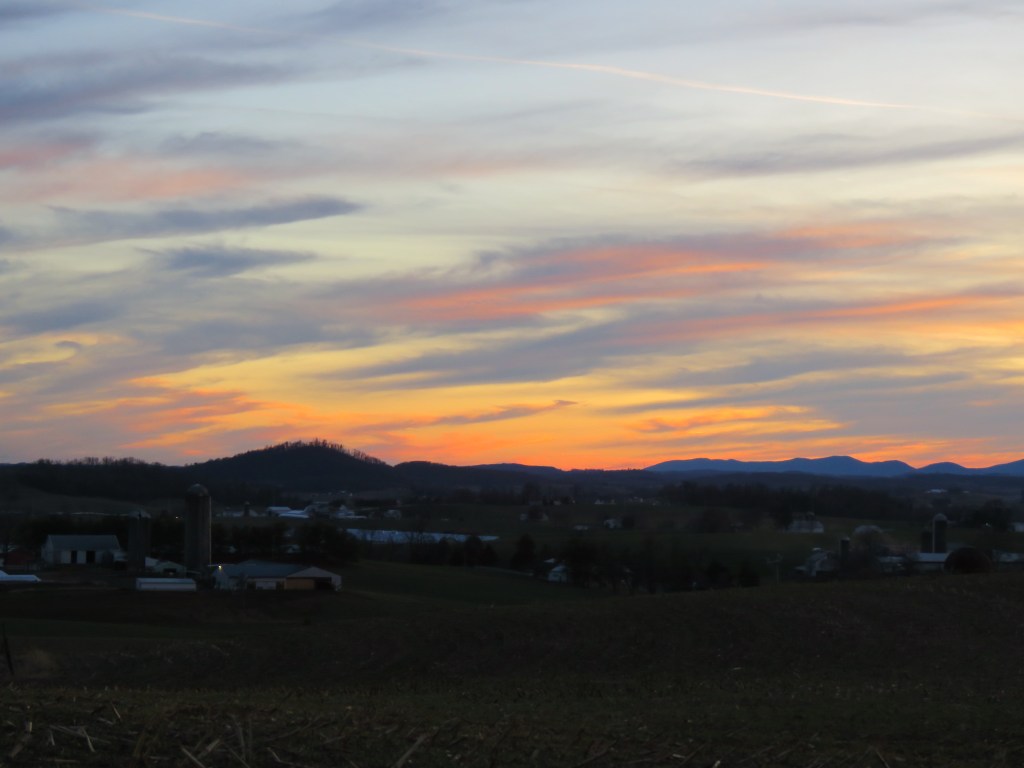
As I neared my exit point of Thornton Gap station, I got my first look at the wildfire lapping the park’s eastern edge. Firefighters from several agencies were working to contain the flames. Smoke trailed north, filling the runs and hollows below. As of this writing, the fire had burned 1,900 acres, including several hundred inside park boundaries.

By now, I had spent nearly six hours in the park. The overlooks were overflowing with global visitors. It was time to head home.

I made one detour to Storybook Trail on Massenutten Mountain at New Market Gap. I wanted to capture the mountainside, the valley, and the Blue Ridge Mountains all in one color photo.

I arrived home in time for supper, and then it was off to a women’s volleyball game at Eastern Mennonite University. It was a good way to unwind from an invigorating day in Shenandoah National Park.

From Massanutten Mountain looking east toward Shenandoah National Park.

© Bruce Stambaugh 2023

Autumn’s Amazing Colors – Part 2

The Dry River in western Rockingham County, Virginia.

My quest to capture fall’s unique colors continued. The weather was incredible for taking photos. The blue skies, unseasonably warm temperatures, and the desire to get outside and enjoy creation spurred me on. Plus, my wife was more than happy for the time to spruce up the house with me out of the way.

I originally had planned to go to Shenandoah National Park at the eastern end of Rockingham County, Virginia’s second largest in square miles. Instead, Shenandoah Mountain on the western edge of the county called my name.

Sugar maples at Pleasant View Old Order Mennonite Church.

I first returned to the Old Order Mennonite Church to capture more photos of the radiant sugar maples in the morning light. They had a funeral the previous day, and out of respect, I didn’t want to interfere, so I only took a few photos.

I wound my way towards the Allegheny Mountains, first stopping at Riven Rock Park, maintained by Harrisonburg Parks and Recreation, even though it is 13 miles west of the Friendly City. Despite the buzzing insects, it was the right decision.

Because the area has been in a moderate to severe drought for weeks, the Dry River was indeed nearly dry. The rising sun sparkled what water was there and drew a light fog from the forest. A few lucky leaves bathed in the sun’s rays in the narrow gap between the steep foothills.

I snapped a few photos and continued through the tunnel of trees of the George Washington National Forest. In a couple of miles, U.S. Route 33 instantly transforms from an arrow-straight highway to a zigzagging assembly of switchbacks for four miles to the peak of Shenandoah Mountain.

I noted several photo opportunities on the way to the mountaintop, as the state line between Virginia and West Virginia. I watched for places to pull off the winding, narrow roadway, too.

Within a quarter mile of my turn-around destination, traffic stopped. West Virginia Department of Transportation was doing some roadwork. Experience told me that it would be a while sitting in the line of vehicles since WVDOT uses a “Follow Me” pilot vehicle in construction zones. That is especially true in the mountains. It’s all for safety’s sake.

Once the line began moving, I pulled into the parking lot for Hightop Mountain Trail, which runs south along the state line to an old fire tower. Once all the cars behind me were gone, I headed back down the mountain. The look on the flagger’s face said, “Where in the heck do you come from?” I just smiled and waved until I reached my first safe pull-out.

I stopped several times, all the while being mindful of traffic from both directions. I often take photos with vehicles in the roadway for perspective and depth.

The next day, I chose to return to the Park View neighborhood of Harrisonburg and continue photographing the many beautiful trees there. I knew it would only be a matter of time before the trees would all be bare.

The sugar maples and the ginkgo trees complement one another.

© Bruce Stambaugh 2023

Autumn’s Amazing Colors

The colors of Massanutten Mountain, Massanutten, Virginia. Photo by Bruce Stambaugh.

With our travels to Greece and Rome during the first two weeks of October, I thought we might miss autumn’s peak colors. I need not have worried.

My wife and I could readily see on our drive home from Dulles International Airport to our home near Harrisonburg, Virginia, that most trees still held their leaves, which were only now turning their true colors. I was glad we hadn’t missed the peak.

As we exited the Interstate highway at New Market, Virginia, a red maple caught my eye. I stopped to photograph the striking tree that stood center stage on a private school campus. It wouldn’t be my last photograph of the annual changing of the leaves.

A red maple in New Market, Virginia.

I feared that with the ongoing drought, the leaves would be dull and simply fall off out of sheer fatigue. Strangely enough, this has been the most colorful fall yet of the seven autumns we have resided in Virginia’s lovely Shenandoah Valley. In fact, several valley natives told me that this has been the most colorful fall in years.

I delved into why that was. I discovered that the weather indeed influences the intensity of leaf colors. The combination of sunny, warm days and cool (but not freezing) dark nights help create the brilliant colors we have experienced here in the valley. From photos posted by friends on social media, I know the fall colors have been equally vivid in other locales.

Ironically, I found many of the brightest and most colorful trees in and around the neighborhoods of Harrisonburg. The colors of the trees and shrubs of both the Allegheny and the Blue Ridge Mountains appeared more uniform and consistent in color. Perhaps the lower valley elevations had more extreme temperature differences between the days and nights.

Here, then, are a few of my favorite tree photos I’ve taken between October 17 and October 24. Photos from Shenandoah National Park and Augusta County will follow in a subsequent post.

October 17

October 18 – 21

October 23

October 24

© Bruce Stambaugh 2023

A Photo Essay: Following the Path of Apostle Paul – Our Final Days in Rome

The entrance to the Vatican Museums.

Our final two days in Rome were rich in architecture, sculpture, art, museums, and churches. At times, it seemed to blend all together. But now, as I reflect on these final days, I can finally appreciate all we experienced in Rome and the rest of the trip.

Our excellent leaders, Linford and Janet, acquired tickets from a local guide for the Museums of the Vatican. Doing so permitted us to skip the long ticket line, which ran around the block.

Our time in the interconnected museums transported us through centuries of fantastic artwork, sculptures, maps, murals, and artifacts. The Sphere Within Sphere by Arnoldo Pomodoro was most impressive in the courtyard. As for the rest of the museums, I’ll let the photos speak for themselves.

Exiting the museum was just as exciting. We traversed the famous spiral staircase of the museum. When we stepped outside, the line still stretched around the corner. I felt extremely fortunate to be in our group.

The spiral staircase in the Vatican Museums.

In the afternoon, I got a reprieve for missing the Roman Forum. Three younger members of our tour group agreed to accompany me to the Forum. While Molly and I went to the Forum, cousins Alicia and Brittany snagged tickets to the Colosseum. The plan was to meet at the Arch of Constantine between the Forum and the Colosseum.

Before exploring the Forum, Molly and I decided to tour the jail cells where the Apostles Peter and Paul were imprisoned. I was moved by the harshness of their dungeon-like confines.

The cells were located in the Forum, where Molly and I ventured next. I marveled at the stone-paved roads preserved after all these centuries. We wandered by old temples and meeting places. A steep section of a cobblestone way was closed to traffic. I guess too many people had fallen on the slippery, well-worn stones.

As we entered the main section of the Forum, I stopped in my tracks. My mind flashed back 60 years to a black-and-white photo in my high school Latin book. I had to be standing close to where the old photo was taken. I had chills, and the hair on my arms stood up, realizing I was living that photograph decades later.

The spot where I flashed back to my high school Latin class.

Molly and I continued to meander around the Forum, taking in the sites. For me, I was almost in disbelief that I was there. It was difficult to absorb it all in so few minutes as the shadows of the relics and ruins grew longer. The afternoon sun sank lower in the western sky, a reminder that we needed to keep moving to our rendezvous with Alicia and Brittany.

Please click on the photos to enlarge them.

They had texted Molly that they had completed their tour of the Colosseum and were waiting for us at the arch. Molly and I finished our stroll down Via Sacra, the central avenue of the Forum. The Colosseum glowed in the evening’s Golden Hour. It was incredible timing.

The shot of a lifetime, with much thanks to Brittany, Molly, and Alicia.

I greatly appreciated these three young women’s willingness to drag this old guy along on their afternoon adventure. It was one of the benefits of having a diverse age range in our tour group of like-minded folks.

The next day, we visited the Church of St. Peter in Vincoli, Rome. The enormous church has many marble columns and houses a famous sculpture. In 1505, Pope Julius II commissioned Michaelangelo to create the Biblical Moses for his tomb. It took two years for Michaelangelo to complete the marble statue, based on a description of Moses in Chapter 34 of Exodus in the Vulgate, a Latin version of the Bible used during the Renaissance.

Moses by Michaelangelo (1513-1515). Photo by Jason Steele on Unsplash.

The church was impressive all on its own, with its finely gilded ceilings and scores of massive marble columns. It is built over the tomb of St. Peter. After seeing the church, we returned to our hotel to pack for our flight home early the following day. For once, the Metro wasn’t crowded.

In the evening, our entire group gathered for one final meal together at a restaurant where Janet and Linford knew the owners. We celebrated our travel and time together and the great joy that we all made it through.

Our fantastic travel group.

Yes, some of us got sick with bronchitis and pneumonia; one even had Covid-19 when she arrived home. But we all got along, helped each other, ate great food, and explored new places together. It was a great group with fantastic leaders.

Most of us headed home the next day. Others extended their time in Europe, visiting other locales in different cities and countries. Some even got to spend time with children and grandchildren who live in Europe.

Below are photos group members took at locations I didn’t visit. I appreciated their willingness to share their photos with me so I can share them with you.

Thanks for traveling with me to Athens, some lovely Greek islands, and Rome.

© Bruce Stambaugh 2023

A Photo Essay: Following the Path of Apostle Paul – Days 10 & 11

A Swiss Guard stands by as Pope Francis addresses the audience at St. Peter’s Square, the Vatican.

I was excited to see Rome and its many iconic sites. After all, all roads lead to and from Rome.

After landing at Rome’s expansive and bustling airport, we took the bullet train to the Metro terminal. Our hotel was less than a block away, and I was most thankful for that. Whatever bug I had was hitting me hard.

Riding the bullet train from the airport to the terminal.

Our group stored its luggage at the hotel since none of the rooms were ready. Another couple and my wife and I walked back to the terminal, which also serves as a shopping center with multiple restaurants, retail stores, and pharmacies.

I was glad to see the pharmacy because my cough worsened. After getting something to eat, we bought medicine for a dry cough and returned to the hotel. Fortunately, our room was ready. We settled in, and I hit the bed and was out.

Our leaders handed out the Roma Pass, a must for getting around in Rome. It’s a 72-hour pass that gives you access to the Metro, buses, and several museums and places of interest. So, the rest of the group rode the Metro to The Forum while I slept.

I hated to miss Linford’s opening talk that gave an overview of The Forum and told about Rome being the final destination for Apostles Peter and Paul. But I was much better off in bed. Consequently, I missed the initial exploration of this historically famous city that dramatically influenced Western cultures.

I had to be content with getting my strength back to experience the next three days’ events. It was the right decision. By evening, I felt better, but the cough persisted.

The next day turned out to be a once-in-a-lifetime experience for us. With the Pope’s Synod on Synodality happening all of October, the usual Wednesday appearance and address by the Pope had been canceled, except this day. Our leaders secured tickets to St. Peter’s Square in Vatican City, and I definitely didn’t want to miss seeing and hearing Pope Francis.

Hustle was the word of the day. We hustled to the train station and jammed into the Metro cars. We were squeezed in like sardines, and I don’t like sardines. We were reminded to be careful of pickpockets in such close quarters. Those admonitions turned out to be more than accurate. During our four days in Rome, pickpockets hit a quarter of our group of 24, with five people losing wallets.

We tumbled out of the Metro and hurried to a particular entrance, hoping to see the Popemobile. We passed long lines of people waiting to enter St. Peter’s Square. However, the Pope’s route was different than our guides had anticipated, so we only saw him ride in via giant screens erected around the famous square.

We joined thousands of others in listening to the Pope. He sat beneath a canopy on the steps of St. Peter’s Basilica. I used my binoculars to see him up close. Police and members of the Swiss Guard in their striking uniforms watched over the assembled masses.

Breaks occasionally interrupted the Pope’s Address, as individuals spoke different languages, expressing their best wishes and blessings for other global peoples and countries.

After the Pope’s address ended, various Cardinals brought Pope Francis gifts and blessings. With that finished, the crowd began to disperse in every direction.

We headed to the Castle of St. Angelo, an easy walk from the Vatican, with a few others from our group.

Here is the castle’s history.

The castle was a great place to explore and provided excellent views of the old city. Boats cruised on the Tiber River, which ran in front of the castle. Vatican City was easy to see.

Tired and hungry, we exited the castle and walked across the ancient St. Angelo Bridge built by Emporer Hadrian. Restauranteers are not shy about recruiting customers, and one soon lured us into his outside seating area right on the street. After lunch, one of the younger members of our group had pinned a gelato place not far away. It was a great choice.

We had lunch on the left.
The gelato place.

We needed to return to The Vatican for the next treat of the day. Our guides had secured tickets for the underground tour of the catacombs. No photos were allowed. It was a fantastic tour, though, with no air movement, the close quarters became humid and hot.

The tour ended in St. Peter’s Basilica, a magnificent cathedral. Its ornate columns, arches, and ceiling dazzled the eye. Michaelangelo’s Pieta was the highlight.

We exited to St. Peter’s Square and were met by more Swiss Guards in the fine regallia. It was time to find the Metro stop and return to the hotel.

I was tired, but this was a day I will remember for a long, long time.

Tomorrow: Our final days in Rome.

Roman Centurians (AKA actors) guard the St. Angelo Bridge.

© Bruce Stambaugh 2023

A Photo Essay: Following the Path of Apostle Paul – Day 9

A typical back alley in the Old Medieval city of Rhodes.

We landed in Rhodes well after dark. We hauled our luggage off the ferry, along the Old City wall, through an ancient gate, and along the inside of the wall to our hotel. The medieval city is a UNESCO World Heritage site.

Because the boutique hotel didn’t have enough rooms for our group of 24, some of us were assigned to other properties farther up the hill and around a corner to our little abode for the next two nights. Ironically, we spent only one full day in this walled paradise, much like the Apostle Paul, according to Acts 21: 1.

On this leg of our journey, we followed the exact path of Paul on his third and final missionary trip and return to Jerusalem. After leaving Kos, his ship stopped in Rhodes and then to Patara.

The memorial to the Rhodes Jews killed in World War II.

After breakfast, our group first headed to Hippocratous Square, where a memorial stood to the 1,604 Jews from Rhodes who were murdered by the Nazis in concentration camps near the end of World War II. To me, it also served as a symbol of the history of persecution of peoples throughout history until our current time.

We headed outside the wall along the harbor’s edge to St. Paul’s Gate. On the way, we saw a section of the now-dry moat surrounding the Old City. Beneath the shade of a large tree, Linford focused on the importance of Rhodes during the Crusades. Because of its strategic location in the southern Aegean, Rhodes was an important trading city and a desired military location.

Please click on the photos to enlarge them.

We marched up the steep incline of the Avenue of the Knights, with its pebbled cobblestones, to the Palace of the Grand Master. The Old Town owes its present-day appearance mainly to the Knights of St. John from the 14th and 15th centuries AD. The Knights closely followed the city’s Hippodamean grid plan, and sometimes, some streets follow the exact route of the 5th century BC streets. The main street today, Sokratous Street, was also the main commercial street in the Hellenistic period.

My wife and I toured the castle for an hour, marveling at its many striking mosaics, opulence, and thick stone walls. Unfortunately, by the time we exited, I wasn’t feeling well at all.

We decided to head back to our apartment. We walked through one marketplace after the other and stopped to rest and have a light lunch and beverage. Returning to our little abode and relaxing in the quiet courtyard was good. We only had to look up to see the old wall surrounding the town.

Please click on the photos to enlarge them.

We also had to watch when we exited our little villa. After opening the protective iron gate, we entered a busy, narrow street. We squeezed against the stone walls as motorbikes and cars whizzed by. I was intrigued with where and how the vehicles were parked in a town built long before motor-driven transportation. The answer was they parked where they could and sometimes where they shouldn’t.

We finished our time in Rhodes with a group meal served by the chef at the boutique hotel. We needed to get to bed early since we had an early flight back to Athens and a connecting flight to Rome, our next destination.

Tomorrow: On to Rome.

Trees are greatly appreciated for their cooling shade on a hot afternoon.

© Bruce Stambaugh 2023

A Photo Essay: Following the Path of Apostle Paul – Days 7 & 8

The lovely view from our hotel.

Patmos won over my heart, even though we were only there for a day. I hated leaving its clean, white-washed buildings, friendly residents, and beautiful waterfront.

But our island hopping continued. We boarded the ferry for Kos just after sunrise. I stood on the top deck at the stern of the boat as we bid farewell to Skala and Patmos. The three-hour trip to Kos included several quick stops at quaint village ports to take on new passengers and drop off others.

We arrived at Kos’ more modern port, not the ancient one where the Apostle Paul’s ship had moored. We hauled our luggage along cobblestone walkways between the Aegean Sea and an old fortress wall to our hotel. We dropped off our suitcases and gathered in a nearby park at the Plane Tree of Hippocrates.

Legend has it that Hippocrates taught his students about medicine beneath the shade of this old tree. Today, this vernal icon, a close relative of the sycamore, is struggling. The Apostle Paul purportedly taught here as well.

Nearby is the newly unveiled statue of Hippocrates. It stands on a knoll overlooking the old harbor of Kos, where Paul’s ship would have put in. On this, Paul’s third and final trip back to Jerusalem, Luke accompanied Paul.

Please click on the photos to enlarge them.

My wife and I found a bench and enjoyed the refreshing ocean breeze across the little harbor filled with sailing and local fishing boats. We watched with interest as a sailing boat carefully backed into an open berth while folks on other ships eyed their maneuvering.

We had a light lunch at one of the many open-air restaurants. I walked the harbor parameters while Neva rested on a bench in the cool breeze.

In the late afternoon, our group met a local tour guide at Asclepion, Hippocrates’ healing center of the Hellenistic world. It was a fantastic place with an equally impressive history.

People throughout the Mediterranean region came to Asclepion to be healed of all sorts of ailments. The ancient hospital was built high on a hill sloping away from the Aegean Sea. The three-tiered grounds enabled patients to be evaluated and prioritized by need and ailment.

A series of steps connected the terraced levels of Asclepion. Walls once held statues of gods and flowing fountains. There was even an area beyond the terraces for patients who needed quarantined.

A few of the marble steps at each level were original. The view from the top level made it worth the climb.

We had a brief worship service in the Roman Agora in Kos in the morning. I pondered the setting and the centuries of history that haunted this place. Massive marble columns lay askew everywhere, like giant pick-up sticks. The remains of old buildings, including apartments, filled the once bustling gathering place. All of these thoughts seasoned the talk by a chaplain in our group.

Please click on the photos to enlarge them.

Since the ferry departure time to Rhodes had been changed to early evening, we had the rest of the day to explore Kos on our own. My wife and I chose to tour a reconstructed Roman villa, which was large even by today’s standard for McMansions.

The villa was filled with artifacts from the period it would have been lived in. Mosaics, typical of the Greek and Roman cultures, adorned several rooms.

We walked a short distance from there to view an old Roman road. The stones looked as if you could drive on them today.

With the heat of the afternoon building, we headed back to the hotel to rest and for refreshments before boarding the ferry. Some in our group, including my wife and me, had picked up a bug. With our persistent coughing, we took a cab to the pier.

The ferry was on time, and we prepared for an extended cruise to Rhodes. Of course, we had several stops in picturesque seaside towns. On the way to Symi, we passed a lighthouse high on a steep ledge in Turkey. Later, a stunning sunset sunk behind a mountainous island.

Tomorrow: The island of Rhodes.

The sun sank behind a mountainous island on the way to Rhodes.

© Bruce Stambaugh 2023

Bay Photos by Donna

Wildlife photos from the Chesapeake Bay region

ROAD TO NARA

Culture and Communities at the Heart Of India

K Hertzler Art

Artist and nature journalist in the Shenandoah Valley of Virginia.

Maria Vincent Robinson

Photographer Of Life and moments

Gabriele Romano

Personal Blog

Jennifer Murch

Art is the only way to run away without leaving home. -Twyla Tharp

Roadkill Crossing

Writing generated from the rural life

ANJOLI ROY

writer. teacher. podcast cohost.

Casa Alterna

El amor cruza fronteras / Love crosses borders