
This pair of squirrels was just hanging out in our front yard on a warm spring day recently. While one chowed down on breakfast from a birdfeeder, the other basked in the morning sunshine.
© Bruce Stambaugh 2024
This pair of squirrels was just hanging out in our front yard on a warm spring day recently. While one chowed down on breakfast from a birdfeeder, the other basked in the morning sunshine.
© Bruce Stambaugh 2024
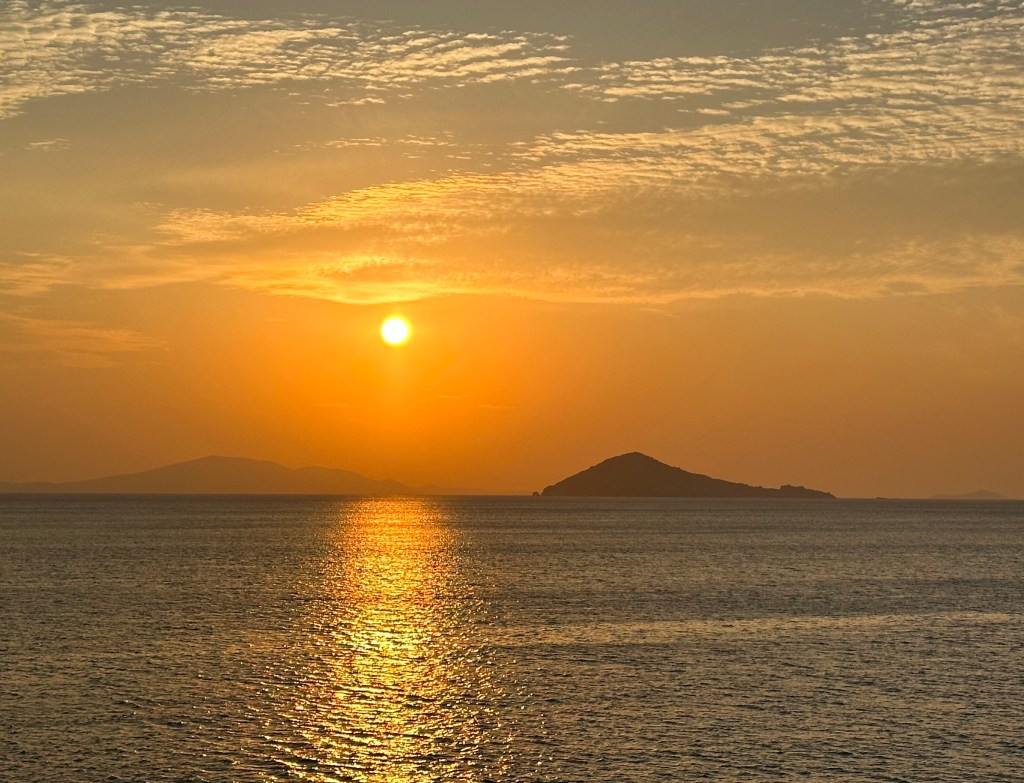
Today is Ascension Day, the 40th day after Christ’s resurrection. For many of the churches that follow the Anabaptist traditions, especially the Amish and Old Order Mennonites, Ascension Day is a holiday.
Families gather to reflect, visit, share, relax, and enjoy each other’s company. Youngsters may go fishing, hiking, biking, or playing games like volleyball and softball.
Of all the holidays that the Amish celebrate, Ascension Day is the most informal. There is no worship service or fasting. It simply honors and remembers the day that Christ ascended into heaven.
Couldn’t we all use a day like that to relax, refresh, and renew our body, mind, and spirit?
© Bruce Stambaugh 2024

I took my lunch outside the other day. The temperatures were more summerlike for the first of May.
I enjoy sitting in the sun for short periods, absorbing the free vitamin D and the natural springtime circus performing around me. Nature sprinkles my light fare with seasonings no human can buy or sell.
I sat on the cultured stone patio in my late mother-in-law’s red and white painted metal rocking chair. A light wind played with my napkin until my cell phone secured it.
I enjoyed the Swiss cheese and crackers and the birds flitting back and forth, singing their luxurious songs until the bully common grackles chased them away.
That gave me an idea. I opened an app on my phone that records birdsong. Soon, I discovered more birds in the immediate area than I realized. My old ears, with their diminished hearing, could not detect them.

The “flying cigars” called Chimney Swifts chitter-chatter high overhead, zooming in wide arching loops, capturing as many insects as possible. The dark, stubby birds that flap their wings faster than the eye can see were hungrier than me.
A clutch of American Goldfinches landed on the thistle sock hung in the tulip poplar tree, its greenish flowers just now blooming. Unfortunately, the grackles heard their gregarious interaction and quickly chased them away.
My app told me a Yellow Warbler was nearby, but I neither heard nor saw it. It might have been a flyover going farther north than Virginia’s Shenandoah Valley.
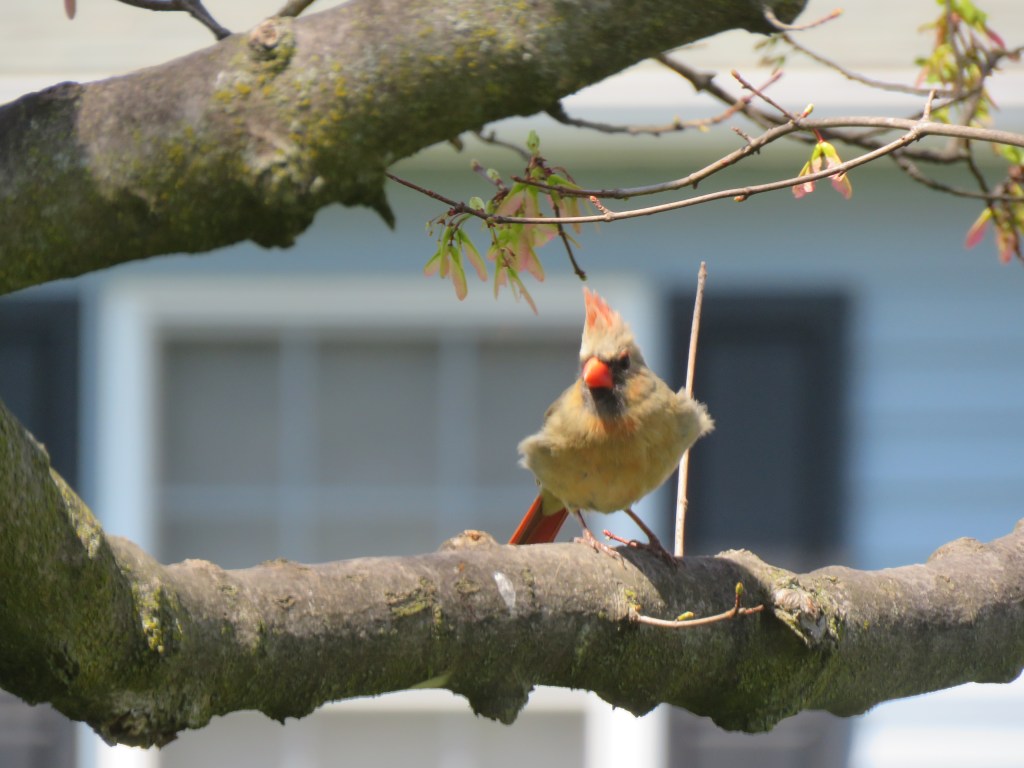
The ubiquitous House Sparrows jabbered atop the bluebird house attached to an old metal fence stake my congenial father-in-law gave me years ago. I made a mental note to check the box to see if the sparrows had built a nest.
Mourning Doves cooed from the neighbor’s rooftop while I finished my potato salad. Though their song is monotonous, I found it pleasantly reassuring.
American Robins bobbed in the grass, searching for their own lunches. Soon, one chased another to the neighbor’s.
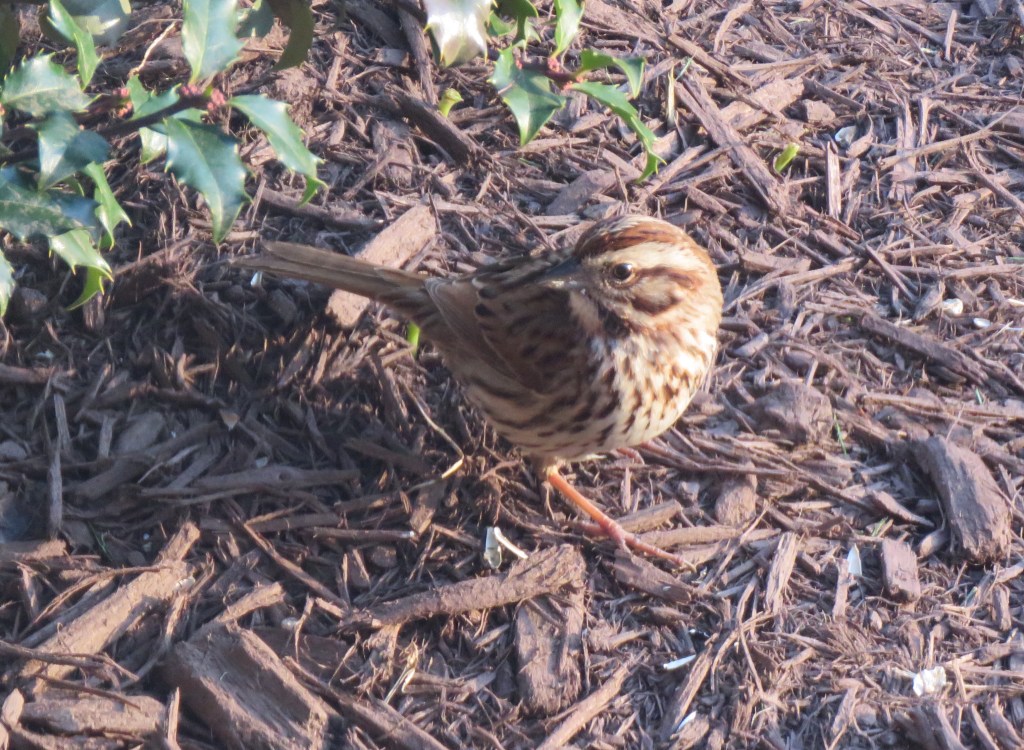
A pair of Northern Cardinals zipped from the Colorado blue spruce along our back property line to the fountain-fed birdbath by the screened-in back porch. Birds get thirsty, too.
For the first time since last fall, I detected a familiar chorus. The Gray Catbird’s liquid warbling gave it away. Its feline mimicking completed the hearty song. The variegated sound proved as joyous as the catbird’s return.
A Carolina Wren and a recently returned House Wren each called from opposite corners of the property. The Carolina adjusted its vocalization according to need while the house wren’s noisy melody beckoned a mate.
I washed down the last bit of ham salad and crackers with sweet tea, the only kind to drink in Virginia. As I reentered our home, the resident Song Sparrow skittered low along the ground and disappeared beneath my wife’s peonies.
That was all the dessert I needed.

© Bruce Stambaugh 2024

My wife and I have been cleaning the house item by item for longer than I can remember. And we’ve been married for 53 years.
She has always been ahead of me in the disposing game. I’m finally beginning to understand the joy of discarding items I have clung to for far too long.
Gone is the brown felt stetson cowboy hat my daughter’s family gave me as a gift years ago when they lived in Texas. It was a striking hat, but I seldom wore it. So, why should I keep it?
To be considerate, I asked my daughter if she cared if I gave the hat away. She just smiled and said, “It’s your hat. You can do whatever you want with it.”
Of course, I knew that, but I wanted to be sensitive to her since she had purchased the thing. I could have donated it to a thrift store, but I didn’t.
Guess where the stetson ended up? Back in my daughter’s household. Her second son, 17, jumped at the chance to own it. He hopes to have a hatter stretch it so it fits him.
Knowing that the hat has a familial home has instilled as much pleasure in me as having received it in the first place. Isn’t that the point of decluttering your life, especially when you’re 76?
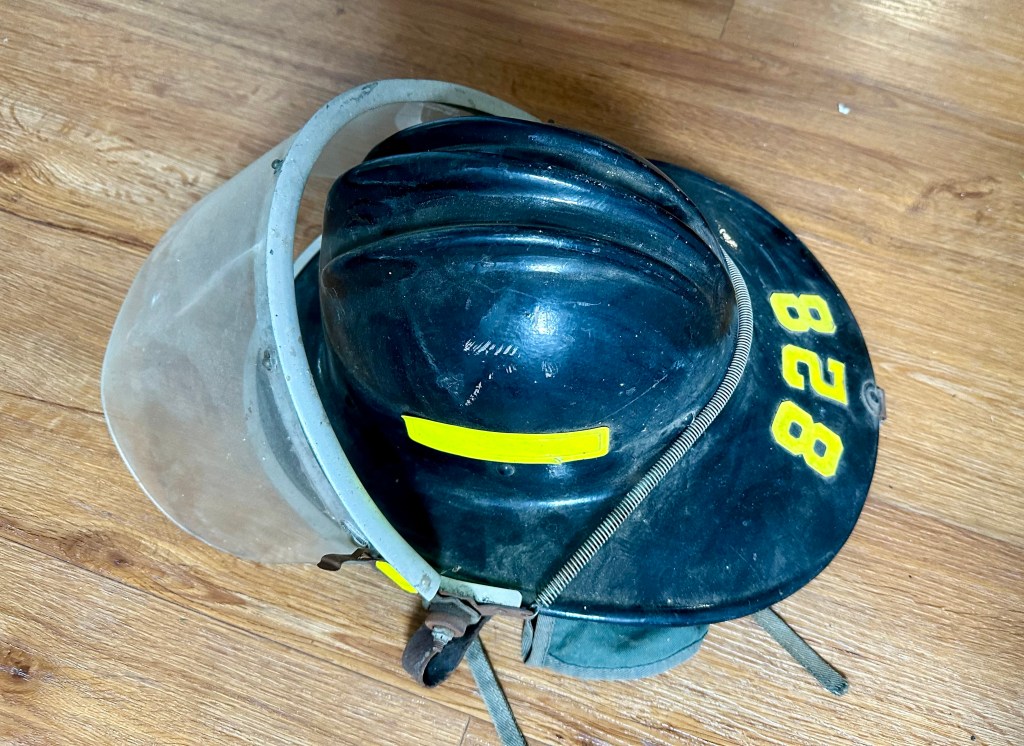
Our two-year-old grandson loves to dress up as a firefighter, among other wholesome job roles. I kept my old helmet from my volunteer firefighting days. The black fiberglass headgear, long lacking necessary safety standards, still has my uniform number, 828, emblazoned on it.
When I offered it to his parents for their son, they declined. I wasn’t either surprised or disappointed. The thing has too many places for tender little fingers to get pinched or cut.
So, the same grandson who confiscated the cowboy hat will also own my helmet. I don’t know what he will do with it, but when I hand it over, I’m sure he’ll ask questions about emergencies to which I responded. I have a storehouse of tales to tell him.
Our teenage granddaughter didn’t hesitate when I offered her a t-shirt from a favorite burger place on the island where we wintered in Florida. Our daughter’s family joined us for a few days a couple of times, and the grandkids loved that restaurant, too. Many snowbird memories passed to her in that faded shirt.
When our son and daughter were young, I brought out my old model train set at Christmas and continued that through the toddler years of the grandchildren. Now, our son has it to entertain his son. I don’t have to be there to know and sense the joy of a child and his father connecting one track segment to another until the oval is complete. Just mentally picturing that scene is enough.
A teen I mentor enjoys birding but needed a bird guide. Over the years, I have collected many books on birds, so it was no sacrifice to give this enthusiastic youngster a field guide I cherished so that he could, too.
I have an old black-and-white photo of four of the 28 fourth-grade students from my first year of teaching. I will send it to the one Amish boy in the picture, knowing he would revere it more than me. He will remember and tell his grandchildren when his fourth-grade class created a radio station.
I discover new items daily that equally resurface loving and sad memories. If I don’t need the apparel, souvenirs, or keepsakes, I gladly pass them on to the younger generations for posterity. I’ve already had mine.
© Bruce Stambaugh 2024
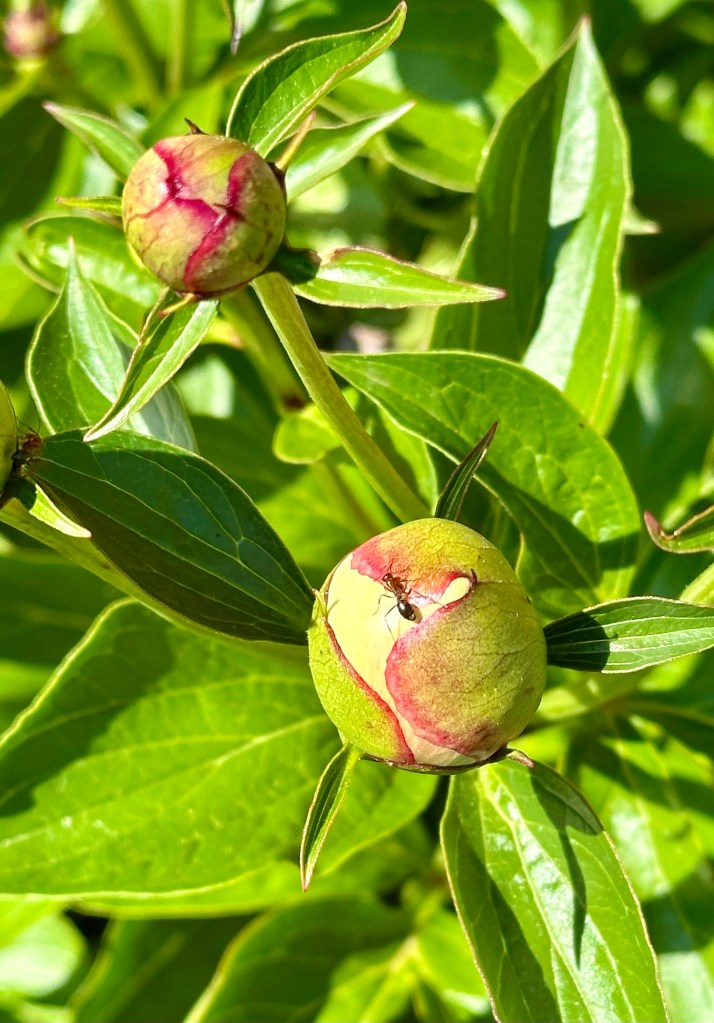
I was working in the backyard when I noticed an ant on a peony bud. Immediately, I thought of the old idea that peony buds need ants to transform from bud to flower.
I didn’t know exactly why or how that interaction worked. So, of course, I Googled it.
It turns out that it’s a myth. Michele Warmund of the Plant and Science Department of the University of Missouri says peonies can blossom all on their own. However, the biological mutualism between ants and peonies is true.
Peony flowers provide food for ants, who keep harmful floral-feeding insects away in return. According to Warmund, spraying the peonies with insecticides is unnecessary. The ants will protect the flowers as long as they can obtain food.
So, if you see ants on your peonies, celebrate!
© Bruce Stambaugh 2024

This is the last in a series celebrating National Park Week.
Autumn is often the best time to visit a national park. The annual coloring of the leaves attracts millions of people to many national parks, including Shenandoah National Park in Virginia.
The Park Service staff do an excellent job of keeping the public informed about the status of the changing of the leaves. From websites to social media to webcams, patrons of the parks can plan their trips accordingly.
Of course, everyone wants to hit the peak colors. The problem is that many factors play into trying to time the peak of coloration. Elevation, weather, temperature, tree species, longitude and latitude, and the sun’s angle all assist the color transformations. People’s schedules add to the leafy puzzle.
Living near a national park makes timing less risky. I closely monitor the weather, social media group photo posts that specialize in leaf watching in Shenandoah National Park, and the park’s weekly livestreaming. When it’s time to go, I head east and am seldom disappointed.
This past fall, much like this spring, was relatively dry. Fire conditions lasted several weeks, and fires did break out. The photo shows smoke from a fire near the Rappadan Camp that started outside park boundaries but quickly burned into the park’s forest.
The fire’s smoke starkly contrasted with the vibrant colors of the ashes, sassafras, hickory, oaks, and poplar trees. It subdued the usual exuberance for the park’s universal beauty.
Over nearly a week, firefighters finally got the upper hand as the leaves began to rain down. Eventually, fall storms helped quench the blazes and brought down the last leaves.
Despite the fire, park visitors still enjoyed the beauty of the changing leaves along Skyline Drive, from overlooks, and walking the trails that remained open.
Given nature’s multiple colors, it’s a good bet everyone left the park with lasting memories and photos to brag about.
© Bruce Stambaugh 2024
This is the fifth post in a series celebrating National Park Week.
When you are in a national park, don’t forget to look down. You don’t want to miss the many wildflowers prolific in all but the winter. Even Death Valley is currently having a superbloom. I would love to see that sometime.
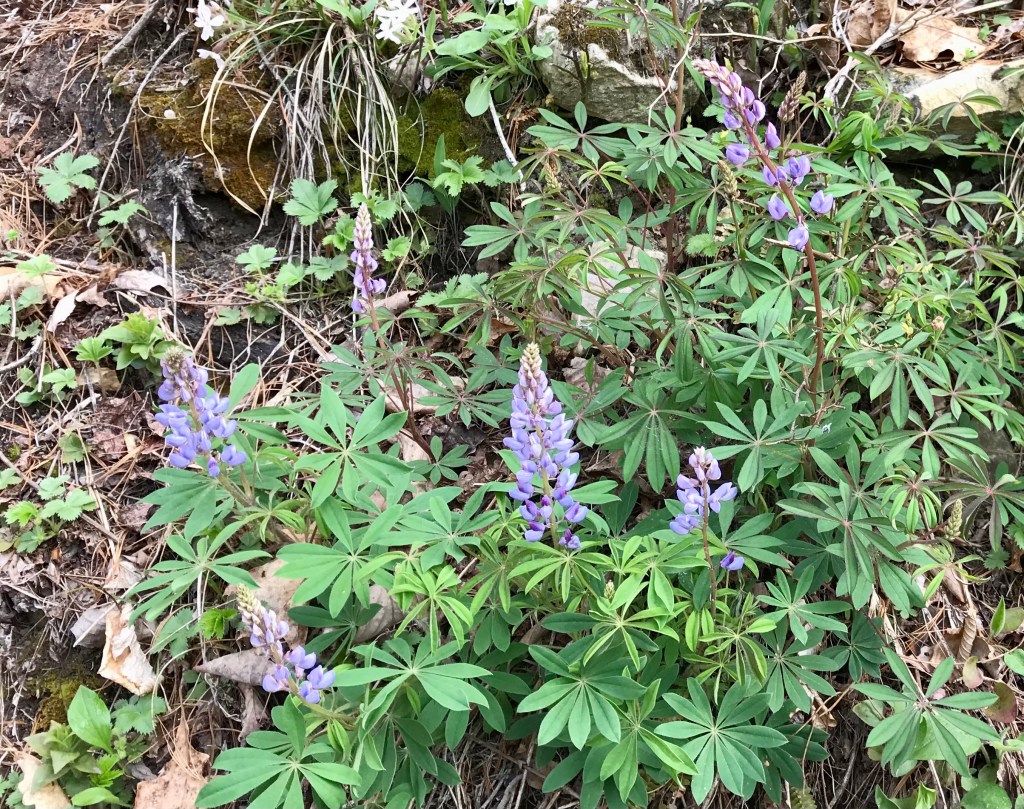
In the meantime, spring is the perfect time to look for wildflowers in national parks. I photographed the wild lupines along a fire road in Shenandoah National Park.
Wildflowers bring beauty to the park and attract other beauties, too. When I first visited Shenandoah National Park seven years ago, I was pleasantly surprised at the number and variety of butterflies I found in the park, even in the forests. The colorful blooms also drew bugs, bees, and, of course, Ruby-throated Hummingbirds.
So, when I visit any national park to bird, hike, and photograph birds and wildlife, the wildflowers also are on my agenda. The lovely lupines are the proof.
© Bruce Stambaugh 2024

This is the fourth in a series of posts celebrating National Park Week.
It is an understatement to say that people are drawn to waterfalls. Big or small, they are simply mesmerizing.
It’s one thing to see a photo or video of a waterfall, but it’s something else entirely to be standing next to one. The roar and the beauty transfix their observers. Even cascades of water over rock, then a crystal clear pool, then more white water entrances children and adults alike.
Shenandoah National Park officially has 36 named waterfalls. However, numerous others are in the park depending on the water flow. The photo above demonstrates that.
It’s one of many mini-falls above Lewis Falls, near the Big Meadows area. On a chilly November day, I hiked the Lewis Falls Trail in a group, and the many rapids and little falls upstream of the main event impressed us all.
It’s easy to be swayed by the impressive Yosemite Falls or Bridalveil Falls. I love them both. But romantic that I am, I am just as happy crisscrossing rapidly falling streams that form white water all the way to the cliff’s edge.
So, big or small, let’s praise the falling water in our national parks, which brings joy to everyone.
© Bruce Stambaugh 2024

This is the third installment of a series celebrating National Park Week.
I often hike alone. But occasionally, I enjoy sharing my love of nature with others.
The church I attend has a mentor/mentee program for youth. A friend and I each serve as mentors for two teenage boys. Knowing we all enjoy the outdoors, we took them for a day trip to Shenandoah National Park last summer. We had a riot.
These energetic young men enjoyed every aspect of the trip. They loved the hikes and the enthralling views. They also identified birds, flowers, and rocks and occasionally pestered one another. A pair of fawns grazing at the edge of Big Meadows startled us as we walked along the union of the meadow and the forest.
We rested on a rock outcropping overlooking the always lovely Shenandoah Valley. The boys loved scrambling over the ancient rock formation and resting in the warm sunshine, basking in all nature’s glory. Given our generational spans between teens and septuagenarians, I marveled at our common contentment.
But that, in part, is what national parks are for. People of all ages, races, religions, backgrounds, and interests feel at home in our nation’s beautiful national parks.
Our excursion was a perfect example of how to celebrate National Park Week.
© Bruce Stambaugh 2024

This is the second in a series celebrating National Park Week.
On the afternoon of May 23, 2018, I decided to finish my day in Shenandoah National Park by hiking the Rock Spring Cabin trail. According to the park map, the trail wasn’t long, and I was curious to see the cabin.
So, off I went, binoculars around my neck and camera across my shoulder. I soon reached the point where the trail joined the Appalachian Trail (AT), and I hiked on. I could hear birds chirping and singing all around me, but the lushness of the forest prevented me from seeing or photographing most of the birds.
As the AT wound west and north around a hillside, the Rock Creek Cabin trail veered left and down a fairly steep slope. I passed the hiker’s shelter, saw the spring gurgling from beneath giant boulders, and hiked back up the incline to the cabin owned by a local hiking club.
My fascination satisfied, I returned to the skinny dirt incline toward the AT. Just before I arrived at the iconic trail, a pair of Common Ravens croaked and chattered noisily overhead. Their deep-throated gurgling echoed through the dense landscape as they bounced from tree branch to tree branch in my direction.
Thinking I was the intruder who initiated the ravens’ commotion, I started down the trail at a slow pace. I didn’t want to disturb the birds any more than I already had.
The strange thing was, though, that they didn’t really seem to pay me any heed. They swooped lower to another tree ahead of me but continued their conversation.
So, I swallowed my ego and began to pay better attention to what was bothering the birds. A short distance down the AT, I discovered their concern. A young but large black bear was foraging on the lush, green forest floor.
I readied my camera and saw my chance. The bear was approaching a small cluster of trees that separated us. So, I quickened my pace to try to photograph this beautiful creature as it emerged from behind the trees.
I stood quietly on the trail for the bear to appear. I didn’t have to wait long. I aimed and clicked the camera just as the bear spotted me. That one simple noise sent the bear racing headlong down the hill and quickly out of sight.
I got one shot and only one shot of the bear. I was as happy as the bear was scared. I had my first photo of a bear in the wild.
That day, I learned an important lesson: Pay attention and use your senses to see all that a national park offers.
© Bruce Stambaugh 2024
Wildlife Photos From The Chesapeake Bay Region
Culture and Communities at the Heart Of India
Artist and nature journalist in the Shenandoah Valley of Virginia.
Photographer Of Life and moments
Personal Blog
Art is the only way to run away without leaving home. -Twyla Tharp
Writing generated from the rural life
writer. teacher. podcast cohost.
El amor cruza fronteras / Love crosses borders
 Roadkill Crossing
You must be logged in to post a comment.