News you may have missed in 2018

By Bruce Stambaugh

It’s been another strange year on Planet Earth. So much craziness filled the headlines that some serious faux pas got overshadowed. Never fear. I kept track for you.

Jan. 12 – A British butcher who got locked in a walk-in freezer used a frozen sausage to batter his way out at his store in Totnes, England.

Jan. 16 – Eyelashes froze when the temperature reached 88.6 degrees below zero in Russia’s remote region of Yakutia.

Feb. 9 – An Alliance, Ohio kindergarten student took a loaded handgun to school for show and tell, but had the gun confiscated by his school bus driver when the boy showed the weapon to the only other student on the bus.

Feb. 23 – A third-grade student fired a police officer’s revolver by reaching into the hostler and pulling the trigger during a safety demonstration at a Maplewood, Minnesota elementary school.

Feb. 27 – Entrepreneur.com reported that the three fastest growing franchises in the U.S. were Dunkin Donuts, 7-Eleven, and Planet Fitness.

March 13 – A study by Bar-Llan University showed that the trauma suffered by Holocaust survivors was transferred to their children and grandchildren.

March 14 – A Seaside, California gun safety teacher’s weapon accidentally fired in class, injuring a student.

March 23 – Orange snow fell on much of Europe due to the combination of sandstorm winds mixing with moisture in snowstorms.

April 5 – A report that studied the Sahara Desert from 1920 to 2013 revealed that the desert, defined by areas that receive four inches of rain or less annually, had expanded by 10 percent in that timeframe.

April 9 – Senator Tammy Duckworth of Illinois became the first sitting U.S. Senator to give birth while in office.

April 13 – A photographer in Madeira Beach, Florida captured a shot of an osprey in flight carrying a shark that was eating a fish.

May 2 – A new report indicated that Americans ages 18 to 22 were far more likely than senior citizens to report being lonely and being in ill health.

May 3 – According to federal research released, the rate of people infected by ticks and mosquitoes has tripled in the last 13 years.

May 9 – A new study by researchers at MIT indicated that fasting could dramatically boost stem cells to regenerate.

May 15 – A Gaylord, Michigan couple opened the hood of their car to discover a squirrel had stuffed 50 pounds of pinecones in their engine compartment.

June 7 – A study showed that seven out of 10 Americans were experiencing news fatigue.

June 25 – A kangaroo bounded onto a Canberra, Australia soccer field, interrupting the play between two professional women’s soccer teams for 32 minutes.

July 3 – Mark Hough of Altadena, California found a black bear bobbing in his backyard hot tub and that the bear had finished off the margarita Hough had left behind.

July 10 – Costa Rica became the first country to ban fossil fuels.

July 21 – After receiving a ticket for speeding, an Iowa woman sped away from police who clocked her at 142 m.p.h. and gave her another citation.

July 27 – A pawn shop in Somerville, Massachusetts bought a stolen violin for $50 and discovered from police that its real value was $250,000.

August 1 – A State of the Climate report indicated that 2017 was the third warmest on record globally after 2016 and 2015.

August 5 – Right-handed reliever Oliver Drake became the first Major League Baseball player to pitch for five different teams in the same season.

August 10 – A new scientific study reported that insect-eating birds consume about 400 million tons of insects each year.

September 10- The Smithsonian Migratory Bird Center reported that 600 million birds are killed annually in the U.S. by flying into buildings, most often at night when they are lured by illuminated office windows.

September 14 – New census data reported that Social Security, food stamps, and other government programs kept 44 million Americans out of poverty last year.

September 25 – A record 1,260 dogs attended the baseball game between the Cleveland Indians and the Chicago White Sox during Chicago’s promotional Dogs’ Night Out event.

September 26 – The United Nations Refugee Agency reported that an unprecedented 68.5 million people globally have been forced from their homes.

October 15 – A report by the University of Missouri indicated that honeybees stopped flying during the total solar eclipse of August 21, 2017.

October 31 – The journal Nature published a report that showed over the past quarter-century the Earth’s oceans have retained 60 percent more heat than previously believed.

November 6 – The World Health Organization listed depression as the leading cause of disability in the world, with the U.S. leading the way with 13 percent of its population on anti-depressants.

November 9 – The Center for Disease Control reported that smoking rates in the U.S. at an all-time low, with 14 percent of adults who smoke cigarettes.

November 25 – A Bank of America ATM machine in Houston, Texas dispensed $100 bill instead of $10, and the bank allowed customers to keep the extra money.

December 8 – A 29-year-old Summerville, South Carolina man was arrested for arson after he allegedly burned several of his neighbors’ outdoor Christmas displays.

December 12 – The CDC listed fentanyl as the deadliest drug in the U.S., causing 18,000 deaths from overdoes in 2016.

December 14 – Snopes.com reported that the busiest day of the year for Chinese restaurants in the U.S. is Christmas Day.

Here’s hoping 2019 is a better year for our planet and all its inhabitants.

Happy New Year!

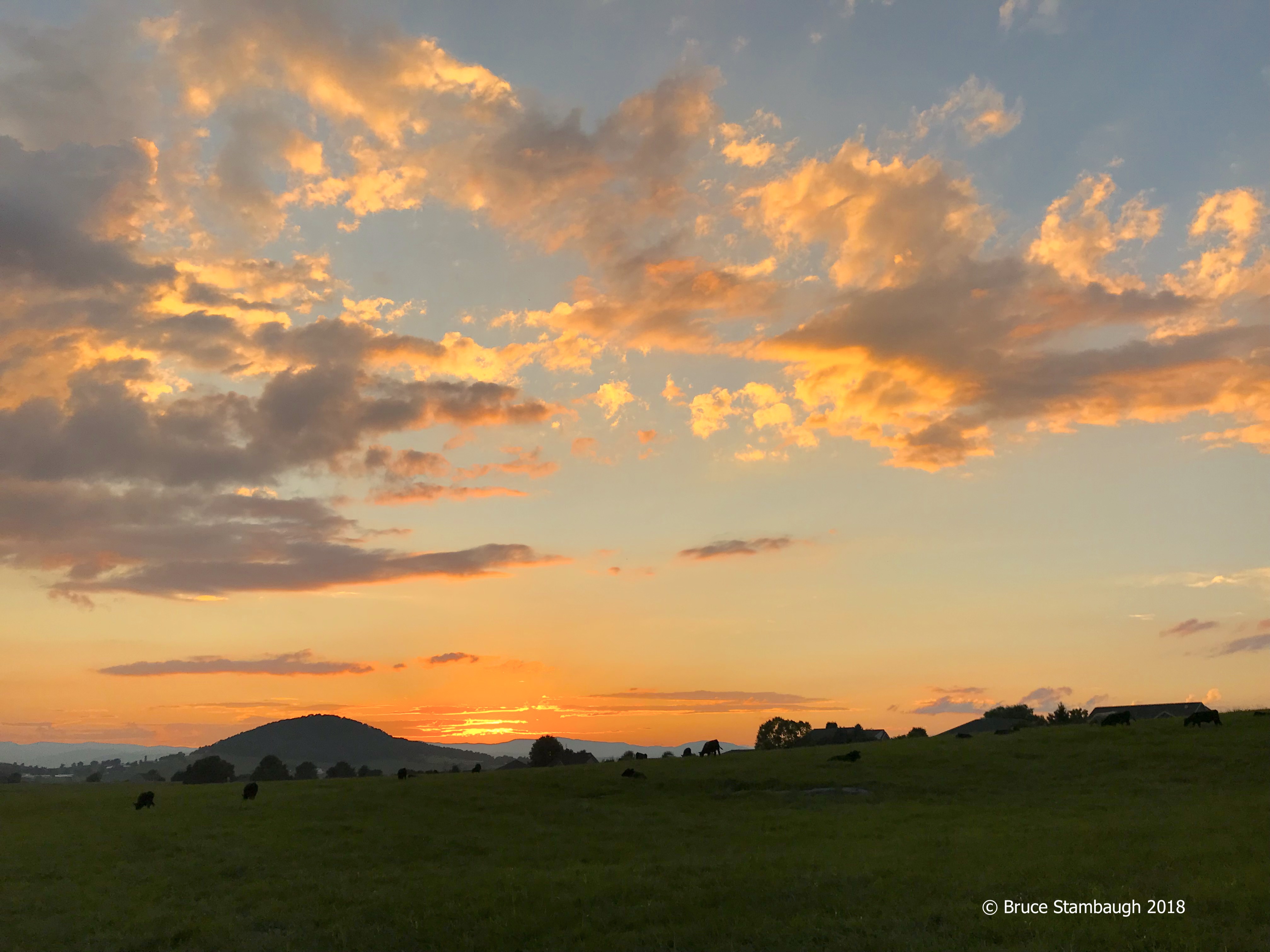
Let’s let the sun set on 2018.

© Bruce Stambaugh 2018

Year-end Shadows

shadows, snow, bird feeder
The end of 2018 is in sight. Given the state of the world today, perhaps we all need a fresh start in life, no matter our age, our situation, our status. A new year brings new hope.

I reflected on all of that during a recent snowstorm that blanketed much of Virginia’s Shenandoah Valley. Shadows of the tree, its limbs, and the bird feeder they held played upon the newly fallen snow in our front yard. The contemplative scene gave pause to my birdwatching, to my reading, to my writing, to all that was happening near and far.

The long shadows cast by the late afternoon sun that had finally broken through gave hope that neither the winter’s frostiness nor the world’s cold calamities could keep us down long. For in the abrupt transition between the snowy brightness and shadowy darkness, light prevails.

Here’s hoping that light will shine warmly for the approaching New Year. “Year-end Shadows” is my Photo of the Week.

Happy New Year!

© Bruce Stambaugh 2018

Birds and trees signal inevitable change

ice storm, male cardinal
Icy red.

By Bruce Stambaugh

The annual migration of birds has been going on for some time now. Fall in the birding vernacular doesn’t equal calendar fall.

There is a logical reason for that. Different species of birds begin their migration at different times. Shorebirds and songbirds often lead the winged entourage to warmer climes. Others trail along alone or in giant flocks to the delight of avid birders. To account for these time travel variances in the birding world, fall is the most extended season, running from August through November.

backyard birds
At the suet feeder.

The same concept is valid for trees and deciduous plants. Some species begin their winter hibernation sooner than others. Their various changing colors can foretell this annual transition. Poison ivy leaves often turn bright red before September arrives, while the glossy leaves of shingle oaks fade from emerald to russet and hang on until early spring.

For me, I welcome these transitions, especially the birding varieties. As the leaves of the red maples in our yard began to fall, birds I had not seen before began to arrive.

Storms brought down many of the remaining leaves. They also blew in flocks of birds, some temporarily. Others seem here to stay.

Last fall, our first in the Shenandoah Valley, birds were scarce at the feeders. The numbers and variety of birds were well below my expectations. I longed for the many beautiful birds we had had in Ohio.

Optimist that I am, I hung the feeders again right after Labor Day and attracted a few regulars. I can always count on chatty house finches and boisterous blue jays. Once the weather cooled, the suet feeder went up in the backyard.

backyard birds
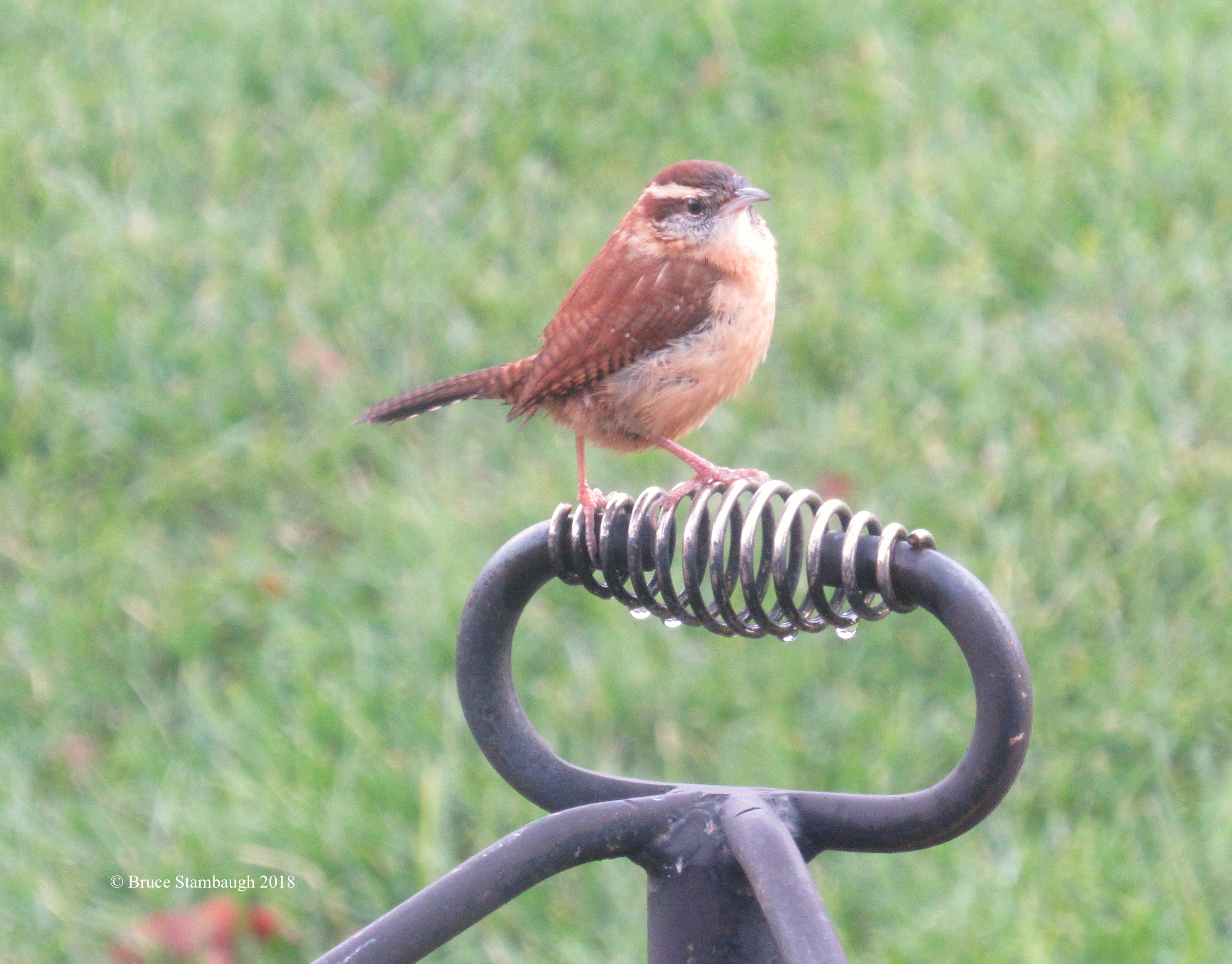
An inquisitive Carolina Wren.

I was contented with the usual suspects, happy that even the Carolina Wrens made regular appearances. But I could not have anticipated what happened next. About six weeks ago, I noticed some birds that resembled the numerous house finches that frequented our feeders. A closer inspection with the binoculars told me that we had a small flock of purple finches with a few pine siskins thrown in for good measure. I was ecstatic.

I had never had purple finches at the feeders and only had had passing pine siskins that took a break to refuel during migration. I hoped beyond hope that the birds would stay. So far they have.

These are gorgeous birds, each in their particular plumage. The reddish hues of the male purple finches appear iridescent, especially if the sun reflects off of their foreheads where the winter colors are the brightest. Though much duller and muted, the rich browns and creams of the females’ feathers are equally stunning.

backyard birds
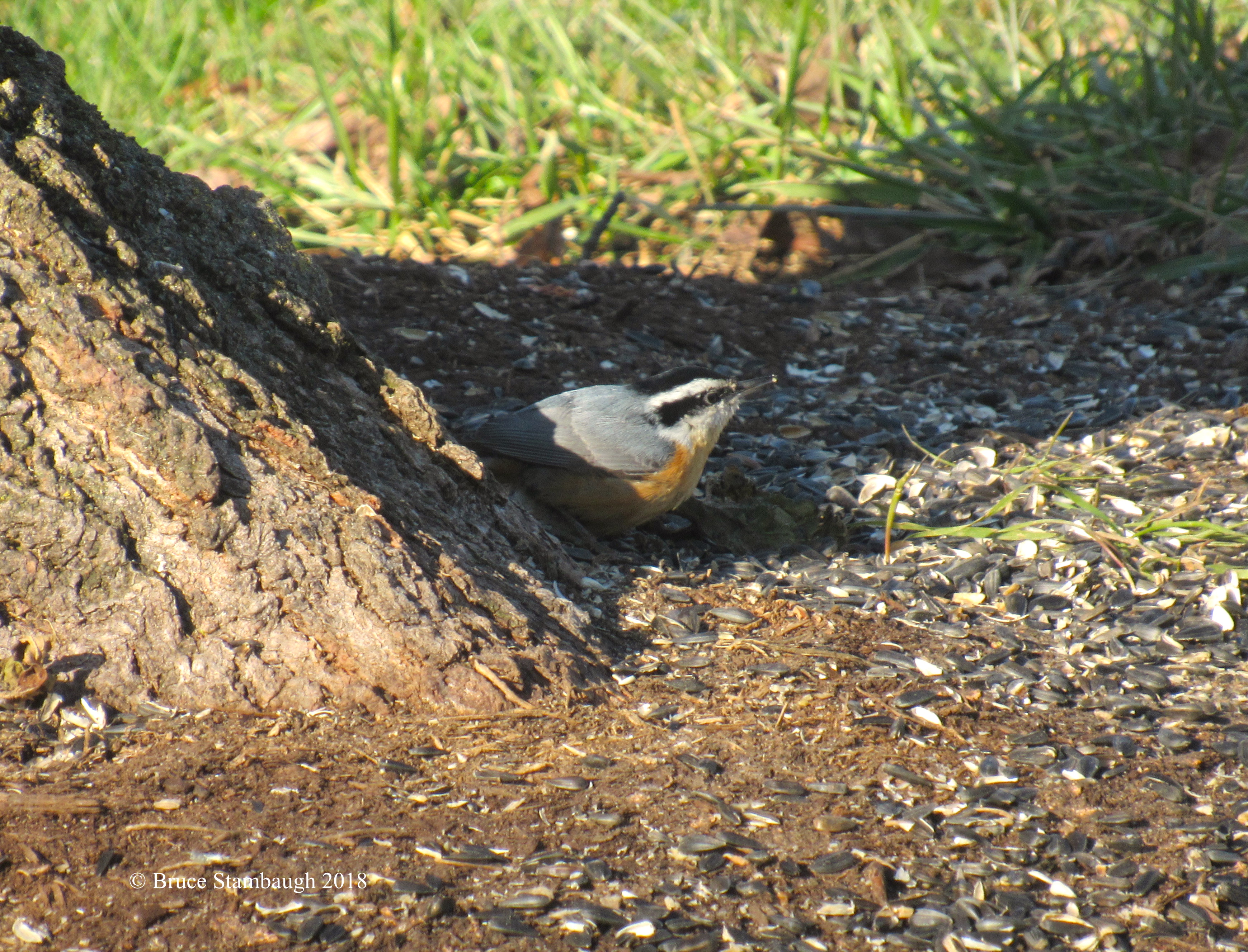
A rare visitor, a Red-breasted Nuthatch.

The more demur pine siskins tend to feed with the purple finches and the American goldfinches. Their brown stripes and flash of yellow at the wing tips make them striking birds as well.

The departure of the leaves and arrival of the birds mimic life. We can’t do anything about the past and try as we might, we can’t predict the future. Dull leaves and the arrival of purple finches are proof positive.

To be most productive, I strive to be present in each moment regardless of what change occurs. The mystery of it all sparks a spirit of gratitude.

I’m thankful the birds and trees keep reminding me that change is inevitable. If we pay attention, we can enrich our lives by embracing each subtle transformation, seasonal or otherwise.

For good or for ill, change happens. It is the way life is.

Purple Finches, Pine Siskins, House Finches, American Goldfinches
Finches feeding.

© Bruce Stambaugh 2018

Where it fell

Where it fell.

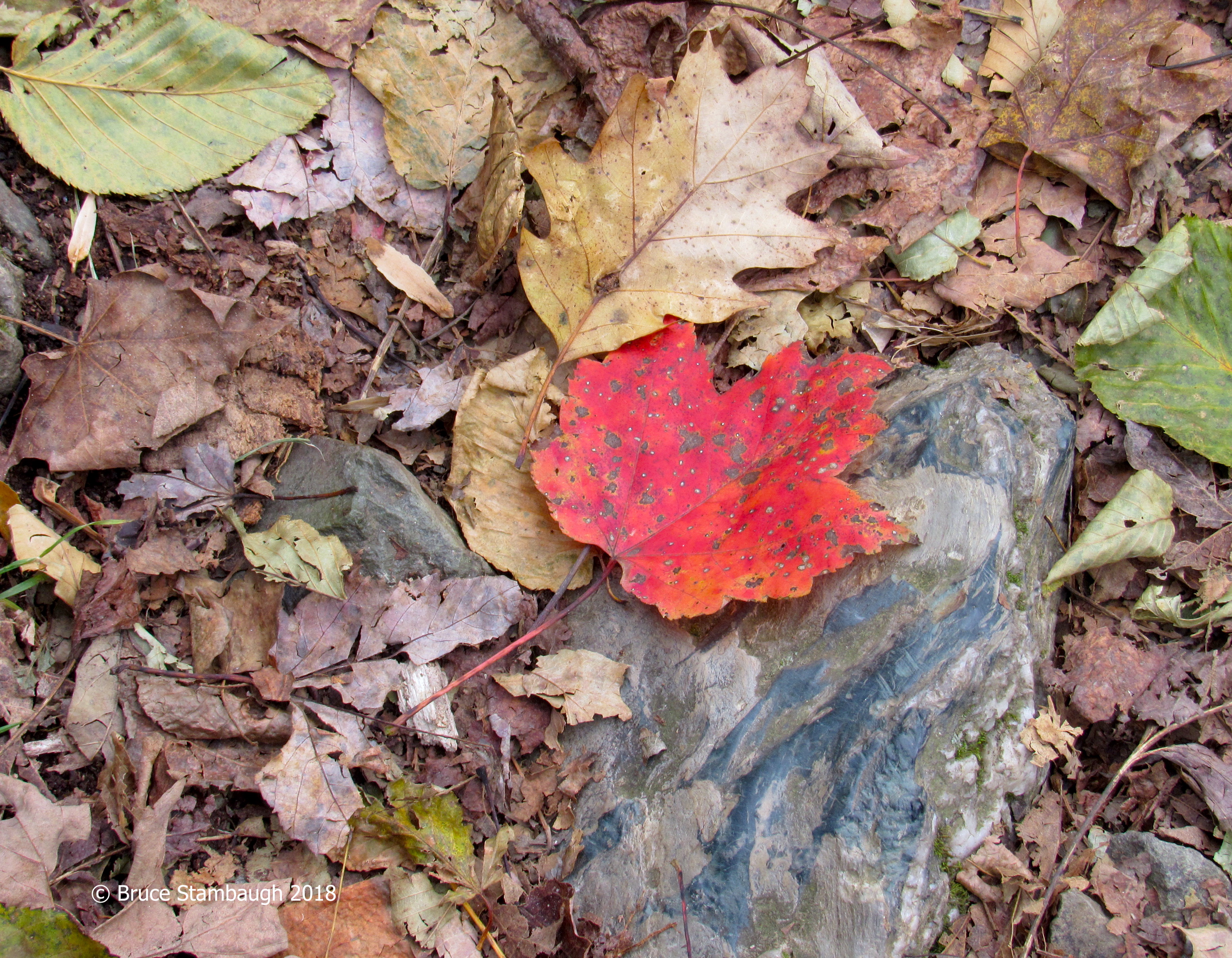
If you are a photographer, it is not hard to figure out why I took this shot. The bright red maple leaf lying in the middle of the Appalachian Trail jumped out at me. Amid the late fall drabness of mostly bare trees, frost-killed ground cover, and other fallen brown leaves, how could I not see the leaf resting upon the bluish-gray basalt rock?

From my perspective, this composition was just waiting to be captured. “Where it fell” is my Photo of the Week.

© Bruce Stambaugh 2018

Learning to be thankful for life itself

Lewis Falls, Shenandoah NP, hiking
Cascades above Lewis Falls.

By Bruce Stambaugh

The holiday season is here. Thanksgiving Day has come and gone. Christmas, Hanukah, and New Years will be here in the twinkling of an eye.

It’s easy to get caught up in all the excitement, hoopla, and glitz of the extended festivities. After all, the big box stores, TV, radio, online ads, and printed fliers have been pushing their holiday wares for weeks now.

I try not to pay too much attention to all that holiday hype. In my retirement, I have, instead, come to enjoy each moment, anticipate the day at hand, and celebrate the unfolding daily events.

I have also learned that that is much easier said than done, given the state of the world, the conniving of greedy people and corporations, the unsettling of Earthly events, natural and otherwise. Still, we must carry on. So I did, and I do.

This particular day I joined a senior citizens’ hiking group led by a retired banker, a most trustworthy man. Our destination was Lewis Falls in Shenandoah National Park.

Our group of nine wound its way down the trail through the shedding deciduous trees, brushing against mountain laurel whose berries the forest birds and bears had not yet devoured. We crisscrossed several small streams, all of them rushing to plummet the 83 feet of Lewis Falls.

These cascading ribbons join just as they tumble into the Shenandoah Valley. We stepped gingerly across the last of the wetted stones and finally made it to the shaded overlook of the falls themselves. We refueled at that lovely sight on the snacks we each had brought along.

This slideshow requires JavaScript.

I climbed over the protective stonewall to get a slightly better view of the falls. It nearly cost me my life. I pitched the last handful of peanut butter cracker crumbs into my mouth and tried to swallow. I couldn’t.

I tried to breathe in. No air made it to my lungs. I didn’t want to die this way.

My EMT training kicked into gear. I got the attention of the nearest person and pointed to my throat. She asked me if I was choking and I nodded my head frantically. She hollered for the others and started to jump the wall to help me.

In these 20 seconds or so, I continued to try to swallow. I couldn’t speak. I thumped my chest with my fist twice, made a growling sound, and attempted to swallow again. Just as this courageous woman was about to apply the Heimlich maneuver, I felt the mountain air tickle my lungs. I took a swig of water, waved off my would-be rescuer, and spoke a few raspy words of thanks.

The woman was heartily relieved, but not nearly as much as me. As we backtracked up the zigzag trail, everything looked brighter, the colors more vibrant, the air sweeter. The trek back to the cars seemed much shorter, easier even until someone noticed that Herb was missing.

The tallest member of our pack, Herb had headed back ahead of the rest of the group. But he wasn’t at the parking lot. The retired banker quickly formed a plan, and once again my firefighter/EMT training instinctively activated, only this time for a search and rescue effort.

Though frustrated for nearly two and a half hours, the search ended happily. Herb was found safe and sound. We all headed for home in thanksgiving and wonderment of creation and life itself.

In the midst of all the mundane marketing and holiday cheer, I have a suggestion. Let’s remember to be thankful for life itself.

The view of the Shenandoah Valley seemed even more pristine than usual despite the muted colors.

© Bruce Stambaugh 2018

Divergence

Massanutten Mt., Shenandoah NP, stratocumulus clouds,
Divergency.

When I left home shortly after 8 a.m., the sky was cloudy. The forecast was sunny. I wondered how “they” could get it so wrong. I was heading to Shenandoah National Park at the easternmost section of Rockingham Co., Virginia. By the time I got to the east side of Harrisonburg, skies to the northwest were crystal clear. I had hope that the day wouldn’t be gloomy after all.

By the time I arrived on Skyline Drive, the road that winds its way along the park’s spine, I could see that it was just a matter of time that the sky would clear. When I reached the critical point of the layer of stratocumulus clouds on the left and clear sky on the right, I had to take a picture. I felt fortunate to capture the meteorological phenomenon that scientists call divergence. That is, the air mass with the clouds was moving away in a horizontal direction from the air mass without clouds.

I used the Southern Pine as the marker of this weather DMZ. Massanutten Mountain is just to the right of the pine tree.

“Divergence” is my Photo of the Week.

© Bruce Stambaugh 2018

Autumn on the Farm

farmstead, Rockingham Co. VA, Shenandoah Valley
Autumn on the Farm.

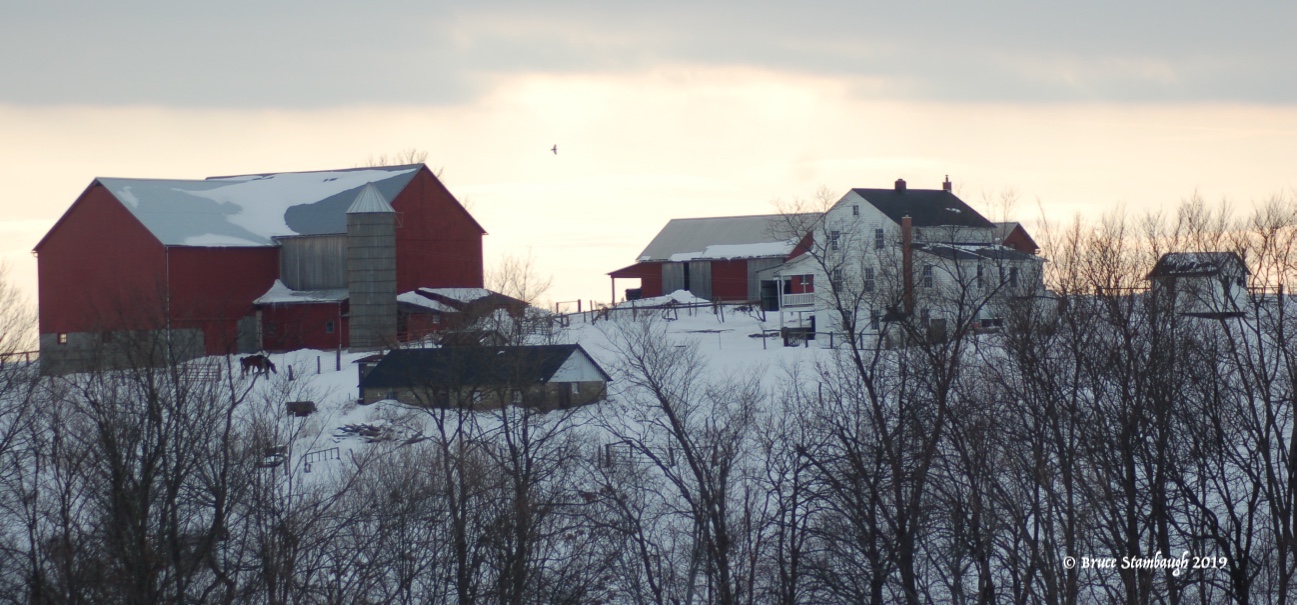
The morning sun broke through the layer of cumulus clouds to perfectly highlight this hillside farm west of Harrisonburg in Virginia’s Shenandoah Valley. Even though they were past their peek coloration, the sun-drenched buildings of the farmstead nicely accentuated the leaves of the mixed hardwoods.

“Autumn on the Farm” is my Photo of the Week.

© Bruce Stambaugh 2018

Aviary Sunbathing

Shenandoah Valley, Rockingham Co.
Absorbing the sun.

At first sight, I wasn’t sure what was under the blazing maple tree. From a quarter of a mile away, I couldn’t tell if the figure was a person or a bird.

Fortunately, I found a route that paralleled the scene and drove slowly down the narrow country road. I clicked a shot with my zoom lens fully extended. A quick review of the picture confirmed my suspicions. I had captured a Great Blue Heron basking in the warmth of the late afternoon sun. But why at this exact spot? Was there water nearby?

I pulled my vehicle forward and found the answers to my questions. A small stream, which I later learned was Cub Run, meandered behind and below the bird and alongside a set of railroad tracks. This gorgeous bird couldn’t have picked a more lovely spot to absorb the welcomed sunrays.

“Aviary Sunbathing” is my Photo of the Week.

© Bruce Stambaugh 2018

Facing unfounded fears brings unexpected rewards

Compton Gap Trail, Shenandoah NP
Our lunchtime view.

By Bruce Stambaugh

I love to hike. Planting myself in a hiker’s paradise has afforded me unlimited opportunities to satisfy my love for hiking. In reality, it hasn’t worked out quite the way I anticipated.

First of all, I have too many interests and too little time to fulfill all of them. Family responsibilities top my priority list, especially in the fall when our grandchildren seem to be their busiest. Hiking takes a backseat so I can help with the grandkids.

When I do get a chance to head to the many trails of Shenandoah National Park, I usually go alone. I enjoy the oneness with nature and the precious personal time to think and explore at my own pace.

However, that lone ranger approach to hiking changed when I discovered a peer-hiking group. When an outing on a trail I had not yet tackled was offered, I wanted to go. However, I hesitated for somewhat personal reasons.

I wasn’t sure just how fast the group would walk. Neither did I know if they would take as many breaks as I was sure to need. At my age, any hike that begins early morning can be problematic. In the words of Forest Gump, “And that’s all I have to say about that.”

Despite my doubts, I sent the confirmation email that I would join the group. I was greatly relieved when I got the reply.

The leader welcomed me into the hiking circle. He volunteered that the trek would accommodate all the hikers’ needs. In other words, the group would stop as often as necessary. I was glad about that news, but now a new set of insecurities surfaced.

I didn’t know how many people would be in the group. I didn’t know their level of hiking expertise. Nevertheless, I didn’t let my petty, irrational fears deter me, and prepared for the hike.

This slideshow requires JavaScript.

I loaded my hiking gear, the hiking poles I had purchased but never used, my camera, binoculars, and a light lunch. I dressed in several layers of clothing to peel off as the day warmed.

Our group was small, only five, all of us retired with various levels of hiking proficiency. The other four hikers were as pleasant as could be.

We each enjoyed the camaraderie that ensued along the way. Our revered leader knew all aspects of the park, its botany, geology, and history. His genial personality served him well.

The day was crisp, the forest quiet except for an occasional gusty wind that rustled the still green leaves. I was surprised at how very few birds I saw or heard.

We followed the Appalachian Trail up the ridge on sometimes rocky, steep terrain, sometimes mostly flat, well-worn earth. Short grasses and fallen leaves bordered the trail.

We ate our lunch standing and sitting on ancient igneous outcroppings overlooking the sweeping valley below. Signal Knob, the northern-most point of the Massanutten Range, stood across the way overlooking the old-aged Shenandoah River.

After lunch, we crossed back over the AT, scrambled around and down another rocky point to view a rare exposure of basalt columnar jointing. Seeing the hexagonal formation dispelled once and for all any remnants of my silly fears.

It had been a glorious day hiking with newfound friends. Naturally, all of my fears proved to be unfounded.

In this age of fear-mongering and extreme reactionary phobias, it was a timely reminder for me. Trivial or not, tell your fears to take a hike before they walk all over you.

South Fork Shenandoah River, Shenandoah NP
Overlook at Shenandoah River State Park.

© Bruce Stambaugh 2018

Nature’s Elements

Paul State Forest, Rockingham Co. VA
Rain drops and sun rays.

If I have learned one thing in my seven decades on this marvelous planet of ours, it is to go with the flow. When I left the house, pleasant temperatures and partly cloudy skies ruled the sky. I intended to drive 10 miles to Paul State Forest near the crossroads known locally as Ottobine. I planned on walking the trails of this 172-acre gem of a woods to look for birds.

I packed my binoculars, birding hat and vest, and of course my travel camera, a Canon PowerShot SX530 HS. The camera is light, easy to use, and takes excellent shots, as long as sufficient light is available. I also had my iPhone along for safety sake. You never know when an old guy like me will need to make an emergency call.

Not far from the forest, the roadway showed signs of recent rain. Indeed, the clouds that hung close to the Appalachian Mountains to the near west looked ominous. With the early evening sun occasionally peeping through, they also looked gorgeous. The billowing thunderheads showed every shade of gray. Sun rays streamed through breaks in the building cumulous clouds, creating a stunning rural scene.

When I reached the small parking lot of the forest, the bucolic view towards the mountains was surreal. I turned my attention to shooting the unfolding and rapidly changing scene. The valley played open to the west, giving me an excellent view. I snapped away with both my camera and phone. Satisfied with the shots, I returned to my original goal of walking the woods in search of any migrating birds settling in for the night.

I had only walked a short distance when the heavens opened up. I returned to my vehicle, contented with the pastoral scene of clouds, rain, and sun rays. The birds would have to wait for another day.

“Nature’s Elements.” is my Photo of the Week.

© Bruce Stambaugh 2018

Bay Photos by Donna

Wildlife Photos From The Chesapeake Bay Region

ROAD TO NARA

Culture and Communities at the Heart Of India

K Hertzler Art

Artist and nature journalist in the Shenandoah Valley of Virginia.

Maria Vincent Robinson

Photographer Of Life and moments

Gabriele Romano

Personal Blog

Jennifer Murch

Art is the only way to run away without leaving home. -Twyla Tharp

Roadkill Crossing

Writing generated from the rural life

ANJOLI ROY

writer. teacher. podcast cohost.

Casa Alterna

El amor cruza fronteras / Love crosses borders