It’s beginning to look a lot like fall already

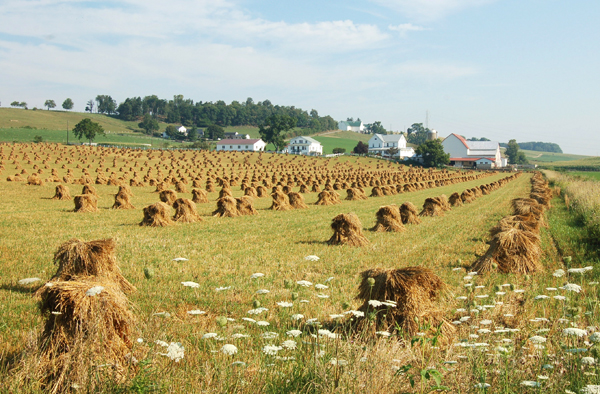
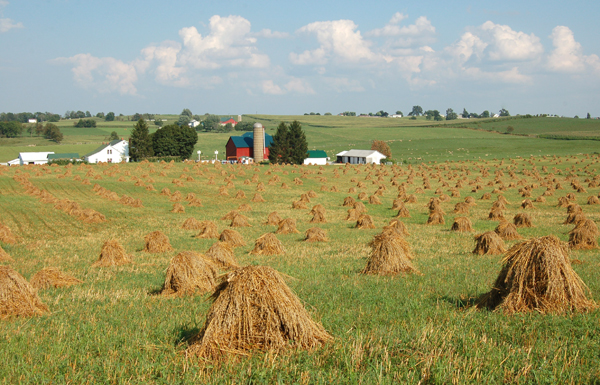
Oats shocks by Bruce Stambaugh
A field full of oats shocks before being gathered for the thrasher near Berlin, Ohio.

By Bruce Stambaugh

With Labor Day upon us, autumn will be right around the corner. In fact, if you look closely, signs of fall are already evident.

Some of the indicators are obvious, others more subtle. Some are predictable with still others seemingly a bit premature.

The days, often the nicest of the summer, have a sly, natural flaw. Day by day, minutes of daylight are silently subtracted from the previous day’s total. By month’s end, daily darkness will outnumber daylight once again.

The sun itself is moving more towards the center of the horizons at sunrise and sunset. Those driving true east and west running roads have already begun to frequently use their sun visors. The fall fogs, too, have clouded crisp mornings, the consequence of cool nights following warm days.

In the fields, the harvesting has begun. My Amish neighbors have long since gathered up the standing army of oats shocks and wheeled them off wagon load after wagon load to the thrasher.

Now it’s the corn’s turn. The field corn seems to have taken on drought status, drying up almost overnight. Brown has overtaken green as the predominant color in the standing sea. Smart farmers have already begun to cut their supply of silage to replenish the silos.
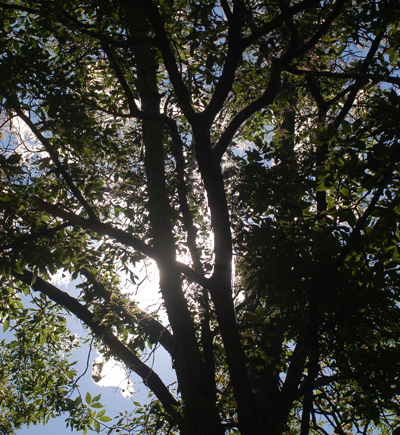
Fall webworms by Bruce Stambaugh
The homes of fall webworms shine in the sun.

In the woods and along highways, once glossy, emerald leaves have dulled and drooped. Some have already begun to drop without even changing color. Now and again a black walnut can be found standing stark naked, save for the cache of fall webworm nests it has involuntarily collected.

In the gardens, the picking of produce is a daily chore. Cucumbers, onions and tomatoes have hit their peek. Kitchens are cluttered with utensils for canning and freezing. The ripened fruits and vegetables that aren’t consumed at the dinner table find their way into jars and containers.

Even the sounds of the season have changed. Only a few American Robins continue to sing, and most likely they are sophomores practicing for next year’s prom. Instead of gathering nesting materials and snagging worms and insects, parent birds lead their fledglings to watering holes for liquid refreshment and necessary bathing.

Well-worn butterfly by Bruce Stambaugh
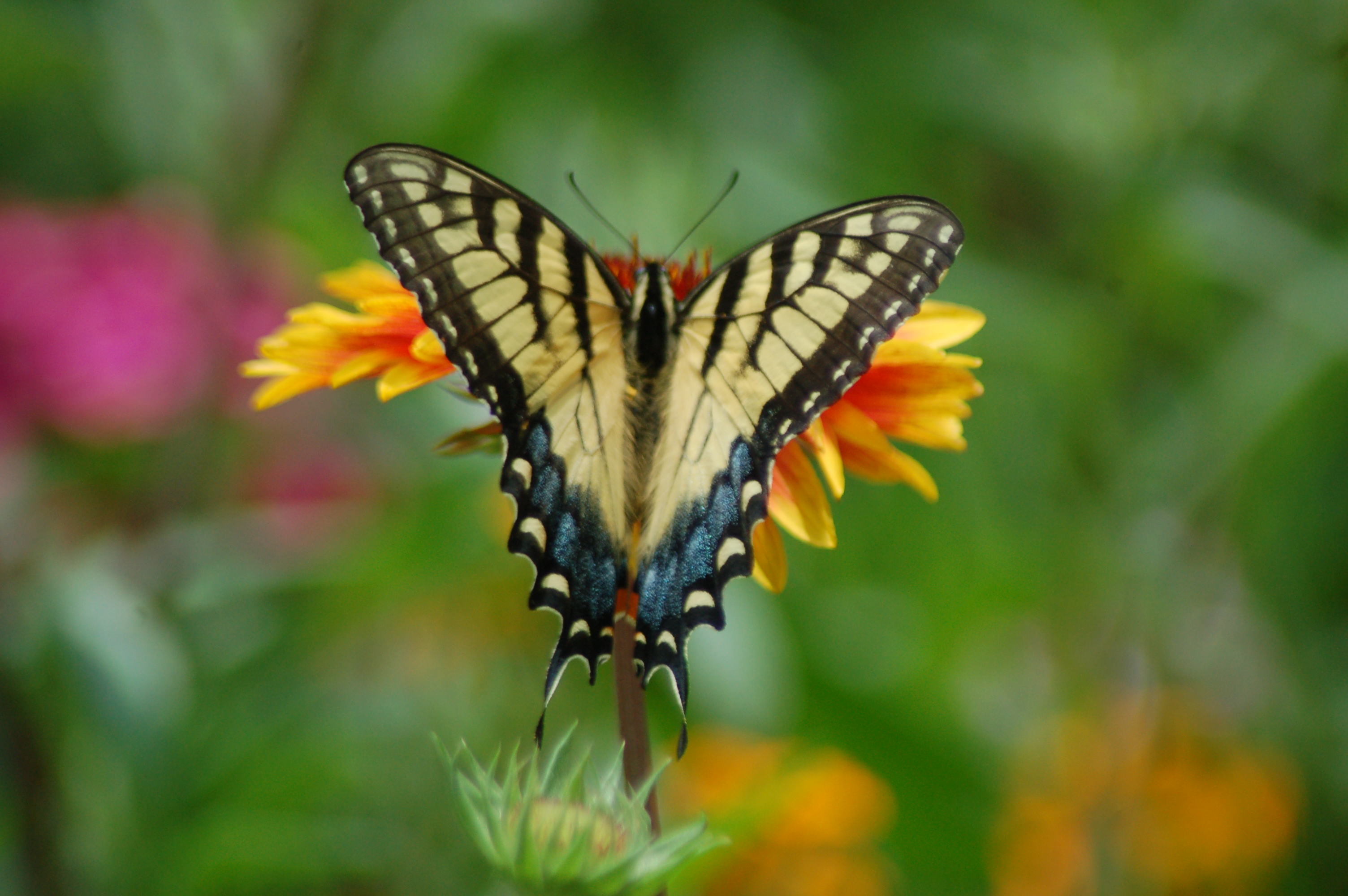
A well-worn tiger swallowtail butterfly took advantage of some wildflowers.

The volume and frequency of the cicada and katydid songs have lessoned considerably. Even the crickets have quieted down.
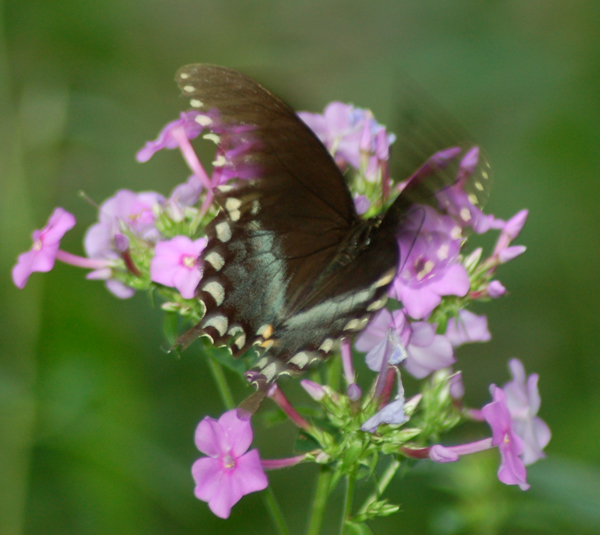
Butterfly on phlox by Bruce Stambaugh
A butterfly enjoys late blooming phlox.

Butterflies of all sizes and colors squeeze whatever nutrients they can out of the fading cornflowers and black-eyed susans. The humming birds, too, seem to sense an urgency to store up extra energy for their upcoming southern vacation travel.

Squirrels are in their glory, cutting as many beechnuts, hickory nuts and walnuts as they can. Thrifty creatures that they are, they also bury future meals for harder times ahead. Only they can’t always remember where they put their stash.

Next spring, when the saplings begin to appear, we will learn just how forgetful the squirrels were. But between now and then, many pleasant days lay ahead, and probably some less than desirable ones, too.

There is yet one more indicator that fall is knocking on our door. Campaign signs have already begun to litter urban, suburban and rural roadsides. They are as prolific and unsightly as the ugly webbed homes of the worms.

The obnoxious yet gaudy campaign posters are a human-induced reminder of what nature is about to bring. Autumn will be here before we know it, and there is little we can do about it except to enjoy the ever-changing colorful show.
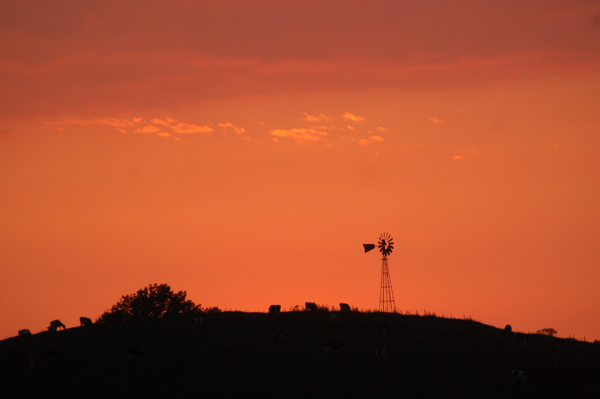
Cows grazed at sunset by Bruce Stambaugh
Cows grazed on a hillside at sunset.

Directions of a different sort

Buggies at Mt. Hope by Bruce Stambaugh
Buggies tied at a hitching rail in Mt. Hope in the heart of Ohio's Amish country.

By Bruce Stambaugh

Word to the wise. If you ask for directions in Holmes County, Ohio, you just might want to get a second or even third opinion. Better yet, use a map, atlas, a GPS or a combination of those geographical aides.

Here’s why. With three to four million visitors to our fine county every year, some of them get lost, or at least do not know exactly where they are. Shoot. Some might not even know where they want to go.

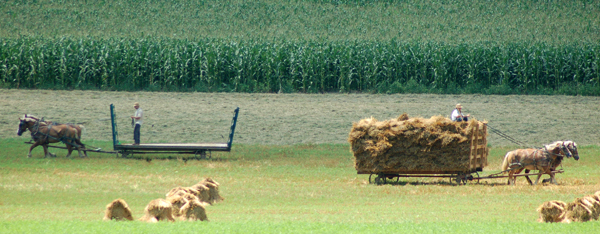
Coming and going by Bruce Stambaugh
Wagons come and go during the oats harvest in Holmes County, Ohio.

But given what I have observed and heard over the years, that’s not a problem either. The genial folks who live here will gladly offer some directional advice if asked.

Generally, the directions given answer the directions sought. But not always. Holmes County has its fair share of ornery characters.

Of course, I wouldn’t be one of them, though living where I do I certainly have had plenty of chances. While working outside, it is not uncommon for a car to slow on our busy highway and have either a passenger or the driver ask how to get to Berlin or Millersburg, or a specific business.

I try to be as succinct as possible, using landmarks and road numbers and the appropriate “turn right” or “turn left.” I like to end with what I have heard countless other locals finish their directional spiel. “Like we say in Holmes County, you can’t miss it.”

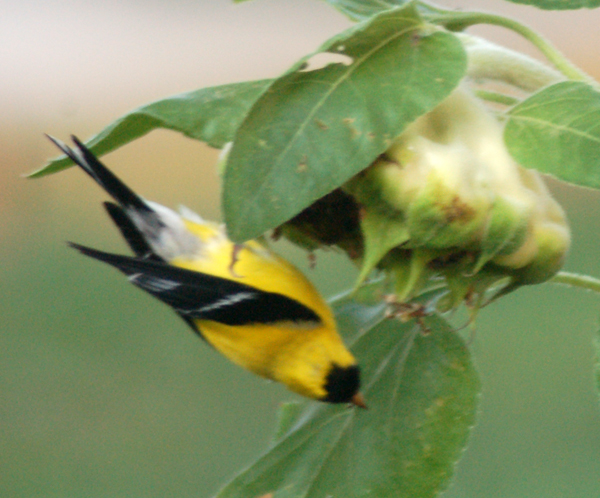
Goldfinch by Bruce Stambaugh
An American Goldfinch enjoys the fresh seeds of a volunteer sunflower. With its many habitats, birds are among the tourists who flock to Holmes County every year.

Meant as affable words of encouragement, too often I fear they are the deathblow to everything that preceded that comment. Since I never see the persons again, I can’t testify whether the colloquialism is true or not. But it could be worse, and sometimes is. The following antidotal incidents are completely true.

After a tourist inquired of a local where a certain person lived, the native immediately asked in all seriousness, “Do you know where the eight-sided barn used to be?” The point of reference had burned to the ground several years previous.

Here’s another. A tourist asked for directions to little unincorporated Saltillo, a cluster of homes at the diagonal crossroads of two county highways. These were the instructions. “You go up a long hill, over a small hump in the road, then it’s just a hop, skip and a jump from there.”

They get better. The state superintendent of public instruction, driving a state car with state license plates, stopped and asked for directions. Seeing the distinguished gentleman’s suit and tie and glancing at the plates, the unsuspecting superintendent got directions that took him far out of his way. Fortunately, he had a good sense of humor and understood the county’s suspicions towards state and federal officials.

A friend of mine was standing on the square in Millersburg when someone in a car going west asked directions to Berlin, five miles to the east. My friend sent them north to Wooster, east to Canton, south to Dover and west to Berlin, a distance of 96 miles.

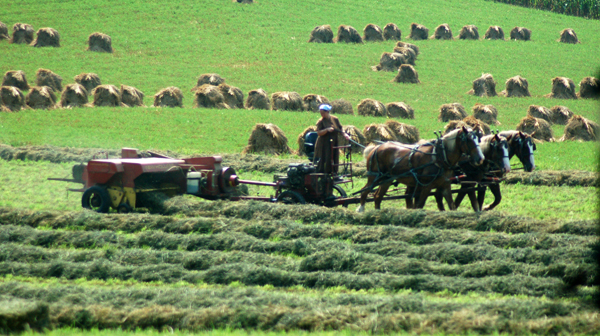
Baling hay by Bruce Stambaugh
Millions of tourist visit Holmes County's Amish country annually to see the Amish work in the fields.

The same friend was once asked for directions from Millersburg to Mohawk Dam in Coshocton County from someone from out of the area. The vehicle was pulling a fishing boat.

My friend figured someone was sending this poor fellow on a wild goose chase. Since the guy had driven this far, my friend figured he might as well complete the ruse. The proper directions were given and the man and his boat were on their way.

Mohawk Dam is a flood-control, dry dam. I’m sure they couldn’t have missed it.

August sunset by Bruce Stambaugh
A glowing August sunset in Holmes County's Amish country.

From every angle, August is golden

Golden sunset by Bruce Stambaugh
Hazy sunsets in Amish country are the norm in August.

By Bruce Stambaugh

These are what I call August’s golden days. If I only referenced orangey sunrises and the hazy, citrus sunsets, that moniker would apply.

August is so much more than lovely solar appearances and disappearances. It is always full of golden moments that make golden memories.

I realize my reflections are provincial. In a world full of disease, disaster, dismay and hostilities, not all would share my august perspectives. However, I cannot deny what I have observed and experienced in this transitional month in Amish country.

In calling August golden, I mean to take the broadest definition possible. Everywhere you turn, deep, rich yellows and golds appear. August is golden, too, in that it is good, providing success and satisfaction as the harvesting begins.

Mowing oats by Bruce Stambaugh
Mowing and stacking the oats into shocks is the first step in the harvesting process for the Amish.

August is usually a hot month in most of the northern hemisphere. Even the poor people in Moscow, Russia, where temperatures have seemed more like Dallas, Texas, have been especially suffering.

True to form, hot and humid have been the bywords in Ohio, too. Those who have had to work out in these blazing elements would argue for sizzling and sultry as better descriptors. But no matter how we describe the daily dog days of August, the benefits surely outweigh the negatives, no matter how muggy.

Coming and going by Bruce Stamabugh
One wagon heads to the barn while the other returns to the field to be loaded again.

My Amish neighbor’s circle of friends purposefully gathers the air-dried, ripened oat shocks wagonload after wagonload. Their water thermos got a workout, too. With their cooperative efforts, the impressive stand of honey-colored sheaves had disappeared by day’s end.

I always find it a miracle that once the sea of grain is cut and shocked, a carpet of bright green immediately replaces it. The hardy clover thrives all the more once it has the ground to itself.

There are other kinds of gold in August, too. The Incredible sweet corn arrives almost simultaneously with the transparent apples. It’s husking, cutting, cooking and freezing corn one day, making tartly sweet applesauce the next.

Ripe tomatoes by Bruce Stambaugh
Heirloom tomatoes ripen on the vine.

The growth of the heirloom tomato plants my wife and son planted in late May is so
prolific, the plant runners get tied daily. Their yellow, red and green-striped fruit add to the festivities.

House wren by Bruce Stambaugh
A house wren leaves the nest after feeding her brood.

The noisy tan house wrens worked frantically to satisfy their last brood of the summer. Their hungry youngsters consumed an amazing amount of worms, caterpillars and insects.

When the little ones began to greet their parents at the entrance to their birthplace, it’s nearly time for them to fly. In our case, the babies were there before church, but not when we got home. The grandsons and I found them learning to forage and hide in the brush pile under the pines near the hammock where other golden moments were made.

Monarch and swallowtail butterflies joined the goodness of the month as they enjoyed the nectar of the milkweed and wild and domestic flowers. Both the black and yellow-billed cuckoo birds announced their arrivals as the tent caterpillars hatched.

The much publicized but often under performing Perseid meteor showers still managed to send enough bright streaks though the new moon sky to extend the month’s goldenness 24/7.

Next week the full moon will strut its stuff, casting a golden glow across landscapes, rural and urban alike. Ready or not, summer vacation has yielded to elongated yellow buses and excited, golden voices of children beginning a new school year.

All things considered, August is a positively golden time of year.

Hammock fun by Bruce Stambaugh
Playing on a hammock in the cool shade serves as a diversion from the August heat and humidity.

Revitalization weekend at the cottage

By Bruce Stambaugh

It had been an unusually stressful week for me. You would think that in semi-retirement, stress wouldn’t even be in my vocabulary. But it is.

Without going into the sordid details, here is a sampling of the week’s chain of events that had sent me over the top by Friday’s end. My six-year old grandson got whacked in the face with a metal baseball bat. The next evening, his daddy severely injured his right knee rounding first base in a softball game.

Maren by Bruce Stambaugh
Our 10-month old granddaughter, Maren.

The following day our daughter reported that our 10-month old granddaughter’s first tooth finally had broken through. In and of itself, that was a good thing. However, Miss Maren was still pretty cranky, with other teeth ready to make their appearance.

Other nerve-racking events oozed into our normally quiet lives in Ohio’s Amish country, too. For confidential reasons, I won’t reveal the nasty details, other than to say one of the logjams required a plunger.

Clearly you can see that the weekend getaway to our cottage was just what the plumber needed. It was the necessary salve to my pent up emotional sores.

First of all, my wife and I feel fortunate to have the cottage my parents built in 1975. We purchased it from them a couple of years ago and finished it the way my mother had always envisioned it would be.

The cottage’s location alone has several advantages. Its rural hillside setting on the natural shoreline lake is the most obvious. Having good neighbors who own other nearby cabins is another.

The cottage by Bruce Stambaugh
Our cottage retreat in southeast Ohio.

But the cottage makes for an ideal sanctuary for other reasons. We have no landline. Cell phone reception is marginal at best. There is no television, no email, no Internet. Other than electricity, the cottage is the epitome of electronic reclusiveness.

Right after we arrived Saturday morning, we went to work cleaning up inside and out. Though the cottage was locked up tight and unused for a couple of weeks, insects not surprisingly managed to make themselves at home. My wife soon took care of that.

Meanwhile, I donned gloves and pruners and attacked the weeds with a mission. That’s no easy task on a steep slope that falls away quickly to the graveled lane below. But just being out in the fresh air was invigorating, and the exercise personally beneficial.

The real blessings came at the marvelous supper my wife prepared. We ate the tasty meal on the open-air deck.

For dessert, we simply sat on the porch and watched and listened. Cicadas intermittently sang their monotonous song. Colorful butterflies enjoyed the sweet fragrance of various wildflower blossoms.

Butterfly by Bruce Stambaugh
A tiger swallowtail butterfly enjoyed a variety of wildflowers.

A Carolina wren serenaded us with its luscious calls. Chickadees and tufted titmice played and fed in the surrounding mixed hardwoods. Cardinals sounded their evening songs. A great blue heron grunted from water’s edge, hidden by the forest curtain.

A gentle breeze rustled the nervous leaves of a quaking aspen. Human induced sounds intruded, too. We have accepted the fact that lawnmowers, weed eaters, shouting children, dogs barking in the distance are all part of the cottage life at times.

Altogether this harmonic mishmash of sights and sounds must have worked its magic. I slept 11 hours that night.

With those revitalizing results, we should embrace the cottage’s graciousness more often.

Confronting life’s unpredictable perils

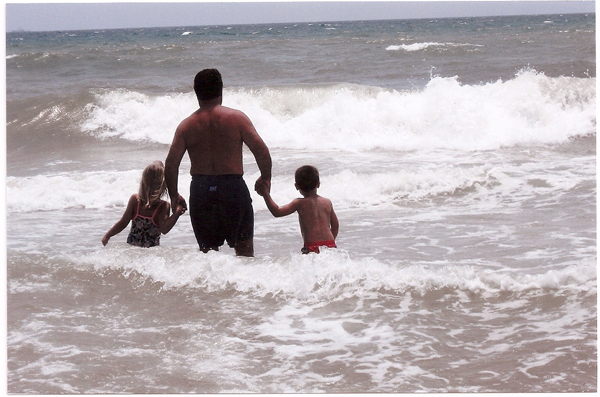
wading in surf by Anna Bishop
Wading in the North Carolina surf. (Photo by Anna Bishop)

By Bruce Stambaugh

Within hours of one another, I received three divergent yet emotional messages about grandchildren.

The first came after I had changed my profile picture on Facebook to a shot of my middle grandchild celebrating his fourth birthday. The picture showed Davis heartily laughing in front of his makeshift birthday cake.

The four candles signifying his age burned as bright as his smile. The candles were securely stuck in a row in the thick, chocolate frosting of a cream stick that Nana and I had bought at a local Amish bakery before leaving Ohio.

Davis' fourth birthday by Bruce Stambaugh
A cream stick for a birthday cake.

It was a fun time, with the family finally gathered for his birthday. It was the first one we had celebrated with Davis. Texas was just too hot and we always seemed to be extra-busy in the middle of July.

But now that Davis and his family had moved to Virginia, we made sure we were there with and for him. The message about all this was from his mother, my daughter, asking for the pictures from the party. I had yet to share them with her. She loved the shot and wanted to see the rest.

When I checked my Facebook page in the morning, I found a disturbing and extremely sad posting by the son of a friend of mine. His sister’s newborn daughter had died right after birth.

I shared the sad news with my wife. We are close friends with the expectant grandparents. This baby would have been their first grandchild, one they had so longed for and had happily anticipated.

Now all expectation of playful days ahead had been dashed. I couldn’t imagine how devastated they must feel. I felt guilty for having three healthy grandchildren.

Their daughter lived in Indiana and I knew they would be with her. What could I do to offer my deepest sympathies, to reach out to them in their time of need?

While I struggled with this dilemma, I received an email containing the weekly column of a friend and writing peer in Virginia. He had written about his vacation with his grandchildren and included a picture of him wading in the ocean, a towheaded granddaughter tugging on one arm, a brown-haired grandson on the other as the foamy surf broke upon them.

It was clear that both grandchildren hung on to their grandfather in trust and love as the soft, warm waves crashed against them. I was happy for him, sad for my other friends, and conflicted about being able to reconcile these seemingly disconnected incidents.

Grandparents are supposed to be wise and loving and adored. My friend’s picture clearly revealed those dynamics. But we also know that there are times when life simply isn’t fair and there is absolutely nothing we can do about it.

I hope and pray that my three grandchildren will grow and prosper and live lives of service to humanity. I am deeply distraught that my friends Bruce and Helen cannot now say the same thing for their granddaughter.

I am sure many of their friends will reach out to this fine couple in their grief. When I get the chance, though, I will pretend we are at the shore, standing knee-deep in the churning surf, readying for life’s perilous waves to come crashing against us, Helen clasping one arm, Bruce the other, trusting and loving.

At this mournful moment, that is all I can offer.
Seaside sunrise by Bruce Stambaugh

In appreciation of Mother Earth

Oat shocks by Bruce Stambaugh
Oat shocks near Mt. Hope, Ohio.

By Bruce Stambaugh

The deep orange crescent moon sat just above the tree line on the dusky horizon. Fanned out high over its tip, Saturn, Mars and Venus sparkled in the late evening sky.

Lightening flashed suddenly and silently interrupting the cloudless scene. Radar indicated the thunderstorm 120 miles southeast near Parkersburg, West Virginia.

The next morning, this natural display of awe and beauty was enthusiastically discussed among those who know the value of such a free show. They were gathered in the shade of a vendor’s tent at the annual Family Farm Field Day event.
Storm approaches by Bruce Stambaugh
A severe thunderstorm near Mt. Hope, Ohio.

It was more than appropriate and not the least bit ironic that such talk should take place at an educational affair celebrating the goodness of the land. These were people who knew the importance of Mother Earth, who knew how to care for her, appreciate her, and affirm her, even profit from her without rendering her useless or sterile.

The venue was as uplifting as the conversation about the storm. Hundreds of black buggies stood side by side against the woods, their unhitched horses now shaded.

Buggies at a hitching rail in Mt. Hope, Ohio
Buggies lined up at a hitching rail in Mt. Hope, Ohio.

Cars, vans and pickup trucks entered at the east gate. Along the drive, dozens of bicycles leaned against chain link fencing that separated yards from right of way and kept children from wandering into the long, graveled lane.

In between these contrasting parking lots, thousands of people milled beneath several large tents searching for information on how to better care for the earth. The slight bluff on which the action took place created a symbolic subliminal significance of man and land over that of man and mobility.

Though most were dressed in homemade denim with suspenders or pastel dresses with coverings and spoke a language I should have learned long ago, I was both at home and in harmony with them. We were all there for the same reason, to learn more about caring for and nurturing the land that provides us sustenance and shelter.

Jr. Burkholder farm by Bruce Stambaugh
A farmstead in Holmes County, Ohio.

Besides the vendors’ displays, tents for keynote speakers, farmsteads and homemakers were erected in a huge horseshoe pattern around the pastured plateau. Of course, there were food tents, too. I couldn’t decide which I liked best, the sugar and cinnamon hot soft pretzel or the salty sweet kettle corn.

With the hot summer sun beating down, shade was at a premium for those seeking relief. That did not deter them from exploring the inescapable interconnection between humankind and our responsibility of caring for the environment.

To be sure, that is serious business. But it was nice to see it presented in such fun and informative ways for multiple generations. To the point, bird, butterfly and nature walks were filled to overflowing.

A billowing cloud by Bruce Stambaugh
A storm cloud builds.

But what was really special for me was the dialogue on the previous night’s celestial display. Some of us saw what is erroneously called “heat lightening.”

From the backside of the storm, which is always the safest and prettiest angle, others
saw huge, billowing columns sail through the darkening sky. The higher they rose, the more the lightening sizzled in and out of them, brightly illuminating the swelling clouds.

One in the group had actually been under the building storm and arrived home in time to also watch the stunning electrical display. To hear that enthusiasm, plus see the genuine, cross-generational interest in caring for the ecosystem by so many people stirred my soul.

I left thoroughly uplifted, and with one large bag of kettle corn to go.

How social networking works

By Bruce Stambaugh

A siren woke me from my deep sleep. Even though I didn’t see it, the quickened rumble told me it was a fire truck.

I arose, and soon a second fire truck went by heading south, lights flashing in the dense morning fog. Several minutes later, a third fire truck from a station 12 miles away roared by. It was obvious there was a big fire somewhere.

Of course, I was curious about the location of the blaze. My curiosity was soon cured. My wife announced that our daughter in Virginia had emailed to ask what we knew about the fire at Martins Creek Mennonite Church.

I was stunned. I asked how Carrie knew about the fire. “She saw it on Kim Kellogg’s Facebook page” came the swift answer.

Since Kim is a mutual friend, both in real life and on Facebook, I immediately went to my Facebook page, clicked on Kim’s posting, and sure enough, there were pictures of the old church burning and the firefighters working diligently to extinguish the flames.

The scene saddened me. I could see that the blaze was serious, and I knew that the historic structure was a tinderbox.

I kept up with the progress of the fire by following Kim’s postings. I was glad our daughter had let us know. I was appreciative of Kim’s timely updates. It had to be hard on him. It was his church.

But I also had to simultaneously absorb the bang-bang way in which we had found out about the blaze. Our daughter, 350 miles away, had notified us electronically of a fire less than three miles from our house.

An ironic pall clouded my thoughts. It wasn’t that it was wrong. But there was a certain ambivalence to the entire process. It felt like the same uncertainty that had kept me from originally joining the social network craze.

What I was experiencing was one of the new ways to communicate in today’s technologically driven world. I had long resisted enrolling in any of the online social networks like Facebook or MySpace. I thought they were mainly for young people. I don’t text either.

I also thought they would be too intrusive into my life, would reveal too much information that would and could be used by unscrupulous schemers. Neither did I see the sense in it. After all, all one had to do was pick up the phone and call, or email, or even write a letter, or better yet, come over and visit.

What made me change my mind? Why my sociable daughter of course. Once I realized that I was missing postings of the latest happenings with her and her family, I decided to open my own Facebook account so I could keep up with the grandkids.

I soon learned that I wasn’t the only old person on Facebook. And when friends, relatives and former students from long past began to connect with me, I felt better about the whole idea of sharing on the Internet. I still try to be both careful and practical with what I post for others to read and view.

That morning’s emotional events still seem surreal. Our daughter in Virginia knew about the fire close to us before we did. But therein lies the justification for social networking. It’s just another method for staying in touch.

Even in catastrophes like fires, social networking can instantaneously bring geographically separated people together. When used properly, that is a very good thing.

Retreating to Lakeside again and again

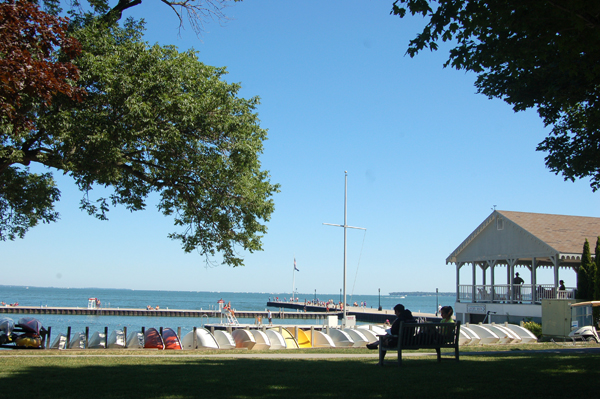
Lakeside view by Bruce Stambaugh
The view of the dock and Lake Erie from Hotel Lakeside's front lawn. Kelley's Island is in the distance.

By Bruce Stambaugh

There are lots of places I would love to visit in the world. But every Fourth of July, you can find me with my wife at Lakeside, Ohio.

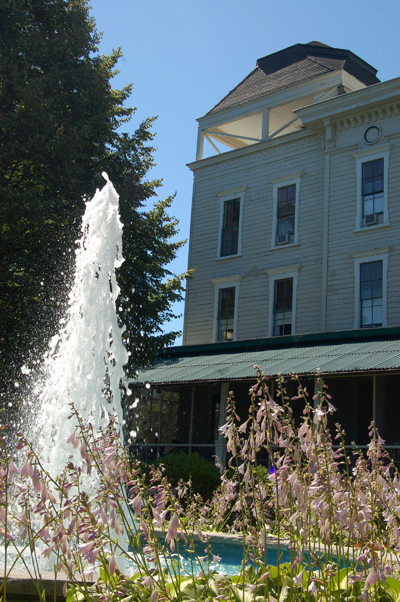
Fountain in front of Hotel Lakeside by Bruce Stambaugh
Wind blew the fountain's water in front of Hotel Lakeside.

Why do we keep going back? I’ll be a typical man and answer that question with another question. How can we not return?

We find the summer resort a respite from our busy schedule. A random survey of Lakesiders would likely reflect that common answer.

You could argue that respite can be found in plenty of other locales, too. But there is only one Lakeside, and the best way to appreciate it is to visit there.

The quaint town on the shores of Lake Erie mushrooms from 600 year-round residents to 3,000 summer vacationers. Gate fees are required from mid-June through Labor Day weekend.

I could list 100 reasons why we savor Lakeside each summer. But I’ll pare it down to a pertinent few pleasures we experienced during our latest stay.

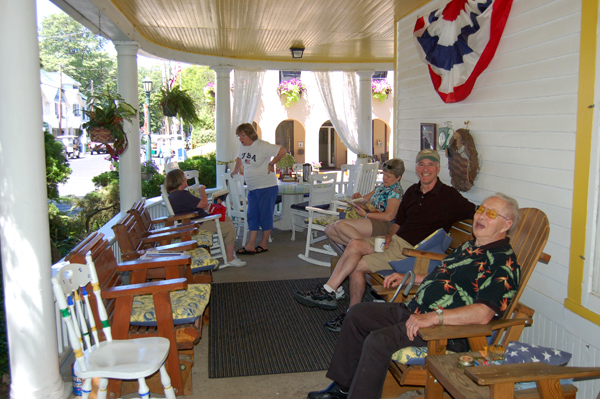
Friends gather on the porch by Bruce Stambaugh
The porch at Maxwell's Hospitality House in Lakeside, Ohio is an inviting, relaxing place.

First and foremost has to be the renewal of relationships with friends, some who we only see at Lakeside. Of course, we stay in touch via email or phone. But we only see most fellow Lakesiders while we are actually at the Chautauqua on Lake Erie

We enjoy where we stay, and we always board at the same hospitality house. We like our hosts and their guests, most of who return the same week annually. We have a lot in common, share food, stories and values.

The Patio Restaurant at Lakeside OH by Bruce Stambaugh
The signs said it all.

We cherish the familiarity and ambiance that Lakeside affords. Doughnuts at The Patio Restaurant, ice cream from Coffee and Cream and pizza from Sloopy’s are all part of the Lakeside experience if we so choose

But we value the special surprises that always seem to plop in our laps. We run into friends from home or people we know that we had no idea even knew about Lakeside. It’s always fun to reconnect and discover how each found the resort town.

P.A. Dunfee of Lakeside, Ohio piloted his 1968 restored Lyman. by Bruce Stambaugh
P.A. Dunfee, Lakeside, Ohio, piloted his restored 1968 Lyman boat.

This year we had an extra special treat. A resident of Lakeside that we got to know through our hosts at Maxwell’s Hospitality House invited my wife and I for a ride on his restored 1968 Lyman inboard motorboat.

With the temperatures and humidity at the wilting stage, we leaped at the opportunity. The wooden boat, originally built in nearby Sandusky, glided through the slightly wavy water with ease. We cruised past Lakeside just beyond the dock.

Lakeside cottages by Bruce Stambaugh
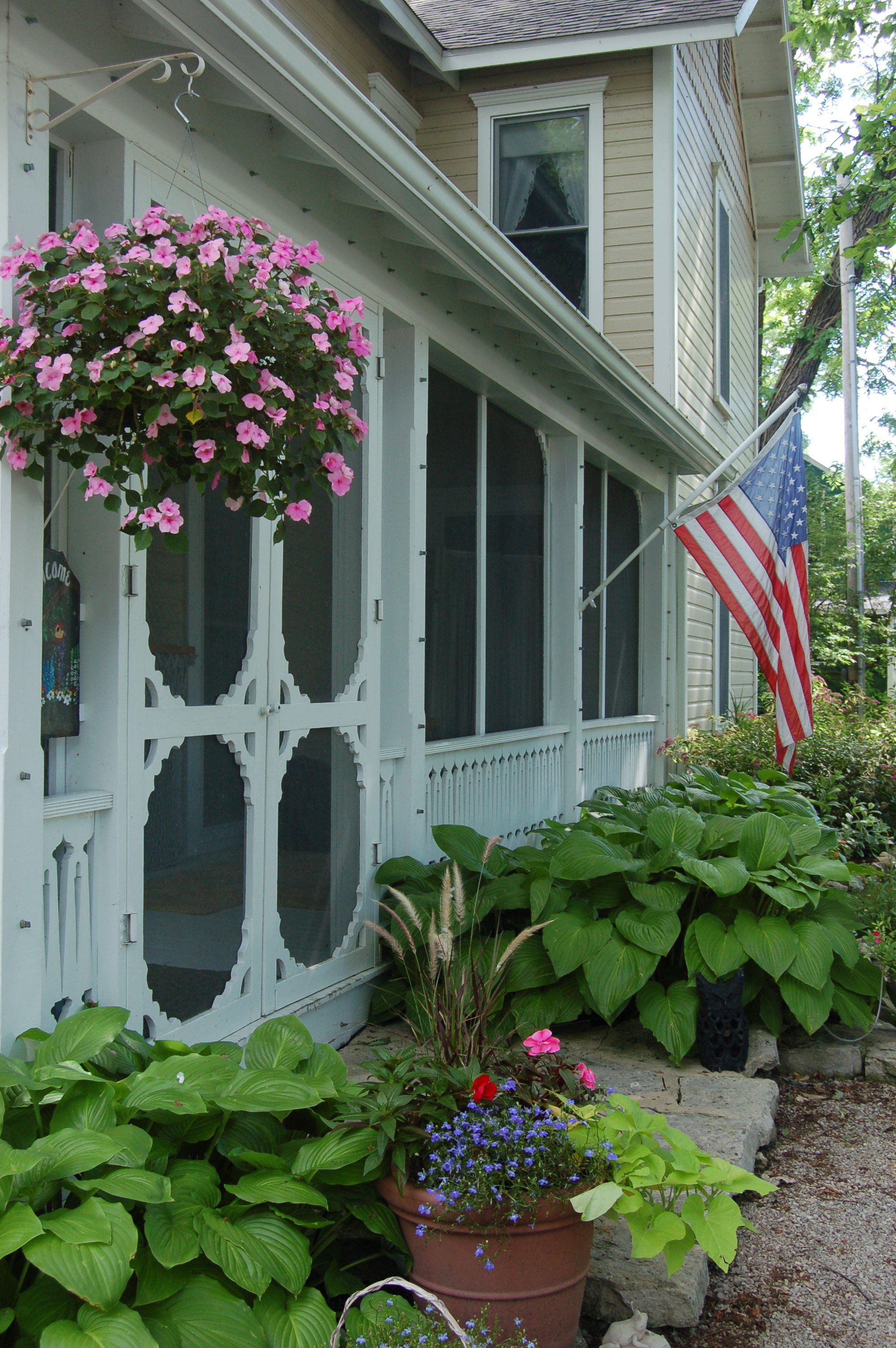
Steamboat style cottages, typical of some of the older homes in Lakeside, Ohio, were decorated for the Fourth of July.

During out week’s stay, we also took in some of the evening entertainment that comes with the price of admission. Workshops, museums, tours and worship are also available for children through adults

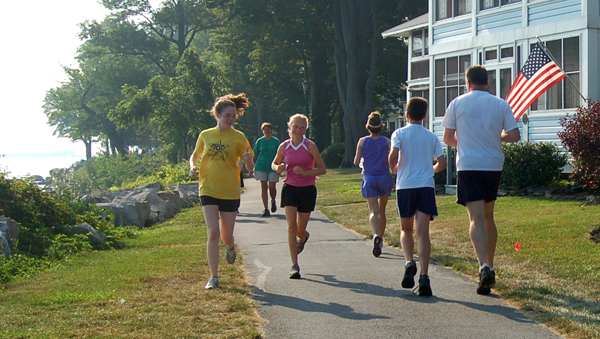
Running at Lakeside by Bruce Stambaugh
The path along Lake Erie in Lakeside, Ohio is a popular place for exercise or just strolling.

Each morning I stretched my legs by walking the two-mile parameter of the lovely village. Walkers, runners, bikers and dog-walkers alike bid each other a friendly Lakeside hello or a nod

Besides the exercise and human interaction, I got to absorb beautiful gardens, charming restored cottages from Lakeside’s beginning in 1873, watch night hawks glide, stroll along where old trolley tracks once ran and glimpse tennis matches on both asphalt and clay courts.

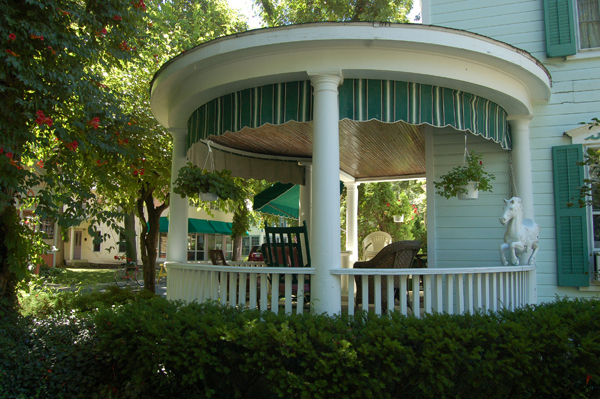
Round porch at Lakeside, Ohio by Bruce Stambaugh
Inviting round porches can be found attached to many homes in Lakeside, Ohio.

I enjoyed a personal Lakeside moment, too. I found a lakeside bench under the generous shade from the large stand of old growth trees and watched the ferries shuttle between Marblehead and Kelley’s Island.

In that Norman Rockwell setting, time seemed to simply stand still. That alone is reason enough to treasure our annual Lakeside vacation.

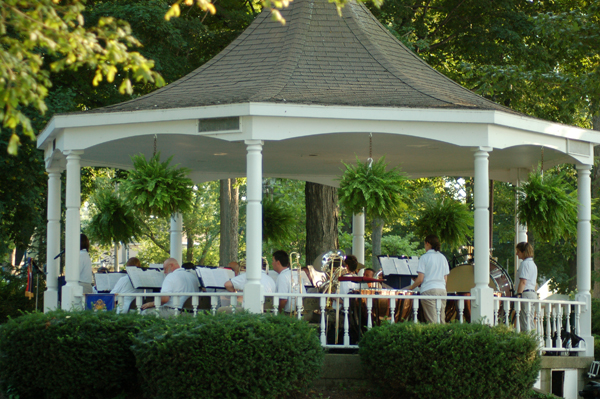
Concert in the park by Bruce Stambaugh
Concerts in the park are always popular at Lakeside, Ohio.

That’s what friends are for

By Bruce Stambaugh

The sky was clear blue, the morning’s puffy cumulous clouds having moved on. The north wind discouraged any humidity, and helped keep the temperatures tolerable.

Earlier my Amish neighbor had tethered the hay he had mown the evening before, fluffing it up for the breeze to blow away any remnant moisture. The barn swallows that had circled his horse drawn machine still skimmed the ocean of cut hay for insects.

I imagined the next day my neighbor, his family and his circle of friends would follow their given routine of making hay. I have marveled at their consistency each and every harvest of hay, oats and wheat. Their combined labor is as affable as it is proficient.

But isn’t that what friends are for? Like the classic Dionne Warwick/Stevie Wonder song belted out, “For good times, for bad times, I’ll be on your side forever more, that’s what friends are for.”

That pretty well sums it up. Friends want the best for you no matter what. They sympathize with you, empathize with you, are honest with you and you them. That friendly formula leads to trust, understanding and compassion.

As humans, we all need that. We are social beings, and unless you are Ted Kaczynski or Lizzie Borden, friends mean the world to you.

Sitting on the porch alone, I had to think about my circle of friends. I was humbled and honored to recall how many times others had come to my rescue or reassured me or celebrated with me or mourned with me or just took time for a visit.

These may seem like ordinary occurrences. But to me, they are extraordinary events, given that they all involved friends.

Food seems to be an important ingredient in friendship. We have enjoyed many a meal around a table with friends, meaning family, neighbors and acquaintances. No matter how tasty the entrées, the fellowship is always the dessert.

A home in Lakeside, OH by Bruce Stambaugh
A home in Lakeside, Ohio. - Bruce Stambaugh

Years ago when we moved from the home we built in the western part of the county to our current home in the east end, friends clamored to help us. Thanks to them, the difficult task was made simple.

Each time we visit our beloved Lakeside, Ohio we are greeted with hugs and kisses from people we may only see there. They are our vacation friends, but from the reactions you would never know it.

When I pushed my grandsons on side-by-side swings so high they bounced out of their seats, they giggled and laughed like little girls. The bright sun wasn’t the only thing warming me that morning.

Reading the blog by the parents of a special newborn child helped me better understand their critical situation. I marveled at how calm and objective their writings were, especially given their uncertain situation.

A birder friend called to tell me about a very rare bird in the neighborhood. Without his kind gesture, I would have missed the Vermilion Flycatcher.

Butterfy on cornflower by Bruce Stambaugh
A butterfly enjoyed the wildflowers in our backyard. - Bruce Stambaugh

Which reminds me that friends are not confined to human beings either. Pets, sunsets, thousands of blinking fireflies rising from the flowering alfalfa and ripening oats, robins chirping their contentment with the day all qualify as friends by my definition.

All these people and creatures and natural events have abundantly blessed me. Isn’t that what friends are for?

Holmes County sunset by Bruce Stambaugh
A recent sunset taken from our back porch. - Bruce Stambaugh

A change of venue for the grandkids

By Bruce Stambaugh

When our daughter told us that her husband had accepted a new job in Harrisonburg, Virginia, we were ecstatic. Although we enjoyed our visits to Texas with our family and their neighbors and friends, we found the flights from Ohio tedious.

With the move to Virginia, our grandchildren would be a quick six-hour drive away. I mean quick in the most liberal sense.

We enjoyed flying but to fly three hours to Texas without a direct flight really consumed an entire day. Add together the drive time to the airport, check-in, security navigations, waiting at the gates, and flight connections and a good day was gone.

Driving to Virginia would be a whole lot easier. To be sure, we knew the route by heart. We drove it often to visit our daughter in college in Harrisonburg. She had met our son-in-law at Eastern Mennonite University, and they had lived and worked in the city for a couple of years after their graduation and marriage. Now he works for the school.

There were multiple ways for us to get to Harrisonburg, an expanding city in Virginia’s beautiful Shenandoah Valley. As long as the weather was good, our favorite route was also the most demanding, climbing and descending eight mountain passes. It was a scenic, curvy drive.

Last week, we made our first trip to Harrisonburg in a decade. Our daughter and her family had moved from Texas, but settling in with three youngsters and a husband who works full-time isn’t the easiest thing to do.

Our excuse was to help our daughter and her husband unpack and to get organized in their Virginia home. Our motive was to see the grandkids. The ever-thoughtful Nana packed up containers of frozen sweet corn and applesauce and we headed southeast.

It was fun to travel again through familiar towns like Elkins, Harman, Franklin and Seneca Rocks, all in West Virginia. Not surprisingly, little had changed in those 10 years. But once we hit the mountains, the road seemed windier than I had remembered, even though it was clear some of the curves had been softened and widened.

I would have gladly crossed 18 mountain passes for the chance to see our two grandsons and granddaughter again. I last saw them in Texas at the end of February.

I was amazed at how much they had matured, if indeed you can say a six-year old, a four-year old and a nine-month old mature. But there were definite differences. The two boys, Evan and Davis, played together well, yet were equally content to play independently, too.

Evan surprised me with how well he could read, even though he had just finished kindergarten. Davis, too, showed his inquisitive prowess with delving questions. When we weren’t watching the World Cup on television, we played soccer on their expansive wooden deck.

Maren cuddled right up to me. She seemed more intrigued with my beard than my conversation, however. When the discussion went sour, Nana was the designated diaper changer.

Maren is crawling, curious and exercising her best operatic voice, although not always in harmony with her energetic brothers. She is one adorable little girl, and has saucers for eyes that match the same Paul Newman blueness of her brothers.

Our stay was much too short. You can be sure that now that they are only hours away, there will be many more visits to come. After all, we have the drive down pat.

Bay Photos by Donna

Wildlife photos from the Chesapeake Bay region

ROAD TO NARA

Culture and Communities at the Heart Of India

K Hertzler Art

Artist and nature journalist in the Shenandoah Valley of Virginia.

Maria Vincent Robinson

Photographer Of Life and moments

Gabriele Romano

Personal Blog

Jennifer Murch

Art is the only way to run away without leaving home. -Twyla Tharp

Roadkill Crossing

Writing generated from the rural life

ANJOLI ROY

writer. teacher. podcast cohost.

Casa Alterna

El amor cruza fronteras / Love crosses borders