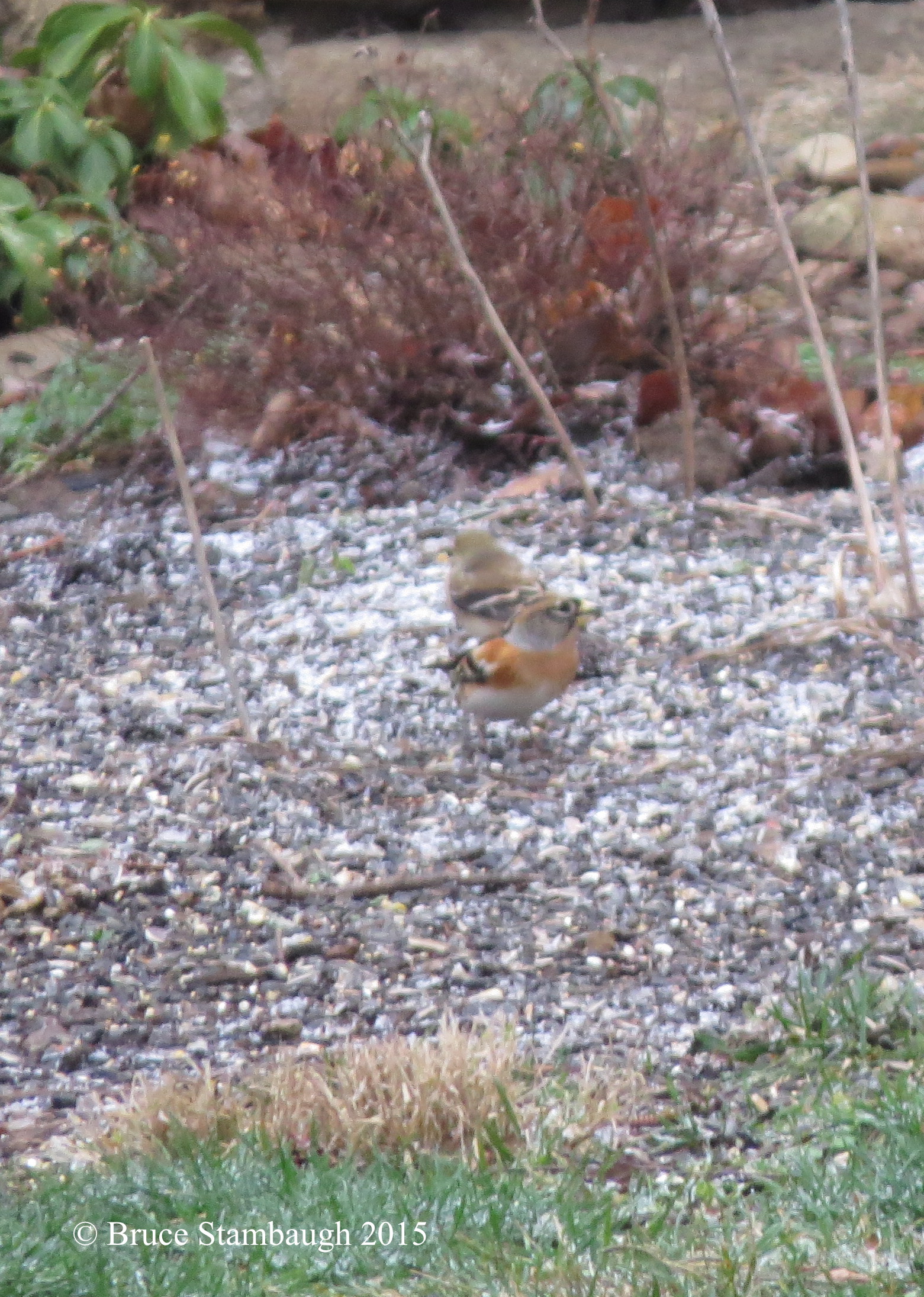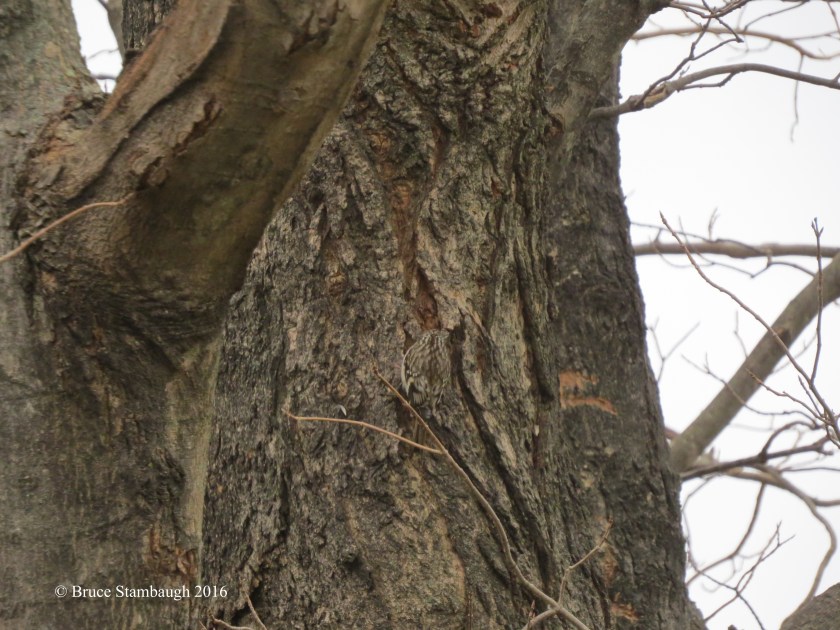
I’m always pleased when I discover a bird that I have never seen in my yard before. I was photographing some woodpeckers when I noticed a little bird darting around the trunk of the large sugar maple tree in the backyard. Not only did this bird move fast, it blended in perfectly with the bark of the tree.
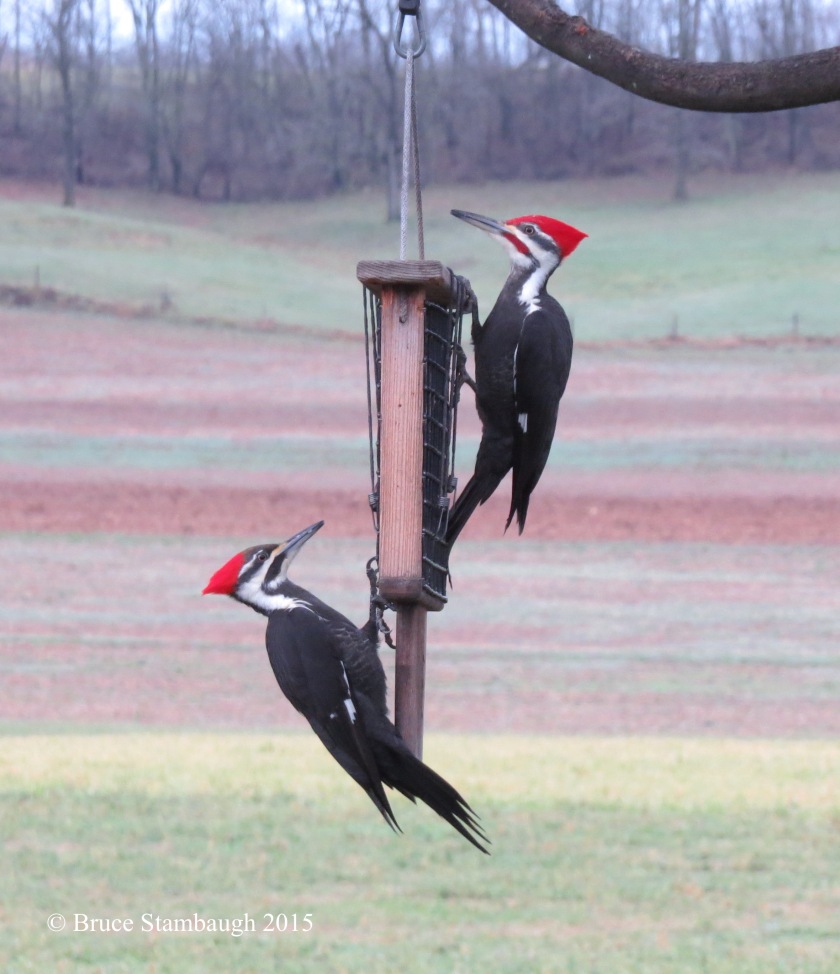
Just before Christmas, this amazing couple made a joint appearance at my peanut butter suet feeder in the backyard. I felt extremely fortunate. Pileated Woodpeckers, Ohio’s largest woodpecker species, usually don’t frequent close to buildings. Apparently, the grove of trees that line the western boundary of our property provide enough protection for this pair of Pileated Woodpeckers that frequent the suet feeder. Seldom, however, do they feed together. The female is on the left, the male on the right. Can you make the distinction?
Fortunately, the Pileateds usually announce their arrival with a loud call meant to discourage other birds away from the feeder. That also allows me to grab my camera and be ready for just the perfect picture.
More often than not, Carolina Wrens are heard rather than seen. One recent sunny morning, however, I found this Carolina Wren taking a dip in the backyard birdbath. After its morning bath, the wren flew to the feeder hanging on the back porch. It stayed there for several minutes, satisfied to let the sun dry its earth-tone feathers.
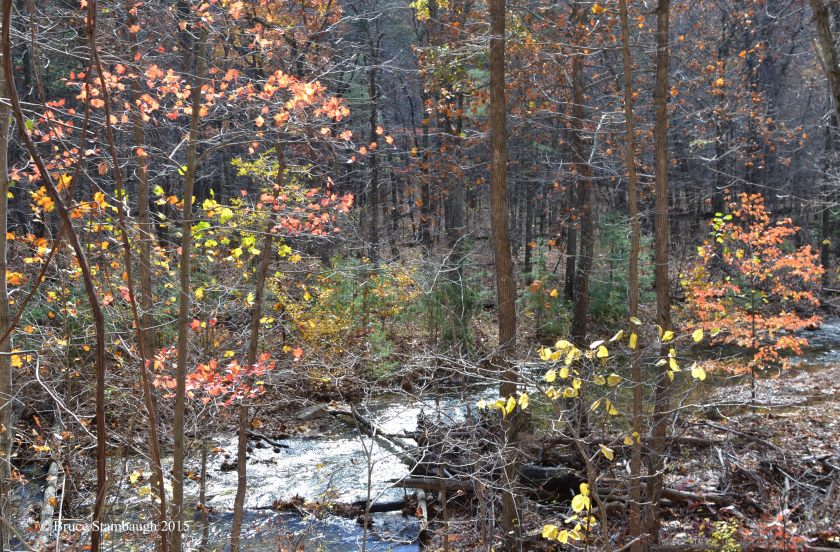
Recent rains made the sparkling mountain stream joyfully sing its way through the sylvan hollow to the broad valley below. The late morning sun’s reflection shimmered as the cold water rushed over and around ancient boulders.
I had driven to this little paradise on the advice of my daughter. She recently had hiked with her family a trail that crossed the creek and scaled one of the precipices of the old, rounded Blue Ridge Mountains. I wasn’t that ambitious.
I was content to drive the 22 miles out of Virginia’s Shenandoah Valley to the end of Port Republic Road to enjoy a morning stroll. I took the much easier firebreak road that shadows the meandering stream.
Stepping stones across the usually placid braided stream broke the trail my daughter took. Today the stream roared rather than lapped its way into the valley.
The native brown trout had to be happy to play in other pools for once. I was happy, too.
This slideshow requires JavaScript.
The temperatures warmed as the sun rose higher above the foothills. The shedding oaks, maples, dogwoods, sycamores and quaking aspens filtered the sun’s splay. Sunrays backlit the remaining colorful leaves. They glowed against the drab earth tones of tree trunks, ferns, and long shadows.
The creek drew me down from the road to its shallow banks. Sapling undergrowth made the way tricky, but not hazardous. I was surprised by both the speed of the stream’s flow and the water’s clearness, especially after recent steady rains. Weeds and reeds normally rustled by the wind swayed submerged.
In the shade, the cooler creekside temperatures chilled me. I didn’t linger there for long.
I returned to the more inviting sunny, well-maintained service road. At times, the stream ran against the narrow berm. In other places, the road curved slightly north while the creek twisted south and out of sight, but never out of earshot.
No car horns, no train rumbles, no jake brakes, no jetliner noise overhead, no boom boxes interfered with the numerous natural sounds. A fox squirrel skittered from the road to the safety of a tree trunk as I approached. It barked at me, and I shot it with my camera.
Click on the photos to enlarge them.
Autumn’s colors.
Talus slope.
Curving creek.
Tree tunnel.
Elder hikers.
Through the trees.
Peaceful pool.
Ripples.
Long view.
Lone hiker.
Up ahead, birds flew across the firebreak. To keep my load light, I had left the binoculars in the vehicle. Fortunately, the birds sat still even as I quietly approached.
I smiled at sighting my first of the year Dark-eyed Juncos, freshly arrived from the Canadian tundra. The flash of their outer white tail feathers against their slate-colored revealed their identity.
The mountain’s granite core stood exposed from time to time. Whitish-gray outcroppings reflected the morning sun both at manmade cuts and in natural talus slopes. I wouldn’t want to be anywhere near the latter if the massive rock pile decided to slide.
Soon hikers a decade older than me approached from the opposite direction. We bid each other adieu, and I asked them how far the road reached.
“Ten miles,” they said, “But it’s an easy walk to the top,” referencing the mountain. The road ended at the Skyline Drive. I took their word for it.
A few trails flared off in either direction. I was content to stay the course for a while before returning to the car for lunch under the noonday sun.
The earthy fragrances, the laughing stream, the vibrant colors pleasantly seasoned my simple fare, which was only right. It had been a sumptuous morning in every aspect.
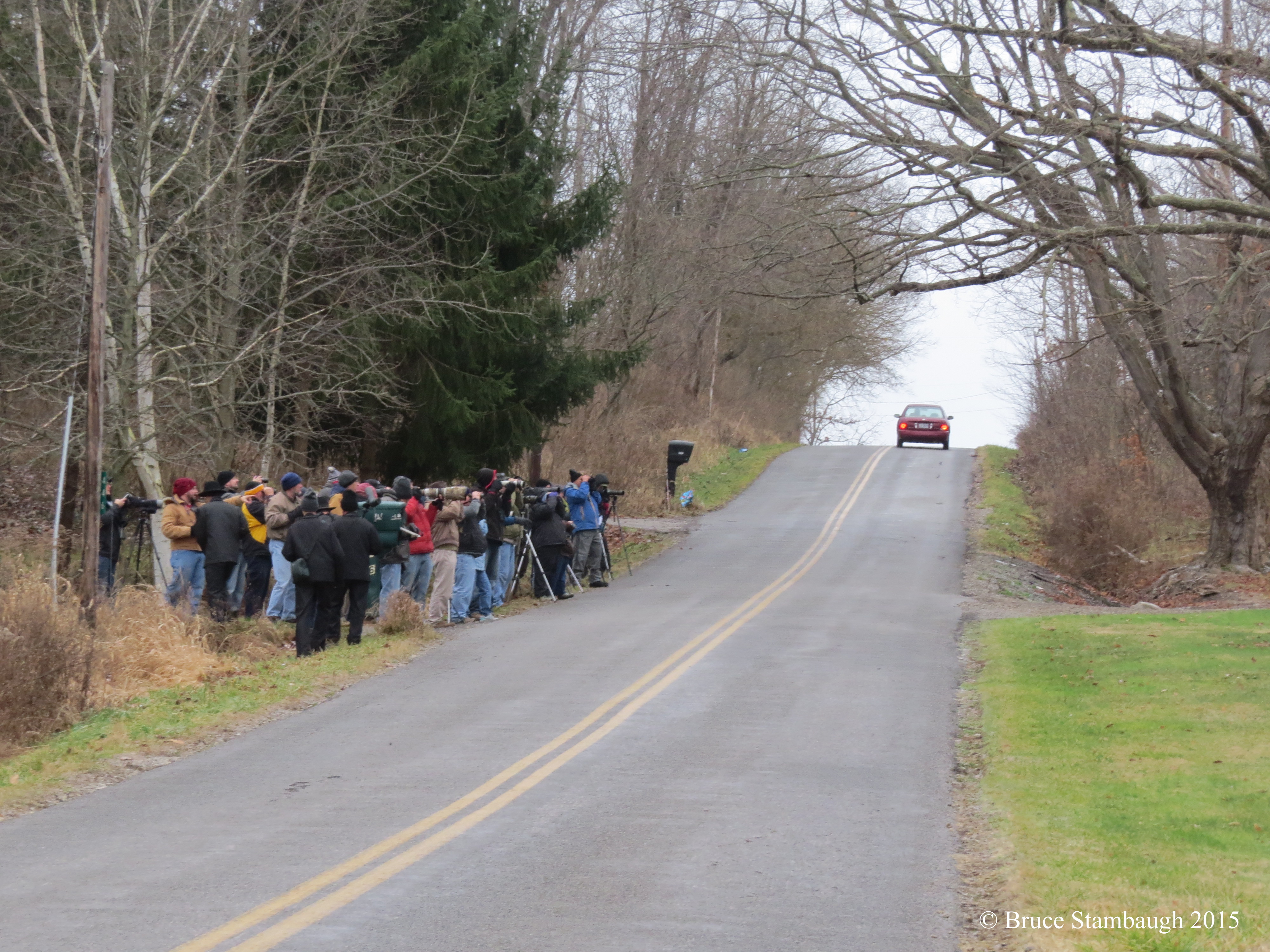
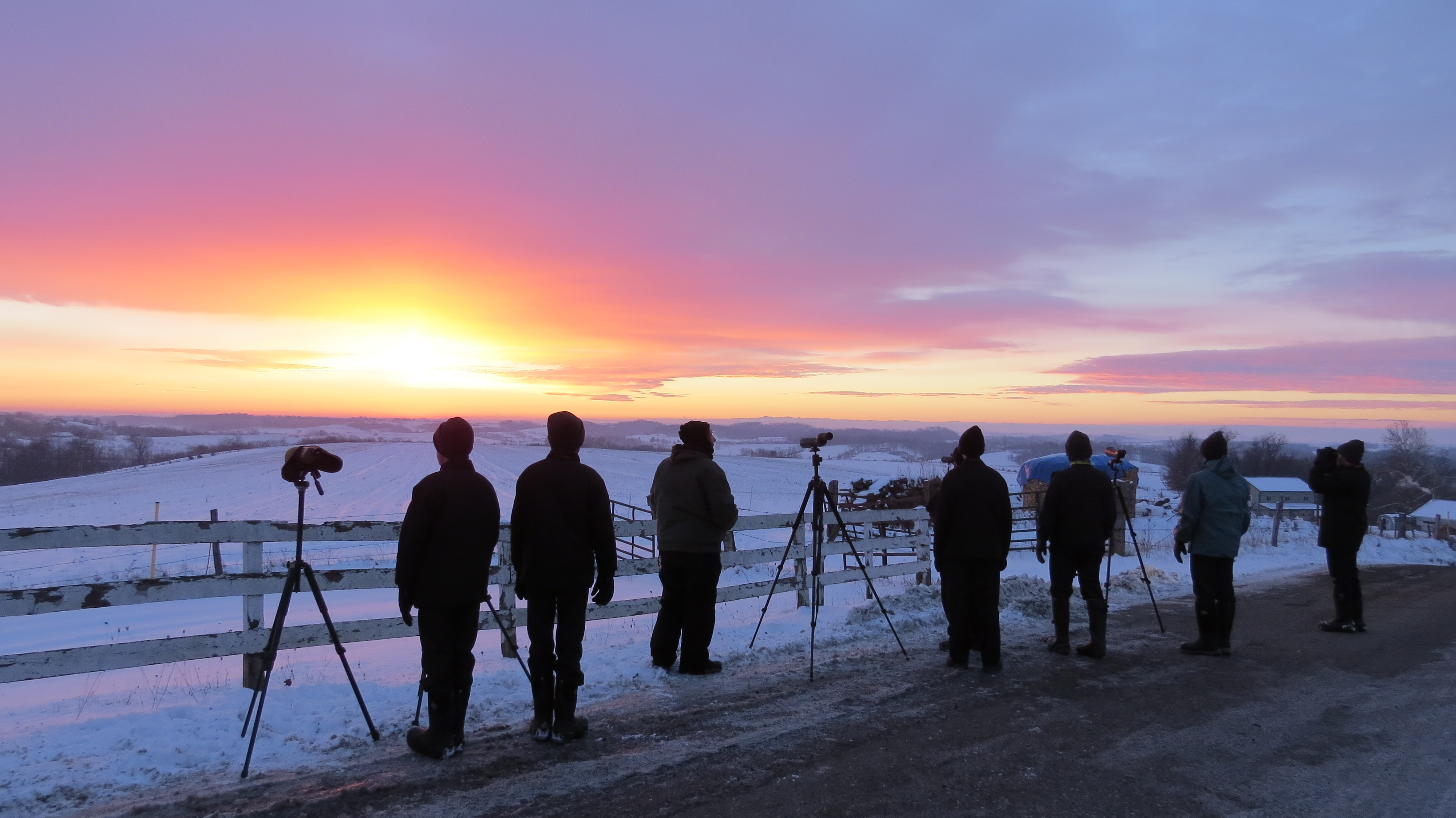
A beautiful sunrise greeted these birders in search of a Snowy Owl.
By Bruce Stambaugh
Birding is one of my many hobbies. I’m no expert birder to be sure. I merely enjoy the sport, and try to weave birding into every travel opportunity.
Birding is an activity enjoyed by folks of all races, religions, cultures and countries. I’m usually side-by-side with men, women, boys and girls wherever I bird.
When these good folks discover I’m from Holmes County, Ohio, I often am asked the same question. Why do you have so many rare birds there?
I smile, pause, and give them my standard answer.
“It’s not that we have any more rare birds than other places,” I say. “Rather, we just happen to have a lot more rare birders.”
That’s when I get the looks. Some vocalize their consternation. The nonverbal cues from others reveal their puzzlement. Still others get it right away.
I believe that the Holmes County, Ohio area has so many unusual bird sightings because it has so many outstanding birders. Many of them are teenagers or young adults.
Attractive habitat.
The varied habitat of the Killbuck Valley and adjoining manicured farmlands east and west create familiar, safe harbor for a wide variety of birds. Marshes, ponds, brushy fencerows, and extensive stands of woodlots provide excellent cover and feeding grounds for birds big and small.
Birders who reside here know to keep a look out for anything extraordinary. If they see or hear something unusual, they tell someone. An authoritative local birder identifies the bird, and the word spreads near and far.
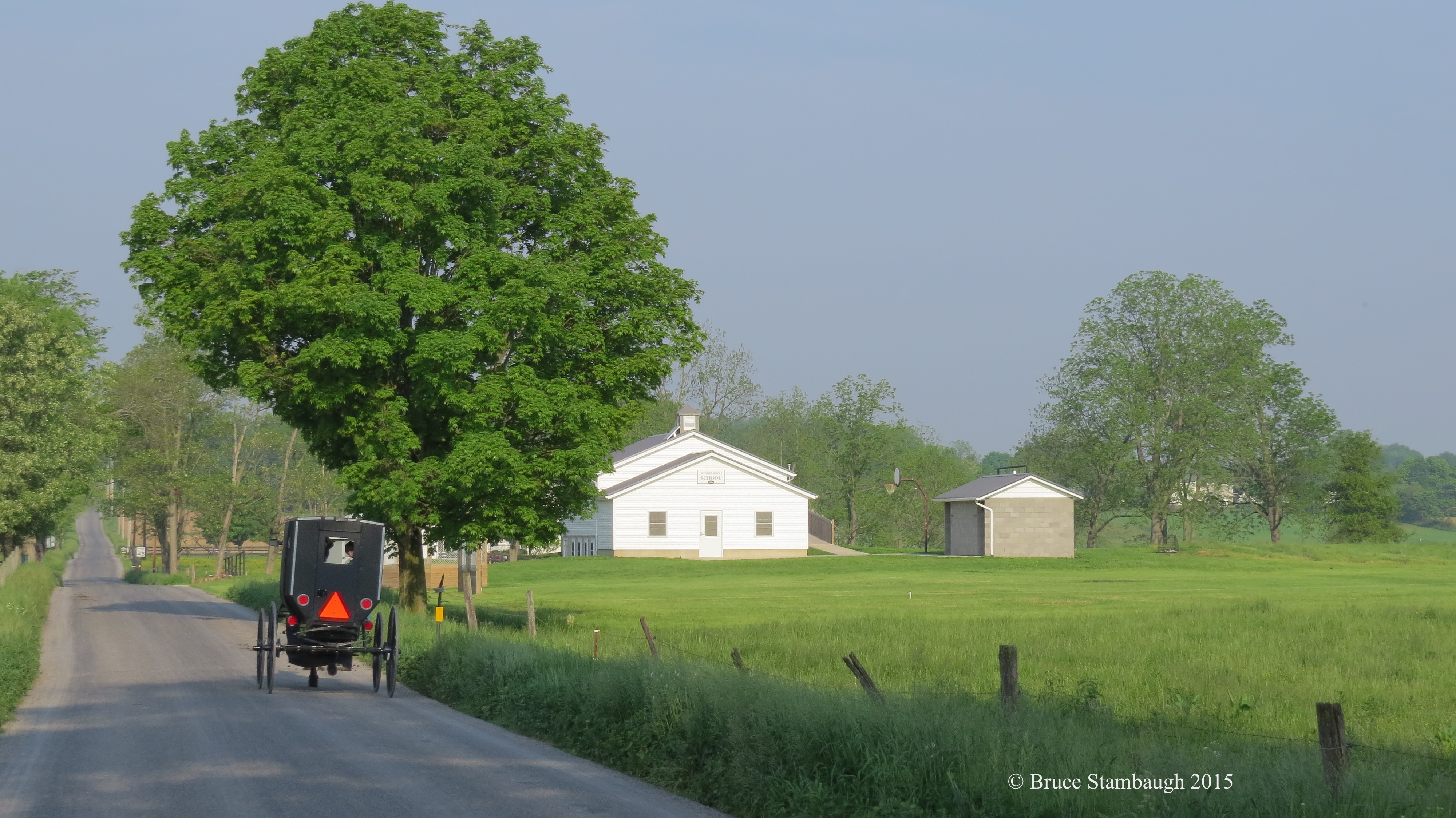
Many of these bird watchers are Amish. It’s a hobby embraced by their culture and family structure. To be sure, birding is an exercise in which all family members can participate, and be out and about in the nature that they love and embrace.
It’s no coincidence that Amish folks have discovered many of the rare birds sited in the area. Now, it’s not simply because they are Amish that they find the birds. No, they see the birds because they pay attention to their surroundings.
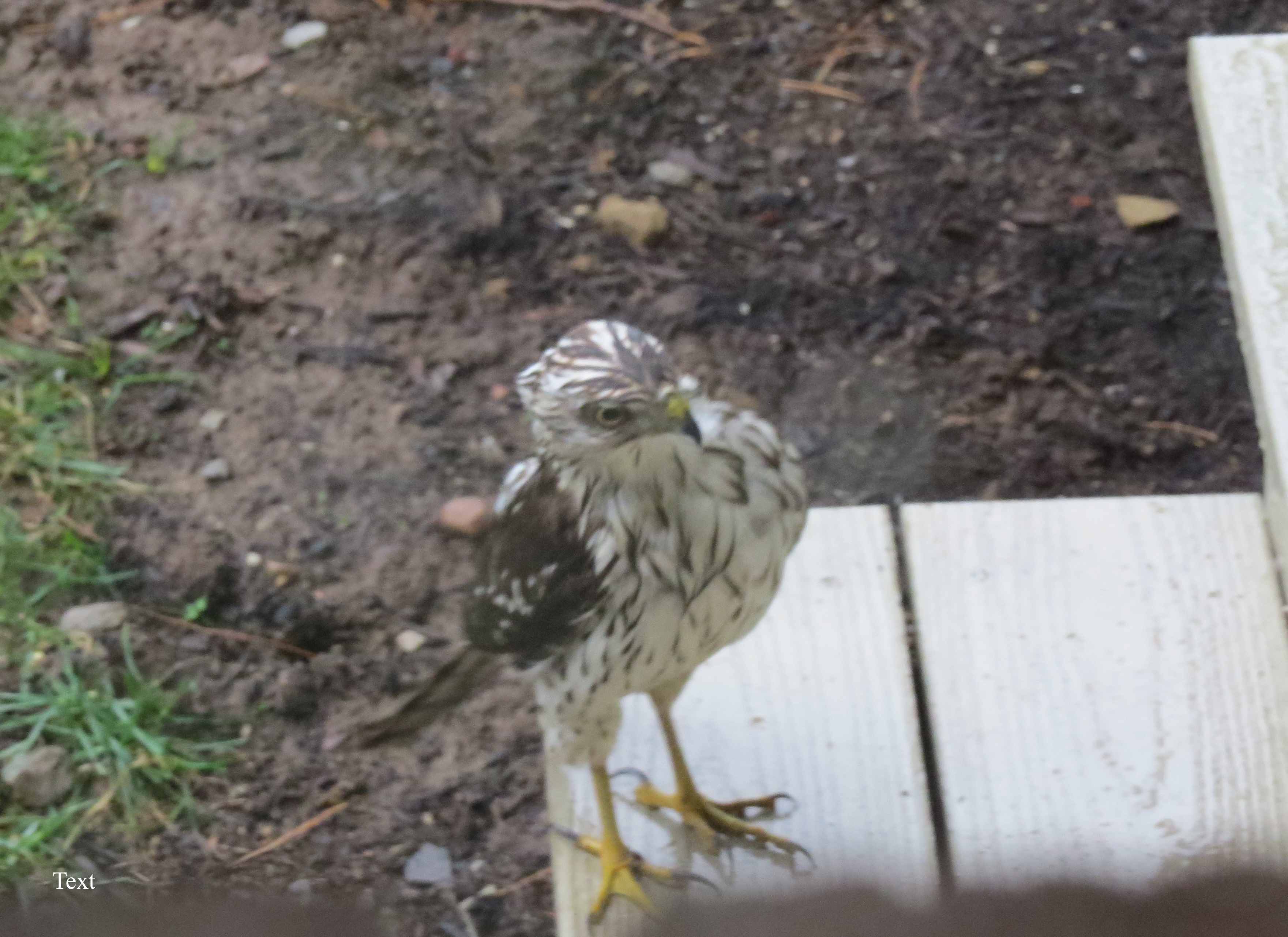
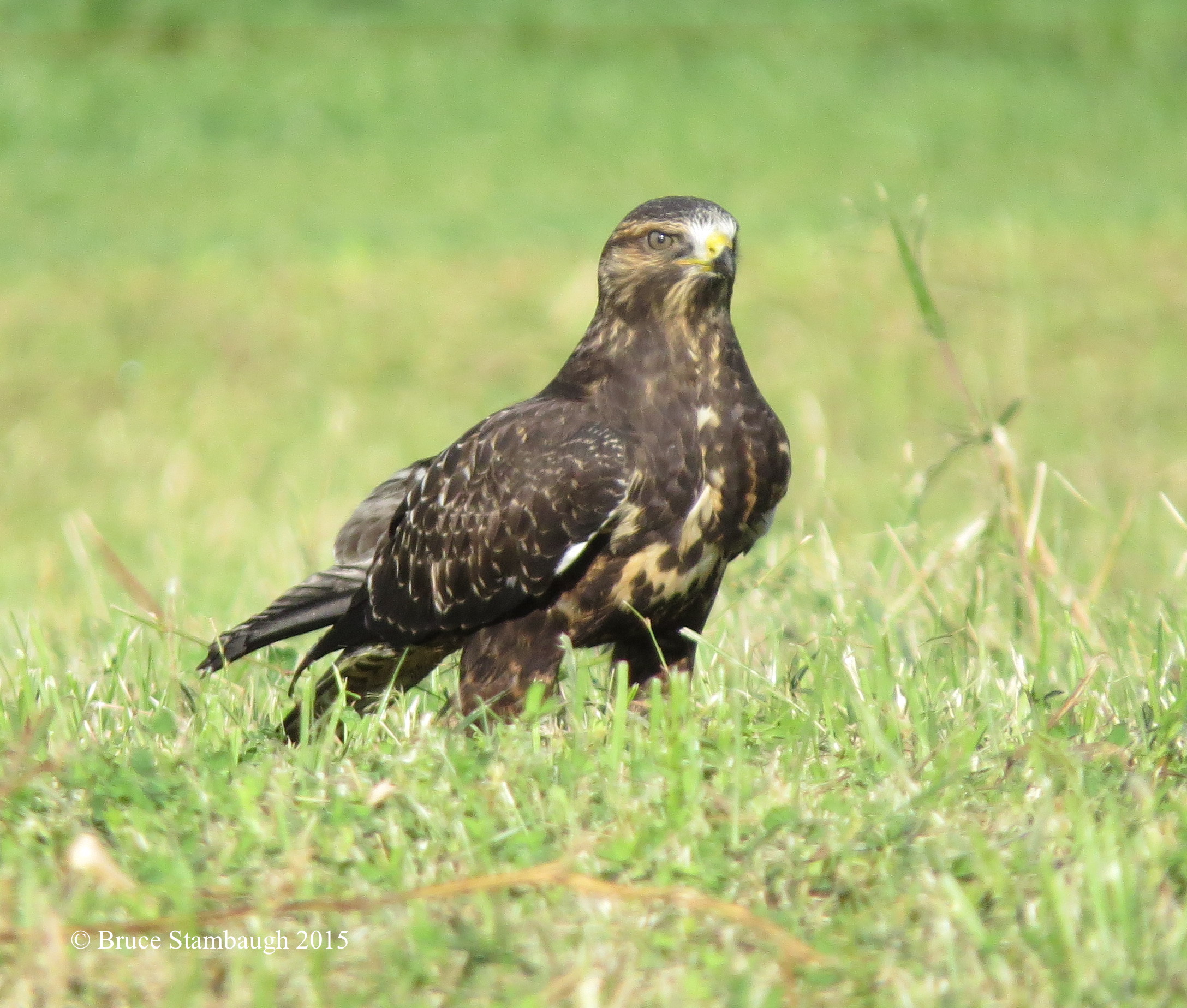
Juvenile Swainson’s Hawk.
Take the latest rarity, the juvenile Swainson’s Hawk discovered recently in a newly mown alfalfa field half way between Berlin and Walnut Creek. Workers at Hiland Wood Products noticed particular peculiarities about this bird, its behavior, its flight pattern, its coloration, and its diet.
When the bird was pointed out to skilled birder, Ed Schlabach of Sugarcreek, he easily identified it. Ed works at the company and is a reputable birder.
Ed not only knew what the bird was; he knew that it was a very rare find for Ohio. In fact, the typical range of this buteo is well west of the Mississippi River, and mostly in the southwest, and only in summer.
What the hawk was doing here was a mystery. Ed knew that birders everywhere would want to see this magnificent specimen. The word went out through phone calls, birding lists, emails, texts and social media.
There is always a rush to see a rare bird. Most often such birds do not hang around for very long. This young bird chose to stay for several days, and also picked a spot to easily observe it, whether on the ground or in the air.
For many birders, the young Swainson’s Hawk was a “life” bird. That is, it was the first time they had ever seen this species.
Once again, we can thank the many rare birders who reside and work in our pastoral abode for this latest mega-rare find. Rare birders find rare birds.
You must be logged in to post a comment.