I am a writer, author, photographer, birder, walker, hiker, husband, father, grandfather, brother, Anabaptist, and community activist. My life is crammed with all things people and nature and wonder. My late father gave me this penchant for giving and getting the most out of life, my late mother the courtesy, kindness, and creativity to see the joy in life. They both taught me to cherish the people I am with. I try and fail and try again.
More often than not, Carolina Wrens are heard rather than seen. One recent sunny morning, however, I found this Carolina Wren taking a dip in the backyard birdbath. After its morning bath, the wren flew to the feeder hanging on the back porch. It stayed there for several minutes, satisfied to let the sun dry its earth-tone feathers.
My wife and I made an impromptu, important decision. We broke a long-standing tradition for the perfect reason.
For the last 40 years, we have always had a live Christmas tree grace our home. That won’t happen this year.
The live tree always stood centered in front of the living room windows for most of December. This year an attractive, used artificial tree retrieved from a local thrift store fills that spot.
Our first live trees weren’t cut either. They still had their roots bound in burlap. After Christmas, we transplanted the trees in the yard of our first home we built four years after our marriage. When we moved to our present home 36 years ago, we switched to live, cut trees.
Christmas morning.
Both my wife and I had grown up with fresh cut trees in our homes for the holidays. My family often took excursions to select just the right tree. Dad used the saw, and us kids would help carry the piney prize back to the car.
We continued that Yuletide tradition with our children. We loved the family experience, the exhilaration of the nip in the December air in Holmes County, Ohio.
My favorite Christmas trees growing up were the Scotch pines. I loved their long, soft needs as opposed to the stiff, prickly ones of the Colorado blue spruce species.
In recent years, my wife and I tried Fraser, Douglas, and Concolor firs. They all kept their needles longer than other species and filled the house with a pleasant, conifer fragrance. Their soft, bluish-green coloration added a festive flair, too.
With all of these positive traits, why would we change now? The truth is, we hadn’t intended to switch.
We went looking for a Concolor that would serve a dual purpose. We would again get a balled tree first to serve as our Christmas tree. After the holidays, we would plant it to replace a mature blighted blue spruce removed from our side yard last summer.
The Jenny tree.
We found a small, balled Concolor at our first stop. It was hardly three-feet tall, much smaller than we had in mind.
Then we got an idea. We bought the little tree and planted it where the stately blue spruce had been. We chose this lovely fir to serve as an evergreen memorial to our dear friend, Jenny Roth Wengerd, who died on Sept. 11 from a brain hemorrhage at age 47.
The tree was about the size of Jenny when we first met her at age three after her adoption from South Korea. Neva and I witnessed her naturalization as a U.S. citizen.
We often cared for Jenny and her siblings while their parents were away. She and her family stayed in our house the day their home burned down. We mourned with the family when Jenny’s brother, Steve, died of cancer at 25.
We had been through a lot together.
Jenny was as beautiful and compassionate as a human could be. She radiated love and joy to all who knew her. Planting a tree to her memory only seemed fitting.
Only a single ornament adorns this extra special Christmas tree. A simple, translucent angel watches over this dedicated evergreen.
We will celebrate Christmas with a fake tree this year just as joyfully as if it were a fragrant, beautiful fir. Outside our Jenny tree will sink its roots into the earth, a living memorial to our gregarious friend who died much too soon.
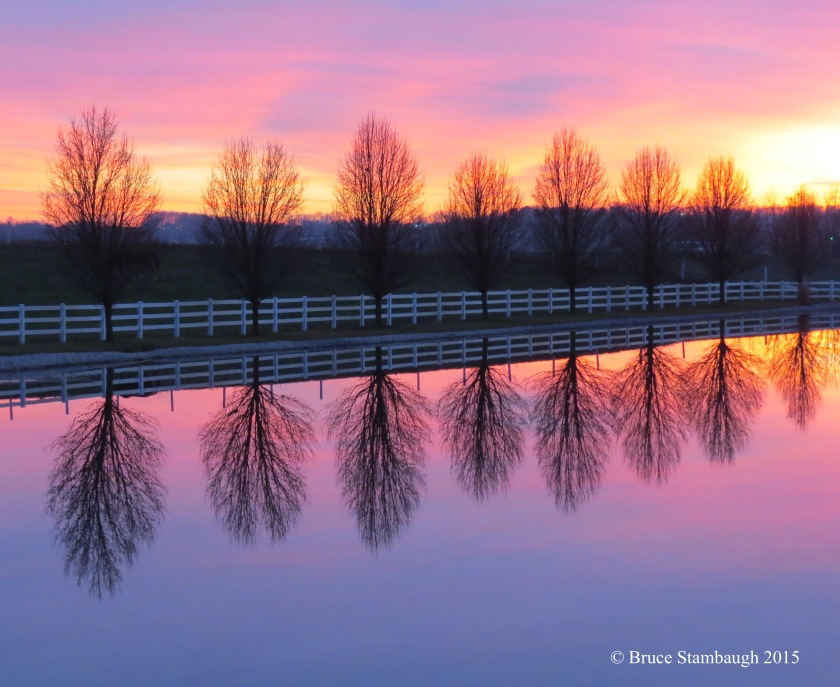
Clearly, this sunset was worth the wait. It exceeded all of my expectations. However, the reflections were what caught my eye. The line of trees and white fence reflected perfectly against the glorious sunset. This sunset shot required no filters and no editing.
I couldn’t resist. I had plenty of inside chores to complete, but the golden brightness of the glorious fall day drew me outside. With the sun dazzling in the clear blue sky, it would have been sinful not to soak it in. So I did.
Sunny days in late fall in northeast Ohio are rare. November and December are historically our cloudiest months. I wanted to take advantage of the beauty. I soon discovered that I wasn’t alone.
Of course, preparations for the holidays ahead already had people out and about. Folks seemed to double down on this beauty of a day. Traffic of all types kept the byways busy.
Going home.
It was a day of contradictions. I passed an Amish man eating an ice cream cone while cruising along in his black buggy. It wasn’t even 10 a.m. It was 47 degrees Fahrenheit, proving once again that temperature is not a prerequisite for enjoying yummy ice cream.
Congestion reigned at the square in Mt. Hope, not an uncommon sight on sale day at the livestock auction. The sun spotlighted a farmer on a tractor chatting on his smartphone. The conversation must have been agreeable. He grinned like a Cheshire cat.
Grazing sheep.Up the road a piece, a flock of sheep grazed in the hollow of a broad, bowl-shaped field. The wooly coats glistened against the straggly spent vegetation that still stood above the close-cropped grass of the pasture.
Amish farmsteads turned uncharacteristically patriotic. A curtain of Navy blue sky served as the backdrop for the starched white clapboard houses and coffin-red barns.
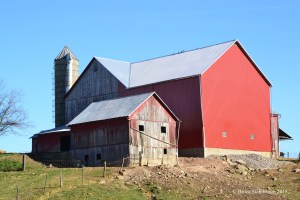
Faded and not.The sun bathed everything everywhere. Even long-neglected faded siding begging for a proper coat of paint stood out. Rusty windmill blades glinted in the brightness.
A pair of Red-tailed Hawks circled and soared low over a woodlot and disappeared. Pigeons claimed barn roof ridges, white and gray backs to the radiant warmth.
By afternoon, sunbeams streamed in on a factory office desk. The busy boss himself beamed in the glory of the day’s beauty.
A pair of Amish preschoolers, probably brother and sister, fearlessly coasted their wooden wagon down the gently sloping township road. It may have been late November, but their joy said summer.
An Amish worker skillfully wrapped a finished piece of machinery in clear plastic to protect its fresh coat of paint during shipping. He was more than glad it wasn’t snowing.
Windows on a passing school bus were all down where the students sat. I doubt the jolly driver cared.
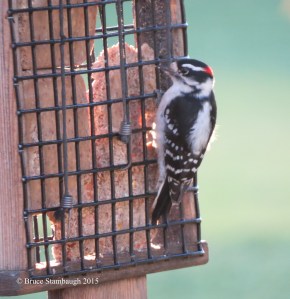
Downy Woodpecker.Near dusk, a stand of hilltop trees filtered the southwestern glow. Nevertheless, the sun’s strength still outlined a downy woodpecker’s fine feathers like an angel’s halo. The usually nervous bird seemed to relish the moment unless it simply wanted to pose for a cameo photo.
The sun set too soon and unspectacularly. On the opposite horizon, November’s frosty moon rose full. Its soft illumination stunningly highlighted thin wispy clouds, a pale but dramatic imitation of sunrise.
By day, the sun radiated more than welcomed warmth. It energized humans, Holsteins and wallowing hogs. By night, the recycled solar rays washed the earth in a rich beauty not often seen without a sparkling snow cover. I hated to do it, but I had no choice. I pulled the bedroom drapes.
I wasn’t shutting out the light so much as keeping the bright beauty of the day internal. Its brilliance still burned within me, an immeasurable, lustrous love that lulled me to sleep.
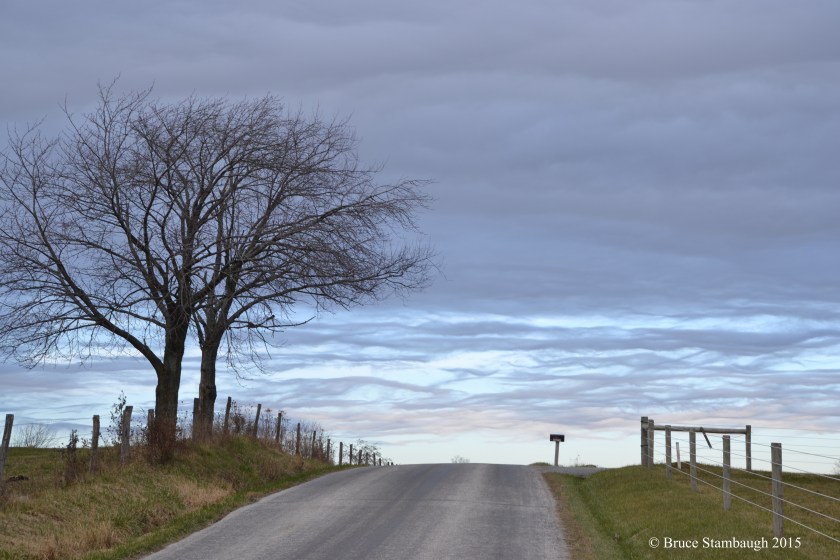
Clouds intrigue me. I know I’m not alone in that sentiment. While driving some back roads in rural Wayne Co., Ohio, I spotted this unusually shaped and colored cloud formation. To use the scientific name, these are stratus undulatus clouds.
In addition to their ribbon-like shape, the wide range of soft colors particularly caught my attention. The trees, mailbox, and fence help add perspective to my Photo of the Week, “Ribbon Clouds.”
I know I’m getting old. I have a birthday soon to prove it.
I thought I just wrote about what November would bring us, and here it is done and gone already. How can that be? I think I have some answers, all of them as lovely as the month itself.
Given the last two winters, we began this November with more than a little trepidation. We had good reasons for our collective unease.
Last November’s snow.Would we be blasted with another surprise snow in the middle of the month like last year? Could we even begin to hope that November would be half as beautiful as October was?
As you happily know, November gave her best to replicate October’s stunning weather here in Ohio’s Amish country. The eleventh month wasn’t quite as bright and pretty as October, but she sure tried hard.
Even with standard time returning and the daylight hours growing fewer by the day, November was a welcome, pleasant surprise. It exceeded all expectations.
Overall, the month turned out to be a much better than average November if only measured by weather. November charmed me with its hospitality, a welcome relief from the state of affairs on the national and international political front.
This slideshow requires JavaScript.
It’s not too many Novembers in Ohio that you see a father and his young son walking along a sidewalk in short sleeves mid-month. Last year they would have been bundled up throwing snowballs.
Municipalities, stores, and homeowners took advantage of the decent days to put up their holiday decorations. It beat trying to hang banners and Christmas lights in blizzard-like conditions.
In some locales, Christmas decorations and Halloween displays stood side by side. I wasn’t going to judge. I just enjoyed the intended spirit each reflected, even if the timing was a little off.
The horses and cattle had to be enjoying the extended stay in the open pastures. Frequent November rains made the grass as fresh as after April showers. In fact, folks were mowing their lawns this November on the same day they were plowing out their driveways last year.
Looking up.I took advantage of the excellent weather, too. I cleaned and readied my multiple bird feeders. I was hardly inside when I spotted a few infrequent Pine Siskins on the cylinder feeder by the kitchen window. They feasted on the cracked sunflower hearts.
With my firewood supply tenuous, I had three pickup loads of split and seasoned hardwoods delivered. Over the space of three days, my wife and I had it all neatly stacked behind the garden shed. Remember, I said I was getting older soon.
November’s brisk winds made regular appearances. That was good news for those who hadn’t yet raked their leaves. Their eastern neighbors may have a different viewpoint on that, however.
We had days of rain and drizzle. We had clear blue-sky days, too. And we had those days of cloudy one minute and sunny the next. None required a snow shovel.
Driving around the November countryside, the landscape seemed wider, more open. Perhaps that was due to the leafless trees affording a three-dimensional illusion, no special glasses needed.
This November frequently offered amazing sunrises and sunsets for all to enjoy. Sometimes they lingered for the longest time. Mostly, though, you had to look sharp, or you would miss the colorful show, just like the month itself.
Like Thanksgiving, November has come and gone. Bring on December and hope that it learned a little kindness from its closest sibling.
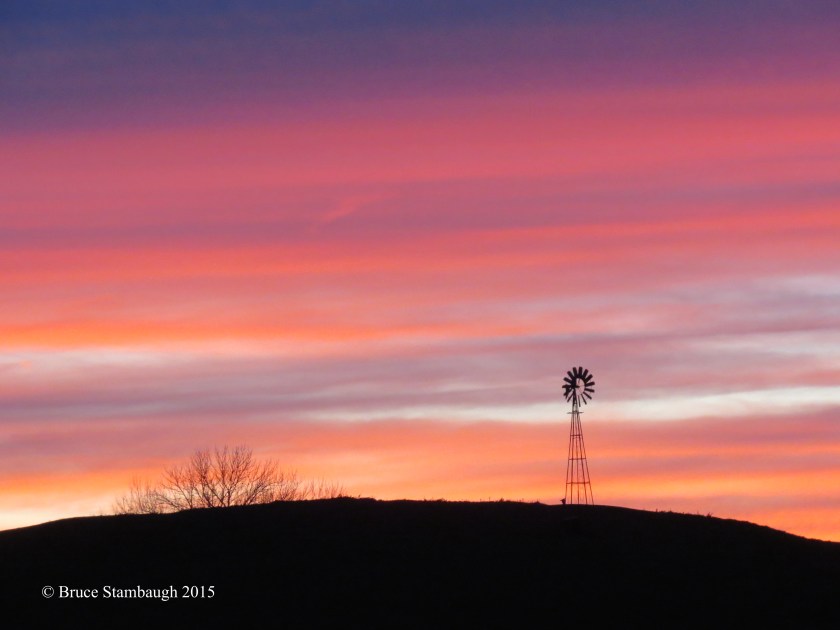
It was unseasonably warm and unusually bright for late November in Ohio’s Amish country. The angle of the late morning sun gave depth to the barn in the foreground and created an artistic display of the windmill’s shadow upon the starched white clapboard farmhouse.
I learned long ago if you want to celebrate you have to relate and communicate.
The designated time to do all three in the Unites States is upon us. Thanksgiving Day is a time to reflect on moments and people for which you are thankful, and to affectionately share that gratitude.
When a situation goes awry, or a snafu in a bond develops, it’s important that we communicate our feelings to maintain positive relationships. It just might help untangle the problem and any hurt feelings.
This Thanksgiving season I thought it appropriate to share some personal experiences I had this year that required communication to keep relationships strong. I call them vignettes of thankfulness.
“I’ll see you in six months,” the doctor told my friend Leroy. A few months earlier, Leroy had been diagnosed with a type of incurable cancer.
Amish homestead.Leroy had decided to accept his fate, and forgo any treatments, which would only extend his life a couple of months. Instead, he relied on doctor approved vitamin supplements and his faith to carry him forward.
I could hear Leroy’s voice quiver when he called me with a medical update. He was ever so grateful for this good news of extended life. I teared up too. I was honored to have received Leroy’s good news call.
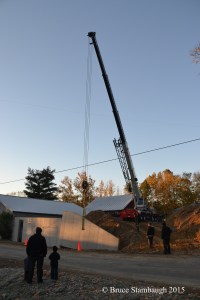
The call about a cement wall of all things had a similar ending. While I was away, a township resident had had a concrete wall poured for his new house. The problem was it was on the township right of way. As a township trustee, I was charged with getting the problem corrected.
I hated to tell Bert, a man I knew well, to move the wall. But move it he did, both efficiently and creatively.
Relocating the wall.My friend Bert used his foresight and imagination to recycle the wall. A craftsman sawed it into two pieces. A giant crane hoisted them into a new location, where they became a retaining wall. Bert seemed even more pleased than me.
“We don’t often get second chances in life,” he said. I heartily agreed. I expressed my thankfulness for Bert’s willingness to correct the mistake and giving the wall a new life. The error did not become a wall that would interfere with our good relationship.
My wife and I thoroughly enjoyed our extended time in Virginia’s Shenandoah Valley helping out our daughter as she coached her university’s women’s volleyball team. To those who know my wife, it was no surprise Neva worked night and day completing every day, necessary chores in our daughter’s household.
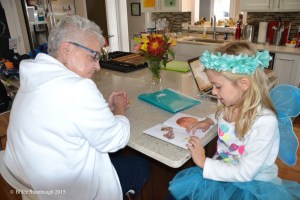
Homework help.While I was available, I helped our kindergartener granddaughter with her homework by listening to her pronounce letters and count numbers in both English and Spanish. For me, those were precious moments.
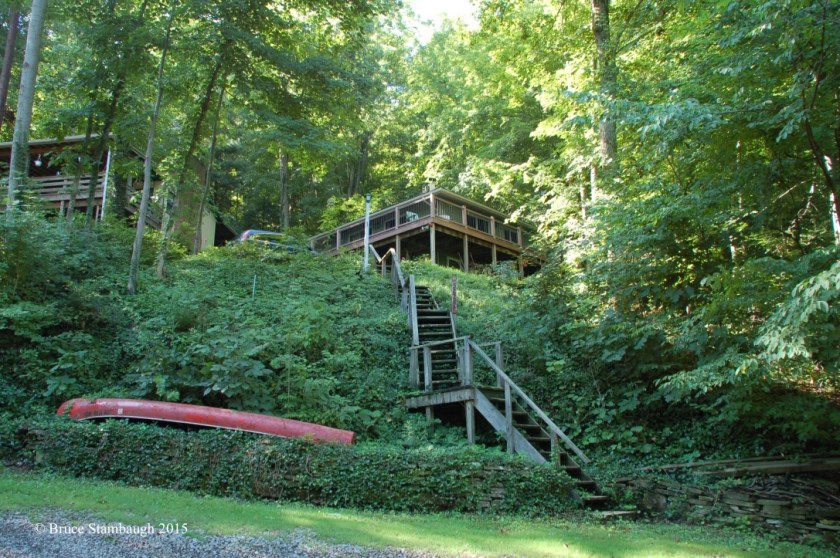
With our travels, Neva and I made a hard decision. We needed to sell the cute cottage my folks had built 40 years ago on a fishing lake in southeast Ohio. We asked around, but no one in the family indicated an interest in taking over the cottage.
After showing the property to some prospective buyers, our son called to say he had changed his mind. He wanted to purchase the cabin.
Neva and I were thrilled. It was the first item on our downsizing list, and our son would be the new owner. I’m pretty certain I saw my folks smiling down from heaven the day the property transferred.
Thanksgiving is a time to celebrate, communicate and relate the moments and emotions for which we are grateful. These are a few of mine. What are yours?
I loved how the pine bows mimicked the curvature of the shed’s roof. But it was the old sandstones, now whitewashed, that really caught my eye. Those ancient stones of the 19th century barn have a lot of stories to tell about the farmers who have come and gone, and about the passersby who have driven or biked or walked past this beautiful old building. I sure hope they saw what I saw.
Recent rains made the sparkling mountain stream joyfully sing its way through the sylvan hollow to the broad valley below. The late morning sun’s reflection shimmered as the cold water rushed over and around ancient boulders.
I had driven to this little paradise on the advice of my daughter. She recently had hiked with her family a trail that crossed the creek and scaled one of the precipices of the old, rounded Blue Ridge Mountains. I wasn’t that ambitious.
I was content to drive the 22 miles out of Virginia’s Shenandoah Valley to the end of Port Republic Road to enjoy a morning stroll. I took the much easier firebreak road that shadows the meandering stream.
Stepping stones across the usually placid braided stream broke the trail my daughter took. Today the stream roared rather than lapped its way into the valley.
The native brown trout had to be happy to play in other pools for once. I was happy, too.
This slideshow requires JavaScript.
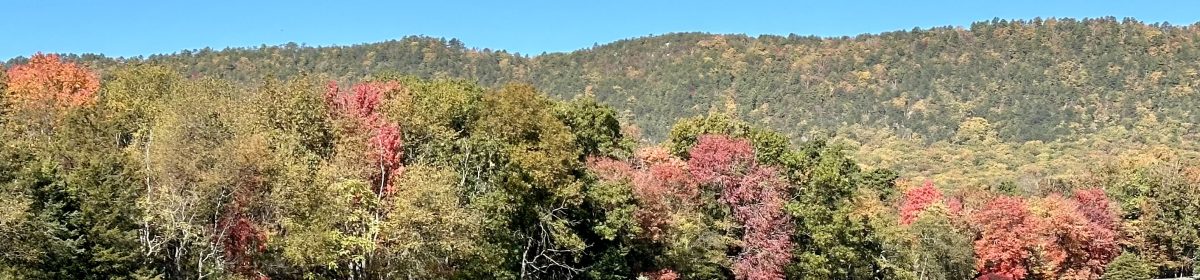
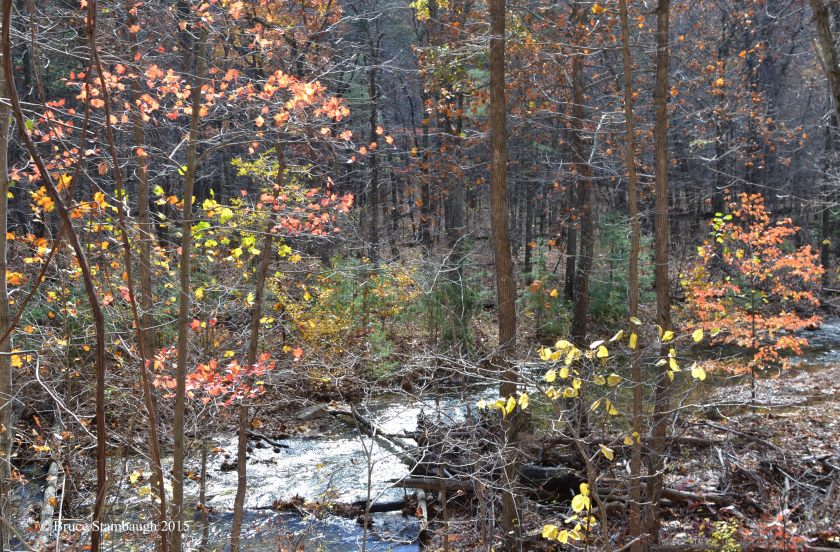
The temperatures warmed as the sun rose higher above the foothills. The shedding oaks, maples, dogwoods, sycamores and quaking aspens filtered the sun’s splay. Sunrays backlit the remaining colorful leaves. They glowed against the drab earth tones of tree trunks, ferns, and long shadows.
The creek drew me down from the road to its shallow banks. Sapling undergrowth made the way tricky, but not hazardous. I was surprised by both the speed of the stream’s flow and the water’s clearness, especially after recent steady rains. Weeds and reeds normally rustled by the wind swayed submerged.
In the shade, the cooler creekside temperatures chilled me. I didn’t linger there for long.
I returned to the more inviting sunny, well-maintained service road. At times, the stream ran against the narrow berm. In other places, the road curved slightly north while the creek twisted south and out of sight, but never out of earshot.
No car horns, no train rumbles, no jake brakes, no jetliner noise overhead, no boom boxes interfered with the numerous natural sounds. A fox squirrel skittered from the road to the safety of a tree trunk as I approached. It barked at me, and I shot it with my camera.
Click on the photos to enlarge them.
Autumn’s colors.
Talus slope.
Curving creek.
Tree tunnel.
Elder hikers.
Through the trees.
Peaceful pool.
Ripples.
Long view.
Lone hiker.
Up ahead, birds flew across the firebreak. To keep my load light, I had left the binoculars in the vehicle. Fortunately, the birds sat still even as I quietly approached.
I smiled at sighting my first of the year Dark-eyed Juncos, freshly arrived from the Canadian tundra. The flash of their outer white tail feathers against their slate-colored revealed their identity.
The mountain’s granite core stood exposed from time to time. Whitish-gray outcroppings reflected the morning sun both at manmade cuts and in natural talus slopes. I wouldn’t want to be anywhere near the latter if the massive rock pile decided to slide.
Soon hikers a decade older than me approached from the opposite direction. We bid each other adieu, and I asked them how far the road reached.
“Ten miles,” they said, “But it’s an easy walk to the top,” referencing the mountain. The road ended at the Skyline Drive. I took their word for it.
A few trails flared off in either direction. I was content to stay the course for a while before returning to the car for lunch under the noonday sun.
The earthy fragrances, the laughing stream, the vibrant colors pleasantly seasoned my simple fare, which was only right. It had been a sumptuous morning in every aspect.












You must be logged in to post a comment.