Finding a Rare Bird is Memorable

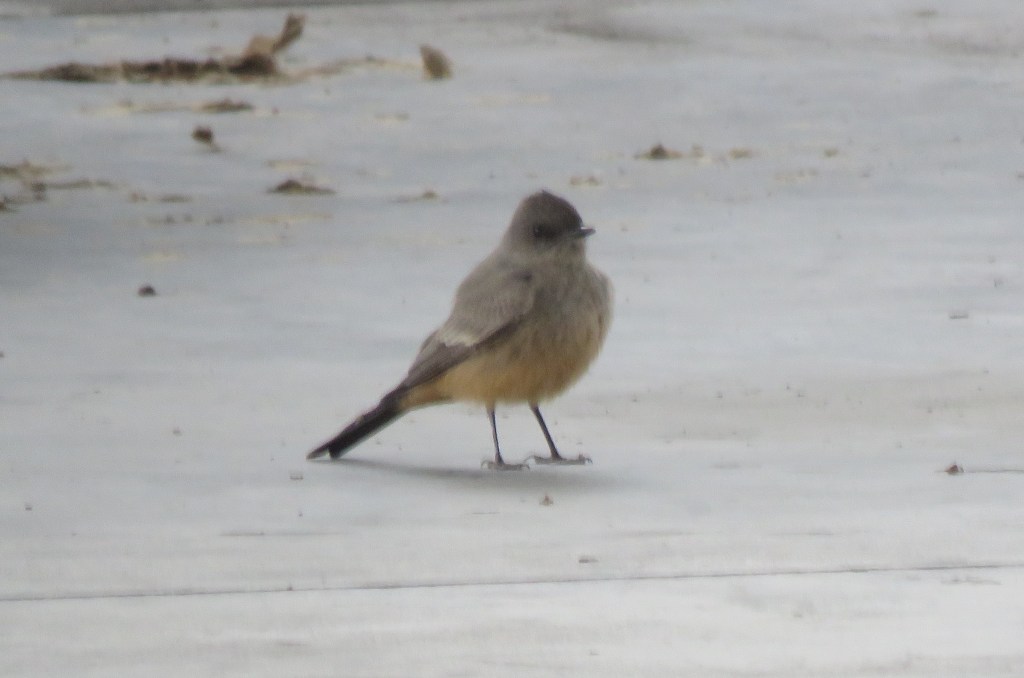
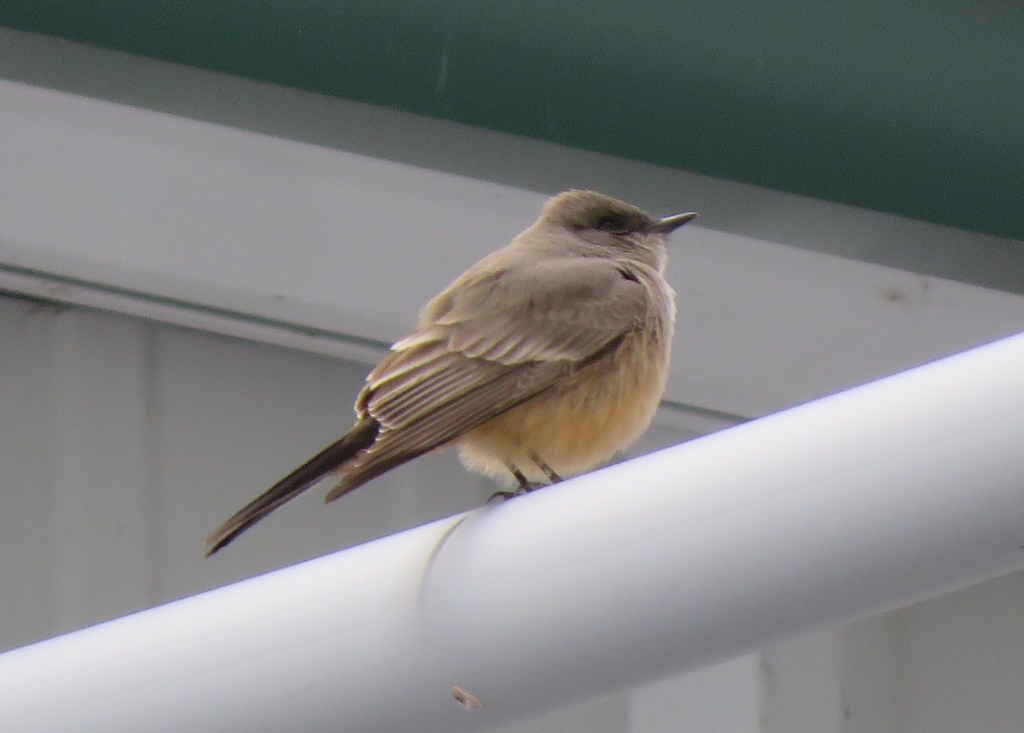
A Say’s Phoebe in Virginia’s Shenandoah Valley. Photo by Bruce Stambaugh

Finding rare birders is always a memorable experience, no matter one’s level of avian expertise. Since I consider myself an average birder, I always appreciate the opportunity to bird with those who are more knowledgeable than me.

That was the case recently when someone discovered a Say’s Phoebe five miles west of my home near Harrisonburg, Virginia. Having a Say’s Phoebe in the Shenandoah Valley was a rare treat, but seeing it in person became my goal since it would be a life bird.

I first learned about the Say’s Phoebe via an email listserv that reports rare bird sightings. I bundled up and headed to the property where the bird was seen. Several birders were already there scouting the bird. Ironically, the phoebe, which should have been in the southwest U.S. or Mexico, was across the road from where I photographed a Snowy Owl a few weeks earlier.

I walked as quietly as possible on the crunching snow and heard words that diminished my enthusiasm. “There it goes,” one of the birders said. It was late afternoon, and the guess was the phoebe was headed for a warmer roast than the steel pole buildings with three open sides.

I got eyewitness reports of the bird and details of its favorite haunts around the produce auction buildings it frequented during the day. The recommendation was to try in the morning when the bird foraged for dead insects.

That is precisely what I did. Only two other birders were present when I arrived. They had not found it yet. Discouraged, one birder headed to her car but soon turned around, waving her arms furiously.

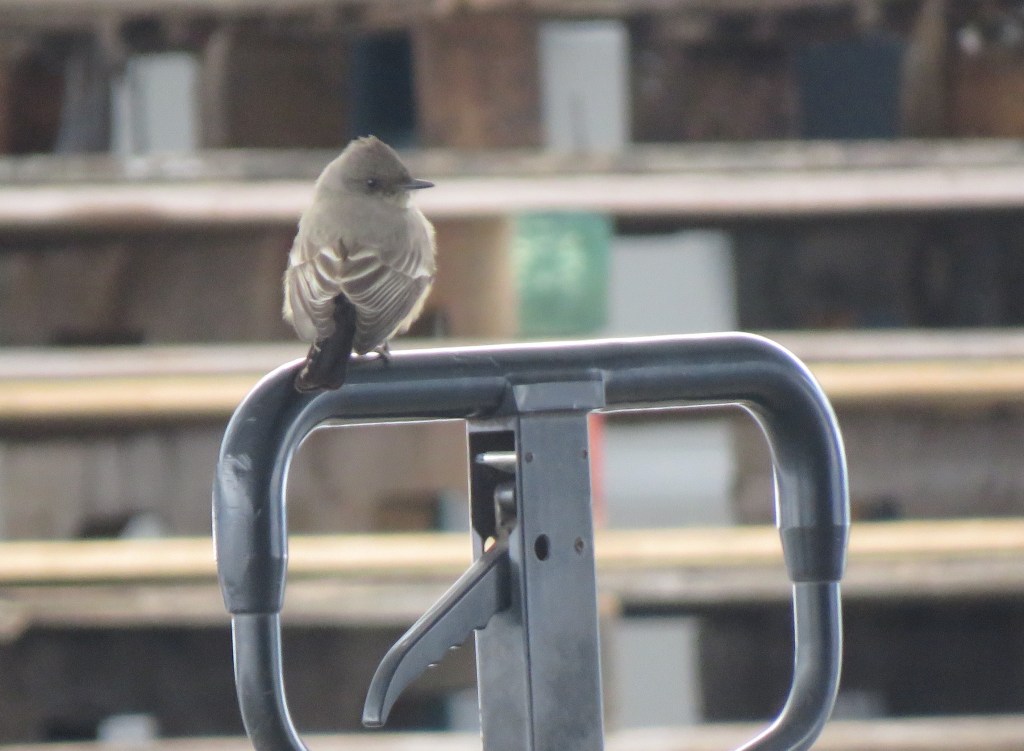
She had spotted the bird sitting on the handle of a hand pump, a favorite spot for the bird. Say’s Phoebes perch lower to the ground to feed than their cousins, Eastern Phoebes. But both species pump their tales and fly to intercept the insects, often returning to the same or near the same perch. Say’s Phoebes have a long, dark tail and a distinctive orange-to-pink buff belly.

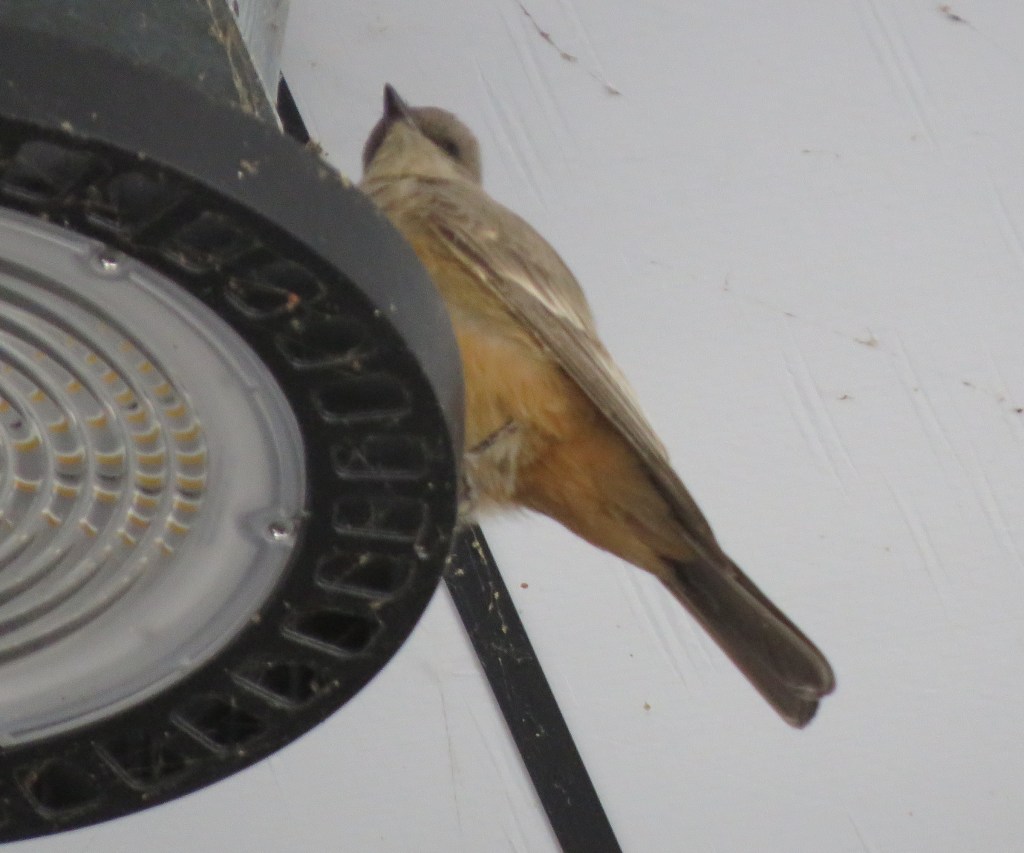
The bird flew into one of the open-sided buildings and continued to snatch dead insects stuck in spiderwebs around the ceiling and security lights. The lovely bird posed enough for us to capture several decent photos.

Satisfied, the woman who spotted the bird departed for other birding hot spots. That left two of us to follow the bird around, which we did for an hour. Given the bird’s feeding behavior, we soon learned to stand in a central location and let the bird fly to us. That strategy paid dividends. My birding companion even recorded the phoebe calling.

The Say’s Phoebe searched high and low for food. Winter in Virginia isn’t insect season, and several inches of snow covered the ground, too. No one knew what brought the bird to the valley, but we were grateful for the opportunity to view it.

I had the photos I wanted in an hour, so I headed home to share the good news with other birders by posting it on several Facebook birding pages. I was happy to add another bird to my life list. This exhilarating encounter was another birding experience I won’t forget.

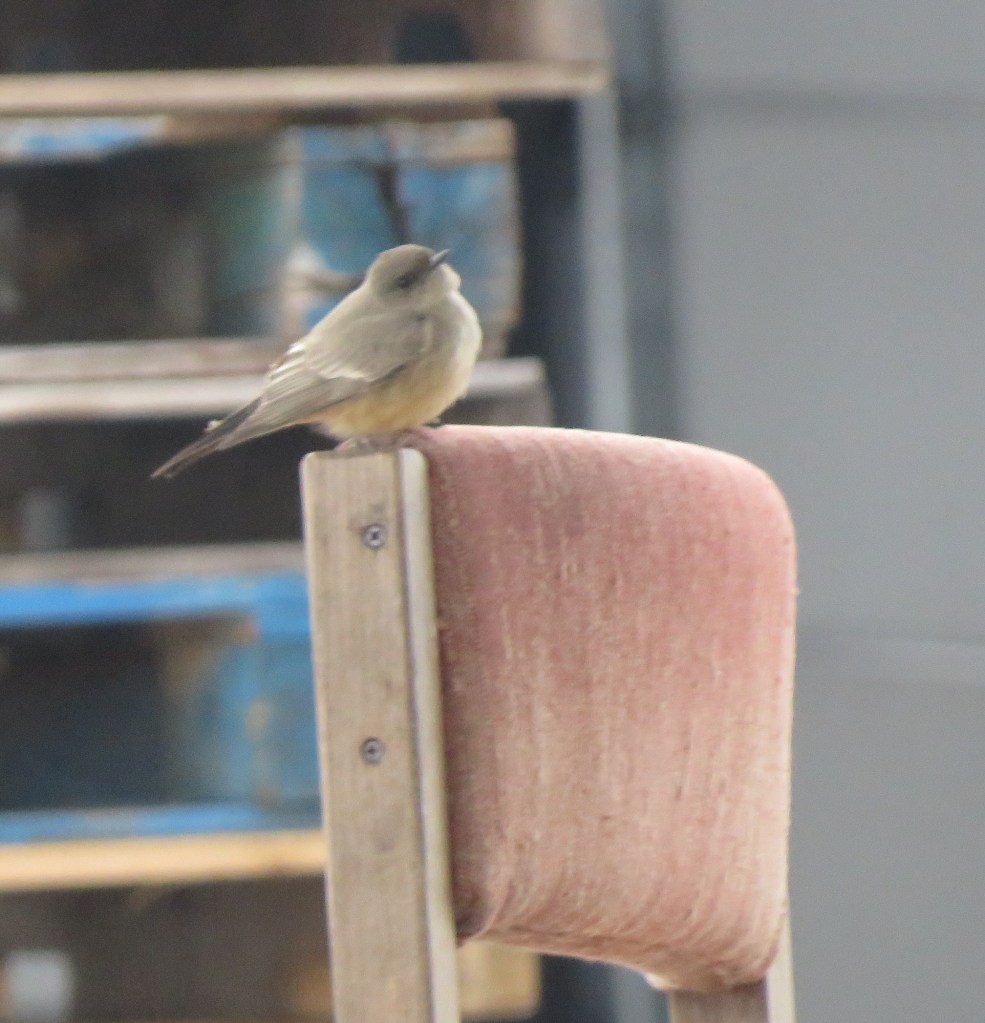
The Say’s Phoebe perched on a wall header. Photo by Bruce Stambaugh

© Bruce Stambaugh 2025

A Birder’s Dream Come True

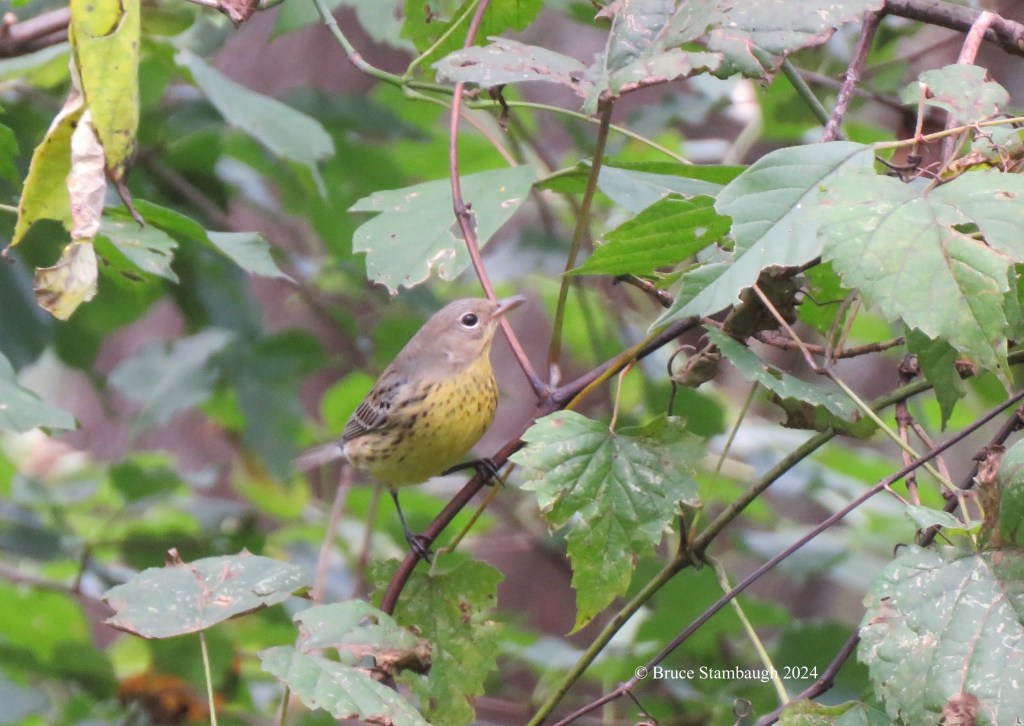
Kirtland’s Warbler, Waynesboro, Virginia. Photo by Bruce Stambaugh

When I opened the email from the birding listserv this morning, I knew I would pursue this rare bird. Fall bird migration was in full swing, and it’s a real rarity when a Kirtland’s Warbler is spotted. Experts estimate that only 1,500 of this species remain today.

It turned out that this bird was in a park only a mile from the wildlife rescue center where I took the injured Cape May Warbler last week. I had never been to the park where the Kirtland’s had been spotted.

My wife and I headed southwest toward Waynesboro, taking familiar back roads. Crossing over I-81 told us we had made the right decision. The busy highway was nearly bumper to bumper in both north and south lanes.

The GPS took us right to the park. The small parking lot was full, but fortunately, a space opened up right after we pulled in. Another birder arrived right after us and wondered where the bird was. I had no idea until we saw a small group emerge from the trees and thicket carrying binoculars and cameras with baseball bat-sized lenses.

They stopped and pointed their cameras and bins toward the thicket as we joined them. They spotted the bird immediately, and as good birders are want to do, they helped newcomers like us find the bird.

My wife had the rare bird in her binoculars before I did. Once it popped into the open, I saw the bird through my binoculars and then tried to capture images on my camera. Documentation is essential in birding, especially rare birds.

The bird darted up and down, in and out of the jungle of vines, saplings, and mature trees. It foraged on insects and berries. The bird finally popped into my viewfinder, and I got this photo and a few other less desirable ones.

Seeing a Kirtland’s Warbler is always exciting, especially if it is a life bird, meaning the first time you have seen the elusive bird. It’s a birder’s dream come true. Indeed, this bird was a lifer for several in the cooperative group.

Birding is all about finding and sharing, which Neva and I experienced today. On our way home, we celebrated with a delicious late lunch at our favorite burger place.

© Bruce Stambaugh 2024

Hiding in Plain Sight

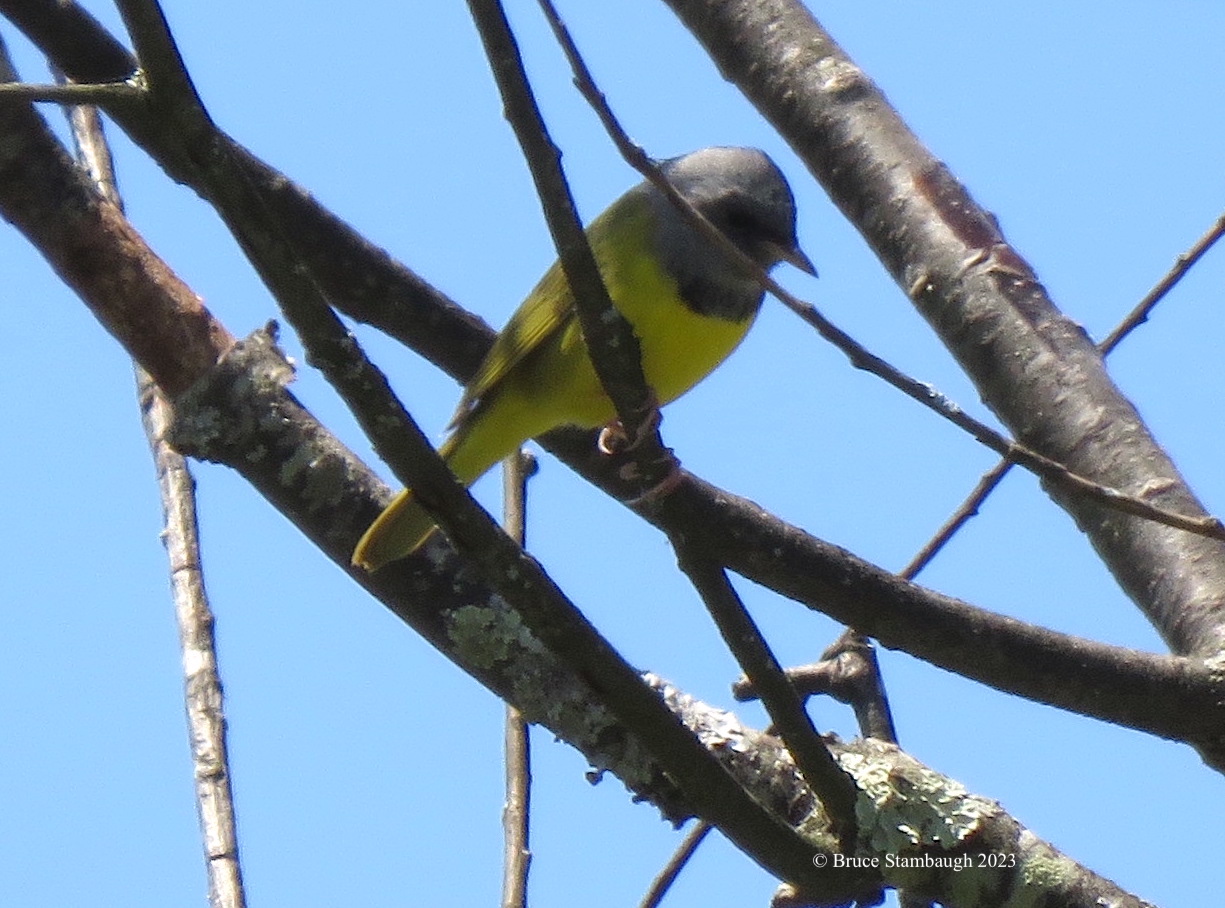
A male Mourning Warbler.

I couldn’t believe my eyes. I had heard a Mourning Warbler singing before, but I had never seen one. I always attributed that to their habitat and skulking behavior. It could have been my poor eyesight, however.

Mourning Warblers tend to stay closer to the ground than the one I spied 15 feet high in a dead wild cherry tree. They favor low brushy habitats, not bare tree limbs. Yet, here it was, and I was pretty happy to be able to capture a few photos before this beautiful bird with a lovely song dropped into the underbrush and out of sight.

Most Mourning Warblers nest in boreal forests in states and Canadian provinces well north of Virginia. However, there is a small area in the Allegheny Mountains along the boundaries of Virginia and West Virginia, where they also breed.

When I learned that other birders had spotted Mourning Warblers near Reddish Knob, a mountain summit on the Virginia/West Virginia border, I decided to go for the bird. The drive to that area is less than an hour from my home in the Shenandoah Valley.

Other birders had the same idea. The bird was easily heard, and with six pairs of eyes, the target bird was soon spotted. However, I didn’t expect it to be so out in the open. But I had to act fast. Mourning Warblers seldom sit still. As you can see, this bird was already looking down and dropped out of sight right after I snapped this photo.

I was grateful for the help of the other birders, who were equally happy that I was able to get the photographs I desired. The Mourning Warbler was only one of several bird species I saw that day, but it was the best.

© Bruce Stambaugh 2023

Bay Photos by Donna

Wildlife photos from the Chesapeake Bay region

ROAD TO NARA

Culture and Communities at the Heart Of India

K Hertzler Art

Artist and nature journalist in the Shenandoah Valley of Virginia.

Maria Vincent Robinson

Photographer Of Life and moments

Gabriele Romano

Personal Blog

Jennifer Murch

Art is the only way to run away without leaving home. -Twyla Tharp

Roadkill Crossing

Writing generated from the rural life

ANJOLI ROY

writer. teacher. podcast cohost.

Casa Alterna

El amor cruza fronteras / Love crosses borders