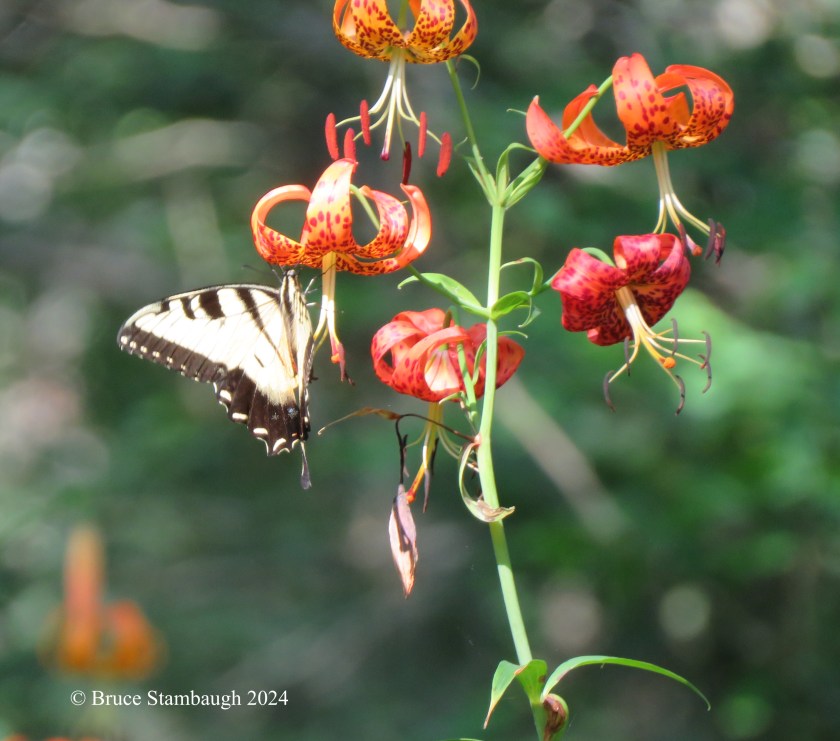
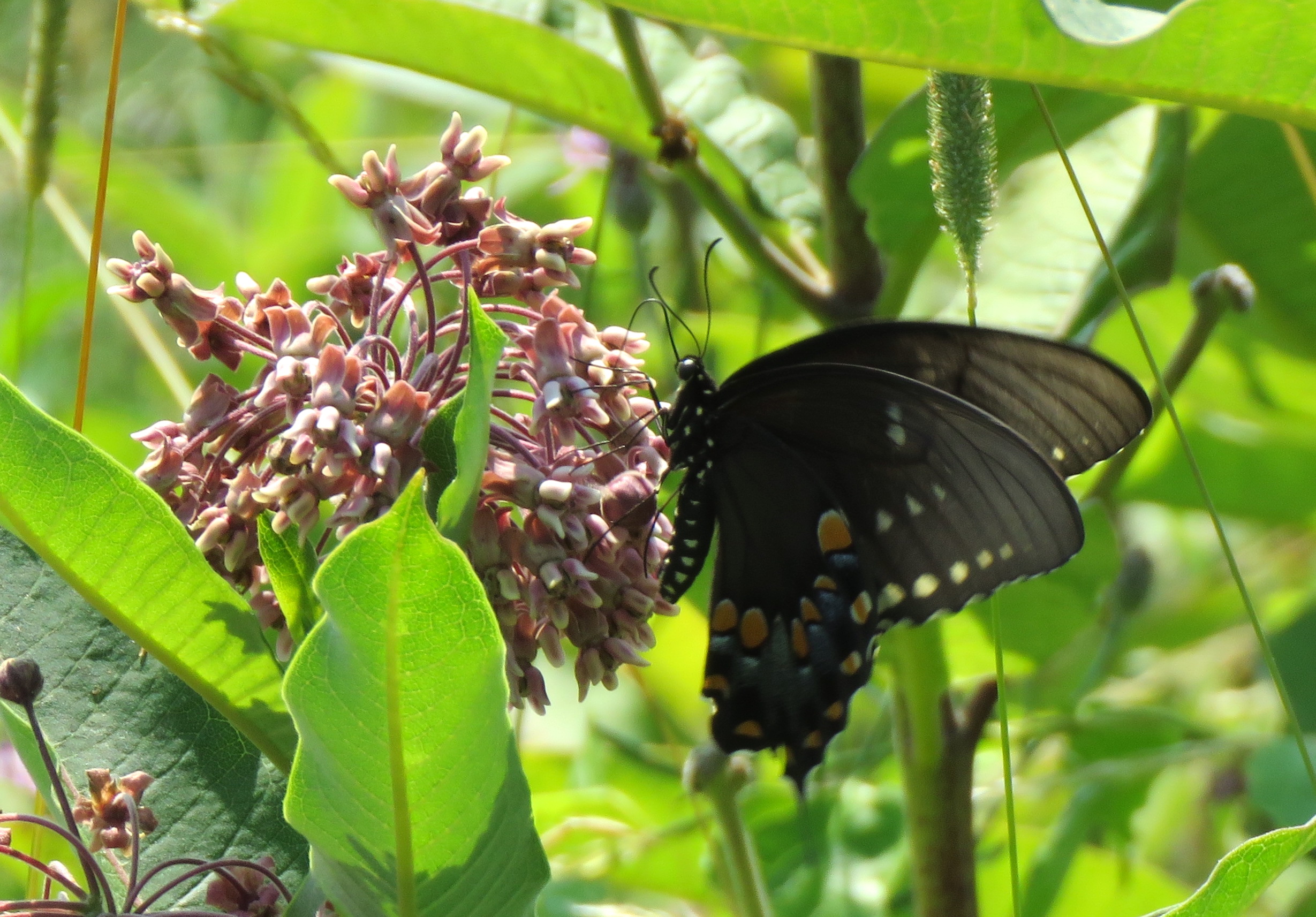
Like this Tiger Swallowtail, butterflies are drawn to Turk’s Cap lilies. Photo by Bruce Stambaugh
I visit Shenandoah National Park whenever I can. Being retired has its advantages. I usually go to the park with a purpose in mind.
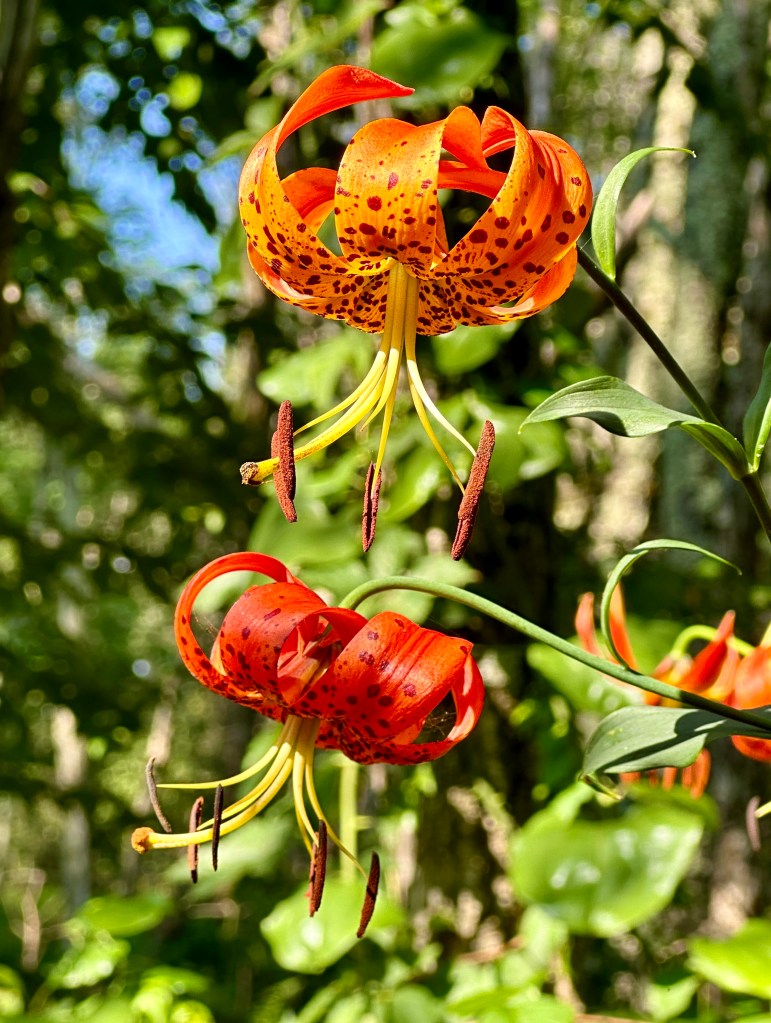
Recently, I drove the 45 miles from my home in Virginia’s Shenandoah Valley to the Big Meadows area of the popular national park for several reasons. I like to capture butterflies on the impressive Turk’s Cap lilies. Secondly, the temperature in the Blue Ridge Mountains, where the park is located, is usually cooler than the oppressive heat the valley has experienced lately.
July is when the impressive summer flowers are in full bloom. Butterflies, bees, and other flying insects can’t resist their lure, and alert humans can’t miss the spotted, bright reddish-orange blossoms either.
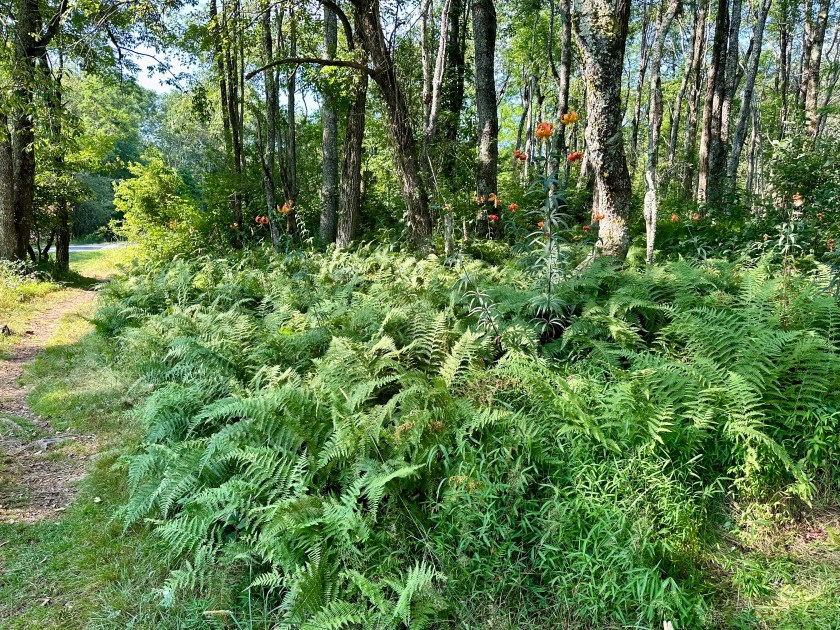
These photos were all taken along Skyline Drive south of Big Meadows.
It didn’t take me long to spot a few butterflies flitting around. I usually find a group of flowers and wait for the butterflies to arrive. There was a problem with being a stationary human, however. I forgot to take my bug spray along, and between the gnats and the mosquitoes, I spent as much time swatting as I did taking photos. It was a minor sacrifice just to observe nature’s glorious beauty.
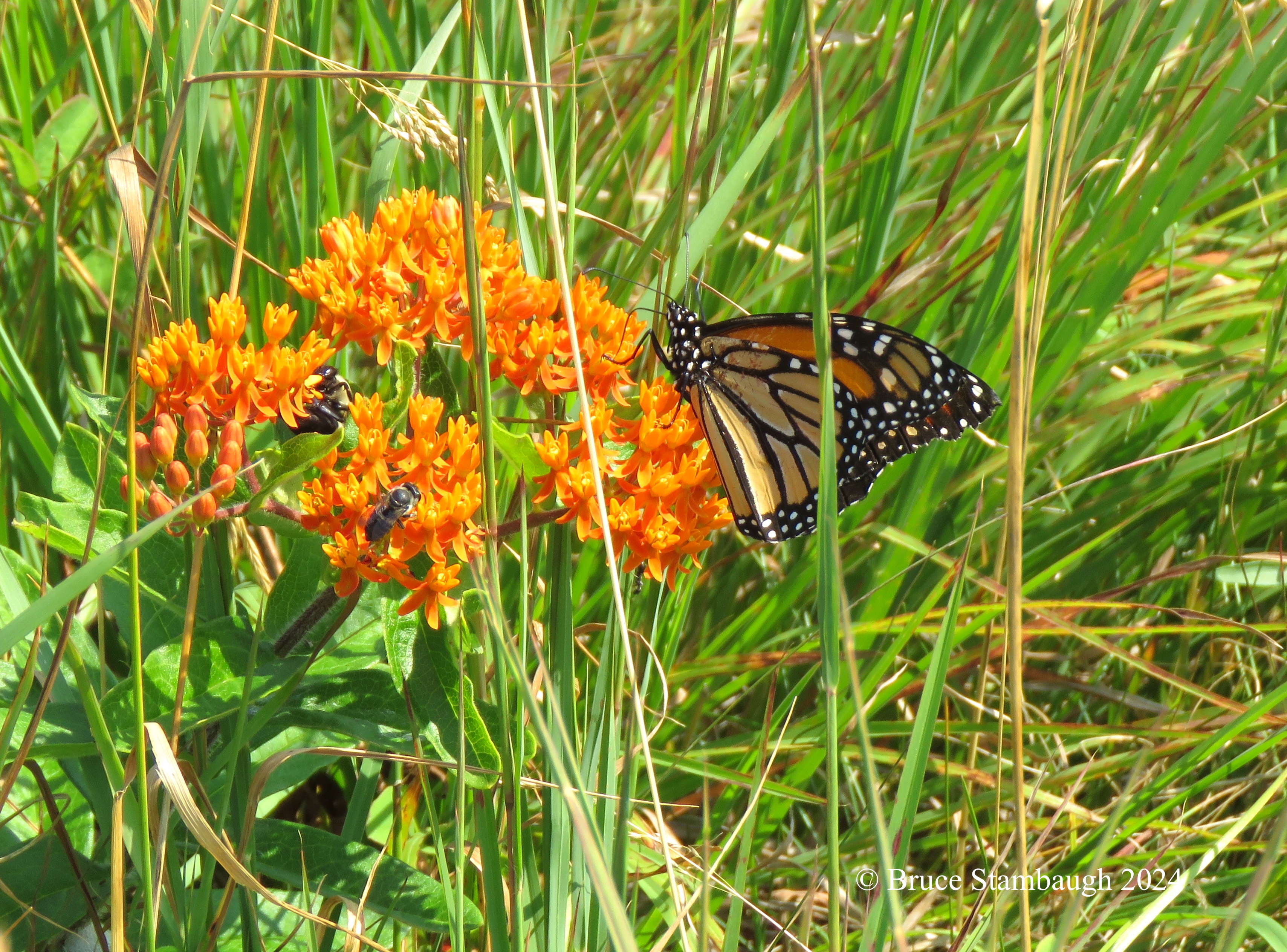
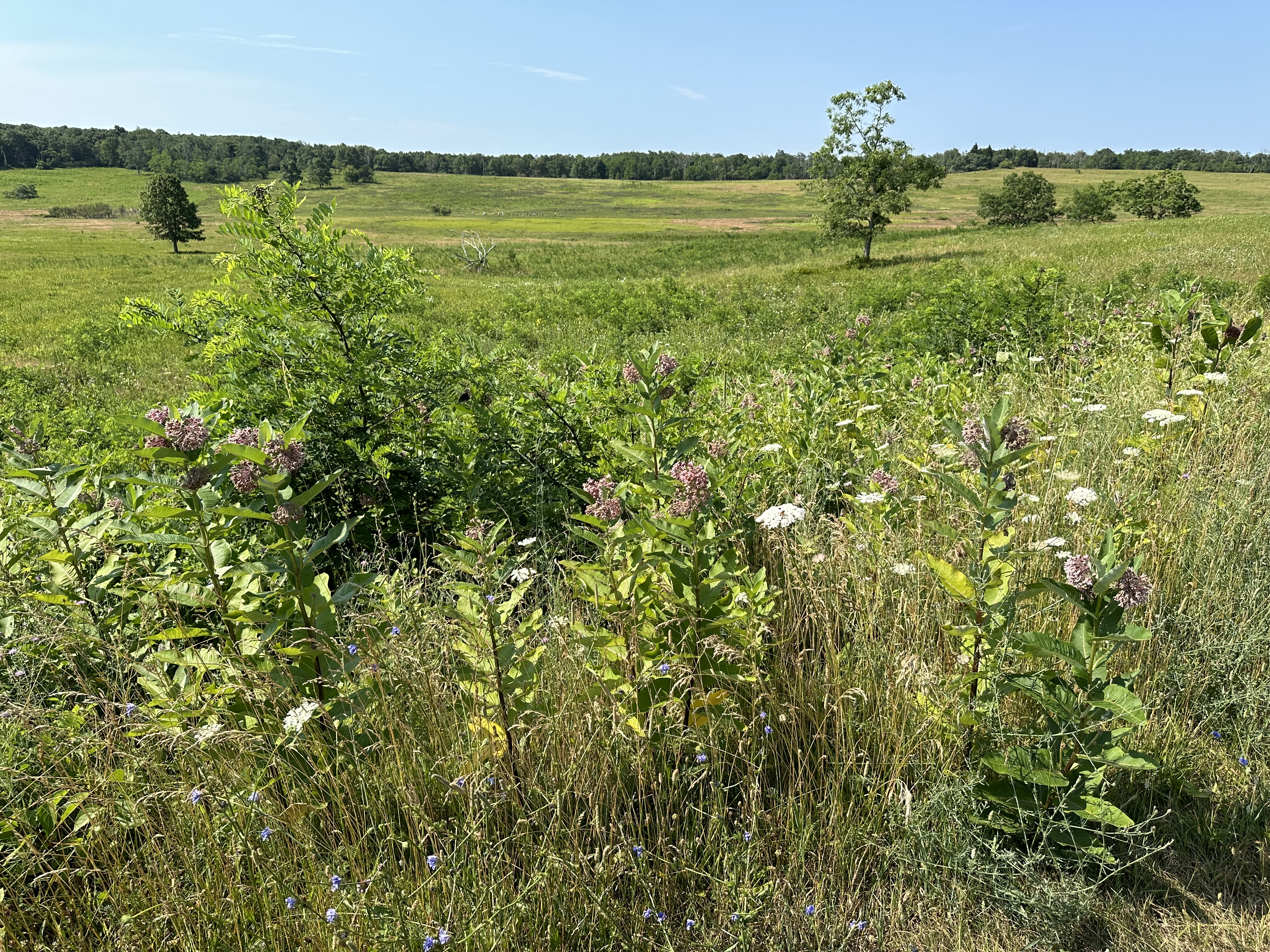
At Big Meadows, a ranger guided a small group of tourists on a nature walk. I moved around the sweeping, prairie-type basin. Due to the ongoing severe drought that Virginia is experiencing, the usual array of wildflowers is not as abundant as in previous years. However, as did the Monarchs and other butterflies, I found a few bright Orange Butterfly Weeds and the aromatic Common Milkweed blooming.
Please click on the photos to enlarge them.
I was also impressed with the thousands of honey bees and bumblebees that buzzed and hummed around the area. The Sweet White Clover got most of their attention.
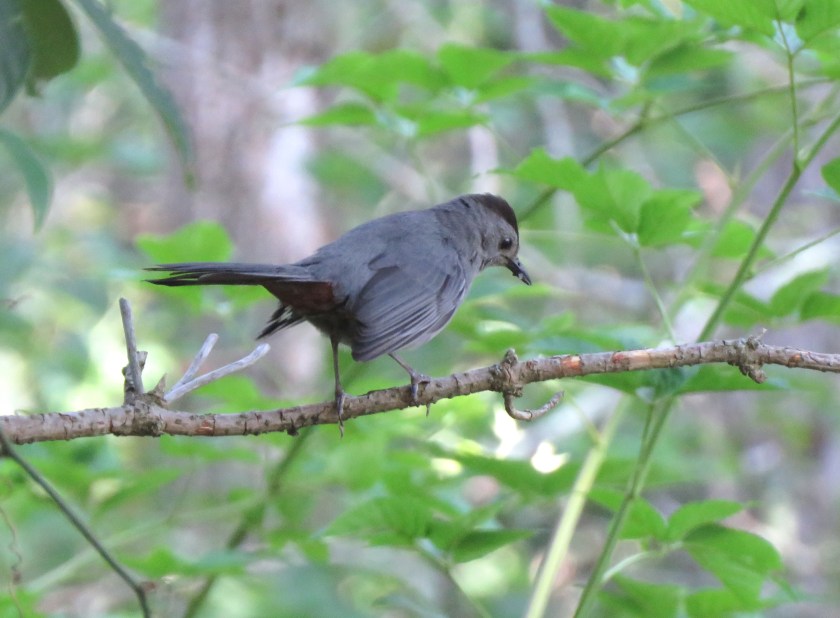
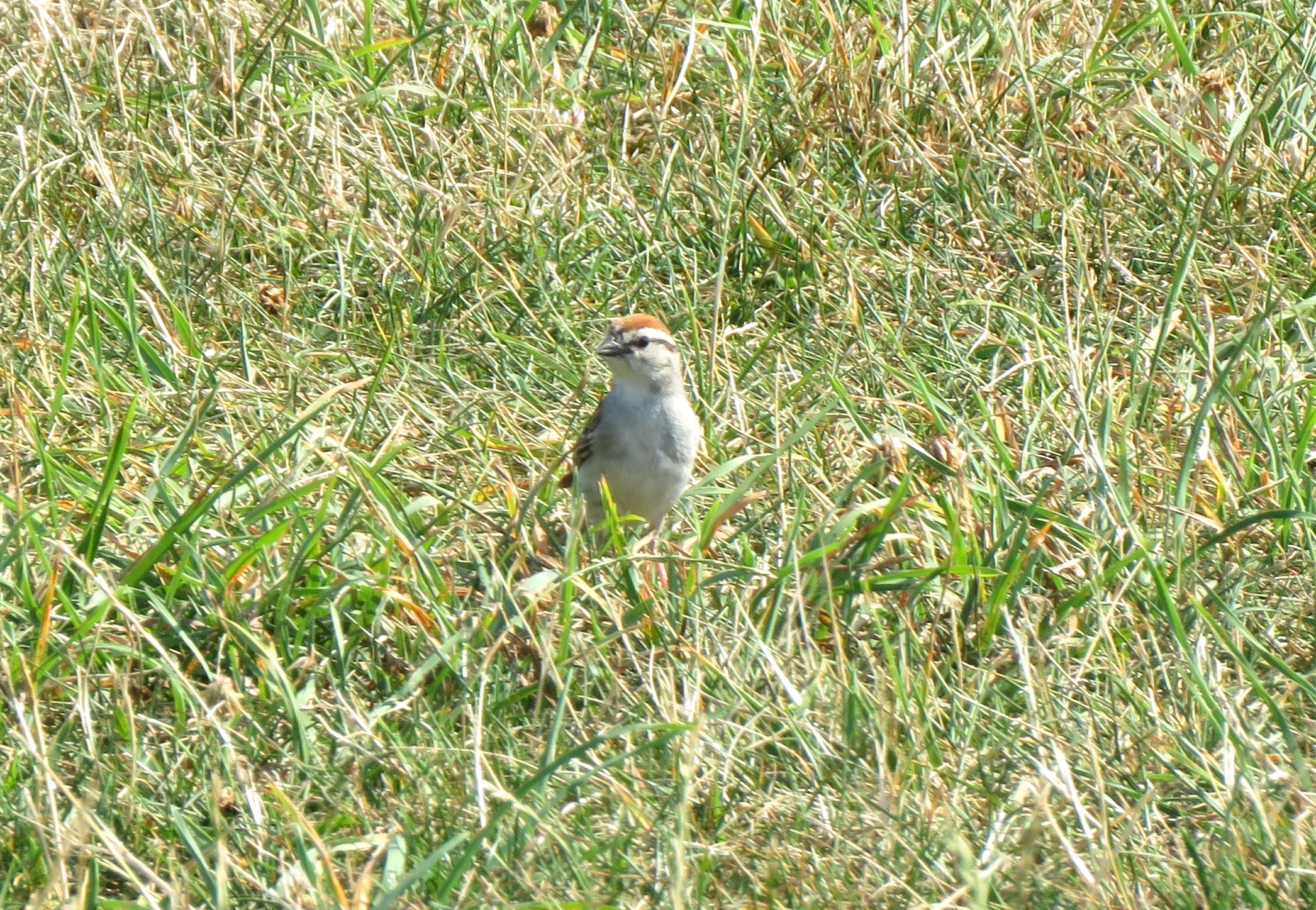
Of course, I can’t go to Shenandoah National Park without taking my binoculars. Songbirds were everywhere, but the dense foliage of the trees made them hard to spot. Did I mention that mosquitoes and gnats were ubiquitous?
By noontime, the heat and humidity sent me back into the valley to the comfort of my air-conditioned home. Still, I felt mentally refreshed and renewed, ready for the rest of the day.
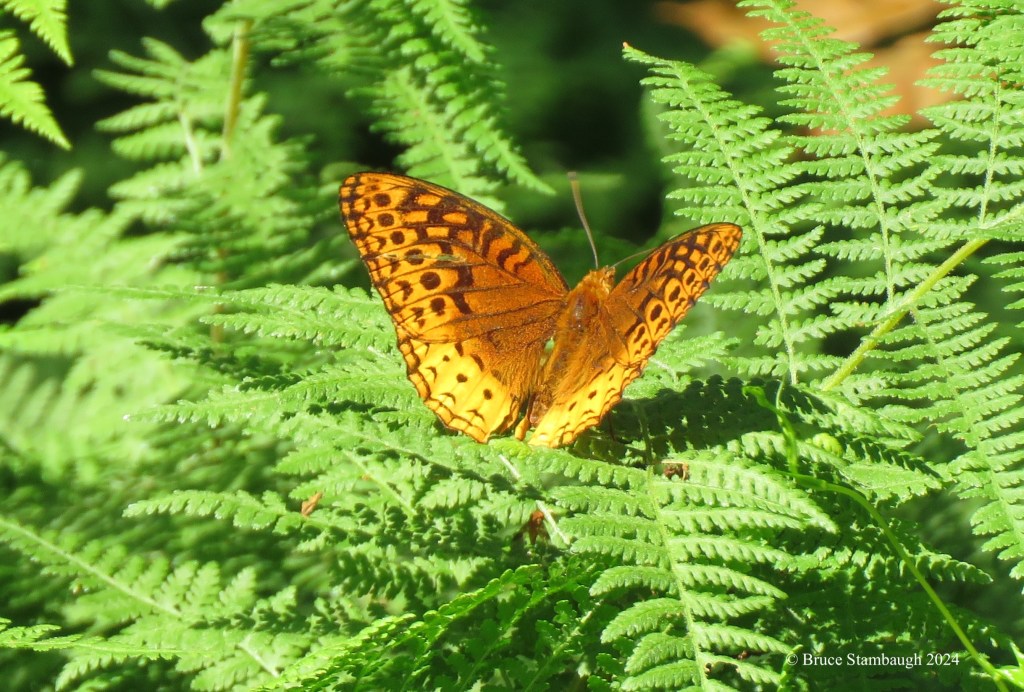
A Great Spangled Fritillary basked in the morning sunlight on a Rattlesnake Fern.
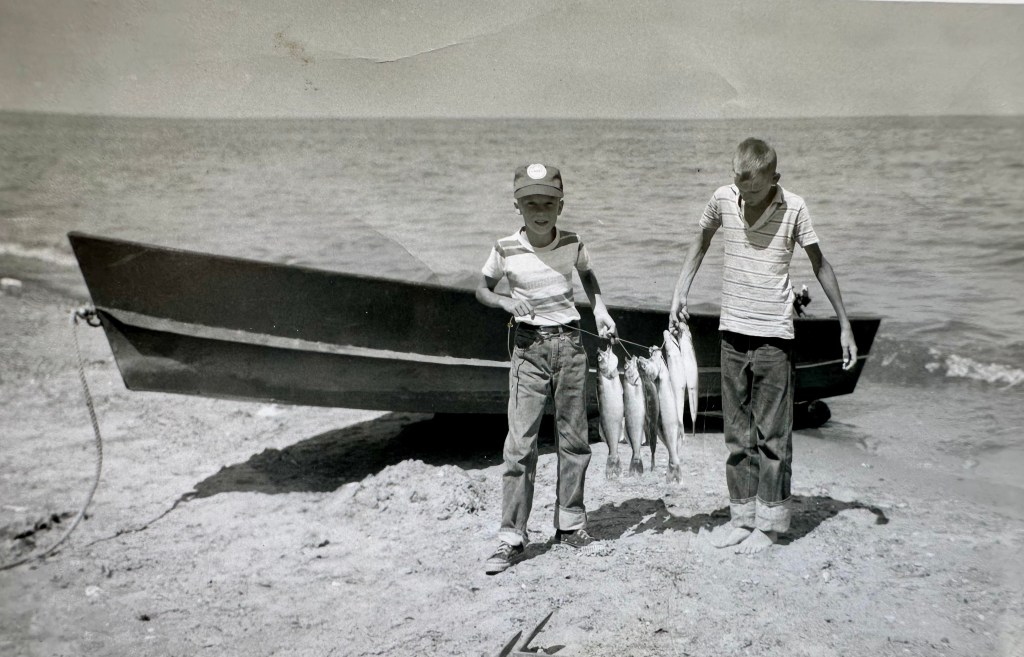
My older brother and I hauled in the walleye. Photo by Bruce Stambaugh
I fondly remember my family vacations in the 1950s and ’60s. I vividly recall them because we didn’t take many. We were a lower-middle-class family from a blue-collar city in northeast Ohio. My folks didn’t have the money to travel around the country too often, especially with five active and vocal children.
My most memorable trip as a youngster was a week on Pelee Island, Ontario, Canada, in Lake Erie. It was the middle of summer, sunny, hot, and humid.
As a 10-year-old, I was excited about our trip for multiple reasons. First, we had to take a ferry from Sandusky, Ohio, to the island. In those days, no passports or IDs were needed. You just paid the ferry fee and boarded the ship. I remember leaning over the side of the boat that foggy morning to watch crew members load cars and trucks onto the ferry.
Our dear mother couldn’t bear to watch because the drivers had to ease the vehicles from the dock to the ship over two unattached, thick wooden planks. I paid particular attention when our 1947 cream-colored, two-door Chevy coupe slipped across the void. Even as a kid, I saw that the car wasn’t centered on the planks. Still, it made it.
Our cousins and their parents accompanied us on the trip, along with our mother’s mother. Their three juveniles were nearly the same age as our three oldest. It was a guaranteed good time.
We enjoyed the voyage around other islands and through Lake Erie’s whitecaps. When we sighted Pelee, our excitement multiplied. From a distance, all I could make out were trees. A little cluster of attractive buildings appeared when the ferry drew closer to the dock. We disembarked and waited for our vehicles. I noted a general store with toys in its nine-pane front window during the downtime.
We piled in the car and headed south and then east on dirt roads, swirling dust clouds into the cerulean sky. As he drove, our outdoorsman father spotted pheasants in fields on the way to our little cottage without slowing down. How we all managed to fit into that two-bedroom, one-bath lake house, I don’t know. As a kid, it wasn’t my problem.
That week’s weather was sunny, hot, and humid, perfect for eight children ages four to 14 to play on the beach that served as our front yard. We enjoyed wading in the warm Lake Erie water when the tide went out. We built sand castles and took turns burying one another in the sand.
We spent hours scouring the beach for sea glass. My young mind couldn’t comprehend how the combination of water and sand could smooth sharp, jagged broken glass. I held the evidence in my hand, nevertheless.
A trio of fishermen rented the cottage south of ours. They used a beautiful wooden Lyman boat with an inboard motor to come and go. One afternoon, the fish must not have been biting because the boat came charging in at low tide.
Even as a kid, I could see by the men’s actions that they were drunk. One guy even fell overboard into the shallow water. Of course, the high-speed approach mired the boat into the wet sand. No matter how hard they tried, the boat wouldn’t budge until the tide came in.
Later, with the boat freed, I moseyed down the beach and found a silver cigarette lighter reflecting the afternoon sun in the clear, shallow water. A cigar lay nearby on the beach. Its paper wrapper with a bright red band still secured the stoggy. My uncle confiscated both when I revealed my treasures at the cottage.
Our father and uncle frequently went fishing for crappies and walleye. When the schools of fish moved a few hundred yards directly offshore of our cabin, my dad and uncle caught enough to feed the entire crew. The delicate white meat of the pan-fried fish filled our hungry bellies.
While our fathers fished, our mothers and grandmother watched us play hour after hour on the sandy beach. Those were the days before sunblock, and apparently, no one remembered to bring along suntan lotion. Before the week was over, the four oldest boys, including me, moaned and groaned in a darkened bedroom. The severe sunburns halted our lakeside romping. We were sore all over, unable to find a comfortable position to rest.
Still, it had been a memorable week. To top it off, our parents remembered the general store with toys. My eyes lit up when I saw the rotating stand displaying several kinds of English-made Matchbox toys. There was no plastic to be found in these miniatures of reality, and they were only a dollar each. I was ecstatic because our parents had given each of their five children a dollar before entering the store. So, I took my time and finally decided on an English-style fire truck as the ferry horn sounded for people to board.
We scurried to the dock across the road, and I carefully clutched my prize, not wanting to crush the colorful cardboard matchbox containing my precious purchase. I bid Pelee farewell as we walked up the ferry’s ramp for the return cruise to Ohio.
It had been a memorable week of fun in the sun, filled with ferry rides, fresh fish, and playing in the water with my siblings and cousins. Those pleasures successfully blocked the short-term memory of my painful sunburn.
These well-worn Matchbox toys are the only ones I have left. Photo by Bruce Stambaugh
Thistle blossoms ready to flower. Photo by Bruce Stambaugh
When I awoke, I noticed the ripples of the morning’s mackerel clouds glowed pink. I headed for a location with an open view to the east. Arriving a few minutes later, the colors had dimmed but were still lovely.
I hustled to a high point on a paved trail that separates a golf course and an overgrown field. I snapped several shots of the sunrise but quickly became distracted by all the bird calls.
When I turned to find the Indigo Bunting, this stand of ready-to-bloom thistles caught my focus. I was struck by the faint kiss of the day’s sunrise on the thistle’s buds. The embrace was subtle but evident nonetheless.
I never did find the Indigo Bunting, however.
My initial view of the morning’s beauty. Photo by Bruce Stambaugh
Like many Mid-West and eastern U.S. areas, the National Weather Service issued a Heat Advisory for Virginia for today. Many urban areas have Excessive Heat Warnings for heat indexes well above 100.
People without air conditioning, and especially the homeless, have to find ways to stay cool. Many have nowhere to turn unless agencies or regular institutions intervene. Individuals can make a difference, too.
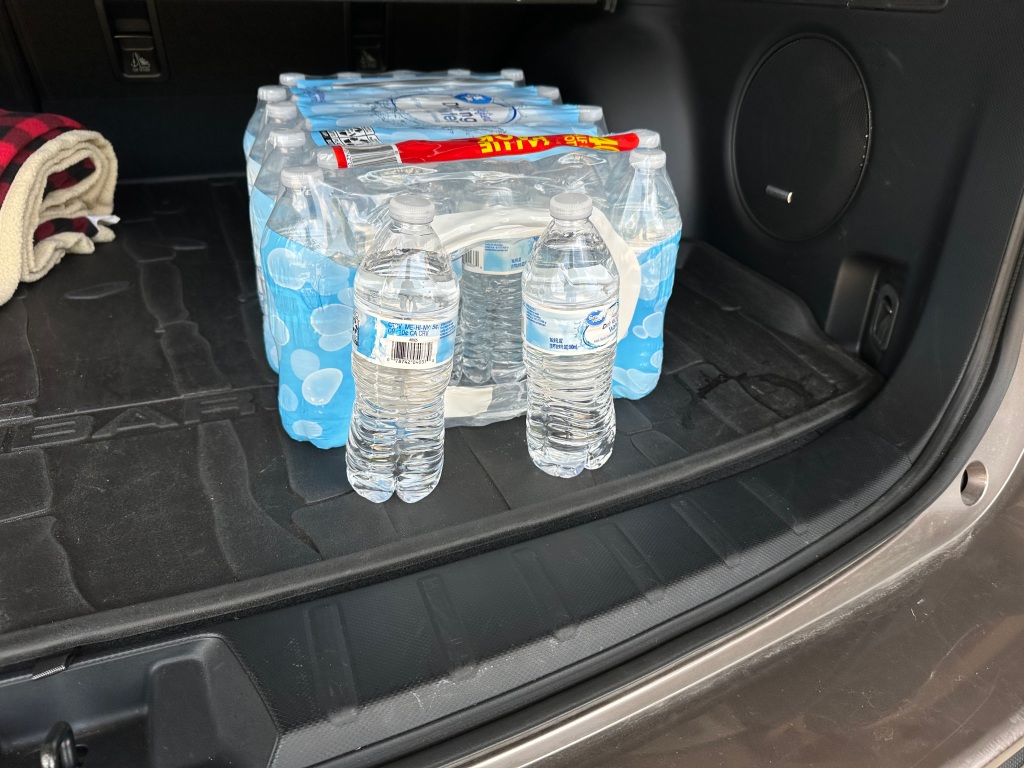
As I write this, it is currently 96 degrees Fahrenheit, but it feels like 103 when the humidity and dewpoint are factored in. This morning, I drove to downtown Harrisonburg, Virginia, where we live, and I distributed a case of bottled water to folks who needed it.
Because Harrisonburg is a small metropolitan area, I knew where to go, where the homeless hangout. However, I had to hunt for them because they were already seeking shelter wherever they could find it.
I found several people gathered under small shade trees, their few belongings stuffed in shopping bags, duffle bags, and backpacks. As I approached the largest group huddled under the larger tree, one of the men came out to greet me and offered to help me with the carton of water.
I simply handed it to him with the instructions to make sure everyone got what they needed. He thanked me and said he would. As I pulled out of the parking lot, I saw the same man distributing bottles of water to those under the other tree closer to the road. I smiled and waited until he had finished before driving away.
I am not sharing this to brag. I am posting this in the hope that those of you reading this post will do likewise in your own community. When the opportunity to help others arises, respond appropriately and humbly in ways that people’s needs are met. It’s the right thing to do.
The gang of volunteer sunflowers. Photo by Bruce Stambaugh
What better way to celebrate the Summer Solstice than to feature sunflowers?
We were fortunate to have volunteer sunflowers sprout up in our backyard flower garden this year. Seeds dropped by birds or buried by squirrels from one of my birdfeeders created these wonders.
At first, the gang of neighborhood rabbits nibbled the tender leaves. But apparently, there were so many sunflower shoots that the bunnies couldn’t keep up. Consequently, for the first time in the seven years we have lived in Virginia’s Shenandoah Valley, we have a helter-skelter stand of sunflowers.
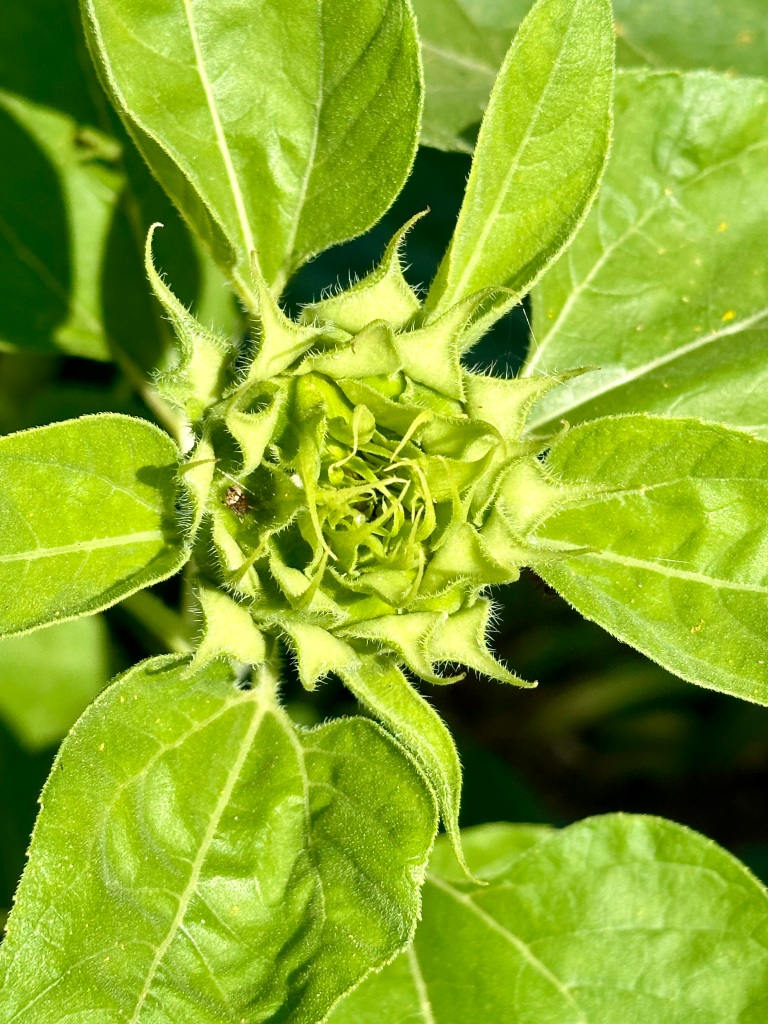
I have enjoyed watching them grow so quickly in the string of warm days and nights we have experienced. As the flowerheads began to form, their various shapes, textures, and swirling patterns intrigued me. At the corner of our back porch, pure art in nature flourishes.
Ants, bees, butterflies, flies, wasps, and other insects depend on sunflowers for nourishment. See how many different creatures you can spot in this series of photos.
Please click on the photos to enlarge them.
How long will it be before the American Goldfinches and other seed-eating birds begin to dismantle these living sculptures in the quest for fresh, tasty seeds?
Whenever I visit Lakeside, Ohio, I always head to the dock around sundown. Even if it is cloudy, I never know what to expect.
Two blocks from the shore, the sky looked promising for another spectacular sunset. When I reached the dock, however, I noted the thick cloud bank to the west. Given past experiences at Lakeside, the Chautauqua on Lake Erie, I hung around.
Part of my interest was in the crashing waves driven by a strong northwest wind. Lakeside is on the western end of the lake, where Erie’s waters are the shallowest. Consequently, strong winds play havoc with the water, causing continuous erosion to Lake Erie’s southern coast.
The dramatic show of the wild waves assaulting the cement dock distracted me from the setting sun. A break in the clouds, however, gave me a shot at capturing a sunset.
The sun peeked through an opening in the clouds and sent a crepuscular ray upward, where it illuminated a high cloud. The fury of the waves colliding with the dock created a mirror-like reflection of the evening’s sun.
The lane to Sunny Slope Farm. Photo by Bruce Stambaugh
Sunny Slope Farm is a popular venue for weddings, banquets, fundraisers, and other gatherings in Harrisonburg, Virginia.
I go there to shoot sunset photos during all four seasons. They are friendly folks, for certain. It’s less than a mile from my home, which makes it handy for me if the western sky suddenly erupts with a stunning sunset.
Such was the case recently. I captured the above photo before the sunset peaked. The lane goes west and then turns sharply southwest, where this image was shot. Ironically, the southwestern sky was brighter than that of the west.
The combination of the fence and the farm lane leads the eye right to the old farm buildings. With all the clouds, the photo had to be taken in low-light conditions.
Crepuscular rays at sunset. Photo by Bruce Stambaugh
I was ready to give up on this sunset that had looked so promising. A layer of clouds hung above the Allegheny Mountains, creating a narrow break in the sky. I hoped for a brilliant sunset, but most of the color was in the southern sky.
I’ve learned to be patient, though. Long after the official sunset time, these crepuscular rays suddenly appeared. Crepuscular rays often occur at twilight and are created by sunlight shining through gaps in the clouds.
The rays created a sharp contrast between light and dark. In this case, the sun turned the rays terracotta and brightened the evening sky for a brief time. The local landmark of Mole Hill stood dark in the foreground.
My wife and I are still exploring Rockingham County, Virginia, where we have lived for seven years. That may sound hard to believe, but Rockingham is the third-largest county in Virginia. It covers 853 square miles, so there’s a lot of area to see.
We recently toured with friends an area of the mostly rural, agricultural county that we had never seen before. They were as curious as we were.
We chose the remote northwest section, where wildfires scorched thousands of acres of mountainous terrain in the George Washington National Forest during the first week of spring. We were pleasantly surprised with what we found.
Recent rains have greened up most of the area, with only a few burned spots visible from roadways. Thanks to firefighters’ efforts, an abandoned cabin was the only structure burned.
The areas of Bergton and Criders are set in a wide-open, fairly flat valley floor surrounded by mostly deciduous forests. It was a lovely scene.
The background of wooded hillsides and the building storm clouds behind this abandoned schoolhouse made an idyllic landscape portrait. It was one of many finds of the day.
A pair of squirrels on our Red Maple tree. Photo by Bruce Stambaugh
This pair of squirrels was just hanging out in our front yard on a warm spring day recently. While one chowed down on breakfast from a birdfeeder, the other basked in the morning sunshine.














 Roadkill Crossing
You must be logged in to post a comment.