Heading down Route 66

grandcanyonbybrucestambaugh
The Grand Canyon, one of the many destinations made more accessible by U.S. Route 66.

By Bruce Stambaugh

U.S. Route 66 is legendary. Built in 1926, the highway that connected Chicago with Los Angeles helped to open up the western United States, especially after World War II.

Officially tabbed “The Will Rogers Highway,” the concreted, two-lane road became so popular that it quickly took on another moniker, “the Mother Road.” The highway enabled many Americans to access locales they had only heard of or dreamed about.

Many took to the famous road to visit historic sites, national parks, or tickle their toes in the southern California surf. Hundreds of service oriented businesses, restaurants, gas stations, motels and the like, grew once sleepy towns into expanding cities.

After Bobby Troup took a trip from Pennsylvania to the west coast on the road, he penned a now iconic song about his experience. “Route 66” is still a familiar song.

Today tourists from around the world travel as much of the original route that remains, too. They want to relive what life was like before the road was decommissioned as a U.S. highway in 1985. The establishment of the Interstate Highway System spelled doom for the romanticized route and the cities and businesses through which U.S. 66 traversed. Radiator Springs, the fictional town in the movie “Cars,” is used as an example of how the Interstate Highway System affected so many small towns across the southwest.

I have traveled on only a few sections of the famous route. My late father, however, had a very personal and memorable connection to U.S. 66. It was the road he and two other sailors drove home following their discharge from the Navy at the close of World War II.

I remember Dad telling me about a restaurant owner in Texas who helped them out. As they drove east along U.S. 66, Dad and his traveling companions kept seeing billboards for a restaurant that advertised serving “the largest steak in Texas.”

Of course the trio decided to check out the claim. Still dressed in their Navy whites, they had little money. Glad for their service to country, business owners often gave them discounts or even free food at places where they stopped.

This restaurateur was no exception. Never one to be bashful, my father approached the restaurant’s owner, and told him they had seen his many billboards along the road. Dad point blank asked him if his largest steak claim was true.

Impressed with their enthusiasm and their military service, the owner gave all three men a free steak dinner. Dad said it was indeed the largest steak he had ever eaten.

So why am I telling you all this about a road that doesn’t exist anymore? I blatantly used this nostalgia to make a simple, metaphoric point. I’m beginning my own journey on 66. I’ll soon be that age. Our birthdays are important after all. We only have them once a year.

Since I was a kid, I have wistfully declared that I would live to be 100. I had no way of knowing that of course. It was just my way of saying I enjoy life, and want to live it as vibrantly, as long, as well, and as purposefully as possible.

I feel very fortunate indeed to have completed nearly two-thirds of the way to that century mark along life’s bumpy highway. I don’t know if I’ll reach that lofty milestone or not, but I am going to give it my all trying. I still have a lot of living to do.

This year I’ll travel down my own personal Route 66. For in the masterful words of the beloved American poet Robert Frost, “I have miles to go before I sleep.”

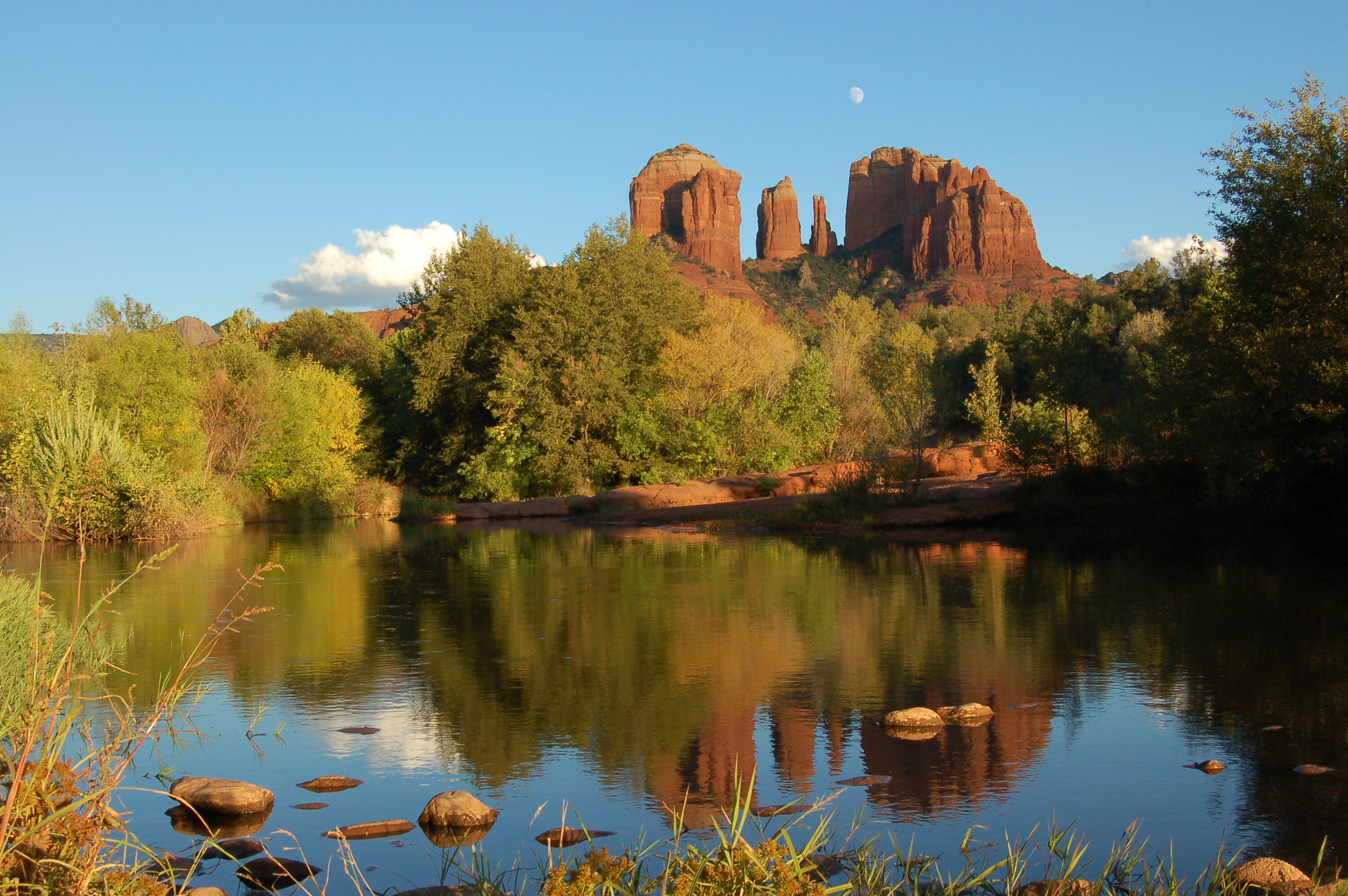
cathedralrockbybrucestambaugh
Cathedral Rock from Oak Creek Crossing, Sedona, AZ.

© Bruce Stambaugh 2013

Finding gratitude from on high

fromjeffersonrockbybrucestambaugh
The view from Jefferson Rock of the confluence of the Shenandoah and Potomac rivers.

By Bruce Stambaugh

There are times when a life experience far exceeds our expectations.

I had just such an encounter recently on a junket my wife and I made to Harpers Ferry National Historic Park in extreme eastern West Virginia. This tiny, old town had played a small but important part in our country’s big history.

On a precipice 800 feet above the confluence of the Potomac and Shenandoah rivers, more flowed together for me than two charming waterways. I had previously seen scenic shots of historic Harpers Ferry from this vantage point in Maryland, and had fancied a few of my own. I departed with more than picturesque photos.

The beauty of the bright morning itself was stunning. I basked in the warmth of the morning sunshine looking down on history. The strengthening sun drenched the charming village in a golden wash. It was a map come alive where famous Americans had all made important imprints on our country’s checkered history.

confluencebybrucestambaugh
A Great Blue Heron preened in the morning light at the confluence of the Potomac and Shenandoah rivers.

The three-mile hike from Harpers Ferry to the overlook was exhilarating. A hint of haze hung above the surface of the churning rivers on the cool morning.

My goal was to arrive at the scenic overlook opposite the town as the day’s sun rose above the Appalachian foothills. I crossed the footbridge, a part of the Appalachian Trail, which paralleled the bridge of the railroad tracks. The tracks split at the town and followed the two majestic rivers, one south, the other west.

Once across the Potomac, its melodious rapids singing all the while, the Appalachian Trail followed the river and the old C & O Canal east. I walked west along the towpath to the trailhead that led up the rocky, forested hillside.

I couldn’t imagine how soldiers, Confederate and Union alike, had muscled heavy artillery up these steep slopes. Massive rock outcroppings protruded everywhere beneath the hardwood forest. The rich greens of mountain laurel and cedars complemented the coloring leaves of the mixed deciduous trees.

I arrived at the overlook in less than an hour. The view, as Thomas Jefferson once declared, “was perhaps one of the most stupendous scenes in Nature.”

As I sat on the cool rocks I looked down on the spot where John Brown had made his ill-fated raid in 1859. I envisioned Jefferson, George Washington, Robert E. Lee, Thomas “Stonewall” Jackson and all the others who had made their lasting marks there striding along the slanting, narrow streets.

Harpers Ferry was a strategic town in the Civil War since it housed the federal arsenal. Both armies occupied the town intermittently during the war. It was the sight of the largest surrender of United States troops in the Civil War.

Behind me birds of the forest searched for breakfast amid golden, backlit leaves. Carolina Wrens, chickadees, cardinals, robins, Tufted Titmice, White-breasted Nuthatches and Brown Creepers scavenged the forest floor and trees.

A Black Vulture sailed west above the Potomac just off of the cliff. A Red-shouldered Hawk, its black and white striped tail fanned out, glided east. Beneath me a freight train rumbled through the tunnel, across the bridge and whistled past the old station.

I had gone up to the sheer cliff for some pictures. I came down with a renewed spirit of gratitude for all that has transpired and will transpire in my life, in our lives.

Together we have a lot for which to be grateful this Thanksgiving.

harpersferrywvbybrucestambaugh
Harpers Ferry, WV from the Maryland Heights overlook.

© Bruce Stambaugh

No rainy days at Lakeside, Ohio

lakesideohiobybrucestambaugh
From sunrise to sunset, the area around Lakeside, Ohio’s dock is where the action is.

By Bruce Stambaugh

There’s never a rainy day at Lakeside, Ohio, making it the perfect summer vacation spot for all ages.

Sure, it rains at Lakeside. It’s in Ohio after all and on the shallow, sometimes precarious south shore of Lake Erie. That doesn’t mean the weather puts a damper on vacationing visitors, some who come from California and other foreign countries.

The weather, no matter how fierce, can’t quash Lakeside’s infectious community spirit. Sunshine or downpour, you can witness Lakesiders being Lakesiders wherever you go in the little resort town populated with quaint cottages and genial folks.

If it does rain, which it did on more than one occasion during our latest week in the Chautauqua on Lake Erie, no one dismays. Plenty of great activities await, with gaggles of polite people to encounter.

lakesidecottagebybrucestambaugh
Steamboat style cottages dot the streets of Lakeside, Ohio.

The new splash park is a cool hit with youngsters on a hot summer’s day. If the weather denies them that chance, you can likely find them sitting on one of the many inviting front porches that distinguish Lakeside cottages and homes.

A wise, gray-haired grandma centers a wicker loveseat, arms embracing grandchildren. They read aloud, do word games, Sudoku, or tell family stories, true and otherwise.

If three generations can’t enjoy a rousing round of miniature golf under the canopy of old-age hardwoods, the family won’t grow bored. They might turn to board games, Scrabble, chess, checkers, or Monopoly.

Thanks to its Chautauqua pillars of religion, education, arts and entertainment, and recreation, Lakeside is known for many engaging activities. Since 1928, shuffleboard has topped the sporting list historically.

Tennis, too, has its fair play at Lakeside. Families, couples, teams, and playing partners ply clay and paved courts for fun and competition.

Should it storm, chairs soon form a tight ring around antique dining room tables, cards are shuffled, and the competitive spirits are expended differently. Instead of power drinks to keep them going, homemade sweet tea and lemonade hit the spot.

Around the two-mile jogging trail that rings Lakeside’s boundary flows a steady stream of fitness. If the weather is too ugly to brave, brainpower replaces muscle power through summer reading or a spirited round of dominoes with family, friends and visitors.

The Lakeside dock is the centerpiece of the summer sun worshippers. Young swimmers, sailors, fishing generations and sun soakers congregate to do their things. In the event that the dock is closed due to inclement weather or northerly gales that swamp the cement pier with crashing waves, alternative plans are made with few complaints.

The handful of Lakeside’s eclectic restaurants and niche cafes, where scores of high school and college students earn a summer’s wage, offer plenty of fare and latitude to accommodate all. Patience whets the appetite for homemade donuts and refreshing ice cream.

Even on the sunniest of days, hundreds of folks hungry for other kinds of food are filled to capacity by the rich stories offered by the weekly chaplains. It’s as cerebral as it is churchy.

Weather-resistant, creatively designed indoor activities abound for children, while adults pick and choose between lectures, programs and displays. Nearly every week, some sort of special community function is offered.

Evenings bring out a large portion of the town’s population for a medley of performances in historic Hoover Auditorium. Others linger dockside basking in the glow of another inspiring sunset, sometimes only minutes after the end of an all-day rain.

Rain or shine, there really are no rainy days at Lakeside, Ohio.

lakesidesunsetbybrucestambaugh
Watching the sunset from the dock is part of the Lakeside tradition.

© Bruce Stambaugh 2013

Like it or not, beach vacations rule

atthebeachbybrucestambaugh

By Bruce Stambaugh

If I had to choose between vacationing in the mountains and spending a week on the beach, I would always head to the mountains. But you don’t always get your way in life, especially when consistently out-voted three to one in a democratic family.

I thought about that recently while relaxing, you guessed it, on a beach. A towheaded little girl jumped in glee as the next lapping froth of a broken wave tickled her toes. The roar of the crashing surf drowned out her joyous squeals.

challengingthewavesbybrucestambaugh
Our four-year-old granddaughter was fearless at the beach.

Sandy-haired young boys, already tanned from summer baseball games, challenged the powerful surf head-on and lost. Deposited several feet down shore, the pair still celebrated in the foamy residue. The gamey boys shook their heads like wet dogs, and went back for more.

The excited little girl and the rollicking boys were our grandchildren. Watching them soak up the benefits of a beach vacation scarcely differed from the memories of our own daughter and son savoring the seashore when they were young. The infectious laughter and shrieks of oceanic ecstasy displayed by the grandkids perfectly mimicked those of our son and daughter.

Clearly, the family beach vacation tradition continues. The seashore in the summer is always mesmerizing. Senses are invigorated.

capehatteraslighthousebybrucestambaugh
The Cape Hatteras Lighthouse is an iconic symbol for vacationers on North Carolina’s Outer Banks.

The sight of whitecaps frosting the rolling water, the sound of wave after wave pounding the beach, whiffs of salty sea air, the texture of gritty sand beneath your bare feet, incredible sunrises and awesome sunsets, animated shorebirds, and picturesque lighthouses soothe even the harshest of souls.

Growing up, our children certainly had plenty of opportunities to catch ocean fever. Once the kids were old enough to enjoy extended trips, the beach seemed to be the destination of choice, no matter what dad suggested. We fitted in informative historical spots and intriguing geographical venues in route to the shore. The beach, however, was the main allure.

Our family beach escapes could actually serve as a partial chronology of our life together.

The first such jaunt was to Ocean City, New Jersey. The kids were hooked, on the beachy benefits, not the historic landmarks of Philadelphia, Pennsylvania that we visited on the way. Intriguingly, our son-in-law and his family had vacationed there, too.

siestakeybeachbybrucestambaugh
Sarasota, Florida’s Siesta Key Beach is rated one the world’s finest.

After that we did Myrtle Beach, South Carolina, and Cocoa Beach and Siesta Key Beach in Florida. Each year the kids upped the ante in where they wanted to plop their beach blankets. Eventually, it was California here we come.

I was all for visiting the left coast of the country. It truly would be a family vacation since both my wife and I had relatives and friends in the Golden State.

Besides, this would provide an excellent opportunity to get the family into some real mountains, Yosemite National Park being the main destination. Though they wouldn’t admit it then, our son and daughter loved Yosemite as I had hoped they would.

summersolsticesunrisebybrucestambaugh
The Summer Solstice sunrise on the Outer Banks was a beauty.

Still, it was being on the beach with their cousins that drew them. Our children were pleased until they hit the water at Huntington Beach. Even though we were in southern California, the ocean was a bit too chilly for swimming. Nevertheless, they soaked up the Orange County suntan time and the lively interacting with their kin.

Another crashing breaker swamped the grandsons. Their fair-haired sister kept building her Outer Banks sand castle. I continued to snap the camera’s shutter capturing the unfolding fun while I mentally recalled the many pleasant scenes on the beaches of our family life.

buriedinthesandbybrucestambaugh
Being buried in the sand is a part of every beach vacation.

© Bruce Stambaugh 2013

Have hat, will travel

hatsbybrucestambaugh
Some of the hats in my utilitarian collection.

By Bruce Stambaugh

People collect all kinds of things when they travel. Post cards, plates, jewelry, T-shirts and mugs are popular items. Souvenir shops in any touristy locale confirm that.

Me? I collect hats, more out of necessity than sentimentality. Given my lack of hair, I call it BPS (Bald Protection Syndrome). At least I have a practical use for my hat hobby.

BPS is the only way I can explain my obsession with hats. Baseball caps, golf caps, air-cooled hats, even a cowboy hat, define my collection.

It dawned on me that my assortment of hats really represents a segment of my personal history. I look at a hat, and I can usually recall where I bought it or in some cases, like the cowboy hat, who gave it to me.

hatrackbybrucestambaugh
Not a spot to spare on my hat rack.
The hats hang on an oak hall tree that a dear friend made for me. The hall tree stands in a corner beside my bed. The hats are the first things I see in the morning and the last at night, keeping the memories fresh in my mind.

The brown, broad-brimmed, pressed velvet Stetson cowboy hat occupies the pinnacle of the hat holder. That’s no coincidence. My daughter and her family gave it to me as a present several years ago when they lived in Texas. I wear it only on rare occasions.

I collect hats the way Imelda Marcos saved shoes. Each peg of the faithful hat rack is full of hats and memories. The hats come in different shapes and colors, but most are ball caps. All generate vivid recollections.

I have too many from a favorite vacation spot, Lakeside, Ohio. I don the bright yellow hat with a big blue block letter “L” on the front most often.

Perhaps some of my favorite hats are the ones I acquired while participating in some special activity. I have a handsome brown cap with the sun rising over the profile of a mountain, all stitched in white. I got that one at the state park where I once hiked and birded in Arizona.

Another hat I wear a lot is the one I received for attending a birding symposium. It should come as no surprise that the hat features a bird on the front.

Still another hat I obtained in Arizona and bought especially for birding is a lightweight, broad-brimmed, air-cooled canvas hat. I only wear it when it’s hot or when we go to the beach with the grandkids.

Two hats in my collection have extra-special meaning to me. I purchased both in Honduras. One is bright red with orange lettering that spells out the name of the poor Central American country.

meandmyhatsbybrucestambaugh
I’m happiest in hats.
The other Honduras hat is black with a red rooster on it, which is very apropos. As unstable as the Honduran government is, I think the roosters actually run the country. They are everywhere and don’t bother to wait for the sun to rise to announce their presence.

The pride and joy sports hat in my collection is bright red with a raised deep blue block “C” on the front. I wear it when I attend Cleveland Indians games to show my support for the often-hapless team. Wearing it may also reveal other blemishes in my character.

Some people collect stamps, others coins or antiques or teacups. I collect hats. Each one has a story and a special meaning.

Vacation season is here. More travel, more memories, and more hats ahead.

© Bruce Stambaugh 2013

When an ill wind blows, persevere

sunnybutcoldbybrucestambaugh
Even sunny days that looked warm were chilled by persistent winds.

By Bruce Stambaugh

The cold and wet of winter and early spring seemed to be unrelenting. The constant breezes made already cold days seem even more so, and damper than they really were. It felt like the wind had blown nonstop since Thanksgiving.

To paraphrase John Heywood, who first penned the words in the 16th century, “It’s an ill wind that blows nobody any good.” That’s the way I thought of the many persistent gales that delivered us storm after storm for four months.

We here in northeast Ohio have endured a variety of weather elements for too long. Snow, sleet, freezing rain, ice, fog, torrential rains, flooding, and bone chilling temperatures have all been part of our weather menu. However, it has been the relentless wind that has been the most bothersome. It made even a sunny spring day seem like February all over again.

Day after day the icy wind seemed to go right through you. It was that bad. As much as I love weather, I had about had it with the unyielding gales.

coldplowingbybrucestambaugh
Amish farmers have had some raw days to do their field work this spring.

I am glad, however, that the wind does aid farmers by drying out the mushy soil so planting can begin. But I pity the many Amish farmers who have had to spread, plow, harrow, and plant in the endless blusters. They and their trusty draft horses had to be freezing.

There’s another hazard to wind. Wildfire danger increases when steady breezes dry out already brittle dormant foliage and grasses. That’s one reason why spring’s quenching rainfalls are so welcome, even if they are accompanied by nasty winds.

On a recent trip to visit friends in Leamington, Ontario, a steady wind buffeted our van on the trip north. Along the Ohio Turnpike we spotted a Bald Eagle soaring against the northwest wind over an open field in search of prey.

windyyardworkbybrucestambaugh
Brisk yard work of cleaning winter’s deposits of debris still required coats and gloves in Ohio this spring.

We discovered that the weather in Ontario, including the wind, hadn’t been any better than ours. Indeed, we wore sweaters and jackets during the extended weekend.

The only exception was our last day there, Monday, April 15. That day dawned in beauty and quiet. The sun shone brightly as we said goodbye to our friends.

By afternoon as we reentered the U.S., the wind had once again picked up. At least it helped push us homeward as we traveled.
I was glad to see the sun, and feel its welcome warmth. Perhaps the stubborn winter weather systems that brought the chilling blustery northwest winds had finally been broken.

Shortly after 4 p.m. I turned on the van’s radio to listen to the news. From the announcers’ demeanors we knew that something serious had happened, only neither my wife or I were clear as to what the problem was. As we listened, we learned of the bombings in Boston.

Like most good people of the world, we were horrified. It was an ill wind no good citizen could ever have anticipated.

Tolerating a persistent cold wind is one thing. Enduring a terrible, intentional act of violence is another concern altogether.

We must live our lives as best we can, embracing each new day with gusto, hope and a fearlessness that no harsh wind, natural or man-made, can destroy.

hopefulsunrisebybrucestambaugh
© Bruce Stambaugh 2013

Anticipating one thing, finding many

predawnlightbybrucestambaugh
The predawn light at 6:38 a.m. on Feb. 1, 2013 on Main Beach, Amelia Island, FL.

By Bruce Stambaugh

I stood on the beach bathed in the pale pre-dawn light. I had gone there to photograph the sunrise over the ocean.

The air was chilly, but unusually still for the seashore. The Atlantic shimmered, uncharacteristically placid. With the tide in, the waves rolled gracefully onto the shell-strewn shore.

I wasn’t the only human on the beach at 6:45 a.m. A few other brave souls were also out before sunup. A silhouette jogged in front of me. Another walked the water’s edge towards me in a hitched gate.

earlyjoggerbybrucestambaugh
An early jogger zipped by me in the half-light along Main Beach, Amelia Island, FL.

All the while, I snapped away, capturing the thin orange line that divided the dark violet sea from the turquoise sky. I wanted to digitally document the gradual, subtle color changes of the new day’s sun.

We few humans weren’t alone as the sky slowly brightened along the beach.

Groups of first year shorebird chicks scurried at water’s edge, probing and pecking for food. Careful not to get their tiny feet wet, they darted at the ebb and flow of the frothy wavelets.

youngshorebirdsbybrucestambaugh
Young shorebirds feed at the ocean’s edge.

Not far off shore, Northern Gannets fished for breakfast in their dramatic style. They circled with their long pointy white wings marked black as ink at the tips, and then plunged into the seawater. Satisfied, they again ascended and started the process all over again.

A little further out a pod of dolphins arched in and out of the water. Their fins revealed their foraging path.

faceoffonthebeachbybrucestambaugh
A gull and a Willet faced off on Main Beach in the early morning light.
A lone Willet snagged a snail from beneath the sand. Seeing an opportunity for a freebie meal, a Ring-billed Gull unsuccessfully chased after the skinny-legged bird. The Willet swallowed the morsel before the gull could steal the bacon.

Flocks of Black Skimmers winged just above the ocean surface, their lower beaks breaking the water in their feeding. They were out of sight in seconds.

By now, the lady with the gimp caught up to where I had stood for 20 minutes. Seeing that I had a camera, she berated me for standing pat, and beckoned me to where the water lapped at the firm sand. It was there that the best color reflected in the receding water and against the few clouds in the northeast sky.

pastelskybybrucestambaugh
Clouds to the north beautifully reflected the rising sunlight.

As we admired the pastel radiance together, a whale broke the water. This unexpected find disappeared and our eyes searched until the first of many waterspouts blew high into the air.

humpbackwhalebybrucestambaugh
Birds circled above the Humpback Whale, making it easier to follow with the naked eye.
The blow spouts drew my attention to a congregation of gulls circling above the whale like an avian tornado. They simplified our whale watching. Just follow the birds, and glimpse the whale. I later learned that it was a Humpback Whale, my first ever whale sighting.

Amid all this activity, I continued to snap picture after picture of the ever-changing sunrise. Just as the sun finally peaked above the horizon, yet one last gem sparkled.

I would have missed it if it hadn’t been for the older lady from New York. She pointed out the sun’s low-angled rays glistening in the crest of the waves as they broke upon the shore. They were golden jewels in an aqua crown.

I remembered seeing the effect in paintings and thought the artists had overdone it. Now I knew they hadn’t. In precious minutes, the bejeweled waves disappeared, replaced by white-capped cousins. The sun was ablaze, bathing the seashore with its warming light.

I had gone to the beach to take pictures of the sunrise. I left enriched with so much more.

jewelsinthewavecrownbybrucestambaugh
The jewels in the crown of the waves made the sunrise even more spectacular.

© Bruce Stambaugh 2013

Remembering a friend who loved and lived to teach

grandcanyonbybrucestambaugh
The Grand Canyon was just one of many places Paul Sauerbrey introduced me to on our trip “out west” in 1970.

By Bruce Stambaugh

My old friend, Paul Sauerbrey, introduced me to four of our most notable presidents. I met the much larger than life-size George Washington, Thomas Jefferson, Teddy Roosevelt, and Abraham Lincoln at Mount Rushmore in South Dakota.

That was July 1970. I was 22 years old and still wet behind the ears. I went with Sauerbrey, which is what he preferred to be called, and three students on what he termed his annual trip “out west.”

paulsauerbreybybrucestambaugh
Paul Sauerbrey
Prior to this, I hadn’t been west of Toledo, Ohio. Sauerbrey’s introductions on that journey certainly didn’t stop with presidential memorials. He opened my world to travel, whetted my appetite for geography, and showed me first hand just how big and marvelous this great country is.

I was one of the fortunate ones. For many years, Sauerbrey used to take summer excursions from Killbuck, Ohio to the West Coast. He would go with families, students, and other teachers like myself. Having already been to the same places, his main purpose was to teach us first hand about America’s extensive topography and the country’s many cultures.

Sauerbrey got as much pleasure out of observing our initial reactions to encountering the numerous noted locales as he did visiting the places himself. In the space of three weeks, we experienced a diversity of venues, from South Dakota’s Badlands to Southern California’s Disneyland, from Yellowstone National Park to the Grand Canyon.

The trip changed my life. It gave me a perspective on the vastness and beauty of our country that I may never have had if Sauerbrey hadn’t asked me to go along. I’ve been traveling ever since.

There was nothing pretentious or shallow about Paul Sauerbrey. He either liked you or he didn’t, and you definitely knew where he stood, too.

bighornsheepbybrucestambaugh
Paul Sauerbrey got as much excitement out of watching his travel companions making new discoveries, like these Big Horn Sheep, as he did seeing the scenery and wildlife himself.

Sauerbrey was a dedicated and respected teacher. He taught elementary school for 43 years without ever missing a full day of school.

Sauerbrey was an exacting teacher. He was especially particular when it came to English and math, two of his favorite subjects to teach. He could diagram a sentence with the best of them, and expected his students to do the same.

Some thought him a bit too strict of a teacher. As a friend and peer, he simply and rightfully had high standards. Students who could not meet those lofty requirements sometimes found themselves in the doghouse with Sauerbrey.

sauerbreyandkidsbybrucestambaugh
Paul Sauerbrey with our son, Nathan, and daughter, Carrie, when they were youngsters.
To be sure, Sauerbrey had his faults. Don’t we all? He loved to teach and lived to teach. That’s what really matters. In a way, he still is teaching.

Each year several high school graduates benefit from Sauerbrey’s generosity, foresight and commitment to education. He donated a majority of his estate to the Holmes County Education Foundation.

In the 20 years since his death on Feb. 13, 1993, scores of students have been awarded scholarships to assist in the cost of their college education. Sauerbrey saw the importance of having a college degree, especially for students from a rural area. Many students who have received a Sauerbrey Memorial Scholarship have been the first in their family to attend college. They have become doctors, directors, lawyers, educators and first-rate mechanics.

Knowing that fact alone would have made Paul Sauerbrey extremely happy. I can imagine the smile on his face. It’s just like the one he had while watching me recklessly scramble to the top of a rock formation to get a better view of four great stone-faced presidents.

© Bruce Stambaugh 2013

Repeat vacations aren’t so bad after all

beachwalkingbybrucestambaugh
Finding just the right spot to relax on Main Beach, Amelia Island, Florida in January is not a problem.

By Bruce Stambaugh

I used to question the wisdom and practicality of vacationing twice in the same location.

Perhaps my personal wanderlust interfered with my empathy for the travel preferences of others. With so many places to visit locally, regionally, nationally and globally, I reasoned why would anyone want to return to the same place year after year?
Surely the urge to explore and discover had to be greater than the certainty of returning to the same destination at about the same time each year. I’m rethinking that opinion.

I am in a transitional period of my life, intentionally between full time employment and true retirement. I’m enjoying the freedom that comes with a flexible schedule.

harborsunsetbybrucestambaugh
The harbor at Fernandina Beach, Florida offers many a scenic sunset.

I still like visiting new locales, seeing new topography, meeting new folks. I am also beginning to more fully appreciate the contentment of familiarity. I realized that fact recently while my wife and I bathed in the glow of another incredible sunset over the harbor at Fernandina Beach, Florida.

For someone who practically calls Lakeside, Ohio his summer home, it should have been obvious to me. I guess I considered our Lakeside stints more tradition than vacation. Silly me.

We had found Amelia Island almost by accident last year. It was an overnight stop on the way to our true vacation destination, Sarasota, Florida. We liked the island so well we spent two more days there on the way home. We were hooked.

ameliaislandcharmbybrucestambaugh
Charming homes line the streets of Fernandina Beach, Florida.
We loved the island’s charm, its beautiful beaches, its commitment to wildlife habitat preservation, its rich history, and the diversity of activities it offered. We had only skimmed the surface last year. We needed to return to further explore this intriguing community.

Last year the weather, like most places in the country, was exceptionally warm for northern Florida in January. We walked the nearly vacant beaches in t-shirts and shorts. I birded the island’s preserve. We dined on locally caught seafood. We were in paradise instead of Ohio in January. It felt marvelous.

This year we returned to this magical destination for two weeks in order to dig deeper into the island’s many treasures. The weather couldn’t match that of 2012, but we had fun nevertheless. Cooler mornings warmed into pleasant days. Shorts and sandals were only appropriate a couple of days this time around.

eganscreekgreenwaybybrucestambaugh
Egans Creek Greenway offers biking, hiking, fishing and birding on the north end of Amelia Island.

We toured the local history museum, lunched outside at most restaurants, and collected perfect seashells of all sizes and colors. I hiked the paths through Fort Clinch State Park and Egans Creek Greenway enjoying the flora, fauna and breath-taking vistas and spring’s emerging pastels.

My epiphany came while I hustled around the boardwalks at Fernandina Beach’s harbor photographing yet another sunset. A patron sitting at a table of a dockside restaurant hailed me, wanting to know if this was my first time on the island.

ameliaislandstateparkbybrucestambaugh
Amelia Island State Park, at the southern tip of the island, is a great place to relax, walk or fish.

When I innocently replied that it was not and then read the man’s surprised facial expression, it hit me. To him I must have looked like a child on Christmas morning as I dashed around trying to get different angles of the ever-changing colorful sky.
I had taken many, many sunset shots last year. Yet here I was plying for more. Lightning struck. I recognized why people did repeat vacations.

I was relaxed, happy, appreciative, satisfied, if not downright blissful. Amelia Island, Florida in January 2014? Why not? It could become our traditional winter vacation.

beachchairsbybrucestambaugh

© Bruce Stambaugh 2013

Oh, the places I go and the people I meet

snowymountainsbybrucestambaugh
A Manhattan-like traffic jam occurred in the snow-covered mountains of Virginia on our way to Florida.

By Bruce Stambaugh

My wife and I love to travel. It’s a common interest that we’ve had since we met nearly 43 years ago.

We feel fortunate to be at the station in life that allows us to travel when the opportunities arise. Of course we enjoy the various places we visit. We also like the people we meet along the way. We encountered a cast of characters on our latest trip to Florida.

walkingthedogbybrucestambaugh
Walking the dog along Main Beach is a common sight on Amelia Island, Fla.

We have learned that a tank of gasoline will take us to Wytheville, Va., where the gas conveniently happens to be cheaper than most locations. We make it a regular pit stop if you get my drift. This go-round there was only one problem. The previous day’s heavy snow had brought down rural power lines. With no electricity, the pumps weren’t working.

I asked the kind clerks behind the counter where the closest station was with power. They said we had passed it seven miles back. I asked about further south, the direction we were going. They said they knew that Hillsville had power, and indeed that’s where we refueled.

We learned from a brief visit last winter that our destination, Amelia Island, Fla., had equally friendly and helpful people. It didn’t take us long to prove that correct again this trip.

excellentfoodbybrucestambaugh
The food was delicious and the staff very helpful at Kelley’s Courtyard Cafe in Fernandina Beach, Fla.
After settling into our rental lodging, we went to the Happy Tomato Café in Fernandina Beach, Fla. for a late lunch only to discover that the eatery had closed for the day. Not to fear. A staff member came out and steered us to a competitor just down the street. We weren’t disappointed.

The waiter at this café was kind enough to direct us to the local grocery store. His directions were perfect.

On my first long walk on Main Beach on the Atlantic coast, I was photographing a flock of wintering gulls and skimmers. A middle-aged couple and their teenage son apologized to me for disturbing the birds and making them fly. I told them they actually had helped create the picture I had wanted, some birds on the wing, others on the sand.

In further conversation, the couple and their son revealed that they were lettuce farmers near Jacksonville, and rattled off local restaurants that purchased their produce from the local farmers’ market. I indicated that we had sampled the fare of several of them.

outdoorrecreationbybrucestambaugh
Bike riding and para-sailing are just two of the many outdoor recreational activities on Amelia Island, Fla.

Later an elderly man walking his dog on the beach struck up a conversation with me about surfers and para-surfers he had seen. In our protracted discussion, I learned much about the man’s long, productive life as a government contractor.

At the Amelia Island History Museum, it was volunteer guide Paula’s turn. A retired social studies teacher, she was ideal for the job. She rattled off more information than my brain could absorb. I’m glad she didn’t give us a pop quiz at the end of her lecture.

At the Maritime Museum on the waterfront, Don was equally congenial, though more laid back. Retired Navy officers are like that. We spoke as if we were long lost friends. Now we’re just new ones.

rosesfromreedsbrucetambaugh
In Savannah, Ga., Nate made roses from reeds.

On a day trip to Savannah, Ga., we met Nate, who made roses out of reeds for his living, which was modest by any standard.
“Just call me Peanut,” Nate said. And so I did.

My wife and I savor our travels together. We enjoy the outgoing people we meet even more.

harborsunsetbybrucestambaugh
Sunsets are spectacular over the harbor at Fernandina Beach, Fla.

© Bruce Stambaugh 2013

Bay Photos by Donna

Wildlife photos from the Chesapeake Bay region

ROAD TO NARA

Culture and Communities at the Heart Of India

K Hertzler Art

Artist and nature journalist in the Shenandoah Valley of Virginia.

Maria Vincent Robinson

Photographer Of Life and moments

Gabriele Romano

Personal Blog

Jennifer Murch

Art is the only way to run away without leaving home. -Twyla Tharp

Roadkill Crossing

Writing generated from the rural life

ANJOLI ROY

writer. teacher. podcast cohost.

Casa Alterna

El amor cruza fronteras / Love crosses borders