Finding gratitude from on high

fromjeffersonrockbybrucestambaugh
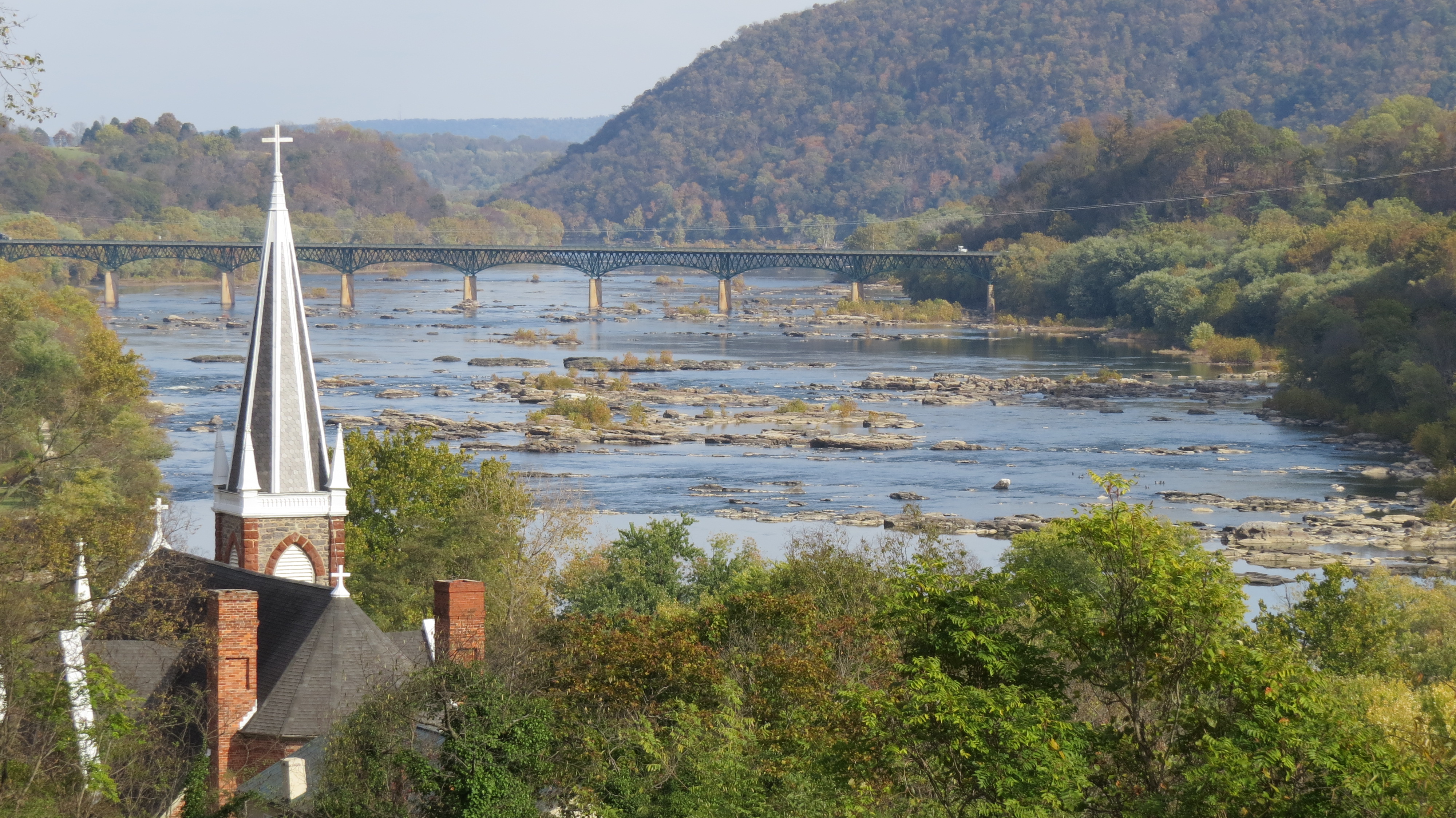
The view from Jefferson Rock of the confluence of the Shenandoah and Potomac rivers.

By Bruce Stambaugh

There are times when a life experience far exceeds our expectations.

I had just such an encounter recently on a junket my wife and I made to Harpers Ferry National Historic Park in extreme eastern West Virginia. This tiny, old town had played a small but important part in our country’s big history.

On a precipice 800 feet above the confluence of the Potomac and Shenandoah rivers, more flowed together for me than two charming waterways. I had previously seen scenic shots of historic Harpers Ferry from this vantage point in Maryland, and had fancied a few of my own. I departed with more than picturesque photos.

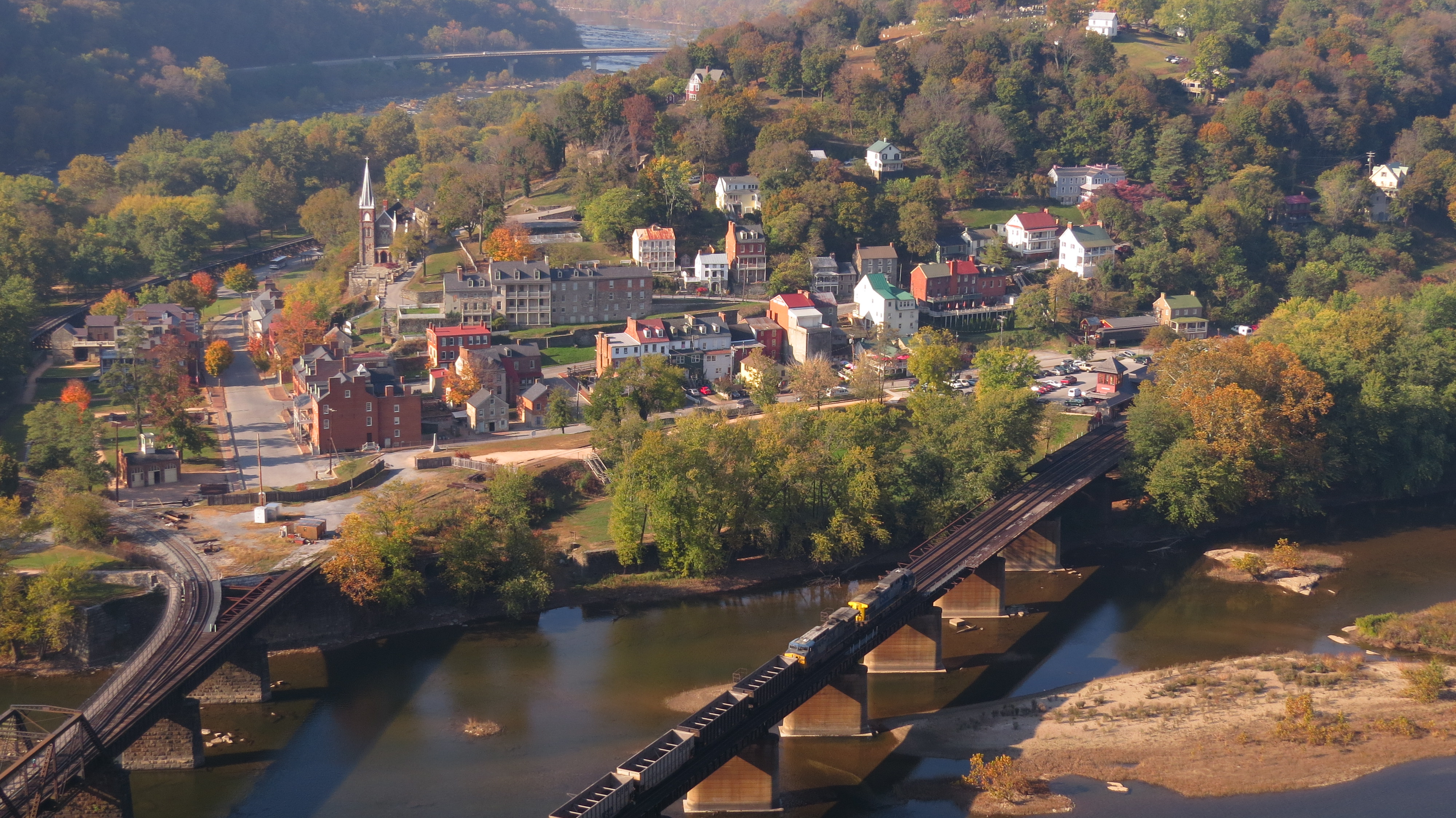
The beauty of the bright morning itself was stunning. I basked in the warmth of the morning sunshine looking down on history. The strengthening sun drenched the charming village in a golden wash. It was a map come alive where famous Americans had all made important imprints on our country’s checkered history.

confluencebybrucestambaugh
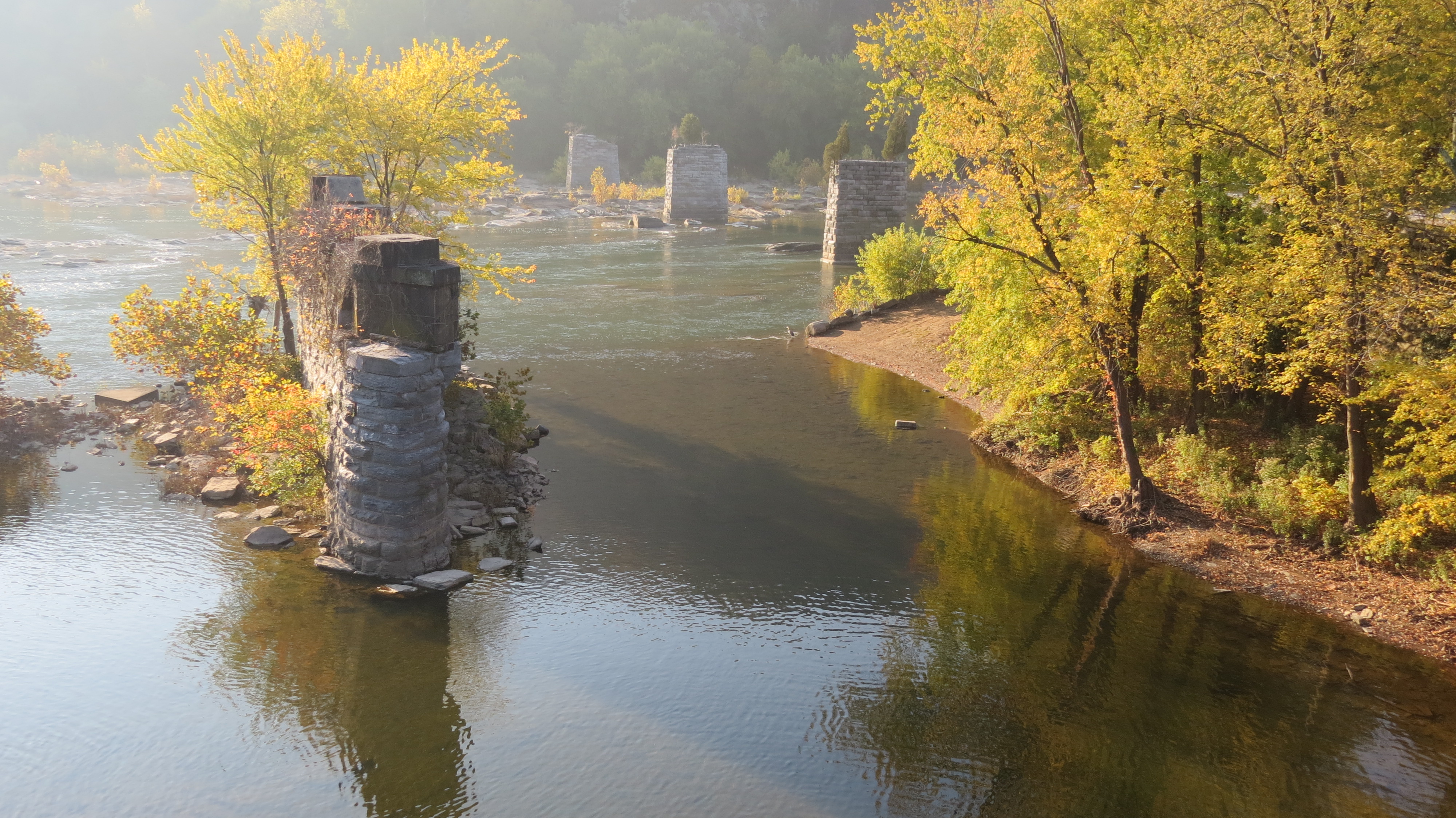
A Great Blue Heron preened in the morning light at the confluence of the Potomac and Shenandoah rivers.

The three-mile hike from Harpers Ferry to the overlook was exhilarating. A hint of haze hung above the surface of the churning rivers on the cool morning.

My goal was to arrive at the scenic overlook opposite the town as the day’s sun rose above the Appalachian foothills. I crossed the footbridge, a part of the Appalachian Trail, which paralleled the bridge of the railroad tracks. The tracks split at the town and followed the two majestic rivers, one south, the other west.

Once across the Potomac, its melodious rapids singing all the while, the Appalachian Trail followed the river and the old C & O Canal east. I walked west along the towpath to the trailhead that led up the rocky, forested hillside.

I couldn’t imagine how soldiers, Confederate and Union alike, had muscled heavy artillery up these steep slopes. Massive rock outcroppings protruded everywhere beneath the hardwood forest. The rich greens of mountain laurel and cedars complemented the coloring leaves of the mixed deciduous trees.

I arrived at the overlook in less than an hour. The view, as Thomas Jefferson once declared, “was perhaps one of the most stupendous scenes in Nature.”

As I sat on the cool rocks I looked down on the spot where John Brown had made his ill-fated raid in 1859. I envisioned Jefferson, George Washington, Robert E. Lee, Thomas “Stonewall” Jackson and all the others who had made their lasting marks there striding along the slanting, narrow streets.

Harpers Ferry was a strategic town in the Civil War since it housed the federal arsenal. Both armies occupied the town intermittently during the war. It was the sight of the largest surrender of United States troops in the Civil War.

Behind me birds of the forest searched for breakfast amid golden, backlit leaves. Carolina Wrens, chickadees, cardinals, robins, Tufted Titmice, White-breasted Nuthatches and Brown Creepers scavenged the forest floor and trees.

A Black Vulture sailed west above the Potomac just off of the cliff. A Red-shouldered Hawk, its black and white striped tail fanned out, glided east. Beneath me a freight train rumbled through the tunnel, across the bridge and whistled past the old station.

I had gone up to the sheer cliff for some pictures. I came down with a renewed spirit of gratitude for all that has transpired and will transpire in my life, in our lives.

Together we have a lot for which to be grateful this Thanksgiving.

harpersferrywvbybrucestambaugh
Harpers Ferry, WV from the Maryland Heights overlook.

© Bruce Stambaugh

The Kennedy assassination: Recollections of a 15-year old 50 years later

I was in junior English class in the early afternoon of November 22, 1963. Jean Wood Giltz, our teacher, was in the midst of projecting one of her mesmerizing English lessons when, without any announcement, the room’s loudspeaker came on. She stopped her lecture and stared at the brown box high on the wall by the classroom door.

The class, 30 or so pimpled pupils, sat attentively in straight rows of desks and chairs so common in that educational era. We seemed as mystified as our astute instructor, who had the largest vocabulary of anyone I had ever met.

It was clear that the voice coming across the public address system was being piped through a radio. The announcer was describing details of a scene that made no sense. The students looked around in dismay, not that we were irritated that the lesson had been interrupted. But this noise was annoying, not only to us, but to Mrs. Giltz as well.

After less than a minute of this rattling on by the reporter, Mrs. Giltz asked Jimmy, a student who usually slept through her class, to go to the office to have the speaker system turned off. She figured that someone in the principal’s office had hit the wrong switch.

As Jimmy reached the door, the announcer said, “And repeating, the president has been shot.” The class immediately went silent. Without being told, Jimmy made a slow U-turn, and returned to his seat. He listened to the report trying to piece the fragments of information together like the rest of us. Mrs. Giltz slumped to her chair behind her big wooden desk.

The announcer went on reporting this breaking news from Dallas. Someone had shot the president and that he had been taken to a hospital. Little else was known.

As abruptly as the broadcast had been turned on to every classroom in the school of 1,200 students, the live feed was suddenly stopped after about 20 minutes. The principal’s voice replaced the reporter’s.

I don’t remember his exact words, only the message. Because of the national tragedy, school was being dismissed early. We went to our lockers, and filed out quietly to our buses. No one said a word.

When I left the school, all I knew was that President Kennedy was critically injured. We boarded the buses and headed out. Because I lived less than a mile from the school, my stop was the first. I rushed into the house, a small brick bungalow in Canton, Ohio, and turned on the black and white television. I tuned to Channel 3 to watch Chet Huntley and David Brinkley. Our family watched them faithfully as if they were relatives to be respected.

In that short timespan from school to home, the announcement had been made that John Fitzgerald Kennedy, the 35th president of the United States of America, had died. Huntley and Brinkley were visibly moved, and I cried, too. I couldn’t fathom why anyone would want to kill the president. He had projected so much youth and hope for the future. He loved the press, and held frequent press conferences, which were more like classroom discussions. He laughed and smiled, and tossed the football with family members. He had two small children and a beautiful wife who was shyly gregarious, unassuming, but confident and classy in her demeanor and dress.

I was crushed. We all were, even my father, who didn’t vote for Kennedy because he was a Catholic. Our cousins were Catholic and we would gather with them for Thanksgiving the very next Thursday. Yet Dad didn’t like the president because he was Catholic. I never understood his thinking in that regard. Never.

Initially, I was home alone. The rest of the family filtered in, my younger brother and two sisters from school and Mom and finally Dad came home from work. My older brother was at college. We were glued to the TV for any breaking news, just the way we had been a year earlier. We had watched together as the young president described the Cuban Missile Crisis to the country.

As scary as that event was, this was much worse. With the death of the president, it was as if the life had been sucked out of all of us.

We watched as Air Force One landed in Washington, D.C. later that evening. The casket was awkwardly lowered from the plane to a waiting hearse. I remember how Jackie had to literally jump down to the tarmac from the truck lift that carried the body of her husband. I thought that so thoughtless of those who were responsible for watching over such a graceful and gracious woman.

The shock of the assassination wore on us all. Without the instant communication of today’s world, we were dependent on the trusted news people of the time to keep us informed. Details of the shooting, the capture of Lee Harvey Oswald, the accused assassin, and the funeral arrangements kept us in front of the TV. Commentators openly discussed how it was possible that Oswald could have done such a thing. Eyewitnesses declared there was a second shooter from the infamous grassy knoll. Everything was confusion.

The events of the next few days unfolded on the screen before us. A balm seemed to settle over the entire nation. Things got really complicated, confusing, suspicious, surreal, even though I didn’t know that word at the time. We watched live as Jack Ruby stepped right in front of the TV cameras and shot Oswald in the stomach as if it were a Hollywood movie. How did that happen? Why did that happen? How did Ruby get into the police station? Why did the police make Oswald so public, having him walk that gauntlet in the open?

The entire affair got more and more murky. What was going to happen next? I don’t remember being so much afraid as numbed by this ugly chain of events. Indeed, the lingering question was, “Were they connected?” I was a sad and confused young man.

Monday was a national day of mourning, with the funeral services, the walk to Arlington National Cemetery and the burial. Two images are forever fixed in my mind. One was little John-John, the president’s son, stepping forth and saluting the passing flag-draped casket pulled on a horse drawn caisson. The other was the line of world leaders walking along, heading the parade of mourners. I particularly remember Charles de Gaulle, the President of France, towering above the others.

Finally, it all got to me as an immature, naïve teenager. I couldn’t take the emotion of it all anymore. I called a few neighborhood friends, and soon we had a pickup game of touch football going in a neighbor’s field. It felt good to again feel good, to forget the troubles and trials of the world, and just play with kids your own age. The game meant nothing, and yet it meant everything. I don’t recall who won or what the score was. I just remember the relief of being young again with no cares in the world. And for the record, none of the dozen or so guys on the field with me even mentioned the events of the last few days.

Once the game was over, however, I dreaded going home. I knew it would be back to reality. The days of Camelot were over. It was a hard reality for a teenager to accept, and one I have endured but never forgotten for half a century.

Bruce Stambaugh
© 2013
Early detection is critical for prostate cancer

By Bruce Stambaugh

I remember the exact time and place when I got the phone call that said I likely had prostate cancer. A biopsy three months later confirmed the preliminary test.

I wasn’t surprised by the news, but I was disappointed. I had hoped to avoid the disease that was in my family’s medical history. My father died of prostate cancer, and a year and a half before my diagnosis, my older brother had had robotic prostate cancer surgery to remove the cancerous prostate.

With this background, my doctors kept a close watch on my situation. When my Prostate-Specific Antigen (PSA) began to rise, my urology appointments went from annual to semiannual.

blueforprostatecancerbybrucestambaugh
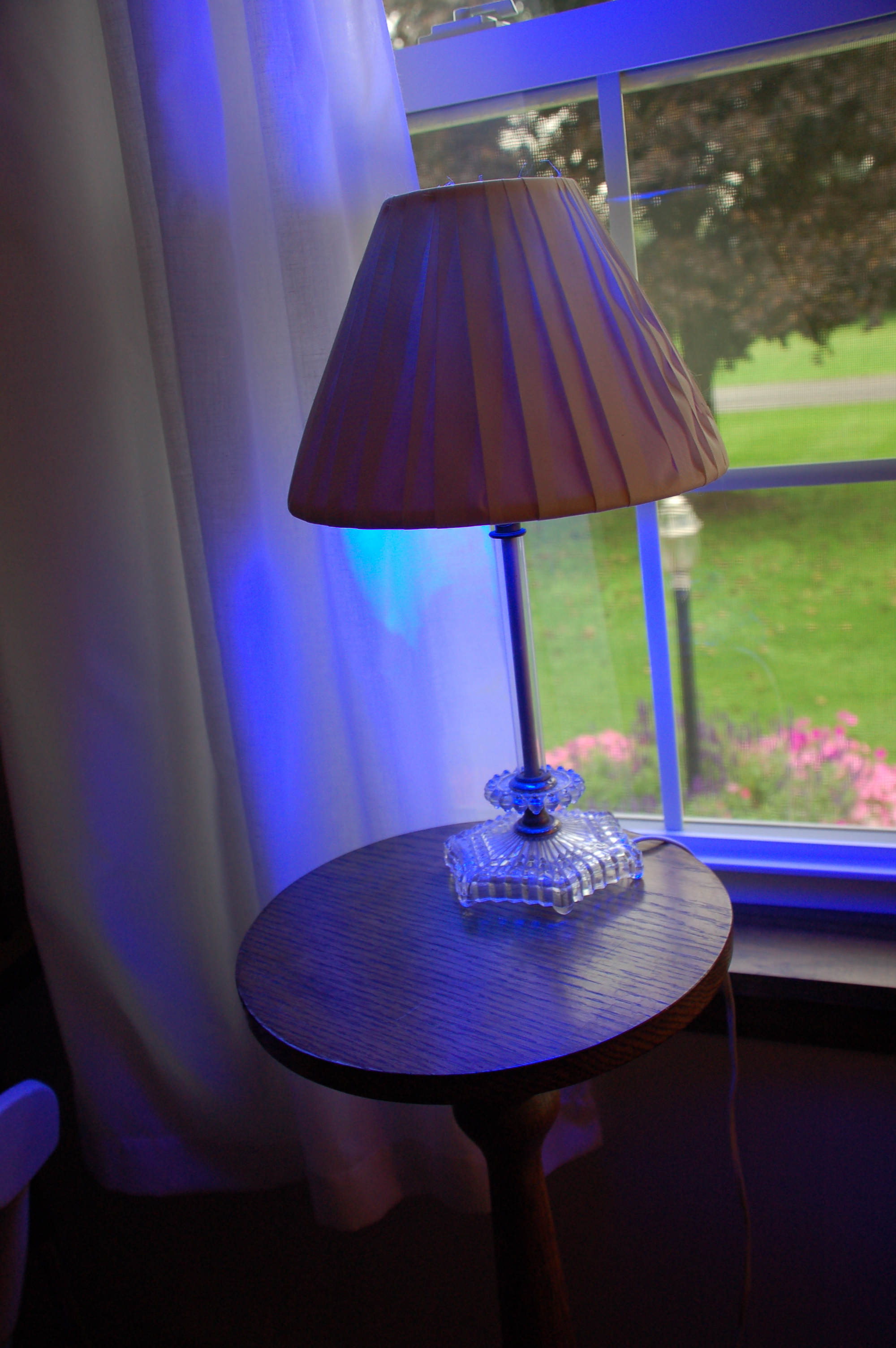
Each September, the lamp in my office shines blue in honor of Prostate Cancer Awareness Month.
The PSA test, which requires a simple blood draw, has been the standard for monitoring a man’s prostate health. September is designated as Prostate Cancer Awareness Month, and having a baseline PSA score is an essential guide for healthcare providers to know their patients’ situations, according to the National Cancer Institute.

“Early detection is important,” said Dr. Timothy Coblentz, a urologist in Canton and a native of Holmes County, Ohio. “Men who are caught early with prostate cancer have very good cure results.”

Dr. Coblentz said the PSA screening is especially important for men ages 55 to 69. He said men with high risk factors of family history and race should also be screened beginning no later than age 40.

“There is no doubt that screening for prostate cancer saves lives,” Dr. Coblentz said. His practice is part of the Canton Urology Group, which hosts a prostate cancer awareness meeting on the second Tuesday of each month.

Luis Lacourt of Massillon, Ohio coordinates the group. He was diagnosed with prostate cancer at age 42, or as he puts it, “About 25 years before the average age of diagnosis.”

Lacourt also had a family history with the disease. His grandfather, father and uncle all had prostate cancer. At the urging of his father, Lacourt asked his family doctor to begin PSA testing to establish a baseline.

At age 40, he began seeing a urologist, who happened to be Dr. Coblentz. When Lacourt’s PSA score doubled in a year, the red flag went up. A biopsy confirmed his prostate cancer in May 2012, and a month later he underwent successful robotic prostate cancer surgery.

Lacourt, now 44, is a guidance counselor at Perry High School in Massillon. He is also an ordained minister.

“I believe that everything happens for a reason,” Lacourt said. “It became clear to me that prostate cancer awareness was something I could share as a positive influence to help others.”

With the assistance of a urology nurse with Dr. Coblentz, Lacourt began the monthly support meeting, which is open to all who have had or currently have prostate cancer. He said the emphasis is on sharing and learning, and recognizing that prostate cancer awareness is important.

Lacourt’s proactivity about prostate cancer began immediately after being diagnosed. He organized a Prostate Cancer Awareness night at a high school football game last October.

Early detection of prostate cancer was critical to me. Knowing the disease was in my family raised my risk of having it. However, my baseline PSA level was much higher than my brother’s. His spiked significantly in one year, the biopsy was done, followed by the surgery.

My PSA went up gradually. When it exceeded the standard threshold of 4, my testing and the exams increased, though I had no symptoms that anything was amiss. On May 12, 2011, I had my robotic prostate cancer surgery, and have fortunately since been declared cancer free.

supportgroupbybrucestambaugh
Having a support group to get through the various stages prostate cancer is important both emotional and physical health.
More than two years post surgery, I am doing very well, partly thanks to a support group of other men who have or are fighting the same fight. Kim Kellogg of Millersburg, Ohio invited me to the group. Kellogg was diagnosed with prostate cancer a year to the day ahead me.

“Having an advocate and being an advocate to others is really important before and after treatment,” Kellogg said. “Stay positive, be vocal, ask questions of the doctors and others who have had prostate cancer.”

Being able to share with a small group of others with prostate cancer has made the physical and emotional recovery from the robotic surgery much easier than trying to go it alone. Our group meets about once a month.

Statistically, one in six men get prostate cancer and 30,000 men die in the United States each year from the disease. Those figures alone drive prostate cancer awareness. Excellent resources about prostate cancer can be found from the Blue Cure Foundation and the One in Six Foundation. Both foundations provide excellent information on prostate cancer prevention, and resources for those diagnosed with prostate cancer and living with the disease.

© Bruce Stambaugh 2013

A commitment to community

fullyinvolvedbybrucestambaugh
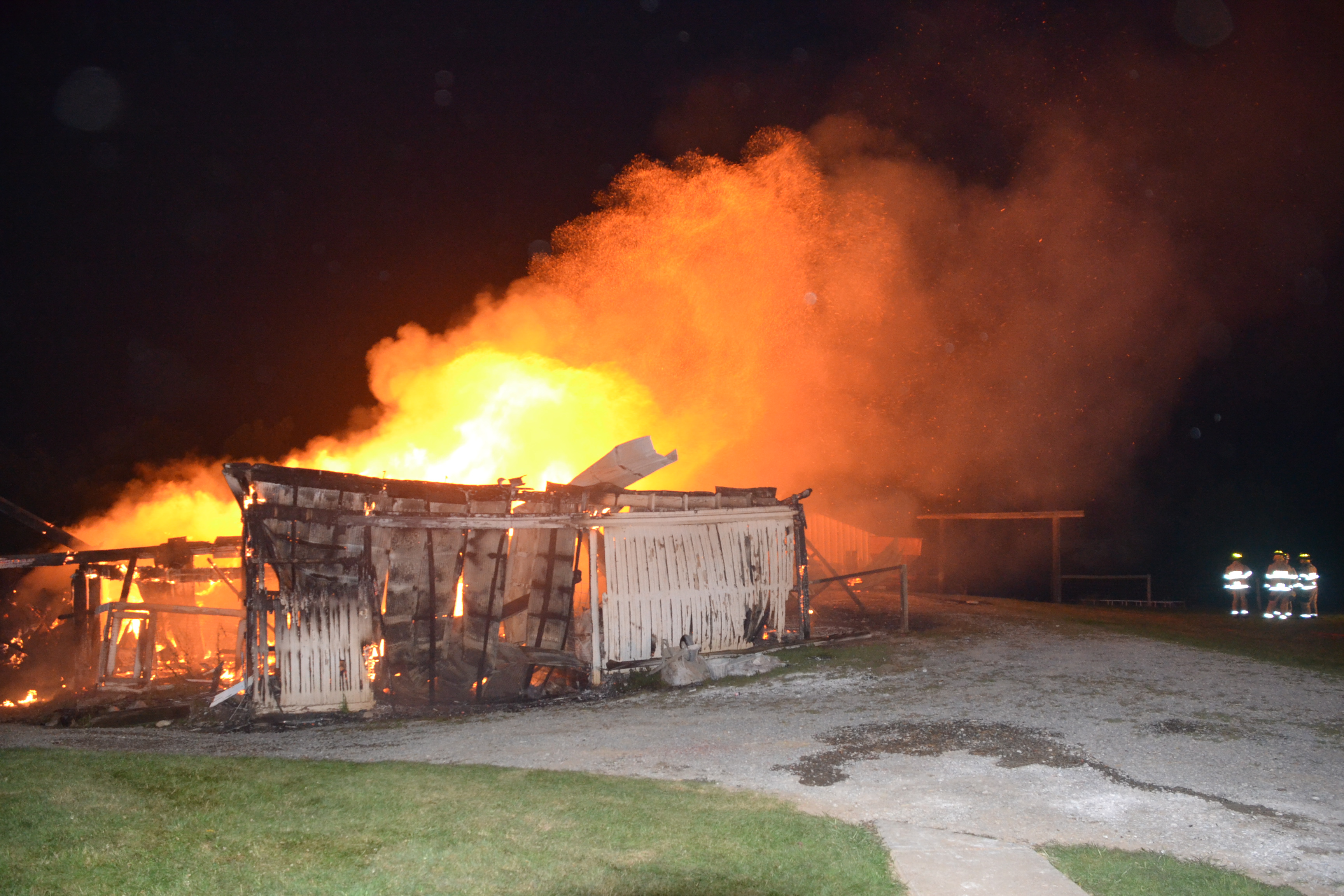
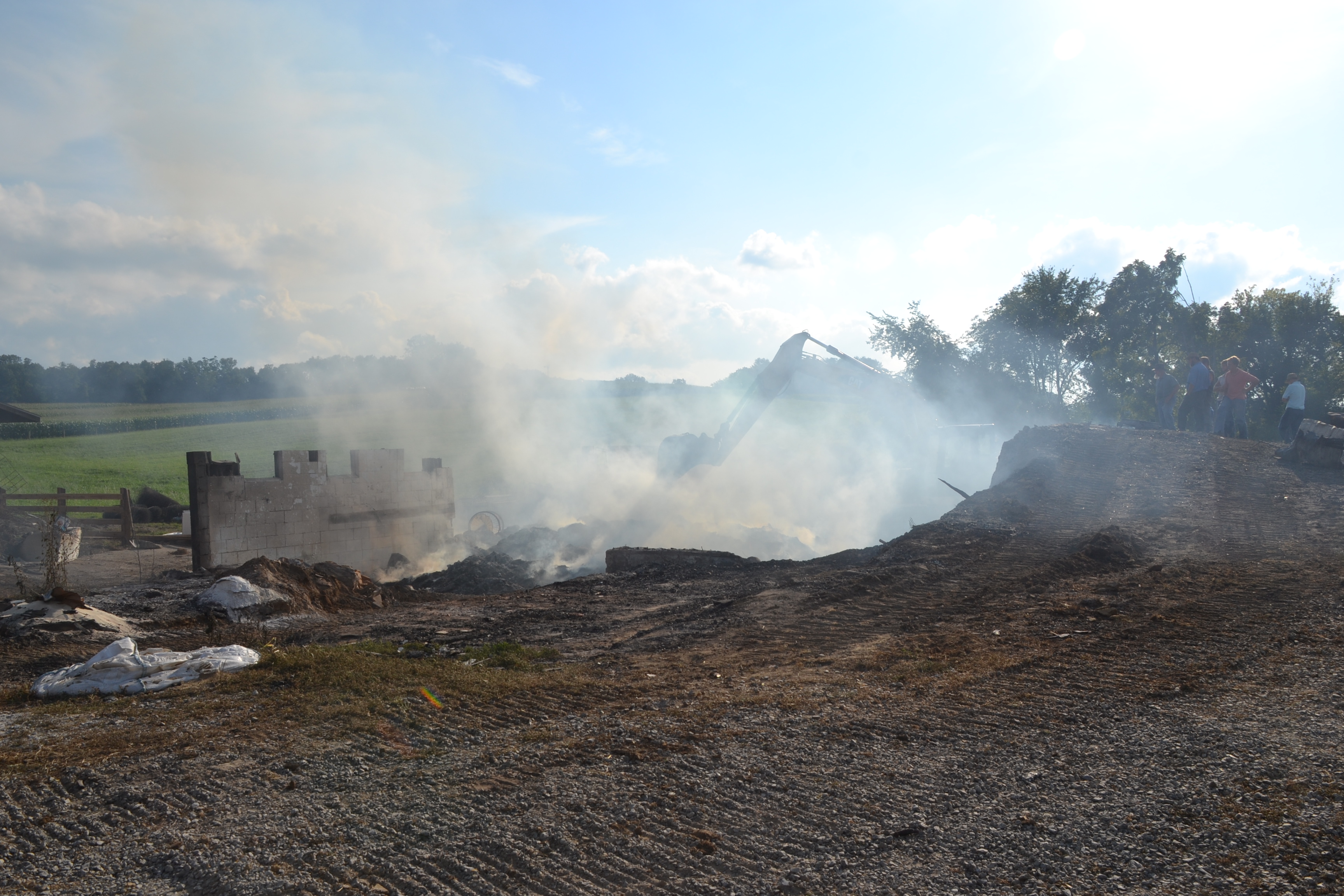
Fire fully involved the barn in minutes.

By Bruce Stambaugh

The middle-aged man sat in the van watching what he really wanted to do. His physically weak condition didn’t allow him to help rebuild the barn that had burned a month earlier.

I knew this man, and knew his heart was with these good people, people from across the community who came together to help resurrect the barn. My friend’s presence moved me as much as the corporate act of mutual aid that we witnessed.

Though he couldn’t help, my friend wanted to be there for support, for community, to keep the connection with his people. His presence was his help. Everyone knew about the fire that had destroyed the old bank barn. There was nothing firefighters could do that night other than to protect the adjacent buildings, which they did successfully.

Only three days before the barn raising, the clarion call went out, one phone message to another, for help. The result was a swarm of activity that began at sunrise and lasted until the job was nearly completed. This was not only how the community worked. It was the community.

barnraisingbybrucestambaugh
Three hours after the work had begun the barn was fully framed.

My friend knew this. He viewed his vicarious participation as imperative.

He didn’t need to tell me this of course. In our decades of living here in this place, we knew the unwritten, modest code of conduct. When your neighbors need help, help them.

It is the way this community operates, has operated, will operate. It is who we are and how we survive. Without one another, we are nothing. No man is an island indeed.

Old Order and New Order Amish worked side-by-side, hammer by hammer, board by board, with one another. Conservative Mennonites, Mennonites, and probably a few Baptists and Presbyterians were in the mix, too. All hands were on deck, no membership cards needed.

One man served as the coordinator for constructing the structure back into a barn. One body, estimated at about 300 men, women and children, made it happen. The process was beautiful to behold, a community in action.

With the foundation and floor previously completed, the framing of the barn began before sunup. By 8 a.m., the trusses were already being set. No orders needed to be barked. Spontaneous crews simply flowed in precision without cue, and the building arose. It was mind-boggling, astounding and inspiring.

Bearded men, clean-shaven men and teenage boys, proving themselves worthy, massed over the 50 by 60 foot frame. Seated on church benches, youngsters and women, their bonnets bleached whiter by the day’s brightness, watched and waited their turn.

By noon, the siding and roof were nearly completed. Hearty meals of homemade meatloaf, mashed potatoes and gravy, and plenty of side dishes and luscious desserts refueled the crews for the afternoon.

Even the weather cooperated for stepping casually across the peek of the roof. Clear blue sky, no wind to sway the balance, no humidity to dehydrate efficient work all made for perfect construction conditions.

In practicality, such a coordinated effort helped cut the cost of rebuilding for the owner. In a broader sense, such a coordinated effort reaffirmed that in a cooperative community no tragedy is too great to overcome.

Though he couldn’t help lift a board, my friend participated in this most sacred and iconic act. To the passersby who stopped to take photographs, it was a special treat to behold.

For those who knew what really transpired, like my friend, it was much more than a delight. It was communion.

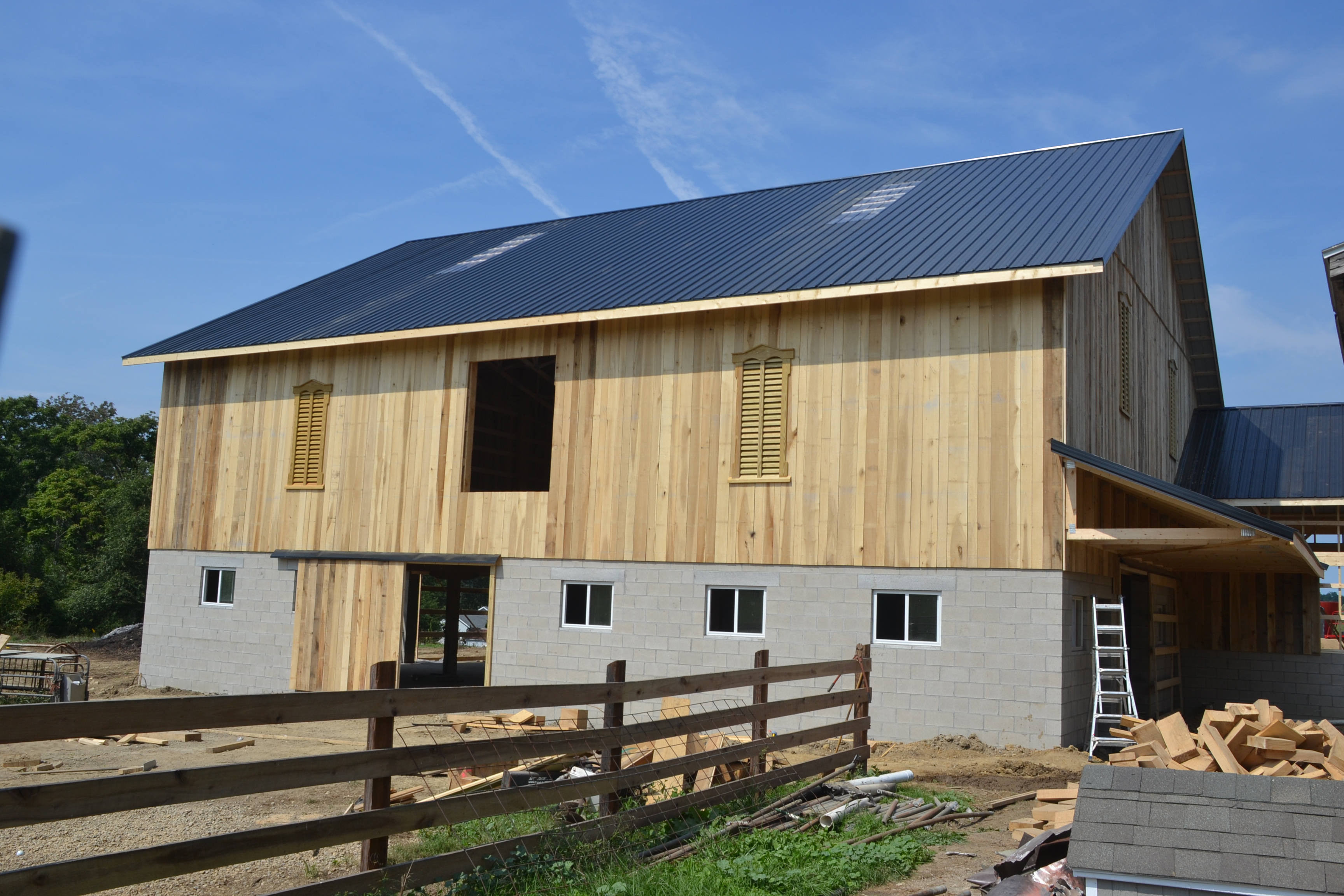
newbarnbybrucestambaugh
By evening work on the main barn had been completed.

© Bruce Stambaugh 2013

A fire in the neighborhood

barnfirebybrucestambaugh
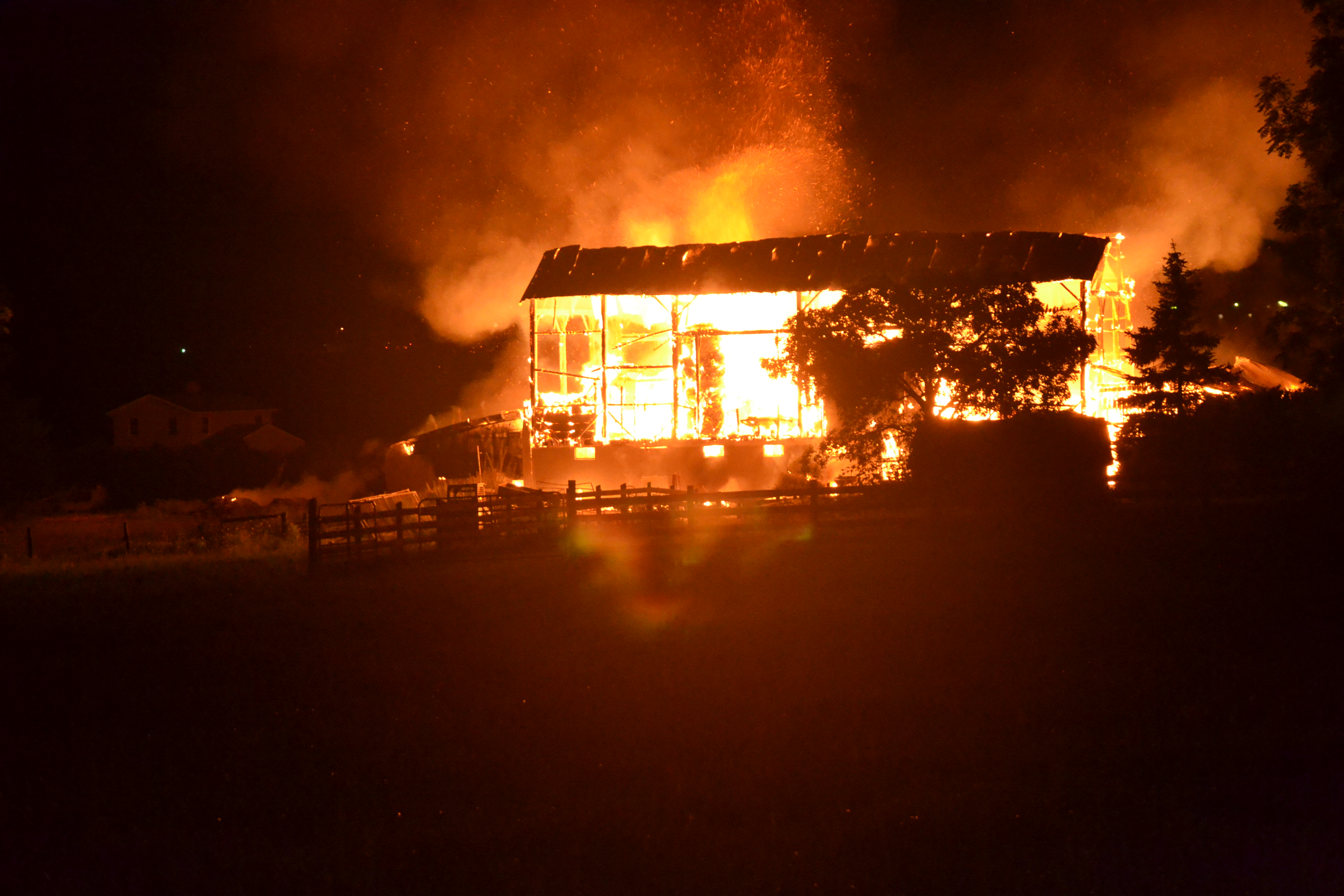
This was the first picture that I took of the barn fire shortly before 10:30 p.m. on August 12, 2013

By Bruce Stambaugh

We had just turned out the lights for the night in anticipation of a really good night’s sleep when we heard the sirens. With the windows open on this warm and wonderful August evening, the sirens grew louder as they quickly approached.

I headed to the dining room to look north out the windows. Above the stand of giant field corn an eerie dancing orange glow lit up the night sky. We had a big fire somewhere in the neighborhood.

I got dressed as quickly as I could, grabbed my cameras and headed to the garage. In the meantime, my wife had ventured out into the front yard. She reported back that it was either our friend’s excavating business or the neighbor’s barn that was burning.

Once the parade of responding fire vehicles passed by, I pulled my car onto the road and quickly saw that indeed it was our neighbor’s barn. It was fully involved in flames. Only the sheet metal roof remained, held up by the century old timber frame, dark against the constantly changing fiery kaleidoscope that was quickly consuming its host.

This slideshow requires JavaScript.

With the barn that far gone, the firefighters executed their only logical option. They concentrated their hoses on protecting the other exposures situated around the old bank barn. Soon long streams of water played back and forth dousing the rooftops, cooling them from the ferocious temperatures generated by the destructive flames.

My first instinct was to see what I could do to help directly at the scene. Knowing I’d only be in the way, I instead pulled into my excavator friend’s parking lot, focused my cameras and started snapping.

I wasn’t alone. Scores of others joined me. Tractors, vans, cars, pickups and bicycles filled the parking lot. Most spectators, like me, were lined along the wire fence that separated a farm field from the parking lot a football field from the blaze.

I photographed the various stages of the fire. Just 11 minutes after I had taken the first picture, the roof succumbed to the inferno. Embers of burning debris cascaded high into the dark sky, carried aloft by a steady south wind.

With the barn completely collapsed, I walked down the road to console the owners and to talk with firefighters that I knew. I was amazed at both their numbers and their efficiency.

Normally, rural areas are hurting for volunteer firefighters. This night, so many men and women in turn out gear or auxiliary smocks had responded to the alarm that they had to take turns spraying water or offering food and drink. The response for this emergency was tremendous. It was an impressive display of community service.

In addition, a gallery of onlookers congregated close to the old farmhouse. Most were family, friends and neighbors who had come to see if they could help in any way. Many had arrived before the first fire engine.

burninghaybybrucestambaugh
In less than an hour, the bank barn was reduced to burning hay inside of charred basement walls.

I took a few more photographs and spoke with the owners. Everyone was fine. No animals had been harmed, and most of the equipment had been removed from the barn just that day. The only losses were the barn, its storehouse of hay, and personal cultivated memories. Amish church insurance would compensate for the material losses of the accidental fire. The origin of the fire was either from wet hay or sparks from an unattended burn pile several feet west of the barn.

I was sad for my neighbors, but heartened by the many people who came to help. A crisis can test the mettle of a community. This August night, its people showed their stuff.

smolderingruinsbybrucestambaugh
The clean up began the next day amid the ruins of the smoldering barn.

© Bruce Stambaugh 2013

Tragedy can draw people closer together

treedamagebybrucestambaugh
Whipping winds from a severe thunderstorm damaged a substantial limb in the middle of the sunburst locust tree in our front lawn.

By Bruce Stambaugh

When a friend gets hurt, you feel sad and sympathetic. When that friend is injured on your property, you feel horrible, helpless, even responsible. That’s just what happened to my friend, Dan.

A recent severe thunderstorm blasted through our area and in the process heavily damaged the majestic and delicate sunburst locust tree in our front yard. A large limb bent to the ground, but remained precariously attached to the main trunk.

Dan is a jack-of-all-trades, especially adept at trimming trees. He takes every safety precaution and uses sound judgment. When I showed him the tree, he said he was willing to trim the badly broken limb.

concessionstandbybrucestambaugh
Just one of Dan’s many trades is operating a highly successful concession stand at a local produce auction.
My preference was to work together some afternoon once he closed his concession stand at the local produce sale. Dan said he preferred to work on the tree on Saturday morning. However, my wife and I were going to our cottage in southeast Ohio for the weekend.

Dan assured me he would be fine alone, and encouraged us to continue with our cottage plans. And so we did until Neva received a text from our neighbor. Dan had been hurt while working on the limb. I felt sick.

Desperate for more information, I called the emergency room at the local hospital and asked to speak with one of Dan’s family members. After a few seconds of hearing some fumbling with the phone, a familiar but softened voice spoke. It was Dan, not quite sounding himself.

Near tears, I asked how he was, and Dan assured me that other than a broken jaw, a broken shoulder blade and a broken rib, he was fine. Typical Dan.

swirledcornbybrucestambaugh
Winds from the severe storm swirled eight-foot high corn nearly to the ground.

Dan immediately took all the blame for the accident and assured me that he was all right. He said we should continue our weekend at the cottage.

Dan’s son filled me in with the few details of the accident that he knew. Passersby saw the mishap unfold, stopped and lifted the large limb off of Dan.

Dan was transferred to a city trauma center for surgery to repair his broken jaw. I still felt horrible about the accident to my friend. Dan’s family kept us updated on his condition, which fortunately was not life threatening.

We enjoyed the weekend with friends as best we could. But Dan was always on my mind. On Monday, I visited Dan at the hospital and was glad to see he remained in his usual good humor even while still waiting on his jaw surgery that evening.

trimmedtreebybrucestambaugh
Dan’s son, family and friends returned to the home to finish cleaning up after the accident.
On Tuesday morning as I was finishing my regular walk, I got a call that finally made me smile. It was Dan. He wondered if I could come pick him up from the Akron hospital when he was released in the afternoon. Absolutely I would.

On the way home, Dan kept saying that he was just so happy that my wife and I weren’t there when the limb came down. He knew we both would have been out helping him, and who knows what would have resulted?

The injury certainly hadn’t damaged his congenial personality. I had failed to ask for a written estimate for the work, so Dan said he would double the bill from $10 to $20.

Dan is convinced there was a reason for the accident happening. I have a hint about that.

The trauma, the emotion, the frantic communication back and forth, and now the joyful reunion had galvanized our friendship. Better times are ahead. Trimming trees won’t be included.

© Bruce Stambaugh 2013

Summer is for gathering

familypicnicbybrucestambaugh

By Bruce Stambaugh

Summer is for gatherings. The season of lyrical calls of songbirds and insects helps set the stage for people coming together for social get-togethers of every kind.

The warmer weather is a big incentive, too. Rain, on the other hand, can be a party pooper for all things outdoors.

At family gatherings, the kid in all of us emerges at dusk when the flight of the fireflies begins. Curious children run with jars to capture the luring light, fascinated with the elusive insects’ blinking ability. Hopefully the kids practice the capture and release approach to the illuminating inspection.

Corralling fireflies is only one checkmark on a long list of summer social events. Family picnics, school reunions, parties, parades, benefit sales, vacations, camping jamborees, weddings, garage sales, backyard cookouts, mud runs, races, ballgames, benefit auctions and fireworks all belong on a summer event calendar.

smoresbybrucestambaugh
Roasting marshmallows over hot coals runs the risk of things being a little smokey.

With their varying purposes, they still all result in people interacting with other people. Some see each other regularly. For others, it can be decades since they have last met.

Long spontaneous conversations ensue, some with participants standing the full length of the chatting. Along comes another familiar face, and the course of the discussion takes another turn, ears attentive to the new flow. What you would expect from friends separated by too much time and space?

Fortunately, gatherings involve more than gabbing. Well, at least the good ones do. Horseshoe and corn hole games, baseball, softball, badminton and volleyball are just some of the friendly competition.

bigcatchbybrucestambaugh
Of course the curious kids had to check out their Dad’s big catch.

Some prefer to relax on a bass boat or pontoon boat and fish the while away. If keepers are caught, it’s a double blessing on the day’s investment. A day at the pool or beach with friends and family can be just as satisfying as a string full of crappies.

I remember my late father’s group from work had an outing at one of northeast Ohio’s many lakes. I was so young I only remember tidy pastel cottages ringed the shores, and behind them towering hardwoods provided plenty of shade.

boatingbybrucestambaugh
A little rowboat cruise around a large pond is always a treat with the kids.

It was what happened under that cool canopy that sticks in my mind the most. The men were pitching horseshoes and kids were allowed to retrieve them. My math skills either weren’t the best or I got too anxious and stuck my hand in for a horseshoe when one came down hard on my small hand. A little cold water and a bandage did the trick, and I’ve steered clear of horseshoe pits ever since.

goodyearblimpbybrucestambaugh
The Goodyear Blimp often made touch and go landings at its hangar near Wingfoot Park east of Akron, Ohio.
Dad orchestrated annual summer gatherings for our extended family for years. Named the Frith reunion, in honor of the maiden name of our mother and her two sisters, we would usually assemble at a shelter in the company park at Goodyear’s lovely Wingfoot Lake east of Akron.

It was a popular place, with families and extended families joining in the summer fun. Carry-ins were the rule, with lots of favorite homemade dishes laid out on the tables. As the children grew into adults, they brought boy friends and girl friends, and then spouses and later still, their own children as the years flew by.

Sadly, that annual ritual has passed along with the three Frith sisters. With generations of descendants scattered all across the country and beyond, the Frith family reunion may be rejuvenated with a multiple of offshoots that will continue the relational connections.

Being with friends and family in both formal and informal settings in the summer helps define the season. Without them, summer just wouldn’t be the same.

facepaintingbybrucestambaugh
Activities like face painting always add fun to summer gatherings.

© Bruce Stambaugh 2013

No matter where they live, people are people

enjoyingthegamebybrucestambaugh
Baseball fans enjoying a game.

By Bruce Stambaugh

I find people fascinating, a joy to watch. I can easily pass the time observing crowds at airports, sporting events, meetings or shopping.

Humans come in a kaleidoscope of shapes, sizes, races and ages. They adorn themselves with a variety of intriguing duds and accessories. I marvel at and learn from their diversifications.

mariebybrucestambaugh
Marie was tickled pink that I wanted to take her picture on the dock at Lakeside, OH.
I remember a specific time many years ago when the shoe was on the other foot. My wife and I were visiting her cousin in southern California. Barb had two daughters, ages two and three months. Our daughter was two months old.

I was informed that we were going shopping one afternoon at the local mall. We were quite the sight and unintentionally created an intriguing distraction as we sauntered around the sprawling mall with a toddler and two infants in strollers and two lovely mothers and one man.

When I volunteered to care for the girls while the women ducked into a few stores, the fun began. We became the mall’s main attraction. The kids drew passing shoppers in like they were magnets.

I found myself engaged in conversations with people curious about the children. Were the babies twins? When I said they were born three weeks apart, I could see the mental wheels turning in the questioners’ heads.

When my wife and her cousin, who are close in age, returned to check on us, the eyebrows really arched. People’s non-verbal communication revealed their conceptual inferences about one man, two wives, and three little girls.

learningaboutconflictbybrucestambaugh
Dr. Catherine Barnes (center) taught the Conflict Analysis course during the Summer Peacebuilding Institute at Eastern Mennonite University, Harrisonburg, VA.

In reality, that’s how we operate as social beings. We reach conclusions based on what we see, and interpret observations based on our own life’s experiences and values. Many times, like my mall experience, those assumptions frame and tilt what reality is if the truth is not properly explored.

Recently I was asked what the single most important point I had learned at the Summer Peacebuilding Institute that I had attended in Harrisonburg, Virginia. The answer flowed easily.

“The most significant concept I learned was that people are people,” I said. Not exactly profound, but true nonetheless.

Not wanting to come across as cryptic, I further explained my seemingly glib answer. Based on what I had gained first hand from my global classmates, we all strive and often struggle for the exact same things. We desire basic human needs and rights regardless of our culture, race, religion, wealth, ethnicity, or gender.

groupprocessingbybrucestambaugh
Much of the SPI class involved small group interaction among class members.

Our modest class consisted of female and male inhabitants from four continents, 13 countries, and multiple races and religions. Yet, we were all there for one common purpose. We wanted to gain practical and applicable methods for understanding and resolving conflict.

To that end, the cultures, traditions, and primary languages of each class member became secondary to the overall goal. No barrier would deter our learning, thanks to an outstanding professor guiding dedicated students.

We all had too much to lose by allowing prejudice to cloud our thinking. After all, most of the astute class members would return home to implement and teach the knowledge they had acquired. In too many situations, that would be done in hostile, dangerous, unstable conditions.

Our class discussions easily revealed that people universally desire the same life goals. We all need food, shelter, security, identity, dignity and the freedom to grow and explore in an ever-changing, challenging world.

No political bend could deny the obvious. Regardless of roots of origin, people are indeed people, and they ache to be treated accordingly.

classmatesbybrucestambaugh
Friendships formed from the classroom interactions.

© Bruce Stambaugh 2013

Viewing the world through different lenses

conflictclassbybrucestambaugh
The Conflict Analysis class of the Summer Peacebuilding Institute at Eastern Mennonite University, Harrisonburg, VA.

By Bruce Stambaugh

We have it pretty nice here in the Greater Holmes County, Ohio area. I have known that ever since I moved to the area just after the historic July 1969 flood.

Ask locals, and they’ll tell you that it’s the best place in the world to live. I wouldn’t begin to argue otherwise.

That doesn’t mean, however, that this is the only place to call home. Clearly, if it were, the countryside wouldn’t be the same. Pastoral settings would give way to a jagged urban scape and all the trappings that accompany it.

For those who never venture afar from our comparatively protected environs, there is a danger with our self-satisfaction. Seeing the world with only our particular glasses can give us a distorted viewpoint on other cultures, socially, politically, economically and any other way you want to look at life.

At times it can be good to change lenses. That means we sometimes have to get well out of our comfort zone to do so. We have to let go of what we know, and learn anew.

foggyviewbybrucestambaugh
Virginia’s Shenandoah Valley offers incredible views, like the morning mist rising out of the valleys.

Recently I took an intensive graduate school course at the Summer Peacebuilding Institute at Eastern Mennonite University in Virginia’s lovely Shenandoah Valley. It’s a place as pretty as home, only old age mountains backdrop rolling, fertile foothills.

Of the 16 participants in the class, I was one of only three North American students. The others came from places like Azerbaijan, Thailand, Iraq, Kurdistan, Belgium, Ghana, Nigeria, Syria and Haiti. I would have struggled to find some of these countries on a globe.

The students ranged from young adults to grandparents like me. Their given names were Amstrong, Yvon, Nurana, Carlos, Rana, Aunt, Ray, James, Oscar, Henry, Nameer, Ernest, Amina, Khant and Salar. They were pastors, government leaders, workers for non-governmental aid agencies, interpreters and teachers.

Though our cultures, races and geographic origins varied greatly, we were there to learn about the various ways to analyze and understand conflict. Given the current situations in the countries represented, much useful information was certain to be shared back home.

smallgroupdiscussionbybrucestambaugh
Much of the class time was spent in small group discussions and activities.

In the classroom, we sat in groups of three or four, each day a different configuration, each day new and fascinating stories intertwined with the professor’s lessons. Their personal stories, shared privately, were compelling, if not fearsome.

A pastor from Haiti called his wife every night and spoke to her from midnight until nearly dawn just to ensure his family’s safety. The consequences of war had destroyed the home of a young woman from Syria. Yet reconciliation, not retribution, was the aim of these devoted, considerate, inquisitive community leaders striving to promote peace.

dynamicwomenbybrucestambaugh
The dynamic women of the Conflict Analysis class of the Summer Peacebuilding Institute.

Instead of focusing on how bad it was in their country or blaming other governments, these men and women were glad for the opportunity to learn how to dissect and resolve conflict. They would take what they had learned and apply it as best they could. Their goal was to improve the world around them, even if it was one person at a time. Where there was despair, they saw hope.

When the Haitian pastor asked me if my home was safe, I hesitated before answering. I looked deep into his dark, wondering eyes, and simply said, “Yes, I live in a very safe place.”

“You are very fortunate,” he replied softly. I was humbled.

All of us who live in our lush, agrarian area are fortunate. Occasionally it takes looking through other life lenses to fully appreciate our own home view.

springtimeinamishcountrybybrucestambaugh
A typical springtime view in Holmes Co., Ohio.

© Bruce Stambaugh 2013

The secret to great ice cream is no secret at all

d&bburgersbybrucestambaugh
One of the food trailers from which Dan and Anna Bowman serve their delicious ice cream. The Bowmans are Amish, so no pictures were taken of them.

By Bruce Stambaugh

When Dan and Anna Bowman crank up their ice cream machine each year in June, it doesn’t take long for a line to form. Their ice cream is that good.

The Bowman’s operate under the business name of D and B Burgers, Fredericksburg, Ohio. Don’t let the name deceive you. They serve up lots more than tasty burgers. Their menu includes offerings for breakfast and lunch, and of course, fresh and delicious soft serve ice cream.

When asked what the secret was to their yummy ice cream, Dan didn’t hesitate to answer, though what he said may come as a surprise. His modest answer reflected his daily demeanor.

“We use the same commercial ice cream mix as several others in the area,” Dan said. “Fresh and clean is a very good combination for good tasting ice cream.” By that he meant that he keeps the soft serve ice cream machine cleaned on a regular basis.

“You can’t keep ice cream mix in too long,” Dan said. “You can only go about two days before you have to sanitize the machine.”

twistandshoutbybrucestambaugh
The twist soft serve ice cream cone is a hit with the Bowman’s customers.
Dan said that if the ice cream sits in the well of the machine too long it gets gritty and sour. To ensure freshness, he even cleans off the dispenser to eliminate any chance of anything less than fresh being dispensed.

To keep it clean, he and Anna completely take the machine apart to clean, a process that takes an hour. The machine gets thoroughly cleaned with the manufacturer’s recommended cleanser, rinsed, dried, and reassembled.

Dan and Anna sell three flavors of soft serve ice cream, chocolate, vanilla and twist. They serve their ice cream in cake cones, cups and sundaes.

“The raspberry sundae is the favorite of customers,” Dan said. Of course, the topping is homemade by Anna.

Again, they said there is no secret to that success. Freshness makes the difference here, too.

“I just add a little sugar to the berries and turn on the blender,” she said. They offer red, black and purple raspberry.

Dan said there are four or five ice cream mixes that he could choose from in the area.

delicioussundaebybrucestambaugh
Anna’s homemade raspberry sundae topping is very popular with customers.

“I use a mix from a local dairy for consistency and freshness there, too,” Dan said. He buys the mix through the Country Mart in Mt. Hope, Ohio. The mix is a liquid that is poured into the vat of the tabletop ice cream galvanized machine.

“We have people tell us that our ice cream tastes better than others,” said Anna. “But we use a commercial mix just like the others.”

Dan said censors on the machine tell him when the ice cream is getting low.

“That’s why we never run out of ice cream,” Dan said. “It only takes about five to 10 minutes before the ice cream is ready to be served.”

Dan said they average about 25 gallons of ice cream per day during the peek time of June to October. Dan and Anna’s stand, which he affectionately refers to as the wiener wagon, can be found at the Mt. Hope Auction during special events like horse sales. They also do some special sales and auctions.

pouiringthemixbybrucestambaugh
The ice cream mix gets poured into the machine, vanilla on one side, chocolate on the other.

The best chance to catch Dan and Anna is at the Farmers Produce Market on State Route 241 a mile west of Mt. Hope June through October when ice cream is served beginning at 10 a.m. The stand, however, opens around 8 a.m. when buyers and sellers start to arrive. D and B Burgers serves breakfast and lunch sandwiches, side dishes, donuts, cookies, candy and hot and cold drinks.

The produce market is affiliated with the Mt. Hope Auction, and Dan and Anna provide food there February to November. During the summer months, the auction runs four days a week, Monday, Tuesday, Thursday and Friday.

“We are very thankful to Steve and Jim Mullet for allowing us to operate at their sales,” Dan said. “My business would not be without the Mullets.”

D and B Burgers operation has been operating for 13 years. They now use two food wagons. One is stationed at the produce market most of the year.

© Bruce Stambaugh 2013

Bay Photos by Donna

Wildlife photos from the Chesapeake Bay region

ROAD TO NARA

Culture and Communities at the Heart Of India

K Hertzler Art

Artist and nature journalist in the Shenandoah Valley of Virginia.

Maria Vincent Robinson

Photographer Of Life and moments

Gabriele Romano

Personal Blog

Jennifer Murch

Art is the only way to run away without leaving home. -Twyla Tharp

Roadkill Crossing

Writing generated from the rural life

ANJOLI ROY

writer. teacher. podcast cohost.

Casa Alterna

El amor cruza fronteras / Love crosses borders