Writing is my labor of love

By Bruce Stambaugh

I like to write. For me, it is a labor of love.

Writing takes time. It’s not physical labor, but it can be just as exhausting.

Sunflower at Marblehead Light House by Bruce StambaughTo report an accurate story, concentration and absorbing details and the setting are essential. Even more difficult is deciphering my scraggly handwriting afterwards. Trying to properly tell the story in an assigned number of words against a deadline adds to the creative challenge.

The good people of many of the events and stories I chronicle don’t necessarily crave the publicity. But they do appreciate the consideration, especially when they have put so much effort into their own work or hobby or community service. Those are stories worth telling.

Stambaugh family by Bruce StambaughOf course, when I write about my family, all bets are off. So far, though, I haven’t been barred from any family gatherings.

For the longest time, I thought everyone could write. I eventually discovered that most people don’t have my passion for writing.

I’m not bragging. I have much to learn in the writing field. In fact, I strive to improve my style, approach and content. This spring I attended three very different writing workshops in the space of six weeks. I was bombarded with helpful and practical information. The poets, columnists, scriptwriters and authors offered invaluable personal and professional tips.

The Erma Bombeck Writers’ Workshop held at the University of Dayton was incredible. Perhaps that’s because a huge majority of the hundreds of participants were women. They didn’t hold anything back, and we didn’t lack for laughter or levity. It truly was inspirational.

Batter up by Bruce Stambaugh
I realize I have several people to thank for teaching and encouraging me in my writing. Some were high school and college teachers. Most, like Hymie Williams, were practitioners.

Hymie was a sports writer for The Plain Dealer, Cleveland, Ohio. He and two news reporters anchored the paper’s Canton bureau. Out of the blue, Hymie called me one day to ask if I would be willing to fill in for him while he was on vacation. I was 16 years old then. Of course I jumped at the chance.

I had been sending Hymie and other local papers summaries of the Stark County Hot Stove League baseball games. Coaches called in the scores to our home since my father was the league’s secretary. I usually answered the phone and quizzed the callers for any significant details about the games.

I wrote up the results and next day looked for the story in the newspaper. I was heartened to see that the articles were consistently published with only minor changes.

I enjoyed my little stint as a sports reporter, especially since it was at the start of the high school football season. I had lots on which to report.

Light rays by Bruce StambaughThis opportunity heavily influenced my choice of a college major. I graduated with a degree in journalism, but quickly made a left-hand turn for a 30-year career in public education. When I retired, a newspaper came calling and the ink in my veins started flowing once again.

It is an honor and a privilege to be able to write a weekly newspaper column, this blog and other feature stories that shine the spotlight on deserving subjects. Their stories are refreshing, especially given all the negative news that dominates the national media. I enjoy sharing my photographs, too. But that’s a story for another time.

My goal is to continue spreading as much good news as I can, and there is still plenty to tell. After all, writing is my labor of love.

This column appeared in The Bargain Hunter, Millersburg, OH.
© Bruce Stambaugh 2012

More than a benefit bake sale

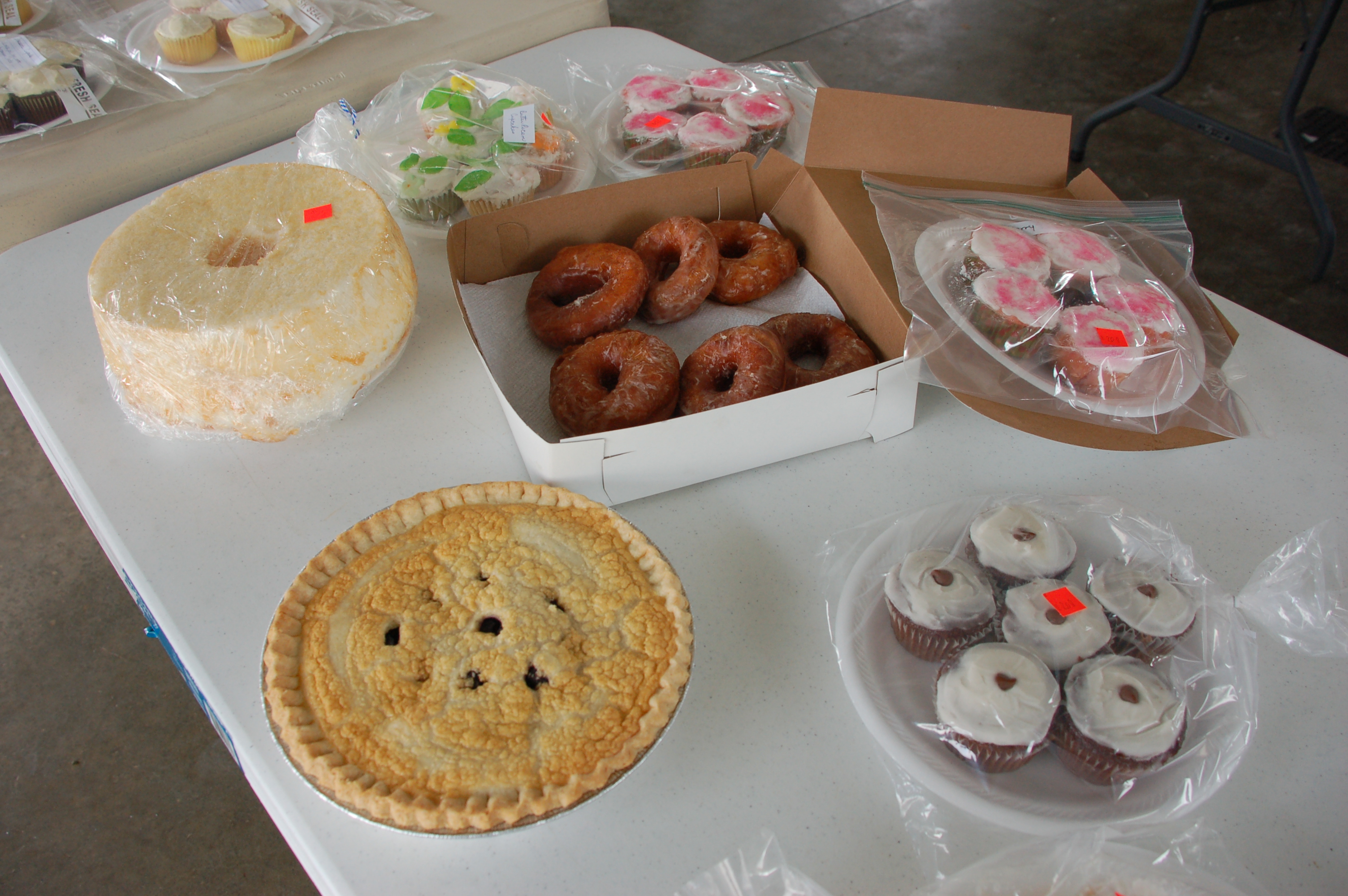
Baked goods by Bruce Stambaugh

By Bruce Stambaugh

This could have been the bake sale of all benefit bake sales. As impressive as they are, the numbers alone don’t tell the entire story.

On June 3, the life of 2-year-old Betty Ann Weaver changed forever. Her left hand was accidentally mangled in a lawn mower. She lost all of her digits, with only a couple of stubs remaining.

Betty Ann returned to her parents’ home four miles west of Holmesville, Ohio on July 4. Her nine brothers and sisters and her parents, Roy and Lovina Weaver, were glad to have her back home.

After a month in the hospital and with rehab visits ongoing, medical bills accumulated. Her maternal grandmother, Ada Yoder, was determined to help. The gregarious woman, who lives with her husband, Wayne, a mile west of Holmesville, had a big idea to raise some funds for her granddaughter. She shared her vision, and soon a bake sale was planned.

“We had lots of help,” Ada said. In fact, four Amish churches donated hundreds of baked items that were sold August 16 and 17.

“There were some good looking items that we sold,” Ada said, “including a square angel food cake.” As delicious looking as all those items were, the homemade donuts were the real draw.

“We used 11 bags of donut mix,” Ada said. “Each bag made 50 dozen donuts. That’s a lot of donuts!

“The first day we started making donuts at 7 a.m. and finished at 9:30 p.m.” Ada explained. The next day the process began all over again.

“We started at 3 a.m. and finished at noon,” she said. “We had people here for donuts at 5:30 a.m. already.” The donut making finished up that evening with another round of frying them in coconut oil that lasted from 4-8 p.m.

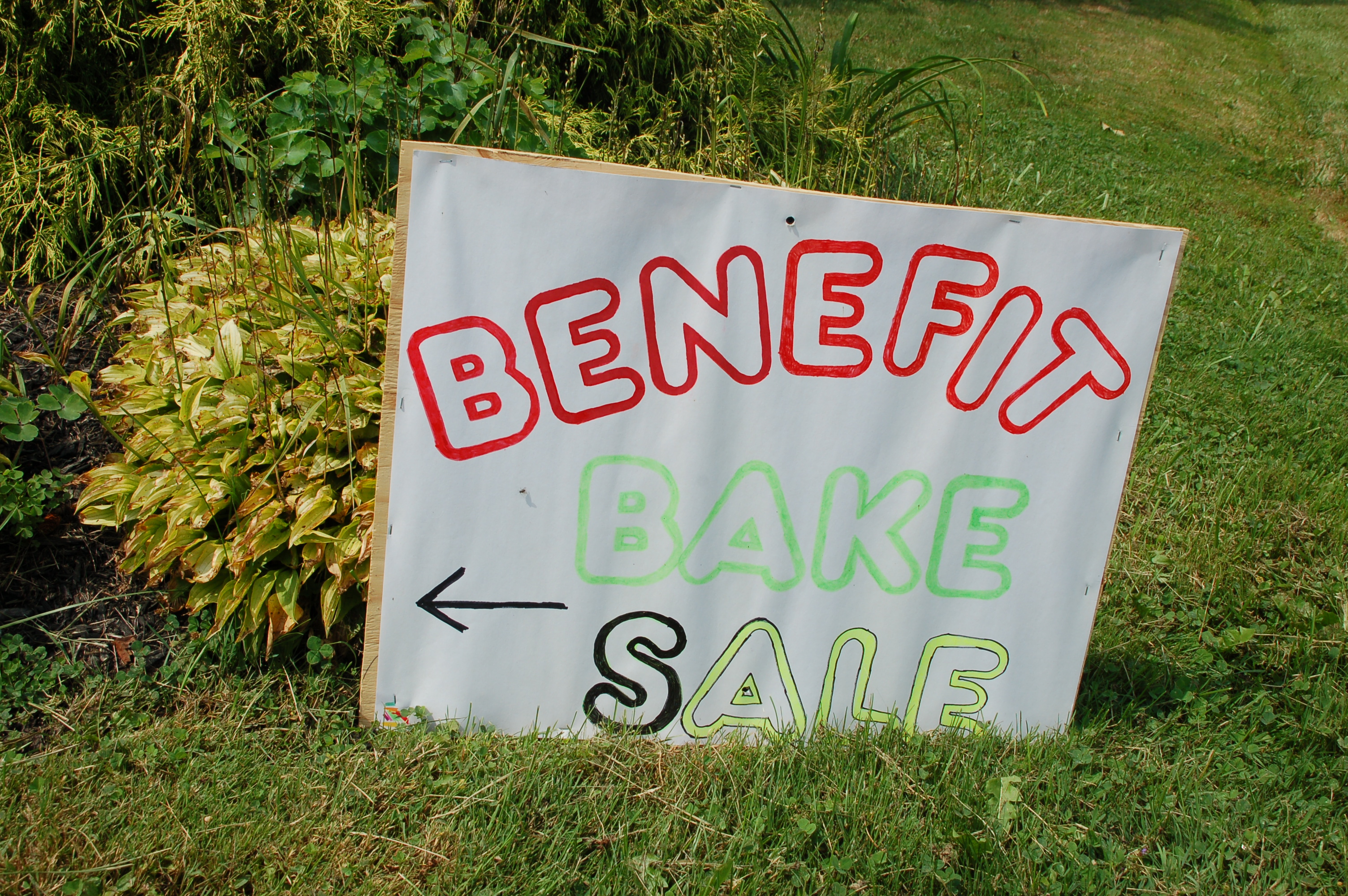
Bake sale sign by Bruce StambaughAda said customers had to wait until the donuts cooled enough for them to be glazed and boxed. To generate orders, she had distributed fliers about the donut and bake sale to several area businesses. Many bought multiple dozens to share with employees.

“We had pre-orders for all the different kinds of donuts we made,” Ada said. “We did raspberry filled, strawberry filled, Bavarian cream and glazed.”

“I made six kettles of raspberry filling,” she said.

Ada said she was overwhelmed with both the amount of help she had and the response. The last baked good item, a regular, round angel food cake, was sold at noon on August 17. The sale was held at the Weaver’s home.

“We were very pleased with the results,” Ada said. “We made in excess of $5,000 the first day alone.”

The money will be used to help defer medical expenses for her granddaughter. Donations may still be sent to Wayne Yoder, 9378 County Road 329, Holmesville 44633.

The article appeared in The Bargain Hunter, Millersburg, OH.

© Bruce Stambaugh 2012

Trouble in a peaceable pond

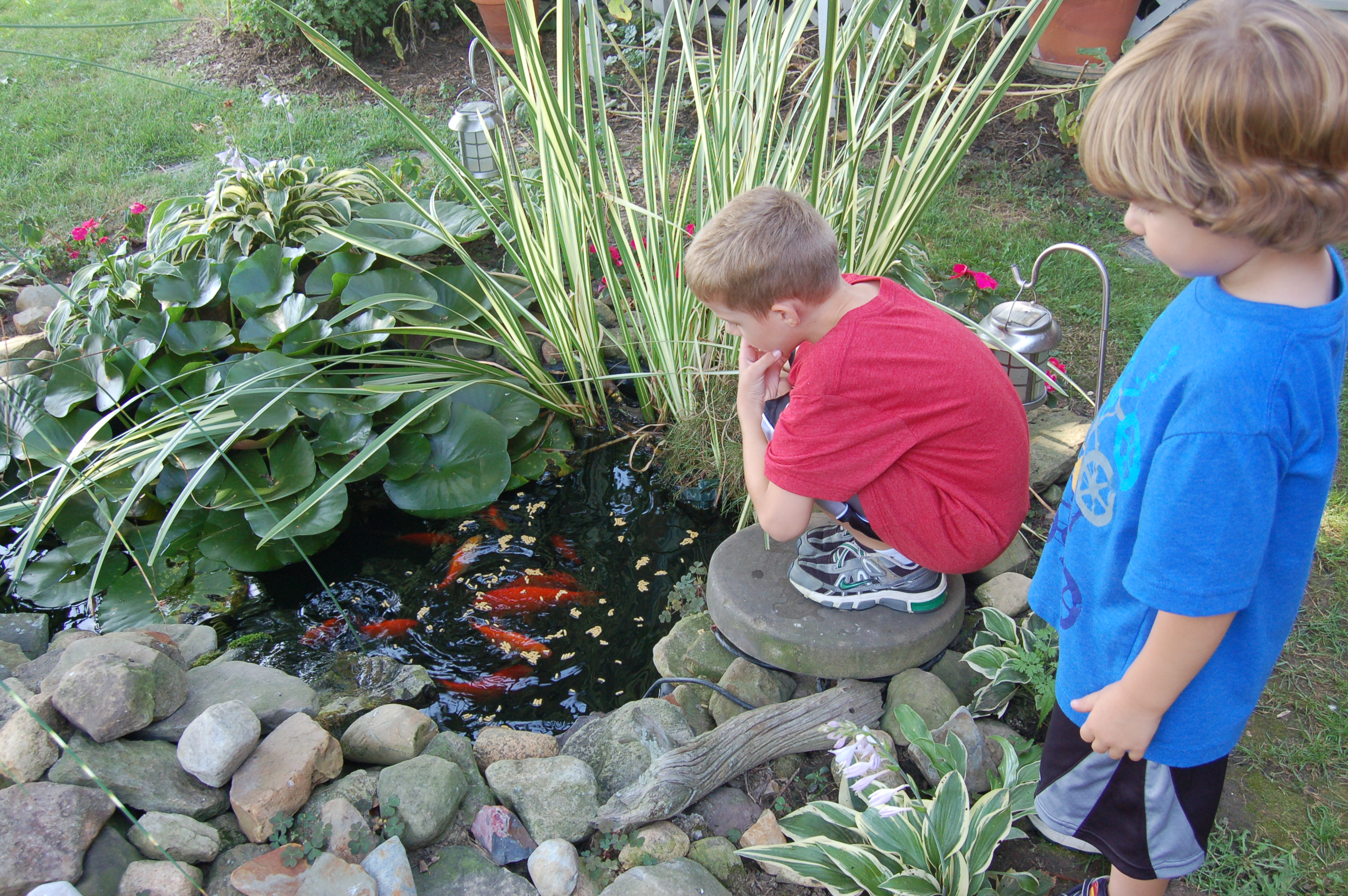
Feeding fish by Bruce Stambaugh
The grandchildren love to feed the goldfish in the little garden pond.

By Bruce Stambaugh

I have greatly enjoyed the little garden pond that students and staff gave me when I retired as their elementary principal 13 years ago. It was fun building the pond and the little waterfall that gurgles night and day.

The pond, visible from all rear windows and our open back porch, has multiple benefits. The mini falls’ mesmerizing tinkling of water on water lulls me to sleep on pleasant nights. An assortment of wildlife has ventured to the pond, including deer and a Great Blue Heron.

Goldfish, snails and aqua plants help keep the pond’s water in proper equilibrium. A family of green frogs just showed up on their own. They have been a welcome addition, until recently that is.

Frog and flower by Bruce StambaughSummer, of course, is when the pond is most popular. Songbirds drink the cool water and bathe in shallow pools. The green frogs station themselves at the pond’s perimeters waiting for insects. Blooming white lily blossoms enhance their chances.

The pond also attracts the grandkids when they visit. It’s one of the first places they explore. They particularly enjoy feeding the goldfish and hunting for the frogs.

Davis, the middle grandchild, is especially inquisitive. Last time here, he wanted to know where the frog nests were. Davis bent over visually surveying the pond, intently looking for the frogs.

Lucky frog by Bruce Stambaugh
Perhaps this green frog was hoping for a little Irish luck in finding lunch.
It was during his investigation that we discovered something very unusual. The largest of the green frogs was resting atop something dark, wet and balled up. I recognized the clump as a dead bird.

As I approached the crime scene, the murder suspect made a quick getaway with one giant plop into the water and hid under the lily pad leaves. From what I could discern, the poor bird was a female House Finch.

I could hardly believe it. I knew that bullfrogs ate birds. But green frogs? I wondered if it wasn’t just a coincidence that the frog came to rest upon the dead bird.

Still, the lifeless bird showed every indication that a frog had tried to swallow it. I distracted the grandkids by playing ball. When I went back later to retrieve the victim, it was gone.

A few days later, while cleaning the pond and feeding the fish, I discovered yet another dead bird. Curious, I contacted Julie Zickefoose, a noted author, artist, and lover of all things nature. She had never heard of a green frog snatching birds either. Julie suggested that I had a troublemaker in my peaceful pond, and that the perpetrator be removed to a farm pond if for no other reason than the safety and welfare of the birds that come to enjoy our pond’s refreshing water.

Fall pond by Bruce Stambaugh
The pond in the fall.
As long as those frogs had been there, I really hated to pin the fowl play on one of the green gang. I decided I needed conclusive rather than circumstantial evidence before I removed the big guy.

I decided to be vigilant, and watch and wait to see if the frog really did go after birds. On sunny days, it usually claims an easily visible grassy pad at water’s edge waiting for a free lunch.

Either the frog has had a change of heart, or perhaps diet, or I’m not a very good detective. So far, I haven’t found anymore carcasses.

I’ll keep watching, and if I catch the frog green-handed, I’ll let you know. In the meantime, let’s hope peace and tranquility reign in our little pond of paradise.

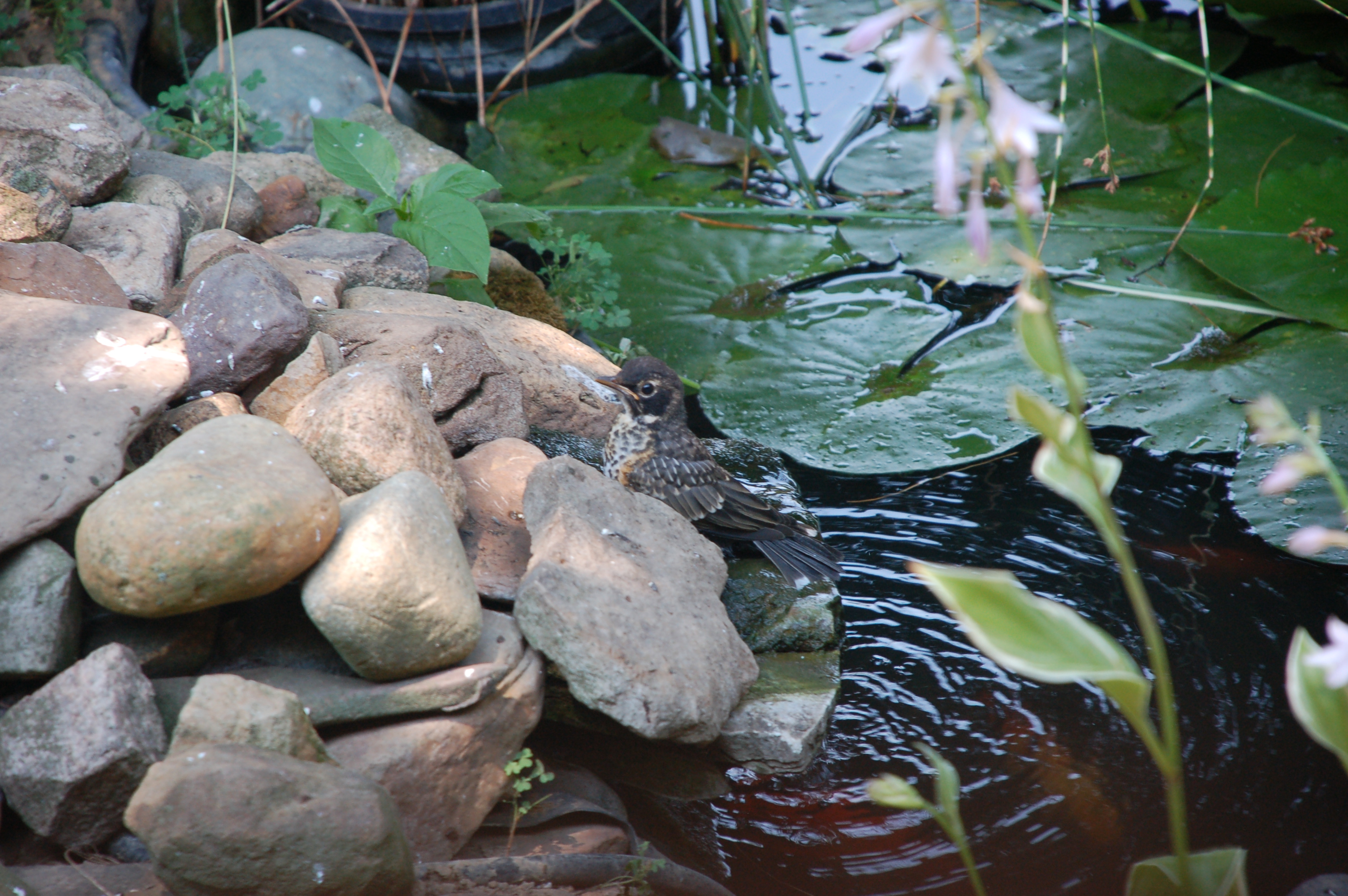
Bird bath by Bruce Stambaugh
A juvenile American Robin enjoyed a refreshing bath in the little waterfalls.

This column appeared in The Bargain Hunter, Millersburg, OH.

© Bruce Stambaugh 2012
The sweetest part of summer

Cooking corn by Bruce Stambaugh
By Bruce Stambaugh

Growing up in my post-World War II world, our family always had a garden. It was a logical way to keep the expenses down for our energetic family of seven.

Even as children, we knew Dad didn’t make much money. He worked hard at his white-color job. He left early and arrived home in time for the staple supper Mom always had waiting for him and the five of us ornery kids, although I think I was easily the best behaved of the bunch.

Mom worked hard, too, without a paycheck. Like most women of the era, she was a professional homemaker. She was at home all day, and during the summer months so were her five children.

She trusted us to roam the neighborhood as long as we checked in from time to time. Cell phones and texting weren’t even bad ideas then.

When Dad arrived home, the tempo changed. If my two brothers and I weren’t playing baseball, we, along with our two sisters, piled into the 1947 two-door, cream-colored Chevy, and headed to the garden two miles away. The land around our suburban home was too small to support a substantial garden.

A friend of Dad’s allowed us to use a portion of his property to garden. We planted, hoed, weeded and watched the crops grow. We cared for potatoes, green beans, radishes, carrots, peppers, and my favorite, sweet corn.

Rainbow of peppers by Bruce Stambaugh

Like a kid on Christmas morning, I couldn’t wait for the corn to ripen. Every trip to the garden I would squeeze the ears to see if they were filling out. When the tassels turned from blonde to brown, I knew the corn was close to being ready.

I loved the smell of corn, stalks and ears alike. Dad showed us how to carefully peel back the husks for a peek to confirm that the ears were ripe. For me, there was something special about the sharp sound of Dad yanking the corn free from its mother stalk. We took turns carrying the plump ears to the wheelbarrow at the end of the rows.

Husking corn by Bruce Stambaugh
Husking sweet corn is still a family affair in our household.

We loaded the car trunk with our golden treasure and headed home. We all helped husk the tender ears. We worked as fast as we could, knowing full well that the quicker we got the corn cleaned, the sooner we could enjoy it.

We ate some, and we froze some. By we, I mean my mother of course. Cooking the corn in the pressure cooker always unnerved me. I guess I was fearful of its scary hissing sound. Thankfully, my wife now just cooks the corn in a kettle on the stove.

Freezing corn by Bruce Stambaugh
Though my wife cuts the kernels from the cob before cooking the sweet corn, she still uses Tupperware and other similar contains to hold the corn in the freezer.
Mom ran the cooked corncobs down a wooden corn cutter. The yellowy kernels and sweet juice dripped into a marbled blue and white porcelain bowl. We helped fill the Tupperware containers, and once they cooled ushered them downstairs to the freezer.

Having sweet creamed corn in the middle of winter was a special treat. Still, it couldn’t compare to holding a freshly buttered and salted ear and crunching those tasty rows of kernels.

The ripening corn crop did have one drawback, however. When we were done harvesting and freezing the Iowa Chief, we knew it was time to start school.

Years later, here we are again near summer’s end. School is set to begin or already has. The tender sweet corn is already in the freezer, although it’s now Incredible, not Iowa Chief.

Sipping my morning coffee, I watch the school buses pass by the house. At my age, it’s the sweetest part of summer.

This column appeared in the Bargain Hunter, Millersburg, OH.

© Bruce Stambaugh 2012

A much needed respite at Lakeside, Ohio

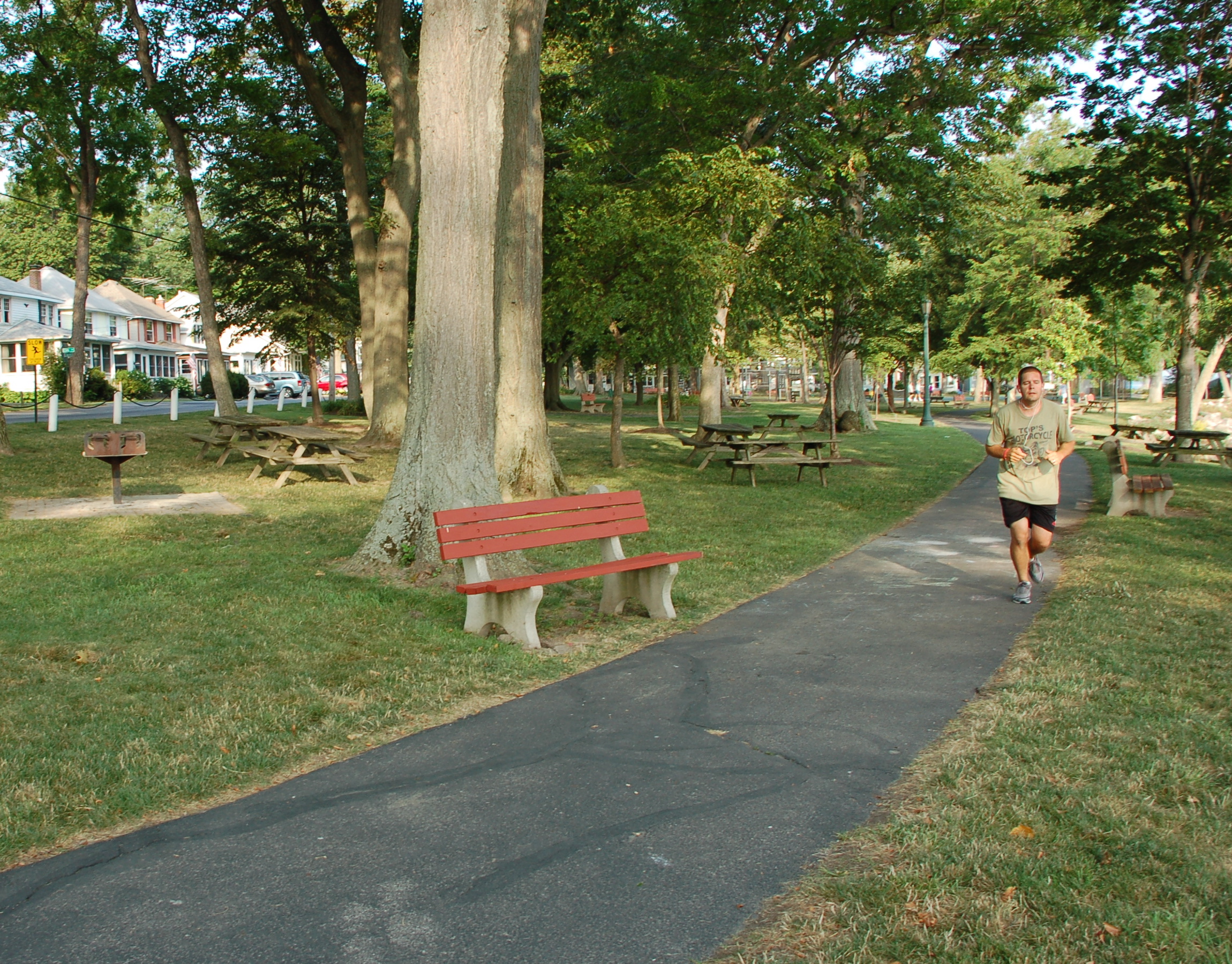
Perry Park by Bruce Stambaugh
Perry Park, located at the east gate of Lakeside, Ohio, is a beautiful place to rest, relax, read a book, jog, play tennis or just enjoy the peace and quiet.

By Bruce Stambaugh

After the week we had had, my wife and I needed a respite. The most logical place for that was Lakeside, Ohio, our favorite place to relax.

We had begun our annual weeklong stint at the Chautauqua on Lake Erie. Early the second morning we received a call to return home. Neva’s mother was gravely ill.

The call wasn’t unexpected. We quickly packed up and returned home. Neva joined her sister in watching over their elderly mother, Esther Miller. Esther died the next evening at age 90.
Hollyhocks by Bruce Stambaugh
Expected or not, a death is still a death. All of the grieving emotions overwhelm family members in different ways and at different times. Time seems to stand still. All the while, the necessary preparations need to be completed. They tend to take their toll on already frayed feelings.

My wife and her sister met with the funeral home director about the services. They met with the pastor to plan the funeral. Next day, they cleaned out their mother’s room at the retirement home.

The family arrived at the church well ahead of the visitation time to set up pictures and meaningful memorabilia, followed by the greeting of mourners and the funeral itself. Afterwards, we hosted the immediate family for an evening meal at our home.

As you can imagine, it was all very draining mentally and physically. We needed a break.

Neva and I held a one-sentence discussion. There could be no doubt that the best place to renew and recharge was to return to our beloved Lakeside. The next morning we were on our way.

Lakeside homes by Bruce Stambaugh

Despite the sweltering heat, it was good to be back at Lakeside with its lovely cottages, inviting dock, marvelous entertainment and multiple activity options.

With its shaded parks and marvelous vistas, Lakeside’s location on Lake Erie makes it idyllic. Really, though, Lakeside is more about people than anything else. From staff to strangers to long-time acquaintances, everyone is family at Lakeside.

A television reporter once did an expose on this special town. He wasn’t unfamiliar with the resort. He had vacationed there as a youngster.

The reporter knew how friendly Lakesiders could be. To prove his point, the reporter casually walked into a cottage without knocking and asked for lemonade. He wasn’t quizzed as to who he was or why he had barged in. Nor was he told to get out. No. Without a second thought, the homemaker poured him his icy drink.

Lakeside cottage by Bruce Stambaugh

On our recent extended weekend retreat, my wife and I had a similar experience. After finishing a very informative walking tour of Lakeside, one of the other participants invited us and another couple to tour her newly remodeled cottage. She didn’t even know us, and yet showed us every corner of her beautiful place. That’s just the way people are at Lakeside.

Lakeside flowers by Bruce StambaughAt the end of our visit of this lovely summer home, I realized that the kind lady didn’t even know our names. We made our introductions as we profusely thanked her.

What nicer place than Lakeside is there to sit back and forget your worries? You can read a book, play dominoes, go for a lovely morning walk, or just enjoy the view while eating a refreshing ice cream cone. If you’re at the right place at the right time, you just might get an unexpected tour, too.

That’s just how Lakeside and its gracious summer citizenry are. They invigorate you just when you need it the most.

The column appeared in the Bargain Hunter, Millersburg, OH.

© Bruce Stambaugh 2012

Changing diets to live

Walking by Bruce Stambaugh
Bruce Stambaugh

Nearly five years ago, I was forced to change diets. That’s right. Forced.

During my annual physical exam at the doctor’s office, I happened to mention that I had recently had a couple of dizzy spells. With a family history of strokes and heart issues, the doctor ordered some tests, including a MRI.

On the return visit, I was told that I had cerebral arteriosclerosis, or hardening of the arteries of the brain. If I continued my regular lifestyle, including my normal, unrestricted diet, I would run a high risk of a stroke.

The doctor of course prescribed medication, encouraged me to increase my exercise routine, and to drastically change my diet. The “don’ts” of the new diet far out numbered the “dos.”

Fresh veggies by Bruce StambaughThe orders were no beef or pork, no processed food, no fried food, and only no-fat dairy products. Instead, my choices were grilled, roasted, baked or broiled fish, chicken or turkey. In addition, I needed to eat at least five to six servings of fruits and vegetables a day. Basically, I could eat anything with two legs or no legs.

My head was spinning. The doctor must have sensed my tension because he did something rather unusual. He pulled up his own medical chart on his laptop and showed me his blood work scores. He, too, had the same disease, and had been on the same diet for more than a year.

“You can do it,” he said.

My doctor was right. I could do it because I did. I have been eating that way every since and enjoying it greatly. In fact within a month of going meatless and eating lots of fruits and veggies, I felt much better.

Of course I had increased my exercise, walking for 30 minutes at least three times per week. I rode the exercise bicycle if the weather was bad.

My wife, the chief cook in our empty nest home, was diligent about preparing food that I could eat. Together we followed the same diet.

Heirloom tomatoes by Bruce Stambaugh

My change in diet came right when our heirloom tomatoes came ripe. That was both good and bad. The tomatoes were great to eat fresh off the vine or in a salad or salsa or soup, but I missed one of my favorite foods, bacon, tomato and lettuce sandwiches. Having the latter two without the bacon hardly qualified as a sandwich.

At my three-month checkup, I told the doctor about my BLT cravings. He said that it was all right to eat some meat once a month or so. I looked forward to my BLTs the next year, but kept to my no meat diet as best I could.

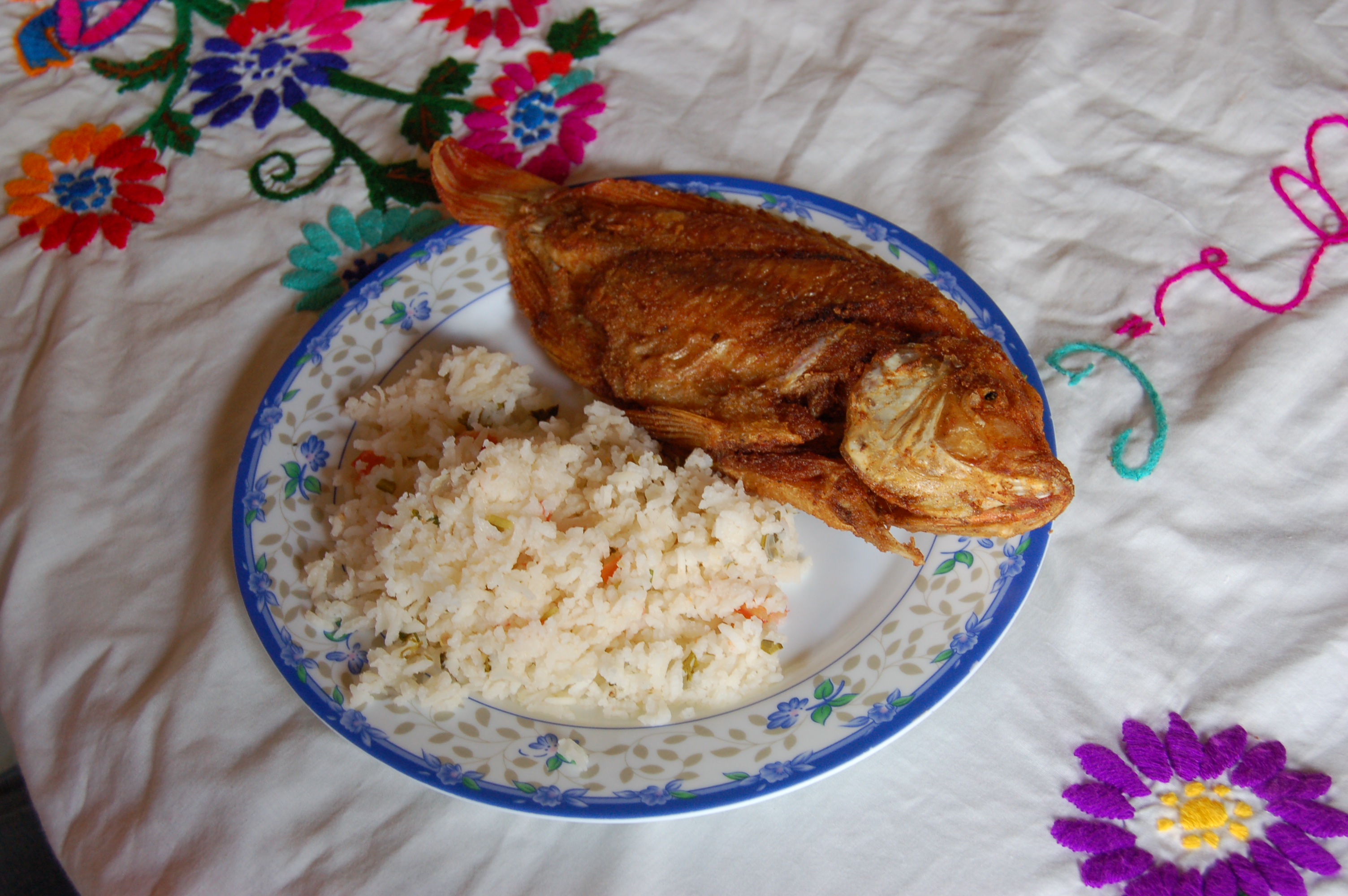
Fried tilapia by Bruce Stambaugh
Fried tilapia and rice served to me in a home in Honduras.
If I was served meat as a guest in someone’s home, I politely ate it, but only a small portion. While working in Honduras on a mission project with a group from our church, we were sometimes served beef or fried fish. Not wanting to be insulting, I ate what was prepared for me or furtively shared with another person.

A year after first going on my new diet I received the best news possible. My homocysteine levels, the important blood work scores, were below the danger threshold. The diet, exercise and medication were working.

My doctor was as pleased as I was. I told him that to celebrate I was going out to eat and have a steak. I didn’t of course. By then, the desire for meat had long faded. In fact, the greasy smell exhausted by restaurants makes me nauseous.

Even though the dizziness about which I had originally complained was unrelated to my disease, I was ever thankful that I had mentioned it. I feel better, less lethargic, and more vibrant. I have lost a few pounds, and enjoy my regular walks, which have the added bonus of communing with God and nature as I stroll along our rural roads.

Best of all, I am able to maintain my regular routines and enjoy not only the food I eat, but the life that God has given me one day at a time.

Country view by Bruce Stambaugh

This article appeared in the July 2012 edition of Purpose, Stories of Faith and Promise.

© Bruce Stambaugh 2012

A drought of a different kind

Miller farm by Bruce Stambaugh
The farm of my late in-laws, Wayne and Esther Miller, as painted by my recently deceased mother, Marian Stambaugh.

By Bruce Stambaugh

Our family has experienced a drought far beyond the on-going dryness that our area and much of the country is currently enduring. My mother died in April, and now my mother-in-law, Esther Miller, recently passed away. Both were 90.

The word drought is usually defined as a long period of dry weather. Wherever they live, Florida, Ohio, Pennsylvania or Virginia, all of Esther’s grandchildren have had to endure this drought. In some areas, the drought is considered moderate while in others it is much more serious.

Funeral flowers by Bruce StambaughThe second definition of drought encompasses a much wider, deeper meaning. Drought is a lengthy serious lack of something. When you lose your mother and your mother-in-law within three months of each other, one cannot help but sense a serious lack of something.

I know I do. My brothers and sisters do. Now my wife and her sister do as well. All of our parents are gone. We are now the elder generation. I’m not sure I’m ready for that distinction yet.

I also know the grandchildren, though they are scattered across the country pursuing their various careers, feel that certain dryness, too. They don’t have to say anything. I can see it in their eyes, their non-verbal sorrowful expressions.

Like my mother, Esther was a good, God-fearing person, dedicated to rearing her family the best way she knew how. She learned those loving skills from her mother, and perhaps her own grandparents.

Reality has set in for all of us. The torch has been passed. It is up to us to carry on what was modeled for us for all those years.

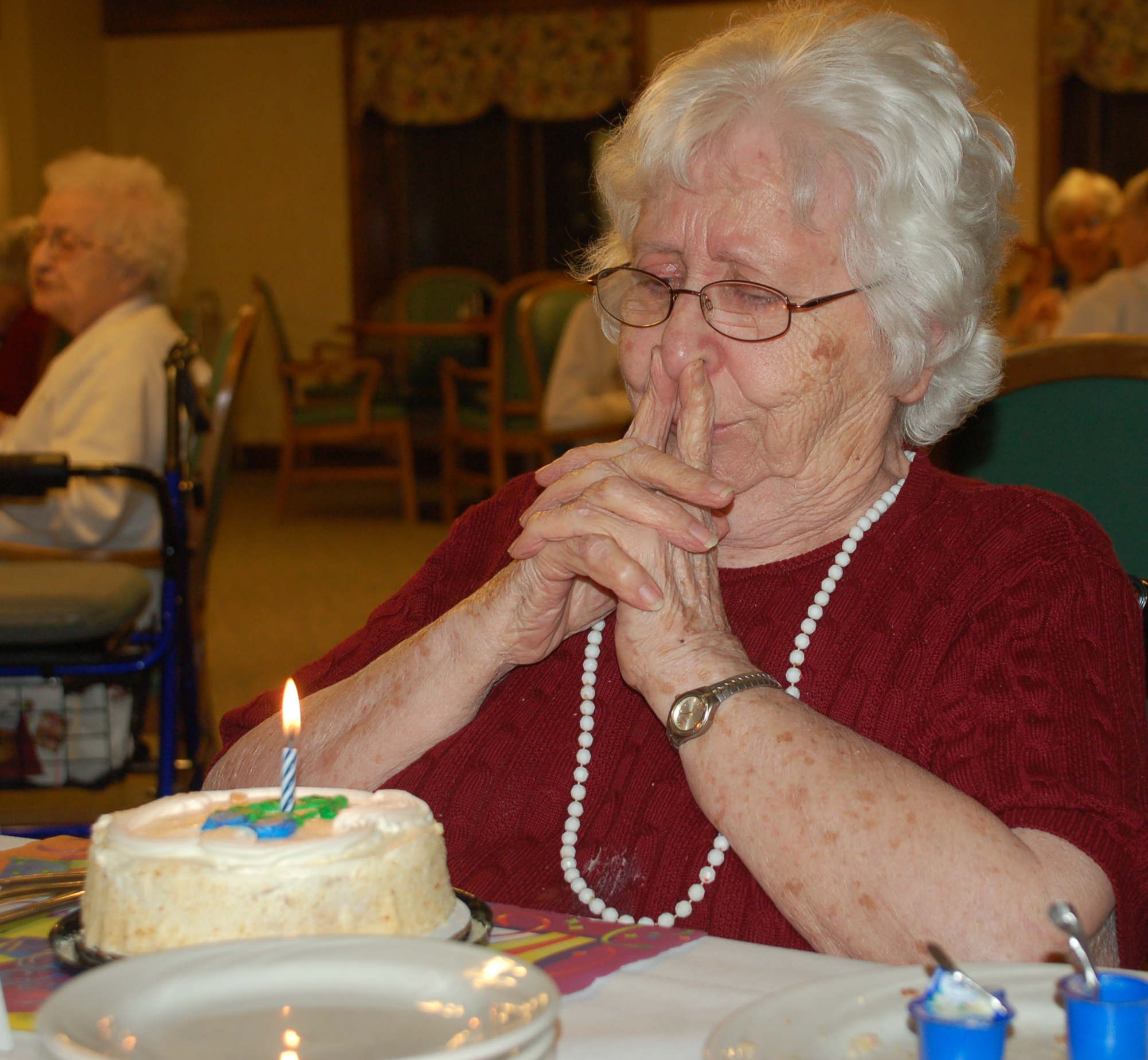
Esther Miller by Bruce Stambaugh
Emotion overcame Esther Miller at her 90th birthday celebration.
I remember the very first time I met my future in-laws at their 80-acre farm east of Louisville, Ohio. I hadn’t been there long when Neva’s father asked me if I wanted to see the pigs. How could I turn down that offer?

I not only got to see the pigs, but also the milk cows and the heifers, too, and the grain bins and hayloft and the tiny milkhouse. At the time I thought Wayne was just being nice. On the way home, Neva told me that she knew her father liked me because I got to see the pigs on the first visit. It took other suitors at least three visits.

Esther welcomed me with equal warmth. Excellent host that she was, she offered me a beverage and a delicious homemade snack. She could have written a book on being a homemaker. When Neva and I announced our engagement to her parents, Esther responded in a most amicable way.

“We are glad to have you in the family,” she said. “If we had had a son, we were going to name him ‘Bruce’.” I was at home away from home.

I remember hustling our young daughter and son into the Miller farmhouse one Christmas Eve in the teeth of a blizzard. Once inside, the warmth of the gracious hospitality far exceeded that of the comfortably heated home.

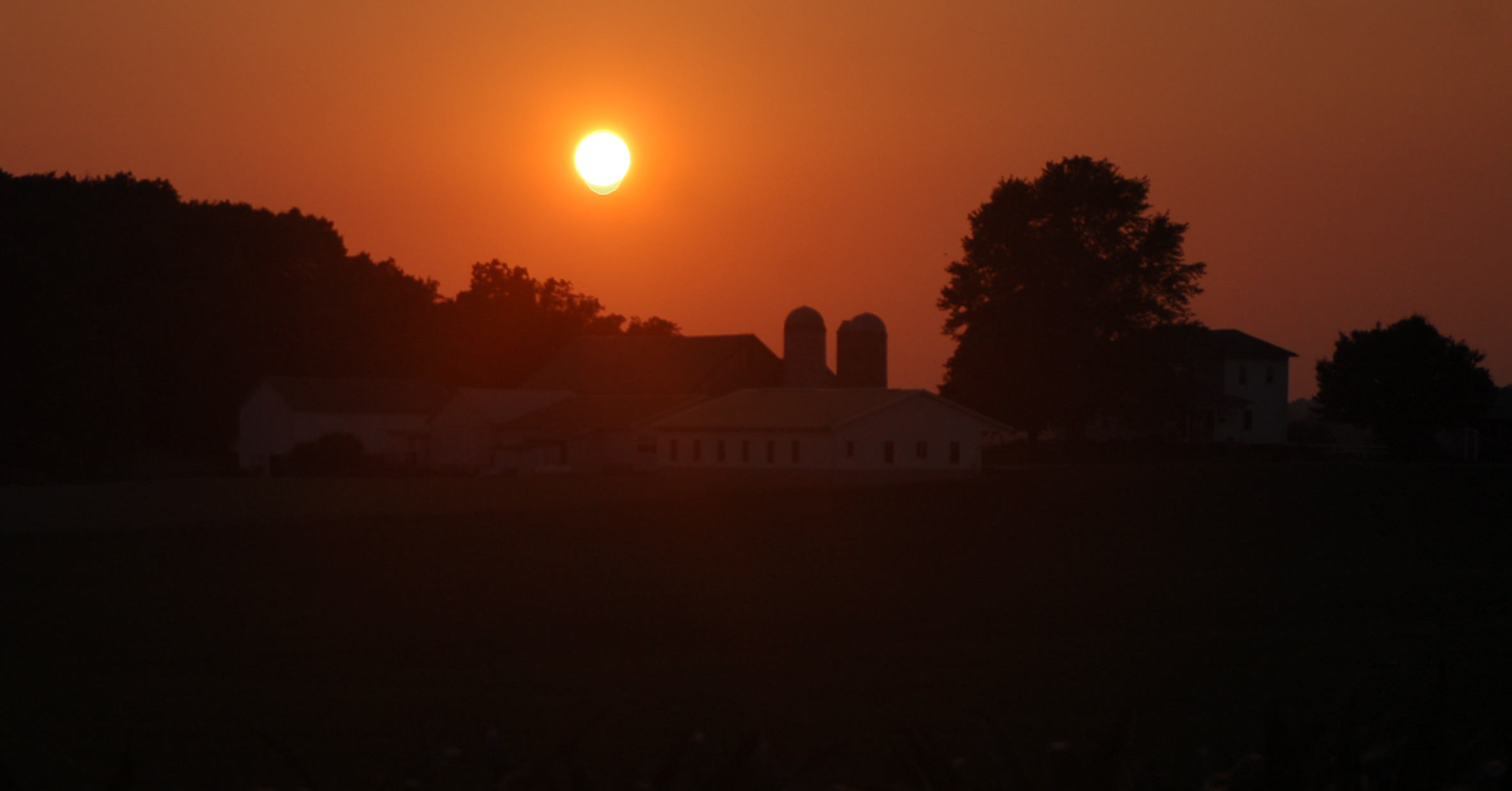
Farm sunset by Bruce Stambaugh

During our times of loss this year, we have experienced the kindness and thoughtfulness of many, many others. They each found their own ways to share in our mourning via food, flowers, cards, emails or calls. We felt blessed by those expressions of sympathy.

In addition, the family has found a wellspring of refreshing comfort despite our maternal losses. We rejoice that our parents enjoy an eternity that will never know any kind of drought whatsoever.

This column appeared in The Bargain Hunter, Millersburg, OH.

© Bruce Stambaugh 2012

Carl Maxwell leads a life worth living


By Bruce Stambaugh

Given his many maladies and his age, Carl Maxwell, 77, of Berlin, Ohio, would have every right to simply give up on life. Instead, he has done just the opposite, and many people are the beneficiaries.

The list of all the good Maxwell has done in his life far exceeds his list of illnesses. Kidney dialysis three times a week, congestive heart failure, diabetes, quadruple bypass surgery on his heart, suffering four heart attacks, staph infections and skin cancer head the list.

Maxwell hasn’t let any of that stop him. If anything, they serve as incentives to live life to the fullest everyday. He does so personally and through several community organizations for which he volunteers.

“I love life,” Maxwell said. “I want to do everything I possibly can while I can.”

Carl Maxwell by Bruce Stambaugh
Carl Maxwell
Maxwell has and is doing a lot by any measure. His accomplishments would be impressive for someone in excellent health.

Maxwell was a charter member of the East Holmes Lions Club and is a charter member of the newly established Berlin Lions Club. He served as president of the East Holmes club, and was recently presented the prestigious Melvin Jones Fellow award by Lions Club International.

“I’m especially interested in the sight aspect of Lions Club,” Maxwell said. Lions Clubs collect used eyeglasses and distribute them to needy people around the world.

Maxwell has served as either president or vice president of the East Holmes Fire and EMS District board since its inception in 2000. He is the at large member of the five-member board.

Maxwell, along with his wife of 53 years, Lorene, volunteer at Save and Serve Thrift Shop in Millersburg twice a week.

“On Tuesdays,” Maxwell said, “I cut rages with Paul Roth.” He and Lorene also help out as cashiers on Thursday evenings.

Maxwell has also taught Sunday school at several levels at Berlin Mennonite Church for many years.

“I like people,” Maxwell simply said.

If he did slow down, no one would question his decision. Maxwell goes for kidney dialysis three times a week in Wooster.

“Counting my time on the road,” he said, “each visit takes eight hours.” Maxwell is not complaining about that.

“I didn’t really want to do dialysis,” Maxwell said. “But I got out voted 5-1 on that.” His loving wife and four sons all wanted him to do the treatments. Maxwell drew the line there.

“I had an opportunity for a kidney transplant,” Maxwell said, “but I turned it down.” He said he felt someone younger than him should have a chance at the available kidney. “I couldn’t live with myself if I had taken a kidney that some 20-year old needed,” Maxwell said frankly.

Carl and car by Bruce Stambaugh
Carl Maxwell showed off his salmon and grey 1958 Buick.

Maxwell doesn’t spend all of his time volunteering. He also has some heart-felt hobbies in which he has invested much time and money. Maxwell, who once had 14 antique cars, now has three old cars and a 2002 Corvette, which he calls his “toy.” He occasionally drives it to his dialysis sessions.

At the peak of his car collecting days, Maxwell served for 16 years on the regional board of directors of the Antique Car Collectors of Canton. Maxwell also has the world’s largest collection of Sinclair Oil products and memorabilia, which was featured earlier this year in an international collection magazine. From old gas and oilcans to large advertising signs to refurbished gasoline pumps, Maxwell’s collection is clearly one-of-a-kind. He has gathered items from many states and even other countries.

That extensive collection stems from his life’s work.

Sinclair signs by Bruce Stambaugh
Carl Maxwell has two triple-check Sinclair Oil signs displayed at his barn. He said only a handful remain.

Maxwell worked 36 years for Holmes Oil, which originally distributed Sinclair products. He started as a truck driver, but after six years, he and Maynard Hummel became co-owners of the business. Maxwell sold his half interest in the business after 30 years.

“I have had an unbelievable life,” Maxwell readily shared. He credits two women for those experiences, his wife and his late mother, Edna Weaver Maxwell.

“I owe a lot to others, especially my wife,” he said. “She’s just been amazing.” He said Lorene has been an incredible help to him in his many times of need. Maxwell said he recognizes his physical limits and takes the time to rest so he can continue to keep his busy pace.

“I want to do everything I possibly can,” Maxwell said. “Life is still worth living, and it’s too short to be negative.”

Carl and pumps by Bruce Stambaugh
Carl Maxwell has collected Sinclair Oil signs, cans and even gas pumps.

This article appeared in the July 2, 2012 edition of the Bargain Hunter, Millersburg, OH.

© Bruce Stambaugh 2012

Lunch on the porch includes more than just good food

Porch view by Bruce Stambaugh

By Bruce Stambaugh

Everyone needs a sanctuary. For my wife and me, our back porch is our quick retreat from life’s demands. A few short steps and we are in a special place. Over the years our back porch has given us many marvelous memories.

We recognize that we are fortunate to live where we do. Our home, built three decades ago off an Amish farm, is situated between Benton, Berlin and Mt. Hope, all in Holmes County, Ohio. Our back porch provides panoramic, inspiring scenes.
Girls in buggy by Bruce Stambaugh
The open-air porch was added to our modest home several years ago. We wanted a quiet place to relax during Ohio’s warmer climes. When the weather does cooperate, we especially enjoy lunches together there. It helps to have a wife who is a great cook. I’m no chauvinist, but I’m no chef either. Neva rules the kitchen and I reap the rewards and help clean up.

Lunch by Bruce Stambaugh
A recent lunch that we enjoyed on the porch.
Somehow the food tastes even better on the porch. One recent lunch featured her homemade butternut squash soup, sprinkled lightly with toasted bread crumbs. A fresh spinach salad with crasins and vinaigrette nicely complemented the soup.

A simple dessert of sweet cherries was washed down with fresh sweet peppermint tea, spiked with basil, giving the tea a sweet-tart taste. The mint was picked just minutes before being doused in boiling water. Other than the tea, no seconds were needed. A single course of each was plenty.
Mowing hay by Bruce Stambaugh
The house serves as a buffer between our busy highway and the backyard, minimizing the traffic noise. We love the quiet.

Well, perhaps quiet isn’t the proper word. Abundant backyard activity breaks any hint of silence. While we dined, we heard the undulating hum of a mower and the rattle of horse harnesses as our Amish neighbor completed his second cutting of hay before taking his own lunch break.

Downy by Bruce StambaughIn the meantime, the birds and wildlife kept us entertained as they also dined. With the porch open on the sides, it’s not unusual for birds to zip over our heads to the feeders. That is especially true for the acrobatic hummingbirds. Their feeder hangs from the edge of the porch near the kitchen window. It is fun to watch the territorial hummers chatter and chase each other away from their own version of lunch. They wouldn’t have to do that. There are several places to perch.

If we stay immobile, even the woodpeckers light upon the peanut butter suet feeder that dangles next to a hanging basket of flowers. The little downys, however, are the only ones that aren’t spooked off by our presence. Still, they nervously but needlessly chip and jerk their heads warily as they jab at the rich mixture, making sure we keep our distance.

Wildflowers by Bruce StambaughA green frog, one of six that inhabit our little garden pond, waits patiently for lunch to fly by. The green frogs that patrol our little garden pond adjacent to the porch patiently wait in the sun for their own lunch to fly by. When I hear a plop, I know they are as satisfied as we are.

Beyond the pond, monarch, swallowtail and red admiral butterflies partake in their own flowery buffet on the patch of ever-changing wildflowers. Along with volunteer sunflowers, the coneflowers, Black-eyed Susan’s, daisies, gaillardia and bachelor buttons paint a colorful palette in the shade of the canopy of pines and giant sugar maple.

When human guests arrive, their smiles reveal their appreciation for our sanctuary. Added together these pure and pleasurable ingredients always make for enjoyable and hardy gatherings. I’m more than happy to share the recipe.

Guests by Bruce Stambaugh

© Bruce Stambaugh 2012

The real reason to celebrate July 4th

D.O.G. Street by Bruce Stambaugh
Many of the tenets of our democratic republic were formed in Williamsburg, VA along D.O.G. Street.

By Bruce Stambaugh

Watching starbursts of fireworks from five miles above the earth was an unexpected treat.

My family and I were flying back from vacation late on July 3, 1988. Our hour-long flight path took us along the southern shores of Lake Michigan and Lake Erie. Shortly after we were airborne, the sky began to pop with burst after colorful burst of fireworks.

Parade by Bruce Stambaugh
Parades are just part of the annual Fourth of July celebrations in the United States.
All along the route towns large and small expressed their jubilation for America’s Independence Day holiday with pyrotechnic displays. From high above I imagined the various sparkling bursts reflecting the broad diversity of folks that comprise this great country. Necks craned skyward, people from many cultures, races and religions in urban parks, county fairgrounds or on their own back porches had to also be admiring their local kaleidoscope of explosions.

As the last sparks flickered, I had to wonder then, as I wonder now, if the real meaning behind the celebratory fireworks is fully understood. As they picked up their chairs and folded their blankets to return home, what were they thinking? Was it just another fireworks display or did they truly comprehend the meaning of the day?

Those are questions that needed to be asked then just as they need to be asked today. Remembering our historic roots helps us to focus on where we are now and where it is we need to be going tomorrow.

Fourth of July decorations by Bruce Stambaugh
Homes like this one in Lakeside, OH will be decorated for the Fourth of July all across the U.S.

As we celebrate another Independence Day in the United States, here are a few historical facts that cannot be changed, though some have tried to distort the truth. The Continental Congress actually declared its independence from Great Britain on July 2, 1776. The revolutionary document, penned by Thomas Jefferson, was signed July 4, 1776, making the radical pronouncement official.

At great risk to their fame, fortune and reputations, these bold men, and they were all men, set down the groundwork of a new nation. That foundation was based on one essential notion, freedom.

A few years later that central idea wove its way into the heart of the U.S. Constitution in the form of the first 10 amendments commonly called the Bill of Rights. They itemized specific freedoms, including the freedom of religion, the freedom of speech, and the freedom to gather, among others.

British flag by Bruce StambaughThe people of the American colonies wanted to shake the hold of Great Britain’s rule and run their own lives. This great document announced a new form of government for all peoples. Without it, anarchy would have ruled.

Since its initial adoption the Constitution of the United States has been amended to appropriately represent rights and freedoms for all of the country’s peoples, regardless of gender, race or creed as the population and society’s mores have evolved. To be sure, that evolution has had its civil rough spots to say the least.

From our present perspective, it can be easy to think that some things always were. “In God We Trust,” for example, was added to our coins and currency in 1864 at the end of the Civil War. The phrase “under God” in the Pledge of Allegiance was not added until 1954 during the McCarthy communism scare era.

The altitude at which we enjoy the July 4th fireworks isn’t terribly important. The attitude of appreciation and a clear understanding and application of how and why our basic freedoms exist, however, are essential for appropriate social discourse.

As the fireworks explode in honor of this July 4th, what will you revere about Independence Day?

Amber waves of grain by Bruce Stambaugh
Religious freedom was the primary moving force for Amish immigrating to the United States, where their amber waves of grain still roll today.

© Bruce Stambaugh 2012

Bay Photos by Donna

Wildlife Photos From The Chesapeake Bay Region

ROAD TO NARA

Culture and Communities at the Heart Of India

K Hertzler Art

Artist and nature journalist in the Shenandoah Valley of Virginia.

Maria Vincent Robinson

Photographer Of Life and moments

Gabriele Romano

Personal Blog

Jennifer Murch

Art is the only way to run away without leaving home. -Twyla Tharp

Roadkill Crossing

Writing generated from the rural life

ANJOLI ROY

writer. teacher. podcast cohost.

Casa Alterna

El amor cruza fronteras / Love crosses borders