A Morning Walk in the Woods

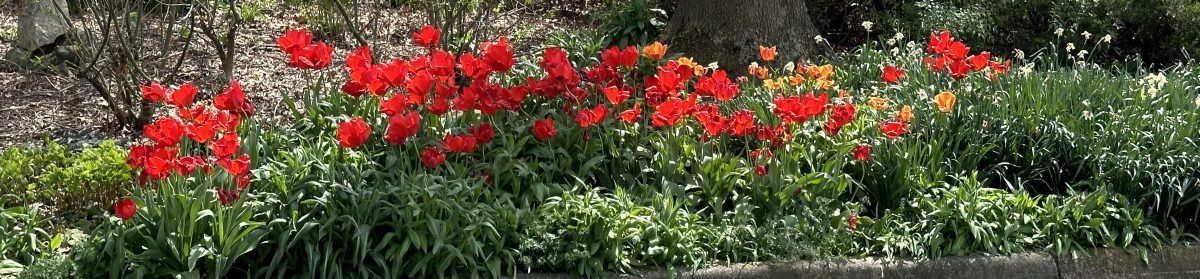
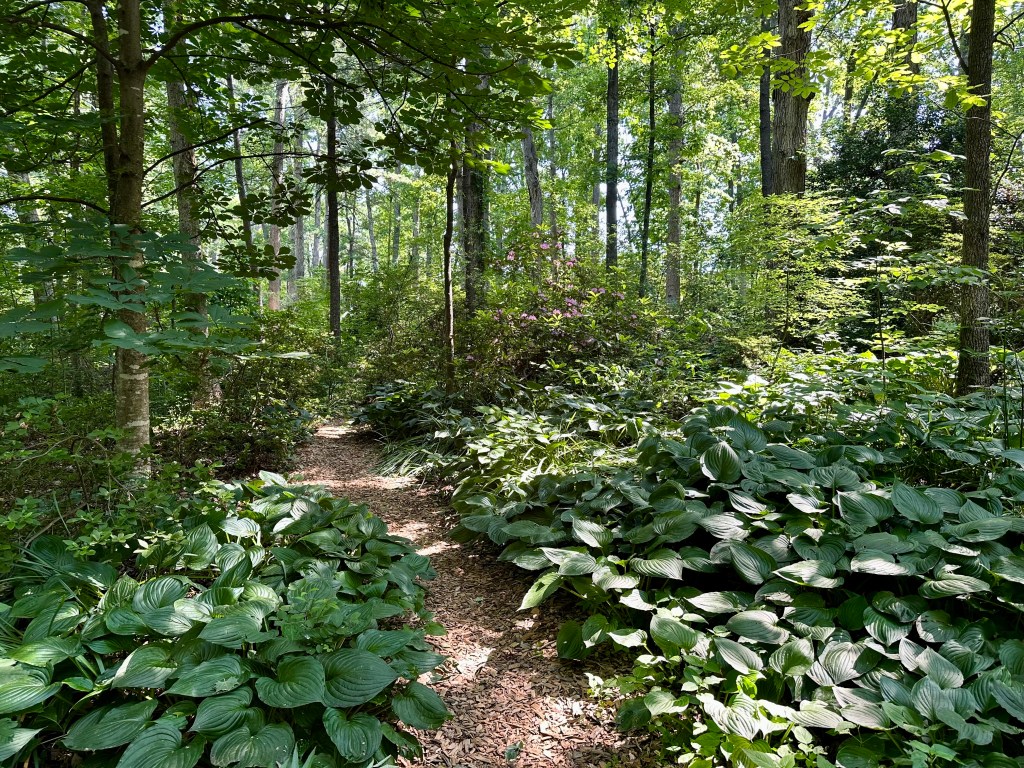
Where I walked. Photo by Bruce Stambaugh

After an 8 a.m. doctor’s appointment, I took a long and much-needed walk in the woods. It happened that the doctor’s office was adjacent to one of my favorite places in the Shenandoah Valley.

The Edith J. Carrier Arboretum on the James Madison University campus in Harrisonburg, Virginia, is a life-giving oasis among 21st-century din. There, birdsong, blossoms, and the verdant forest provide a temporary sanctuary from life’s bustling and boisterous busyness.

To be sure, you still hear the sirens, the traffic’s hum on the interstate that cuts the campus and town in half, the train horns, even the airliners cruising into airports two hours away.

The forest canopy covers you with its sacred, healing goodness. It’s life’s true purpose. Use your senses to enjoy the rapturous unfolding.

A late-migrating Wilson’s Warbler flits and feeds on insects deep in the recesses of dense elderberry bushes. Wood Thrushes sing their multiphased cheery song in the shadows of the mixed deciduous woodlots. American Robins scold one another as they defend their nesting territory.

A Wood Thrust sheltered in the shade of a hickory tree. Photo by Bruce Stambaugh

A slight mist rises from the forest floor, beckoned by the strengthening morning light. White-breasted Nuthatches, Eastern Wood-Pewees, Tufted Titmice, Northern Cardinals, Carolina Wrens, and Song Sparrows fill the wooded ravine with glorious, variegated tunes. A Red-bellied Woodpecker’s vocalization echoes deep from the hillside woodlot while an American Crow sails through the trees, cawing from one perch to the other.

Each in their own way, joggers, birders, parents with toddlers, grandparents, and college students enjoy this preserved paradise. Time in the arboretum is an equal opportunity home with a smorgasbord of enjoyment. Some are passing through. Some are exploring the flora and fauna. Others simply sit, look, listen, and smile.

A lone rhododendron holds onto its precious purple blossoms along a wood-chipped path in the shade of the congregation of hardwoods. Here and there, morning light filters through the giants’ canopy, speckling the forest floor.

The broad leaves of huge hosta plants invite you to explore, hike, relax, reflect, listen, and admire all that nature has to offer. A well-located bench beckons you to sit a spell and breathe in the cool freshness before summer’s heat and humidity arrive.
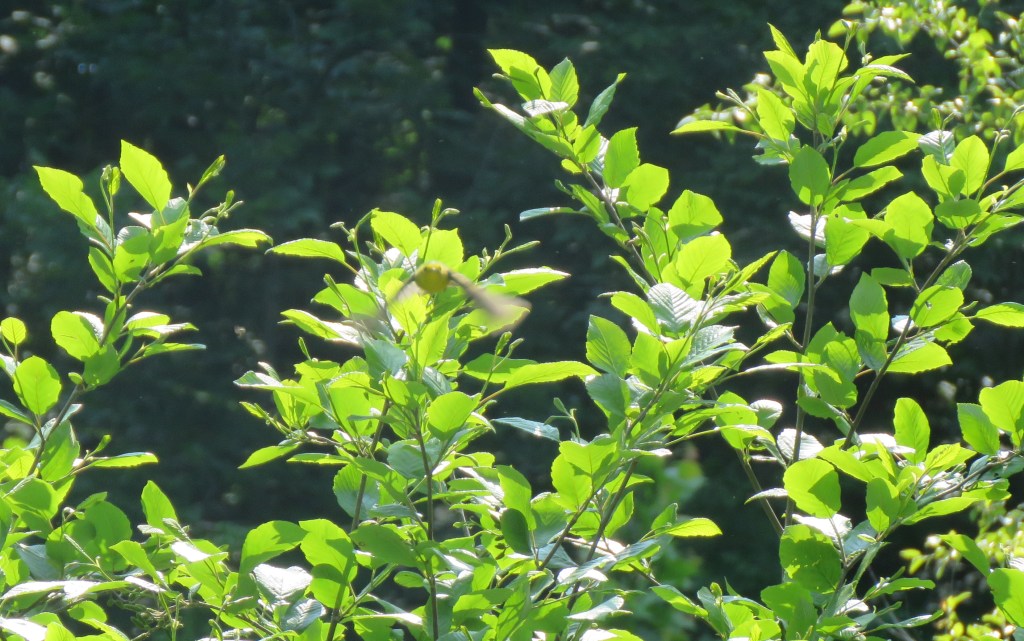
My only shot of a reclusive male Wilson’s Warbler. Photo by Bruce Stambaugh

© Bruce Stambaugh 2025

Everyone needs a sanctuary


Everyone needs a sanctuary. Recent research shows that connecting with nature helps humans in multiple ways.

Nature helps heal, soothe, and restore individuals from pain, stress, and depression. We all need a place to escape, if only temporality, from the pressures and madness of the world.

When my wife and I winter in Florida, we are fortunate to have just such a place. Egans Creek Greenway is the first spot I visit after my wife and I get settled into our rental.

Egans Creek Greenway is an island inside an island. Covering more than 300 acres, the greenway is a city-run park on the north end of the 13-mile long Amelia Island, a barrier island northeast of Jacksonville.

The greenway is not your typical sanctuary, but it’s mine for many reasons. I get needed exercise walking its grassy trails. A variety of wildlife is in abundance. I can practice my photography hobby shooting landscapes and nature’s flora and fauna.

Please click on the photos to enlarge them.

Egans Creek winds its way through the two main sections of the greenway. A saltmarsh dominates the northern half. It teems with wading birds, birds of prey, songbirds, furry mammals, and intriguing reptiles. The Atlantic Ocean tides keep its waters brackish.

The southern section is part maritime forest and part freshwater ecosystem. The creek runs along the eastern side while a grid of manmade ditches from previous farming attempts crisscrosses elsewhere.

Mixed vegetation creates a habitat for a wide variety of creatures. Pileated woodpeckers fly their noisy flight high above momma alligator and her baby brood while a barred owl hoots from a branch of a giant live oak tree.

Scores of yellow-rumped warblers dart from the underbrush to palm trees, chip-chipping all the way. A red-shouldered hawk watches for lunch from high on a dead snag. A freshly hatched monarch butterfly flaps its damp wings on a Florida holly bush.

A reunion of soft-shelled turtles suns on the steep banks of the creek. A honeybee gorges on a clump of newly blossomed marsh-pink.

This slideshow requires JavaScript.


Where the creek runs along the west side of the greenway, an osprey hovers before diving for an unsuspecting fish. In the process, large shorebirds are flushed. A great egret, wood stork, and a beautiful roseate spoonbill all take flight.

I am not alone in appreciating this preserve. Students stroll through on their way home from school. Seniors ride bicycles or walk in the sunshine of gorgeous days. Middle-aged joggers hustle by. This passive recreation is part of the park’s plan.

Strangely, concentration is essential to appreciate all the greenway has to offer. Surrounded by streets, houses, and businesses, the greenway is a quarter of a mile from the ocean. Horns, sirens, and roaring engines compete with the clacking call of the clapper rails.

So, too, to do the helicopters flying back and forth to the Mayport Naval Station 20 miles to the south. Commercial airliners, private jets, and noisy single-engine planes fill the air space overhead as they approach the local airport and Jacksonville International.

Besides a sanctuary, the greenway serves as an outdoor classroom. People stop to ask what I’m looking at or to tell me of a bird they saw. I love their smiles when they spot the eastern bluebirds devouring cedar berries.

I enjoy the greenway all the more when others accompany me. Multiple pairs of eyes and ears trump singular old ones. We help each other find and admire all the greenway’s splendor.

I am grateful for this island sanctuary, and that it reinforces the scientific evidence about nature.

© Bruce Stambaugh 2020

Bay Photos by Donna

Wildlife photos from the Chesapeake Bay region

ROAD TO NARA

Culture and Communities at the Heart Of India

K Hertzler Art

Artist and nature journalist in the Shenandoah Valley of Virginia.

Maria Vincent Robinson

Photographer Of Life and moments

Gabriele Romano

Personal Blog

Jennifer Murch

Art is the only way to run away without leaving home. -Twyla Tharp

Roadkill Crossing

Writing generated from the rural life

ANJOLI ROY

writer. teacher. podcast cohost.

Casa Alterna

El amor cruza fronteras / Love crosses borders