I’m a weather nut, geek, groupie, whatever you want to call me. The weather has fascinated me since I was a child. My wife will verify that I get antsy in severe weather. I’ve tried to channel that excitement and energy into practical action. I’ve been a severe weather spotter for the National Weather Service since 1975.
Imagine my surprise when the fog rolled in off of the Atlantic Ocean while walking a beach near Mayport, FL one afternoon. I was surprised and thrilled to see this rare fogbow appear. I was extremely fortunate to be at the right place at the right time because fogbows don’t last long and are seldom photographed.
Fogbows are cousins to rainbows. Fogbows form from the sun reflecting in millions of tiny water droplets that make up the fog. Since it takes one million cloud droplets to make a single rain droplet, the fog droplets are too small to adequately refract the colors that create rainbows. Consequently, the fogbows shine bright white but only for a brief time. Because of their color, fogbows are also called ghost rainbows, white rainbows, or cloud bows.
You can get a feel for the size of the fogbow by comparing the people below the far left end of the weather phenomenon. “Fogbow” is my Photo of the Week.”
I can’t exactly tell you when the weather bug hit me. All I know is that the weather just fascinates me.
Maybe it started when I was a youngster. A summer thunderstorm would force the neighborhood gang of kids onto our front porch. Rained out of our outdoor mischief, we passed the time oohing and ahhing at the vivid streaks of lightning dancing across the sky.
College invigorated my interests all the more. Geography courses answered questions I didn’t even know to ask. My weather appetite intensified.
After I had graduated, I took a teaching position at Killbuck Elementary School and joined the volunteer fire department after moving to the village in the valley. When I learned that the National Weather Service depended on first responders as severe weather spotters, I was elated. I took the required course to become a trained spotter. Doing so enabled me to combine two interests into one, firefighting and weather.
I keep an eye on weather forecasts for good reasons. The lives of others might depend on it. In today’s electronically connected world, I get the word out about potential severe weather through posts on social media just in case a few people don’t hear about the impending storm.
I likely won’t ever outgrow the desire to watch the weather. When the National Weather Service posts a storm watch near where I happen to be, I go into proactive mode watching various radar and severe weather pages on the Internet.
Thanks to technology, a spotter’s approach to watching for severe weather has significantly changed over the decades. Instead of going to the highest hilltop with the best vantage point and viewing from a vehicle, I can stay in the safety of my home. There I track the storm on my computer and by watching out the windows for rotating clouds, hail, and any flooding I can see.
Morning and evening, the local weather service office receives reports of new snow totals from dozens of snow spotters across the coverage areas. Doing so helps the professionals in evaluating their forecasts and even in issuing weather advisories. After all, frozen precipitation is the hardest type for career meteorologists to predict accurately.
Like many of the other community activities I’ve done in my life, being a weather spotter is a voluntary position. Knowing I am only one of many who help the weather service get the weather word out to citizens is all the pay I need.
Between tornadoes, blizzards, flash floods, damaging straight-line winds, and lightning strikes, I’ve seen a lot of wild weather in my lifetime. It may sound a little strange to say this, but I enjoy reporting what I find.
I suppose I do it both for the thrill and the necessity to relay what I have observed. Helping the official weather forecasters, even in some small ways, gives me great satisfaction.
I guess I’m just a weather geek at heart. I’ll gladly wear that badge of honor as I forge into the next snowdrift.
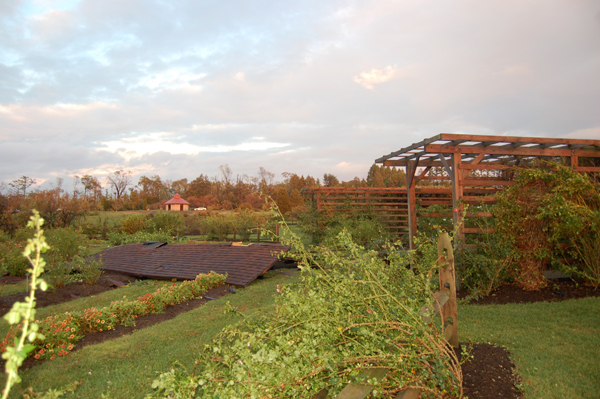
The entrance to the Secrest Garden and Arboretum after the tornado.
By Bruce Stambaugh
For the second time this summer, tornadoes caused significant damage in Ohio’s Amish country.
Shortly before 5:30 p.m. on Thursday, Sept. 16 a powerful tornado touched down on the south edge of Wooster, Ohio along Prairie Lane. The tornado, which the National Weather Service rated an EF2, proceeded east destroying businesses and homes, and crossed Madison Ave. onto the campus of the Ohio Agricultural Research and Development Center, a division of The Ohio State University.
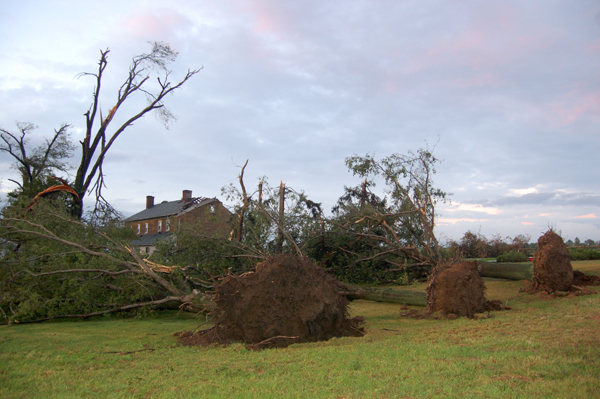
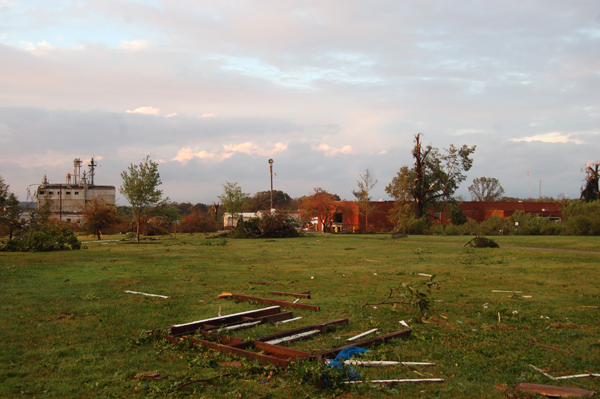
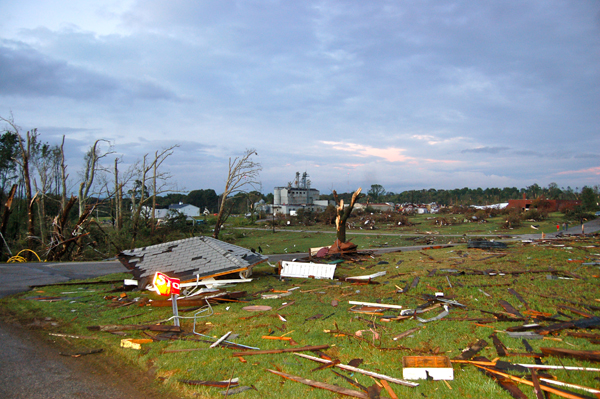
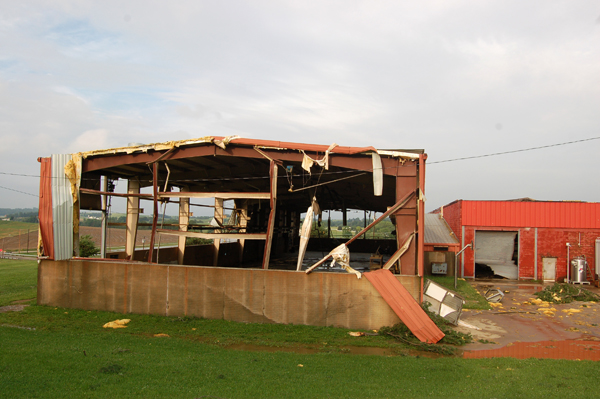
The tornado caused extensive damage to campus buildings, including some historical homes used as offices. It also destroyed the machine shop and heavily damaged parts of Secrest Garden and Arboretum, where many people love to walk and relax among the roses, ornamental shrubs and old age trees. The tornado clipped off dozens of the huge trees 20 to 30 feet above the ground.
The Wooster Twp. Fire chief reported that only one person was slightly injured. But she refused transport to the hospital.
The tornado continued on an east northeast path destroying and damaging several other homes and farm buildings. It did considerable damage to the Riceland Golf Course on U.S. 30 south of Orrville. Altogether, the NWS reported that the tornado was on the ground for 12 miles and reached wind speeds of 130 m.p.h. It left a path of destruction 200 yards wide.
Around 6 p.m., an EF1 tornado hit near the rural town of Farmerstown, Ohio in Holmes County about 25 miles south of Wooster. Several homes and barns were destroyed or damaged there. But again, no one was injured, although some farm animals had to be put down. The tornado was on the ground for three miles and reached a maximum speed of 100 m.p.h. It ranged from 50 to 75 yards wide.
As a Skywarn severe weather spotter for north central Holmes County, the Cleveland office of the National Weather Service asked me to photograph the damage at the OARDC. This was prior to knowing of the tornado in Holmes County. No tornado warning was issued for Holmes County.
I arrived at the OARDC shortly before 7 p.m., which left me a little more than a half an hour to take pictures before dark. I shot as many pictures as I could, but due to darkness, was unable to make it entirely around the campus. As I walked back to my car, parked in the arboretum a half mile east of the damaged OARDC buildings, I cut through open fields. I found several places where debris had hit the ground, leaving large gouges in the fields and grass.
The first tornado of the summer hit Holmes County and continued into Tuscarawas County on June 5. The EF1 and EF2 tornado caused extensive damage along its 10 mile path.
A gallery of some of my shots at the OARDC is shown below. Information about the Farmerstown tornado can be found here: http://www.holmescountyjournal.com/.
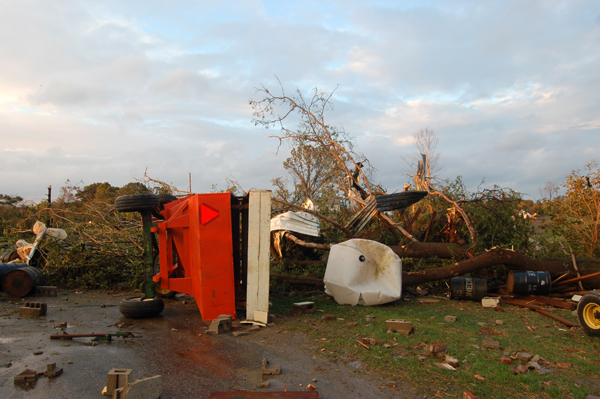
Trees were snapped and the old Rice House heavily damaged at the OARDC in Wooster, Ohio.One of the many OARDC buildings destroyed by the tornadoAnother view of the building shown above.Debris and stripped trees at the OARDC.The tornado toppled large trees on the OARDC campus.The OARDC's machine shop was heavily damaged by the tornado.Following the tornado's path to the machine shop at the OARDC.Damaged farm equipment and trees at the OARDC.More damage around the machine shop at the OARDC.Another destroyed building at the OARDC.The destroyed machine shop at the OARDC.Debris from the tornado littered the OARDC campus.Damage was extensive at the building that housed the campus police station.The agricultural engineering building was destroyed.The OARDC rose garden was heavily damaged.
This buggy, which was used for display at a bed and breakfast, received heavy damage from the high winds.
By Bruce Stambaugh
Around 2:30 p.m. on Saturday, June 5, 2010, the National Weather Service issued a Tornado Warning for Holmes County, the heart of the world’s largest Amish population.
Sirens sounded as the storm rapidly approached. As a Skywarn spotter, I scanned the sky from the safety of my home. As the rain intensified, the sky looked ominous, and the sirens sounded again. However, it appeared that the worst of the storm had gone south of me. A friend alerted me to possible damage in the Berlin area.
I grabbed my camera, put on my waterproof shoes and headed south. I didn’t get very far. Fallen trees only two miles south of my home blocked the road. The fierce winds had ravaged old-growth woods behind a friend of mine’s home west of Berlin. A few homes were slightly damaged, a shed was completely destroyed and many trees were toppled.
I followed the damage into the west side of Berlin, where again trees were down, some laying in opposite directions. A home had the upper half of a large tree on its roof and the wind sent a limb through the roof of a nearby motel.
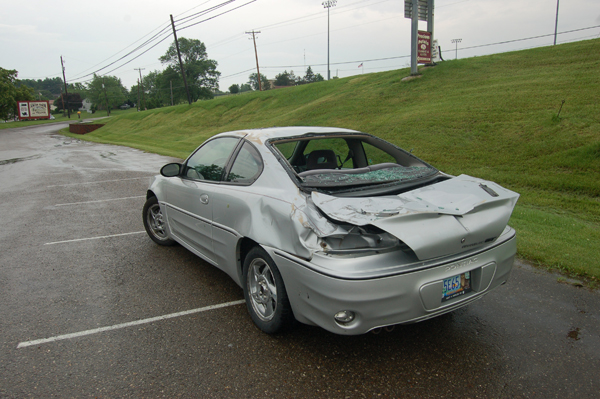
The next damage was east of Berlin near Hiland High School. Much of the damage there was from straight-line winds. Roofs were damaged; metal storage buildings buckled and signs were blown onto cars, damaging eight vehicles. Fortunately on one was injured.
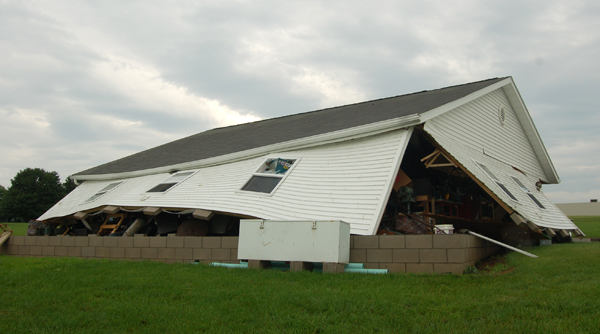
Firefighters spotted a funnel cloud west of Walnut Creek, where the first official touchdown was recorded. A large garage at a bed and breakfast was destroyed. The storm continued east-southeast through Walnut Creek Township. A combination of straight-line winds and tornado winds downed trees, and damaged sheds and two houses near Walnut Creek, and then hit metal storage buildings south of Walnut Creek. The tornado touched down again at Gerber Valley Farms on CR 144 southeast of Walnut Creek where it damaged two barns. The tornado did minor damage to a few homes on a township road near the county line.
Once the tornado passed into Tuscarawas County at Sugarcreek, it intensified into an EF-1 tornado, according the Pittsburgh office of the National Weather Service, which has jurisdiction for Tuscarawas County and points east. They estimated the tornado winds at 95 m.p.h.
The tornado did major damage to Skyline Mobile Home Company on SR 93 north and to a home across the road. Several large trees were toppled. From there, the storm hit Uhrden Corporation and Zinck’s Fabric warehouse on the northeast side of Sugarcreek. It crossed the flooded Sugar Creek, causing heavy damage to both the old and new sewer treatment plant buildings of the village. Just east of there it hit a home and caused major damage to Sugarcreek Pallet.
The tornado continued east, striking four homes along SR 39 on the eastern edge of Sugarcreek. All four had roof damage. The tornado crossed SR 39, hit another industrial building and destroyed a large barn on the Lorenz farm south of Dutch Valley Restaurant. At that point, the tornado lifted.
In all, I spent five hours taking pictures. The shots below are representative of the damage that occurred in the path of this storm.
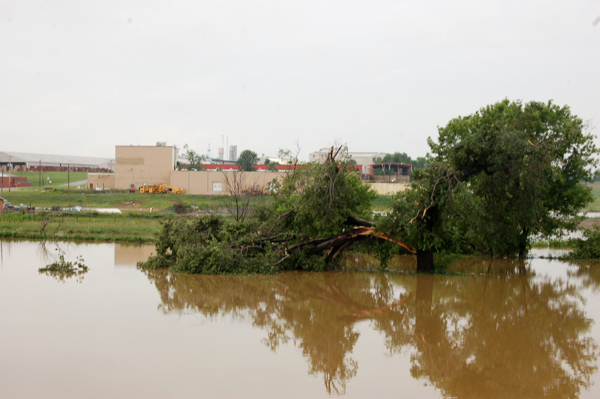
Old-growth trees were splintered and tossed like sticks west of Berlin, OH.This was one of several cars damaged by a large sign that was blown onto them east of Berlin.High winds destroyed this garage halfway between Berlin and Walnut Creek, OH.The tornado hit at the Robert J. Yoder farm near Walnut Creek, OH.Neighbors and workers began replacing the roof of this broiler house near Walnut Creek shortly after the tornado hit.The tornado buckled the south wall at Skyline Mobile Homes, Sugarcreek, OH.The tornado peeled much of the roof off Skyline Mobile Homes, Sugarcreek, OH.The tornado blew out every wall of the north section of Uhrden Company, Sugarcreek, OH.Flooding in Sugarcreek, OH was a problem both before and after the tornado hit the buildings in the background and the tree in the water.The tornado destroyed the main barn on the Lorenz farm east of Sugarcreek, OH.
















 Roadkill Crossing
You must be logged in to post a comment.