

Earth Day in Virginia’s Shenandoah Valley dawned with a steely gray overcast sky. It remained that way for the entire day. Still, I ventured out to celebrate the day set to honor Mother Earth.
Recently diagnosed with some unsettling health issues, I spontaneously decided to join the celebration. I hoped doing so would calm my nerves and help me settle my emotions.
I usually plan my daytrips so I’m ready to go at the crack of dawn. Consequently, I lost valuable time in the morning packing my lunch, birding equipment, and attire for the mountains. My destination was Reddish Knob, a peak on the front range of the Allegheny Mountains on the border of Virginia and West Virginia.
With reports of migrating shorebirds and songbirds returning, I wanted to see what I could find. Even though I have been birding for most of my life, I consider myself an average birder. As I age, my hearing has diminished, so I can no longer hear the higher-toned decibels of many songbirds.
I’m grateful for the birding apps on my smartphone. I especially like the Merlin app for identifying bird calls. It’s not always accurate, but it gets the job done for me. Better birders than I, most of whom are younger, are proficient in naming birds upon hearing and seeing them. It’s reason enough to bird in a small group of experienced birders.
However, today, I chose to go it alone. I needed the solitude and the solace. I did so, knowing that other birders would likely be out searching in the same areas. But it wasn’t to be. I spent the day on my own.
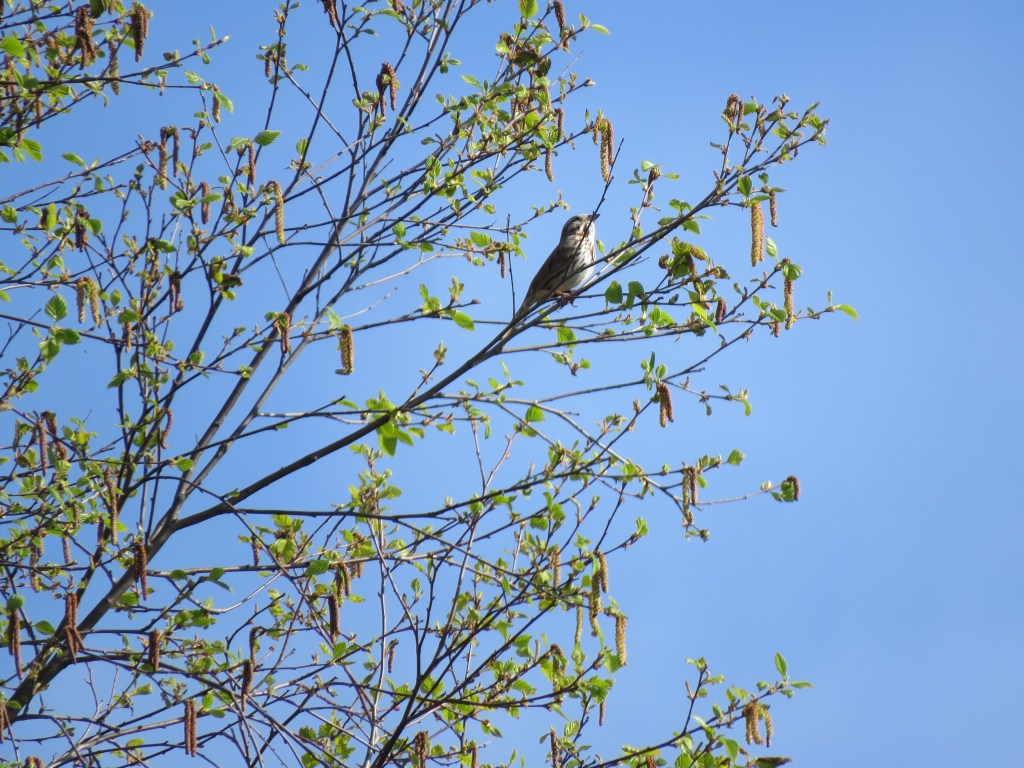
Before I even left, a Song Sparrow sang from a tree across the street. My first stop was a nearby lake renowned for its bird-watching and fishing opportunities. Wind-felled trees provided cover and roosting areas for birds and reptiles.
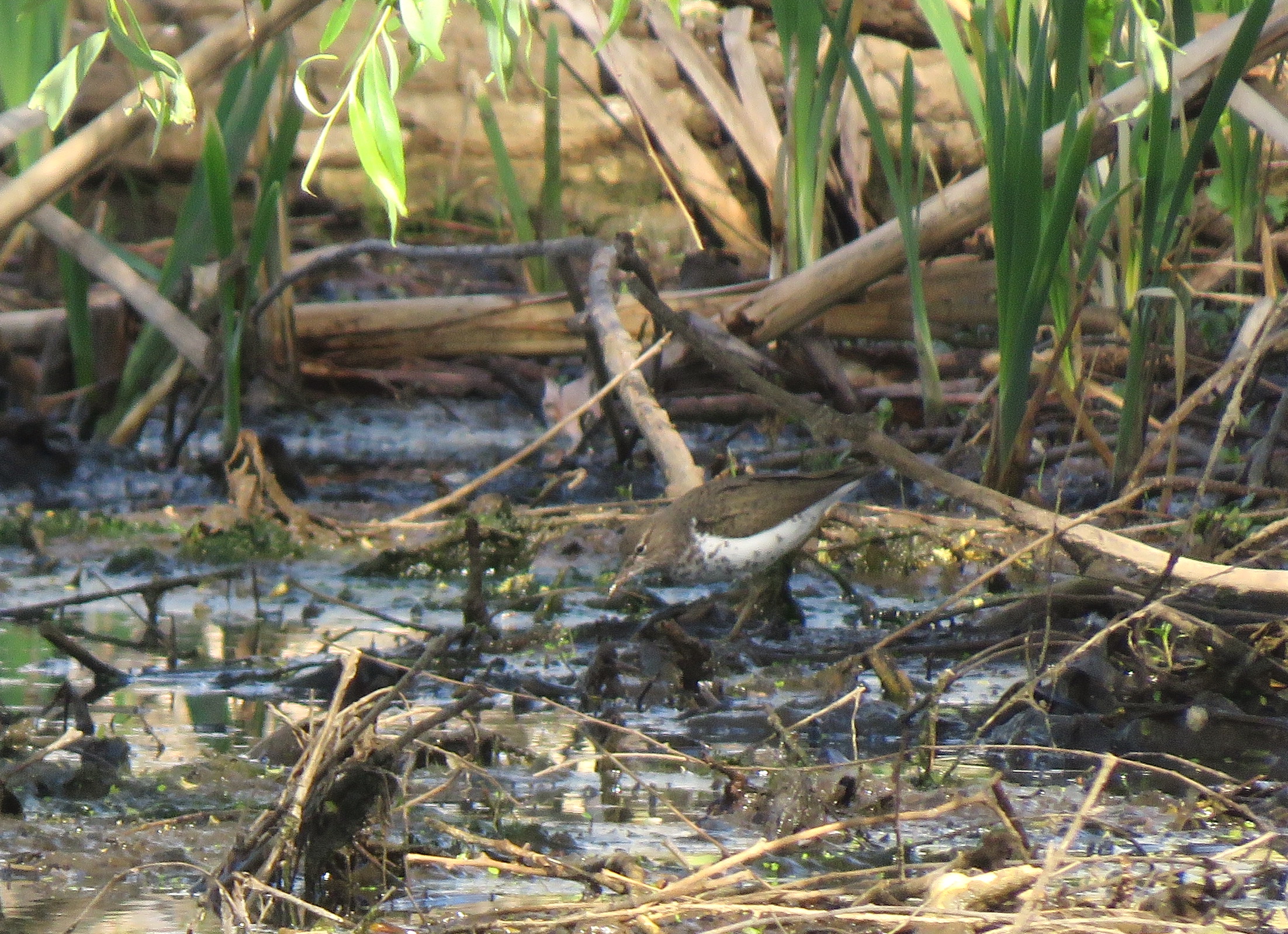
I spotted movement in the shadows along the shallow end of the lake’s shoreline. Beyond a downed tree where turtles rested, a Solitary Sandpiper stealthily stalked its prey. Closer to me, a pair of Spotted Sandpipers waded gingerly among the lily pads, reeds, and downed branches, searching for breakfast.




The lake is a hotspot for migrating ducks and other waterfowl, but there were none today. Above the spillway, however, a pair of Black-crowned Night Herons occupied separate branches on a giant sycamore tree. Soon, a stately-looking Osprey joined them. All eyes were on the lake.
A few miles away, I stopped at a marsh in a farmer’s pasture that allows visibility from the public highway. I heard the familiar calls of Killdeer, and a pair soon landed among the grasses sprouting from the marsh’s muck. Red-winged Blackbirds trilled while Black Vultures sailed silently overhead.

I passed through the rural burg of Briery Branch, and onto Reddish Knob Road. I drove at a snail’s pace with the windows and moonroof open. I turned on the Merlin birding app to listen for calls. When a Louisiana Waterthrush and Blue-headed Vireo popped up, I pulled off the narrow road, turned off the car, grabbed my binoculars, and scanned the tender, emerging leaves for birds. Though they continued to call, I couldn’t find them. The gray sky proved a harsh backdrop.
I continued the slow climb up the mountain. The valley gave way to steep forested hillsides, split by a rushing stream, as I drove higher and higher into the Allegheny Mountains. I stopped whenever a pull-off presented itself and scanned the trees and bushes for birds.
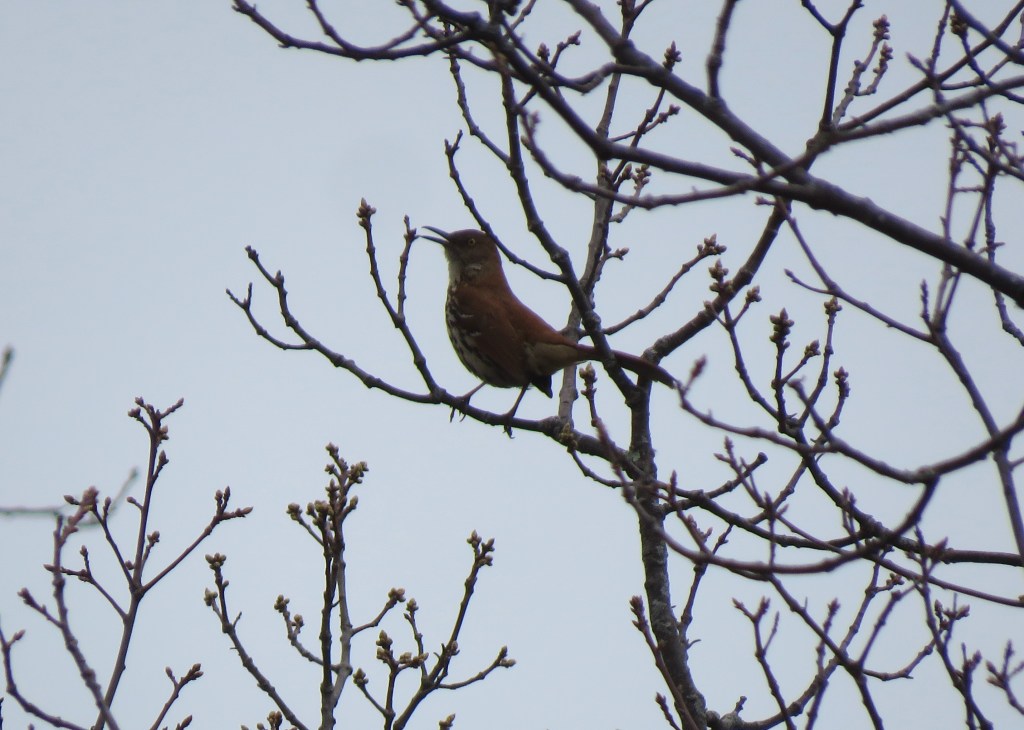
On the right, a recent controlled burn had left the landscape blackened. The underbrush was singed brown, and the needles of young pines hung yellow from the heat. The smell of the fire lingered in the air. Still, I found a Brown Thrasher perched in a tree singing its melodious song high above the scorched earth below.
Just up the road, I reached my destination, the intersection of Reddish Knob Road and a US Forest Service fire road, which is a mix of dirt and gravel. As I pulled over to park, a small flock of Red Crossbills flew up in front of my vehicle. Those were the birds I had hoped to see and photograph.
I parked my vehicle a few feet away, excitedly exited with my camera, and the birds returned to the same spot on the side of the road. These beautiful birds were what I call “graveling.” Why do these lovely, social birds ingest grit and minerals along roadsides? The pebbles and dirt help them digest the pinecone seeds they eat.
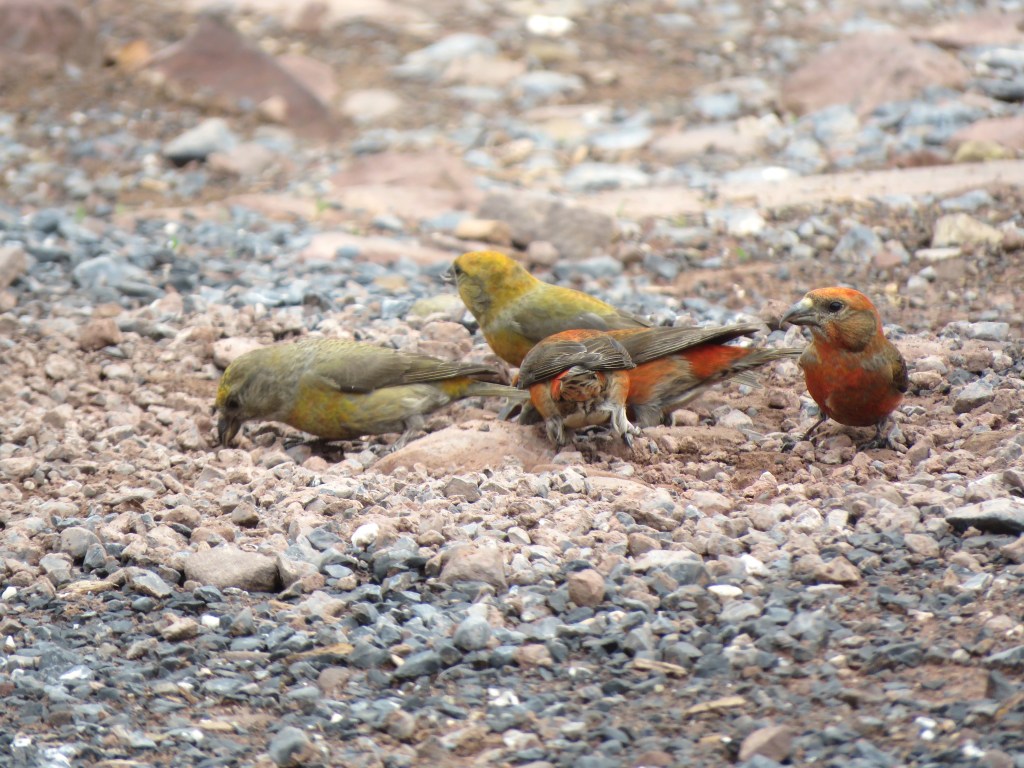

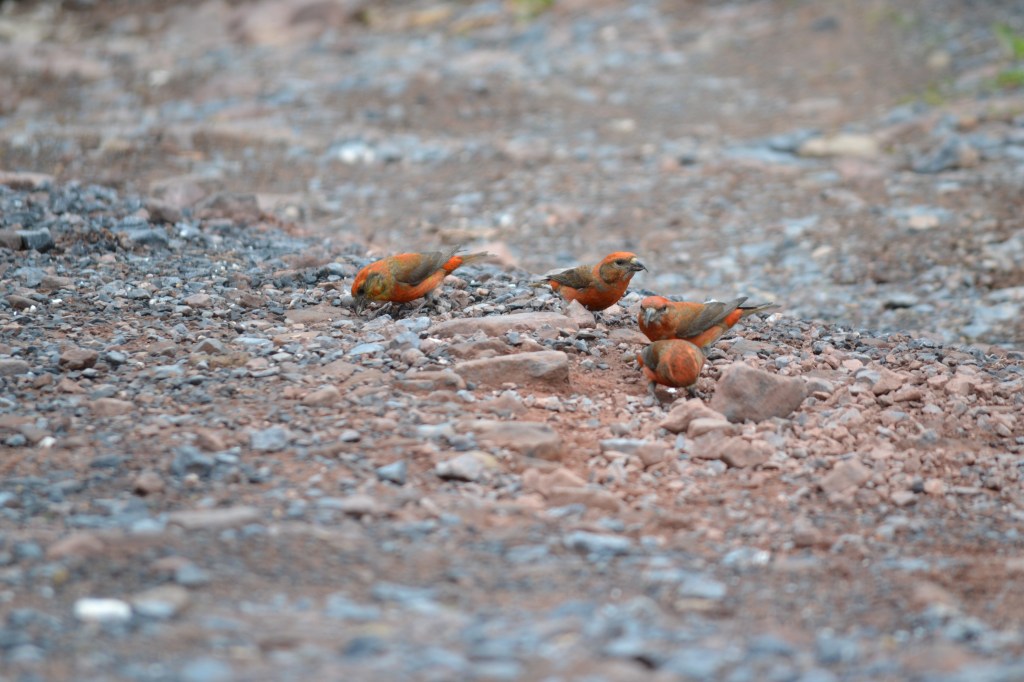
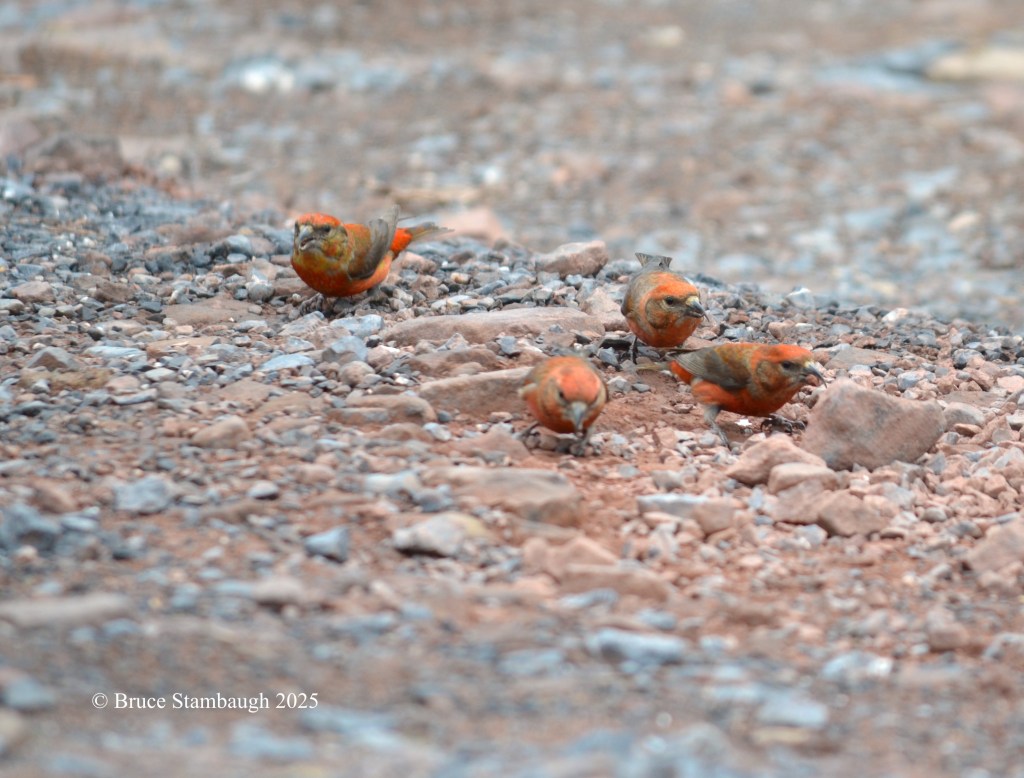
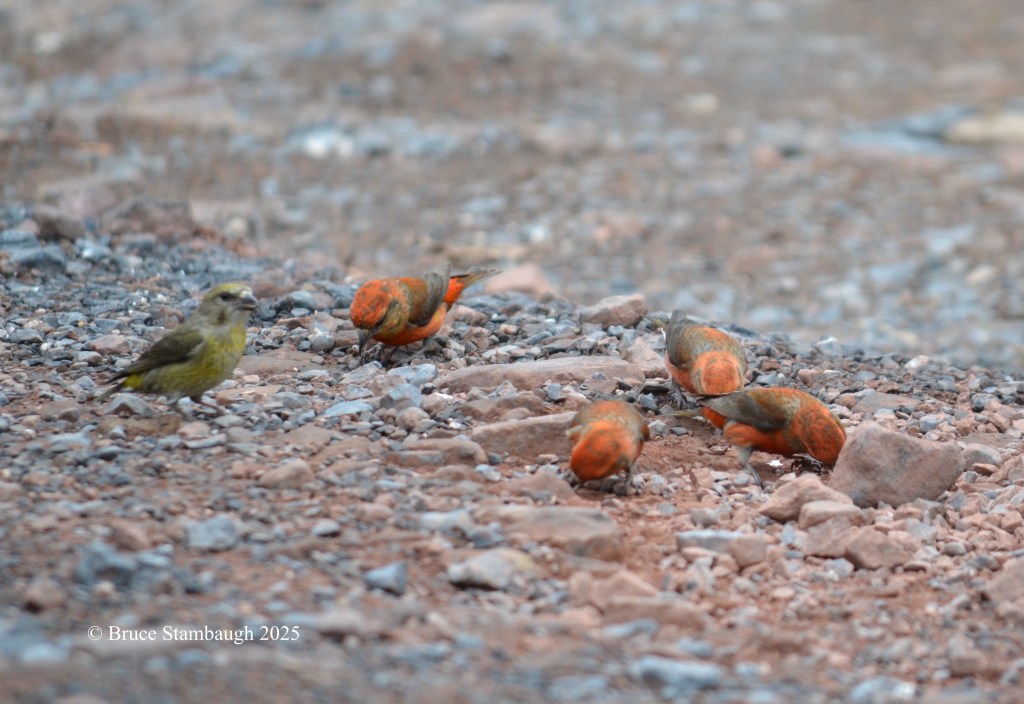

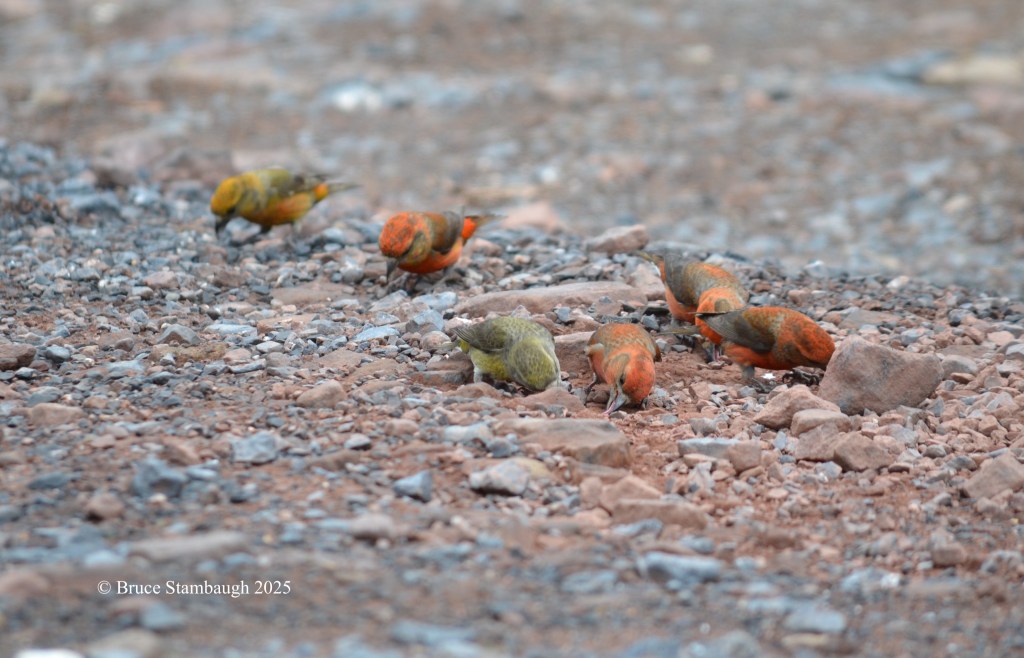

The Red Crossbills gathering grit. Photos by Bruce Stambaugh
The birds settled in as I stayed as still as possible. I captured several photos of these magnificent birds gathering grit. The females are a yellowish-green, while the males are mostly a fire-engine red with dark wings. They can be found year-round in a small geographical area along the front range of the Alleghenies. They are scarce in most other regions of the US except the Rocky Mountains.
All the while, Common Ravens flew back and forth above the ridgeline. Blackburnian and Black-throated Green Warblers sang in the tree tops as they foraged for insects. Ovenbirds, Blue-headed Vireos, and Eastern Towhees joined the chorus.


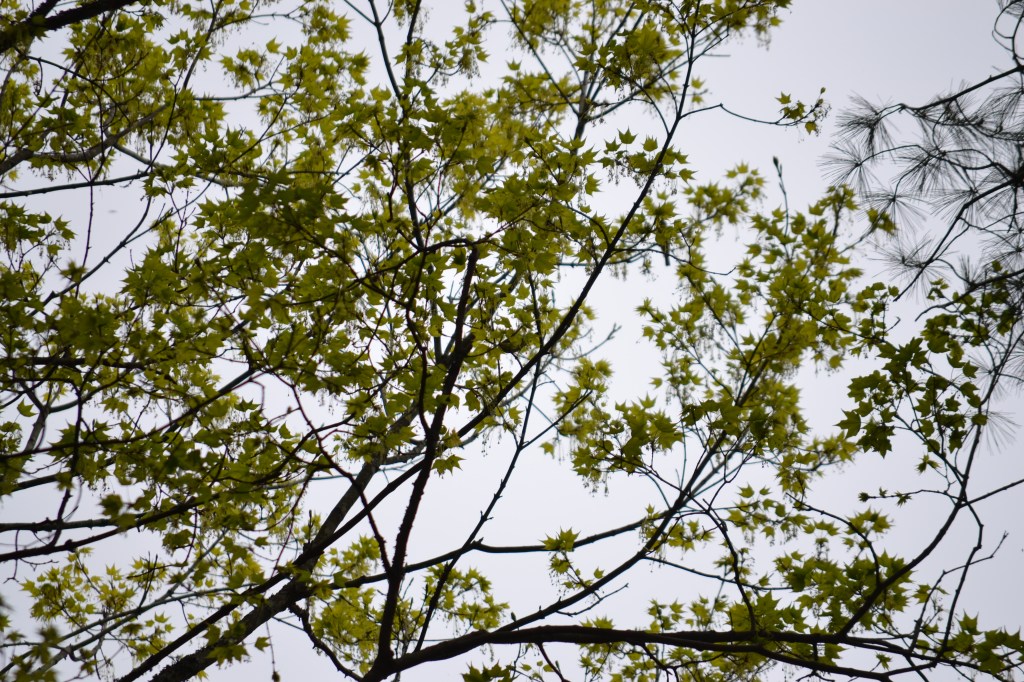
Please click on the photos to view them in full size.
On my retreat down the mountain, I stopped at a camping area adjacent to a gurgling mountain stream. I heard many warblers, but saw only a few. I could have used other pairs of eyes to help spot the birds high in the emerging canopies.
Still, it was a fulfilling and satisfying Earth Day for this septuagenarian. I surrendered to my surroundings, the fresh air, the towering evergreens, and the budding deciduous trees. Bird calls replaced motor vehicle and lawnmower noises, and clear mountain streams rushed their way to the valley floor.
Thanks to the bird song choruses, inspiring mountain views, and the singing brooks, nature’s peace enveloped me. Isn’t that one of the goals of Earth Day?
© Bruce Stambaugh 2025
 Roadkill Crossing
You must be logged in to post a comment.