From One Nest to Another

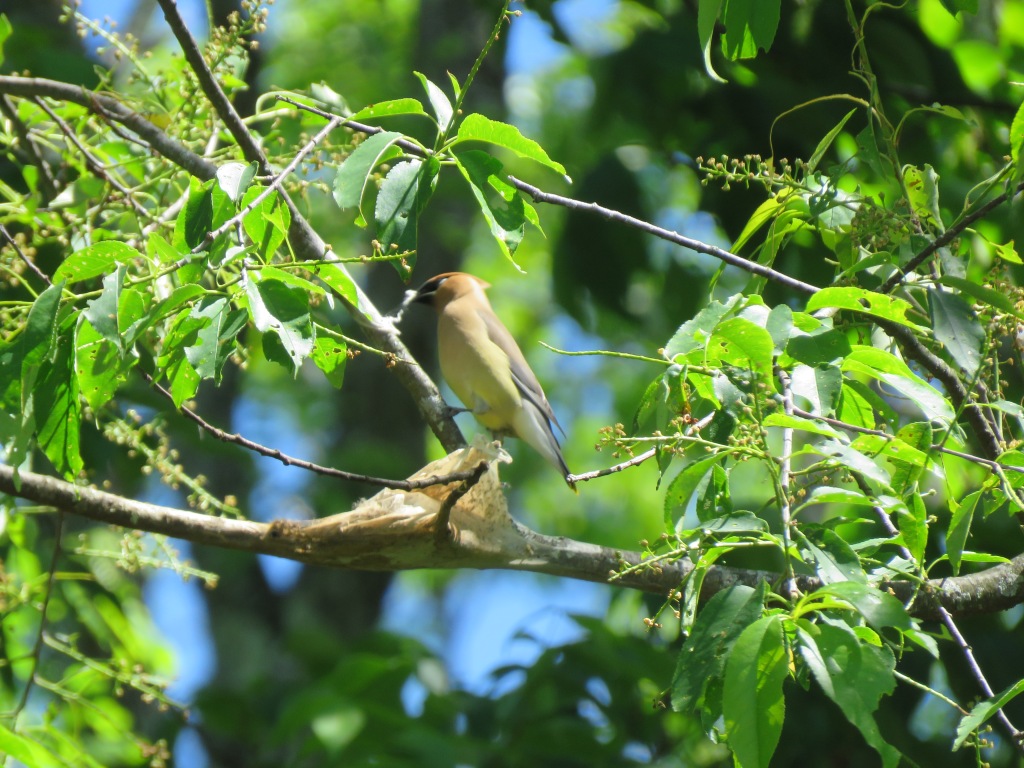
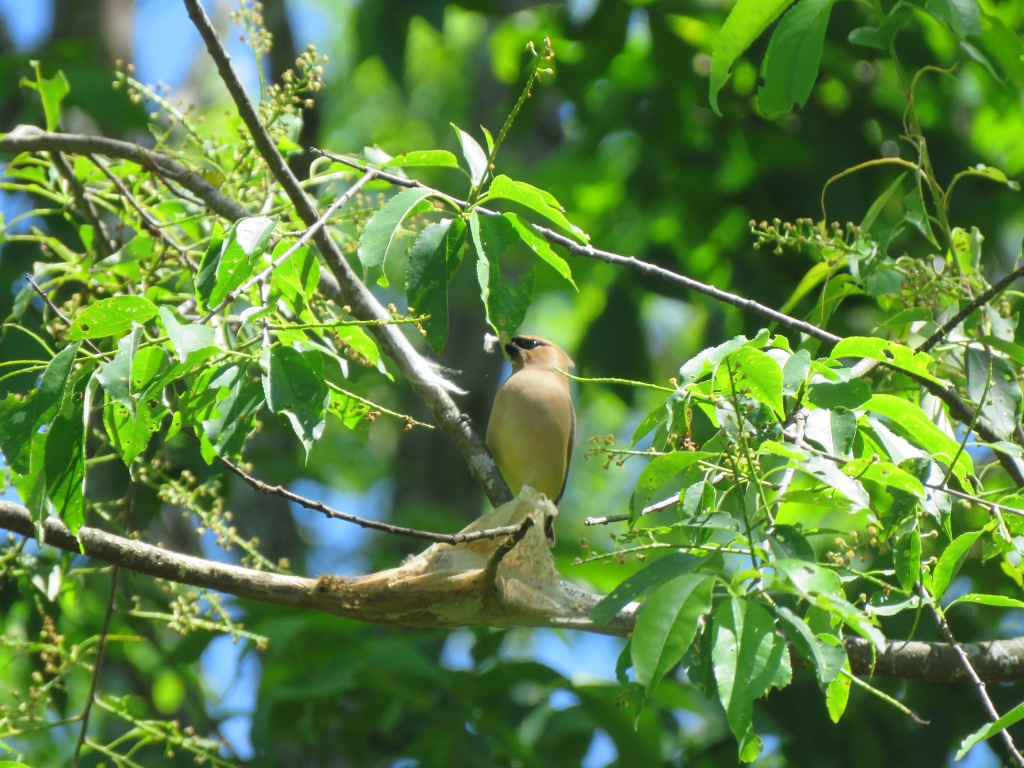
A Cedar Waxwing collects nesting material. Photo by Bruce Stambaugh

Birds always teach something new.

While mainly looking for warblers on Reddish Knob on the Virginia/West Virginia boundary, I spotted a Cedar Waxwing light into a wild cherry tree. I aimed my camera to capture a shot or two of the always lovely and entertaining waxwings.

At first, I thought the bird might be after the Eastern Tent Caterpillars in their silken nest. Waxwings supplement their spring and summer diets with insects when berries aren’t available.

Since the bird stayed in the same spot, I kept clicking away. It wasn’t until I loaded the photos onto my laptop that I realized that the Cedar Waxwing was after nesting material, not food. According to the Cornell Lab of Ornithology, the female Cedar Waxwing usually gathers the nesting material for the first brood.

In this case, the waxwing collected the tent’s silk support strands and ignored the rest. Perhaps those connecting threads are stronger than the silk that forms the tent.

The process took less than a minute, and she was off to add her precious cargo to construct her own nest. The female waxwing weaves grasses, twigs, cattails, and pine needles to form her cup-like nest. Now, tent caterpillar silk threads can be added to the list.

The sequence of the Cedar Waxwing gathering silk from the Eastern Tent Caterpillar tent. Please click on the photos to enlarge them. Photos by Bruce Stambaugh.

Not only did I see a beautiful bird at work, but I also learned about Cedar Waxwing nest building. And, yes, I heard and saw a few colorful warblers, too.

© Bruce Stambaugh 2024

The benefits of standing still


I’m a person that is usually on the go. However, I know first-hand the benefits of standing still.

I recently went to the Big Meadows area of Shenandoah National Park in Virginia to do some birding. I have learned that the open spaces along and near parking lots are favored by certain bird species. Wildflowers and dense brush grow there beneath mature deciduous trees. That combination provides both cover and food for my avian friends.

It didn’t take me long to be rewarded. Though it was windy, the birds were active. Due to the wind, however, most kept low and in the thicket, making it harder to photograph them or even find them with binoculars.

On this overcast morning, the sun suddenly peeked through, and just as suddenly, this lone Cedar Waxwing landed on a pokeweed bush right in front of me. I slowly raised my camera and clicked away.

I couldn’t believe my good fortune. Cedar Waxings are some of my favorite birds due to their posture, coloration, and behavior make them regal birds. I snapped off four quick shots of this beauty as it checked its surroundings, and then just as quickly as it had arrived, the bird flew off.

Other than the slow raising of my camera and the ear-to-ear smile, I hadn’t moved. I was graciously rewarded for standing still. For the record, cropping and adding my watermark were the only “alterations” done to the photo.

“The benefits of standing still” is my Photo of the Week.

© Bruce Stambaugh 2020

Bay Photos by Donna

Wildlife photos from the Chesapeake Bay region

ROAD TO NARA

Culture and Communities at the Heart Of India

K Hertzler Art

Artist and nature journalist in the Shenandoah Valley of Virginia.

Maria Vincent Robinson

Photographer Of Life and moments

Gabriele Romano

Personal Blog

Jennifer Murch

Art is the only way to run away without leaving home. -Twyla Tharp

Roadkill Crossing

Writing generated from the rural life

ANJOLI ROY

writer. teacher. podcast cohost.

Casa Alterna

El amor cruza fronteras / Love crosses borders