Spring’s multifaceted green abounds

horses and plowing
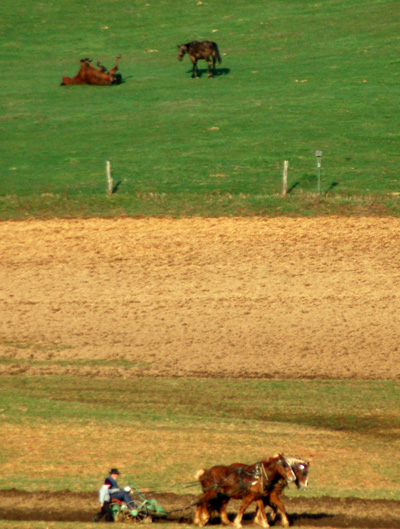
Horses frolic while others work.

By Bruce Stambaugh

Green is not my favorite color. But I’ll make an exception, especially now when every plant and animal seems to be greening up in some way.

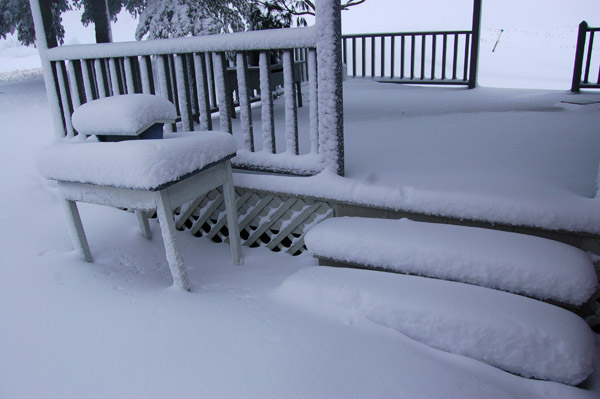
The most obvious change is in the grasses. They all transitioned from bland dormancy to verve seemingly overnight. Once relieved of their heavy snow burden, then drenched with intermittent rains followed by warm, sunny days, the grasses grew emerald uniformly on natural cue.

Whether front yards or rolling pasture fields, the green on green effect is stunning. It may be the greenest green I have ever seen, or maybe the winter was simply so long and so hard, that I forgot what true green really looks like.

Nevertheless, it’s marvelous to see the countryside covered with such a luscious, vibrant carpet. Only problem is mowing will commence shortly, if it hasn’t already. But it will be nice to inhale that fresh cut fragrance again.

In preparation for that initial trimming of 2010, many of the yards in Amish country have already been rolled and fertilized. That was part out of necessity, and part out of relief that winter was finally over. Yes, we had one nasty, last snow that left the roads the slickest of the winter. But my bones say that ammunition has been spent.

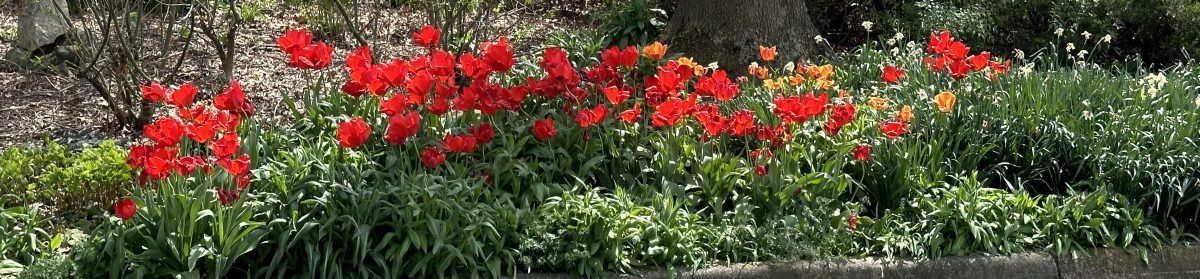
Grass isn’t the only vegetation to go green. My wife’s tulips, daffodils, crocuses and lilies have all displayed their various leaves at different intervals. Of course, the crocuses have bloomed and faded, and the daffodils were primed for Easter.

In the woodlots, colts foot were the first to unfold. The giant hardwoods hovering over them have swelled their buds, anxious to let their leaves unfurl. They’ll wait until it’s safe from certain future frosts, unless coaxed open by an extended warming spell.

The evergreens have no such problem. They have already transformed from the deep, mature green of the hibernation months to a lighter, brighter green that mirrors that of the grasses.

Things are greening up around my little garden pond, too. The moss and lichens, long covered by two feet of snow, now look like splotches of paint and bristle brushes, respectively. Water lilies are shooting their first leaves to the surface.

Both the variegated water plant and the variegated reeds are coming to life, with the former having a huge head start. Its bulbs are pushing their pale green and russet pointy leaves profusely, fighting through some soft, velvety grass that somehow homesteaded over the winter.

I would eliminate the grass altogether, except that the pair of resident bullfrogs prefers its lush softness for their sunbathing and bug collection. The frogs’ color, too, has evolved from the mucky blackness of the bottom of the pond to more their natural camouflage.The male tries to woo his mate with his deep throated croaking both day and night. From nearby wetlands, choruses of spring peepers erupt. It’s all music to my ears.

High on the neighbor’s pasture where Holsteins and draft horses grazed earlier in the day, deer come out of hiding at dusk to nibble at fresh green sprouts. By night, they clean the corncobs at my birdfeeders.

Really, just airing out the house with open windows and doors that invite refreshing breezes brings you closer to mother earth. I also glory in the secondary benefits, the simultaneous serenading of birdsongs and echoes of children playing.

Spring doesn’t get any greener than that.

Birding Ohio’s Amish Country

By Bruce Stambaugh

Horses and buggies. Pastoral, broad valleys amid rolling hills frescoed with quilt-like patterns of crops. Fine, handcrafted furniture. Delicious, bountiful meals at reasonable prices.

All of the above are reasons scores of people from far and wide annually travel to Ohio’s Amish country. There is yet one more unassuming category to add to the list: birding.

With its diverse topography, greenery and abundant waterways, Ohio’s Amish country is a birder’s paradise. The area offers both a wonderful spectrum of bird species and excellent birding locales.

Ohio’s Amish country offers something for the novice, casual or serious birder. Birders can find migrating birds, native residents and the occasional rare visitor. The area affords numerous birding spots easily accessible for persons of all ages. A good pair of binoculars will help enhance any aviary quest in Amish country.

A good place to start the birding expedition and get a little exercise as well is the Holmes County Rails to Trails that cuts an easy diagonal through the county. The main starting point and parking lot is at the old railroad depot just north of West Jackson St. in Millersburg, the county seat. This 15-mile paved trail runs from Fredericksburg in Wayne County to Killbuck in southwestern Holmes County.

Following this trail provides a sampling of the birding habitats found throughout the area. However, its dominant geographic feature is the Killbuck Creek valley, a major north-south flyway for migrating birds and a wonderfully dense habitat for year-round bird residents. Woodlots, marshland, open water and cropland are in close proximity all along the trail’s length.

Birders should be aware that horse and buggies, horseback riders, bicyclists, runners and walkers use the trail, too. Birding etiquette and safety dictate setting up spotting scopes or viewing with binoculars on the side of the trail. All types of waterfowl can be found among the reeds and rushes in the marsh areas. Even a rookery of Great Blue Herons can be seen.

Not far from the north end of the Holmes County Trail is another outstanding birding area, the Killbuck Marsh Wildlife Area. An excellent observation spot is at the east end of Force Road, which is accessed from Valley Road east of Shreve.

From this vantage point, if one is patient, birders can view an array of species. American Bitterns, a wide variety of ducks, rails and even Bald Eagles may be seen. The Killbuck Marsh is a state run wildlife management area.

Two other state-owned areas in Ohio’s Amish country also offer excellent birding opportunities. The Funk Bottoms Wildlife Area is located in Wayne and Ashland counties, and Mohican State Park in southern Ashland County.

With its moist soil and shallow water habitat, the Funk Bottoms is a natural wetland area consisting of about 1,500 acres, mostly along State Route 95 near Blachleyville. The Ohio Division of Wildlife said birds that frequent the area include 23 species of migrating waterfowl, including Tundra Swans and Sandhill Cranes, and 28 species of shorebirds. A variety of raptors also winter over and are seen during migration.

Mohican State Park is a spectacular location for many activities, especially hiking and birding. With its dense forests and large open body of water, Bald Eagles and Ospreys have been spotted. The park is located just west of Loudonville between State Routes 95 and 97.

In the eastern end of Amish country sits another ideal birding spot, The Wilderness Center. It provides excitement for even the most novice birder. The Wilderness Center is located on Alabama Ave. off of U.S. 62 near Wilmot in Stark County.

With marked trails, an informative and hands-on interpretive building, it is the perfect place for families. From restored Ohio prairies to old growth forest, The Wilderness Center is host to a wide range of birds, especially songbirds.

With its checkered, rolling farm fields, spring-fed streams and treasured woodlands, many species of birds can be observed merely by driving around the back roads of Amish country. If you happen to see a farmer spreading manure in the winter, look for Horned Larks and Snow Buntings. If hay is being mowed in the summer, watch for Barn, Tree, Bank and Cliff Swallows circling for insects.

The area also boasts high numbers of Bobolinks, Eastern Bluebirds and Barn Owls. Since many avid birders live in the area, visitors can find good advice on where to bird and what might be found simply by asking.

A pair of juvenile green herons perched on a TV antenna.

This article appeared in the March 2010 edition of Ohio’s Amish Country.

The winter that wouldn’t end

By Bruce Stambaugh

The winter that seemingly would not end finally has. I hope.

Spring is now within sight. The vernal equinox officially arrives on Saturday, March 20 at exactly 1:32 p.m.

That milestone won’t guarantee that winter won’t quit. But it’s nice to know that if it does show its frosty face again, the odds are in our favor that a late winter sting won’t hurt us like the series of heavy snows we incurred in January and February.

For a while there, it seemed like everything had come to a freezing halt. It would snow. The road crews worked hard to free the highways of their slippery burden, and just when you thought it was safe to travel again, it snowed again.

During a normal winter in the western Appalachian foothills of Holmes County, Ohio, a couple of feet of snow are spread over several months. This winter we recorded more than three feet of snow in February alone.

With the weight of this winter still upon us, it seems spring has been a long time in coming. It was magnificent to get an early peek at what lies ahead with the recent string of sunny, warm weather here in Ohio’s Amish country.

It’s truly amazing what warmer weather does. I only had to step outside to fully appreciate the preview of spring.

The backyard birds filled the air with their choruses. Robins came out of hiding in the thick woods to begin scouting out their nesting territories. The resident Song Sparrow, which became reclusive in winter and played it low to the ground, perched high in a crimson maple, tilted its head back and cut loose.

Over the course of just a couple of days, the blanket of snow vanished altogether. Even the huge piles of plowed snow were greatly humbled by the bright sun and balmy temperatures.

If ever there were a perfect example of cause and effect, the melting snow would be it. The ground was so saturated from the abundant moisture that Mallards swam the temporary pond in my neighbor’s grain field.

Flower petals pushed through the mushy earth, as if reaching for the inviting sun. The daffodil heads swelled, readying for their brilliant birth. In our flower gardens, Johnny Jump Ups were the first to bloom.

Life stirred in my little garden pond, too. The mountain of snow that once surrounded the poor pool did a glacial retreat. The caretaker pair of bullfrogs ventured out in search of any wayward insects, and to bask in the sunshine’s warmth.

The school of goldfish revived. The largest broke water as I cleaned out the gunk from the pump. I don’t know if it was showing off or begging for food. The pump filters were so clogged with slime it was a wonder water still flowed over the little waterfalls.

I couldn’t help but notice doors and windows open in homes, shops and cars alike as I ran errands. Shoot, those with convertibles were driving around like it was July. After this cold, snowy winter, I couldn’t blame them. It felt like it.

People personally expressed their relief that an end to this nonstop winter seemingly had arrived. They appeared more congenial to the point of being jovial.

For those who longed for an old-fashioned winter, you got your wish. Let’s hope those that hunger for a perfect spring get theirs, too.

St. Patrick’s Day Sunset

Could there have been a more generous sunset,
and on St. Patrick’s Day yet?

The perfectly clear, but not empty sky
silhouetted the naked tree line at the top
of the neighbor’s pasture field.
To the right, three does grazed
unaware of my distant spying.

Above them, as if it mattered, Venus shown
bright and true, and still higher above her
the first sliver of March’s eventual full moon
cradled the amazing earthshine tenderly, boldly,
for all who cared to see to see.

I saw. I cared, glad for St. Paddy’s celestial gift.
I don’t know about the deer though.

Bruce Stambaugh
March 17, 2010

Competing in the winter Olympics, Texas style

By Bruce Stambaugh

I have had a long infatuation with the winter Olympics. This year was no exception. In fact, instead of just watching on television, I actually got to compete.

Coupled with the fatigue of the seemingly endless Ohio winter and the desire to visit our Texan grandchildren, my wife and I scheduled a trip to the Lone Star State right in the middle of the winter Olympic games. We were especially eager to see our four-month-old granddaughter, Maren. She was just a week old when I last saw her.

Just what does this have to do with competing in the winter Olympics? Plenty. Given the crazy weather of this weird winter, it didn’t snow in Vancouver, British Columbia, where the Olympics were hosted. But it did snow deep in the heart of Texas.

Of course, like everything else in Texas, it snowed big. At times, the snowflakes were huge. In a location where snow is seldom seen, the accumulation reached up to four inches.

The school kids were ecstatic. When they arrived home from classes, the Texas Winter Olympics were on. The entire neighborhood joined in one event after the other. The only qualifying necessities were to dress warm and have as much fun as possible. The rarity needed to be enjoyed while it lasted, since the snow likely wouldn’t linger in the south central Texas clime.

And have fun we did, including Maren. However, she wisely chose to serve as the beautiful, babbling, blue-eyed commentator from the warmth and safety of her parent’s home.

I felt like a kid again. Often, when the grandkids visited Nana and Poppy in Ohio’s Amish country in the winter, we seldom had snow. Now we were in their southern home territory, and the snow was perfect for any and every kind of wintry game.

The gathered Olympians participated in sledding, snowball throwing, snowman building, and of course the ever popular snow tasting contest. The results, which required no sophisticated judging, were measured in enjoyment rather than technical point calculation.

The lead sledding team, kindergartner Nola and her energetic father, Michael, won that event hands down. They were the only ones on the block with a sled. Even then, they had a rather short slope to navigate, another neighbor’s diminutive front yard.

To no one’s surprise, the snowball throwing drew the most participants and thus was gauged a Texas-sized success. The awards were meted in smiles and laughter rather than shiny medals. Evan, our nearly six-year-old grandson, won the artistic award for creating the most symmetrical snowballs. They were perfectly round and hand-packed hard.

The ever-daring three-and-a-half year old grandson, Davis, ate more snow than he threw. He said it tasted better than ice cream. You never know what those lefties will say.

As for the snowman contest, Poppy was in the lead for most of the way until he realized that the large rolled up snowball was more of a load than he should be pushing. His back disqualified him, and he had to call in reinforcements to complete the job.

Not surprisingly, Davis was a good helper. However, true to form, he wanted to eat the carrot rather than use it for the snowman’s nose.

Next day, when the snow quickly disappeared with Vancouver-like temperatures, the Texas Winter Olympics were declared closed, at least temporarily. With this strange winter weather, it could snow again in Texas. Vancouver could only hope.

Davis and Evan
My grandsons with their Texas snowman. Davis and Evan are on the left.

From Haiti to Millersburg, Ohio, a harrowing journey

Fritz Jeanty family
Fritz Jeanty hold two and a half year old son, Samuel, while his wife, Mamie, cuddles five month old son, Benjamin.

By Bruce Stambaugh

Shortly before 5 p.m. on January 12, Fritz Jeanty of Port-au-Prince, Haiti was on his way home when his car lurched from the force of a 7.0 magnitude earthquake. He didn’t realize the seriousness of the situation until he saw people running and heard people praying and praising God for being saved.

Fritz headed for home via the main road, but quickly came upon even more devastating scenes. People carried injured victims. Debris and clouds of dust were everywhere.

People were screaming, crying and praying all at the same time. While attempting to get home, Fritz met his pastor, who had his car full of injured victims, on the way to a hospital. The pastor told Fritz that the church had been leveled.

In his tireless effort to reach his family, Fritz drove as fast as he could until the road was completely blocked with collapsed buildings and dead bodies. Fritz parked his car, and ran towards home, fearful of what he would find. Before he could arrive, however, a neighbor intercepted him with good news. Fritz’s family was safe.

“I started crying right away,” Fritz said. They were tears of joy and sadness. “I was happy my family was alive, but I was sad for all the dead and injured, too.”

When he arrived home, his wife, Mamie, and two young sons, Samuel, two-and-a half, and Benjamin, five months, were unhurt but scared. Their home was rendered uninhabitable. The grocery store Fritz owned and operated five miles away had been completely destroyed, too.

“You could hear crying everywhere,” Fritz said. “I was overwhelmed.”

With darkness arriving, Fritz had to wait until early the next morning to turn his attention to extended family members who lived nearby. At dawn, he went to look for his brother, who he discovered was all right. However, Mamie’s two sisters were both crushed in the rubble of their home. But her mother was alive.

The Jeanty family lived on the street outside their destroyed home for a week. Fritz said they could hardly sleep, with frequent aftershocks, mosquitoes, nothing but rubble to lie on and potential looters roaming. The only provisions they had were some rice and cooking oil Fritz had stored in an old car in his yard. They had some water in a drum container, and Fritz had to walk two miles to refill it.

With precious commodities running low, Fritz went into survival mode. He reentered their badly damaged home, and carefully retrieved important personal papers, including the boys’ passports.

Fritz went to the American embassy in Port-au-Prince and was disheartened to find a long, long line. But because both of his sons had been born in the United States, Fritz was told to go to the airport to be airlifted out of Haiti.

Early the next morning they found themselves on a transport plane, unsure of where they were going. When they landed, they were in Orlando, Florida, which was providential. Just the previous day, Fritz had obtained a key for his father-in-law’s home in Orlando in case they somehow ended up there.

But Fritz knew they could not stay there long without money. He had kept some phone numbers of persons with whom he had worked in Christian Aid Ministries, based in Berlin, with missions in Haiti. A friend of a former CAM worker helped the Jenaty family make contacts in Ohio.

Arrangements were made for Fritz and his family to ride the Pioneer Trails bus back to Holmes County. In addition, contacts with Save and Serve Thrift Store in Millersburg were established, an apartment found, and by the time Fritz and his family arrived in Berlin the next day, they had a place to stay amid the largest Amish population in the world.

Fritz and his family are permitted to stay for six months. He is filling in his time by volunteering at Save and Serve, which is taking donations to help buy food and living necessities for the family. Donations to assist Fritz and his family may be sent or delivered to Save and Serve, marked Haitian Relief, P.O. Box 128, Millersburg, OH  44654.

Knotting comforters for Haiti

comforters for Haiti
An Raber (L), Peggy Roth and Linda Yoder knot a comforter for people in Haiti. Mennonite Central Committee (MCC), Akron, PA had asked congregations to knot 10,000 comforters for people in Haiti to match the 10,000 donated by a Canadian business.
working on comforters
Caroll Roth (L), Paul Thomas and Sandy Miler ready a comforter to be knotted at Millersburg (OH) Mennonite Church.

Rushing home for the big snow

Our back porch
A foot of snow covered the bird feeders by our back porch.

By Bruce Stambaugh

I think I am just going to quit going to Florida in the winter. I know it sounds selfish of me. But I really think it’s the right thing to do.

First of all, I am not a big fan of the Sunshine State. When I have visited in the summer, it’s always been way too hot and sticky for my liking. My experiences in the winter haven’t been much better. Both times that I have sought a sunny, warm reprieve from the sting of winter in rural Ohio, I got burned, and I don’t mean sunburned.

In 2008, my wife and I flew to Florida in March, mainly to see a few Cleveland Indians baseball spring training games before they moved to Arizona. Near the end of our brief stay, a rare blizzard hit the mid-west, including our home area. The magnitude of the storm was so vast, so consequential that no commercial airlines were flying to Ohio. Our stay in Florida was extended for three days. But it wasn’t much of a reward because the weather turned cool and damp, keeping us inside.

Instead of being able to take advantage of walking a pristine beach or go birding, we spent a lot of time watching The Weather Channel. Their meteorologist reported live from downtown Cleveland, showing firsthand the effects of the blizzard. As strange as this may seem, I really wanted to be at home, not in Sarasota. Part of that desire was guilt. I am a township trustee and I felt duty bound to be home to help dig out.

But more than that, I love storms. Weather is one of my major hobbies. In addition to being a severe weather spotter, I also measure the snowfall for our area for the National Weather Service. And here we were getting more snow that we had had in a long time and I wasn’t there to experience it, much less send in my snow reports.

Last month, we had another chance to visit Florida. Good friends invited us to stay a week with them in a house they had rented in Sarasota. Neva and I needed a break since 2009 had been such a draining year for us with all the family health issues we had had, most notably my father’s illness and subsequent death. This trip, though, we decided to drive instead of fly. When we arrived, the weather was very nice, our friends even nicer. We settled in and began planning our week’s activities.

We did the beach thing, which allowed me to both walk and take pictures, yet two more hobbies. We visited a lovely state park where I learned a lot about Florida floral, fauna and local history. Here, again, I was able to photograph several species of birds and some rather large alligators.

The last part of our trip was to be spent in Savannah, Georgia, a city I had long wanted to visit. We managed a trolley tour of the lovely historic city before our plans changed. Once again, a major winter storm was brewing in the mid-west, and once again my wife and I were glued to The Weather Channel. I saw the track of the storm and its expected arrival time. I knew we had two choices. We could cut our stay short and drive straight home or stay an extra few days until the roads were cleared. You can guess what we decided.

We returned in time for me to have the distinct honor of sending in my mundane but necessary snow reports. We were home, and I was happy to be measuring this big snow.

Bay Photos by Donna

Wildlife photos from the Chesapeake Bay region

ROAD TO NARA

Culture and Communities at the Heart Of India

K Hertzler Art

Artist and nature journalist in the Shenandoah Valley of Virginia.

Maria Vincent Robinson

Photographer Of Life and moments

Gabriele Romano

Personal Blog

Jennifer Murch

Art is the only way to run away without leaving home. -Twyla Tharp

Roadkill Crossing

Writing generated from the rural life

ANJOLI ROY

writer. teacher. podcast cohost.

Casa Alterna

El amor cruza fronteras / Love crosses borders