This was to be benefit Saturday for my wife and I. I simply couldn’t have projected just how beneficial it would end up being.
Before dawn a delightful aroma wafted across the landscape from the Amish farmstead behind our rural Millersburg, Ohio home. A congregation of people was barbequing chicken on portable grill wagons. A generator cast a harsh, artificial light upon the busy group, creating predawn silhouettes.
The benefit barbeque was for a couple that needed financial assistance due to extreme medical bills. She had cancer, twice. He had had surgery that kept him off of work for six months. To help out, we ordered six quarters of chicken to be picked up after 11 a.m.
A Mongolian hut is called a ger. (Photo by Kim Kellogg)That was but one of three different fundraisers in which we participated that day. The first began at 7 a.m. with sausage, ham and pancakes. My wife ate the meat. I ate the pancakes. The breakfast was held to raise money for a mission project in Mongolia. An authentic, completely furnished Mongolian ger, a felt lined hut, had been erected in the church fellowship hall for all to inspect.
As tasty as the food was, the fellowship that buzzed around our table was even better. We reminisced with old friends about how our lives had intersected during the ups and downs of life. Breakfast doesn’t usually come with dessert, but that’s what this conversation ended up being.
Though the chicken cooking was literally in our back yard, we had to pick up our order at a residence a mile up the road. For lunch, Neva and I each downed a quarter of the flavorful hinkel, as the Amish refer to it. We enjoyed the chicken so much I returned to buy more, only to be told that they only had enough to fill the presale orders.
Our Amish neighbors hosted the grilling of the barbequed chicken.
I drove back my neighbors’ long graveled lane to where the chicken was being grilled. I got the same answer there, but discovered the full measure of devotion of this gracious act of charity.
More than 80 friends, family and extended family members gathered to do the chicken. A total of four tons or nearly 8,500 quarters of chicken had been barbequed to sell on behalf of this family in need. The charcoal was lit at 5 a.m. The grilling began at 6 a.m. and finished up at 2 p.m. It was an all day deal.
From the looks on the workers faces, they were both elated at the success of their selfless efforts and fatigued from their long hours of hanging around the smoky grill pits. A total of 36 Amish churches helped sell the chicken, and they indeed sold it all. They may have barbequed lots of chicken, but in the process they also cooked up a liberal batch of compassion.
The band, Honeytown, performed at a local coffee shop to help raise money for our church youth group.
In the evening, Neva and I headed into town for a concert by a renowned, local quartet. Honeytown sang and played as a fundraiser for our church youth group. The kids were raising funds to attend a church wide conference in Arizona this summer. Only Mennonites would hold a gathering in the desert in July.
Each of these three benefits had a specific purpose, and each achieved success. Love comes in many shapes, sizes, and means, pancakes, barbequed chicken, and inspirational song among them. Though independent of one another, a common purpose and generous acts of human kindness bound the benefits as one.
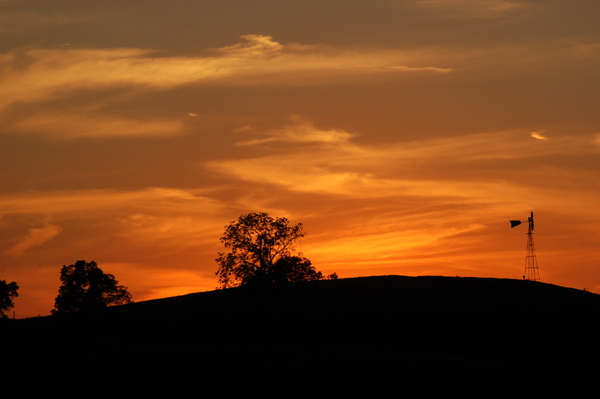
We had been thrice blessed. Beneath an umbrella of golden sun and cloudless coral sky, this benefit Saturday had truly been extraordinary.
March 27, 1971 was a beautiful Saturday. It was warm, the sun was shining, and spring was definitely in the air. The field next to the church had just been sprayed with liquid manure.
I remember it well, the wedding, not the smell. It was the day I married my best friend. Of course, I didn’t know she would become my best friend. My best friend was my best man. I married Neva to be my wife, or so I thought. It has turned out so much more than that naïve 23 year-old groom could have imagined.
We soon discovered that we had a lot in common besides amorous affection. We both liked travel, adventure, antiques, nature and Milky Way candy bars.
The summer after our wedding we lived on a mountain with no communications, no electricity or running water. As part of a church sponsored summer service project, we hosted hikers at a camp about halfway up Pikes Peak in Colorado. I chopped the firewood and Neva prepared our meals over either a woodstove or an open fire.
We never tire of the view behind our rural home in Ohio’s Amish country.
That experience helped set the stage for all that was to transpire in the next 42 years. Through thick and thin, in sickness and in health, we strived and thrived as individuals and as a couple. It hasn’t all been pretty or perfect, but we have endured, much the way we did on the mountain.
We each spent a career in public education, something we both dearly believe in for the good of our own children, our community and our country. It was an honor to serve in that capacity.
We built one new home and completed another. Both had excellent views and wonderful neighbors.
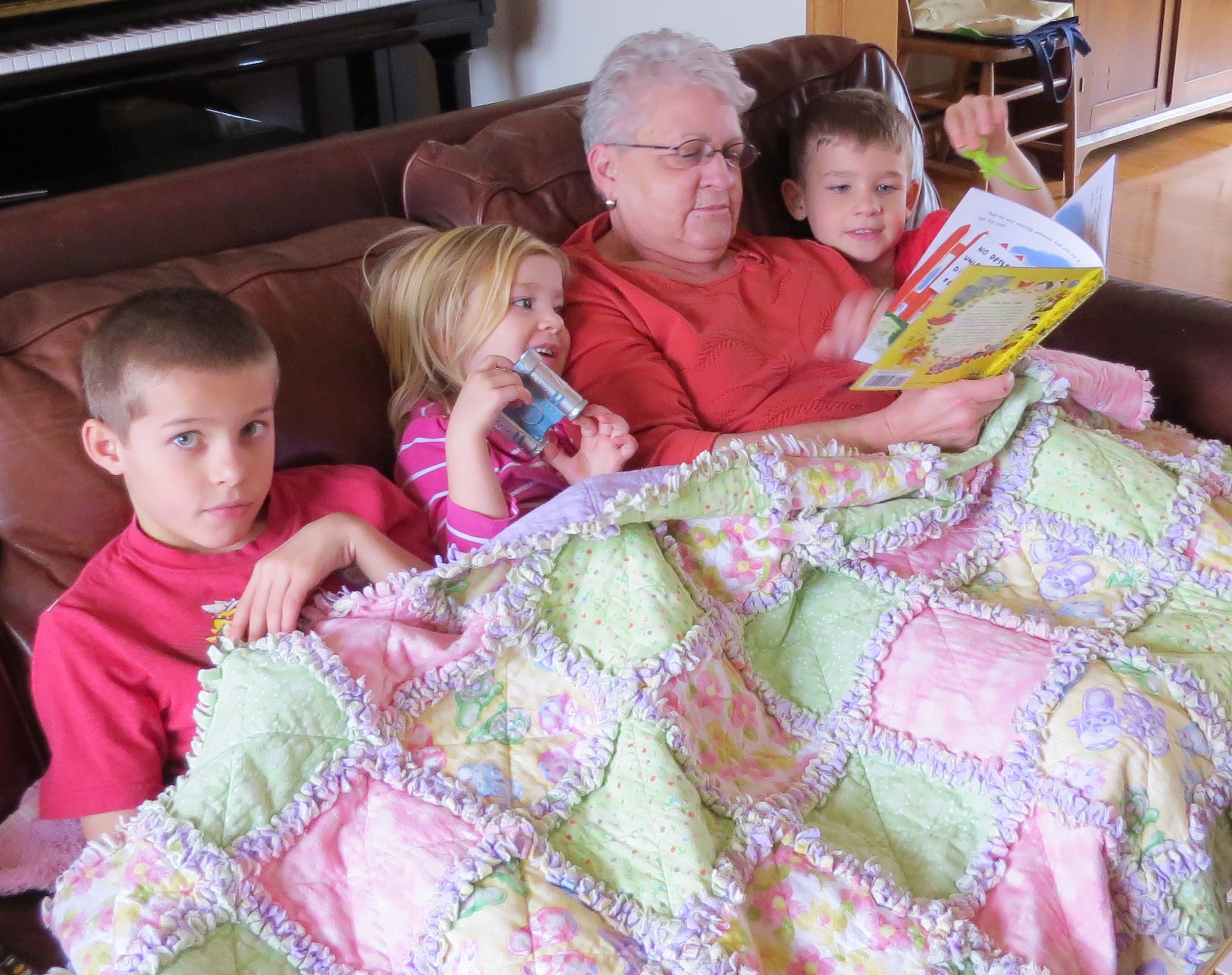
Our grandchildren snuggle under a blanket as Nana read a book to them on a cold winter’s night.We raised two beautiful children, who each have an amazing spouse of their own. It’s a joy to watch them all blaze their trails through life, positively affecting others. Of course, we adore our three grandchildren as precious gifts, too.
Our similarities and differences have balanced, renewed and enriched our lives, and have helped cement our marital friendship. Neva loves helping at the local thrift shop. I enjoy photographing sunsets. She quietly quilts or sews while I write.
The length and strength of our marriage can be attributed to our many common interests, and the recognition that we try to allow space for our own wants, wishes, talents and abilities. We complement one another, and we compliment one another.
Neva made this baby quilt for our granddaughter.After 42 years of marriage, Neva and I have reached a new phase in our relationship. We love being grandparents, and seize each opportunity to host, visit or vacation with the grandkids. Being mostly retired allows us to do that.
It also gives us pause to ponder how we have made it through the good and bad that life has thrown at us. All I can determine is that we have survived for two main reasons. We have many faithful friends and family members who have unwaveringly stood by us, and we have each other.
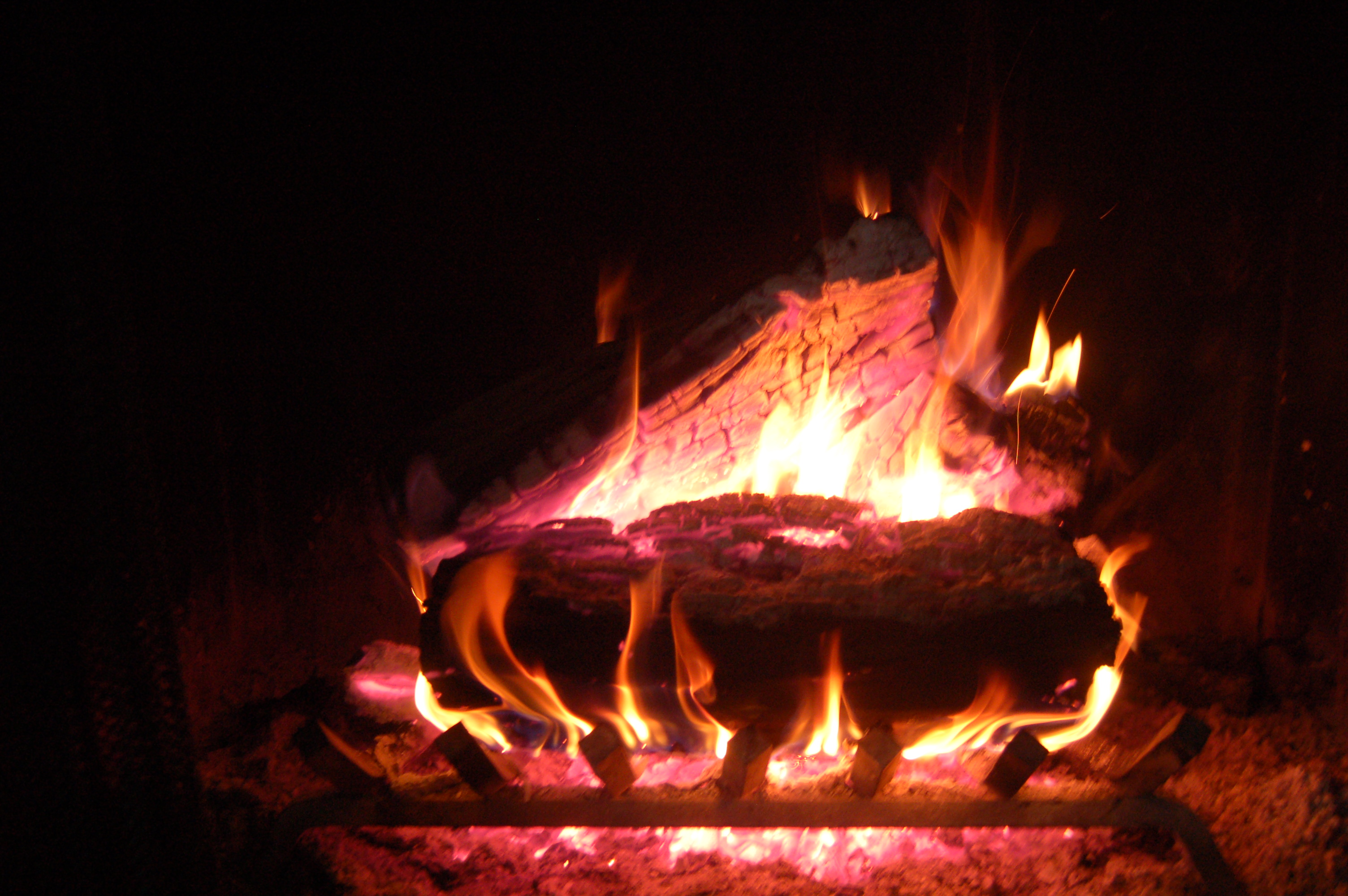
With a mesmerizing fire in the fireplace, a cup of coffee and some of Neva’s delicious homemade cookies, we spend many winter evenings together enjoying college basketball games on TV. It doesn’t take much to make us happy.
We are still close friends with our best man and his gregarious wife. But as I look back on our life together, it is obvious that Neva and I are more than wife and husband. We indeed are each other’s best friends.
Nana engaged our grandsons while our granddaughter entertained herself.
By Bruce Stambaugh
“Who knew it would be so much fun?” That was an email reply to me from a grandparent friend. Indeed, who knew?
Though we have always lived many miles apart, we have tried to be involved with our three grandchildren as much as time and distance allowed. First it was Texas, and now Virginia.
Our daughter, whose husband works for a university in Virginia’s lovely Shenandoah Valley, asked if we would care for her trio of children while they spent the school’s spring break in Florida. We didn’t hesitate. We rearranged our schedules and headed 350 miles southeast.
Like her mother, our daughter is extremely organized. She had the week’s agenda outlined day by day. Of course, life has a way of upsetting the best of plans.
Even little Maren wanted to help shovel snow.The upheaval began not long after our daughter and her husband headed south. During the night Davis, the six year old, got sick. Monday it was his big brother’s turn. At first we thought Evan just missed his parents. When the school called to say Evan was ill, we realized he wasn’t just being overly sensitive. The next night little sister, Maren, woke up sick, too.
With the weather cooler than norm for The Valley, we kept the woodstove stoked overnight. Once, though, the smoke detector suddenly screamed. The woodstove apparently was a little too stoked, its temperature needle reaching the danger zone.
Garbage trucks were converted into snowplows to help clear the roadways.Halfway through our weeklong mission a major winter storm stirred. Harrisonburg became the bull’s eye on the official snow accumulation chart. A total of 15 inches of heavy, wet snow piled up, cancelling school for two days, with a delay the third. Retrofitted garbage trucks morphed into snowplows to help clear the roads.
Fortunately, the sicknesses lessened as the snow depth increased. Sledding and snowman building became the focus of activity. Neighbors loaned slippery sleds that zoomed the bundled up kids down the steep hill behind their father’s office building. They were fearless in their swooshing, especially the youngest.
During down times between sledding excursions Maren kept us busy with her favorite activity, playing a memory card game. No matter how many pairs of cards we laid out, she skunked us all. To watch her consistently recall where the matching cards were, and hear her glee at winning was worth the licking Nana and I took.
We also made good use of the snowy elements. Nana whipped up a yummy batch of snow ice cream using nothing more than vanilla, heavy cream, sugar and snow.
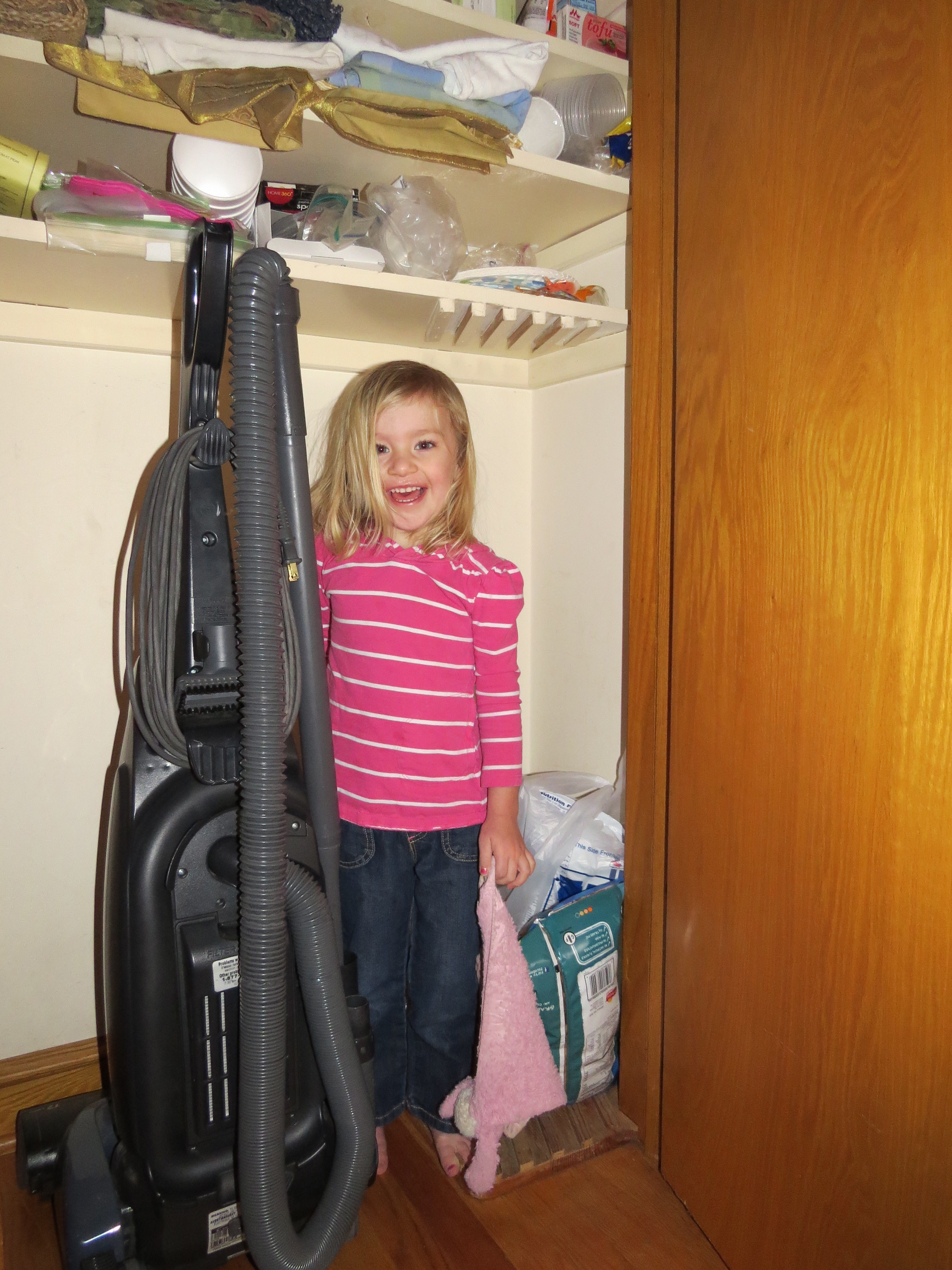
Maren found “hiding” behind the sweeper.Maren kept us all entertained playing hide and seek her way. She would tell us where she was going to hide, and then insist we close our eyes and count to 10 before beginning the imaginative search.
Sweet Maren had to keep track of her folks, too. At least three times a day she followed the route her parents took from their home to Sarasota on a Google map I had created on my computer. After a while, I merely pointed the curser, and she recited the travel log.
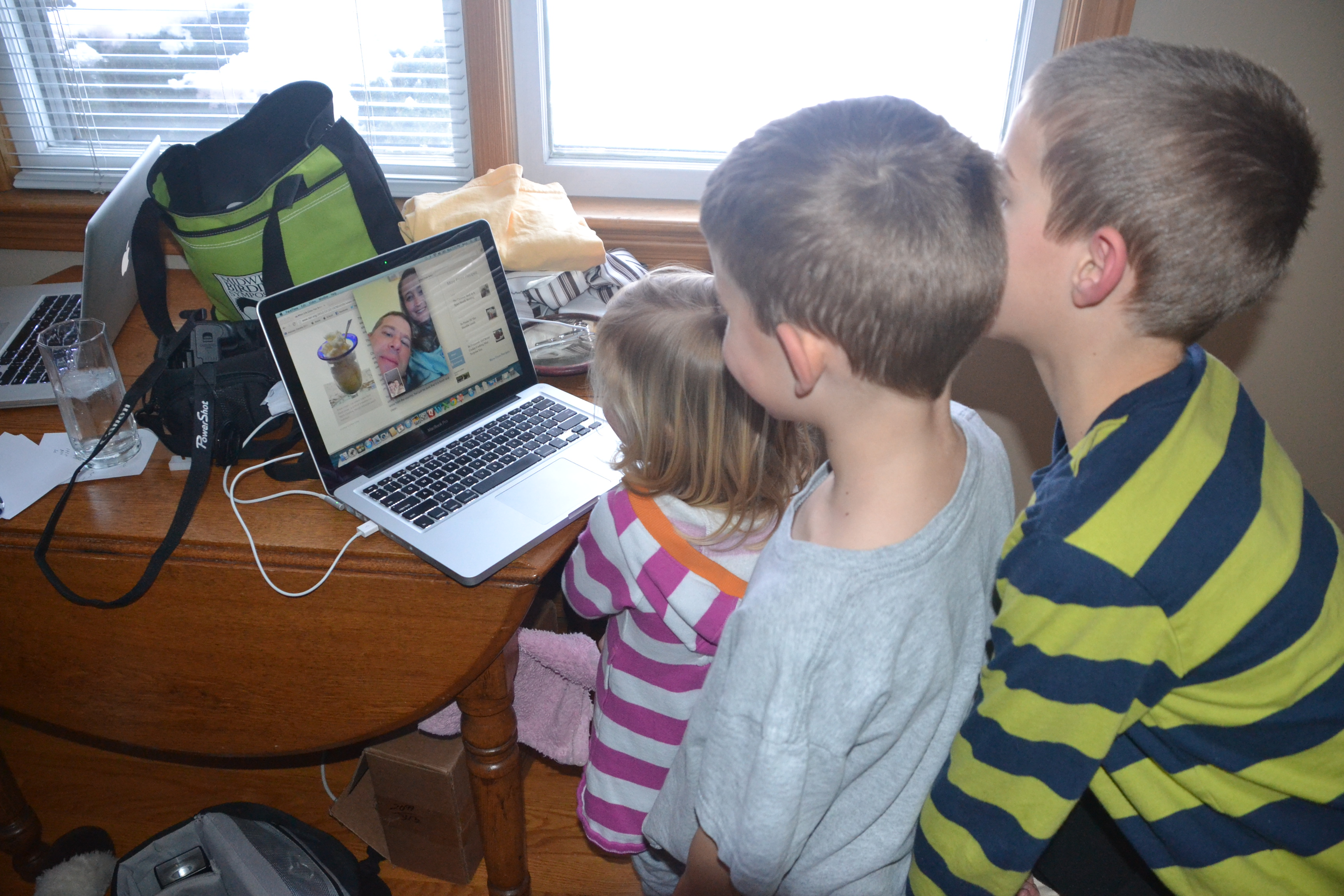
The grandkids enjoyed seeing their parents a few times via Face Time using Nana’s computer on our end and a smartphone in the Sunshine state. Those opportunities seemed to allay any apprehensions the grandkids had about their extended separation from Technology helped soothe the distance between the grandkids and their parents.their loving parents.
For Nana and I, this was one more chance for quality time with our creative and energetic grandchildren. Who knew it would be so much fun?
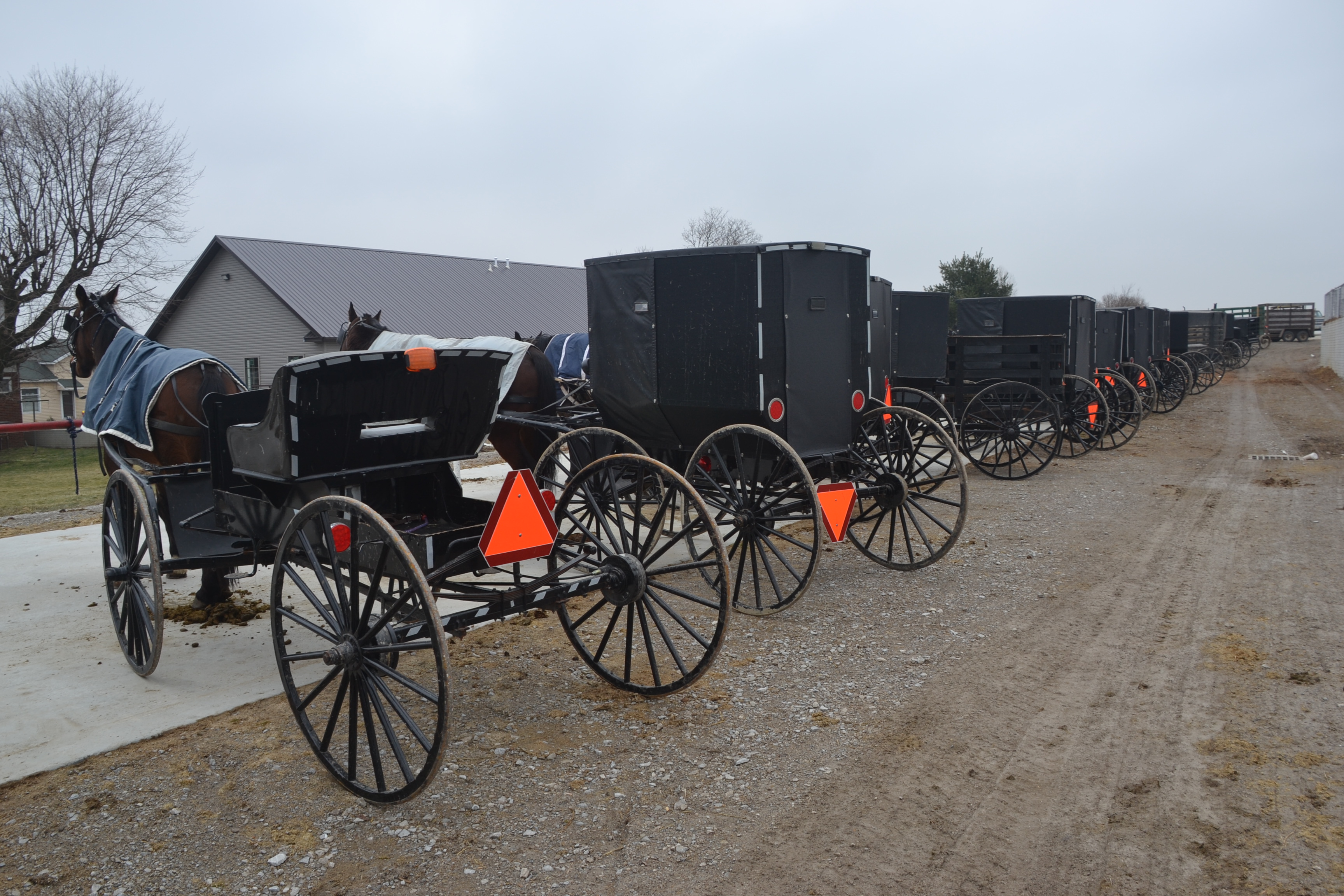
An assortment of buggy styles were tied up at a local auction barn.
By Bruce Stambaugh
Amish buggies in Ohio’s Amish Country may be all black, but they definitely aren’t all the same. The nondescript, unobtrusive color merely keeps them uniform and modest.
Even if they all are black, a closer look reveals that there are many differences in buggies. These variances are especially true for buggies owned by younger Amish men. Particular attention is paid to the kind of accessories included on their buggies. After all, a buggy can last for 30 years if it is well maintained.
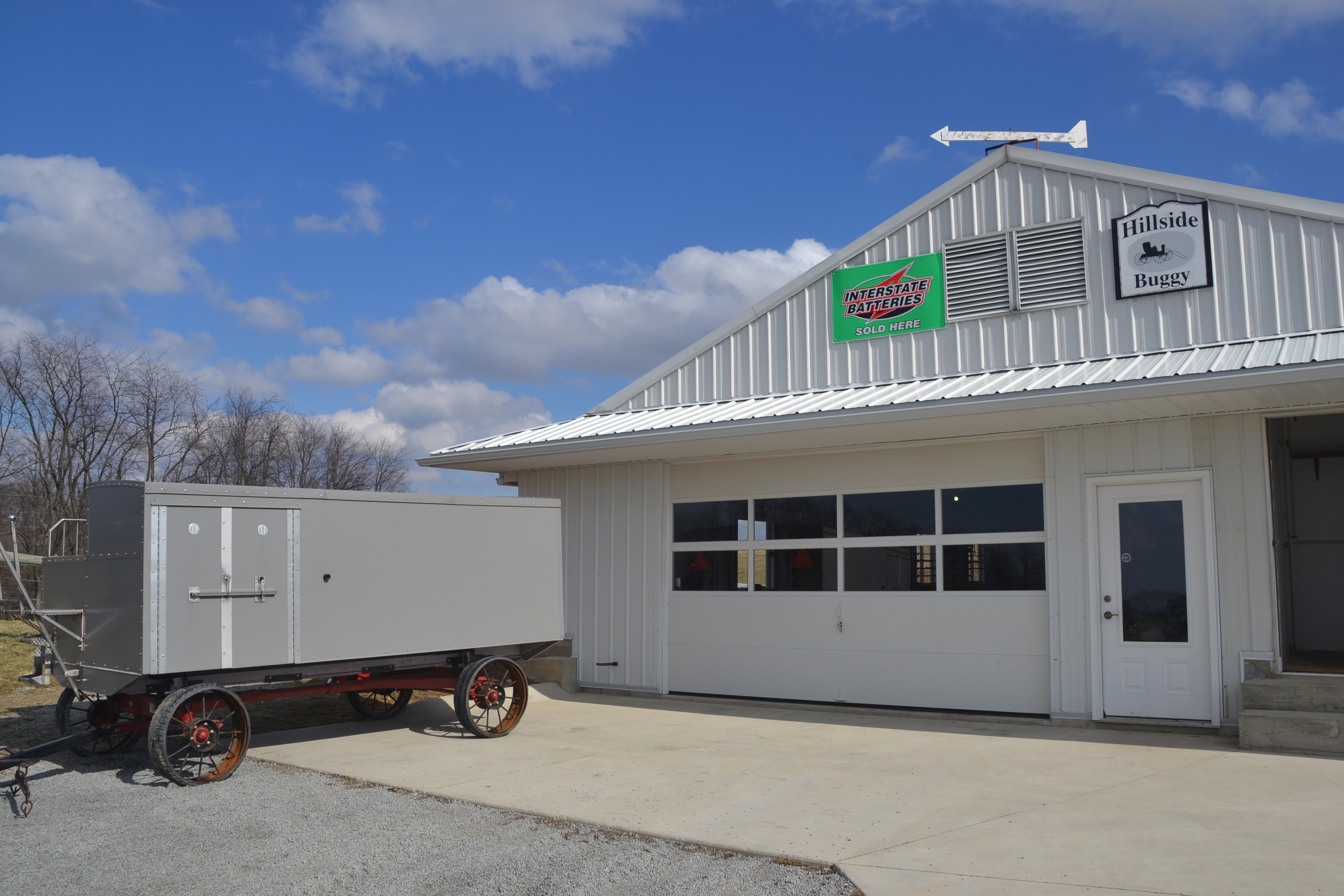
An Amish bench wagon stood outside an Amish buggy shop near Berlin, OH. The wagon is used to carry the church benches from one location to another. Since the Amish do not have church buildings, they take turns hosting church for the 100 or more members and their children. Shops like this one are cleared out and cleaned in preparation for church service.At least two-dozen buggy shops are sprinkled around the Greater Holmes County area. That way the Amish do not have to travel far to order a buggy or have one repaired. That concept is maintained in all aspects of the Amish lifestyle.
Demand for new buggies is high. Most buggy shops reported a year’s wait for a new buggy. Depending on the size of the shop and the kind of buggies being built, buggies are produced at the rate of no greater than one per week. Buggy repairs are worked in accordingly. Should a buggy be damaged in an accident or lose a wheel, for example, it would receive priority status.
Most buggy shops are family operations. A father and his son or sons may run the shop, assisted by an apprentice or even wives and daughters. This way the trade can be passed from generation to generation.
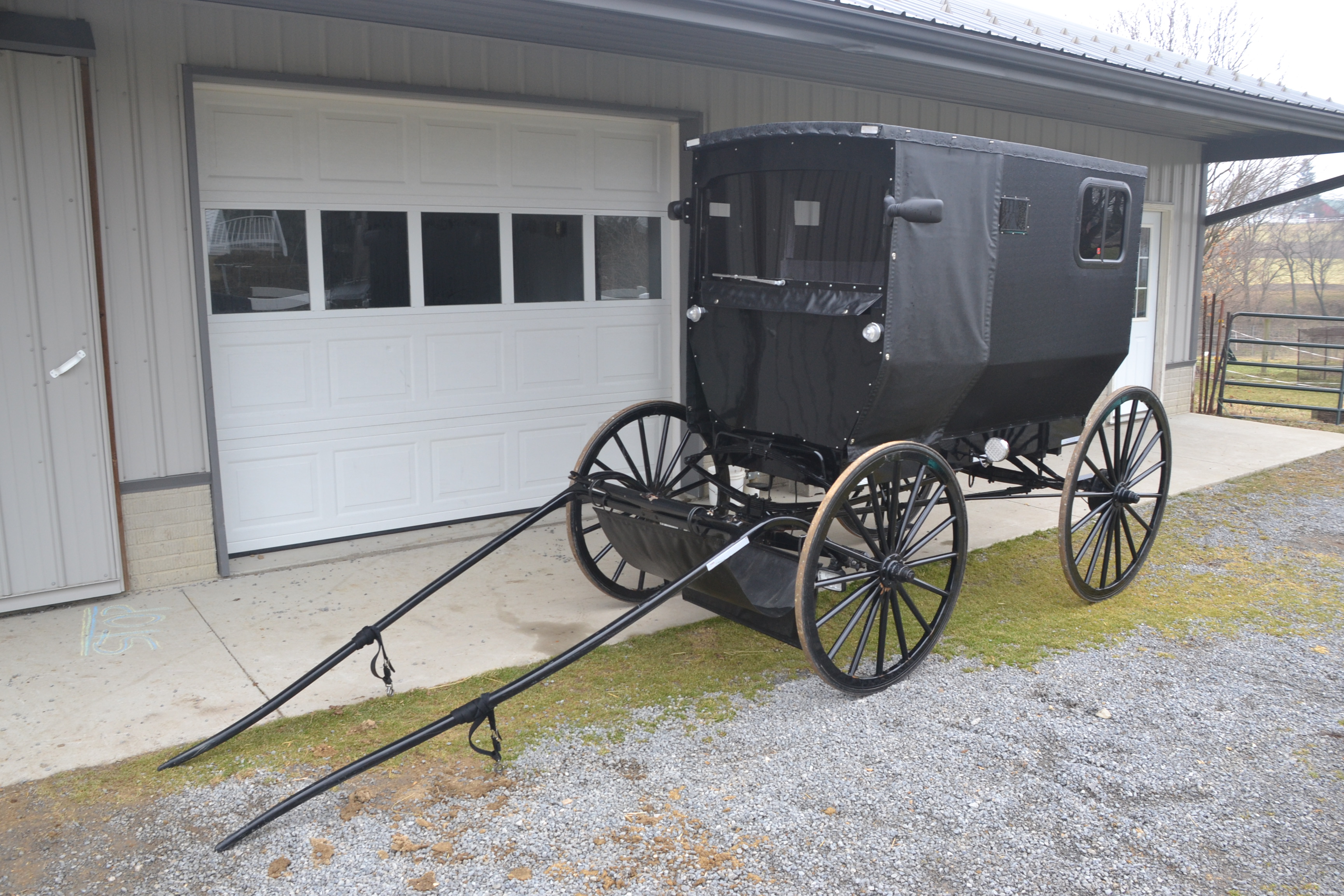
Amish buggies are built one at a time. The buggy in the foreground still needs to have its black vinyl coated cloth skin attached, and painting completed.
Because each buggy is custom-built one at a time, assembling a buggy is a prolonged process, taking as long as a year to complete. To build a sturdy, useful buggy, shop owners and workers need a variety of skills. They must be a carpenter, welder, upholsterer, painter and mechanic all in one.
According to Menno Schlabach, owner and operator of M & S Coach near Berlin, buggies start with a wooden base. Reinforced with metal braces, a wood framed structure is attached. The sides and tops are covered with a grained, vinyl coated black cloth.
“With 150 church districts in the area, customization of each buggy varies a great deal,” Schlabach said.
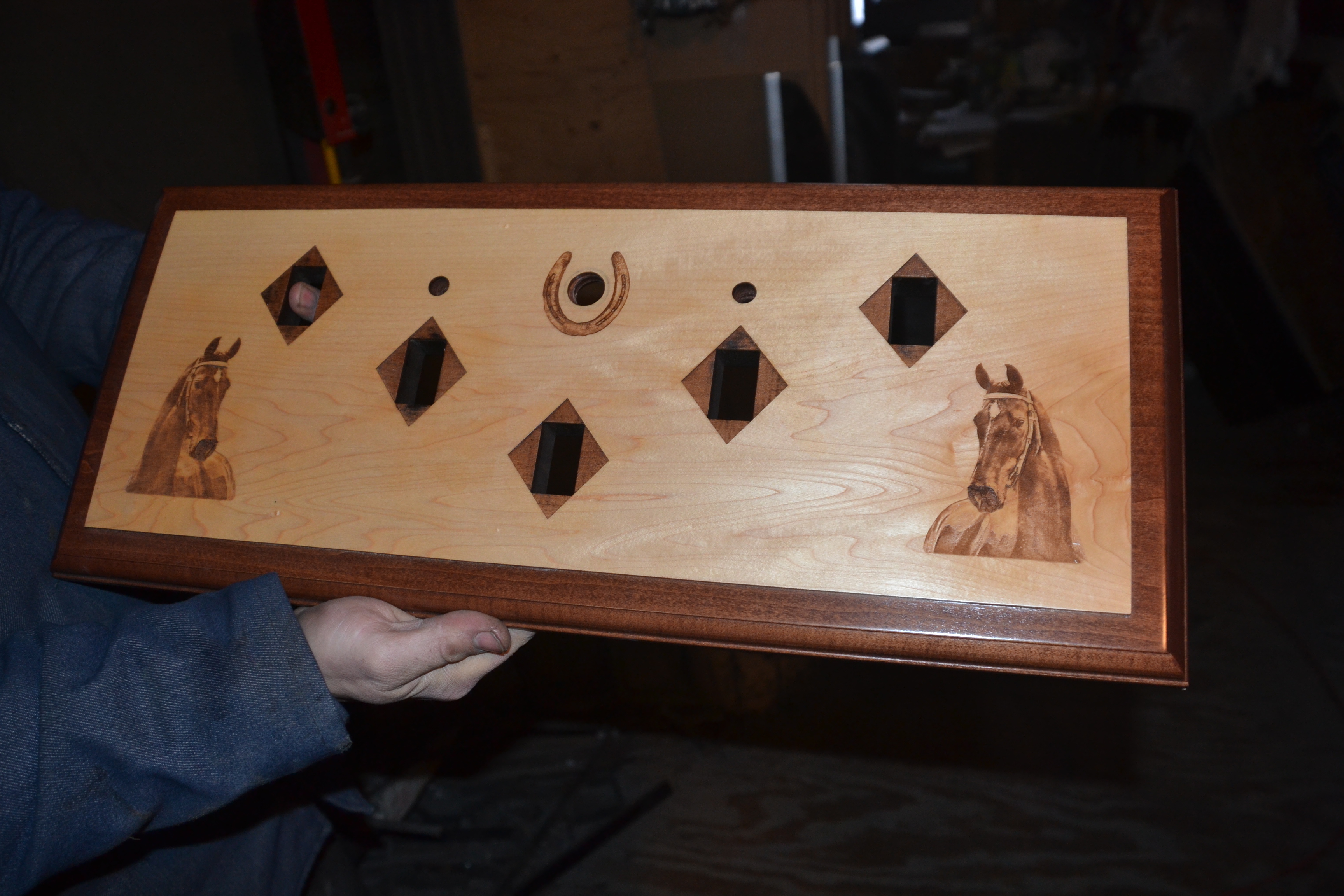
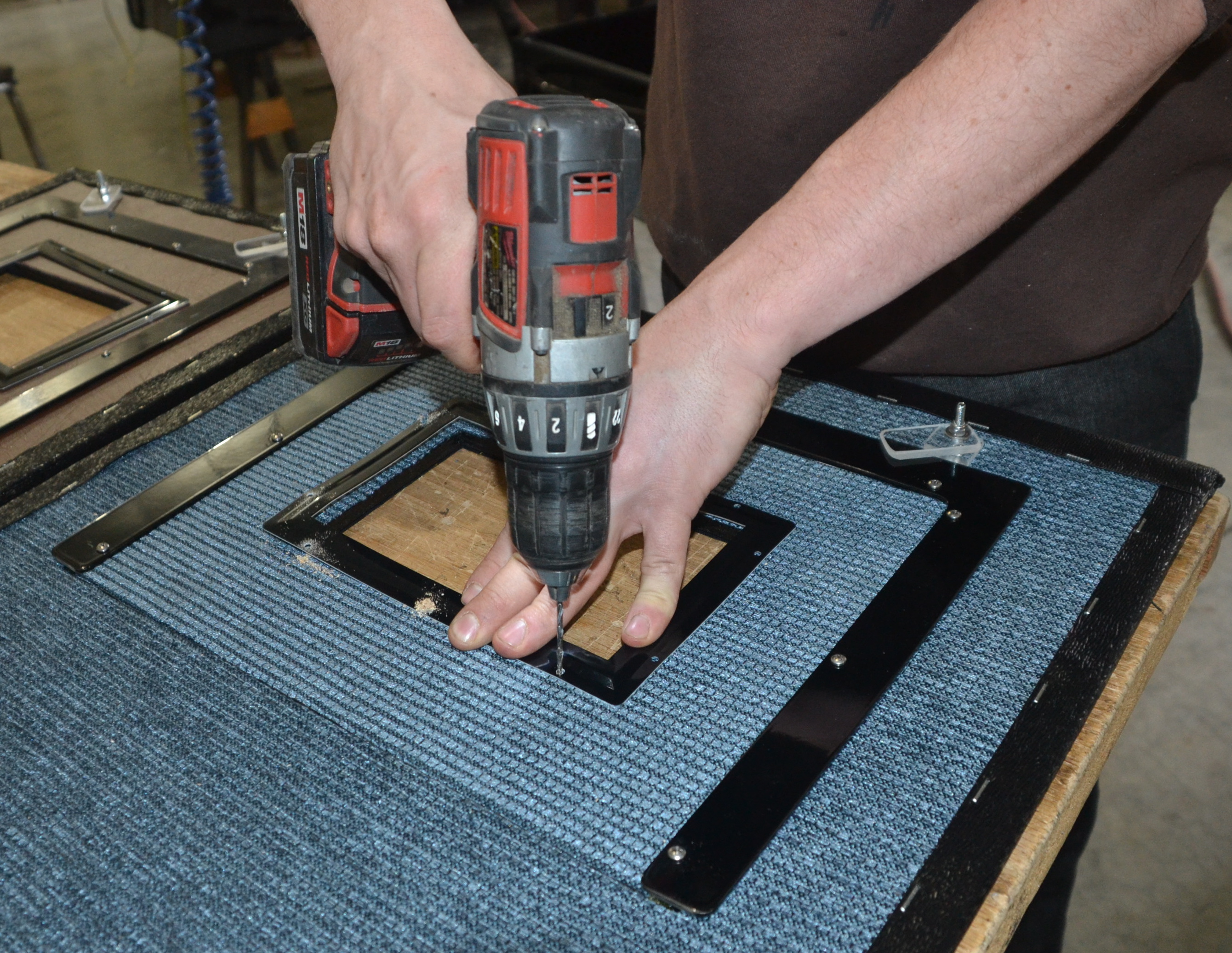
This wood inlaid dashboard is typical for young Amish men to have installed in their first buggy. The levers that operate lights and even a hand-powered windshield wiper fit through the cutout holes.
Indeed, it is the customization that allows the customer to put personal preferences into the new buggy to give it character. That process also slows the construction. With all the various options, Schlabach said it takes an average of 150 hours to build a new buggy.
A worker installed a window in the door of a new buggy.Some buggies have curtain doors that roll up, while others have sliding doors on the side and a hinged door in the back for easier access. Other buggy accessories include shelves for storage, switches, battery compartments, mirrors, window sizes and shapes including the choice of glass or Plexiglas or no glass at all, shapes and cushioning of seats, manually operated windshield wipers, brakes, upholstery and a variety of lighting options. Even the materials of the wheels and shafts vary.
Dashboards seem to be the telling tale of the owners’ preferences. Some are intricately made using inlaid or exotic wood. The dashboards are mounted on the inside of the front piece of the buggy. They generally house switches for exterior and interior lights and turn signals.
Buggies in the Greater Holmes County, Ohio area are usually well-lighted and marked with a slow moving vehicle reflector, reflective tape, and rear amber blinking light.Even the exterior lighting is customized. Just like cars, buggies have headlights and taillights. Most also have amber warning lights on the top rear of the buggy. Running lights along the sides of the buggies help drivers see at night. Marker lights positioned on the front and sides of buggies are other accessories that give the buggy its individual distinction. Only buggies owned by Swartzentruber Amish, the lowest Amish order, still use kerosene lanterns for visibility.
The style of buggy is determined by its purpose. A two-wheeled cart is the simplest of all buggy types and is used for quick, local trips. The hack is the Amish equivalent to a pick up truck. Sometimes called buckboards, a hack is a four-wheel buggy that is designed for hauling livestock and other bulk items. Some driver compartments of hacks are covered, while others are open.
The most common buggy type is the surrey. They are built with a bench seat and a storage area in the back that also has an option for two small flat seats along the insides. The side seats can be removed to increase storage. Usually children use those rear seats.
Most parts of buggies are made locally, including these shafts that connect the horse to the buggy. The shafts are made and bent at a specialty shop near Mt. Hope, OH.
Surreys come covered or open. Covered buggies are called top buggies. The family version of a surrey has two bench seats and four openings for access, plus some storage space in the rear with a door or curtain that rolls up.
The Amish like to keep things as local as possible. The wheel, spokes, axel and brakes were all made within 15 miles of this buggy’s owner’s home.The newest buggy version is the mini-surrey, which can actually hold more passengers than a regular top buggy. Affectionately called a minivan by some Amish, the mini-surrey serves the same purpose. The side seats behind the front bench comfortably hold two adults or several children on each side.
The cost of new buggies varies depending on the type and size of the buggy and the kind and amount of accessories included. A new cart could cost $1,500 while a new, well-equipped mini-surrey could run up to $7,000.
With a horse for an engine, the buggy’s driver steers with a set of reins instead of a steering wheel. Still, the purpose of a buggy is the same as a motorized vehicle. It transports its passengers from one place to the other, just at a much slower speed.
Buggies may be black. But they are an important element that helps keep the Amish culture moving in every way.
The newest style buggy seen is the Holmes County area is the Amish mini-buggy, affectionately called the Amish minivan.
The fearlessness of children today never ceases to amaze me, especially when it comes to using technology.
A friend on Facebook posted that her young son had purchased an upgrade for an application for her wireless phone. I marveled at the child’s fortitude, yet also wondered about the dangerous ramifications given that such a transaction could be that simple.
A few days later I heard a similar story on the radio. A woman’s young son purchased a $50,000 automobile by using her smartphone while the lady was driving her car. How could that kind of transaction so easily take place?
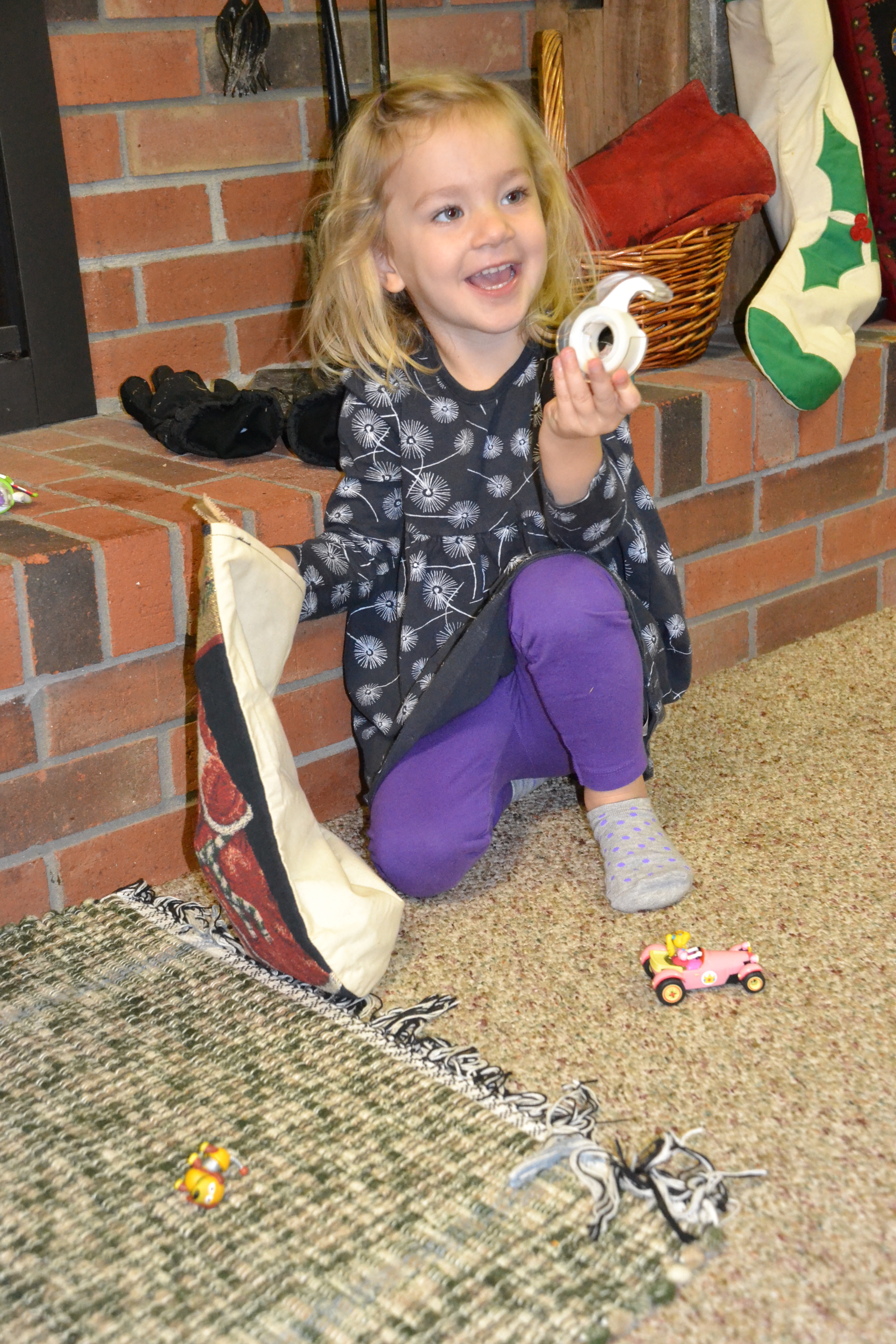
Fortunately, technology isn’t the only thing that our granddaughter enjoys. She was pleased with this roll of Scotch tape she found in her Christmas stocking.I admire the ability of children to grasp and use electronic technology as if it were innate. Our three-year old granddaughter, Maren, could teach me a thing or two about using the iPhone, iPad or any other device that begins with lower case “i.”
My wife once discovered Maren, then a mere two, under the covers in her parents’ bed nimbly using the iPad as if it were old hat. This is not a pronouncement on either her parents or Maren’s tenacity and dexterity. Rather, it is a singular example of how well young children adapt to all things technology.
I think that both a blessing and a curse. I admire their aptitude to use a wide variety of electronic devices. I am glad young people are not restrained by the anxiety that many my age and older seem to have towards fully embracing technology. They use it with ease. We complain that the buttons are too small.
However, that untamed acceptance of gaming, texting, movies on demand, live streaming and so much more at the touch of an app has its drawbacks. My Facebook friend can attest to that. In fact, several mothers shared stories of their own young children committing similar acts. And don’t forget the mother with the brand new car. Children readily learn to use technology in their daily lives.
I find that both exciting and alarming. I am glad today’s young people so easily grasp the use of technology in today’s world. Technology really does put the world at our fingertips.
The world is growing smaller because of technology. Social media, tweeting and texting are the modern ways to communicate, including in third world countries. Even hungry children in poor, remote regions of the world know what is going on globally thanks to rapidly spreading technology.
The world is a scary place. If children can order items online or cars from a smartphone with the swipe of a finger or touch of an app, imagine the other possibilities that are out there. I like to think that most are good, expanding the youngsters’ horizons.
Unfortunately, some aren’t all that helpful, and perhaps are even harmful. The fearlessness of young children and their lack of life’s experiences make them vulnerable to the shysters of the world, and that’s not a good thing at all.
I would hate to see a family’s credit or reputation ruined because of some greedy corporation or individual taking advantage of an innocent, exploring mind. Worse still is the thought of even one child being naively duped.
I am not advocating prohibiting children from using today’s technology by any means. Children’s fearlessness toward technology should be metered with instruction, caution and supervision, applied appropriately for the age and situation.
I don’t pretend to have all the answers to my concerns. If I did, people would pay me big money for my solutions and I’d be rich. Maybe then I could hire my granddaughter to teach me how to use an iPhone.
Our granddaughter posed perfectly for a picture taken on a smartphone.
During the course of a year, I take a lot of photographs, thousands to be exact. My son says I take too many, especially of the same thing. But I snap away for several reasons. My mother gave me her artsy eye to see the beauty in the world around me. She painted landscapes. I take pictures. Shooting pictures is also a way to document the year. In addition, I enjoy sharing the pictures I take, either through this blog, in magazines, on websites, or simply printing them out for people to enjoy.
With that introduction, this is my 2012 in review. With so many pictures, I didn’t want to bore you. Instead, I chose a picture a month, kind of like a calendar in reverse. I hope you enjoy my selections.
Happy New Year!
Bruce
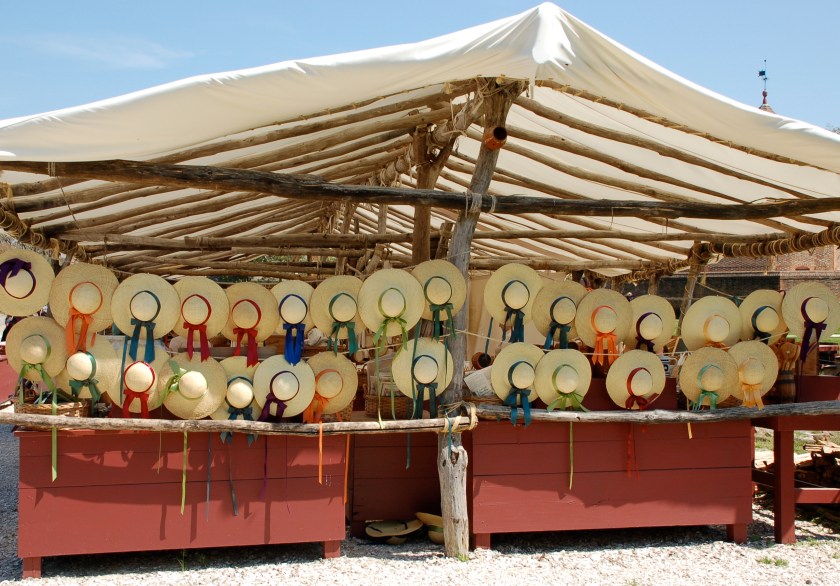
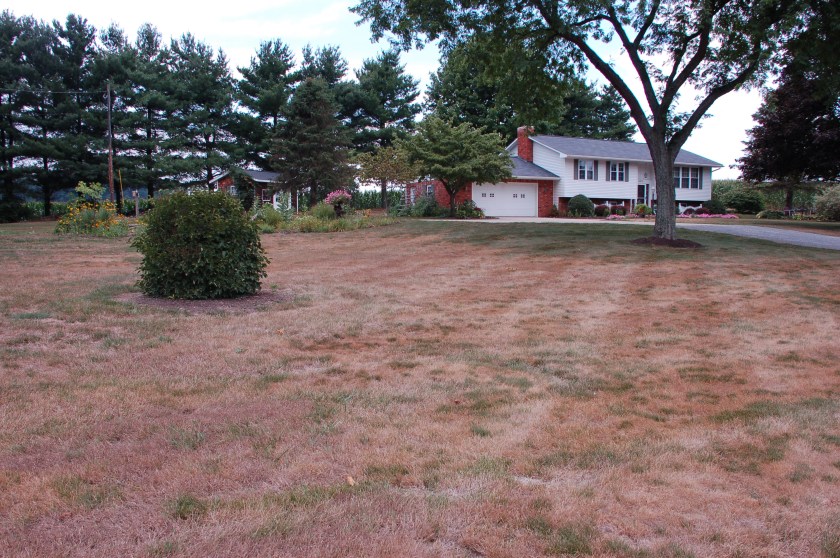
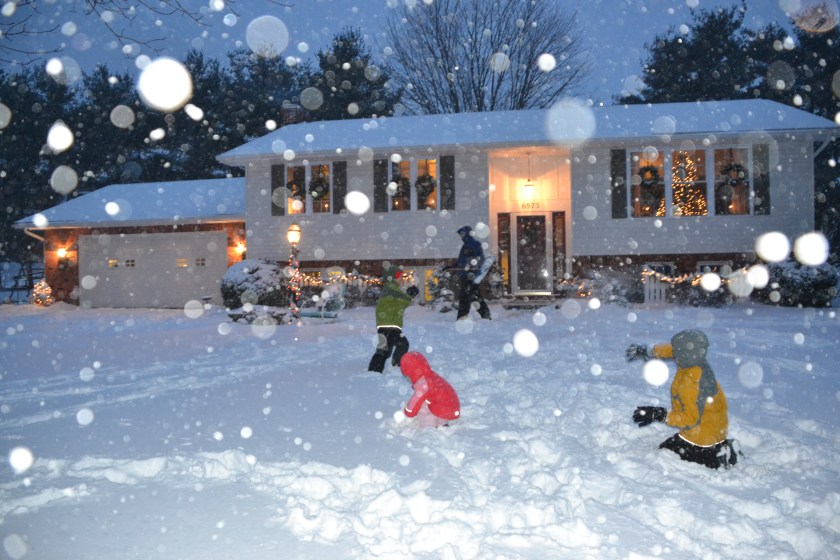
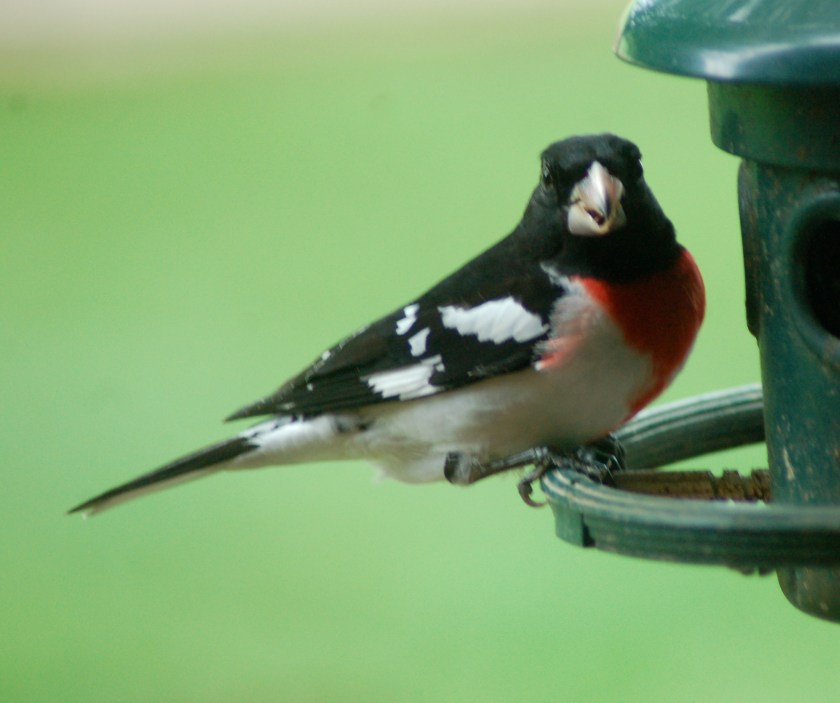
Enjoying a beautiful sunset on America’s number 1 rated beach, Siesta Key, Sarasota, FL, was a great way to begin the year.I love birding. This Northern Flicker posed perfectly for this shot in Feb.My wife and I celebrated our 41st anniversary in March by visiting Williamsburg, VA. These hats caught my eye.Lakeside, OH is one of my favorite vacation spots. When the Lakeside Daisies are blooming, which they did two weeks early this year, the town is even prettier. These daisies only bloom on the Marblehead Peninsula, and this bee enjoyed the small patch of these special flowers on April 29.I feel very fortunate to have Rose-breasted Grosbeaks frequent my backyard feeders. This male seemed fearless as he gorged on oil sunflower seeds in early May.I enjoyed capturing our grandchildren’s initial reaction to the surf at Sunset Beach, NC in early June.The end of July was the peak of the summer’s drought in Ohio’s Amish country, where my wife and I live.Summer fog is not unusual in Ohio’s Amish country. I often take my camera along on my morning walk, and I was glad I had this late August morning.A young Amish girl checked out the colorful balloons at the neighbor’s produce stand during their Customer Appreciation Day at the end of Sept.Laundry drying against the colorful leaves in mid-Oct. in Holmes Co., OH created a contrasting shot.The silhouettes of the corncrib and tree against the Thanksgiving Day sunset made a stunning image.Watching our grandchildren and their parents play in the snow the day after Christmas was as magical as the snow itself, and a wonderful way to end 2012.
My late father loved Christmas. In truth, he lived for Christmas. Dad got so excited about Christmas it was as if our poor mother had six children, not five. When it came to Christmas, Dad was a grown man who never grew up.
Dad’s exuberance for the holiday was prolific, to the point of over-spending an already limited income. No matter the economy, there were always plenty of presents for everyone under our Christmas tree. I really don’t know how my folks financially did it.
My late father, Dick Stambaugh, with Senator Bob Dole at the World War II Memorial, Washinngton, D.C., Sept. 12, 2009His joy for the season wasn’t limited to gift giving. Dad dragged us downtown in frigid weather to watch Santa arrive on a fire truck in the annual Christmas parade. He hauled us to his workplace where we stood in line with thousands of others to receive Christmas candy and small gifts.
Choosing the Christmas tree became a family event, too. Dad would stuff as many of us kids as he could catch into the car, and off we went, oftentimes tromping through the snow to select and cut the perfect tree.
Dad made the house a priority for being properly trimmed for Christmas. The tree was erected in front of the large plate glass window in the living room for all to see. Garland, tinsel, lights and heirloom ornaments nearly hid the needles. The plastic white star always crowned the glittery tree.
A little plastic church that lit up took center stage on the fireplace mantel between a pair of red candles in glinting glass holders. Of course, the stockings were all hung with care around the hearth.
Dad’s perennial priority project, however, was outside the house. His beloved light display seemed to grow each year. It started with the six-foot pine planted on the corner of our lot at 44th and Harrison in Canton, Ohio. It was a rather busy intersection in our post-World War II suburban neighborhood.
Dad loved to load up the tree with string after string of colored lights. The single lighting option then was using strands of large bulbs, which were individually screwed in. We got lots of compliments about the tree, which only encouraged Dad all the more.
As the tree grew, he added additional cords of lights. Later, the extension ladder came out until it was no longer practical for Dad to try to decorate a 20-foot tree. Instead, he loaded up the shrubbery with lights, and outlined the ridge of the house with those big bulb lights. By then, all of us kids were no longer kids. We had grown, married and had families of our own.
Each Christmas the Stambaugh family, like thousands upon thousands of other families, gather to celebrate the day and its meaning. We continued to do so long after our parents were unable to host the annual family gathering. Our late mother, Marian Stambaugh, is in the center of attention.
Dad kept his holiday lighting tradition going nevertheless. When the dainty icicle lights came out, Dad draped those from the multi-colored lights around the facing of the house. It was festive, but not exactly aesthetically award winning.
Dad capped off the holiday merriment with buying out the neighborhood candy store of its assortment of tasty chocolates. I think he alone kept the store in business for years.
On each Christmas Day, my brothers and sisters and I gathered with our families and extended families in the home where we grew up out of celebration for the day and respect for our Santa Claus parents. Those were magical days, made more so by a man who refused to grow up, and who bequeathed his fervor for sharing joy to the next generation and the next.
If anyone knew how to keep Christmas, our spirited father, artfully aided by our loving mother, surely did.
Keeping the Christmas tradition alive in the Stambaugh family.
In case you haven’t noticed, it’s the gift-giving season again. I think the TV commercials started just after Labor Day.
If you follow their lead, it’s spend, spend, spend to please your loved one with just the right gift. That certainly might help the economy, but not your budget. It doesn’t have to be that way. Gifts don’t need to be expensive to be appreciated. In fact, they don’t even need to be purchased. Please note I am not endorsing shoplifting as an option.
Gifts come in all kinds of packages. The most precious don’t need to be unwrapped. We just need to be alert enough to recognize them when they surreptitiously present themselves.
Pick your smile.
A friend recently shared that she smiled at a stranger in a store. The man, who could have qualified in age as her grandfather, walked away, stopped and returned to her. He told my friend that her smile had made his day, and he wanted to thank her for her thoughtfulness. He said he seldom sees people smile any more. I thought that a perfect example of the kind of gift giving that really counts. The young woman was so impressed with the man’s comments that she eagerly shared the encounter with others. I hope the man passed his gratitude on with a smile of his own.
If we listen to the seasonal marketing hype, Advent is more corporate than celestial. Of course, if we take my friend’s approach, it doesn’t have to be that way.
The gifts enjoyed most happen freely everyday.
A recent sunrise was a thing to behold. Thick clouds covered the rising sun, yet bands of rays somehow squeezed through and fanning out to create an incredible heavenly display.
Later that morning a Red-breasted Nuthatch snatched seeds precision like from pinecones my wife had gathered and placed in a bowl to decorate an old wash bench on the back porch. The little bird was too quick for my camera.
Later that evening, we sat around the dining room table exchanging touching stories with trusted and trusting friends. We lamented and laughed at our common situations. Unwavering, lifetime friendship is a priceless gift.
The perfect gift also could be something as simple as discovering your driver’s license is about to expire. The startling realization turned out to be a rich blessing. I rushed to the license bureau where the employees had just dealt with a pretty crusty customer. Not to be distracted from their normal good humor, they treated me like a king, and I walked away with a new license and an uplifted spirit.
At the doctor’s office, I meet an acquaintance I only see on occasion. We talked until I was called in for my appointment. Good thing, too, or we’d still be talking. You know how men are.
I received a card with a hand written note of appreciation from a friend. It was given for the sole purpose of expressing gratitude for our friendship. I placed the note where I can see it every morning.
A day ended with the sun showing its artistic ability. As a flock of Canada Geese flew overhead, a palette of pastels filled the evening sky. It was another fleeting and inspiring gift that cost only the time to notice.
At this special time of year, what are some of the gifts that you have received that you didn’t have to unwrap? Better still, what are some that you will give?
Brooke Hershberger entertained participants of last year’s church walk at Millersburg Mennonite Church.
By Bruce Stambaugh
The event has such a straightforward name. Yet, participating in the annual Millersburg Candlelight Church Walk is so much more than that.
Yes, it is a walk, unless you choose to drive from church to church. This year six churches within walking distance in and close to Historical Downtown Millersburg, Ohio are set to host visitors on Friday, December 14 from 6 to 8 p.m. Millersburg is located 35 miles southwest of Canton, 75 miles south of Cleveland or 80 miles northeast of Columbus.
The churches are chosen for the proximity as well as their historical significance, according to Kate Findley, who is the volunteer coordinator for the event, now in its third year.
Kate Findley (left), coordinator for the church walk, shared about the Presbyterian Church at last year’s church walk.“We want those who can do so to be able to walk from church to church,” Findley said. “Those who cannot walk are welcome to drive to each church.”
Besides the physical exercise, people who participate in the tour will also learn about the history of each church. Findley said representatives from each congregation would be available to share about their church and answer any questions. For example, some of the church buildings have housed different denominations over the years.
In addition, the various churches in the walk have unique architectural features that people should find interesting. From ornate bell towers to stained glass windows to intricate pulpits, each church has its own structural story.
“This is an opportunity for people who might drive by these churches frequently without ever being inside them to see what they look like,” Findley said.
Participants in the church walk can view special Christmas decorations and traditions at each of the participating churches.
The six churches included in the candlelight walk include Faith Lutheran Church, 187 S. Clay St.; First Presbyterian Church, 90 S. Clay St.; Grace Pointe Community Church, 164 N. Washington St.; Millersburg Christian Church, 125 N. Clay St.; Millersburg Mennonite Church, 288 E. Jackson St., and St. Peter’s Catholic Church, 379 S. Crawford St.
“The walk committee is really excited to have Grace Pointe Community Church join the walk this year,” Findley said. The building formerly housed the United Methodist Church. Findley emphasized that participants can visit the churches in any order they choose. Maps of church locations will be available at each church.
“There is no starting or ending place,” Findley said. “We are encouraging people to participate in the special music and Christmas carol singing after the walk.”
A special music presentation and singing of carols at Millersburg Mennonite Church will begin at 8:15 p.m. Members of Millersburg Mennonite will perform vocal and instrumental pieces as well.
Each church will be decorated for the holidays according to the particular traditions of each congregation, Findley said. Luminaries will decorate the path to each church. Participants are also invited to relax at each church and enjoy the music presented. Participants will also have a chance to taste the culinary skills of the various church parishioners. Refreshments, including homemade Christmas cookies, will be available at each church building.
“The Millersburg Candlelight Church Walk is an excellent time for families to get in the holiday spirit,” Findley said. “It’s fun for everyone.” During the first two years of the church tour, participants represented several generations. Findley said that the church walk gained such notoriety in its first two years that people from other counties contacted her about starting one in their communities.
“I think that says a lot about the quality of the Millersburg Church Walk,” she said.
Findley noted that participants should be aware that the Grace Pointe Church is not handicapped accessible, and that parking is across the street from the church.
The walk is free and open to the public. Besides county residents, several persons from outside the Holmes County area attended the previous two walks.
Smack in the center of our bucolic county is a gift that can be enjoyed by all. The Holmes County Trail is a golden thread that symbolically intertwines the east and the west as one.
Now December may seem like a strange time to be writing about hiking and biking. When we have a gem of a trail in our midst it isn’t. Despite living in northeast Ohio where the weather is as fickle as its politicians, township trustees excluded, the trail is a year-round treasure for hikers, bikers and birders alike.
The trail ties Holmes County’s two cultural and geographic regions together through more than its central location. This multipurpose ribbon of assimilation serves as outdoor gym, nature center, photographic paradise and transportation route all in one. Many people, local residents and visitors alike, utilize those undeniable attributes.
Though the trail has been open for awhile, it has only been in the last couple of years that I have begun to fully appreciate its value. I bike and hike the trail for the obvious reasons. I need and enjoy the exercise. The trail, however, provides so much more than physical workouts. For 15 miles from Fredericksburg to Killbuck, enigmatic landscapes of steep wooded hills and low marshlands with grasses, reeds, wildflowers, wildlife, ponds and estuaries abound.
The Holmes Co. Trail runs through the Killbuck Marsh, an important wildlife area and fly way for migrating birds
Whether cycling or walking, memories flood my old brain much like the murky waters of the streams overwhelm the old-age valley after a summer deluge. Traversing where locomotives once chugged and whistled through the heart of the county invigorates the body, mind and soul. Truly its worth spans far beyond any personal physical or mental gains.
Historic and aesthetic reminders of railroad days appear occasionally along the way. The weathered, wooden arms of long-abandoned telegraph poles still stand. Girders of old iron bridges that once ferried locomotives pulling passenger and freight cars continue as supports for the trail to cross the many tributaries that feed the mother stream.
The old railroad bed that once conveyed products between Ohio cities has a renewed and appreciated purpose. Families leisurely stroll the paved path on a sunny Sunday afternoon. Casual and serious bikers alike zoom along the trail’s smooth, gentle gradient at preferred paces. Horses and buggies pass safely from home to store with no motorized hindrance.
Horses keep to one lane and bikers and hikers the other on the Holmes Co. Trail.
I am never surprised but always pleased by what I discover on my encounters along the trail. In the spring, pleasing pastels of plants, flowers and trees unfurl, and lyrical sounds of migrating songbirds, shorebirds, waterfowl and birds of prey fill the precious marshy flyway. In the shaded tree tunnels along the route, summer’s highlights include meeting fellow bikers from near and far who have come to enjoy the beauty of this special pearl.
A young Red-tailed Hawk took flight along the Holmes Co. Trail near Fredericksburg.Besides its rich, changing colors, the fall brings the joy of discovering a clamorous gang of crows spooking a bald eagle from its comfortable roost. Just down the way, gnawing beaver have encircled a cottonwood to the point of marveling that the tree still stands.
I have yet to experience winter on the trail. With the first fluffy snowfall, that will likely change.
As seasons come and seasons go, old friends meet and new friendships form along the blissful trail. Of all its intrinsic qualities, perhaps this virtue is the trail’s greatest gift to those who choose to unwrap it.
A Canada Goose gosling follows its mother through the marshy water along the Holmes Co. Trail.Families enjoy all the Holmes Co. Trail has to offer.North of Holmesville, a road parallels the trail.The views from the Holmes Co. Trail are beautiful and ever-changing.Fall is especially nice along the Holmes Co. Trail.In the fall, the Holmes Co. Trial really is a golden thread.The Holmes Co. Home is visible from the trail.Crops like field corn and soybeans also add to the variety along the trail.The trail follows the Killbuck Creek most of the way from Holmesville to Killbuck.The old depot in Killbuck marks the southern-most part of the Holmes Co. Trail.Horses are required to stay on one side of the trail for obvious reasons.The old railroad bridges still serve their purposes along the trail.The trail cuts through a variety of topography while maintaining a level ride.Though not in its original location, the Millersburg depot serves as the hub for the trail.The Killbuck Marsh is both a valuable wildlife habitat and a photographer’s haven.
The Holmes Co. Trail has several access points. They include from north to south Fredericksburg, Holmesville, Millersburg and Killbuck.
You must be logged in to post a comment.