I am a writer, author, photographer, birder, walker, hiker, husband, father, grandfather, brother, Anabaptist, and community activist. My life is crammed with all things people and nature and wonder. My late father gave me this penchant for giving and getting the most out of life, my late mother the courtesy, kindness, and creativity to see the joy in life. They both taught me to cherish the people I am with. I try and fail and try again.
This picture of the summer solstice sunrise was taken at 5:13 a.m. on June 21, 2010. - Bruce Stambaugh
I have absolutely no idea why it took me so long to post these pictures of the sunrise and sunset of the summer solstice, which occurred on June 21, 2010. Nevertheless, here they are, finally.
These pictures were taken at our home in Ohio’s Amish country, four miles southwest of Mt. Hope in Saltcreek Twp. – Bruce Stambaugh
The last look at the sun at 8:24 p.m. on June 21, 2010 as it sank behind my neighbor's barn. - Bruce Stambaugh
It’s no accident that Leah Miller’s life has come full circle. Agriculture runs deep in her genes, personal life and in her professional career.
She grew up on a farm, and now her life is all about farming, both at home and on the job, whichever particular job it is she happens to be doing. In between, her career took a productive, if not circuitous route before Miller, 61, planted her agricultural roots.
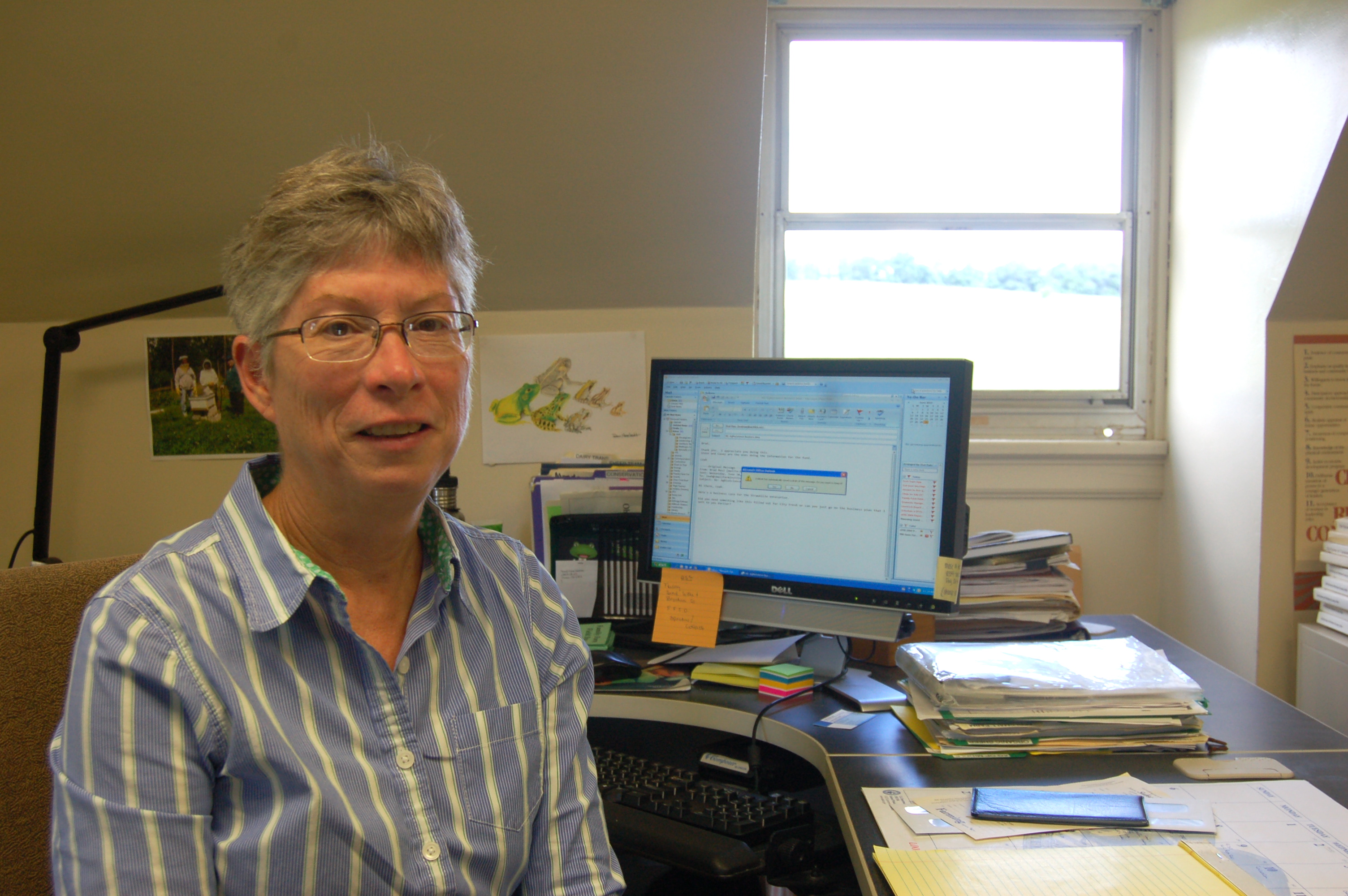
In a rare moment, Leah Miller was in her Small Farm Institute Office in Coshocton County, Ohio.
Born in Conneaut, Ohio near her parent’s home farm at Pierpont, Miller followed some pretty big family footprints. Her father and her father’s father were both agricultural teachers, in addition to running separate farms in Ashtabula County.
Miller’s mother, Celia Wright, took charge of the family farm when her husband, Eber, moved into regional planning. Ironically, that is exactly the job Miller took in Lake County after graduating from The Ohio State University in 1971. She became Holmes County’s regional planning director two years later.
There is a bit of double-irony in this scenario. The Holmes County regional planning office was in the front of Hotel Millersburg.
“My parents spent the first night of their honeymoon at Hotel Millersburg,” Miller said. “They got a late start from their wedding reception in Columbus and following U.S. 62, Millersburg was as far as they got.”
Miller served in this capacity for six years. Once she and her husband, Mic, started their family, Miller turned her efforts to community service. She served two terms on the West Holmes Local School Board. Later, she served on the board at Central Christian School. She also served a term on the Ohio Mennonite Relief Sale board of directors, and was a 4-H advisor for a dozen years.
Miller was the first director of the Holmes County Chamber of Commerce, once it expanded from beyond Millersburg proper. In the 1990s, Miller’s leadership abilities became political. She was twice elected as a Holmes County commissioner.
All the while she found solace from her demanding schedule on her 50-acre sheep farm, Blue Bird Hill, east of Millersburg. She also kept bees, as did her father.
Her love for land and the people that farmed stirred within her. In 2001, she worked with former state representative Joy Padgett to form the Small Farm Institute.
“There was a concern about erosion and farming,” Miller explained. “The emphasis was to help farmers do more grazing with their animals.” She said the sod would help reduce run-off, and at the same time provide a natural grass diet for cows, cattle and sheep.
Miller is the director of the Small Farm Institute, which is based at the United States Department of Agriculture’s hydrological station in Coshocton County. She assists small farm operations to improve income by providing helpful information on sustainable environmental practices that support strong family and rural communities. Her focus is on production, processing and distribution of product.
“We encourage people to look for value-added production to enhance profitability,” Miller said. “If they run a produce stand, they can increase their income by making jam or canning instead of selling all their fruit and vegetables fresh.”
Much of Miller’s responsibility revolves around facilitating grazing groups. She said this has been especially successful among the Amish, who tend to form their own peer groups in close proximity to help reduce the need for transportation.
“It’s been a joy to watch them expand,” she said. “They hold pasture walks where they share helpful grazing information with one another.”
As satisfying as that is for Miller, she also supports much larger events. Her skill sets also assist the annual North Central Ohio Grazing Conference for Dairy, which brings in hundreds of people, including many from other states.
Miller also advises the planning committee for the upcoming annual Family Farm Field Day. David and Emily Hershberger will host the event on their farm, located on Saltcreek Township Road 613 in Holmes County, on July 17, from 8:30 a.m. to 4 p.m.
As if she weren’t busy enough, Miller works part time as stakeholder coordinator in agricultural economic development for the Ohio Agricultural Research and Development Center in Wooster. She splits her time between there and the Small Farm Institute. Miller is the executive secretary of the Ohio Forage and Grasslands Council, too.
Miller has traveled extensively, including Australia, Mexico, France and Honduras, touring grazing and farm production operations and doing a little mission work, too. She uses these experiences to expand what she shares about improving local farming practices.
It seemed only logical then that Miller’s leadership abilities be put to use in yet another positive way for the community. Miller has successfully lead Leadership Holmes County for employees of area businesses for several years. In that fact, there is no irony.
This article was first published in the Holmes Bargain Hunter, July 5, 2010.
When our daughter told us that her husband had accepted a new job in Harrisonburg, Virginia, we were ecstatic. Although we enjoyed our visits to Texas with our family and their neighbors and friends, we found the flights from Ohio tedious.
With the move to Virginia, our grandchildren would be a quick six-hour drive away. I mean quick in the most liberal sense.
We enjoyed flying but to fly three hours to Texas without a direct flight really consumed an entire day. Add together the drive time to the airport, check-in, security navigations, waiting at the gates, and flight connections and a good day was gone.
Driving to Virginia would be a whole lot easier. To be sure, we knew the route by heart. We drove it often to visit our daughter in college in Harrisonburg. She had met our son-in-law at Eastern Mennonite University, and they had lived and worked in the city for a couple of years after their graduation and marriage. Now he works for the school.
There were multiple ways for us to get to Harrisonburg, an expanding city in Virginia’s beautiful Shenandoah Valley. As long as the weather was good, our favorite route was also the most demanding, climbing and descending eight mountain passes. It was a scenic, curvy drive.
Last week, we made our first trip to Harrisonburg in a decade. Our daughter and her family had moved from Texas, but settling in with three youngsters and a husband who works full-time isn’t the easiest thing to do.
Our excuse was to help our daughter and her husband unpack and to get organized in their Virginia home. Our motive was to see the grandkids. The ever-thoughtful Nana packed up containers of frozen sweet corn and applesauce and we headed southeast.
It was fun to travel again through familiar towns like Elkins, Harman, Franklin and Seneca Rocks, all in West Virginia. Not surprisingly, little had changed in those 10 years. But once we hit the mountains, the road seemed windier than I had remembered, even though it was clear some of the curves had been softened and widened.
I would have gladly crossed 18 mountain passes for the chance to see our two grandsons and granddaughter again. I last saw them in Texas at the end of February.
I was amazed at how much they had matured, if indeed you can say a six-year old, a four-year old and a nine-month old mature. But there were definite differences. The two boys, Evan and Davis, played together well, yet were equally content to play independently, too.
Evan surprised me with how well he could read, even though he had just finished kindergarten. Davis, too, showed his inquisitive prowess with delving questions. When we weren’t watching the World Cup on television, we played soccer on their expansive wooden deck.
Maren cuddled right up to me. She seemed more intrigued with my beard than my conversation, however. When the discussion went sour, Nana was the designated diaper changer.
Maren is crawling, curious and exercising her best operatic voice, although not always in harmony with her energetic brothers. She is one adorable little girl, and has saucers for eyes that match the same Paul Newman blueness of her brothers.
Our stay was much too short. You can be sure that now that they are only hours away, there will be many more visits to come. After all, we have the drive down pat.
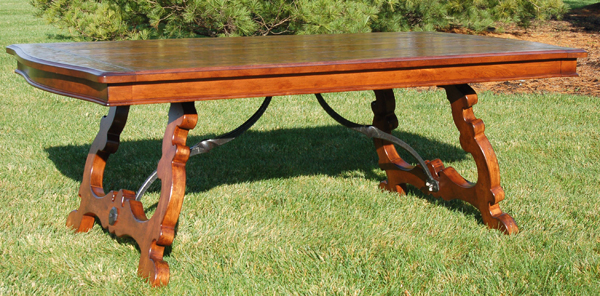
A sample of the kind of furniture offered at benefit auctions in Ohio's Amish country.
By Bruce Stambaugh
Benefit auctions abound in Ohio’s Amish country. Every year thousands of people from near and far attend these worthwhile functions.
Dave Kaufman of Kaufman Realty, Sugarcreek, serves as auctioneer at many of the benefit auctions. He’s not surprised at the popularity of the events at all. He said the formula for their success is pretty simple.
“It’s a very giving, caring community,” Kaufman said. “If it’s a good cause, the auction will get good support.”
Kaufman estimated that there are at least 35 such benefit auctions in Amish country. Some are small, local auctions, like the ones for private Amish schools. Others draw big crowds and usually raise major money for their causes.
“If there is a need,” Kaufman said, “people come to the rescue.”
One of the largest benefit auctions is the Rainbow of Hope Auction in Mt. Hope. Henry Hershberger is its president and founder. This year’s sale is July 23 and 24 at the Mt. Hope Auction barn.
The sale has been a local mainstay since 1987 when Hershberger’s young daughter was hospitalized for two months. Hershberger is Amish and along with other members contributes to the church’s medical fund. But in this case, the fund was depleted before the bills were paid.
Hershberger turned to the community for help, which responded by raising the $20,000 balance of his medical bills. Touched by the generosity, Hershberger started the auction as a way to help others who might be in a similar situation.
“Our best auction was in 2008 when we totaled $403,735,” Hershberger said. He rattled off that figure from memory.
“We try to focus on the community to make it work,” Hershberger said. “It’s something the entire community can participate in.”
Like most other benefit auctions, Rainbow of Hope Auction depends on volunteer labor and donations of items for a successful sale. With furniture the biggest moneymaker, Hershberger said that the work of the furniture committee is key.
“We have about 25 people who canvas the community, hitting every furniture manufacturer and retail store for donations,” he said. “All the items are new.”
Quilts like this one are often found at the benefit auctions held each summer in Ohio's Amish country.
Hershberger said they also auction quilts, gift certificates and other home and garden items. Hershberger stressed that the Rainbow of Hope fund is not just for Amish.
“Any resident in Coshocton, Holmes, Tuscarawas and Wayne counties can apply to the committee for financial help,” he said. “We may not be able to pay all of their bills, but we can help in some way.”
Hershberger said the Rainbow of Hope fund has never run out of money either. He said the committee uses two percent for overhead.
“The other 98 percent is used for those who need it,” Hershberger said. He has served as chair of the auction for 20 years.
Another popular benefit auction is the Ohio Mennonite Relief Sale, which will be held August 6 and 7 this year in Kidron. Last year, the sale raised $338,653 for Mennonite Central Committee (MCC).
MCC is the relief, service and development agency of North American Mennonite and Brethren in Christ churches. Several such sales are held throughout North America annually. The Ohio Mennonite Relief Sale is typical of those auctions.
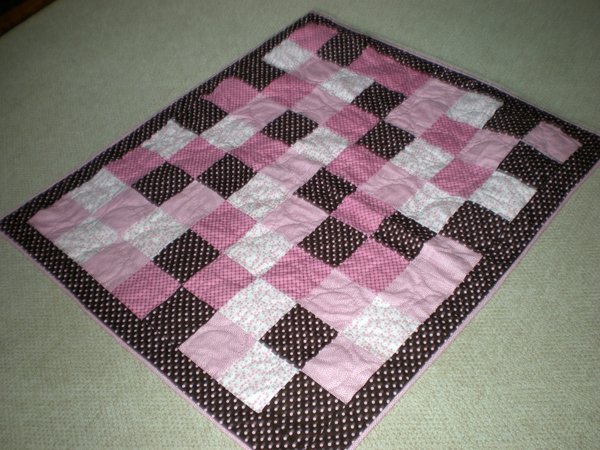
A baby quilt typical of the kind auctioned off. My wife, Neva, made this one for our granddaughter.
Once again, the Ohio Mennonite Relief Sale will feature a varied schedule of events. Everything from food to children’s activities to the auction items themselves will be included. Even a USA Track and Field certified Run for Relief will be held to help raise money for MCC projects worldwide.
Another big benefit auction in the area is the Ohio Haiti Sale, also held at the Mt. Hope Auction in Mt. Hope. This year’s sale, which will have special meaning given the catastrophic January earthquake in Haiti, will be held on Labor Day weekend, September 3 and 4.
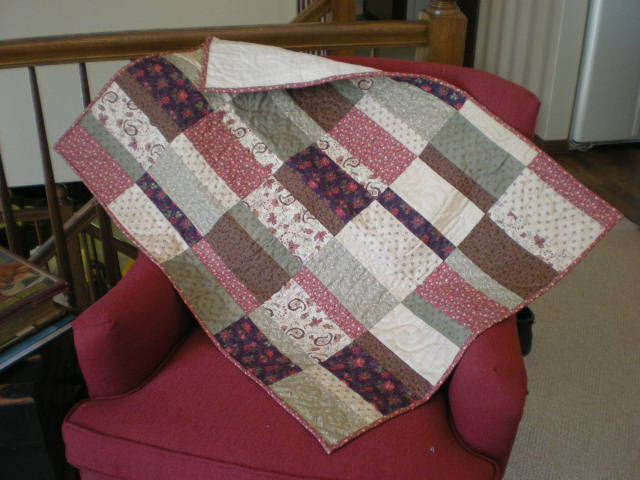
This is another example of the kinds of quilts available at charity benefit auctions.
This sale is also one of several held around the country for the benefit of those in need in Haiti. The Ohio Haiti sale was also begun in 1987. It, too, takes a coordinated effort of many volunteers and donated items to raise funds.
Food, fun and fellowship enhance the actual auctioning of items at the Haiti sale, just like all the other benefit auctions that predominate the summer months annually in Ohio’s Amish country.
This article first appeared in the June 2010 edition of Ohio’s Amish Country.
For me, that is not a contradiction. There is a gulf between waiting and impatience. Delays in life, often inconvenient, are inevitable. New York City cabbies, with their persistent honking, are not my model for waiting.
When my son had surgery last week, waiting became part of the routine, more than either my wife, his wife or I cared to tolerate. His surgery was scheduled for evening one day, then postponed until early afternoon the next and yet delayed again. It was frustrating. But when you are at the wrong end of the scalpel, what choice do you have?
That state pertains to concerned family, too. When you are assigned to a room appropriately labeled “Waiting 1,” that’s what you do. Time seems to stand still. You feel stuck in an institutional time warp.
The hospital tried to accommodate relatives in 21st Century style. Each family was given a four-digit tracking number for confidentiality purposes. In turn, that number was displayed on a blue and white lined electronic board in proximity of each family waiting area. It was like checking the status of a flight at an international airport.
I grew a little anxious when my son’s number didn’t even appear long after he had been taken to the operating room. Finally when it did, the message simply indicated the original time of his surgery, information that we knew was inaccurate.
The sign continued to display numbers of other patients who were at various stages of their surgeries. Impersonal but efficient “Patient in OR,” “Patient out of OR,” and “Surgery start time” scrolled by in herky-jerky fashion.
About the time his surgery should have ended, the waiting room phone rang. It had rung earlier for other families, indicating that their family member was either going into surgery or was in recovery.
Our lovely daughter-in-law took the call. Wives always trump fathers. That’s life’s pecking order as defined in Robert’s Rules of Order or Hints from Heloise or Emily Post.
“He’s just now going into surgery,” our daughter-in-law said puzzled.
We waited some more. My wife called us for an update on how the surgery had gone. I had to tell her that the surgery had just begun. She arrived in Waiting 1 a half-hour later, and joined the Team Waiting.
We surfed the web via the free Internet service. We chatted quietly and took a few phone calls. And we waited and waited.
It was supposed to be a simple, in-and-out type surgery. In our hearts, we knew no surgery was indeed “simple.” Silent prayers were offered, and yet we waited far longer than we ever imagined.
Finally, nearly four hours after his original surgery start time, the sign said, “Patient out of surgery.” But we waited for human confirmation.
Shortly before 4:30 p.m., the surgeon informed us that Nathan’s gall bladder was so badly inflamed that an incision had to be made instead of the planned laparoscopy. Nathan was fine, but he would be in the hospital three to four more days.
Our wait was over. Only now another had begun, a wait that hopefully, would be more tolerable. We all were anxious to see Nathan, to hold his hand and hear him complain. For that happy reunion, we had to wait another long 30 minutes. But I would have waited a lifetime.
Glenn Wengerd showed off one of the many cars he has restored.
By Bruce Stambaugh
Glenn Wengerd, 61, is about as unassuming as a person can be. Dapper, sophisticated, egotistical are words that would never describe him.
That is just fine with the Winesburg native. Wengerd is as down home, easy going and likeable of an individual as you will ever meet. Of course, Wengerd would be too humble to say such things about himself. But that is typical Glenn Wengerd, too.
Wengerd is a life-long resident of Winesburg, a quaint unincorporated town tucked in the northeast corner of Holmes County. Although Winesburg has had its characters over the years and at one time had seven bars, it is no comparison to Sherwood Anderson’s famous novel “Winesburg, Ohio.”
Having spent his entire life in the picturesque village, which now has no saloons, Wengerd has known many of those characters over the years. He calls them “old-timers.”
Wengerd remembers riding his tricycle up and down the sidewalks of Winesburg as a toddler, and being teased by some of the town fathers.
“The old-timers would stop me by putting the hook of their canes into my bike’s spokes,” he recalled with a chuckle. Later the “old-timers” would visit him in his restoration shop just to sit and chat while he worked.
But Wengerd doesn’t linger or even live in the past. He helps preserve it. As a
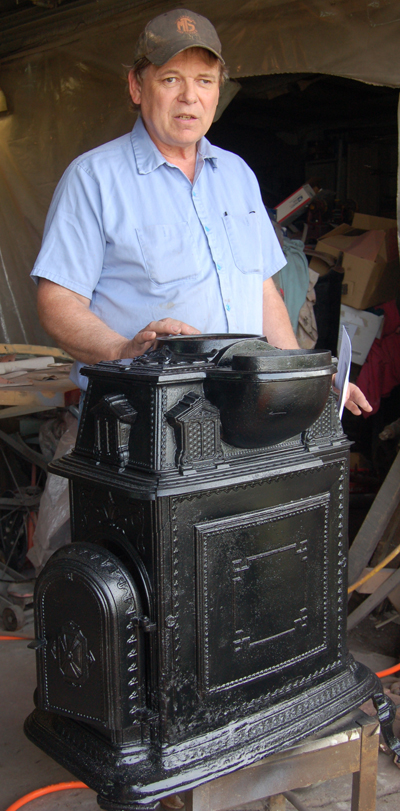
Glenn Wengerd displayed his latest restoration project, a stove for a local museum.
profession, he restores antique cars and other assorted old items. Putting the finishing touches on an old potbellied stove for the German Culture Museum in Walnut Creek was his latest sidebar.
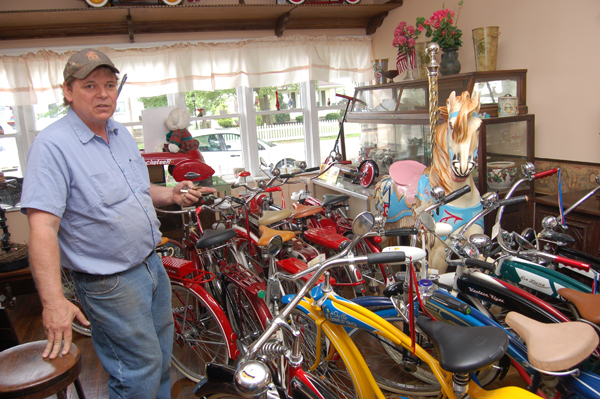
He restores antique toys and bicycles as a hobby. Wengerd even dedicated a rather large room in his 1897 residence on Main Street to house all his entertaining restorations. He holds open houses occasionally, including this coming September during the Winesburg Reunion, which happens every five years.
It is here where Wengerd really shines. He devotes untold hours helping the little town preserve itself for current and future generations to enjoy and appreciate. He has served as either President or Vice President of the Winesburg Historical Society for 25 years.
“The funny thing about that,” Wengerd said, “was that I agreed to join if I wasn’t an officer.” The group waited until the second year to name him their leader.
Prior to his deep involvement with the historical society, Wengerd served as president of the park board during the early development of the town’s recreational park. Today he gets a quiet contentment out of seeing people enjoy the shade of the trees he helped plant.
Wengerd’s roots go deep into the history of Winesburg. He owns the property his grandfather bought in 1949. His restoration shop was the chicken barn and carriage house.
Glenn Wengerd stood by the plaque at his front door that showed all the owners of his 1897 home in Winesburg, Ohio.
As a child, Wengerd marked up the walls of his grandparents’ home with his tricycle tires. Now he lives in that same beautiful home, and according to Wengerd, he regrets being so reckless with his trike.
“We are trying to spruce up the house in preparation for the reunion,” he said, “and those marks are very hard to remove after all these years.”
The home’s exterior is also getting a fresh coat of paint, using the original color scheme as much as possible. To do that, he hired Nelson Roller, a local handyman who moved to Winesburg from West Virginia because he told his wife that “it felt like home.”
When Roller discovered his last name on the plaque that lists the past owners of Wengerd’s house, he inquired within. He went to the right person. The Rollers were among Winesburg’s first settlers. Nelson is likely a descendent.
Wengerd’s restoration efforts, however, go far beyond his own business and home. He has lead the effort through the Winesburg Historical Society to restore and relocate an old log cabin, Peter’s School and replicate the town’s original bandstand. All are set in a small park across from the town’s fire station.
Glenn Wengerd restores toys and bicycles, which he has on display in his home.
Restoring the 1861 German Methodist Church building is the next project on the horizon. Wengerd said the historical society would like to see this undertaking completed in conjunction with the 150th anniversary of the U.S. Civil War in 2011.
Dedicated as he is, Wengerd certainly doesn’t see his time, hard work or the interruptions as a bother. Just the contrary is true.
“It is a privilege to know, cultivate and hand down some of the local history,” he said. “Just recently people from Oregon and Maryland tracked me down about finding their roots here.”
Of course, Wengerd entertained their questions and invited them back for the reunion. That’s just the way Wengerd is, and Winesburg reaps the benefits.
This story first appeared in the Holmes Bargain Hunter on June 21, 2010.
I remember the catalpa tree that grew across the street from my childhood home. I had no idea that such a tree had a brief but pinnacle part in the history of our family until my late father related an unforgettable story to me about this time last year.
We were on our way to one of Dad’s numerous doctors’ appointments regarding treatment for his aggressive cancer. I drove. Dad rode shotgun, while his walker took the backseat.
During each trip to and from the doctors, Dad would tell me many stories about his past, the family, or complain about his Cleveland Indians, the team he loved to hate.
If Dad weren’t feeling particularly well, he would ride along silently, head turned gazing out the passenger window. He might speak up if something caught his fancy, like a field he thought would be good for hunting arrowheads.
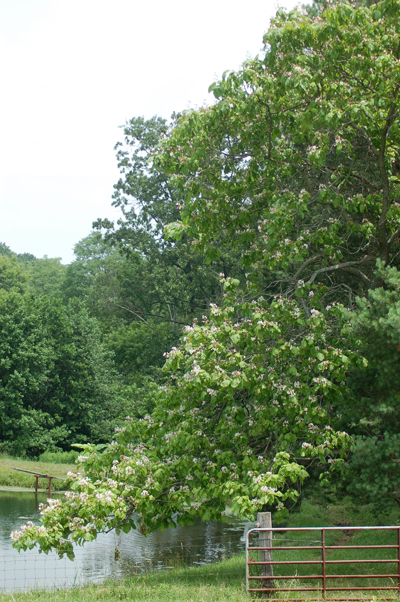
On this particular trip, Dad was quiet until he spied a catalpa tree.
The fading blossoms of a catalpa tree overhanging a pond.
“See that tree?” he queried. I answered in the affirmative. “That’s a catalpa tree like the one by our house.”
I assured him that I remembered the tree. We called it the cigar tree because of the elongated, greenish-brown seedpods that it produced.
The tree’s broad canopy loaded with big, lobed leaves provided plenty of shade. We lamented, however, that it grew so close to the road. Its blossoms were large, white and fragrant.
“I remember the Sunday your Grandpa and Grandma Frith visited us,” Dad continued. By “us” he meant Mom, my older brother and himself. I was six months along in my mother’s womb. It was June 1947.
While sitting on the porch of my parent’s first home that Sunday afternoon, my grandfather saw a tree in full bloom that he didn’t recognize. Grandpa asked what kind of tree that was, and Dad told him it was a catalpa tree.
“I’ll never forget that day,” Dad said, “because after visiting with us, he and Grandma also visited with Aunt Gerry and Aunt Vivian.” They were my mother’s sisters, who also each had a child.
Dad’s voice softened as the thoughts played out in his mind.
“Normally Grandma and Grandpa Frith only visited one daughter per Sunday,” he said. “But for some reason this Sunday they went to all three families.”
“I was always so glad they had done that,” Dad revealed with rare emotion, “because the next day was when Grandpa Frith was killed.” My grandfather was an electrician and had been accidentally electrocuted on a worksite.
I knew the electrocution story by heart. But I never knew of the fateful Sunday afternoon visits.
The other day I happened to see a catalpa tree in full bloom. It was tall with an impressive crown and full of showy white blossoms, just like I remembered from my childhood. I smiled, and fondly if not sadly thought of both my grandfather and my father.
Dad had taught my brothers and sisters and I a lot about life. Foremost in his teaching was the importance of family.
Now, whenever I see the catalpa’s showy white blossoms, I will be forever reminded of that poignant lesson, and eternally thankful that Dad had related that personally valuable slice of family history.
Jr. Schlabach sprays his secret barbeque sauce onto the chicken as it cooks.
By Bruce Stambaugh
Henry Schlabach, Jr. knows a thing or two about barbequing chicken. He should. He’s been at it for 45 years.
The 72-year-old Schlabach, who lives between Berlin and Millersburg, seems to get as much satisfaction from helping his customers as he does making the chicken. Schlabach’s reputation for preparing excellent barbequed chicken has spread far and wide over those many years with some customers coming from 60 miles or more. He mainly grills chicken for families, organizations and wedding receptions.
Schlabach said he normally barbeques an average of 10,000 chicken halves a year. He has relied solely on word-of-mouth advertising.
“In all those years,” Schlabach said matter-of-factly, “I haven’t spent one penny on advertising.”
For Schlabach, the season for barbequing chicken runs from April through November. Not surprisingly, he is particularly hectic around holidays.
On the Saturday of Memorial Day weekend, for example, he was busy barbequing 740 chicken halves and 300 chicken quarters. Schlabach said he usually barbeques the chicken in batches of 500 halves at a time, 25 halves to a rack.
“That takes us four to five hours to do that many,” Schlabach said.
Of course, Schlabach doesn’t take on all this alone. His sons, Tim and Mark, help out. They started helping him by making the sauce when they each were around 10-years old. Today, they are grown men with families themselves. Now the grandsons have joined the crew.
“I couldn’t do it without their help,” Schlabach said. If an organization orders chicken, representatives from that group also assist in the hot and sweaty production.
Grandson Charlie Schlabach said he likes to help for three reasons. “I get paid, it’s fun, and we get to eat chicken, too,” he said with a smile to match that of his grandpa.
The Memorial Day effort was a combination fundraiser for the Walnut Creek little league team and making chicken for high school graduation parties. The crew gathered at 5:30 a.m. to begin so they could be completed by mid-morning.
Schlabach started his chicken barbequing with a portable pit on a trailer.
“We could only do 150 halves at time with that,” he said. Schlabach has progressed to two roof-covered barbeque pits built behind a garage near his residence.
Schlabach began his barbequing career for the Shreve Businessmen’s Association that sold barbequed chicken at the Wayne County Fair. At that time, Schlabach ran a restaurant in Shreve.
“The guy that was supposed to make the chicken quit doing it,” Schlabach explained. “I don’t know why they called me to do it, but they did.” That first year he made 750 halves. Last year they sold 10,000 halves at that fair.
Schlabach said he uses a combination of vinegar, butter, Worcestershire sauce, salt and water, though he didn’t provide the specifics of the recipe. He still uses the original wire-meshed racks that were locally made to barbeque the chicken.
Schlabach is picky about the charcoal he uses, too. He drives to Brookville, Pennsylvania and buys a season’s worth of Humphrey Charcoal.
He said getting the fire hot, and then turning the racks with the cooking chickens is the key to ensuring good chicken. Of course, spraying the sauce with pressure sprayers is just as important. The most chickens ever done by Schlabach at one time was 2,000, which took about eight hours to complete.
With the demand for barbequed chicken growing, Schlabach has seen a lot of competition come and go over the years. This year, he said, there aren’t so many people making chicken.
“It’s just plain hard work,” he said, wiping sweat from his brow. He thinks the craving for chicken in the area could possibly be due to the high number of benefit sales conducted locally. For the record, the Walnut Creek baseball team sold all their chicken.
That’s what Jr. Schlabach wanted to hear. For him, all the effort he put into the day, even with its early start, was worth it. And as a bonus, he got as much satisfaction from working with his family as he did barbequing his famously delicious chicken.
This article first appeared in the June 14, 2010 Holmes Bargain Hunter.
A trio of local Amish country grilling aficionados shared a few tips on how to ensure your summer grilling efforts are successful. Here’s what they recommend.
1. Plan your menu.
This may sound pretty obvious, but with today’s varying diets and preferences, there’s a lot to pick from. According to our local experts, you can grill your entire meal if you want.
Rueben Erb, owner of Sugar Valley Meats, Sugarcreek, Ohio, Roy Weaver, general manager of Weaver Furniture, Sugarcreek, and Ray Haas, owner of Shreve Custom Meats, Shreve, Ohio, each had excellent suggestions for successful grilling. In fact, Haas posts recipes online.
What you grill, including vegetables, all depends on your personal preferences. But they all agreed that planning is the important first step.
2. Prepare the food.
Another step that gets overlooked is preparing the food. Too many people simply want to light the fire, throw the meat on and take it off when it looks like it’s done. There is a lot to do before ignition.
Weaver is extremely particular about how he prepares his fillet. Just ask Erb.
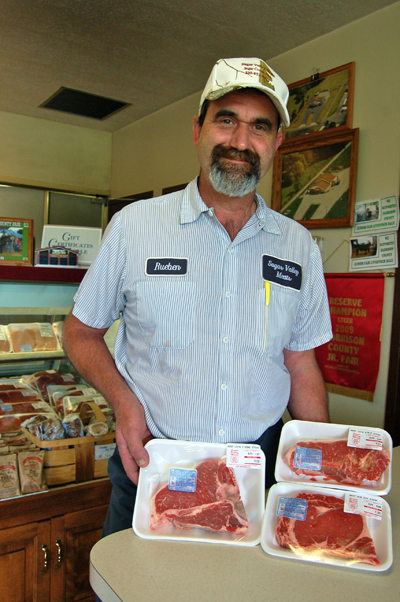
Rueben Erb of Sugar Valley Meats, Sugarcreek, OH, recommends well-marbled meats for grilling.
“I have people ask for ‘Roy’s cut’ all the time,” he said. When they do, Erb knows exactly what they want, a two and a quarter inch thick piece of well-marbled fillet.
Besides how it’s cut, Weaver follows a lockstep method of seasoning the fillet.
“Meat should always be at room temperature before you season it and definitely before you grill it,” Weaver said.
Once it’s ready Weaver adds his own sequence of herbs and seasonings. He continues the seasoning during cooking, along with basting the meat with melted butter. The result is what he refers to as a crusted steak.
Haas’ approach is more basic. He just uses garlic salt to season his sirloin steak, a cut he said is overlooked by many people because it is generally a cheaper cut of meat.
With the advent of gas grills, people turned to rubs and liquid barbeque sauces to add flavor, according to Erb. He said that skinless chicken breast should be marinated prior to grilling, while chicken with skin should have the sauce applied during the cooking.
3. Use the right tools.
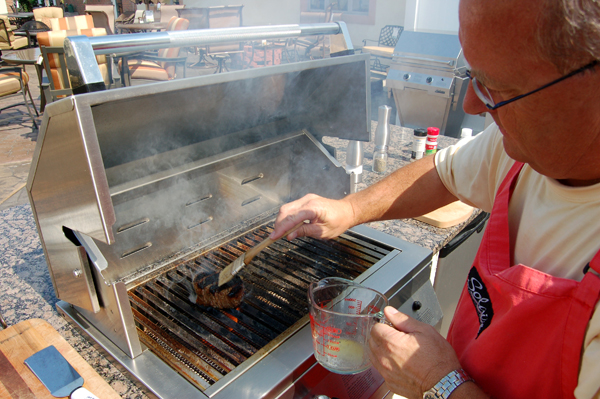
To ensure both excellent results and safe cooking, Weaver said it is important to use the correct tools when grilling. For example, Weaver uses two different wood cutting blocks when he grills, one for preparation, the other to use for the cooked food.
He also uses tongs to turn the meat with ease. A sharp knife, stainless spatula, a brush for basting, a timer and an apron are always at his ready, too.
Erb said using a meat thermometer is essential to know that whatever you are cooking is hot enough at its center.
4. Choose your fire.
In today’s grilling world, there are lots of choices. Our three experts each had their own preferences.
Erb prefers to grill using a wood fire, even though it takes up to two hours to get the fire hot enough to cook. He uses hickory or apple to get that smoky flavor in the food that gas grills can’t provide.
Haas enjoys a mix of charcoal and wood for his grill, also for added flavor.
Weaver uses an infrared grill, which he preheats the grill to 1,800 degrees Fahrenheit before putting on the meat.
5. Properly grill your food.
Regardless of which method you choose, half the fun is in the grilling. All three agreed that time and temperature were critical in ensuring that the other half, eating, was as much fun.
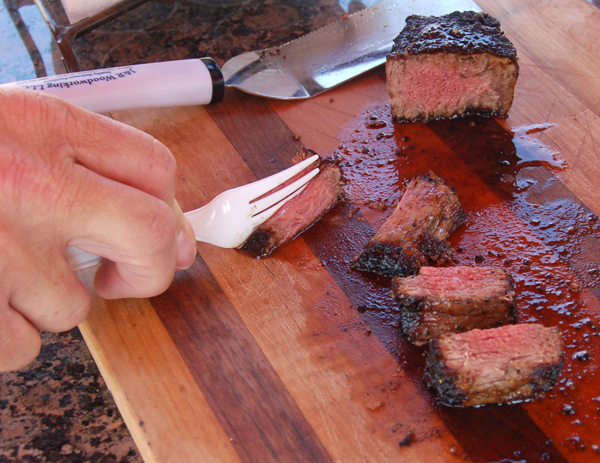
Roy Weaver grilled a 2 1/4 inch thick fillet to medium. The meat was so tender he easily cut it with a plastic fork
The methods vary according to meat selection, the fire you have chosen and your own personal preference on how well you like your meat, chicken or fish cooked.
Haas said he uses cast iron grates on which to grill. “Once the meat releases, I flip it,” he said. “It’s done when the other side releases.”
Each advised grilling vegetables in aluminum foil. Use salt, pepper and olive oil to season the veggies and keep them moist. Weaver said it is important to watch the vegetables so they don’t overcook. For fish, Erb recommended taking the fish off once it begins to flake.
Whatever your taste palette desires, summer is the time to satisfy it by grilling. Following simple but important steps can make your efforts all the more enjoyable.
This article first appeared in the Holmes County Bargain Hunter, June 14, 2010.
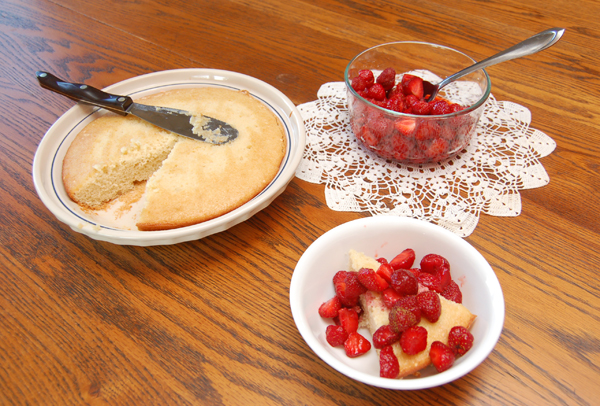
Fresh strawberries ready for the fresh out of the oven shortcake.
Anytime I mention my wife’s good cooking, or in this case baking, I should automatically include the recipe. But you know how men are. However, having enjoyed yet another meal of the sweet, spongy cake, smothered with strawberries and moistened to taste with a little skim milk, I thought it best to post the recipe, with compliments to Neva and appropriate recognition to the late Doris Janzen Longacre, who compiled the More-with-Less Cookbook from whence the recipe originated. – Bruce Stambaugh
Carla’s Hot Milk Sponge Cake
1. Preheat oven to 325 degrees Fahrenheit.
2. Beat two eggs in mixing bowl.
3. Add one cup of sugar and one teaspoon of vanilla and beat until light.
4. Combine separately one cup of flour, one teaspoon of baking powder and 1/4 teaspoon of salt.
5. Fold dry ingredients by hand into egg mixture.
6. Bring to boil in a small saucepan 1/2 cup of milk and one teaspoon of butter/margarine.
7. Add this mixture slowly into the batter, stirring gently.
8. Pour the batter into a well-greased and floured 7″ x 12″ or 9″ x 9″ cake pan.
9. Bake 30-35 minutes.








 Roadkill Crossing
You must be logged in to post a comment.