Notice that Jesus
rode a donkey, not an elephant,
into and out of his earthly life.
Bruce Stambaugh
April 13, 2011
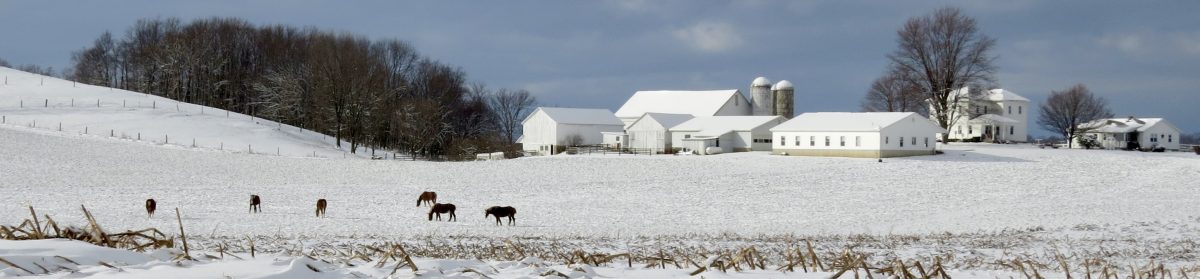
Notice that Jesus
rode a donkey, not an elephant,
into and out of his earthly life.
Bruce Stambaugh
April 13, 2011
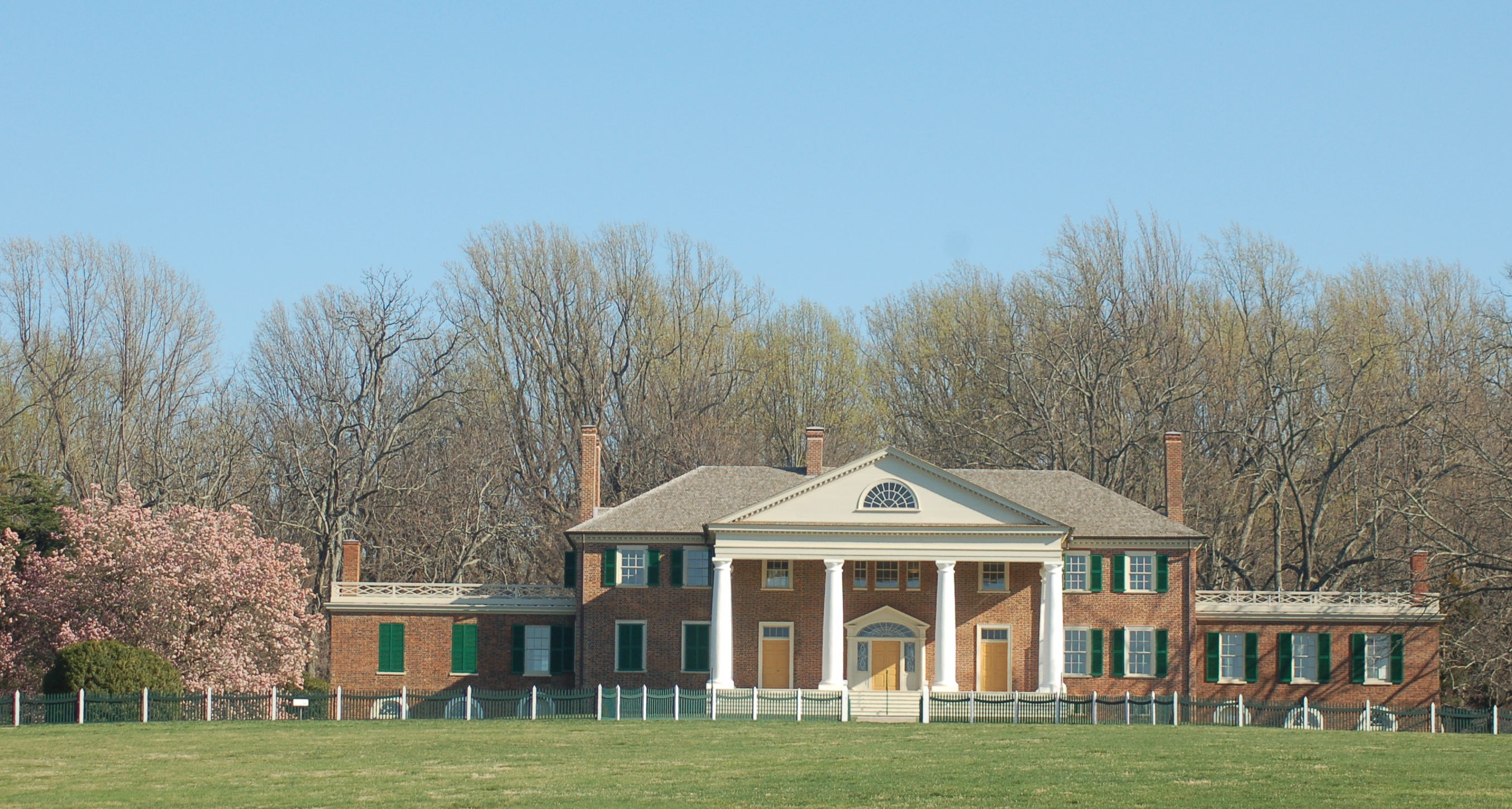
White, pink and yellow floral displays, both wild and domesticated, brightened the cold, steely overcast morning, invigorating our drive along Virginia’s historic Constitution Route.
Pastels predominated in the form of flashy forsythia bushes and clusters of buttery daffodils, showy pink magnolia petals, peach, cherry and redbud blossoms. Serviceberry bushes and flowering ornamentals showed their whites against winter’s dormant and dull remnants.
Familial signs at the gates of long lanes announced the names of many old money mansions of the sprawling plantations that now operate as horse and cattle farms all along the serpentine trail, officially known as Virginia Route 20. Mint Meadow, Gaston Hall, Hershey Hill, and Somerset were only a few of the rolling farms’ monikers.

Miles of fences, some white as the tree blossoms that kept them company, others stained soot black, still others meshed wire, lined the curvy route between Montpelier, James Madison’s home, and Monticello, Thomas Jefferson’s architectural wonder.
Most of the meandering highway on the 40-minute drive closely followed the very route that these two founding fathers and United States presidents had traveled by horseback or carriage more than two centuries earlier.
At one of the lazy s-curves, with a greening meadow on the east side and a dense deciduous woodlot on the other, a Bald Eagle flew across in front of us. Its talons clutched a trailing tangle of leafy vines, likely the softer lining for its bulky stick nest.
Though we were traveling at a much faster pace in a much faster world, I couldn’t help but sense the history that had happened along this path and at the dignified homes we passed. Only now farmhands groomed the horses and fed the cattle instead of slaves.
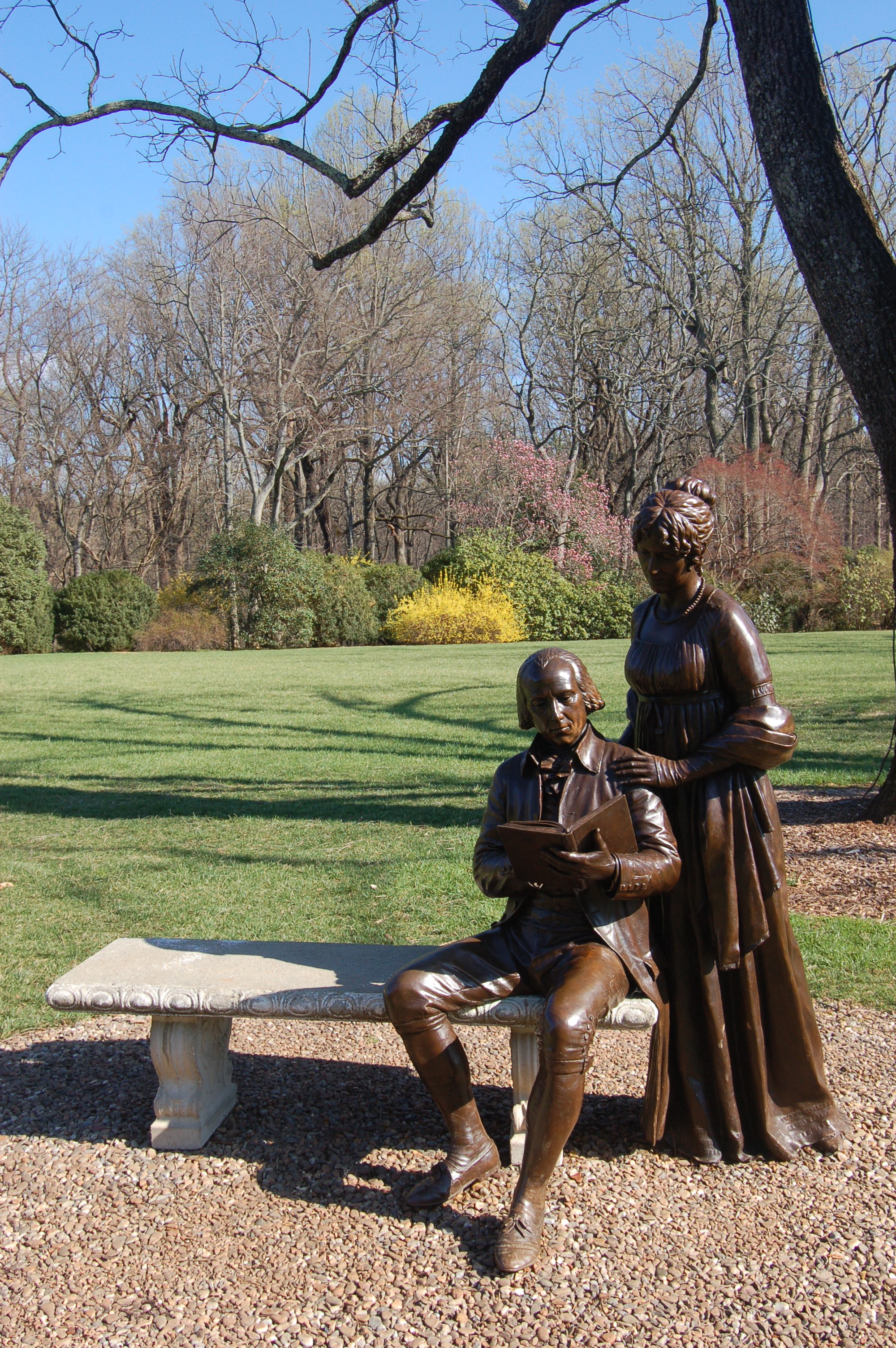
At Montpelier, a spreading magnolia in full-bloom served as the backdrop for a life-sized bronze statue of James and Dolly Madison. Though slight in stature, both were giants in establishing the democratic and social courses for our fledgling republic.
The ingenious Jefferson, author of our Declaration of Independence, and the meticulous Madison, the father of the Constitution, regularly rode the Constitution Route to each other’s homes to both socialize and pontificate.
To walk in their footsteps and see first hand their magnificent homes, slave quarters included, and to learn more about their magnificent minds and accomplishments was beyond inspirational. It was humbling and moving.
Exploring there was a refreshing retreat from the current turbulent and often selfish political times in which we find ourselves. Silently I wondered what these two great men would say about today’s state of affairs. At each location, the informative visitor centers helped answer that pondering.

Jefferson and Madison, both learned visionaries who lived at opposite ends of the Constitution Route, were united in determining the direction the Constitution should take, that all people are created equal and endowed with specific freedoms.
Virginians will quickly point out that both men played prominent rolls in developing the Virginia Statute of Religious Freedom. Their joint influence is revealed in the law: “The religion then of every man must be left to the conviction and conscience of every man.” That concept was the first point Madison made in the Bill of Rights.
The two homesteads were fascinating to tour. The dedicated commitment of Jefferson and Madison to form, frame and cement certain rights, including the choice of religion sans government endorsement or coercion, made the Constitution the jewel in the crown neither president ever wanted to wear.


By Bruce Stambaugh
I’m a planner. So is my wife.
When we arrange a trip, like we did for our 40th anniversary that we recently celebrated, we share completing the travel details. We also recognize that not everything can be foreseen.
We have come to expect the unexpected, especially in our travels. The motel room doesn’t look half as good in person as it did on the website. Highway construction forces us to take an alternate route. A storm cancels our scheduled flight.
Those examples of inconveniences can be amended. Add in the human factor, however, and unanticipated events can throw a real curveball into the most detailed itinerary.
Robert Burns immortalized this phenomenon in his poem, “To a Mouse,” when he wrote, “The best laid plans of mice and men oft go astray.” That’s what happened on our anniversary trip.
Our 11-day Virginia vacation seemed simple enough. The first couple of days we would watch our grandchildren while our daughter was away and her husband had several business meetings. We would then escape a few days for our anniversary, and finish up the trip back at our daughter’s place.
We devised all sorts of ideas to occupy the trio of grandchildren, ages six, four and one and a half. Before we left Ohio, we knew the oldest one was ill. By the time we arrived, the youngest had a double ear infection.
Obviously our activity scheme had to be altered. Baby-sitting now included health care. I did squeeze in some individual playtime with the middle child. But even that was limited due to the raw, dank weather. The south had had a harsh winter, too, and although spring had officially arrived, winter still held its heavy hand on the Virginia landscape.

On our anniversary morning, we awoke to four inches of fluffy white snow and the third grandchild also sick. Things weren’t going the way we had hoped.
With reservations made in the historic Charlottesville area, we reluctantly headed out, but only after the temperature warmed enough to slowly melt the snow. Knowing our son-in-law would be home to help a couple of days lessened any grandparent guilt for leaving.
We enjoyed our time away, visiting just some of the several significant places in the history of our country. The weather cleared for our visits to the architecturally amazing University of Virginia campus, picturesque Montpelier, Thomas Jefferson’s masterpiece, Monticello, and James Monroe’s estate.

Then it was off to quaint, revitalized Staunton for a night before returning to our daughter’s place further up the beautiful Shenandoah Valley. At Staunton, our plans were again derailed. The flu bug caught up to my wife, and when we awoke the next morning snow was again flying. On top of that, I wasn’t feeling the best myself.
Fortunately, the snow didn’t reach the forecasted amount. Unfortunately, our daughter let us know that she was on the way to the doctor with the four-year-old.
By the time we arrived back at our daughter’s, the kids were playing and glad to see us. Our granddaughter kept calling my name, Poppy. Poppy just wished he had felt well enough to answer her call.
Instead, after a bowl of chicken noodle soup, it was off to bed. Like much of our time away, that’s not what I had wanted or planned, an all too personal example of what poet Burns had penned.
By Bruce Stambaugh
From little on up, I have always been an inquisitive person.
One of the neighbor ladies from my suburban rustbelt neighborhood where I grew up must have noticed it. She called me “The Beacon Journal,” in honor of her favorite daily newspaper I presumed.
Seems I was always asking questions. If something happened in the neighborhood, I had to know all the assorted details, whether they were any of my business or not. They usually weren’t.
That inquisitiveness probably had a lot to do with my decision to major in journalism in college. Enjoying writing helped, too.
I still have the same inquiring mind today. The need to know is paramount from my perspective.
No matter what I’m doing, I seem to always be thinking of questions. Oftentimes they are totally unrelated to what I’m doing, which should come as no surprise either.
That mental process happens a lot when I’m on long trips, whether flying or driving. A big rig passes me and I wonder what the trucker is hauling. I see a jet cruise overhead and I wonder what were its points of departure and destination.
I ponder both the ludicrous and the serious stuff of life. In fact, I think about questions so much I started a list. I figured if I shared them with you I just might get some answers.
In no particular order, here are some of the significant questions conjured by my motivated mind.
• Once you pull those folded up canvas chairs out of their covers, does anyone ever put the chairs back in the covers again?
• How is it that you can put four pairs of socks in the laundry and when you retrieve the wash from the dryer you have nine socks and only six match?
• How far back should you stay from a car with the vanity plates H1N1?
• How many chocolate covered raisin clusters equal a serving of fruit?
• Why does it feel colder when it is raining and 36 degrees than it does when it is snowing and 26 degrees?
• Why do referees at high school basketball games wear jackets during the pregame warm-up when the gym is already stifling?
• Why don’t men know how to replace an empty toilet paper holder?
• Why is it that when you are driving with the windshield wipers going and they streak, the streak is always at eye level?
• Why do most people use the top plug in an electrical receptacle first, which blocks the use of the bottom plug?
• Do fish sleep?
• Why is the Big Ten Conference called that when it has 11 schools in its league?
• How can there be such a thing as “live video?”
• Even when they can see the road is inundated, why do drivers daringly head right into flooded roadways, often to be stranded and eventually rescued?
• Why did the Cleveland Indians trade Rocky Colavito for Harvey Kuenn?
• Why do rocks that are naturally imbedded in soil find their way to the surface while rocks that you set in flowerbeds gradually sink?
I suppose I could have Googled for the answers to these pressing questions. But I’d rather hear from you. I look forward to seeing your answers, I think.
My wife and I
stayed in a bed and breakfast
in Waynesboro on Wayne St.,
and the owner’s name was Wayne.
I couldn’t, no I wouldn’t make this up.
Bruce Stambaugh
March 29, 2011

By Bruce Stambaugh
Where do you begin to share about being married to the same person for four decades? After all, my wife and I have been through a lot together during those 40 years.
Perhaps the best place to start is at the beginning. And what a beginning it was.
Crazy as it sounds, nine days after we met we were engaged, although we did wait a month to make it public. We didn’t want people to think we were totally nuts. We were married nine months later. When our two children were old enough to understand, we advised them against using our expeditious courtship as a model to matrimony.
I can remember our wedding day as if it were yesterday. I was so scared that I didn’t even notice that the farm field next to the church had been sprayed with liquid manure that afternoon.
Before the receiving line had formed, I got a taste of what married life really would be like. I accidentally stepped on the train of my wife’s wedding dress, and immediately had her finger in my face. I think that’s when I started to smell the manure.
Our son once asked me what was the secret to the success of our marriage. I simply told him that his mother and I have had no secrets between us. What happens happens. Good or bad, helpful or harmful, “for richer or for poorer,” it’s all out there.
Like most marriages, it hasn’t always been pretty or blissful. No marriage is perfect, including ours. Sure, we air things out, but in so doing try to always maintain our love, respect and admiration for one another. We may have raised our voices to one another from time to time, but never a hand.
We haven’t come this far together on our own either. Family and friends have graciously helped us along the way. Our parents were excellent models of wedded commitment.
From them we learned not only to serve others, but to also enjoy each opportunity that would come along. We try our best to humbly help wherever and whenever we can.
Another plus for us is that Neva and I have a lot in common. We love to travel, enjoy quietness, sunsets, nature, and sharing a meal with guests. Hospitality is one of Neva’s greatest gifts.
Of course, we each do our own things, too. She reads. I write. She quilts. I bird.
That might be another element that cemented our marital longevity. We wisely allow each other our own space and time, without a hint of jealousy or suspicion. If you truly love someone, trust is everything. Break it, and you find yourself back at square one or worse.
For me, the best part of being married for 40 years is just that. We have been married for 40 years. Our marriage has been an investment in one another, our wonderful children and their spouses, our grandchildren, our families, the community, friends, and our church family. We have been blessed by their contributions to us, too.
Where do you end sharing about being married to the same person for 40 years? For that answer, it’s probably best to go back to the beginning, again: “Until death do us part.”

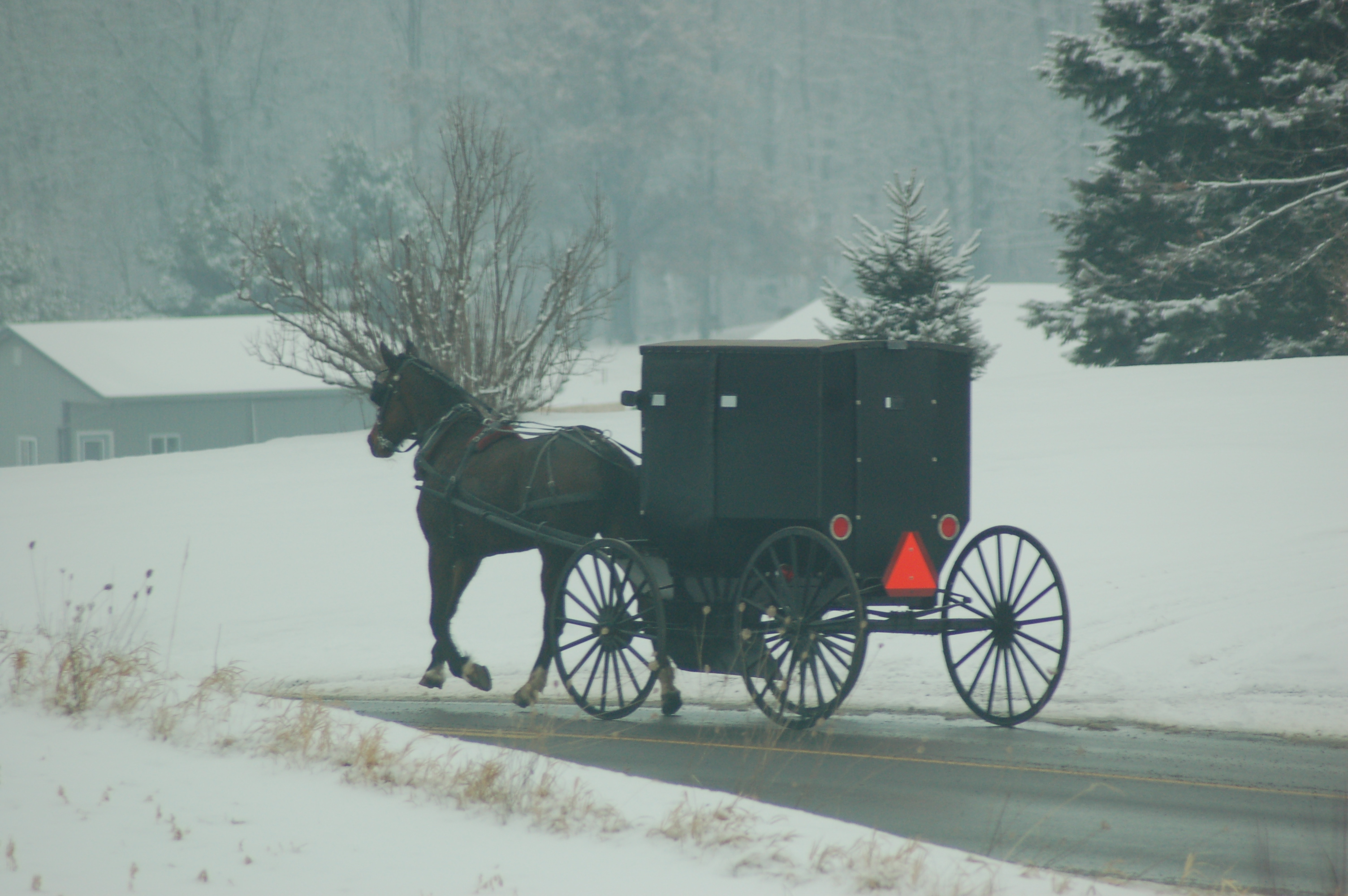
Don’t miss the big, bright
Supermoon tonight at dusk
rising in the east.
Bruce Stambaugh
March 19, 2011
By Bruce Stambaugh
I don’t know about you, but I am more than ready for spring. It’s been a long, long winter.
True, this year residents of Ohio’s Amish Country avoided the huge snowstorms of last winter, and overall we didn’t compile as much snowfall as last year. Instead, ice, as in freezing rain ice, predominated the snows. The nasty combination made the lesser snow amounts just as slippery and difficult to maneuver in as the previous year’s foot-deep accumulations.

Last fall, my wife and I made a major decision that we thought prudent. We had our home’s original windows and spouting replaced. Since the house was built in the mid-70s, both were overdue to be changed.
After all, building materials had greatly improved in the last three decades. Windows were manufactured to be tighter and more energy efficient. Spouting became seamless long ago. It was time we caught up.
With our rural property full of trees, and a dense deciduous thicket not far to the south and west, leaves and pine needles tended to clog our gutters and downspouts year-round. It’s amazing how much debris gets blown around long after the trees have dropped their foliage.
If a storm was forecast during any season, I would trudge to the garden shed, take down the eight-foot wooden ladder, grab the stepladder, and head to the roof to clean the gutters and downspouts. I used the bigger ladder to access the garage roof, and leaned the stepladder next to the stubby brick chimney to climb onto the house roof.
I really didn’t mind this labor-intensive exercise. Heights never bothered me either. I enjoyed my periodic roof excursions. The views were great. I could see the neighbor’s faded white barn a mile to the east. Belgian workhorses and chestnut buggy horses intermingled in the pasture with the Holsteins.
The north afforded the best scenery, a panoramic landscape of hills and valleys miles away. I peered over roof’s edge at the back of the house to spy on the school of goldfish swimming carefree in the little garden pond.
As I aged over the 31 years in this home however, I realized my balance wasn’t what it used to be. With safety in mind, I decided to quit the climbing and go for the new gutters with leaf guards.
The guards installed were u-shaped channels with tiny perforations that would allow the water to enter but nothing else, not even the thin, burnt orange pine needles. I was more than contented with this overdue addition until winter’s initial ice storm.
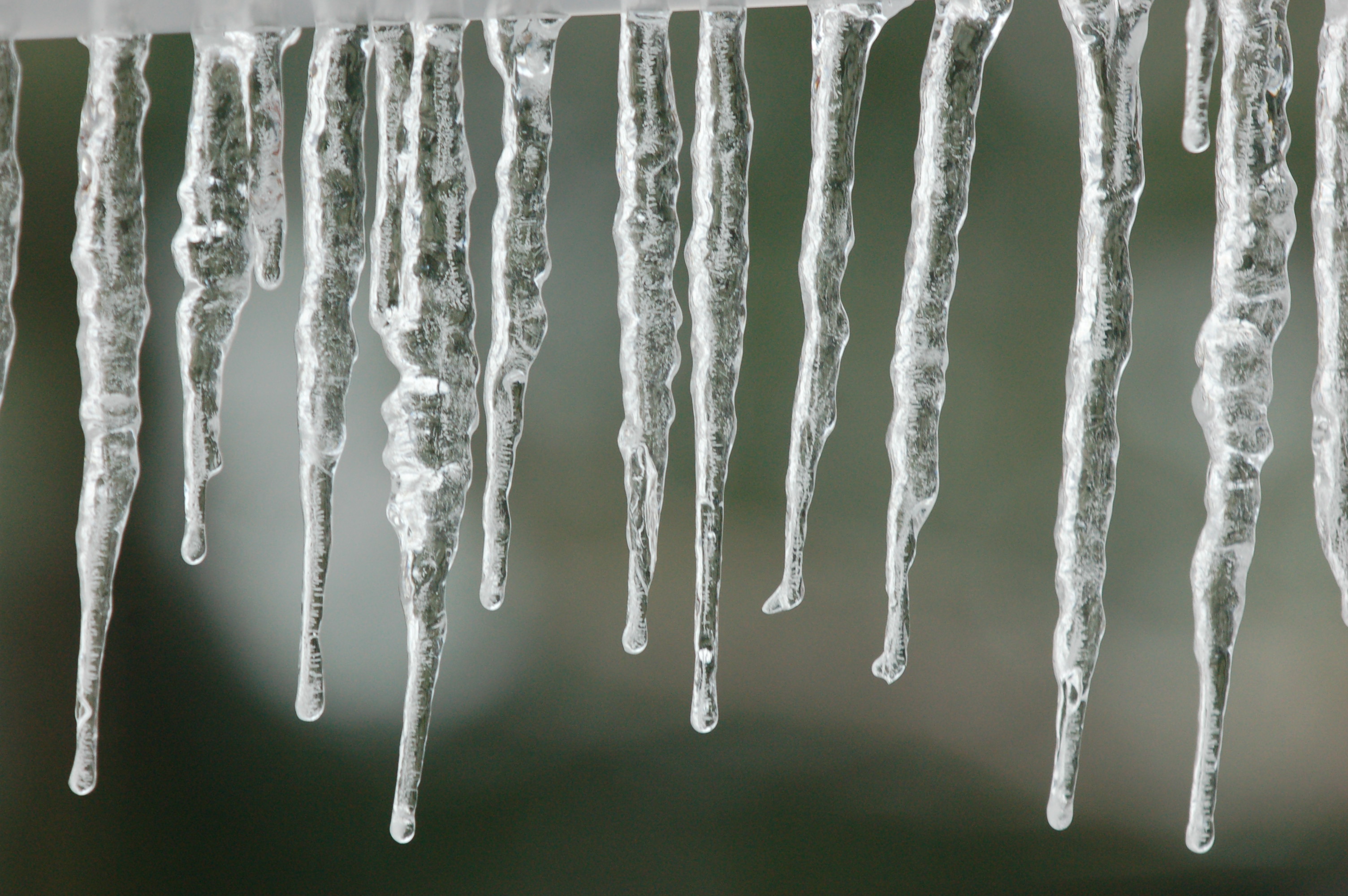
The first glaze of ice sealed the pinholes of the gutter guards. With the freeze and thaw, freeze and thaw cycles of the storms, thick layers of ice easily accumulated on the new gutters. Ice cycles dangled the full length of the gutters on the front and back of the house.
When I realized what was happening, out came the ladders again, and back up on the treacherous roof I went. Given the series of storms with their mixed bag of precipitation that we experienced, I kept handy the rubber mallet and metal scraper needed to break loose the stubborn ice.

If for no other reason than saving my own neck, I for one will be glad when the vernal equinox says goodbye to winter and hello to spring. Just to be safe, I probably won’t put the deicing tools away until June. It is Ohio after all.

Tonight, just above the horizon
in the western sky
less than an hour after sunset,
planets Jupiter and Mercury
are only a piece of pie apart.
Bruce Stambaugh
March 14, 2011

By Bruce Stambaugh
When Gary Miller of rural Millersburg, Ohio got the idea to make his own maple syrup a couple of years ago, he never envisioned where that thought would take him.
“Two years ago,” Miller said, “I was standing in the rain under an umbrella boiling sap in an assortment of old used pans on my grill.”
This year, thanks to the ingenuity and dedication of some close friends and family members, Miller has his very own sugar shack. And when the sap is running, his shack and the surrounding woods are very busy places indeed.
The shack itself was donated to Miller. A friend, Paul Conrad, had an old shed he told Miller he could have, and Miller’s sons moved it in seven different sections for him. Once on site, the building was reassembled, reusing the old lumber.
That process set the tone for what was to come. Much of the equipment used by Miller and his friends has been refurbished as some part and purpose of the maple syrup operation.

Indeed, when the sap is moving, so are a half dozen or so of Miller’s friends who help with the project. They placed 400 taps in sugar, red and black maple trees, according to Miller.
“We are careful about how many taps we place in a tree,” Miller said. “We don’t want to stress them.”
They also helped split the wood that fuels the fire that boils the sap on a homemade evaporator. Of course, the gregarious crew also put that together. Much of that ingenious system consists of recycled metal and other materials.
The wood stove that holds the fire that boils the sap belonged to Scott Sponsler, another friend. The stove was extended with metal from old toolboxes from a pickup truck that Miller owned.
Miller had a fan rebuilt and some ductwork manufactured locally. Together they help distribute the heat generated by the wood stove. The heat evaporates the sap into syrup.
The sap enters the sugar shack from another recycled item, an old bulk tank rescued from an unused milking parlor. It is held up by a repurposed metal stand so the sap flows by gravity into a smaller, reconstructed holding tank inside the old wooden shed.

From there, the sap runs into a customized sheet metal maze that allows the sap to be evaporated as it circulates up and down the four parallel troughs. After entering a second connected metal maze, the sap begins to change color. It is closer to the firebox and the preheated sap really starts to boil. Its darker color indicates that the moisture is being bubbled away.
Miller said that the sap isn’t officially maple syrup until its consistency is at least 66.9 degrees Brix, as measured by a hydrometer. Miller said with his setup, it takes 51 gallons of sap to produce a gallon of syrup.

Miller and his friends make the syrup when the sap is running. He said warmer days and cooler nights are the best conditions to make the sap run.
Before it is pumped into the elevated holding tank, the sap is gathered into 15-gallon containers from each tap bucket. The containers are carried on the back of a small tractor. Of course, the tractor was loaned, too.
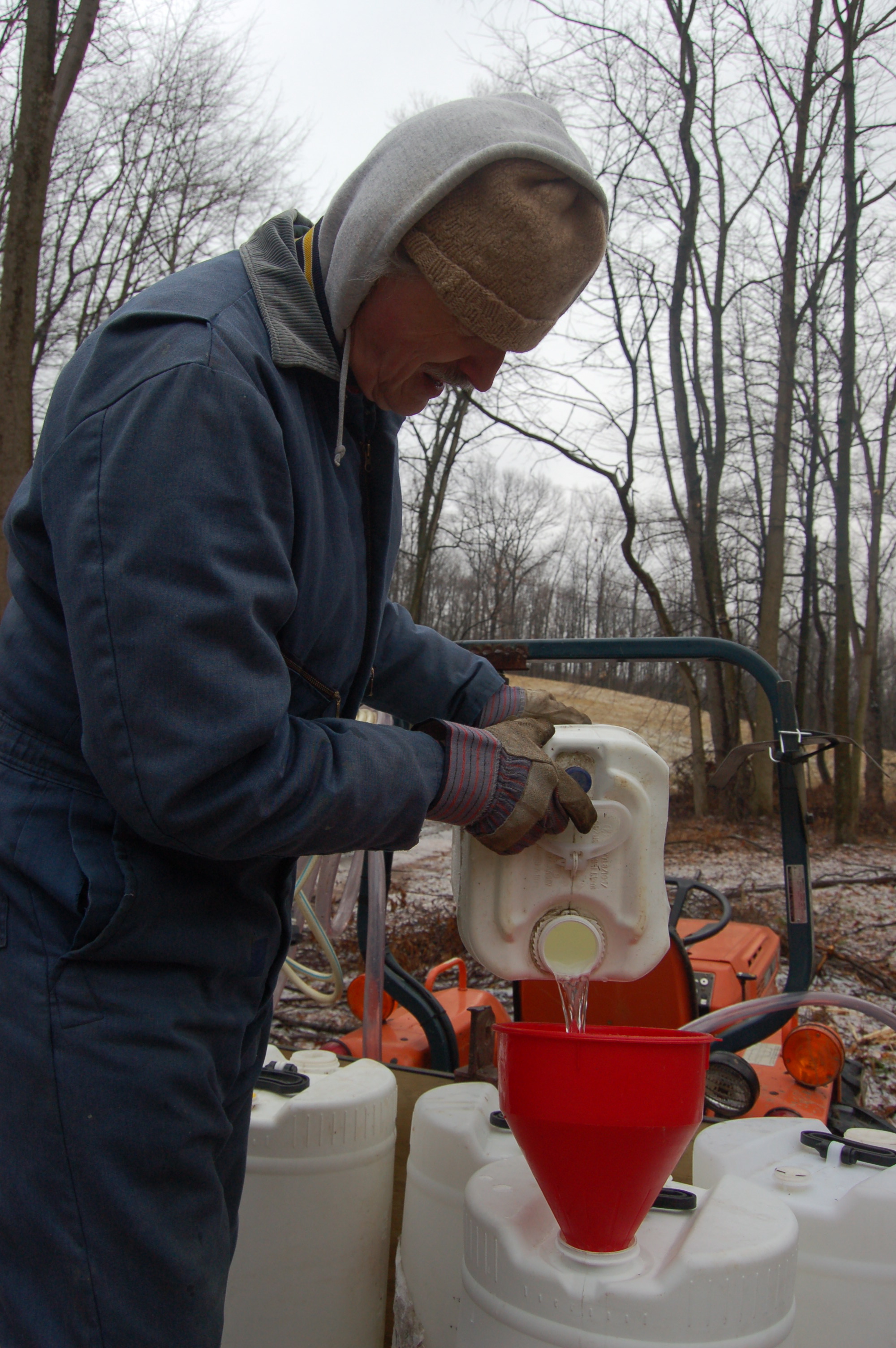
All the free equipment and labor is only appropriate. Miller said the maple syrup that is produced is not for sale, although it does have a name, Smoke Pit Maple Syrup.
“This is not a commercial operation,” Miller emphasized.
Instead customers get to donate whatever they feel the syrup is worth. The money is used for an educational scholarship program in Honduras. Miller’s Sunday school class at Millersburg Mennonite Church is financially sponsoring the schooling of several children there.
With all that said, Miller shared another important ingredient in the maple syrup production as far as he is concerned.
“It’s not about the syrup,” Miller said. “It’s about the fellowship.”
Indeed, laughter and kibitzing among the friends intermingle with the steam from the cooking sap in the cold, small shack. The steam and merriment waft together out into the cold air through the open doorways. The good-natured ribbing helps make the labor-intensive sugaring efforts all the sweeter.
Persons interested in obtaining some of the Smoke Pit Maple Syrup should contact Miller at 330-763-0364.

Wildlife Photos From The Chesapeake Bay Region
Culture and Communities at the Heart Of India
Artist and nature journalist in the Shenandoah Valley of Virginia.
Photographer Of Life and moments
Personal Blog
Art is the only way to run away without leaving home. -Twyla Tharp
Writing generated from the rural life
writer. teacher. podcast cohost.
El amor cruza fronteras / Love crosses borders
 Roadkill Crossing
You must be logged in to post a comment.