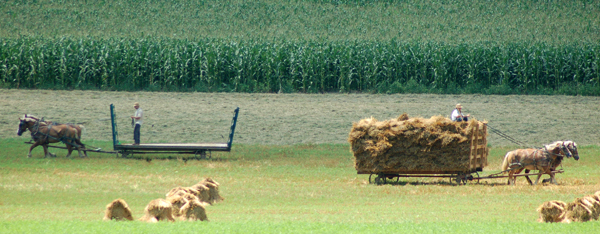
I was on another assignment when I saw this scene recently. I lowered the window of my vehicle and took the photo. It’s the iconic image of Amish gathering hay that most folks envision. The truth is, the way Amish farm has changed drastically in recent years. Most mainline Amish bale hay, either in rectangular bales or big round bales. Only the most conservative of the sect, the Swartzentrubers and those who belong to the Dan Church, continue to use the method pictured to gather hay.
I especially liked that the grandchildren were driving the team of horses while Grandpa properly balanced the huge stack of loose hay.
I have been encouraged by friends and followers of this blog to share more of my photographs. I have decided to post a Photo of the Week, choosing the best photograph taken during the previous week.
I hope you enjoy this series of photos, and I welcome your comments.
The first offering is of an Amish farmer with his Down Syndrome son. The youngster walked the length of the field to catch up to his father and the team of work horses. His father placed a large chunk of a recently cut tree trunk on the harrow for the boy to use as a seat. Half-way across the field, the father handed the reins to his young son to guide the team of horses on his own.
Hazy sunsets in Amish country are the norm in August.
By Bruce Stambaugh
These are what I call August’s golden days. If I only referenced orangey sunrises and the hazy, citrus sunsets, that moniker would apply.
August is so much more than lovely solar appearances and disappearances. It is always full of golden moments that make golden memories.
I realize my reflections are provincial. In a world full of disease, disaster, dismay and hostilities, not all would share my august perspectives. However, I cannot deny what I have observed and experienced in this transitional month in Amish country.
In calling August golden, I mean to take the broadest definition possible. Everywhere you turn, deep, rich yellows and golds appear. August is golden, too, in that it is good, providing success and satisfaction as the harvesting begins.
Mowing and stacking the oats into shocks is the first step in the harvesting process for the Amish.
August is usually a hot month in most of the northern hemisphere. Even the poor people in Moscow, Russia, where temperatures have seemed more like Dallas, Texas, have been especially suffering.
True to form, hot and humid have been the bywords in Ohio, too. Those who have had to work out in these blazing elements would argue for sizzling and sultry as better descriptors. But no matter how we describe the daily dog days of August, the benefits surely outweigh the negatives, no matter how muggy.
One wagon heads to the barn while the other returns to the field to be loaded again.
My Amish neighbor’s circle of friends purposefully gathers the air-dried, ripened oat shocks wagonload after wagonload. Their water thermos got a workout, too. With their cooperative efforts, the impressive stand of honey-colored sheaves had disappeared by day’s end.
I always find it a miracle that once the sea of grain is cut and shocked, a carpet of bright green immediately replaces it. The hardy clover thrives all the more once it has the ground to itself.
There are other kinds of gold in August, too. The Incredible sweet corn arrives almost simultaneously with the transparent apples. It’s husking, cutting, cooking and freezing corn one day, making tartly sweet applesauce the next.
Heirloom tomatoes ripen on the vine.
The growth of the heirloom tomato plants my wife and son planted in late May is so
prolific, the plant runners get tied daily. Their yellow, red and green-striped fruit add to the festivities.
A house wren leaves the nest after feeding her brood.
The noisy tan house wrens worked frantically to satisfy their last brood of the summer. Their hungry youngsters consumed an amazing amount of worms, caterpillars and insects.
When the little ones began to greet their parents at the entrance to their birthplace, it’s nearly time for them to fly. In our case, the babies were there before church, but not when we got home. The grandsons and I found them learning to forage and hide in the brush pile under the pines near the hammock where other golden moments were made.
Monarch and swallowtail butterflies joined the goodness of the month as they enjoyed the nectar of the milkweed and wild and domestic flowers. Both the black and yellow-billed cuckoo birds announced their arrivals as the tent caterpillars hatched.
The much publicized but often under performing Perseid meteor showers still managed to send enough bright streaks though the new moon sky to extend the month’s goldenness 24/7.
Next week the full moon will strut its stuff, casting a golden glow across landscapes, rural and urban alike. Ready or not, summer vacation has yielded to elongated yellow buses and excited, golden voices of children beginning a new school year.
All things considered, August is a positively golden time of year.
Playing on a hammock in the cool shade serves as a diversion from the August heat and humidity.
It’s no accident that Leah Miller’s life has come full circle. Agriculture runs deep in her genes, personal life and in her professional career.
She grew up on a farm, and now her life is all about farming, both at home and on the job, whichever particular job it is she happens to be doing. In between, her career took a productive, if not circuitous route before Miller, 61, planted her agricultural roots.
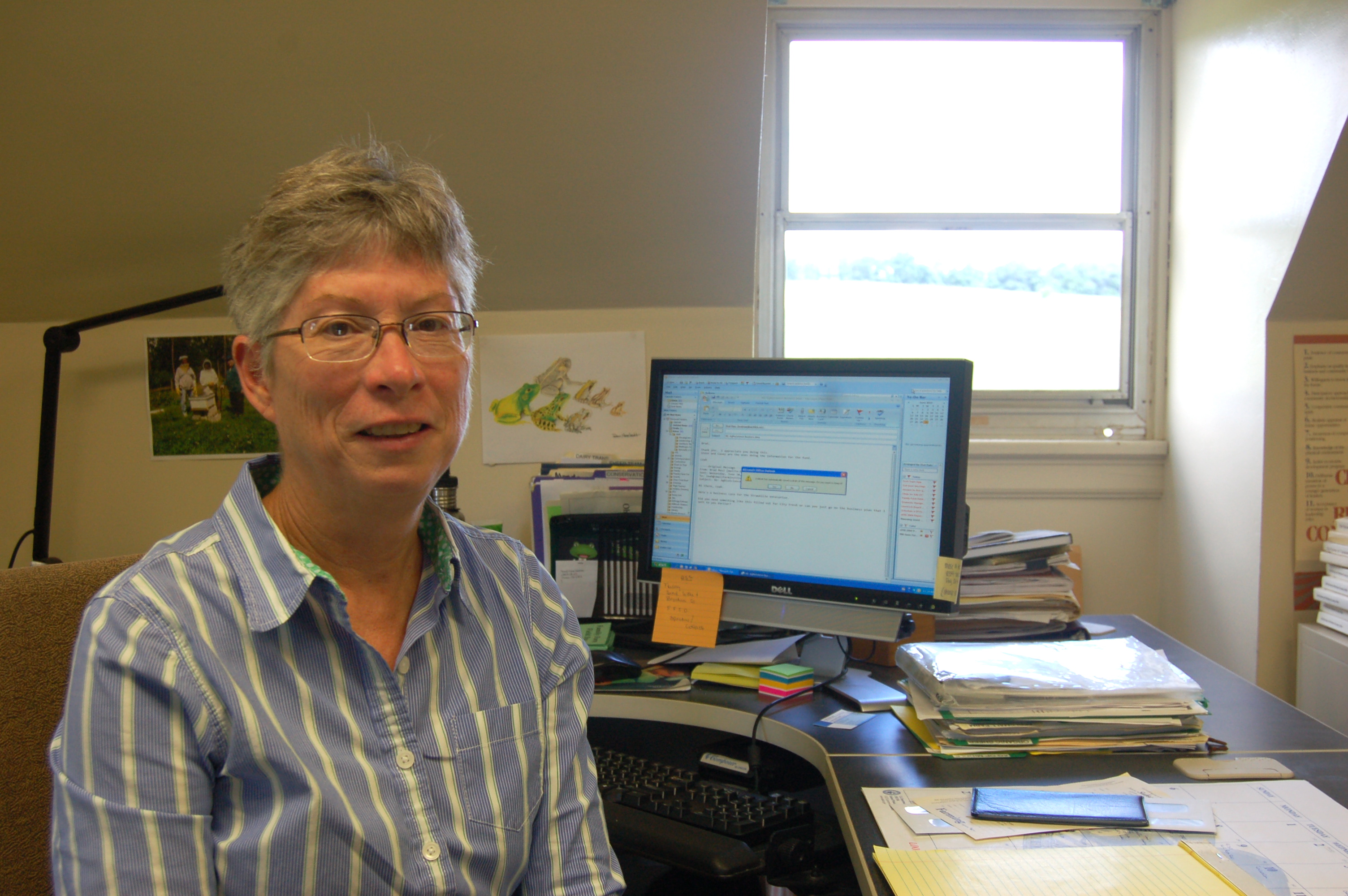
In a rare moment, Leah Miller was in her Small Farm Institute Office in Coshocton County, Ohio.
Born in Conneaut, Ohio near her parent’s home farm at Pierpont, Miller followed some pretty big family footprints. Her father and her father’s father were both agricultural teachers, in addition to running separate farms in Ashtabula County.
Miller’s mother, Celia Wright, took charge of the family farm when her husband, Eber, moved into regional planning. Ironically, that is exactly the job Miller took in Lake County after graduating from The Ohio State University in 1971. She became Holmes County’s regional planning director two years later.
There is a bit of double-irony in this scenario. The Holmes County regional planning office was in the front of Hotel Millersburg.
“My parents spent the first night of their honeymoon at Hotel Millersburg,” Miller said. “They got a late start from their wedding reception in Columbus and following U.S. 62, Millersburg was as far as they got.”
Miller served in this capacity for six years. Once she and her husband, Mic, started their family, Miller turned her efforts to community service. She served two terms on the West Holmes Local School Board. Later, she served on the board at Central Christian School. She also served a term on the Ohio Mennonite Relief Sale board of directors, and was a 4-H advisor for a dozen years.
Miller was the first director of the Holmes County Chamber of Commerce, once it expanded from beyond Millersburg proper. In the 1990s, Miller’s leadership abilities became political. She was twice elected as a Holmes County commissioner.
All the while she found solace from her demanding schedule on her 50-acre sheep farm, Blue Bird Hill, east of Millersburg. She also kept bees, as did her father.
Her love for land and the people that farmed stirred within her. In 2001, she worked with former state representative Joy Padgett to form the Small Farm Institute.
“There was a concern about erosion and farming,” Miller explained. “The emphasis was to help farmers do more grazing with their animals.” She said the sod would help reduce run-off, and at the same time provide a natural grass diet for cows, cattle and sheep.
Miller is the director of the Small Farm Institute, which is based at the United States Department of Agriculture’s hydrological station in Coshocton County. She assists small farm operations to improve income by providing helpful information on sustainable environmental practices that support strong family and rural communities. Her focus is on production, processing and distribution of product.
“We encourage people to look for value-added production to enhance profitability,” Miller said. “If they run a produce stand, they can increase their income by making jam or canning instead of selling all their fruit and vegetables fresh.”
Much of Miller’s responsibility revolves around facilitating grazing groups. She said this has been especially successful among the Amish, who tend to form their own peer groups in close proximity to help reduce the need for transportation.
“It’s been a joy to watch them expand,” she said. “They hold pasture walks where they share helpful grazing information with one another.”
As satisfying as that is for Miller, she also supports much larger events. Her skill sets also assist the annual North Central Ohio Grazing Conference for Dairy, which brings in hundreds of people, including many from other states.
Miller also advises the planning committee for the upcoming annual Family Farm Field Day. David and Emily Hershberger will host the event on their farm, located on Saltcreek Township Road 613 in Holmes County, on July 17, from 8:30 a.m. to 4 p.m.
As if she weren’t busy enough, Miller works part time as stakeholder coordinator in agricultural economic development for the Ohio Agricultural Research and Development Center in Wooster. She splits her time between there and the Small Farm Institute. Miller is the executive secretary of the Ohio Forage and Grasslands Council, too.
Miller has traveled extensively, including Australia, Mexico, France and Honduras, touring grazing and farm production operations and doing a little mission work, too. She uses these experiences to expand what she shares about improving local farming practices.
It seemed only logical then that Miller’s leadership abilities be put to use in yet another positive way for the community. Miller has successfully lead Leadership Holmes County for employees of area businesses for several years. In that fact, there is no irony.
This article was first published in the Holmes Bargain Hunter, July 5, 2010.
Our neighbors, who own Mast Poured Walls, pour the cement for our parking pad.
By Bruce Stambaugh
I can’t say for sure if the idling engines woke me or if I just happened to notice the noise after a full night’s sleep. No matter. Their steady, pre-dawn purring was merry music to my ears.
Both neighbors across the road own a construction-related business. One pours walls for a living, the other trenches fields and lays pipe.
Their tidy steel buildings sit cattycorner from my home, one to the southeast, and the other to the northeast. On mornings when they work, they often pull out their always-clean vehicles and let them idle before heading out to the job site.
It doesn’t take a financial wizard to guess that their work, like most building related work, has slowed considerably in this extended recession. Though neither has ever complained to me, my neighbors’ patience for work has had to replace actual labor.
This lack of employment has been hard on them, not just financially, but emotionally, too. These men are used to working hard for their daily living. But in this economy, with construction moving at a snail’s pace, regular, substantial work has waned.
Last year was especially uncertain. Too many days their trucks were silent. It may sound funny to say this, but I missed that motorized humming and the occasional sharp clanking of metal against metal as they prepared to head out. I felt their pain.
The expressions on my neighbors’ faces couldn’t hide their concerns. They were frustrated at the lack of work. These are talented men, men who know how to put in a decent day’s work for honest pay.
Unfortunately, it wasn’t just my good neighbors whose jobs had slowed or stopped altogether. It seemed every business took a hit, regardless of occupational focus. In a community where work ethic is king, doing nothing or next to it was absolutely agonizing.
The economic downturn was particularly hard on this community that hosts the world’s largest concentration of Amish and Mennonites. Consequentially, the tourist industry, a major revenue producer for private and governmental institutions alike, tapered off.
It was difficult to see people’s work hours curtailed. A few businesses simply closed for lack of customers. For the first time in a long time, our rural area felt what the rest of the global economy was feeling. And it hurt.
Farmers weren’t immune either. While milk and commodity prices sputtered, operating expenses kept rising. It was a losing proposition.
For these thrifty people with whom I have communed daily for four decades, it wasn’t just about the money. Cash flows were low, and so were their spirits.
These were people who knew how to work, had excellent skills, many self-taught, and labored for a fair wage. They had done so all of their lives, as had their fathers and mothers before them. Work was as much tradition as it was means.
But true to their congenial nature, their heritage and their commitment to faith, family and community, my neighbors in Big Prairie, Nashville, Glenmont, Killbuck, Clark, Farmerstown, Walnut Creek, Winesburg, Mt. Hope, Benton, Holmesville, Millersburg, Berlin and yes, even charming Charm preserved. They skimped along as best they could, and hoped and prayed for the best.
Perhaps we are not completely out of the economic woods yet. But it sure is nice to wake up to the sound of diesel engines running once again. Here’s hoping they keep on purring.





 Roadkill Crossing
You must be logged in to post a comment.