Queen Anne’s Lace bloom pinned
between black bonnet and golden hair,
light blue dress hiked to her knees,
the poised and carefree Amish girl pedaled
down the road, her two-wheeled air conditioning
the only practical escape from the oppressive heat.
It’s no accident that Leah Miller’s life has come full circle. Agriculture runs deep in her genes, personal life and in her professional career.
She grew up on a farm, and now her life is all about farming, both at home and on the job, whichever particular job it is she happens to be doing. In between, her career took a productive, if not circuitous route before Miller, 61, planted her agricultural roots.
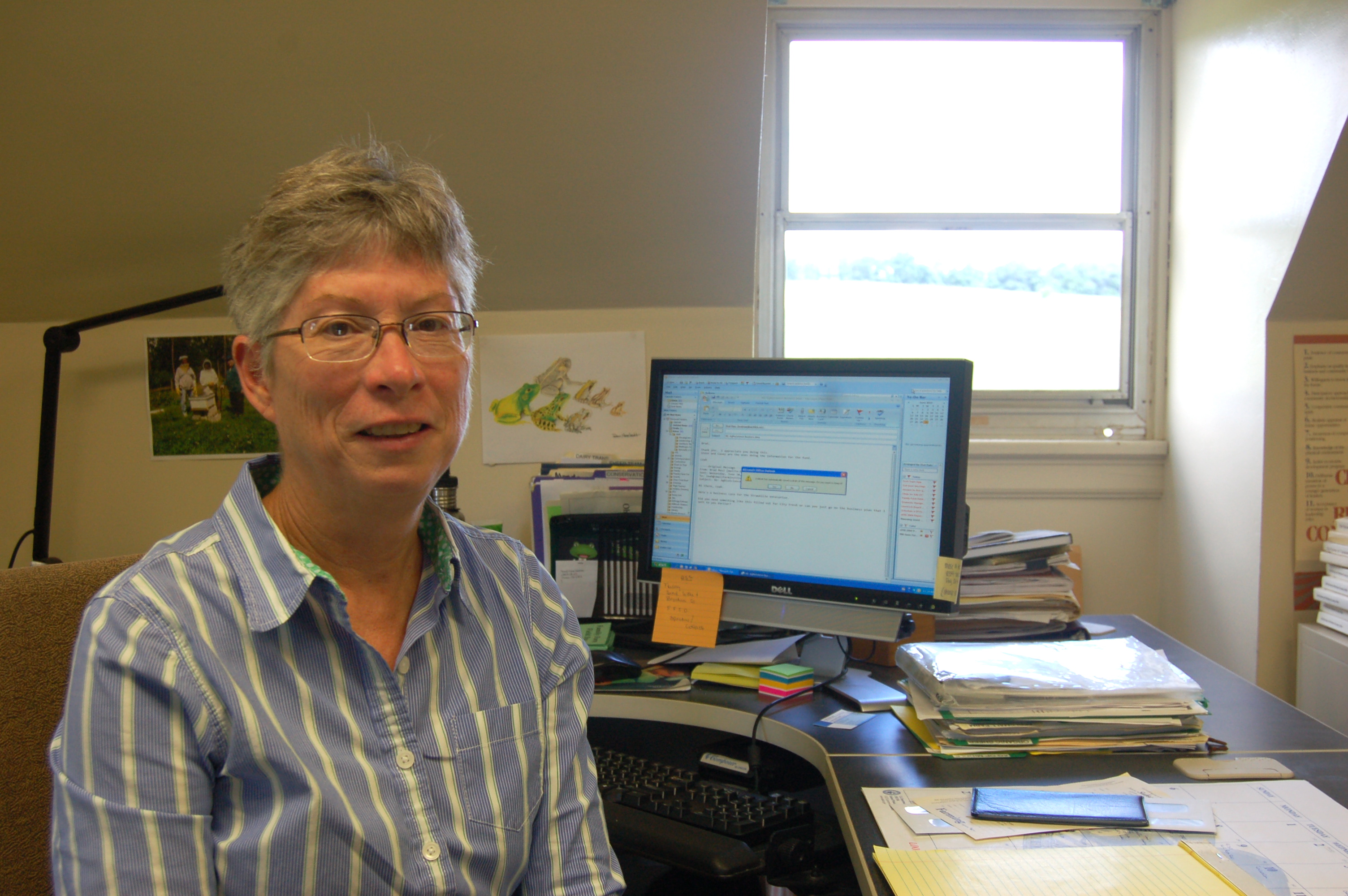
In a rare moment, Leah Miller was in her Small Farm Institute Office in Coshocton County, Ohio.
Born in Conneaut, Ohio near her parent’s home farm at Pierpont, Miller followed some pretty big family footprints. Her father and her father’s father were both agricultural teachers, in addition to running separate farms in Ashtabula County.
Miller’s mother, Celia Wright, took charge of the family farm when her husband, Eber, moved into regional planning. Ironically, that is exactly the job Miller took in Lake County after graduating from The Ohio State University in 1971. She became Holmes County’s regional planning director two years later.
There is a bit of double-irony in this scenario. The Holmes County regional planning office was in the front of Hotel Millersburg.
“My parents spent the first night of their honeymoon at Hotel Millersburg,” Miller said. “They got a late start from their wedding reception in Columbus and following U.S. 62, Millersburg was as far as they got.”
Miller served in this capacity for six years. Once she and her husband, Mic, started their family, Miller turned her efforts to community service. She served two terms on the West Holmes Local School Board. Later, she served on the board at Central Christian School. She also served a term on the Ohio Mennonite Relief Sale board of directors, and was a 4-H advisor for a dozen years.
Miller was the first director of the Holmes County Chamber of Commerce, once it expanded from beyond Millersburg proper. In the 1990s, Miller’s leadership abilities became political. She was twice elected as a Holmes County commissioner.
All the while she found solace from her demanding schedule on her 50-acre sheep farm, Blue Bird Hill, east of Millersburg. She also kept bees, as did her father.
Her love for land and the people that farmed stirred within her. In 2001, she worked with former state representative Joy Padgett to form the Small Farm Institute.
“There was a concern about erosion and farming,” Miller explained. “The emphasis was to help farmers do more grazing with their animals.” She said the sod would help reduce run-off, and at the same time provide a natural grass diet for cows, cattle and sheep.
Miller is the director of the Small Farm Institute, which is based at the United States Department of Agriculture’s hydrological station in Coshocton County. She assists small farm operations to improve income by providing helpful information on sustainable environmental practices that support strong family and rural communities. Her focus is on production, processing and distribution of product.
“We encourage people to look for value-added production to enhance profitability,” Miller said. “If they run a produce stand, they can increase their income by making jam or canning instead of selling all their fruit and vegetables fresh.”
Much of Miller’s responsibility revolves around facilitating grazing groups. She said this has been especially successful among the Amish, who tend to form their own peer groups in close proximity to help reduce the need for transportation.
“It’s been a joy to watch them expand,” she said. “They hold pasture walks where they share helpful grazing information with one another.”
As satisfying as that is for Miller, she also supports much larger events. Her skill sets also assist the annual North Central Ohio Grazing Conference for Dairy, which brings in hundreds of people, including many from other states.
Miller also advises the planning committee for the upcoming annual Family Farm Field Day. David and Emily Hershberger will host the event on their farm, located on Saltcreek Township Road 613 in Holmes County, on July 17, from 8:30 a.m. to 4 p.m.
As if she weren’t busy enough, Miller works part time as stakeholder coordinator in agricultural economic development for the Ohio Agricultural Research and Development Center in Wooster. She splits her time between there and the Small Farm Institute. Miller is the executive secretary of the Ohio Forage and Grasslands Council, too.
Miller has traveled extensively, including Australia, Mexico, France and Honduras, touring grazing and farm production operations and doing a little mission work, too. She uses these experiences to expand what she shares about improving local farming practices.
It seemed only logical then that Miller’s leadership abilities be put to use in yet another positive way for the community. Miller has successfully lead Leadership Holmes County for employees of area businesses for several years. In that fact, there is no irony.
This article was first published in the Holmes Bargain Hunter, July 5, 2010.
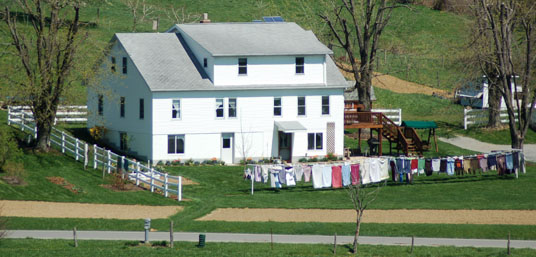
Our neighbors, who own Mast Poured Walls, pour the cement for our parking pad.
By Bruce Stambaugh
I can’t say for sure if the idling engines woke me or if I just happened to notice the noise after a full night’s sleep. No matter. Their steady, pre-dawn purring was merry music to my ears.
Both neighbors across the road own a construction-related business. One pours walls for a living, the other trenches fields and lays pipe.
Their tidy steel buildings sit cattycorner from my home, one to the southeast, and the other to the northeast. On mornings when they work, they often pull out their always-clean vehicles and let them idle before heading out to the job site.
It doesn’t take a financial wizard to guess that their work, like most building related work, has slowed considerably in this extended recession. Though neither has ever complained to me, my neighbors’ patience for work has had to replace actual labor.
This lack of employment has been hard on them, not just financially, but emotionally, too. These men are used to working hard for their daily living. But in this economy, with construction moving at a snail’s pace, regular, substantial work has waned.
Last year was especially uncertain. Too many days their trucks were silent. It may sound funny to say this, but I missed that motorized humming and the occasional sharp clanking of metal against metal as they prepared to head out. I felt their pain.
The expressions on my neighbors’ faces couldn’t hide their concerns. They were frustrated at the lack of work. These are talented men, men who know how to put in a decent day’s work for honest pay.
Unfortunately, it wasn’t just my good neighbors whose jobs had slowed or stopped altogether. It seemed every business took a hit, regardless of occupational focus. In a community where work ethic is king, doing nothing or next to it was absolutely agonizing.
The economic downturn was particularly hard on this community that hosts the world’s largest concentration of Amish and Mennonites. Consequentially, the tourist industry, a major revenue producer for private and governmental institutions alike, tapered off.
It was difficult to see people’s work hours curtailed. A few businesses simply closed for lack of customers. For the first time in a long time, our rural area felt what the rest of the global economy was feeling. And it hurt.
Farmers weren’t immune either. While milk and commodity prices sputtered, operating expenses kept rising. It was a losing proposition.
For these thrifty people with whom I have communed daily for four decades, it wasn’t just about the money. Cash flows were low, and so were their spirits.
These were people who knew how to work, had excellent skills, many self-taught, and labored for a fair wage. They had done so all of their lives, as had their fathers and mothers before them. Work was as much tradition as it was means.
But true to their congenial nature, their heritage and their commitment to faith, family and community, my neighbors in Big Prairie, Nashville, Glenmont, Killbuck, Clark, Farmerstown, Walnut Creek, Winesburg, Mt. Hope, Benton, Holmesville, Millersburg, Berlin and yes, even charming Charm preserved. They skimped along as best they could, and hoped and prayed for the best.
Perhaps we are not completely out of the economic woods yet. But it sure is nice to wake up to the sound of diesel engines running once again. Here’s hoping they keep on purring.
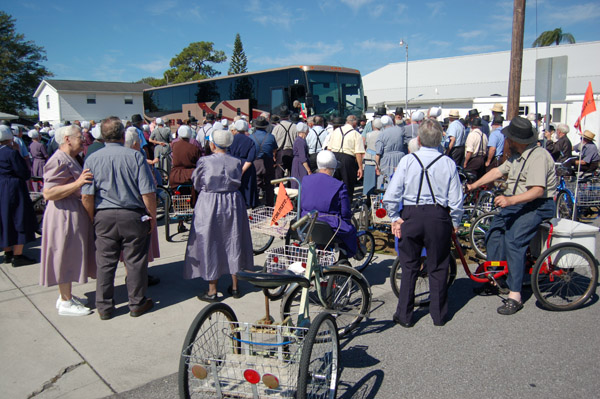
Crowds gather in Sarasota, FL when the bus from up north arrives.
By Bruce Stambaugh
The anticipation was almost tense, the excitement palpable, and the energy contagious.
The crowd gathered early, as if waiting to get into a sporting event. People milled around, talking with their inside voices though they were bathed in bright, Florida sunshine while standing in a church parking lot. But they weren’t going to a worship service.
Welcome to the bus arrivals from Amish country north to temporary Amish country south, also known as Pinecraft, an unincorporated section of Sarasota, Florida. Three times a week in February and March, the snowbirds cram the little parking lot where the buses unload.
By the time the bus pulled in, the attendance had swollen to nearly a 100. The crowd plus the cars, vans, pickups and two-wheeled and three-wheeled bicycles barely left enough room for the bus. In fact, the self-appointed welcoming committee spilled over into the narrow alley, making any passage by motorized vehicle impossible.
The atmosphere was part family reunion, part auction crowd. Some came to meet and greet. Most were there to watch. Men with white beards and denim pants with suspenders and women in pastel dresses and lacy white coverings predominated the scene. A few children in straw hats and long, plain dresses held tight to a parent’s hand. This entertainment was too lame for teenagers. Many of them were already at the beach.
The bus did pull in right on time opposite the tiny, stuccoed Pinecraft post office, and the anticipation grew as the assembled crowd waited for the bus’ door to open. It was as if Elvis himself would bebop his way down the bus’ steps.
Though all the cargo was precious, no one of that fame was expected to be aboard. Rather the murmured questions were simple. Who was on the bus that I know? How long will they stay? And where?
Appropriately enough, the bus had to turn off of Miller Ave. to enter the lot. A number of Millers were among those who waited. An unknown number of Millers were on the bus.
When the bus door did open, the answers appeared as the passengers made their exit one-by-one. With waves and smiles, friends and relatives welcomed the new arrivals to their transient winter home. The passengers returned the favor as they exited carefully down the deep steps.
Some in the crowd were drawn more by curiosity than the need to help carry luggage. They just wanted to see who was on the bus. Would there be people they might know aboard? What news from home would they bring?
In this particular case, “home” is most generally Amish country. Amish and Mennonites flock to this resort home away from home to escape winter’s chilly edge in Indiana, Ohio, Pennsylvania and other states, too.
Many of the Indiana and Ohio snowbirds travel Pioneer Trails buses to the Sunshine state. It’s their most economical, and in many cases, only choice. Their faith does not allow them to fly or drive, so they take the bus.
David Swartzentruber, owner of the Millersburg-based bus business, said Pioneer Trials has been fulfilling the transportation need for these individuals for 26 years. During the two peak months, buses arrive Monday, Wednesday and Friday.
Passengers on Pioneer Trials are primarily from the Amish populations in northern Indiana and in Holmes, Tuscarawas and Wayne counties. Buses pick up passengers and their luggage at various locations around each geographic area. Most often, buses from Indiana and Ohio meet up near Cincinnati, combine their loads and continue south. The northbound bus from Pinecraft and the southbound usually connect near Chattanooga, Tennessee. The drivers switch buses and the trips north and south continue.
Swartzentruber said other bus companies also transport people to Pinecraft, especially from Pennsylvania, where Pioneer Trails does not have a route. He said the other bus companies do not travel as frequently as does Pioneer Trails.
As expected, most passengers were Amish, and most in their retirement years. However, some young families, with two or three young children, and a few teenagers seeking fun in the sun exited the bus.
Some in the crowd, like Christ Miller from Millersburg, were surprised to see their neighbors arrive. They knew they were coming south. They just didn’t know when. In this case, Miller welcomed his neighbors Jr. and Fannie Burkholder.
Like the onlookers, the stays of the new arrivals range from one week to three months or more. No matter how short or long their time in Pinecraft, they will make the most of their stay visiting, eating out and enjoying the normally pleasant weather.
Once the last passenger had luggage in hand and connected with friends and relatives, the crowd thinned quickly. In 15 minutes, the excitement was over at least until the next scheduled bus due in from the north. When it arrives, the gregarious process will begin all over again.


 Roadkill Crossing
You must be logged in to post a comment.