Harvesting more than produce from your garden

Amish garden by Bruce Stambaugh
Large vegetable gardens like this one are everpresent in Ohio's Amish country.

By Bruce Stambaugh

Lakeside rocks and flowers by Bruce Stambaugh
Creative rock sculptures mirror the Hollyhocks in a Lakeside, Ohio garden.

I’ll make my confession right up front. I am not the most authoritative person to write about gardening.

Still, I like to think that I am observant enough to recognize a good garden when I see one. Whether vegetable, rock or flower, all gardens require much manual effort to keep them manicured and productive.

Growing up in the suburbs of a northeast Ohio blue-collar city, our father loved to garden. He saw it as a way to be out in the fresh air and to simultaneously save money by growing our own food. With five children, it was the practical thing to do. For efficiency’s sake, he recruited his offspring to help cultivate, plant, nurture and reap the garden harvest.

Rock garden by Bruce Stambaugh
Rock gardens add esthetics to any property.
Bright lilies by Bruce Stambaugh
These lilies would brighten any yard.

Our lovely mother would prepare in season feasts that included sweet corn, new potatoes, green beans, cucumbers and beets. She also canned and froze food for the cold winter months ahead. If we had had a bumper crop, we would set up shop in a busy business parking lot and sell sweet corn out of the car’s trunk.

Mom also propagated lovely flower gardens around the parameters of our small piece of suburban property. Mom used her artistic eye with the floral color selection to nicely accent the cherry red brick exterior of our post-war bungalow.

Home canned goods by Bruce Stambaugh
Home canning is back in vogue in rural, suburban and urban settings.

Those pleasant memories returned with the current onslaught of the harvest season in gardens all across the country. Television shows, newspaper stories, Internet blogs and even high-end glossy magazines feature how to properly prepare and preserve your garden gleanings.

Having a plot of garden is almost assumed when you live in one of Ohio’s richest agricultural counties. Don’t be fooled though. Contrary to what some might think, gardening is not confined to rural areas. People garden in suburbs and cities, too.

Herb garden by Bruce Stambaugh
Even small backyard plot provides fresh herbs and vegetables.

With the advent of the organic, all natural craze, and the tough economy, gardening appears to have made a universal comeback. Whether you have an acre or simply a few pots of herbs sitting on an apartment balcony, gardening is good.

Caring for tender plants, watering them, protecting them from weather’s extremes and pesky insects is worthwhile work with tasty rewards. I see it as a way to get us back to our roots, reconnected to the soil from which and on which all life depends.

Lakeside community garden by Bruce Stambaugh
A community garden in Lakeside, Ohio.

If we are mindful, we will recognize that gardening provides a solid base that can lead to other returns as well. Cooperative gardens, sponsored by both church and civic organizations, have sprung up across the country. Besides those who garden, the abundant produce often helps the less fortunate, the homeless and the needy.

An acquaintance told me how his parents would load up their battered family pickup with the excess of their giant two-acre garden, head into town and end up on the wrong side of the tracks. There they would park the truck and hand out the fresh, healthy produce to whomever needed it.

They repeated the routine throughout the growing season. The thankful recipients were so moved by the family’s generosity that they offered to help plant and maintain the garden the next growing season. Their grateful offer was accepted, and new trust and friendships were born.

Flower garden by Bruce Stambaugh
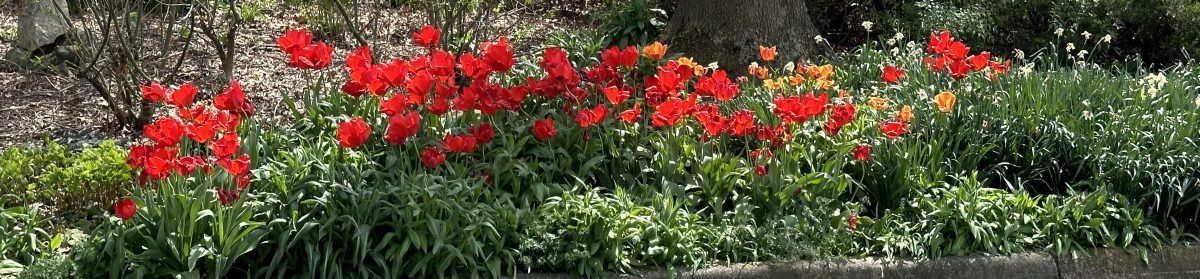
If properly planned and planted, flower gardens can brighten a property throughout the growing season.

Gardens connect us to the soil that yields our sustenance. If we are proactive, they also open our lives to much more than delicious food. Gardening doesn’t get any more satisfying and splendid than gathering two crops from one planting.

Lakeside flower garden by Bruce Stambaugh
An award-winning flower garden at Lakeside, Ohio.

Words I always wanted to use

Amish clothesline by Bruce Stambaugh
Perhaps this post, like this clothesline, is just a lot of literary laundry flapping in the wind.

By Bruce Stambaugh

I have loved words for as long as I can remember. That’s a good thing for a writer.

Following the instruction of a highly regarded journalism professor, I never tried to use highfalutin words in my written endeavors. To be absolutely clear, it was best to write with everyday, run-of-the-mill words.

I have tried to stick to that advice ever since, earnestly desiring to avoid platitudes. Over the years though, I endeavored to expand my vocabulary. I noted catchy words that I either liked or sent me to the dictionary. I gradually created a latent lexis cache for future use.

Procrastinator that I am, I never got around to incorporating most of those exotic words in my dissertations. Consequently my verbose hoard burgeoned.

I figured a quick way to rectify that error would be to incorporate a multitude of those expressive descriptors in one fell swoop. My writer’s itch would then be scratched.

If and when I did such a deed, I pontificated that I had better generate a productive manuscript that actually resonated with the readers. I didn’t want to simply create a haberdashery of verbiage. I saw no need to hemorrhage words just for the sake of typographical splaying.

No matter how many syllables they contained or how obscure, the use of the words had to make sense. I wanted such exhortation to be both sanguine and seminal. That amalgamation would be a challenge. I emphatically didn’t want my text to be blowviating.

It would be inscrutable of me if the sentences were disparate. Therein lay the quandary. There could be no dissonance to what I wrote. I had to maintain my own aplomb. I certainly didn’t want my writing to be disingenuous. The content had to be sublime and easily assimilated.

I had to be succinct, too. A sheer plethora of words would not be acceptable. I couldn’t fathom allowing hubris to interfere with my communiqué. By my own volition, my certitude had to temper my cognition to avoid a panacea of a wanton wordy warren.

I could not permeate my writing with supercilious words that meant zilch to the readers. This discourse had to have evocative consonance. I certainly didn’t want the piece to be an Archipelago of disassociated declarations.

Intuition told me that the document had to be symbiotic. Being glib would never do. Creating a cacophony of jibber would not suffice either.

I knew I had to approach this sensitive assignment with both timidity and temerity. It would be a narrow literary line to walk. I would simply have to conjure up the pluck to pull it off.

Simultaneously, I understood that this nuance of style could not be maniacal in any way, shape or form. There was no room for duplicity.

To be true to both my readers and myself, I absolutely had to use discretion. Otherwise, the entire peripatetic piece would culminate into nothing more than an oxymoron. Such a paroxysm would be extremely unfortunate.

Whether you are agog, aglow or have a sense of animus after reading this, I just hope that this quixotic, idiosyncratic reverie of mine hasn’t dissuaded you. Otherwise I will have orchestrated my own demise with this effusive enigma, this pretentious prattle, this demonstrative claptrap.

Ergo, I would have to plead for impunity. Wait. I better go look up that one.

A window with an ever-changing view

Ohio sunrise by Bruce Stambaugh
One of the many spectacular sunrises I've seen through my office window.

By Bruce Stambaugh

I’m glad I have a window with a view in my home office. That view is forever changing, sometimes subtly, sometimes dramatically.

When our daughter flew the coop 13 years ago to marry the love of her life, her mother and I converted her bedroom into our home office. The room was just the right size to meet our workplace needs. The cheery double window to the outside world was an added bonus.

My work area occupies the space right beside the window on the east side of our east-facing home. My wife’s computer desk is to my right. The window affords me some periodic and necessary breaks from the long-term sitting I do at the computer.

I’ve seen a lot over all the years peeking out that office window. Keep in mind our house is built on an Amish farm on a very busy county road that cuts through the heart of the world’s largest Amish population.

Horse and buggy on CR 201 by Bruce Stambaugh
Horse and buggy traffic is common along Holmes County Road 201.

The surface of County Road 201 routinely carries an amazing array of cargo. If I were to create a catalog of the movements north and south along the road, I would have a pretty thick document.

The booklet’s index would include several categories. A random representation of the locomotion I’ve witnessed would include canoes atop buggies, bicyclists, strings of antique cars, wagon trains, tractor-trailer parades, tractors pulling wagon loads of people sitting on lawn chairs, speeding motorcycles and dedicated joggers.

Of course, not everything I have seen has buzzed by on the highway. We rejoice when we see our neighbors readying their equipment to head out for their work away from home jobs. Given the economy, that surely is a happy sight.

Hoar frost by Bruce Stambaugh
Hoar frost stuck to twigs on a dogwood bush.

Some of the prettier things we’ve observed through the window include incredible sunrises, spiny hoar frost stuck to everything it touched, and triple rainbows. I have watched as golf ball sized hail covered the ground. Blinding snow squalls prevented me from seeing the roadside mailbox.

I have seen some rather ugly images out that window, too. Auto accidents and insensitive people pitching litter from passing vehicles make that unpleasant list.

My favorite observations, however, are the animals I see. And just like the highway bill of lading, I have watched a variety of wildlife engaged in assorted activities in every season. Eastern Bluebirds have perched atop the lamppost positioned along the front sidewalk. Deer scurried for cover by taking a shortcut through the front yard.

Cooper's Hawk by Bruce Stambaugh
A Cooper's Hawk pinned its catch, a Mourning Dove, to the snowy ground.

After one of last winter’s heavy snows, I spied a Cooper’s Hawk pinning its Mourning Dove breakfast to the ground, feathers scattered in a broad oval around the crime scene. I shot lots of pictures through the window for evidence just in case the assault ever got called into court.

Recently, a curious flash drew my attention away from the computer, through the window to the greening yard. A Red-tailed Hawk had swooped down to claim a fox squirrel that had been run over on the road earlier that day.

Hawk and squirrel by Bruce Stambaugh
The dead fox squirrel was simply too heavy for the Red-tailed Hawk to lift for any distance.

As the hawk tried to roost in one of our Norway maple trees, it dropped the flattened rodent. Try as it might, the hawk could not fly away with its fortunate find.

Finally, the frustrated hawk left still hungry. I took pity on the poor dead squirrel, went outside and placed the mutilated carcass at the base of the tree trunk.

The next morning I discovered the squirrel was gone. Though curious as to what had happened to it, I was really thankful that was one incident I didn’t have to view out my window.

Bluebird on ice by Bruce Stambaugh
A male Eastern Bluebird perched on an ice-covered limb outside my office window.

Cancerous haiku

Is prostate cancer
appropriate for haiku,
and is it for me?

Bruce Stambaugh
March 11, 2011

The sickening consequences of getting sick

By Bruce Stambaugh

I hate getting sick, absolutely hate it. But then, who doesn’t?

I wasn’t alone in my winter woes. Lots of people everywhere were sick with a wide variety of ailments.

Initially, I had a minor infection which one doctor had diagnosed and prescribed an appropriate antibiotic. Take the pills and it will get better. I did and it did, except that I started to feel worse, but in a different way.

I had no energy. I started to cough. I sneezed from time to time, too. My wife fled to the guest bedroom.

I slept, but when I woke I felt worse. I also dreamed crazy stuff, worse than the ones where I dream of being in the middle of a large crowd wearing no pants. At least I hope those were dreams.

I ached all over. My stomach rumbled, but fortunately, nothing more. I had gotten my flu shot. Maybe this strain wasn’t in the shot.

I went to bed chilling. The next morning I woke before 5 with a fever. I tossed and turned for a couple more hours until I called the doctor, who told me what I already knew. Go to the emergency room.

I felt horrible. I could hardly stand up straight. My breathing was short and labored.

I coughed and wheezed my way into the emergency room. The personnel there couldn’t have been nicer, even the ones that took my blood. They were just doing their jobs and they did them magnificently.

The doctor told me I had clinical pneumonia. The discharge papers said acute bronchitis. I wasn’t going to haggle over semantics. I was a sick puppy, and I just wanted to go home.

Like a good patient, I drank and drank and drank, hot tea, water, juices. I ate some, too. Mostly, I slept. Of course, I took more prescribed medications, which probably added to my drowsiness.

As time progressed, one symptom led to another. The infection brought the fever. The medication loosened the lungs, which caused me to cough more. The sustained coughing led to some unpleasantries not suitable for family reading. The more I coughed, the worse the headache.

The coughing was the absolute worst part. I sounded like a coon dog chasing a coyote. I didn’t want to be around anybody and nobody needed to be around me. My good wife hid out downstairs.

Once the medications fully kicked in, I slept really well. I would go to bed at 9, wake up at 8 the next morning, get up, clean up, eat breakfast, and take a two-hour nap. I never nap, especially in the morning.

I managed to wake for lunch, which was usually one of my wife’s wonderful homemade soups, chicken noodle, potato, chowder, tomato. After lunch, I’d take another nap.

My eyes watered too much to either read or write. I would cough some more, take more medication, eat supper, watch some college basketball, and then go to bed.

In the slow process of healing that lasted days, I lost track of time. I couldn’t distinguish one day from the other. It was hard to believe that an entire week had lapsed.

I’m hoping this week will be better and that I can get back into a more normal routine. But if that does happen, I’m going to miss those morning and afternoon naps.
A post a day in 2011

I’ve decided I want to blog more. As a commitment, not a hollow resolution, I will make every attempt to post a blog everyday in 2011. I’ll still post my columns and articles, but I want to write more poetry, too. Perhaps I’ll make other observations as well.

I know it will be challenging, and there will be days when I won’t get it done. But it should be fun, inspiring, awesome and wonderful. In so doing, I’m promising to make use of The DailyPost, and the community of other bloggers with similar goals, to help and encourage me along the way. Of course, I will try to encourage others when I can, too.
If you already read my blog, I hope you will encourage me with comments and words of good will along the way. And don’t forget to click the “like” button, too.

Thanks for your support, and Happy New Year!

Bruce

Amish sledding haiku

Amish farm in snow by Bruce Stambaugh
The fresh blanket of snow made perfect sledding conditions for children on this Amish farm.

The boy and the girl
took turns sliding down the hill
in a coal shovel.

Bruce Stambaugh
December 13, 2010

It’s no joke: April 1 used to be New Year’s Day

By Bruce Stambaugh

If there was one day I dreaded each school year for the three decades I spent in education, it was April 1, better known as April Fools Day.

The students and even a few teachers were merciless with their inane April Fools jokes. I was relieved when April 1 happened to fall on a weekend.

But five times out of seven, it did not. As a teacher and then principal, I endured the school-wide silliness. I gave a little more slack to the younger children who dared approach the principal to trick him. I did my best to play along.

I fondly remember their coy smiles and giddy calls of “your shoe’s untied.” I always took the bait, waited for the giggles, and moved on down the hall until the next juvenile ambush.

It was harder for me to tolerate the older students who tried unsuccessfully to be more sophisticated with their trickery. I didn’t have much patience with students who released the distracted teacher’s pet garter snake in the room or those who put tacks on teachers’ seats.

I wondered who in the world ever invented such a silly day. After all these years, I decided to quit wondering and investigate.

My due diligence was a thorough, if not speedy, search on Google. The results didn’t really lead to any definite conclusions other than to surmise that the antics of the crazy day likely got started way back when the Gregorian calendar was introduced. This significant change, which had to make health care reform seem simple, revamped the annual calendar in the entire civilized world.

The King of France, Charles IX, instituted the switch in 1564. Foremost was beginning the New Year on January 1 instead of April 1. The problem was that 16th-century communications were not what they are today. Of course, given the state of the current Twittering world, that may have been a good thing.

Word of the calendar change took several months, even years, to spread throughout Europe and beyond. Not surprisingly, some resisted the change and preferred to maintain the status quo, which included celebrating a new year beginning on March 25 and culminating on April 1. Just imagine New Year’s Eve lasting eight days. Sounds a lot like Mardi Gras to me.

Those who refused to honor January 1 as the beginning of the New Year and continued to use the April 1 demarcation became known as April Fools for their obstinacy and resistance to change. As the lore goes, April 1 was dubbed April Fools Day for those who clung to their old ways.

Those poor fools, excuse the pun, who refused to accept the new calendar were sent off on ridiculous errands and were made the butt of practical jokes, like sticking signs on their backs that said: “Kick me.” It reminded me of those good old-school days.

Perhaps because it took so long for the new calendar to be accepted, the practice of nonsense on April 1 became an annual event. The silliness gradually spread to the British and French colonies in America.

Apparently, traditions, whether good or bad, die hard. Students have been pestering teachers, principals, and probably parents ever since. With that in mind, you might want to check your seat today before you sit down.

IMG_6901

Silly rabbit.