Being more visible is no accident

By Bruce Stambaugh

It’s no accident that buggies, pedestrians and bicyclists are easier to see when traveling the hilly and curvy roads of the area.
Visible walkers by Bruce Stambaugh
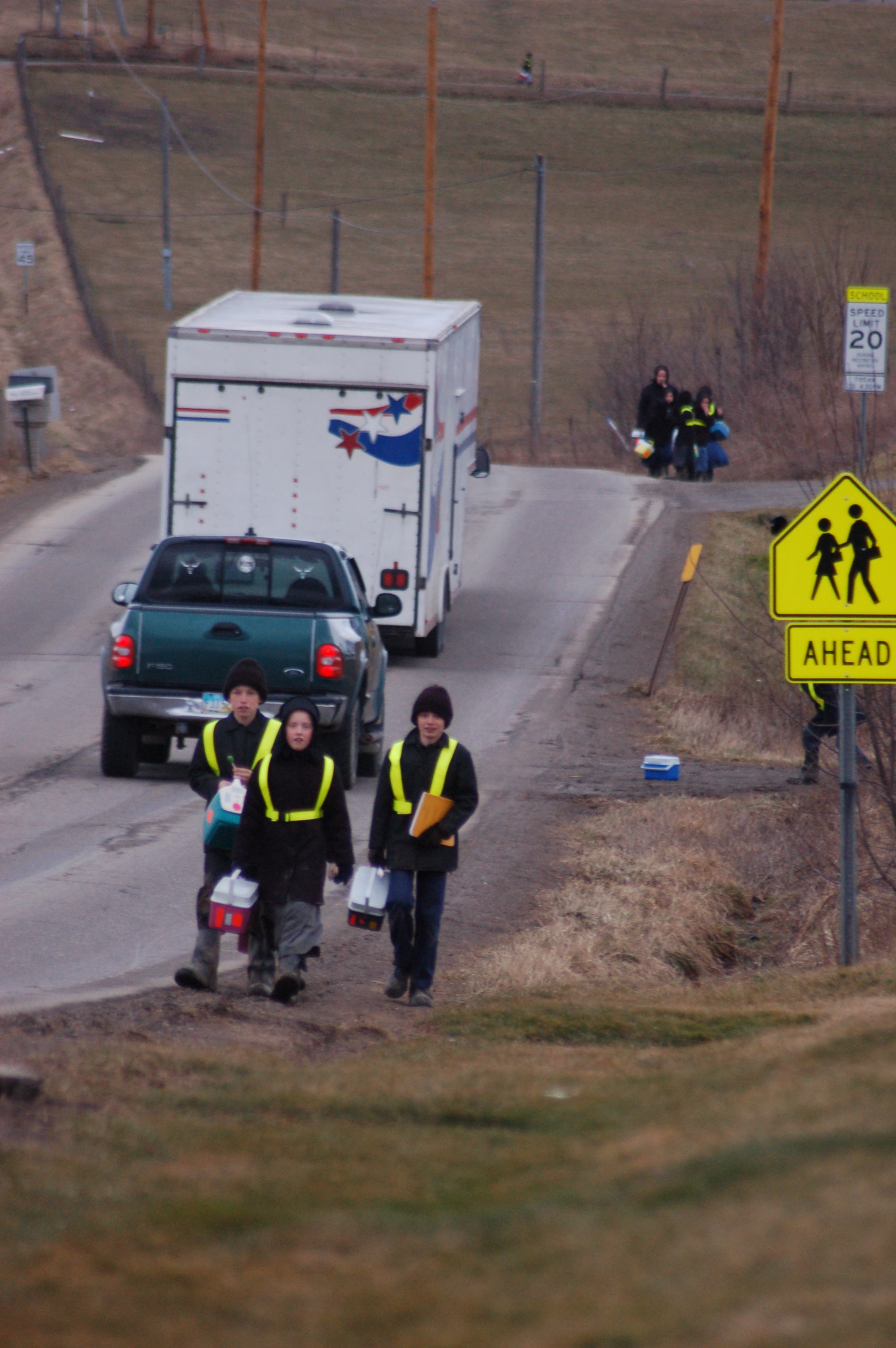
Pedestrians, like these Amish school children, are much more visible since they started wearing day glow vests.
The Amish Safety Committee, made up of three Amish men, has been working for 18 years to educate their constituency on road safety. The most recent focus has been on improving visibility.

Drivers who frequent the Amish areas of Holmes, Wayne and Tuscarawas counties can literally see the impact the committee has made. Recognizing the importance of being seen, lighting has been the biggest improvement. In addition to the required slow moving vehicle orange triangle on the rear of the buggy or cart, most horse-drawn vehicles are now well lighted.

“The biggest factor in most car/buggy accidents is speed,” said Wayne Hochstetler, of rural Millersburg, and a member of the safety committee. “Drivers just can’t judge how fast they come upon a dark colored buggy.” Church rules stipulate that buggies be black in Ohio.
Visible buggy by Bruce Stambaugh
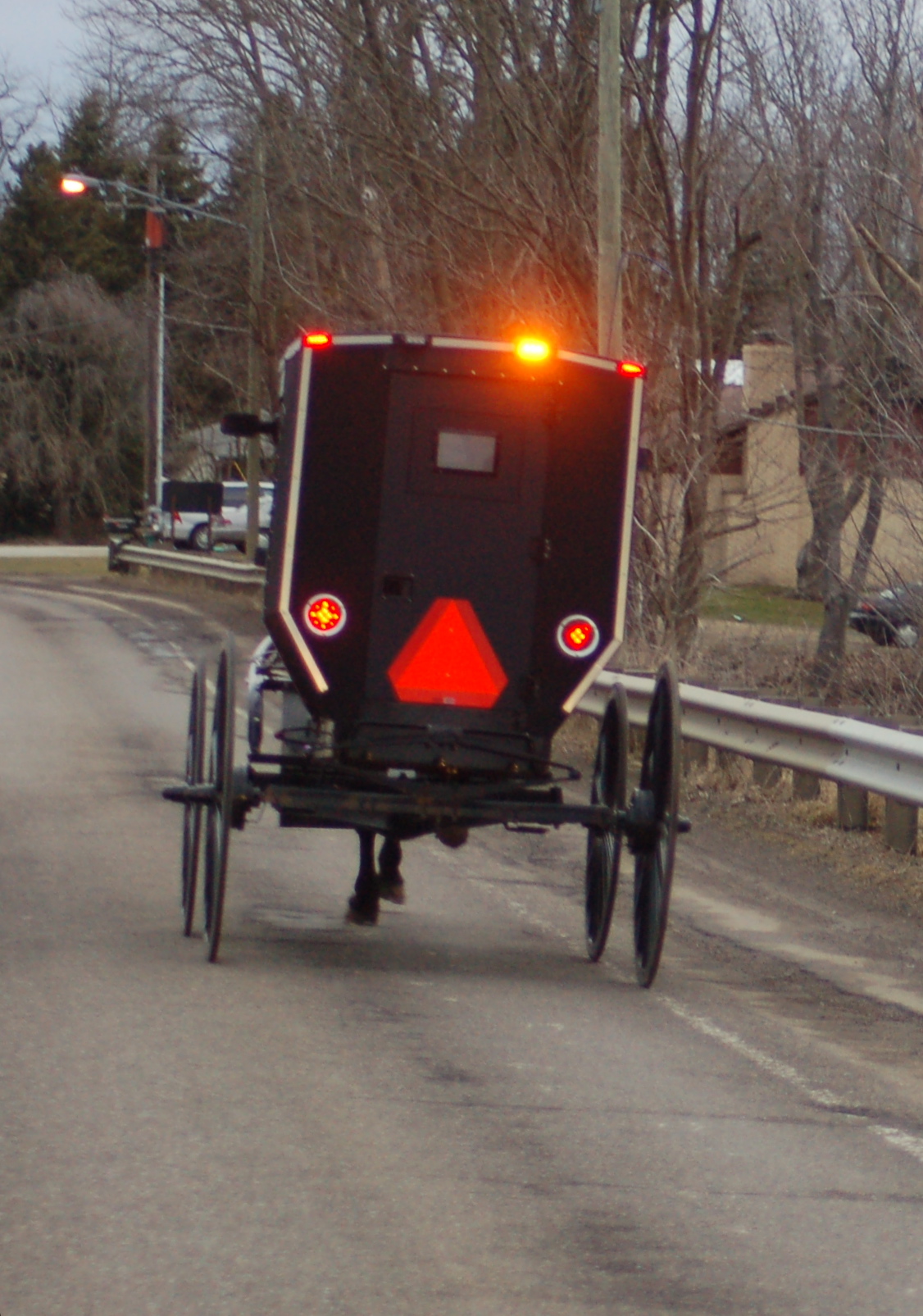
Amish buggies, like this one in Holmes Co., OH, are much easier to see thanks to improved marking and lighting.
“The biggest help has been the blinking amber light,” Hochstetler said. The light is usually centered at the top of the back of the buggy. It operates on batteries, and some models even provide varying blinking patterns.

“The blinking light tells the driver that a buggy is ahead sooner than the triangle does,” Hochstetler said. The committee has suggested other lighting for buggies as well.

“We encourage people to use taillights and running lights for both the front and back,” Hochstetler said. Rear lights are imbedded in the body of the buggy, while running lights are on both sides of the buggy.

The rear lights are red, just as they would be on a motorized vehicle. The running lights serve as a form of headlight, although, according to Hochstetler, they are used more to be seen than afford light for the buggy operator to see.
Tied buggies by Bruce Stambaugh
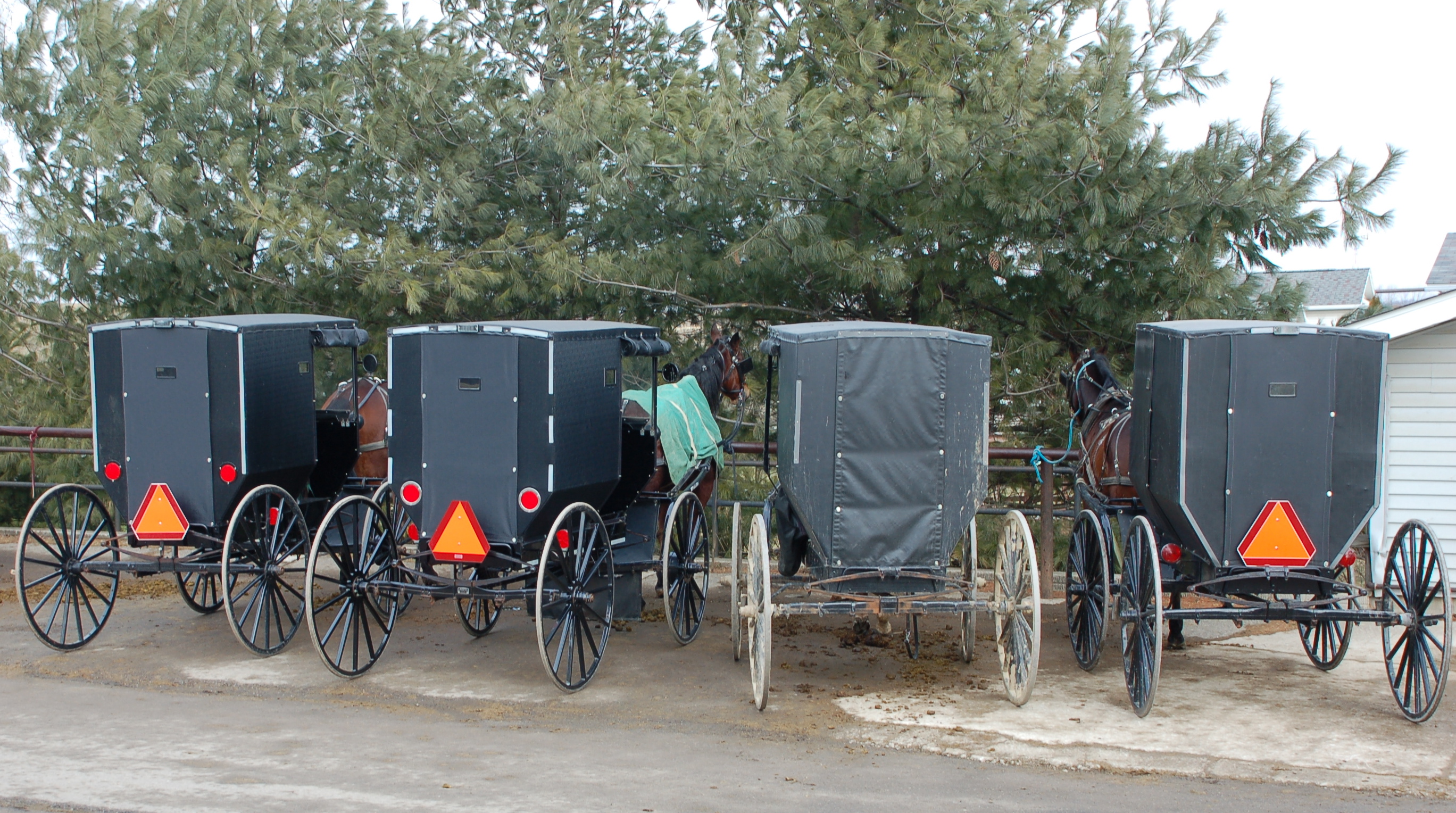
Amish buggies are marked with Slow Moving Vehicle orange triangles, reflective tape, and lights. How they are marked is determined by the church district to which they belong, or which sect of Amish, like the Swartzentruber buggy with no SMV.

In addition, smaller lights are often used on the top front of the buggies, too. These are white, amber or sometimes blue, though law enforcement discourages the latter. Most of the new lighting is LED lamps, which create a brighter, easier to see light. Most buggies also have white reflective tape that outlines the back of the buggy.

The illumination improvements haven’t been confined to horse-drawn vehicles either. Many pedestrians and bicyclists now wear reflective and lighted vests for easier visibility. Like the buggy lights, the lighted vests blink at night. Some walkers use LED lamps attached to their hats in order to be seen by oncoming traffic.

Bicycles also use red blinking taillights and bright white headlights. Reflective straps are also used around horses’ ankles and on the shafts of the buggies to which they are hitched. This permits reflectivity from traffic approaching from the side.

Safety sign by Bruce Stambaugh
Drivers of all kinds are reminded to drive safely in Amish country.

Besides Hochstetler, other committee members are Gid Yoder and Rueben Schlabach. Detective Joe Mullet, of the Holmes County Sheriff’s Office, and Lt. Chad Enderby, of the Wooster Post of the Ohio State Highway Patrol, serve as ad hoc advisory members.

Hochstetler said that the grassroots efforts of the committee have been so well embraced by the Amish in Holmes, Tuscarawas and Wayne counties that they have been invited to help form other safety committees in other Ohio Amish communities.

“We have even been asked to share in other states like Indiana, Michigan and New York,” Hochstetler said.

Mullet said that even the Swartzentruber Amish, the lowest order of the sect, are now using two lighted lanterns with front and rear lens. They formerly used only one.

Mullet said that he spends several days a year visiting Amish parochial schools to teach the students practical safety measures. They include the proper way to walk and ride bikes to and from school, and encouraging wearing the day glow vests.

Mullet said he often tells personal stories to make it more meaningful for the students. Mullet also has an advantage in keeping the students’ attention since he can speak Pennsylvania Dutch with the students.

In addition to being proactive on safety, the Amish for several years have paid a self-imposed donation to the Ohio Department of Transportation to help improve area roadways. Hochstetler said each church district has a person designated to annually collect donations for each horse-drawn road vehicle owned by the household.

ODOT shares the money with county and township officials for local road improvement in areas where Amish live. The money is intended to be a monetary substitution for road improvements in lieu of paying gasoline taxes, which owners of motorized vehicles pay each time they buy fuel.
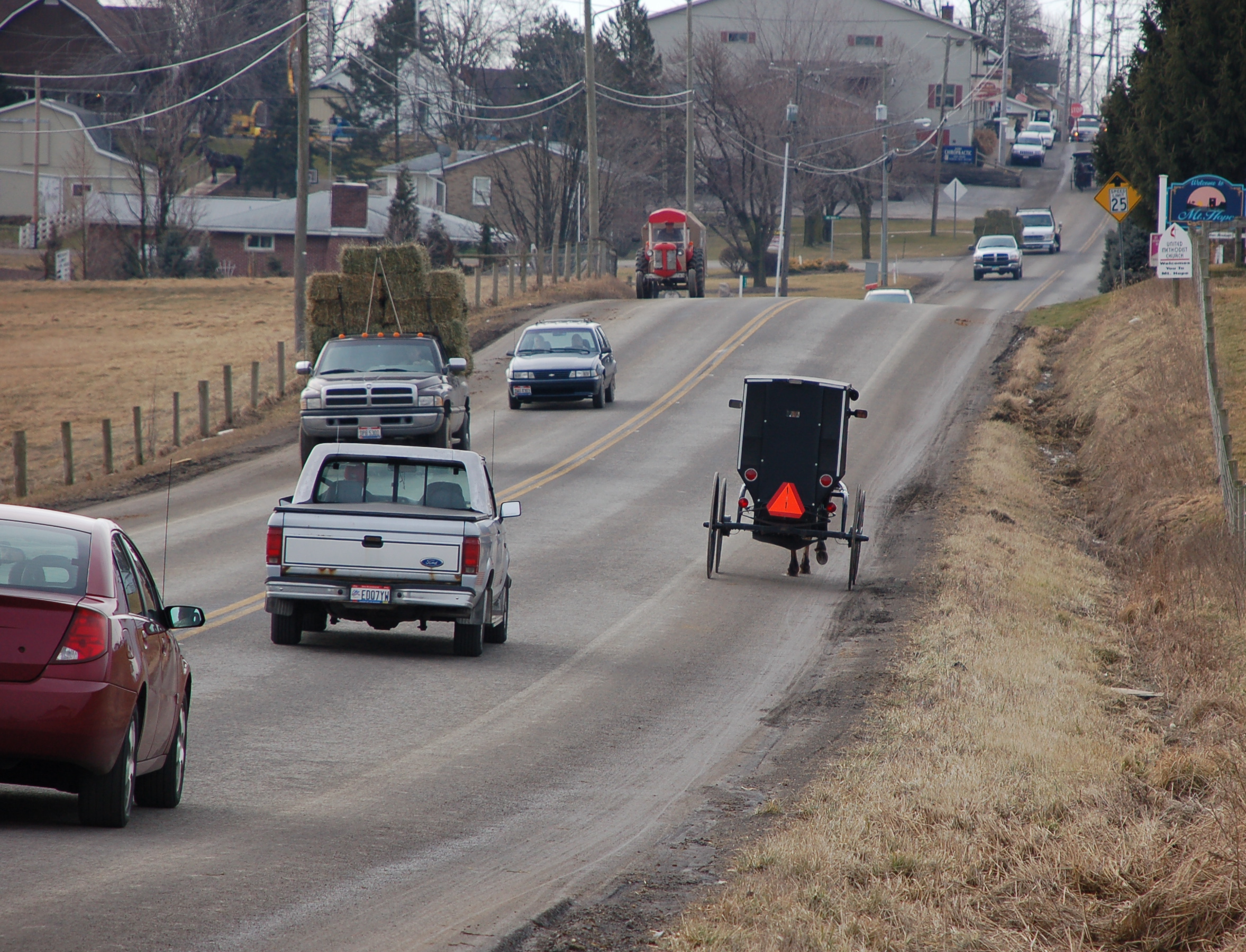
Buggy lane by Bruce Stambaugh
Donations by Amish families to the Ohio Dept. of Transportation help construct and maintain buggy lanes for safer traffic flow. This buggy was traveling near Mt. Hope, OH.

This sugar shack produces more than maple syrup

Sugar shack by Bruce Stambaugh
The sugar shack sits adjacent to the woods on Gary Miller’s farm west of Millersburg, Ohio.

By Bruce Stambaugh

I had often heard about the sugar shack. A group of guys I knew, mostly from our church, had formed an informal co-op. The goal was to make and offer maple syrup, with the donated proceeds going to a scholarship program for students in rural Honduras.

My journalistic nosiness finally got the best of me, and I ventured out one chilly day when the sap was running strong. My intent was to write a story for a local weekly newspaper. What I discovered went far beyond what any feature story could represent. Here were a few good men who through sheer determination made this sweet enterprise work. They worked cooperatively out of a common desire to succeed, not out of individual or corporate profit. Indeed, there were no profits. The money collected through donations went to the scholarship program.

Stoking the fire by Bruce Stambaugh
Tim Roth, left, and Paul Conrad stoke the fire of the sugaring evaporator system.
This endeavor was borne of commitment, desire, effort, camaraderie, purpose, joy, ingenuity, and sacrifice, all with rewarding results. And to think that it all started with the landowner, Gary Miller, standing in the rain dreaming of making maple syrup. Miller never envisioned how far his idea would go.

“Three years ago,” Miller said, “I was standing in the rain under an umbrella boiling sap in an assortment of old used pans on my grill.” Miller lives on a small farm west of Millersburg, Ohio.

Miller shared his idea with his friends, and the sugar shack quickly became a reality. The structure itself was donated to Miller. A friend, Paul Conrad, had an old shed he told Miller he could have, and Miller’s sons moved it in seven different sections for him. Once on site, the building was reassembled, reusing the old lumber. Since then, its design and size has been tweaked and expanded.

That process set the tone for what was to come. Much of the equipment used by Miller and his friends has been refurbished as some part and purpose of the maple syrup operation.

Tree taps by Bruce Stambaugh
Paul Conrad, left, and Bobby Miller check one of the 400 taps in Gary Miller’s woods.

Indeed, when the sap is moving like it is now, so does this voluntary collection of Miller’s friends and family who assist with the project. They placed 400 taps in sugar, red and black maple trees.

“We are careful about how many taps we place in a tree,” Miller said. “We don’t want to stress them.”

Like most farming efforts, preparing for the sap harvest takes a lot of preparation, and can be an ongoing project. Recently a shed was built to store the chords of firewood needed to heat the boiling process. Of course the friends also helped split and stack the wood that fuels the fire that boils the sap on a homemade evaporator. True to form, the gregarious crew also put that together. Much of that ingenious system consists of recycled metal and other repurposed materials.

The wood stove that holds the fire that boils the sap belonged to Scott Sponsler, another friend. The stove was extended with metal from old toolboxes from a pick up truck that Miller owned. Miller had a fan rebuilt and some ductwork manufactured locally. Together they help distribute the heat generated by the wood stove. The heat evaporates the sap into syrup.

The sap enters the sugar shack from another recycled item, an old bulk tank rescued from an unused milking parlor. It is held up by a repurposed metal stand so the sap flows by gravity into a smaller holding tank inside the old wooden shed.

Gary Miller by Bruce Stambaugh
Gary Miller explained how the sap is heated by running through a maze of troughs in order for it to become maple syrup.

From there, the sap runs into a customized sheet metal maze that allows the sap to be evaporated as it circulates up and down the four parallel troughs. After entering a second connected metal maze, the sap begins to change color. It is closer to the firebox and the pre-heated sap really begins to boil. Its darker color indicates that the moisture is being bubbled away.

Miller said that the sap isn’t officially maple syrup until its consistency is at least 66.9 degrees brix, as measured by a hydrometer. Miller said with this set up, it takes 51 gallons of sap to produce a gallon of syrup.

Miller and his friends make the syrup when the sap is running. He said warmer days and cooler nights are the best conditions to make the sap run. When the sap runs, so does this gang of close friends and family members. When the sap is running, his shack and the surrounding woods are very busy places indeed.

Pouring sap by Bruce Stambaugh
Scott Sponsler poured sap from the collection bucket into a 15-gallon container, which was hauled back with several others to the sugar shack via tractor.
Before it is pumped into the elevated holding tank, the sap is gathered into 15-gallon containers from each tap bucket. The containers are carried on the back of a small tractor. In keeping with the pattern, the tractor was loaned, too.

All the free equipment and labor is only appropriate. Miller said the maple syrup that is produced is not for sale, although it does have a name, Smoke Pit Maple Syrup.

“This is not a commercial operation,” Miller emphasized.

Instead customers get to donate whatever they feel the syrup is worth. The money is used for an educational scholarship program in Honduras. Miller’s Sunday school class at Millersburg Mennonite Church is financially sponsoring the schooling of several children there.

Roy Miller, a retired Holmes County family physician, serves as the unofficial coordinator of activities. He even travels to Honduras several times a year and meets with the students, their parents and the local church leaders who oversee the scholarship program there.

With all that said, Gary Miller revealed the secret ingredient in the maple syrup production as far as he is concerned.
“It’s not about the syrup,” Miller said. “It’s about the fellowship.”

Indeed, laughter and kibitzing among the friends intermingle with the steam from the cooking sap in the cold, small shack. The steam and merriment waft together out into the cold air through the open doorways. The good-natured ribbing helps make the labor-intensive sugaring efforts all the sweeter.

In that initial visit, I was impressed with the care given to producing a quality product, and with the interpersonal interaction that makes this particular micro business the all around success that it is.

It was clear to me that two pure products are produced at the sugar shack. High quality maple syrup created for a great cause is the tasty finished product. Genuine, committed friendship that knows no bounds and has no earthly measure is the dividend.
Persons interested in obtaining some of the Smoke Pit Maple Syrup should contact Gary Miller at 330-763-0364.

Hydrometer by Bruce Stambaugh
Gary Miller demonstrated how he checks the sugar content of the maple syrup using a hydrometer.

This story appears in the current edition of Farming Magazine.

The best thing about vacations

Leaving the harbor by Bruce Stambaugh
Fishermen leave the harbor at Fernandina Beach, FL.

By Bruce Stambaugh

Vacation is one of my favorite words. Perhaps it’s because it’s one of those duplicitous words in the English language that can be used as either a noun or a verb.

I love to go on vacation. We will vacation at the beach. Either way, the end result is still the same. Vacation is vacation.

My wife and I are fortunate to be at a point in our lives where we can get away, if only for a few days, without much hassle. When friends invited us to share a house with them in sunny Florida for a week, we cleared our schedules and confirmed our reservations.

When you live in northern Ohio and it’s wintertime, there’s only one direction to go on vacation, and that is south. Clearly, I’m not a snow skier. At my age, I prefer the warmth to cold, and so do my old bones.

Siesta sunset by Bruce Stambaugh
Sunset at Siesta Key Beach, Sarasota, FL.

It’s more than climate that draws us away from our familiar digs, Holmes Co., Ohio, where up to four million visit annually. Most visitors to our area, however, choose spring, summer and especially fall to roam the bucolic Holmes County hills.

Our curiosity and desire for adventure draw us away from our own congenial vistas as much as anything. We love to explore new places as well as revisit familiar ones.

Our gracious Florida hosts planned plenty of interesting activities for us during our weeklong stay. Fortunately, we enjoy many similar activities as our friends. Like us, they prefer to pace themselves. It was vacation after all. No reason to rush.

I could bore you with a verbal slideshow of our trip. I’ll just say we had a great time, whether we were on the most beautiful beach in the country, which we were, or enjoying an enlightening and informative historical tour, which we did.

Florida House by Bruce Stambaugh
The Florida House, Fernandina Beach, FL, is the oldest operating hotel in Florida.

Instead, I want to tell you about some of the people we encountered along the way. It happens wherever we go. I am fascinated and appreciate the kindness of pure strangers we encounter on our travels. Meeting new people is one of the vacation perks.

Sure, there are a few goofballs almost everywhere. But for the most part, we have found people to be absolutely engaging, matching the gorgeous scenery that surrounds them.

It is hard to single out any one person in Mt. Airy, North Carolina. Everyone we met seemed like a familiar character from Mayberry.

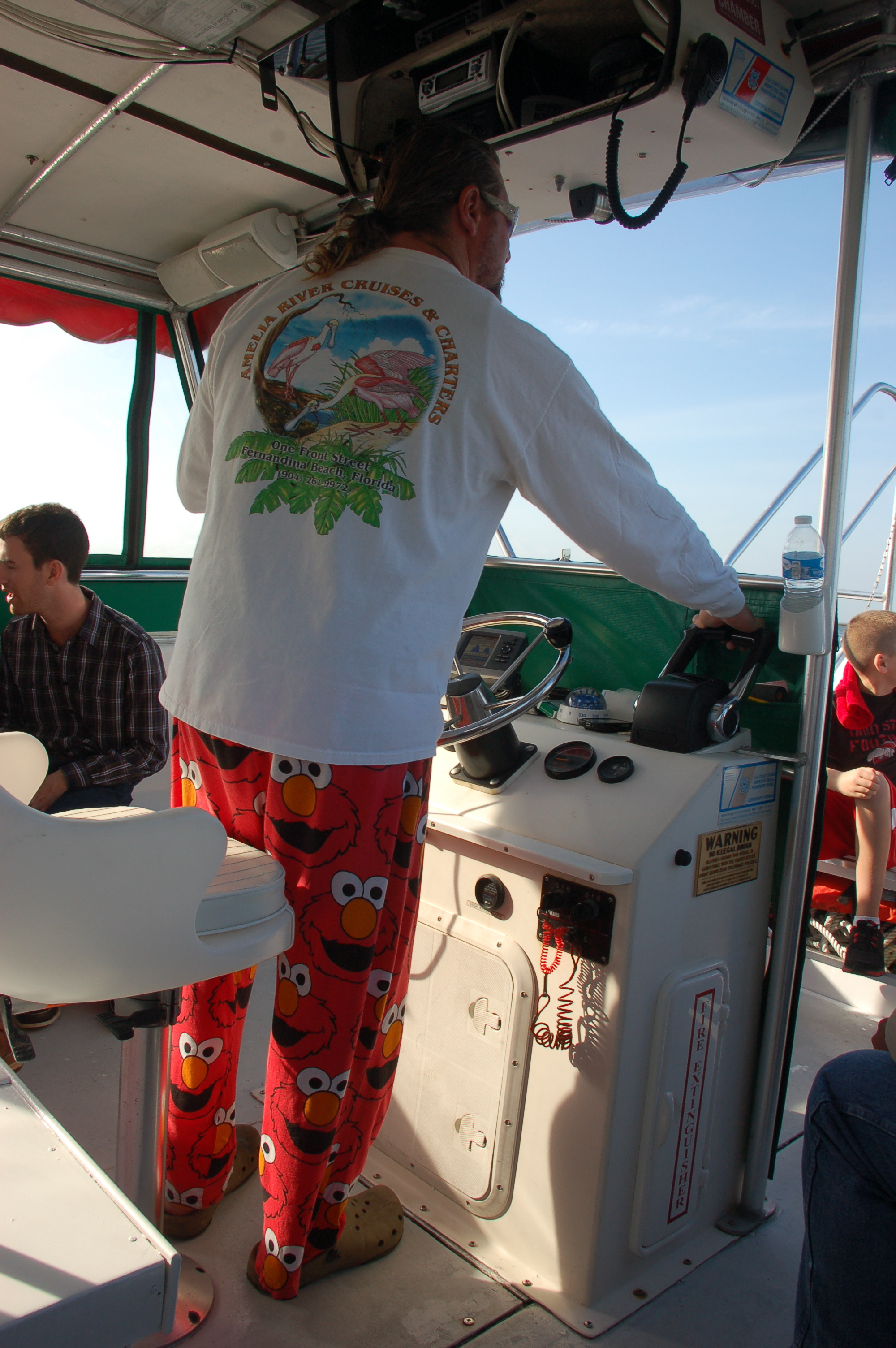
Captain Dave by Bruce Stambaugh
Captain Pajama Dave piloted our Beach Creek tour at Fernandina Beach, FL.
The young and enthusiastic park ranger near Mt. Mitchell on the Blue Ridge Parkway was most helpful. He directed us to Asheville when we found the road unexpectedly closed.

The kind lady at the Venice Rookery who encouraged us to return at dusk to watch the hundreds of nesting egrets, herons and ibises settle in for the night was a pure gem. Even a non-birder would marvel at that experience.

Another amazing individual was our tour boat captain at Fernandina Beach, Florida. Captain Dave was as cordial and passionate about his lovely habitat as the history of the area was interesting. His trademark bright red Elmo pajama pants fit his personality and his passion for nature’s handiwork that he so eloquently pointed out.

Juniper by Bruce Stambaugh
The precocious Juniper.

Finally, there was 2-year-old Juniper, the petite and perky daughter of some friends in Charlotte. We had never met her. Yet by evening’s end, she wanted “Pruce” to read her one more book.

To paraphrase Dr. Seuss, Oh the places we’ve been and the people we’ve met. Together they make vacation a charmed word in our household.

Timing is everything, especially when birding

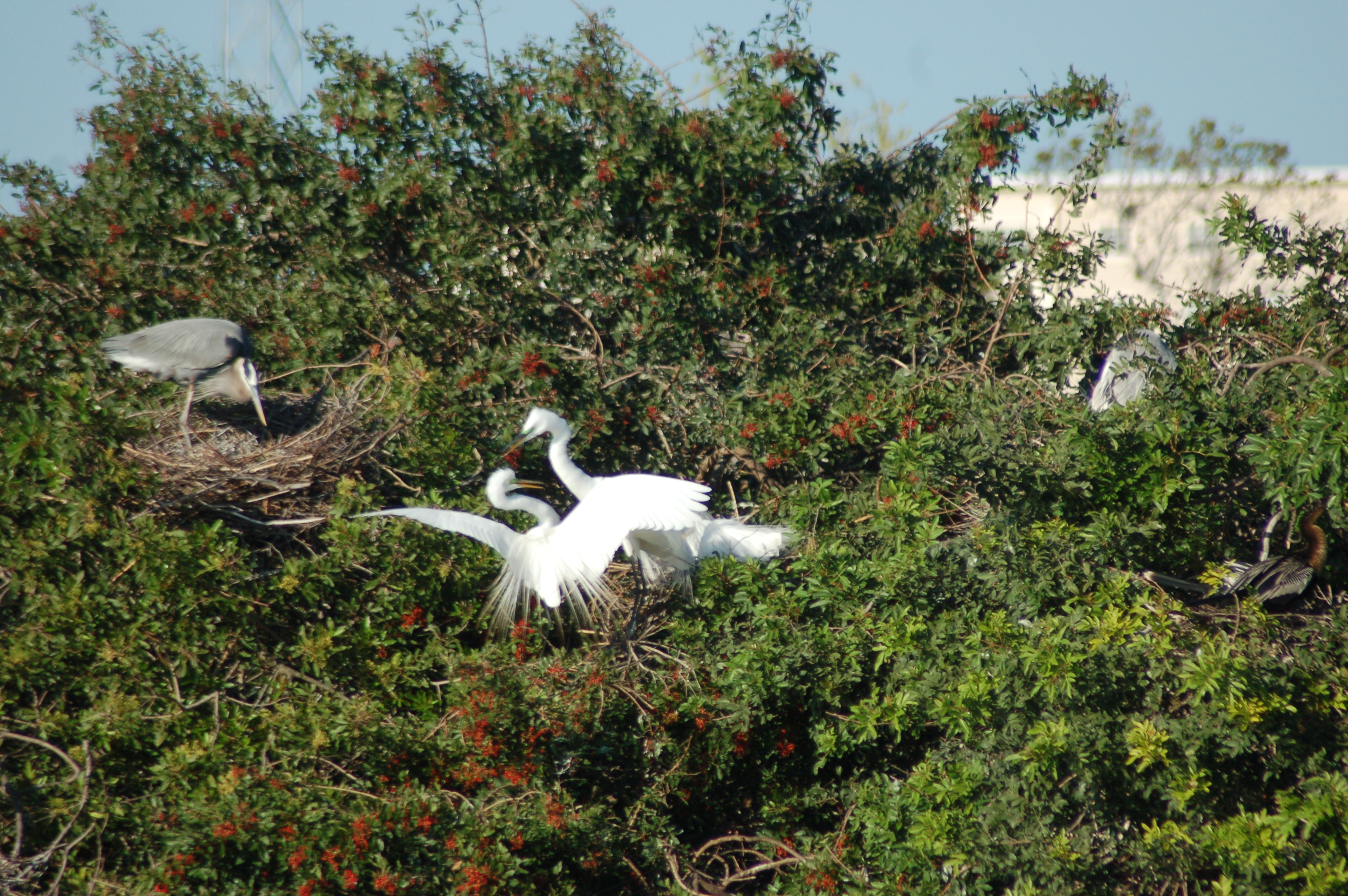
Courting Egrets by Bruce Stambaugh
I caught this pair of Great Egrets in their courting ritual at the Venice, FL Rookery. The Great Blue Heron to the left didn't seem too impressed.

By Bruce Stambaugh

The weather was dreary and cold, with occasional snow flurries. It was just another winter’s day in Holmes County, Ohio as far as I was concerned. But it turned out to be so much more than that.

I drove the nine miles east to check on my mother, who lives in a local nursing home. I kept my visit short as usual, making sure I had refilled Mom’s bowl of jellybeans before I said goodbye.

As I was driving home a flash of white caught my attention to the right just east of Berlin, center of the world’s largest Amish population. Besides the color, the bird’s large wings, small head and short tail were all instantly noticeable.

I checked traffic and slowed my vehicle. The bird’s rapid, steady flight cut directly across my path right to left, giving me a full, close view for nearly a minute.

By its distinctive wingbeats, its size and color, I reckoned it was a Snowy Owl. Given my situation, I had no other choice. I had to keep alert driving, yet I tried to keep my eyes on this rare bird.

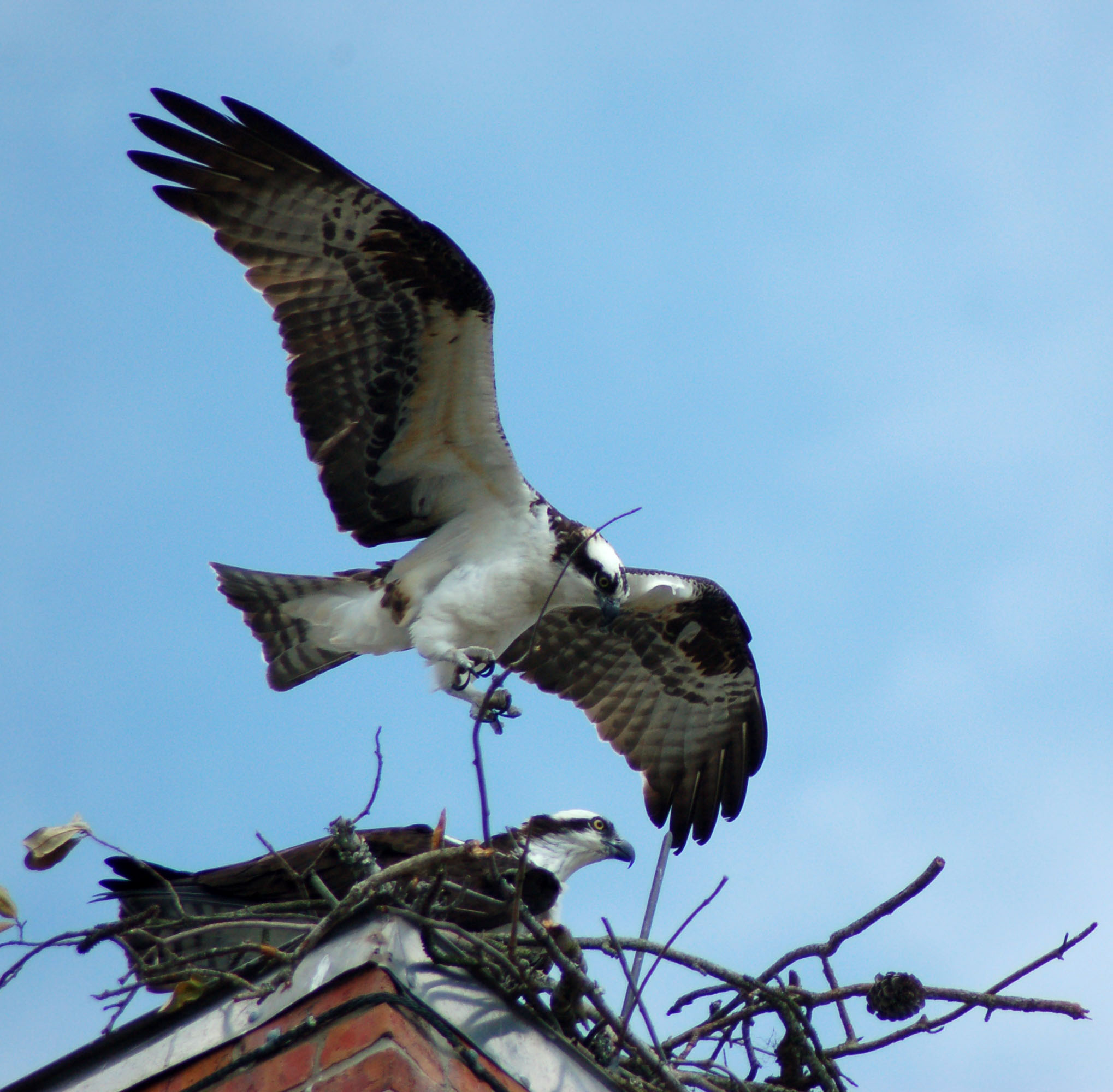
Ospreys at Corolla NC by Bruce Stambaugh
While vacationing in Corolla, NC, I happened upon this pair of Ospreys building a nest on a rooftop.
I didn’t have either my binoculars or camera along. The only thing to do was to keep driving and hope that I could spot it again as I made my way west through town.

Snowy Owls recently had been reported all across the midwestern part of the country, including Ohio. This was far south of their normal winter range. Experts speculated that the owls came in search of food. Normally nocturnal, Snowy Owls will hunt in the daytime when stressed by hunger.

As I motored through two signal lights and the usual clog of traffic in the busy unincorporated village, I kept looking south. I spotted the bird off and on, and saw it gliding as if it was going to land southwest of town.

Once I reached the open area west of Berlin, I again found the white owl, this time flapping its large wings. As I headed down the hill colloquially dubbed Joe T. hill, I lost sight of this magnificent bird. I didn’t know if it had landed or flown out of sight.

My only option had been to observe every detail of the bird that I could while driving. In the birding world, that process is called reckoning, meaning noting the birds shape, size, flight pattern, and behavior.

To be sure of my sighting, I consulted several bird books when I got home. They confirmed what I had seen. I reported the sighting to the rare bird alert. That way others in the area might see the owl, too.

That’s the way birders are. Half the joy of watching birds is sharing what is seen with others.

Amish boys biking by Bruce Stambaugh
Young Amish boys like these young men often will bike miles to go birding.
Ohio’s Amish country is blessed with an abundance of excellent birders, many of them in their early teens. It is not uncommon for them to get a group together, and bike for miles to go birding for a day.

They keep track of what they see, species, numbers and locations. And if they happen to spot an unusual bird, the word gets spread quickly so others may enjoy the opportunity as well.

In this case, I couldn’t believe my good fortune to be at just the right place at just the right time to see a Snowy Owl. I considered myself extremely fortunate to have seen this rare bird.

When birding, like so many other situations in life, timing is everything.

2012 calendar looks to be a bit on the crazy side

Eerie sunset by Bruce Stambaugh
By Bruce Stambaugh

We were having a right nice 2012 until January 13th arrived. Of course, it was a Friday, the day the first disruptive snowstorm of the season hit the northeast Ohio area.

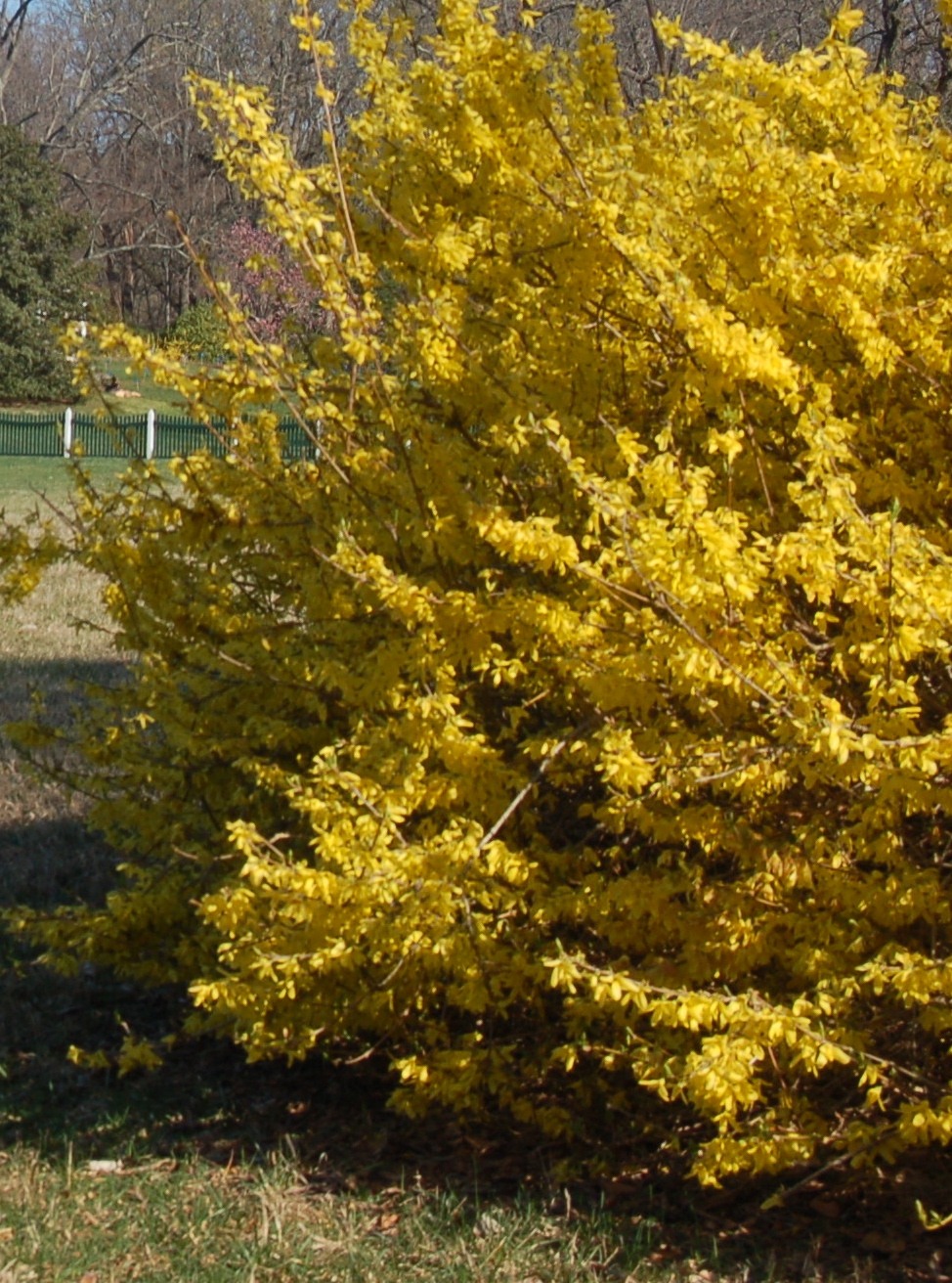
Forsythia by Bruce StambaughUntil then, the winter weather had been more like early spring. People reported dandelions and forsythia blooming. I even saw a pussy willow bush ready to open. One person bragged about mowing the lawn at the end of December.

Then along came Friday the 13th. Please don’t misunderstand. I’m not blaming the snowstorm on that supposedly superstitious day. In fact I’m not even superstitious, knock on wood.

I had to wonder though if this was going to be the first of several goofy events, either natural or human induced, to occur in 2012. I’m only thinking this because of the way the year’s universal calendar plays out.

Besides the Friday the 13th snowstorm, this is also a leap year. People born on February 29 will finally get to celebrate their Birthday by Bruce Stambaughbirthdays again. February, the shortest month of the year even with Leap Day, has five Wednesdays this year. September has its usual 30 days, and five of them are Sundays.

Of the 12 months, three begin on a Sunday, one on a Monday, one on a Tuesday, two on a Wednesday, two on a Thursday, one on a Friday and two on a Saturday. I think we can thank the Leap Year phenomenon again for making sure no day got ignored.

Other oddities include Washington’s Birthday and Ash Wednesday coinciding. April Fools’ Day and Palm Sunday share the same date. A full moon occurs on Good Friday. August is the only month that has two full moons, August 2 and 31. September’s full moon also occurs on the last day of the month.

Unless you have been hiding in a cave, you have long figured out that 2012 is also a presidential election year. Given the candidates performances so far, that alone would make 2012 a bit tilted.
Flag and bunting by Bruce Stambaugh
To add to the calendar party, we have to mention the Mayan calendar references December 21 as being the day the world ends. That day just happens to be this year’s winter solstice. Maybe we won’t have to worry about winter anymore.

Of course, as we learned last year and a thousand times before, the Mayans can’t claim title to announcing the end of time. Harold Camping still has some explaining to do from last year’s fruitless end-times predictions.

Playing off the fears of an already unsettled global society, the goofiness goes on. For instance, one claim for this year is that a previously unknown planet will hit Earth. Right, and the Cleveland Indians will beat the Chicago Cubs in the World Series thanks to an assist by Steve Bartman.

Another oddball prediction has the Earth’s magnetic poles switching places, sparked by a series of solar storms. Better stock up on sunscreen before the prices go up.

Number 13 by Bruce StambaughThere is yet one more piece of information that just might sway you to cash in all your stocks, sell your property and give the proceeds to a respectable charity. Of course it involves Friday the 13th. There are three of them in 2012, January 13, April 13 and July 13.

That in itself may not be so statistically unusual until you hear what my friend, Mic, discovered. The three Friday the 13ths are each 13 weeks apart.

To quote my good friend, “Be forewarned.”

Checking the roads and the scenery

Fall haying by Bruce Stambaugh
By Bruce Stambaugh

When I moved to Holmes County, Ohio more than four decades ago, one of my initial purchases was a county road map. I wanted to learn my way around the ridges, valleys and hamlets of the area.

I drove both the highways and back roads in order to get to know the topography and citizenry of this place. Geography buff that I am, landscape variations between the glaciated and the unglaciated portions of the county greatly intrigued me.

I marveled equally at the steep wooded hills that defined the broad Killbuck Valley, and the rolling farmlands and rivulets in the county’s northern section. The common elements of picturesque scenery and practical people reoccurred despite the demographic differences.

All these years later I still drive the roads, still learn, still enjoy my bucolic and human encounters. I think about that often, especially when I inspect the roads for which I am responsible as a township trustee.

Washout by Bruce StambaughMy main objective is to ensure safe road conditions, and check for potential problems like plugged culverts, leaning trees and slippery roads. I do those duties, but the pastoral vistas and the genial people I encounter along the way can easily distract me. I don’t mind in the least. The diversity of the countryside and characters in my township are truly remarkable.

My regular route takes me up hill and down vale, through densely wooded ravines with sharply slanting walls that rise abruptly on both sides. In several places road and stream are pinched with just enough room to navigate side-by-side.
Amish farm by Bruce Stambaugh
In minutes, I can motor from forested valley to high, rolling fertile fields that surround coffin red bank barns and white farmhouses. Various shapes and sizes of purposeful farm buildings cluster around the intentionally unadorned agrarian castles.

It was inevitable that over the years the views would be altered. With the population regularly expanding and the land not, cottage businesses and manufacturing buildings sprouted up out of necessity. Many are Amish run and involve some aspect of the lumber industry. Other shops create products specifically for the benefit of the Amish lifestyle, like buggy shops and farriers.

The commerce is nice. The views and residents are better.
Saltcreek farm by Bruce Stambaugh
Near one of my favorite hilltops, the land falls away gradually, cascading toward the Killbuck lowlands. It is a sacred place for me, and yet it is at this precise spot where a new Amish country murder mystery novel is set. When I read about the book’s release, I wondered if the writer had ever met the good folks on the homestead he had impugned.

Last winter, during a fierce snowstorm, a semi-tractor trailer truck got stuck on the slippery incline in front of this very farmstead. The kind farmer cranked up his bulldozer, puttered out the long lane in blinding snow and pushed the teamster and his rig over the hill and on his way.
Wash line by Bruce Stambaugh
When it comes to beauty, seasons are really insignificant as I traverse my lovely township. Refreshing summer breezes flap wash lines loaded with pastel clothing. Gaggles of youth skate and play on frozen ponds. A Golden Eagle roosts on a chubby fence post. Leafy rainbows of the mixed hardwoods compete with those in post-storm skies.

Then, too, rounds from paintball guns plaster stop signs, runaway streams wash away road banks, and citizens rankle at impassible roads. Fear not. Repairs can be made, relationships mended.

Peace is restored to my Camelot, at least until my next dreamy drive.
Amish school by Bruce Stambaugh

The year in pictures

By Bruce Stambaugh

I had the grandiose idea to post photos I had taken in 2011 in four categories, people, floral and fauna, scenery and weather. As I sorted through the nearly 4,000 imagines I had taken this year, I quickly realized that the task was too daunting, especially given the limited time I had.

Instead, I chose to select a picture for each month of the year. Most were taken near my home near Millersburg in Ohio’s Amish country. Others were shot while on vacation or out of our area. What I assembled turned out to be an eclectic collection that ends up serving both as a through the lens summary of my year and a representation of each of the original categories.

Here, then, are my pictures of the month for 2011.

January

American Goldfinch by Bruce Stambaugh
Bird lover that I am, I enjoy feeding and photographing birds. This female American Goldfinch posed nicely for me on a porch post while waiting for an opening at a feeder.

February

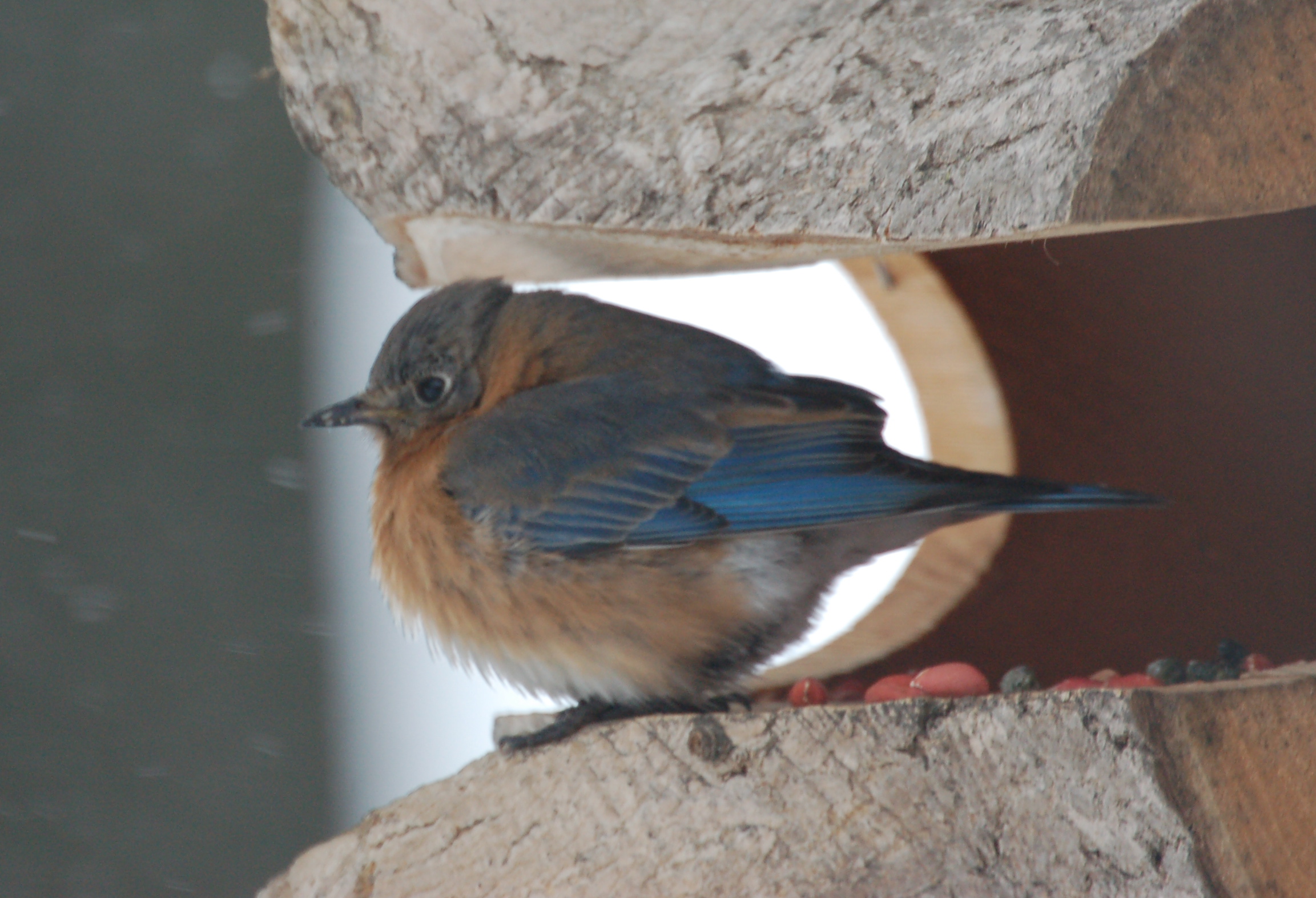
Eastern Bluebird by Bruce Stambaugh
Though this shot is of another bird, this chilly female Eastern Bluebird served as model for both the birds that I love and the weather that I watch. With the stinging, horizontally blowing snow on a late February day, she sought food and shelter and found both in the hollowed out log peanut feeder that hung on our back porch.

March

Espresso art shot by Bruce Stambaugh
I chose this shot as a symbol of how the year unfolded. Taken outside a café in downtown Charlottesville, Virginia, I couldn’t help notice the irony of the dark gray shadow of the white window lettering on the back of the chair inside the shop. The rest of the picture is busy and blurred with multiple reflections, much like my 2011 life experience.

April

Family photo by Bruce Stambaugh
Inscribed on my grandfather Stambaugh’s tombstone is the simple yet profound phrase, “He liked people.” Well, so do I, especially family. Whenever family gathers, like my daughter’s family did at Easter with us, we try to get a family photo. But with young children, getting a perfect picture is a challenge. I thought this imperfect one to perfectly represent that point. The middle child, the long-haired lefty on the left, distains set up shots about as much as me. His older brother enjoyed Davis’ tantrum while the boys’ father tried to settle number two. The granddaughter ignored the silliness and played with a toy, while our photogenic daughter stayed focused on the camera as best she could.

May

Two birds by Bruce Stambaugh
Yep, another bird picture. It wasn’t the subject matter as much as the color that made this the May pick. Plus, it’s a rarity to have a male Baltimore Oriole and a male Red-headed Woodpecker on a suet feeder at exactly the same time. Fact is, neither seemed to mind the other since they continued to feed for several minutes.

June

Floral and fauna by Bruce Stambaugh
June was a beautiful month, save the occasional severe weather. After a long, chilly, wet spring, June’s warmth and sun brought out beautiful flowers and insects, like these Sweet Williams and this Tiger Swallow-tail butterfly.

July

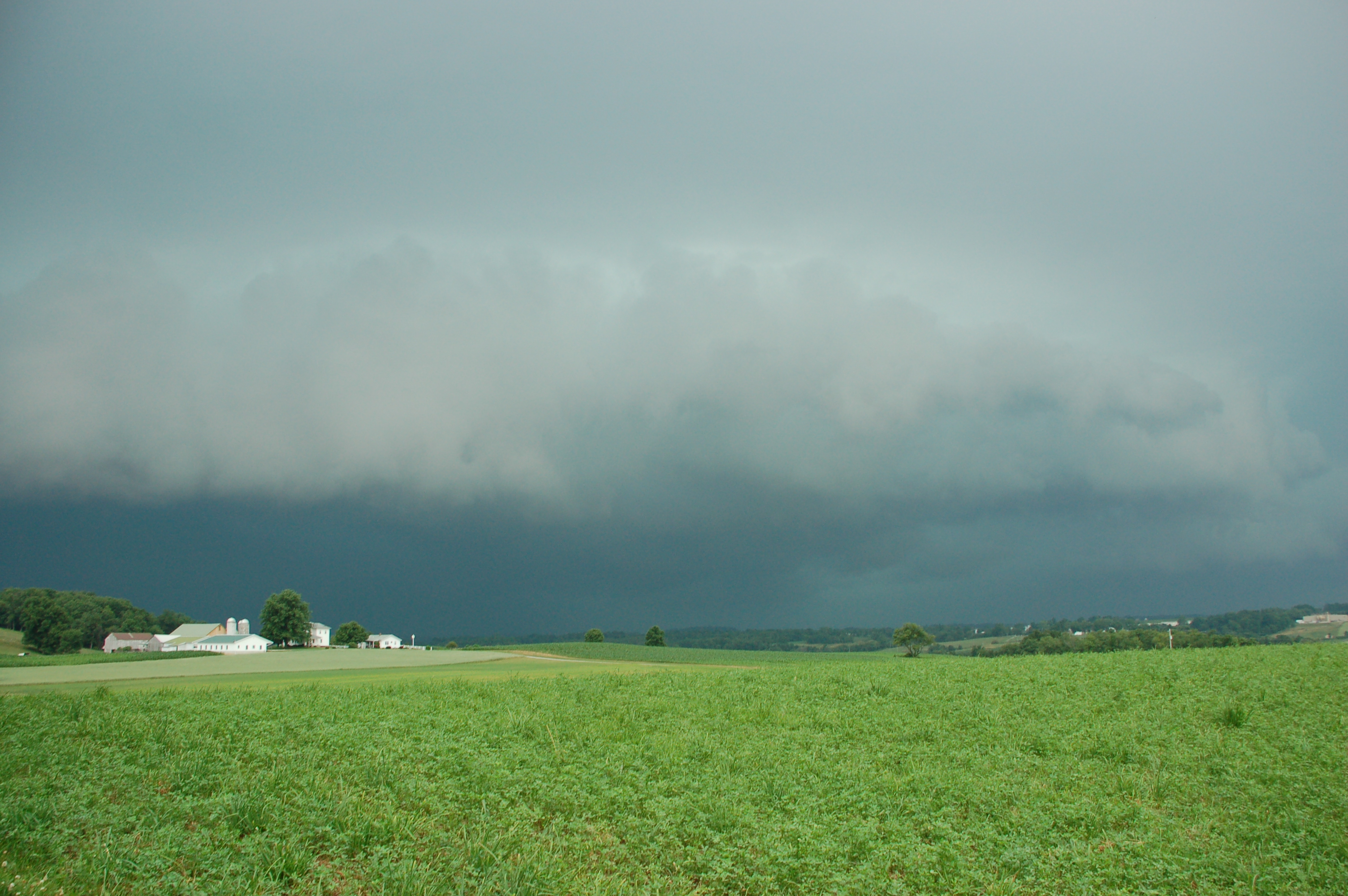
Shelf cloud by Bruce Stambaugh
I felt this picture embodied the year we had in northeast Ohio as much as any photo I shot. Precipitation records were broken throughout the state in 2011. Severe thunderstorms, like this one with its foretelling shelf cloud, pelted northern Ohio all spring and well into the fall. Flooding, damaging tornadoes and microbursts, hail and blinding snowstorms were all a part of the year’s complex weather.

August

Lush harvest by Bruce Stambaugh
Notorious as a hot, humid and often dry month, August fooled us this year. As lovely as June was, August was even nicer. I thought this shot of my Amish neighbor cutting golden oats between lush alfalfa and emerald field corn best represented the month’s congeniality.

September

Sept. 11 sunset by Bruce Stambaugh
Like millions of other global citizens, September 11 is a special day for me. Mostly out of the desire for peace, I consider this day personally sacred. I tend to use the day for reflection and prayer. I thought the sunset on the 10th anniversary needed no words of explanation as to why it was September’s choice.

October

Fall sunrise by Bruce Stambaugh
Every photographer knows when he or she has taken the shot. On a foggy fall morning, I was fortunate enough to capture this shot two miles east of our home. I still smile when I see it.

November

Benefit auction by Bruce Stambaugh
Our church community is an important ingredient in my life. On the first Saturday in November, Millersburg Mennonite Church held a benefit auction for two couples in our congregation who either have adopted or are in the process of adopting children. Of course, the cost of that process is high. All the items in the auction were donated. Needless to say, the auction was an all-around success.

December

Christmas Bluebird by Bruce Stambaugh
We began this venture with a bird. I figured we might as well end it that way, too, especially when this male Eastern Bluebird came calling at the sunflower heart feeder and basked in the Christmas Day afternoon sun.

People, floral and fauna, scenery and weather all play important parts in my life. I feel fortunate to be able to regularly photograph shots representing each category. If I just happen to stumble upon some scene, bird, flowers, cloud or person that requires that I shoot a shot, I consider myself a happy and blessed person.

Happy New Year everyone!

Bruce

A family tradition comes to an end

Jan and Larry Coldwell by Bruce Stambaugh
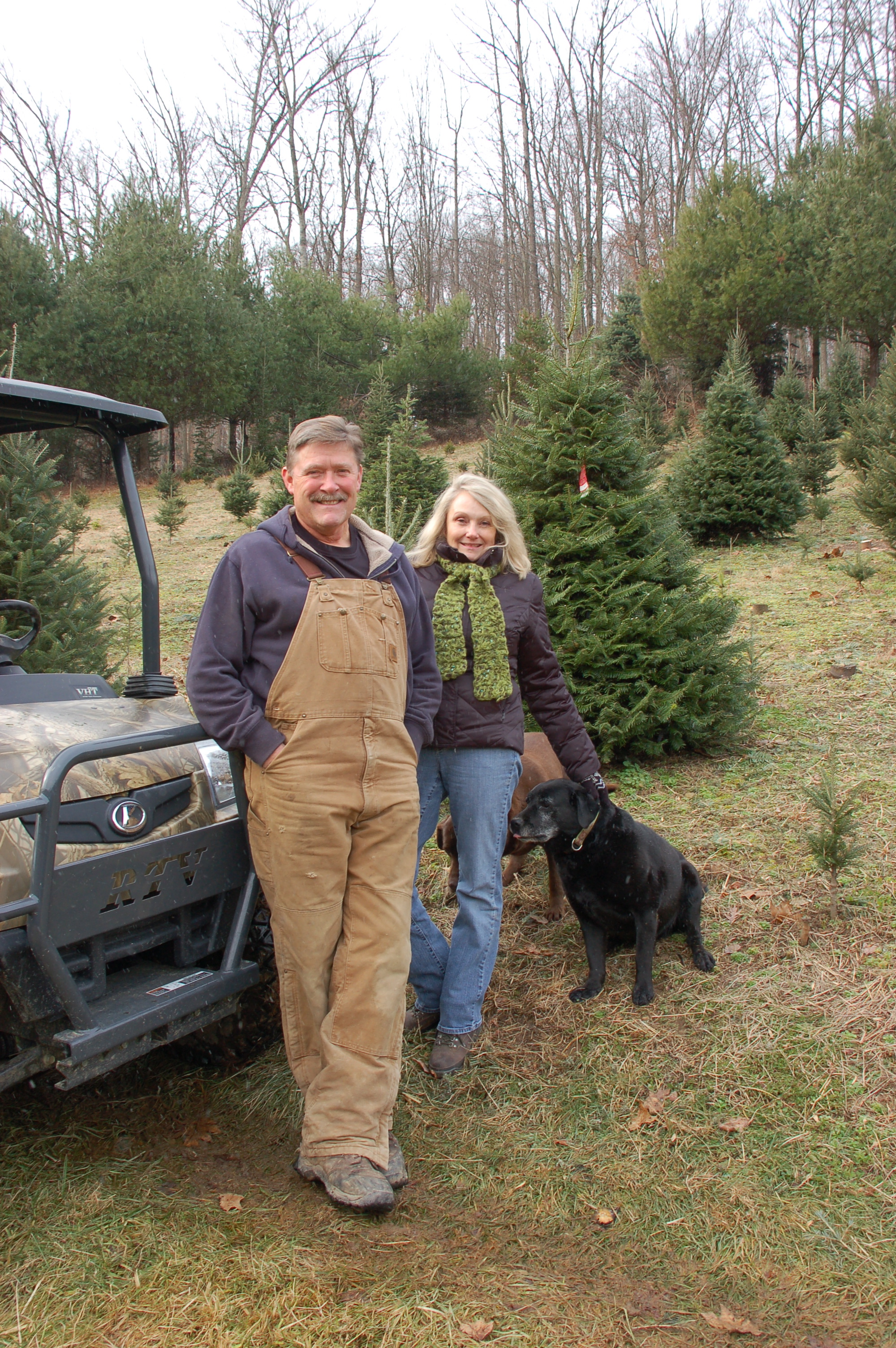
Jan and Larry Coldwell of rural Killbuck, Ohio.

By Bruce Stambaugh

Larry and Jan Coldwell, of rural Killbuck, Ohio, have been selling Christmas trees for 24 years. Area families were sad to learn that this year was their last.

“This decision has been harder than when I retired from teaching,” Larry said. Coldwell taught at Killbuck Elementary School until 2006.

“Growing Christmas trees was a hobby that got out of control,” Larry said. “We started selling a few, word spread, and it became an annual business.”

Larry and Jan Coldwell by Bruce Stambaugh
Larry and Jan Coldwell relax in their home near Killbuck, Ohio.
Both Larry and Jan said it would be difficult to end the business because of the relationships that have developed over the years. They have never advertised their trees for sale, yet were as busy as they wanted to be since 1987.

Larry said he began planting Scotch and White pine trees for wildlife and conservation purposes in 1981. When someone asked if those trees were for sale in December 1987, the Christmas tree selling began.

Since then, scores of people returned year after year to pick out their own tree. Of course, Larry accompanied them up the steep hillsides to help cut the tree.

“I kept a written record of who bought what species every year,” Larry said. Over time, he realized he had to expand his offerings as customers’ tastes changed.

“People were looking for more than just pines,” Larry said. With the help of his family, Larry planted several varieties of conifers, including 12 different kinds of fir.

Larry said the first two weeks of December were always the busiest for selling trees. People would even come tag their trees ahead of time in order to pick just the right tree, he explained.

“If they came the third week in December,” Larry said, “color was more important than shape, fragrance, density or needle texture.”

Friendly folks that they are, Larry and Jan both said that they would miss the annual interaction with their customers.

“I got to be a pretty good photographer,” Larry said. “People wanted a family picture with the tree they chose.” He said he recently took a family picture of four generations who had cut Christmas trees. The youngest in the photo was a toddler.

As their three children grew and left home, all the year-round work of maintaining and preparing the trees for sale at Christmas simply became too much for the couple.

Coldwells by Bruce Stambaugh
After 24 years, Larry and Jan Coldwell decided to discontinue selling Christmas trees from their tree farm.
“It’s a very labor intensive enterprise,” Larry said. “Growing trees on steep hillsides eliminated the possibility of mechanical farming.”

During the growing season, Larry fertilized, sprayed and trimmed the trees, plus he mowed between the rows. Jan pitched in with hours of weed eating.

Larry credits his late father, Loren, for his avid interest in conservation.

“Dad loved the out-of-doors,” Larry said.

Over the years, the Coldwells have received letters, cards of thanks along with pictures of customers’ trees. Some trees were even cut when no one was home, but they never had trouble with people stealing trees.

“We would find money in our mailbox, between the doors and some even brought money to school to pay for trees they had cut while we were away,” Larry said.

“It’s not the money that we will miss,” Larry said. “It’s the people.”

Larry will continue to operate his certified 113-acre tree farm and be an active board member of the Killbuck Valley Landowners Association. Jan is a nurse at Walnut Hills Nursing Home in Walnut Creek, Ohio.

Christmas is the evergreen holiday

Christmas tree cutting by Bruce Stambaugh
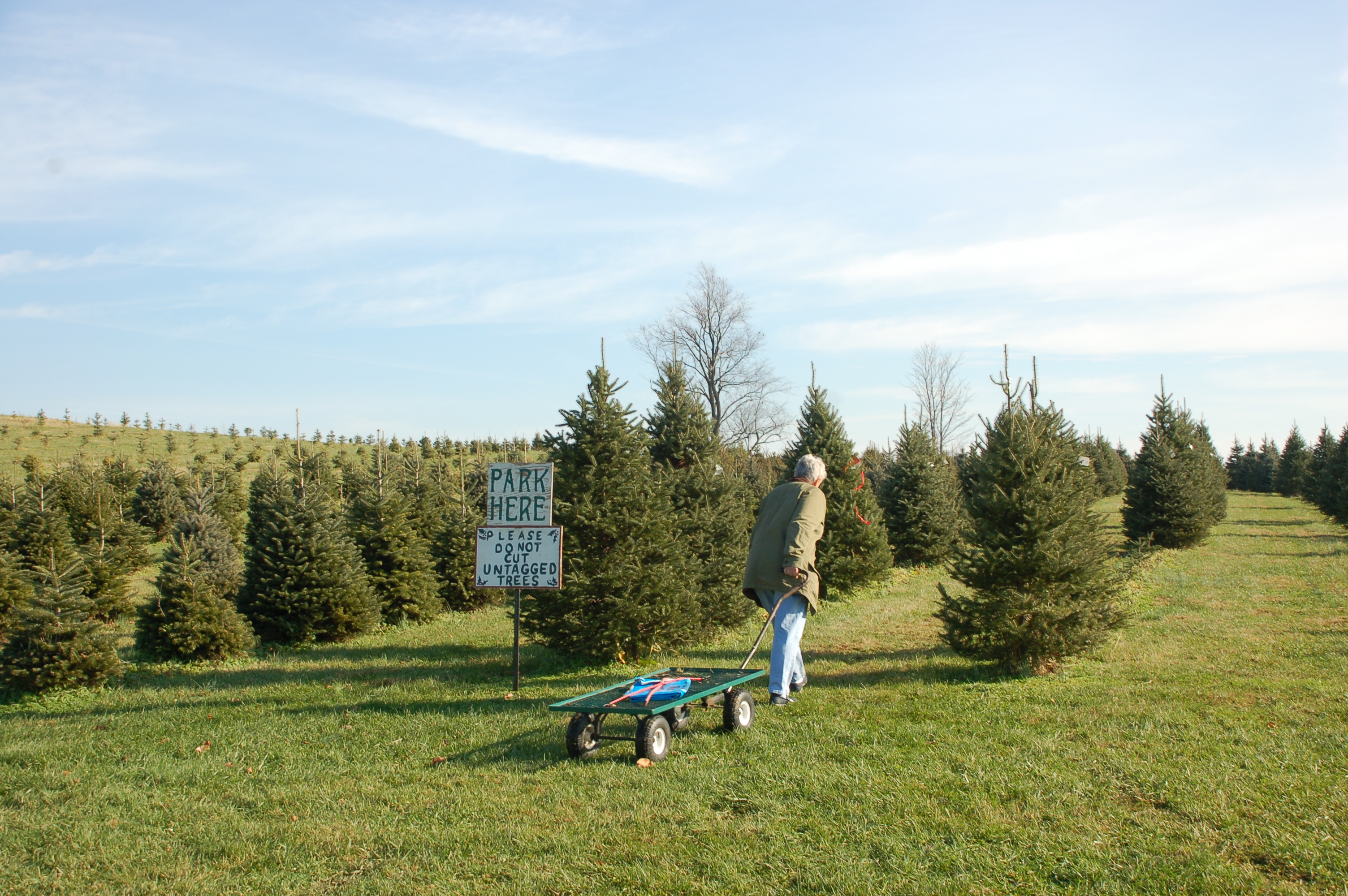
My wife, Neva, headed out in search of the perfect Christmas tree.

By Bruce Stambaugh

It wouldn’t be Christmas without a Christmas tree.

I realize an evergreen wasn’t part of the original Nativity setting. Nevertheless, having a decorated tree is a must for our family Christmas.

By tree, I mean a real, live evergreen. Nothing less will do. An artificial tree is beyond the pale of consideration.

We are fortunate to live where we have easy access to purchasing trees right from a tree farm. In fact, we most often select and cut our own.

Fortunately, my good wife has an equal inherent affection for acquiring, decorating and displaying Christmas trees. Each of our families took special efforts to secure just the right tree. Our fathers were instrumental in establishing that tradition.

Tree ornaments by Bruce StambaughMy father often piled his five children into the car on a holiday expedition to choose the perfect tree. Perhaps Dad thought if we helped select the tree and drag it back to the car, the fussing about the tree’s quality was greatly diminished if a bare spot or crooked trunk were discovered once we got it up.

The tree had to be proportionate to the space it would occupy, which was usually in the living room. It also had to be either fresh cut or a balled tree that could be planted after the holidays had concluded.

My wife and I repeated the holiday tree trek tradition with our own children. No tree was chosen without consensus. Certain anticipation, exuberance and satisfaction filled the collective process.

Since our home’s property is already sufficiently populated with evergreens and deciduous trees, we generally cut our tree. That’s what my wife and I did again this year.

Rolling hills by Bruce StambaughOn a sunny Saturday morning earlier this month, we meandered along the scenic drive across rolling hills and through pastoral valleys south into the next county. At the Christmas tree farm, high on an open, breezy ridge, where Native Americans once hunted and traversed through old growth forests, our search didn’t take long. We found the Frazier fir we wanted within minutes.

Neva held the beauty while I made quick order of the trunk with my trusty tree saw. Green person that I am, the tree gets recycled as temporary bird shelter near the feeders once the holidays are concluded.

Christmas tree by Bruce StambaughIt’s a joy to inhale the marvelous fragrance of the conifer as we set it up in front of the living room windows. The vibrant needles, deep green on top, blue green beneath, are supple and showy. The pleasing symmetry and the piney smell are additional benefits to having a live tree.

Decorating the tree is also family tradition for both my wife and I, though the process varies from year to year. We tend to trim the evergreen modestly, out of reverence for its natural beauty. No garland or tinsel can be found on our tree.

The strings of mini-white lights, symbolizing the stars in that Bethlehem night sky, are first to grace the tree. Colorful ornaments of various sizes and shapes are aesthetically hung, dangling on the tender branches. An unassuming cloth angel, older than our marriage and gifted to my wife by a student, traditionally tops the tree.

It is only fitting that we have a live Christmas tree. Like the timeless Yuletide story itself, the evergreen adds a vernal blessing to an already blessed season.
Nativity by Bruce Stambaugh

Candlelight church walk success continues

Advent candles by Bruce Stambaugh
The Advent candles at Millersburg Mennonite Church.

By Bruce Stambaugh

Try as it might, the chilly, snowy night couldn’t dampen either the inviting luminaries or the spirits of those who participated in the second annual Candlelight Church Walk held in Millersburg, Ohio on Dec. 9.

By all accounts, the evening of touring five Millersburg churches went well, according to Kate Findley, who coordinated the event. She said with entertainment and refreshments provided, and genuine good cheer among the participants it was another successful evening.

“Despite the weather, we had a very nice evening,” Findley said. “Attendance was up from last year, and we were really pleased with the number of people from out of town who came.”

Sharing details by Bruce Stambaugh
Sharon Burgett shared details about Millersburg Christian Church with Jsaon and Melissa Raber of Millersburg.
Bill and Nancy McMann of Indianapolis, Ind. were typical of those who came from a distance. They said they came specifically for the church tour and to shop.

“We stayed at the Hotel Millersburg in October,” Nancy McMann said, “and saw a pamphlet about the church walk.”

Bill McMann said he and his wife visit Holmes County once or twice a year.

“We enjoy the people and the history here,” he explained.

Local residents, like Jason and Melissa Raber of Millersburg, concurred.

“We love Millersburg,” Melissa Raber said. “We wanted to visit some of the churches that we haven’t been in.”

Viewing the tree by Bruce Stambaugh
Julie Brewer and Pam Bores, both of Glenmont, Ohio enjoyed the tree at Faith Lutheran Church.

That seemed to the sentiment of many who attended for the first time. “We missed it last year” was heard time and again. Judging by their enthusiasm and smiles, those who attended weren’t disappointed.

Luminaries that lined the sidewalks at each of the five churches, each decorated for Christmas according to their particular church tradition, greeted tour-goers. Inside, visitors could view the church sanctuary, obtain information about the history of each church, and enjoy refreshments. Musicians and singers performed for appreciative visitors throughout the two-hour event.

Greeting by Bruce Stambaugh
Dave Findley greeted Pam Leach and Becky Chenevey, both of Wooster, Ohio at First Presbyterian Chruch.

Visitors were free to tour the quintet of churches in any order they wanted and at their own leisure. Millersburg churches open for the walk included Faith Lutheran, First Presbyterian, Millersburg Christian, Millersburg Mennonite and St. Peter Catholic Parish.

The tour concluded at Faith Lutheran with a concert of Christmas selections by the Walsh University Chamber Choir from North Canton. The 40-member choir attracted a standing room only crowd at the hour-long performance.

Director Dr. Britt Cooper said the troop performs one concert outside the Stark County area each year, and that they like to sing in the home community of one of the choir members. In this case, the member was Jenna Baker, who attends First Presbyterian, where her father, Jed Baker, is choir director.

Pianist by Bruce Stambaugh
Pianist Brooke Hershberger entertained particpants of the candlelight walk at Millersburg Mennonite Church.

Cooper taped Jenna Baker to sing a soprano solo in the performance of True Light, one of several sacred songs sung. The packed congregation rose spontaneously during the singing of Handel’s Hallelujah chorus from Messiah.

Cooper had the audience participate in the singing of several verses of traditional Christmas carols. Cooper said the chorus sang in an unfamiliar formation. Due to the limited space, the group sang in the round, standing along the walls and in front of the pulpit area of the church.

At the concert’s conclusion, the choir received a standing ovation. The crowd filed out with spirits warmed by the inspirational music, the tour and the inviting hospitality that again highlighted the Millersburg Candlelight Church Walk.

Findley said she was overwhelmed with the choir’s performance.

“After this performance, we’re not sure what we’ll do for an encore next year,” she said.

Walsh Chamber Choir by Bruce Stambaugh
A concert by the Walsh University Chamber Choir concluded the candlelight church walk.