Flower forecasting

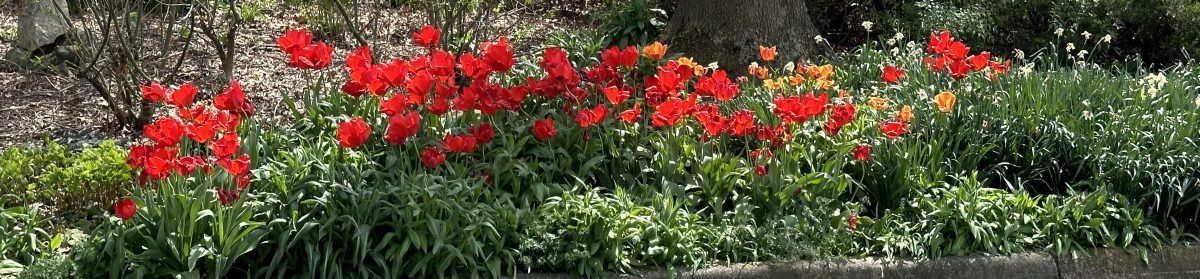
French lilacs by Bruce Stambaugh

When the French lilacs
start to bloom in Ohio
frost is a good bet.

Bruce Stambaugh
May 3, 2011

A mess of morels

Morel mushrooms by Bruce Stambaugh

It was quite the haul.
I found the first mushroom and
my son the other.

Bruce Stambaugh
April 29, 2011

A window with an ever-changing view

Ohio sunrise by Bruce Stambaugh
One of the many spectacular sunrises I've seen through my office window.

By Bruce Stambaugh

I’m glad I have a window with a view in my home office. That view is forever changing, sometimes subtly, sometimes dramatically.

When our daughter flew the coop 13 years ago to marry the love of her life, her mother and I converted her bedroom into our home office. The room was just the right size to meet our workplace needs. The cheery double window to the outside world was an added bonus.

My work area occupies the space right beside the window on the east side of our east-facing home. My wife’s computer desk is to my right. The window affords me some periodic and necessary breaks from the long-term sitting I do at the computer.

I’ve seen a lot over all the years peeking out that office window. Keep in mind our house is built on an Amish farm on a very busy county road that cuts through the heart of the world’s largest Amish population.

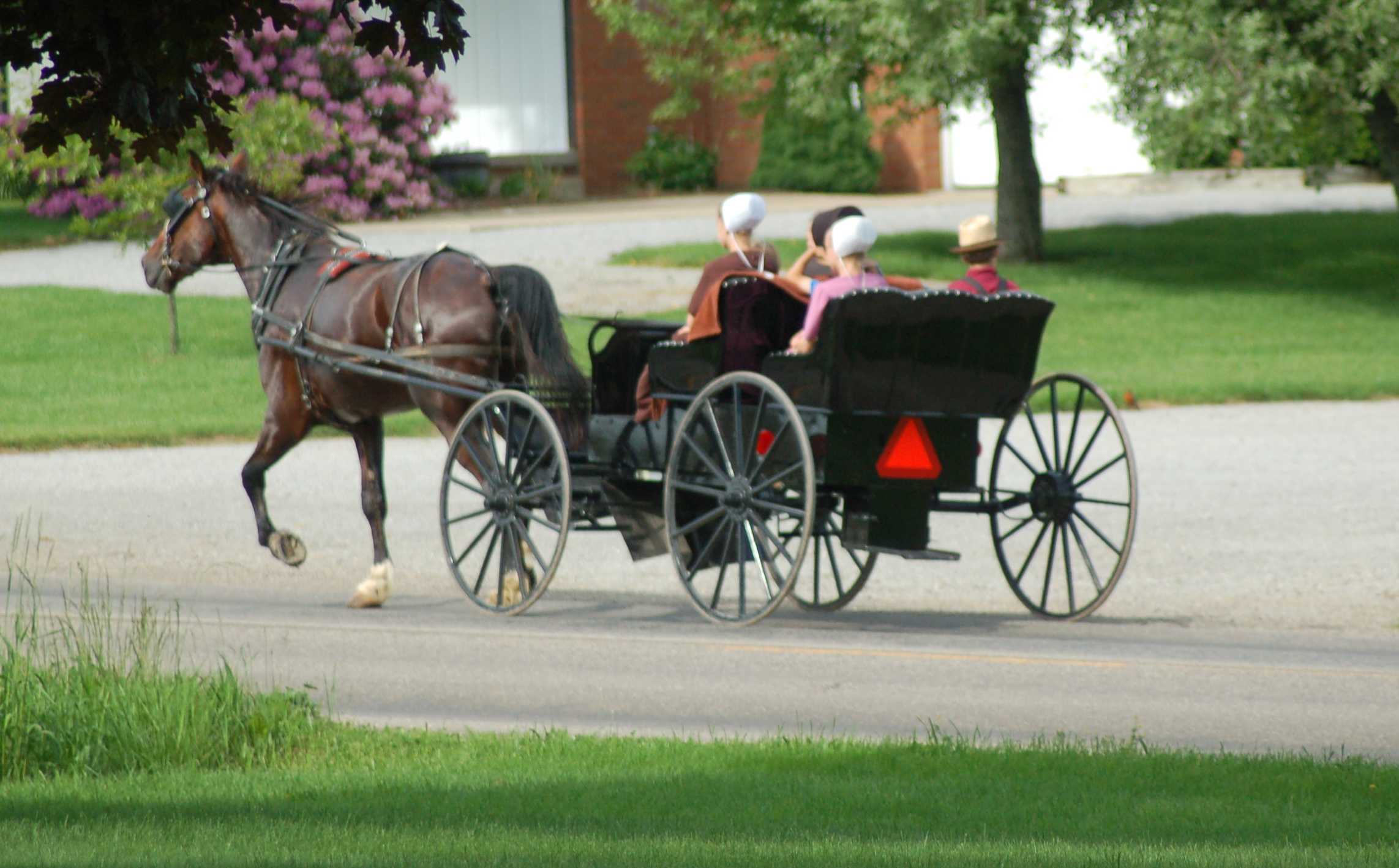
Horse and buggy on CR 201 by Bruce Stambaugh
Horse and buggy traffic is common along Holmes County Road 201.

The surface of County Road 201 routinely carries an amazing array of cargo. If I were to create a catalog of the movements north and south along the road, I would have a pretty thick document.

The booklet’s index would include several categories. A random representation of the locomotion I’ve witnessed would include canoes atop buggies, bicyclists, strings of antique cars, wagon trains, tractor-trailer parades, tractors pulling wagon loads of people sitting on lawn chairs, speeding motorcycles and dedicated joggers.

Of course, not everything I have seen has buzzed by on the highway. We rejoice when we see our neighbors readying their equipment to head out for their work away from home jobs. Given the economy, that surely is a happy sight.

Hoar frost by Bruce Stambaugh
Hoar frost stuck to twigs on a dogwood bush.

Some of the prettier things we’ve observed through the window include incredible sunrises, spiny hoar frost stuck to everything it touched, and triple rainbows. I have watched as golf ball sized hail covered the ground. Blinding snow squalls prevented me from seeing the roadside mailbox.

I have seen some rather ugly images out that window, too. Auto accidents and insensitive people pitching litter from passing vehicles make that unpleasant list.

My favorite observations, however, are the animals I see. And just like the highway bill of lading, I have watched a variety of wildlife engaged in assorted activities in every season. Eastern Bluebirds have perched atop the lamppost positioned along the front sidewalk. Deer scurried for cover by taking a shortcut through the front yard.

Cooper's Hawk by Bruce Stambaugh
A Cooper's Hawk pinned its catch, a Mourning Dove, to the snowy ground.

After one of last winter’s heavy snows, I spied a Cooper’s Hawk pinning its Mourning Dove breakfast to the ground, feathers scattered in a broad oval around the crime scene. I shot lots of pictures through the window for evidence just in case the assault ever got called into court.

Recently, a curious flash drew my attention away from the computer, through the window to the greening yard. A Red-tailed Hawk had swooped down to claim a fox squirrel that had been run over on the road earlier that day.

Hawk and squirrel by Bruce Stambaugh
The dead fox squirrel was simply too heavy for the Red-tailed Hawk to lift for any distance.

As the hawk tried to roost in one of our Norway maple trees, it dropped the flattened rodent. Try as it might, the hawk could not fly away with its fortunate find.

Finally, the frustrated hawk left still hungry. I took pity on the poor dead squirrel, went outside and placed the mutilated carcass at the base of the tree trunk.

The next morning I discovered the squirrel was gone. Though curious as to what had happened to it, I was really thankful that was one incident I didn’t have to view out my window.

Bluebird on ice by Bruce Stambaugh
A male Eastern Bluebird perched on an ice-covered limb outside my office window.

Staying connected is really important

By Bruce Stambaugh

It didn’t take long for our year and a half old granddaughter to warm up to me when my wife and I visited with her and her family recently in Virginia. Since we live in Ohio, we don’t get to interact with them as much as we would like.

Once Maren felt comfortable in my presence, she was fascinated with my bald head. When I bent down to her toddler level, the beautiful little girl boldly reached out and patted my baldness.

Now and then, after patting and rubbing my head, she would move her hand down, and jab her dimpled index finger into my beard. That little gesture generated an ornery laugh from the precocious Maren.

Granddaughter by Bruce Stambaugh
Poppy and Maren

It was as if she were saying, “If Poppy can grow hair on his face, why can’t he grow it on top of his head?” I’d like to know the answer to that question, too.

Maren was connecting with me inquisitively, creatively. Her affectionate patting and prodding warmed my heart. I truly felt connected.

Near the end of our extended stay in the beautiful Shenandoah Valley, I attended a two-day conference entitled “Conversations on Attachment.” It was about how we humans interconnect with one another, and why it’s so important, even for bald guys.

The words of the various articulate speakers evoked mental examples of meaningful interactions with others. I felt blessed.

Here were renowned psychologists, doctors, therapists, professors and theologians providing well-researched and published theories and studies confirming what I already believed. Humans are social beings designed to be interdependent. We are intended to live in community and in close relationships. One speaker described the collective process of positively relating with others as “a shared humanity.”

Before my wife and I left for our Virginia visit, our son and his wife graciously hosted us for dinner. Knowing how well they cook, I was more than glad to accept their kind invitation in honor of our 40th anniversary.

In addition to the magnificent food, we were pleasantly surprised with the inclusion of the best man at our wedding and his wife. The couple has been lifetime best friends with us. It was an engaging evening of delightful conversation and cuisine.

Texas BBQ smoker by Bruce Stambaugh
Son-in-law, Daryl Bert, and his Texas barbecue smoker

Before leaving Virginia, our daughter and son-in-law repeated the surprise performance at our last supper there. Using his best transplanted Texan barbecue skills, we dined on smoked pork ribs and incredible grilled burgers.

Again, we didn’t feast alone. Our daughter clandestinely invited four couples we had known over the years and with whom we had oft interacted. Now they all lived near her. She also invited our niece, a fellow Virginian. Just like before, we had no idea they were coming.

They each brought their own delicious dishes to complement the meaty main course. When the scrumptious meal wound down, our daughter had the guests disclose how they knew us. As the sharing evolved, something truly amazing unfolded. Though some around the table had never met, as they listened they realized they knew some of the same people mentioned in the various stories.

Their connecting with one another generated joyous revelation. The combination of the great food, inspiring conversation and spontaneous connectivity made it a truly fulfilling gathering. We had held our own attachment conference.

The great food, lively conversing and personal discoveries around the table equated with patting me on the head and poking my beard. I couldn’t get more attached than that.

The politics of Jesus

Notice that Jesus
rode a donkey, not an elephant,
into and out of his earthly life.

Bruce Stambaugh
April 13, 2011

Traveling the Constitution Route, then and now

Montpelier by Bruce Stambaugh
Montpelier, home of James and Dolly Madison.
By Bruce Stambaugh

White, pink and yellow floral displays, both wild and domesticated, brightened the cold, steely overcast morning, invigorating our drive along Virginia’s historic Constitution Route.

Pastels predominated in the form of flashy forsythia bushes and clusters of buttery daffodils, showy pink magnolia petals, peach, cherry and redbud blossoms. Serviceberry bushes and flowering ornamentals showed their whites against winter’s dormant and dull remnants.

Familial signs at the gates of long lanes announced the names of many old money mansions of the sprawling plantations that now operate as horse and cattle farms all along the serpentine trail, officially known as Virginia Route 20. Mint Meadow, Gaston Hall, Hershey Hill, and Somerset were only a few of the rolling farms’ monikers.

Blooms at UVA by Bruce Stambaugh
Ornamental trees were in full bloom in Virginia.

Miles of fences, some white as the tree blossoms that kept them company, others stained soot black, still others meshed wire, lined the curvy route between Montpelier, James Madison’s home, and Monticello, Thomas Jefferson’s architectural wonder.

Most of the meandering highway on the 40-minute drive closely followed the very route that these two founding fathers and United States presidents had traveled by horseback or carriage more than two centuries earlier.

At one of the lazy s-curves, with a greening meadow on the east side and a dense deciduous woodlot on the other, a Bald Eagle flew across in front of us. Its talons clutched a trailing tangle of leafy vines, likely the softer lining for its bulky stick nest.

Though we were traveling at a much faster pace in a much faster world, I couldn’t help but sense the history that had happened along this path and at the dignified homes we passed. Only now farmhands groomed the horses and fed the cattle instead of slaves.

Madison statue by Bruce Stambaugh
A lifesize statue of James and Dolly Madison accentuates the beautiful backyard at their historic homestead, Montpelier in Virginia.

At Montpelier, a spreading magnolia in full-bloom served as the backdrop for a life-sized bronze statue of James and Dolly Madison. Though slight in stature, both were giants in establishing the democratic and social courses for our fledgling republic.

The ingenious Jefferson, author of our Declaration of Independence, and the meticulous Madison, the father of the Constitution, regularly rode the Constitution Route to each other’s homes to both socialize and pontificate.

To walk in their footsteps and see first hand their magnificent homes, slave quarters included, and to learn more about their magnificent minds and accomplishments was beyond inspirational. It was humbling and moving.

Exploring there was a refreshing retreat from the current turbulent and often selfish political times in which we find ourselves. Silently I wondered what these two great men would say about today’s state of affairs. At each location, the informative visitor centers helped answer that pondering.

Montpelier slave quarters by Bruce Stambaugh
Excavating the living and working areas of Madison's slaves at Montpelier is underway.

Jefferson and Madison, both learned visionaries who lived at opposite ends of the Constitution Route, were united in determining the direction the Constitution should take, that all people are created equal and endowed with specific freedoms.

Virginians will quickly point out that both men played prominent rolls in developing the Virginia Statute of Religious Freedom. Their joint influence is revealed in the law: “The religion then of every man must be left to the conviction and conscience of every man.” That concept was the first point Madison made in the Bill of Rights.

The two homesteads were fascinating to tour. The dedicated commitment of Jefferson and Madison to form, frame and cement certain rights, including the choice of religion sans government endorsement or coercion, made the Constitution the jewel in the crown neither president ever wanted to wear.

Monticello by Bruce Stambaugh
Thomas Jefferson's masterpiece, Monticello.

Things don’t always go as planned

Monticello by Bruce Stambaugh
Pastel blooms accented Monticello's architectural beauty.

By Bruce Stambaugh

I’m a planner. So is my wife.

When we arrange a trip, like we did for our 40th anniversary that we recently celebrated, we share completing the travel details. We also recognize that not everything can be foreseen.

We have come to expect the unexpected, especially in our travels. The motel room doesn’t look half as good in person as it did on the website. Highway construction forces us to take an alternate route. A storm cancels our scheduled flight.

Those examples of inconveniences can be amended. Add in the human factor, however, and unanticipated events can throw a real curveball into the most detailed itinerary.

Robert Burns immortalized this phenomenon in his poem, “To a Mouse,” when he wrote, “The best laid plans of mice and men oft go astray.” That’s what happened on our anniversary trip.

Our 11-day Virginia vacation seemed simple enough. The first couple of days we would watch our grandchildren while our daughter was away and her husband had several business meetings. We would then escape a few days for our anniversary, and finish up the trip back at our daughter’s place.

We devised all sorts of ideas to occupy the trio of grandchildren, ages six, four and one and a half. Before we left Ohio, we knew the oldest one was ill. By the time we arrived, the youngest had a double ear infection.

Obviously our activity scheme had to be altered. Baby-sitting now included health care. I did squeeze in some individual playtime with the middle child. But even that was limited due to the raw, dank weather. The south had had a harsh winter, too, and although spring had officially arrived, winter still held its heavy hand on the Virginia landscape.
Virginia snow by Bruce Stambaugh
On our anniversary morning, we awoke to four inches of fluffy white snow and the third grandchild also sick. Things weren’t going the way we had hoped.

With reservations made in the historic Charlottesville area, we reluctantly headed out, but only after the temperature warmed enough to slowly melt the snow. Knowing our son-in-law would be home to help a couple of days lessened any grandparent guilt for leaving.

We enjoyed our time away, visiting just some of the several significant places in the history of our country. The weather cleared for our visits to the architecturally amazing University of Virginia campus, picturesque Montpelier, Thomas Jefferson’s masterpiece, Monticello, and James Monroe’s estate.

Montpelier by Bruce Stambaugh
James and Dolly Madison's Montpelier.

Then it was off to quaint, revitalized Staunton for a night before returning to our daughter’s place further up the beautiful Shenandoah Valley. At Staunton, our plans were again derailed. The flu bug caught up to my wife, and when we awoke the next morning snow was again flying. On top of that, I wasn’t feeling the best myself.

Fortunately, the snow didn’t reach the forecasted amount. Unfortunately, our daughter let us know that she was on the way to the doctor with the four-year-old.

By the time we arrived back at our daughter’s, the kids were playing and glad to see us. Our granddaughter kept calling my name, Poppy. Poppy just wished he had felt well enough to answer her call.

Instead, after a bowl of chicken noodle soup, it was off to bed. Like much of our time away, that’s not what I had wanted or planned, an all too personal example of what poet Burns had penned.

Looking for answers to some of life’s perplexing questions

By Bruce Stambaugh

From little on up, I have always been an inquisitive person.

One of the neighbor ladies from my suburban rustbelt neighborhood where I grew up must have noticed it. She called me “The Beacon Journal,” in honor of her favorite daily newspaper I presumed.

Seems I was always asking questions. If something happened in the neighborhood, I had to know all the assorted details, whether they were any of my business or not. They usually weren’t.

That inquisitiveness probably had a lot to do with my decision to major in journalism in college. Enjoying writing helped, too.

I still have the same inquiring mind today. The need to know is paramount from my perspective.

No matter what I’m doing, I seem to always be thinking of questions. Oftentimes they are totally unrelated to what I’m doing, which should come as no surprise either.

That mental process happens a lot when I’m on long trips, whether flying or driving. A big rig passes me and I wonder what the trucker is hauling. I see a jet cruise overhead and I wonder what were its points of departure and destination.

I ponder both the ludicrous and the serious stuff of life. In fact, I think about questions so much I started a list. I figured if I shared them with you I just might get some answers.

In no particular order, here are some of the significant questions conjured by my motivated mind.

• Once you pull those folded up canvas chairs out of their covers, does anyone ever put the chairs back in the covers again?

• How is it that you can put four pairs of socks in the laundry and when you retrieve the wash from the dryer you have nine socks and only six match?

• How far back should you stay from a car with the vanity plates H1N1?

• How many chocolate covered raisin clusters equal a serving of fruit?

• Why does it feel colder when it is raining and 36 degrees than it does when it is snowing and 26 degrees?

• Why do referees at high school basketball games wear jackets during the pregame warm-up when the gym is already stifling?

• Why don’t men know how to replace an empty toilet paper holder?

• Why is it that when you are driving with the windshield wipers going and they streak, the streak is always at eye level?

• Why do most people use the top plug in an electrical receptacle first, which blocks the use of the bottom plug?

• Do fish sleep?

• Why is the Big Ten Conference called that when it has 11 schools in its league?

• How can there be such a thing as “live video?”

• Even when they can see the road is inundated, why do drivers daringly head right into flooded roadways, often to be stranded and eventually rescued?

• Why did the Cleveland Indians trade Rocky Colavito for Harvey Kuenn?

• Why do rocks that are naturally imbedded in soil find their way to the surface while rocks that you set in flowerbeds gradually sink?

I suppose I could have Googled for the answers to these pressing questions. But I’d rather hear from you. I look forward to seeing your answers, I think.

Wayne on Wayne

My wife and I
stayed in a bed and breakfast
in Waynesboro on Wayne St.,
and the owner’s name was Wayne.
I couldn’t, no I wouldn’t make this up.

Bruce Stambaugh
March 29, 2011

For this marriage, the key to success is no secret

Bruce and Neva Stambaugh

By Bruce Stambaugh

Where do you begin to share about being married to the same person for four decades? After all, my wife and I have been through a lot together during those 40 years.

Perhaps the best place to start is at the beginning. And what a beginning it was.

Crazy as it sounds, nine days after we met we were engaged, although we did wait a month to make it public. We didn’t want people to think we were totally nuts. We were married nine months later. When our two children were old enough to understand, we advised them against using our expeditious courtship as a model to matrimony.

I can remember our wedding day as if it were yesterday. I was so scared that I didn’t even notice that the farm field next to the church had been sprayed with liquid manure that afternoon.

Before the receiving line had formed, I got a taste of what married life really would be like. I accidentally stepped on the train of my wife’s wedding dress, and immediately had her finger in my face. I think that’s when I started to smell the manure.

Our son once asked me what was the secret to the success of our marriage. I simply told him that his mother and I have had no secrets between us. What happens happens. Good or bad, helpful or harmful, “for richer or for poorer,” it’s all out there.

Like most marriages, it hasn’t always been pretty or blissful. No marriage is perfect, including ours. Sure, we air things out, but in so doing try to always maintain our love, respect and admiration for one another. We may have raised our voices to one another from time to time, but never a hand.

We haven’t come this far together on our own either. Family and friends have graciously helped us along the way. Our parents were excellent models of wedded commitment.

From them we learned not only to serve others, but to also enjoy each opportunity that would come along. We try our best to humbly help wherever and whenever we can.

Another plus for us is that Neva and I have a lot in common. We love to travel, enjoy quietness, sunsets, nature, and sharing a meal with guests. Hospitality is one of Neva’s greatest gifts.

Of course, we each do our own things, too. She reads. I write. She quilts. I bird.

That might be another element that cemented our marital longevity. We wisely allow each other our own space and time, without a hint of jealousy or suspicion. If you truly love someone, trust is everything. Break it, and you find yourself back at square one or worse.

For me, the best part of being married for 40 years is just that. We have been married for 40 years. Our marriage has been an investment in one another, our wonderful children and their spouses, our grandchildren, our families, the community, friends, and our church family. We have been blessed by their contributions to us, too.

Where do you end sharing about being married to the same person for 40 years? For that answer, it’s probably best to go back to the beginning, again: “Until death do us part.”

Bay Photos by Donna

Wildlife Photos From The Chesapeake Bay Region

ROAD TO NARA

Culture and Communities at the Heart Of India

K Hertzler Art

Artist and nature journalist in the Shenandoah Valley of Virginia.

Maria Vincent Robinson

Photographer Of Life and moments

Gabriele Romano

Personal Blog

Jennifer Murch

Art is the only way to run away without leaving home. -Twyla Tharp

Roadkill Crossing

Writing generated from the rural life

ANJOLI ROY

writer. teacher. podcast cohost.

Casa Alterna

El amor cruza fronteras / Love crosses borders