Birding Ohio’s Amish Country

By Bruce Stambaugh

Horses and buggies. Pastoral, broad valleys amid rolling hills frescoed with quilt-like patterns of crops. Fine, handcrafted furniture. Delicious, bountiful meals at reasonable prices.

All of the above are reasons scores of people from far and wide annually travel to Ohio’s Amish country. There is yet one more unassuming category to add to the list: birding.

With its diverse topography, greenery and abundant waterways, Ohio’s Amish country is a birder’s paradise. The area offers both a wonderful spectrum of bird species and excellent birding locales.

Ohio’s Amish country offers something for the novice, casual or serious birder. Birders can find migrating birds, native residents and the occasional rare visitor. The area affords numerous birding spots easily accessible for persons of all ages. A good pair of binoculars will help enhance any aviary quest in Amish country.

A good place to start the birding expedition and get a little exercise as well is the Holmes County Rails to Trails that cuts an easy diagonal through the county. The main starting point and parking lot is at the old railroad depot just north of West Jackson St. in Millersburg, the county seat. This 15-mile paved trail runs from Fredericksburg in Wayne County to Killbuck in southwestern Holmes County.

Following this trail provides a sampling of the birding habitats found throughout the area. However, its dominant geographic feature is the Killbuck Creek valley, a major north-south flyway for migrating birds and a wonderfully dense habitat for year-round bird residents. Woodlots, marshland, open water and cropland are in close proximity all along the trail’s length.

Birders should be aware that horse and buggies, horseback riders, bicyclists, runners and walkers use the trail, too. Birding etiquette and safety dictate setting up spotting scopes or viewing with binoculars on the side of the trail. All types of waterfowl can be found among the reeds and rushes in the marsh areas. Even a rookery of Great Blue Herons can be seen.

Not far from the north end of the Holmes County Trail is another outstanding birding area, the Killbuck Marsh Wildlife Area. An excellent observation spot is at the east end of Force Road, which is accessed from Valley Road east of Shreve.

From this vantage point, if one is patient, birders can view an array of species. American Bitterns, a wide variety of ducks, rails and even Bald Eagles may be seen. The Killbuck Marsh is a state run wildlife management area.

Two other state-owned areas in Ohio’s Amish country also offer excellent birding opportunities. The Funk Bottoms Wildlife Area is located in Wayne and Ashland counties, and Mohican State Park in southern Ashland County.

With its moist soil and shallow water habitat, the Funk Bottoms is a natural wetland area consisting of about 1,500 acres, mostly along State Route 95 near Blachleyville. The Ohio Division of Wildlife said birds that frequent the area include 23 species of migrating waterfowl, including Tundra Swans and Sandhill Cranes, and 28 species of shorebirds. A variety of raptors also winter over and are seen during migration.

Mohican State Park is a spectacular location for many activities, especially hiking and birding. With its dense forests and large open body of water, Bald Eagles and Ospreys have been spotted. The park is located just west of Loudonville between State Routes 95 and 97.

In the eastern end of Amish country sits another ideal birding spot, The Wilderness Center. It provides excitement for even the most novice birder. The Wilderness Center is located on Alabama Ave. off of U.S. 62 near Wilmot in Stark County.

With marked trails, an informative and hands-on interpretive building, it is the perfect place for families. From restored Ohio prairies to old growth forest, The Wilderness Center is host to a wide range of birds, especially songbirds.

With its checkered, rolling farm fields, spring-fed streams and treasured woodlands, many species of birds can be observed merely by driving around the back roads of Amish country. If you happen to see a farmer spreading manure in the winter, look for Horned Larks and Snow Buntings. If hay is being mowed in the summer, watch for Barn, Tree, Bank and Cliff Swallows circling for insects.

The area also boasts high numbers of Bobolinks, Eastern Bluebirds and Barn Owls. Since many avid birders live in the area, visitors can find good advice on where to bird and what might be found simply by asking.

A pair of juvenile green herons perched on a TV antenna.

This article appeared in the March 2010 edition of Ohio’s Amish Country.

The winter that wouldn’t end

By Bruce Stambaugh

The winter that seemingly would not end finally has. I hope.

Spring is now within sight. The vernal equinox officially arrives on Saturday, March 20 at exactly 1:32 p.m.

That milestone won’t guarantee that winter won’t quit. But it’s nice to know that if it does show its frosty face again, the odds are in our favor that a late winter sting won’t hurt us like the series of heavy snows we incurred in January and February.

For a while there, it seemed like everything had come to a freezing halt. It would snow. The road crews worked hard to free the highways of their slippery burden, and just when you thought it was safe to travel again, it snowed again.

During a normal winter in the western Appalachian foothills of Holmes County, Ohio, a couple of feet of snow are spread over several months. This winter we recorded more than three feet of snow in February alone.

With the weight of this winter still upon us, it seems spring has been a long time in coming. It was magnificent to get an early peek at what lies ahead with the recent string of sunny, warm weather here in Ohio’s Amish country.

It’s truly amazing what warmer weather does. I only had to step outside to fully appreciate the preview of spring.

The backyard birds filled the air with their choruses. Robins came out of hiding in the thick woods to begin scouting out their nesting territories. The resident Song Sparrow, which became reclusive in winter and played it low to the ground, perched high in a crimson maple, tilted its head back and cut loose.

Over the course of just a couple of days, the blanket of snow vanished altogether. Even the huge piles of plowed snow were greatly humbled by the bright sun and balmy temperatures.

If ever there were a perfect example of cause and effect, the melting snow would be it. The ground was so saturated from the abundant moisture that Mallards swam the temporary pond in my neighbor’s grain field.

Flower petals pushed through the mushy earth, as if reaching for the inviting sun. The daffodil heads swelled, readying for their brilliant birth. In our flower gardens, Johnny Jump Ups were the first to bloom.

Life stirred in my little garden pond, too. The mountain of snow that once surrounded the poor pool did a glacial retreat. The caretaker pair of bullfrogs ventured out in search of any wayward insects, and to bask in the sunshine’s warmth.

The school of goldfish revived. The largest broke water as I cleaned out the gunk from the pump. I don’t know if it was showing off or begging for food. The pump filters were so clogged with slime it was a wonder water still flowed over the little waterfalls.

I couldn’t help but notice doors and windows open in homes, shops and cars alike as I ran errands. Shoot, those with convertibles were driving around like it was July. After this cold, snowy winter, I couldn’t blame them. It felt like it.

People personally expressed their relief that an end to this nonstop winter seemingly had arrived. They appeared more congenial to the point of being jovial.

For those who longed for an old-fashioned winter, you got your wish. Let’s hope those that hunger for a perfect spring get theirs, too.

The case of being too fat to fly

Black Vultures hang around a large alligator at Myakka River State Park near Sarasota, Florida.

By Bruce Stambaugh

As the plane sat on the tarmac waiting permission to take off, I filled my idle time peering through the thick porthole. Meadowlarks chased one another and American Kestrels swooped for rodents above the broad grassy areas between the concrete avenues.

I watched other jetliners defy both logic and gravity, race down the runways and lift into the air. Aerodynamically, their appearance belies the fact that they actually can get airborne. The jumbo jets especially seemed too fat to fly. Yet, they taxied, throttled and despite their bulkiness climbed into the sky effortlessly.

When the words “too fat to fly” came to mind, I flashed back a month to our time in Florida. My wife and I and our good friends had taken a boat tour on a lake at Myakka River State Park. The guide filled us in on the unusual appearance of hundreds of vultures gathered all along the shorelines. Most were Black Vultures with a few Turkey Vultures thrown in, their red baldheads making them conspicuous.

We had gone to the park to see alligators, shorebirds, birds of prey, and to learn of the local floral and fauna. The congregations of vultures were an unexpected bonus, present everywhere. To the locals, the flocks of homely birds were a necessary nuisance, even roosting on campers and cars.

Their appearance was easily explained. Prior to our arrival in the Sunshine State, which was mostly cloudy and cool while we were there, an extended cold snap had settled in.

Between the below freezing temperatures and the lack of sunshine, both the water and air temperatures had dropped well below normal for a sustained amount of time. In fact, the Gulf of Mexico had registered 49.6 degrees Fahrenheit, amazingly cool for that expansive tropical body of water.

Citrus and produce farmers fought the cold conditions by misting their nearly ripe crops. The cold temps effectively coated the fruit with ice, saving most of the delicate commodities. Fishermen had no such option. The unusually cold water killed tens of thousands of fish.

Upper Lake Myakka was no exception. The guide said that at least 30,000 fish had died from the shallow lake’s much reduced water temperature. Of course, the dead fish soon washed ashore and the throngs of vultures voluntarily arrived to clean up the mess. Their sense of smell is truly amazing. The fishy smell we sensed was equally amazing, even weeks after the big kill.

The impressive, black birds had cleaned up most of the carcasses by the time we took the tour. Nevertheless, the pungent odor lingered, as did the vultures.

Days after the fish kill, park officials noticed something odd about the vultures. The unsightly creatures just lay around as if they were sick. Concerned, biologists easily caught and examined a few of the birds to find the cause of their lethargy.

After running multiple tests, the scientists came to a very logical conclusion. The vultures had eaten so many dead fish they were simply too fat to fly or even walk for that matter. All they needed to do was to stop eating, and they would be fine.

By now, it was our plane’s turn to take off. I double-checked my seatbelt, readied myself for the runway sprint and sudden ascent into the cloudless sky. But with the overstuffed vultures on my mind, I didn’t want to take any chances. I said a silent prayer that this particular bird wasn’t too fat to fly.

Turning thoughts into actions

By Bruce Stambaugh

I don’t know about you, but I do a lot of thinking while I’m shoveling snow. Given the amazing amounts of snow that have fallen this winter, my brain is about as strained as my back.

With two feet of snow on the ground, the most logical thought was obvious. Where would I put it all? The sidewalk already looked like the Grand Canyon, and the piles that lined the cement parking pad and limestone driveway were even higher.

As I shoveled my way around the house, making access to bird feeders easier, I realized my thinking strayed far from my physical task. My thoughts were so meandering that I absent-mindedly pitched the snow upwind.

Even with that rude awakening, my mind continued to wander. Is this a symptom of cabin fever or old age or am I just a typical man? Since I am not really expecting answers, we’ll go with all of the above.

I found Mourning Dove feathers in a couple of places. I wondered what predator dined on this prevalent and apparently delectable bird. Was it an owl, a hawk, a cat? I brushed the feathers aside and kept shoveling.

I thought about my friend, Jose, a coffee farmer who lived near San Marcos, Honduras where I visit occasionally. Jose, a tall, quiet, generous man, was killed recently in an accident while trimming a tree on his farm.

Jose was such a hard worker, a family man, dedicated to representing his little community the best he knew how. I’ll never forget the day I rode in the cab of his old, dented pickup truck, up the switch-backed, bumpy, one lane road to his two acre stand of vibrant coffee bushes growing on a steep mountain slope.

Though Jose knew no English, and I little Spanish, his non-verbal communication oozed hospitality. He turned our small group loose on those poor coffee plants and enjoyed the show, his welcoming smile continually flashing.

Several cardinals took flight as I rounded the house to the backyard. I had interrupted their lunch of cracked corn and oil sunflower seeds.

I thought about the Sunday morning service at the little church we attended while vacationing in Florida. I had already enjoyed some local birding opportunities, but never expected to be able to do so while at church.

The service was held in a room with large windows that faced a broad stream that met the Gulf a mile away. The faithful pastor had his back to what was happening outside.

While he preached, Black and White Warblers and Phoebes played in the banyan trees, live oaks and palms. Beyond the lush banks, Buffleheads scurried through the stream’s shallow water. Snowy Egrets and Black-crowned Night Herons waded, too.

I had just about completed my shoveling when I thought about my new friend, Fritz. He and his family had survived the catastrophic earthquake in Port-au-Prince, Haiti, and had miraculously found their way to our little corner of the world in Ohio’s Amish country.

I remembered Fritz staring straight ahead while he related his harrowing story as if he were reliving each horrific moment. All I could do was listen. I felt for Fritz and his family. They had lost everything, including close relatives.

Amid the natural beauty around me, in Sarasota, in the mountains of Honduras, even in ravaged Haiti, my contemplative jigsaw puzzle reminded that life wasn’t always pretty. My efforts resulted in much more than snow removal.

Long after this deep snow has melted, opportunities to help others in need will abound. That conclusion doesn’t take much thought.

Winter is for the birds

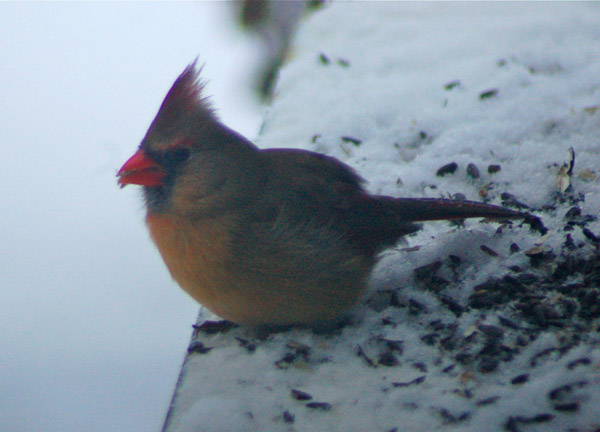
Female Cardinal

By Bruce Stambaugh

I am of the opinion that winter is for the birds. I mean that literally.

Watching the backyard birds enjoy the variety of foodstuffs at the feeders is my winter’s entertainment. The various kinds of feeders are stocked with an assortment of options for the birds to devour, and are placed for safe access by the birds and convenient observation by me.

In the feeding frenzy, the birds put on quite a show.

Several kinds of birds enjoy the spoils of the tube feeder filled with sunflower hearts. The feeder hangs in front of the kitchen window and can accommodate six birds at a time, if all goes well. However, just like people, birds get greedy and guard their territory, even though there is plenty for everybody.

The American Goldfinches seem to be the best behaved, often feeding in families around the feeder’s cardinal ring. It’s named that so that cardinals can enjoy the seeds, too. Cardinals normally prefer a flat surface or the ground for feeding. But occasionally the bright red males and reddish tinged olive females will take advantage of their namesake.

Despite their bright coloration and moderate size, cardinals tend to be skittish creatures and fly off at the first hint of trouble. A few of the cardinals prefer the cracked corn that is spread at the base of the sugar maple. But so does the feisty Song Sparrow, which easily scares off the bigger bird. Using its clawed feet, the Song Sparrow jump kicks at the seed, even though it wouldn’t have to. Hereditary habits are hard to change.

Other sparrows show their faces as well, especially if the ground is snow-covered. The pretty Tree Sparrow, with its distinctive yellow bottom bill, joins the feast along with the showy White-crowned Sparrow. The latter is one of the few species that sings in the winter. Their beautiful tune can warm even the coldest day.

The real fun begins when the acrobatic nuthatches, Chickadees and Tufted Titmice arrive, which they often do simultaneously. I am fortunate to have both White-breasted and Red-breasted Nuthatches, a first for me, coming to the feeders. They are the only birds that move headfirst down the trunk of a tree.

These birds take full advantage of the menu offered at the feeders. If the black oil sunflower seeds aren’t available, they might enjoy some extra protein that the suet provides. Or they might savor a hulled peanut.

All these birds give way when the bully Blue Jays appear. They loudly announce their arrival, and scatter the other birds with their arrogant intrusion. The jays gulp down a gullet full of seeds before flying off with their meal.

An even bossier bird is the Red-bellied Woodpecker. It wants to dine alone while partaking of the smorgasbord offerings, especially enjoying the peanuts. But they can be finicky, too. The next trip in the same bird may hit the ear corn.

Perhaps my favorite visitors are the Eastern Bluebirds, normally not noted as feeder birds. They do enjoy the brilliant holly berries right from the bush out front, but they also have been seen imbibing at the suet and sunflower feeders.

There are times, though, when the birds just don’t show up at all. It’s then that I know that perched nearby is the neighborhood Cooper’s Hawk, which loves a songbird lunch.

Occasionally I know that the swift hawk has enjoyed my feeders, too, at least indirectly. A pile of House Finch feathers atop the snow provides the proof.

Female Red-bellied Woodpecker
Bay Photos by Donna

Wildlife photos from the Chesapeake Bay region

ROAD TO NARA

Culture and Communities at the Heart Of India

K Hertzler Art

Artist and nature journalist in the Shenandoah Valley of Virginia.

Maria Vincent Robinson

Photographer Of Life and moments

Gabriele Romano

Personal Blog

Jennifer Murch

Art is the only way to run away without leaving home. -Twyla Tharp

Roadkill Crossing

Writing generated from the rural life

ANJOLI ROY

writer. teacher. podcast cohost.

Casa Alterna

El amor cruza fronteras / Love crosses borders