Look who’s talking now

Amish phone booth by Bruce Stambaugh
A phone booth on an Amish property is often placed away from the home to avoid the temptation of overusing the phone.

By Bruce Stambaugh

On a dark, chilly November night several years ago, an emergency medical technician arrived on the scene of a car verses buggy accident at a rural intersection. Unlike the car’s passengers, the older Amish man driving the lantern-lit buggy was uninjured.

As the scene cleared, the first responder asked the Amish man how far he had to go to call for help. With a toothless grin, the Amish man reached into his denim jacket and flopped opened a cell phone.

In the early days of cell phones, when even the EMT didn’t have one, that scenario might have been rare in Amish country. It isn’t any longer. As contradictory as is it may sound, Amish have and use telephones. They use them to converse, to fax, for GPS, to text, and on rare occasions, to access the Internet.

Of course, like many of other Amish lifestyle “rules,” there are many variables in the Amish – phone connection. Church leadership metes out phone use guidelines for Amish. Those rules and their application vary greatly. It all depends on which church and which order of Amish as to what the rules may allow. The rules about phone use, like other lifestyle guidelines, even differ from church to church within the same order of Amish.

Amish place by Bruce Stambaugh
The home of a young Amish family in Holmes County, Ohio.

The orders of Amish, if placed on a continuum, would range from New Order on the left to the Swartzentruber’s on the right. In other words, from the most progressive to the most conservative, with those terms being used in the religious sense, not politically. In between are the most numerous, the Old Order Amish that people describe when they refer to the sect.

The extremes of phone use by Amish would range from members of one church group permitted to have landline phones in their residence to others that are permitted no phones at all. Again, their individual church leaders determine how and where Amish use phones. This may seem strange or even unfair to those unfamiliar with the Amish, and sometimes to those who even live among them. But simply put, that’s just the way it is.

Driving down any highway in Amish country will reveal which families and businesses are not permitted to have landline phones in their buildings. Near the edge of the road, travelers will see small buildings about the size and shape of the old-fashioned phone booths with a door and usually a window for light.

They look like phone booths because that is exactly what they are. Enclosing the phone in a small structure protects the person using the phone from any inclement weather and provides privacy. The homemade phone booths are usually locked to prevent any vandalism or misuse.

Amish farmstead with phone booth by Bruce Stambaugh
Find the phone booth among all the other buildings on this farmstead near Walnut Creek, Ohio.

Such phone booths could be used by a single family or business, or by multiple families. Each family or business would have its own voicemail extension. The phones are not answered live.

Some churches require that phone booths be so many feet from the home or business. Some even require the phone to be across the road, so as not to be too convenient, thus reducing the possibility of casual use. Some Amish, especially the New Order sect, would allow a landline in their home.

In many churches, phones for calling out and faxing are permitted in the business, but not in the home. Incoming calls go directly to voice mail. This rule is economically weighted. The successes of cottage industries, which have boomed among the Amish in the last two decades, are critical to the welfare of the Amish community. Only about 10 percent of the Amish population farms today. The rest either have their own businesses or work at other local businesses.

Of course, any discussion about Amish and the use of phones would be incomplete without mentioning the ubiquitous cell phones. Cell phones are actually more widely accepted among the Amish leaders than landlines, simply because they are not literally tied to the public utility grid.

Cell phones have proven to be an efficient tool when it comes to doing business, regardless of the trade or product produce. Generally speaking, a common rule for cell phones is that they are turned off in the residence. Another rule stipulates that the phones cannot access the Internet or e-mail.

Because they are not yet church members, none of the rules apply to Amish youth, unless of course their parents say they cannot use them. Just like their non-Amish peers everywhere, texting and using cell phones to take pictures are typical for today’s Amish teenagers regardless of which church order their parents may belong.

In the 21st century, phones are one technology the Amish have embraced. Clearly though, the difference between them using the phone compared to the rest of society is in the details. For those instructions, the Amish look to their respective church leadership.

Amish Super Bowl Haiku

Amish head to church by Bruce Stambaugh
Amish youth gathered for a Super Bowl Sunday hymn sing.

Super Bowl Sunday
neighborhood Amish youth hold
an evening hymn sing.

Bruce Stambaugh
Feb. 6, 2011

Loathing acts and words of violence

Amish school by Bruce Stambaugh
A typical winter scene in Ohio's normally peaceful Amish country.

By Bruce Stambaugh

In the aftermath of the recent shootings in Tucson, Arizona, fierce discussion immediately followed the quick apprehension of the alleged shooter. To try to make some sense of this despicable act, heated vitriol quickly ensued, trying to focus blame on the rhetoric of popular political talking heads left and right.

I watched and listened. Mostly thanks to the ability to communicate spontaneously through the miracle of modern technology we call social networking, cable TV and talk radio, voices and anger rose simultaneously. So did the sale of guns and ammunition.

I watched and listened because I had sadly seen it all unfold before too many times in my lifetime. John F. Kennedy, Martin Luther King Jr., Bobby Kennedy, George Wallace, John Lennon, Gerald Ford, Ronald Reagan, Indira Gandhi, and Benazir Bhutto all came to mind.

These names, these famous folks were merely added to an even longer list of assassinations throughout history, the world’s and ours. Unfortunately, many of the more noted killings occurred in our own republic. Abraham Lincoln, William McKinley, James Garfield, Huey Long only begin the list.

We don’t have to stop at naming people either. Virginia Tech, Columbine, Paducah, and Nickel Mines are too easily recalled.

That’s what happens in the land of the free and the home of the brave where the first two articles of the United States Constitution create freedom of speech and freedom to arm. It is a delicate balance indeed to maintain in a free and open society. Too often, as was apparently the case in Tucson, unbalanced people upend everyday life at the price of innocents.

We cry out to make sense of it all when history has shown time and again that the reasons for shootings are often obscure and obscured. Usually, there is no clear-cut, well-reasoned reason.

Such high profile shootings demand the media’s attention because the public has a right to know and indeed needs and wants to know the details, the who, the what, the when, the why and the where of each and every act of violence. Sadly, because a crazy person chooses one freedom over the other, 9-year-old girls, federal judges, and United States representatives become the victims.

The public outcry is fast and fierce, and the rush on gun and ammo purchases shows an equal and opposite sentiment out of the desire for self-protection. Again, an ugly and unnecessary counterbalance occurs.

The unfortunate truth is, as we have learned in recent days, that these killings, usually via gunshots, happen close to home, too. A 10-year-old boy allegedly kills his mother with a gun. An adult son allegedly shoots his parents to death. An angry man blindly kills a young man hiding in a cornfield.

These last examples, of course, all occurred here in quaint, quiet and safe Amish Country. It doesn’t happen here. Those words were spoken in Tucson, Arizona, Big Prairie, Mt. Eaton and Mt. Hope, Ohio. Of course, “it” does because “it” did. “It” always catches us by surprise. It shouldn’t.

When people are free to speak their minds, to go about their normal business, and others are free to arm themselves and go about their abnormal business until the breaking point, a fateful, fatal crash between bullets and bodies results.

I mercifully dislike violence whether by guns or by vitriol, a word as ugly as its meaning. Both hurt and kill. There is simply no sense for sensible people to join the ranks of the unbalanced. The deranged already accomplish enough harmful havoc all by themselves.

Amish skaters

Honest to goodness laughter punctuated
the snowy night air, easily drowning out
the steady hum of the gasoline generator
that powered the incandescent necklace
arched over the frozen pond, illuminating
the slick surface where skaters frolicked.

Bruce Stambaugh
Jan. 7, 2011


Amish sledding haiku

Amish farm in snow by Bruce Stambaugh
The fresh blanket of snow made perfect sledding conditions for children on this Amish farm.

The boy and the girl
took turns sliding down the hill
in a coal shovel.

Bruce Stambaugh
December 13, 2010

How Amish celebrate the holidays

Amish church by Bruce Stambaugh
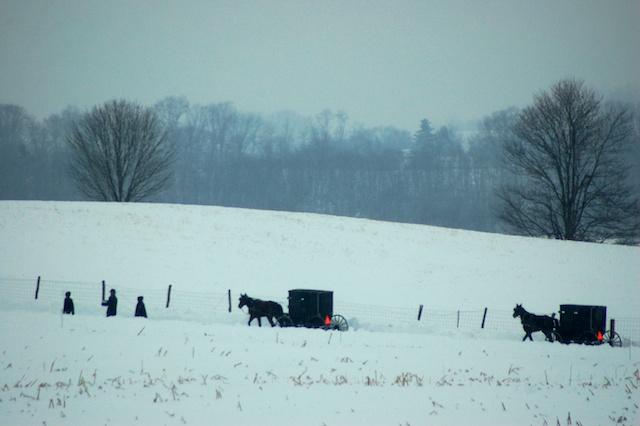
Amish on their way to church near Mt. Hope, Ohio. Church was held in a member's home.

By Bruce Stambaugh

The Amish enjoy celebrating the holidays just as much as anyone else. They simply go about it a bit differently.

Defining how the Amish celebrate America’s most time-honored holidays deserves an introductory explanation. The Amish are divided into church groups, usually about 100 persons per church. And by church, they mean fellowship, since they hold church in their homes, shops or barns.

There are actually many different types or orders of Amish. The Swartzentruber Amish are considered to be the lowest order, with the New Order Amish the highest, since they hold Sunday school on the alternate worship Sundays.

Using the terms “lowest” and “highest” is not intended to be derogatory or even hierarchical. It simply is the way it is with the Amish. Those in between are the Old Order, by far the most numerous in among the Amish population. The orders are simply determined by rules of the church leaders.

Clearly, defining the Amish is a lot harder than their simple lifestyles might let on. Nevertheless, they all celebrate the holidays one way or another.

The key to understanding how the Amish do so lies in this understanding. You can’t generalize about the Amish. Their holiday traditions and rituals vary from family to family, church-to-church and sect-to-sect, not much different that any other culture or ethnic group.

Modesty is a major principle in the values of the Amish. That fact can be seen in exactly how the Amish keep the holidays. In living out their faith beliefs, they do so joyously surrounded by food, family and friends.

Here then is an overview of how any given Amish family, save those in the Swartzentruber order, might celebrate the holidays.

Thanksgiving

Most Amish take advantage of this national holiday just the way the rest of the country would. They gather with family, extended family and friends and enjoy turkey, mashed potatoes and gravy, cranberry sauce, a vegetable and of course dessert, usually homemade pie.

However, instead of breakfast, many of the Amish fast prior to the large noon meal. Fasting is a physical sign of purification in preparation for the celebration.

The lower order Amish, however, have a different take on Thanksgiving. They see it as an opportunity to prepare for the winter months ahead. For them, Thanksgiving is the big hog-butchering day. They’ll save their substantial meal for another later.

Christmas

From the Amish perspective, anyone not Amish is considered “English.” The Amish recognize and respect the “English” demarcation of Christmas on December 25. For them, Christmas is a sacred day in honor of the birth of God’s only son, Jesus Christ. And here again, many, though not all, will fast prior to their family gathering.

Amish actually celebrate Christmas twice, once on the standard date of December 25, and again on January 6, commonly referred to as Old Christmas. In higher religions, that day is known as Epiphany.

Unlike the rest of society that celebrates Christmas, the Amish do not have Christmas trees or decorations. They will, however, burn Christmas candles in honor of the day.

After the usual Christmas meal of turkey or ham and all the trimmings, the Amish will spend the afternoon and evening away playing table games, board games and cards. None of the card games would involve using face cards.

Of course, it wouldn’t be Christmas without gifts and the Amish carry out this tradition of gift giving as well. The gifts will be wrapped, but usually nothing elaborate. Children will receive toys.

Since not all of Amish Country is Amish, the usual holiday decorations and activities occur like in the rest of Christendom. Millersburg, the Holmes County, Ohio seat,  holds a Christmas parade, Santa included, and on December 10 will initiate its first candlelight church walk from 6 to 8 p.m.

Berlin, Ohio, the hub of Amish Country, has a luminary ceremony. Even little Mt. Hope, where mostly Amish live, has a Christmas parade and a live nativity scene. Santa, however, is nowhere to be found.

Old Christmas

Old Christmas harkens back to the change from the Julian calendar to the Gregorian calendar during the latter stages of the Reformation when Pope Gregory XIII switched Christmas to December 25. Out of tradition and reverence for their forefathers, the Amish have continued to honor Christ’s birth on January 6.

Unlike the more jovial December 25 celebrations, Old Christmas is more solemn. It begins with fasting, followed by another typical Christmas meal and some more gift giving. However, the emphasis is on reflecting and visiting as apposed to reveling.

No matter which holiday is being celebrated, family is always an important element in any get-together for the Amish. And that is true for any Amish order.

Make shopping thrifty in Ohio’s Amish Country

Thrift store shopper by Bruce Stambaugh
Marlene Burrell of Mineral City, OH shops regularly at the Harvest Thrift Store in Sugarcreek, OH.

By Bruce Stambaugh

Frugal shoppers will find a bonanza in Ohio’s Amish Country. The area is abundant with several well-stocked thrift stores, which is a reflection of Amish and Mennonite values.

The Amish and Mennonite cultures have a reputation for being thrifty. Recycling clothing, house wares and other household items and much more not only fits that image but their theology of service as well. Accordingly, profits from all the area’s thrift stores go to various charities.

Great bargains covering a wide range of items can be found in each thrift store. All resell clean, functional and stylish merchandise for the entire family.

On the eastern edge of Amish Country is the Harvest Thrift Store in Sugarcreek, Ohio. Located at 1019 West Main Street, the Harvest Thrift Store has been in operation for four years. A second store at 102 East Main Street in Wilmot opened last May.

All proceeds go to youth ministries and to local non-profit organizations like Every Women’s House in Wooster. According to store manager Holly Lehigh, 30 to 40 percent of her customers are from out of the area.

“We have some people from out of state who come back three or four times every year,” she said. “They tell me that what they spend on gas they more than make up in the savings of what they buy.”

In Wayne County’s Kidron, MCC Connections offers its items in a pleasant and well-organized atmosphere. Store manager, Bill Ressler, said that a number of tour buses stop at the store on occasion, the most recent from North Carolina. He attributes those visits to the promotion of the store by the Wayne County Convention and Visitors Bureau.

According to Ressler, all proceeds from sales at MCC Connections go to Mennonite Central Committee (MCC), Akron, Pennsylvania. MCC assists peoples around the globe in education, water projects and agricultural initiates, encouraging health, hygiene and sustainability. MCC Connections is located at 4080 Kidron Road, Kidron.

Back in Holmes County in the hub of Amish Country is Berlin, where Share and Care Thrift Store operates on U.S. 62. Share and Care sends 80 percent of its profits to Haiti missions and uses the balance for local needs, such as fire victims and personal disasters.

Day manager Noah Troyer estimated that at least 50 percent of the store’s business is from tourists. He said that amount increases during peak tourist time.

“We have had people here from Arizona and California,” Troyer said.

Millersburg, the county seat, hosts two thriving thrift shops, the internationally known Goodwill Industries, and Save and Serve Thrift Shop. They just happen to be catty corner from one another on South Washington Street at Rodhe Drive.

Like it’s international corporation goals, Goodwill’s objective is to finance the employment of those who need jobs. Store manager, Josh McWilliams, said most of his customers are local residents, though the number of tourists who frequent the store increases seasonally.

“They are mostly looking for down home, Amish-made items,” McWilliams said.

According to Helen Glick, co-manager at Save and Serve, about 25 percent of their customers are from outside the immediate area.

“Our on-going silent auctions seem to attract collectors and others interested in unusual pieces and antiques,” Glick said. A look at the silent auction bid book indicated customers from all across Ohio as well as several from other states.

Eric Raber, co-manager at Save and Serve, credits the community’s continued support for the long-term success of his store. Save and Serve was founded in 1975.

“Even in a down economy, the local people continue to provide us with amazing amounts and quality items to offer at reasonable prices,” Raber said. Like MCC Connections, all of the profits at Save and Serve are sent to MCC. In its 35 years of operation, Save and Serve has sent $3.3 million to MCC to help fund its global projects.

Whether from near or far, bargains galore are sure to be found in the thrift stores in Ohio’s Amish Country. And emblematic of the holiday spirit, all of the profits from sales go to those in need.

Thrifty shoppers by Bruce Stambaugh
Kay Schrock, Mary Hoefer, and Jo Troyer, all of Goshen, IN, and Becky Christophel of Harrisonburg, VA, shopped several Amish Country thrift stores, including Share and Care in Berlin. The three sisters and their mother, Troyer, enjoy their frequent rendezvous' in Ohio's Amish country.

A private woman has a very public life

Lucille Hastings by Bruce Stambaugh
Books have always played an integral part of Lucille Hastings' life.

By Bruce Stambaugh

For someone who relishes her privacy, Lucille Hastings of Big Prairie, Ohio has led a very public life.

Perhaps that seemingly contradictory situation is because of her love for life long learning. Hastings has had this instinctive drive to share what she learns. In short, contributing personally and professionally to the community at large has been a way of life.

That shouldn’t come as a surprise for someone who has her major life concepts down pat. Her life has revolved around her personal faith and church fellowship, service to others, which includes family, friends and the larger community.

Having lived on a farm for most of her life, she heartily reveres the land as a true gift from God. To accomplish and enjoy all that, she also believes in healthy personal lifestyles.

“I do water aerobics three times a week,” she said. “I need to watch my weight.”

Once she began her own well-researched and devised low carbohydrate diet a dozen years ago, Hastings lost 100 pounds. She has continued to be very careful about what she eats.

“Physical and emotional health are very important,” she related. Hastings said that as much for herself as for the benefit of others.

Hastings is fastidious about everything she does. But some things in life have been out of her control.

Hastings retired in 1992 from West Holmes Local Schools after serving 34 years as the library/media director in charge of the district’s libraries. Since then, she has continued as a part-time educational library/media consultant to the district.

“I retired because Jim retired,” she said, referring to her late husband. He died in 2000. “I miss Jim,” she said wistfully, “but I worked through it.” They had been married for 43 years.

She still lives on the Hastings family farm, which is rented out to an area farmer. The farm’s old barn was burned several years ago when a string of arson fires hit Holmes and surrounding counties.

Lover of the land that she is, Hastings said she marvels at how the agriculture around her has changed over the years. She has a great appreciation for her neighbors.

“The Amish have gradually moved into our area because the land was cheaper,” she said. “They are simply wonderful neighbors.”

With her background in library, it should come as no surprise that she considers herself a very organized person. She attributes that trait to enabling her to be of service to the larger community.

“Services like libraries, schools and churches happen because people make them happen,” Hastings said. “They just don’t happen by themselves.” Given her life long service to the surrounding community, Hastings clearly has done her best to improve those services for the community at large.

Here is a sampling of the many positions in which Hastings has served. She was president of the State Library Board of Ohio. She served on the Holmes County Library board for 16 years, 10 of which she was president. She was chairperson of the Ohio Reading Circle board for 16 years. That volunteer position allowed her to donate $350,000 worth of Reading Circle books to the county and local school libraries.

Hastings is a member of the Ohio Director of Agriculture’s 12-person advisory committee for administration of Ohio’s $25 million Clean Air/Clean Water Fund for Farmland Preservation.

She was the first woman president of the Holmes County Farm Bureau, and she is the only woman Sunday school teacher at her church. She has taught Sunday school for 60 years, and she is chairperson of the Mission Ministry at Ripley Church of Christ. She was a member of the Holmes County board of elections for eight years.

Hastings good works haven’t gone unnoticed. She has been dooly recognized for her many efforts. She received the Martha Holden Jennings Outstanding Teacher Award in 1974. She was inducted into the Ohio Women’s Hall of Fame in 2007. That same year Hastings received the Outstanding Alumni Award from Kent State University, where she received her Master of Arts Degree.

Hastings has two sons. Joel lives in Dallas, Texas, and Sidney resides in St. Louis, Missouri.

“I feel like I have been blessed,” she said. “I have had some unique opportunities.” And because she made the most of those chances, the community has reaped the benefits.

That’s what happens when life long learning is generously and graciously shared.

This article appeared in the Holmes Bargain Hunter, August 30, 2010.

From every angle, August is golden

Golden sunset by Bruce Stambaugh
Hazy sunsets in Amish country are the norm in August.

By Bruce Stambaugh

These are what I call August’s golden days. If I only referenced orangey sunrises and the hazy, citrus sunsets, that moniker would apply.

August is so much more than lovely solar appearances and disappearances. It is always full of golden moments that make golden memories.

I realize my reflections are provincial. In a world full of disease, disaster, dismay and hostilities, not all would share my august perspectives. However, I cannot deny what I have observed and experienced in this transitional month in Amish country.

In calling August golden, I mean to take the broadest definition possible. Everywhere you turn, deep, rich yellows and golds appear. August is golden, too, in that it is good, providing success and satisfaction as the harvesting begins.

Mowing oats by Bruce Stambaugh
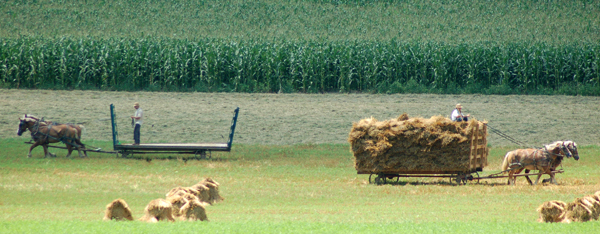
Mowing and stacking the oats into shocks is the first step in the harvesting process for the Amish.

August is usually a hot month in most of the northern hemisphere. Even the poor people in Moscow, Russia, where temperatures have seemed more like Dallas, Texas, have been especially suffering.

True to form, hot and humid have been the bywords in Ohio, too. Those who have had to work out in these blazing elements would argue for sizzling and sultry as better descriptors. But no matter how we describe the daily dog days of August, the benefits surely outweigh the negatives, no matter how muggy.

Coming and going by Bruce Stamabugh
One wagon heads to the barn while the other returns to the field to be loaded again.

My Amish neighbor’s circle of friends purposefully gathers the air-dried, ripened oat shocks wagonload after wagonload. Their water thermos got a workout, too. With their cooperative efforts, the impressive stand of honey-colored sheaves had disappeared by day’s end.

I always find it a miracle that once the sea of grain is cut and shocked, a carpet of bright green immediately replaces it. The hardy clover thrives all the more once it has the ground to itself.

There are other kinds of gold in August, too. The Incredible sweet corn arrives almost simultaneously with the transparent apples. It’s husking, cutting, cooking and freezing corn one day, making tartly sweet applesauce the next.

Ripe tomatoes by Bruce Stambaugh
Heirloom tomatoes ripen on the vine.

The growth of the heirloom tomato plants my wife and son planted in late May is so
prolific, the plant runners get tied daily. Their yellow, red and green-striped fruit add to the festivities.

House wren by Bruce Stambaugh
A house wren leaves the nest after feeding her brood.

The noisy tan house wrens worked frantically to satisfy their last brood of the summer. Their hungry youngsters consumed an amazing amount of worms, caterpillars and insects.

When the little ones began to greet their parents at the entrance to their birthplace, it’s nearly time for them to fly. In our case, the babies were there before church, but not when we got home. The grandsons and I found them learning to forage and hide in the brush pile under the pines near the hammock where other golden moments were made.

Monarch and swallowtail butterflies joined the goodness of the month as they enjoyed the nectar of the milkweed and wild and domestic flowers. Both the black and yellow-billed cuckoo birds announced their arrivals as the tent caterpillars hatched.

The much publicized but often under performing Perseid meteor showers still managed to send enough bright streaks though the new moon sky to extend the month’s goldenness 24/7.

Next week the full moon will strut its stuff, casting a golden glow across landscapes, rural and urban alike. Ready or not, summer vacation has yielded to elongated yellow buses and excited, golden voices of children beginning a new school year.

All things considered, August is a positively golden time of year.

Hammock fun by Bruce Stambaugh
Playing on a hammock in the cool shade serves as a diversion from the August heat and humidity.
Bay Photos by Donna

Wildlife Photos From The Chesapeake Bay Region

ROAD TO NARA

Culture and Communities at the Heart Of India

K Hertzler Art

Artist and nature journalist in the Shenandoah Valley of Virginia.

Maria Vincent Robinson

Photographer Of Life and moments

Gabriele Romano

Personal Blog

Jennifer Murch

Art is the only way to run away without leaving home. -Twyla Tharp

Roadkill Crossing

Writing generated from the rural life

ANJOLI ROY

writer. teacher. podcast cohost.

Casa Alterna

El amor cruza fronteras / Love crosses borders