This sugar shack produces more than maple syrup

Sugar shack by Bruce Stambaugh
The sugar shack sits adjacent to the woods on Gary Miller’s farm west of Millersburg, Ohio.

By Bruce Stambaugh

I had often heard about the sugar shack. A group of guys I knew, mostly from our church, had formed an informal co-op. The goal was to make and offer maple syrup, with the donated proceeds going to a scholarship program for students in rural Honduras.

My journalistic nosiness finally got the best of me, and I ventured out one chilly day when the sap was running strong. My intent was to write a story for a local weekly newspaper. What I discovered went far beyond what any feature story could represent. Here were a few good men who through sheer determination made this sweet enterprise work. They worked cooperatively out of a common desire to succeed, not out of individual or corporate profit. Indeed, there were no profits. The money collected through donations went to the scholarship program.

Stoking the fire by Bruce Stambaugh
Tim Roth, left, and Paul Conrad stoke the fire of the sugaring evaporator system.
This endeavor was borne of commitment, desire, effort, camaraderie, purpose, joy, ingenuity, and sacrifice, all with rewarding results. And to think that it all started with the landowner, Gary Miller, standing in the rain dreaming of making maple syrup. Miller never envisioned how far his idea would go.

“Three years ago,” Miller said, “I was standing in the rain under an umbrella boiling sap in an assortment of old used pans on my grill.” Miller lives on a small farm west of Millersburg, Ohio.

Miller shared his idea with his friends, and the sugar shack quickly became a reality. The structure itself was donated to Miller. A friend, Paul Conrad, had an old shed he told Miller he could have, and Miller’s sons moved it in seven different sections for him. Once on site, the building was reassembled, reusing the old lumber. Since then, its design and size has been tweaked and expanded.

That process set the tone for what was to come. Much of the equipment used by Miller and his friends has been refurbished as some part and purpose of the maple syrup operation.

Tree taps by Bruce Stambaugh
Paul Conrad, left, and Bobby Miller check one of the 400 taps in Gary Miller’s woods.

Indeed, when the sap is moving like it is now, so does this voluntary collection of Miller’s friends and family who assist with the project. They placed 400 taps in sugar, red and black maple trees.

“We are careful about how many taps we place in a tree,” Miller said. “We don’t want to stress them.”

Like most farming efforts, preparing for the sap harvest takes a lot of preparation, and can be an ongoing project. Recently a shed was built to store the chords of firewood needed to heat the boiling process. Of course the friends also helped split and stack the wood that fuels the fire that boils the sap on a homemade evaporator. True to form, the gregarious crew also put that together. Much of that ingenious system consists of recycled metal and other repurposed materials.

The wood stove that holds the fire that boils the sap belonged to Scott Sponsler, another friend. The stove was extended with metal from old toolboxes from a pick up truck that Miller owned. Miller had a fan rebuilt and some ductwork manufactured locally. Together they help distribute the heat generated by the wood stove. The heat evaporates the sap into syrup.

The sap enters the sugar shack from another recycled item, an old bulk tank rescued from an unused milking parlor. It is held up by a repurposed metal stand so the sap flows by gravity into a smaller holding tank inside the old wooden shed.

Gary Miller by Bruce Stambaugh
Gary Miller explained how the sap is heated by running through a maze of troughs in order for it to become maple syrup.

From there, the sap runs into a customized sheet metal maze that allows the sap to be evaporated as it circulates up and down the four parallel troughs. After entering a second connected metal maze, the sap begins to change color. It is closer to the firebox and the pre-heated sap really begins to boil. Its darker color indicates that the moisture is being bubbled away.

Miller said that the sap isn’t officially maple syrup until its consistency is at least 66.9 degrees brix, as measured by a hydrometer. Miller said with this set up, it takes 51 gallons of sap to produce a gallon of syrup.

Miller and his friends make the syrup when the sap is running. He said warmer days and cooler nights are the best conditions to make the sap run. When the sap runs, so does this gang of close friends and family members. When the sap is running, his shack and the surrounding woods are very busy places indeed.

Pouring sap by Bruce Stambaugh
Scott Sponsler poured sap from the collection bucket into a 15-gallon container, which was hauled back with several others to the sugar shack via tractor.
Before it is pumped into the elevated holding tank, the sap is gathered into 15-gallon containers from each tap bucket. The containers are carried on the back of a small tractor. In keeping with the pattern, the tractor was loaned, too.

All the free equipment and labor is only appropriate. Miller said the maple syrup that is produced is not for sale, although it does have a name, Smoke Pit Maple Syrup.

“This is not a commercial operation,” Miller emphasized.

Instead customers get to donate whatever they feel the syrup is worth. The money is used for an educational scholarship program in Honduras. Miller’s Sunday school class at Millersburg Mennonite Church is financially sponsoring the schooling of several children there.

Roy Miller, a retired Holmes County family physician, serves as the unofficial coordinator of activities. He even travels to Honduras several times a year and meets with the students, their parents and the local church leaders who oversee the scholarship program there.

With all that said, Gary Miller revealed the secret ingredient in the maple syrup production as far as he is concerned.
“It’s not about the syrup,” Miller said. “It’s about the fellowship.”

Indeed, laughter and kibitzing among the friends intermingle with the steam from the cooking sap in the cold, small shack. The steam and merriment waft together out into the cold air through the open doorways. The good-natured ribbing helps make the labor-intensive sugaring efforts all the sweeter.

In that initial visit, I was impressed with the care given to producing a quality product, and with the interpersonal interaction that makes this particular micro business the all around success that it is.

It was clear to me that two pure products are produced at the sugar shack. High quality maple syrup created for a great cause is the tasty finished product. Genuine, committed friendship that knows no bounds and has no earthly measure is the dividend.
Persons interested in obtaining some of the Smoke Pit Maple Syrup should contact Gary Miller at 330-763-0364.

Hydrometer by Bruce Stambaugh
Gary Miller demonstrated how he checks the sugar content of the maple syrup using a hydrometer.

This story appears in the current edition of Farming Magazine.

From Haiti to Millersburg, Ohio, a harrowing journey

Fritz Jeanty family
Fritz Jeanty hold two and a half year old son, Samuel, while his wife, Mamie, cuddles five month old son, Benjamin.

By Bruce Stambaugh

Shortly before 5 p.m. on January 12, Fritz Jeanty of Port-au-Prince, Haiti was on his way home when his car lurched from the force of a 7.0 magnitude earthquake. He didn’t realize the seriousness of the situation until he saw people running and heard people praying and praising God for being saved.

Fritz headed for home via the main road, but quickly came upon even more devastating scenes. People carried injured victims. Debris and clouds of dust were everywhere.

People were screaming, crying and praying all at the same time. While attempting to get home, Fritz met his pastor, who had his car full of injured victims, on the way to a hospital. The pastor told Fritz that the church had been leveled.

In his tireless effort to reach his family, Fritz drove as fast as he could until the road was completely blocked with collapsed buildings and dead bodies. Fritz parked his car, and ran towards home, fearful of what he would find. Before he could arrive, however, a neighbor intercepted him with good news. Fritz’s family was safe.

“I started crying right away,” Fritz said. They were tears of joy and sadness. “I was happy my family was alive, but I was sad for all the dead and injured, too.”

When he arrived home, his wife, Mamie, and two young sons, Samuel, two-and-a half, and Benjamin, five months, were unhurt but scared. Their home was rendered uninhabitable. The grocery store Fritz owned and operated five miles away had been completely destroyed, too.

“You could hear crying everywhere,” Fritz said. “I was overwhelmed.”

With darkness arriving, Fritz had to wait until early the next morning to turn his attention to extended family members who lived nearby. At dawn, he went to look for his brother, who he discovered was all right. However, Mamie’s two sisters were both crushed in the rubble of their home. But her mother was alive.

The Jeanty family lived on the street outside their destroyed home for a week. Fritz said they could hardly sleep, with frequent aftershocks, mosquitoes, nothing but rubble to lie on and potential looters roaming. The only provisions they had were some rice and cooking oil Fritz had stored in an old car in his yard. They had some water in a drum container, and Fritz had to walk two miles to refill it.

With precious commodities running low, Fritz went into survival mode. He reentered their badly damaged home, and carefully retrieved important personal papers, including the boys’ passports.

Fritz went to the American embassy in Port-au-Prince and was disheartened to find a long, long line. But because both of his sons had been born in the United States, Fritz was told to go to the airport to be airlifted out of Haiti.

Early the next morning they found themselves on a transport plane, unsure of where they were going. When they landed, they were in Orlando, Florida, which was providential. Just the previous day, Fritz had obtained a key for his father-in-law’s home in Orlando in case they somehow ended up there.

But Fritz knew they could not stay there long without money. He had kept some phone numbers of persons with whom he had worked in Christian Aid Ministries, based in Berlin, with missions in Haiti. A friend of a former CAM worker helped the Jenaty family make contacts in Ohio.

Arrangements were made for Fritz and his family to ride the Pioneer Trails bus back to Holmes County. In addition, contacts with Save and Serve Thrift Store in Millersburg were established, an apartment found, and by the time Fritz and his family arrived in Berlin the next day, they had a place to stay amid the largest Amish population in the world.

Fritz and his family are permitted to stay for six months. He is filling in his time by volunteering at Save and Serve, which is taking donations to help buy food and living necessities for the family. Donations to assist Fritz and his family may be sent or delivered to Save and Serve, marked Haitian Relief, P.O. Box 128, Millersburg, OH  44654.

Knotting comforters for Haiti

comforters for Haiti
An Raber (L), Peggy Roth and Linda Yoder knot a comforter for people in Haiti. Mennonite Central Committee (MCC), Akron, PA had asked congregations to knot 10,000 comforters for people in Haiti to match the 10,000 donated by a Canadian business.
working on comforters
Caroll Roth (L), Paul Thomas and Sandy Miler ready a comforter to be knotted at Millersburg (OH) Mennonite Church.

Rushing home for the big snow

Our back porch
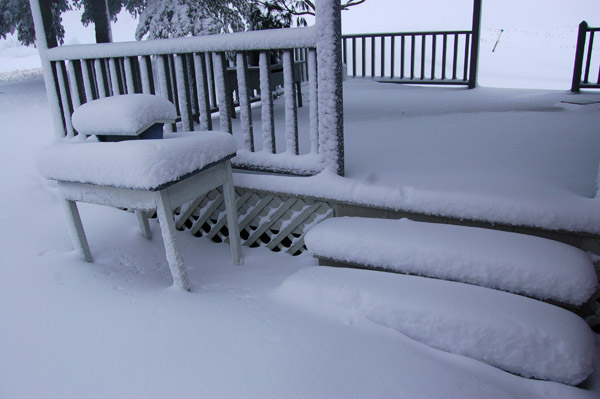
A foot of snow covered the bird feeders by our back porch.

By Bruce Stambaugh

I think I am just going to quit going to Florida in the winter. I know it sounds selfish of me. But I really think it’s the right thing to do.

First of all, I am not a big fan of the Sunshine State. When I have visited in the summer, it’s always been way too hot and sticky for my liking. My experiences in the winter haven’t been much better. Both times that I have sought a sunny, warm reprieve from the sting of winter in rural Ohio, I got burned, and I don’t mean sunburned.

In 2008, my wife and I flew to Florida in March, mainly to see a few Cleveland Indians baseball spring training games before they moved to Arizona. Near the end of our brief stay, a rare blizzard hit the mid-west, including our home area. The magnitude of the storm was so vast, so consequential that no commercial airlines were flying to Ohio. Our stay in Florida was extended for three days. But it wasn’t much of a reward because the weather turned cool and damp, keeping us inside.

Instead of being able to take advantage of walking a pristine beach or go birding, we spent a lot of time watching The Weather Channel. Their meteorologist reported live from downtown Cleveland, showing firsthand the effects of the blizzard. As strange as this may seem, I really wanted to be at home, not in Sarasota. Part of that desire was guilt. I am a township trustee and I felt duty bound to be home to help dig out.

But more than that, I love storms. Weather is one of my major hobbies. In addition to being a severe weather spotter, I also measure the snowfall for our area for the National Weather Service. And here we were getting more snow that we had had in a long time and I wasn’t there to experience it, much less send in my snow reports.

Last month, we had another chance to visit Florida. Good friends invited us to stay a week with them in a house they had rented in Sarasota. Neva and I needed a break since 2009 had been such a draining year for us with all the family health issues we had had, most notably my father’s illness and subsequent death. This trip, though, we decided to drive instead of fly. When we arrived, the weather was very nice, our friends even nicer. We settled in and began planning our week’s activities.

We did the beach thing, which allowed me to both walk and take pictures, yet two more hobbies. We visited a lovely state park where I learned a lot about Florida floral, fauna and local history. Here, again, I was able to photograph several species of birds and some rather large alligators.

The last part of our trip was to be spent in Savannah, Georgia, a city I had long wanted to visit. We managed a trolley tour of the lovely historic city before our plans changed. Once again, a major winter storm was brewing in the mid-west, and once again my wife and I were glued to The Weather Channel. I saw the track of the storm and its expected arrival time. I knew we had two choices. We could cut our stay short and drive straight home or stay an extra few days until the roads were cleared. You can guess what we decided.

We returned in time for me to have the distinct honor of sending in my mundane but necessary snow reports. We were home, and I was happy to be measuring this big snow.

True love is best lived

By Bruce Stambaugh

Love was a word that my late father used sparingly, unless it was in reference to ice cream. Instead, Dad chose to display his affection, devotion and genuine love for people pragmatically.

That could explain why he was so deeply involved in such a wide range of activities in his long life. His presence was his way of saying he cared.

Dad went at life full throttle, never holding back, even when he probably should have. In the process, Dad didn’t let little things like tact and common sense get in the way of enjoying life.

Dad was like a big, little kid who loved life so much, he was afraid he was going to miss something. He immersed himself in any activity that brought him much joy.

That didn’t mean he was a selfish person. Just the opposite was true. If he liked you, Dad would give you the shirt off of his back, and he often did, even if he couldn’t really afford to. Dad liked a lot of people in his lifetime. When you live to be 89, are gregarious and have a variety of interests, life gives you many friends.

Dad had friends in both high places and skid row. He felt at home with either, and often used his friendships to get where he wanted to go. Dad’s goals weren’t lofty ones. But he saw no shame in networking when he needed to. In fact he knew so many people, he may have invented the practice.

If one of us kids needed a summer job, he would make a few calls and more often than not, we were employed. During my college years, I found gainful employment where Dad worked. I thought I was hired because of my charming personality and abundant skill set. More likely Dad pestered the daylights out of the personnel department, as human relations were called way back then.

That’s the way Dad was. He wouldn’t say he loved you. He just did loving things for you or with you. Dad wasn’t a mushy person, and he never would have been mistaken for a Casanova. He just put his love into action.

Hunting, fishing, arrowhead hunting, family picnics, reunions, traveling, civic and church organizations all attracted Dad like a magnet. Dad chose those activities to express his affections. He seldom did things alone. He lived for outdoor expeditions that involved as many of his buddies, family and friends as possible.

Dad hauled us kids along whenever he could. I never could figure out if it was his way of relieving Mom of some of the domestic duties or if he genuinely wanted us to learn how to find arrowheads or shoot rabbits or explore a buzzard’s nest deep in a cave.

In sorting through Dad’s myriad of items that he had saved, we discovered pictures of family, letters he had sent home from World War II, and much, much more. Dad could never throw anything away because it had a special meaning to him or could possibly be used for something. Problem was, only he knew what.

Weeks after Dad’s death, the family is still receiving notes of condolence. Many of those expressions of sympathy include specific, personal images of my father. Several have said they can still see Dad intently walking their farm fields back and forth scouring for any piece of flint he could find.

This year, those kind remembrances have a special twofold purpose. Besides heartfelt sympathies, they are Dad’s Valentines to us, too.

When the bus comes in, the fun begins

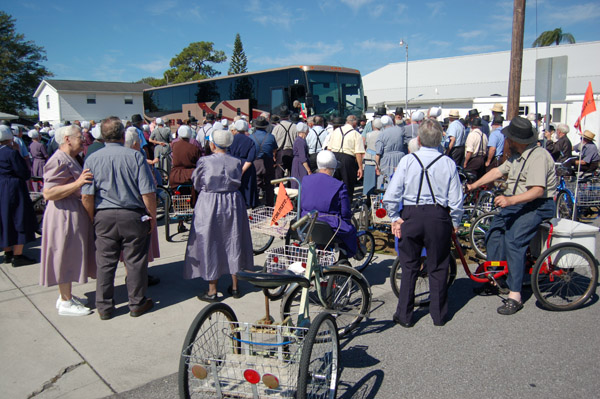
Crowds gather in Sarasota, FL when the bus from up north arrives.

By Bruce Stambaugh

The anticipation was almost tense, the excitement palpable, and the energy contagious.

The crowd gathered early, as if waiting to get into a sporting event. People milled around, talking with their inside voices though they were bathed in bright, Florida sunshine while standing in a church parking lot. But they weren’t going to a worship service.

Welcome to the bus arrivals from Amish country north to temporary Amish country south, also known as Pinecraft, an unincorporated section of Sarasota, Florida. Three times a week in February and March, the snowbirds cram the little parking lot where the buses unload.

By the time the bus pulled in, the attendance had swollen to nearly a 100. The crowd plus the cars, vans, pickups and two-wheeled and three-wheeled bicycles barely left enough room for the bus. In fact, the self-appointed welcoming committee spilled over into the narrow alley, making any passage by motorized vehicle impossible.

The atmosphere was part family reunion, part auction crowd. Some came to meet and greet. Most were there to watch. Men with white beards and denim pants with suspenders and women in pastel dresses and lacy white coverings predominated the scene. A few children in straw hats and long, plain dresses held tight to a parent’s hand. This entertainment was too lame for teenagers. Many of them were already at the beach.

The bus did pull in right on time opposite the tiny, stuccoed Pinecraft post office, and the anticipation grew as the assembled crowd waited for the bus’ door to open. It was as if Elvis himself would bebop his way down the bus’ steps.

Though all the cargo was precious, no one of that fame was expected to be aboard. Rather the murmured questions were simple. Who was on the bus that I know? How long will they stay? And where?

Appropriately enough, the bus had to turn off of Miller Ave. to enter the lot. A number of Millers were among those who waited. An unknown number of Millers were on the bus.

When the bus door did open, the answers appeared as the passengers made their exit one-by-one. With waves and smiles, friends and relatives welcomed the new arrivals to their transient winter home. The passengers returned the favor as they exited carefully down the deep steps.

Some in the crowd were drawn more by curiosity than the need to help carry luggage. They just wanted to see who was on the bus. Would there be people they might know aboard? What news from home would they bring?

In this particular case, “home” is most generally Amish country. Amish and Mennonites flock to this resort home away from home to escape winter’s chilly edge in Indiana, Ohio, Pennsylvania and other states, too.

Many of the Indiana and Ohio snowbirds travel Pioneer Trails buses to the Sunshine state. It’s their most economical, and in many cases, only choice. Their faith does not allow them to fly or drive, so they take the bus.

David Swartzentruber, owner of the Millersburg-based bus business, said Pioneer Trials has been fulfilling the transportation need for these individuals for 26 years. During the two peak months, buses arrive Monday, Wednesday and Friday.

Passengers on Pioneer Trials are primarily from the Amish populations in northern Indiana and in Holmes, Tuscarawas and Wayne counties. Buses pick up passengers and their luggage at various locations around each geographic area. Most often, buses from Indiana and Ohio meet up near Cincinnati, combine their loads and continue south. The northbound bus from Pinecraft and the southbound usually connect near Chattanooga, Tennessee. The drivers switch buses and the trips north and south continue.

Swartzentruber said other bus companies also transport people to Pinecraft, especially from Pennsylvania, where Pioneer Trails does not have a route. He said the other bus companies do not travel as frequently as does Pioneer Trails.

As expected, most passengers were Amish, and most in their retirement years. However, some young families, with two or three young children, and a few teenagers seeking fun in the sun exited the bus.

Some in the crowd, like Christ Miller from Millersburg, were surprised to see their neighbors arrive. They knew they were coming south. They just didn’t know when. In this case, Miller welcomed his neighbors Jr. and Fannie Burkholder.

Like the onlookers, the stays of the new arrivals range from one week to three months or more. No matter how short or long their time in Pinecraft, they will make the most of their stay visiting, eating out and enjoying the normally pleasant weather.

Once the last passenger had luggage in hand and connected with friends and relatives, the crowd thinned quickly. In 15 minutes, the excitement was over at least until the next scheduled bus due in from the north. When it arrives, the gregarious process will begin all over again.