The painful truth of reality

By Bruce Stambaugh

The scene seemed a little surreal if not downright incongruous. If it didn’t hurt so much, I might have been laughing. You can if you want.

Even though it was still early April, outside it was like summer, warm, sunny, and balmy. But I wasn’t able to enjoy it.

Instead, I was forced to remain inside. I sat in my favorite overstuffed chair, television remote control by my side, heating pad on my back, and chunk of ice on my left foot. As my friend Steve would say, “Couldn’t happen to a nicer guy.”

Don’t get me wrong. I am not seeking sympathy for my ills, mostly because I probably wouldn’t deserve any. A little common sense might have prevented my mostly self-inflicted problems. But man that I am, I was either too stubborn or too proud or both to pay attention to the messages my body was sending me.

Maybe that was the real issue. The signals were just too simple to heed. Or perhaps I subconsciously heard them and tried to deny the obvious. My 20th century Baby Boomer brain was trapped inside my 21st century grandfatherly body.

Because I didn’t listen or didn’t believe what my body was telling me, I kept my usual pace when I shouldn’t have. I just wasn’t careful. I shoveled too much snow. I lifted too many heavy items too many times. I strayed from my exercise routine.

Finally, the consequences of my actions caught up to me. And there I sat warming my back, while freezing my foot, and surfing the channels like I was on a safari.

If there was an upside to this conundrum, it was that I had no choice but to come to terms with my physical situation. I realized that I simply had to accept the fact that I am aging, and that I must take better care of myself if I ever wanted to someday achieve my dream of driving the staff at the local nursing home absolutely crazy.

I recalled a conversation from Mitch Albom’s book “Have a Little Faith.” When quizzing his elderly rabbi about his advanced age, the rabbi wisely replied, “It’s not being old that is the problem. It’s getting old.”

I couldn’t agree more. If I want to get old, that is older than I am now, I have to take better care of myself daily. I also have to accept life’s realities and parcel out any physical work I do.

I have to look in the mirror and tell myself everyday that I need to get real if I want to enjoy whatever number of days I have left. I hope they are many, but there are no guarantees.
I don’t want to sound morbid about this. I just want to be honest with myself and with where I am at this point in my life.

Sitting there in the chair I also realized that it could be a whole lot worse. My situation pales in comparison to individuals and peoples in the world who suffer unimaginable hardships far beyond my temporary inconveniences.

Unlike my icy hot circumstance, no amount of rehab or exercise could rescue them from their agonizing plights. They could not extricate themselves from the inflictive pain of their illnesses or poverty or servitude. I could.

If I didn’t want to continue the folly of warming my back and icing my foot simultaneously, I had an easy out. I simply needed to slow down and listen to my body.

There is only one traffic cop that can make that happen. That’s me.
Spring’s multifaceted green abounds

horses and plowing
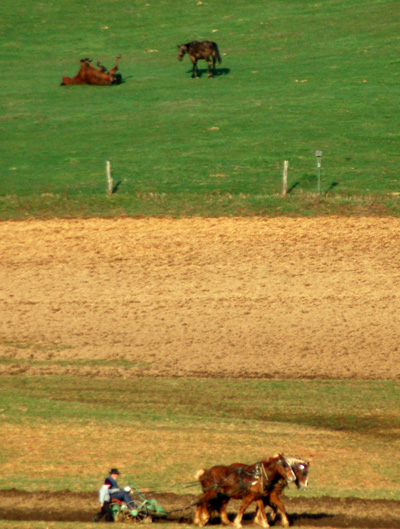
Horses frolic while others work.

By Bruce Stambaugh

Green is not my favorite color. But I’ll make an exception, especially now when every plant and animal seems to be greening up in some way.

The most obvious change is in the grasses. They all transitioned from bland dormancy to verve seemingly overnight. Once relieved of their heavy snow burden, then drenched with intermittent rains followed by warm, sunny days, the grasses grew emerald uniformly on natural cue.

Whether front yards or rolling pasture fields, the green on green effect is stunning. It may be the greenest green I have ever seen, or maybe the winter was simply so long and so hard, that I forgot what true green really looks like.

Nevertheless, it’s marvelous to see the countryside covered with such a luscious, vibrant carpet. Only problem is mowing will commence shortly, if it hasn’t already. But it will be nice to inhale that fresh cut fragrance again.

In preparation for that initial trimming of 2010, many of the yards in Amish country have already been rolled and fertilized. That was part out of necessity, and part out of relief that winter was finally over. Yes, we had one nasty, last snow that left the roads the slickest of the winter. But my bones say that ammunition has been spent.

Grass isn’t the only vegetation to go green. My wife’s tulips, daffodils, crocuses and lilies have all displayed their various leaves at different intervals. Of course, the crocuses have bloomed and faded, and the daffodils were primed for Easter.

In the woodlots, colts foot were the first to unfold. The giant hardwoods hovering over them have swelled their buds, anxious to let their leaves unfurl. They’ll wait until it’s safe from certain future frosts, unless coaxed open by an extended warming spell.

The evergreens have no such problem. They have already transformed from the deep, mature green of the hibernation months to a lighter, brighter green that mirrors that of the grasses.

Things are greening up around my little garden pond, too. The moss and lichens, long covered by two feet of snow, now look like splotches of paint and bristle brushes, respectively. Water lilies are shooting their first leaves to the surface.

Both the variegated water plant and the variegated reeds are coming to life, with the former having a huge head start. Its bulbs are pushing their pale green and russet pointy leaves profusely, fighting through some soft, velvety grass that somehow homesteaded over the winter.

I would eliminate the grass altogether, except that the pair of resident bullfrogs prefers its lush softness for their sunbathing and bug collection. The frogs’ color, too, has evolved from the mucky blackness of the bottom of the pond to more their natural camouflage.The male tries to woo his mate with his deep throated croaking both day and night. From nearby wetlands, choruses of spring peepers erupt. It’s all music to my ears.

High on the neighbor’s pasture where Holsteins and draft horses grazed earlier in the day, deer come out of hiding at dusk to nibble at fresh green sprouts. By night, they clean the corncobs at my birdfeeders.

Really, just airing out the house with open windows and doors that invite refreshing breezes brings you closer to mother earth. I also glory in the secondary benefits, the simultaneous serenading of birdsongs and echoes of children playing.

Spring doesn’t get any greener than that.

39 years is a long time

By Bruce Stambaugh

My wife and I will soon celebrate our 39th wedding anniversary.

I could be mean and say that 39 years seems like a really long time. It has been, but in a good way. Not that our marriage has been all peaches and cream and full of roses. There have been a few thorns along the way. But I won’t presume to tell my wife’s side of the story.

Let’s just say we are both human. And I recognize I that I have not always been the easiest person to live with. But I do my best to make it interesting.

As I look back over all those years, there are a lot of stories to be told, and then there are some that will never be told. Perhaps the most intriguing is how we met.

The short answer to that is that I chased Neva around a three-acre field filled with tender cucumber plants. We were on a mission/study trip in Kentucky with the youth from my church. The group’s assignment was to hoe the weeds in the field. Once Neva realized I was hoeing faster to catch up to her, she increased her weed eradication, too.

I just took that as sign that she liked me. You know how women can play hard to get. Well, I must have been right about her feelings because nine days after we had met we were engaged. You read correctly. Nine days. And if you thought that was fast, we married just nine months later without the shotgun. I was 23, she 21, both much too young.

We made sure we told our children not to repeat such foolishness in their own romantic adventures. That bit of advice probably wasn’t necessary. I think they saw the silliness in our story more than we did.

Regardless, facts are facts, and love is love. We’re still married after all those years. Of course, we have made our share of mistakes and misstatements. But rather than dwell on details, we’ve each managed to find forgiveness time after time.

As I recalled those 39 years, certain instances came to mind as if they had happened yesterday. The wedding day was one of those recollections.

The thing I remember foremost was just how scared I was. It wasn’t that I was having second thoughts. I was so out of it I’m not sure I was having any thoughts at all, and I hadn’t even had a bachelor’s party.

Thing is, I thought I was calm until an uncle made a sarcastic comment about how nice it was that the farmer across the road from the rural church had spread liquid sunshine on his field. I had to ask what he meant.

My uncle couldn’t believe I hadn’t noticed the pungent manure odor. I’m not sure I smelled it even after he had said something.

I remember that most of my fourth grade class came in Paul Rohr’s refurbished school bus. During the ceremony they were the quietest they had been all year.

I remember that it took so long for the greeting line to end that people were leaving the reception before the bride and groom arrived. I also remember accidentally stepping on my wife’s wedding dress as we exited the church, and her finger wagging in my face. I knew I was a goner right then and there.

Somehow, we have made it this far, two houses, two children, both grown and happily married, and three grandchildren later.

Through good times and bad times, in sickness and in health, at work and at play, we have tangoed together for 39 years. Here’s hoping year number 40 will be the best one of all.

The winter that wouldn’t end

By Bruce Stambaugh

The winter that seemingly would not end finally has. I hope.

Spring is now within sight. The vernal equinox officially arrives on Saturday, March 20 at exactly 1:32 p.m.

That milestone won’t guarantee that winter won’t quit. But it’s nice to know that if it does show its frosty face again, the odds are in our favor that a late winter sting won’t hurt us like the series of heavy snows we incurred in January and February.

For a while there, it seemed like everything had come to a freezing halt. It would snow. The road crews worked hard to free the highways of their slippery burden, and just when you thought it was safe to travel again, it snowed again.

During a normal winter in the western Appalachian foothills of Holmes County, Ohio, a couple of feet of snow are spread over several months. This winter we recorded more than three feet of snow in February alone.

With the weight of this winter still upon us, it seems spring has been a long time in coming. It was magnificent to get an early peek at what lies ahead with the recent string of sunny, warm weather here in Ohio’s Amish country.

It’s truly amazing what warmer weather does. I only had to step outside to fully appreciate the preview of spring.

The backyard birds filled the air with their choruses. Robins came out of hiding in the thick woods to begin scouting out their nesting territories. The resident Song Sparrow, which became reclusive in winter and played it low to the ground, perched high in a crimson maple, tilted its head back and cut loose.

Over the course of just a couple of days, the blanket of snow vanished altogether. Even the huge piles of plowed snow were greatly humbled by the bright sun and balmy temperatures.

If ever there were a perfect example of cause and effect, the melting snow would be it. The ground was so saturated from the abundant moisture that Mallards swam the temporary pond in my neighbor’s grain field.

Flower petals pushed through the mushy earth, as if reaching for the inviting sun. The daffodil heads swelled, readying for their brilliant birth. In our flower gardens, Johnny Jump Ups were the first to bloom.

Life stirred in my little garden pond, too. The mountain of snow that once surrounded the poor pool did a glacial retreat. The caretaker pair of bullfrogs ventured out in search of any wayward insects, and to bask in the sunshine’s warmth.

The school of goldfish revived. The largest broke water as I cleaned out the gunk from the pump. I don’t know if it was showing off or begging for food. The pump filters were so clogged with slime it was a wonder water still flowed over the little waterfalls.

I couldn’t help but notice doors and windows open in homes, shops and cars alike as I ran errands. Shoot, those with convertibles were driving around like it was July. After this cold, snowy winter, I couldn’t blame them. It felt like it.

People personally expressed their relief that an end to this nonstop winter seemingly had arrived. They appeared more congenial to the point of being jovial.

For those who longed for an old-fashioned winter, you got your wish. Let’s hope those that hunger for a perfect spring get theirs, too.

The case of being too fat to fly

Black Vultures hang around a large alligator at Myakka River State Park near Sarasota, Florida.

By Bruce Stambaugh

As the plane sat on the tarmac waiting permission to take off, I filled my idle time peering through the thick porthole. Meadowlarks chased one another and American Kestrels swooped for rodents above the broad grassy areas between the concrete avenues.

I watched other jetliners defy both logic and gravity, race down the runways and lift into the air. Aerodynamically, their appearance belies the fact that they actually can get airborne. The jumbo jets especially seemed too fat to fly. Yet, they taxied, throttled and despite their bulkiness climbed into the sky effortlessly.

When the words “too fat to fly” came to mind, I flashed back a month to our time in Florida. My wife and I and our good friends had taken a boat tour on a lake at Myakka River State Park. The guide filled us in on the unusual appearance of hundreds of vultures gathered all along the shorelines. Most were Black Vultures with a few Turkey Vultures thrown in, their red baldheads making them conspicuous.

We had gone to the park to see alligators, shorebirds, birds of prey, and to learn of the local floral and fauna. The congregations of vultures were an unexpected bonus, present everywhere. To the locals, the flocks of homely birds were a necessary nuisance, even roosting on campers and cars.

Their appearance was easily explained. Prior to our arrival in the Sunshine State, which was mostly cloudy and cool while we were there, an extended cold snap had settled in.

Between the below freezing temperatures and the lack of sunshine, both the water and air temperatures had dropped well below normal for a sustained amount of time. In fact, the Gulf of Mexico had registered 49.6 degrees Fahrenheit, amazingly cool for that expansive tropical body of water.

Citrus and produce farmers fought the cold conditions by misting their nearly ripe crops. The cold temps effectively coated the fruit with ice, saving most of the delicate commodities. Fishermen had no such option. The unusually cold water killed tens of thousands of fish.

Upper Lake Myakka was no exception. The guide said that at least 30,000 fish had died from the shallow lake’s much reduced water temperature. Of course, the dead fish soon washed ashore and the throngs of vultures voluntarily arrived to clean up the mess. Their sense of smell is truly amazing. The fishy smell we sensed was equally amazing, even weeks after the big kill.

The impressive, black birds had cleaned up most of the carcasses by the time we took the tour. Nevertheless, the pungent odor lingered, as did the vultures.

Days after the fish kill, park officials noticed something odd about the vultures. The unsightly creatures just lay around as if they were sick. Concerned, biologists easily caught and examined a few of the birds to find the cause of their lethargy.

After running multiple tests, the scientists came to a very logical conclusion. The vultures had eaten so many dead fish they were simply too fat to fly or even walk for that matter. All they needed to do was to stop eating, and they would be fine.

By now, it was our plane’s turn to take off. I double-checked my seatbelt, readied myself for the runway sprint and sudden ascent into the cloudless sky. But with the overstuffed vultures on my mind, I didn’t want to take any chances. I said a silent prayer that this particular bird wasn’t too fat to fly.

Competing in the winter Olympics, Texas style

By Bruce Stambaugh

I have had a long infatuation with the winter Olympics. This year was no exception. In fact, instead of just watching on television, I actually got to compete.

Coupled with the fatigue of the seemingly endless Ohio winter and the desire to visit our Texan grandchildren, my wife and I scheduled a trip to the Lone Star State right in the middle of the winter Olympic games. We were especially eager to see our four-month-old granddaughter, Maren. She was just a week old when I last saw her.

Just what does this have to do with competing in the winter Olympics? Plenty. Given the crazy weather of this weird winter, it didn’t snow in Vancouver, British Columbia, where the Olympics were hosted. But it did snow deep in the heart of Texas.

Of course, like everything else in Texas, it snowed big. At times, the snowflakes were huge. In a location where snow is seldom seen, the accumulation reached up to four inches.

The school kids were ecstatic. When they arrived home from classes, the Texas Winter Olympics were on. The entire neighborhood joined in one event after the other. The only qualifying necessities were to dress warm and have as much fun as possible. The rarity needed to be enjoyed while it lasted, since the snow likely wouldn’t linger in the south central Texas clime.

And have fun we did, including Maren. However, she wisely chose to serve as the beautiful, babbling, blue-eyed commentator from the warmth and safety of her parent’s home.

I felt like a kid again. Often, when the grandkids visited Nana and Poppy in Ohio’s Amish country in the winter, we seldom had snow. Now we were in their southern home territory, and the snow was perfect for any and every kind of wintry game.

The gathered Olympians participated in sledding, snowball throwing, snowman building, and of course the ever popular snow tasting contest. The results, which required no sophisticated judging, were measured in enjoyment rather than technical point calculation.

The lead sledding team, kindergartner Nola and her energetic father, Michael, won that event hands down. They were the only ones on the block with a sled. Even then, they had a rather short slope to navigate, another neighbor’s diminutive front yard.

To no one’s surprise, the snowball throwing drew the most participants and thus was gauged a Texas-sized success. The awards were meted in smiles and laughter rather than shiny medals. Evan, our nearly six-year-old grandson, won the artistic award for creating the most symmetrical snowballs. They were perfectly round and hand-packed hard.

The ever-daring three-and-a-half year old grandson, Davis, ate more snow than he threw. He said it tasted better than ice cream. You never know what those lefties will say.

As for the snowman contest, Poppy was in the lead for most of the way until he realized that the large rolled up snowball was more of a load than he should be pushing. His back disqualified him, and he had to call in reinforcements to complete the job.

Not surprisingly, Davis was a good helper. However, true to form, he wanted to eat the carrot rather than use it for the snowman’s nose.

Next day, when the snow quickly disappeared with Vancouver-like temperatures, the Texas Winter Olympics were declared closed, at least temporarily. With this strange winter weather, it could snow again in Texas. Vancouver could only hope.

Davis and Evan
My grandsons with their Texas snowman. Davis and Evan are on the left.

Turning thoughts into actions

By Bruce Stambaugh

I don’t know about you, but I do a lot of thinking while I’m shoveling snow. Given the amazing amounts of snow that have fallen this winter, my brain is about as strained as my back.

With two feet of snow on the ground, the most logical thought was obvious. Where would I put it all? The sidewalk already looked like the Grand Canyon, and the piles that lined the cement parking pad and limestone driveway were even higher.

As I shoveled my way around the house, making access to bird feeders easier, I realized my thinking strayed far from my physical task. My thoughts were so meandering that I absent-mindedly pitched the snow upwind.

Even with that rude awakening, my mind continued to wander. Is this a symptom of cabin fever or old age or am I just a typical man? Since I am not really expecting answers, we’ll go with all of the above.

I found Mourning Dove feathers in a couple of places. I wondered what predator dined on this prevalent and apparently delectable bird. Was it an owl, a hawk, a cat? I brushed the feathers aside and kept shoveling.

I thought about my friend, Jose, a coffee farmer who lived near San Marcos, Honduras where I visit occasionally. Jose, a tall, quiet, generous man, was killed recently in an accident while trimming a tree on his farm.

Jose was such a hard worker, a family man, dedicated to representing his little community the best he knew how. I’ll never forget the day I rode in the cab of his old, dented pickup truck, up the switch-backed, bumpy, one lane road to his two acre stand of vibrant coffee bushes growing on a steep mountain slope.

Though Jose knew no English, and I little Spanish, his non-verbal communication oozed hospitality. He turned our small group loose on those poor coffee plants and enjoyed the show, his welcoming smile continually flashing.

Several cardinals took flight as I rounded the house to the backyard. I had interrupted their lunch of cracked corn and oil sunflower seeds.

I thought about the Sunday morning service at the little church we attended while vacationing in Florida. I had already enjoyed some local birding opportunities, but never expected to be able to do so while at church.

The service was held in a room with large windows that faced a broad stream that met the Gulf a mile away. The faithful pastor had his back to what was happening outside.

While he preached, Black and White Warblers and Phoebes played in the banyan trees, live oaks and palms. Beyond the lush banks, Buffleheads scurried through the stream’s shallow water. Snowy Egrets and Black-crowned Night Herons waded, too.

I had just about completed my shoveling when I thought about my new friend, Fritz. He and his family had survived the catastrophic earthquake in Port-au-Prince, Haiti, and had miraculously found their way to our little corner of the world in Ohio’s Amish country.

I remembered Fritz staring straight ahead while he related his harrowing story as if he were reliving each horrific moment. All I could do was listen. I felt for Fritz and his family. They had lost everything, including close relatives.

Amid the natural beauty around me, in Sarasota, in the mountains of Honduras, even in ravaged Haiti, my contemplative jigsaw puzzle reminded that life wasn’t always pretty. My efforts resulted in much more than snow removal.

Long after this deep snow has melted, opportunities to help others in need will abound. That conclusion doesn’t take much thought.

Winter is for the birds

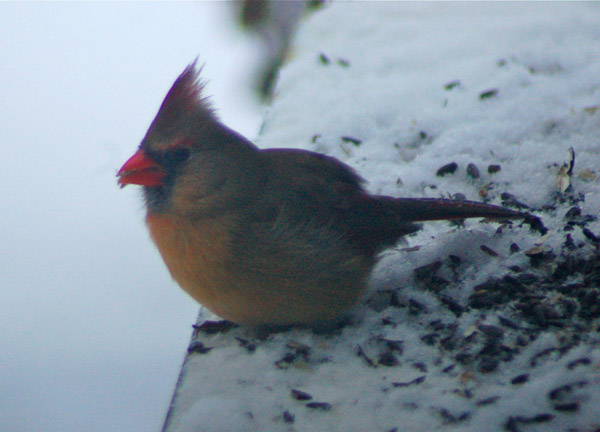
Female Cardinal

By Bruce Stambaugh

I am of the opinion that winter is for the birds. I mean that literally.

Watching the backyard birds enjoy the variety of foodstuffs at the feeders is my winter’s entertainment. The various kinds of feeders are stocked with an assortment of options for the birds to devour, and are placed for safe access by the birds and convenient observation by me.

In the feeding frenzy, the birds put on quite a show.

Several kinds of birds enjoy the spoils of the tube feeder filled with sunflower hearts. The feeder hangs in front of the kitchen window and can accommodate six birds at a time, if all goes well. However, just like people, birds get greedy and guard their territory, even though there is plenty for everybody.

The American Goldfinches seem to be the best behaved, often feeding in families around the feeder’s cardinal ring. It’s named that so that cardinals can enjoy the seeds, too. Cardinals normally prefer a flat surface or the ground for feeding. But occasionally the bright red males and reddish tinged olive females will take advantage of their namesake.

Despite their bright coloration and moderate size, cardinals tend to be skittish creatures and fly off at the first hint of trouble. A few of the cardinals prefer the cracked corn that is spread at the base of the sugar maple. But so does the feisty Song Sparrow, which easily scares off the bigger bird. Using its clawed feet, the Song Sparrow jump kicks at the seed, even though it wouldn’t have to. Hereditary habits are hard to change.

Other sparrows show their faces as well, especially if the ground is snow-covered. The pretty Tree Sparrow, with its distinctive yellow bottom bill, joins the feast along with the showy White-crowned Sparrow. The latter is one of the few species that sings in the winter. Their beautiful tune can warm even the coldest day.

The real fun begins when the acrobatic nuthatches, Chickadees and Tufted Titmice arrive, which they often do simultaneously. I am fortunate to have both White-breasted and Red-breasted Nuthatches, a first for me, coming to the feeders. They are the only birds that move headfirst down the trunk of a tree.

These birds take full advantage of the menu offered at the feeders. If the black oil sunflower seeds aren’t available, they might enjoy some extra protein that the suet provides. Or they might savor a hulled peanut.

All these birds give way when the bully Blue Jays appear. They loudly announce their arrival, and scatter the other birds with their arrogant intrusion. The jays gulp down a gullet full of seeds before flying off with their meal.

An even bossier bird is the Red-bellied Woodpecker. It wants to dine alone while partaking of the smorgasbord offerings, especially enjoying the peanuts. But they can be finicky, too. The next trip in the same bird may hit the ear corn.

Perhaps my favorite visitors are the Eastern Bluebirds, normally not noted as feeder birds. They do enjoy the brilliant holly berries right from the bush out front, but they also have been seen imbibing at the suet and sunflower feeders.

There are times, though, when the birds just don’t show up at all. It’s then that I know that perched nearby is the neighborhood Cooper’s Hawk, which loves a songbird lunch.

Occasionally I know that the swift hawk has enjoyed my feeders, too, at least indirectly. A pile of House Finch feathers atop the snow provides the proof.

Female Red-bellied Woodpecker

Tracks in the snow

Wing prints from the red-tailed hawk

By Bruce Stambaugh

I love when snow covers the dormant winter ground. The beauty is enhanced when the blanket is refreshed with daily snowfalls the way it was earlier in the month.

Snow illuminates everything, even at night. The defused light of a waning moon can still glitter the landscape like a mirror to the stars. A glowing sunrise, a rarity in the normally dreary Ohio January sky, sparkles the morning countryside all around.

The unbroken whiteness seems to connect everything it has touched. It softens the harshest angles of any nondescript building and compliments the already lovely evergreen bows with inches of powdery beauty.

The view beckons me outside. But I hate to make tracks in the snow. I don’t want to do anything that pollutes the purity of the picture perfect scene. Suddenly, the rumbling of the snowplow shakes me from my idealistic stupor. Reality is calling.

The birdfeeders need attended to, the sidewalk and parking pad must be shoveled. Disturbing the beauty isn’t an option. The garbage can has to be wheeled to the roadside and I need to replenish my inside stack of firewood. All of these activities require me to do what I do not want to do. I have to break the virgin snow.

I bundle up much like I did when I was a kid readying to go sledding. Only these endeavors fit the chore category. Still, I get to be out in the invigorating elements.

It doesn’t take long to realize my naivety. Other creatures have been out and about well ahead of me. Bird tracks are evident at the garage door. I didn’t even hear them knock. Rabbit tracks are obvious. Even deer have visited the yard.

Still, I step respectfully, trying hard to bother as little snow as possible. On repeat trips, I retrace my previous tracks. The cottontails seemed to have the same rule.

I feel forgiven for my obsessive/compulsive behavior. Every now and then, while I am doing something mundane, I witness something extraordinary. Recently while retrieving the morning paper from its plastic delivery tube, I found a rabbit flattened on the road.

I mercifully tossed it into the snow near the low bush at the end of the driveway. Later that day, I spied a red-tailed hawk sitting on the snow beneath the bare canopy of the sunburst locust tree in the front yard. The bird flew off before I could take its picture.

Curious, I went out to see why it had been on the snowy ground instead of perched in its usual roost in the pine thicket. I couldn’t believe what I found. The hawk had pounced on the dead rabbit and repeatedly tried lifting off with it. Evidence of that deduction was a crooked path that led away from the roadside shrub where I had pitched the deceased to the locust tree.

There in the snow, on each side of the furrowed trail, was a series of periodic wing imprints. They reminded me of the snow angels we used to make as kids. I must have discovered the beautiful raptor while resting from its numerous futile efforts of trying to get the frozen bunny airborne. Instead, it dragged its catch through the snow.

A closer look revealed that the hawk had begun to tear the rabbit apart, apparently hungry enough to cancel its instinctive routine of capture, fly, perch and eat.

Next day I returned to the scene of the crime. The rabbit was gone. Spots of blood stained the snow. No other tracks of any kind were apparent. The wily bird must have returned to claim it’s prized meal.

I learned an important lesson. Tracks in the snow tell dramatic stories.

Behold winter in rural Ohio

By Bruce Stambaugh

On the coldest day of the young year, winter gave us an icy gift to salve our longings for warmth. The landscape in rural northeast Ohio glistened with delight.

Some call it a quirk of nature. Others know the weather phenomenon as hoar frost. Most ignore the verbiage and science and just enjoy the beauty while it lasts. Like any other meteorological event, nature has a recipe for hoar frost, but it’s more bureaucratic than tasty.

The National Weather Service describes hoar frost as a deposit of interlocking crystals formed by direct sublimation on objects, usually those of small diameter freely exposed to the air, such as tree branches, plants, wires, poles, etc. The deposition of hoar frost is similar to the process by which dew is formed, except that the temperature of the frosted object must be below freezing. It forms when air with a dew point below freezing is brought to saturation by cooling.

No doubt the younger generation would have a one-word answer for that gobbledygook: whatever. Besides, like a double-chocolate layer cake, hoar frost is much better consumed than defined. Only you use your eyes rather than your mouth, unless you happen to be out and about when the icy icing is spread.

On this particular Sunday morning, many people were. They reaped both the benefits and the drawbacks of passing through Creation’s cold kitchen as the raw rarity was being concocted.

Witnesses, who preferred to remain anonymous, said they bundled up for a brisk walk or buggy ride to church. Brisk is a bit too bland. It was downright frigid, five degrees below zero just after sunrise. What a sunrise it was, too, dark one minute and light the next. The sun seemed to skip the formalities and simply bounded over the cloudless horizon, exceedingly anxious to warm up the frozen countryside.

Instantly invisible sunbeams awakened a million diamonds across the snowscape. It was as if the snowy blanket had turned completely into a sparkly sequined gown. But that was only the appetizer for this organic, outdoor brunch.

Everything, and I do mean everything, was covered with a breathtaking whiteness, fresher than the day itself. Evergreens were transformed ever white. The bare deciduous trees were plastered trunk to tip as if they had been spray-painted. Dazzling is too tame of a word to describe the scene, which suddenly grayed.

The snow ceased gleaming as quickly as it had started. The brilliance diminished considerably. Drawn to the window by this abrupt turn of events, I quickly saw the reason for both the diminution and the hoar frost itself. A huge, elongated ice cloud had obscured the sun, but only temporarily.

This ghostly mass had risen from the creek bottoms and deposited its pretty icy prickles as it went. Indeed, it was on the move. Those pedestrians or buggy-goers who had no choice but to pass through the crystallized cloud went in one foggy door wearing black and out the other as ashen apparitions. Hoar frost coated brown horses and men’s beards alike.

Eventually the sun won out, even in the super cold air. The ice fog just vanished, evaporated into nothingness. As the morning continued to warm, the frozen saturation succumbed, falling like sheets of snow.

The bright morning sun had burned off a lingering mist, revealing a glistening glaze affixed to every animate and inanimate object in its path, while diamonds danced on the endless blanket of snow. Behold the unfolding glories of winter in Ohio.

Contact Bruce Stambaugh at brucestambaugh@gmail.com.

Hoar frost defined
Hoar frost on display
Bay Photos by Donna

Wildlife photos from the Chesapeake Bay region

ROAD TO NARA

Culture and Communities at the Heart Of India

K Hertzler Art

Artist and nature journalist in the Shenandoah Valley of Virginia.

Maria Vincent Robinson

Photographer Of Life and moments

Gabriele Romano

Personal Blog

Jennifer Murch

Art is the only way to run away without leaving home. -Twyla Tharp

Roadkill Crossing

Writing generated from the rural life

ANJOLI ROY

writer. teacher. podcast cohost.

Casa Alterna

El amor cruza fronteras / Love crosses borders