Weatherwax lends a helping hand

By Bruce Stambaugh

Jill Weatherwax, 59, of Glenmont, Ohio likes to lend a helping hand whenever she can.

Weatherwax, who by day works at Rice-Chadwick Rubber Company in Killbuck, spends several evenings each month helping others feel better. She provides reflexology treatments for residents at area retirement and nursing homes.

Weatherwax has been offering her services to seniors for a dozen years now. In fact, she specifically focuses on the elderly for a personal reason.

“I got into this because I missed my grandparents, Bob and Sally Allison,” the petite woman said. “I felt a void without them around.”

Jill Weatherwax by Bruce Stambaugh
Jill Weatherwax provided reflexology treatments for Esther Miller, a resident of Walnut Hills Retirement Home in Walnut Creek, Ohio.

Weatherwax has easily filled the void all these years with her gentle touches. She is careful to differentiate what she does from that of massage therapy.

Reflexology is considered a complementary touch therapy. Weatherwax gently, but firmly, works with the hands and feet of senior residents at Majora Lane Nursing Home, Sycamore Run Nursing Home, both in Millersburg, and Walnut Hills Retirement Home, Walnut Creek.

Residents who receive her treatments report relief from pain, stiffness, and other maladies.

“I like it because I can sleep better,” Esther Miller said. Miller is a resident at Walnut Hills Retirement Home and said she looks forward to the helpful visits by Weatherwax.

Weatherwax said it is not unusual for residents to report such extended advantages to the reflexology treatments.

“Relaxing the hands and feet improves the circulation,” she said. “Consequently, the entire body is relaxed, which is why some people report being able to sleep better.”

Her visits, which are paid for by the facilities and offered to the residents free of charge, are regularly scheduled at each location. She said she visits Majora Lane twice a week, Sycamore Lane weekly, and Walnut Hills every other week. And she does so after completing her daytime shift at Rice-Chadwick, where she has worked for 33 years.

“I am on my feet for eight-hours a day,” Weatherwax said. “So I know how important taking care of your hands and feet is.”

Weatherwax, who is certified to offer the reflexology services, said that before she works on residents, she gives the facilities’ administrators the opportunity to experience her treatments. That way they know exactly what is happening when she is there, she said.

“After my grandparents passed on, I asked God to do something to help me fill the void,” she said. After the third time of having her own hands and feet treated by a reflexology therapist, she realized she could provide the same services.

She said she knew such services were not offered in the area. “People don’t want to handle other people’s feet,” she said. “But I feel called to do it.”

According to the Farber Family Foundation, reflexology is a unique method of using the thumb and fingers on reflex areas in the feet and hands that correspond to all of the glands, organs and part of the body to elicit areas of potential or actual disorder. Pressure applied to the reflex points promotes better blood flow and nerve impulses, along with other physiological benefits.

Weatherwax began at Majora Lane, and then reached out to the other retirement centers. She actually finds the sessions therapeutic herself.

“The therapy works both ways,” Weatherwax said. “I get to listen to them while I work on their hands and feet, and they get to listen to me.”

“You need to be in tune with the person you are working with,” she said. “You have to be compassionate for each situation. If not, you are going to hurt them.”

Weatherwax’s gentle touch, soft-spoken approach and years of experience help provide positive results for many area seniors. That’s what helping hands are meant to do.

This article first appeared in the Holmes Bargain Hunter, Millersburg, Ohio, August 2, 2010.

Lakeside, Ohio: A relaxing place to be

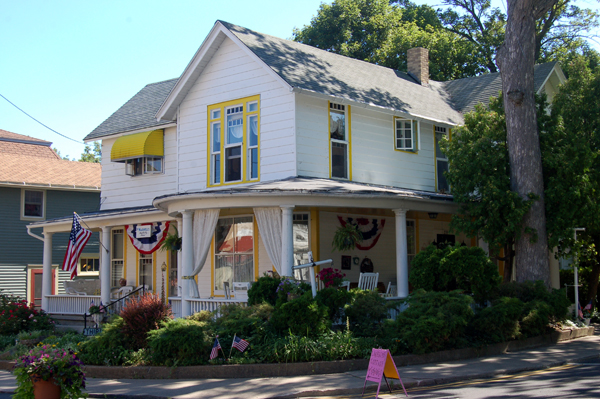
Cottages at Lakeside, Ohio by Bruce Stambaugh
Cottages at Lakeside, Ohio.

By Bruce Stambaugh

Erik Beun of Berlin was typical of the many people from the Holmes County area who vacation at Lakeside, Ohio.

“It’s a relaxing place,” Beun said. Beun and his family were enjoying their sixth year at Lakeside. Beun also brought along his parents, Henry and Julie, for their first Lakeside experience.

Their family was emulating a scene seen thousands of times a year at Lakeside. They were tooling around the quaint village on bicycles. And why not? It’s an easy way to see Lakeside’s immaculate gardens, quaint old cottages, shady lakeside parks and amazing views of Lake Erie and its islands.

The Beun family by Bruce Stambaugh
Allison, Laura, Erik, Andrew, Henry and Julie Beun all enjoyed a bike ride around Lakeside.

Because Lakeside is a gated community during the summer months, it is a non-motorized vehicle friendly place. In fact, bicycles often go faster than cars. In part, that’s because once at Lakeside, the need for a car drops dramatically.

The place is so pretty, so quaint, so relaxing and the people so friendly there is no hurry to go anyplace. You are on vacation. Sit back, relax and enjoy. Many from the Holmes County area have done just that over the years.

Kent Miller of Millersburg started going to Lakeside with his parents when he was 10-years old. That was 1982. Now his son, Kyle, is 10, and has the same sort of fun that his father did.

Miller said the family likes Lakeside because it is “a safe haven for young families to go and relax for a week.” He said they particularly enjoy the amenities of doughnuts from The Patio Restaurant, and letting the kids shop at Marilyn’s, a store with an eclectic mix of clothing, candy and Lakeside souvenirs.

Shasta Mast, executive director of the Holmes County Chamber of Commerce, and her family have retreated to Lakeside for 15 years. She said the most difficult decisions she has to make while at Lakeside are what book to read and when to get ice cream.

Beach and dock at Lakeside, Ohio by Bruce Stambaugh
The small beach and Lakeside's extended dock entice swimmers and sun worshippers of all ages.

Like many other Lakesiders, Mast likes to read her book while sunning on Lakeside’s popular dock that juts out into Lake Erie. Others swim, with lifeguards provided during certain hours. Still others fish from the dock, while some simply choose to sit and watch the variety of boats sail or speed by. In the evening, the dock is crowded with sunset watchers with cameras at the ready.

Of course, the front porch is just as good for reading as the dock. It could be the house rented for the week, a bed and breakfast or the sweeping, screened porch of the historic Hotel Lakeside. They all provide peace, shade and plenty of congenial company.

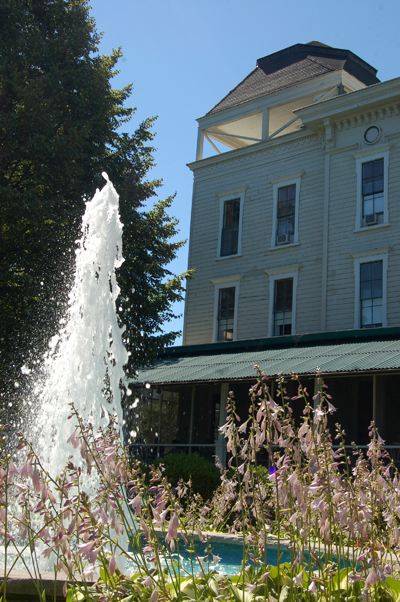
fountain by Bruce Stambaugh
The fountain in front of Hotel Lakeside.

After all, Lakeside is the Chautauqua on Lake Erie, nurturing the body, mind and soul. That is what the Lakeside Association both promotes and provides for its visitors. Educational workshops, seminars, evening entertainment and worship can all be part of the Lakeside experience for children to adults.

Tennis, shuffleboard, miniature golf, running, walking and Frisbee are also available if exercise and competition are your game. There are businesses to spend your money if you want, and by the lines, a lot do. Specialty drinks, ice cream, homemade doughnuts, and Lakeside-specific clothing are all available.

Then, again, you can just adopt Erik Beun’s attitude and simply relax. That’s the Lakeside way.

Maxwell Hospitality House by Bruce Stambaugh
Maxwell Hospitality House, Lakeside, Ohio.

This article initially appeared in The Holmes County Journal, July 29, 2010.

A love for agriculture come full circle

By Bruce Stambaugh

It’s no accident that Leah Miller’s life has come full circle. Agriculture runs deep in her genes, personal life and in her professional career.

She grew up on a farm, and now her life is all about farming, both at home and on the job, whichever particular job it is she happens to be doing. In between, her career took a productive, if not circuitous route before Miller, 61, planted her agricultural roots.

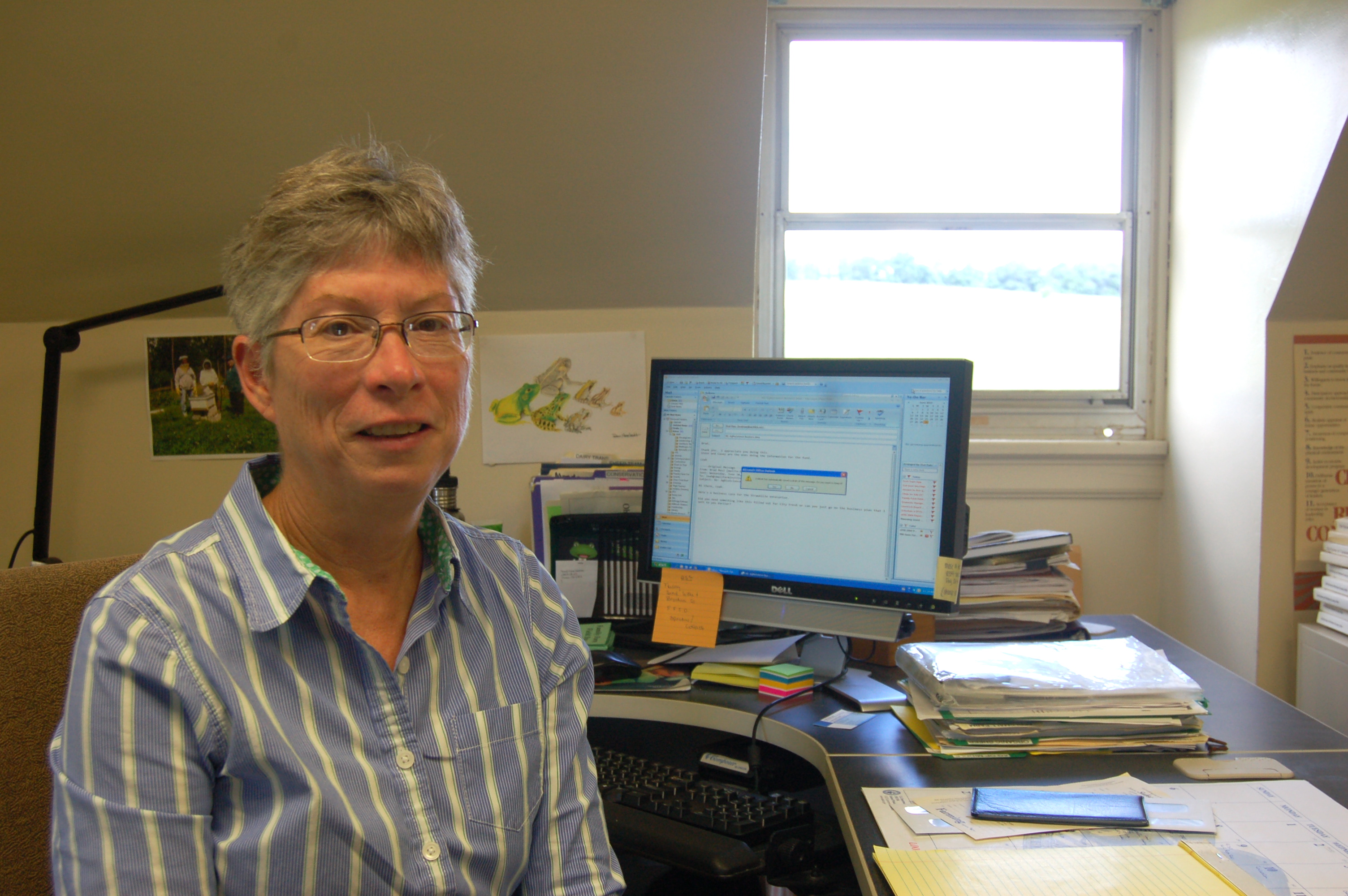
Leah Miller by Bruce Stambaugh
In a rare moment, Leah Miller was in her Small Farm Institute Office in Coshocton County, Ohio.

Born in Conneaut, Ohio near her parent’s home farm at Pierpont, Miller followed some pretty big family footprints. Her father and her father’s father were both agricultural teachers, in addition to running separate farms in Ashtabula County.

Miller’s mother, Celia Wright, took charge of the family farm when her husband, Eber, moved into regional planning. Ironically, that is exactly the job Miller took in Lake County after graduating from The Ohio State University in 1971. She became Holmes County’s regional planning director two years later.

There is a bit of double-irony in this scenario. The Holmes County regional planning office was in the front of Hotel Millersburg.

“My parents spent the first night of their honeymoon at Hotel Millersburg,” Miller said. “They got a late start from their wedding reception in Columbus and following U.S. 62, Millersburg was as far as they got.”

Miller served in this capacity for six years. Once she and her husband, Mic, started their family, Miller turned her efforts to community service. She served two terms on the West Holmes Local School Board. Later, she served on the board at Central Christian School. She also served a term on the Ohio Mennonite Relief Sale board of directors, and was a 4-H advisor for a dozen years.

Miller was the first director of the Holmes County Chamber of Commerce, once it expanded from beyond Millersburg proper. In the 1990s, Miller’s leadership abilities became political. She was twice elected as a Holmes County commissioner.

All the while she found solace from her demanding schedule on her 50-acre sheep farm, Blue Bird Hill, east of Millersburg. She also kept bees, as did her father.

Her love for land and the people that farmed stirred within her. In 2001, she worked with former state representative Joy Padgett to form the Small Farm Institute.

“There was a concern about erosion and farming,” Miller explained. “The emphasis was to help farmers do more grazing with their animals.” She said the sod would help reduce run-off, and at the same time provide a natural grass diet for cows, cattle and sheep.

Miller is the director of the Small Farm Institute, which is based at the United States Department of Agriculture’s hydrological station in Coshocton County. She assists small farm operations to improve income by providing helpful information on sustainable environmental practices that support strong family and rural communities. Her focus is on production, processing and distribution of product.

“We encourage people to look for value-added production to enhance profitability,” Miller said. “If they run a produce stand, they can increase their income by making jam or canning instead of selling all their fruit and vegetables fresh.”

Much of Miller’s responsibility revolves around facilitating grazing groups. She said this has been especially successful among the Amish, who tend to form their own peer groups in close proximity to help reduce the need for transportation.

“It’s been a joy to watch them expand,” she said. “They hold pasture walks where they share helpful grazing information with one another.”

As satisfying as that is for Miller, she also supports much larger events. Her skill sets also assist the annual North Central Ohio Grazing Conference for Dairy, which brings in hundreds of people, including many from other states.

Miller also advises the planning committee for the upcoming annual Family Farm Field Day. David and Emily Hershberger will host the event on their farm, located on Saltcreek Township Road 613 in Holmes County, on July 17, from 8:30 a.m. to 4 p.m.

As if she weren’t busy enough, Miller works part time as stakeholder coordinator in agricultural economic development for the Ohio Agricultural Research and Development Center in Wooster. She splits her time between there and the Small Farm Institute. Miller is the executive secretary of the Ohio Forage and Grasslands Council, too.

Miller has traveled extensively, including Australia, Mexico, France and Honduras, touring grazing and farm production operations and doing a little mission work, too. She uses these experiences to expand what she shares about improving local farming practices.

It seemed only logical then that Miller’s leadership abilities be put to use in yet another positive way for the community. Miller has successfully lead Leadership Holmes County for employees of area businesses for several years. In that fact, there is no irony.

This article was first published in the Holmes Bargain Hunter, July 5, 2010.

Benefit auctions abound in Ohio’s Amish Country

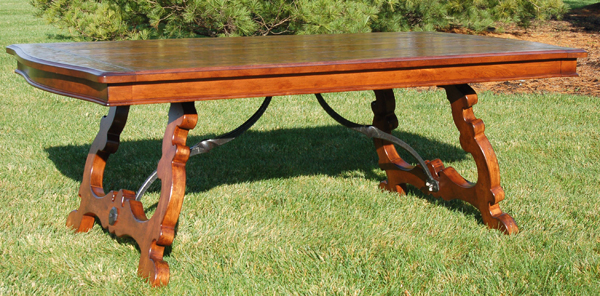
Handcrafted table by Bruce Stambaugh
A sample of the kind of furniture offered at benefit auctions in Ohio's Amish country.

By Bruce Stambaugh

Benefit auctions abound in Ohio’s Amish country. Every year thousands of people from near and far attend these worthwhile functions.

Dave Kaufman of Kaufman Realty, Sugarcreek, serves as auctioneer at many of the benefit auctions. He’s not surprised at the popularity of the events at all. He said the formula for their success is pretty simple.

“It’s a very giving, caring community,” Kaufman said. “If it’s a good cause, the auction will get good support.”

Kaufman estimated that there are at least 35 such benefit auctions in Amish country. Some are small, local auctions, like the ones for private Amish schools. Others draw big crowds and usually raise major money for their causes.

“If there is a need,” Kaufman said, “people come to the rescue.”

One of the largest benefit auctions is the Rainbow of Hope Auction in Mt. Hope. Henry Hershberger is its president and founder. This year’s sale is July 23 and 24 at the Mt. Hope Auction barn.

The sale has been a local mainstay since 1987 when Hershberger’s young daughter was hospitalized for two months. Hershberger is Amish and along with other members contributes to the church’s medical fund. But in this case, the fund was depleted before the bills were paid.

Hershberger turned to the community for help, which responded by raising the $20,000 balance of his medical bills. Touched by the generosity, Hershberger started the auction as a way to help others who might be in a similar situation.

“Our best auction was in 2008 when we totaled $403,735,” Hershberger said. He rattled off that figure from memory.

“We try to focus on the community to make it work,” Hershberger said. “It’s something the entire community can participate in.”

Like most other benefit auctions, Rainbow of Hope Auction depends on volunteer labor and donations of items for a successful sale. With furniture the biggest moneymaker, Hershberger said that the work of the furniture committee is key.

“We have about 25 people who canvas the community, hitting every furniture manufacturer and retail store for donations,” he said. “All the items are new.”

John Deere quilt by Bruce Stambaugh
Quilts like this one are often found at the benefit auctions held each summer in Ohio's Amish country.

Hershberger said they also auction quilts, gift certificates and other home and garden items. Hershberger stressed that the Rainbow of Hope fund is not just for Amish.

“Any resident in Coshocton, Holmes, Tuscarawas and Wayne counties can apply to the committee for financial help,” he said. “We may not be able to pay all of their bills, but we can help in some way.”

Hershberger said the Rainbow of Hope fund has never run out of money either. He said the committee uses two percent for overhead.

“The other 98 percent is used for those who need it,” Hershberger said. He has served as chair of the auction for 20 years.

Another popular benefit auction is the Ohio Mennonite Relief Sale, which will be held August 6 and 7 this year in Kidron. Last year, the sale raised $338,653 for Mennonite Central Committee (MCC).

MCC is the relief, service and development agency of North American Mennonite and Brethren in Christ churches. Several such sales are held throughout North America annually. The Ohio Mennonite Relief Sale is typical of those auctions.

Baby quilt by Bruce Stambaugh
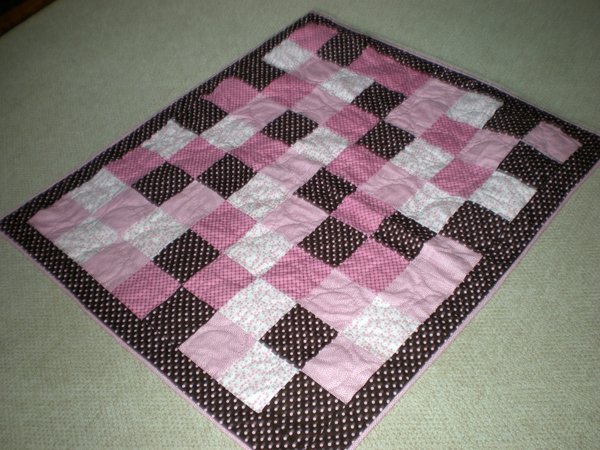
A baby quilt typical of the kind auctioned off. My wife, Neva, made this one for our granddaughter.

Once again, the Ohio Mennonite Relief Sale will feature a varied schedule of events. Everything from food to children’s activities to the auction items themselves will be included. Even a USA Track and Field certified Run for Relief will be held to help raise money for MCC projects worldwide.

Another big benefit auction in the area is the Ohio Haiti Sale, also held at the Mt. Hope Auction in Mt. Hope. This year’s sale, which will have special meaning given the catastrophic January earthquake in Haiti, will be held on Labor Day weekend, September 3 and 4.

A small quilt by Bruce Stambaugh
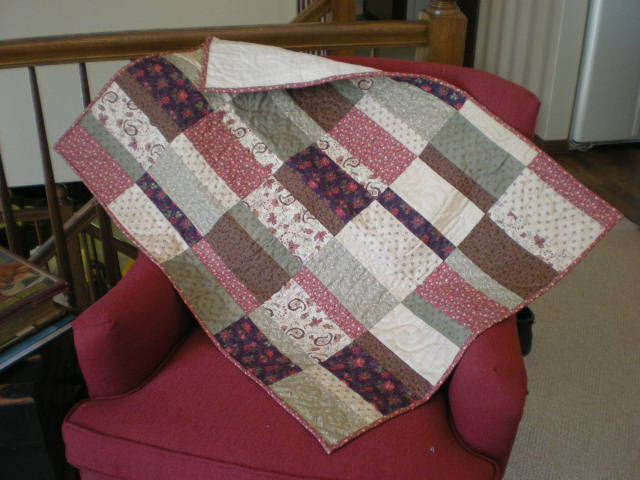
This is another example of the kinds of quilts available at charity benefit auctions.

This sale is also one of several held around the country for the benefit of those in need in Haiti. The Ohio Haiti sale was also begun in 1987. It, too, takes a coordinated effort of many volunteers and donated items to raise funds.

Food, fun and fellowship enhance the actual auctioning of items at the Haiti sale, just like all the other benefit auctions that predominate the summer months annually in Ohio’s Amish country.

This article first appeared in the June 2010 edition of Ohio’s Amish Country.

Glenn Wengerd and Winesburg, Ohio: A natural fit

Glenn Wengerd by Bruce Stambaugh
Glenn Wengerd showed off one of the many cars he has restored.

By Bruce Stambaugh

Glenn Wengerd, 61, is about as unassuming as a person can be. Dapper, sophisticated, egotistical are words that would never describe him.

That is just fine with the Winesburg native. Wengerd is as down home, easy going and likeable of an individual as you will ever meet. Of course, Wengerd would be too humble to say such things about himself. But that is typical Glenn Wengerd, too.

Wengerd is a life-long resident of Winesburg, a quaint unincorporated town tucked in the northeast corner of Holmes County. Although Winesburg has had its characters over the years and at one time had seven bars, it is no comparison to Sherwood Anderson’s famous novel “Winesburg, Ohio.”

Having spent his entire life in the picturesque village, which now has no saloons, Wengerd has known many of those characters over the years. He calls them “old-timers.”

Wengerd remembers riding his tricycle up and down the sidewalks of Winesburg as a toddler, and being teased by some of the town fathers.

“The old-timers would stop me by putting the hook of their canes into my bike’s spokes,” he recalled with a chuckle. Later the “old-timers” would visit him in his restoration shop just to sit and chat while he worked.

But Wengerd doesn’t linger or even live in the past. He helps preserve it. As a

Glenn Wengerd by Bruce Stambaugh
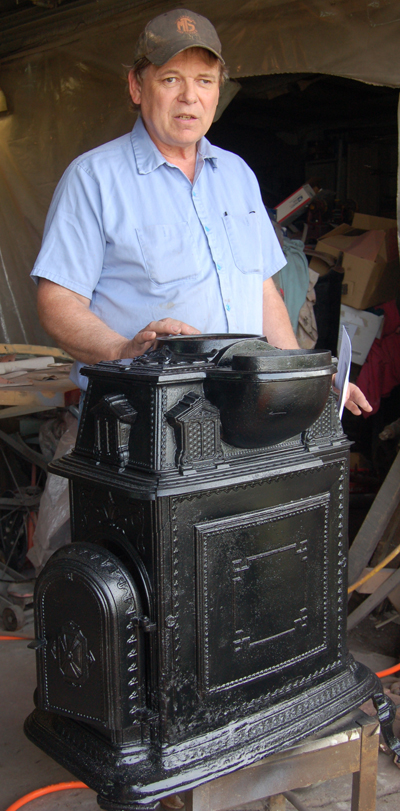
Glenn Wengerd displayed his latest restoration project, a stove for a local museum.

profession, he restores antique cars and other assorted old items. Putting the finishing touches on an old potbellied stove for the German Culture Museum in Walnut Creek was his latest sidebar.

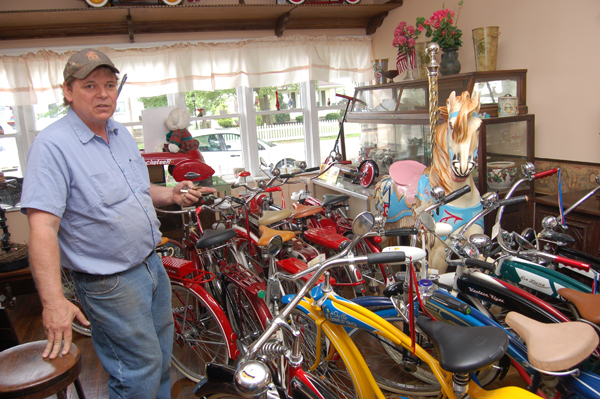
He restores antique toys and bicycles as a hobby. Wengerd even dedicated a rather large room in his 1897 residence on Main Street to house all his entertaining restorations. He holds open houses occasionally, including this coming September during the Winesburg Reunion, which happens every five years.

It is here where Wengerd really shines. He devotes untold hours helping the little town preserve itself for current and future generations to enjoy and appreciate. He has served as either President or Vice President of the Winesburg Historical Society for 25 years.

“The funny thing about that,” Wengerd said, “was that I agreed to join if I wasn’t an officer.” The group waited until the second year to name him their leader.

Prior to his deep involvement with the historical society, Wengerd served as president of the park board during the early development of the town’s recreational park. Today he gets a quiet contentment out of seeing people enjoy the shade of the trees he helped plant.

Wengerd’s roots go deep into the history of Winesburg. He owns the property his grandfather bought in 1949. His restoration shop was the chicken barn and carriage house.

Glenn Wengerd by Bruce Stambaugh
Glenn Wengerd stood by the plaque at his front door that showed all the owners of his 1897 home in Winesburg, Ohio.

As a child, Wengerd marked up the walls of his grandparents’ home with his tricycle tires. Now he lives in that same beautiful home, and according to Wengerd, he regrets being so reckless with his trike.

“We are trying to spruce up the house in preparation for the reunion,” he said, “and those marks are very hard to remove after all these years.”

The home’s exterior is also getting a fresh coat of paint, using the original color scheme as much as possible. To do that, he hired Nelson Roller, a local handyman who moved to Winesburg from West Virginia because he told his wife that “it felt like home.”

When Roller discovered his last name on the plaque that lists the past owners of Wengerd’s house, he inquired within. He went to the right person. The Rollers were among Winesburg’s first settlers. Nelson is likely a descendent.

Wengerd’s restoration efforts, however, go far beyond his own business and home. He has lead the effort through the Winesburg Historical Society to restore and relocate an old log cabin, Peter’s School and replicate the town’s original bandstand. All are set in a small park across from the town’s fire station.

Glenn Wengerd by Bruce Stambaugh
Glenn Wengerd restores toys and bicycles, which he has on display in his home.

Restoring the 1861 German Methodist Church building is the next project on the horizon. Wengerd said the historical society would like to see this undertaking completed in conjunction with the 150th anniversary of the U.S. Civil War in 2011.

Dedicated as he is, Wengerd certainly doesn’t see his time, hard work or the interruptions as a bother. Just the contrary is true.

“It is a privilege to know, cultivate and hand down some of the local history,” he said. “Just recently people from Oregon and Maryland tracked me down about finding their roots here.”

Of course, Wengerd entertained their questions and invited them back for the reunion. That’s just the way Wengerd is, and Winesburg reaps the benefits.

This story first appeared in the Holmes Bargain Hunter on June 21, 2010.

BBQ chicken, Jr. Schlabach style

Jr. Schlabach by Bruce Stambaugh
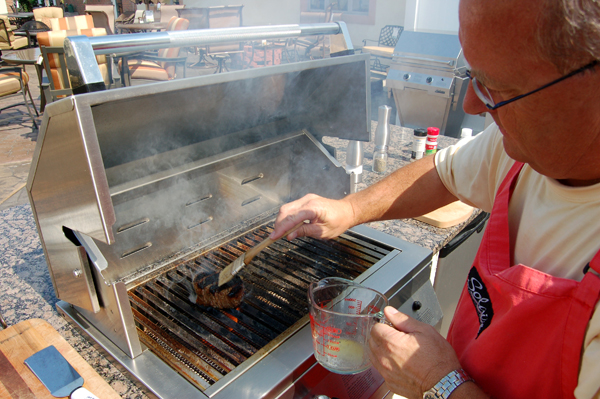
Jr. Schlabach sprays his secret barbeque sauce onto the chicken as it cooks.

By Bruce Stambaugh

Henry Schlabach, Jr. knows a thing or two about barbequing chicken. He should. He’s been at it for 45 years.

The 72-year-old Schlabach, who lives between Berlin and Millersburg, seems to get as much satisfaction from helping his customers as he does making the chicken. Schlabach’s reputation for preparing excellent barbequed chicken has spread far and wide over those many years with some customers coming from 60 miles or more. He mainly grills chicken for families, organizations and wedding receptions.

Schlabach said he normally barbeques an average of 10,000 chicken halves a year. He has relied solely on word-of-mouth advertising.

“In all those years,” Schlabach said matter-of-factly, “I haven’t spent one penny on advertising.”

For Schlabach, the season for barbequing chicken runs from April through November. Not surprisingly, he is particularly hectic around holidays.

On the Saturday of Memorial Day weekend, for example, he was busy barbequing 740 chicken halves and 300 chicken quarters. Schlabach said he usually barbeques the chicken in batches of 500 halves at a time, 25 halves to a rack.

“That takes us four to five hours to do that many,” Schlabach said.

Of course, Schlabach doesn’t take on all this alone. His sons, Tim and Mark, help out. They started helping him by making the sauce when they each were around 10-years old. Today, they are grown men with families themselves. Now the grandsons have joined the crew.

“I couldn’t do it without their help,” Schlabach said. If an organization orders chicken, representatives from that group also assist in the hot and sweaty production.

Grandson Charlie Schlabach said he likes to help for three reasons. “I get paid, it’s fun, and we get to eat chicken, too,” he said with a smile to match that of his grandpa.

The Memorial Day effort was a combination fundraiser for the Walnut Creek little league team and making chicken for high school graduation parties. The crew gathered at 5:30 a.m. to begin so they could be completed by mid-morning.

Schlabach started his chicken barbequing with a portable pit on a trailer.

“We could only do 150 halves at time with that,” he said. Schlabach has progressed to two roof-covered barbeque pits built behind a garage near his residence.

Schlabach began his barbequing career for the Shreve Businessmen’s Association that sold barbequed chicken at the Wayne County Fair. At that time, Schlabach ran a restaurant in Shreve.

“The guy that was supposed to make the chicken quit doing it,” Schlabach explained. “I don’t know why they called me to do it, but they did.” That first year he made 750 halves. Last year they sold 10,000 halves at that fair.

Schlabach said he uses a combination of vinegar, butter, Worcestershire sauce, salt and water, though he didn’t provide the specifics of the recipe. He still uses the original wire-meshed racks that were locally made to barbeque the chicken.

Schlabach is picky about the charcoal he uses, too. He drives to Brookville, Pennsylvania and buys a season’s worth of Humphrey Charcoal.

He said getting the fire hot, and then turning the racks with the cooking chickens is the key to ensuring good chicken. Of course, spraying the sauce with pressure sprayers is just as important. The most chickens ever done by Schlabach at one time was 2,000, which took about eight hours to complete.

With the demand for barbequed chicken growing, Schlabach has seen a lot of competition come and go over the years. This year, he said, there aren’t so many people making chicken.

“It’s just plain hard work,” he said, wiping sweat from his brow. He thinks the craving for chicken in the area could possibly be due to the high number of benefit sales conducted locally. For the record, the Walnut Creek baseball team sold all their chicken.

That’s what Jr. Schlabach wanted to hear. For him, all the effort he put into the day, even with its early start, was worth it. And as a bonus, he got as much satisfaction from working with his family as he did barbequing his famously delicious chicken.

This article first appeared in the June 14, 2010 Holmes Bargain Hunter.

Tornado hits Ohio’s Amish country

damaged buggy
This buggy, which was used for display at a bed and breakfast, received heavy damage from the high winds.

By Bruce Stambaugh

Around 2:30 p.m. on Saturday, June 5, 2010, the National Weather Service issued a Tornado Warning for Holmes County, the heart of the world’s largest Amish population.

Sirens sounded as the storm rapidly approached. As a Skywarn spotter, I scanned the sky from the safety of my home. As the rain intensified, the sky looked ominous, and the sirens sounded again. However, it appeared that the worst of the storm had gone south of me. A friend alerted me to possible damage in the Berlin area.

I grabbed my camera, put on my waterproof shoes and headed south. I didn’t get very far. Fallen trees only two miles south of my home blocked the road. The fierce winds had ravaged old-growth woods behind a friend of mine’s home west of Berlin. A few homes were slightly damaged, a shed was completely destroyed and many trees were toppled.

I followed the damage into the west side of Berlin, where again trees were down, some laying in opposite directions. A home had the upper half of a large tree on its roof and the wind sent a limb through the roof of a nearby motel.

The next damage was east of Berlin near Hiland High School. Much of the damage there was from straight-line winds. Roofs were damaged; metal storage buildings buckled and signs were blown onto cars, damaging eight vehicles. Fortunately on one was injured.

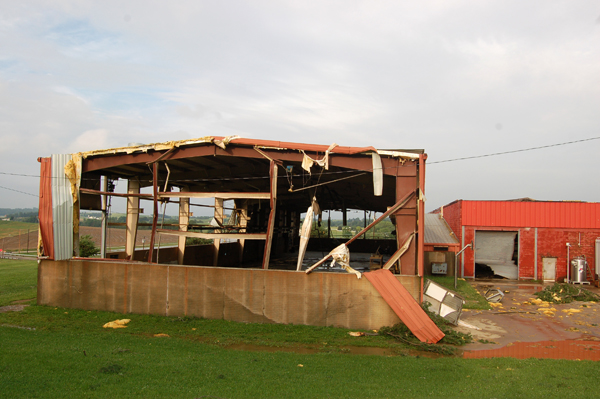
Firefighters spotted a funnel cloud west of Walnut Creek, where the first official touchdown was recorded. A large garage at a bed and breakfast was destroyed. The storm continued east-southeast through Walnut Creek Township. A combination of straight-line winds and tornado winds downed trees, and damaged sheds and two houses near Walnut Creek, and then hit metal storage buildings south of Walnut Creek. The tornado touched down again at Gerber Valley Farms on CR 144 southeast of Walnut Creek where it damaged two barns. The tornado did minor damage to a few homes on a township road near the county line.

Once the tornado passed into Tuscarawas County at Sugarcreek, it intensified into an EF-1 tornado, according the Pittsburgh office of the National Weather Service, which has jurisdiction for Tuscarawas County and points east. They estimated the tornado winds at 95 m.p.h.

The tornado did major damage to Skyline Mobile Home Company on SR 93 north and to a home across the road. Several large trees were toppled. From there, the storm hit Uhrden Corporation and Zinck’s Fabric warehouse on the northeast side of Sugarcreek. It crossed the flooded Sugar Creek, causing heavy damage to both the old and new sewer treatment plant buildings of the village. Just east of there it hit a home and caused major damage to Sugarcreek Pallet.

The tornado continued east, striking four homes along SR 39 on the eastern edge of Sugarcreek. All four had roof damage. The tornado crossed SR 39, hit another industrial building and destroyed a large barn on the Lorenz farm south of Dutch Valley Restaurant. At that point, the tornado lifted.

In all, I spent five hours taking pictures. The shots below are representative of the damage that occurred in the path of this storm.

Damaged trees
Old-growth trees were splintered and tossed like sticks west of Berlin, OH.
damaged car
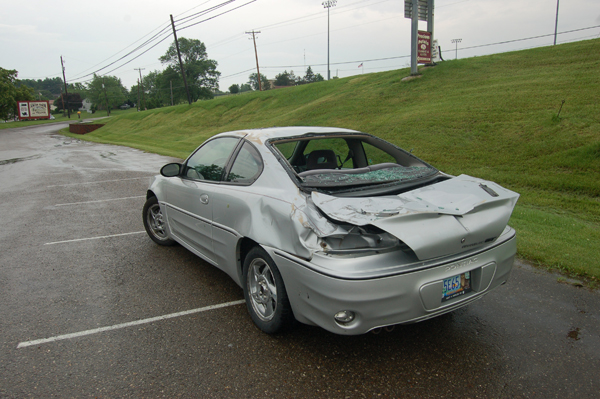
This was one of several cars damaged by a large sign that was blown onto them east of Berlin.
damaged garage
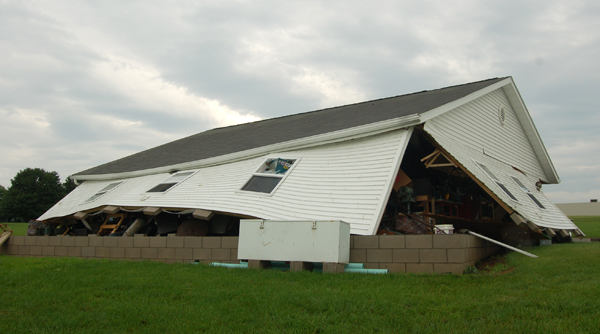
High winds destroyed this garage halfway between Berlin and Walnut Creek, OH.
damaged home at Robert J. Yoder farm.
The tornado hit at the Robert J. Yoder farm near Walnut Creek, OH.
Gerber Valley Farm
Neighbors and workers began replacing the roof of this broiler house near Walnut Creek shortly after the tornado hit.
Skyline Mobile Homes
The tornado buckled the south wall at Skyline Mobile Homes, Sugarcreek, OH.
Inside Skyline
The tornado peeled much of the roof off Skyline Mobile Homes, Sugarcreek, OH.
Uhrden Company
The tornado blew out every wall of the north section of Uhrden Company, Sugarcreek, OH.
flooding at Sugarcreek, OH
Flooding in Sugarcreek, OH was a problem both before and after the tornado hit the buildings in the background and the tree in the water.
Lorenz barn
The tornado destroyed the main barn on the Lorenz farm east of Sugarcreek, OH.

A dairy farmer at a turning point

Hershberger farm
Bobby Hershberger's farm in Paint Valley west of Millersburg, OH.

By Bruce Stambaugh

A brief glance at Bobby Hershberger’s hands, and you know his profession. Crinkled, calloused, chapped, all the marks of a born-again dairy farmer.

Not yet 50, his thick fingers belie the rest of his body. His steely eyes still sparkle, even on a gray day in Ohio’s Amish country. His rutty smile foretells his honesty, integrity, and dedication to farm, family and faith.

Modest as the day is long, Hershberger loves dairy farming. He must. He has spent his entire life milking cows, plowing ground, seeding fields, mowing hay, picking corn, feeding livestock, caring for family, serving church and community.

On good days he only works eight hours or so. On really good days, he works twice that amount. Such is the life of a dedicated dairyman.

With his equally dedicated wife, Beth, at his side, Hershberger has made it all these years, even milking just 30 Holsteins, not exactly a mega farm. The Hershberger’s also operate Pine Loft Bed and Breakfast out of their home high on a hill that overlooks Hershberger’s home farm in Monroe Township’s Paint Valley west of Millersburg, the county seat in Holmes County.

“Tilling 110 acres and milking just 30 cows, there are Amish who have bigger farms,” he said humbly. The combination of his demeanor and his gentleness tells even a visitor that there is no malice in this man.

There are 40 years of thought, vision and compassion, however. Hershberger began milking cows with his entire family. He then went 50/50 with his father, and for the last 22 years, he has been on his own. And that has worn him down.

In his lifetime of milking, Hershberger has seen a gradual but significant transition in the dairy industry. When Hershberger started helping on the family farm, farming was slower paced. Cooperation out-muscled competition, and income was much more stable, thanks in part to government milk subsidies.

But much of that has changed. In the last decade or so, the change has become more an economic stampede of sorts. To put it simply, it’s either get run over by the big guys, or step out of the way.

As hard of a decision as it was, the Hershberger’s have chosen the latter. This summer they will sell their herd, effectively ending an agricultural aspect that has kept the couple close to home 24 hours a day, seven days a week.

Holsteins, after all, don’t take vacations, so neither do their owners. As the couple looked ahead and weighed their options, the decision to stop milking became pretty clear. Day in and day out, milking cows is as grueling as it is satisfying.

“The decision really came down to this,” Bobby explained. “Either we had to expand or get out.” They loved their life on the farm. But they also knew that there was more to life than milking cows twice a day until you physically couldn’t do it any more.

“Farming is a challenge,” Bobby said. “The work is never the same from day to day because something always comes up.”

“I have enjoyed being able to work from home,” he reflected, “but when you milk, you are always at home.” Hershberger said after all these years he and his wife are simply tired.

Last year was an especially horrible year for farmers, according to Hershberger. In a way, that made their decision to stop milking much easier. Bobby saw staying in the dairy business as a sinking hole.

“With prices down, you work seven days a week and end up having nothing to show for it,” he said dejectedly.

Hershberger said that the only way to continue as a dairy farmer was to expand operations. To do that, he would have to purchase or rent more land, which would require him to buy bigger, better, and more expensive farm equipment and buildings, and hire farmhands. All of that meant borrowing more money, and that just wasn’t something he and Beth wanted to do at this stage in their lives.

Hershberger wanted to be clear that this was a personal decision. He doesn’t begrudge anyone. Dedicated farmer that he is, he wants the industry to succeed. But he sees the small farmer like himself being squeezed by the system more and more.

Hershberger is a practical man. “Being a dairy farmer has gone from a way of life to a way of making a living for big business,” he said.

With that, the strong, humble man’s voice tailed off, almost in a quiet relief of the decision he had made to stop milking cows. Hershberger said he would continue to farm the fields.

“But I will have to find a part-time job someplace to make up for the lost income,” he said realistically. “I feel at peace about my decision though.”

Bobby Hershberger
Bobby Hershberger on his way home from the barn.

This story originally appeared in the Farm and Dairy tab of the Holmes County Bargain Hunter.

Tipping the Teacup: A frugal fashion show

Naomi Raber
Naomi Raber checked her hat before making her entrance into the fashion show.

By Bruce Stambaugh

A fashion show sponsored by a thrift store sounds like the punch line to a bad joke. But that’s exactly what happened recently in Millersburg to the delight of all who attended.

Save and Serve Thrift Shop of Millersburg sponsored a memorable event titled “Tipping the Teacup” Friday evening, May 21 at Millersburg Mennonite Church. Part meal, part fashion show, part fundraiser, the enjoyable gathering was officially dubbed “a very special tea party and style review.” No matter how it was described, the evening became quite the social party.

Helen Glick, assistant manager at Save and Serve, organized and hosted the party, which was attended by nearly 150 people. That number included 23 individuals, children to grandmothers, who served as models for the fashion show that followed the heavy Hors d’ Oeuvres meal.

The church was filled with decorated tables set with china plates, teacups and saucers, all from Save and Serve. Bouquets of fresh cut flowers adorned each table.

After raiding a buffet worthy a cruise ship and having tea or coffee served to them, attendees were entertained while they ate. Rhoda Mast played the piano and sang. Others sang as well, including Kudzayi Nyakura, Rachel Miller, and Annie and Carrie Yoder.

After the meal, the patrons, who paid $20 each to attend, settled in for the stylish entertainment. They weren’t disappointed.

Carol Mullet of Sugarcreek served as commentator of the style review. Each volunteer model dawned pre-selected outfits obtained from Save and Serve’s inventory and wound their way through the audience as Mullet described their choice of clothing.

Zack, Kevin and Jonathan show off their outfits.
Zack Miller, Kevin Roth and Jonathan Reuel revisited years gone by with their outfits.

The wardrobes modeled ranged from prom dresses to hip garb to head-to-toe cowboy. Each model chose three separate outfits to wear.

60s dress
Back to the 60s.

Some wore exquisite clothing, while others exhibited crowd-pleasing silliness with combinations from by-gone eras.

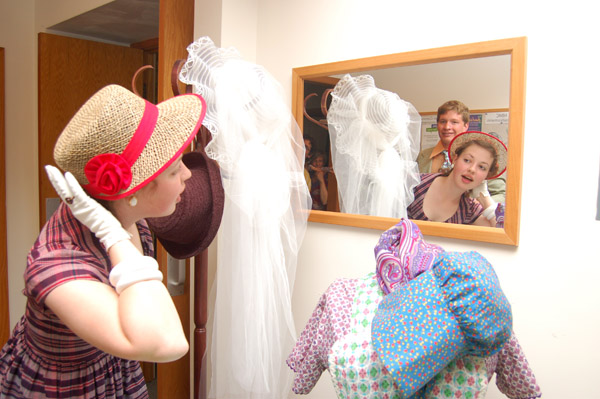
The style show concluded with entrance of a black tuxedo complete with top hat worn by Dr. Roy Miller. He escorted Heather McDonough dressed in a lacy, black formal gown and contrasting red hat and veil. All the models had first option to buy the clothing they wore. After that, those in attendance could purchase particular items they had spied.

Glick said the evening earned nearly $2,400 for Mennonite Central Committee (MCC). Proceeds from Save and Serve also are sent to MCC, which aides refugees in need of food, clothing and shelter around the globe. Emergency kits for Haiti following the devastating earthquake there earlier this year are an example of MCC’s services.

The Tipping the Teacup planning committee included Glick, Mullet, Janice Miller and Ruby Miller. This was the second year for the benefit fashion event.

formal and tux
Formal attire completed the benefit fashion show.
Bay Photos by Donna

Wildlife Photos From The Chesapeake Bay Region

ROAD TO NARA

Culture and Communities at the Heart Of India

K Hertzler Art

Artist and nature journalist in the Shenandoah Valley of Virginia.

Maria Vincent Robinson

Photographer Of Life and moments

Gabriele Romano

Personal Blog

Jennifer Murch

Art is the only way to run away without leaving home. -Twyla Tharp

Roadkill Crossing

Writing generated from the rural life

ANJOLI ROY

writer. teacher. podcast cohost.

Casa Alterna

El amor cruza fronteras / Love crosses borders