The trellises worked: A tomato success story

Brandywine tomatoes by Bruce Stambaugh
Red Brandywines ripening in the shade of the tomato trellis.
Tomatoes ripening on the vine by Bruce Stambaugh
Tomatoes ripening on the vine.

How did our tomatoes grow this year? They did quite well, thank you very much, and little thanks to me. My wife did most of the work. I just took the pictures and enjoyed the bounty.

As you may recall, we tried something different this year. Tired of the weighty tomatoes collapsing the stakes and metal cages we “secured” them with, my wife found a plan for tomato trellises. Our son, who has become quite the food guru, lives in a loft in Wooster, Ohio, 16 miles north of us. He and his wife have no outdoor space for growing the vegetables and herbs that he loves to use for his gourmet cooking. (See the May 27, 2010 post entitled “A beautiful morning well spent.”)

Amish farm Ohio by Bruce Stambaugh
The Amish farm on which our home is built.

Our house is built on an Amish farm four miles southwest of Mt. Hope and four miles northwest of Berlin, the unofficial capital of Ohio’s largest Amish population. In other words, we’re out in the country with Amish neighbors and farms all around. Since our son drives right by us every workday, he asked to join us in our limited gardening. After the drought of 1988, we gave up most gardening. My wife turned to flower gardening, which adds a multitude of color to our little acre and a half each growing season.

Wildflower garden by Bruce Stambaugh
The backyard wildflowers are only some of the beautiful flowers my wife cultivates each year.

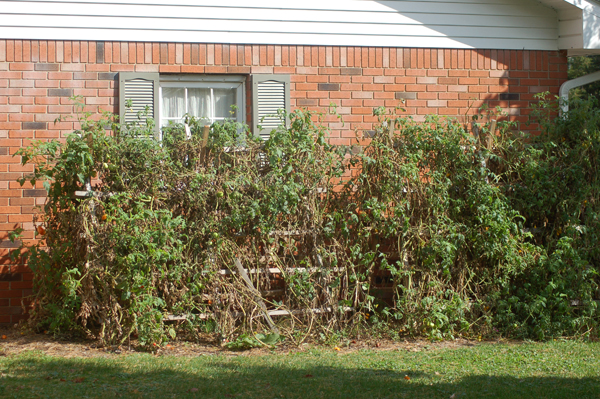
The tomato trellis plans called for plenty of space, which required me to dig out more yard along the bricked garage wall at the south end of our home where we annually grow the tomatoes. We have discovered that the tomatoes seemed to thrive on the extra heat radiated by the bricks.

I dug out the grass by a couple of more feet, spaded the ground and added some horse manure the neighbor supplied when he fertilized the fields adjacent to our home. Our son, my wife and I erected a pair of the trellises on May 15. My wife purchased and planted a dozen heirloom tomato plants. Varieties included Hillbilly, Striped Zebra, Black Krim, Mortgage Lifters, Red Brandywine, Roma’s, and Old German. A friend from church also gave us an unknown variety. And several Yellow Pear tomato plants volunteered from last year’s crop.

Driving tomato stakes by Bruce Stambaugh
Our son drove 7 ft. stakes into the ground to form the support of the trellis.

We purchased seven foot oak stakes at a local nursery. The original plans called for eight-foot stakes, but the sevens were the best we could find without having some special ordered at a much-increased price. The main stakes were pounded into the ground, and the lateral ones were spaced and tied with garden twine.

The plants seemed to grow slowly the first month. But once the summer heat and humidity really kicked in, the tomato plants boomed. My wife repeatedly tied the ever-increasing shoots as best she could. Still, the end result looked like a jungle.

The plants are still producing, but with the peak of the season behind us, the plants production has slowed considerably. We did have to fight a bit of blight throughout the summer, but the plants continued to thrive. And we enjoyed their abundant production.

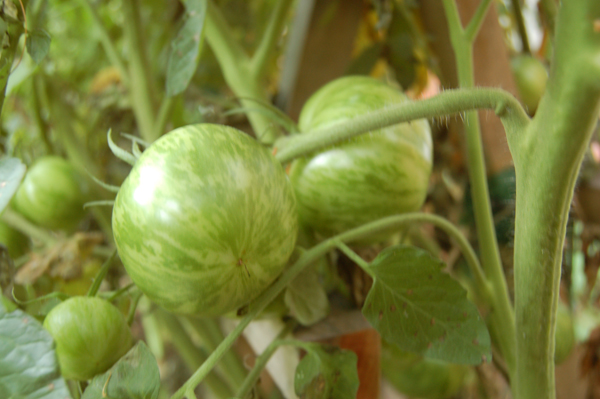
Green Zebra tomatoes by Bruce Stambaugh
Green Zebra tomatoes growing on the vine.

I especially enjoyed the Green Zebras and the Hillbilly. They were sweet and low on acid. Sprinkled with a little sea salt, they made many summer lunches on the back porch tasty and enjoyable.

My wife also made delectable tomato salads with slices and chunks of the different varieties offered on the same plate, sprinkled with fresh mozzarella cheese and virgin olive oil. Cuttings of fresh basil perfectly seasoned the offering.

Mixed tomatoes by Bruce Stambaugh
A plate of colorful heirloom tomatoes.
Sliced heirloom tomatoes by Bruce Stambaugh
Heirloom tomatoes ready to eat.
Canned tomato products by Bruce Stambaugh
Just some of the beautiful and delicious handy work of my wife.

Of course my industrious wife also canned whole tomatoes as well as chunked tomatoes, made tomato soup, and peach salsa. I did persuade her to reveal her delicious tomato soup recipe, which is as follows:

Tomato Soup

Group 1
14 qts. cut up tomatoes (preferably Roma’s)
14 stems of celery cut up
14 bay leaves
27 whole cloves
1 green pepper diced

Cook the above until all vegetables are soft. I use a roaster. Then put through a strainer. I let the initial liquid drain off before cranking the strainer handle. I can this for juice. Keep hot until ready to add group 2.

Group 2 (Note that any recipe with dairy products like butter and cream should be properly pressure canned.)
12 Tbsp. flour
1 # butter
6 tsp. salt
1 cup cream
16 Tbsp. sugar

Slowly cook group 2 to make a paste.

In a kettle/roaster bring the strained group 1 to a boil and add group 2. Stir often. Bring back to a slow boil. This is not a thick soup.

Put in jars, makes approx. 17 pints. Process in a water bath 30 min.

When ready to use put 1 jar in kettle with ½ jar milk and heat thoroughly.

Neva Stambaugh

Of course I tried to document the progress of the tomato growing and harvesting throughout the summer. Following is a sequence of how our tomatoes grew following the May 15, 2010 installation of the trellises.

Tomatoes mid-June by Bruce Stambaugh
Tomatoes mid-July by Bruce Stambaugh
Tomatoes mid-July.
Tomatoes mid-August by Bruce Stambaugh
Tomatoes mid-August.
Tomatoes mid-Sept. by Bruce Stambaugh
Tomatoes mid-Sept., beginning to die out.
Tomato blossoms by Bruce Stambaugh
Tomatoes in blossom.
Green tomatoes by Bruce Stambaugh
Green tomatoes on the vine.
Ripe tomatoes by Bruce Stambaugh
Ready to pick.

By the way, after the first frost, the plan is to disassemble the trellises and store them for the winter. We also plan on extending the growing area yet again to allow more room to maneuver between the garage and the trellises.

We found several advantages to using the trellises. They were much more effective in cutting the loss of tomatoes to dry rot. Varmints, especially the four-legged variety, caused less damage, and the tomatoes were much easier to pick.

If you used trellises or have other options and suggestions, we would like to hear them. Please leave a message with your successes, ideas and lessons learned.

Enjoy your tomatoes while they last.

Bruce Stambaugh
Sept. 29, 2010

Roma tomatoes by Bruce Stambaugh
Roma tomatoes awaiting the canner.
Picked tomatoes by Bruce Stambaugh
A variety of heirloom tomatoes.

Gloria Yoder embodies the spirit of community

By Bruce Stambaugh

Gloria Yoder, 61, never ventured far from where her ancestors settled in Holmes County in the early 19th century. That’s just fine by her.

Based on what she has done and continues to do, the community is the better for it, too. In this case, the residents in and around the little town of Mt. Hope are the beneficiaries.

Yoder grew up on the family homestead on McClure Hill just west of Mt. Hope. McClure was her maiden name. Eli, her husband, was raised on a neighboring farm. They have been married 42 years.

The Yoder’s operate two popular area businesses. Mrs. Yoder’s Kitchen in Mt. Hope is noted for its hardy breakfast, lunch and dinner buffets. Yoder’s Amish Home near Trail, where they live, is a noted destination for tourists. She also operates the restaurant at the Mt. Hope Auction March through October.

Gloria Yoder by Bruce Stambaugh
As she normally does, Gloria Yoder bought several animals at the Holmes County Junior Livestock Auction.

Gloria has a keen sense of combining business with community service. She sees a commitment to community at the Holmes County Fair. She annually purchases prized and award winning animals at the fair’s Junior Livestock Auction.

“I like to help out the kids who work so hard with their animals,” she said while waiting to bid at this year’s fair sale. Of course, Gloria has a personal stake in the event. She was a 4-H’er herself and served 20 years as the advisor for two different 4-H clubs.

This year Gloria purchased the grand champion pen of three hens, the grand champion market turkey, a lamb, three hogs and several rabbits. That alone helped a number of 4-H participants. But Yoder doesn’t stop there.

Each year, Mrs. Yoder’s Kitchen offers a special fair buffet featuring the animals she has purchased. The buffet will be this Wednesday, September 29 from 3 to 8 p.m.

“We have people who come from as far as Cincinnati for our buffets,” Yoder said. She also calls a list of people who live out of town, and some out of state, to tell them when the buffet will be offered.

This year’s fair buffet will feature barbecued rabbit, roasted leg of lamb, smoked turkey, pan-fried chicken and beef tenderloin. Yoder said she expects about 500 customers for the buffet.

But Gloria’s life ranges far beyond the confines of her restaurant. She spends much of her time assisting with and organizing for community activities.

Besides supporting the 4-H program, she faithfully serves in the small United Methodist congregation in Mt. Hope. That includes organizing and recruiting help for the annual pancake and sausage meal held each April.

Gloria helps with the egg hunt each spring, and orchestrates the parade and live nativity scene each Christmas season. Local school children enjoy playing the different parts of the sacred story. Over the years, she said group singing was added, and last year the community held a special fundraiser for a local family in need.

“Our young people are our future,” she said plainly but sincerely. “Whatever little bit I can do to help, I will.”

As a leader in the Mt. Hope Merchants Association, she also helps make the annual July Sundown Sale successful and purposeful. This year, for example, a dollar from every meal sold along with money from the volleyball teams were donated to needy families in the Mt. Hope area.

Gloria has some very personal reasons for being so involved in the community. Only months after her only child, Trent, was born in 1972, Gloria spent three months in the hospital in Columbus.

In 1983, she had a serious car accident in Berlin, and just two years ago Gloria was diagnosed with blood clots in both lungs. She hasn’t forgotten how the community responded to her needs and those of her family.

“I feel very fortunate to be alive,” she said. “God has been watching over me, and evidently still has some purpose for me in life.”

“Once you face death,” Gloria continued, “everything takes on a new meaning. I have felt the community of caring.”

In spite of her busyness, Gloria does find time for herself. She enjoys gardening, and trying new recipes. It’s no wonder, given the fact that she has a collection of 250 cookbooks.

“I enjoy reading them,” she said. “You can tell a lot about a church or community by what they include in their cookbook.” Gloria said that if a recipe includes “a pinch” of a certain ingredient, “You know it’s from an old cook.”

Gloria said she remembers when Mt. Hope resembled a ghost town. But in recent years, thanks to the success of area businesses, the little town is booming. And that is just the way Gloria likes it.

This story first appeared in the Holmes Bargain Hunter.

A life of public service achieved

Lt. Richard Haun by Bruce Stambaugh
Lt. Richard Haun spends much of his time documenting cases on the computer.

By Bruce Stambaugh

Simply put, Richard Haun is living his dream.

As a teenager, Haun knew exactly what he wanted to do. With timely guidance and self-determination, he has more than achieved his goal. Not bad for someone yet to turn 40 years old.

Haun is actually Lieutenant Richard Haun of the Holmes County Sheriff’s Office. He has been with the sheriff’s office for 24 years. Do the math and the answer becomes apparent. Haun began his law enforcement career at that tender age of 15.

It really all began with some public service modeling by his mother and encouragement from a friend that got Haun thinking about life in law enforcement.

His mother served as an emergency medical technician, and a friend encouraged him to join the Boy Scouts of America troop that served as Explorers with the sheriff’s department.

“I always wanted to be a deputy,” Haun said. “That’s why I joined the Boy Scouts law enforcement Explorers Club. That’s how I got started and I’ve been here ever since.”

One assignment of the Explorers was to be a presence at the Holmes County Fair. He began making his rounds there in 1986 and hasn’t missed a fair since then.

“Once I got into the Explorers,” Haun related, “that’s when it clicked for me.”

Born in Millersburg, Haun grew up in Killbuck and graduated West Holmes High School in 1989. With his sights set on a career in law enforcement, Haun didn’t have much social life as a teen.

“I would go to school during the day,” Haun said, “then attend the police academy in Coshocton in the evening.” Haun said those classes ran from 5 p.m. to 10 p.m. Monday through Friday.

“We even had some classes on Saturday,” Haun said. “I couldn’t even attend my senior prom because I had to qualify on the firearms range.”

Haun lives in Millersburg with his wife, Susan, and two sons. The Hauns have been married for 17 years.

Haun started as a reserve officer in 1988. He went full-time in 1989 as a dispatcher in the communications division and has worked his way up the law enforcement ladder one rung at a time.

Haun has been a road patrol deputy, the supervisor of road patrol, a court bailiff and a detective. Now he is supervisor of both the civil division and the child support division.

“When I started, we didn’t even have a computer,” Haun said. “We wrote everything down on a legal pad. Now everything is done with computers and legal pads are used as scratch pads.”

Haun spends much of his day doing electronic paper work on the computer. He has to stay up on changing laws and attorney general rulings and relay that information to the rest of the sheriff’s office staff.

“That’s the toughest part of my job,” Haun said. “Keeping track of all the necessary paper work is demanding.”

During his years with the sheriff’s office, Haun has seen first-hand how crime has changed. He said the sheriff’s office deals more and more with identity theft and computer theft.

“We sock a lot of man hours into online crime,” Haun said. “Sexual predators and embezzlement are increasing.”

Haun coordinates prisoner transports, court appearances, and monitors all of Children’s Services needs when it comes to background checks for employment and those seeking employment.

The various positions he has held have required him to train in all divisions. Haun said his experience and training, including online training, enables him to be flexible in his work.

“I’ve gone where I’m needed,” Haun said. “It’s all a part of the educational process.”

“I do regret not going to college,” he shared. “But if I were to count all the hours of training I’ve done, I probably would have some kind of degree.” He said he would encourage his sons to go to college.

Still, Haun has no regrets about the career path he has chosen.

“It’s a pleasure to be of service to the public,” Haun said.

This story first appeared the Holmes Bargain Hunter.

Tornadoes hit Ohio’s Amish country again

Secrest Garden by Bruce Stambaugh
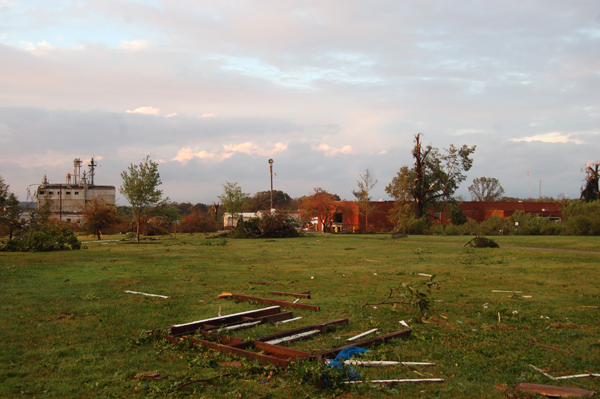
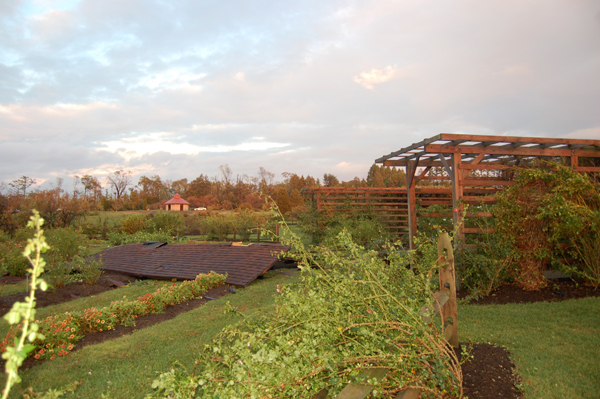
The entrance to the Secrest Garden and Arboretum after the tornado.

By Bruce Stambaugh

For the second time this summer, tornadoes caused significant damage in Ohio’s Amish country.

Shortly before 5:30 p.m. on Thursday, Sept. 16 a powerful tornado touched down on the south edge of Wooster, Ohio along Prairie Lane. The tornado, which the National Weather Service rated an EF2, proceeded east destroying businesses and homes, and crossed Madison Ave. onto the campus of the Ohio Agricultural Research and Development Center, a division of The Ohio State University.

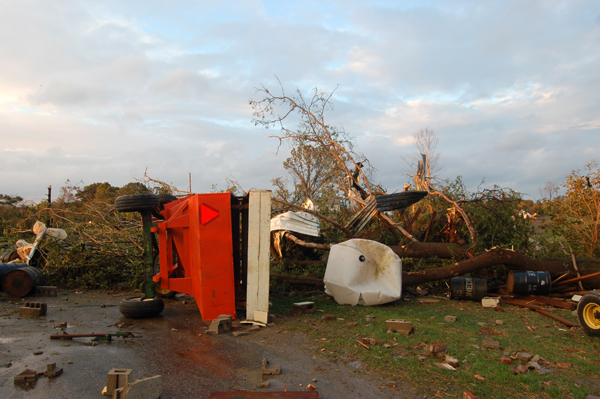
The tornado caused extensive damage to campus buildings, including some historical homes used as offices. It also destroyed the machine shop and heavily damaged parts of Secrest Garden and Arboretum, where many people love to walk and relax among the roses, ornamental shrubs and old age trees. The tornado clipped off dozens of the huge trees 20 to 30 feet above the ground.

The Wooster Twp. Fire chief reported that only one person was slightly injured. But she refused transport to the hospital.

The tornado continued on an east northeast path destroying and damaging several other homes and farm buildings. It did considerable damage to the Riceland Golf Course on U.S. 30 south of Orrville. Altogether, the NWS reported that the tornado was on the ground for 12 miles and reached wind speeds of 130 m.p.h. It left a path of destruction 200 yards wide.

Around 6 p.m., an EF1 tornado hit near the rural town of Farmerstown, Ohio in Holmes County about 25 miles south of Wooster. Several homes and barns were destroyed or damaged there. But again, no one was injured, although some farm animals had to be put down. The tornado was on the ground for three miles and reached a maximum speed of 100 m.p.h. It ranged from 50 to 75 yards wide.

As a Skywarn severe weather spotter for north central Holmes County, the Cleveland office of the National Weather Service asked me to photograph the damage at the OARDC. This was prior to knowing of the tornado in Holmes County. No tornado warning was issued for Holmes County.

I arrived at the OARDC shortly before 7 p.m., which left me a little more than a half an hour to take pictures before dark. I shot as many pictures as I could, but due to darkness, was unable to make it entirely around the campus. As I walked back to my car, parked in the arboretum a half mile east of the damaged OARDC buildings, I cut through open fields. I found several places where debris had hit the ground, leaving large gouges in the fields and grass.

The first tornado of the summer hit Holmes County and continued into Tuscarawas County on June 5. The EF1 and EF2 tornado caused extensive damage along its 10 mile path.

A gallery of some of my shots at the OARDC is shown below. Information about the Farmerstown tornado can be found here: http://www.holmescountyjournal.com/.

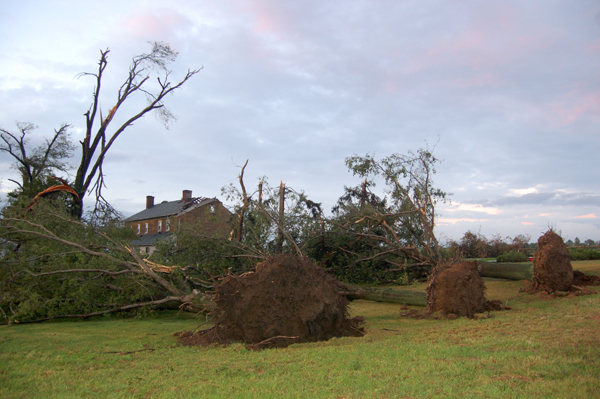
brick house by Bruce Stambaugh
Trees were snapped and the old Rice House heavily damaged at the OARDC in Wooster, Ohio.
damaged OARDC building by Bruce Stambaugh
One of the many OARDC buildings destroyed by the tornado
View of damaged OARDC building by Bruce Stambaugh
Another view of the building shown above.
Debris and stripped trees at the OARDC by Bruce Stambaugh
Debris and stripped trees at the OARDC.
Large trees down by Bruce Stambaugh
The tornado toppled large trees on the OARDC campus.
The OARDC's machine shop was heavily damaged by the tornado.
Machine shop destroyed by Bruce Stambaugh
Following the tornado's path to the machine shop at the OARDC.
Damage at the OARDC by Bruce Stambaugh
Damaged farm equipment and trees at the OARDC.
More damage around the machine shop by Bruce Stambaugh
More damage around the machine shop at the OARDC.
Another destroyed building at the OARDC by Bruce Stambaugh
Another destroyed building at the OARDC.
Destroyed machine shop by Bruce Stambaugh
The destroyed machine shop at the OARDC.
Debris littered the OARDC campus by Bruce Stambaugh
Debris from the tornado littered the OARDC campus.
OARDC police station by Bruce Stambaugh
Damage was extensive at the building that housed the campus police station.
The agricultural engineer building by Bruce Stambaugh
The agricultural engineering building was destroyed.
Rose garden by Bruce Stambaugh
The OARDC rose garden was heavily damaged.

A private woman has a very public life

Lucille Hastings by Bruce Stambaugh
Books have always played an integral part of Lucille Hastings' life.

By Bruce Stambaugh

For someone who relishes her privacy, Lucille Hastings of Big Prairie, Ohio has led a very public life.

Perhaps that seemingly contradictory situation is because of her love for life long learning. Hastings has had this instinctive drive to share what she learns. In short, contributing personally and professionally to the community at large has been a way of life.

That shouldn’t come as a surprise for someone who has her major life concepts down pat. Her life has revolved around her personal faith and church fellowship, service to others, which includes family, friends and the larger community.

Having lived on a farm for most of her life, she heartily reveres the land as a true gift from God. To accomplish and enjoy all that, she also believes in healthy personal lifestyles.

“I do water aerobics three times a week,” she said. “I need to watch my weight.”

Once she began her own well-researched and devised low carbohydrate diet a dozen years ago, Hastings lost 100 pounds. She has continued to be very careful about what she eats.

“Physical and emotional health are very important,” she related. Hastings said that as much for herself as for the benefit of others.

Hastings is fastidious about everything she does. But some things in life have been out of her control.

Hastings retired in 1992 from West Holmes Local Schools after serving 34 years as the library/media director in charge of the district’s libraries. Since then, she has continued as a part-time educational library/media consultant to the district.

“I retired because Jim retired,” she said, referring to her late husband. He died in 2000. “I miss Jim,” she said wistfully, “but I worked through it.” They had been married for 43 years.

She still lives on the Hastings family farm, which is rented out to an area farmer. The farm’s old barn was burned several years ago when a string of arson fires hit Holmes and surrounding counties.

Lover of the land that she is, Hastings said she marvels at how the agriculture around her has changed over the years. She has a great appreciation for her neighbors.

“The Amish have gradually moved into our area because the land was cheaper,” she said. “They are simply wonderful neighbors.”

With her background in library, it should come as no surprise that she considers herself a very organized person. She attributes that trait to enabling her to be of service to the larger community.

“Services like libraries, schools and churches happen because people make them happen,” Hastings said. “They just don’t happen by themselves.” Given her life long service to the surrounding community, Hastings clearly has done her best to improve those services for the community at large.

Here is a sampling of the many positions in which Hastings has served. She was president of the State Library Board of Ohio. She served on the Holmes County Library board for 16 years, 10 of which she was president. She was chairperson of the Ohio Reading Circle board for 16 years. That volunteer position allowed her to donate $350,000 worth of Reading Circle books to the county and local school libraries.

Hastings is a member of the Ohio Director of Agriculture’s 12-person advisory committee for administration of Ohio’s $25 million Clean Air/Clean Water Fund for Farmland Preservation.

She was the first woman president of the Holmes County Farm Bureau, and she is the only woman Sunday school teacher at her church. She has taught Sunday school for 60 years, and she is chairperson of the Mission Ministry at Ripley Church of Christ. She was a member of the Holmes County board of elections for eight years.

Hastings good works haven’t gone unnoticed. She has been dooly recognized for her many efforts. She received the Martha Holden Jennings Outstanding Teacher Award in 1974. She was inducted into the Ohio Women’s Hall of Fame in 2007. That same year Hastings received the Outstanding Alumni Award from Kent State University, where she received her Master of Arts Degree.

Hastings has two sons. Joel lives in Dallas, Texas, and Sidney resides in St. Louis, Missouri.

“I feel like I have been blessed,” she said. “I have had some unique opportunities.” And because she made the most of those chances, the community has reaped the benefits.

That’s what happens when life long learning is generously and graciously shared.

This article appeared in the Holmes Bargain Hunter, August 30, 2010.

Vivian Miller offers compassion through cards and visits

By Bruce Stambaugh

After the doctor informed Vivian Miller, 68, four years ago that she had Parkinson’s disease, he asked how she felt about the diagnosis.

Miller didn’t flinch. She mustered up her usual pluck and said, “It’s not going to put me in a corner someplace.” Indeed it hasn’t.

In the time since, Miller has spent her life quietly helping others.

“It’s not about me,” she said modestly. “God uses me as an encouragement and support for others.”

Miller, who lives in Berlin, Ohio, intentionally looks for those in need, though she clearly tries to be subtle and discreet. If she finds out about someone with health or personal problems, Miller doesn’t hesitate to help, even if it’s simply by sending a homemade card.

She uses a software program to create personally appropriate cards. Miller often incorporates a picture of the person or herself into the card’s design.

Vivian Miller by Bruce Stambaugh
Vivian Miller enjoys making personalized cards for people.

When she was unable to go on a cruise with her Sunday School class, Miller knew what to do. Instead of being envious, she made a welcome home card for each member. On the front of the card was the picture of the cruise ship on which the group had sailed.

“I wanted them to have a special memento from their trip,” Miller said.

That statement pretty well sums up Miller’s approach to life. Her doctor told her she would do well with that positive attitude, and Miller has. Miller said it really boils down to a pretty fundamental formula.

“It’s about listening to others,” she said. “Everybody has a story, and all you need to do is listen.”

Miller retired as a deputy director in the Holmes County Treasurer’s office in 2006. She had also worked in the office at Rodhe’s IGA in Millersburg for several years.

“From my vantage point in the office, I would see the same people come into the store over and over,” she said. “They usually just wanted someone to talk to.”

“I try to see the goodness in people,” Miller said, “no matter what their situation is.”

Miller credits her term as a deaconess at Walnut Creek Mennonite Church with giving her the courage and opportunities to be in a helping mode. She did hospital visits and checked in on the less mobile.

Miller looks for every possible way to help and to meet new people. She even works at the polls at times to help expand her circle of friends.

Miller especially has sought out others who have been diagnosed with Parkinson’s disease. She explained that support, no matter what the issue, is critical for quality of life.

According to the National Institute of Health, Parkinson’s disease is a motor systems disorder, which is the result of the loss of dopamine-producing brain cells. The four primary symptoms of the disease are tremor or trembling in the hands, arms, legs, jaw and face.

Often times the onset of Parkinson’s is due to surgery or a head injury. In Miller’s case, she noticed the symptoms after a series of unrelated surgeries following her retirement.

For Miller, the disease has affected her left side. She discretely calms her left arm with her right hand and continues her conversation. That in itself is a physical sign of the inner awareness that Miller has. She is determined to share her compassion no matter what.

“Sometimes people seek me out,” Miller said, “and sometimes I go to them.”

Each situation is different, and Miller tries her best to be mindful of that. Miller just takes her illness in stride.

“Now it’s my turn to help,” she said. “Some of my best friends have come as the result of just being with families in need.”

Strident comforter that she is to others, Miller recognizes that she, too, needs support to do what she does. Miller credits her husband, Duane, and adult children, Valerie Gerber of Sugarcreek, and Scott Miller of Chapel Hill, North Carolina, with providing the emotional and physical uplifting that she needs to maintain her active and involved pace.

“Duane has been wonderful,” she said, “and Valerie calls me everyday.” Her son sent her a laptop computer while she had an extended stay in the hospital. In part, that gift is what led to Miller’s practice of designing, printing and sending the personalized cards.

“I have been blessed by everyone I have met,” Miller said. Most likely, the recipients of her kindness could say the same thing about her.

This article was initially published in the Holmes Bargain Hunter.

Abigail Troyer experienced a shakeup of plans

Abigail Troyer by Bruce Stambaugh
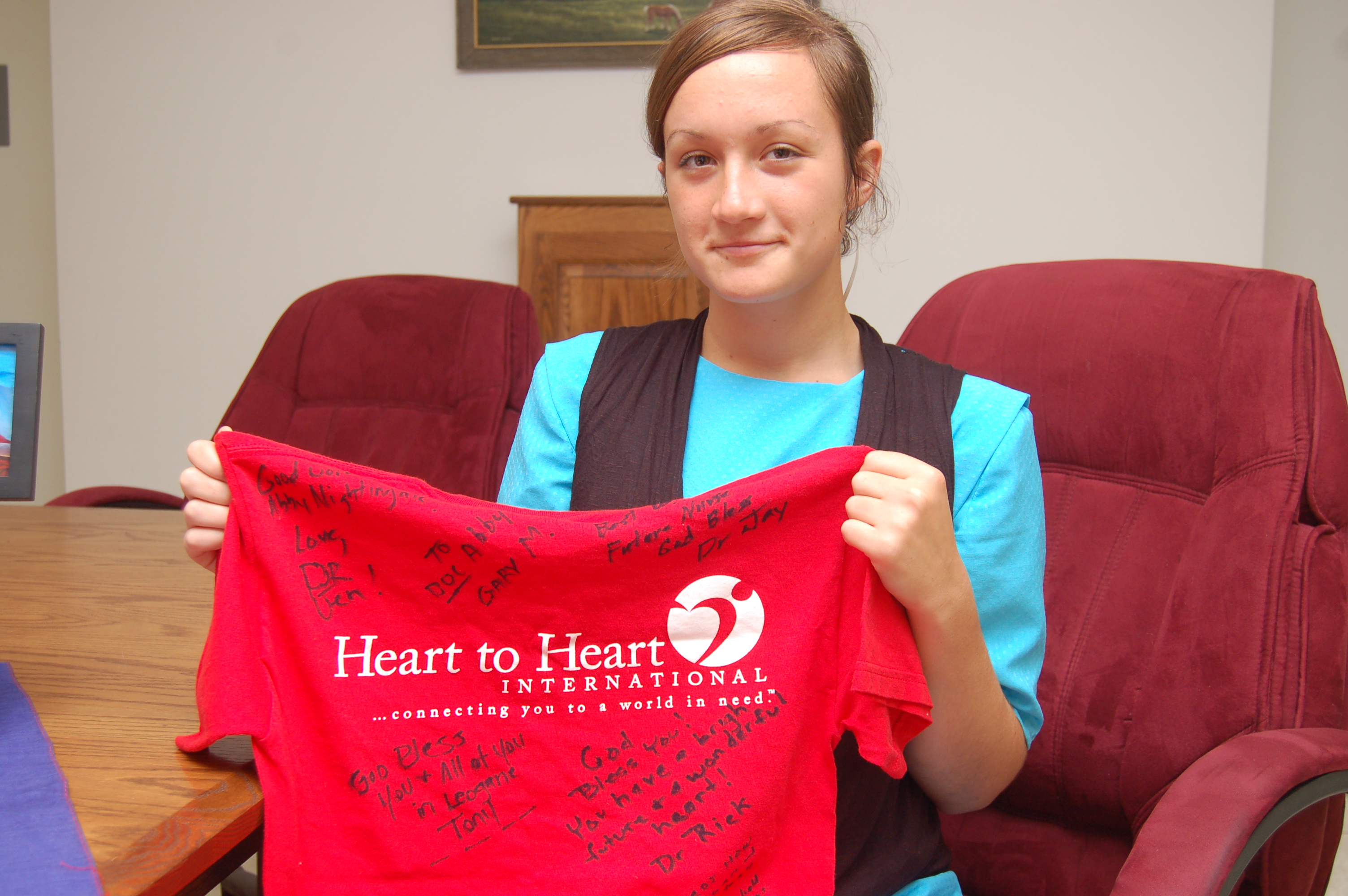
Abigail Troyer of Sugarcreek, Ohio showed of the T-shirt signed by each member of the Heart to Heart International team she assisted in the Haiti earthquake.

By Bruce Stambaugh

When the earth roared like thunder, everything changed for young Abigail Troyer.

The 19-year old rural Sugarcreek woman was in Haiti visiting a friend who worked at a home for poor girls in Leogane, a city of 120,000. When the massive earthquake hit on January 12, Troyer’s vacation turned into a spontaneous mission trip.

With the frightening sound and incredible shaking her first thought was to exit the food storage building she was in. Troyer said she was able to stay on her feet to get out. But once outside she had to crawl on her hands and knees due to the fierce shaking.

“After the shaking stopped, I couldn’t believe it really happened,” Troyer said. “I wasn’t hurt, but I was emotionally spent.”

Troyer said she huddled with the staff and girls in the compound of the school, which is operated by Blue Ridge Missions, headquartered in Montgomery, Indiana. The school helps poor girls with education, hygiene and basic life skills.

Troyer said one of the problems was that the tremblers kept coming every five to 10 minutes, and she wondered when they would quit. Fortunately, no one at the school was seriously hurt, although the buildings and protective concrete wall were severely damaged. Troyer said it could have been much worse, too. She said several of the girls were delayed in going into a building that was destroyed.

“It was scary, especially at night,” Troyer said. “Outside in the streets it was chaos.” Fortunately, the school had a generator, which was run periodically to provide some light for security.

“We also had a couple of guard dogs that protected us,” she said. “Some men from Blue Ridge Missions arrived via the Dominican Republic five days later.” All that time, the staff and schoolgirls slept outside on mats and blankets, Troyer said.

Troyer has worked as a graphic designer at Carlisle Printing in Walnut Creek for two years. But her real ambition is to go to college to become a Registered Nurse.
Little did Troyer know that she would get some first-hand nursing experience before she left for Haiti last New Year’s Eve. But several days after the quake, she got recruited to help the injured.

An aid organization called Heart to Heart International, based in Kansas City, Kansas, sent medical personnel to assist with the multitude of injuries caused by the quake. In searching for a place to locate, members of the group came upon the girls’ school.

“Heart to Heart set up a temporary hospital in the neighborhood,” Troyer explained, “and since we had water from a well, they did their laundry at the compound.”

Once she saw what Heart to Heart was doing, she volunteered her services. Troyer assisted with the injured, and boxed medical supplies for the nurses and doctors.

“I helped clean wounds and wrapped bandages for six days,” Troyer said. “It was amazing to see the wounds heal in that amount of time.” She said she worked with the nurses and doctors six to eight hours a day.

“Originally I went there for a vacation,” she said. “Helping like that wasn’t what we had planned, like shopping, which of course didn’t happen.

Troyer did manage a few souvenirs, just not the ones she had imagined before she left Ohio. A favorite is the colorful flag of Haiti in the form of a scarf. Another is a T-shirt signed by all the Heart to Heart staff with whom she worked.

Troyer has plenty of pictures that she is more than happy to share. Since her return, she has given several programs at area churches about her experiences.

Laurie Mast, whose sister, Emily, works at the mission school, accompanied Troyer on the trip. They were able to return to Ohio on February 1 by way of the airport in the Dominican Republic.

This vacation trip turned volunteer nurses’ aid was an experience Troyer will never forget. Furthermore, Troyer indicated that it has greatly enhanced her vision of becoming a nurse. With her confidence, courage and assertive approach to life, that aspiration is pretty certain to happen.

For information about Troyer sharing her experiences in Haiti, contact her at abigailnicoletroyer@yahoo.com.

This article first appeared in the Holmes Bargain Hunter, August 9, 2010.

The road to a fresh start

Mixed peppers by Bruce Stambaugh
Boxes of colorful peppers looked too good to resist.

By Bruce Stambaugh

You can find them nearly everywhere in Ohio’s Amish country. Seasonal roadside produce stands are one of the area’s mainstays.

But for probably a sundry of reasons, tourists and local residents alike often ignore these unsophisticated and sometimes spontaneous mini-markets. They shouldn’t. The goods offered provide lasting and tasteful memories of Ohio’s Amish country.

The produce stands offer excellent foodstuffs and canned goods at very fair prices. A bonus is that the products peddled are green, as in locally grown green.

“Locally grown fruits and vegetable are not only good for you,” says Leah Miller, director of the Small Farm Institute based in Coshocton, Ohio. “They also provide families who live on small farms with additional and needed income.”

Blessing Acres sign by Bruce Stambaugh
The sign to Blessing Acres produce stand says it all.

Blessing Acres Produce, a produce stand located about half way between Berlin and Mt. Hope, Ohio on Township Road 362 in Holmes County, is a prime example. Anna Miller and her children operate the 25-acre produce farm. Son, Abe, serves as the manager.

Definitely off the beaten path, the Miller family still has many repeat customers who have found this little Garden of Eden. Homemade signs direct traffic off of two parallel county roads to the business. As different items like beets, cucumbers, corn and tomatoes come ripe, they are added to the bottom of the sign. At times the chain of produce names reaches clear to the ground.

Their season conveniently starts about the time schools dismiss for the summer. Strawberries are their first main crop, and are always in high demand for their flavor, sweetness and freshness.

Those are some of the key customer benefits to buying from the roadside stands, according to the online Ohio Farm Fresh directory at http://www.ohiofarmfresh.com. Freshness, taste and nutrition are all reasons why purchasing from the seasonal stands makes sense. Of course, the farmers appreciate the cash flow, too.

Marion Steiner has operated the Kidron Road Greenhouse and Produce stand for 17 years with help from her 11 children. Located on Kidron Road just south of U.S. 250 in Wayne County, Steiner said a majority of her customers are local, but a few out-of-state people also stop in.

June Hammond of Wooster, Ohio  has been a regular throughout many growing seasons.

“I come here because the people are friendly, the prices reasonable, and the products are fresh,” Hammond said.

Just down the road at Raber’s Fresh Produce similar comments are offered by long-time, repeat customers. Raber’s is located on Kidron Road just south of Harrison Road.

Dave Guthrie drives all the way from Vermillion, Ohio to buy sweet corn simply because he says it tastes better than what he can buy at stores back home. Guthrie’s seven-year-old grandson, Joshua Snyder, came along for the ride, too.

Hold on tight by Bruce Stambaugh
Joshua Snyder held on tight to the cucumbers he selected.

“It’s pretty and it’s fun out here,” Snyder said. “I like looking around, especially seeing the horses and buggies, and the nice houses and fields.”

The youngster actually hit on another benefit to buying from countryside stands. The bucolic ambiance coupled with decent prices and fresh, tasty food that is also good for you adds up to a win-win situation.

Many of the produce stands also offer fresh, homemade baked goods and what Leah Miller calls “value-added products” like home-canned fruits, vegetables and jams and jellies.

Some of the stands like the one that young sisters Anna and Neva Miller manned pop up randomly. The girls brought excess green beans from their garden and set up shop opposite a local bulk food store north of Mt. Hope. It wasn’t long until they had to return home to replenish their supply.

There is yet one other important reason for stopping at a local produce stand. You just might make friends, like Scott Thomas of Fresno, Ohio has.

Thomas has been coming to Blessing Acres for years. He knows each family member by name, and you could tell by the smiles of family members that they are always glad to see him.

“They come down to my place and help me butcher hogs,” Thomas said. In turn, he lets family members hunt deer on his property.

Fresh, tasty, nutritious food and good friends are always a healthy combination. And in Ohio’s Amish country, all that can be found right along the road.

Roadside beans by Bruce Stambaugh
Anna and Neva Miller sold beans from their garden along the highway north of Mt. Hope, Ohio.

This story was first published in Ohio Amish Country magazine, August 2010.

Bay Photos by Donna

Wildlife Photos From The Chesapeake Bay Region

ROAD TO NARA

Culture and Communities at the Heart Of India

K Hertzler Art

Artist and nature journalist in the Shenandoah Valley of Virginia.

Maria Vincent Robinson

Photographer Of Life and moments

Gabriele Romano

Personal Blog

Jennifer Murch

Art is the only way to run away without leaving home. -Twyla Tharp

Roadkill Crossing

Writing generated from the rural life

ANJOLI ROY

writer. teacher. podcast cohost.

Casa Alterna

El amor cruza fronteras / Love crosses borders