From book seller to book author, Wesner connects with the Amish

By Bruce Stambaugh

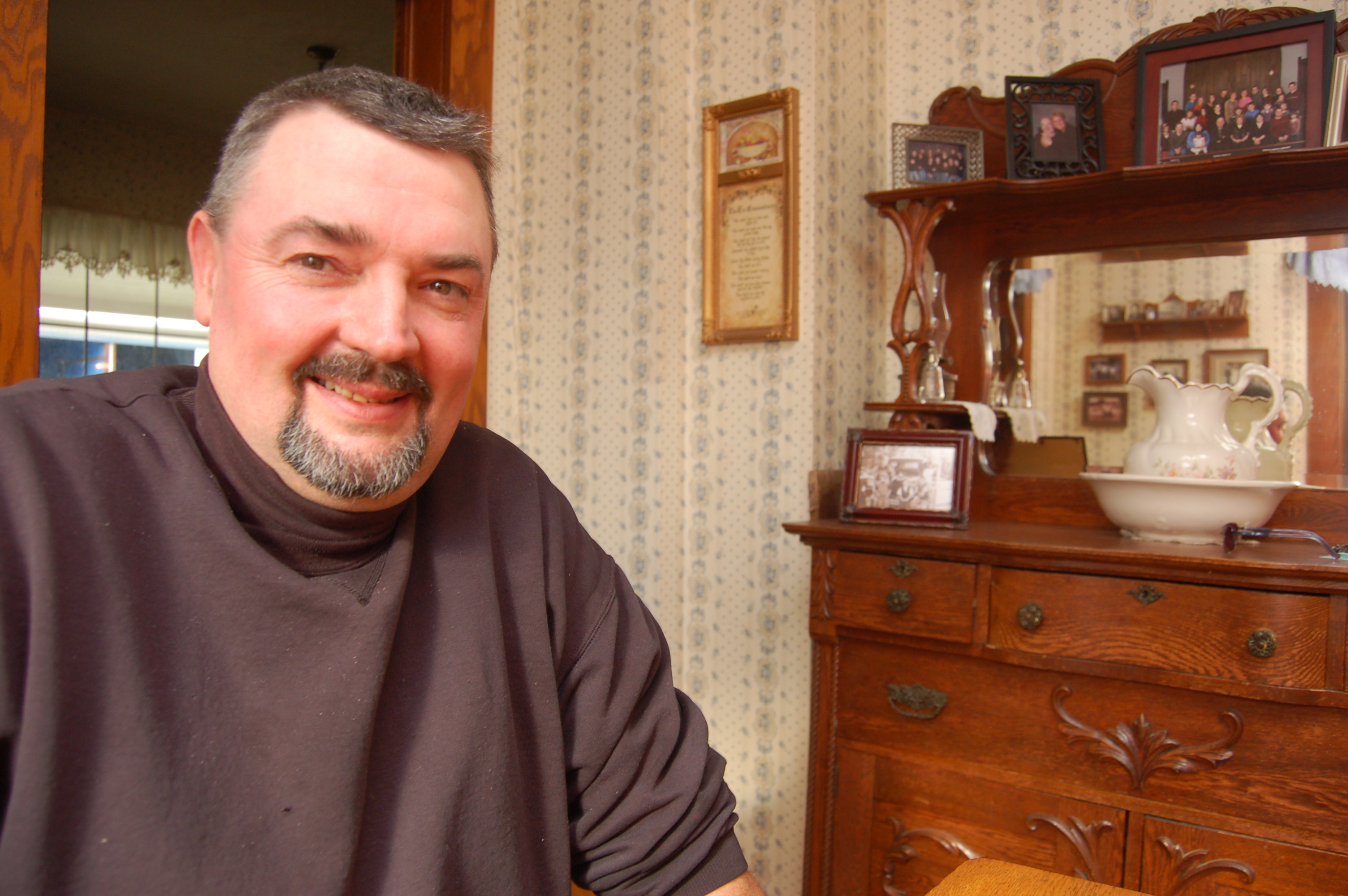
Erik Wesner, 33, went from selling books to the Amish to writing one about them. It was an unexpected but enjoyable trek for the Raleigh, North Carolina native.

“I kind of stumbled into it beginning in Arthur, Illinois,” Wesner said.

Erik Wesner by Bruce Stambaugh
Erik Wesner
Wesner went door-to-door selling books for nine years. His job took him to many communities around the country where Amish had settled.

“The kind of books I was selling were appropriate for them,” Wesner said. He explained that they included sets of family Bible study books.

Whether he spent five minutes or 20 minutes with each household, he liked what he saw and heard. He was impressed with the inquisitiveness of the Amish, their resourcefulness and friendliness.

Wesner graduated from the University of North Carolina with a double major of English and economics. It was that knowledge that caused him to take notice of something else that he found common among the Amish.

“Everywhere I went in the Amish communities,” Wesner explained, “I saw successful businesses.” He said he was intrigued with that pattern, especially since most of the entrepreneurs were self-taught and didn’t have either high school or college degrees.

“While visiting in Amish-owned businesses, I saw customers who had driven three hours from Indianapolis and Chicago to make purchases,” he said. “I figured that was a sign of quality and honesty.”

Wesner couldn’t help but notice the continued success of these businesses in each Amish community he visited, even given the down economy.

“From Iowa to Illinois to Lancaster, Pennsylvania to Holmes County, Ohio, I found many success stories to share,” he said. That instilled in him a desire to learn about how they were able to not just survive but thrive when other businesses were not.

That intrigue lead to his book, Success Made Simple, an extensive review of Amish-owned businesses and what makes them consistently tick and click. His book is based on many interviews with Amish business folks across the country.

Wesner said though the book didn’t make the best-seller list, he gained something even more rewarding.

“Through all of this, I have made many friends among the Amish,” he said. That is what brought him back to Holmes County recently. He was visiting some New Order Amish in the Shreve, Ohio area.

In addition to his book, Wesner started a blog called “Amish America” right after the Nickel Mines incident in Lancaster County, Pensylvania in 2006. A gunman shot several Amish schoolgirls. The story made headlines worldwide.

“I didn’t like some of the things I saw and heard following that tragic situation,” Wesner said. Since he enjoys writing, he began the blog at http://amishamerica.com/.

The blog features stories and photographs of various Amish communities. He said he writes about and shows examples of everyday Amish life without trying to glorify it.

“I really enjoy the immediacy of the blog,” Wesner said, referring to the immediate posting of comments by some of his many followers. “I find that very rewarding.”

Wesner said there have been unexpected benefits to his blog.

“I mentioned an Amish business on my blog,” he said, “and the owner thanked me. She had customers who said they heard about her business by reading the blog.”

Wesner said he is working on a second book about the Amish. He said it would focus on the lesser-known things about the Amish lifestyle.

When he is not visiting Amish communities during the summer months, Wesner spends eight months out of the year teaching English in his parents’ home country of Poland. He said his students are mostly adult professionals who need to learn English for their jobs.

“I guess I feel a sense of obligation,” Wesner said about living in Poland. “My grandmother still lives there, and I didn’t want her to feel alone.”

That kind of dedication to family would resonate well with the Amish culture, too.

Boiling sap produces more than just maple syrup

Sugar shack by Bruce Stambaugh
Gary Miller's sugar shack is nestled against the woods where the maple sap is obtained.

By Bruce Stambaugh

When Gary Miller of rural Millersburg, Ohio got the idea to make his own maple syrup a couple of years ago, he never envisioned where that thought would take him.

“Two years ago,” Miller said, “I was standing in the rain under an umbrella boiling sap in an assortment of old used pans on my grill.”

This year, thanks to the ingenuity and dedication of some close friends and family members, Miller has his very own sugar shack. And when the sap is running, his shack and the surrounding woods are very busy places indeed.

The shack itself was donated to Miller. A friend, Paul Conrad, had an old shed he told Miller he could have, and Miller’s sons moved it in seven different sections for him. Once on site, the building was reassembled, reusing the old lumber.

That process set the tone for what was to come. Much of the equipment used by Miller and his friends has been refurbished as some part and purpose of the maple syrup operation.

Checking taps by Bruce Stambaugh
When the sap is running, the taps get checked frequently.

Indeed, when the sap is moving, so are a half dozen or so of Miller’s friends who help with the project. They placed 400 taps in sugar, red and black maple trees, according to Miller.

“We are careful about how many taps we place in a tree,” Miller said. “We don’t want to stress them.”

They also helped split the wood that fuels the fire that boils the sap on a homemade evaporator. Of course, the gregarious crew also put that together. Much of that ingenious system consists of recycled metal and other materials.

The wood stove that holds the fire that boils the sap belonged to Scott Sponsler, another friend. The stove was extended with metal from old toolboxes from a pickup truck that Miller owned.

Miller had a fan rebuilt and some ductwork manufactured locally. Together they help distribute the heat generated by the wood stove. The heat evaporates the sap into syrup.

The sap enters the sugar shack from another recycled item, an old bulk tank rescued from an unused milking parlor. It is held up by a repurposed metal stand so the sap flows by gravity into a smaller, reconstructed holding tank inside the old wooden shed.

Sap maze by Bruce Stambaugh
Gary Miller explained how his sap boiling operations works.

From there, the sap runs into a customized sheet metal maze that allows the sap to be evaporated as it circulates up and down the four parallel troughs. After entering a second connected metal maze, the sap begins to change color. It is closer to the firebox and the preheated sap really starts to boil. Its darker color indicates that the moisture is being bubbled away.

Miller said that the sap isn’t officially maple syrup until its consistency is at least 66.9 degrees Brix, as measured by a hydrometer. Miller said with his setup, it takes 51 gallons of sap to produce a gallon of syrup.

Hydrometer by Bruce Stambaugh
Gary Miller showed how he uses a hydrometer to measure the maple syrup's moisture content.

Miller and his friends make the syrup when the sap is running. He said warmer days and cooler nights are the best conditions to make the sap run.

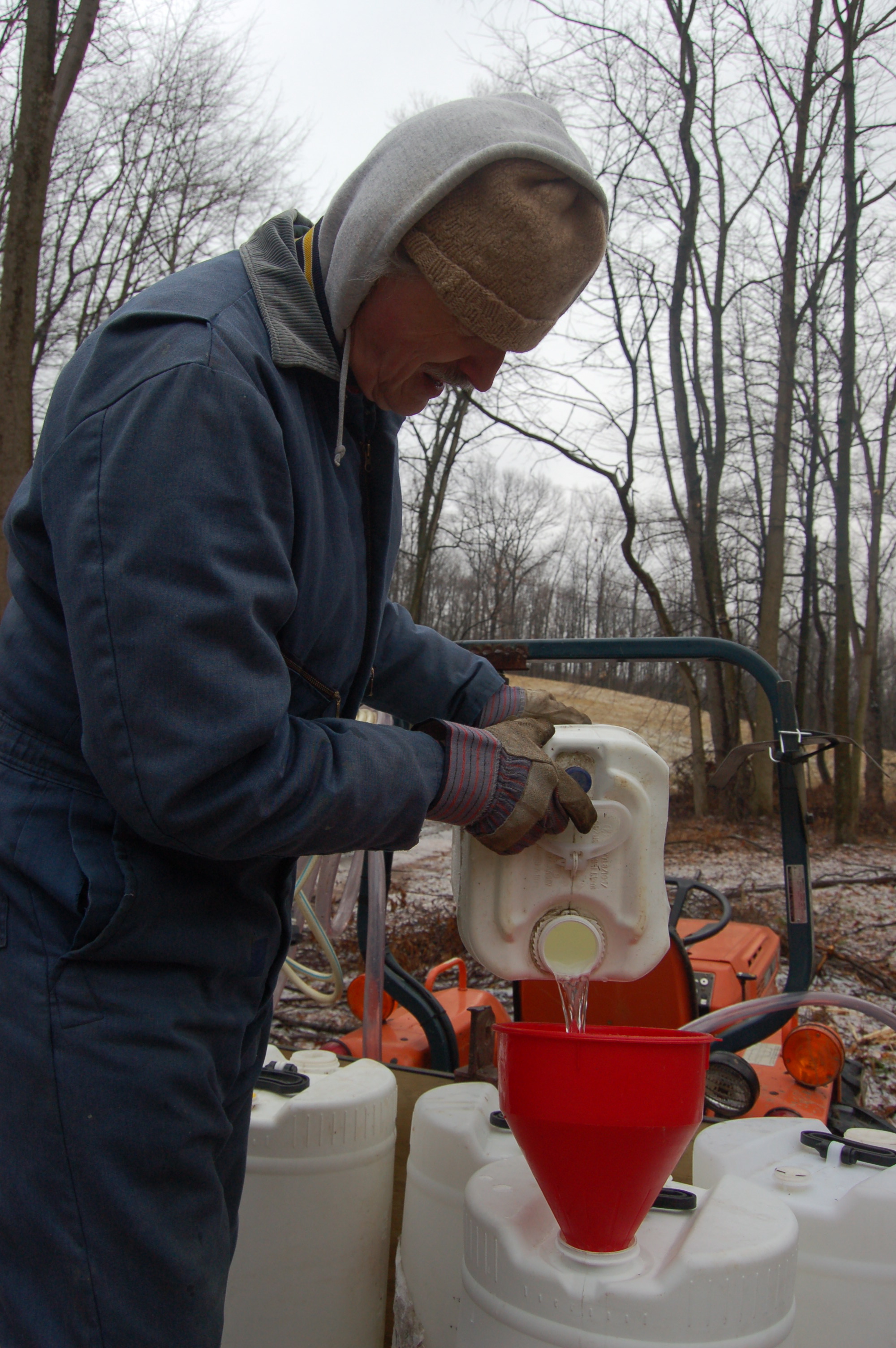
Before it is pumped into the elevated holding tank, the sap is gathered into 15-gallon containers from each tap bucket. The containers are carried on the back of a small tractor. Of course, the tractor was loaned, too.

Pouring sap by Bruce Stambaugh
Scott Sponsler poured sap from one of the tap buckets into a 15-gallon container before heading back to the sugar shack.

All the free equipment and labor is only appropriate. Miller said the maple syrup that is produced is not for sale, although it does have a name, Smoke Pit Maple Syrup.

“This is not a commercial operation,” Miller emphasized.

Instead customers get to donate whatever they feel the syrup is worth. The money is used for an educational scholarship program in Honduras. Miller’s Sunday school class at Millersburg Mennonite Church is financially sponsoring the schooling of several children there.

With all that said, Miller shared another important ingredient in the maple syrup production as far as he is concerned.

“It’s not about the syrup,” Miller said. “It’s about the fellowship.”

Indeed, laughter and kibitzing among the friends intermingle with the steam from the cooking sap in the cold, small shack. The steam and merriment waft together out into the cold air through the open doorways. The good-natured ribbing helps make the labor-intensive sugaring efforts all the sweeter.

Persons interested in obtaining some of the Smoke Pit Maple Syrup should contact Miller at 330-763-0364.

Maple syrup by Bruce Stambaugh
Various sized jars of Smoke Pit Maple Syrup lined a shelf in the sugar shack.

Look who’s talking now

Amish phone booth by Bruce Stambaugh
A phone booth on an Amish property is often placed away from the home to avoid the temptation of overusing the phone.

By Bruce Stambaugh

On a dark, chilly November night several years ago, an emergency medical technician arrived on the scene of a car verses buggy accident at a rural intersection. Unlike the car’s passengers, the older Amish man driving the lantern-lit buggy was uninjured.

As the scene cleared, the first responder asked the Amish man how far he had to go to call for help. With a toothless grin, the Amish man reached into his denim jacket and flopped opened a cell phone.

In the early days of cell phones, when even the EMT didn’t have one, that scenario might have been rare in Amish country. It isn’t any longer. As contradictory as is it may sound, Amish have and use telephones. They use them to converse, to fax, for GPS, to text, and on rare occasions, to access the Internet.

Of course, like many of other Amish lifestyle “rules,” there are many variables in the Amish – phone connection. Church leadership metes out phone use guidelines for Amish. Those rules and their application vary greatly. It all depends on which church and which order of Amish as to what the rules may allow. The rules about phone use, like other lifestyle guidelines, even differ from church to church within the same order of Amish.

Amish place by Bruce Stambaugh
The home of a young Amish family in Holmes County, Ohio.

The orders of Amish, if placed on a continuum, would range from New Order on the left to the Swartzentruber’s on the right. In other words, from the most progressive to the most conservative, with those terms being used in the religious sense, not politically. In between are the most numerous, the Old Order Amish that people describe when they refer to the sect.

The extremes of phone use by Amish would range from members of one church group permitted to have landline phones in their residence to others that are permitted no phones at all. Again, their individual church leaders determine how and where Amish use phones. This may seem strange or even unfair to those unfamiliar with the Amish, and sometimes to those who even live among them. But simply put, that’s just the way it is.

Driving down any highway in Amish country will reveal which families and businesses are not permitted to have landline phones in their buildings. Near the edge of the road, travelers will see small buildings about the size and shape of the old-fashioned phone booths with a door and usually a window for light.

They look like phone booths because that is exactly what they are. Enclosing the phone in a small structure protects the person using the phone from any inclement weather and provides privacy. The homemade phone booths are usually locked to prevent any vandalism or misuse.

Amish farmstead with phone booth by Bruce Stambaugh
Find the phone booth among all the other buildings on this farmstead near Walnut Creek, Ohio.

Such phone booths could be used by a single family or business, or by multiple families. Each family or business would have its own voicemail extension. The phones are not answered live.

Some churches require that phone booths be so many feet from the home or business. Some even require the phone to be across the road, so as not to be too convenient, thus reducing the possibility of casual use. Some Amish, especially the New Order sect, would allow a landline in their home.

In many churches, phones for calling out and faxing are permitted in the business, but not in the home. Incoming calls go directly to voice mail. This rule is economically weighted. The successes of cottage industries, which have boomed among the Amish in the last two decades, are critical to the welfare of the Amish community. Only about 10 percent of the Amish population farms today. The rest either have their own businesses or work at other local businesses.

Of course, any discussion about Amish and the use of phones would be incomplete without mentioning the ubiquitous cell phones. Cell phones are actually more widely accepted among the Amish leaders than landlines, simply because they are not literally tied to the public utility grid.

Cell phones have proven to be an efficient tool when it comes to doing business, regardless of the trade or product produce. Generally speaking, a common rule for cell phones is that they are turned off in the residence. Another rule stipulates that the phones cannot access the Internet or e-mail.

Because they are not yet church members, none of the rules apply to Amish youth, unless of course their parents say they cannot use them. Just like their non-Amish peers everywhere, texting and using cell phones to take pictures are typical for today’s Amish teenagers regardless of which church order their parents may belong.

In the 21st century, phones are one technology the Amish have embraced. Clearly though, the difference between them using the phone compared to the rest of society is in the details. For those instructions, the Amish look to their respective church leadership.

Jeanty family is ready to return to Haiti

Fritz Jeanty family by Bruce Stambaugh
Mamie, Samuel, Fritz and Benjamin Jeanty will return to Haiti after spending a year in Millersburg, Ohio following the devastating earthquake January 12, 2010.

By Bruce Stambaugh

There is no place like home. In this case, for Fritz and Mamie Jeanty and their two young sons, Samuel and Benjamin, home is Haiti.

A year after their miraculous exit from earthquake ravaged Port au Prince, Haiti, to Millersburg, the Jeanty family is ready to return.

“From what I understand, it will be like it happened yesterday,” Fritz Jeanty said. “Friends and family tell me that almost nothing has been cleaned up.”

Fritz, 36, has been in regular touch via cell phone and e-mail with friends and relatives in his native Haiti. He knows it won’t be the best situation.

But he said thoughtfully, “It’s time to go home.”

Fritz understands the huge physical obstacles he and his family will face. His grocery store business was destroyed, and will never be reopened. Their home was damaged to the point of being unlivable. The cholera outbreak is yet another concern.

Nevertheless, Fritz and Mamie, 31, are ready to return home, ready to face the devastation and mourn the loss of life of friends, neighbors and family.

“Mamie lost two sisters,” Fritz said. “And right after the earthquake occurred, her 18-year-old brother disappeared. No one has seen him since.”

Fritz said he knows it will be hard to return. But he also knows it is the right thing to do.

“The people here have been wonderful to us,” Fritz said. “We are very, very grateful for all that has been done for us.”

A week after the massive trembler that leveled most of Port au Prince, Fritz used his resourcefulness to get his family to his father-in-law’s home in Orlando, Florida. From there he made contact with people with whom he previously worked in Christian Aid Ministries, based in Berlin, Ohio.

Within days the Jeantys were settled into a home in Millersburg, and donations of money, food, furniture and clothing were made. A Haitian Relief Fund was established to help the displaced family during their stay in Holmes County. At that point, the length of their stay was undetermined.

Fritz Jeanty by Bruce Stambaugh
Frtiz Jeanty volunteered five days a week at Save and Serve Thrift Shop during his year-long stay in Millersburg.

Fritz spent his time volunteering at Save and Serve Thrift Store in Millersburg five days a week, while Mamie cared for the boys. Samuel enrolled in Head Start preschool and soon learned English. Once the family adjusted to their temporary home, Mamie also volunteered at the store.

With his family safe, Fritz began thinking about their eventual return to Haiti. While assisting at Save and Serve, he marveled at the efficiency and goals of Save and Serve.

Knowing the need for good, inexpensive used clothing would be great in Haiti, Fritz imagined starting a similar store in Port au Prince using Save and Serve as a model. He shared his plan with the Save and Serve board of directors and they were supportive of his desire to help his fellow citizens while establishing a business to help his family survive, too.

Encouraged by their response, Fritz moved ahead with his plan. His father-in-law donated some land, and construction for the clothing store was begun.

A 26-foot box truck was donated to Fritz, and it was filled with clothing and shoes, which were also donated. Fritz and a driver, Ed Yoder of Millersburg, left for West Palm Beach, Florida. on January 10. Once there, the truck was loaded onto a cargo ship headed for Haiti.

“I need to be in Haiti when the truck arrives,” Fritz said.

He and his family plan to leave January 25. But it won’t be easy either for the Jeanty family or for those with whom they have worked.

“Fritz has been a tremendous help to us,” said Eric Raber, co-manager at Save and Serve. “He will definitely be missed, but we also wish the family well.”

Fritz plans on restocking his used clothing store in Haiti through the Mennonite Central Committee (MCC) thrift store operations based in Akron, Pennsylvania. Such outreach businesses are part of MCC’s mission.

The Jeantys will live with family until Fritz can restore a room in their damaged home to a point where it is inhabitable.

“We will get one room ready,” Fritz said with his usual confidence, “and work on the rest as we can.”

As for the cholera, Fritz said that they would take the necessary precautions.

“We will only drink clean water,” he said. “We will wash our hands and make sure everything is clean before we eat it.”

Joe Wengerd set to end his education career

Joe Wengerd by Bruce Stambaugh
Joe Wengerd announced his retirement after 36 years in education.

By Bruce Stambaugh

The day after the school board accepted his resignation for retirement, Joe Wengerd’s ear was either tuned to the bus radio or had a cell phone pushed against it.

He was still handling his duties as superintendent of the East Holmes Local Schools in his calm, deliberate, concerned way. A snowstorm was approaching, and he had dismissed school two hours early.

With safety foremost on his mind, Wengerd wanted to make sure all the students arrived home safely. He also conferred with the athletic director to reschedule a basketball game.

“This wasn’t an easy decision for me,” Wengerd said about his retirement, “but it was the right one.”

Wengerd said he had thought about retirement for sometime. Finally, he concluded that it was time for a younger person to step in and take over the district’s leadership.

“I’m leaving the best job ever,” he said, “especially given this school district.”

However, one thing Wengerd said he wouldn’t miss was getting up at 4:15 in the morning to check for inclement weather. Altogether Wengerd has spent 21 years in the East Holmes Local Schools. He was superintendent for the last five years. He has a total of 36 years in education.

Wengerd began his career as a counselor at a children’s home in Logan County, Ohio. He later received his education credentials and entered the educational field. He taught elementary school in Ada prior to moving back to Holmes County.

He was principal in the West Holmes Local School District at Millersburg, Lakeville and Nashville elementary schools for eight years before returning to his home school district.

Wengerd said that one of the reasons leaving the school would not be easy was because his roots run deep in the East Holmes community. He was born here, attended Berlin Elementary and graduated from Hiland High School, and lives in the home where he grew up.

“It’s a great community to be connected to.”

Prior to serving as superintendent, Wengerd was principal at Charm, Flat Ridge and Wise elementary schools for four years and at Berlin Elementary for a dozen years. He also filled in temporarily at Hiland High School.

“Each of these were unbelievable jobs,” Wengerd said wistfully. “I didn’t want to leave any of them.

“Each leadership position became such a part of me,” Wengerd said. He also said he considered each a new challenge.

Wengerd said he was hoping for a new landscape to draw him. He won’t be alone in that sentiment. His wife, Phyllis, has also decided to retire after 31 years of teaching. She is a teacher at Chestnut Ridge Elementary.

“We will probably do some short term church service projects,” Wengerd said. “We love the national parks and will probably visit some of them, too.” He said they would also spend time with their only grandchild in Columbus.

The Wengerds have three adult children, all of whom are teachers. Daughters Kate and Maggie both teach elementary grades in Pickerington, and their son, Jesse, teaches math at Berlin.

“We didn’t make them go into teaching,” Wengerd said. But he and his wife weren’t necessarily the sole models for their children either.
“Education is the legacy of Phyllis’ family. She and her three siblings were all in education and so were their spouses.”

Wengerd received his bachelor’s degree from Bluffton University, and his Master of Education degree from the University of Dayton.

True to form, he had been thinking about retiring for sometime.

“There wasn’t a single event that lead to this decision,” Wengerd said. “I thought I would retire out of a building.”

Reflecting on being the district’s chief educational leader, Wengerd said, “I thought the superintendent’s position was a great opportunity to influence our students and give back to the community at the same time.

“I will miss working with the kids,” Wengerd said. “I liked to visit every building when I could.

“I love going out to Hiland and seeing former students that I had in Berlin as a principal. It’s fun to see them grow, mature and participate in extracurricular activities.”

Wengerd said he felt his biggest achievement as superintendent was getting the staff and students to all work in the same direction.

“In the five years I was superintendent, East Holmes received either an Excellence or Excellence with Distinction rating,” he said.

“Those results weren’t me,” he continued. “Those were the students and teachers working hard on student achievement goals.”

Wengerd said school board members were gracious in accepting his resignation.

“They told me they valued my leadership,” Wengerd said. “I greatly appreciated their comments.”

Wengerd said the board would work with the Tri-County Educational Service Center and the Ohio School Board Association in formulating a plan to search for a new superintendent.

Oceans and the weather

Gulf storm clouds by Bruce Stambaugh
Storm clouds gather at sunrise near Port Aransas, TX.

By Bruce Stambaugh

If it weren’t for the oceans of the world, the earth probably wouldn’t have weather as we know it. The landmasses then bear the brunt of nature’s bad weather and embrace her best. Considering that more than half of the world’s population lives within 60 miles of an ocean, their importance in weather making cannot be overstated.

Earth’s oceans occupy 71 percent of the world’s surface, and contain more than 97 percent of all the water contained on the globe. That huge volume of water helps create the weather that arrives on the planet’s landmasses.

Surprisingly, it is not so much the amount of water in the oceans that affects the weather as it is the temperature of the water. Just a degree or two warmer or cooler, and the oceans can have a dramatic effect on the weather experienced from season to season.

Oceans have an incredible ability to absorb, store and release heat into the atmosphere. It is this characteristic alone that affects the weather received around the world, even far inland.

Shelf cloud by Bruce Stambaugh
A shelf cloud of a severe thunderstorm moved over Ohio's Amish country.

This quality of ocean water also has the most dramatic affect on both climate and weather. Consider that the first 10 feet of ocean surface contains more heat than the earth’s entire atmosphere.

Major climate events, such as El Nino, result from ocean temperature changes. These temperature changes then impact weather events like hurricanes, typhoons, floods and droughts. Of course, those disasters directly relate to the success or failure of crops, and greatly affect the price of fruits, vegetables and grains, for example.

Just as the atmosphere is divided into layers, so are the oceans. The surface layer, the Epipelagic Zone, is also called the sunlight zone and extends from the surface to 660 feet deep. It is here that most of the visible light exists.

Naturally, with the light comes heating from the sun. This heating is responsible for the wide change in temperature that occurs in this zone seasonally and in latitudes. For example, surface water in the Persian Gulf can be 97 degrees Fahrenheit, while the water at the North Pole is 28 degrees.

Ocean circulations, waves, tides and sea breezes are other aspects of the ocean. Individually and collectively, they all influence the weather to some degree.

This article first appeared in the winter issue Farming Magazine.

An uncomplicated man gets involved

By Bruce Stambaugh

Jim Croskey, of rural Holmesville, Ohio is an uncomplicated man. But don’t let his down home folksiness fool you.

For most of his adult life, Croskey has put his inner spirit into action for the good of others. His productive community interactions reflect the spectrum of his interests and priorities.

Jim Croskey by Bruce Stambaugh
Jim Croskey has been involved in a variety of community activities in and around Holmes County, Ohio.

His philosophy for civic duty is as straightforward as the man himself.

“If you’re not involved,” Croskey said plainly, “you can’t complain.”

He should know. Croskey has been involved in a web of activities that crisscross his most treasured values. Family, farming, church and the environment are all dear to his heart.

After graduating from West Holmes High School in 1980, Croskey said he continued his education in the school of hard knocks. In other words, he worked in the oilfields for four years.

That experience got him both thinking and looking into what he really wanted to do. He married Shirley Schlegel in 1984, and with a common interest in antiques, Croskey began an antique refinishing business.

A year later, he started working for his father-in-law, Roy Schlegel, on DalRoy Farms. He must have found his niche, because Croskey is in his 25th year of farming with the Schlegel’s. Croskey is the farm manager of the 900-acre agricultural business.

“I worked on farms in the summer during high school,” Croskey said. “I saw this as a good opportunity to allow me to get into farming.”

His job is to make sure the day-to-day farm operations happen. Croskey said they focus on raising corn, soybeans and hay, and that is his job to look for the best prices on fertilizers and sprays. He said they no-till farm, meaning they do not plow the cropland.

With conservation ever on his mind, Croskey said they have used rye as a cover crop for harvested cornfields. In the spring, the rye is cut for fodder for their livestock.

Croskey said is it critical for him to stay abreast of the latest innovations by attending workshops and seminars.

Croskey incorporates his agricultural interest into community service by sitting on the Holmes Soil and Water board. He has done so for 10 years.

“I see that service as helping farmers and helping the environment,” Croskey said.

Long prior to his service on Soil and Water, Croskey and his wife served as 4-H advisors for two different clubs for a total of 19 years.

“When we started,” Croskey said, “4-H involved five to six families in the clubs. Now it has grown far beyond that status.” Croskey also served on the county 4-H committee for several years.

Before his 4-H service, Croskey was on the Holmes County Farm Bureau for eight years, including three as president.

“That’s what really got me started on the community service,” he said. “At the time, I was the youngest Farm Bureau president ever.”

Croskey said that changed this year when his son, Jimmy, became the organization’s president at age 25. “So the tradition continues,” he said with a wink.

“I haven’t had very much recliner time,” he chuckled. Indeed he hasn’t. Croskey has also been elected Prairie Township Trustee for three terms.

Croskey has also been very active in the church he attends, Fredericksburg Presbyterian. He served eight years as an elder, a trustee, and is currently chairperson of the outreach committee.

That position lead to another, the Fredericksburg Outreach Committee, which established the Chain Reaction Bicycle Shop.

With the Holmes County Trail ending in Fredericksburg, the three local churches thought it a good idea to offer something practical for local children to safely enjoy the benefits of the trail, according to Croskey. The group sponsors bike trips.

“People come to ride that may not come to church,” Croskey said. “We might as well help them, too.” The shop is now closed for the season.

“Church prepares you for how you go out into the world,” Croskey said. “I simply try to be an example.”

Just in case he is not involved enough, Croskey also serves on the board of the Loudonville Farmer’s Equity, which has 250 members.

After all these years, the Croskey’s still enjoy antiques. The difference is they have furnished their farm home with them, rather than refinish them for others.

With all that he does for the community, Croskey probably wouldn’t have the time anyhow.

A post a day in 2011

I’ve decided I want to blog more. As a commitment, not a hollow resolution, I will make every attempt to post a blog everyday in 2011. I’ll still post my columns and articles, but I want to write more poetry, too. Perhaps I’ll make other observations as well.

I know it will be challenging, and there will be days when I won’t get it done. But it should be fun, inspiring, awesome and wonderful. In so doing, I’m promising to make use of The DailyPost, and the community of other bloggers with similar goals, to help and encourage me along the way. Of course, I will try to encourage others when I can, too.

If you already read my blog, I hope you will encourage me with comments and words of good will along the way. And don’t forget to click the “like” button, too.

Thanks for your support, and Happy New Year!

Bruce

Schuler remains young at heart

Feeding the birds is one of life’s pleasures for Judson Schuler, of Millersburg, Ohio.

By Bruce Stambaugh

In every way, Judson Schuler, 94, belies his age.

His mind is as sharp as a tack. He recalls incidences from 60 years ago as if they happened yesterday. And yet, he can more than carry his own in conversation about current events.

For a man is his 90s, Schuler has maintained his health, too. He attributes that to his regular physical workout routine three times a week at a local physical fitness facility.

“I like to stay active,” Schuler said. “I think it’s one of the secrets to staying healthy while getting old and enjoying it.”

He is true to his word.

“I still like to mow and help out with raking and gathering the leaves,” Schuler said. Given the size of his property, that is no small task. Schuler lives on Briar Lane in Millersburg, Ohio. His late wife, Beverly, was the daughter of the president of Briar Hill Stone in Glenmont.

“The original idea for our development was that every home would be built using their stone,” Schuler said. “It was to be a model for what could be done in construction.”

“Bev and I built this in 1956,” he said. “It still suits me well.” Accordingly, the home was built using the decorative, multi-colored sandstone. The Schuler’s were married 62 years. Schuler has a son, a daughter, four grandchildren and eight great grandchildren.

The living room and den to the back of the stately home both have large windows and sliding glass doors that afford Schuler good views of the wildlife that he so adores.

“I enjoy feeding the birds, especially the goldfinches,” he said. Indeed, he has a thistle feeder and a hopper feeder in the spacious backyard. His binoculars hang at the ready by his favorite chair.

Schuler also gets great pleasure from watching other wildlife, like squirrels and deer that scurry through his tree-studded backyard. Though he wouldn’t ever say so, Schuler certainly has earned his right to leisure away his days.

Schuler was a noted attorney in Holmes County for many years. He practiced law well into his ‘70s. His late brother, John, was one of his partners. Ray Miller was the other.

“I still have an office in the firm,” he said. “That was part of the sale, that John and I would always have an office to go to.”

Schuler said that when he began practicing law in 1946, Millersburg had six or seven attorneys.

“Now I think there are 20,” he said with an ornery smile.

Schuler said he no longer practices, but that he still goes to the office occasionally just to check in with the other attorneys. The Critchfield, Critchfield and Johnston law firm bought Schuler’s Millersburg firm when he retired.

“My middle name is Critchfield,” Schuler said. “I’m a second cousin to that family.”

Early in his attorney days, Schuler was once the Holmes County prosecutor. But his heart was in private practice.

With his successful career behind him, Schuler takes one day at a time and enjoys every minute of his experiences. That approach might be because his life has revolved around relationships with his clients, his friends, his community activities and his family.

Schuler has served in several civic capacities. He was the local veterans service officer. He served on the development disabilities board, the airport authority, and several years on the board of directors of the Commercial and Savings Bank.

Schuler was also appointed by the governor to serve on the Ohio Public Health Council, which processed all the rules for mental hospitals, nursing homes, and even public water supplies.

“That was an incredible experience for me,” Schuler said. “I learned a lot during those 12 years.”

Schuler is also a member of the American Legion Post 192 and was made a life member of the Killbuck VFW.

Schuler served in the Army during World War II and fought in the battle of The Bulge. He can rattle off details of war stories as if they had happened yesterday.

He likes to read a lot, too, focusing on “the great people at the beginning of the Republic.” Schuler also likes golf and of course, watching Ohio State football games. He has owned season tickets for 50 years, as he received both his bachelor’s and law degree from The Ohio State University.

Though he has traveled the world and had many exciting experiences, Schuler still considers himself “a small town guy.” Likely, there are plenty of local people thankful for that.

Judson Schuler, of Millersburg, often relaxes in his den.

Holiday hospitality highlights church walk

Church walk visitors By Bruce Stambaugh
By Bruce Stambaugh

The visitors came from near and far. All were treated to a good measure of holiday hospitality during the first Candlelight Church Walk held in Millersburg, Ohio on Dec. 10.

Five Millersburg churches were chosen for their close proximity to make it easy for people to walk from stop to stop. At each church, visitors were kindly greeted with a combination of church history, tours, Christmas displays and holiday refreshments.

Visitors were given a map to follow to guide them from church to church. They were heartily greeted at each church, which was festively decorated according to its own holiday traditions.

Yet, many common elements connected the quintet of denominations. The candlelight segment of the walk came in the form of luminaries that lined the front sidewalks and guided visitors into the individual sanctuaries. The luminaries were unique to each church, giving visitors a foretaste of what was inside.

Jim and Kim Sabo drove three hours from Bridgeport, West Virginia to do the tour. The Sabo’s consider the area their second home. When Mrs. Sabo happened to see the church walk mentioned online, they didn’t hesitate to do the tour.

At St. Peter’s Catholic Church, a couple that had retired to the Millersburg area for the peace and quiet found it in the sanctity of the walk and the people they met along the way.

Visitors to the Faith Lutheran Church marveled at the handmade decorations on the lovely Christmas tree at the front of the church, and rested at tables in the fellowship hall to enjoy homemade cookies and punch.

Live nativity scene by Bruce Stambaugh
Millersburg Christian Church featured a live nativity scene in the sanctuary.

A live nativity scene brought a respectful hush over those who passed through the Millersburg Christian Church sanctuary. The nativity actors, all attired with period costumes, filled the pulpit area.

At First Presbyterian Church, visitors enjoyed refreshments upon entering the foyer, and could inspect the decorated sanctuary at their leisure. Louisa Erb, of Mt. Eaton, said she had always wanted to see the Presbyterian Church but never had.

“I like architecture and the church is very nice,” she said.

Making the piano sing by Bruce Stambaugh
Arlene Yoder made the piano sing at Millersburg Mennonite Church.

Several members of Millersburg Mennonite Church provided visitors with seasonal music that included various musical instruments. Each church provided a variety of refreshments.

Friends Lisa Lawhead, of Millersburg, and Cindy Funk, of Shreve, met at a local restaurant, and then decided to do the tour. Lawhead echoed a comment heard at nearly every church.

“I have been by this church many times,” she said, “but had never been in it until tonight.”

Others, like Bill and Barb Roderich and Tom and Pat Albu, of Canton, made the drive to do the tour at the invitation of friends. They said it was more than worth the drive. The evening ended with caroling at the First Presbyterian Church.

Lead organizer Kate Findley, who attends the Presbyterian Church, said she and the other planners were pleased with the turnout.

“We hope to do this again next year,” she said. “We really thank all the people from each congregation who made this event go so smoothly, and of course thank those who chose to take the tour.”

Bay Photos by Donna

Wildlife Photos From The Chesapeake Bay Region

ROAD TO NARA

Culture and Communities at the Heart Of India

K Hertzler Art

Artist and nature journalist in the Shenandoah Valley of Virginia.

Maria Vincent Robinson

Photographer Of Life and moments

Gabriele Romano

Personal Blog

Jennifer Murch

Art is the only way to run away without leaving home. -Twyla Tharp

Roadkill Crossing

Writing generated from the rural life

ANJOLI ROY

writer. teacher. podcast cohost.

Casa Alterna

El amor cruza fronteras / Love crosses borders