Making whoopee over Whoopie pies

Whoopie pies by Bruce Stambaugh
Whoopie pies are actually two cookies stuck together with some kind of filling or icing. These have marshmellow cream, and were not purchased in Maine.

By Bruce Stambaugh

For two consecutive nights, I sat with hundreds of others in a College of Wooster, Wooster, Ohio performance hall and listened to real experts share about urgent current events in the world.

The first evening, the speaker was an Iranian journalist who told his story of being arrested and tortured in Iran for reporting newsworthy events. The country’s autocratic leadership didn’t take kindly to him telling the world what was happening.

The next evening, two career diplomats from Egypt took the same stage and mesmerized an even larger crowd with Egyptian political history and their observations on the unfolding events in their home country. They were ecstatic that the mostly peaceful revolution had succeeded, and were nearly giddy about the country’s potential to finally embrace democracy.

All the while in our democratic nation’s capital, Congress raucously debated the necessity and wisdom of spending federal dollars on programs to feed and educate children. This version of democracy in action numbed me.

Amid all this critical confusion, a ludicrous verbal war had broken out between two states. Maine and Pennsylvania were at loggerheads over the origin of the Whoopie pie, of all things.

If you are not familiar with this delectable snack, Whoopie pies look like two cookies held together on their bottom sides with white frosting. They look that way because that’s what they are.

Things got serious between Maine and Pennsylvania.

When a Maine legislator introduced legislation to make the delicious treat the state dessert, the keystone state took it personally. Pennsylvania’s tourism bureau set up an online petition for people to sign. It was titled “Save Our Whoopie” as if Maine was going to round them all up for themselves.

The original Whoopie pies were chocolate, and most still are. But other flavors and colors have found their way into recipes, like pumpkin, red velvet, and carrot. I even saw some pink ones in honor of Valentine’s Day. The filling is generally sugary vanilla icing, although alternatives could be whipped cream, ice cream and marshmallow cream, which is Maine’s claim to fame. In some areas, they are known as Chocolate Gobs.

Most Whoopie pies are the size of hamburger buns. Others are more bite sized.

Things got so testy about where and how the first Whoopie pie was made that major metropolitan newspapers picked up on the story. It probably was a nice diversion from all the nasty news they had to report.

The tone of the rhetoric between Maine and Pennsylvania nearly matched that of the sound bite D. C. politicians. This was more than just a publicity stunt. Why couldn’t both states have the same dessert as their state’s favorite? After all, seven states claim the Cardinal as their state bird, and I have not seen any feathers fly over those duplicate designations.

In all the Whoopie pie war reporting, never once did I either hear or see anything about how popular Whoopie pies were here in the world’s largest Amish population. Here, the delectable treats show up regularly at family gatherings, reunions, at picnics and in school lunch boxes.

I thought it admirable that our own plain people paid little heed to this confectionery war. They had better, more productive things to do.

As for Egypt, Iran, Congress and all the others, we’ll have to hope for the best. While Maine and Pennsylvania make whoopee over their Whoopie pies, I think I’ll just enjoy mine.
Look who’s talking now

Amish phone booth by Bruce Stambaugh
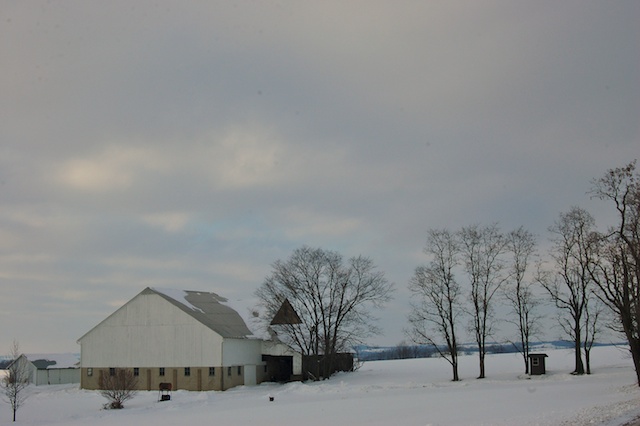
A phone booth on an Amish property is often placed away from the home to avoid the temptation of overusing the phone.

By Bruce Stambaugh

On a dark, chilly November night several years ago, an emergency medical technician arrived on the scene of a car verses buggy accident at a rural intersection. Unlike the car’s passengers, the older Amish man driving the lantern-lit buggy was uninjured.

As the scene cleared, the first responder asked the Amish man how far he had to go to call for help. With a toothless grin, the Amish man reached into his denim jacket and flopped opened a cell phone.

In the early days of cell phones, when even the EMT didn’t have one, that scenario might have been rare in Amish country. It isn’t any longer. As contradictory as is it may sound, Amish have and use telephones. They use them to converse, to fax, for GPS, to text, and on rare occasions, to access the Internet.

Of course, like many of other Amish lifestyle “rules,” there are many variables in the Amish – phone connection. Church leadership metes out phone use guidelines for Amish. Those rules and their application vary greatly. It all depends on which church and which order of Amish as to what the rules may allow. The rules about phone use, like other lifestyle guidelines, even differ from church to church within the same order of Amish.

Amish place by Bruce Stambaugh
The home of a young Amish family in Holmes County, Ohio.

The orders of Amish, if placed on a continuum, would range from New Order on the left to the Swartzentruber’s on the right. In other words, from the most progressive to the most conservative, with those terms being used in the religious sense, not politically. In between are the most numerous, the Old Order Amish that people describe when they refer to the sect.

The extremes of phone use by Amish would range from members of one church group permitted to have landline phones in their residence to others that are permitted no phones at all. Again, their individual church leaders determine how and where Amish use phones. This may seem strange or even unfair to those unfamiliar with the Amish, and sometimes to those who even live among them. But simply put, that’s just the way it is.

Driving down any highway in Amish country will reveal which families and businesses are not permitted to have landline phones in their buildings. Near the edge of the road, travelers will see small buildings about the size and shape of the old-fashioned phone booths with a door and usually a window for light.

They look like phone booths because that is exactly what they are. Enclosing the phone in a small structure protects the person using the phone from any inclement weather and provides privacy. The homemade phone booths are usually locked to prevent any vandalism or misuse.

Amish farmstead with phone booth by Bruce Stambaugh
Find the phone booth among all the other buildings on this farmstead near Walnut Creek, Ohio.

Such phone booths could be used by a single family or business, or by multiple families. Each family or business would have its own voicemail extension. The phones are not answered live.

Some churches require that phone booths be so many feet from the home or business. Some even require the phone to be across the road, so as not to be too convenient, thus reducing the possibility of casual use. Some Amish, especially the New Order sect, would allow a landline in their home.

In many churches, phones for calling out and faxing are permitted in the business, but not in the home. Incoming calls go directly to voice mail. This rule is economically weighted. The successes of cottage industries, which have boomed among the Amish in the last two decades, are critical to the welfare of the Amish community. Only about 10 percent of the Amish population farms today. The rest either have their own businesses or work at other local businesses.

Of course, any discussion about Amish and the use of phones would be incomplete without mentioning the ubiquitous cell phones. Cell phones are actually more widely accepted among the Amish leaders than landlines, simply because they are not literally tied to the public utility grid.

Cell phones have proven to be an efficient tool when it comes to doing business, regardless of the trade or product produce. Generally speaking, a common rule for cell phones is that they are turned off in the residence. Another rule stipulates that the phones cannot access the Internet or e-mail.

Because they are not yet church members, none of the rules apply to Amish youth, unless of course their parents say they cannot use them. Just like their non-Amish peers everywhere, texting and using cell phones to take pictures are typical for today’s Amish teenagers regardless of which church order their parents may belong.

In the 21st century, phones are one technology the Amish have embraced. Clearly though, the difference between them using the phone compared to the rest of society is in the details. For those instructions, the Amish look to their respective church leadership.

Amish Super Bowl Haiku

Amish head to church by Bruce Stambaugh
Amish youth gathered for a Super Bowl Sunday hymn sing.

Super Bowl Sunday
neighborhood Amish youth hold
an evening hymn sing.

Bruce Stambaugh
Feb. 6, 2011

Loathing acts and words of violence

Amish school by Bruce Stambaugh
A typical winter scene in Ohio's normally peaceful Amish country.

By Bruce Stambaugh

In the aftermath of the recent shootings in Tucson, Arizona, fierce discussion immediately followed the quick apprehension of the alleged shooter. To try to make some sense of this despicable act, heated vitriol quickly ensued, trying to focus blame on the rhetoric of popular political talking heads left and right.

I watched and listened. Mostly thanks to the ability to communicate spontaneously through the miracle of modern technology we call social networking, cable TV and talk radio, voices and anger rose simultaneously. So did the sale of guns and ammunition.

I watched and listened because I had sadly seen it all unfold before too many times in my lifetime. John F. Kennedy, Martin Luther King Jr., Bobby Kennedy, George Wallace, John Lennon, Gerald Ford, Ronald Reagan, Indira Gandhi, and Benazir Bhutto all came to mind.

These names, these famous folks were merely added to an even longer list of assassinations throughout history, the world’s and ours. Unfortunately, many of the more noted killings occurred in our own republic. Abraham Lincoln, William McKinley, James Garfield, Huey Long only begin the list.

We don’t have to stop at naming people either. Virginia Tech, Columbine, Paducah, and Nickel Mines are too easily recalled.

That’s what happens in the land of the free and the home of the brave where the first two articles of the United States Constitution create freedom of speech and freedom to arm. It is a delicate balance indeed to maintain in a free and open society. Too often, as was apparently the case in Tucson, unbalanced people upend everyday life at the price of innocents.

We cry out to make sense of it all when history has shown time and again that the reasons for shootings are often obscure and obscured. Usually, there is no clear-cut, well-reasoned reason.

Such high profile shootings demand the media’s attention because the public has a right to know and indeed needs and wants to know the details, the who, the what, the when, the why and the where of each and every act of violence. Sadly, because a crazy person chooses one freedom over the other, 9-year-old girls, federal judges, and United States representatives become the victims.

The public outcry is fast and fierce, and the rush on gun and ammo purchases shows an equal and opposite sentiment out of the desire for self-protection. Again, an ugly and unnecessary counterbalance occurs.

The unfortunate truth is, as we have learned in recent days, that these killings, usually via gunshots, happen close to home, too. A 10-year-old boy allegedly kills his mother with a gun. An adult son allegedly shoots his parents to death. An angry man blindly kills a young man hiding in a cornfield.

These last examples, of course, all occurred here in quaint, quiet and safe Amish Country. It doesn’t happen here. Those words were spoken in Tucson, Arizona, Big Prairie, Mt. Eaton and Mt. Hope, Ohio. Of course, “it” does because “it” did. “It” always catches us by surprise. It shouldn’t.

When people are free to speak their minds, to go about their normal business, and others are free to arm themselves and go about their abnormal business until the breaking point, a fateful, fatal crash between bullets and bodies results.

I mercifully dislike violence whether by guns or by vitriol, a word as ugly as its meaning. Both hurt and kill. There is simply no sense for sensible people to join the ranks of the unbalanced. The deranged already accomplish enough harmful havoc all by themselves.

Amish skaters

Honest to goodness laughter punctuated
the snowy night air, easily drowning out
the steady hum of the gasoline generator
that powered the incandescent necklace
arched over the frozen pond, illuminating
the slick surface where skaters frolicked.

Bruce Stambaugh
Jan. 7, 2011


New Year’s Day forecast haiku

Rain changing to snow
is the New Year’s Day forecast
for Amish country.

Bruce Stambaugh
Jan. 1, 2011

Christmas isn’t about hustle and bustle

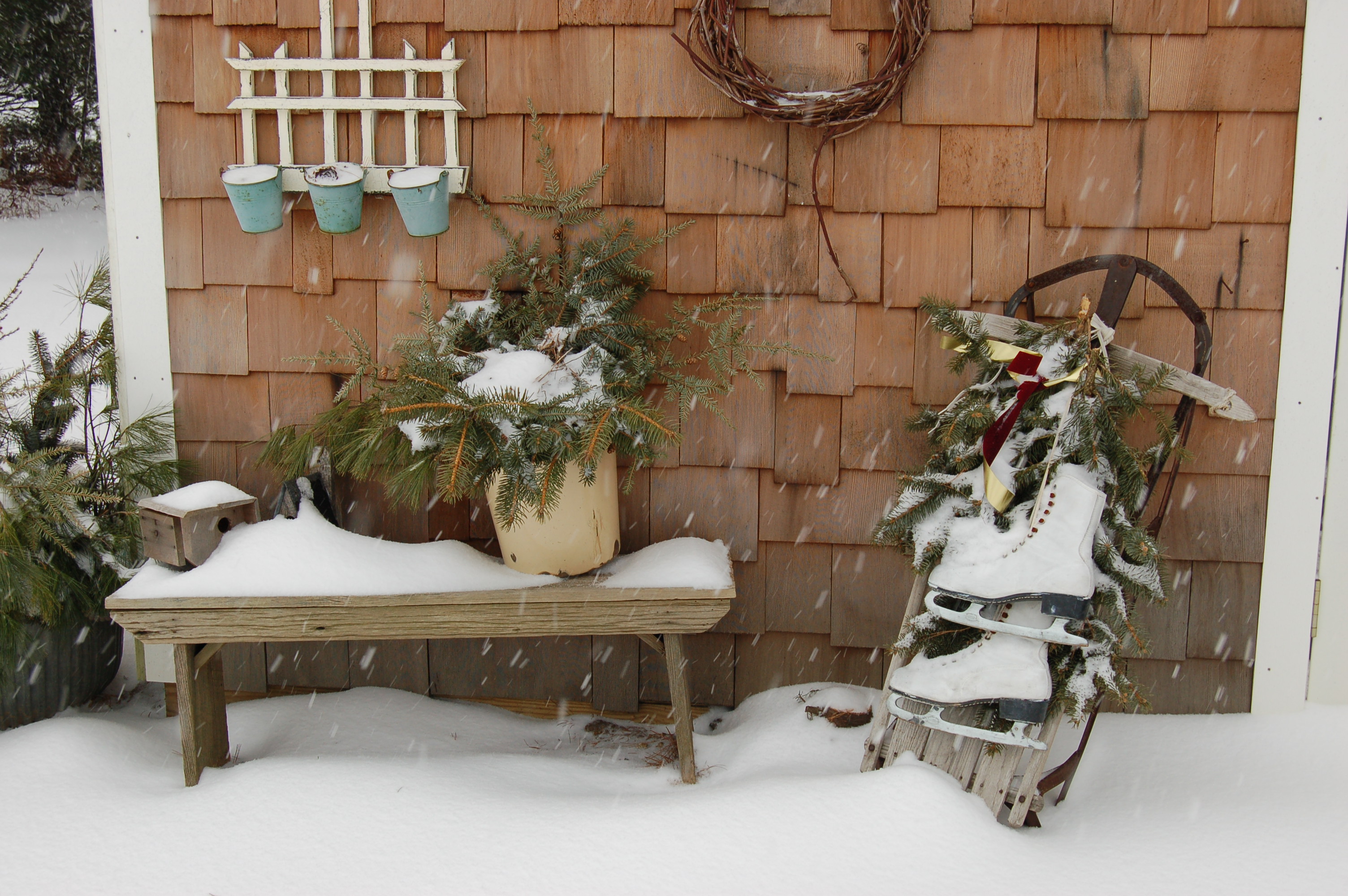
Snowy decorations by Bruce Stambaugh
Snowy decorations always add to the Christmas celebrations.

By Bruce Stambaugh

I don’t watch much television. But what little I do, I can’t help but notice how the torrent of holiday-oriented commercials focuses on the urgency of buying something really nice for that special someone in your life.

Celebrating Christmas in our advanced society seems distorted. A brand new car wrapped with a huge red ribbon and bow sitting in the driveway, a sparkling diamond ring and a gold necklace cannot supersede the original gifts of the Magi.

Eager for customers, the ads have managed to push their way to the forefront of the holiday season much too early. Growing up, the countdown to Christmas started the day after Thanksgiving, now known as Black Friday. Today, it seems to start the day after Labor Day.

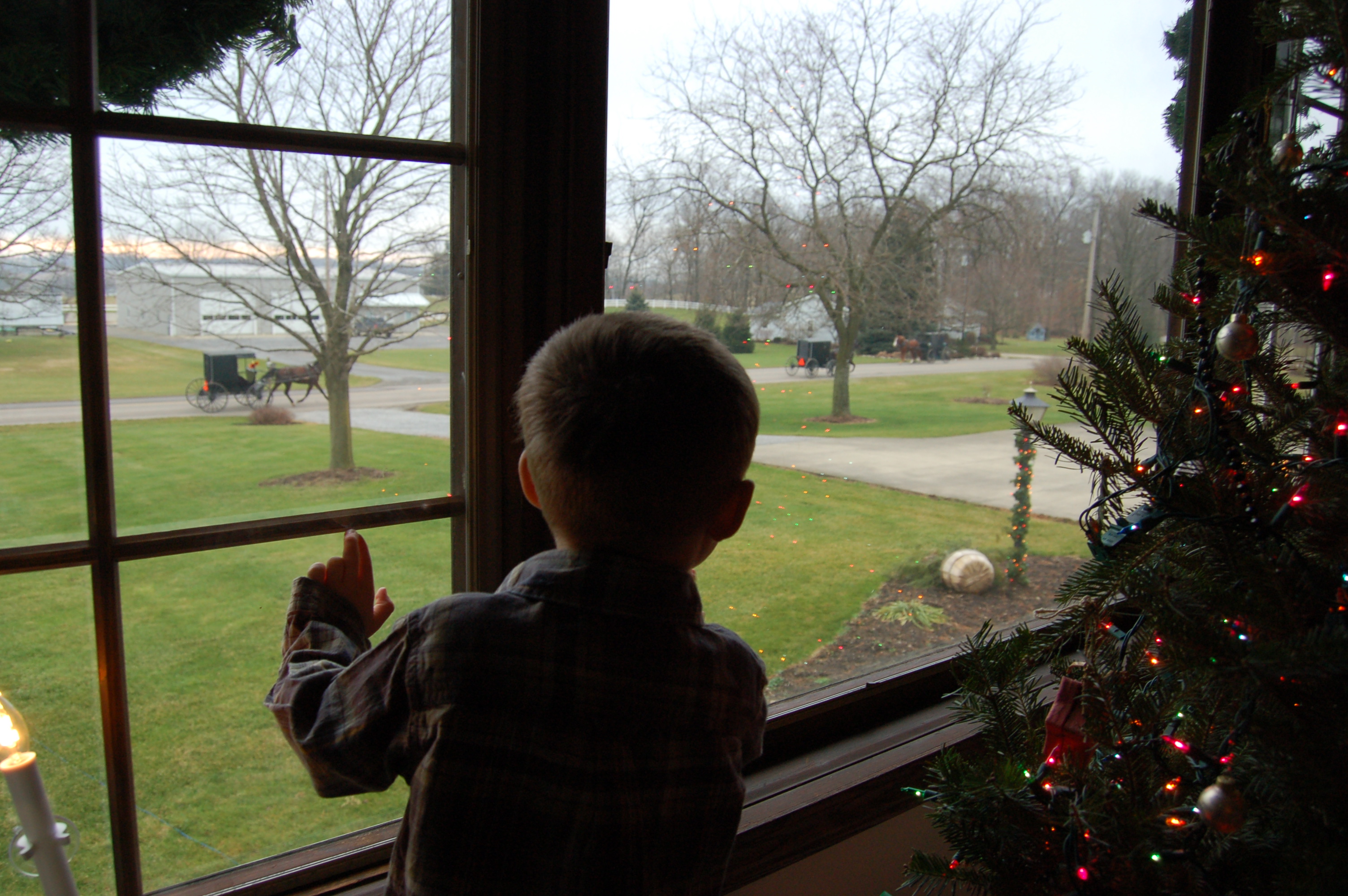
Watching for buggies on Christmas Day by Bruce Stambaugh
Watching for buggies on Christmas Day.

Even here in the heart of Ohio’s Amish country, we feel the hustle and bustle of the season. Without admitting it, we might even add to it. It’s always easier to see the fault of others than your own.

Wreath on frosty window by Bruce Stambaugh
A frosty holiday decoration.

I don’t want to be negative about Christmas. It’s my favorite holiday of the year.

I just think that given all the commercialization of Christmas, we need a different approach. As I reflect on the historical account of the Advent season that I learned early in life, it seems more and more obvious to me that Christmas really is more about patience than it is presents.

I have many fond childhood memories of readying for Christmas, and the excited anticipation of Christmas morning. My brothers and sisters and I couldn’t wait to raid the pretty packages strewn beneath the tree on Christmas morning. That scene was not the model of patience.

Mom and Dad had stayed up late assembling and wrapping the gifts for us kids. We always pushed our luck at getting up before the crack of dawn to undo what it had taken Santa and our folks hours to prepare.

But what a happy morning it was, with the excitement of surprise with every unwrapping. Those days were simple compared to what passes as season’s greetings today. I find the entire holiday hubbub of shopping, buying and spending exhausting.

Opening gifts by Bruce Stambaugh
Exchanging gifts at Christmas is part of the family tradition.

I long for the true peace and quiet of Christmas, with the family gathered, the fireplace blazing, the tree’s lights sparkling. Of course, we maintain the gift-giving tradition. We have just toned it down so that reason rules. We want the gifts to represent personal quality instead of absurd quantity.

The stockings hang by the chimney with care. They are filled on Christmas Eve, and emptied on Christmas morn. Just like when I was a child, an orange will be the last to tumble out of each.

The grandkids will watch The Polar Express over and over until the DVR wears out. We’ll play games, eat, and bask in the glow of the moment and the season.

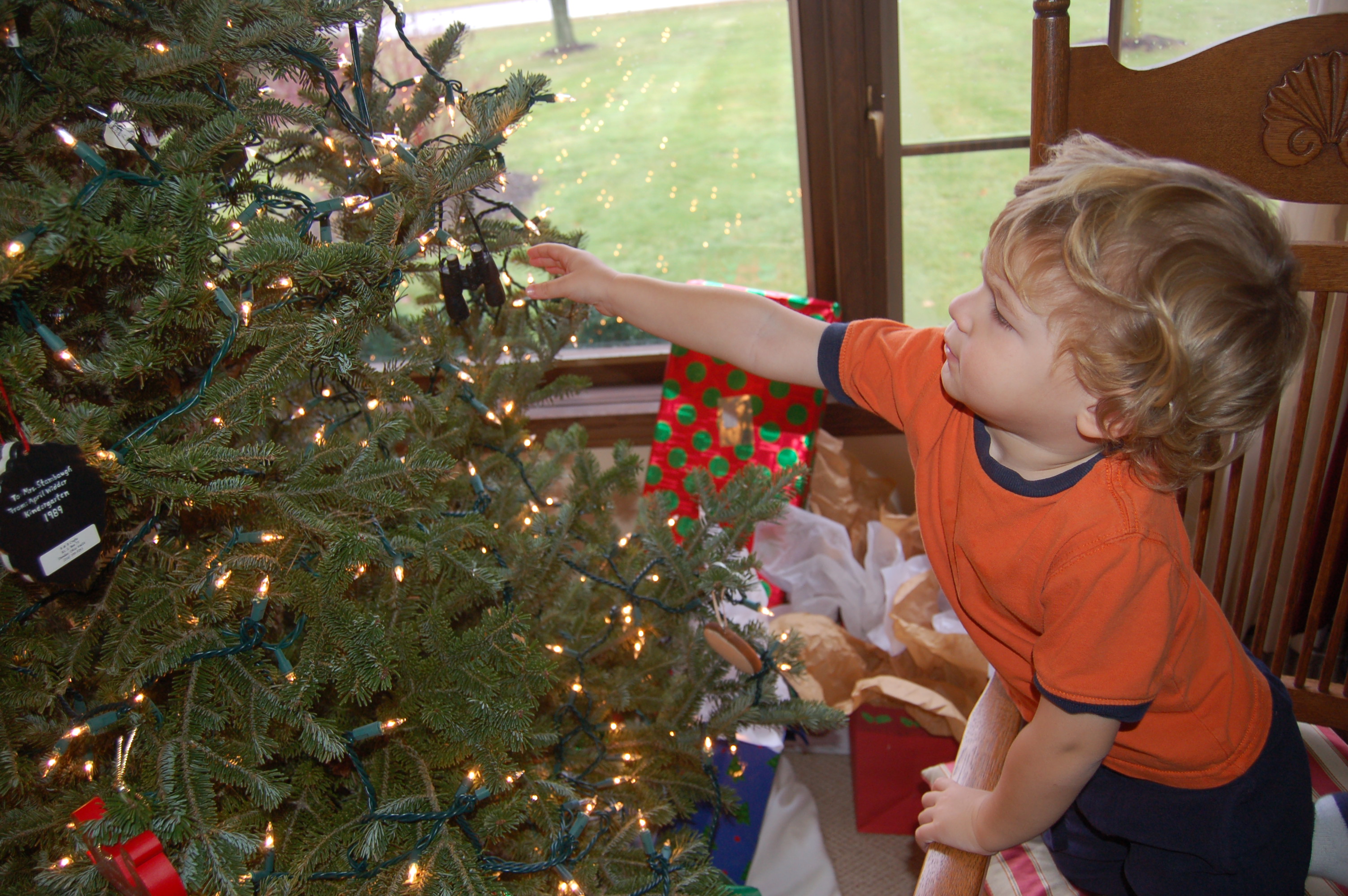
Decorating the tree by Bruce Stambaugh
The grandchildren enjoy helping to decorate the Christmas tree.

Our modern society may rush the Advent season and judge it by its economic success. But as for me and my family, we will enjoy each others company, joyously share our humble appreciation and rejoice that it is Christmas once again.

Those are Christmas gifts worth waiting for.

Getting ready for winter

Martins Creek by Bruce Stambaugh
A series of heavy snowfalls hit Ohio's Amish country last winter.

By Bruce Stambaugh

Like it or not, winter is right around the corner. We have already tasted some of winter’s appetizers, snow, temperatures in the teens, and, of course, shortened daylight.

Fortunately here in Ohio’s Amish Country, the snow didn’t amount to much, and the skinny temperatures quickly moderated. Once winter arrives officially next week, that could change. We could have a snow-filled winter like last year, or worse yet, one like 1977 and 1978 when snowdrifts reached 20 feet or more.

Living in Ohio all my life, I have found it helpful to mentally and physically prepare myself for the inevitable. Whether it is prolonged or only stays awhile, the weather will get cold, and it will snow from time to time.

Snowbirds arrive in Pinecraft, FL by Bruce Stambaugh
Snowbirds arrive via bus in Pinecraft, FL.

Those who dislike that harsh reality and who are in a position to do so flee south or southwest to warmer climes. At least the snowbirds hope they will be warmer. Last year proved otherwise. It frosted in Florida and snowed deep in the heart of Texas.

Snow deep in the heart of Texas by Bruce Stambaugh
It even snowed in Austin, TX last winter.

All of us can’t escape the onslaught of winter’s harshness. Some of us don’t want to. Others are involuntarily stuck here to fend for themselves.

I have fond childhood memories of the benefits of winter, like ice skating, sledding, flinging snowballs and digging snow tunnels. Most of them likely were indeed in the throes of winter. But I do remember delivering newspapers in a glorious Christmas Eve snow.

I also recall hustling our young son and daughter into my in-laws’ farmhouse amid stinging, sideways snow, howling winds, and frigid wind chills. There are times when Ohio winters are at their absolute worst in December.

We then anticipate January and February to be utterly horrible. And low and behold they might turn out to be meek and mild, not to mention mucky.

Whether we stay or whether we go, winter, regardless of the weather, will arrive. We might as well get ready for it.

Snow covered cornshalks by Bruce Stambaugh
A typical snowy scene in Ohio's Amish country.

In many ways, we already have. The tomato trellises we erected last spring have long been coaxed out of the ground and stored in the garden shed, thanks mostly to one of our kind, strong young neighbors.

The birdfeeders have been cleaned, filled and hung, and the backyard birds, and a couple of mooching fox squirrels, have already been taking advantage of the freebies. Actually, I am the one that is grateful. Watching the birds, and squirrels, rabbits and occasional deer, enjoy the cracked corn, oil sunflower seeds and suet mixes is my winter’s entertainment.

White breasted nuthatch by Bruce Stambaugh
A white-breasted nuthatch at my kitchen window feeder.

In truth, I feed the birds year-round. With winter’s approach, I merely increase the number and style of feeders to accommodate the various feeding habits of my feathered friends.

Of course, I can’t neglect the vehicles that transport us from place to place during the winter weather. I make sure each is winterized and ready to endure whatever winter has to throw at us.

The woodpile is stacked high and wide, ready to feed the hungry fireplace. I’d rather be shunning the cold elements in front of a warm fire than on the outside shoveling them. Who wouldn’t?

Winter is nigh. Are you ready?

Amish sledding haiku

Amish farm in snow by Bruce Stambaugh
The fresh blanket of snow made perfect sledding conditions for children on this Amish farm.

The boy and the girl
took turns sliding down the hill
in a coal shovel.

Bruce Stambaugh
December 13, 2010

How Amish celebrate the holidays

Amish church by Bruce Stambaugh
Amish on their way to church near Mt. Hope, Ohio. Church was held in a member's home.

By Bruce Stambaugh

The Amish enjoy celebrating the holidays just as much as anyone else. They simply go about it a bit differently.

Defining how the Amish celebrate America’s most time-honored holidays deserves an introductory explanation. The Amish are divided into church groups, usually about 100 persons per church. And by church, they mean fellowship, since they hold church in their homes, shops or barns.

There are actually many different types or orders of Amish. The Swartzentruber Amish are considered to be the lowest order, with the New Order Amish the highest, since they hold Sunday school on the alternate worship Sundays.

Using the terms “lowest” and “highest” is not intended to be derogatory or even hierarchical. It simply is the way it is with the Amish. Those in between are the Old Order, by far the most numerous in among the Amish population. The orders are simply determined by rules of the church leaders.

Clearly, defining the Amish is a lot harder than their simple lifestyles might let on. Nevertheless, they all celebrate the holidays one way or another.

The key to understanding how the Amish do so lies in this understanding. You can’t generalize about the Amish. Their holiday traditions and rituals vary from family to family, church-to-church and sect-to-sect, not much different that any other culture or ethnic group.

Modesty is a major principle in the values of the Amish. That fact can be seen in exactly how the Amish keep the holidays. In living out their faith beliefs, they do so joyously surrounded by food, family and friends.

Here then is an overview of how any given Amish family, save those in the Swartzentruber order, might celebrate the holidays.

Thanksgiving

Most Amish take advantage of this national holiday just the way the rest of the country would. They gather with family, extended family and friends and enjoy turkey, mashed potatoes and gravy, cranberry sauce, a vegetable and of course dessert, usually homemade pie.

However, instead of breakfast, many of the Amish fast prior to the large noon meal. Fasting is a physical sign of purification in preparation for the celebration.

The lower order Amish, however, have a different take on Thanksgiving. They see it as an opportunity to prepare for the winter months ahead. For them, Thanksgiving is the big hog-butchering day. They’ll save their substantial meal for another later.

Christmas

From the Amish perspective, anyone not Amish is considered “English.” The Amish recognize and respect the “English” demarcation of Christmas on December 25. For them, Christmas is a sacred day in honor of the birth of God’s only son, Jesus Christ. And here again, many, though not all, will fast prior to their family gathering.

Amish actually celebrate Christmas twice, once on the standard date of December 25, and again on January 6, commonly referred to as Old Christmas. In higher religions, that day is known as Epiphany.

Unlike the rest of society that celebrates Christmas, the Amish do not have Christmas trees or decorations. They will, however, burn Christmas candles in honor of the day.

After the usual Christmas meal of turkey or ham and all the trimmings, the Amish will spend the afternoon and evening away playing table games, board games and cards. None of the card games would involve using face cards.

Of course, it wouldn’t be Christmas without gifts and the Amish carry out this tradition of gift giving as well. The gifts will be wrapped, but usually nothing elaborate. Children will receive toys.

Since not all of Amish Country is Amish, the usual holiday decorations and activities occur like in the rest of Christendom. Millersburg, the Holmes County, Ohio seat,  holds a Christmas parade, Santa included, and on December 10 will initiate its first candlelight church walk from 6 to 8 p.m.

Berlin, Ohio, the hub of Amish Country, has a luminary ceremony. Even little Mt. Hope, where mostly Amish live, has a Christmas parade and a live nativity scene. Santa, however, is nowhere to be found.

Old Christmas

Old Christmas harkens back to the change from the Julian calendar to the Gregorian calendar during the latter stages of the Reformation when Pope Gregory XIII switched Christmas to December 25. Out of tradition and reverence for their forefathers, the Amish have continued to honor Christ’s birth on January 6.

Unlike the more jovial December 25 celebrations, Old Christmas is more solemn. It begins with fasting, followed by another typical Christmas meal and some more gift giving. However, the emphasis is on reflecting and visiting as apposed to reveling.

No matter which holiday is being celebrated, family is always an important element in any get-together for the Amish. And that is true for any Amish order.

Bay Photos by Donna

Wildlife photos from the Chesapeake Bay region

ROAD TO NARA

Culture and Communities at the Heart Of India

K Hertzler Art

Artist and nature journalist in the Shenandoah Valley of Virginia.

Maria Vincent Robinson

Photographer Of Life and moments

Gabriele Romano

Personal Blog

Jennifer Murch

Art is the only way to run away without leaving home. -Twyla Tharp

Roadkill Crossing

Writing generated from the rural life

ANJOLI ROY

writer. teacher. podcast cohost.

Casa Alterna

El amor cruza fronteras / Love crosses borders