A life of public service achieved

Lt. Richard Haun by Bruce Stambaugh
Lt. Richard Haun spends much of his time documenting cases on the computer.

By Bruce Stambaugh

Simply put, Richard Haun is living his dream.

As a teenager, Haun knew exactly what he wanted to do. With timely guidance and self-determination, he has more than achieved his goal. Not bad for someone yet to turn 40 years old.

Haun is actually Lieutenant Richard Haun of the Holmes County Sheriff’s Office. He has been with the sheriff’s office for 24 years. Do the math and the answer becomes apparent. Haun began his law enforcement career at that tender age of 15.

It really all began with some public service modeling by his mother and encouragement from a friend that got Haun thinking about life in law enforcement.

His mother served as an emergency medical technician, and a friend encouraged him to join the Boy Scouts of America troop that served as Explorers with the sheriff’s department.

“I always wanted to be a deputy,” Haun said. “That’s why I joined the Boy Scouts law enforcement Explorers Club. That’s how I got started and I’ve been here ever since.”

One assignment of the Explorers was to be a presence at the Holmes County Fair. He began making his rounds there in 1986 and hasn’t missed a fair since then.

“Once I got into the Explorers,” Haun related, “that’s when it clicked for me.”

Born in Millersburg, Haun grew up in Killbuck and graduated West Holmes High School in 1989. With his sights set on a career in law enforcement, Haun didn’t have much social life as a teen.

“I would go to school during the day,” Haun said, “then attend the police academy in Coshocton in the evening.” Haun said those classes ran from 5 p.m. to 10 p.m. Monday through Friday.

“We even had some classes on Saturday,” Haun said. “I couldn’t even attend my senior prom because I had to qualify on the firearms range.”

Haun lives in Millersburg with his wife, Susan, and two sons. The Hauns have been married for 17 years.

Haun started as a reserve officer in 1988. He went full-time in 1989 as a dispatcher in the communications division and has worked his way up the law enforcement ladder one rung at a time.

Haun has been a road patrol deputy, the supervisor of road patrol, a court bailiff and a detective. Now he is supervisor of both the civil division and the child support division.

“When I started, we didn’t even have a computer,” Haun said. “We wrote everything down on a legal pad. Now everything is done with computers and legal pads are used as scratch pads.”

Haun spends much of his day doing electronic paper work on the computer. He has to stay up on changing laws and attorney general rulings and relay that information to the rest of the sheriff’s office staff.

“That’s the toughest part of my job,” Haun said. “Keeping track of all the necessary paper work is demanding.”

During his years with the sheriff’s office, Haun has seen first-hand how crime has changed. He said the sheriff’s office deals more and more with identity theft and computer theft.

“We sock a lot of man hours into online crime,” Haun said. “Sexual predators and embezzlement are increasing.”

Haun coordinates prisoner transports, court appearances, and monitors all of Children’s Services needs when it comes to background checks for employment and those seeking employment.

The various positions he has held have required him to train in all divisions. Haun said his experience and training, including online training, enables him to be flexible in his work.

“I’ve gone where I’m needed,” Haun said. “It’s all a part of the educational process.”

“I do regret not going to college,” he shared. “But if I were to count all the hours of training I’ve done, I probably would have some kind of degree.” He said he would encourage his sons to go to college.

Still, Haun has no regrets about the career path he has chosen.

“It’s a pleasure to be of service to the public,” Haun said.

This story first appeared the Holmes Bargain Hunter.

Directions of a different sort

Buggies at Mt. Hope by Bruce Stambaugh
Buggies tied at a hitching rail in Mt. Hope in the heart of Ohio's Amish country.

By Bruce Stambaugh

Word to the wise. If you ask for directions in Holmes County, Ohio, you just might want to get a second or even third opinion. Better yet, use a map, atlas, a GPS or a combination of those geographical aides.

Here’s why. With three to four million visitors to our fine county every year, some of them get lost, or at least do not know exactly where they are. Shoot. Some might not even know where they want to go.

Coming and going by Bruce Stambaugh
Wagons come and go during the oats harvest in Holmes County, Ohio.

But given what I have observed and heard over the years, that’s not a problem either. The genial folks who live here will gladly offer some directional advice if asked.

Generally, the directions given answer the directions sought. But not always. Holmes County has its fair share of ornery characters.

Of course, I wouldn’t be one of them, though living where I do I certainly have had plenty of chances. While working outside, it is not uncommon for a car to slow on our busy highway and have either a passenger or the driver ask how to get to Berlin or Millersburg, or a specific business.

I try to be as succinct as possible, using landmarks and road numbers and the appropriate “turn right” or “turn left.” I like to end with what I have heard countless other locals finish their directional spiel. “Like we say in Holmes County, you can’t miss it.”

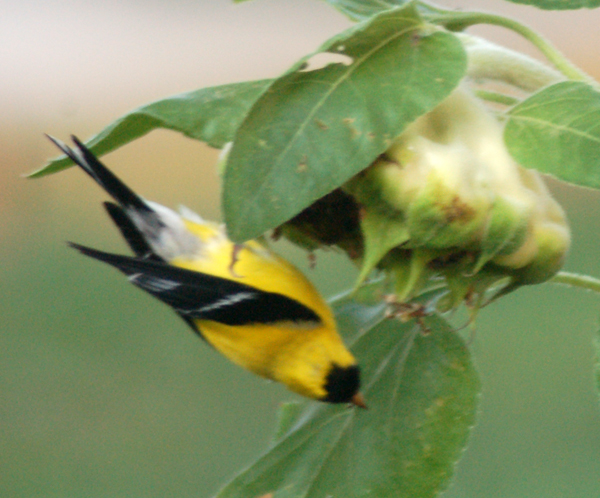
Goldfinch by Bruce Stambaugh
An American Goldfinch enjoys the fresh seeds of a volunteer sunflower. With its many habitats, birds are among the tourists who flock to Holmes County every year.

Meant as affable words of encouragement, too often I fear they are the deathblow to everything that preceded that comment. Since I never see the persons again, I can’t testify whether the colloquialism is true or not. But it could be worse, and sometimes is. The following antidotal incidents are completely true.

After a tourist inquired of a local where a certain person lived, the native immediately asked in all seriousness, “Do you know where the eight-sided barn used to be?” The point of reference had burned to the ground several years previous.

Here’s another. A tourist asked for directions to little unincorporated Saltillo, a cluster of homes at the diagonal crossroads of two county highways. These were the instructions. “You go up a long hill, over a small hump in the road, then it’s just a hop, skip and a jump from there.”

They get better. The state superintendent of public instruction, driving a state car with state license plates, stopped and asked for directions. Seeing the distinguished gentleman’s suit and tie and glancing at the plates, the unsuspecting superintendent got directions that took him far out of his way. Fortunately, he had a good sense of humor and understood the county’s suspicions towards state and federal officials.

A friend of mine was standing on the square in Millersburg when someone in a car going west asked directions to Berlin, five miles to the east. My friend sent them north to Wooster, east to Canton, south to Dover and west to Berlin, a distance of 96 miles.

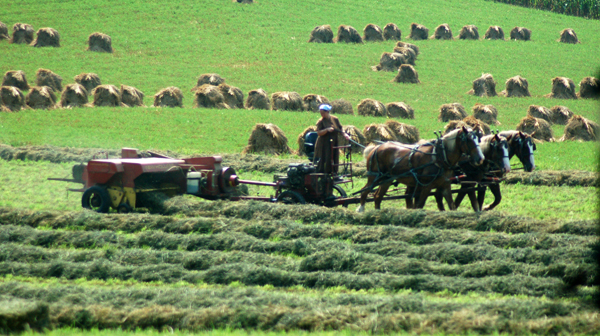
Baling hay by Bruce Stambaugh
Millions of tourist visit Holmes County's Amish country annually to see the Amish work in the fields.

The same friend was once asked for directions from Millersburg to Mohawk Dam in Coshocton County from someone from out of the area. The vehicle was pulling a fishing boat.

My friend figured someone was sending this poor fellow on a wild goose chase. Since the guy had driven this far, my friend figured he might as well complete the ruse. The proper directions were given and the man and his boat were on their way.

Mohawk Dam is a flood-control, dry dam. I’m sure they couldn’t have missed it.

August sunset by Bruce Stambaugh
A glowing August sunset in Holmes County's Amish country.

Weatherwax lends a helping hand

By Bruce Stambaugh

Jill Weatherwax, 59, of Glenmont, Ohio likes to lend a helping hand whenever she can.

Weatherwax, who by day works at Rice-Chadwick Rubber Company in Killbuck, spends several evenings each month helping others feel better. She provides reflexology treatments for residents at area retirement and nursing homes.

Weatherwax has been offering her services to seniors for a dozen years now. In fact, she specifically focuses on the elderly for a personal reason.

“I got into this because I missed my grandparents, Bob and Sally Allison,” the petite woman said. “I felt a void without them around.”

Jill Weatherwax by Bruce Stambaugh
Jill Weatherwax provided reflexology treatments for Esther Miller, a resident of Walnut Hills Retirement Home in Walnut Creek, Ohio.

Weatherwax has easily filled the void all these years with her gentle touches. She is careful to differentiate what she does from that of massage therapy.

Reflexology is considered a complementary touch therapy. Weatherwax gently, but firmly, works with the hands and feet of senior residents at Majora Lane Nursing Home, Sycamore Run Nursing Home, both in Millersburg, and Walnut Hills Retirement Home, Walnut Creek.

Residents who receive her treatments report relief from pain, stiffness, and other maladies.

“I like it because I can sleep better,” Esther Miller said. Miller is a resident at Walnut Hills Retirement Home and said she looks forward to the helpful visits by Weatherwax.

Weatherwax said it is not unusual for residents to report such extended advantages to the reflexology treatments.

“Relaxing the hands and feet improves the circulation,” she said. “Consequently, the entire body is relaxed, which is why some people report being able to sleep better.”

Her visits, which are paid for by the facilities and offered to the residents free of charge, are regularly scheduled at each location. She said she visits Majora Lane twice a week, Sycamore Lane weekly, and Walnut Hills every other week. And she does so after completing her daytime shift at Rice-Chadwick, where she has worked for 33 years.

“I am on my feet for eight-hours a day,” Weatherwax said. “So I know how important taking care of your hands and feet is.”

Weatherwax, who is certified to offer the reflexology services, said that before she works on residents, she gives the facilities’ administrators the opportunity to experience her treatments. That way they know exactly what is happening when she is there, she said.

“After my grandparents passed on, I asked God to do something to help me fill the void,” she said. After the third time of having her own hands and feet treated by a reflexology therapist, she realized she could provide the same services.

She said she knew such services were not offered in the area. “People don’t want to handle other people’s feet,” she said. “But I feel called to do it.”

According to the Farber Family Foundation, reflexology is a unique method of using the thumb and fingers on reflex areas in the feet and hands that correspond to all of the glands, organs and part of the body to elicit areas of potential or actual disorder. Pressure applied to the reflex points promotes better blood flow and nerve impulses, along with other physiological benefits.

Weatherwax began at Majora Lane, and then reached out to the other retirement centers. She actually finds the sessions therapeutic herself.

“The therapy works both ways,” Weatherwax said. “I get to listen to them while I work on their hands and feet, and they get to listen to me.”

“You need to be in tune with the person you are working with,” she said. “You have to be compassionate for each situation. If not, you are going to hurt them.”

Weatherwax’s gentle touch, soft-spoken approach and years of experience help provide positive results for many area seniors. That’s what helping hands are meant to do.

This article first appeared in the Holmes Bargain Hunter, Millersburg, Ohio, August 2, 2010.

A love for agriculture come full circle

By Bruce Stambaugh

It’s no accident that Leah Miller’s life has come full circle. Agriculture runs deep in her genes, personal life and in her professional career.

She grew up on a farm, and now her life is all about farming, both at home and on the job, whichever particular job it is she happens to be doing. In between, her career took a productive, if not circuitous route before Miller, 61, planted her agricultural roots.

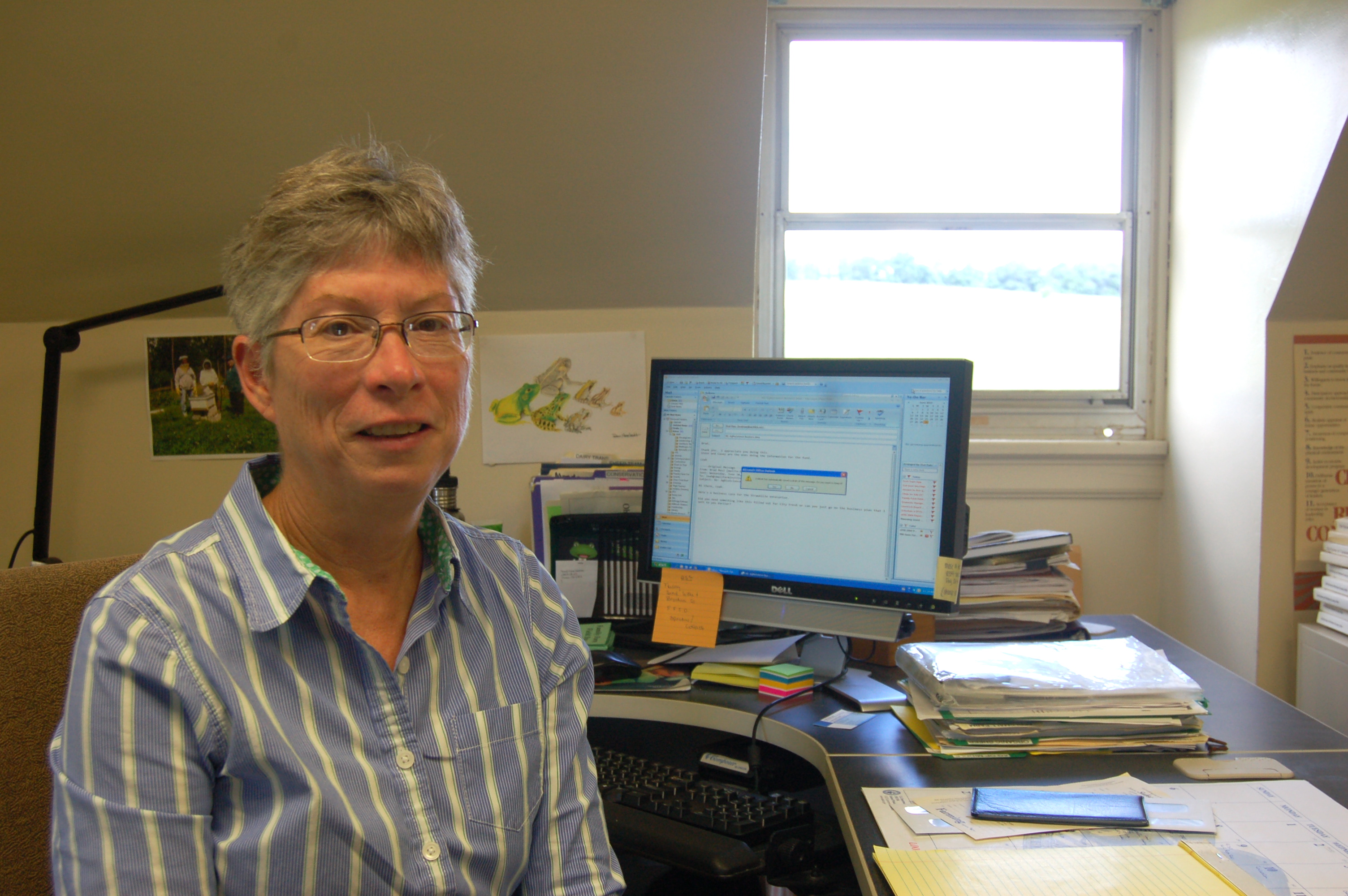
Leah Miller by Bruce Stambaugh
In a rare moment, Leah Miller was in her Small Farm Institute Office in Coshocton County, Ohio.

Born in Conneaut, Ohio near her parent’s home farm at Pierpont, Miller followed some pretty big family footprints. Her father and her father’s father were both agricultural teachers, in addition to running separate farms in Ashtabula County.

Miller’s mother, Celia Wright, took charge of the family farm when her husband, Eber, moved into regional planning. Ironically, that is exactly the job Miller took in Lake County after graduating from The Ohio State University in 1971. She became Holmes County’s regional planning director two years later.

There is a bit of double-irony in this scenario. The Holmes County regional planning office was in the front of Hotel Millersburg.

“My parents spent the first night of their honeymoon at Hotel Millersburg,” Miller said. “They got a late start from their wedding reception in Columbus and following U.S. 62, Millersburg was as far as they got.”

Miller served in this capacity for six years. Once she and her husband, Mic, started their family, Miller turned her efforts to community service. She served two terms on the West Holmes Local School Board. Later, she served on the board at Central Christian School. She also served a term on the Ohio Mennonite Relief Sale board of directors, and was a 4-H advisor for a dozen years.

Miller was the first director of the Holmes County Chamber of Commerce, once it expanded from beyond Millersburg proper. In the 1990s, Miller’s leadership abilities became political. She was twice elected as a Holmes County commissioner.

All the while she found solace from her demanding schedule on her 50-acre sheep farm, Blue Bird Hill, east of Millersburg. She also kept bees, as did her father.

Her love for land and the people that farmed stirred within her. In 2001, she worked with former state representative Joy Padgett to form the Small Farm Institute.

“There was a concern about erosion and farming,” Miller explained. “The emphasis was to help farmers do more grazing with their animals.” She said the sod would help reduce run-off, and at the same time provide a natural grass diet for cows, cattle and sheep.

Miller is the director of the Small Farm Institute, which is based at the United States Department of Agriculture’s hydrological station in Coshocton County. She assists small farm operations to improve income by providing helpful information on sustainable environmental practices that support strong family and rural communities. Her focus is on production, processing and distribution of product.

“We encourage people to look for value-added production to enhance profitability,” Miller said. “If they run a produce stand, they can increase their income by making jam or canning instead of selling all their fruit and vegetables fresh.”

Much of Miller’s responsibility revolves around facilitating grazing groups. She said this has been especially successful among the Amish, who tend to form their own peer groups in close proximity to help reduce the need for transportation.

“It’s been a joy to watch them expand,” she said. “They hold pasture walks where they share helpful grazing information with one another.”

As satisfying as that is for Miller, she also supports much larger events. Her skill sets also assist the annual North Central Ohio Grazing Conference for Dairy, which brings in hundreds of people, including many from other states.

Miller also advises the planning committee for the upcoming annual Family Farm Field Day. David and Emily Hershberger will host the event on their farm, located on Saltcreek Township Road 613 in Holmes County, on July 17, from 8:30 a.m. to 4 p.m.

As if she weren’t busy enough, Miller works part time as stakeholder coordinator in agricultural economic development for the Ohio Agricultural Research and Development Center in Wooster. She splits her time between there and the Small Farm Institute. Miller is the executive secretary of the Ohio Forage and Grasslands Council, too.

Miller has traveled extensively, including Australia, Mexico, France and Honduras, touring grazing and farm production operations and doing a little mission work, too. She uses these experiences to expand what she shares about improving local farming practices.

It seemed only logical then that Miller’s leadership abilities be put to use in yet another positive way for the community. Miller has successfully lead Leadership Holmes County for employees of area businesses for several years. In that fact, there is no irony.

This article was first published in the Holmes Bargain Hunter, July 5, 2010.

Bay Photos by Donna

Wildlife photos from the Chesapeake Bay region

ROAD TO NARA

Culture and Communities at the Heart Of India

K Hertzler Art

Artist and nature journalist in the Shenandoah Valley of Virginia.

Maria Vincent Robinson

Photographer Of Life and moments

Gabriele Romano

Personal Blog

Jennifer Murch

Art is the only way to run away without leaving home. -Twyla Tharp

Roadkill Crossing

Writing generated from the rural life

ANJOLI ROY

writer. teacher. podcast cohost.

Casa Alterna

El amor cruza fronteras / Love crosses borders