I am a writer, author, photographer, birder, walker, hiker, husband, father, grandfather, brother, Anabaptist, and community activist. My life is crammed with all things people and nature and wonder. My late father gave me this penchant for giving and getting the most out of life, my late mother the courtesy, kindness, and creativity to see the joy in life. They both taught me to cherish the people I am with. I try and fail and try again.
The story didn’t get much play in the mainstream media of the United States. But I found it incredibly noteworthy if not uplifting, especially during this Advent season.
If you missed it, here’s what happened.
Sometime in late September, three teenage boys slipped into a 12-foot boat and headed to one small Pacific island from another. Unfortunately, their outboard motor ran out of fuel before they could reach their destination, the atoll island of Tokelau.
If you have never heard of it, don’t feel bad. I hadn’t either. Curious though, I looked it up. It’s part of an archipelago many miles northwest of Samoa.
Samoa I had heard of. As a child, I perused the many shiny black and white photographs that my late father had taken when he had visited Samoa and surrounding islands during his stint on the U.S.S. San Diego during World War II. The water buffalo and the thatched roof huts of the Polynesian island natives fascinated me.
Maybe it was that bit of sentimentality that drew me to the story initially. Once I read the first few sentences, however, I had to know the full story.
With no oars and no fuel, the boys and their tiny boat drifted far away from any land. Soon they were deep in the expansive Pacific, adrift with only a handful of coconuts they had thrown into the “tinnie,” the colloquial tag for their vessel.
The blazing sun beat down on them, and they parceled out the coconuts, the only food they had. The boys floated aimlessly for days, parched without vital drinking water.
Day after day they sat helpless in the tropical sun searching the horizon for signs of land or other boats. A series of fierce storms cropped up at night, nearly capsizing the boat. The boys hit the boat’s bottom and clung to the sides to steady their small vessel.
The storms provided an upside, however. The boys lapped at puddles of the fresh rainwater left by the downpours. Once, at night, a ship passed close to them, but because they had no light of their own, the boys could only watched in despair as the big ship glided by.
Once the coconuts were gone, their only food came in the form of small, flying fish that happened to jump into their boat. Another time, a bird landed on their boat and one of the boys managed to grab it. They devoured it raw.
Again desperate for water, the boys began drinking small amounts of seawater. Near the end of November and some 50 days after they had left their little atoll, a deep sea fishing boat approached them. This time it was during the day, and they and their little boat were rescued 800 miles from where they had originally launched.
The boys spent a few days in the hospital to regain nourishment and strength, but it would be more than two weeks until a boat would take them back to their small country of 1,500 residents.
Fascinated by this amazing story, I typed in Tokelau into Google Earth. I wanted to get a visual on their tropical homeland in the middle of the Pacific.
Sure enough, the program took me right to it. I zoomed in to see the series of small islands, all formed from volcanoes. The residents lived on the rims of the inactive craters. Amazingly, picture icons were posted. I clicked on them, and shots of a tropical paradise emerged. Swaying palm trees, pristine beaches, and deep blue bays beckoned.
I mentally kept connecting this joyous, improbable survival story with the one on which the Advent season is based. Like the Bethlehem account from long ago, with its unlikely cast of characters, this miraculous tale had to be shared, too.
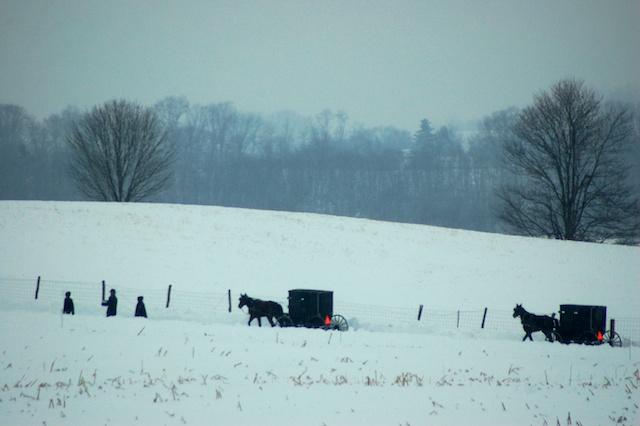
Amish on their way to church near Mt. Hope, Ohio. Church was held in a member's home.
By Bruce Stambaugh
The Amish enjoy celebrating the holidays just as much as anyone else. They simply go about it a bit differently.
Defining how the Amish celebrate America’s most time-honored holidays deserves an introductory explanation. The Amish are divided into church groups, usually about 100 persons per church. And by church, they mean fellowship, since they hold church in their homes, shops or barns.
There are actually many different types or orders of Amish. The Swartzentruber Amish are considered to be the lowest order, with the New Order Amish the highest, since they hold Sunday school on the alternate worship Sundays.
Using the terms “lowest” and “highest” is not intended to be derogatory or even hierarchical. It simply is the way it is with the Amish. Those in between are the Old Order, by far the most numerous in among the Amish population. The orders are simply determined by rules of the church leaders.
Clearly, defining the Amish is a lot harder than their simple lifestyles might let on. Nevertheless, they all celebrate the holidays one way or another.
The key to understanding how the Amish do so lies in this understanding. You can’t generalize about the Amish. Their holiday traditions and rituals vary from family to family, church-to-church and sect-to-sect, not much different that any other culture or ethnic group.
Modesty is a major principle in the values of the Amish. That fact can be seen in exactly how the Amish keep the holidays. In living out their faith beliefs, they do so joyously surrounded by food, family and friends.
Here then is an overview of how any given Amish family, save those in the Swartzentruber order, might celebrate the holidays.
Thanksgiving
Most Amish take advantage of this national holiday just the way the rest of the country would. They gather with family, extended family and friends and enjoy turkey, mashed potatoes and gravy, cranberry sauce, a vegetable and of course dessert, usually homemade pie.
However, instead of breakfast, many of the Amish fast prior to the large noon meal. Fasting is a physical sign of purification in preparation for the celebration.
The lower order Amish, however, have a different take on Thanksgiving. They see it as an opportunity to prepare for the winter months ahead. For them, Thanksgiving is the big hog-butchering day. They’ll save their substantial meal for another later.
Christmas
From the Amish perspective, anyone not Amish is considered “English.” The Amish recognize and respect the “English” demarcation of Christmas on December 25. For them, Christmas is a sacred day in honor of the birth of God’s only son, Jesus Christ. And here again, many, though not all, will fast prior to their family gathering.
Amish actually celebrate Christmas twice, once on the standard date of December 25, and again on January 6, commonly referred to as Old Christmas. In higher religions, that day is known as Epiphany.
Unlike the rest of society that celebrates Christmas, the Amish do not have Christmas trees or decorations. They will, however, burn Christmas candles in honor of the day.
After the usual Christmas meal of turkey or ham and all the trimmings, the Amish will spend the afternoon and evening away playing table games, board games and cards. None of the card games would involve using face cards.
Of course, it wouldn’t be Christmas without gifts and the Amish carry out this tradition of gift giving as well. The gifts will be wrapped, but usually nothing elaborate. Children will receive toys.
Since not all of Amish Country is Amish, the usual holiday decorations and activities occur like in the rest of Christendom. Millersburg, the Holmes County, Ohio seat, holds a Christmas parade, Santa included, and on December 10 will initiate its first candlelight church walk from 6 to 8 p.m.
Berlin, Ohio, the hub of Amish Country, has a luminary ceremony. Even little Mt. Hope, where mostly Amish live, has a Christmas parade and a live nativity scene. Santa, however, is nowhere to be found.
Old Christmas
Old Christmas harkens back to the change from the Julian calendar to the Gregorian calendar during the latter stages of the Reformation when Pope Gregory XIII switched Christmas to December 25. Out of tradition and reverence for their forefathers, the Amish have continued to honor Christ’s birth on January 6.
Unlike the more jovial December 25 celebrations, Old Christmas is more solemn. It begins with fasting, followed by another typical Christmas meal and some more gift giving. However, the emphasis is on reflecting and visiting as apposed to reveling.
No matter which holiday is being celebrated, family is always an important element in any get-together for the Amish. And that is true for any Amish order.
Soon I’ll be 63. I used to think that age was ancient. I probably was 36 then.
Of course, there was a time when I viewed 36 as old. I was probably 18. When I was nine, 18 was old. You get the pattern. “Old” is a relative term.
I am not saying that I don’t feel my age. I do. I say that because whoever said 60 is the new 50 must have been 50. They sure weren’t 60.
Ever since I hit the big 6 0, an invisible physical switch seems to have been flipped. I eat less and gain more. I tire too easily, but find consistent restful sleep evasive. I have far less hair than five years ago, and what’s left is mostly gray.
My memory isn’t as sharp as it once was, my dexterity not as nimble. Aches and pains seem the rule rather than the exception they once were, even after only moderate exercise.
I might feel the various bodily effects of aging, but my mind says I’m still young at heart. I’ll be the first to acknowledge that I sometimes act like I’m still 18. But after a half dozen tosses of the baseball to my grandson, my arm feels like it will fall off.
I recently spent an inspirational afternoon with a handful of young people, all in their 20’s. The outing was intended to be an opportunity for quiet reflection and introspection.
When it was time to share at the end of the retreat, I told those assembled that I really felt for them. Here they all were, young, talented, each one much smarter than me, and yet, they were struggling to find jobs that fit their training, experiences and dreams.
I shared how it was so much different for baby boomers like me when we were their age. We graduated from college, and we could basically name our price and place to work. They all laughed when I said, “And I chose Killbuck, Ohio.”
It was one of the best decisions I ever made. Killbuck Elementary School was where I began my teaching career. I was 21, right out of college with a degree in journalism. The only education class I had had was driver education.
That didn’t matter. There was a teacher shortage, and since I had a bachelor’s degree and heartbeat, I was offered a contract 20 minutes into my interview. I made $6,000 that first year, and $186 more the second.
But like most educators, I clearly didn’t teach for the money. I taught because I loved the kids, the personal interaction, the daily battle between routines and spontaneous interruptions, the classroom characters, and the challenging instructional process. In all that, I felt welcomed with open arms and loving hearts.
Sure there were things I detested. Every job has that. That’s where age has an advantage. I have found it more convenient, healthier, and safer to let the good memories override the bad.
I told that crew of young people that I never ever expected that we would be in a situation where good jobs would be so scarce. In hindsight, I realize just how fortunate I was back then, salary not withstanding.
My birthday is my personal reminder that time is short. I want to be as productive, as positive, and as purposeful as possible. You never know what tomorrow will bring.
I want to get up everyday with a spring in my step, a song in my heart and an audacious hope that I will remain forever young regardless of how “old” I am or will be.
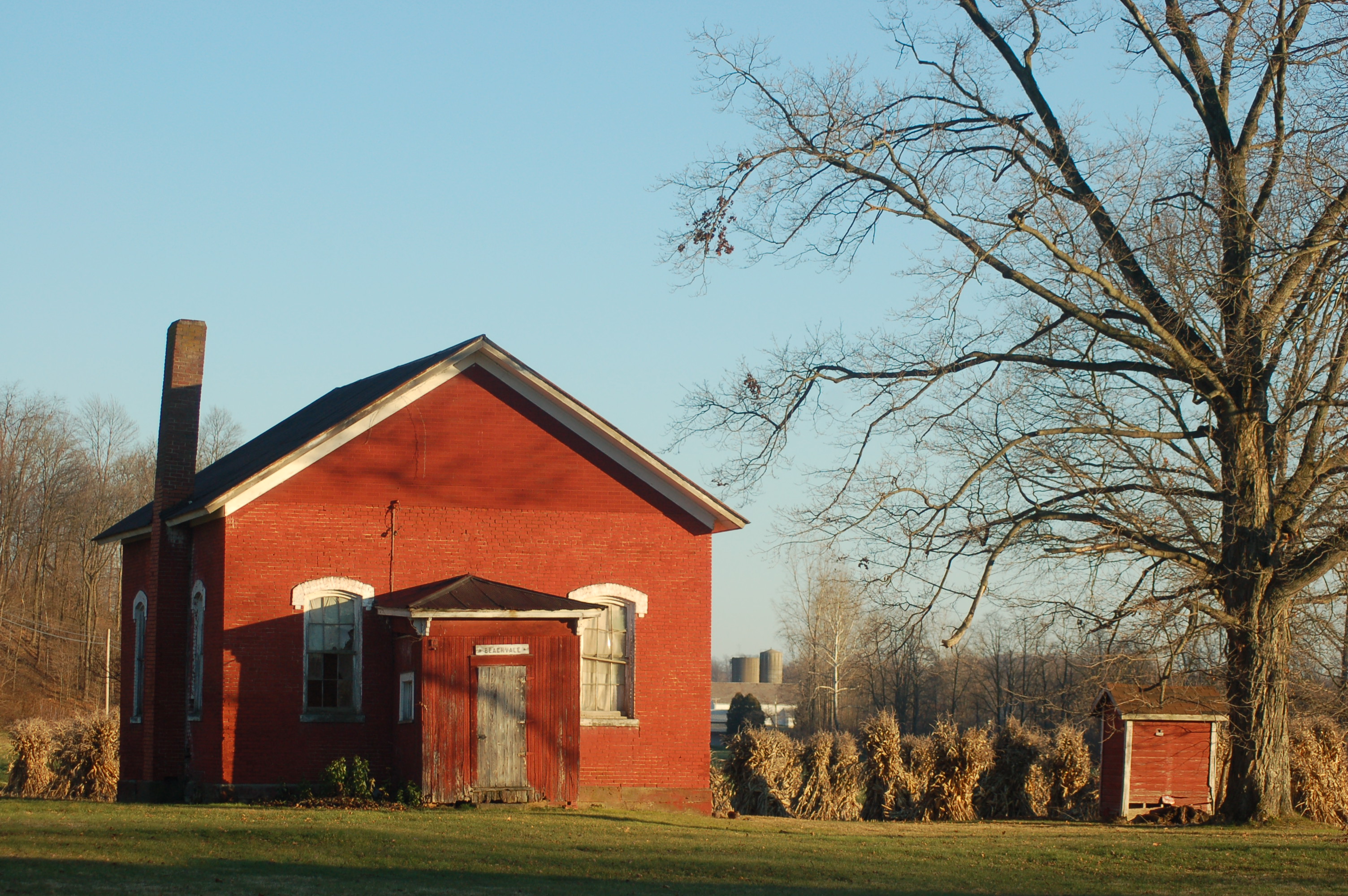
The one room Beechvale School near Benton, Ohio has been abandoned for several years.
A candlelight walking tour of five churches in Millersburg, Ohio is planned for Friday, Dec. 10, from 6 to 8 p.m.
The tour is designed to coincide with the Advent season, according to Kate Findley, of Millersburg, who is coordinating the event.
“We want this to be a relaxing, enjoyable evening for families,” Findley said. She is a member of the First Presbyterian Church in Millersburg, one of the participating congregations.
Findley said that the churches will be decorated for the holidays, and that each church will have representatives on hand to provide historic information about the church.
“Participants can also enjoy music and refreshments at each stop,” Findley said.
Churches participating include Faith Lutheran, 187 South Clay Street, First Presbyterian, 90 South Clay Street, Millersburg Christian, 125 North Clay Street, Millersburg Mennonite, 288 East Jackson Street, and St. Peter’s Catholic, 379 South Crawford Street.
Findley said people can begin at any church they choose, and tour at their leisure. Maps will be available at each stop to guide people from church to church.
“Everyone is invited to complete the evening at the First Presbyterian Church, at 8:15, for a time of Christmas caroling,” she added.
“This is an opportunity for people to visit church buildings that they may have never been to before. Some people might attend their own church and drive by others, but have never seen them.”
Findley said the five churches were chosen because of their close proximity.
“We wanted to make it as easy as possible for people to walk from church to church. But they also have the option to drive the tour.”
Jane Voltz has both worked and volunteered for several years at Pomerene Memorial Hospital in Millersburg, Ohio.
By Bruce Stambaugh
Jane Voltz, of Killbuck, Ohio epitomizes the role of a volunteer. She loves the work, but doesn’t want any of the notoriety. Her efforts are reward enough.
Voltz, 70, has been a volunteer with the Joel Pomerene Memorial Hospital auxiliary in Millersburg, Ohio off and on for 30 years. Next year, she will be its president.
That’s why she is looking for yet one more volunteer to replace another volunteer position she has held. Voltz has served as the local Medicare advocate. Because she is once again about recent changes to Medicare, and how the annual open enrollment time, which expires Dec. 31, works.
The Ohio Senior Health Insurance Information Program at the Ohio Department of Insurance is sponsoring the workshop. It is billed as a way to stay informed, stay healthy and to save money for those enrolled in Medicare.
“This would be a good opportunity for someone to explore what is involved in the position,” Voltz said. “Of course, everyone with questions about Medicare can attend.”
For Voltz, Pomerene Hospital has been a second home. Aside from her extensive volunteering roles, she has worked at the hospital for 35 years.
“I started in 1956 as a nurse’s aide,” Voltz said. She retired 25 years later, and then returned “as a back up to the back lab currier,” as she put it.
“I like spur-of-the-moment things like that,” she said. Voltz cited a Sunday morning call she received to make a run to another hospital for the lab as an example of how her immediate assistance is needed.
Voltz said she considers the hospital staff and volunteers her second family.
“We are very fortunate to have this hospital,” she said.
Voltz said in the process of helping visitors and patients at the hospital, she gets to see people she hasn’t seen in awhile. Voltz said she is only one of at least 100 volunteers who make up the auxiliary.
Voltz said the main roles of volunteers include transporting patients within the hospital, especially department to department, and delivering flowers to patients’ rooms.
She said the auxiliary depends solely on fundraising in order to provide funds for items that are needed, but don’t make it into the hospital’s budget. Profits from the gift shop, uniform sales, poinsettia sales, book sales and bake sales all contribute money to pay for auxiliary donations.
“We work closely with the Pomerene Hospital Foundation,” Voltz said. “The auxiliary recently bought a $6,000 ice machine for the dining area.”
Voltz said she has been the Medicare advocate for the hospital since 1992.
“I want to spend time with my grandchildren,” she said. “There has to be somebody out there who is willing to do this needed service.”
Voltz has a son and a daughter and four grandchildren. She also has five stepchildren, 13 step-grandchildren and 13 step-great-grandchildren. Her first husband, Harold Garver, died in 1970, and her second husband, Dwight, died in 2004. Voltz had stepped away from her volunteer work for a while to care for Dwight, who had Alzheimer’s disease.
Voltz was born and raised in Killbuck, and is a graduate of Killbuck High School. In addition to helping with her grandchildren, Voltz said she likes to travel.
“Anyone who says they don’t know what they would do if they retired needs to know there are many ways to help as a volunteer,” Voltz said.
“We have to enjoy each day because we don’t know what tomorrow will bring.”
Voltz used her mother as her inspiration for volunteering. She said her mother would donate items to the Volunteers of America truck whenever it came around.
“Everyone should volunteer for something,” Voltz said. “Your payment is the satisfaction of helping someone.”
During her long career as a volunteer, Voltz certainly has received a great deal of satisfaction from her efforts. Her hope now is that someone will pick up her role as Medicare advocate before the end of the year.
Anyone interested in the Medicare advocate position should contact Voltz by calling the hospital at 330-674-1015.
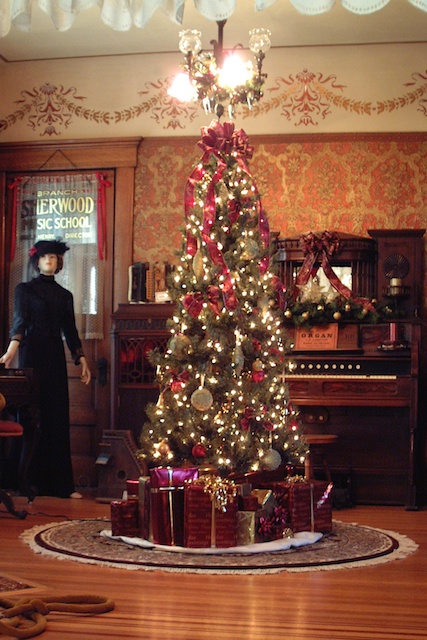
If you ever wondered what an old-fashioned Christmas really looked like, the Victorian House in Millersburg, Ohio will let you cure your curiosity.
Each holiday season the Victorian House in Millersburg, Ohio is beautifully decorated inside and out. (Photo provided by the Victorian House.)
Every year local businesses, organizations and individuals spend two weeks transforming the historical, 6,000 square foot Victorian House into “Holidays at the Mansion.” The 28-room, three-story mansion comes alive with Christmases gone by.
Area decorators create holiday splendor as it once was by decorating multiple Christmas trees, window decorations and decorating several rooms with authentic and festive period accessories. Displays of lights and garland will festoon the exterior.
The holidays are celebrated in every room of the Victorian House in Millersburg, Ohio. (Photo provided by the Victorian House.)
“This year we will have several new room sponsors that will add a fresh new look to this year’s decorations,” Mark Boley, Director of the Holmes County Historical Society, announced.
“In addition,” Boley continued, “a special holiday exhibit will be on display in our ballroom.” Harry Wilson, of New Philadelphia, will have several of his one-of-a kind egg art on exhibit. Wilson is affectionately known as “The Egg Man.” Wilson uses the natural color of the eggs from ostriches, emu, geese and chickens to create unique works of art.
The Victorian House will be open for holiday tours Monday through Thursday, 1 to 4 p.m., and Friday through Sunday, 1 to 8 p.m. through December 31. The Victorian House will be closed both Thanksgiving Day and Christmas Day.
The Victorian House has been featured in Victorian Homes Magazine, and on the Home and Garden TV show Victorian America.
You can take your time enjoying the Victorian House holiday decorations since the tours are self-guided. Costs are $8 for adults, $7 for those 65 and older, and $3 for students. Children are also welcome to check out the holiday flare since some of the rooms are dedicated for kids. The kids can look for Santa in an old bathtub. Every woman’s House will sponsor a special room just for the kids. There is no charge for children 12 years old and younger.
Besides the holiday decorations, the Victorian House showcases the historical collection of the Holmes County Historical Society. The mansion is listed on the National Register of Historical Places.
L. H. Brightman, a wealthy industrialist from Cleveland, built the Victorian House in 1900. It is located at 484 Wooster Road in Millersburg. The Holmes County Historical Society uses the mansion as its headquarters
To arrange a group or bus tour, call 330-674-0022 or email the Victorian House at info@holmeshistory.com.
It was only appropriate that for a full week after the first snow of the year that we experienced a perfect Indian summer here in Ohio.
The extended summer-like days, which seemed to actually improve chronologically until the rains came, served as a picturesque bridge between a superb fall and an inexplicit winter yet to come.
We can only wonder what winter will be like. Will it be as harsh and record breaking as the last? We hope not. Clearly we have no say in the matter.
Snowfall in Ohio's Amish country totaled three feet in February 2010.
Every fall the National Weather Service issues a long-term guesstimation of what winter will bring. But even the scientists hedge their prognostications on percentages, casino like.
In the end, we have no choice but to take what we get. Hushed by the holiday clamor, a certain question lingers unspoken. Will we appreciate what we receive? In truth, that question can and should be applied far beyond the realm of weather.
I remember well the winter of 2004-2005 when the infamous ice storm nailed our area. The accumulating ice snapped giant trees, brought down power lines, halted commerce, interrupted communications, and thinned traffic to emergency purposes only for days.
Those of us who were on the electrical grid were hit hard. Fortunately, an Amish friend saved my family and me with the use of a generator to at least keep the gas hot water heat on. Without the generator’s assistance, the pipes in our home would have frozen and burst, causing extensive damage. Thankfully that did not happen, due to the unconditional generosity of my friend.
All the while, with our communication to the outside world cut, thousands upon thousands of people were caught in the wake of a horrific earthquake and subsequent tidal waves that killed scores of people.
In sorting through an overflowing basket of mishmash the other day, I came upon some handwritten notes I had made about the catastrophe. Apparently, I did so while listening to a battery-operated radio. In reviewing my scribbling, I was reminded that the inconvenience of living without electricity for five days paled in comparison to the plight of millions of fellow human beings halfway around the world.
A sampling of my jottings, dated Dec. 26, 2004, relived the calamity: Banda Ache, 60-foot wave, two miles inland, 30 mph, eight-12 feet deep flood; deaths, 200,000 in Indonesia alone, 400,000 injured; no system to alert people in Indian Ocean rim; 9.3 magnitude earthquake, the world’s deadliest tsunami. Unfortunately, those initial notations proved accurate.
Once power was restored the horrible scenes unfolded on television. I was appalled for the victims, thankful for my family that we had only lost power and a few trees in the yard. Compared to the widespread wreckage and unbelievable totals of death and injuries of so many innocents, we had been fortunate.
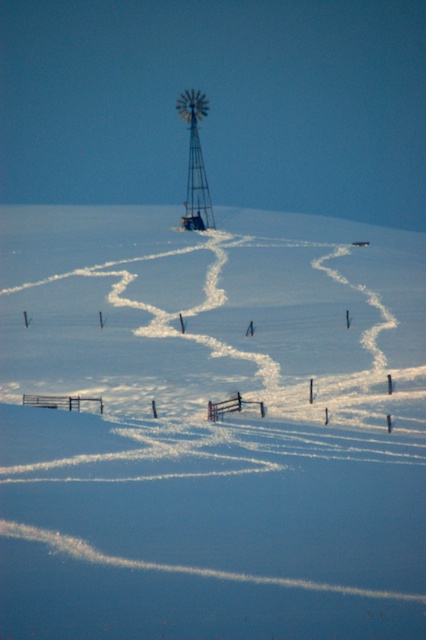
Horses made serpentine tracks in the heavy snow last Feb. in Holmes County.
Since then, infinite natural and man-made disasters, including the sluggish global economy, have occurred. Others will likely continue to develop as time progresses. Nevertheless, as we begin this holiday season in North America, we still have so much for which we can be thankful no matter our personal situation.
This Thanksgiving perhaps we can express our gratitude by simply helping the less fortunate. We may not have to look clear to the Indian Ocean rim for those opportunities either.
Maybe, just maybe, a proactive generosity can be an Indian summer bridge to brighten someone else’s rainy day life. That would be a practical, productive and prudent Thanksgiving.
Sue Pyle, of Strongsville, Ohio checked out some of the many items she donated to Save & Serve Thrift Shop for its Christmas Open House.
By Bruce Stambaugh
Sue Pyle wanted to downsize from her home in Strongsville, Ohio to a smaller place. That meant doing away with some of her most valuable treasures, her many Christmas tree displays.
For the past 26 years, Pyle has filled her house with the trees, each with its own separate theme. Year after year, she opened her house to many an admirer.
Pyle’s trees came in all sizes. She decorated as many as 32 trees. Some were half-trees that hung on the wall while others were miniature trees. Of course, she had a traditional Christmas tree, too.
The trees and ornaments took up a lot of storage space when not used. Though she hated to do it, Pyle knew in downsizing she had to dispense of much of her holiday decorating tradition.
Friends encouraged her to sell the decorations, some of which she had had for years. Others told her to hold a garage sale. But neither is what Pyle had in mind.
Instead, Pyle remembered what some friends had told her about the annual Christmas Open House held at Save & Serve Thrift Shop in Millersburg, Ohio. She had visited the store, learned of its mission, where the profits went, and made up her mind to donate her Christmas collection to Save & Serve, even though it was an hour away from her home.
“I know that all the money made from selling my items will go directly to help people,” Pyle said. “That’s what I wanted because I like their global mission.”
In total, all of Pyle’s seasonal decorations filled a 16-foot box truck and a van. It was probably the largest seasonally specific donation of it’s kind, according to Eric Raber, co-manager at Save & Serve.
“We once had a pick up load arrive from Chicago for the same reason,” Raber said. “But this was definitely the largest donation specifically for decorating.”
In addition to her Christmas items, Pyle also donated fall and other holiday decorations. Raber said the donations from Pyle helped make the Christmas Open House a huge success. The event was held Oct. 25-27.
“We sold 2,000 items the first day alone,” Raber said.
Curious as to how things would be displayed, Pyle visited Save & Serve the first day of the Christmas Open House sale.
“I was impressed with how they had everything displayed,” Pyle said. “They did an excellent job, and they were great to work with.”
Raber praised the seven volunteers who spent many hours organizing and creating the festive Christmas arrangements. He said many of the items were from Pyle’s donations.
“It was the eye of those who created the displays that made them so attractive and presentable for customers,” Raber said. “Those creative gifts made the open house the success that it was.”
“I really enjoyed visiting the store,” said Marilyn Howarth, a friend of Pyle’s who tagged along on the trip from the Cleveland area. “Everything was displayed so nice.”
Raber said this was the third year for the Christmas Open House, and the most successful. He said sales from the first day of the open house were the best since the opening day at Save & Serve’s South Washington Street location.
“Sue’s generosity was wonderful,” Raber said. “We value the intent of the donor.”
Raber said Save & Serve appreciates the generosity of all those who donate merchandise, as well as the generosity of time by the many volunteers who sort through the donations.
“Giving develops through relationships,” Raber said citing Pyle as an example. “It’s people connecting with people.”
Pyle, a retired elementary teacher, said she started her collections from the gifts given to her by students.
“It started with the giraffe collection,” she said. “I expanded my collections with spur-of-the-moment purchases.”
Some of her themes included a hunt tree, a kitchen tree, little books and a bear tree. She even had a Lakeside, Ohio tree, a place where she vacations annually.
Pyle’s generosity wasn’t just aimed at Save & Serve. In 2001, Pyle began creating a themed tree that she donated to the Akron Children’s Hospital’s Holiday Tree Festival. The trees are purchased with the proceeds going to the hospital.
“This year I am doing a Merry Mickey Christmas tree,” Pyle said.
Like the many shoppers at Save & Serve, whoever buys that tree will have their holidays enhanced thanks to Sue Pyle.





 Roadkill Crossing
You must be logged in to post a comment.